rilólo
POT
review ■ KKim W
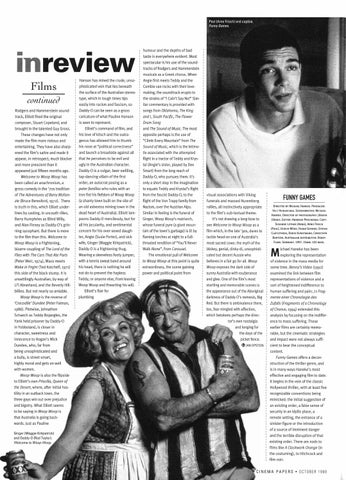
Films continued Rodgers and Hammerstein sound track, Elliott fired the original composer, Stuart Copeland, and brought in the talented Guy Gross. These changes have not only made the film more riotous and entertaining. They have also sharp ened the film’s satire and made it appear, in retrospect, much blacker and more prescient than it appeared just fifteen months ago. Welcome to Woop Woop has been called an anachronism, a gross comedy in the ’70s tradition of The Adventures of Barry McKen zie (Bruce Beresford, 1972). There is truth in this, which Elliott under lines by casting, in uncouth roles, Barry Humphries as Blind Willy, and Alan Finney as Daddy-O’s grin ning sycophant. But there is more to the film than this. Welcome to Woop Woop is a frightening, bizarre coupling of The Lord of the Flies with The Cars That Ate Paris (Peter Weir, 1974), Waco meets Wake in Fright (Ted Kotcheff, 1971) this side of the black stump. It is unsettlingly Australian, by way of Li’tAbnerland, and the Beverly Hill billies. But not nearly so amiable. Woop Woop is the reverse of ‘Crocodile’ Dundee (Peter Faiman, 1986). Plotwise, Johnathon Schaech as Teddy Bojangles, the Yank held prisoner by Daddy-0 in Yobboland, is closer in character, sweetness and innocence to Hogan’s Mick Dundee, who, far from being unsophisticated and a bully, is street-smart, highly moral and gets on well with women. Woop Woop is also the flipside to Elliott’s own Priscilla, Queen of the Desert, where, after initial hos tility in an outback town, the three gays win out over prejudice and bigotry. What Elliott seems to be saying in Woop Woop is that Australia is going back wards. Just as Pauline Ginger (Maggie Kirkpatrick) and Daddy-0 (Rod Taylor). Welcome to Woop-Woop.
Hanson has mined the crude, unso phisticated vein that lies beneath the surface of the Australian stereo type, which in tough times tips easily into racism and fascism, so Daddy-0 can be seen as a gross caricature of what Pauline Hanson is seen to represent. Elliott’s command of film, and his love of kitsch and the outra geous has allowed him to thumb his nose at “political correctness” and launch a broadside against all that he perceives to be evil and ugly in the Australian character. Daddy-0 is a vulgar, beer-swilling, tap-dancing villain of the first order, an autocrat posing as a paterfamilias who rules with an iron fist his fiefdom of Woop Woop (a shanty town built on the site of an old asbestos mining town in the dead heart of Australia). Elliott lam poons Daddy-0 mercilessly, but for all his jocularity, and sentimental concern for his over-sexed daugh ter, Angie (Susie Porter), and sick wife, Ginger (Maggie Kirkpatrick), Daddy-0 is a frightening thug. Wearing a sleeveless footy jumper, with a tennis sweat band around his head, there is nothing he will not do to prevent the hapless Teddy, or anyone else, from leaving Woop Woop and thwarting his will. Elliott’s flair for plumbing
humour and the depths of bad taste is everywhere evident. Most spectacular is his use of the sound tracks of Rodgers and Hammerstein musicals as a Greek chorus. When Angie first meets Teddy and the Combie van rocks with their lovemaking, the soundtrack erupts to the strains of “I Cain’t Say No!” Sim ilar commentary is provided with songs from Oklahoma, The King and I, South Pacific, The Flower Drum Song and The Sound of Music. The most apposite perhaps is the use of “Climb Every Mountain” from The Sound of Music, which is the leitmo tiv associated with the attempted flight in a tractor of Teddy and Krys tal (Angie’s sister, played by Dee Smart) from the long reach of Daddy-O, who pursues them. It’s only a short step in the imagination to equate Teddy and Krystal’s flight from the fascist Daddy-O, to the flight of the Von Trapp family from Nazism, over the Austrian Alps. Similar in feeling is the funeral of Ginger, Woop Woop’s matriarch, whose funeral pyre (a giant moun tain of the town’s garbage) is lit by flaming torches at night to a fullthroated rendition of “You’ll Never Walk Alone”, from Carousel. The emotional pull of Welcome to Woop Woop at this point is quite extraordinary, the scene gaining power and political point from
visual associations with Viking funerals and massed Nuremberg rallies, all instinctively appropriate to the film’s sub-textual theme. It’s not drawing a long-bow to see Welcome to Woop Woop as a film which, in the late ’90s, dares to tackle head-on one of Australia’s most sacred cows: the myth of the blokey, genial, dinky-di, unsophisti cated but decent Aussie who believes in a fair go for all. Woop Woop exposes the dark side of sunny Australia with exuberance and glee. One of the film’s most startling and memorable scenes is the appearance out of the Aboriginal darkness of Daddy-O’s nemesis, Big Red. But there is ambivalence there, too, fear mingled with affection, which betokens perhaps the direc tor’s own nostalgia and longing for the days of the picket fence. JAN EPSTEIN
FUNNY GAMES D ir e c t e d
by
M ic h a e l Ha n e k e . P r o d u c e r :
V e l t H e id u s c h k a . S c r e e n w r it e r : M ic h a e l Ha n e k e . D ir e c t o r
o f p h o t o g r a p h y : Jü r g e n
Ju r g e s . E d it o r : A n d r e a s P r o c h a s k a . C a s t : S u s a n n e Lo t h a r (A n n a ), A r n o F r is c h (P a u l ), U lr ic h M ü h e , Fr a n k G ie r in g , S t e f a n C l a p c z y n s k i , D o r is K u n s t m a n n , C h r is t o p h B a n t z e r . A u s t r a l ia n
d i s t r ib u t o r :
F il m s . G e r m a n y . 1997. 35 m m . 103
Dendy m in s .
ichael Haneke has been exploring the representation ofviolence in the mass media for some time. Benny’s Video (1992) examined the link between film representations ofviolence and a sort of heightened indifference to human suffering and pain; 72 Frag mente einer Chronologie des Zufalls (Fragments of a Chronology of Chance, 1994) extended this analysis by focusing on the indiffer ence to mass suffering. These earlier films are certainly memo rable, but the cinematic strategies and impact were not always suffi cient to bear the conceptual content. Funny Games offers a decon struction of the thriller genre, and is in many ways Haneke’s most effective and engaging film to date. It begins in the vein of the classic Hollywood thriller, with at least five recognizable conventions being mimicked: the initial suggestion of an existing order, a false sense of security in an idyllic place, a remote setting, the entrance of a sinister figure or the introduction of a source of imminent danger and the terrible disruption of that existing order. There are nods to films like A Clockwork Orange (in the costuming), to Hitchcock and film noir.
M
C I N E M A PAPERS • OCTOBER 19 98