festivals
The latest in serious Indian cinema elements that are not followed HE INDIAN PANORAMA through. The John Cleese imitations of section of the Interna one of the two leading characters is tional Film Festival of irritatingly amateur. India, held recently in Amol Palekar’s rejected film, Trivandrum, might well Daayra be remembered not so much for the(The Square Circle), is clearly a better film than either of these, though quality of its films as for the contro it is, nevertheless, a crass attempt to versy provoked by its selection panel. treat a serious and sensitive theme in Intended to showcase the best of the a way that might make it as acceptable Indian art cinema of the previous
more realistic example of political cor rectness is decided upon: the deviant must be killed, and by the thugs who had earlier raped his female compan ion. While it is, ultimately, cheap and populist, Daayra had no less an enti tlement to inclusion than some of the selected films. Another reject was Govind Nihalani’s Sanshodhan (Correction), a very well-made film about the legislation for empowerment of women in village administration and the conservative reaction against it. Sanshodhan is
Santwana Bardoloi. Nairashya deals with the obsessive preference for male children that still prevails in many Hindu families, where girls are regarded even by their mothers and grandmothers as a curse. In this case, the father, an unabashed misogynist, is a teacher of physics, a man one would have thought educated enough to know the biological facts of gender determination. Nairashya’s subject is extremely important and its treatment is intelligent, despite occasionally bor dering on melodrama. However, it is
twelve months, the Panorama may show anything up to 21 films. This year, the selection panel chose a mere 14. Bearing in mind a committee’s usual propensity to produce camels when designing horses, this one came up with an interesting beast, noble in some respects, a lame hack in others, with half the hump and maybe a leg or two altogether missing. Several films by noted filmmakers, including Govind Nihalani, Aparna Sen, Basu Bhattacharya and Amol Palekar, were rejected by the selection panel whose decisions were made, accordingto the chairman, Manipuri filmmaker Aribam Syam Sarma, on artistic merit alone. Presumably, the films of the reputable rejects lacked artistic merit and here was the basis of the controversy that waxed more than a little bitter at times during the Festi val. The films were not actually rejected In favour of films that were claimed to be better; they might, in fact, have been included, bringing the total to eighteen, still three short of the prescribed maximum, and the con troversy would very simply have been avoided. There were, in fact, films selected in the Panorama that were clearly inferior works. One wonders how Santosh Sivan’s Halo made it into the Panorama, being a film for children, yet that aside it has little to recom mend it other than its technical slickness. It is full of hackneyed senti ment buoyed by all the clichés of commercial cinema and popular televi sion. Arun Khopkar’s film, Katha Don Ganpatraonchi (its English title is not much easier: The Tale of Two Ganpatraos), was another undeserving entrant, a fatuous film based on Gogol’s short story of the two quar relling Ivans. While Khopkar has taken a good story as a basis for his film, his treatment of it is marked by ham-fisted acting, contrived and clichéd comedy, and a very flabby script in which too much importance is given to narrative
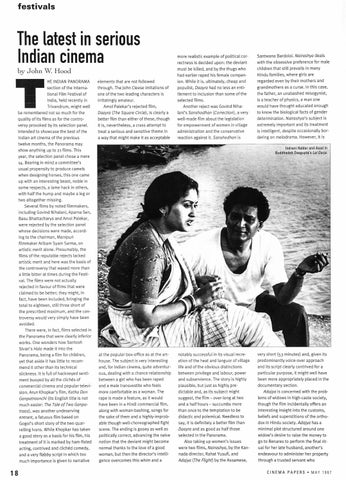
notably successful in its visual recre ation of the heat and languor of village life and of the obvious distinctions between privilege and labour, power and subservience. The story is highly plausible, but just as highly pre dictable and, as its subject might suggest, the film - over-long at two and a half hours-succum bs more than once to the temptation to be didactic and polemical. Needless to say, it is definitely a better film than Daayra and as good as half those selected in the Panorama. Also taking up women’s issues were two films, Nairashya, by the Kan nada director, Rahat Yusufi, and Adajya (The Flight) by the Assamese,
very short (53 minutes) and, given its predominantly voice-over approach and its script clearly contrived for a particular purpose, it might well have been more appropriately placed in the documentary section. Adajya is concerned with the prob lems of widows in high-caste society, though the film incidentally offers an interesting insight into the customs, beliefs and superstitions of the ortho dox in Hindu society. Adajya has a minimal plot structured around one widow’s desire to raise the money to go to Benares to perform the final rit ual for her late husband, another’s endeavour to administer her property through a trusted servant who
by John W. Hood.
T
18
at the popular box-office as at the arthouse. The subject is very interesting and, for Indian cinema, quite adventur ous, dealing with a chance relationship between a girl who has been raped and a male transvestite who feels more comfortable as a woman. The rape is made a feature, as it would have been in a Hindi commercial film, along with woman-bashing, songs for the sake of them and a highly-improbable though well-choreographed fight scene. The ending is gooey as well as politically correct, advancing the naive notion that the deviant might become normal thanks to the love of a good woman, but then the director’s intelli gence overcomes this whim and a
C I N E M A P A P E R S • MA Y 1997