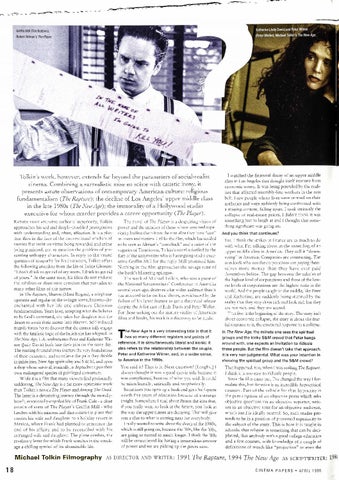
Katherine (Judy Davis), and Peter Witner
^Griffin Mill fimi Robbins),
(Peter W eller) Michael Tolkm’s The New Age.
Hoferî Altman's The Playei
Tolkin’s work, however, extends far beyond the parameters of social-realist cinema. Combining a surrealistic mise en scène with caustic irony, it presents astute observations of contemporary American culture: religious fundamentalism {The Rapture)) the decline of Los A ngeles’ upper middle class m the late 1980s (The New Age)) the immorality of a Hollywood studio executive for whom murder provides a career opportunity (The P la yer). t h a n assum ing authorial superiority, Tolkin approaches his sad and deeply-troubled protagonists with understanding and, often, affection. It is a ploy that flies in the face of the conventional wisdom of movies that insist on virtue being rewarded and crime being punished, not to mention the problem of pre senting unhappy characters. In reply to the vexed question of sympathy for his characters, Tolkin offers the following anecdote from the life of Jackie Gleason: “I don’t drink to get rid of m y warts, I drink to get rid of yours.” At the same time, his films do not endorse the nihilism or dismissive cynicism that pervades so many other films of this nature. In The Rapture, Sharon (Mimi Rogers), a telephone operator and regular on the swinger scene, becomes dis enchanted with her life and embraces Christian fundamentalism. Years later, accepting what she believes to be God’s command, she takes her daughter into the desert to await their ascent into Heaven. Self-induced tragedy forces her to discover that she cannot full}- engage with the fatalistic logic of the beliefs she has adopted. In The New Age, L.A. sophisticates Peter and Katherine Wit ner (Judy Davis) both lose their jobs on the same day. The ensuing financial crisis shatters the very foundations of their existence, and to relieve the pain they dabble in infidelities, New Age spirituality and S & M, and open a shop whose survival, ironically, is dependent upon thenown endangered species of privileged consumers. While it is a film that many viewers find profoundly saddening, The New Age is a far more optimistic work than Tolkin’s novels The Player and Among The Dead. The latter is a devastating journey through the morallybereft, emotionally-crippled life of Frank Gale - a close cousin of sorts of The P layer's Griffin M ill - who lunches with his mistress and thus misses the plane that carries his wife and daughter to a holiday resort in M exico, where Frank had planned to announce the end of his affaire and to be reco n ciled w ith his estranged wife and daughter. The plane crashes, the revelatory letter for which Frank searches in the wreck age a chilling symbol of his abominable life.
R ather
M ic h a e l T o lkin F ilm o g ra p h y
18
The novel of The Player is a despairing vision of power and the mindset of those whose assumed supe riority buffers them from the non-élite the}" have “cast” as losers and victims. Unlike the film, which has tended to be seen as Altman’s “comeback” and a satire of the vagaries of Tinseltown, Tolkin’s novel is fuelled by the fury of the scriptwriter who is haranguing studio exec utive Griffin M ill for the reply M ill promised him. Nothing in the film approaches the savage tone of the book’s blistering epilogue. The work of Michael Tolkin, who was a guest of the National Screenwriters’ Conference in Australia several years ago, deserves a far wider audience than it has attracted so far on local shores, as evidenced by the failure of his latest feature to get a theatrical release despite the A-list cast of Judy Davis and Peter Weller. For those seeking out the mature vitality of American films and books, his work is a discovery to be made. he N e w Age is a v e ry in te re s tin g title in t h a t it
I watched the financial decay of an upper middle class in Los Angeles that thought itself immune from economic worry. It was being pounded by the reali ties that affected assembly-line workers in the rust belt. I saw people whose lives were centred on their aesthetics and were suddenly being confronted with a missing content, falling apart. I took seriously the collapse of real-estate prices. I didn’t think it was something just to laugh at and I thought that some thing significant was going on. A n d y o u th in k t h a t c o n tin u e s ?
Yes. I think the strikes in France are as much to do with what I’m talking about as the unsettling of an upper middle class in America. They call it “down sizing” in America. Companies are contracting. The overlords who run the corporations are paying them selves m ore m oney than they have ever paid themselves before. The gap between the salaries of the highest level of corporations and those of the low est levels of corporations are the highest ratio in the world. And the people caught in the middle, like Peter and Katherine, are suddenly being stunned by the reality that they may dress rich and look rich but they are not rich, and they are scared. That fear is the beginning of the story. The story isn’t about economic collapse; the story is about the fear ful response to it, the emotional response to a collapse.
T
In The N ew Age, th e m in u te o n e sees th e sp iritu a l
re fe re n c e . It is s im u lta n e o u s ly lite ra l a n d iro n ic; it
a ro u n d w ith , o n e e x p ec ts an in v ita tio n to rid ic u le
also re fe rs to th e re la tio n s h ip b e tw e e n th e c o u p le ,
th e s e p e o p le . B u t th e film d o e s n 't ta k e th a t ap proach ;
has so m a n y d iffe re n t re g is te rs a n d p o in ts o f
g ro u p s an d th e k in k y S & M c ro w d th a t P e te r hangs
P e te r a n d K a th e rin e W itn e r , a n d , in a w id e r se n se ,
it is v e ry n o n -ju d g m e n ta l. W h a t w a s y o u r in te n tio n in
to A m e ric a in th e 1990s.
s h o w in g th e s p iritu a l g ro u p a n d th e S & M c ro w d ?
You said it! That is it. Next question! [Laughs.] I always thought it was a good movie title because it was complicated, because of what you said. It could be taken literally, satirically and prophetically. Sometimes you open up a book and get a half-quote worth five years of education because of a strange insight. Somewhere I read about Proust the idea that, if you really want to look at the future, you look at the way the upper classes are decaying. That will give you a clue to what is coming next for everybody. I really wanted to write about the death of the 1980s, which is still going on, because the ’80s, like the ’60s, are going to extend so much longer. I think the ’80s will be remembered for having a tremendous amount of power and we are picking up the pieces now.
as d ir e c t o r a n d w r it e r :
That happened, too, when I was making The Rapture. I think it is too easy to ridicule people. Since the film came out, I’ve changed the way I for mulate this, but America is an incredibly hypocritical country. Part of the vehicle for that hypocrisy is the presumption of an objective press which asks objective questions via an objective reporter, w rit ten in an objective tone for an objective audience, which itself is ideally neutral. So, each reader pre tends to be in a position of presumed superiority to the subject of the story. This is how it is taught in schools: that religion is something that can be deci phered; that anybody with a good college education and a few courses, with knowledge of a couple of definitions of words like “projection” or even the
1991 The Rapture, 1994 The N ew Age
a s s c r ip t w r it e r :
C I N E M A P A P E R S • APRI L 1996
®