jjAPRIL
1993
YAHOO SERI OUS AS
./J^-W^LLY IN SEilQj kelliuM
¥ A H O D SER IO USr'RECitl GEORGE MILLED: 'LO R E-.'N ZO ’S ‘ - . '■'#V **#*; ■'"w * .>', ’ ' ':, =#* i .¿.¿M W'sm'M. ,
n t
• ■. ••'
. . y i i w s
I > :, '^-■ :;' •
“
^
^
^jr*i ‘ ^?:: •-'
- V- ''
MEGAN SIMPSON : 'ALEX’ 7« JEAN-JACQUfiS ANf M IN THE FILM AND ffcLE#ISION INDUSTRY / AU
th e
Lo v e r
Purple Rain" and "Eddie and the Cruisers’ " were the only two films about rock ’n’ roll which really worked for me - until I saw " Heaven Tonight!" IAN MELDRUM 1990
"Truly great acting". THE HOLLYWOOD REPORTER
" Should be of intrinsic interest to a wide public" JOHN FLAUS
|| "Moving, honest and well crafted....Great acting, If good music and an emotionally charged script brought i f strongly to the screen make HEAVEN TONIGHT an Australian film that should appeal to audiences young and old". BIG NIGHT OUT
An undiscovered gem of Australian film-making re-emerges from an undeserved oblivion. It has drama, humour, pathos, satire and truth!
NOW RUNNING CARLTON MOVIE HOUSE 235 FARADAY STREET CARLTON BOULEVARD FILMS Presents HEAVEN TONIGHT JOHN WATERS REBECCA GELLING K IM GYNGELL And GUY PEARCE Music JOHN CAPEK Director of Photography. DAVID CONNELL A.C.S.
Editor PHILIP REID Written by FRANK HOWSON And ALISTER WEBB Executive Producer PETER BOYLE Produced by FRANK HOWSON Directed by PINO AM EN TA
CHECK LISTINGS FOR SCREENING TIMES |y |
J
RECOMMENDED FOR MATURE 15 + AUDIENCES 15 YEARS AND OVER
DOLBY STEREO
BRIEFLY GEORGE MILLER: ‘LORENZO’S OIL INTERVIEW, RY SCOTT MURRAY f '
WHY THE FRENCH HAD TO LOVE THE LOYER CULTURAL PERSPECTIVE BY ANPREF \NNE JA( I-EL
M COVER: Y A H O O SERIOUS AS NED KELLY
E G » iiftt^ n L a
i w
w w ^ — VIDEO AMb. RADIO INDUSTRIES
IN SERIOUS’ 'RECKLESS KELLY’. S E E INTERVIEW P 3 0
SUMMARY'BY FINCINA HOPGOOD
EDITOR
'
PICTURE PREVIEW: BROKEN HIGHWAY’
S c o ti M urray
M Debra ¡sharp
l i i «
INTERVIEW BY \NDRFW L URBAN
Fred Harden EDI TORI AL
ASSI STANT
R affa ele Caputo
4 f i p FILM C hris S te w a rt [A c tin g C hairm an],
DEN GIODA VILJAN (THE BEST INTENTIONS) JOHAN FINGAL.Dàn Pearce
1% ENCHANTED APRIL BRIAN McFARLANE FORTRESS*-. JONATHAN ROPER
a d v e r t i s i n g
T LORENZOS OIL JOHN C'ONOMOS-
s| | , S E € O ^ D ^ L A N C % ^ j .R affaele C aputo FOUNDI NG
HE'AVEN’TONIGHT ADRIAN RAWLINS.
PUBLI SHERS
P eter B eilby S c o tt M urray, P hilippe Mora D Ê S 1G N
fan Robinson
£4Mi mfpk?*THE( W S TR A IIA N JILM AND TELEVISION INDUSTRY IN THE NINETIES?^ 'w M m Ê S B S Ê B ^ Ê B ^ f ' -
p r i n t i n g
BY JOHN B
Jenkin Buxton Pty. L td . '
W@m
V.' I
'-pi-.j / ''./.
. ".".V1
PilmVictona I WITH FINANCIAL ASSISTANCE FROM THE
80
AUSTRALIAN FILM COMMISSION
'
,
5 T' MU
'" '
'
’ L B Li'-H IN i
OOn 2 * * u <*» :
and n o t n e ce ssa rily th a t o f the e d ito r and p u b lis h e r. ffllM
INCLUDING FILM FINA^CE*CORPOPAT'ON FUNDING D F C Is lo ffe ji ' M
i V **-' i U
*
W b SL
NILOHAMATIC NINE
© COPYRIGHT 1 9 9 3 LIMITED A U N
Signed a rtic le s rep re se n t the view s o f the authors
W
I
mm ||m MICK BBÓOEMCtM m ^ & M i^ ^ M m iéiS aM M M à& m sM ^ ^ È M & h^ m ^ ^m ^ÒHH^CÓNOM ÓS^kar^^M M ^ o f NSW. jo h an
W hile every care is ta ke n w ith m a n u s c rip ts and
m a te ria ls su p p lie d to th e m agazine ,n e ith e r th e e d ito r «2 nor P it p u b lish e r i an a^cep 1 a b ility fo i ii | \ tn<-j pi lam -fie w h i'h in<iv a r '3t* Tins m ig iz in t r iiiy nnt hi. reproduced in w hole o r p a rt w ith o u t 'he express p e rm issio n o f the copyrig ht owners.'C /Yie^ra.'Papers is.
puhh -.hird (approximately) e'w’ rv two r'onlnsjfcylj
a n d r é e -a n n e
fNio B ^ ^ S ^ S B ß m ^ ^ ^ m m B M s ^ ^ x S s S ß e ^ ä ^ i i ^ s i ^ i i :ie^ä3^ A 'S s M M ife c a ffC ÌifS
^ ^ ^ ^ K t y i L b É 1 m Ì l B jo lfe ÌE Ìip & fÉ Sound Archive in Canberra, CHRIS L0N£as a MejbOurrré.ftlm^ ts tg ria ftg r^ ^ ^ y S ^ j 5£!&£BRIAN McFARLANE s an Assonali Piofes^ur in- the Engli h btpartnipnt at Monach Hi'i^tC'sny
i" ,-
vi
'
*
!
'¿ifßz- REBECCA McMM.LAN.is a freelance writer^. JOHN B. MURRA^ja'an Australian film producer; ADRIAN RAWLINGS fs a Iff" .¿ p o e t philosuphf with a paitu uni interest tr> susualirn rack culture; JONATHAN ROPER is a freelance w n t e ^ v W j i
Abbotsford, Victoria, A u s tr a llc j& I SIjl
^ ^ ^ t K Ì W f ò M Ì ^ B I S S Ì Ì ^ ^ i 8 l a S ^ ^ K ^ ^ ^ Slbé^U^versity, ANDREW L/’URgAN fs thè Australian y§0% fc
CINEMA
PAPERS
9 2 ..1
B
R
I
E
F
L
Y
Berlin 1993 Australia had three features at the Berlin Film Festival this year, though sadly hone in the official Competition (paralleling Cannes last year). Ann Turner’s Hammers over the Anvil, David Elfick’s Love in Limbo and Richard Lowenstein’s
bourne’s best-known repertory group,
Say a Little Prayer were all screened in the Pano
The Melbourne Cinematheque, going national. The Melbourne Cinematheque
rama section, which highlights new filmmakers
is based on the famous Cinémathèque Française of Paris, a venue for people
All three films were financed as part of the
est possible range of international cin
Australian Film Finance Corporation’s third Film Fund. Beyond Films is the international sales rep
The Melbourne Cinematheque is the place for neglected or nearly forgotten
resentative.
classics, even those recent films that have missed out on a commercial re
AFC News
lease. For the film scholar and student, The Cinematheque is a precious insti tution, exhibiting works of historical sig
There appears to be an ever-increasing interest in specialist and/or retrospective cinema, as ev idenced by the number of cinema outlets which have sprung up recently around the country. In Melbourne, there is the new twin Cinema Nova in Carlton. One of the most contemporary cinema complexes in Australia, it was designed by three young architects, Leonard Hamersfeld, Andrew Straube and Peter Harper, with graphic design by Brian Sadgrove. They believe the experience of going to the cinema should be as exhilarating as the movie itself. Therefore, the architecture at Cinema Nova creates drama and the sense of theatre through the use of sculptural expressionism and stylish materials and colours. From the open foyer with floating ceilings and smashed-glass walls, past dramatically-lit gold blade walls, one enters two intimate cinemas with velvet walls and organic shaped speakers. Also new in Melbourne is the Panorama, in
of the Competition.
to discover and learn about the broad ema art.
Cinemas
and cinemas. Many critics often find the Panorama selection more innovative and interesting than that
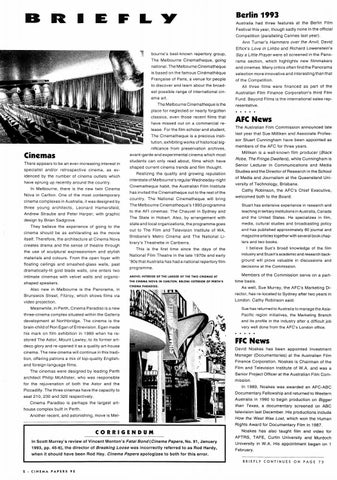
nificance from preservation archives, avant-garde and experimental cinema which most students can only read about, films which have shaped current cinema trends and film thought. Realizing the quality and growing reputation interstate of Melbourne’s regular Wednesday-night Cinematheque habit, the Australian Film Institute has invited the Cinematheque out to the rest of the country. The National Cinematheque will bring The Melbourne Cinematheque’s 1993 programme to the AFI cinemas: The Chauvel in Sydney and The State in Hobart. Also, by arrangement with state and local organizations, the programme goes out to The Film and Television Institute of WA, Brisbane’s Metro Cinema and The National Li brary’s Theatrette in Canberra. This is the first time since the days of the National Film Theatre in the late 1970s and early '80s that Australia has had a national repertory film programme. ABOVE: INTERIOR OF THE LARGER OF THE TW O CINEMAS AT THE CINEMA N O V A IN CARLTON. BELOW: EXTERIOR OF PERTH'S CINEMA PARADISO.
The Australian Film Commission announced late last year that Sue Milliken and Associate Profes sor Stuart Cunningham have been appointed as members of the AFC for three years. Milliken is a well-known film producer (Black Robe, The Fringe Dwellers), while Cunningham is Senior Lecturer in Communications and Media Studies and the Director of Research in the School of Media and Journalism at the Queensland Uni versity of Technology, BrisbaneCathy Robinson, the AFC’s Chief Executive, welcomed both to the Board: Stuart has extensive experience in research and teaching in tertiary institutions in Australia, Canada and the United States. He specializes in film, media, cultural studies and broadcasting policy and has published approximately 60 journal and magazine articles togetherwtth several book chap ters and two books. I believe Sue’s broad knowledge of the film industry and Stuart’s academic and research back ground will prove valuable in discussions arid decisions at the Commission. Members of the Commission serve on a parttime basis. As well, Sue Murray, the AFC’s Marketing Di
Brunswick Street, Fitzroy, which shows films via video projection.
rector, has re-located to Sydney after two years in London. Cathy Robinson said:
Meanwhile, in Perth, Cinema Paradiso is a new three-cinema complex situated within the Galleria
Sue has returned to Australia to manage the AsiaPacific region initiatives, the Marketing Branch and its profile in the industry after a difficult job very well done from the AFC’s London office.
development at Northbridge. The cinema is the brain-child of Ron Egan of Entrevision. Egan made his mark on film exhibition in 1989 when he re stored The Astor, Mount Lawley, to its former artdeco glory and re-opened it as a quality art-house cinema. The new cinema will continue in this tradi tion, offering patrons a mix of top-quality Englishand foreign-language films. The cinemas were designed by leading Perth architect Philip McAllister, who was responsible for the rejuvenation of both the Astor and the Piccadilly. The three cinemas have the capacity to seat 210, 230 and 320 respectively. Cinema Paradiso is perhaps the largest arthouse complex built in Perth. Another recent, and astonishing, move is Mel
CORRIGENDUM In Scott Murray’s review of Vincent Monton’s Fatal Bond (Cinema Papers, No. 91, January 1993, pp. 45-6), the director of Breaking Loose was incorrectly referred to as Rod Hardy,
FFC News David Noakes has been appointed Investment Manager (Documentaries) at the Australian Film Finance Corporation. Noakes is Chairman of the Film and Television Institute of W.A. and was a Senior Project Officer at the Australian Film Com mission. In 1989, Noakes was awarded an AFC-ABC Documentary Fellowship and returned to Western Australia in 1990 to begin production on Bigger than Texas, a documentary screened oh ABC television last December. His productions include How the West Was Löst, which won the Human Rights Award for Documentary Film in 1987. Noakes has also taught film and video for AFTRS, TAFE, Curtin University and Murdoch University in W.A. His appointment began on 1 February.
when it should have been Rod Hay. Cinema Papers apologizes to both for this error. BRI EFLY 2 • CINEMA
PAPERS
92
CONTINUES
ON
PAGE
73
Old Court House
ST KILDA FILM FESTIVAL 1993 MARCH
2 4 - 2 8
A SEASON OF CONTEMPORARY AUSTRALIAN SHORT FILMS NATIONAL THEATRE BARKLY STREET ST KILDA PROGRAMS AVAILABLE FROM ST KILDA TOWN HALL TELEPHONE (03) 536 1397 S E S S IO N
Guesthouse Restaurant Un-stress yourself in Araluen Wine dine and relax with us
,
Telephone (048) 464 053
TIM E S
Wednesday March 24 • 6pm & 8 pm Opening Night Thursday March 25 • 7pm & 9pm Friday March 26 • 7pm & 9.30pm Saturday March 27 • 2pm, 4pm, 6pm and 8.30pm plus Sunday May 3 • 2pm, 4pm, 6pm & 8.30pm Awards Night $ 7 pe r sessio n ($ 5 C o n c e s s io n ) M in i Pass $ 1 8 ($ 1 2 C o n c e s s io n ) Fu ll F e s tiv a l $ 4 0 ($ 3 0 C o n c e s s io n ) O p e n in g N ig h t $ 1 5 ($ 1 0 C o n c e s s io n ) S T K IL D A F IL M F E S T IV A L G R A T E F U L L Y A C K N O W L E D G E S T H E A S S IS T A N C E O F T H E A U S T R A L IA N F IL M C O M M IS S IO N , F IL M V IC T O R IA , T H E N S W F IL M A N D T E L E V IS IO N O F F IC E A N D Q U IT .
KINGSGROVE 44 FITZROY STREET ST KILDA TELEPHONE (03) 536 3000
Special industry rates: $75-135 per night, $395-770 per week. All apartm ents feature usual luxury appointm ents, separate livingroom / bedroom (s), very fully equipped kitchen, full size bath/show er over.
FACSIMILE (03) 525 4571
In-house laundry, sauna, spa. In-house m ovies; direct dial-in phones;
TOLL FREE (008) 033 786
Room service lunch and dinner. Continental breakfast on request (in
answ ering service, and facsim ile on request. Full business service. apartm ent). 24 hour reception. High security building. We are the film
MELBOURNE AUSTRALIA
and entertainm ent specialists, attentive to your special needs.
CINEMA
PAPERS
92 . 3
SO N LORENZO (ZACK O'M ALLEY GREENBURG). GEORGE MILLER'S LORENZO'S O IL
A U G U STO (NICK NOLTE) A N D MICHAELA ODO N E (SUSAN SARANDON) W ITH THEIR
Wm£;
G e o rg e M iller
in lir v ie w e c l
L o r e n zo ’s
HiiJjs one of the finest films
j^ c o tt M u r r a y
m ade
about the nobility of
spirit. It is bdsed on fj|e true struggle, by Michaela and Augusto Odone to find ^¿treatment for their child, Lorenzo, who suffers from the rare and Incurable’ degenerative disease, Airenoleukodystrophy (ALD). W hen told Lorenzo (Zaek O ’Malley Greenburg) has two years at most to liv e ^ u g u s to |Nick Nojte) and Michaela (§Usan Sarandon) try every specialist doctor in the hope of some breakthrough; But the experimental therapies are intrusive failures and merely worsen
R efusingte give upf, the Odones begin their own search for a cure, wading through all the relevant medidal literature they can find, though nbithef has any medical training. They even mortgage their house twice to pay for the medfdaj symposiums and scientific experti jrnents theyJnitiate|The;result, as many would know from the wide jpK$ss coverage, is the breakthrough use of oleic oil and erucic acid in
tpos'e with th ^ d is¥ase from degenerating further. If diagnosis is early ^ ^ rn g h i then the child can look forward to a normal life
G eorge M iller : ‘Lorenzo’s O il’
ut Miller’s film is much more than a reconstruction of two people’s fight to save a son. It is also the story of an extraordin arily brave boy’s will to live. Lorenzo had seemingly every reason to give up: agonizing pain and a total inability to communicate with the world outside him. But as his body withered, his spirit did not. There is a Swahili Warrior Song quoted at the beginning of the film which will be much referred to:
B
Life has meaning only in the struggle. Triumph or defeat is in the hands of the Gods ... So let us celebrate the struggle! In this case, the struggle is very much that of individuals. They question, challenge, show no concern for notions of appropriate, acquiescent behaviour and pursue their goals with a singleminded ness that is inspiring. Even more remarkable, they balk from any descent into self-pity or despair, particularly Michaela who has a focus that brooks no interference. There is a key scene where she dismisses the second, kinder, nurse from tending Lorenzo because she clearly regards her patient as retarded, inferior. The look on Michaela’s face as she shows the nurse the door is both chilling and exhilarating. The Odones are contrasted most effectively with other parents of ALD boys. Most have refused to allow themselves hope (it is too painful); they unquestioningly treat doctors as all-knowing gods; they abdicate responsibility to others - to the medical fraternity and the ALD Foundation, which is much more concerned with keeping the parents anaesthetized than helping the children. To such people, the Odones are troublemakers. They stand alongside all those individuals throughout history who have refused to accept conven tional wisdom and searched for their own truth. In his film, Miller not only extols individuality, but also ethnic ity. The characters celebrate their individual nationality, be they the Italian Augusto Odone, the English bio-chemist Don Suddaby (played by Suddaby), the African Omouri (Maduka Steady). 6 . CINEMA
PAPERS
92
Miller is arguing that all specialness is to be valued, as must be the very struggle to be oneself. This is made quite explicit in the scene where the heads of the ALD Foundation refuse to dissemi nate the Odones’ breakthrough information on oleic oil. During the argument that follows, Augusto is accused of being arrogant. He replies that the Latin root for the word is “arrogare”, meaning “to claim for oneself”. That is what Lorenzo and his parents are doing; that is why they are inevitably opposed. On several occasions, Miller captures visually the enormity of this struggle. The most dramatic is when the Odones go to the library for the first time to begin their studies. The camera climbs and twists up a wall and ceiling to reveal the massiveness of the library and its reference collec tion, The daunting task facing these individuals is clear. Another example is when Omouri arrives at the airport, having left his native Africa for the first time. Miller tracks low along the ground, Omouri dwarfed in an empty terminal by a curved glass wall that reaches ever upward. Miller makes no more of it (no explanatory dialogue, no close-ups, no over-awed expres sions from Omouri). He has made his point effectively and precisely. But most striking of all are the wide-angle track forwards, such as that in front of the Odones’ house, past Lorenzo to Michaela, or, equally telling, past a family gathering inside the house towards the window overlooking a yard where Lorenzo is playing with other children (and where he has an accident that prefigures the problems ahead). At the time, these shots may appear overly-dramatic and without sufficiently precise a meaning. But they carry undercurrents that signal, perhaps half consciously, that this film is about a journey forward, about a surge away from despair. One can be but swept up with it. This cinematic command is indicative of how L o ren z o ’s O il is the work of a master filmmaker at the height of his powers. But what is most apparent is the sensitivity at work. After the Mad M ax films1 and The W itches o f Eastw ick (1987), many thought M iller a director solely concerned with an elaborate and visceral style in the service of “action”.2 But all these films, in fact, represent Miller’s interest in telling mythic stories, in detailing a hero’s journey into the wasteland (here medical ignorance) and, through overcoming various trials, reaching an inner transcendence that selflessly ben efits others.3 In this, Miller has been greatly informed by the work of Joseph Campbell.4 Since making those films, Miller has had a child. It is simplistic to suggest that has had an effect on his storytelling, but L o ren z o ’s O il could only have been made by a parent, by someone who has personally experienced the risks involved. There is that ever-present danger of things going wrong with a child and one can only stand in awe of those afflicted parents and children who, instead of being defeated by setback, fight on. Such people have been celebrated throughout the history of cinema. But often there has been that Hollywood need to sentimen talize the story. Miller does not. His film is made with fierce
“‘Lorenzo’s O il’ classically follows what Joseph Campbell describes as the heroic path. Two people making their way in the world are drawn into an adventure by a magical figure, in this case their diseased son. They venture out into a vast dark unknown wasteland Where they undergo terrible and fabulous adventures.” G E O R G E MI L L E R
intelligence that refuses to bow to genre, to accepted wisdoms, to sentimentality. There have been many fine films made by Australians, but none has approximated a masterpiece. There is little doubt that L o ren z o ’s O il is one.*I
Where did you first hear the story of Lorenzo Odone? I read it in T he Australian, which had syndicated it from T he Sunday Times. My first thought was, “If this is a true story, it’s extraordi nary.” I then gave it to [joint producer] Doug Mitchell to read, and he too felt it was a great story. But, as a doctor, I didn’t really believe it. I honestly thought it was a beat-up, that if one really went into the science it wouldn’t be quite as it seemed. People just don’t come up with an effective cure to a son’s fatal illness - especially if they are not doctors. At this point, Doug and I were about to fly to London to buy the rights to a book. I had wanted to make as a film. I asked Doug if he felt we should put that to one side and go with the Lorenzo story. Doug replied, “You’ve got to do it!” So I called the Odones, who really didn’t want to know, because they had had lots of people responding to the article. But we discovered that Augusto Odone was leaving London the day we were getting there. So we hopped in a cab with him on the way to an airport and asked some questions. In that short time, I recognized that he was a person who didn’t measure people by what they said, but only by what they did. I then called Nick Enright, who had just finished a play, and was about to go off for a holiday in Thailand. I asked him to read the article and see if he wanted to work with me on it as a film. I needed someone who could speak Italian, who’d lived in America and who had the intelligence to grasp a lot of information, espe cially medical. Nick read the article, cancelled his ticket to Thailand and ended up with me in Washington. We just turned up on the Odones’ doorstep. Gradually we won over their trust. We knew Augusto was giving his go-ahead when he said, “M y friends, I want to cook you a great Italian meal. ” We shook on it and he said that he wanted us to honour the truth. He didn’t want us to do a Hollywood version. I said we don’t want to either, and talked about how we planned to approach it. He also asked that he be played as an Italian because he had the conceit that only an Italian would struggle that hard on behalf of a child, which I don’t think is true. I told Augusto that we will honour the truth but that he and Michaela would have no right to censor anything we said about them or anybody
else. We had to make that judgement and he and Michaela agreed. While we consulted them at every point during the writing of the screenplay, they couldn’t tone down any scene that might have made them look unfavourable. When you started writing, how much were you bound by what you had discovered factually about the case? We didn’t have to change very much. In fact, it’s remarkably true to what happens. O f all the Kennedy Miller projects, The Dismissal5was probably the most difficult because we were dealing with real-life people, many of whom were litigious, and subjects everyone knew very well. But L o ren z o ’s O il was even more difficult because we were making promises of medical cure. Just before you arrived, I spoke to a journalist from Florida who has been diagnosed as having multiple sclerosis (MS) and he took great hope from the movie. He’s called the number at the end for the Myelin Project. So, as you can see, we had to be quite scrupulous about what we claimed. As for changes, the scene where the parents get up in the conference and say they want the oil didn’t happen quite that way. Once word got out about the oil, the Odones were inundated by phone calls from all around the world. For days and nights the phone rang hot. Someone would ring and say they were already packed and ready to fly over from Spain. “Where can I get the oil? Where can I get the oil?”
FACING PAGE: GEORGE MILLER, DIRECTOR, CO-WRITER A N D A PRODUCER OF LORENZO'S OIL. CLOCKWISE FROM TOP LEFT: WATCHED BY AFRICAN CHILDREN, LORENZO A N D O M O U R I (M A DU KA STEADY) FLY A KITE. MICHAELA CALMS THE INCREASINGLY-DESTRUCTIVE LORENZO. MICHAELA, LORENZO A N D AUGUSTO AT LORENZO'S BIRTHDAY PARTY. LORENZO'S OIL.
CINEMA
PAPERS
92 • 7
G eorge M iller : ‘Lorenzo’s Oïl"
Instead of showing this with a whole series of phone calls, it was much more efficient in the third act to do it with that scene at the conference. The extraordinary thing about the chronology of the Odones’ story is that it has very much in common with a thriller. Time is of the essence, and the clock is ticking for their son. The film follows a thriller form fairly accurately. In fact, someone described it the other day as a serial killer movie, where there is someone going around killing children. No one knows who it is; the parents go to the police, but they say they can’t do much; so the parents become amateur detectives to track down the killer and stop the killings. Why did you change the original name of the Professor Nikolais (Sir Peter Ustinov) character. Nikolais is based on a doctor who is very conflicted between wanting to be compassionate and wanting be a dispassionate scientist. Still, he is a person who has chosen to work in childhood neurology and not plastic surgery in Beverly Hills. To that degree, he is a serious doctor and I didn’t want to embarrass him. As well, the Dr Judalon character [Gerry Bamman] is actually a composite of two doctors - a pediatrician and a pediatric neurolo gist. In most other cases, we have kept the real doctors’ names because I think that they should be embarrassed. I think they behaved reprehensibly.
8 • CINEMA
PAPERS
92
Because doctors are powerful, they’re like politicians. You must keep them honest. You must challenge them. That’s the only way there can be worthwhile evolution. The best doctors and the best patients are the most questioning. The Odones questioned relentlessly. And what is unusual about them is their ability to ask the right questions.6 How accurate is the representation of the ALD Foundation, with its fearful stonewalling? Totally. In fact, I think we were kind to them. While you are critical of various doctors and organizations, nobody is portrayed as a villain. You give everybody their reasons. There is not the typical Hollywood delineations of good guys and bad guys. Well, each man has his own good reason - even the most evil of us. Having been a doctor, I already acknowledge that doctors are flawed, so I didn’t have to be overly respectful or condescending to them. I didn’t even have to be angry with them because I know that doctors are human beings, not gods, facing the same sort of problems as other human beings - doubts, despair, scepticism, lack of courage, but sometimes great courage.7 How much did your being a doctor influence the writing of the script? It helped in a lot of ways and was probably what stopped me from being deterred from telling the story. I knew that the medical journey is essentially the MacGuffin, in the traditional Hitchcock sense. Essentially I knew two things. One was that the Odones started from ignorance and gathered knowledge as they went along. So, if we told the story from their point-of-view, the audience would also go from ignorance towards some knowl edge. Second, I knew that all great scientific insight comes from the ability to conceptualize simply, from coming up with the exactly appropriate question. Science is about clarifying and it’s the Odones’ ability to do that which lends itself to film. This is also what makes Augusto, in particu lar, a great scientific thinker, which allowed for the breakthrough. The whole analogy of the kitchen sink is exactly what Augusto had done (whereas Nick and I invented the paper clips as a simple metaphor). That’s what science is about. The whole of Einsteinian physics was based on one simple and very poetic question: What does the universe look like if I ride on a beam of light? Einstein asked that when he was 14 and had answered it by 28 - hence the bomb and every thing else that Einsteinian physics is about. The science is not that difficult; it’s more a question of observing the world of medical sci ence honestly, which is more complicated. Nick initially was daunted by it, but he is someone who could have breezed through medi cal school. He was able to go from no scientific knowledge to understanding the principles of biochemistry and scientific deduction easily.
FACING PAGE: AUGUSTO A N D MICHAELA BEGIN THEIR EPIC MEDICAL RESEARCHES AT THE STATE LIBRARY. PROFESSOR NIKO LA IS (PETER USTINO V) DISCUSSES ALD W ITH THE ODONES. RIGHT: AUGUSTO A N D MICHAELA DISCUSS AUGUSTO'S KITCHENSINK AN ALO G Y FOR ALD. PROFESSOR NIKO LAIS W ITH A PRIZED JAR OF OLEIC OIL. LORENZO'S O IL
So, the fact that I was a doctor probably made me less intimidated. It made me understand that you can approach a story like this and not make it too complex. It was interesting because Susan Sarandon had known of the story four years before. The father of her first child is an Italian director called Franco Amurri, and Franco had interviewed the Odones on tape with a mind to making a movie with Susan. He very generously gave me his tapes and he said his biggest problem was tackling the science, in trying to make it clear. Did you do much audience testing with the medi cal issues in mind? We tested the film three times in the States and I was delighted that on the very first screening the audience had no problem with the science. In fact, they loved the idea of being able to follow it. I was not worried because I thought back to the complexity of some films, like The M altese Falcon [John Huston, 1941]. I also remember that when I saw T he Silence o f the L am bs [Jon athan Demme, 1991], I had trouble following exactly some of the deductions that were being made. But it doesn’t diminish the enjoyment of a film so as long as you know the characters under stand what they are doing. On a more personal level, how much did your being a parent influence the film?
out to highlight how he has finally subjugated himself for the benefit of others.
If I hadn’t become a parent, I probably would not have been as alert to the story. But the real reason I was drawn to the story, make no mistake about this, is the same reason I was drawn to the Mad M ax films, which is their heroic dimension. L o ren z o ’s O il classically follows what Joseph Campbell describes the heroic path. Two people making their Way in the world are drawn into an adventure by a magical figure, in this case their diseased son. They venture out into a vast dark unknown wasteland where they undergo terrible and fabulous adventures. They come to the moment of their deepest despair, where the obstacles are at their greatest. They have a choice of being sucked back into the darkness, or somehow or other overcoming self-interest and venturing forward. And even when they are invited to give up, by not only their enemies but by their loved ones, they still choose to go forward. I’m giving the subtext here, but Lorenzo in the end of the second act refuses to die. Even when finally his mother in private says “Go, if you want to go”, he refuses. This happened in real life, and the Odones said to themselves, “We just have to go back and under stand this thing.” They did and they made their breakthrough. And because of what they have done, they have bestowed a boon on their world for ever, recognizing that finally it’s not for their own, it’s for others. If it weren’t for the presence of the Odones, all those children you see at the end of the film would be if not dead, then severely ill.
Yes, up till then M ax is unwittingly, reluctantly heroic. And that can be the case. One of the reasons I loved The Last Tem ptation o f Christ [Martin Scorsese, 1988] so much is that Jesus [Willem Dafoe] is so reluctantly heroic. He in fact built crosses just to prove to himself and God that he can’t be the Messiah. “How could I do something so evil as to make these instruments of death and torture?”, he asks.
M ax helps people more indirectly than do the Odones. He is very much a reluctant hero, acting purely out of self-interest. Only in M ad M ax Beyond Thunderdom e (1985) does he consciously do good. You even have him duck under the plane as the children fly
And that’s how it is with the Odones. They certainly felt horribly alone through much of those eight years of struggle. Now they are with all the world. You can’t be in their house without calls coming from all around the world. And it
Apart from showing the nobility of the human spirit, the film also values highly individuality and ethnicity. There is something won derful in Don Suddaby’s Englishness and understatement, his quiet heroicism, just as there is in the bravura quality of Augusto’s Italianness or the African Omouri’s peaceful coping with change. It is unusual to see a film today that values so highly the specialness of individuals. That reflected the truth of it. The Odones are internationalists, and I wanted to show that. Again taking the subtext, one of the hallmarks of the hero’s path, as Campbell has it, is that where we had thought to met an abomination, we shall find a God. And where we had thought to slay another, we shall slay ourselves. Where we had thought to travel outwards, we will come to the very centre of our own existence. And where we had thought to be alone, we will be with all the world.8
CINEMA
PAPERS
92 • 9
G eorge M iller : ‘Lorenzo’s O il’
Again referring to Hitchcock, there is that famous story about filming the concentration camps when the Allies first went back into Europe. Someone asked Hitchcock how he would shoot it, and he said the only thing he could think of was to play it all out in one shot. It woukhsuggest that reality was recorded, rather than an artificial language or structure being imposed on it. I think that I’ve tended to follow that. Unless there is a reason to cut, I don’t. Was that also guided by the actors, because they have quite emotionally-intense scenes together? That’s exactly right. I wanted those emotions to be honest and I was certainly guided by the actors. I knew I had two actors, in Nick Nolte and Susan Sarandon, who work in an incredibly similar way. They have done theatre and they understood that it’s a dance. So I told them, “I will not shoot an emotional scene unless the two of you are within the frame. I won’t cut to close-ups because I want the musicality of the two performances to be preserved, and not be imposed on by our cutting rhythms.” If I had had other actors who didn’t act in the same sphere, as it were, I would have used a different technique. I probably would have broken it up more. I really went for actors who were good even in the bit parts, actors who are truthful and all at the same pitch. There were many New York theatre actors. As for Lorenzo, I knew a child actor couldn’t reproduce the kind of disintegration that a real person would go through. So I very much abstracted Lorenzo. I had a wonder ful, brilliant girl called E. G. Daily who did his voice and all his crying and his breathing throughout the movie. She is a rock ’n’ roll singer from L. A. who does cartoon voices and has an incredible ability to mimic everything from a baby crying to a Hispanic teenager. You knew that Augusto wanted himself played as an Italian. How did that guide you in the casting? ABOVE: MICHAELA AN D AUGUSTO RAISE QUESTIONS AT A N ALD FOUNDATION MEETING ABOUT TREATING ALD. FACING PAGE: AT THEIR POINT OF GREATEST DESPAIR, AUGUSTO ATTACKS MICHAELA FOR H A V IN G "POISONED BLOOD". LORENZO'S OIL.
is obviously worse now that there is a movie and now they are actively promoting the Myelin Project. You also show how the physical world can dwarf the individual, as with the shot setting up the Odones’ entering the library or the track at the airport where Omouri arrives. The point is made visually, then it is back to the journey, to that quiet movement forward. When you are dealing with people in search of knowledge, it’s not something you can do in a flamboyant way, using all the visual syntax that you might do with an action movie. But there is that notion of going forward. Yes, absolutely. I had to be very rigorous. It would have been very easy to get out of hand with the film language. I had to really trust the truth of it. As you know, there are not that many cuts in the movie. There tend to be a lot of one-shot scenes. You tend to believe it more the less cutting there is. 10 . C I N E M A
PAPERS
92
Even before Augusto told me that, in fact the instance I met him, I only saw Nick Nolte. They are both big men, whose appearance belies how cerebral they are. Nick is if not the best-read person I have met, then certainly the best-read actor. His house is like this big book barn, with book shelves even down the centre. Every one of those books has been read and annotated. He’s read all the classic literature and all the great philosophers. You’ll sit there and talk for hours, and he’ll go and grab a book and quote somebody. Nick’s a great seeker, a spiritual explorer, and I think a lot of his past debauchery with drugs and alcohol was part of that quest. When I met Augusto, I had just seen Q & A [Sidney Lumet, 1990] and N ew York Stories [1989]9 in which I thought Nick Nolte was emerging as a great actor. I subsequently learned that it was at that point Nick began to be sober. He had just had a child and decided to give up his wild and wicked ways. I remember calling up Sidney Lumet and asking him whether Nick could do an Italian accent. Sidney said, “Nick can play anything”, but suggested I ask Nick as he’ll give me an honest answer. So I met Nick and he said, “i l l give it a shot.”
“♦♦♦ there is that famous story about filming the [European] concentration camps ♦♦♦ Someone asked Hitchcock how he would shoot it, and he said the only thing he could think of was to play it all out in one shot. It would suggest that reality was recorded, rather than an artificial language or structure being imposed on it. I think that I’ve tended to follow that. Unless there is a reason to cut, I don’t .” G E O R G E MI L L E R
Nick has taken a bit of*flack in America for his accent but it’s completely unj ustified. Anyone who has met Augusto sees that Nick has not only got him down perfectly on the surface but has captured the soul. If Augusto were as well known as Gandhi, Nick’s would be a highly-celebrated performance, I believe. Do you think it is criticism of the accent or because they know Nolte is doing an accent? They know that Nick is doing an accent and he is defined as a particular American actor. He is a good old boy from Virginia, so it’s a bit of a big stretch in a way. It’s a culture clash. Nick has also done a broad range of work - from broad comedy to mini-series to serious work - but all of the rôles tend to be of the one sort. I think that’s also part of the problem. Nick is an extraordinarily well-prepared actor. After The Witches o f E astw ick, I honestly thought I would never never work with an actor as gifted as Jack Nicholson again. But in many ways Nick eclipses Jack. He prepares more. Jack prepares very intuitively and you might sit around for hours talking with him about anything but the work. Then suddenly he might start to do a scene for you. It’s his way of sniffing around, exploring the rôle. Nick is much more systematic. He’ll sit down and break every scene down on a computer. He has an assistant, Bill Cross, and together they graph the entire movie.10 Nick had his bed in this huge room in a huge house in Pittsburgh
and the script covered the ceiling as well as the walls. There was not only the dialogue but each scene, colour coded. I’m sure that when he worked drugged, he’d rip off a sheet each morning and could tell where he was in terms of the broad scheme of things. He would know the essential thing he’s playing that day. In that way, Nick is director-proof. Susan is quite the opposite. She certainly prepares the character but she relies on the director to put it into a context. She doesn’t have an overview; she is just there in the moment, which is a good way of working provided you have a well-prepared director who has an eye towards the narrative and knows how the piece fits within the whole. In that sense, I worked a lot more intensely with Susan. I think Susan is an under-achiever as an actor in that she is more interested in real life than she is in work. She is someone who will take a role in a bad movie and always do okay. It doesn’t matter who the director is. But I find she tends to work towards the first idea, or obvious idea, and you have to say, “Let’s push that a bit further. Let’s try something a bit beyond that.” She can be fairly combative, but always responsive finally. She is very very sharp. You go a couple of rounds with Susan to get something that’s a bit less obvious. So it’s two different ways of working and yet when they are together in the piece they are superb. I loved watching them and I’d love to do a comedy with both of them - like Tracy and Hepburn. Another great character is Don Suddaby. I didn’t realize till the end credits that he had played himself.
«•Mimi
I looked everywhere for the right actor to play him, but I just couldn’t find one. So I called up Suddaby and said, “What do you think about playing yourself?” “Oh, I don’t think so”, he replied very modestly. I then said ,“You just have to be yourself. You don’t have to do much.” Finally he said okay, but he had just had arterial surgery on his legs and couldn’t move for more than six or seven yards before getting breathless. So I took a small crew and flew to London to do the filming. He was fabulous. I’ve only seen the film with an audience in test screenings, but they cheer when he says, “Well, I’m going home now.” It is a powerful moment because of the dedication of the man. Was it a last great obsession for him? Yes. If you follow the chronology, and we didn’t have time to have whole scenes with him because it is one of the few times we are away from the three Odones, he had six months to go at the end of his working life. They said to him, “Well, let’s see if you can do it within that time.” As it happened, it took him nine months. His contribution, fractionating the oils, is an in credibly difficult thing to do. It means very careful, painstaking work, and once you start on it you literally have to work all through the night. If it takes 12 hours, you have to be there every moment. Suddaby is one of those very laconic, modest people, who was at one stage a very fine rugby player. He worked during World War II on one of the drugs that is used to cure tuberculosis. But since then, he has been basically working with cosmetics. So this was an opportunity to do something more meaningful. CINEMA
PAPERS
9 2 • 11
G eorge Miller : ‘Lorenzo’s O il’
How do you imagine some parents will react to the film? Are some going to feel uncomfortable for not having done as much for their children as the Odones have for Lorenzo? According to Campbell, the reason we tell ourselves stories is because we have this impulse to communicate with each other, to impart ideas, whether sitting at the dinner table or around a camp fire in the middle of a cave. There is an urge to communicate through storytellings because they are basi cally metaphors. At heart, L o ren z o ’s Oil is a manual for courageous human conduct. If you are in such a situation, and we all find this moment in our lives when we are about to be swallowed up by despair, per haps you will remember a story like L o ren z o ’s Oil. It might be a fairy story or a biblical story or a family anecdote that your father or mother or grandfather told you. You remember these snippets, these little manuals for courageous human conduct, and somehow they lean you toward the light, towards the positive, and you take that step forward. Even if all hope is lost, they help you not be swallowed up by despair. It has never happened in history before that someone has done what the Odones did, which is find an effective cure for a child’s terminal illness. But that’s not to say that confronted with the issue of AIDS, a rapidly-decaying environment, massive poverty, the slaughter in Cambodia and Timor, the starvation in Somalia, the madness of Northern Ireland and Y ugoslavia or the moral complex ity of South Africa that you don’t at least know that some part of you has to strive towards what is a struggle out of despair. What I’ve learned about telling the Odones’ story is that I know I couldn’t do what the Odones did - God forbid that anything should happen to my child - even though I am a doctor. But given another situation, I will remember what the Odones did, how they picked themselves off the floor, dusted themselves down and went forward. And, likely as not, I’m going to fail, but at least I have that thing of going forward. That’s all that a film like this can achieve, really. It’s just simply to remind people about that. There is also the ongoing nature of the Odones’ journey. After achieving a degree of success they don’t sit back and feel some satisfaction; instead, they keep going. Now they are working on the Myelin Project. Which is even more spectacular. ALD is a remarkably rare disease, but I don’t know anybody who doesn’t know somebody with MS. This Myelin research is accelerating effective treatment for MS many fold. They are pushing forward at an incredible rate and look like doing the first human trials this year, which is exceptional because until two years ago they had only done it on mice and cats. Initially, the Odones were told by everyone that there was no way they could get scientists involved in a kind of Manhattanproject taskforce piloted by laymen. Well, I’ve met these scientists and they’re gung ho. They’re having fun. They not only get to eat great banquets in northern Italy when they get together for the 12 ■ C I N E M A
PAPERS
92
ABOVE: O M O U R I, DEIDRE (KATHLEEN W ILHOITE), MICHAELA AN D AUGUSTO TEND LORENZO. RIGHT: PROFESSOR NIKOLAIS A N D AUGUSTO. LORENZO'S OIL.
Myelin Project during the white truffle season, they also love the fact that they are faxing each other each day, instead of being secretive and competitive. What I find impressive about the Myelin Project scientists is they are all hot shots, mostly in their thirties, from top medical institu tions around the world. Many of them have chairs in neurology, neurosurgery, veterinarian science, whatever, and they are highly sought after. Universities are forever competing not only for their expertise but for the funds that they bring with them. And yet, they are not threatened at all by the fact that the Odones are laymen. They like the boldness of the adventure. It is part of the Odones’ ability to enthuse people. You present the sickness in the film in a harrowing way. There is not the avoidance, the sanitization, of illness one expects in Hollywood films. Quite frankly, I was worried that I wouldn’t make it convincing and I was saved by E. G. Daily in conveying the suffering. That was the real issue, not how much people could tolerate. But I suppose the Hollywood version might have sugar coated it a bit. If you notice, a lot of the suffering is conveyed through the sound. You don’t see Lorenzo very much at all. In fact, many times through the central part of the movie there are whole scenes in which you only hear his breathing. I deliberately wanted to abstract him: feel his presence, but not see him. I knew that if we were telling the story through the Odones’ eyes, the film had to get the audience to the point of thinking, “Give up”, just as Michaela’s sister, the person who loved her the most, says, “Give up for God’s sake.” The scene where the Odones are told that Lorenzo has only two years to live is the only one in cinema where I have actually felt the abyss open up before the characters. These moments are usually false in that one is only too aware that one is watching a scripted
"There is an urge to communicate through storytellings because they are basically metaphors. A t heart, 'Lorenzo’s Oil* is a manual for corageous human conduct.” G E O R G E MILLER
tive and so engaged and so questioning and so collaborative in the process. ” If the film ‘bashes’ anything, it is unques tioning minds.
drama with actors emoting fake distress. But here there is something in the doctor’s monotone delivery, the eerie turning off of the airconditioning beforehand, that sends a chill down the spine. To a degree, one really does sense what is confronting the Odones. Oh, it’s fantastic you say that. That is certainly what we went after. That scene is an example of just letting the camera do the work. If you notice, there are only two shots. We virtually play just to the doctor’s voice and hold the shot of the two Odones for a long time, with long pauses, till there is absolute silence. We let the facts do the work and don’t try to jazz it up. I love it when he turns off the airconditioner. There is nothing there, so you can’t hide behind noise or music or anything. How have the critics reacted to the film? Todd McCarthy in Variety11, while basically liking the film, criticizes it for being too bold, too strong - in fact, for being too good. In a way, he parallels the status q u o stance of the ALD Foundation. I have to say that of all the films we have done at Kennedy Miller, I’m proudest of the response that this has had. It has been very provocative. It gets deep down under people’s skin. The reviewers are writing about it in a way that I haven’t experienced before. They are discussing the subtext and how it provokes them. You get everything from Tim e magazine saying it’s just a boring movie, and one thing I absolutely know is it’s not a boring movie, to others praising it highly. There have been some wonderful reviews in which people see it as going a little bit beyond what a film should be doing. In T he N ew Y orker, for instance, Terrence Rafferty12 discusses the film as if he were really present during all those months while Nick and I were writing the script. He reviewed the subtext absolutely accurately. It is provocative. It does challenge people in the manner in which you said. It questions what you would have done, how much you could have endured. It challenges the whole question of authority. Yes, you are right. It’s fascinating to me how doctors respond. Some are saying we’re doctor bashing; others are saying, “My god, if only all my patients where like the Odones. If only others could be so provoca
That’s exactly right. That’s the big thing: to not go through life without questioning; to challenge all institutions; to challenge the experts. A society is weak to the extent that it takes the word of the experts, whether they be politicians, educators, economists, journalists, whoever. We are diminished in Australia in that we don’t question to the degree that we used to. We don’t have that cynicism or scepti cism that earlier Australians did. We ac cepted too much in the 1980s and our institutions are the weaker for it. That is why the American political institution, for all its faults, is so powerful. It is under much more scrutiny than any other society that’s ever existed in history. The freedom of expression and information in the U.S. eclipses all the European democracies and it certainly eclipses ours. I was in America during the Gulf War and the whole issue was debated in the Congress and on television. Everyone on the street was talking about it. Bob Hawke didn’t even consult his Cabinet before he sent off that ship to the Gulf. And he certainly didn’t consult the people. But Australians have always attacked those who question, those who refuse to accept the status quo. Even back in 1971 iCWake in Fright” (T ed Kotcheff) was exposing that. It is very much part of the Australian character. Yes and it’s certainly the same in America. The behaviour of the other parents and the other doctors in L o ren z o ’s O il is fairly typical. It was interesting to me that the first really good story of the Odones was written by a Brit, Russell Miller of T he Tim es in London. When N ew sw eek wrote the first couple of stories, they were very cautious and very solicitous of the expertise of the doctors. This was back in 1985, well before the full oil had been established, and it was very cautious. And, as I said earlier, being a doctor myself I didn’t believe the story when I first read it. But that was the right, the questioning, thing to do. I suppose so ... And you are right: the people who are bashed in the movie are the ones who don’t question. Except, in fairness to the other parents, you do indicate the degree of their fear. In the scene in the Odones’ kitchen with the ALD Foundation heads, one does get a sense of how terrified they are of hoping for a cure, how they feel unable to cope with more setbacks. To them, holding back is the only way to survive. I think that’s exactly what happened in their case. Yes, fear and terror.
C O N T I N U E S
O N
P A G E
60
CINEMA
PAPERS
9 2 . 13
A n d r é e -A n n e J a c k e t d is c u s s e s J e a n -J a c q u e s A n n a u d 's L 'A mant ( T he Lover) a n d t h e c o n s e q u e n c e s o f E n g lis h -F r e n c h c o -p r o d u c t io n s o n t h e F re n c h f ilm i n d u s t r y T h e is s u e h a s b e c o m e in f la m e d r e c e n tly w i t h t h e exclusion of T hë Lover from thé F re n c h film a w a r d s (th e C é s a rs ), f
a n d t h e s u b s e q u e n t re s ig n a tio n in p r o te s t b y , a m o n g o th e r s . C la u d e B e rri, o n e Of F ra n c e 's m o s t s u c c e s s fu l p r o d u c e r s a n d d ire c to rs .
M EL m ith a record number of films produced in the M m % m past few years, an abundance of film subsi1 # \m dies and fund-raising mechanisms, and an ™ ™ aggressive international policy led by Stu dio Canal+ and CIBY 2000, French producers should be the last people in Europe to worry about the future of their film industry. The truth is that although 156 films were produced in 1991 (half of which were co-produced with one or more foreign partners), today the French are seriously considering
ÂtÉ
T h e Lover
N o d o u b t th e c o m m e rc ia l fa ilu re s of c o -p ro d u c tio n s h a v e p la y e d a p a rt in last d e n y p ro d u c tio n s s h o t in English
whether the new national and international developments in the industry may be about to bring with them, what many already fear to be, irreversible changes in French film culture. The new strategies developed in the late 1980s to encourage the production of big-budget movies have failed to hinder both the decline of cinema audiences (which reached an all-time low of 117 million in 1991) and the growing popularity of American block busters with French cinemagoers (the French film share of the home market has dropped from 37 per cent in 1990 to 30 per cent in 1991). Cyrano de Bergerac (Jean-Paul Rappeneau, 1990) and the Marcel Pagnol adaptations, Claude Berri’s Jea n de Florette and M anon des Sources (1985-86) and Yves Robert’s L a G ioire de m a Pere and L e Chateau de m a M ère ( 1990), have been the exceptions rather than the rule. Until now, large budget films, whether art movies likeLeos Carax’s Les Amants du Pont N eu f (1992) or mass audience-orientated products like L a Reine Blanche, CIBY 2 0 0 0 ’s first venture starring Catherine Deneuve, have not proved very successful at the French box office. Co-productions shot in English, such as Milos Forman’s estimated FF200 million ($50 million) Valm ont and Axel Corti’s L a Putain du R oi (King’s W hore 1990), have an even worse record. No doubt the commercial failures of these expensive Englishspeaking “French” co-productions have played a part in last year’s 16 . C I N E M A
PAPERS
92
discussions at the French Ministry of Culture to deny productions shot in English the benefits of the French generous system of subsidies, and in the move by the Centre National de la Cinématographie (CNC) to consider restricting subsidies to those films where the dialogue is written in the language of the main producing partner. The latter explains why L ’Am ant (The Lover), an 80 per cent majority French co-production and Jean-Jacques Annaud’s film adaptation of Marguerite Duras’ autobiographical best seller (1,500,000 copies have been sold and the book has been trans lated into 43 languages), had to be shot in French and in English while, in the past three years, all Anglo-French co-productions had a direct sound-recording made in English. In many ways, the production, distribution and promotion strategies used for The L ov er are symptomatic of the new tendencies at work in French cinema today. Falling audiences have often been attributed to the lack of effective mechanisms by French producers and distributors to promote their films. The promotion of The L o v er in France can be seen as a direct response to those criticisms. The huge media coverage that surrounded the release of The L ov er in January 1992 must be a precedent in the recent history of French cinema. French tabloids devoted pages to little Missunknown Jane March from Middlesex, England, chosen to play
th e s e e x p e n s iv e E n g lis h -s p e a k in g “F re n c h ” y e a r ’s d is c u s s io n s a t th e F re n c h M in is try of C u ltu re to th e b e n e fits of th e F re n c h g e n e ro u s s y s te m of s u b s id ie s ...
the 15-year-old Marguerite Duras, seduced while still at school in Saigon by a rich and older handsome Chinese man (Tony Leung). Ample coverage was given to the director’s hints about what really went on during the sex scenes and his comments about how intricate the filming of the few seconds of the most explicit footage was, and how, ultimately, he felt the 32 frames had to be removed from the final screen version. While the portrait of the young English model appeared on the front page of countless magazines, Jean-Jacques Annaud seemed to have given interviews to almost every daily paper in France: from the communist L ’H um anité to the catholic L a Croix L ’Evènement. They all published accounts of how the film director had organized for 7,000 young girls from all over the world to be interviewed for the part of “la petite Donnadieu” - the young Marguerite Duras and how little expense had been spared to recreate the Saigon of the late 1920s. The producers’ attempts at seducing professionals and audi ences alike led them to publish two glossy brochures to accompany the film’s release. One was free of charge for the benefit of the professionals - which incidentally may explain the incredible number of “interviews” granted by Annaud —in which the film maker relates the need to build roads and houses in Vietnam for the sole purpose of his faithful adaptation of the novel, along with his long search for a unique 1929 Léon-Bollée limousine finally located
LEFT: FILMING THE CHOLON STREET WHERE THE CHINESE M A N HAS HIS CHAMBRE D'AM OUR. ABOVE: "HE BECOMES ROUGH, DESPERATE, HE THROWS HIMSELF O N ME, DEVOURS THE CHILDISH BREASTS, SHOUTS INSULTS. I CLOSE M Y EYES O N THE INTENSE PLEASURE. I TH IN K, HE'S USED TO IT, THIS IS HIS OCCUPATION IN LIFE, LOVE, NO TH IN G ELSE." THE CHINESE M A N (TONY LEUNG) AN D THE GIRL (JANE MARCH). JEAN-JACQUES AN NA UD 'S THE LOVER.
in Seattle (U.S.) and for “the great black liner” (seen in the final scenes leaving Saigon) imported from Cyprus. The link between Claude Berri’s Renn Productions and the Maritime Department of the Chargeurs Réunis Co. proved useful in more ways than a strictly financial one. The second brochure, on sale to the general public at the cost of a mere FF172 ($45), is a souvenir album offering a meagre comment in 18 pages of text and a more generous selection of 162 photo graphs signed by Benoit Barbier. Both featured on their front cover Jane March’s oval face with a 1920s hairstyle and make-up, almost perfectly matching the young Marguerite Donnadieu’s faded pho tograph. The same portrait could be seen on the posters displayed at every strategic street corner in Paris to launch the release of Annaud’s film on no less than 44 screens in the French capital on 22 January 1992. Audio-visual times obligeant, radio and television coverage followed. Little wonder that The L ov er, marketed as the “first filmic event qf 1 9 9 2 ”, managed to monopolize nearly a third of the Paris market. CINEMA
PAPERS
9 2 • 17
T h e Lover
R u m o u r h a s it th a t D u ra s h a d p la n n e d to shoot in a P a ris s u b u rb w ith Is a b e lle A djani w o u ld h a v e a fie ld day
Intense debates followed about, among many others, the need to spend a budget of over a FF150 million ($37 million) to re-create the Saigon of the late 1920s as described by Duras, or the doubtful merits of choosing an English-speaking cast for the screen adapta tion of a novel that won the Prix Goncourt in 1984 (the highest literary award in France). Nevertheless, word of mouth worked in favour of the film and The L over attracted over one million French cinemagoers within a few weeks; at the same time, the film music by Gabriel Yared entered the French charts shortly after the unexpected entry of the more classical sounds of 1992’s recipient of seven Césars, Alain Corneau’s Tous les Matins du M onde. Duras’ silence before and after the film’s release undoubtedly contributed to interest in Annaud’s film as well as to increased sales of both her 1984 novel and her own scripted version for a film on the same subject, published in 1990 under the title L ’Amant de la Chine du N ord {The N orth China Lover) - a book written, as she put it, “to express her refusal to be depossessed of her own story”. While Annaud has tirelessly recounted his encounter with the controversial novelist in 1989, her disbelief when told that her family’s house in Sadec, her school and even the “Chinaman’s house” in Saigon were still standing, and her astonishment at his idea of the project ( “He talks about it as if it were his film! ” ), Duras refused to be interviewed on the subject, as if the usually outspoken writer had chosen to oppose the media furore with a haughty silence. Rumour has it that Duras had planned to shoot her own version of her most intimate memoirs in a Paris suburb with Isabelle Adjani in the lead role. No doubt if she did, film critics and students would have a field day in contrasting the respective merits of the two versions. In the meantime, the world will have to be content with Annaud’s adaptation. Jean-jacques Annaud likes to claim that he is not an auteur and that the God-like attitude of his fellow directors “has been disas trous for European Cinema”. Quite simply, for him, “Cinema is entertainment, it’s also communication [...] and it can be art.” He claims to be more interested in producing a good spectacle, a film with universal appeal than in pleasing the small clique of Cahiers du 18 • C I N E M A
PAPERS
92
Cinéma. The latter has recently compared Annaud with Bernard Tapie, the self-made businessman and perfect image of the new entrepreneur in 1980s France. Apart from his humble origins (Annaud was born in what he remembers as “the drab suburb” ofDraveil, near Paris) and a nouveaux riches inclination for spending, the 49-year-old director shares with Tapie a particular at traction for risky projects combined with a certain degree of success, a talent for showmanship and a high sense of the value of his own persona. Perhaps more important in the present economic climate of rapidly-shrinking cinema audiences for French films on their home market, Annaud is one of the very few French directors who can boast three international block busters in a row: Q uest fo r Fire in 1981, a FrancoCanadian co-production with, almost no dialogue, The N am e o f the R ose, Annaud’s adaptation of Umberto Eco’s mediaeval thriller in 1986, a German-FrenchItalian co-production starling Sean Connery, and L ’Ours {The Bear) in 1988, have all been major international successes, although, interestingly enough, more so in Europe and Japan than in the U.S. Annaud is no genre director. A filmmaker of consummate skill, he has been compared to David Lean. A creator of commercial products of quality, Annaud has never relied on easy recipes for success: apart from the presence of Connery in The N am e o f the R ose, none of his films has any real stars and they all, in different ways, challenge the conventions of the genre. His risk-taking capacities alone deserve admiration and, like Lean, he has been both praised and criticized for his ambitious challenge to filmmaking and his endeavours to shoot “unfilmable” stories. The recurrent theme in Annaud’s films is the constant quest for knowledge and self-improvement. In The Lover, the quest is in terms of self-discovery through the experience and the pleasures of sex. Annaud and his director of photography, Robert Fraisse, have chosen to give the interior scenes an almost religious air of solemnity by lighting the cham bre d'am our in chiaroscuro, and positioning the camera in order to “physically capture” what is for the two characters an essentially physical experience. If Annaud succeeds in avoiding vulgarity in the most intimate scenes between the poor white girl and her Chinese rich lover, there is nevertheless something which verges on the obscene in his wellpublicized determination to acquire “the” car, “the” boat, “the” school bus for his careful period reconstruction of the contrast between rich and poor in South East Asia, a questionable search for authenticity which is also present in Roland Joffé’s recently criti cized attempts at building replicas of the slum shacks of Calcutta for his City o f Jo y , another hefty ($30 million) Anglo-French co production. Up to a point, it can be argued in the case of The L ov er that such a deliberate display of high production values by the Draveil-born ABOVE: " I'M FIFTEEN AN D A HALF [...] CROSSING A BRANCH OF THE M EKONG O N THE FERRY THAT PLIES BETWEEN V IN H LONG AN D SADEC IN THE GREAT PLAIN OF MUD AN D RICE IN SOUTHERN COCHIN CH IN A ." THE GIRL. THE LOVER.
FACING PAGE: THE YO U N G MARGUERITE DONNADIEU ON
THE COVER OF THE AMERICAN EDITION OF THE LOVER (PANTHEON BOOKS, NEW YORK, 198 5). "AFTERWARDS THEY'D JUST SAY, 'SHE'S GOT NICE EYES. AN D HER SMILE'S NOT UNATTRACTIVE.'" JEAN-JACQUES AN N A U D O N THE SET W ITH TO NY LEUNG AN D JANE MARCH.
h e r o w n v e rs io n of h e r m o s t in tim a te m e m o irs in th e le a d role. N o d o u b t if s h e did, film critics a n d s tu d e n ts c o n tra s tin g th e re s p e c tiv e m e rits of th e tw o v e rs io n s .
director is of the same vein as the egocentric determination of the future writer brought up by a distraught mother in the poor district of Sadec. There is an evident parallel between the young girl and the unrealistic demands of the successful film director. That such costly production requirements have been met in France at the beginning of the 1990s is highly informative of the new aggres sive policy for “potentially commercial films”. A very intimate story set in pre-war Indochina, strangely evocative of the past decade’s greedy consumerism, The L ov er is an expression of its times which illustrates, in more ways than one, the excesses of the new style of French film production. That audiences have been attracted to the novelty of such product also accounts for the film success: The L over is one of the first of what may be a long list of films released to be set in Indochina: Pierre Schoendoerffer’s tribute to a soldier’s honour and self- sacrifice in D iênBiên Phû came out in March 1992, followed closely by Indochine, Régis Wargnier’s Hollywood-style saga starring Catherine Deneuve. However, the multi-media launching campaign of The L over and the effect of curiosity alone are not sufficient to explain Annaud’s film success. French cinema audiences have changed. Today they are more receptive to a visual style that appeals directly to the senses. Visually, The L over is stunning. Lavish attention has been given to the smallest detail with each shot rigorously composed and edited. In a superb scene between the “Chinaman” and his father, Annaud cleverly makes the point that foreign dialogues need no subtitles to be understood. The beauty of the scene and the absence of translation for the Chinese dialogue conveys perfectly to Western audiences both the sense of permanency attached to Chinese traditions and the impos sibility to communicate between old and new generations. So faultless a cinematic scene attests to the talent of Annaud. Such mastery in the composition of images is not, however, always appreciated in the country which produced the N ouvelle
Vague and Annaud’s Visual style recently came under the virulent attack of film critic Gérard Lefort, who claimed the film was no more than a juxtaposition of chic commercials. “When The L over is shown on television, it will be very difficult to work out when the adverts end and the film begins” wrote the journalist in the Leftwing Libération. Neither Annaud nor his producer Claude Berri are known for thèir patience with film critics, but Berri’s outburst against Lefort on French television, for what he considered a deliberate attempt to denigrate French cinema, went too far: particularly anxious that the film did well (Berri had taken the calculated risk of not appointing an international sales agent until The L over opened), the most powerful producer in France had literally threatened the journalist with reprisals should the film’s career suffer from Lefort’s damaging article. Berri’s display of force, along with his well-orchestrated cam paign for The L over in the French media, seemed to reveal the existence of an underworld of cinema, adopting hard marketing and distribution methods, where it is understood that the role of the journalist is relegated to that of a mere publicist. Today, Annaud and his producer can relax: as the sole film responsible for a substantial rise of the share of the cinema audience for “French” films in the first threevmonths of 1992, The L over has the blessing of the French Government-sponsored CNC, the great majority of the French media and the French film industry. But the unorthodox methods of “ Berri the Big Boss ” have come under heavy criticism and his reputation as the actor-director-producer, whose legendary life-long dedication to cinema had inspired respect and admiration, both at home and abroad, has undoubtedly been marred. With it, French cinema has not come out untarnished. Freedom of speech is a French tradition which goes back to the French Revolution and, as such, is an integral part of French culture. Reflecting on how it was becoming increasingly difficult to criticize any film produced by Berri’s Renn Productions, Cahiers du Cinéma raised thé unwelcome but necessary question: “Could there be something rotten today in the state of French cinema and film critique?” This may explain why the late Serge Daney, editor of Cahiers du Cinéma between 1973 and 1981 and film critic in L ibération, chose the British magazine Sight and Sound to publish his last English-language article in which he compared The L over to “a kind of Em m anuelle with a bit of literary gloss,” a series of “synthetic images and synthetic emotions for a spectator devoid of criti cal faculties” and labelled Annaud “the first noncinephile robot in the history of cinema”. Finally, The L over is more likely to go down in the History of Cinema as “the media event of 1992” than as “the filmic event of the year”, and French Cinema will be none the better for it. ■ CINEMA
PAPERS
9 2 . 19
•r r j M
y
H
r a H
B
B
a
(Läuten Jackson /left), ^ i f j f ß ^ - ^ ^ She is headstrong* an over-achiev
she must face a series of cJiallßhg^^ v.;-
,,.- \ ' v
..... ; .
•
: -.. ‘ • . ;
' ..■'-.
>>.;V
The film m the feature dét f . graduate of the Australian Film A n A:- 'u stralian S u m m'eV r.-■,. .
received a oâl ’
s ,y ^
John Ruane’s FEATHERsv#foré re ^ ^ tf H; ::-. «;■ ~ ;-
j *-
J :
, , ;■;
*
"
.
I
¿$ß&* is a N é w 2 e a la n d -A ^ ^ 3
Total Film& Television in Sydney* a n d T |V ih A u d ki^d . it is
Ii 20 . JCJHiEMA FAf^R-.S,
the character?
How did you become involved in A lex} I was actually at home in Perth, visiting my mother, and I got a phone call from a man asking, “Is Megan Simpson there?” I thought, “Who would have my mother’s phone number in Perth? Maybe some guy has tracked me down.” Then the voice said, “It’s Phil Gerlach here.” I had never met Phil, but I knew he was quite important. I think Phil got my name from Bob Weis, with whom I had done one of the Six Pack episodes. The producers were looking for a woman director for Alex because the writer of the book is a woman and the story is about a young woman’s experience. I was on a short list and, after a number of meetings, I got the job. I believe I got it largely because one of the things I’ve found really useful to do for producers is put together a concept board with a whole lot of images. Some were magazine images or photographs I’d found that gave some idea of the look I thought the film should have. They could see, “Well, this is what she is going to do ”, and they instantly felt comfortable. Had you seen the script or read the book before this?
c h a m p io n s w im m e r , h a s h e r s ig h t s o n R o m e s h e ’ s l i k e l y t o w in , b u t in a n d o u t o f t h e p o o l s e le c t io n f o r t h e O ly m p ic G a m e s ,
director Megan Simpson (right), a 1988 R a d io S c h o o l. H e r g r a d u a t e film ,
theatrical release on a double bill with s h e d i r e c t e d M im i G o e s to th e A n alyst
c o - p r o d u c t i o n b e t w e e n P h il G e r l a c h ’ s P a r k i n s o n ’s I s a m b a r d P r o d u c t i o n s
from the first of a series of four novels by
Alex Archer.
When Phil asked me to see him when I got back to Sydney, I grabbed the book and read it on the plane. I had never heard of it before, even though it seems most girls in the age group under 16-years-old know about it, particularly in New Zealand. The book is the biggestselling Penguin of any kind in New Zealand. It has sold all over the world, and particularly in the U.S. It is also in different European editions. The script was at an early draft stage and, once I got the job, I had numerous communications by letter with Tessa Duder, the book’s author. Tessa was very good actually. She would come to the meetings and say what she thought about an idea. We really didn’t want to change anything from the book, but we couldn’t fit everything in there. As well, there is quite an odd, particular structure to the book. What is that structure? The book has mini-climaxes all the way through. There are quite a few ways in which you could be side-tracked and it took a bit of energy to stay on course. We handled it the best way we could. Tessa would basically tell us if she thought something was out of spirit for Alex’s character, or what would be appropriate for the swimming part of the film. Then Ken Catran would go away and write it up. We both gave him a bit of a hard time! Although the film is a little bit episodic, there were more things happening in the book. There are a lot of little incidents that reflect what is going to happen. For instance, there was another car crash, where another boy is not killed, but injured, which is a precursor to the death of Andy [Josh Picker], Alex’s boyfriend. We thought some of the episodes were just distracting, and we took a lot of stuff out, but we also added other little things to bring out character traits in Alex. In the book we know from her own thoughts that Rome is very important to her; but in the script, apart from seeing her swim, you didn’t see how Rome weighs in her thoughts. We brought out that aspect by having her learn and speak Italian. CINEMA
PAPERS
9 2 • 21
Megan Sim pson
What about the dolphin analogy? It is there at the beginning and end, but it’s uncertain how it fits in with the whole story. The analogy is in the book in much the same way, in that it is fleetingly referred to; it isn’t something which is laboured upon. Basically, I think dolphins are something that appeal to young girls. They are creatures everybody likes to watch, and they’re very magical. Going from the title sequence, there is a contrast drawn between the water of the dolphins, which is very free, and the water of the pool, which is divided by lane ropes. The contrast has to do with an animal that is free and in its environment and Alex, who is contained by the pressure to swim and the competition. One can also read the analogy not as an element of difference but of affinity. Yes. That is also there because swimming is something very natural for Alex, and she feels at home in the water. It’s a natural part of her life. What I saw as the essential question of the film is whether Alex should give up every other part of her life in order to swim. We had to be very careful with this in the script because, when doing the first draft, it seemed to be that Alex is losing because she is doing too many things and, when she finally gets it into her head to give them up, she wins. Well, that to me is wrong because it meant that in fact Mrs Benton [Elizabeth Hawthorn] is right by not letting Maggie [Catherine Godbold], Alex’s main rival, do anything else but swim. We changed that and strengthened the other side of it, which is to make Alex’s trainer, M r Jack [Chris Haywood], understand that all those other parts of Alex’s are just as important to her, and she just wasn’t going to be reduced to a swimming machine. When he realizes this, he can draw on those other strengths. Finally, M r Jack does in effect say to her that her strength and personal character, which have developed from all those other involvements in her life, including her boyfriend, are what lift her up from Maggie. That is the metaphor of the “head above the water”. It’s not just a physical thing. Alex understands swimming is a physical activity, but in order to win she has to get her head right in terms of belief. Yes, I think that is a part of it. How, then, do you see the death of Andy? Couldn’t that be construed as a way of putting aside one part of her life? 22 • C I N E M A
PAPERS
92
No. What happens after his death is that she trains very hard. She might put things temporarily aside, but she ends up focusing very clearly. The Andy character is important for me even after his death, and he is still with Alex in a sense. I really liked the way Tessa had written him. She made him into what she thought was a really positive rôle model for men because he is very supportive of Alex. I wanted that to be very much a part of his character. I found casting his rôle from a string of young actors absolutely fascinating. I did the scene where Andy and Alex are sitting on the beach and she has just given up swimming with M r Jack. Andy is trying to talk to her and she is getting quite angry and upset and turns her anger on him in a way. What I found over and over again in the casting stage is that, when she got upset, they would get upset and drag the scene around to be about them and how upset they were, rather than putting their energy into focusing on her. This happened even though I put it clearly that this is how I wanted the scene to go. Only two of them could do it and one of the two was Josh Picker. The relationship between Andy and Alex is a sexual one, although not openly sexual, and there’s a bit of rivalry between them on this level. It is also there in the scene on the beach at night after Andy’s death, when Alex strips naked and heads into the water. In a sense, it is like she is giving herself over to him. That’s interesting. I didn’t see that. I don’t believe there’s rivalry between them. I think what’s happening in that scene, again going back to the dolphin analogy, is that she feels so at home in the water. The water is her solace. So, at a time of crisis, the water is what she retreats to in a way. Also, she is an active person and she has to release grief somehow, so she swims and swims and swims. The thing I did wonder about is whether Andy really had to die for her to win. If it were me, I wouldn’t have had that. But it was too much a part of the book to have changed it. I wouldn’t like to think that the film presents the idea that women need a crisis in order to succeed. I hate films that say you have to give up your personal life, or sacrifice something. That is why I had Andy re-appear just after she wins the qualifying race. His re-appearance is not in the book, but it is something I wanted at the end of the film. It s something I wanted to bring back in the sense that what she gained from the relationship is not lost. She’ll carry him with her thoughts and, even though she is full of grief, after the race she seems to be at peace.
BELOW, LEFT TO RIGHT: ALEX AND HER BOYFRIEND, ANDY (JOSH PICKER). MRS BENTON (ELIZABETH HAWTHORN) AND MAGGIE (CATHERINE GODBOLD), ALEX'S M AIN SWIMMING RIVAL. MR JACK (CHRIS HAYWOOD), ALEX'S SW IMMING COACH, AND ANDY. ALEX AND ANDY. MEGAN SIMPSON'S ALEX.
The film has been described as a women’s Chariots o f Fire (Hugh Hudson, 1981). How do you feel about that description? I have always said the film is a cross between N ational Velvet [Clarence Brown, 1944] and Chariots o f Fire. It’s a shorthand way of describing the film to buyers. They need to get their heads around it very quickly. It goes beyond that, though. It also puts up a certain expectation and meaning. I don’t know if it’s going to be widely said. There are some elements that you could compare between Alex and the Harold Abrahams character in Chariots o f Fire. He feels he doesn’t fit into society because he is Jewish. He studies at Cambridge, is brilliant, very successful and not accepted. He goes on to excel in a particular area for his country; in some way, he vindicates himself. In the same way, Alex doesn’t fit in with society because she is five foot eleven and a quarter, she’s outspoken and a high achiever while being a girl in 1959. For all these reasons she doesn’t fit in. So there is something there that is comparable, but Alex is not consciously a Chariots o f Fire. In fact, the producers originally said to me that they thought it was more Flashdance [Adrian Lyne, 1983], and that is what at one stage they were hoping for. It is about physical activity and activity films are quite important for teenagers. The producers were also hoping there would be a certain amount of sensuality with girls in bathers. That wasn’t the part I was interested in. I don’t like Flashdance but I was a teenager when it came out and it was one of the very few films made for teenage girls. Whether that’s because the film industry thinks boyfriends decide on which film teenagers go to see, I don’t know. I went to see films with my sisters and girlfriends, even if I had a boyfriend. I went to see Flashdance with my sisters and we all went out and started up jazz ballet after we saw it. And there is a good reason for that: the character in Flashdance is very empowered. She succeeds; she’s an achiever. That is so rare. You come out of the film and just go, “I’ve just got to do it!” Alex is a film that works very well for young girls. I’ve seen this film with teenagers, and it’s a very family film. For older teenagers it is not a particularly sophisticated film in terms of its sexual mores, however; they like it. For 15-year-olds down to 10- or 8-year-olds, they like Andy and they feel so excited and so empowered, and they just think Alex is a hero.
The producer brought down his two little daughters, 6- or 5year-olds, to the screening and they were jumping up and down. After they saw the film they re-enacted it, wanting to join up for swimming lessons for the summer. Why does the swimming official, Mr Upjohn (Grant Tilly), dislike Alex? Tessa Duder was herself a swimmer in those days. She never went to the Olympics, but she went to the then Empire Games in 1959, so she had a lot of experience. The character of Alex is based a little bit on her experience and a little bit on Dawn Fraser’s. Tessa also has four daughters, none of whom swim but who all are very strong and fiesty characters. The swimming officials in those days were very authoritarian and they thought swimmers should behave like children. Alex is someone who doesn’t tow the line; she doesn’t say, “Yes sir” or “No sir”, and that is why she stands out. She’s different and she challenges Mr Upjohn; he doesn’t like that. He is also trying to ingratiate himself with Mrs Benton, who is obviously from a higher society, a nicer family, and Maggie is also a quieter and more acceptable girl. Maggie is a neater package. So the rivalry element has a lot to do with class rivalry? Yes. That was one of the things about swimming in the 1950s and ’60s, even though it was an enormously popular sport. I’ve looked at photographs of the big swimming competitions and thousands and thousands of general people from the community would come. It had a very high profile, but it was also what they called a “silver tower” sport. It was a sport for the wealthy who had access to pools, who had access to private trainers, who could pay for all the training. There weren’t government programmes set up, so it was more a sport for the wealthy. Someone like Dawn Fraser was very much the exception, not the rule. Maggie has all that going for her. She can be sent off to Queensland to train, for instance. In the scene after Andy’s death, where Alex is riding along and Mrs Benton andMaggie drive by and stop up ahead, you see Maggie and Alex through Mrs Benton’s point-of-view in a way. The audience is simultaneously looking at the scene behind Airs Benton and at Mrs Benton looking at the same scene through the rear-vision mirror. That shot is important in terms of the female characters. One, CINEMA
PAPERS
9 2 • 23
Megan Sim pson
because Alex is obviously a strong character and, two, because Maggie and Alex are not really rivals among themselves. Rather, there is a certain amount of compassion between them. It’s also about Mrs Benton, who is really the rival. I didn’t want her to be a Sigourney Weaver-type character from W orking Girl [Mike Nichols, 1988] who gets absolutely crucified. That’s why the shot is composed in that way. It also explains why at the end of the film we see Mrs Benton and Maggie in the way we do. Some people thought we should end with Alex’s victory and not cut to Maggie upset or cut to Mrs Benton. But I thought this was really part of the richness of the film. Mrs Benton at the end is very alone. You probably realize that her actions are very wrong, but that she is probably very lonely and that there’s a whole back story to the character, where her only way of achievement is really through social means and having a daughter as a swimming star. I wanted to deal with point-of-view in this film. I really couldn’t do as much as I wanted because shooting the swimming sequences took up so much time. We couldn’t get the coverage I wanted in all the scenes. But I felt it really important to get inside Alex’s head when we get inside the swimming pool. It’s about someone who swims and you have to get into the pool, into the water. The various shots in the opening scene where the camera dives into the pool were very important to me - also the scenes where you are underneath the water and it’s kind of silent and you come up and there’s the roar of the crowd. I think this stuff comes off quite well. But if we had been in America, we would have invented the technology for getting into the pool even more and it would have been fabulous. What about A lex in Rom e? There are four “Alex” books, one between Alex and Alex in R om e and another afterwards. These two are much more interior pieces. The sequel to Alex is Alex in Winter. She still has to get to Rome, and what happens is that Mrs Benton schemes again with Mr Upjohn against Alex’s being selected. So Alex still has to go for trials against Maggie and it lasts for ages. Anyway, both get selected, but Maggie gets appendicitis at the last moment. We decided there’s only one more film in there, and if Alex goes well it would be lovely to make Alex in R om e. Rome in 1960, design-wise and with the wardrobe, would be fantastic. There has been a film made of the Rome Olympics. It’s amazing because it has got some incredible 1960s jazz tracks and has some amazing shots. It has shots in a fast-paced, papparazzi style, and is quite entrancing to watch.
It’s not firmly set up. Ideally we’d like to do it this year because Lauren is growing all the time and she would lose that youthful look of the face. She was 15 when she did the film, she’s sixteen now, so I’d like to do it as soon as possible. Total has also optioned one of my scripts called “Dating the Enemy”, and they’re hoping to get that up. Things are in motion and we are just waiting to hear what will happen with it. Total seems fairly committed to it. I am pretty sceptical about these things until they actually happen. It will probably happen this year; it is just a question of whether it will be in the first part or the second part of the year. If people like Alex, then that helps. What is “Dating the Enemy” about? The title is so close to Sleeping with the Enem y (Joseph Ruben, 1991). Yeah, well that’s a problem. I wrote this sometime ago, before that film came out. It has a very different tone, so I might even have to change the title because of it. It is a modern, urban, romantic comedy about sex roles in a relationship. It is about a couple that are basically at war with each other, until they both stop and realize they should be on the same side. ■ A le x Isambard Productions and Total Film & Television in association with New Corporation Pty Limited present. Producers: Tom Parkinson, Phil Gerlach. Line
It’s just a documentary and you can probably get it from the Archive. It’s in Italian without subtitles. When Tessa went to Rome to do research, she brought back a copy and lent it to me. Would you shoot in Rome? W e’d shoot part of it in Rome, but I don’t know how much; we may have to set up in Lygon Street with a few backdrops. Rome is the most expensive city in the world to film in at the moment. I don’t know whether the studio stuff will be shot here in Australia or in New Zealand. It will depend on the deal, and again it will depend on what happens in the story. There are some good parts to the story in that in those times the officials were anti-coaches, and coaches were very disempowered. With people like M r Jack, there wasn’t a question that they’d go. So, in the story, Mr Jack can’t go and Alex is in Rome by herself and Mr Upjohn is the only person she can deal with, and he of course hates PAPERS
So are you already working on A lex in Rom e?
Zealand Film Commission!,] New Zealand on Air and Australian Film Finance
What is the film?
24 • C I N E M A
her. She is over there languishing and then suddenly, in through the gate of the compound, walks M r Jack with a little press card in his hat. He has found someone to fly him over there and there’s some nice things to it. When A lex went to the MIFED market in Milan, I think the co production agreement between Australia, New Zealand and Italy was set up but I don’t think has been signed yet. A lex in R om e will depend upon the success of Alex. But the Italian theatrical distribu tors Penta Films bought the film straight away. We’ll see what happens and it will really depend on how A lex goes. I’m not sure what the dates are for the release of A lex in Italy. It has made quite a few sales, but I’m not sure if there’s a theatrical deal as well. I know the Italians were signed, sealed and the cheque handed over. It will be released in Italy later this year and we will see what happens. There was also quite a lot of interest from America, which surprised me. But all these deals are being sorted out at this moment.
92
producer: Tom [sic; Tony] Winley. Associate producer: Alan Withrington. Scriptwriter: Ken Catran. Based on the novel by Tessa Duder. Director of photography: Donald Duncan. Production designer: Kim Sinclair. Costume designer: Sara Beale. Editor: Tony Kavanagh. Composer: Todd Hunter. Addi tional music: Johanna Pigott. Sound recordist: David Madigan. Location: Auckland. 35mm . 105 mins. © 1 992 Australian Film Finance Corporation Pty Limited[,] New Zealand Film Commission [,] New Zealand On Air [and] Isambard Productions Limited. Cast: Lauren Jackson (Alex), Chris Haywood (Mr Jack), Josh Picker (Andy), Catherine Godbold (Maggie), Elizabeth Hawthorn[e] (Mrs Benton), Bruce Phillips (M r Archer), May Lloyd (Mrs Archer), Patrick Smith (Mr Benton), Rima Te W iata (Female Commentator), Mark Wright (Male Commentator), Grant Tilly (M r Upjohn), Greg Johnson (Male Journo), Alison Bruce (Female Journo), Kim Hanson (Julia), Vicky Burrett (Gran), Leon Woods (Jamie), Gavin Endicott (Keith), JaclynD ruittf Vicki), Christine Bartlett (Miss M acrae), Gilbert Goldie (Man Official), Joy W atson (Female Official).
Th e perfect life A dangerous affair Tem ptation beyond her control Never think it won’t happen to you...
GET THE PICTURE ESSENTIAL DATA ON AUSTRALIAN FILM, TELEVISION AND VIDEO
The Australian Film Commission presents the second edition of
Get The Picture
— an essential reference for anyone
interested in the Australian film, television and video industries. Over 200 pages of commentary and key statistics on Australian film, TV and video production, distribution, critical/audience reception and information sources. Copies are available for $20 or $32 for the first and second
A CHRIS BROUWER & HAIG BALIAN PRODUCTION of a BEN VERBONG FILM THE INDECENT WOMAN JOSÉ WAY HUUB STAPEL COEN VAN VRIJBERGHE DE CONINGH Screenplay by MARIANNA DIKKER JEAN VAN DE VELDE BEN VERBONG and PETER MÄRTHESHEIMER PEA FRÖLICH Music by NICOLA PIOVANI Director of Photography LEX WERTWIJN Produced by CHR\S BROUWER & HAIG BALIAN Directed by BEN VERBONG I I I DOLBY STEREOI9 IN SELECTED THEATRES
RECOMMENDED FOR MATURE 15+- a u d ie n c e s 15 y e a r s a n d o v e r HIGH LEVEL SEX SCENES
__ __ __ 1 ^ t : rPKKT&S * aOASO
edition (postage and packaging are included). Please send cheque payment or credit card details (your name, type of card, number and expiry date) to:
LArllUL
Publications, Australian Film Commission GPO Box 3984,
Sydney Season Com m ences M arch 5 Coming soon to all S tates.
Sydney NSW 2000 Phone 02 925 7333 Fax 02 959 5403.
380 LYGON S T
CINEM A
: CARLTON. 347 5331
THE MOST HONOURED ITALIAN FILM SINCE CINEMA PARADISO
THE STOLEN CHILDREN (Il ladro di bambini)
/
winner^
.
®
Italy's official entry for
K JURYPRIZE H & CANNESFUM » ^ E E S II9 9 2 ^
44
A film by GIANNI AM ELIO
j f winner WINNER^ E UROPEAN » D E C T FOREIGN F A D F I f i N E ll M K BEST B t ® 1 r U I t t l W l FILM U L IV I S 0S AR R » O SC CA BESTFUM, ACADEMY AWARD % BESTFIlM^p
THE BEST FILM - KEITH CONNOLLY, SUNDAY AGE
“★ ★ ★ ★
EXCELLENT! A FILM OF RARE QUALITY T H A T SHOULD NOT BE MISSED.” - IVAN HUTCHINSON, HERALD-SUN
¡A
c u r l im e PROFOUNDLY AFFECTING CR1E DE c I e S r ON b e h a l f OF ABUSED CHILDREN."
b u cu n
w
n
EpsT0Ni
m e lb o u r n e report ^
NOW SHOWING
M A G IC B O O T E N T E R T A IN M E N T
CHECK DAILY PAPERS FOR SESSION TIMES CINEMA
PAPERS
9 2 . 25
F I N C IN A H O PG O O D
"What Do I Wear For W O M EN IN A U S T R A L IA N FILM , T E L E V IS IO N , V ID E O A N D R A D IO IN D U STR IES,
The figures sp eak fo r them selves* W om en have co m e a lon g w a y in th e film industry since 1 9 7 4 , w h e n th e y m ade up o n ly 13*6 p e r c e n t o f fe a tu re film crews* T od ay, th e y re p re s e n t som e 3 9 p e r c e n t o f film crew s, b u t th e fa c t th a t this fig ure is still b e lo w th e p ro p o rtio n o f w o m en in th e w o rk fo rc e as a w h o le (4 2 p e r ce n t) is indicative o f th e co ntinuing struggle w o m en fa c e to secure them selves e q u ita b le e m p lo y m e n t in th e film, television, vid e o and radio industries* This latest report on women in these industries, written by Eva Cox and Sharon Laura, was commissioned and funded by the National Working Party on the Portrayal of Women in the Media (NWP) and the Australian Film Commission (AFC). Published in November last year, it is the third survey to critically research and examine women’s position in this field of cultural production, expanding upon and updating the findings of the original 1982 study and its update in 1987. The 1992 report includes, for the first time, a survey of women in commercial and public radio, as well as an increased television and video production sample. Conducted by the Sydney group Distaff Associates, the survey results were drawn from three data formats: the crew lists for 27 feature films and 122 documentaries of more than half an hour in length filmed during 1990-91; responses from a selfadministered questionnaire distributed nationally to women and men in the industries; comments and points raised from open answer sections of the questionnaire and during focus group discussions in Sydney and Melbourne. In addition to surveying the current position of women working in film and the media, the report details the recommen dations developed by the AFC and NWP in response to these findings, which are designed to create greater efficiency, as well as equity, in the industry. Both the survey findings and the recommendations made cover two main areas: employment and training in the industry, which relates to the role of the AFC and various training institutions; and issues of representation and control, which are affected by the employment of women and their capacity to influence programme content. This latter area carries implications for the role of the NWP in the film and media industries. Perhaps the most significant finding of the survey was that men were twice as likely as women to believe that the situation 26 ' C I N E M A
PAPERS
92
has improved for women. Not only do the numbers of women working in the technical area of film and television production suggest exactly the opposite — their numbers have, in fact, decreased - but as Piilary Glow, manager of the Women’s Program at the AFC explains, this attitude is a serious threat to women’s progress in the future: It seems many men believe that their female colleagues are being rewarded beyond their merit. As a result, they may come to view Affirmative Action legislation as ‘unfair’ when in fact it is absolutely necessary to redress the balance [...] This has proved to be the key attitudinal finding of the survey. As Glow sees it, the report is a mixed bag of “good news and bad news”. While the proportion of female directors has increased dramatically since the last survey in 1987 (7 per cent to 22 per cent) along with the number of female writers (18 per cent to 27 per cent), the proportion of female producers has dropped significantly from 24 per cent to 15 per cent. O f greater concern, however, is the decline in number of female editors: the current 7 per cent is less than half that of 1985-86 (18 per cent). This statistic reflects the overall lack of female representation in technical areas and the continued gender-based job division which characterizes the industry. Cox and Laura warn that if men continue to believe that there is little or no discrimination, or that women are being given some advantages, they are likely to remain tacitly or overtly opposed to progressive measures such as Equal Employment Opportunity and Affirmative Ac tion programmes. Glow emphasizes this point: “The industry tends to perceive itself as fair and judicious, but the statistics indicate that this is not so. We must remain realistic about women’s representation within the industry.” Equality of representation is essential in the field of cultural production and diversity is the key to achieving this - that is, the diversity of groups working within the industry (the “produc ers ”) will reflect the diversity of the audience (the “consumers ”). At the moment, the relative absence of women from key creative, decision-making and programming positions must inevitably limit the extent to which the final product is repre sentative of and sensitive to the concerns and interests of society as a whole. Producer and Chairperson of W IFT (Women in Film and Television) Marion Cook comments that: The push for a higher profile for women can often change the culture of a film crew. As a producer, I know that happens [...] and, quite often, it has an inevitable impact on the material being presented. Cook cites Brides o f Christ as a successful harnessing of the potential women have to create a programme which found a particular empathy with its audience and tapped into a market which offered new opportunities for Australian television. Part of the agenda for the moment, she feels, should be expanding upon this market audience as part of an overall focus on efficiency, as well as equality, of cultural production.
A H u rric a n e ? ” A REPORT RESEARCHED AND WRITTEN BY EVA COX AN D SHARON LAURA
Cook considers the report’s recommendations framed by the AFC and the NWP to be extremely positive, as they share the responsibility for increasing women’s representation and progress within the industry among different cultural, administrative and financial bodies which all have a long-term commitment to the film industry and to women. It is vital that the cultural bodies which are currently low on funds share the challenge of follow ing these recommendations with the legislative and training bodies such as the Affirmative Action Agency and the Depart ment of Employment, Education and Training (DEET) which still have the financial resources to help effect change. Given the current economic climate, the industry should be maximizing the efficiency of its resources and this is part of the two-fold aim of the recommendations - to do away with the narrow range of people represented in the industry and its rigid assignation of job rôles implicitly based on gender by using the skills and training of women to their fullest potential. Too many women complained of being passed over for job promotion in favour of a male colleague, even though they had more formal qualifications and training for the position. Through creating a more equitable industry, these recommendations hope to create a more efficient industry. Some of the key recommendations include: • increasing awareness of Affirmative Action policies and their legislative requirements among major media enter prises and the possible incorporation of some of these in broadcasting licence conditions (This is in response to the disappointing lack of awareness of these policies from employees at commercial television stations and non-gov ernment production houses.); • research into the outcomes of specific media training, with the aim of improving the accessibility for women to the latest technologies (This is vital to ensure that women are not restricted to the media they use - film or video - through outdated technical training.); • national meetings of cultural and communications bodies, and of the major players in media and related fields, in order to discuss the issues raised by the report to be co-ordinated by the AFC and the Business Council of Australia respec tively; • the establishment of mentor and rôle-model programmes by the AFC and WIF I to give support and encouragement to other women as they aspire to reach more senior positions and to draw media attention to a wider cross-section of women working in the industry; and • regular courses in negotiation, market planning and finan cial matters, in addition to those on the latest technology, so that women may gain training and experience in areas where they are less likely than men to have had access to such training Lastly, an explanation of the title: “What do I wear for a hurricane?” It is taken from the stories of a woman who was a
Perhaps th e most significant finding o f th e sur vey was th at men w ere tw ice as likely as w om en to believe th at th e situation has im proved fo r w om en- N o t only d o th e numbers o f w om en working in th e technical area o f film and televi sion production suggest exactly th e o p p o site their numbers have, in fact, decreased [ — ] this attitu de is a serious threat to w om en ’s progress in th e future-
television journalist before becoming an independent producer. Cox and Laura chose this quote for their title as they feel the woman’s experiences are reflective of those of other women working on both sides of the camera. As a journalist covering major newsbreaking events (such as hurricanes), she realized that frequently concerns about her work centred on her appear ance - whether she was wearing the right clothes and looked “just right”, whether she had remembered her hairspray. She saw this as symptomatic of women in the media, who are forced into adopting such worries through the attitudes and expecta tions of their male employers and colleagues. In an effort to gain control over and change the view the lens presented to the audience, she switched to the other side of the camera. Fiowever, as independent producer, she found she was fighting against the same attitudes and behaviours from many of her male colleagues that provoked her insecurities as a television journalist. It is these attitudes which are symptomatic of the male culture which continues to make the industry a battleground for those women who are trying to break through the proverbial glass ceiling; for those who are fighting against the expectation to be “one of the boys” in order to survive in the technical areas; for any woman who has ever felt disadvantaged by her gender in her employment, promotion or work condi tions. The 1992 report represents a very positive step towards the goal of rectifying this situation - a goal which will ultimately benefit not only women but the industry as a whole. The value of such a report is clear: it focuses attention on the inequalities of the industry, what we are doing and what we need to do if we are to improve. This is a precarious industry in which everyone suffers when there is a state of financial insecurity and uncer tainty. Not only is it important that women are not expended in the struggle to survive but, given greater control over programme content, they may prove to be the key to greater efficiency and financial recovery. • CINEMA
PAPERS
9 2 • 27
PJCfU R E PREVIEW
LAURIE Mc I N N ES ’
Broken Highway ‘Broken Highway’ is the first feature of Laurie Mclnnes, whose ‘Palisade’ won the Palme d’O r for short films at Cannes in 1987. A mystery drama set in Coastal Queensland, it is the story of a young merchant seaman who, in fulfilling the dying wish of an old sea friend, finds himself drawn into the unknown territory of the old man’s life and embroiled in the dark history of the town. The film, which was shot in anarmorphic black & white, is now in post-production. C R E W : Producer: Richard Mason. Line producer: Julie Forster. Scriptwriter: Laurie Mclnnes. Director of photography: Steve Mason. Production designer: Lesley Crawford. Wardrobe supervisor: Meg Gordon. Editor: Gary Hillberg. Composer: David Faulkner. Sound recordist: Paul Brincat. Budget: $1.35 million. Location: Queensland. 35mm. Anarmorphic. Black & white. C A S T : Aden Young (Angel), Dennis Miller (Max), Claudia Karvan (Catherine), Bill Hunter (Wilson), Norman Kaye (Elias Kidd), David Field (Tatts), William Mclnnes (Roger), Stephen Davies (Jack), Peter Settle (Night Manager), Kris McQuade (Woman). PHOTOGRAPHS:
ELSI E L O C K WO O D
MAIN PICTURE: TATTS {DAVID FIEU >fA N D hA N G E rfA I»»^O lJM . INSET, FACING PAGE: DIRECTOR lA ll£ ^ p |M g ^ |p it t c H > STEVE |® O N . ABOVE, TOP TO BOTTOM: A R ^ P m u m eE
(BILL HUNTER).
^ KIDD (NORMAN KAYE). CATHERINE (CLAUDIA KARVAN) AND ANGEL.
A N G ^ N D TATTS. TATTS AND ANGEL.
^
Yahoo Serious catapulted himself to international recognition as a zany innocent in a cinematic effervescence called Y o u n g E in s t e in (1988). Serious thought of the idea, wrote the script, produced the movie, chose or composed the music, played the starring role and directed it. And it made him a star. But, more important for his future career as a filmmaker, it made enough money (grossing some $80 million internationally) to buy artistic freedom. Now when Serious calls the shots, they stay called. He has been given his head, by way of final cut, by W arner Bros, and Village Roadshow and the Australian Film Finance Corporation (FFC ). He is an artist worth his weight in gold, literally, having spent more than $ 2 0 million to make R e c k l e s s K e l l y . erious was 26 when he first thought of recreating t Einstein in Australia: the same age, he points out, as Einstein was when he came up with the theory of I relativity. Serious is now 39 and Reckless Kelly is tX ready for release at Easter - finally, after three years of work (and a year promoting Young Einstein around the world with co-producer, Lulu Serious [nee Pinkus]). Like Young Einstein, Serious’ new film takes a historical char acter - this time Australia’s own Ned Kelly - as its starting point. The similarity ends there. Through the Kelly character, Serious wants to reflect something of the current Australian psyche; the social setting is contemporary, while the character seeks to fuse together some of the seminal
S
Yahoo Serious
In Young Einstein, the political messages were simple enough, selling the benefits of egalitarian humanity, sincerity and truth. In R eckless Kelly, Serious, the working-class boy from Newcastle, is tackling core social issues: the flag and the republic, the elements of multi-cultural Australia, the role of Aborigines, the immoral Americans, the media, the environ ment, guns - and, of course, the Ned Kelly-Robin Hood character, symbol of the workers’ getting even. It is still all done with laughs and music. A lot of the music is from Yahoo himself, including the big number sung in the film by Anthony Warlow, titled “Handle The Fame”. Much of the rest comes from this Australian rock galaxy: IN XS, The Divinyls, Mental As Anything. The film begins and ends musically with Yothu Yindi. It is quite extraordinary how Serious has penetrated the film industry establishment (Australian and American) on his own terms, on the strength of his first, low-budget comedy and the concept of the second. Not only has this establishment backed him, it has done so without any visible sign of censoring or proscribing him. Just which of the parties is reckless ? Nobody knows ... yet.
How would you describe R eckless K elly ? With about as much difficulty as I would Young Einstein. R eckless Kelly is about a bank robber who lives in a wilderness paradise (one that’s been here for 40,000 years). It takes the greatest Australian icon and myth that we have and sets him on a world stage in the 1990s. Ned is very much a Robin Hood character : he robs mainly from banks, which he re-deposits into accounts of poor people who can’t pay off their loans. He is pretty dam good at holding up automatic teller machines. This makes him a bit of a ‘rock-star’ robber, and the film looks at what it means to be a media personality and the myths that go with it. Ned also very much idolizes things that are American. Events take him there, and he sees everything that he thought was great. He has this wonderful line, “For an outlaw, America is a land of opportunity. ” You have said elsewhere that you portray Los Angeles as a Dr Jekyll and M r Hyde place, with a make-believe world on one side and reality on the other.
elements of Australianness: the laconic Australian of the bush with the modern, urban, thinking (and republican) baby boomer. R eckless Kelly, then, is a political film masquerading as popular comedy. Hmmm. Didn’t Charlie Chaplin ...? This should come as no surprise: Serious is a big Chaplin fan, and has paid tribute to him in various subtle ways in Young Einstein. But it may surprise some people - some of his backers included - that Serious is making political films in the guise of populist entertainment. To make political films one does not have to make grand statements: Serious argues that this style would be counter productive. 32 • C I N E M A
PAPERS
92
Los Angeles has that quality about it. What has showed up in this movie are my experiences of the excesses of America. It is a gun-mad society and the film is essentially a gun-mad film. I got to be pretty good with a Baretta and a Magnum .44, since Ned is the best shot in the world. He can shoot a fly in mid flight. Ned’s a character who totally embraces these excesses, but is finally forced to give them up. In the end, we have a pretty amazing last stand, where the question is: What does this character do when he has given up guns? I’m an anti-violence freak and I learnt that, if you want to get a point across, then the best thing to do is to have the main character embrace that aspect. In this case, he’s the best shot in the world, but then he comes to see that guns are the wrong way of doing things,
I w o u ld d e s c r ib e m y w o r k a s a c o llis io n b e t w e e n a R o ad R unner c a r t o o n a n d L a w r e n c e o f A r a b ia , w h i c h is w h e r e t h e i m p o s s i b le e v e n t s o f c a r t o o n s a r e h a p p e n i n g in r e a l life , o n a b ig s c a l e a n d t o r e a l p e o p l e .”
especially when confronted with the madness of American society and all that it offers. With R eckless Kelly, I realized that a whole generation wasn’t recording what we are as a nation. We are passing through an incredible time, given the leaps white Australia has taken to recognize the oldest continent and culture on earth. There is now a huge awareness and respect for Aboriginal culture that wasn’t there four or five years ago. On top of that, there is the whole multi-cultural and republican debate. Yet no one is recording these changes. Entire stories about our culture are being by-passed, and our greatest directors, at least the previous generation of directors, are doing American scripts. What is our identity and w h o represents it? We really only have one image, Ned Kelly, who was a working-class, egalitar ian and laconic larrikin with a disgust of authority. It is extraordinary that the first real movie made in the world is about Ned - The Story o f the Kelly G ang [Charles Tait, 1906]. Then there are the Nolan paintings of Ned Kelly, which is our most famous series of paintings. When Manning Clark gave lectures, he would always refer to Ned Kelly. And Hawke was popular because he had that larrikin spirit. You can even see it in Keating, who represents more of an intellectual Australia. But, then, even Ned Kelly wrote poems and sent letters to members of parliament. Ned Kelly represents many things. For example, there are Chinese, Japanese and French Kellys, and, of course, Irish Kellys and Aboriginal Kellys. Ned is a metaphor for what we are today. One of the most ironic things is that when Keating became prime minister, he said, “Let’s get rid of the flag.” I thought, “ Yahoo, you will be seen as being some sort of a mug ”, because I was shooting a scene where Ned Kelly cuts through the Union Jack on the Australian flag. Do you think you can portray a complex society through one kind of image? The first rule is to do it with comedy, because then you are not preaching. As soon as you start to preach in any art form, people are not interested; you just end up with a really narrow group of people listening to you. And once you get the taste for speaking to a broader audience, as I have, you really want to keep doing that. With comedy, you can have as many layers and levels as you want. In fact, you are almost forced to, because ten different people like ten different things. You really have to approach it as broadly as possible. You have to use broad brush strokes, which is not necessarily going to be seen as arty or cool or profound. What you do is submerge all those levels deeper and speak to a lot of people that way. In the end, that for me is what cinema is all about. People watch a film in a kind of dream state. They say, “I’m going to give you 100 minutes of my life.” That’s a pretty big responsibility. It is also a wonderful privilege for some relatively poor, ordinary, working-class kid to make a statement about his culture that will go all over the world. You don’t get to do that in a lot of countries, which is one of the great things about Australia. Are you proudly patriotic?
FACING PAGE: YAHO O SERIOUS AS RECKLESS KELLY. ABOVE: MELORA HARDIN AS THE ENVIRONMENTALIST IN RECKLESS KELLY.
Patriotic stuff is a worry sometimes because it is like joining a club, and I don’t like clubs of any kind. I stand for the individual. It is important that a tribe has an identity, though, so I talk about Australia as a tribe rather than as a nation. That’s the best way to describe it in an international sense. The tribe into which I was born is Australian, so no matter what you do you can’t help but make judgements about that, especially if you are the author of the piece. Does Ned have a girlfriend? CINEMA
PAPERS
9 2 ■ 33
Yahoo Serious
character doesn’t have to learn something; that’s just a tradi tional thing. There are all sorts of threads in there: a merging of Aboriginal culture and Shakespeare that is as much of a merging as I make between classical music and rock music, or between wide-screen cinema and the concepts of cartoons. Is this combination and creation of elements unique to you as a filmmaker? It’s just what I think anyone does; it doesn’t matter if you are a painter or a musician. I just happen to work in a medium that combines all mediums at once. It is a very young medium. Did you set out to make a movie rather like a European writerdirector, in having something specific to say and using film to say it?
ABOVE: RECKLESS KELLY OUTSIDE THE 'GLENROW AN HOTEL'. BELOW: ALEXEI SAYLE AN D MELORA HARDIN IN RECKLESS KELLY. FACING PAGE: YAHO O SERIOUS IN RECKLESS KELLY.
Ned is a pretty wild guy and he gets mixed up with an American environmentalist, who is working at an international bank here. The bank is the bad ‘guy’ in the movie, because it wants to destroy Ned’s wilderness home. The environmentalist helps Ned and alerts him to the problems that are going to happen. He then sets off to raise money and buy his home back, but, because he is always giving away the money he robs, he has to go overseas to raise it. All the way through there are references back to Australian culture. For example, Errol Flynn was accidently discovered and became a movie star, so Ned gets accidently discovered and becomes a movie star. That’s the way that he is going to raise the money. How does Ned behave toward this woman? In the typical Australian macho way, but he eventually sees the error of his ways. I created a man who ultimately treats women in a different way than either Flynn or Kelly would have. I began dealing with the problems of supporting the Australian machismo. But underneath the macho football image, there is a sensitive side, which a lot of Australian men are frightened to show. I tried to explore that. Ned develops throughout the film, in as much as he finds out that guns aren’t the way to go. He also discovers that living by the myths perpetuated in society and by the media is wrong. He thinks from inside, searching for the individual, very much like Einstein did. What is important is that we are pushed towards being like we are supposed to be. What is great about us all is that we are individuals. That sort of statement always comes through in serious films, for some reason. It’s always the way I have conducted myself. Having faith in one’s own judgement is what it’s really all about. Do you want to change people’s behaviour by the film? No. I just do things in the character sense to show a transition. A 34 • C I N E M A
PAPERS
92
I am not sure about that. But you can imagine what happened after the success of Young Einstein. There were all kinds of offers for sequels and deals. But it’s at that point I had to decide what filmmaking is all about. I’ve only ever been an artist; I’ve only ever done paintings and made films. The only logical thing to do was to approach the next film in the way I did Einstein, which is to have a subject and deal with it in an original manner. I like history and try to treat it in a poetic way. What happened since Einstein came out proved that, even in your own time, the things people write about you, the way you are portrayed on television, is not really who you are. I can imagine how a myth like Ned Kelly grows, or Napoleon or Abraham Lincoln. Jesus Christ is the best example. If any of those people came back today, everyone would be disappointed. So you were driven by this interest in history and contemporary Australian society. Beneath the humour is a critical look at Aus tralia? Very much so, and extremely critical of America, too. Mainly it’s looking at Australia, our weaknesses and strengths. Comedy is a wonderful way of saying to people, “Look, this is what is”, rather than preaching about what I think. It is not a personal Yahoo Serious statement. What is your wife Lulu Serious’ credit on the film?
I lik e h i s t o r y a n d t r y t o t r e a t it in a p o e t i c w a y . W h a t h a p p e n e d s i n c e E in s te in c a m e o u t p r o v e d t h a t , e v e n in y o u r o w n t i m e , t h e t h i n g s p e o p le w r i t e a b o u t y o u , t h e w a y y o u a r e p o r t r a y e d o n t e l e v i s i o n , is n o t r e a l ly w h o y o u a r e . ”
They know I like to have the creative control, because you have thousands of artists who have their trust in you. I like to be able to say, “Relax. Be as creative as you want and I’ll protect you.” Because it took so long, were you able to keep going with the script? Well, it’s not one guy doing everything, and I have script advisers like Lulu, Warrick Ross and David Roach. I write stuff and run it past them. It basically grows from an idea. We’re not like scriptwriters at a studio, which can be like a factory. If you take away the honeymoon in Africa and the promoting of Young Einstein, then it has been three years from inception to completion, which is about average or even a little quicker. The average actor works on a film for two or three months and goes on to something else. When you are directing, writing, producing and doing all the music, that takes a lot of time. It seems as if the film has been a time of intense concentra tion for you. Did you have time for a life outside it? She is co-producer. Everyone thinks she is just in on the business and organizational side, but she is a major artistic influence on the film. I wrote three songs for the movie and she was the first person I ran them by. What is it like working together? There is no division between the life and the work. We are lucky to have creative control and be successful in what we do. Just as much of the film is about who I am, which is an Australian in the 1990s, our art and lives are intertwined. I come from the purely visual side of things and Lulu from purely acting side; she has a NIDA background. In terms of performance, we work very closely. She is also very good in the development of female characters, and that is why my female characters are always more intelligent than the male ones. Did Lulu Serious direct you while you are on camera? No. We mostly work things out at home because, once I am on set, I have to be the director. I rehearse everybody and work out the camera positions. Only at the last minute do I get into character and play the part. At the end of a take, I review what we’ve done on video and throw a few things around. But it’s all mostly done by then. The filmmaking process is only the recording of everything that has already been written and discussed. If anything, disappointments have more to do with the weather. It has been four years since Young Einstein and you’ve spent the best part of that travelling the world promoting Young Einstein. And a pretty hefty slither of that was the honeymoon. We just got lost in Africa for about half a year. Did Young Einstein make you a lot of money? It hasn’t made me a penny. Even my wage I put back into the film. The great thing about Roadshow and Warner Bros, is that, follow ing the success of the film, they could see there was something else coming along. I was able to put together the deal for R eckless Kelly in the same way I did for Einstein.
No, I just worked longer hours than everybody else. You are up at seven and working until ten at night, but it’s structured within a familiar environment. We work with our friends, so to speak. It’s not like, “Oh, it’s five. I’ll go home now, and do something else.” I guess it’s pretty hard for people to understand. I know this from my own family, where we have always had this structured work thing. But our friends who are artists find no distinction between work and life. You get up in the morning thinking about art and go to bed thinking about it. The same with people who make music. You are talking about film as an art form but it is also a business. From what you have said, you have kept the business side at bay. How did you manage that? It’s a weird thing, because there is no mystery in anything, in art or in the business. There is just a logic that takes over. When you are working with artists, they not only have to get financial reward, but, most of all, artistic reward. It is the same with business people. They have to get satisfaction, not only in business terms, but in terms of what they are making. Everyone has an ego and each has to be satisfied in his or her own way. The big thing I do as a producer is not get down in the nitty gritty about figures, but bring artists and business people together, and teach them not to be frightened of each other. Has there ever been a moment where you faced a problem you didn’t think you would overcome, where you were tested to the limit? No, I don’t think so. I probably would be in a war, but not in making a film. If it gets that difficult, then it’s not going to work anyway. The pressure of making a film is absolutely enormous: there’s so many people to feed and so much equipment to get to a certain place; then there’s the light, the recording of things, and make-up, hair and wardrobe. There is so much stuff to do before you get to be creative. Now, if you are making a comedy and it gets too tough, it won’t be funny. So I try to keep everything around me as light as possible.
C O N T I N U E S
O N
P A G E
72
CINEMA
PAPERS
9 2 . 35
CHRI S
LONG
Australia’s First Films: T
With Australia's cinema centenary approaching, the published accounts of our industry's birth are overdue for revision. Enduring film fables have been accepted as fact by a process of unchallenged repetition. Chris Long continues his exploration into the myths and fictions surrounding the introduction of the moving picture to Australia.
For Part One o f this feature, see Cinema Papers 91, January 1993
he
S
tory
S
o
F ar
The imminent centenary of Australian cinema in 1994 has created a need for an accurate record of our industry’s birth. Many existing accounts are based on the confused or biased memories of the pioneers which have been unchallenged, eventually becoming the accepted mythology. Inaccuracies seemed less important in the past, but now domestic video has allowed early film to be an accessible historical resource. Early footage is now seen as worthy of academic study. The myths must be scrutinized and many venerated stories must be scrapped. Supported by Griffith University (Brisbane), Pat Laughren and I have spent several years examining the newspapers and journals of the 1890s for film data. Our findings will be controversial. For instance, the Salvation Army was Australia’s first major film producer, making more than 300 films between 1897 and 1909.1 However, its reputation still rests largely on the myth of “The Soldiers of the Cross”. This was not a film, nor even a Salvation Army production in the normal sense. It was in fact a lecture program m e of slides and short film inserts assembled from various sources. None of the film inserts could last more than 90 seconds on the Lumière projectors, and some of the films were not produced by the Salvation Army.2This will be further expounded in a forthcom ing instalment. In this issue, we will examine Australia’s first demonstrations of film projection, leading up to the making of the first local films late in 1896. Our first instalment traced Australian cinema from its inception on 30 November 1894, when the Edison kinetoscope movie viewer premiered in Sydney. A phonograph-equipped version of the kine toscope introduced sound films to Australia in September 1895, and by November 1895 more than forty short 35mm films had been exhibited here.
N
ew
K
in e to s c o p e
D
is c o v e r ie s
Following the publication of our first article, several films shown at the 1894 Sydney premiere were unexpectedly located. They were auctioned with a kinetoscope at Sotheby’s in London during October 1992, and included “Annabelle’s Skirt Dance”, “The Cock Fight” and “The Comical Barbershop Scene”. Today’s Australians can now view the first films shown in this country, which are preserved in a Californian collection.3 From Clive Sowry in New Zealand, we have information on the kinetoscope exhibitor Alfred Henry Whitehouse, who gave that country’s first movie show in Auckland on 29 November 1895. Whitehouse subsequently toured with four kinetoscopes, adding at least one kinetophone to the complement on 8 January 1896. He later shot some of the first New Zealand films in December 1898. Through Ina Bertrand’s courtesy, microfilms of the Perth news paper, T he W est Australian, for 1896 were viewed. No kinetoscope exhibitions in Perth have been traced, so that it seems that is the only state which missed out. Left: The surviving Kinetophone in Sydney: Australia’s oldest surving film viewing machine, 1895, with door open to reveal the cylinder photograph mechanism which provided sound accompaniment to the film s. Courtesy Ray Phillips. 36 • C I N E M A
PAPERS
92
FACTS A N D FABLES
RART
TWO
P r o je c t o r s r e a c h A u s t r a l i a T
Annabelle Moore dances for the Edison Kinetoscope. A frame enlargement from the 1894 film used at the first Australian film show in Sydney, 30 November 1894, recently purchased at Sotheby’s. Photo courtesy of Ray Phillips, California.
- Mrs. Shawe, lady whistler, with piano accompaniment. - “I Can’t Change It”, comic song by Arthur Livingstone, London. Two further kinetophone sound films were shown at Sydney’s Edison Electric Parlour from 25 July 18966: - Frank Lawton, whistler, performing a “Trio Dance”. -Frank Lawton whistling “Ben Bolt”, “The Canary Polka” and the “Honeymoon M arch”. Lawton’s film soundtracks were probably recorded in Sydney, as he was then performing with “Hoyt’s Comedians” at the Sydney Lyceum.7 The Hoyt Company was filmed at Edison’s New Jersey studio performing dances from A M ilk W hite Flag sometime in 1895.8 Cylinders could have been cut of Lawton’s voice locally, carefully timed to synchronize with the existing film. The cylinder replay devices in the kinetophone were arranged to play only about 25 seconds of audio to fit the 50-foot film. “Sync drift” would not have been too troublesome for such a short “take”.
K in e t o s c o p e ’s L e g a c y
One of the kinetoscope’s major innovations was the 35mm film gauge we still use. In a field noted for its state-of-the-art technology, the 100-year life of this gauge is nothing short of miraculous. Edison films made as long ago as 18 93 can still be run in modern projectors. The kinetoscope is therefore seen by most serious film research ers as the genesis of cinema. Its films could easily have been projected on a screen, but Edison initially refused to develop a suitable projector. His kinetoscope viewers made healthy profits, and he thought that movies would quickly lose their novelty if they were screened to many people simultaneously. Other inventors disagreed. December 1895’s Scientific Austra lian predicted the imminent application of screen projection. Sev eral inventors were already experimenting in this direction, includ ing Latham, Armât and Jenkins in America; Paul and Acres in England; Skladanowsky and Messier in Germany; the Lumières and Demeny in France; and possibly James Mann in Australia. A few of them built movie cameras and commenced production in 1895.
T Further information has come to hand concerning the kinetophone sound film viewers imported to Australia in September 1895. Although only 45 kinetophones were manufactured, phonograph conversion kits for silent kinetoscopes were sold in unknown numbers.4 All three surviving kinetophones, including the Sydney example, are of the conversion kit type, so that sound films shown during 1895-96 may have been more common than we presently assume. Edison’s factory fire in 1914 destroyed many of his movie production records. The few reliable details of the 1895 kinetophone “talkie” productions survive in newspaper reviews. Several new kinetophone sound film subjects have been added to our Broken Hill listing. Before their season concluded on 11 March 1896, two films were introduced on 7 March:5
he
he
P roblem
of
P
r o je c tio n
In Edison’s kinetoscope viewers, the film moved continuously as each frame was momentarily illuminated by a flash of light, like a stroboscope. To increase the amount of light and permit projection, the film had to be intermittently halted so that each frame could pass light for a significant time. This also allowed the picture repetition rate to be reduced from the kinetoscope’s 30- or 40-a-second to the Lumières’ 16 pictures-per-second. Various types of intermittent film-advancing mechanisms were devised: • Armât used an eccentric cam beating against the film to pull each frame into position. He leased this “dog beater” system to Edison, who retailed the projector as the Vitascope from about May 1896.9 • Paul in England used the “maltese cross” or “geneva” mecha nism still used today to advance the film, retailing his projector as the Theatrograph from around March 1896.10 • The Lumière brothers used a unique claw-and-cam mechanism in their Cinématographe of 1895.11This combined the functions of camera, film printer and projector in a single portable unit, and used 35mm film with special round perforations. It wasn’t sold publicly until 1897, the earlier demonstrations being given by the Lumière company’s own operators.12 • The Frenchman Georges Demeny used a “beater” intermittent like the Vitascope, but Demeny’s Chronophotographe projec tor of 1896 used special broad-gauge film, 60mm wide.13 Most of Australia’s earliest projectors shown in 1896 were of those four basic types. Light sources for projection were borrowed from earlier lantern slide practice. Occasionally, electric carbon arc light was used, but more frequently the source was “limelight”, a block of limestone heated to white incandescence by a gas jet. The gas was usually generated by heating chemicals in a retort beside the projector.14 CINEMA
PAPERS
9 2 • 37
F
A. J. Perier, probably the first Australian importer of the movie projector, while sales manager for the photographic warehouse of Baker & Rouse, Sydney. The De Dion car, one of the first imported to Sydney, was incidentally the property of Dr Macdonough, father of the famous Macdonough sisters, pioneer Sydney filmmakers.
This bulky and hazardous process was nevertheless transportable, and it had an advantage in the many halls which then had no reticulated electric supply. Concurrent with the introduction of film projectors, the sources and types of available films rapidly diversified. Until the early months of 1895, the camera in Edison’s Black Maria studio was the world’s sole source of film15, its subject matter being limited to the vaudeville turns and genre scenes which could be brought to it. In about February 18 95, Birt Acres and R. W. Paul began shooting film “on location” around England, including the “Oxford and Cam bridge Boat Race” in March.16 In France, the Lumières began production at about the same time, photographing “Delegates to the Photographic Congress at Lyons” on 10 June 1895.17 In response to these topical subjects, Edison began to shoot film away from his studio early in 1896, so that the subject matter generally shifted from theatrical novelty to actuality and news films.
T
he
J
ames
M
ann
M
ystery
Two vague references to Australian film projection in 1895 have been located: Apropos the Melbourne Opera House cinematograph. Engineering demonstrator Mann of Melbourne University has had one working in his laboratory this last 18 months, and it works ever so much better than Hertz’s, because Mann quite understands such things. - The Bulletin (Sydney), 12 September 1896, p. 12. Engineering demonstrator Mann of Melbourne University is being inundated with orders for cinématographe motors and new plates [films] from professionals who intend touring with them around Australasia. - The Bulletin (Sydney), 26 September 1896, p. 20. These suggest that Mann commenced projection experiments around March 1895, the time of the kinetoscope’s Melbourne debut. A likely scenario is that Mann borrowed kinetoscope films and constructed an experimental projector. Melbourne University Archives confirm that James Mann was a physics laboratory technician there between 1890 and 1910. He wrote the book Australian Tim ber: Its Strength, Durability and Identification (Melbourne, 1900; 2nd edn. Melbourne, 1921), but beyond that nothing is known of him. One “J. K. M ann”, described as a “biograph inspector”, wrote an article on “Hints on the Care of Dynamos and M otors” in the film industry magazine Every ones (9 May 1923, p. 152), but this may not be the same person. Diligent research has failed to locate any confirmation of Mann’s achievement, so his success must remain an open question. 38 • C I N E M A
PAPERS
92
i r s t Im p o r t e d P r o j e c t o r PERIER OR MACMAHON?
Carl Hertz is wrongly credited with bringing the first projector to Australia. He obtained a machine from R. W. Paul in London late in March 1896, but toured South Africa with it before reaching Australia in late August. Others landed projectors in Australia before Hertz arrived. A. J. Perier was an important recorder of the birth of film in Australia. Born at Lyon on 22 April 1871, educated chiefly at Geneva in Switzerland, his family emigrated to Sydney in 18 84. His father taught French while resident at Darlinghurst Road, where young Perier lived until 1903.18 During the 1880s, A. J. Perier became a keen amateur photog rapher, in November 1892 joining the sales staff of Australia’s largest photographic suppliers, Baker &c Rouse. From 1894, that firm published its own edition of the P hotographic R eview o f R eview s, which was expanded the following year to become the completely indigenous Australasian P hotographic Review. In this context, Perier was ideally placed to be aware of the latest photo graphic technology. As a native French speaker, his knowledge of French photographic innovations and imports was unsurpassed in Australia. In latter years, Perier frequently claimed to have landed the first movie projector in Australia while acting as sales manager for Baker & Rouse: The great news came through that the cinématographe or moving pictures had at last reached a point where they could be exhibited in public. My friend Gustave Neymark was a French artist sent out by the French Government to look upon the art possibilities in Australia, and had relations in Paris. We wrote to his sister, suggesting to her that she should send us one of those [cine] instruments, together with pictures to display. This projector duly arrived in Sydney in the middle part of 1896.19 Educated guesswork places the date of arrival around the end of July 1896.20 The machine was the Cinématographe Perfectionné by the obscure manufacturer A. J. Pipon of Paris.21 As the whole stock of films sent with it consisted of only 12 subjects, the owners awaited further supplies before making a public exhibition. The films eventually shown included22: - Grand National Steeplechase, 1896 (including “Drags leaving the Course”). - Coventry Bicycle Race. - Parisian Street Life (near the Bastille). - Soudanese Diving. - A Pleasant Surprise. - Buck Jumping. - Finish of the Grand Prix of Paris, 1896. - Arrival of the Paris Express (and its departure). - Military Exercises. Perier had another lengthy delay in learning how to control the projector’s electric arc light source: Unfortunately we did not know much about electric projection as there was very little of that done - it was [then] mostly limelight, and we were held up for some time over the matter of [electric arc supply] resistance. Consequently the Lumière people, who had sent out Mr. Sestier to Australia, got in ahead of us [...] The machine that Neymark and I had in our possession tickled Mr Rouse’s fancy, and he decided that he would go to Melbourne right away and open a [moyie] Salon of Pictures in Melbourne, which he did in Collins Street. Unfortunately, Collins Street was not the place for that class of entertainment, and our cinématographe venture turned out a bit of a fiasco. True, we got our money back for the machine, but we
NEW
YORK
HERALD. SUNDAY. MAY 3, JS96.
certainly did not launch into the cinématographe business as we should have, seeing how other people [like Sestier] got on.23 Their Melbourne Cine Salon opened on 26 October 1896, confirming the long delay recalled by Perier.24 The machine was also used during Rignold’s run of H enry V at Melbourne’s Theatre Royal, where it was seen “before Harfleur or the Battle of Agincourt can be so much as thought of”25. The Collins Street Salon was scathingly reviewed in T he Bulletin: The cinématographe is responsible for some exhibition of colossal ‘cheek’ by amateur showmen. A Cine Salon - a long, thin, ill-ventilated room - was opened in Collins Street, Mel bourne, the other week. The entertainment consisted of 16 views displayed in a very small frame, very little better, as works of photography, than those which Rickards includes in his variety entertainment. Yet the public were asked to pay 1/- a time for the periodical production of those 16 second-rate samples of a stale novelty [...]26 The “stale novelty” closed on 9 November 1896, the machine subsequently doing a brief Victorian country tour before returning to Sydney.27 Perier and Neymark paid the price of pioneering the field by obtaining a very early and primitive machine. It could only have been a profitable speculation while no competition existed to indicate its deficiencies. Their delay in exhibiting this first Austra lian import killed their commercial opportunity. Macm a h o n B r o t h e r s VITASCOPE AND CHRONOPHOTOGRAPHE With two years of kinetoscope exhibition behind them, the Macmahons were predictably prompt in pursuing rumours of film projec tion abroad. Their Edison connections led them to initially import the Vitascope28, giving the first demonstrations of film projection in Sydney, Brisbane and (via assignees St. Hill and Moodie) in Adelaide and Perth. The Armat-Edison Vitascope projector went on sale in England around the beginning of May 1896. In June, James Macmahon left for Europe aboard the “ S. S. Parramatta”, T he Bulletin revealing that “the Mecca of [his] London pilgrimage is said to be the Cineotograph [sic]”.29James spent three months in Europe, apparently for warding the crude and imperfect Vi tascope to his brother Joseph in Syd ney while he searched Europe for something better.30
Above: James Macmahon (1857-1915) travelled to Edison’s laboratory late in 1890 on behalf of his brothers Charles and Joseph, to arrange an exhibition franchise for Edison’s inventions in Australia, leading to the first local demonstrations of motion pictures in November 1894. Portrait: Weekly Times, 3 August 1889, p. 20. Left: The Armat-Edison Vitascope projector of May 1896, showing the operation of the “dog beater” intermittent film advancing mechanism. The eccentric pin caused a loop to form in the film, pulling the film down by one frame for each of its revolutions. From the original American patent, 19 February 1896.
The Vitascope seems to have landed in Sydney early in August 1896, a few days ahead of Carl Hertz. On 8 August, The Bulletin reported: “A cinématographe for Sydney is aboard the incoming Oroya, and a second machine is to follow. The introducer is confident of a boom.” Joseph Macmahon used the Vitascope and some Edison film productions to give Sydney’s first private show of film projection on 27 August 1896. Carl Hertz had given the first Melbourne demon stration only ten days earlier. The Sydney M orning H erald’s review of Macmahon’s show was surprisingly vapid considering its un precedented nature: Mr. Joseph MacMahon [sic] issued invitations to a few theatrical people last night to witness, at the Criterion Theatre, the first exhibition in this city of the latest scientific toy with a Greek name [...] It obviously possesses great commercial value as a theatrical attraction. The best illustration last night exhibited a danseuse [Annabelle] twirling her skirts beneath constantly changing [col oured] lights; and the execution of ‘Mary, Queen of Scots’, was vividly pourtrayed [sic ...] Mr. MacMahon will exhibit the kinetomatograph [sic] in public shortly.31 No further Sydney showings of this machine have been traced. Charles Macmahon gave public demonstrations of it in Brisbane from 26 September 1 89632, possibly avoiding competition from the Lumière Cinématographe by then on show in Sydney. The Brisbane show terminated on 10 October 1896, the same day that Oldershaw’s Edison Electric Parlour in Sydney offered Vitascopes for sale to Australian showmen.33 On 19 October 1896, the Vitascope was previewed at AdeCINEMA
PAPERS
9 2 . 39
put into the old Lumière cinématographe venue at 2 3 7 Pitt Street. The venue was immediately renamed the Salon Cinématographe by the Macmahons, the initial set of broad-gauge films exhibited being: -
The Best Cinematograph for Professionals, Amateurs, Schools of Arts, &c., &c., is the
New Chronophotograph
+
0. DEMENY. ( S mall M o d e l .) 8uit»ble both for taking Negatives and projecting Motioned Pictures. As easily handled as a Half-plate Camera. Bulk reduced to a minimum. Flickering unnoticeable. No Repairs required. A Source oi Revenue to Schools of ArtB and Societies
Price, Complete, for Projection, £ 2 5 . C all ano I n s p e c t i t at
HARRÌNGTOH & CO.’S, LTD., 66 King Street, or
W r i t e for P a r t i c u l a r s .
The 60mm film projector used by the Macmahons at the Salon Cinématographe. In Harrington’s Australian Photographic Journal, 20 December 1898 (Sydney).
laide’s Theatre Royal by Messrs. St. Hill and Moodie34, probably acting as local managers for the Macmahons, just as they had done in the earlier exhibitions of the peepshow kinetoscope. They opened a “Cine Salon” in a former shop in King William Street on the following day, showing films by Edison.35 They departed for Perth on 10 November 189636, giving Western Australia its first public view of film projection on 21 November 1896. Meanwhile, James Macmahon returned from Europe aboard the “Arcadia”, landing in Sydney on 24 October 1896.3/His threemonth European tour was mainly spent in acquiring the Aus tralasian rights to the Demeny-Gaumont Chronophotographe pro jector, one of the first machines employing film of wider gauge than the standard 35mm.38 Its films were 60mm wide, providing a projectable image around four times the area of its 35mm equiva lent.39 The result on the screen was greater brightness, a larger picture and much better image clarity. Its first Australian exhibition appears to have been in Sydney on 7 November 189640, when it was
L u m iè re
0
c
3
•c c
E d iso n
**c c □
3
I B in
3 ’
3 3
J P re s ttric h
----- ------------- 3 / jjt------— C
3
C
□
c
□
JJe 7 7 t e v iy *----- ----- -------------- 60-m-n•------------------ ------>
40 . C I N E M A
PAPERS
92
Film gauges of the 1890s. “Edison” or “American” gauge, with the addition of a sound track, is the same as modern 35mm film. The Lumière gauge, 35mm film with a single pair of sprocket holes either side of each picture, was most commonly used for Australian films up to 1901. Another gauge, larger than any of these (68mm or 2 3/4 inches), was used in Australia by the British Biograph Company around 1900. Their films ran at the unusually high speed of 40 pictures-per-second. All but the Edison 35mm gauge were obsolete by the end of 1901. From Hopwood’s Living Pictures (1899).
Paris: the Avenue de L’Opéra (going backwards). French Swordsmen’s Duel. Arrival of Paris Traip. Animals at a French Zoo. Stefan Platz, Vienna. Waves at Dieppe. Living Statuary. Batteries of the Royal Artillery. Dancer: La Loie Fuller (in colour).
The Demeny machine’s exhibition continued at Sydney’s Salon Cinématographe until 189 8.41 Harrington’s subsequently.managed Demeny’s local sales.42 A length of Demeny film of a staged Paris café scene, probably a relic of the Macmahons’ Australian exhibi tions, survives in the Museum of Victoria.43 Like many of the other early movie projectors, the Demeny machine could also be used as a camera. Thé A delaide Register of 19 October 1896, reporting on James Macmahon’s return from Europe, stated that: “Mr. Macmahon has the necessary films to photograph the finish of the Melbourne Cup, and has arranged to reproduce the effect in London and Paris at Christmas.”44 No Macmahon film of the Melbourne Cup is known to have been successfully produced, but this may have been the announce ment that stung the local Lumière operator Marius Sestier into making his film of the event. However, the possibility that the Macmahons might have produced Australia’s first films cannot be entirely discounted. A week-long Melbourne season of the Vitascope at the Melbourne Athenaeum commenced on 31 October 1896. The advertisements list fourteen imported films produced by Edison and R. W. Paul, as well as “fourteen replicas of Australasian scenes and people”45. A review in the Melbourne Argus of 2 November 1896 speaks of “a number of views of life in the colonies”, but this might only be an allusion to lantern slide (still) projection. Earlier advertisements indicated that these exhibitions were of “living photographs and moving scenes”46, so that in lieu of further information the ambigu ity persists. The Sestier-Lumière claim to taking Australia’s first films cannot be verified in these circumstances.
C
arl
H
ertz
:
f a l s e cla im s
Carl Hertz’s projector wasn’t the first to land in Australia, but it may have been the first publicly exhibited in a local theatre. Born in San Francisco in 1859, Louis Morgenstein, profession ally known as “Carl Hertz”, was one of the world’s best-known magicians of the 1890s.47 An international traveller, raconteur, meticulous technician and consummate showman, Hertz visited Britain briefly during March 1896 on the eve of a world tour. Recognizing the immense possibilities of incorporating movies in his magic act, Hertz approached various London showmen to obtain a projector. Felicien Trewey, the Lumière brothers’ London concessionaire, flatly refused him. Fellow magician David Devant, the first independent exhibitor of R. W. Paul’s projector, was willing to help but had no spare machines. So Hertz made an offer to the pioneer instrument maker R. W. Paul directly: Paul agreed to sell me a machine for £50, but said that he could not deliver it for two or three months. I told him that I was leaving for South Africa on the following Saturday - it was then Wednesday and that I would like to take the machines with me. But he said that he only hád two machines, and that these were on the stage at the Alhambra, where he was fulfilling a six months’ engagement at £100 a week [...] So we went back to the Alhambra, where he took me on to the stage and showed me the whole working of the machine
now
and you could win a copy of "Marlene Dietrich� by her daughter Maria Riva worth $49*95 h Bloomsbury Book are supplied courtesy of
Allen & Unwin
9 Atchison Street St Leonards NSW Telephone (02) 901 4088 Facsimile (02) 906 2218
BACK
ISSUES:
CINEMA
PAPERS
NUMBER 1 (JANUARY 1974):
NUMBER 20 (MARCH-APRIL 1979)
NUMBER 41 (DECEMBER 1982)
NUMBER 55 (JANUARY 1986)
David Williamson, Ray Harryhausen, Peter Weir, Antony Ginnane, Gillian Armstrong, Ken G. Hall, T he Cars that
Ken Cameron, Claude Lelouch, Jim Sharman, French film, My Brilliant
Igor Auzins, Paul Schrader, Peter Tammer, Liliana Cavani, Colin Higgins,
James Stewart, Debbie Byrne, Brian Thompson, Paul Verhoeven, Derek Meddings, tie-in marketing, T he Right-
Ate Paris.
NUMBER 2 (APRIL 1974):
Censorship, Frank Moorhouse, Nicolas Roeg, Sandy Harbutt, Film under Allende, Between T h e Wars, Alvin Purple NUMBER 3 (JULY 1974):
Richard Brennan, John Papadopolous, Willis O’Brien, William Friedkin, T he T rue Story O f Eskim o Nell.
NUMBER 10 (SEPT/OCT 1976)
Nagisa Oshima, Philippe Mora, Krzysztof Zanussi, Marco Ferreri, Marco Belloochio, gay cinema. NUMBER 11 (JANUARY 1977)
Emile De Antonio, Jill Robb, Samuel Z. Arkoff, Roman Polanski, Saul Bass, The Picture Show Man.
NUMBER 12 (APRIL 1977)
Ken Loach, Tom Haydon, Donald Sutherland, Bert Deling, Piero Tosi, John Dankworth, John Scott, Days O f H ope, T he Getting O f Wisdom.
NUMBER 13 ( JULY 1977)
Louis Malle, Paul Cox, John Power, Jeanine Seawell, Peter Sykes, Bernardo Bertolucci, In Search O f Anna. NUMBER 14 (OCTOBER 1977)
Phil Noyce, Matt Carroll, Eric Rohmer, Terry Jackman, John Huston, L u k e’s Kingdom , T he Last Wave, Blue Fire Lady.
NUMBER 15 (JANUARY 1978)
Tom Cowan, Truffaut, John Faulkner, Stephen Wallace, the Taviani brothers, Sri Lankan film, Chant O f Jim m ie Black smith.
NUMBER 16 ( APRIL-JUNE 1978)
Gunnel Lindblom, John Duigan, Steven Spielberg, Tom Jeffrey, T he Africa Project, Swedish cinema, D aw n!, Patrick. NUMBER 17 (AUG/SEPT 1978)
Bill Bain, Isabelle Huppert, Brian May, Polish cinema, N ew sfront, T he N ight The Prowler.
Career.
T he Year O f Living Dangerously.
NUMBER 22 (JULY/AUG 1979)
NUMBER 42 (MARCH 1983)
Bruce Petty, Luciana Arrighi, Albie Thoms, Stax, Alison’s Birthday
Mel Gibson, John Waters, Ian Pringle, Agnes Varda, copyright, Strikebound,
NUMBER 24 (DEC/JAN 1980)
Brian Trenchard-Smith, Ian Holmes, Arthur Hiller, Jerzy Toeplitz, Brazilian cinema, H arlequin. NUMBER 25 (FEB/MARCH 1980)
David Puttnam, Janet Strickland, Everett de Roche, Peter Faiman, Chain Reaction, Stir.
NUMBER 26 (APRIL/MAY 1980)
Charles H. Joffe, Jerome Heilman, Malcolm Smith, Australian nationalism, Japanese cinema, Peter Weir, Water U nder T he Bridge.
N U M B ER S (JUNE-JULY 1980)
Randal Kleiser, Peter Yeldham, Donald Richie, obituary of Hitchcock, NZ film industry, Grendel G rendel Grendel. NUMBER 28 (AUG/SEPT 1980)
Bob Godfrey, Diane Kurys, Tim Burns, John O’Shea, Bruce Beresford, Bad Timing, Roadgames.
NUMBER 29 (OCT/NOV 1980)
Bob Ellis, Uri Windt, Edward Woodward, Lino Brocka, Stephen Wallace, Philippine cinema, Cruising, T he Last Outlaw. NUMBER 36 (FEBRUARY 1982)
Kevin Dobson, Brian Kearney, Sonia Hofmann, Michael Rubbo, Blow Out, Breaker Morant, Body Heat, T he Man From Snowy River.
NUMBER 43 (MAY/JUNE 1983)
Sydney Pollack, Denny Lawrence, Graeme Clifford, T he Dismissal, Careful H e M ight H ea r You.
NUMBER 44-45 (APRIL 1984)
David Stevens, Simon Wincer, Susan Lambert, a personal history of Cinema Papers, Street Kids.
NUMBER 46 (JULY 1984)
Paul Cox, Russell Mulcahy, Alan J. Pakula, Robert Duvall, Jeremy Irons, E ureka Stockade, Waterfront, T h e Boy In T he Bush,A W oman Suffers, Street H ero.
NUMBER 47 (AUGUST 1984)
Richard Lowenstein, Wim Wenders, David Bradbury, Sophia Turkiewicz, Hugh Hudson, Robbery U nder Arms. NUMBER 48 (OCT/NOV 1984)
Ken Cameron, Michael Pattinson, Jan Sardi, Yoram Gross, Bodyline, T he Slim Dusty Movie.
NUMBER 49 (DECEMBER 1984)
Alain Resnais, Brian McKenzie, Angela Punch McGregor, Ennio Morricone, Jane Campion, horror films, N iel Lynne. NUMBER 50 (FEB/MARCH 1985)
Stephen Wallace, Ian Pringle, Walerian Borowczyk, Peter Schreck, Bill Conti, Brian May, T he Last Bastion, Bliss.
NUMBER 56 (MARCH 1986)
Fred Schepisi, Dennis O’Rourke, Brian Trenchard-Smith, John Hargreaves, D ea d-E n d Drive-In, T h e M ore Things Change, Kangaroo, Tracy.
NUMBER 58 (JULY 1986)
Woody Allen, Reinhard Hauff, Orson Welles, the Cinémathèque Française, The Fringe Dwellers, G reat Expectations: The Untold Story , T he Last Frontier.
NUMBER 59 (SEPTEMBER 1986)
Robert Altman, Paul Cox, Lino Brocka, Agnes Varda, The AFI Awards, The M overs.
NUMBER 60 (NOVEMBER 1986)
Australian Television, Franco Zeffirelli, Nadia Tass, Bill Bennett, Dutch Cinema, Movies By Microchip, Otello. NUMBER 61 (JANUARY 1987)
Alex Cox, Roman Polanski, Philippe Mora, Martin Armiger, film in South Australia, D ogs In Space, H ow ling III. NUMBER 62 (MARCH 1987)
Screen Violence, David Lynch, Cary Grant, ASSA conference, production barometer, film finance, T he Story O f The Kelly Gang.
NUMBER 63 (MAY 1987)
Gillian Armstrong, Antony Ginnane, Chris Haywood, Elmore Leonard, Troy Kennedy Martin, T he Sacrifice, L and slides, Pee W ee’s Big A dventure, Jilted.
NUMBER 37 (APRIL 1982)
NUMBER 51 (MAY 1985)
NUMBER 64 (JULY 1987)
Stephen MacLean, Jacki Weaver, Carlos Saura, Peter Ustinov, women in drama,
Lino Brocka, Harrison Ford, Noni Hazlehurst, Dusan Makavejev, Em oh
M onkey Grip.
Ruo, Winners, T he N aked Country, M ad M ax: B eyond Thunderdom e, Robbery Under Arms.
Nostalgia, Dennis Hopper, Mel Gibson, Vladimir Osherov, Brian TrenchardSmith, Chartbusters, Insatiable.
NUMBER 38 (JUNE 1982)
Geoff Burrowes, George Miller, James Ivory, Phil Noyce, Joan Fontaine, Tony Williams, law and insurance, Far East.
NUMBER 39 (AUGUST 1982)
John Lamond, Sonia Borg, Alain Tanner, Indian cinema, D im boola, Cathy’s Child.
Helen Morse, Richard Mason, Anja Breien, David Millikan, Derek Granger, Norwegian cinema, National Film Archive, We O f T h e N ev er Never.
NUMBER 19 (JAN/FEB 1979)
NUMBER 40 (OCTOBER 1982)
Antony Ginnane, Stanley Hawes, Jeremy Thomas, Andrew Sarris, sponsored documentaries, Blue Fin.
Henri Safran, Michael Ritchie, Pauline Kael, Wendy Hughes, Ray Barrett, M y
NUMBER 18 (OCT/NOV 1978)
T he M an From Snowy River.
H an d M an, Birdsville.
D inner With A ndre, T h e Return O f Captain Invincible.
NUMBER 52 (JULY 1985)
John Schlesinger, Gillian Armstrong, Alan Parker, soap operas, TV News, film advertising, D o n ’t Call M e Girlie, For Love Alone, D ouble Sculls.
NUMBER 53 (SEPTEMBER 1985)
Bryan Brown, Nicolas Roeg, Vincent Ward, Hector Crawford, Emir Kusturica, N.Z. film and TV, Return T o Eden. NUMBER 54 (NOVEMBER 1985)
Graeme Clifford, Bob Weis, John Boorman, Menahem Golan, rock videos, Wills A n d B urke, T he G reat Bookie R obbery, T h e Lancaster M iller Affair.
NUMBER 65 (SEPTEMBER 1987)
Angela Carter, Wim Wenders, Jean-Pierre Gorin, Derek Jarman, Gerald L’Ecuyer, Gustav Hasford, AFI Awards, P oor M an’s Orange.
NUMBER 66 (NOVEMBER 1987)
Australian Screenwriters, Cinema and China, James Bond, James Clayden, Video, De Laurentiis, New World, T he Navigator, W ho’s That Girl.
NUMBER 67 (JANUARY 1988)
John Duigan, George Miller, Jim Jarmusch, Soviet cinema- Part I, women in film, shooting in 70mm, filmmaking in Ghana, T he Year M y Voice Broke, Send A Gorilla.
interview, Peter Weir and G reencard, Pauline Chan, Gus Van Sant and D rugstore C ow boy, German Stories.
BACK OF BEYOND DISCOVERING AUSTRALIAN FILM AND TELEVISION
NUMBER 81 (DECEMBER 1990)
Ian Pringle Isabelle Eberhardt, Jane Campion A n A ngel A t M y Table, Martin Scorsese G oodfellas, Alan J. Pakula P resum ed Innocent NUMBER 82 (MARCH 1991)
Francis Ford Coppola T he G odfather Part III, Barbet Schroeder Reversal o f Fortune, Bruce Beresford’s Black Robe, Ramond Hollis Longford, Backsliding, Bill Bennetts, Sergio Corbucci obituary. NUMBER 83 (MAY 1991)
NUMBER 68 (MARCH 1988)
Martha Ansara, Channel 4, Soviet Cinema, Jim McBride, Glamour, Ghosts O f T h e Civil D ead, Feathers, O cean, O cean.
NUMBER 69 (MAY 1988)
Cannes ’88, film composers, sex, death and family films, Vincent Ward, David Parker, Ian Bradley, Pleasure D om es. NUMBER 70 (NOVEMBER 1988)
Film Australia, Gillian Armstrong, Fred Schepisi, Wes Craven, John Waters, A1 Clark, Sham e Screenplay Part I. NUMBER 71 (JANUARY 1989)
Yahoo Serious, David Cronenberg, 1988 in Retrospect, Film Sound , Last T em p tation o f Christ, Salt Saliva Sperm & Sweat
NUMBER 72 (MARCH 1989)
Charles Dickens’ Little D orrit, Australian Sci-Fi movies, Survey: 1988 Mini-Series, Aromarama, Ann Turner’s Celia, Fellini’s L a dolce vita, Women and Westerns NUMBER 73 (MAY 1989)
Cannes ’89, D ea d Calm , Franco Nero, Jane Campion, Ian Pringle’s T he Prisoner o f St. Petersburg, Frank Pierson, Pay TV. NUMBER 74 (JULY 1989) T h e D elinquents, Australians in Hollywood, Chinese Cinema, Philippe Mora, Yuri Sokol, Twins, T ru e Believers, G hosts... o f the Civil D ead, Sham e
screenplay. NUMBER 75 (SEPTEMBER 1989)
Sally Bongers, The Teen Movie, Anim ated, E dens Lost, Mary Lambert and Pet Sematary, Martin Scorsese and
Paul Schrader, Ed Pressman. NUMBER 76 (NOVEMBER 1989)
Simon Wincer, Q uigley D ow n U nder, Kennedy Miller, Terry Hayes, Bangkok H ilton, John Duigan, Flirting, R o m ero, Dennis Hopper and Kiefer Sutherland, Frank Howson, Ron Cobb. NUMBER 77 (JANUARY 1990)
Special John Farrow profile, Blood Oath, Dennis Whitburn and Brian Williams, Don McLennan and Breakaway, “Crocodile” Dundee overseas. NUMBER 78 (MARCH 1990)
George Ogilvie’s T h e Crossing, Ray Argali’s Return H o m e, Peter Greenaway and T h e C o o k .. .etc, Michel Ciment, Bangkok H ilton and Barlow and Cham bers
NUMBER 80 (AUGUST 1990)
Cannes report, Fred Schepisi career
Australia at Cannes, Gillian Armstrong: T h e Last Days at C hez N ous, Joathan Demme: T h e Silence o f the Lam bs, Flynn, D ea d T o T h e W orld, Marke Joffe’s Spotsw ood, Anthony Hopkins NUMBER 84 (AUGUST 1991)
James Cameron: Term inator 2 : Ju d gm en t D ay, Dennis O’Rourke: T h e G ood W om an o f Bangkok, Susan Dermody: Breathing U nder Water, Cannes report, FFC. NUMBER 85 (NOVEMBER 1991)
Jocelyn Moorhouse: Proof-, Blake Edwards: Switch-, Callie Khouri: Thelm a & Louise; Independent Exhibition and Distribution in Australia, FFC Part II. NUMBER 86 (JANUARY 1992)
Overview of Australian film: R o m per Stom per, T h e N ostradam us Kid, G reenkeeping, Eightball; plus Kathryn
LIMITED NUMBER of the beautifully designed
J
catalogues especially prepared for the 1988 ■
T
h
season of Australian film and television at the
l m
UCLA film and television archive in the U.S.
are now available for sale in Australia. Edited by Scott Murray, and with extensively researched articles by several of Australia’s leading writers on film and televi sion, such as Kate Sands, Women o f the Wave; Ross Gibson, Formative Landscapes; Debi Enker, Cross-over and Collaboration: Kennedy M iller, Scott Murray, George M iller, Scott Murray, Terry Hayes; Graeme Turner, M ixing Fact and Fiction; Michael Leigh, Curiouser and Curiouser; Adrian Martin, Nurturing the N ext Wave. The Back o f Beyond Catalogue is lavishly illustrated with more than 130 photographs, indexed, and has full credit listings for some 80 films.
Bigelow, HDTV and Super 16. NUMBER 87 (MARCH 1992)
PRICE:
$24.95, including postage and packaging.
Multi-Cultural Cinema, Steven Spielberg and H oo k, George Negus filming T he R ed U nknow n, Richard Lowenstein Say a Little Prayer, Jewish Cinema. NUMBER 88 (MAY-JUNE 1992)
Cannes ’92, Baz Luhrmann’s Strictly Ballroom , Ann Turner’s H am m ers over the Anvil, Kathy Mueller’s Daydream Believer, Wim Wenders’ Until the E n d o f the W orld, Satyajit Ray. NUMBER 89 (AUGUST 1992)
Full report Cannes ’92 including Australian films, David Lynch Press Conference, Vitali Kanievski interview, Gianni Amelio interview, Christopher Lambert in Fortress, Film-Literature Connections, Teen Movies Debate. NUMBER 90 (OCTOBER 1992)
Gillian Armstrong: T h e Lasst Days o f C hez N ou s, Ridley Scott: 1 4 9 2 : Conquest o f Paradise, Stephan Elliot: Frauds, Giorgio Mangiamele, Cultural Differences and Ethnicity in Australian Cinema, John Frankenheimer’s Year o f the G un. NUMBER 91 (JANUARY 1993)
Clint Eastwood and U nforgiven; The Cinema of Raul Ruiz; George Miller and Gross M isconduct; David Elfick’s L ove in L im bo , O n T h e Beach, Australia’s First Films. ■
BACK
CINEMA PAPERS SUBSCRIPTION
INTERNAI
I wish to subscribe for
Back Issues
6 Issues
12 Issues
18 Issues
1 Year
2 Years
3 Years
Add to P ricl per copy
□ 6 issues at $28.00 □ 12 issues at $52.00 □ 18 issues at $78.50
Surface
Surface
Surface
Surface
New Zealand
36.00
65.00
97.00
1.80
Niugini
Air
Air
Air
Air
48.00
90.00
136.00
3.35
Surface
Surface
Surface
Surface
Zone 1:
Please □ begin □ renew
my subscription from the next issue
Total Cost __________________
Zone 2: Malaysia
36.00
65.00
97.00
1.80
Fiji
Air
Air
Ah
Air
Singapore
42.00
77.00
iló . 00
3.20
Surface
Surface
Surface
Surface
Hong Kong
36.00
69.00
102.00
1.80
India
Air
Air
Air
Air
Japan
59.00
112.00
168.00
5.15
Surface
Surface
Surface
Surface
USA
37.00
67.00
101.00
2.40
Canada
Air
Air
Air
Air
Middle East
65.00
125.00
187.00
6.20
Zone 3:
ADDITIONAL ITEMS 1. BACK OF BEYOND: DISCOVERING AUSTRALIAN FILM AND TELEVISION
Philippines China Zone 4:
I wish to order
no. of copies
□ $24.95 per copy (Includes Postage) Total Cost $ ________________
Zone 5:
2. BACK ISSUES
Surface
Surface
Surface
Surface
UK/Europe
37.00
68.00
187.00
2.40
Africa
Air
Air
Air
Air
South America
71.00
136.00
205.00
7.20
I wish to order the following back issues □ CINEMA PAPERS Issue nos.
□ 1-2 copies @ $4.50 each □ 3-4 copies @ $4.00 each
NAME ___ TITLE ____
□ 5-6 copies @ $3.50 each □ 7 or more copies @ $3.00 each
COMPANY
Total no. of issues
ADDRESS _
Total Cost $
C O U N TR Y___________________ POSTCODE ________ TELEPHONE Cheques should be made payable to: M TV PUBLISHING LIMITED and mailed to: MTV Publishing Limited, 43 Charles Street, Abbotsford, Victoria 3 0 6 7 NB. ALL OVERSEAS ORDERS SHOULD BE ACCOMPANIED BY BANK DRAFTS IN AUSTRALIAN DOLLARS ONLY
home
______________ w o r k __________________
Enclosed is my cheque for $ or please debit my □ BANKCARD
□ MASTERCARD
□ VISACARD
Card N o .__________________________________________ Expiry D ate_________________________________ _______ Signature_________________________________
The movements of the persons and animals on the screen were so slow as to be really comical, for the films were worked on the kinetoscope by electricity, whereas the first cinematograph ma chines were worked by hand. But the audience, who knew no better, thought the pictures great, and we did wonderful business.52 Hertz’s South African tour continued through Pretoria, Kimber ley, Bloemfontein, Pietermaritzburg, Durban, King William’s Town and other places.53 It delayed his arrival in Australia, allowing other exhibitors to import movie projectors before Hertz’s premiere. We know that Neymark, Perier and the Macmahons managed to “scoop” Hertz to the importation of Australia’s first film projector, and there were probably others. Hertz’s South African tour concluded on 20 July 1896, when he boarded the RMS “Ruapehu” at Cape Town, arriving in Hobart on 7 August 1896.54 He gave no public performances in Tasmania, crossing Bass Strait in the “Pateena” from Launceston and arriving in Melbourne on 11 August.55 There, on 15 August 1896, Hertz made his Australian debut in the Opera House, later known as the “Tivoli”, in Bourke Street. No film was shown at that initial Saturday performance, and the reviews were only lukewarm: “It cannot be said that there was anything of surpassing novelty in the entertainment. Most of the tricks, indeedf,] have been seen before.” -A rgus (Melbourne), 17 August 189656 However, on the following Monday, 17th August 1896, he followed his public magic show with a midnight preview of film projection to an invited audience of theatricals and press represen tatives . This was the first recorded Australian presentation of film projection in a theatre: Above: Robert W. Paul (1 8 6 9 -1 9 4 3 ) operating a movie camera in 1896. He is the British pioneer and instrument maker who supplied the projector and film to the conjuror Carl Hertz in March 1896. Right: Robert W . Paul’s “Theatrograph Number One”, the first British-made film projector (February 1 8 9 6 ), which was taken to South Africa and Australia by Carl Hertz. Note the 8-slot star-wheel intermittent, lower right. The machine had neither feed sprocket nor take-up spool. The lens has been removed for the purpose of clarity.
English Mechanic, 6 March 1 8 96.
-how to fix the films in and everything concerning it. We were there for over an hour, during which I kept on pressing him to let me have one of the machines. Finally, I said: ‘Look here! I am going to take one of these machines with me now.’ With that, I took out £100 in notes, put them into his hand, got a screw-driver and almost before he knew it, I had one of the machines unscrewed from the floor of the stage and on to a fourwheeler.48 Hertz left for South Africa aboard the “Norman” on 28 March 1896, giving film screenings to passengers en route, probably the first movie shows given on a ship at sea.49At Johannesburg’s Empire Theatre, Hertz gave South Africa its first view of film projection at a preview on 9 May, and in public screenings which began on 11 M ay.50 Up to this time he had only the original five films supplied with the projector by R. W. Paul, including: -
A Military Parade. “The Sailor’s Courtship”. Street Scenes in London. A Trilby Dance. Highland Dancers.
Each of these ran for only fifty seconds, so it was with consid erable relief that Hertz was able to supplement them with a further twenty Edison films purchased from a Johannesburg kinetoscope parlour.51 These Edison films, shot at a rate of about 30 picturesper-second and projected by Hertz at around 16 pictures-persecond, presented a peculiar appearance:
In principle, it is the kinetoscope of Mr. Edison. In practice, it is a marvellous improvement upon it. Life-size figures and pictures, true to nature, are shown upon the canvas. A cou ple of scenes from a comical Trilby called forth much laugh ter, and scenes of London streets and bridges, with crowds of traffic, omnibuses moving rapidly, hansom cabs dashing along speedily, fairly brought down the English part of the house. Dancing girls in plenty were produced, from the slow and graceful moving Nautch girl of India to the swift-stepping and pretty coryphee of the English stage. Tommy Atkins and his nurse maid sweetheart were introduced, and finally a seascape, represent ing the waves dashing upon a shore bounded by a high cliff. The water was so blue and the spray so refreshing that one of the young ladies audibly expressed a desire to paddle in it. And as the orchestra played ‘A Home on the Ocean Wave’ the audience burst forth into general applause, and gave Mr. Carl Hertz a special call.57 Public exhibitions of the R. W. Paul “Theatrograph” projector by Carl Hertz commenced on the following Saturday, 22 August 1896.58Press reviews continued in rapturous superlatives, the initial set of films including: - Seascape, with waves in motion. (Paul film; possibly “Rough Sea At Dover”.) - Scene from ‘Trilby’: Death of Svengali. (Edison film?) CINEMA
PAPERS
9 2 . 41
-
-
-
Westminster Bridge. (Paul film; c. March 1896.) London street scene. (Paul-Acres film, c. 1895.) Kimpton Park Races. (Paul film; date unknown.) A Military Review. (Probably Acres film “German Emperor Reviewing Troops”.) Boxing Cats, (Edison film; 1894. ) Gaiety Co. Ballet. (Edison film; c. 1895.) Negro Dancers. (Edison film; c. 1895. ) Serpentine Dance (by a dog) (un known origin) Sword Combat on Horseback. (Probably Acres film; c. 1896.) Burlesque Boxing Match. (Prob ably Paul-Acres film; 1895.) Scene on London Bridge. (Paul film; “Rush Hour Record on London Bridge”.) The Soldier’s Courtship. (Paul film; c. March 1896.)
These films were Australian au dience’s first major exposure to sub Above: Carl Hertz’s Australian ject matter significantly different to Tour. One of the first Australian the studio-bound kinetoscope prod film posters, from late 1896 or uct. Some, like “Boxing Cats” and early 1897. “Gaiety Co. Ballet”, had been seen in the kinetoscope, but there were also actualities shot on location (“Westminster Bridge”, “London Street Scene”, “Seascape”), news films of sporting events (“Kimpton Park Races”) and two narrative films (“Trilby” and “The Soldier’s Courtship”). The last item was the first comic picture play produced in England. Its principals, Fred Story and Julie Seale, were filmed by R. W. Paul on the roof of London’s Alhambra Theatre, the sole ‘prop’ being a rustic garden seat. The simple plot was described in The E ra: Mars and Venus [a befeathered Harriet] are interrupted in their “billing and cooing” by a lady of maturer years, who insists on making a third on a seat occupied by the lovers. Protestations are in vain. Finally, the linesman, taking the law into his own hands, tips up the seat violently and throws the uninvited one to the ground. The courtship then continues.59 Every one of the films shown by Hertz was photo graphed in a single take with a static camera set-up. There were no opening titles, no cuts, camera movements or edits, and no film exceeded 50 seconds in length. Each film was a single photographic statement, with no connection or link to its succeeding item. The R. W. Paul Theatro-graph projector used by Hertz had no “feed sprocket”, so that the inertia of film reels exceeding about 60 foot in length would resist the intermit tent mechanism, jerking the film and tearing the sprocket holes.60 Long pauses interrupted the presentation as each 60-foot item had to be individually threaded in the projec tor. Modern audiences, if transported back in time to the Melbourne Opera House during Hertz’s presentations, would notice other technical deficiencies. The projector, a 42 • C I N E M A
PAPERS
92
rather noisy device, was usually operated from the back of the stage, projecting onto the back of a translucent screen (often of dampened muslin or canvas). The screen was rather small and the pictures were dim, the images being swamped even by the lighting of matches in the theatre.61 Owing to poor image registration of the films, the screen image was unsteady, and the pictures flickered rather badly owing to the relatively long blanking interval provided by the projector’s oscillating shutter. Even at the time, the more critical reviews of Hertz’s shows drew attention to the technical deficiencies in the presentation: The pictures are probably inferior specimens, or Hertz needs more practice in producing them. - The Bulletin (Sydney), 5 September 1896. The movements of some of the figures on the screen are much slower than we would find in nature, notably those of combatants in a boxing match, in which the blows are struck as slowly and deliber ately as the ram of the hydraulic press moves. In others there is evidence that either the component photographs of a scene are not passed before the condensor rapidly enough in succession, or that an insufficient number of photographs has been taken. In a scene from ‘Trilby’, all the moving white objects have such a jerky motion that they resemble so many loose papers flying about the room in which the death scene takes place. The Westminster Bridge and London street scenes are very good, though in these again the vehicles move rather too rapidly; in the bridge view, the manner in which a man who is walking along with his back to the spectators, suddenly turns his head and faces them for a moment, as if wondering what they are looking at, convulses the house. The disc [image], too, has a tremulous motion, due apparently to insecure fixing of the projecting instrument. -Australian Photographic Journal, 21 September 1896, pp. 219220.
a rt»
Judging from a private trial given at the Melbourne Opera House the other night, these kinetoscopical views on a sheet are not as clear, or as natural in movement as the peep show pictures produced by Edison’s original apparatus.” - The Bulletin (Sydney), 29 August 1896, p.12. The “tremulous motion” of Hertz’s images probably were due to his modification of the kinetoscope films acquired in Johannesburg: I found when I got to the theatre that the films from the Kinetoscope would not fit my machine, as the spracket-holes [sic] were all differently ar ranged. However, I thought of a way out of my difficulty, and acc-ordingly set to work to cement all the spracketholes [sic] with fresh strips of film and make fresh spracket-holes [sic] which would fit my machine.62 The kinetoscope sprockets were probably slightly smaller than those in the R. W. Paul films, and had to be enlarged to fit the projector. This would have grossly increased image registration inaccuracies. The problem was undoubtedly exacerbated by the projector’s deficiencies, which its designer R. W. Paul later admitted to having inferior image steadiness to the rival Lumière Cinémato graphe.63 Nevertheless, the Hertz demonstrations were outstandingly profitable for the magician and his manager Harry Rickards. After a month in Melbourne, Hertz moved to the Sydney Tivoli on 17 September 189664, repeating his success there. A week after Hertz left Melbourne, Rickards placed a “second edition” R. W. Paul projector in the Melbourne venue, under the control of a Mr. Baxter “from Paul’s London workshops”.65 Baxter’s new projector was probably the Paul Theatrograph No. 2, which had a feed sprocket Left: The Soldier’s Courtship, an R. W . Paul British production of April 189 6 presented during Carl Hertz’s first Melbourne demonstrations of film projection in August 1896. Below: Audience in the Melbourne Opera House, 3 October 1896, as seen from Carl fHertz’s position while giving the first Australian demonstrations of movie projection in Melbourne. From the Australasian (Melbourne), 17 October 1896, p. 754.
w ill
Left: R. W. Paul’s Theatrograph Number Tw o, imported to Australia by W . Baxter, September 1896. Above: Schematic diagrams of Paul’s Theatrograph Number Tw o. Note the unique double maltese cross intermittent mechanism. From British Patent No. 4 6 8 6 , 2 M arch 1 896.
between the intermittent and the feed spool. This allowed long films to be projected without injury and with improved steadiness. Several subjects could be spliced end-to-end on the new machine, so that whole film programmes could be presented without breaks for re-threading.66 Concurrent improvements in the accuracy of film perforation would also have promoted image steadiness. Baxter apparently brought new films from Paul’s London base, including67: - G. H. Chirgwin, the “White Eyed Kaffir”. (Music hall comedian, filmed in late July 1896.) - London Railway Scene. (Possibly “Arrival of Paris Express at Calais, May 1896”.) - The English Derby, 1896. (Filmed 3 June 1896.) - Henley Regatta, 1896. (Filmed 7 -9 July 1896.) - Devant, Conjuror. (Filmed late July 1896.) - London street scenes. (Date unknown.)
hifiiiifoi,.
After Hertz’s Sydney season, Rickards tried to limit the magician from exhibiting films elsewhere. Theatrical man ager Edwin Geach recalled the circumstances in Theatre M agazine during 1912:
aaMritk
Besides drawing a salary Mr. Hertz was on a percentage basis. The receipts were so enormous that Mr. Rickards closed down on the machine. He did this because he found that when everything came to be reckoned up, Mr. Hertz was doing so much better out of the house than he was.68 The new arrangement seems to have operated from about November 1896, when Hertz was forced to play most of his remaining Australian tour without the films. C O N T I N U E S
ON
P A G E
62
CINEMA
PAPERS
9 2 • 43
FILM
REVIEWS
IL LADRO Dl BAMBINI (THE STO LEN CHILD REN ); A N G LEG A R D (H O U SE OF A N G E LS); COME BY CHAN CE; DEN G IO D A V ILJA N (THE BEST IN TEN TIO N S); ENCHANTED A PRIL; FO RTRESS; a n d , LO R E N Z O ’S O IL
ROSETTA (VALENTINA SCALICI) A N D HER BROTHER, LUCIANO (GIUSEPPE IERACITANO). G IA N N I AMELIO'S IL LADRO Dl BA M B IN I (THE STOLEN CHILDREN).
from the teachings of its avowed founder (who befriended, if not married, a prostitute) as to make any Catholic pretence of piety quite sacri legious. Antonio is then ordered to take Rosetta and Luciano to a state home in Sicilia, from where their family originally came. As they journey South, Antonio is drawn increasingly towards the children. Not only do they inspire a protectiveness, they also liberate the child in him. Quite clearly, Amelio feels that the way society has distanced adults from chil dren not their own has been detrimental for all. He shows how there are ways for adults and children to interact outside fam ily groupings and such perversions as child prostitution. Not that Amelio suggests it is always easy. There is a chilling scene at Antonio’s aunt’s restaurant in Calabria where Rosetta, surrounded by children, shows the first signs of happy child hood behaviour: up till then, she has behaved like a child forced to live between childhood and
IL LADRO Dl BAMBINI [THE STOLEN CHILDREN] SCOTT
MURRAY
been eerily signalled by the stunning shot at the
adulthood, in a disorientating no-woman’s-land.
end of the arrest sequence when the police cars
But, then, a woman at the wedding celebra
speed off and the camera cranes up to where
tion approaches Rosetta and is outrageously
Luciano is by himself on a higher level, watching
cruel, making ifso un d as if Rosetta is to blame
ianni Am elio’s II Ladro di Bambini ( The
sort of excitedly but not comprehending. (In the
for what her mother forced upon her. The wom
Stolen Children) is his fourth feature, com
background, the boys who have taken his soc
an’s nasty interference (in part motivated by
ing after his brilliant adaptation of Leonardo
cer ball are playing amongst themselves, an
sexual jealousy, in part mirrowing church atti
Sciascia’s Porte Aperte ( Open Doors). Already
image that has repercussions throughout the film.)
tudes) is absolutely crushing on Rosetta (and
acclaimed at Cannes (Jury Prize) and in Italy (numerous awards and excellent box-office),
This crane movement also signifies the very
Equally, there is the earlier scene where
The Stolen Children confirms Amelio as one of
distance (emotional and social) between the
Rosetta w atthes the other carabinieri towel down
G
the audience).
the world’s most talented and sensitive direc
‘compromised’ Rosetta and her innocent brother
in the bathroom. Though their conversation is
tors.
- a distance that their journey together will
about pop music, the man’s perception is very
touchingly shorten.
much sexual: not even in an innocent chat is
The film begins in an impersonal Milanese block of flats (shades of Colpire al Cuore [Blow
The court has ordered the children be es
Rosetta free from being viewed as a sex object
to the Heart, 1982]), where a woman is ironing
corted to Roma by two carabinieri, one of whom
and her 11 -year-old daughter, Rosetta (Valentina
begs off at Bologna to see a girlfriend (though
for adults: everywhere she turns, her childhood is taken from her.
Scalici), is forced to prostitute herself in the next
lightly played, this is one of many scenes where
Such adult imposition makes it extremely
room with a middle-aged man. Outside on the
Amelio skewers a disintegrating, modern Italia).
hard for Rosetta and Luciano to open up emo
concrete steps sits Rosetta’s brother, Luciano
The children are now in the sole hands of the
tionally as quickly as Antonio does to them. As
(Giuseppe leracitano). He does not know what
young and rather simple-souled Antonio (Enrico
well, Rosetta is prim arily concerned with taking
is happening to her, but appears ill-at-ease,
Lo Verso). He is a man given small duties: he
protective care of her brother, to whom she
apprehensive of the dark-suited stranger and
has neither the skill nor the zeal to move up
reveals no sign of her torment. And she man
lonely in his boyish exclusion.
higher. In a sense, he is a simpler version of
ages to keep it that way - at least in the Austral ian version.
This harrowing opening is very economically
Steve (Frankie J. Holden) in Ray Argali’s Return
stated: a shy girl behind a door, the back of a
Home (1990): they are both people who ask little
In the print shown at Cannes, there is a scene
weighty middle-aged man, a hand touching an
of life, but who get pleasure from doing their
where Luciano glances at a magazine article
other on the bed, a passing figure in a stairwell.
simple jobs well.
about Rosetta’s “case” . The sadness of his dis
Later, after the police burst in and arrest the
At the Roman orphanage, however, the chil
covery, but more important the way Rosetta is able to suppress her own hurt to continue look
mother, Rosetta and Luciano are sent by the
dren are turned away because of Rosetta’s past:
court to a church-run orphanage outside Roma.
how can such a girl be allowed among virgins?,
ing after someone she so cares about, make for
This journey away from a ‘home’ has already
a priest demands. This is a church so removed
some overpowering scenes. It is hard to under-
44 • C I N E M A
PAPERS
92
stand why so crucial a scene has gone m issing.1
dience, and so on. And over the land hovers a
Despite such intended and actual scenes of
cloud of melancholia, an atmosphere Stolen
by Ian Thompson, quoted in “A Conversation in
Children captures so effectively.
Palermo with Leonardo Sciascia, in 1912+1: A
darkness, there are moments of light, as when Antonio and the children take delight in this
The most striking thing about the film is its
magic ‘tim e -o ff by lolling on beaches and w alk
unostentatious style. This has led many to dis
ing unconcernedly the Sicilian streets. Even an
cuss it as if it were social realist or a return to
accidental meeting with two young French tour
neo-realism, but at its deepest level it is neither.
ists gives rise to delight, though, even here, the
Rather, Amelio so accurately captures moments
State manages to interfere.
of reality, a reality devoid where possible of
4
Taken from an interview with Sciascia conducted
Novel, Carcanet, Manchester, 1989, p. 112. 5
See interview with Am elio in Cinema Papers, No. 89. August 1992, pp. 16-7.
IL LADRO DI BAMBINI (THE STOLEN CHILDREN) Di rected by Gianni Amelio. Producer: Angelo Rizzoli. Executive producer: Enzo Porcelli. Line producer: Stefano M unafo’. Co-producer: Bruno Pesery. Script
In nobly doing his job by arresting a thief,
“authorship”5, that these moments attain a state
Antonio’s actions alert the authorities to the fact
of reverie. This purity of style (and, correspond
Directors of photography: Tonino Nardi, RenatoTafuri.
that he has not delivered the children as quickly
ingly, emotion) is increasingly rare and precious
Art directors: Andrea Crisanti, Guiseppe M. Gaudino.
as instructed and that his fellow carabinieri has
in cinema today, and contrasts starkly with the
Costume designers: Gianna Gissi, Luciana Morosetti.
disappeared. Antonio’s career is finished, sim
indulgent and soulless artifice of much Am eri
Sound recordist: Alessandro Zanon. Editor: Simona
ply for following his heart. Had Antonio been
can cinema, such as Bram Stoker’s Dracula
motivated by greed or lust, he would have been
(Francis Ford Coppola, 1993).
more readily understood, for that is what the bureaucracy encourages and feeds off, not de
There was surely n ofinerfilm released world wide last year.
cency. (It is here the m istranslation of the title is key: it should be “The Thief of Children” or “The
writers: Gianni Amelio, Sandro Petraglia, Stefano Rulli.
Paggi. Composer: Franco Piersanti. Cast: Enrico Lo Verso (Antonio), Valentina Scalici (Rosetta), Giuseppe leracitano (Luciano), Florence Darel (Martine), Ma rin a G o lo v in e
(N a th a lie ),
F a b io A lle s s a n d rin i
(Grignani), Vitalba Andrea (Antonio’s Sister), Mas simo De Lorenzo (Papaleo), Vincenzo Peluso (Nea
1
Child Thief” , referring to Antonio, not Rosetta
Ivan Hutchinson has also discovered another de letion, though this time the cut was made during
and Luciano.1 2)
production. Having astutely noted the unresolved
The final steps of the shared journey is now
emphasis placed on Antonio’s gun in the film, as
edged with sadness for all three. Unable to
when he hides it under the bed in the hotel room,
reach the orphanage before the gates close,
Hutchinson queried Amelio during an interview in Melbourne. Amelio admitted tha tthe gun did figure
they spend the night in a deserted construction zone. The next morning, Antonio still asleep,
politan Carabiniere), Santo Santonocito (2nd Carab iniere). ERRE Production - Alia Film in collaboration with RAIDUE, Arena Films (Paris) and Vega Films (Zurich). Australian distributor: Sharmill. 35mm. 110 mins. Italy-France. 1992.
ANGLEGARD
more because in the scripted ending Antonio is so
[HOUSE OF ANGELS]
distressed about going to the orphanage that he
BRIAN
Rosetta goes to comfort her brother by the
steals the gun and commits suicide by shooting
roadside. Understanding his distress, she says,
himself in the head. One can only be grateful
T
McFARLANE
he most popular Swedish film to date, in Sweden that is, is the work of an expatriate
“Maybe they will have a soccer team at the
Amelio chose to ignore this conclusion and gone
Orphanage.” It is a profoundly moving scene. In
for an ending that allows some glimmer of hope,
Englishman. Anglegard (House o f Angels) is the
the darkest of all possible worlds, Rosetta has a
though one can still see signposts to the scripted
third feature film of Colin Nutley who began his
ending in the insistent descent to silence on the
pure love for her brother, and Antonio for two
roads and in the early crane which separates
stray children, that is enough to, however mo mentarily, light up the world. t
•
•
t
t
Luciano from everyone else as they drive away. 2
career in British television but now appears to have settled in Sweden. His feeling for a foreign
It is also, of course, a reference to Vittorio de
country reminds one of what was achieved by,
Sica’s IIL a d rid iB iclcle tte (Bicycle Thieves, 1948).
say, Jean Renoir in The Southerner (1945) or
The journey, too, is paralleled by an eerie depic
Max Ophuls in Reckless Moment (1949) re
tion of the changing roadways. The film near
sponded so vividly to the difference of America.
Sicilia, Amelio is describing a journey south that
begins with police cars screeching off. The free
Swedish cinema - from the silent greatness
has for all Italians enormous social and political
ways are then seen to be crowded with thundering
of Victor Sjostrom to the austere masterworks of
By starting the film in Milano and ending in
implications. In particularly, he sets out to cap ture Leonardo Sciascia’s notion of the increas
3
trucks, then lessening cars. Once in Sicilia, the transport dwindles to motor bikes and, finally, there is nothing but empty streets. Only at the very
Ingmar Bergman - has been characteristically sombre in its dealings with the sexual and the metaphysical. It has taken a British director to
ing Sicilization of Italy: how the movement of
end, when Rosetta and her brother sit by the road,
people and ideas from the South has led to a
their journey with Antonio all but over, do the cars
decay in the fibre of traditional Italian life.3
and trucks rumble past again: a journey toward a
ZAC (R1KARD WOLFF) A N D FA N N Y (HELENA BERGSTROM).
peaceful and refreshing human-ness has ended.
COLIN NUTLEY'S ANGLEGARD (HOUSE OF ANGELS).
Sciascia uses the idea of the “linea della palma” or palm tree line to discuss this: M aybe the w hole of Italy will becom e a sort of S icily [...] scie ntists say tha t the palm tree, that is the clim ate suita ble fo r the grow th of the palm, is m oving north, five hundred m etres, I think it was, every year [...] It is rising like m ercury in a the rm o m eter, this palm tree line [...] S icily fu n ctio n s as a m etaphor in my books in so far as there is a lessening of the public spirit the w orld over, and to th a t extent my m ost che rish ed ideals and values, those sim ple and very V olta ria n ones of Liberty, Reason and Ju s tice, get tram pled on. W hat is happening in the rest of Italy is in m any w ays w orse than in Sicily; it’s ju s t th a t the evils on the m ainland are too diffuse fo r anyone to take su fficie n t notice of.4
Of the artists who are, Amelio is perhaps the most percipient: he chronicles the malaise pre cisely but without surrealist exaggeration or po lemic. In the background, as it were, is the degradation of landscape, the reliance on junk food in a land of a great cuisine, the disintegra tion of the work ethic, holy faith turned to expe
CINEMA
PAPERS
9 2 . 45
find warmth and comedy in a situation that might
When Fanny’s friendly
have received much starker treatment from an
overtures have failed and
indigenous filmmaker.
she has decided “ I’ll give
The situation is indeed the archetypal stuff of
them something to talk
narrative fiction: newcomers threaten the ways
about” , she invites a group
of a small community. This basic scenario is
of city friends to stay with
articulated through a series of events that point
her. Their note of urban
to a melodramatic outcome but the film keeps
raffishness (decadence,
subverting such expectations. An old man, Erik
as the villagers see it -
Zander (Per Oscarsson), dies and his will re
“T h e y’ re n arcotics ad
veals that he has left his dilapidated manor
dicts”, rails one) reinforces
house and his valuable forest lands to an unex
the film ’s central conflict.
pected ille g itim a te g ra nd da ug h ter, Fanny
They engage in nude
(Helena Bergstrom), who has never met him.
bathing, outrageous cru
Her mother, Erik’s daughter Alice, is dead and
dities, talk of opening a
there is speculation about whom her father may
b ro th e l, and m ount a
be. The small rural community offers at least two
cabaret which includes a phallic performance with
possible candidates. However, the film doesn’t move towards fu ll
a motor saw. The pastor,
blown melodramatic confrontations either be
written and played with
tween the girl and the community or between the
sympathy, presides over
girl and her father, satisfying as these might
this show in one of those
have been. Nor does it move remorselessly
gestures that signal the
towards a tragic resolution in which irreconcil
film ’s generosity. Christi
able opposites destroy each other. Instead, af
anity, as exemplified by
ter the girl’s defiance of the community and the
this pastor, is w e ll-re
exposure of their contrary life-styles, it uses the
moved from the life-strait
paraphernalia of melodrama and the potential
ening rigours it has often
for tragedy in the interests of generous-spirited
d is p la y e d in S w edish
comedy. It is also far from the arch rural farce,
films.
with a cast of lovable eccentrics, that British
The issues of melo
cinema might have made of it in its heyday. It is
drama - of property and
comedy firmly rooted in the unpredictabilities of
inheritance, of secret parentage - are sorted out
W ollter (Axel Flogfalt), Viveka Seldahl (Rut Flogfalt),
human behaviour, observed with intelligent kind
without clamour. Some may miss the all-stops-
Reine Brynolfsson (Fleming Collmert), PerOscarsson
ness.
out approach, but the mode that Nutley has
(Erik Zander), Ernst Gunther (Gottfried Petersson), Tord Petterson (Ivar Petersson), Ing-Marie Carlsson
The central opposition - between the free
opted for is marked by delicacy and warmth.
wheeling but oddly vulnerable Fanny and the
Fanny quietly accepts the news of her father;
peaceful bigoted rural community - is estab
they acknowledge each other in the rural grave
lished in th e film ’sopeningshots. Thefirstim age is of a stiletto heel on the rung of a stool, the
yard where she has had a headstone erected to
stning, Nordsik Film & T V Fund. Australian distributor:
her mother and grandfather; there is a moving
Palace. 35mm. 126 mins. Sweden. 1993.
camera climbing to reveal the gorgeous face of
access of sympathy for Fanny in her most vocal
a young pop singer, Fanny. It then cuts to a dim
critic; and in the final anti-melodramatic touch
COME BY CHANCE
room full of mementos and an old man writing his
the wrong man preens himself on being Fanny’s
RAFFAELE
will, before cycling off through the woods.
father.
It is a teasing opening, and the teasing ele
This is my first sighting of Nutley’s work; I
ment is intensified by the introduction of several
hope it won’t be the last. He has made a film of
sets of characters, between whom the connec
great visual beauty (Jens Fischer’s camera), full
tions are not clear. There is talk of property and
of misty and luminous exteriors and glowing
inheritance. To set the plot in motion old Erik
interiors. The acting, especially by the radiant
must die (in a black comedy mode not pursued,
Helena Bergstrom, as the sexy but naive Fanny,
(Eva Agrn), Jan Mybrand (Per-Ove Agren). Memfis Film & Television with SVT/TVS Gothenberg, Swed ish Film Institute, Danmarks Radio/Norsk Riksrkringka-
I
CAPUTO
n an industry where normal practice is to apply for government assistance to get a film off the
ground, Come by Chance is a first feature self-
financed for around $12,000. This film is not an isolated case. In 1992 two other feature-length productions, Bloodlust (Richard Wolstencroft, John Hewitt) in Melbourne and Mad Bom ber in
he is killed in an accident involving a pastor
Ernst Gunther as the old villager who becomes
driving his red car through the woods and sing
her ally, and Viveka Seldahl as Axel’s bigoted
Love (James Bogle) in Sydney, gained moder
ing along with ABBA the while). This leads to the
wife, is individually beyond reproach and collec
ate public attention on the grounds that these
funeral and to the girl, who has arrived on motor
tively at the service of Nutley’s humane vision.
films also did not rely on government funds in
bike with her cross-dressing friend Zac (Rikard
For him, neither urban sophistication nor pasto
order to be completed. With a couple more on
ral retreat is allowed a monopoly of the virtues,
the way the trend is small but relatively signifi cant.
Wolff), striding into the church, literally dividing the assembled community as she does so.
and in eschewing melodrama, tragedy and black comedy, and in settling for a comedy of human
It is difficultto pinpoint the cause but, hand in
the men are on her side, except Axel (Sven
errors, he has produced a work sui generis. He
hand with the recession, the tendency hints at a
Wollter), who wants to buy her land, and the
shows a talent, neither decorous nor didactic,
climate of dissatisfaction over government film
women are hostile to her cheerful sexuality. One
that contemporary British cinema could well
financing. The director of Come by Chance,
is reminded of those Sirkian melodramas (e.g.,
have used.
Her attempts to be friendly are misinterpreted:
A ll I Desire, 1953; There’s Always Tomorrow, 1956) in which unbidden visitors prove disrup
Lara Dunston, has said, “That as a student with only a few short films and a feature-length video
ANGLEGARD (HOUSE OF ANGELS) Directed by Colin Nutley. Producer: Lars Jonsson. Scriptwriter:
tive, but though House o f Angels recalls Doug
Susanne Falck. Director of photography: Jens Fischer.
las Sirk’s critiques of small-town values it is
Production designer: Ulla Herdin. Costume design
under my belt, I’d have difficulty in getting fund ing and I didn’t want to wait to find out.” It is not a trend, however, likely to continue beyond the first feature, or one-off occasion.
much less shrill about it and much more ready to
ers: Sven Lundgren, Britt Marie Larsson. Sound re
concede shades of moral greyness. In allowing
cordists: Eddie Axberg, Asa Lindgren-Davidsson.
W ithout financial assistance, and therefore
this, Nutley further blurs the lineaments of melo
E dito rfP erry Schaffer. Composer: Bjorn Isfalt. Cast:
without the talent and labourthatcan be bought,
drama.
Helena Bergstrom (Fanny), Rikard W olff (Zac), Sven
one can expect technical polish or proficiency to
46 • C I N E M A
PAPERS
92
LEFT: THE GIRL (ANNABEL STOKES) A N D THE BOY (S IM O N H A N N ). LARA DU NSTO N 'S COME BY CHANCE.
be of secondary importance. Some films turn this expectation into a selling point. Bloodlust, for example, was marketed along traditional lines of exploitation cinema, highlighting rather than masking the “badness” of the film. Another aspect of low production values, however, is the potential forturning technical disadvantages into advantages of them atic and formal experimen tation. Come by Chance leans toward the latter: it combines a number of documentary styles, visual textures of different film mediums, and there is a plot but not much of a story. The two lead characters, simply known as “The Girl” (Annabel Stokes) and “The Boy” (Simon Hann), are innercity dwellers obsessed with country ’n’ western music, and who take to the road in search of “what the west is all about” , as they put it. There is the sense that the whole exercise is going to be therapeutic for both characters. The compari son may seem absurd, but there is a slight echo of the theatre of Beckett or maybe Pirandello, in that The Boy and The Girl are really two charac ters in search of a story. Indeed, if there is a story to tell, then it is still to be discovered somewhere in their journey out west, and it is the journey which will hopefully give their obsession a sem blance of meaning. The film opens by cross-cutting between the couple readying themselves for the journey, stripping away the accoutrements of inner-city life in exchange for those of a western lifestyle,
ters. They look ridiculous. And when we occa sionally glimpse the couple’s contented smiles
[THE BEST INTENTIONS]
at one another as they head further out, they
JOHAN
look equally ridiculous. The only clue of what the couple are actually experiencing is told through the soundtrack, the country ’n’ western tunes laid overthe endlessly rolling landscape. But the soundtrack has the same function as all the other western accoutre ments; it doesn’t quite fit together with the land scape, with the outback characters and so on. Finally, there is one moment which really intrigues, and illustrates the ambivalence of their journey. Throughout the entire film, The Girl sports a long, thick, braided black hairpiece, and one is never sure if it is her own hair. At the film ’s end, as the couple are still driving further west, she pulls the piece off and flings it out the car window. It is revealed that she has blonde hair. She extends her body out the window and with a glorious smile lets the breeze run through her hair. The gesture is one which says that the illusive grail has been found and the journey has ended. But the gesture is empty of meaning because their obsession is one that the audi ence can never share in. The western elements they had traded for at the beginning of the film can just as equally be traded in. It opens out further the gap between the west of their imagi nation and the west they keep travelling to. To discover the west of the imagination one can only ever find it further on west. And to keep travelling further west is to return from where one started. But at $12,000 it’s cheaper than a psychiatrist.
while two little girls in western garb form the film ’s title with a piece of rope. With the title complete, the film immediately swings into an interview-style documentary as the characters, shot separately, respond to questions from be hind the camera. The couple are interviewed
Froler) takes a rather ruthless stand against his grandfather. A conflict in the past has caused a split in the family, and Henrik, a poor student of theology, furiously rejects his wealthy grandpar ents’ offer of reconciliation and economic ben efits. The older man’s seemingly generous actions are determined by quite selfish reasons, which only makes the young priest more hateful. He is bitter and very incompassionate in his inability to forgive. It is a confrontation not only between genera tions but, more important, between social classes and between opposing values. Ingmar Bergman, the Swedish master direc tor, has returned to the cinema, even if it is as a scriptwriter only. He resisted the temptation to direct, leaving this position to the Danish Bille August. Bergman’s comeback is rathersurprising, as he swore not to do film again after Fanny och Alexander(Fanny and Alexander) in 1982; how ever, according to the marketing of the film, he has “one last story to tell” . Once again, he finds inspiration in his background. The screenplay is based on the relationship of his parents prior to his own birth. The opening scene marks an important de parture, as The Best Intentions is an attempt to identify with the father, to understand and ap Bergman had himself left the family home full of
Dunston. Director of photography: Lara Dunston. Sound: Terry Carter. Art director: Lara Dunston. Edi tors: Lara Dunston, Terry Carter. Composer: Terry Carter: Cast: Annabel Stokes (The Girl), Simon Hann (The Boy), Kathryn Collins (Young Cowgirl), Michelle
feel about each other. In most cases they con
Assistant), Karen W hitney (Supermarket Cashier),
situations and what becomes a document of the
I
ers: Lara Dunston, Terry Carter. Scriptwriter: Lara
Collins (Young Cowgirl), Wendy Carnes (Shoestore
The film then cuts between the two interview
n the opening scene of Den Gioda Viljan ( The
Best Intentions), Henrik Bergman (Samuel
preciate his struggle for independence. Ingmar
how they’ll live while on the road, and how they
cover the west.
FINGAL
COME BY CHANCE Directed by Lara Dunston. Produc
about their desire, the clothes they’re wearing,
tradict each other, except in their desire to dis
DEN GIODA VIUAN
Kerry McCool (Car Salesman), Bluey O’Brien (Man at Club Hotel Bar), Ray Polzin (Service Station Proprie tor), The Desert Man Mick James (as himself). Aus
resentment and rage in his adolescence. Anna Akerblom (Pernilla August), Ingmar’s mother, in contrast, has a very close relationship HENRIK BERGMAN (SAMUEL FROLER), ERNEST AKERBLOM (BJORN KJELLMAN), MARTHA AKERBLOM (EVA GRONDAHL), CARL AKERBLOM (BORJE AHLSTEDT), SVEA AKERBLOM (GUNILLA NYRO OS), OSCAR AKERBLOM (BJORN G RANATH), THE FAMILY M AIDS, JO HA N AKERBLOM (M A X V O N SYDO W ), KARIN AKERBLOM (GHITA NORBY), A N N A AKERBLOM (PERNILLA AUGUST) A N D TW O
tralian Distributor: Lara Dunston. 16mm. 95 mins.
GRAND-DAUGHTERS. BILLE AUGUST'S DEN G IO DA V IU A N (THE
Black & White. Australia. 1992.
BEST INTENTIONS).
actual journey, with the couple travelling along country roads in a beat-up Holden, checking into a motel room, and encountering a number of outback characters. Then these sequences are further intercut occasionally with images of the landscape that the girl has filmed on her Super 8 camera. To say that Come by Chance com bines various elements of the documentary as an investigation of the form is already is to overrate the film; that it is a skilful mess is rather more appropriate. Amusingly, in all the balancing and counter balancing of different images and situations is discernible a perspective on the west that is always illusive. That is, the film has a definite or literal direction - “Go west young man” , accord ing to Horace Greely - but it is also without direction for it is never clear for the audience if the obsession and the journey actually inte grate. In some instances, when the couple meet up with outback characters, their traditional wild west gear sets them apart from these charac CINEMA
PAPERS
9 2 . 47
with her parents (Max von Sydow and Ghita
being returned to his abusive foster parents,
ENCHANTED APRIL
Norby). The harmonious upper-class home is
reacts with despair. In spite of their w ell-m ean
BRI AN
thrown into a disruptive confusion, however,
ing efforts, the Bergmans’ first concerns are with
when Anna pursues a romance with Henrik, who
themselves, and Petrus is only one of many
is not considered suitable by her mother.
victims this will cause. Some bitterness is ex
We see the young man gaze longingly into their beautiful home from a safe distance. He
pressed here, although in a very balanced man ner.
feels that he can never be a part of their world;
Bergman’s Sm ultronstâllet ( Wild Strawber
he feels inadequate and hates them for it; yet, he
ries, 1957) calls for an interesting comparison.
persists.
This is quite a different portrait of a father figure,
Anna’s physical attraction and her desire to
Isak Borg (w o n d e rfu lly p layed by V ic to r
care for Henrik seem to be a way for her to break
Sjôstrôm). While Isak Borg will be forced to
out from a protected environment. She is strong-
change during his journey through landscapes
minded and will eventually defy her m other’s
and dreams, Henrik will remain the same, even
wishes and marry the recently-ordained priest.
if he reluctantly compromises at the end of the
After a splendid wedding in Uppsala Cathe
film.
dral, she follows him to his little parish in Norrland
It is not a positive portrait, but a sympathetic
(the “outback” of northern Sweden). They both
one, characterized by the desire for an under
carry the best intentions, so to speak - he as the
standing of the people who were his parents,
idealistic priest and she as a nurse. They are
their relationship and its endurance despite so
determined to make a difference, to sacrifice
many obstacles. The director and the scriptwriter
themselves for the benefit of their fellow man
have refrained from making The Best Intentions
Published extracts from the script clearly
into a Saga of the Bergmans, as the film ’s length
show how open Bergman has left it, daringly
and time span might otherwise have indicated;
perhaps, leaving generous space for directorial
rather, it is personal and intimate cinema, per
interpretation and expression. Even if the writing
formed with intelligence and fully justifying its
belongs to the legend of Bergman, the images
Palme d’Or at Cannes.
must be contributed to the talented August. He
McFARLANE
« | ^ o you know, I believe we should all behave l ^ q u i t e differently if we lived in a warm sunny climate all the time. We shouldn’t be so with drawn and shy and difficult.” So, in 1945, did Laura Jesson (Celia Johnson) fam ously reflect in David Lean’s romantic classic, B rie f Encoun ter. Laura, of course, never gets to test her belief, misses her one chance for love and ex citement, and remains at least “withdrawn and shy” in the drab respectabilities of mid-1940s provincial Britain. This apparently random aside was one of several intersecting thoughts provoked by watch ing Mike Newell’s Enchanted April. Newell’s four main female characters - two unsatisfactorily married young women, Lottie (Josie Lawrence) and Rose (Miranda Richardson), a bored young socialite, Lady Caroline (Polly Walker), and for midable and lonely widow, Mrs Fisher (Joan Plowright) - do leave damply oppressive Eng land and go to warm sunny Italy to share a castle for several w eeks’ holiday. A lot of what happens is predictable, but the very predictability is instructive about certain English ways of thinking. There is a general loosening up of normally constrained emotions
deals with the complicated story with an impres
D E N G IO D A V IL J A N (T H E B E S T IN T E N T IO N S ) Di
sive ease and flexibility, using light and subtle
rected by Bille August. Producer: Lars Bjalkeskog.
colours to create an intense, yet very intimate,
Executive producer: Ingrid Dahlberg. Scriptwriter:
of the landscape and to the glamour in the air, in
Ingmar Bergman. Director of photography: Jorgen
the quality of light. There is an intensity in the
Persson. Production designer: Anna Asp. Costume
natural world that is at once charged with excite
designer: Ann-Mari Anttila. Sound recordists: Lennart
ment and a source of peaceful harmony. Mrs
atmosphere. It is not a ground-breaking film in any way; in fact, it’s almost old-fashioned in its naturalistic
Gentzel, Johnny Ljungberg. Editor: Janus Billeskov
purity. It is executed with near perfection and a
Jansen. Composer: Stefan Nilsson. Cast: Samuel
breathtaking beauty. Of course, the acting is
Frôler (Henrik Bergman), Pernilla August (Anna
also very much responsible for creating this
Bergman), Max von Sydow (Johan Akerblom), Ghita
impression. August shares with Bergman the unique talent of extracting magnificent perform ances from his ensemble. Still, The Best Intentions is to a great extent a part of the Ingmar Bergman oeuvre, with nu merous references to other films, most obvi ously to Fanny and Alexander. It is tempting to view the characters as a part of a Bergmanesque tradition: Henrik is introverted and ego istical, and Anna is a woman ruled by her emo tions and almost as if drawn to suffering. Their intentions, then, will eventually let them down. They arrive in the small community bliss fully unaware of the conditions under which their fellow men live. These were times of political tension in Sweden, with general strikes and the rise of socialism, the news of which failed to reach the student from the city, or at least they failed to make an impression. Henrik surprises everyone, however, by to l erantly allowing the workers to have a union meeting in his church, thus upsetting many peo ple. His hatred of the upper class is a personal one only, and doesn’t necessarily result in sym pathies with the working class, as he never questions the bourgeois values. As often in Bergman’s films, a child has a central role, without necessarily being a central part of the plot. Petrus (Elias Ringquist), a vio lently abused boy, gets a temporary shelter in the Bergman household, but is soon rejected. This is followed by some of the film ’s most moving scenes, as Petrus, under the threat of 48 • C I N E M A
PAPERS
92
Norby (Karin Akerblom), Lennart Hjulstrom (Manag
as the women respond to the sensuous beauty
Fisher has, she claims, learnt Italian from Brown ing, and this bit of name-dropping recalls what Italy meant to the Brownings - escape to a bolder landscape, a chance of health - or to
ing Director Nordenson), Mona Malm (Alma Bergman),
Keats, who longed “for a beaker full of the warm
Lena Endre (Frida Strandberg), Bjorn Kjellman (Ernst
south” and who finally fetched up in Italy.
Akerblom), Borje Ahlstedt (Carl Akerblom), Hans Alfredson (The Reverend Gransjo). Australian dis tributor: Penman. 35mm. 180 mins. Sweden. 1992.
ROSE ARTBUTHNOT (M IR A N D A RICHARDSON) A N D GEORGE BRIGGS (MICHAEL KITCHEN). MIKE NEWELL'S ENCHANTED AP RIL
W hat is being offered in Enchanted A pril is
as “ having the face of a disappointed Madonna” .
Rex Maidment. Production designer: Malcolm Thorton.
not “ realism ” . To start with, the idea of such a
Newell, his screenwriter (Peter Barnes), his
Costume designer: Sheena Napier. Sound recordist:
castle’s being available, within the means of the
cameraman (Rex Maidment) and his art director
John Pritchard. Editor: Dick Allen. Composer: Richard
women, and being staffed as it is, does not strike
(Malcolm Thorton) contrive to create an en
one as very probable. Nor is this a profitable or
closed world of drab browns and greys, of muted
even relevant line of enquiry, for in this film and
discontents, of stifled desires and unequal rela
Alfred M olina (M ellersh W ilkins), Jim Broadbent
in so many other British fictions “ Italy” is less a
tionships. Lottie keeps a record book of every
(F rede rick A rbuthnot), M ichael Kitchen (G eorge
real place than an idea. If Paris in British fiction,
minute expense and tries not to notice that her
Briggs), Neville Phillips (Vicar), Stephen Beckett (Jon
at least in film, usually signifies an ooh-la-la
husband (Alfred Molina) eats like a pig. Rose’s
athan), Mathew Radford (Patrick). BBC Theatrical
naughtiness, Italy is apt to connote a more
blustering husband (Jim Broadbent) writes “sug
serious liberation of the spirit, high romance
gestive” novels, flirts with and fawns over soci
rather than an illicit weekend.
ety ladies such as (to his embarrassment when
E. M. Forster’s repressed Englishwomen
he turns up in Italy) Lady Caroline, who is in turn
surrendertothe lure of a metaphorical loosening
tired of the social round and longs for a holiday
of the stays when they venture where angels
with strangers. Mrs Fisher, forever dropping the
fear to tread or when they acquire a room with a
names of famous but dead Victorians, wants to
view. In a moment of wishful fantasy, Laura
“sit in the sun and remember better men and
Jesson imagines herself floating down the Grand
better tim es” . All of this is accomplished with
Canal in a gondola, with the man who never
great assurance, never putting a foot wrong.
Rodney Bennett. Cast: Josie Lawrence (Lottie Wilkins), Miranda Richardson (Rose Arbuthnot), Joan Plowright (Mrs. Fisher), Polly W alker (Lady Caroline Dester),
Films Production in association with Miramax Films and G reenpoint Films. Australian distributor: Road show. 35mm. 110 mins. U.K. 1992.
FORTRESS JONATHAN
I
ROPER
t made me wonder when the compere of the preview night for Fortress told the audience
that the movie had not opened anywhere else in
the world, except, that is, Taiwan. I thought
becomes her lover. David Lean’s other famous
The camera cuts from a slamming door to a
about that “except Taiwan” for a while: was this
heroine, Jane Hudson (Katharine Hepburn) of
ship’s prow and finally comes to rest on the
a sign of something strange, a new direction in
Sum m er M adness (1955), is adm ittedly Am eri
magical Italian countryside as predictably - a
theatrical release strategy, of perhaps a test of
can, but hersexual tim id ity -a n d the way it melts
shutter of the castle is flung open to reveal it.
the film itself? I took it optim istically. If you can
under the glamour of Venetian skies and the
This gesture prefigures the freeing up of emo
make it in such an action-dominated market as
less obvious charms of Renato di Rossi (Rossano
tions and psyches that overtakes the women as
Taiwan, then you should be able to make it
Brazzi) - finds just the right mentor in her Eng
they settle to the business of living together in
anywhere. Did Fortress pass the Taiwan test? I
lish director. In fact, it took a greater fiction-
this little, community so unlike those they’ve
do not know. Does it pass the Australian test?
maker, Henry James (in, say, Daisy M illeror The
come from. “She’ll soon be herself without try
Well, Fortress is a hi-tech sci-fi prison film,
Portrait o f a Lady), to understand that the charms
ing” , someone says of Mrs Fisher, and this is the
well lubricated with extensive splatter. The world
of Italy might be delusively corrupt and corrupt
leitm otif of the Italian sojourn for all of them. The
of the future is that prophesized by those popu
ing as well as liberating.
film is seriously interested in the claims of love
lation doomsdayers who preach compulsory
My point is that such British fictions are actu
and liberty, of the self and others, and makes
contraception and forced sterilization. As the
ally sharper and w ittier and more touching when
quite bold, almost didactic, use of voice-over to
novel reads:
they are concerned with the facts of the damp
render the wom en’s thoughts.
The w orld was full of people. Every new mouth
climate, the grey streets and the inhibitions that
Perhaps hardline feminists will not be pleased
are perceived to accompany them. (Notably,
that two of the women succumb to inviting their
when an Italian actress, Sophia Loren, played
husbands to stay, and indeed return to England
United S tates it was illegal to have an abortion.
Laura Jesson in Alan Bridges’ 1974 remake of
with them; or that Caroline finds romantic inter
Those who becom e pregnant fo r the second
to feed was one too many. In m ost countries it was illegal to have more than one child. In the
B rief Encounter, the results were disastrous.
est in the castle’s owner (Michael Kitchen) when
tim e were gaoled and the baby taken from them
She brought riot only the wrong looks but also
he visits them; or that Mrs Fisher softens into
and reared apart. The babies were program m ed,
the wrong character associations to the role and
saying, “I’m tired of the dead, I want the living.”
trained to becom e gaolers. To cope w ith the
the film.) There is a reality in their representation
However, these emotional manoeuvres are ex
m assive num bers of prisoners, huge private
of English life that makes Italy look like a rom an
ecuted with a respect for human compromise
pe nite ntia ries were built and ow ned and o p er
tic alternative, not a real one. Other kinds of films
that makes one grateful that they end not by
ated by three com peting organisations. One
suggest better what happens when English pas
simply wallowing in a tourist’s view of sun
such was the M en-Tel C orporation [...] whose
sion breaks through the layers of decorous re
drenched Italy.
m axim um security prison [was] the Fortress. , [Rob G errand, Fortress, Bookm an, M elbourne,
straint: one thinks of such Undervalued melodra
There may be cliché in the film ’s basic oppo
mas as Blanche Fury (Marc Allegret, 1948) and
s itio n s - England/ltaly, repression/release, drab-
1992, p. 15]
So Evil My Love (Lewis Allen, 1948), for in
ness/brightness - but perhaps this is the case
The film follows the passage of John and
stance, or, more recently, Truly M adly Deeply
with all such oppositions. I don’t know Elizabeth
Karen Brennick (Christopher Lambert and Loryn
(Anthony Minghelia, 1991). As for such films as
von Arnim ’s novel on which the film is based;
Locklin) into the Fortress and direct confronta
A Room with a View (James Ivory, 1985) and
maybe, like those other English fictions, it is at
tion with prison director, Poe (Kurtwood Smith).
Where Angels Fear to Tread(CharlesSturridge,
its best on its home ground. However, this mod
Fortress is very much a prison film that pays
1991), they are far more perceptive, more firm ly
estly pleasing film seems aware of a slackening
due homage to its predecessors such as I Am a
rooted in the actual, when they are on the home
in its central section and picks itself up becom
Fugitive from a Chain Gang (Mervyn Le Roy,
territory. Given a whiff of Italy, their art designers
ingly at the end. If there is not really reason to
1932), and Cool Hand Luke (Stuart Rosenberg,
and lighting cameramen are apt to surrender to
hope for a sustained renaissance in British cin
1967). You’ll be glad to know that in the future
the physical beauties of the place and to lose
ema of the kind enjoyed at the time of Brief
prisoners still break up rocks, that the prison
Encounter, this cleverly acted and directed film,
director still needs a black “trustee” prisoner to
their grip on the inner human drama. Now, Enchanted A pril seems to me a better
along with the half-dozen British films in town
shave him with an open blade razor, and the
film than either o f the Forster adaptations re
rece ntly (M ichael Leigh’s R iff Raff, Peter
threat of having to become some gorilla’s “girl
ferred to above, but it shares this English belief
Chelsom ’s Hear My Song, Terrence Davies’ The
friend” is as big as ever.
in the emotional release that Italy offers to the
Long Day Closes, etc.), at least gives evidence
In the Fortress, confession and obedience is
receptive. Like those otherfictions, too, it is at its
that it is not dead, that it can still offer a viable
still prized above all. The resident computer
most intelligent, most alive to nuances of behav
alternative to mainstream Hollywood as It did in
Zed-10 is on constant alert for illicit thoughts and
iour and relationship, when it is setting up the
decades long ago.
constrained lives of its four women in their native state. The first half of the film is fluent and witty
ENCHANTED APRIL Directed by Mike Newell. Pro
unauthorized dreams. Prison discipline takes as its adage, “The way to a man’s heart is through
ducer: Ann Scott. Executive producers: Mark Shivas,
his stomach.” On arrival, each prisoner is sys
as it lays foundations fo rthe women’s discontent
Simon Relph. Associate producer: Matthew Hamilton.
tem atically violated - a silver phallus thrusts
- in, for instance, describing one of the women
Scriptwriter: Peter Barnes. Director of photography:
itself into the prisoner’s mouth and shoots its CINEMA
PAPERS
9 2 • 49
load, an intestinator, into the stomach. The in-
FORTRESS Directed by Stuart Gordon. Producers: John
movie’s extraordinarily sinuous pre-credit scenes
testinator, when activated, causes severe pain
Davis, John Flock. Executive producers: Graham
depicting Lorenzo as a young child in East Africa
or death, depending on the situation. Death by intestinator is a horrifically fantastic sight as the stomach begins to distend until it
Burke, Greg Foote. Co-producers: Neal Nordlinger, Michael Lake. Line producer: Irene Dobson. Script writers: Steve Feinberg, Troy Neighbors, Terry Curtis Fox. Director of photography: David Eggby. Produc
becoming entranced by a large kite flapping in a clear blue sky. By the end of this “old-fashioned” medical
tion designer: David Copping. Sound recordist: Paul
detective drama, we are convinced that Miller
handled in Fortress. Blood is splattered, sprayed
Clark. Editor: Timothy Weliburn. Composer: Frederic
and his co-screenwriter Nick Enright have cre
and spurted all over walls, elevators and secu
Talghorn. Cast: Christopher Lambert (John Brennick),
ated a multi-faceted powerfully-told and per
rity monitors. That this is all just part of the
Kurtwood Smith (Poe), Loryn Locklin (Karen Brennick),
formed movie out of a 60 Minutes human inter
workings of a hi-tech prison is shown in the
Lincoln K ilp a trick (A braham ), C lifto n G onzalez
est story.
scene where a prisoner explodes with blood and
Gonzalez (Nino), Jeffrey Combs (D-Day), Tom Towles
explodes. In fact, all the splatter scenes are well
intestine everywhere, followed immediately by a shot of a cleaner shuffling into view with mop
(Stiggs), Vernon W ells (Maddox). Village Roadshow Pictures/Davis Entertainment. Australian distributor: Roadshow. 35mm. 89 mins. Australia-U.S. 1993.
and bucket.
What needs to be understood is how M iller’s return to the H ollyw ood studio system of filmmaking after his rather unpleasant experi ence with The Witches o f Eastwick represents
Mention must be made of the gun with which John Brennick ‘slices’ off the arm of a dying
LORENZO’S OIL JOHN
CONOMOS
Miller, on his own admission, found The Witches o f Eastwick to be “chaotic creatively, organiza
strike clone. This gun puts Rambo and Termina tor to shame, and as a one-handed operation is
an act of courage in itself. For it appears that
G
iven George M iller’s medical background it
tionally and m orally” . Nevertheless, he felt that
is quite understandable why he felt comp
Lorenzo’s Oil had to be filmed in the U.S., and
is so big I could not understand why he did not
elled to film the real story of Augusto and Michaela
despite his objections to the studio system there
just fall over all the time. Apart from setting a new
Odone and their courageous struggle to find a
he found a “user-friendly” studio in Universal.
standard in the ballistic stakes for action movies,
medical cure or therapy for their son Lorenzo
M iller’s decision to cast Nick Nolte as the
I figure you need something that big just to
who became stricken by the incurable disease
Italian-born, World Bank economist Augusto
match the size of Christopher Lambert’s head
Adrenoleukodystrophy (ALD). What we encoun
proved to be a sound decision despite one’s
(which looks like the product of a difficult birth).
ter in Lorenzo’s O/'/is a deftly constructed, highly
initial reaction to Nolte’s attempt at speaking
Remember the size of the sword in Highlander.
gripping and subtly performed movie, which is
with an Italian accent. So resourceful and flex
A pretty difficult theory to refute.
notable for its kinetic visual expressivity (a hall
ibly capable is Nolte in playing diverse roles, that
Fortress cost $14 million. I have been debat
mark aspect of Miller’s directorial style) and its
as we watch this magnetic, subtle actor perform
ing whether it is worth fourteen Romper Stomp-
ideal dramatic ingredients of what constitutes an
we become quite unconscious of the fact that he
e/s.1 I think it is. For one, I did not get bored
absorbing movie drama.
is an American actor playing an Italian.
far superior to the weaponry of Aliens. This gun
halfway through and have to take a leak; two,
The thematic concerns of Lorenzo’s Oil focus
Susan Sarandon as Michaela, a feisty intel
there was no love triangle; three, I’m sure it won’t
on a very topical issue: the moral imperative to
ligent linguistfrom an Irish-Catholic background,
provoke hours of boring radio talkback; and four,
question the authority and the mystique of our
is characteristically impressive as the deter
it does not wear its heart on its sleeve.
so-called experts (like doctors) who govern our
mined mother seeking - by asking (along with
Go and watch, see, read, rent, consume
lives. In the wake of AIDS and the growing
her husband) the right kind of questions - a
Fortress at an outlet near you, and see just how
criticism in the U.S. and elsewhere about the
workable remedy for her son’s horrible disease.
fortunate the Taiwanese were to see it first.
politics of health care, Lorenzo’s Oil is a very
Sarandon, like Nolte, has an elastic perform a
contemporary and relevant story.
tive capacity to understand and vividly project to
1 Romper Stomper (Geoffrey W right, 1992).
JO H N (CHRISTOPHER LAMBERT) A N D KAREN BRENNICK (LORYN LOCKUN). STUART G OR DO N'S FORTRESS.
Miller, above all, has a highly-pronounced imaginative flair and the right kind of visual
the spectator the important emotional colours and nuances of a character’s inner world.
storytelling skills to make popular cinematic nar
In less-gifted hands, a film like Lorenzo’s Oil,
ratives. That is quite clearly suggested in the
as a story of courage, suffering and intense struggle, would have ended up as a maudlin or overbearing movie. It is a tricky dramatic terrain to work in. Miller, however, avoids on the whole the more traditional generic and sty listic pitfalls related to such material. Though it needs to be said that there is the occasional scene of overdrawn suffering (usually featuring overhead shots of Sarandon as the caring “Holy Mother” and the Christ-like figure of Lorenzo in her arms), and, for this reviewer, the occasional overblown use of western classical music. These are slight problematical features of an otherwise powerfully directed, riv eting and resonant movie. John Seale’s crisp and dynamic photography captures the acute dra matic conflict, doubt and turmoil that the Odones (including the brave and non-complaining Lorenzo) experi ence. M iller’s graphic kinetic direc torial style is ideally suitable for con veying the struggle that the Odones faced in questioning the medical es tablishment. In one stunning over-
50 • C I N E M A
PAPERS
92
At the same time, Miller values the mythic dimensions of movies. Movies as modern-day totemic myths that speak of our deep-seated aspirations, fears and preoccupations. Both the mythic and surreal aspects of Miller’s style of filmmaking are clearly evident in Lorenzo’s Oil. However, in the case of this particular movie, the former is more apparent than the latter. One yearns that Miller would follow through his sur realistic instincts in a more thorough fashion. Nevertheless, in one extraordinary scene we encounter this aspect: we see the exhausted Augusto at his library desk sleeping and sur rounded by books, journals and paper clips which he used as models to duplicate his son’s disease. Visually the scene jumps at you, it is a scene reminiscent of Polanski’s or Tourneur’s horror movies. Augusto is trying to figure out the “dialectic” (his word) between the good enzymes and the bad ones that characterize Lorenzo’s disease. As Augusto sleeps, he dreams o f his situation in the library whereby the paper clip chains that he has created to emulate the bio chemical structure of the disease hang over the library desk. Augusto dreams his son is sitting underneath his desk pulling on the paper clip chains as one continuous chain. That’s the break through he and his wife have toiled over for so many months. The two kinds of enzymes form one continuous ribbon. Consequently, this dis covery led to the creation of the oil remedy ABOVE: AUGUSTO (NICK NOLTE) A N D MICHAELA ODONE (SUSAN SARANDON) W ITH THEIR SO N LORENZO (ZACK O'MALLEY GREENBURG). GEORGE MILLER'S LORENZO'S O IL
crude caricature or over-simplifications. Peter Ustinov as Professor Nikolais represents the complexities and contradictions of medical sci ence: on the one hand, he is anguished by the
head wide-angle scene, the camera moves in its
Odones’ tragic circumstances, but on the other
liquid, mobile manner over a rail to reveal the
he is a scientist concerned with the protocols of
cavernous space of a library where we see the
scientific knowledge. The Odones don’t have
seated Augusto dwarfed in such an immense
the time to follow through proper procedures of
building studying in the hope of helping his son.
medical research: prior to the discovery of the
It is a potent metaphorical comment on the
remedy (Lorenzo’s Oil) the disease usually would
Odones’ David-and-Goliath struggle against in
take from diagnosis to death only two years.
different and uncaring doctors and medical sci
Thanks to the Odones, Lorenzo is still alive
entists who close ranks when outsiders start
today, as are his fellow sufferers. We find this
critiquing their ethics and knowledge. We feel
out in the movie’s end credits where we see
for Lorenzo and his parents as we witness their
many children, ALD sufferers (only boys get this
anguish and stoical determination in enduring
disease, passed down from their carrier moth
the cruel ravages of a disease that has irrevoca
ers), in video talking-head images coming in
bly altered their lives.
from all sides of the screen to eventually fill in the
named after his son. (This was the Odones’ wish instead of receiving any royalties fortheirinvaluable remedy.) Lorenzo’s Oil is an accomplished work on many different levels. Its extremely relevant theme is one of the movie’s numerous appealing characteristics. Without sounding condescend ing about the issue, generally speaking Lorenzo’s Oil may not be a “hip” Hollywood genre, but what counts at the end of the day is how Miller and his collaborators have approached its subject mat ter. On this front, Lorenzo’s Oil is an intelligently made movie that will entertain the most jaded amongst us. Miller accepts challenging material and takes considerable risks as a creative artist. He feels for the Odones and their plight, and knows as a movie storyteller how to pitch his movie to a modern audience. Like the Odones, Miller asks the right kind of questions of his craft
Though Lorenzo’s Oil may have (as indi
screen like a gigantic quilt (another reference to
cated earlier) the attributes of an “old fashioned”
AIDS). This is an unpredictable bonus for the
family drama, it is quite a “modern” movie. Be
viewer as we are reminded that Lorenzo’s Oil
cause the Odones dared to question the con
(though based on a true story) is a fictional film
ventions and codes of medical science (the
by the unexpected appearance of these endear
phrases used in the m o vie , “science has its own
ing actuality images floating in on us like elec
ers: Doug Mitchell, George Miller. Executive pro
time” and “whether children exist for the service
tronic confetti. It’s a fine stylistic finale to the
ducer: Arnold Burk. Associate producers: Johnny
of medical science or medical science exists for
movie and simultaneously it is a moving testa
the service of children”, come to mind), they
ment to the Odones and the necessity of ques
strike a particular chord in our lives. For they
tioning all kinds of knowledge and authority
designer: Colleen Atwood. Sound recordist: Ben Osmo.
epitomize on a fundamental level the ethical
figures.
Sound design: Lee Smith. Editors: Richard Francis-
and of his peers. I think this may be one critical reason why Lorenzo’s Oil comes together as an imaginative work. LORENZO’S OIL Directed by George Miller. Produc
Frledkin, Daphne Paris, Lynn O’Hare. Scriptwriters: George Miller, Nick Enright. Director of photography: John Seale. Production designer: Kristi Zea. Costume
Miller’s highly-sophisticated visual sense as
Bruce, Marcus D’Arcy. Cast: Nick Nolte (Augusto
Lorenzo’s Oil poses one of the key questions
a movie storyteller, embodies a surreal dimen
Odone), Susan Sarandon (Michaela Odone), Peter
of our era: “Why do people conform?” This is not
sion to it. A cursory familiarity with Miller’s oeuvre
Ustinov (Professor Nikolais), Kathleen Wilhoite (Deidre
to suggest that medical scientists by definition
will support this observation. Arguably Miller’s
are uncaring charlatans concerned only with
propensity for generating vivid dark and kinetic
academic and social prestige and are resentful
movie images and sounds colour his entire ap
Steady (Omouri), Zack O’Malley Greenberg (Lorenzo
of grass-roots dissenters who want to unveil the
proach to filmmaking: he revels in making highly-
Odone), Don Suddaby (Don Suddaby). Kennedy Miller.
shrouds df mystique that marks their profession.
mobile, engrossing movies that communicate to
Australian distributor: UIP. 35mm. 135 mins. U.S.
It’s not that simple, nor is the movie engaged in
the spectator the magic of movie storytelling.
1992.
importance of questioning the status quo.
Murphy), Gerry Bamman (Doctor Judalon), Margo Martindale (Wendy Gimble), James Rebhom (Ellard Muscatine), Ann Hearn (Loretta Muscatine), Maduka
■ CINEMA
PAPERS
9 2 . 51
S E C O N D
G L A N C E
IN THIS RE-APPEARANCE OF A N OCCASIONAL COLUMN, WRITERS DISCUSS FILMS WHICH THEY FEEL DESERVE ANOTHER OR NEW READING, IN THIS ISSUE, ADRIAN RAWLINGS RE-EXAMINES HEAVEN TONIGHT, WHICH HE HAS HELPED PROMOTE DURING ITS RECENT RE-RELEASE AS A LATE SHOW, WHILE SCOTT MURRAY LOOKS A T THE SALUTE OF THE JUGGER, A FILM HE FEELS HAS BEEN UNJUSTIFIABLY IGNORED,
LEFT: TW O GENERATIONS OF ROCK: JO H N N Y DYSART {JOHN WATERS) A N D SON PAUL (GUY PEARCE). BELOW: JO H N N Y AND RECORD EXECUTIVE TIM ROBBINS (SEAN SCULLY). PINO AMENTA'S HEAVEN TONIGHT.
as well as Sydney, that the sixties really began in this country. When the Easybeats moved to London and, prompted by hundreds of letters Australian fans sent to him, Australian BBC DJ Alan Freeman catapulted “ Friday on my Mind” into an international hit, Australian rock came of age. This history is implicit in the opening mon tage sequence of Pino Am enta’s Heaven To night where we see, as through a strobe darkly, the rise of an Australian rock band - a bunch of dare-devils and larrikins called The Chosen Ones - to pop stardom “in the sixties” . We observe moments of adulation, the trappings of fame and excess, clips and newsreel snippets telling us that the band is hovering on the brink of superstardom. Then, there is a crash: internal ructions, a drug bust, bad publicity, and cancel PINO AMENTA’S
HEAVEN TONIGHT
of the International Society for Krishna Con
lation of the world tour, local engagements and
sciousness.
the anticipated record deal. It’s over.
Boulevard Films. Producer: Frank Howson. Executive
The nature of the music made by Zappa and
When the strobe is turned off, m etaphorically
producer: Peter Boyle. Line producer: Barbi Taylor.
The Fugs led to the Velvet Underground, Lou
speaking, the film focuses on Johnny Dysart
Co-producer: James Michael Vernon. Scriptwriters:
Reed and the entire psychedelic generation.
(John Waters), the band’s singer-songwriter-
Frank Howson, Alister Webb. Director of photography:
There were other spurs to this period of genuine
guitarist, now returned to Melbourne eighteen
David Connell. Production designer: Bernadette
though unbalanced idealism, though for most
years after The Chosen Ones’ big hit, “Heaven
people the music was the medium which carried
Tonight” . He is playing the pub circuit with his
the Message.
own band, straddled with a loyal but dopey
Wynack. Costume designer: Jeanine Cameron. Edi tor: Philip Reid. Composer: John Capek. Sound re cordist: Andrew Ramage. Cast: John Waters (Johnny
English rock, epitomized byThe Beatles, had
manager and a string of unfaithful drummers. He
(Baz Schultz), Sean Scully (Tim Robbins), Guy Pearce
slightly different roots, owing more to the British
is almost the pathetic figure of Dylan’s eternally relevant song - but not quite.
Dysart), Rebecca Gilling (Annie Dysart), Kym Gyngell (Paul Dysart). Australian distributor: Boulevard Films.
Traditional Jazz revival (spearheaded by the
Video: W arner Home Video. Rating: M. 35mm. 95
1951-2 appearances of Graeme Bell’s Austra
Johnny is supported in many ways by a loyal
mins.
lian Jazz Band, which inspired English jazz
and loving wife (Rebecca Gilling) and has a son,
lovers to go professional). The financial hard
Paul (Guy Pearce), who is also pursuing a ca
ships incumbent in this uneasy “professional
reer in music. As the father’s star fades, his son’s rises.
ADRIAN
RAWLINGS
He was famous long ago for playing the electric violin on Desolation Row - Bob Dylan
ism” forced certain members of those bands to
he great song which Dylan wrote after read
jazz and folk and juke music ele
ing Jack Kerouac’s novel Desolation Angels
ments) called “skiffle” , which became
predicts, proposes and also describes (as though
a big craze in 1954-5 and led many
from the future) the bent and elliptical decade
young Englishm en to form such
which in America stretched from 1963 to 1970,
bands.
T
and in Australia concertina-ed from 1965 to
invent a hybrid form (compounded of
After Elvis Presley’s “Heartbreak
1971 and is universally known as “The Sixties”.
Hotel” became a world hit in 1955,
The “decade” in the U.S. may really have
quickly followed by records of Chuck
begun with Frank Zappa as early as 1957, and
Berry, Fats Domino and Little Richard,
officially began with the release of The Fugs’
younger musicians became obsessed
double album, which contained a track of Allen
with rock W roll. But in Australia it
Ginsberg chanting the Hare Krishna maha-
w a s n ’t u n til
mantra while accompanying himself on the har
Easybeats acquired a sympathetic
monium. This led directly to the appearance in
a lb e it
person in America of Sri Prabhupad,thefounder
Blackmore, and made it in Melbourne
52 . C I N E M A
PAPERS
92
m a n ic
I9 5 5 -6 , w he n th e m a n a g e r in
Ron
As the film unfolds, many strands intertwine: the iro n y -s o m e tim e s bitter, sometimes co m icof a musician who has known fam e and adula tion and is reduced to working on the second rung of the ladder; the story of a man who loves his wife and child, but finds him self increasingly alienated from them in his drive to regain the public recognition his music once commanded. Johnny initially refuses to face the passage of time, but as the film progresses we are inexo rably drawn into a “rites of passage” tale in which the son learns more about his father and the father is forced to learn about himself and his son. This aspect of the story is realized with faultless acting as the director gives his cast lee way to thinkthem selves into every situation. The script enables us to penetrate the characters’ inner life w ithout manipulating us into stock situations. There is a great dignity and beauty in the way the story unfolds to a happy ending which is in no way schm alzy and still leaves questions hanging - just as life does. As the film closes, on a note of optimism, the character of “Einstein” from “Desolation Row” fades slowly but surely into the background. There are many fine character performances - most notably from Kim Gyngell, Sean Scully and Reg Evans - which give the story character colour and depth.
KIDDA (JOAN CHEN) AN D SALLOW (RUTGER HAUER). DAVID PEOPLES' SALUTE OF THE JUGGER.
Co-writers Frank Howson and Alister Webb
The Avocado Plantation is “dism al”1). But this is
expelled for having once courted a wealthy lady,
know the scene and the songs Howson has
one of the best-written and -directed films of the
is at first reluctant, but finally agrees.
written underscore and amplify key scenes in
revival, with brilliant production design from John
At the City, Sallow must beat off the sinister
the film, adding another layer of irony to the
Stoddart and, yet again, excellent photography
plans of Lord Vile (Hugh Keays-Byrne), who
story’s fabric.
from David Eggby (whose superb work on Simon
instructs Sallow be blinded, and lead his inexpe
Some critics have objected to the directorial
W incer’s Quigley the next year would be equally
rienced team to victory against the vicious and
style - which is obvious in some places, subtle
ignored). Now that Peoples is a hot property in
professional cruelty of The League.
and sym pathetic in others - but after seeing the
Hollywood (due to his superb script for Clint
Many films gain drama from a sporting vic
film several times I still find the story rivetting,
Eastwood’s Unforgiven, 1992), The Salute of
tory at the end, but few are as dramatic and
the characters wholly believable and many pro
the Jugger may one day be widely seen and
exhilarating as this. Sallow’s defiant instruction
duction values very fine indeed.
discussed. It would be a shame if it were not.
to Kidda to not run with the dog’s head to the
Heaven Tonight is an Australian film which
The time is the future, a post-apocalyptic
has world significance. The Chosen Ones could
wasteland straight out of Mad Max Beyond Thun-
have been - in real life - The Easybeats, The
derdome (George Miller and George Ogilvie,
Clearly, the film is influenced by the sort of
Virgil Brothers, The Groop, Procession or some
1985), with its poverty-stricken desert towns
stories re-told and analyzed by Joseph Campbell.
sim ilar group from Germany, Poland, Italy or
and horrendous underground cities where the
The heroic journey, recounted here is clearly
Hungary. Their fate most likely would have been
rich and privileged live on one level, and the rest
delineated (returning to the site of defeat and
similar.
below. (Peoples and Stoddart have highlighted
facing blindness in the battle to succeed). It also
what is the Mediaeval influence inherent in such
has striking parallels with the genre of “life game”
DAVID PEOPLES’
a concept, even having that key image of tax
novels, such as Kawabata’s The M aster o f Go.
THE SALUTE OF THE JUGGER
collectors defrauding all who venture from zone
Kings Road Entertainment. Producer: Charles Roven.
to zone.)
spike, but walk, is heroic in the most powerfully mythic of ways.
Victorious, the younger players are snapped up by The League, but Sallow is cast again into
For the survivors of this wasteland, the cen
the wasteland, unforgiven, where he will con
Peoples. Director of photography: David Eggby. Pro
tral interest is The Game (shades of the Thun-
tinue to play The Game till totally blind and all life drained from him. That is his fate: to be the best
Executive producer: Brian Rosen. Scriptwriter: David duction designer: John Stoddart. Costume designer:
derdome). It is an extremely violent derivative of
Terry Ryan. Editor: Richard Francis-Bruee. Composer:
rugby1 2with many broken limbs and deep wounds
and all but forgotten, to teach others to embrace
Todd Boekelheide. Sound designer: Jay Boekelheide.
(there are many scenes of flesh being sewn).
fear and revel in the very struggle of existence.
Sound recordist: Lloyd Carrick. Cast: Rutger Hauer
But at the end of each game, every player treats
(Sallow), Joan Chen (Kidda), Vincent Phillip D’Onofrio
the others with respect and friendship (the
(Young Gar), Anna Katarina (Big Cimber), Delroy Lindo (Mbulu), Hugh Keays-Byrne (Lord Vile), Gandhi McIn tyre (Gandhi), Max Fairchild (Gonzo). Australian dis
Bust in the Australian Film Industry, Macmillan,
Despite all, a sportsmanship survives, as if some
Sydney, 1990, p. 286.
tributor: Filmpac. Video: Filmpac. Rating: M. 35mm.
thing noble in man remains resistant to destruc
100 mins.
tion. Once a champion of The Game and an élite
SCOTT
MURRAY
1. David Stratton, The Avocado Plantation: Boom and
crossed arms perhaps the “salute” of the title).
member of The League, made up of teams from
2. Each side has one runner (the quick), one protector and four defenders. The aim is for the quick to grab the dog skull and, circumventing the violent attacks of the opposition (wielding padded steel bars and spiked chains), reach the end of the playing ground
D
avid Peoples’ The Salute o fth e Ju g g e ris an
the nine cities, Sallow (Rutger Hauer) now w an
undiscovered gem of the Australian cin
ders with his motley team from one outer town to
ema. An Am erican-financed production made
another. When the inexperienced Kidda (Joan
clear in all its rules and stratagems. All this with
here with some local cast and crew, it was
Chen) replaces his injured runner (or “quick”),
barely a word of explanation - yet another tribute to
dismissed by most who saw it during its brief
she cajoles the group into going to the Red City
Peoples’ skill as a director.
release (David Stratton’s one-word critique in
and challenging The League. Sallow, who was
and place the skull on the spike. Some have said the game is incomprehensible, but it is absolutely
CINEMA
PAPERS
9 2 • 53
BO O K
REVIEWS
hausted, or, at the very least, didn’t
not the French film culture which mesmerized
seem to be as useful as it had been.
Screen magazine. The third collection contains
In his “L’Evidence” in this collection,
the best and most important writing (on the
William Routt reminds us that criti
whole), and it is mostly about mise en scène and
cism d oesn’t come from theory:
could variously be titled (as is Adrian M artin’s
theory comes from criticism. A gen
piece) “Mise en scène is dead” ; or “ Mise en
eral effect of the book is one of
scène is back - and she’s mad as heii” ; or, “Mise
memory applied: a re-thinking back
en scène: thank God he’s on our side” ; or, “The
to and back from key shifts in the
Eyes of Mise en scène”.
field.
It has been years since so much thinking has
As movement in several direc
been done so profitably about what mise en
tions at once: never one to risk te
scène means. It may be that David Bordwell’s
dium, Martin selects a potentially rich
Making Meaning triggered some of this activity,
area-style and stylistics of film - then
or perhaps Noel Carroll’s re-examination of Andre
presents as many definitions as he
Bazin and V. F. Perkins in Philosophical Prob
can find spokesman for. Nor is his
lems o f Classical Film Theory, no matter. What
selection of topic simply opportune:
a remarkable body of work this is: M artin’s “Mise
“My feeling that a certain textual-
en Scène is Dead, or The Expressive, the Ex
analytical facility has dropped out of
cessive, The Technical and The Stylish” , Routt’s
cinema study and criticism in recent times led to the adoption of film style
of Mise en Scène R evisited’] Edward Colfess’
and stylistics as the subject matter
“The Possessed” and Raffaele Caputo’s “Film
...” A good deal of the collection can
Noir. ‘You Sure You Don’t See What You Hear?”’
“L’Evidence”; Barrett Hodsdon’s “The Mystique
(and probably should) be read as a
Hodsdon is acute about the shortcomings or
contentious open letter to the film
absences within mise en scène criticism as
study community raising questions
perceived which made it vulnerable to (an ex
about that dropping out. The anthol
tremely) hostile takeover. Martin provides fifty-
ogy clearly changed focus along the
some pages (and 146 footnotes) reconstructing
FILM - MATTERS OF STYLE
way; by shuffling the articles variously one could
and analyzing the twin histories of mise en
(CONTINUUM: THE AUSTRALIAN JOURNAL OF
make at least three smaller, monovalent collec tions.
scène as a concept of filmmaking practice, and
Martin says he began by asking his writers to
elegant, metaphorical discussion of perform
in Culture and Communication, Murdoch
focus on the style/stylistics of different elements
ance. Routt explains the ways in which mise en
University, WA, 1992, 392 pp., pb., rrp $12.50
of film - editing, camera movement - and to
scène was, literally, a different way of looking at
theorize them, and such pieces are here: Philip
films. And Caputo demonstrates that, despite it
MEDIA AND CULTURE, VOLUME 5, N O . 2, 1992)
Edited by Adrian M artin, Centre for Research
as one of critical method. Colless turns in an
Brophy’s “ Read My Lips: Notes on the Writing
being the road not taken at the end of the 1960s,
Maria Kozic’s chartreuse-salmon-amber-chalk
and speaking of Film Dialogue” , which is also a
cover for Film: Matters of Style could be about a
d iscussion of a c tio n /e xp lo ita tio n cin e m a ’s
beautiful mise en scène criticism is still being written.
lot of things; don’t let it misdirect you. Adrian
method and a demonstration of the scholarship
Mise en scène criticism is also, perhaps,
Martin has orchestrated the most interesting
of the popular; Jodi Brooks on “ Fascination and
made to stand for an approach to writing about film which desires that the writing itself become
and probably the most important homegrown
the Grotesque: Whatever Happened to Baby
discussion of film culture to appear in a long
Jane?’] and John Flaus’ “Thanks For Your Heart,
an object/activity of craft and of art. These arti
time. If you have any interest in how film has
Bart” , a piece on acting which is also the book’s
cles are. They also speak of and enact a particu
been thought about in the past thirty years, read
move toward the stylistics of self-portraiture.
lar and passionate love of films and of the ideas
this issue of Continuum. Here are some rea sons.
Along the way, a broader categorical con
they circulate within.
ception of style enters: “... any of the diverse
As an index of Australian film thinking at this
arrangements of traits or markers that come to
REPUBLIC OF IMAGES
moment (more or less); despite chronic rumours
identify an auteur, a genre, or a mode of
A HISTORY OF FRENCH FILMMAKING
of its death and/or tran sfigu ratio n, M artin
film m aking... ” , yielding, among others, Gabrielle
Alan Williams, Harvard University Press,
presents fifteen essayists doing extremely lively
Finnane’s “Discussing Privilege: An Interview
1992, 458pp., pb., rrp $19.95
and forward-looking work in the field (it is cause
with Yvonne Rainer” ; Carol Laseur’s “Australian
for further optimism that one can think of an
Exploitation: The Politics of Bad Taste” ; and
equal number of other Australian film thinkers
Tom O’Regan’s watershed contexting of Am eri
The Republic o f Images is a general, and by all
who could have been included in the collection;
can cinematic activity on the current world stage,
means insightful, history of French filmmaking
but, at 392 pages, space has its limits).
“Too Popular By Far: Accounting for Hollywood’s
removed from the routine accounts which have
Popularity.”
become unconsciously embedded in the im agi
As a sign of a shift in the firmament; the
RAFFAELE
CAPUTO
collection consciously presents itself as an act
The third possible anthology is suggested by
nation of French cinema advocates. It is a revi
of (and a record of) change. The 1980s began
French h in ts -th e dedication of the anthology to
sionist history, retracing old ground but with a
with Adrian Martin reporting on a cinema studies
the late Serge Daney; the dozens of footnotes to
sharp eye on significant aspects of industry and
conference under the Tex Avery-style headline
French writers; Routt’s title, “L’Evidence”; the
French society rather than the movies alone.
“Theory Weary” ; the decade went on to consider
inclusion of two P ositif pieces by Alain Masson.
Take, for example, the cinema of the nouvelle
that film theory has dead-ended, or been ex
The French film culture being looked at here is
vague, or New Wave, perhaps France’s most
54 . C I N E M A
PAPERS
92
controversial film export outside of Brigitte
not exist before 1895, it was certainly ‘imagina
of Renoir’s La Règle du jeu, it does not seem
Bardot. In the context of France’s cultural and
ble’ in the early part of the 19th Century. As is
immediately evident that both took breath from
political life during the 1950s, W illiam s illus
already well-docum ented, cinema history be
the same political climate of the period. Williams,
trates how the notion of the nouvelle vague had
gins in France with the first presentation of
however, is not unwilling to offer biographical
a wider application than its comrrionly-restricted
Lum ière’s Cinématographe to a paying public.
details of each of their careers (among others)
designation of a handful of ex-critics from Cahiers
But, rather than a pure invention, the cinema
coupled with an account of Left-wing cultural
du Cinéma. The importance of the Cahiers group
was born out of a spirit fo r ‘tinkering’ or bricolage,
policies.
is not underestim ated, but equally important for
adapting bits and pieces of established tech
The selection of filmm akers W illiams scans
W illiam s is an account of the econom ic crisis
nologies in order to produce new devices and
across the nine decades of the cinema are by no
expèrienced by the film industry at the time -
capabilities.
means unfamiliar. Among Renoir and Vigo dur
along with a troubled social context tied in with
Like the many inventors of the time, Williams
ing the 1930s are Jacques Feyder, Julien Duvivier
the Algerian W a r - which brought about decisive
approaches the French cinema in similar spirit.
and Max Ophuls, all of whom had their careers
changes in content and style across the spec
He is a bricoleur of sorts, bringing together the
interrupted by the war, some to take refuge in
trum of mainstream, documentary, short films
already-known with the little-known. By taking
Hollywood and to return to France in the late
and experim ental practices.
bits and pieces from individual careers, political
’40s with depressing, commercial results. An
Alongside the Cahiers group in the 1960s -
events, highs and lows of the national economy,
other stream of filmm akers who gained some
which comprised Jean-Luc Godard (Breathless),
social movements and institutional structures,
prominence in the ’30s and worked steadily
François T ruffaut ( The 400 Blows), Claude
and attuning it with theoretical concepts and
through the ’40s on to the ’50s can be best
Chabrol {Le Beau Serge), Jacques Rivette {Paris
debates, W illiams weaves a very opulent por
represented by Claude Autant-Lara, Jacques
Nous Appartient) - were Jean-Pierre Melville,
trait. Something like the aesthetic debate gener
Becker and René Clément. Given the density of
already a prominent figure in the industry by the
ated around Lumière and Méliès is better under
other historical material, W illiam s’ discussion of
late 1940s; the same with Robert Bresson, al
stood within the context of a new invention
the work of particular directors is of varying
though he was making films with less and less
establishing itself as an industry, or finding its
degrees; mostly it suffices to present a coherent
frequency; Alain Resnais, who emerged out of
market. And such a view is made grander with
chronicle of a cinema with so many obscure and
eleven ye ars of d o cu m e n ta ry film m a kin g ;
the input of other individuals such as Charles
diverse threads.
Jacques Demy, who worked his way through
Pathé and Ferdinand Zecca who are both just as
film school and spent a short time in animation,
central to the debate.
While the book emphasizes that the works under review are stylistically innovative and defy
while Roger Vadim worked his way through the
Once the cinema established itself as a com
rigid classification, they were also made under
ranks of the industry; and, of course, there is
mercial industry, the notion of bricolage is not a
commercial conditions. W illiams recognizes the
Georges Franju, who founded a short-lived film
specific concern of the bulk of cinema history in
history of an influential canon of landmark films
magazine in the 1930s, as well as having the
general. But it can be useful as a central refer
to be part of the larger history of the industry. If
fa m o u s
ence point running th ro u g h o u t th is book.
not altogether comprehensive by taking into
Cinémathèque Française with Henri Langlois,
m a n tle
of
c o -fo u n d e r
of
th e
W illiam s’ main concern is with films that have
account commercial trends and genres, it still
before starting his filmmaking career late in his
attempted to extend further than strict com m er
includes an abundance of lucid information, es-
life.
cial goals: i.e., works of personal ex
This is really only a sample selection, and
pression, social com m entary and
only slightly representative of the range of di
aesthetic exploration that have more
verse streams. Not only were young film enthu
often than not failed disastrously with
siasts with directorial aspirations involved, but
audiences. And yet these are the films
also included were new and established produc
which define the French cinema, which
ers (most notable during the 1950s was veteran
students study, are consistently w rit
producer Pierre Braunberger), scriptwriters and
ten and read about, and retrospec
actors.
tively hailed as landmark works. So it
The history of French cinema is marked by a
is with the spirit of the bricoleur that
plethora of cinem atic practices and styles which
W illiams makes significant headway
often tend to be cast in opposing camps depend
in dealing with a mixed bag of films
ent on the personalities of individuals, as has
and filmmakers.
been the case between the ‘documents of eve
Formal concerns do not loom large
ryday life’ presented by the Lumière brothers
for W illiams, although his critical com
and the fantastic narratives of Méliès. W hile the
mentary is not fashioned by m echani
rôle of individuals is certainly not downplayed,
cal ideas based on creative genius.
the diversity of styles for W illiams is moreover a
Jean Renoir, for example, stands as a
reflection of successive stages of crises and
figure who made significant formal
demands from within and w ithout the industry.
contributions to the evolution of French
Of particular interest is W illiam s’ approach in
cinema, while his work also served to
dealing with this highly-sensitive national cin
express the political sub-culture of the
ema. The first chapter, titled “The Cinema Be
Left. The latter is a highly-influential
fore Cinem a”, is perhaps most revealing in this
dimension of the French cinema of the
regard. It is comm endable that W illiam s begin
1930s, also shared by Jean Vigo and
his book with an extensive historical view of the
René Clair. Yet when one takes the
events and type of inventions which foreshad
surrealist aspects of Vigo’s Zéro de
owed the inception of cinema. If the cinema did
C onduit and the theatrical metaphors CINEMA
PAPERS
9 2 • 55
Book Reviews
pecially in regard to the coming of sound and the
peruse from cover-to-cover, or choose year-by
economic crises of two post-war periods, as well
year within a decade. Alternatively, those who
but here he turns unconvincingly at the last m o
as occasionally noting the inherent influence of
randomly dip into any title can get an idea of the
m ent into a S pielbergian sentim entalist, [p. 434]
particular producers, censorship and govern
film ’s genre contemporaries by flicking forward
However, while effectively apologizing for
ment regulations. For W illiams, personal ex
or backward a few pages. It becomes a little less
Dan Aykroyd, his put-down in the same sen
sequent resilience of his heroes and heroines,
pression is an important element but not the sole
reader-friendly if you only know a film by its title,
tence of Kim Basinger in M y Stepm other is an
element. His main focus is with the conditions
say Future Cop (1984), and have to go to the
Alien (1988) seems far from justified:
that made more and more room for innovative
index because this is listed under its UK title
styles, an industry which - as it grew and con
Trancers. Similarly, all non-English films (and,
tracted and grew again - further encouraged
thankfully, there are hundreds of them included
personal expression.
here) are listed under their original designation.
In one respect, the story W illiams weaves
But don’t be put off: much of the pleasure de
right up to the end of the 1980s harps back to the
rived from this encyclopedia comes from acci
difference between Lumière and Méliès. The
dental discovery and serendipity.
French cinem a’s consistent drive for stylization,
[...] Basinger is so spaced out tha t one gets the im pression that rather than playing an alien she is doing a distasteful im personation of a m entally retarded person, [p. 429]
A few minor quibbles. Although Hardy re marks in his new Preface that this is “a com
Most individual entries list original title and
pletely revised and updated edition” (p. viii), and
as well as social and personal exploration, cer
“also known as” titles, production company, coun
goes on to thank (and lists some) readers who
tainly seems to bear the legacy of Méliès - the
try of origin, duration, and key cast and crew
sent in corrections, a quick comparison to the
creation of a reality as opposed to its simple
names. The synopses are informative and opin
first work demonstrates that, page by page,
reproduction.
ionated, often cross-referencing titles with other
nothing has changed typographically or in lay
works of note, or providing titbits of production
out, suggesting that, if there is any revision to
SCIENCE FICTION
detail/history For example, after World W ar II,
the bulk of the encyclopedia (1895-1983), it is
THE AURUM FILM ENCYCLOPEDIA
the Allies were so impressed by Otto Hunt’s
minuscule and presumably does not include a
Edited by Phil Hardy, Aurum Press, London,
production design in the 1934 German produc
single additional appended entry during this
1992, 478 pp., pb., rrp $75.00
tion G o ld (1934), which depicts an atomic reac
ninety-year period. And in the new entries, where
tor changing lead into gold, that they screened
for instance, are films such as Radioactive
the film to nuclear scientists in the U.S. “in case
Dreams (1987), Man Facing Southeast (1986),
Can it really be ten years since the publication of
it betrayed precocious knowledge of nuclear
Future Hunters (1985), Rats, N ight o f Terror
the first edition of this bountiful encyclopedia?
reactors the Germans weren’t supposed to have” (p. 91).
(1986) or Sons o f Steel (1988)?
MICK
BRODERICK
Well, yes, and what a decade it’s been for
Certainly some of the appendices have re
The encyclopedia is in fact in its third edition,
mained untouched. For example, Appendix 4
If you are looking for cultural indicators of late
previously published in 1984 and 1986. Hardy
“Select Bibliography” (p. 471) lists no works
capitalism, post-modernism and the crisis of
points out that all the entries from 1985 onward
after 1983. This is particularly poor and a missed
representation or subjectivity, this substantially
have been supplied by the prolific critic and
opportunity in such an important resource con
expanded reference tool acts as a compendium
author Kim Newman. While this editorial deci
sidering the recent dearth of popular and critical
of these social phenomena and much, much
sion may deny a plurality of discourse, Newman
writing on th.e science fiction genre: e.g., Vivian
more. If you’re new to the genre and unaware of
is certainly a worthy successor to Hardy & Co.,
Sobchack’s revised Jam esonian critique of
its history or its potential, you couldn’t find a
displaying an awesome appreciation of the genre
American sf, Screening Space, Kim Newman’s
better directory.
he catalogues, while injecting fresh perspec
Nightmare Movies, Andrew Tudor’s Monsters
tives regarding post baby-boomer science-fic
and Mad Scientists, or anthologies such as Danny
science fiction.
Editor Phil Hardy and his fellow contributors Denis Gifford, Anthony Masters, Paul Taylor,
P e a ry’s Screen F lig h ts /S c re e n Fantasies,
tion cinema.
Annette Kuhn’s Alien Zone and the Camera
Paul W illemen and Kim Newman - all estab
After reading successive Newman synopsis/
lished British film commentators - have yet
commentaries you eventually become fam iliar
Obscura special SF edition, to name afew . Also,
again compiled perhaps
with his critical acumen,
while it is nice to find an expanded (no women,
the single most useful re
biases, guilty pleasures
Phil?) range of critics’ Top Ten listings (Ramsey
source on science fiction
and other author idiosyn
Campbell, Nigel Flood, Stephan Jaworzyn, Alan
c in e m a
crasies. W hether you ul
Jones, Stephen Jones, Kim Newman and Bill
tim ately agree with his
Warren), the original critics lists hold no entries
The book is arranged
a s s e s s m e n ts o r not,
post-1983, suggesting either a collective and
ch ro n o lo g ica lly w ith a
there is plenty of incisive
contemptuous reaction to post-modern sf by
chapter devoted to each
and factual information in
establishm ent critics, or they simply were not
decade (except for “The
each film précis to whet
asked to resubmit.
Early Years” which incor-
your appetite or curl your
p o ra te s
lip in horror.
fo r
n o v ic e ,
scholar and buff alike.
1 8 9 5 -1 9 1 9 ).
Each chapter is intro duced by a brief summary
But don’t get me wrong, these are relatively small beans in comparison to an overall bo
On the floundering fi
nanza of concise and authoritative writing. Ac
nale of The Abyss (1989),
companied by hundreds of illustrations from the
of the genre’s highpoints
Newman pin-points the
Kobal Collection, a clean design makes this a
and lowpoints with films
problem, thus:
handsome volume and one that is a pleasure to
lis te d
a lp h a b e tic a lly
Cam eron’s strongest suit as
within each year. The util
a film -m a ker is his hitherto
ity of this design is the
unshakeable belief in the
historical perspective it
essential m alevolence of
grants readers who can
the universe and the con
56 • C I N E M A
PAPERS
92
delve into. The first edition has survived nearly ten years of sporadic though solid use and I’m sure this new expanded volume will serve well into the new millennium.
BRIEF
THE AUSTRALIAN FBUM AND TELEVISION INDUSTRY IN THE NINETIES
oughly. He suggests that the pro
Law B rief will not only aid producers to antici
ducer should research and analyze
pate that which will be required of them, but act
all relevant details, plan exactly what
as a warning should the task not be undertaken
he/she requires the solicitor to un
conscientiously.
dertake, and provide detailed w rit
' m zm fair
/
voH'TexP£CT>ioû^ÊÊk
ten notes which not only list the
JUDY GARLAND
pertinent facts but also the aims the
David Shipman, 4th Estate, London, Ulus.,
producer wishes to realize. This ap
320 pp., hb., rrp $39.95
plies, too, to correspondence in
REBECCA
McMILLAN
cluding contracts received by the
M I S BmB M ». mÊ mÊ MM ■
wwÊmïÊmm§m
¡¡g§§§§
■■I
producer directly. He/she should
David Shipm an’s biography of Judy Garland
note responses and attitudes to the
promises a “frank but sym pathetic account of
various conditions proposed and
the woman behind the legend” . It is a claim
suggest alternatives to those found
reinforced by the rather unflattering and inap
unacceptable before meeting with
propriate cover shot of a middle-aged and worn
the solicitor. Clearly, this helps mini
Garland.
mize expenditure on legal fees.
WmmÊmm
The “woman behind the legend” is one who in
With regard to legal costs, one
LAW BRIEF: THE AUSTRALIAN FILM A N D TELEVISION INDUSTRY IN THE NINETIES
Shipm an’s view became less like herself, even
should also applaud the tim ely in
something of a fraud, when she failed to satisfy
clusion by Encore (November 26 -
the expectations of others.
December 9, 1992) of “ Film and
In his biography, Shipm an’s view of Garland
Television Solicitors” , compiled by
alternates between a curious mixture of starry-
Sandy George. It profiles those so
eyed schoolboy admiration and an almost fa
licitors experienced in film and television, and
therly sternness and disapproval. On the one
provides a helpful guide to their hourly charges
hand, he is extraordinarily ‘sym pathetic’ in his
and estimated project costs.
regard of her and is enthusiastic to the point of
While Sayer-Jones says that the legal busi
being effusive. Not only does he believe that “the
Lyndon Sayer-Jones, Trade News Corpora
ness is as competitive as any other, I do, with
delicacy she brings to ‘Have Yourself a Merry
tion, Sydney, 1992, 148pp., pb., rrp $24.85.
respect, doubt this. Have you ever tried to get a
Little Christm as’ remains a marvel” but he also
Includes postage and packaging. Available
close estimate from a solicitor prior to the event?
shares with the reader that after he “fell in love
only by order from Trade News Corporation
And if one has already familiarized a solicitor on
with her in a record shop in Oxford in 1955” and
detailed matters, it is then not at all easy to up
saw her perform live (his chief qualification for
A FILM LAWYER’S GUIDE FOR N O N LAWYERS
JOHN
B. M U R R A Y
anchor and shop around.
Lyndon Sayer-Jones has based this valuable
It is difficult, too, to call so
work on his “Law Brief” column published in
licitors to account - impossible
Encore magazine. It will assuredly be awelcom e
unless one gets detailed esti
and, after a time, well-thumbed addition to the
mates and then monitors time
producer’s desk.
and costs. I suggest that the
Sayer-Jones has obviously noted well his
producer could request a pro
considerable experience in servicing the film
gressive account of time spent
and television production industry, and expresses
on each item in the aggregate
this knowledge concisely and in a way that will
at the end of each month, and
encourage fair dealings by all parties to a con
not wait until protracted mat
tract, but, at the same time, ensure that all
ters are resolved over, say, a
relevant rights are protected for and on behalf of
year. If monthly costs seem to
those involved.
â V ID SHIPMAN
be running high, there may be
The author begins with the decision to enter
a way, as Sayer-Jones re
into business, then traces essential elements to
marks, that the producer can
be thought out and incorporated in legal agree
do more of the leg work, or,
ments for the writing, developm ent and produc
through discussions with his/
tion of programme material and the insurance
her solicitor, can agree on an
thereof, before dealing with merchandising,
alternative means of achiev
marketing and distribution. He draws attention
ing a satisfactory result.
to these matters in a brief and informal manner,
More thought to structure
but manages to detail principal aspects and
and a reference index at the
initiate a pattern of thinking which the producer
back might have improved this
should wisely follow through. He has included
manual. But Sayer-Jones has
contributions by solicitors David Heidtman and
not overlooked anything of im
Andrew Hart on “Tax Planning” and “ Negotiating
portance to the producer or, by
artist em ploym ent contracts” , respectively.
inhplication, to those who enter
Sayer-Jones rightly places the onus on the
into agreements with produc
producer to brief a solicitor accurately and thor
ers or production companies.
CINEMA
PAPERS
9 2 • 57
writing the book). If he “could live just one night
“interpret” (paraphrase) Garland, thereby not
of [this] life again it would be a magical night at
only stating the obvious but doing so with neither
has a chapter on copyright covering the funda mentals of copyright clearance, royalties, and
the London Palladium in I9 6 0 )” .
elegance nor grace. Garland says of her rela
law. Copyright is not an easy topic to make
On the other hand, he often comments on
tionship with her father, “ I wasn’t close, but I
comprehensible, but here you will gather the
“show people” and how they “had always been
wanted to be all my life. He had a funny sense of
basis for a proper understanding.
careless about morals” and reflects constantly
humour, and he laughed all the time - good and
The appendices include a glossary and a
on Garland’s “laziness” and “neuroses”. Not
loud, like I do.” Shipman says “W hat she un
listing of reference materials, most of which are
long before her death, Garland gave a perform
doubtedly meant was that she was not as close
foreign though valuable and definitely enviable,
ance which involved pulling her husband up on
as she would have liked to have been.”
and in some cases absolutely essential library
stage and “slobbering all over him” . Shipman
As one would expect, a great deal of the
items. There is also a brief listing of archival
assures us that “the real Judy Garland would
biography focuses on the films Judy Garland
sources for stock footage, still photographs and
never have embarrassed an audience” like that.
starred in, those she might have appeared in,
so on (which further underscores the need for an
Who his “ real Judy Garland” is never clear.
Hollywood affaires and gossip, pre- and post
up-to-date directory of this sort).
He presents her as a child who grew uncomfort
production costs, and so on. But essentially
One of the admirable aspects of the Guide’s
ably into womanhood, and especially uncom
Shipm an’s Garland is the woman he and others
approach is that Jenny Middlemiss states quite
fortably for her audience. The “real” woman was
wanted her to be, at times the “gay”, “bright”
clearly that while guidelines to this work can be
one who performed on cue, the “unreal” one did
young girl who smiled, danced and sang, earn
laid out, a good researcher uses instinct and a
what she wanted to do.
ing studios, theatres and record companies mil
kind of nous that can only be learned in practice,
Pushed by both parents to perform, Garland
lions of dollars. But she was also a woman few
not taught. Sally Anne Jackson
learned “encouragement” atthe age of two when
people ultimately wanted to know: demanding,
she first appeared on stage. As she grew older,
unreliable and volatile. While the author strug
FRANK CAPRA
to keep up both her workload and her spirits and
gles to provide a detailed portrait, he also insists
THE CATASTROPHE OF SUCCESS
keep off the weight considered so unseemly and
on maintaining the distinction between the good
Joseph McBride, Faber and Faber, London,
unsexy (despite the persistence of her “girl next
Judy and the bad one.
1992, 763pp., Ulus., rrp $50.50
door” image), she began using amphetamines and soon after started drinking heavily. Shipman goes into great detail about Gar land’s latenesses,neuroses and bouts of “ill
Added to the volume of information, often trivial, clichéd and humourless, which Shipman feels necessary to include, the reader can look forward to hours of dull reading.
ness” . Although initially excused for what was
BOOKS RECEIVED
she soon found herself being sent to psychia trists, neurologists (it was believed that she would think she was crazy if she was sent to
In the course of analysis, patients may regard talking about th e ir dream s as curious and talking
GUIDE T O FILM A N D TELEVISION RESEARCH Jenny Middlemiss, AFTRS, 1992, 224pp., pb.,
accurate autobiography, The Name Above the
start to exam ine their childhood, it is extrao rdi nary how many unpleasant events and incidents
ever, you are looking for a handbook on how to
are found buried in the psyche.
begin work on a research job, or as a researcher,
admitted that she took great amusement in lying
in either film or television production, then look no further. Even seasoned researchers will find this book a useful tool. The book takes you from the very beginnings of how research is undertaken. It explains vari
to her doctors. The author also has an annoying tendency to
ous terms used and in particular what a “brief” is (which is the basis of all research jobs),
FREE Q U A R TE R L Y C A TA LO G U E OF N E W TITLES A V A ILA B LE
Specialising in Film, Media & TV
what kind of informa tion you can expect to be given in one, as well as what to ask when you do not re ceive the necessary
ELECTRIC SHADOWS BOOKSHOP
information. Guide to Film and Television Research shows howto prepare
City Walk, Akuna Street,
the information gath
Boulevard Shopping Centre, Canberra City 2608 Ph: (06) 248 8352 Fax (06) 249 1640
ered into a report for
OPEN
SEVEN
DAYS
the programme mak er, which is often the key to a good re searcher’s skills. It
58 • C I N E M A
PAPERS
92
needed correction of Capra’s outrageously in T itle (re v ie w e r E llio tt S tein c a lle d
rrp $25.00 If you are expecting a directory to source mate
incidences” during her visits, she also freely
epitomized by such films as M r Smith Goes to
McBride uncovers much that is new about
rials for researchers, then don’t bother. If, how
d is c o v e r so m e “ u n p le a s a n t e v e n ts and
timental view of small-town American values
Capra (not all endearing) and does a much-
about them selves as an ego-trip, but once they
At any rate, whether Garland did in fact
tors and synonymous with an all-clean and sen
(1946).
to be “cured” .
acteristically probing insights. He says that:
1897, at Bisacquino, Sicilia. After moving en famille to the U.S. in 1900, Capra eventually
Washington (1939) and It’s a W onderful Life
another psychiatrist) and clinics for short spells
chiatrist, David Shipman makes one of his char
and career of Francesco Capra, born 18 May
became one of Am erica’s m ost-regarded direc
essentially regarded as an artistic temperament,
Writing about her first experience with a psy
This large tome is a wide-ranging look at the life
it an
“autohagiography”). Capra even admitted to McBride that he used the book to settle scores and was perfectly happy to belittle through omis sion or misrepresentation, claiming the errors were “intentional, of course” . Beware the Sicil ian. As is often the case, directors of sensitive films are not necessarily sensitive. There is hardly the irony here that McBride sees (it is too common an occurrence) and he hammers the point a little relentlessly. Yes, Capra failed badly the HUAC test (but how many didn’t); yes, he was not always easy to work with (so w hat); and personally his life was no model. Of course, that is just the taste of this reader who really doesn’t give a damn how awful a film m aker is on or off the set, it is w hat’s on screen that counts. And Capra delivered. His work may not reach the rarified heights it has been accorded (the cheap sentim entality, the deliberately naive view of innocence, the mecha nistic structuring get in the way), but by any accounts he is a m ajor figure of the American cinema in the 1940s and 1950s. Forthose reasons, M cBride’s book is worth a read and appears a more thorough work than his earlier ones on Ford and Welles. Scott Murray
30 D A Y G U A R A N T E E Every Focal Press p u b licatio n carries a c o m p lete G u a ran tee of S atisfactio n . You have 30 days in w hich to e x a m in e any book and if it is not e xactly w h a t you w a n t you m a y return it to us fo r a full refund on th e p urchase price.
F o c a l P re s s
F o r a f u ll r a n g e o f b o o k s c o v e r in g a ll o f t h e m e d ia a r ts S c r ip t A n a ly s is f o r A c t o r s , D ir e c t o r s a n d D e s ig n e rs Jam es Thom as
A g u id e to th e p rin c ip le s a n d p ro c e d u re s o f f o r m a l th e a tr e s c rip t a n a ly s is b a s e d on t h e p r e m is e t h a t p la y s a re o b je c ts o f s tu d y in th e m s e lv e s . A c to rs , d ire c to rs a n d d e s ig n e r s w ill b e n e fit fr o m s u m m a r ie s a n d q u e s tio n s m e a n t to s tim u la te t h e ir c re a tiv e p ro c e s s e s . 1992 2 4 0 p p pa 0 240 80129 6 $50.00
M a k in g M o n e y in F ilm a n d V id e o - A F re e la n c e r's H a n d b o o k R au l d a S ilv a 2 n d E d itio n W r itt e n w it h b o th th e re c e n t film s c h o o l g r a d u a te a n d th e fre e la n c e p ro fe s s io n a l in m in d , th is b o o k s h o w s y o u n o t o n ly h o w to p ro d u c e film s b u t h o w to e a rn a liv in g w h ile d o in g so. A le a n , w o r k in g h a n d b o o k , it b rid g e s th e g a p b e tw e e n th e w o r ld o f t h e o r y a n d t h e p ra c tic a l, h a r d -n o s e d re a lity o f f ilm m a k in g . 1992 177 p p pa 0 240 80144 X $55.00
F ilm D ir e c t in g - S h o t b y S h o t S te v e K atz A c o m p le te c a ta lo g u e o f m o tio n p ic tu re te c h n iq u e s f o r film m a k e r s . O v e r 5 0 0 s to ry b o a rd illu s tra tio n s a n d p h o to g ra p h s d e m o n s tr a te th e w a y s in w h ic h s c rip ts c an b e tu r n e d in to d r a m a tic im a g e s . (A M ic h a e l W ie s e F ilm B o o k ). 1991 3 2 5 p p pa 0 941 18810 8 $50.00 R ing us n o w fo r a c o p y o f th e la te s t Focal Press c a ta lo g u e and p rice list. Focal Press books a re a v a ila b le fro m y o u r lo cal b o o k s e lle r, o r m a y be o rd e re d fro m B u tte r w o rth -H e in e m a n n . P a y m e n ts by c h e q u e , c re d it card o r c u rre n t B u tte rw o rth s a c c o u n t m u s t a c c o m p a n y o rd e rs . Prices a re s u b je c t to c h a n g e w ith o u t n o tice .
U T T E R W O R T H E 1 N E M A N N ACN
001 00 2 357
SOUNDTRACKS
2 7 1 —272 L a n e C o v e R o a d [E n tr a n c e 3 4 W a te rlo o R o a d ] P O B o x 3 4 5 , N o r t h R y d e , N S W 2113 T e le p h o n e [0 2 ] 3 35 4 444 F a c s im ile [0 2 ] 335 4655
N A TU O W A L
SCREENWRITERS’ WE
GRATEFULLY SUPPORT
CONFERENCE
ACKNOWLEDGE
OF
OUR
THE
SPONSORS
PRINCIPAL SPONSOR
N E W & U N U S U A L S O U N D T R A C K R E C O R D IN G S FROM OUR LARGE RANG E M arch 4 - 7
1 993
Home Alone 2 • John W illiams • $30 Chaplin • John Barry • $28.95 M atinee • Jerry Goldsmith • $30 Hear M y Song • Various Artists • $28.95
N A T IO N A L
Young Indiana Jones Chronicles Volume 2
S C R E E N W R IT E R S '
ARTIST SERVICES Ommissûnu
Laurence Rosenthal & Joel McNeely • $30
• •• • •• • ••
CONFERENCE Bram Stoker's Dracula • Wojchech Jilar • $28.95 Film Music of Malcolm Arnold
18 HALL STR EET
includes Inn of the 6th Happiness and Bridge on the River K w ai • $30
N E W P O R T 3015
Aladdin (new Disney film) • Alan Menkeno, Howard Ashman • $35
Y
V IC T O R IA
Moviola • Various John Barry Themes, newly recorded • $30
Film Victoria TELE P H O N E
READI NGS • SOUTH YARRA
( 03) 399 1125
153 T00RAK ROAD • 8671885 • BOOKS /LPS/ CDS/CASSETTES 73-75 DAVIS AVENUE • 866 5877 • 2NDHAND LPS/CDS/CASS.
^ ■Á3 » KT1T Q u een sla n dfui
m
OPEN 7 DAYS A WEEK ( 03) 3 9 9 1951
ais
mint»«
ABCTV T A F F N E R RAM SAY P
R
O
D
U
C
T
I
O
N
S
000
OTHER STORES 366 LYGON STREET CARLTON 347 7473 269 GLENFERRIE ROAD MALVERN 509 1952 710 GLENFERRIE ROAD HAWTHORN 819 1917 MAILORDER • P 0 BOX 482 SOUTH YARRA VIC. 3141
MNHiFILIS Roadshow Coote & Carroll Cameron’s Management Ric Raftos Management Millenium Pictures
CINEMA
PAPERS
9 2 • 59
G e o r g e M iller : ‘L o r e n z o ’s Oil’ C O N T I N U E D
FROM
PAGE
13
The one thing that separates the film from other classics of the “nobility of the human spirit” genre is that there is no sentimentality in the film. If one thinks of Capra and films like Ifs a Wonderful Life (1946), or the end of The Lives of a Bengal Lancer (Henry Hathaway, 1933), there is a high degree of sentimentality. In yours, there is not a frame. That was what I was most terrified of - making it sentimental. That’s the easiest thing to do when you’re telling the story of a dying child, and there was nothing sentimental in the Odone struggle. There was certainly a lot of love, but they never indulged in sentiment themselves. You talked to them and suddenly tears would well up, but they would just move onto the next thing. They just don’t have the time. Because I was terrified of making it sentimental, I couldn’t use a composer. I had to go to the classics for the music. I have been lucky enough to work with three of the greats in John Williams, Jerry Goldsmith and Maurice Jarre. Thinking back, I don’t believe even the best of them, including Morricone, even though they all would have been alert to it, could have written a score that didn’t at least underline some sort of sentiment. I also wondered whether you took music of the Baroque period because the composers were accustomed to writing about purity, austerity and even faith in a non-religious sense. Today there isn’t that tradition and anything that is written risks being artificial, a pastiche. Absolutely. That’s very true. We don’t have composers writing liturgical music any more. On an entirely different level, there are some parallels with your own career in that, when I last spoke to you in 1988, you weren’t interested in directing anymore. You had a very bad experience in Hollywood with The Witches ofEastwick and you wanted to concentrate on producing. But you have resumed your directing journey, returned on your own terms and made a highly individualistic film with studio money. I am definitely a different director in my approach to work than when I did The Witches o f Eastwick. That experience really did take the joy out of it for me, if joy is the word. I recognize that film directing is a very obsessive thing. To do the job properly you have to be obsessive to the extent that it takes over your every waking moment - and not only waking. If you ask any director who is working properly as a director, they also have lots of directing dreams. I’m sure you did when you made Devil in the Flesh. You wake up in the middle of the night with these bizarre dreams about the work. I suppose it is the same with any work that you do in an obsessive way. When you are working on a chaotic or dysfunctional film, where half the energy is going toward the politics and the strange power games that can go on in Hollywood, and The Witches ofEastw ick was a worst-case scenario, then the obsessions became very dark. Winning becomes more important than getting the movie made. In Hollywood, you are invited to behave at your worst. The most astonishing thing is that you actually get rewarded for bad behaviour, which is completely opposite to the way we work at Kennedy Miller. For instance, as a director, part of your job is to be alert to what’s coming up down the track. And if you find a problem that no one is taking any action about, despite reminding them of it, you write a memo. And again if no one takes any notice, you throw a tantrum. Suddenly, everyone takes a huge amount of notice. I simply refused to turn up to work one day on Witches until I had a particular problem addressed. I had 15 phone calls asking, “Why didn’t you tell us there was a problem?” I said, “Look at the memos I’ve been sending.” You then get the feeling, “Hey, this is great.” You can throw tantrums and pretty soon you’re getting noticed and getting things done. People are responding and you get what you want. That’s why directors 60 . C I N E M A
P A P E R S 92
and movie stars have learned to behave so badly in Hollywood. The more noise you make, the more attention you get. It then gets worse because you actually get penalized for good behaviour. I remember that at one of the first budget meetings on Witches we went through the budget trying to cut it down. I said, p don’t need a trailer. I’m never in my trailer. I’m either on the set or in the actor’s trailer talking about the film.” So, they quickly scratched my trailer from the budget. It was the worst mistake I could have made, because it was interpreted as me being negotiable on everything. That meant that when I said I wanted 150 extras I would make do with 75, or if I needed two cameras on a certain day I was really only talking about one. My compensating tactic for that was to double everything. If I needed 150 extras, I ordered 300. They’d then say, “You don’t need 300” and I’d say, “I won’t shoot the scene.” I was able to getaway with it because I was aligned with Jack Nicholson. If I went, he went. So, they couldn’t get rid of me. Pretty soon, I found I enjoyed the excesses and it really became the worst kind of filmmaking. Fortunately, I was warned by a very clever sound editor during the mix. He said, “I’ve seen this thing happen to a lot. I used to be Peckinpah’s sound editor and Peckinpah became set in making movies j ust to get back at Hollywood. The game was no longer getting the movie made but of getting his way. As the movies became secondary to the power games, so the results became worse.” Directing is this strange job where you get highly paid and can indulge a special kind of lifestyle. Let’s face it, movie stars and directors in Hollywood are perennial children. They are highly indulged, and virtually any abhorrent behaviour is tolerated. I had the wisdom to stay out. The healthy part of me, as attracted as I was to the life there, said, “I’d better stay out of this. I’m not strong enough to rise above it”, whereas I had thought I was. But I was pretty soon down there in the trenches playing the same power games as everyone else and part of me, the dark side of me, was enjoying it. Of course, some people are just brilliant at handling it, of rising above it, like Jack. I also really love producing. It’s not obsessive, you can certainly influence the piece, you can do three or four films at the same time, you can spend time with your family, read books and even go to the movies. The difference between producing and directing is like the difference between a coach and an athlete. The coach can influence the athlete in a big way, trying always to get the best out of the athlete, to encourage and amplify what is best about them and make up for what’s not good. But the coach doesn’t have to go out there and do the performance. That’s why I didn’t direct for a while. I was offered a lot of movies, and many of them have now been made - some into fine films. Thelma & Louise [1991] is an example. Ridley Scott asked me to direct that but I couldn’t because we were working on Flirting [John Duigan, 1991] at the time. I thought it was a great screenplay, but I couldn’t work out why Ridley wasn’t going to direct it himself. He was just finishing Black Rain [1989] at the time and Michelle Pfeiffer and Jodie Foster were going to play the leads. It’s the only movie I’ve walked out of that I’d been offered and didn’t direct where I thought there was no way I could have made that film that well. It has a very powerful, visual, Marlboro-man look that Ridley’s the master of. It’s the perfect vernacular for the film. I thought it was great. But when I was offered lots of films, I felt it wouldn’t make any difference if I did them or the next person. So l secretly told myself that I wouldn’t do a film unless I knew it was something I really wanted to do and that I could make exactly the way I wanted to. Lorenzo’s Oil was the first of them and it has certainly whetted my appetite for directing again. I really have the urge to do a lot now. If there are any faults with Lorenzo’s Oil, there all my faults. I can’t blame the studio and I can’t blame the producer, because we had total
Bank of Melbourne
Free Cheques! No Fees! (Even on balances below $5 0 0 ) ■ Free Cheques No Fees, regardless of account balance size.* ■ Earn good interest ■ Receive a free VISA Card or Bank of Melbourne Card and a free cheque book. ■ Bank on Saturday from 9 to 12 (most branches). On Weekdays from 9 to 5 * Only government duties apply.
BANK 42052
Bank of Melbourne cuts the cost of banking Head Office: 52 Collins Street Melbourne, 3000.
CINEMA
PAPERS
92 . 61
to watch” . M ost peculiar is his closing remark: “Very clearly hand-crafted
control. Every studio that called me after The Witches ofEastw ick said, “We know what a bad time you had on that. It doesn’t have to be that bad. If you do a film with us, you can do it your way.” So I have never had to discuss that with anyone. It was just given.
in every respect rather than machine-tooled, pic is a troubling experience, as much as for the subject matter as for the ambitious, accomplished but ultimately somewhat off-putting way in which it was m ade.” M cCarthy obviously finds “machine-tooled” films less “off-putting” than “hand crafted” ones. Others might disagree.
N O TES
1
M a d M a x (i9 7 9 ), M a d M a x 2 (1981) and M a d M a x B e y o n d T h u n d e r d o m e
12 “Force of N ature”, a review of L o r e n z o ’s O il by Terrence Rafferty, T h e N e w Y o r k e r , 11 January 1993.
(1 9 8 5 , co-directed by George Ogilvie). 2
There was also a belief that he was not an actors’ director; how wrong that
G E O R G E M ILLER FILM O G RA PH Y
turned out to be. 3
4
In the case of M ax Rockatansky (Mel Gibson), that transcendence collec
1 979: M a d M a x - also co-writer; 1 9 81: M a d M a x 2 (aka T h e R o a d W a rrio r)
that is why, one suspects, Miller has no need to continue the saga.
- also co-writer; 1 9 S 3 :T w il i g h t Z o n e : T h e M o v ie (U .S .)-“Nightmare at 2 0 ,0 0 0
American philosopher (1 9 0 4 -8 7 ) whose work on the importance of myths
Feet” episode; 1 9 8 5 : M a d M a x B e y o n d T h u n d e r d o m e - co-director (with
has influenced many directors, including Steven Spielberg and George Lucas (Star W a rs is specifically based on Campbell’s work). His influence is now
informing much popular culture, as with the television series N o r t h e r n E x p o s u r e . Two key works among several are T h e H e r o H a s a T h o u s a n d F a ces, The Bollingen Series XVII, Pantheon Books, New York, 1 9 4 9 , and T h e P o w e r o f M y th , with Bill Moyers, Doubleday, New York, 1988.
5
T h e D ism issa l (19 8 3 ), a mini-series directed by George Miller, Phillip
Noyce, George Ogilvie, Carl Schultz (spelt “Shultz” on the credits) and John Power.
George Ogilvie), also co-writer, a producer; 1987: T h e W itch es o f E a stw ick (U.S.j; 1992: L o r e n z o ’s O il (U.S.) - also co-writer, a producer A S D IR E C T O R (O T H E R )
1 9 7 2 : V io le n c e in th e C in e m a ... P a rt 1 (short) - also writer, actor; 19 7 3 : D ev il in E v e n in g D re s s (docum entary)-also writer; 1983: T h e D ism issa l (mini-series)
- a director, also an executive producer A LSO
1 9 7 3 : F r i e z e - A n U n d e r g r o u n d F ilm (short) -ed ito r; 1980: T h e C h a in R e a c tio n - second unit director, an associate producer; 1984: B o d y lin e (mini-series) - a
6
This and the preceding paragraph are taken from the press notes.
7
This paragraph is also taken from the press notes.
8
The passage Miller quoted can be found in T h e P o w e r o f M y th , op. cit., p.
producer; 1 985: T h e C o w ra B r e a k o u t (mini-series) - a producer; 1 9 8 5 : T h e M a k in g o f M a d M a x B e y o n d T h u n d e r d o m e
123. 9
A S D IR E C T O R (F E A T U R E S )
tively takes three films. In a sense, they combine to make one full journey and
(documentary) - an executive
producer; 1 987: V ie tn a m (mini-series) - a producer; 1987: T h e Y e a r M y V o ic e B r o k e - a producer; 1988: T h e D irtw a te r D y n a s ty (mini-series) - a producer;
The “Life Lessons” segment, directed by Martin Scorsese.
10 On the credits Bill Cross is credited as “Nolte Conspirator” .
1988 : S p o rtz C ra zy (documentary series) - a producer; 1 9 8 8 : T h e C lea n M a c h in e (tele-feature) - a producer; 1988: T h e R id d le o f th e S tin so n (tele
11 “Lorenzo’s Oil”, a review by Todd M cCarthy, V a riety , 21 December 1992,
feature) - a producer; 1 9 8 8 : F r a g m e n t s o f W a r: T h e S to ry o f D a m ie n P a r e r (tele
pp. 5 9 -6 0 . M cCarthy writes, among other things, that the film will “devas
feature) - a producer; 1 989: D e a d C a lm - a producer; 1 9 8 9 : B a n g k o k H ilto n
tate some viewers and prove too overbearing and clinical for others” and
(mini-series) —a producer; 1 9 9 1 : F lirtin g - a producer
“the terrible suffering Lorenzo endures will be more than some people want
Australia’s First Films CONTINUED
FROM
PAGE
43
Rickards instead placed the Paul Theatrograph with several of his other touring companies. The Newbury-Spada Company exhib ited a Paul projector in Ballarat and Hobart during December 189669, and the Cunard Family Entertainers took one to Brisbane in May 189 7 .70When Carl Hertz arrived in Brisbane on 5 December 1896 he had no film with him71, and his subsequent Adelaide performances that Christmas at the Theatre Royal saw him billed below Sestier’s Lumière Cinématographe on the sam e bill.72 Hertz evidently became “the goose that laid the golden egg” although he returned to tour with films of Queen Victoria’s Jubilee late in 1897.
Local P
roduction
F acilities: 1896
With the projection of imported film flourishing by October 1896, it could only be a matter of time before someone shot and processed a local film. The Vitascope and Theatrograph were only capable of projection, but other early projectors were adapted to function as movie cameras. The two earliest Australian imports capable of functioning as cameras were the broad-gauge Demeny machine imported by the Macmahons in October 1896, and the Lumière Cinématographe imported by Sestier and Barnett in September 1896. Of those, only Sestier seems to have had the access to photographic processing facilities necessary for initiating produc tion. In our next instalment, we revise existing accounts of the beginnings of Australian production by telling the real story of the Lumière Cinématographe’s introduction to Australia. A hitherto unpublished manuscript account of the event will reveal that the 1896 Melbourne Cup was not the subject of the first Australian film. 62 • C I N E M A
P A P E R S 92
ACKNOWLEDGEMENTS Above all, my thanks go to Pat Laughren of Griffith University, Brisbane, for supporting this project financially and in terms of personal encouragement, after support from the National Film & Sound Archive (NFSA) terminated. Research support was generously provided by Ray Phillips of California; John Barnes of Cornwall, England; Clive Sowry of Wellington, New Zealand; Cecily Close of Melbourne University Archives; the Perier family of Mosman; George Ellis of Salvation Army Archives, Melbourne; Ken Berryman of the NFSA’s M el bourne office; Bob Klepner; Phillip Grace; and the state library staffs of Melbourne, Sydney, Adelaide, Brisbane and Hobart. Other important contributions were made by Ina Bertrand, Graham Shirley, Ross Cooper, Frank Van Straten, Gael Newton, Alan Davies and particularly Meg Labrum, NFSA Documentation Officer. Further thanks for support and accommodation while travelling go to Judy Adamson, Helen Ludellen, Peter Mercer, John Ingham, Marilyn Dooley and Prue Speed.*1 NOTES 1.
W ar C ry (Melbourne), 20 April 1991, p. 3: “Salvationists and the Silver Screen”, by C. Long and G. Ellis.
2.
Original slides held by the National Film & Sound Archive (NFSA) in Canberra bear various manufacturers names, some Australian, some British, so m e made locally by the Salvation Army. The film segments “Christ Entering Jerusalem” and “The Crucifixion” used in “The Soldiers of the Cross” were parts of L a Vie et la Passion d e Jesu s-C h rist directed by Georges Hatot for the Lumière Company in Paris in 1898. See W ar C ry (Melbourne), 18 August 1900, p. 9, and John Barnes’ F ilm in g T h e B o e r W ar, BishopsgatePress, London, 1992, pp. 12930.
3.
Ray Phillips’ collection, Studio City, California.
4. 5.
B a rrier M in er (Broken Hill), 7 March 1896 p. 3; 9 March 1896, p. 3.
6.
T h e Sydney M o rn in g H era ld , 25 July 1896, p. 2; 1 August 1896, p. 2; 22 August
Ray Phillips: personal communication to author, 18 November 1992.
1896, p. 2.
7.
ibid, 4 July 1896, p. 2; 25 July 1896, p. 2; 1 August 1896, p. 2.
8.
C. Musser, T h e A m erica n S creen to 1 9 0 7 , Scribner’s, New York, 1990, p. 78.
9.
C inem a P ro g ra m m e o f 1 8 9 6 (cat. 19471/A 576). 44. So uth Australian R egister, 19 October 1896, p. 3.
J. Barnes, T h e B eg in n in g s o f the C in em a in E n g la n d , David & Charles, Newton Abbott, England, 1976, p. 171. 10. ibid, p. 47.
45. A rgu s (Melbourne), 31 October 1896, p. 8. 46. ibid, 24 October 1896, p. 8. 47. E. Barnouw, T h e M agicia n a n d the C inem a, Oxford University Press, New
11. R. Fielding (Ed.), A T ech n o lo g ica l H istory o f M o tio n P ictures a n d T elevision, University of California Press, Berkeley, 1974, pp. 49-51.
York, 1981, p. 58; and, J. Barnes, T h e B egin n in g s o f th e C inem a in E n g la n d , op. cit., p. 122.
12. E. Barnouw, D o cu m en ta ry - A H istory o f the N o n -F ictio n Film , Oxford University Press, London, 1 9 7 7 , pp. 9-17; and, J. Barnes, T h e B egin n in gs o f the C in em a in E n g la n d , op. cit., p. 92.
48. C. Hertz, A M o d e rn M ystery M erch a n t, Hutchinson, London, 1924, pp. 139140.
13. J. Barnes, T h e B egin n in gs o f the C inem a in E n g la n d , op. cit., p. 175. 14. John Barnes, in a letter to the author dated 2 January 1993, maintains that compressed gas cylinders were commonly used for limelight plants in Britain by 1896. In Australia, however, retorts retailed by Gunn’s and the Salvation Army were commonly used up to 1910. Photographs of projection outfits and the surviving accounts of Australian showmen confirm this. 15. G. Hendricks, T h e K in eto sco p e, Arno Press and New York Times, 1972, p. 3. Experimental films were made before 1895, but, to quote Brian Coe on the work of LePrince, Friese-Greene, Varley, Rudge, Donisthorpe and others, these were “an interesting but unfruitful attempt to solve the basic mechanical and photographic problems involved in kinematography; work off the mainstream of development of moving pictures” . Only the Edison-Dickson films, on the same 35mm gauge still used today, were a fully commercial product leading into the mainstream of cinema’s birth. 16. J. Barnes, T h e B egin n in gs o f the C inem a in E n g la n d , op. cit., p. 202. 17. B. Coe, T h e H istory o f M o v ie P h o to gra p h y , Ash & Grant, London, 1981, p. 72. 18. This biographical data is derived from an oral history interview tape recorded with A. J. Perier around 1955, probably by Keast Burke. A copy is held by the author. 19. A. J. Perier: oral history tape c.1955. 20. Australasian P ho to -R eview , October 1951, p. 646, gives the date of Neymark’s import as “September 1 896 ”, but an earlier date is likely. 21. E v ery o n es, 28 June 1922. pp. 18-20. Also A rgu s (Melbourne), 23 October 1896, p. 8; 27 October 1896, p. 4. 22. A rg u s (Melbourne), 24 October 1896, p. 8; 26 October 1896, p. 8; 27 October 1896, p. 4; 30 October 1896, p. 8; 31 October 1896, p. 8; also, Ballarat Star, 3 December 1896, p. 3 (lists eleven of the films shown). 23. A. J. Perier: oral history tape, c.1955. 24. A rg u s (Melbourne), 26 October 1896, p. 8. 25. Australasian P ho to -R eview (Sydney), October 1951, p. 646; and, Australasian (Melbourne), 7 November 1896, p. 917. 26. T h e B ulletin (Sydney), 21 November 1896. According to M elb o u rn e P u n ch , 29 October 1896, p. 252, the Cinematographe Salon of Neymark’s was at “221 Collins Street, adjacent to Mullins”. 27. Ballarat Star, 2 December 1896,pp. 2 ,3 ; 3 December 1896, pp.l, 3; 4 December 1896, pp. 2, 3; 5 December 1896, p. 5. 28. The type of projector imported by the Macmahons is confirmed by the Edison film subjects used, and by descriptions of the machine in the South A ustralian R egister, 19 October 1896, p> 6, which describe the sp o o l bank film looping system exclusively employed by the Vitascope at this early date. The Vitascope had the notable disadvantage of requiring an electrical power source for its motor and illuminant. In those days, reticulated power was rare, and a bewildering assortment of voltages were generated. The problem for Australian exhibitors touring with the Vitascope was acute. 29. T h e B ulletin (Sydney), 20 June 1896, p. 8; 4 July 1896, p. 17. 30. So uth A ustralian R egister, 19 October 1896, p. 3. The Vitascope could equally well have been acquired without James’ intercession, through the Macmahons’ long-standing Edison company contacts, probably through Edison’s export
49. J. Barnes, T h e B egin n in gs o f the C inem a in E n g la n d , op. cit., p. 124. 50. ibid. 51. C. Hertz, A M o d ern M ystery M erch a n t, op. cit., pp. 144-45. 52. ibid, p. 145. 53. ibid, p 151. 54. M ercu ry (Hobart), 8 August 1896, p. 2: Shipping arrival: RMS “Ruapehu”. 55. A rgu s (Melbourne), 12 August 1896, p. 4: Shipping arrival - SS “Pateena”. 56. A rgu s (Melbourne), 17 August 1896, p. 6: “Opera House - New English Artists”. 57. T h e H era ld (Melbourne), 18 August 1896, p. 2: “After The Opera - Midnight Performance”. 58. A rgu s (Melbourne), 20 August 1896, p. 8; 24 August 1896, p. 7; 26 August 1896, p. 8; T a b le Talk (Melbourne), 21 August 1896, p. 14; 28 August 1896, p. 14; and, T h e H era ld (Melbourne), 24 August 1896, p. 3. 59. T h e E ra (London), 16 May 1896, p. 16. 60. The type of projector initially imported to Australia by Carl Hertz is in doubt. In the 1920s, the late Will Day in London acquired a projector purporting to have been taken to Australia by Hertz. A photo from Day’s catalogue in J. Barnes’ T h e Rise o f the C inem a in G reat Britain, Bishopsgate Press, London, 1983, p. 244, shows the machine to be Paul’s s eco n d model of theTheatrograph, which had a feed sprocket. I believe that this would have been Hertz’s 1896-97 repla cem en t for his original machine, which would have been necessary to present the long films of Queen Victoria’s Jubilee in 1897. The reports of Hertz’s initial projection faults in August 1896, as well as his March 1896 London departure date, are consistent with the usage of Paul’s Theatrograph Number One. 61. J. Barnes, T h e B eginnin gs o f the C inem a in E n g la n d , op. cit., pp. 104-105. 62. C. Hertz, A M o d ern M ystery M erch a n t, op. cit., p. 145. 63. R. Fielding (Ed.), A T ech n o lo gica l H istory o f M o tio n P ictures a n d T elevision, op.cit., p. 43. 64. A rgu s (Melbourne), 17 September 1896, p. 5, states that Hertz “goes to Sydney tomorrow”. Sydney newspapers indicate that Hertz’s first show there was given at the Tivoli on 19 September 1896. 65. A rgu s (Melbourne), 26 September 1896, p. 8: first mention of “second edition” R. W. Paul projector at Melbourne Opera House; and, A rgu s (Melbourne) 24 October 1896, p. 8: first mention of “Mr. W. Baxter, direct from the inventor’s [R. W. Paul’s] laboratory”. 66. J. Barnes, T h e B egin n in gs o f the C inem a in E n g la n d , op. cit., p. 47. 67. A rgu s (Melbourne), 26 September 1896, p. 5; 28 September 1896, p. 6; 29 September 1896, p. 8; 24 October 1896, p. 8; 31 October 1896, p. 8. 68. T h ea tre M agazine (Melbourne), 2 December 1912, p. 21: “Moving Pictures in Australia”. 69. Ballarat Star, 28 November 1896, p. 5; 2 December 1896, p. 3; 3 December 1896, pp. 2, 3; and, M ercu ry (Hobart), 5 December 1896, p. 3; 14 December 1896, p. 2 (list of films). 70. B risb a n e C o u rier, 1 May 1897, p. 2; 3 May 1897, p. 6; 15 May 1897, p. 2. 71. ibid, 17 October 1896, p. 2 (Hertz’s first visit - no film); 5 December 1896, p. 2 (second visit to Brisbane - still no film). 72. South A ustralian R egister, 25 December 1896, p. 8; 28 December 1896, p. 3.
agents. 31. T h e S y dn ey M o rn in g H era ld , 28 August 1896, p. 7: “The Kinetomatograph [sic]”. 32. B risb a n e C o u rier, 26 September 1896, p. 2. The venue was the Royal Arcade in Queen Street. Ten Edison films were shown, apparently the same programme shown in the Sydney Vitascope preview on 2 7 August 1896. 33. 34. 35. 36.
T h e S y d n ey M o rn in g H era ld , 10 October 1896, p. 2. S o uth A ustralian R egister, 20 October 1896, p. 6.
ibid, 2P October 1896 et. seq.; 9 November 1896, p. 7. ibid, 7 November 1896, p. 10; 10 November 1896, p. 8. It subsequently appeared at the Olde English Fayre in Perth. 37. T h e Sy d n ey M o rn in g H era ld , 26 October 1896, p. 4: “Shipping Arrivals”. 38. South A u stralian R eg ister, 19 October 1896, p. 3. 39. B. Coe, T h e H isto ry o f M o v ie P h o to gra p h y , op. cit., p. 77. 40. T h e S y d n ey M o rn in g H era ld , 7 November 1896, p. 2; 9 November 1896, p. 3. 41. T b& f$dkiey M ea n in g H era ld , 2 October 1897, pp. 2 ,1 0 ; last known advertise ment for the Salon Cinematographe, but it probably carried on into 1898. 42. A ustralian P h o to g ra p h ic Jo u rn a l, 20 December 1897, p. 295; 20 December 1898, p. xxii. 43. Apart from this original Demeny nitrate, the National Gallery (Canberra) has prints of several Demeny films included in the 16mm lending collection film, A CINEMA
PAPERS
9 2 . 63
C O M P IL E D BY FRED H A R D E N
C u ttin g
R e m a rk s I N T R O D U C T I O N
y
C
L
O S E Ly
In my (distant English) youth, I was a train-spotter. We spent idle hours, inches from the main line to Scotland, swapping jokes and recording the numbers
ou c a n ’t g e t c lo s e r to th e raw
stuff of o u r m a n u fa c tu re d d re a m s th a n th e n e g c u tte r a n d in this issu e D o m in ic C a s e looks a t th e u s e of K eykod e™ , fo u r y e a rs d o w n th e tra c k s . W e s a w th e first K o d a k K e y k o d e d sto cks h e re in
of the steam engines hauling trains on their way north. It was ages before I got the hang of reading the numbers on the expresses as they flew past - and they were always the best “cops” . Perhaps later I could have put the skill to use, reading edge numbers on film - without stopping on the rewind. Popular history has it that barcodes were first used on the railways. Freight cars had large white stripes painted on the side to show their destination without stopping. If it’s true, then the system never
A u s tra lia in 1 9 8 9 a n d it has ta k e n a lot of tim e fo r us to
reached British Railways in time to save my eyesight.
b e c o m e fa m ilia r w ith it. It will ta k e e v e n lo n g e r to lose
tive now has the vital edge-number counting system
But it has caught up - eventually. Virtually all nega printed on in barcode format, as well as conventional
s o m e of th e fe a rs a b o u t its p o te n tia l. T h e r e is on ly a
human-readable numbers. An apparently minor and predictable advance, but it’s part of a major upheaval
h an d fu l of neg cu tte rs in A u s tra lia th a t w e tru st to
in the way negative matchers do their job. So what has Keykode done for the film handlers?
put th e b la d e th ro u g h o u r p re c io u s w o rk,
I spoke to the labs and the neg matchers, and found a very mixed set of reactions.
an d w e m u st listen to th e m . Film a n d n o n -lin e a r rule O K ! B ut cutting on ta p e
Neg-Matchers Are their days numbered?
fo r a film finish still has a lot of life. H o w S p e c tru m
Greg Chapman thinks it’s betterthan a pop-up toaster; Chris Rowell is worried that it might lead to the end of
h a n d le s th a t p ro c e s s roun ds out this issue.
neg matching; and Marilyn Sommer reckons it’s un
E v e n w ith all th e s p a c e in C in e m a P a p e rs , th e re is still
same thing? Yes: it’s Keykode - the machine-read
in fo rm a tio n th a t d o e s n ’t m a k e it into an issu e. B e c a u s e w e c o m e out b i-m o n th ly , holdin g stuff o v e r d o e s n ’t w o rk — it’s old n e w s . I c a n o n ly m a k e m y a p o lo g ie s to p e o p le w h o m w e plan to in clu d e th a t
reliable. Can three neg matchers be talking about the able barcode system of film edge numbering intro duced by Kodak a couple of years ago. Keykode was probably one of the more predict able advances in film technology of recent years. Traditionally, neg matchers have spent a large part of their time winding through rolls of film, writing down edge numbers, and searching through lists to find the corresponding number on the negative. To be fair,
s e e th e c le a r tra s h icon on th e E d ito r’s M a c .
neg matchers became very good at reading strings of
Y o u r su p p o rt fo r o u r film b ias h a s b e e n e n c o u ra g in g
side-down and even without stopping the rewind, but
microscopic numbers sideways, back-to-front or up I never understood why computer software wasn’t
a n d p le a s e k e e p us in fo rm e d a b o u t ite m s
developed very early in the story to assist with the searching. In truth, of course, it was; but there was
you th in k will fit o u r film brief.
always the bottle-neck of typing all the edge numbers into the database.
FRED HARD EN
It didn’t take long for the superm arkets to see the advantages of barcodes for much the same reason.
64 . C I N E M A P A P E R S 92
A T C H E D
T RAI NS EA STM A N 35 M M Edgeprint Form at Featuring KEYKODE™ N um bers
So we might simply be heralding barcode edge numbers as the key to computerized negative matching. But I have a feeling that it wouldn’t be much of a story if that’s all there was. Keykode has happened at the same time as a couple of other, quite separate, developments. One, of course, is the non-linear editing revolution. And the other is the rediscovery of film as a finishing medium. Suddenly, automatic edge num bercollection seems a very small step: the giant leap is
•j i : ..... j y TT P O O O O O O O O O O O O O G KJ
2 3 1 2 3 4 5 6 7 7»
J I _ _ _ _ _ _ _ _ _ J l_ _ _ _ _ _ _ _ _ J 1 _ _ _ _ _ _ _ _ _ 1 1 _ _ _ J O O O O O O O O O O O O O C -
II HI III III m ill lililí
I
M a ch in e -re a d a b le
•
I
m u ni m ui ih unii i Mid-foot
Mid-fool
Key - 1 1— KEYKODE™ — Number Number Zero-fraiTie Reference Mark ------ Repeats Every 64 Perforations---L
1— KEYKODE™ — 1 Key Number Number Zero-frame Reference Mark Repeats Every 64 Perforations---------
the connection between film edge numbers and 0 3 3 0 Q C 3 0 0 0 0 » 0 0 0 0 0 30 0 3 C 0 3 O O O C 0 3 0 0 0 0 0 0 0 0 3 33 0 0 3 P C 0 0 0 0 0 0 0 3 0 0 0 0 0 0 O C Q O 0 0 0 0 0 0 0 0 0 0 0 0
TAILS
video timecode. Matching negative to edited videotape was possible long before Keykode arrived. But
OCOOOOOOOOOOCCOOCOOOOOOCOOOOOOOOOOOOOOOOOOOOOOOOOGOOOOOOOCOOOOOOOOOOOOOOOCOO
BASE UP
Keykode has made the technique attractive - to editors, if not to neg matchers. It took a while for Chris Rowell recently installed OSC/R - the computer system that can be used to convert EDLs generated by electronic editing systems back to film edge numbers, or “cutting lists” . With
b o o o o o o C>o ?3 '2o 3A ß
0
-
0
0
0
JT
JI 0
0
A_______ -
0
0
0
0
#_______ -
Product Code----Emulsion No.-----
there’s no real time saving. At least it’s errorfree. With the reader, you
0
Matching Check Symbols —^
Roll and Part No."
edge numbers or old stock with no barcode — and that slows you right down again. Overall,
0
Frame Marker Repeats Every 4 Perforations —
from film. Chris is still equivocal about the ben
Where it’s all Keykode it’s probably quicker, but there are always difficult bits - reverse
)
Film Manufacturer-
OSC/R came the reader to collect barcodes efits of Keykode:
JI
JT
things to fall into place, but now it’s unstoppable.
0
C
Printer No.-------Year Code---------
never worked in film so they don’t know. But if neg matchers disappear, then, when they come to cut a feature, there’ll be no one around with the film knowledge to do it for them.”
They’ve chosen the wrong standard - USS 128 is no good for a single scan. There’s much more chance of it failing to read the number. Also, the scanners aren’t cheap, and you need one for every bench.
have a 99.9 per cent chance of the edge
Karen Psaltis at Atlab has been using OSC/
number being right. But it’s very fussy with
R for several months, and now logs all work
With or without Keykode, computer assis
things like noughts and Os.
using the computer, whether it is electronic edit
tance for neg matching is the only way to go for
The new post-production methods that have come in the wake of Keykode have touched a raw nerve with Chris Rowell:
or film edit. Cutting mainly features and televi
Marilyn: “I used to have people sitting in the
sion drama, she finds Keykode “wonderful” .
corner all day, just working through lists of num
Negative filing is quicker, but overall cutting
bers. You had to change people around every so
takes about the same time. Karen points out that
often or they’d go mad.”
I’m angry with the videotape houses —they’re
video editors often do things without under
Marilyn points out that the validity of the data
taking our work away. Tape people often don’t know what they’re doing on the film side.
standing the effect on the neg match. For ex
- the collected edge numbers - is of paramount
ample, video editors can re-use the same shot
importance. Her existing computer software has
They’re going neg-to-tape, and compiling on
more than once: on-line it’s not a problem, but
a number of checks built in to validate the key
line from full rolls of neg. They’re using nega
for the negative cutter it means ordering a dupe,
board entry. Several faults in Keykode - on one
tive like workprint, and one day it’ll crash. They are spending a fortune on telecine time, and,
or finding another shot. In one production, the
occasion barcodes appeared every 21 frames
editor advised of three repeats: the neg match
instead of 20 - were all picked up by her error
if they only did their costings, they could save
ers found another fifteen! Over at Negative Cutting Services, Marilyn
checking when the numbers were typed in manu
money by doing extracted takes through the neg matcher.
Som mertakes a very different view. NCS contin
Ideally, said Marilyn, Keykode should be
Chris said that a number of producers and
ues to match negative to electronic edits despite
scanned on the telecine - it makes sense to do
directors simply weren’t aware of the well-estab
Keykode, not because of it. Marilyn has a list of
it then and there, as the neg is being transferred.
lished methods that film could offer: “They’ve
criticisms of Keykode. To start with,
But the data must then be validated by the neg
ally.
CINEMA
PAPERS
9 2 • 65
Technicalities: Keykode
cutting, we need to have confidence in the data” , says Marilyn. In one incident Marilyn encoun tered in a recent overseas tour, negative from the wrong production was cut into a reel be cause of a simple handling error by the telecine operator who put the wrong lid on a can before sending it to the neg matcher. Of course in an
Cinevex also uses Keykode when selecting nega
numbers correctly.
matcher. “If w e’re to have the responsibility of
tive for opticals: timecodes or EDLs supplied by
W orkprint was not so straightforward. It
editors are easily converted to Keykode num
seems that the labs started out printing the edge
bers, and effect durations into frame counts, for
code very dark on workprints, and the scanners
accurate negative extraction and marking up.
were not sensitive enough to pick up the bar
Although much negative reaching Cinevex
code pattern. Now, after some co-operative work
has already been scanned for Keykode on
with the labs and Kodak, there’s a new standard
electronic edit, where there is no workprint to guide the cutter, such a mistake can go undetec ted.
telecine, Chris shares the view that “negative
density, and things are more reliable.
should be logged by whoever is to cut it” , and all
Greg points out that Keykode is primarily a
data used at Cinevex is given a “human” check
“logging tool” for negative matchers. Producers
for accuracy at the end of each roll. “Not that
or editors seem to think it’s a complete system in This highlights a concern shared by all neg
matchers. Chris recommends a kine of the ed
there’s anything wong with telecine readers” ,
itself:
says Chris. “But it’s important fo rthe neg cutters
ited tape; Marilyn wants her software to validate
People ring up asking ‘How do I get Keykode?’,
to have complete certainty of the numbers they’re
telecine data; while Greg Chapman at Negthink
and I have to explain the whole thing to them.
cutting to.”
prefers to log the negative edge numbers him self. All of them stress the unique feature of
Or they used to send in rolls of negative with no information about video roll numbers or
edge numbers themselves changed. There are
negative cutting: you only get one chance to cut
what they synced the timecode on or anything.
now ten digits (previously 35mm numbers were
it right. And they all believe that only neg match
But it’s getting better. I think we’ve had just about every variation now —24 or 25 frames a
found the new numbers easier to read (you still
ers understand all the ramifications of decisions
When Keykode was introduced, the style of
only 5 digits, 16mm were 7). Most neg matchers
second, descending Keykode numbers, the lot. It’s been a steep learning curve.
- or errors - that happen further up the line. Unlike some of the others, Greg is fulsome in his praise of Keykode. He couldn’t do without
need to read them when you’re cutting), with the Fuji numbers singled out for particular clarity. However, the matchers found the extra digits
In Melbourne, Cinevex has had OSC/R for
it now: “It’s so convenient, so tim e-saving.”
confusing. Greg Chapman:
over a year, and now uses it for all its commercial
Greg installed E xca lib u r- a computer-based
work, converting EDLs to edge number lists.
negative matching system - about eighteen
However, the lab has only recently added the
months ago. Over that time, he reckons he has
Digisync bench Keykode readers to the system.
ent rolls. I don’t remember it really being a problem ever, but now you can pick up three
logged over half a million feet of film using
Technical Manager Chris Sturgeon felt that the
rolls of negative in a row that have identical
Keykode:
design of the early readers was poor: later mod
numbers and only the prefixes are different.
els incorporate the laser barcode reader tech
It’s much easierto slip up if you’re reading a lot of numbers down a list.
It’s 100 per cent reliable on negative. We even had a section with edge fog for 100 feet so the
The old numbers didn’t really repeat on differ
nology into a conventional film synchronizer.
reader couldn’t see the barcode, but then the
According to Chris, the lab’s neg matchers are
fogging cleared, and the next number came in
swinging steadily over to the automatic data
spot on - the system filled in all the missing
collection for both 35mm and 16mm work.
What about the other marks printed in the edge number? Says Greg: Yes, the hyphens and check symbols are useful to check frame-line posi tions; and the dot-offset is useful [a dot
KEYKODE - W H A T IS IT?
by each edge number identifies a sin gle frame so that any other frame can be referenced unambiguously]. If the
Negative has always had sequential num
transporting system. Once scanned, the edge
bers printed every foot along the edge of
number data (usually with corresponding
the film, to label and identify the material.
footage or frame counts) can be handled by
client needs the workprint back for dub bing or whatever, we can scan it and get a frame-accurate cutting list and
When a workprint is made, the edge num
software systems (OSC/R, Excalibur, or some
send the workprint back, then get on
bers are printed through with the image, so
of the non-linear editing systems) for various
that after editing it is possible to match up
purposes.
with the neg matching. We’ve got all the details and the customer can go on using the workprint.
each workprint shot with the correspond
The numbers are printed on the negative
ing piece of original negative - frame for
by the manufacturer. A ll Kodak stock now
frame. This is the neg matcher’s jo b . They
carries barcode edge numbers; Agfa and Fuji
more than that. The point is not just
are the only ones to handle the original
stocks are still in transition, but can supply
that edge numbers can be read on a
negative/ ensuring that the images reach
coded stock if specially requested. The last
machine faster than before. W ithout
the screen in the right sequence, and in
to be converted will be 16mm Agfa negative,
perfect condition.
which will becom e available later this year,
Has Keykode made life easier for neg matchers? Perhaps it has done
Keykode, non-linear editing would still have burst upon the scene. But how could traditional, steam-age negative
O n Keykoded film, the edge numbers
according to Sales Manager Graeme Wisken.
matching have kept up with the elec
appear in barcode format as well as conven
Kodak calls it Keykode; Fuji calls it MR-
tronic editing era? Maybe the transi
tional (human-readable) numbers, so that
Code (MR: machine-readable), and Agfa sim
tion back to film would simply have
the data can be collected automatically.
p ly refers to Barcode. The y all follow exactly
been “too hard” for producers to con
Typically neg matchers do this as they wind
the same standards. SMPTE has co-ordinated
the negative through a synchronizer fitted
standards for the sequence of numbers and
with a laser scanner. The scanners can also
the position on the film; and all barcodes use
be fitted to telecines or any other film
the same barcode language (USS128).
template; and negative matchers, like train-spotters, would simply have died out for lack of work. Dominic Case
D.C. Keykode is a trademark of Eastman Kodak
66 . C I N E M A
P A P E R S 92
COMPUTAMATCH
Neg Matching to Offline Edit or Cutting Copy
N E G T H I N K 'S SYDNEY •LONDON ■SINGAPORE
D ea r C lie n t here are some good reasons w hy we should cut your neg:
COMPUTER MATCHBACK' SYSTEM Scans Keykode™
in 1 6 m m , s u p e r 1 6 m m o r 3 5 m m
P r o d u c i n g F r a m e A c c u r a t e N e g C u t t in g lis t s f r o m E D L S p r o d u c e d b y a ll lin e a r o r
N C S is a computerised negative cutting company with 21 years of experience
n o n lin e a r e d it in g s y s t e m s .
N C S has C O M P UTAM A TCH , its own and the world's first negative matching system 100% Australian designed and developed and compatible with all linear and non linear editing systems.
G re g C h a p m a n
c o n t a c t
T E L E P H O N E
(0 2 ) 4 3 9 3 9 8 8
FACSIM ILE
(0 2 ) 4 3 7 5 0 7 4
N C S has the track record: 20,000 commercials, loo's of documentaries and short films, 100's of hours of mini-series and 20 cinema/tele-features in Australia and overseas. N C S operates internationally with highlyskilled staff. N C S offers competitive prices ... and deals.
PTY LTD
N C S gives you the best technical advice for your negative post-production. 1/ 85 LONGUEVILLE ROAD LANE COVE NSW 2066 TELEPHONE (02) 428 4022 FAX (02) 427 7919
CINEVEX Speak to Cinevex about what KeyKode
105 / 6 C L A R K E S T R E E T C R O W S N E S T N S W 2 065
:BÜ'mJü Iw
35mm & 16mm NEGATIVE CLTTING
STO C K FOOTAGE LIBRARY
can do for your project. Several new post-production options are
CHRIS ROW ELL PRODUCTIONS PTY LTD SUITE D 172 FILM AUSTRALIA BUILDING
available using KeyKode technology
ETON ROAD LINDFIELD NSW 2070 TEL: (02) 416 2633 FAX: (02) 416 2554
With over 100 projects completed using KeyKode technology, Cinevex can confidently support your post-production methods.
2 0 Y e a rs s e rvic e to th e M o tio n P ic tu re In d u s try
\
optical & Titling graphic Specialists Pty. Ltd
Call and find out how Cinevex can finish what you never dreamed of starting.
Telephone 03 528 6188
• • • • •
1000 Typefaces on line Extensive Proofing system Accept IBM or MAC Files for discount Ail formats including anamorphic Quoting a pleasure
5 Chuter St, McMahons Point, North Sydney, NSW 2060
Phone: (02) 922 3144
Fax: (02) 957 5001
CINEMA
PAPERS
9 2 • 67
FRAMEWORKS AVID IS READY FOR ITS SECOND FEATURE IN APRIL Frameworks was not only the first to edit a
Right now the first feature film cut on Avid in Australia is under editor Tony Kavanaghs smooth, non-linear touch at Frameworks.
ft
feature film, we were also the
IP
first to introduce Avid to Australia. First to install a
i
second Avid. First to cut 'Signal O ne1 is a fast-paced
I I ■ ili ■ iti ■
award-winning drama.
thriller from Canealian The credit for editing the first
Productions. Neal Gechtman,
feature on Frameworks Avid
Executive Producer & Phil Avalon,
goes to Canealian Productions.
Producer. Director, Rob Stewart.
The credit for cutting the next can be yours.... Call Stephen Smith about your next picture. We'll be able to give you 'lockout' from April '93
FRAMEWORKS 2 RIDGE STREET NORTH SYDNEY 2 0 6 0 PHONE ( 0 2 ) 9 5 4 0 9 0 4 FAX ( 0 2 ) 9 5 4 9 0 1 7
1993 STUDIO
Quote: "Producers who don't consider the advantages of non-linear editing for their new projects are seriously limiting their options." For non-linear editing needs from corporate through to features, E dit Advise has the track record to get you off the cutting room floor. Call Barry or John at E dit Advise about your post production needs today. Phone 03 686 8888
Fax 03 682 6736
DOCO PR BEGINS MARCH
STUDIO D O C O is a fortnightly series of FREE FILM SC R EEN IN G S, held in the studio at Open Channel. The screenings aim to show a diverse range of mportant works in documentary film m aking from Australia and around the world.
The program includes films from: Maysles Bros., Broomfield/Churchill, Resnais, Marker, Leacock & Pennebaker, Bradbury, Wiseman, Noyce, Rubbo, Essie Coffey, Les Blank, Kopple, to name a few. Phone Open Channel for a free STUDIO D O C O program . Open Channel is Australia's largest community based video organisation which provides access to video production and training facilities
Open C h a n n e l a c k n o w le d g e s
s u p p o rt from Film V ic to ria
a n d the A u stra lia n Film C o m m issio n
21
OPEN CHANNEL
13 Victoria Street, Fitzroy, 3065 Ph: 03/419 5111 Fax: 03/419 1404 FACILITIES / TRAINING /PRODUCTION
68 ' C I N E M A
PAPERS
92
WORK
PRINTS
-
The M ovielab View
M ovielab is booming. As other labs have
A lot of DOPs rely on the famous one-light
watched theirfootages shrink, Sydney’s new
workprint; they simply aren’t comfortable
film laboratory is doing well over four times
looking at their rushes on video. So much
the business that owner Kelvin Crumplin
can get fixed up on telecine, it’s hard to
(right) predicted a year ago. But he warns
know what you’ve shot. And five years
that the future is not all rosy for film.
down the track, if it all goes process only,
According to Kelvin Crumplin, it is being
the expertise will be gone.
a small, fam ily business that gives Movielab its consistency and quality. As well as his
Kelvin points out that when there’s no
brother Paul and wife Kerry, several people
workprint, the lab can’t see what it’s doing.
came over with Movielab when it moved
It’s much harder to m onitor the quality of the
from Perth last year. Sydney locals who
processing.
have joined the “fam ily” - such as Marketing
While labs are losing workprints, video
Manager Martin H o y le -a re allfam iliarfaces,
houses are bursting at the seams with an
seasoned lab people w ho’ve been around
unexpected boom in telecine work. This isn’t
labs for years.
all good. As W arwick Davies at Apocalypse points out:
Movielab believes firm ly in the “handson” approach. Kelvin explains:
You can only do one production at a time. Once you’ve booked a series in for two
We look after our own machines. My brother Paul’s a co-director - he owns 30
hours of rushes every morning, there’s not
per cent of this company. He cleans the
a lot of hours left, and everyone is used to
machines himself. He won’t let just any
getting their rushes through overnight.
body touch them; he wouldn’t be able to
The top-line Ursa telecine is in great
sleep at night.
demand, although W arwick points out that
Plus, we didn’t run a night shift. In a
their conventional Rank machine is more
small lab, we couldn’t have just anyone
appropriate as a rushes machine.
running the machines at night. At first, clients
transfer negative to tape for an electronic edit,
Another problem is that telecine transfers
didn’t like it, but they found they got better
thus avoiding the workprint. At Movielab they will
simply can’t be done “at one light” in the same
quality footage because it was being con
“bend over backwards to get a production back
way as workprints. Film contrast is too great,
trolled by having all the expertise here.
onto workprints” , according to Kelvin. Producers
and there are many variables such as film base
More recently, according to Kelvin, they have
point to the cost of the workprint as a major
density that can’t be regulated.
reason to choose the electronic route, but Kelvin
Faced with these problems, it seems that
maintains that by cutting his workprint rates to If it’s a new client or a new production, some of
some producers are being persuaded back to
“nigh-on cost” , then editing on film does in fact
us will stay back all night to see someone
the workprint. At Movielab, Kelvin Crumplin cer
become cheaper again.
tainly hopes so, and in no uncertain terms. “ It’s
had to run at night.
through a bit of a worry. It’s our company - a family company - so things work a little bit differently. But like all laboratories, Movielab is con cerned about the tendency for productions to
Apparently several productions, originally
the future of the industry. If they don’t hurry up
slated for electronic editing, have reconsidered
and realize what they’re doing, there’ll be no lab
their options after discussions at Movielab.
left.”
Kelvin points out all the advantages of a
Dominic Case
workprint:
SPECTRUM Post-production of a film project on videotape
ware. Shotlister is in
has always been a complicated process. With
tegral to all our sys
shrinking budgets, more and more producers,
tems. As well as be
directors and editors are having to come to
ing a sophisticated
term s with video to realize the time and cost
editing tool, Shotlister
benefits of electronic post-production. Digiteyes,
translates all commu
a Sydney company, has developed a video post
nication between the
production system called Shotlister which puts
various kinds of equ
Australia on the cutting edge of post-production
ipment we use.
technology.
Three features have
Spectrum Films in Sydney has fifteen film
recently been completed
cutting rooms working mostly on features and
at Spectrum on Betacam
mini-series. They also have two non-linear edit
using Shotlister: Broken
ing systems, Lightworks and Touchvision, and
Highway, edited by Gary
four SP Betacam editing suites. Every Betacam
Hillberg; Fatal Past, ed
room has a Shotlister. One room doubles for
ited by John Scott; and
editing and syncing rushes, and the other three
Redheads, produced by Dick Mason.
USING SHOTLISTER AT SPECTRUM ON A FILM FINISH
are for conventional video editing from one player
The Custodian, directed by John Dingwall
film. The negative is transferred to Betacam
to one recorder. Says Simon Dibbs of Spectrum:
and edited by Mike Honey, is currently following
mute. The location sound has been recorded on
We have a lot of computers and a lot of soft
a typical Spectrum production path for a feature
DAT without timecode. This DAT is copied to CINEMA
PAPERS
92 • 69
Technicalities another DAT tape and timecode is added to identify each frame. The timecode DAT sound is then synced up onto the picture tape using Shotlister to keep records of the timecode relationship. The Betacam tape, with sound, is then edited to produce an assembly, and then this is used to cut a rough-cut, and so on. As each re-cut is performed, Shotlister traces all of the edits back to their original sources including so u n d
fro m
th e
tim e c o d e
DAT
tapes.Spectrum recommends this system of cutting while the film is being shot. After the shoot, the Shotlister EDL (edit decision list) of the most recent cut is transferred into Lightworks for fine cutting. Once a final version is achieved, the Lightworks EDL goes back into Shotlister to be traced, pro ducing an EDL suitable for neg cutting soft ware that relates timecodes to edge num bers. Spectrum’s Lightworks EDLs are also processed through Shotlister for auto load ing from timecode DAT to their Fairlight MFX2 hard-disk sound-editing systems. Shotlister is used with the MFX2 to provide the EDL storage and control software for auto-loading, which is becoming an essen tial method of tracklaying sound into a digi tal sound suite. Post-production of the third series of Police Rescue, co-produced by the ABC and BBC, is organized in the same way, using Shotlister to sync sound before non linear editing, and to trace the sound and picture edits afterwards. The EDL of all the sound edits is sent to the ABC’s Editracker suite, to be auto loaded from DAT into Editracker, have music and effects added and be mixed.
Melbourne camera assistants Rob Murray
equipment for both cameras and craft.
and Peter White have developed a new aerial
Peter said that both he and Rob had con
film system which uses a remote-piloted model
sulted extensively within the industry to ensure
helicopter. Calling on Australian champion
all improvements possible had been identified.
model helicopter pilots, John Wessel and Rob Barbuto, Murray and White have created equipment that offers a cheaper and far more versatile approach to aerial filming. The concept for the system was a craft brought out from England for use on the
Rob Murray said reaction to date from the industry had been very enthusiastic: Shots previously considered not feasible, eitherfinancially orlogistically, are now within reach of smaller budget jobs. You can hire
“Great Ocean Road” television commercial
two blokes, a couple of suitcases and get shots that were previously impossible. Fea
shot last Christmas for the Victorian Tourist
tures or series directors can call on the sys
Commission. Having both worked on the shoot,
tem as a second unit and use it on a daily
Murray and White identified an opportunity to
basis since the unit is complete with its own camera and lenses.
produce a better system based in Australia. Peter said there were five key areas to the original machine that needed work: We had to improve the design for quicker turn-around to film loading, lens changes
The system delivers clear, crisp 35mm film pictures in an area previously limited to 16mm pictures because of weight restric tions.
Julian Russell of 220 Productions in
and the like. Plus, we had to include an iris
Pencil cam is also available on request
Sydney has just completed three hour-long
and, if “C” series lenses are used, Anamorphic
documentaries for the ABC and Channel
control facility. Longer takes and more power were
Four. He syncs the DAT tapes to pictures
needed to allow greater air speeds and
So BirdsEye Films Australia has been es
on Super VHS using Shotlister, edits in
provide a wider range of shots. Finally, to minimize down-time in the event of an equip
tablished. The team can be contacted via Free
Lightworks, and then uses Shotlisterto pro duce the neg cut EDL and a sound EDL. Programmes are generally auto-as sembled before being sent to the neg cut
ment failure, a complete second machine
the EDL coming from the non-linear suite
Remote Piloted Vehicle (RPV) that is light,
and better picture resolution, which is much
quiet, manoeuvrable and can
appreciated by sound mixers trying to keep
reach speeds of up to 10Okmh.
an eye on lip sync. Auto assembly is being
It weighs 9kg and, depending
done in a Shotlister suite using a new Dig-
on the fuel tanks fitted, has up
iteyes controller called “frED ” . This two-
to fifteen minutes’ flying time.
machine controller takes the traced EDL
The “passenger” canopy
from the computer and assembles a clean
of the craft has been engi
copy of the programme using two nine-pin
neered to carry specially-de
controllable machines, such as Betacam7
signed 35mm lig h t-w e ig h t
BVU, SP Umatic or SVHS.
cameras which hold 200-foot magazines. There is a black-
production of features and television series
and-white video split via micro-
demonstrates the power and versatility of
wave link to ground, iris con
an Australian product now recognized world
trol, lenses from 16mm to
wide as a link between film and video edit
24mm, and complete back-up
70 • C I N E M A
P A P E R S 92
Peter White on (03) 646 3664 and Rob Murray
ABOVE: THE RPV FROM BIRDSEYE FILMS, INNOVATIVE AERIALS
The core of the system is a 1.7m-long
ing.
lancers Promotions on (03) 598 5104 or call
was needed along with good spare parts back-up for both RPV and cameras.
ter. This achieves two results: a check of
This commitment to Shotlister for post
35mm format is also available.
OUT OF THE BOX. BELOW: JOHN WESSEL, LEFT, CHAMPION MODEL AIRCRAFT PILOT WITH THE RPV .
A t la b . Setting the Standard. Australia’s leading post-production facilities for film processing, stereo sound mixing, optical effects and negative matching.
a u s t r a li s 47 Hotham Parade, PO Box 766, Artarmon, NSW 2064, Australia. Phone: (02) 906 0100. Fax: (02) 906 2597. ATLAB QUEENSLAND PTY. LTD. Warner Roadshow Studios, Pacific Highway, Oxenford, Qld. 4210
For the finest in motion picture cameras
CAMERAQUIP F ilm E q u ip m e n t R e n ta ls & S e rv ic e
64-66 Tope Street, South Melbourne 3205 Phone: (03) 6 9 9 3922 Fax: (03) 6 9 6 2564
330 Kina Georges Ave, Singapore 0820 Phone: [65] 291 7291 Fax: [65] 293 2141
CINEMA
PAPERS
9 2 • 71
Technicalities
Detecting the 'Vinegar Syndrome’
Books
[You know you getting popular when you get
Th e solution:
Two books in the last mail. Richard Krohn (or
press releases from Denmark! And the solution
DANCHEK is an acid indicator (patent pending).
was it Margaret McLoughlin?) from Kodak sent
to a problem that just not archives have is rea
When mounted in your container or a DANCAN
two small publications that are worth chasing.
son enough to include it here. Fred.]
prepared with a hole for the indicator, it offers
The first is the June 1992 edition of the shirt/
Th e problem
you an early warning of the presence of acetic
jeans pocket-size Cinematographers Field Guide
acid. The indicator is delivered in a blister pack.
to Eastman Kodak Motion Picture camera films.
Press it into a hole in the side of the can and
With a token page or two of Tips and Tech
puncture the aluminium foil, it is then active. The
niques, this is really the best compact form of
original colour is blue. When it turns yellow the
data on the 16 and 35mm Eastman stocks. W e’ll
Cellulose triacetate is widely used as a base material for 16 and 35mm cinematograph film. Originally, cellulose nitrate was used for this purpose, but problems associated with its long term chemical stability and flamm ability led to its replacement by cellulose triacetate around 1950. Although this polymer was originally consid ered to be a satisfactory archival material, there
film has begun to release acetic acid and it’s
arrange to send one to Nino Martinetti who
time to make a copy. Imagine that you enter an
confessed in the last Kodak testim onial ad we
archive where it smells of acetic acid. There are
saw that he still has to sneak into the camera
10,000 rolls of film in the room and you cannot
truck and read the product sheets.
find the sick one! With DANCHEK you can find it
is now growing evidence that parts of collections
The second is really just a glossy brochure
visually. Just look for the yellow ones.
promoting 70mm but nicely presented as the
acetates are exhibiting signs of degradation, in
What else?
background to Ron Howard’s Far and Aw ay
some cases 30-40 years after the material was
Safe storage of film is a long chain of events.
(which we now all know was the first 70mm
introduced. The degradation properties of this
Follow afew simple rules. Use a DANCAN which
Hollywood feature since R yan’s Daughter). With
material are therefore of significance with re
has been analyzed and tested for use in storing
a sm attering of historical information and some
gard to its archival storage.
film material. It has the highest resistance to
nice colour photos that I haven’t seen before, it
of archival objects incorporating cellulose tri
Initial evidence of the degradation process
breakdown of any can tested. (Manchester Poly
ends with Eastman Motion Picture V.P. and
is manifested by the occurrence of the odour of
technic in England). Don’t leave paper and other
General Manager Joerg D. Again prophesying
acetic acid followed eventually by the migration
information in the can. Store at 35% RH and
that 1992 will be remembered as a milestone
of plasticiser to the surface of the film.
16°C for black & white and -4°C for colour.
because of the 70mm feature, and its “bigger
Previous work has established that the film
There is no local dealer, as far as we know,
dream” . The brochure is worth asking for, but the
deteriorates by an acid catalyzed hydrolytic
so requests fo rfurth er literature and information
advertising hype reminds me of the Jean Cocteau
deesterification and metai-ion/acid catalyzed
should be made to Dancan International Sales,
quote about widescreen, “Next time I write a
degradation of the cellulose backbone.
Box 140, 3520 Farum, Denmark.
poem I’ll use a bigger sheet of paper.
Yahoo Serious
CONTINUED
FROM
PAGE
35
The biggest problem you have is in hiring an army of people: some are going to be brilliant choices and some not. Once everyone is on board, you can get yourself into a lot of trouble by your mistakes. You physically pay for it, because you end up doing that work yourself to make sure it is right. While I was filming, each night I was able to go back and watch what we’d done - about two minutes a day. I was then able to edit it really quickly on videotape and see how it was working, rather than come back to it after three months of filming and say, “Well now, what have I got?” Did you feel you needed to know more about the technology than you did
•
Have you been influenced by other filmmakers, other artists ? I like to read a lot of things. At the moment, I am reading Robert Hughes’ book on Barcelona, which is very interesting because one of my architectural heroes is Antonio Gaudi. He did the cathedral in Barcelona and it looks like it is growing from the earth. Actually, the Glenrowan pub in Reckless Kelly comes from a painting I did twenty years ago. I have the pub growing from the Australian outback and then I had to build the damn thing! That’s the great thing about making films: you work three dimensionally. Do you get a chance to see other Australian films? Pretty well everything. Strictly Ballroom is fantastic. You sort of feel like you
on Young Einstein} Definitely. Every director has to keep abreast of the technology, because it’s
are a little bit alone out there, then it came out and was successful as comedy, parody and irony.
changing so quickly. Does that interfere with your own creative process? N ot with my stuff, though I can see how it would with a lot of other directors. I would describe my work as a collision between a Road Runner cartoon and Lawrence o f Arabia, which is where the impossible events of cartoons are happening in real life, on a big scale and to real people. I don’t think too many people are exploring that ground.
It is quite sophisticated, even though some people would doubt it. As soon as you do comedy, people are going to say it’s not sophisticated. Look at the Academy Awards or any awards: Chaplin never had an award in his life until he’d just about carked it. They gave him an Academy Award only after they kicked him out of Hollywood. Comedy doesn’t win awards, but drama is easy in comparison. When you are performing comedy before the camera, you have no idea whether
Did you feel a pressure to prove yourself following Young Einstein}
it is working. You plan it to your best and you think it is working. Then you
No. If nothing had happened after Young Einstein, I would still be very
get to the editing room and you begin to see what doesn’t. So, you play with
satisfied. I didn’t think Einstein would translate overseas, but it was number
it a little more.
one all over Europe and it made some $80 million around the world, even
It’s like the very ill actor who was asked if dying was hard and he said
though it’s some crummy little $4 million Australian picture. It has brought
“Yes, but not as hard as doing comedy.” That’s why I think comedy is such
a lot of joy to millions of people, made a lot of money and allowed me to keep
a hit: when it works, it is drama plus something else. You have to have the
on going as an artist.
drama, the story and everything else working, and the last touch is the laugh.
As for Reckless Kelly, you can’t say if it’s going to work at the box-office
When you hear people laughing, they don’t have anything to worry
or if it is going to get critical acclaim. But I started as a painter and painters
about. For that moment in their life, they’re happy. It’s one of the greatest
never get anything of the value of their work until they are dead. I don’t
hits you can ever have. To move people to tears is something, but to make
expect to do anything much more than reflect the time in which ! live.
them laugh is the greatest joy.
72 • C I N E M A
PAPERS
92
£
CHANGES TO FILM INDUSTRY ASSISTANCE IN WESTERN AUSTRALIA THE FILM INCENTIVES PROPOSAL
Major prize for documentary excellence of
The Lotteries Commission’s Film Incentives Pro
$200,000 will be awarded to any documentary
posal is a new funding initiative designed to pro mote WA as a film production centre and assist the
feature produced in WA that is awarded Best Documentary in the AFI Awards, Best Documen
commercial development of the WA production
tary (Feature) at the U,S. Academy Awards, the
industry. The proposal is also expected to stimu
Grand Prix Award at the Cinéma du Reel in France
late interstate and international investment in local
orthe Grierson Award for Best Documentary at the
production, as well as international production undertaken in WA.
British Film Institute Awards;
The proposal has four key funding programmes:
Special prize for film excellence of $200,000 will be awarded to any film produced in WA that is
1. The WA Film Employment Scheme;
awarded the Grand Prix du Jury, a Prix du Jury or
2. Awards for Excellence;
a Prix de la Jeunesse in competition at the Cannes
3. Incentive Financing Facility for Low-budget Pro duction; and
Film Festival or the Sutherland Trophy (for best
4. Capital Grant for Advanced Audio-visual Tech nology.
THE WA FILM EMPLOYMENT SCHEME This year $1.5 million has been allocated to the Scheme, designed to encourage the employment of skilled Western Australians in film and television production. The incentive applies to commercial film production which is undertaken in Western Australia. Payments are made to the successful production company at the end of the year (i.e. retrospectively) on the basis of a points system which awards points on Western Australian ‘con tent’ in a film, for example, the employment of Western Australian principals and credited crew, percentage of photography undertaken in this State, etc. Payments are capped at 20 percent of audited production expenditure incurred by qualifying ap plicants during the year. Specific features of the Film Employment Scheme are: •
the allocation of ‘weighted’ points to creative principals and senior personnel who are WA residents;
•
a double weighting for television drama or sit
first/second feature) at the British Film Institute Awards; Special prize for excellence of $100,000 to a short film or documentary produced in WA that is awarded Best Short Film or Best Short Animation at the AFI Awards, or Best Short Film (Animated or Live-action) or Best Documentary (Short Subject) at the U.S. Academy Awards; Various nomination prizes for film excellence for the nomination to major awards of the major Australian and world festivals valued at $100,000 for a feature film and $40,000 for all others; Major prize for excellence in a television com mercial of $100,000 to a commercial produced in WA that is awarded Commercial of the Year at the FACTS Awards; Nomination prize for excellence in a television commercial of $40,000 for a local television com mercial nominated at the FACTS Awards; Prize for craft excellence of $15,000 to any Western Australian person (or persons) who wins a craft award at the AFI Awards or the FACTS television industry awards.
THE INCENTIVE FINANCING FACILITY FOR LOW-BUDGET PRODUCTIONS The Incentive Financing Facility will support quali fying productions budgeted at no more than $1.5 million. The grants will match on a dollar-for-dollar basis financial commitments made by a commer cial investor to an eligible production, to a maxi mum of $500,000 as determined by the Lotteries Commission, and approved by the governing cor porate body. Productions supported by the Fi nancing Facility for Low-budget Productions will be ineligible for the Film Employment Scheme.
THE CAPITAL GRANT FOR ADVANCED AUDIO-VISUAL TECHNOLOGY A capital grant of up to $500,000 is under consid eration to develop the use of computers in audio visual production, specifically in the areas of com puter-generated images, digital manipulation of live-action images, digital compositing or matting, and virtual reality. The purpose of the grant is to ensure that the most advanced technology is avail able to WA filmmakers and thereby foster a com mercially productive cottage industry unique in the world. This initiative recognizes the value to WA of developing specialized skills and facilities which may be used at long distance, thus closing the gap between WA and other filmmaking centres.
APPLICATION GUIDELINES AND ADMINISTRATION OF THE FILM INCENTIVES PROPOSAL Guidelines for applicants and full details of the administrative arrangements and timetable will be available from the Lotteries Commission early in
In all cases the division and usage of the prize monies will be at the discretion of the recipients.
1993. Lotteries Commission PO Box 1113, Osborne Park, Western Australia, 6917.
com series and serials, to reflect the perceived value to the local industry of an on-going drama production; •
a payment ‘cap’ for any single production com pany or group of companies of 50 per cent of annual funding allocation to the Scheme;
•
the number of qualifying applicants and likely funding requirement for the program will be ascertained through a system of provisional applications that will enable early announce ment of the qualifying productions; and
•
the eligible categories of production are feature films, television drama mini-series, series and serials, tele-features, feature-length documen taries and documentary series.
AWARDS FOR EXCELLENCE
'Salo* unbanned
□
fter nearly two decades in the banned closet, Pier Paolo
Pasolini’s ‘Salo o le Centiventi Gior
nate di Sodoma’ (‘Salo or the 120 Days of Sodom’, 1975) has finally been cleared for cinema release in
Australia. The film was originally banned for its explicit (though clearly faked) sex and violence, and later attempts to have it shown at the film festivals failed (a slide show had to suffice).
A system of prizes will reward outstanding achieve
When Premium Distributors again
ment in film production. Prizes will be awarded to Western Australian film and television productions
tried to have the film classified late
which achieve national or international critical rec ognition, including: Major prize for film excellence of $500,000 to be awarded to any film produced in WA that is awarded Best Feature Film at the annual Austra
last year, it was again banned. How ever, the Appeals Board overturned the decision. Those who have seen the film know it is a key work in any app
lian Film Institute (AFI) Awards, Best Picture at the
raisal of Italian cinema and politics
U.S. Academy Awards, the Palme d’Or at the
since the war, let alone an apprecia
Cannes Film Festival or the Film Award at the
tion of Pasolini’s life and work.
British Film Institute Awards; CINEMA
PAPERS
92 • 73
.-■"Vi
,V •
:
%.
FILM F IN A N C E C O R P O R A T IO N F U N D IN G D E C IS IO N S
\
P R O D U C TIO N SURVEY I N F O R M A T I O N IS C O R R E C T A N D A D J U D G E D A S O F 15/2/93.
11 December
TELEVISION DRAM A THE FEDS (90 mins; tele-feature) Crawford Productions. Executive producer: Terry Ohlsson. Producer: Jan Marnell. Director: David Caesar. Writers: Vince Moran, John Reeves. A police story about a double cross and betrayal, which spans a typical 48 hours inside the Australian Federal Police. The action shifts from Mildura to Sydney, from Canberra to Hong Kong, in a world where the Triads and L’Honorata co exist and where governments rise and fall.
D O CUM EN TA R Y RECONCILIATION - APPOINTMENT WITH THE DREAMING (50 mins) Mistpalm. Executive producer: Bob Plasto. Producers: Bob Plasto, Ruth Berry, Anya Irritya Ross. Director: Bob Plasto. Writ ers: Bob Plasto, John Cribbin, Anya Irritya Ross. This documentary will go to the power ful and mystical heart of Australia to explore the significance of the proposed Reconcilia tion between Aboriginal and white Australia.
A USTR ALIAN FILM FINANCE C O R P O R ATIO N DECEMBER APPROVALS Following the 11 December meeting of the Board, the Australian Film Finance Corpora tion has entered into contract negotiations with producers over the following projects:
FEATURES SIRENS (100 mins) Samson Productions. AustralianUK co-production. Producer: Sue Milliken (Australia). Co-producer: Sarah Radclyffe (UK). Director-writer: John Duigan. In the 1920s, controversy over a Norman Lindsay painting brings a young English clergyman and his wife to the artist’s country house. The erotic atmosphere of the bohemian group puts their marriage and morals in crisis.
TRAPS (90-110 mins) Ayer Productions. Producer: Jim McElroy. Director: Pauline Chan. Writers: Robert Carter, Pauline Chan. Based on a novel by Kate Grenville. Louise and Rennie Duffield travel to Indo-China where the their relationship is challenged by disruptions.
TELEVISION DRAM A - CHILDREN’S MINI-SERIES ESCAPE FROM JUPITER (13 x TV 1/2 hour) Film Australia. Executive producers: Ron Saunders, Kagari Tajima. Pro ducer: Terry Jennings. Directors: 10episodes - Australian TBA; 3 episodes- Fumitaka Tamura. Writers: John Patterson, David Ogilvy, Martin Daley.
OCEAN GIRL (13 x TV 1/2 hour) Westbridge Productions. Executive Producer: Jonathan M. Shift. Line producer: Gina Black. Directors: Mark Defriest, Colin Budds. Writers: Peter Hepworth, David Phillips, Neil Luxmoore, Alison Niselle, Ian Coghlan, Charles Boyle, Denise Morgan, Tony Cavanaugh, Jen/iy Sharp. The story of Neri, a mysterious girl from the ocean and her dis covery by the young inhabitants of an under water research colony. It is set in the tropical rainforests and coral reefs of North Qld.
BAY CITY (13 X TV 1/2 hour) Nomad Films International Executive Producers: Doug Stanley; Tom
74 . C I N E M A P A P E R S
92
Donald (London Films). Producer: Kate Faulkner. Line producer: Dixie Betts. Direc tors: Stephen Wallace and one other TBA. Writers: Roger Carr, Ken Kelso, Doug Stanley and others. A family action-adventure series about four children who live in a small city on Australia’s West Coast.
NOTE: Production Survey forms now adhere to a revised format. C inem a P apers regrets it cannot accept information received in a different format, as it does not have the staff to re-process the information.
FEATU R ES P R E -P R O D U C TIO N
(96 mins; tele-feature) Rutherford Films Hold ings. Executive producers: Alan Bateman, VictorGlynn, Hiroyuki Ikeda, Susumu Kondo, Chris Brown. Producer: John Sexton. Direc tor: TBA. Writer: Suzanne Hawley. Kate Roberts, a wealthy woman with a dark secret, marries handsome property developer Sato Mitsuru. A series of weird disturbances in their seventh-floor apartment intensifies into a frightening campaign that drives Kate to wards insanity before she discovers a con spiracy against her life and fights back.
TELEVISION DRAM A - A D U L T MINI-SERIES Since the previous Board meeting, following a special meeting of FFC directors, the Cor poration has entered into contract negotia tions with the producers of the following project:
THE MAN FROM SNOWY RIVER (13 x TV hour) PRO Films (No 3). Executive producers: Richard Becker, Russell Becker (Australia); Earl Hamner, Don Sipes (U.S.). Development Producer: Lyn Bayonas. Direc tors: TBA. Writers: Peter Schreck, Peter Kinloch, Keith Aberdein, Ted Roberts, Everett de Roche, David Phillips, Margaret Kelly. The mini-series, based on the classic narrative poem by Andrew “Banjo” Paterson, focuses on Matthew McGregor, the original Man From Snowy River, 20 years after the ride which made him a legend.
EXILE Prod, company Dist. company Budget Pre-production Production Post-production
Illumination Films Beyond International $2 million 1/2/93 -14/3/93 15/3/93-17/4/93 19/4/93 ...
Principal Credits Director Producers
Paul Cox Paul Cox Santhana Naidu Paul Ammitzboll William T. Marshall Paul Cox Priest Island by E. L. Grant Watson Nino Martinetti James Currie Neil Angwin
Exec, producer Scriptwriter Based on the novel DOP Sound recordist Prod, designer
Planning and Development Script editor Budgeted by
John Larkin Santhana Naidu
Production Crew Production manager Paul Ammitzboll Financial controller Santhana Naidu Accounts asst Vanitha Naidu Insurer Holland Insurance Brokers Completion guarantor MPG Legal services Marshalls & Dent
Camera Crew Camera operator Focus puller Clapper-loader Key grip
Nino Martinetti Warwick Field Richard Cornelissen Peter Kershaw
On-set Crew Continuity
DOCUM EN TARY UNDERWATER DISCOVERIES (3 x 1 hour) Extra Dimensions/sford Film Productions Executive producer: Michael Caulfield. Producers: Andrew Wight, Liz Wight. Director: Andrew Wight Writers: Michael Caulfield, Andrew Wight, Liz Wight. Underwater filmmakers Andrew and Liz Wight document the dangers, excitement and re wards of deep-sea exploration.
PARADISE LOST THE KING OF TONGA (55 mins) Titus Films. Executive producer: Nicholas Adler. Producers-directors-writers: Nicholas Adler, Caroline Sherwood. A look at Tonga’s transition from feudal monarchy into the 21st Century. The film will centre on the ruling King of Tonga and show how the tiny island nation celebrates his 75th birthday with elaborate displays of allegiance.
CONCRETE CITY (52 mins) Mandy King & Fabio Cavadini. Producers-directors-writers: Mandy King, Fabio Cavadini. The environmental effects of urban development using the inner-city life of Pyrmont and Ultimo as the focus.
CHARLES BLACKMAN (55 mins) R M Films. Executive Producer: Lyn McCarthy. Producer-director: Richard Moore. Writers: Felicity St John Moore, Richard Moore. This film is timed to coincide with artist Charles Blackman’s 65th birthday, and his major retrospective exhibition at the National Gallery of Victoria next year.
Emma Hay Chris Kennedy Anna Borghesi
Planning and Development Script editor Max Dann Casting Liz Mullinar Casting Consultants Sally Ayre-Smith Budgeted by The Bottom Line
Production Crew
TELEVISION DRAM A - A D U LT SEVENTH FLOOR
Editor Prod, designer Costume designer
Margot Wiburd
Post-production Sound editor Post-sync superviser Laboratory Neg matching Gauge Shooting stock
Craig Carter Oliver Streeton Cinevex Meg Koernig 35mm Kodak 5245, 5296
Government Agency Investment Development Film Victoria Production FFC Cast: Aden Young (Peter), Beth Champion (Mary), Claudia Karvan (Jean), David Field (Dullach), Norman Kaye (Priest (Ghost)), Tony Llewellyn-Jones (Jean’s Father). Synopsis: In the 19th Century, a young man is banished to an island after stealing a few sheep. There he lives, fighting the demons of his past and the ghosts of his present, until the arrival of a young woman, who hears of his existence and longs to be with him. When the God-fearing citizens of the mainland learn of their life together, they demand the two be married.
Sally Ayre-Smith Fiona King Stephanie Finn Henry Osborne Bob Graham Daniel Heather Belle Eder Money Penny Services Steeves Lumley (FIUA) Insurer Film Finances Completion guarantor Lloyd Hart Legal services Prod, supervisor Prod, co-ordinator Producer’s asst. Location manager Unit manager Production runner Prod, accountant
Camera Crew Focus puller Camera type
Martin Turner ARRI IV
On-set Crew 1st asst director 2nd asst director 3rd asst director Continuity Boom operator Catering
Chris Webb Geoffrey Guiffre Tanya Jackson Jo Weeks Gerry Nucifora Johnny Faithfull
Art Department Art director Standby props
Hugh Bateup Robert Moxham
Post-production Laboratory Lab liaison Gauge Screen ratio Shooting stock
Atlab Denise Wolfsen 35mm
12:1 Kodak
Government Agency Investment Development Production
AFC FFC
Marketing Inti, sales agent Southern Star Publicity Victoria Buchan Cast: [No details supplied]. Synopsis: A contemporary comedy.
SHIMMER Prod, company Production
Avalon Film Corporation February 1993 Principal Credits Producer Phillip Avalon Assoc, producer Dennis Kiely Scriptwriter Phillip Avalon DOP Martin McGrath Prod, designer Richard Hobbs Script editor Brian A. Williams Finance Private Gauge Super 35 mm Length 92 mins Cast: [No details supplied] Synopsis: A political thriller set on the Gold Coast.
SIGNAL ONE Prod, company
Canealian Prods
Principal Credits GINO Prod, company Budget Pre-production Production Post-production
Filmside Productions $2.8 million 22/2/93 ... 5/4/93 ... 17/5/93 ...
Principal Credits Director Producer Assoc, producer Scriptwriters DOP Sound recordist
Jackie McKimmie Ross Matthews Sally Ayre-Smith Vince Sorrenti Larry Butrose Ellery Ryan Ben Osmo
Director Producer Exec, producer Assoc, producer Scriptwriter DOP Sound recordist Editor Art director Composer
Rob Stewart Phillip Avalon Neal Gechtman Dennis Kiely Karl Shiftman Martin McGrath Tim Lloyd Tony Kavanagh Cathy Finlay Art Phillips
Planning and Development Script editor Casting
Phillip Avalon Liz Mullinar Suzanne Johannesen
Budgeted by
Ann Darrouzet Budget Analyst
Production Crew Prod, manager Prod, co-ordinator Location manager Unit manager Unit runner Prod, accountant Auditor
Lynda Wilkinson Ann Folland Richard Montgomery Phil Urquhart Tony Fields Michele D’Arcey Michael Megna J. F. Wells & Assoc. Tony Gibbs Hammond Jewell Rob Fisher/FACB Lloyd Hart
Insurer Complet, guarantor Legal services Camera Crew Focus puller Clapper-loader 2nd unit camera 2nd unit assistant Camera equipment
Ian Phillips Brett Matthews Roger Buckingham Andrew Birbara Roger Bailey Lemac Brett McDowell John Tate David Parkinson Daryl Pearson Andrew Moore Andrew Moore
Key grip Grip Gaffer Best boy 3rd electrics Generator operator On-set Crew 1st asst director 2nd asst director 4th asst director Continuity Boom operator Make-up Hairdresser Special fx Stunt co-ordinator Safety report Unit nurse Still photography Publicist Caterer Drivers
Dennis Kiely Clinton White Heather Jean Moyes Alison Goodwin Mark Van Kool Hilary Pearce Hilary Pearce John Bowring Danny Baldwin George Mannix Jackie Ramsey Barry Peake Lionel Midford Cassie & David Vaile Out to Lunch Heather Jean Moyes (Cast) Paul Naylor (W/R, M/W Van)
Art Department Art dept, runner Props buyers Standby props Armourer Wardrobe Costume supervisor Standby wardrobe Post-production Post-production 2nd asst, editor Sound editor Mixer Mixed at Laboratory Film stock Other Credits Finance
Quentin Conybeare Murray Gosson Peter Forbes Murray Gosson John Bowring Jenny Campbell Vicky Friedman Frame Works (AVID) Frame Works Les Fiddess Phill Judd Tracks Studio Movielab Kodak Eastman
Phaedon Vass FFC Citibank Bankers I.N.I Entertainment Inti, distributor Group Inc. Cast: Christopher Atkins (Martin Bullet), Mark Jackson (Jack Moran), Virginia Hey (Toni), Maureen Richard Carter (Frankie), O’Shaughnessy (Charlene), Alfie Bell (Doug), Laurie Moran (Bazza), Damien Cudmore (Sal), Kee Chan (Chang), Lyn Turner (Forensic Woman), Doug Scroope (Grimmer), Shane Flint (Gay Man), Fiona Sullivan (Reporter), Ben Collard (Lead Singer). Synopsis: [No details supplied].
Editor Henry Dangar Prod, designer Lissa Coote Costume designer Clarrissa Patterson Planning and Development Script editor Keith Thompson Casting Liz Mullinar & Assoc. IPerformance consultant Lindy Davies :Storyboard artist Brandon Hendroff Shooting schedule Keith Heygate IBudgeted by Julia Ritchie IProduction Crew Prod, manager Julia Ritchie Prod, co-ordinator Rowena Talacko Location manager Robin Clifton Unit manager Rick Komaat Asst, unit manager Wil Milne Prod, assistant Virginia Croall Production runner Julian Ryan Prod, accountant Dianne Brown Insurer Steeves Lumley Completion guarantor Film Finances Legal services Michael Frankel & Co. Camera Crew Focus puller Gary Bottomley Clapper-loader Mark Muggeridge Key grip Pip The Grip’ Shapiera Asst, grip Joe James Gaffer Tom Moody Best boy Andrew Smith On-set Crew 1st asst director Keith Heygate Topher Dow 2nd asst director 3rd asst director Belinda Mravicic Continuity Nikki Moors Boom operators Mark Van Kool Andy Duncan Make-up Angela Conte Michelle Johnston Hairdressers Angela Conte Michelle Johnston Still photography Elise Lockwood Catering Megan Howie Good Lookin’ Cooking Art Department Art dept runner Jann Vignes Set decorators Jane Murphy Glen W. Johnson Standby props George Zammit Armourer John Bowring Wardrobe Wardrobe co-ord. Jackline Sassine Gabrielle Dunn Standby wardrobe Loris Perryman Cutter Sheryl Pilkinton Seamstress Construction Dept Chris Budryss Construct, manager Greensman Gregg Thomas Post-production Asst, editor Basia Ozerski Edge numberer Leigh Elmes Gauge Super 16mm Blown up to 35mm Eastman Color Negative Shooting stock Government Agency Investment Development AFC Production AFC Marketing AFC Cast: Victoria Longley (Julia), Angie Milliken (Stephanie), Richard Roxburgh (Harry), Jacqueline McKenzie (Girl), John Jarratt (Mac). Synopsis: An overheard conversation has bi zarre and unexpected repercussions on two women’s lives. i
F EA TU R E S P R O D U C T IO N BUBBY Prod, companies
TALK Prod, company Pre-production Production Post-production Principal Credits Director Producer Scriptwriter DOP Sound recordists
Suitcase Films 18/1/-26/2/93 1/3/ - 2/4/93 5/4/ - Nov 93
Principal Credits Director Producers Co-producers
Susan Lambert Megan McMurchy Jan Comall Ron Hagen Tim Lloyd Don Connolly
Exec, producers Scriptwriter IDOP Sound recordist Editor
Bubby Fandango SRL SAFC Rolf de Heer Rolf de Heer Fiona Paterson Domenico Procacci Giorgio Draskovic Domenico Procacci Giorgio Draskovic Rolf de Heer Ian Jones James Currie Suresh Ayyar
Prod, designer Mark Abbott Costume designer Beverley Freeman Composer Graham Tardif Planning and Development Casting Audine Leith Budgeted by David Lightfoot Production Crew Prod, manager Paul Ammitzboll Prod, co-ordinator Gina Ploenges Unit manager Charlie Kiroff Prod, assistant Phil Surry Assembly editor Craig Rowley Prod, accountant Sharon Jackson Insurer Lee Dean Steeves Lumley Completion guarantor Rob Fisher (FACB) Legal services Guilia Bemardi (SAFC) Freight co-ord. Raymond Lucas Flo-Freight Camera Crew Camera operator Ian Jones Focus puller Harry Glynatsis Clapper-loader Tibor Hegedis Camera type Technovision Key grip Mike Smith Asst grips Keith Johnston Richard Rees Jones On-set Crew 1st asst director Paul Ammitzboll 2nd asst director Fran O’Donoghue Continuity Carmel Torcosi Sound asst Fred Stahl Make-up Beverley Freeman Hairdresser Beverley Freeman Catering Mieke Vandenbos Art Department Asst art director Tim Nicholls Construction Dept Construction super. Mike Thomas Carpenters Tim Stanley Crispin Joos Studios SAFC Post-production Mixer James Currie Mixed at SAFC Laboratory VFL Lab liaison Mark Freeman Gauge 35 mm Screen ratio 1:2.35 (anamorphic) Shooting stock Kodak Government Agency Investment Development Filmsouth Cast: Nick Hope (Bubby), Claire Benito(Mom), Ralph Cotterill (Pop), Carmel Johnson (Angel). Synopsis: [No details provided] CRIME BROKER Prod, companies John Sexton Productions Channel Ten Network Portman Entertainment (UK) Sogovision (Japan) Principal Credits Director Ian Barry Producers John Sexton Andrew Warren Kazuo Nakamura Exec, producers Susumu Kondo Hiroyuki Ikeda Chris Brown Victor Glynn Alan Bateman Other Credits Prod, supervisor Sally Ayre-Smith Prod, co-ordinator Fiona King Prod, secretary Silla Childs Prod, assistant Daniel Heather Prod, accountant Lyn Jones Accounts asst Kerin Begaud Producer’s asst Michelle Courts 1st asst director Chris Webb 2nd asst director Geoffrey Guiffre 3rd asst director Lucy Goodman Location manager Henry Osborne Unit manager Bob Graham Continuity Pam Wills tasi: Jacqueline bisset (i-iony boames), Masaya Kato (Jin Okazki), John Bach (Frank McPhee), Sally Warwick (Belinda), Justin Lewis (Josh), Gary Day (Goodwin), Barry Quin (Julian Roberts), Victoria Longley (Carver), Gary Sweet (Luke Blair), Richard Roxburgh (Harrison), Gabrielle
Hammond (Prosecutor). [No further details supplied] KEVIN RAMPENBACKER AND THE ELECTRIC KETTLE (formerly Cops and Robbers) Prod, company Total Film & Television Total Film & Television Dist. company Principal Credits Murray Reece Director Producer Tony Winley Philip Gerlach Exec, producers Tom Parkinson Scriptwriter Timothy Bean DOP Steve Arnold Paul Brincat Sound recordist Editor Simon Reece Tim Ferrier Prod, designer Composer Todd Hunter Other Credits Casting Heather Ogilvie Prod, manager Lesley Parker Charles Rotherham 1st asst, director Government Agency Investment Production AFC New Zealand Film Commission Total Film & Television Inti, sales agents New Zealand Film Commission Cast: Grant Dodwell, Melissa Kounnas, Rima Te Wiata, Mark Wright, Gosia Dobrowolska, Martin Vaughan. Synopsis: A bankrupt man bungles his suicide attempt and embarks on a career of crime in this action-packed cops and robbers comedy involv ing murder, mayhem and marriage. RED RAIN Prod, company Dist. company Pre-production Production Principal Credits Director Producers Co-producers
Line producers Exec, producers
Scriptwriter DOP Editor Prod, designer Other Credits Casting Shooting schedule
Rosa Colosimo Productions Angelika Films Inti. May 92 ... 12/10/92 ... Jim Kaufman Rosa Colosimo Will Spencer Ellepi Film SRL Dan Q Inc. Ciné Ciné Canada Inc Basil Appleby (Aust) Gino Millozza (Italy) Leo Pescarolo Arthur Syin Ron Cohen Rosa Colosimo Dion Beebe Edward McQueen-Mason Franco Ceraolo
Maura Faye Will Spencer Gino Millozza Budgeted by Will Spencer Prod, manager Christine Hart Prod, secretaries Vivian Simonelli (Aust) Sabrina Ferilli (Italy) Financial controller John Brousek Completion guarantor MPG Legal services Luigi Ferrara Rosemary Brondolino & Co. Length 90 mins Gauge 35mm Finance FFC Ellepi Films (Italy) Cine Cine (Canada) Dan Q (Japan) Inti, sales agent Angelika Films Cast: Russell Crowe, Jennifer Beals. Synopsis: A brilliant young professor and a beautiful enigmatic 1woman strike a macabre pact to avenge the deaths of their love partners in this psycho-sexual thriller set against a stylish Italian backdrop.
FEA TU R E S P O S T -P R O D U C T IO N BEDEVIL Prod, company Dist. company Principal Credits
CINEMA
Anthony Buckley Productions Southern Star Group
PAPERS
92 • 75
Tracey Moffatt Director Anthony Buckley Producer Carol Hughes Co-producer Tracey Moffatt Scriptwriter Geoff Burton DOP David Lee Sound recordist Wayne Le Clos Editor Stephen Curtis Prod, designer Rosalea Hood Costume designer Carl Vine Composer Planning and Development Maizels & Associates Casting Peter Voeten Shooting schedule Carol Hughes Budgeted by Production Crew Maggie Lake Prod, co-ordinator Robin Clifton Location manager Wil Milne Unit manager Dennis Hulm Unit asst Martin Williams Production runner Juanita Parker Prod, accountant Steeves Lumley Insurer Film Finances Complet, guarantor Blake Dawson Waldron Legal services Donna Ives Attachments Maryanne Sam Camera Crew Kathryn Millis Focus puller Leilani Hannah Clapper-loader Simon Quaife Key grip David Hansen Asst grip Ian Plummer Gaffer Grant Atkinson Electricians Robbie Burr Janina Harding Attachment On-set Crew Peter Voeten 1st asst director Emma Schofield 2nd asst director Kathy Fisher Attachment Alison Goodwin Continuity Mark Keating Boom operator Lesley Rouvray Make-up Barbie Cope Make-up asst Blair Maxwell Special fx co-ord. Rodney Bourke Special fx Stephen Page Choreographer Danny Baldwin Stunts Sharon Rigby Tutor Elise Lockwood Still photography Victoria Buchan Unit publicist Southern Star Group Kerry Fetzer Catering Victoria Conant Kollage Art Department Martin Brown Art director Nicholas Bonham Asst art director Frances McDonald Art dept co-ord. Glen W.Johnson Set decorator Alicia Walsh Set dresser Ken Wilby Design docu. Kristen Reuter Prisque Salvi Props buyer/dresser Tony Campbell Special props maker John Osmond Standby props James Kalisch Attachment Wardrobe Sally Molineaux Wardrobe supervisor Andrea Hood Standby wardrobe Construction Dept Eric Todd Scenic artist Bob Paton Construct, manager Frank Falconer Set finisher Greg Thomas Greensman Mentmore & Max Studios Studios Post-production Wayne Hayes Asst editor Simon Martin Edge numberer Frank Upson Sound editors Peter Burgess Atlab Laboratory Denise Wolfson Lab liaisons Ian Russell 35 mm Gauge Cast: Diana Davidson (Shelley), Jack Charles (Rick), Tracey Moffatt (Ruby, 25 years), Pauline McLeod (Jack), Auriel Andrew (Older Ruby), Cecil Parkee (Bob Malley), Les Foxcroft (Old Micky), Lex Marinos (Dimitri), Dina Panozza (Voula), Luke Roberts (The Artist). Synopsis: A trilogy of ghost stories.
76 . C I N E M A
PAPERS
92
BLACK RIVER Lucas Produkzions Prod, company Film Australia Dist. company 23/11/92-24/12/1992 Production Principal Credits Kevin Lucas Director Aanya Whitehead Producers Kevin Lucas Fiona Paterson Sue Maslin Co-producer Paul Humpfress Exec, producer Ade Kukoyi Assoc, producer Kevin Lucas Scriptwriter Kim Batterham DOP Dany Cooper Editor Diaan Wajon Art director Edie Kurzer Costume designer Andrew Schultz Composer Other Credits Julianne Schultz Librettist Roland Peelman Musical direction Sydney Metropolitan Opera Stephen Page Choreography Stephen Jones Prod, manager Anita Mathews Prod, co-ordinator Rick Komaat Unit manager Bob Donaldson 1st asst director Rowena Talacko 2nd asst director Darrin Ballangarry Director’s asst Nathan Watson Runner Linda Ray Continuity Kate Dennis Focus puller Matt Butler Motion-control camera Brett McDonald Grip Richard Curtis Gaffer Mark Watson Best boy Neville Maxwell Special fx Lesley Rouvray Make-up John Russell Prod, accountant Lisa Gallear Standby wardrobe James Cox Standby props Faith Robinson Props buyer James McKay Construct, manager MaryAnn Sam Extras casting Michael Bianchino Stills photography Samuelsons Equipment Film Australia Sound stage Film Australia Editing rooms Cast: Maroochy Barambah (Miriam), John Pringle, Cindy Pan, Clive Birch, James Bonnefin, The Bangarra Dance Troupe. Synopsis: Anchored by Aboriginal mezzo-so prano Maroochy Barambah (Miriam), Black River is a cinematic adaption of an award winning contemporary Australian opera. The story tells of three generations of Miriam’s family and treats the issue of race relations and Aboriginality with a refreshing blend of music, drama and dance. BODY MELT Body Melt Prod, company July-Oct 1992 Pre-production Oct - Nov 1992 Production Dec 1992 - June 93 Post-production Principal Credits Philip Brophy Director Rod Bishop Producers Daniel Scharf Lars Michalak Asst, producer Philip Brophy Scriptwriters Rod Bishop Ray Argali DOP Gary Wilkins Sound recordist Bill Murphy Editor Maria Kozic Prod, designer Bob McCarron Specxial fx make-up Anna Borghesi Costume designer Philip Brophy Composer Planning and Development Annette Blonski Script editor Greg Apps Casting Prototype Scott Goodings Extras casting Scott Goodings Bit parts Charles Kenway Storyboard artists Philip Brophy Production Crew Yvonne Collins Prod, manager Jo Friesen Prod, co-ord. Chris Odgers Location manager Kevin Morrison Location security Michael Batchelor Unit managers
Kevin Morrison Steve Crockett Asst unit manager Megan Spencer Production runner Bernadette Breitkreuz Prod, accountant Steeves Lumley Insurer First Completion guarantor Australian Completion Bond Co. Holding Redlich Legal services Janine Mazzini Chaperon Camera Crew Jennifer Meaney Camera operator Kattina Bowell Focus puller Warwick Lawrence Clapper-loader Angelo Sartori Add. camera assts Ian Phillips Stuart Crombie Key grip Freddo Dirk Asst grips Travis Walker Rory Timoni Gaffer Battista Remati Best boy Stevie Price Asst electrics On-set Crew Euan Keddie 1st asst director Tony Gilbert 2nd asst director Andy Pappas 3rd asst director Kristen Voumard Continuity Mark Wasiutak Boom operators Chris Goldsmith Christine Miller Make-up Paul Pattison Christine Miller Hairdressers Paul Pattison Bob McCarron Special fx make-up Sonja Smuk Prosthetics Peter Stubbs Special fx Chris Peters Stunts co-ordinator Wally Dalton Safety officer Jeff Brook Unit nurse George Vidovic Mechanic Mark Dundon Still photography Keith Fish Catering Tony Sini Food for Film Art Department Peta Lawson Art director Zlatko Kasumovic Art dept runner Denise Goudy Set dresser Colin Robertson Props buyer Graham Blackmore Standby props John Fox Armourers John Backhous Wardrobe Rachel Nott Standby wardrobe Louise McCarthy Wardrobe asst Leonard Cossari Wardrobe attach. Construction Dept Walter Sperl Construct, manager Post-production Lars Michalak Post-prod, supervisor Jane Usher Asst editor Oliver Streeton Edge numberer Film Sync Eugene Wilson Sound transfers Craig Carter Sound editor Jack Rath Video camera Eric Gorton Video graphics Cinevex Laboratory Ian Anderson Lab liaison 35 mm Gauge Government Agency Investment AFC Production Film Victoria Cast: Gerard Kennedy (Sam Phillips), Andrew Daddo (“Johno” Johnson), Ian Smith (Doctor Carrera), Vince Gil (Pud), Regina Gaigalas (Shann), Maurie Annese (Gino), Nick Polîtes (Sal), William Mclnnes (Paul Matthews), Brett Climo (Brian Rand), Suzi Dougherty (Kate), Adrian Wright (Thompson Noble), Lisa McCune (Cheryl Rand), Robert Simper (Ryan), Jillian Murray (Angelica Noble), Ben Guerens (Brandon), Amanda Douge (Elouise), Bill Young (Willie), Neil Foley (Bab), Anthea Davis (Slab), Matt Newton (Bab), Tommy Dysart (Sergeant), Rosemary Margan (Bag Lady). Synopsis: A sensitive and moving portrayal of family life in suburban Australia, centred on the emotional crisis suffered by a defective pla centa. THE CUSTODIAN Prod, company The Custodian Film
Company Principal Credits Director Producers Co-producer Exec, producers Scriptwriter DOP Sound recordist Editor Prod, designer Costume designer Planning and Research Casting Production Crew Prod, co-ordinator Prod, manager Prod, secretary Location manager Unit manager Unit assts
Prod, accountant Prod, runner Insurer Completion guarantor Legal services Camera Crew Focus puller Clapper-loader Key grip Asst grip Gaffer Best boy 3rd electrics 4th electrics On-set Crew 1st asst director 2nd asst director 3rd asst director Continuity Boom operator Sound attachment Make-up Make-up asst. Hairdresser Hair asst Armourer fx Asst armourer Stunt co-ordinator Action vehicles Safety officer Still photography Catering Art Department Art director Set dresser Props buyer Asst buyers Standby props Wardrobe Wardrobe supervisor Standby wardrobe Wardrobe asst Construction Dept Construct, manager Construct, workshop Scenic artist Set finisher Carpenters
Post-production Post-prod, facilities Laboratory Still processing labs
John Dingwall Adrienne Read John Dingwall Dimitra Meleti Mikael Borglund Gary Hamilton John Dingwall Steve Mason Ben Osmo Michael Honey Philip Warner Terry Ryan Allison Barrett Kristin Whitfield
Lisa Harrison Lynda Wilkinson Suzanne Johannesen Trisha Rothkrans Tick Carroll Wil Milne Simon Lucas Joe Wilkinson Paul Taylor John May Lyn Henerson Hammond Jewell Film Finances Hart & Co. John Platt Leah Ashen hurst Paul Thomopson Benn Hyde Reg Garside Alan Dunstan Gary Hill Stephen Gray Adrian Pickersgill Nikki Long Tom Read Pamela Willis Gerry Nucifora Ben Cheah Lesley Vanderbilt Cassie Hanlon Lesley Vanderbilt Cassie Hanlon John Bowring David Bowring Danny Baldwin Tim Parry George Mannix Jim Sheldon Camera Cooks Ian Gracie Alky Avramides Alky Avramides Jane Murphy Andrew Short John Osmon Paula Ryan Heather Laurie Ali Yeldham Geoff Howe Dog Pavilion Sydney Showgrounds Frank Falconer Richard Baldwin Eugene Land Steve Tullock Brad Dunlop
Spectrum Films Atlab Superprint (B&W) Vision Graphics (Colour) Shooting stock Kodak Cast: Anthony Lapaglia (Quinlan), Hugo Weav ing (Church), Kelly Dingwall (Reynolds), Barry Otto (Ferguson), Essie Davis (Jilly), Skye Wansey (Claire), Wayne Pigram (Massey), Gosia Dobrowolska (Josie), Tim McKenzie (Beetson), Richard Hill (Hanrahan). Synopsis: Quinlan, although not aware of the
fact, was in a clinical stage of depression. It was 2 o’clock in the morning and the woman on the sofa was spread-eagled with her head over the edge, the back of her hand resting on the floor. She looked, murdered. She was, as usual, dead drunk. She was Helen, his wife. He took a revolver from a shelf in the dressing room, packed clothes in a carry all, walked out and he never came back. DAWN OF THE DMF’S Prod, company Black on Black Film Group Budget $50,000 Principal Credits Director Chris Summers Producers Darrell Martin Chris Summers Scriptwriter Chris Summers DOP Darrell Martin Sound recordist Rick Chandler Editors Chris Summers Darrell Martin Prod, designers Steve Radie Helena Sawchak Matthew Baxter Other Credits Camera operator Campbell Miller Clapper-loader Michael Kampermann Grip Tim Porter Gaffer Jason Raftopolous Lighting asst. Georgie Basey Asst, directors Aaran Creece Martin Green Hugh Johnstone Boom operators John Heinz Richard Goffin Make-up Fiona Adams Special fx make-up Adam Zchech Special fx Lloyd Finemore Wardrobe Caaran Englehart Julie Benton Prod, assistants Sharon Bliss Syd Manson Ian Randall Jody Watts Tim Norton Stills photography Super 8 Gauge SP Betacam Video master Cast: Greg Cristie (The Soldier), David Whiteley (The Businessman), Chris Summers (The Punk), Sharon Murakami (Madame Director), Steve Radie (Chief Alien), Martin Egan (Dr Yoyo), Bernie Rhodes (Agent No.1), Ian Cann (General B. Bender), Jason Stallion (Col. Jock Jezebell), Greg Pryor (Prof. H. Schraube-Locker). Synopsis: Schlock-horror sci-fi splatter com edy set in present day Melbourne. Aliens invade Earth with the plan of subjugating the entire human race by turing the population into inco herent babbling morons. Three unlikely and unwilling agents are set the task of saving the world from extinction. LE DENTISTE [See previous issue for details] GET AWAY GET AWAY Conventry Films Prod, company Winfalz Investments Dist. company Principal Credits Murray Fahey Director Murray Fahey Producer Murray Fahey Scriptwriter Peter Borosh DOP David Glasser Sound recordist Brian Kavanagh Editor Frank Strangio Composer Production Crew Ewan Campbell Unit manager Mark Drew Asst unit manager Jennifer Akhurst Prod, assistant Winfalz Completion guarantor Investments Camera Crew Peter Borosh Camera operator Geoff Borosh Focus puller Brian Brehany 2nd unit DOP Shaun Walker 2nd unit clapper ARRI Camera type Mick Eady Key grip On-set Crew
1st asst director Boom operator Make-up Make-up asst Still photography Catering Runner Art Department Art director Asst art director Art dept runner Set dresser Propsperson Post-production Post-prod, super. Sound editors
Ally Henville Joe Spinelli Hilary Pearce April Walker Mark Drew Feral Food Steven Nichols Tim Adlide Janet Irving Danelle Denny Anneka Baughan Mark Drew
Brian Kavanagh Craig Carter Livia Ruzic Frank Strangio Music performed by Peter Frost Mixer Film Soundtrack Aust. Mixed at Oliver Streeton Titles Atlab Laboratory Kerry Jenkin Lab liaisons Denise Wolfsen Karen Psaltis Neg matching Wayne Hopkinson Grader 16 mm Gauge Screen ratio 1.85 Kodak Shooting stock Kodak Print stock Cast: Murray Fahey (Rick Carter), Annie Davies (Suzette), Ewan Campbell (Carltlemouth), Ned Manning (Bennytle), Rodd Hibbard (Darren the Cafe), Stephen Leigh (Bill the Cook), Anthea Dennis (Mayling), Glennen C. L. Fahey (Andrew), Lisa Peers (Noelene), Penny Pederson (Sharon). Synopsis: A paranoid bank teller meets a deter mined French woman, and on the way to Galarganbone they change each others’ lives forever. A quirky road movie about relationships. THE HEARTBREAK KID [See previous issue for details] JUSTIFIED ACTION Prod, company Westworld Film Production $2.9 million Budget Pre-production 16/11/92-3/1/93 4/1/93 - 15/2/93 Production Post-production 16/2/93 - 30/4/93 Principal Credits Rene Nagy Jnr Director Rene Nagy Jnr Producer Jack Samardzisa Exec, producer Summer Nicks Assoc, producers Michael J. Knowles Scriptwriter Elliot A. McGarva Based on the story Justified Action Written by Elliot A. McGarva Rene Nagy Jnr Jack Samardzisa Kevan “Loosey” Lind DOP John Shiuoibane Sound recordist Gary Woodyard Editor Wayne Deakin Art director Eva Maria Trust Costume designer Planning and Research Richard Carter Script editor Summer Nicks Casting Kelly’s Inc. Extras casting Michael Shooting schedule by Mercurio Rene Nagy Jnr Budgeted by Ron Stigwood Production Crew Michael J. Knowles Prod, supervisor Ron Stigwood Prod, manager Karen Anne Mansfield Prod, co-ordinator Blonde Producer’s asst David Munro Location manager Louis Nagy Transport manager Kathy Thomas Prod, assistant Phill Toynton Production runner Jasman Jade Prod, accountant Jasman Jade Paymaster Peter Boyer Base-office liaison Camera Crew Kevan “Loosey” Lind Camera operator Rob Foster Focus puller Terry Brazier Clapper-loader Arriflex 35BL 4S Camera type
Key grip Asst grip Gaffer Best boy Electricians On-set Crew 1st asst director 2nd asst director 3rd asst director Playback operator Boom operator Make-up Make-up asst Hairdresser Stunts co-ord. Stunts Still photography Unit publicist Runners Art Department Art director Set dresser Standby props Armourer Wardrobe Wardrobe supervisor Animals Horse master Post-production Laboratory
Kerry Jackson Gary McNamara John Bridon Brown Vaugn Ottoway Paul Richard John Klicin Michael Mercurio Deb Copeland Clinton White Joseph Eiby Chriss Goldsmith Margaret Archman Jackie Deakin Margaret Archman Greg Skippen Paul Hass Ian Withnal Blair Man Nicks P.R. Co. Nadine Cagzell Melissa Cagzell Wayne Deakin Nick Brewner Dirk Vanden Driesen Ian Skeneton Movie Ordinance Eva Maria Trust Eva Czaran
Cast: [No details supplied.] Synopsis: Bondi Stories will consist of three stories which look at traditional Australian icons (beach culture, car worship, etc) and set them in the context of pluralist Australia in the nineties. LIFE AFTER HYSTERECTOMY Flinders Media Prod, company Spotlight Dist. company Principal Credits Michael Warrell-Davies Director Michael Warrell-Davies Producer Lyn Pike Assoc, producer Michael Warrell-Davies Scriptwriter Lyn Pike Based on idea by Andrew Ganczarczyk Sound recordist Michael Warrell-Davies Editor Other Credits Spotlight Artists Casting Lyn Pike Casting consultant Michael Warrell-Davies Camera operator Andrew Ganczarczyk Sound editor Metro Television Video master by Cast: [No details supplied.] Synopsis: In this programme a numberof women share the experiences of their hysterectomies and the events which followed, especially in the first post-operative year. It explores the informa tion, misinformation and lack of information expe rienced by some women, and offers the warning that although the procedure itself is simple, the effect on a woman can be traumatic.
Lome Sheridon Cinevex Atlab Kodak
Shooting stock Marketing Publicity Summer Nicks Cast: Donald Swayze (Curtis Carter), Peter Phelps (Eddie Carter), Christina Ongley (Sarah Jordan), Mark Hembrow (Richard Carter), John Samaha (Vinny), SummerNicks (Wilton Lineker), Richard Carter (Sam), Michael J. Knowles (Bennett), Rene Nagy (Tom Matthews), David Knowles (McDonald). Synopsis: A head of internal security of a multi million dollar corporation and his estranged brother team up to track down and avenge a Japanese underworld businessman, for the murder of their older brother, with a little help from their friends. THE SILVER BRUMBY [See previous issue for details] RECENTLY COMPLETED See previous issues for details on: ALEX BROKEN HIGHWAY DE VILS’ TAS MANIA FRAUDS GROSS MISCONDUCT NO WORRIES PIANO LESSON RECKLESS KELLY SAY A LITTLE PRAYER (formerly Came Back to Show You I Could Fly) STRANGERS IN CLOSE PROXIMITY
DOCUMENTARIES BONDI STORIES Prod, company AFTRS Dec 1992 - Jan 1993 Production Jan - Mar 1993 Post-production Principal Credits Director Chantal Abouchar Producer Imani Gunesekara Peter Coleman DOP Gavin Marsh Sound recordist Richard Payne Editor Felix Davies Composer Other Credits Add. photography Chantal Abouchar Julia Greeton Camera asst. SP Betacam Gauge 26 mins Length Presale SBS
For details of the following see previous issue: BATHURST NATIONAL TRANSPLANT GAMES 1992 CITY OF DREAMS CLEFT LIP AID MISSION TO TIMOR DONE BALI LIVING CANVAS MIMI PULKA ROLLING CLONES
SHORTS JACK BUKOWSKI - DEATH IS BLUE Prod, company Firebrand Films Principal Credits Director Michael Boland Producer Gareth Calverley Scriptwriter Michael Boland DOP Nick Paton Sound recordist Basil Krivoroutchko Prod, designer Lesley Crawford Composer Ross McLennan Planning and Development Casting Sue Manger Production Crew Locations Gareth Calverley Ross Hughes Prod, runner Cathy Thomas Kerry Mulgrew Accounts asst. Insurer FIUA Legal services Ian Gray Camera Crew Camera operator Nick Paton Camera assistant Simon Christidis Clapper-loaders Margaret McClymont Warren Lazarides Key grip Kurt Olsen Asst, grip Mark Buckley On-set Crew 1st asst director Angella McPherson 2nd asst director Luke Denham Continuity Karen Mansfield Boom operator Andrew Ellis Make-up Julia Le Sueur Ellie White Art Department Asst, art director Suzanne Acton Set dressers Nie Brunner Beverley Dunn Margie Rahman Standby props Dirk Vanden-Driesen Emma Rudkin Armourer Jim Sully Wardrobe Wardrobe supervisor Kim Strewe Standby wardrobe Justine Dunne Construction Dept Construct, supervisor Dennis Smith
C I N EM A PAPERS
92 . 77
Cast: Anthony Phelan (Joe/Jack), Russell Kiefel (Birelli), Angle Quick (Jill), Darryl Hukins (Dominic), Stephen Davis (Arab), Ray Marsh (Pilot), Catherine Miller (Hostess), Kelly Hanson (Emma), Peter Thompson (Stud), Dragicia Debert (Blonde). Synopsis: Jaded private detective Jack Bukowski battles his nemesis, the evil arch villain Birelli, in a fictional world created by a hopeful young writer named Joe. OPPORTUNITY KNOCKS Prod, company VCA Production Principal Credits Mick Connolly Director Producer Scottie Walker DOP Justin Brickie Brain Rapsey Sound recordist Prod, designer Paul Carland Other Credits Prod, manager Scottie Walker Art director Rachael Guthridge 1st asst director Andrea Bosshard Nicola Loder Camera assistant Prod, co-ordinator Fiona Mclnemey Jill Harris Prod, assistant Phil Winters Sound design Freddo Dirk Grip Andrew Brimstead Gaffer Set builder David Murrey Neil Timms Make-up Suzi Kent Continuity Zoe Chang Stills photography Helena’s Caterer Cinevex Laboratory Gauge 16 mm 15 mins Length Cast: James Vicary (Jason), Paul Sonkkila (Peter), Gus Mercurio (Max). Synopsis: A psychopath, a loser and a rehabilitation officer. Vocational guidance made easy. SOMETHING LOST, SOMETHING GAINED Australian Cinema Prod, company Ensemble Principal Credits Angelo Salamanca Director Scottie Walker Producer Angelo Salamanca Exec, producer Angelo Salamanca Scriptwriter Stephen Amis DOP Phil Winters Sound recordist Nadia Cossich Editor Scottie Walker Art director Janine De Lorenzo Composer Planning and Development Casting Australian Cinema Ensemble Production Crew Tass Sideris Producer’s asst. Camera Crew Stephen Amis Camera operator Joanne Donahoe Focus puller Joanne Donahoe Camera asst ARRI BL Camera type Darryl Stokes Kep grip Darryl Stokes Gaffer On-set Crew Mick Connolly 1st asst director Nadia Cossich Continuity Boom operator Phil Winters Marie Lupino Make-up Marie Lupino Hairdresser Angelo Salamanca Choreographer Scottie Walker Still photography Helena’s Caterer Post-production Editing supervisor Piero Colli Phil Winters Sound transfers Phil Winters Sound editor Janine De Lorenzo Musical director Janine De Lorenzo Music performed by Peter Frost Mixer Film Soundtrack Mixed at Cinevex Laboratory Ian Anderson Lab liaison Tim Morgan Grader 16mm Gauge 1:1.85 Screen ratio 16mm 7245, 7292 Shooting stock Cast: Joseph Spano(Cris), NaniMcMullin (Tess), Wayne Condo (Rex), Nancy Finn (Wendy).
78 - C I N E M A
PAPERS
92
Synopsis: Marriage guidance, buskers, voyeur ism. Life is a bit like that!
AUSTRALIAN FILM TELEVISION & RADIO SCHOOL KEMBALI UHAT - RETURN LOOK AFTRS Prod, company Pre-production 1/12/92 -18/1/93 19/1/-2/3/93 Production Post-production 3/3/ - 30/4/93 Principal Credits Sally Regan Director Sally Regan Producer Peter Coleman DOP Sam Petty Sound recordist Richard Pain Editor Other Credits Siobhan Hannan (Aust) Prod, manager Greg Fitzgerald Sound editor Movielab Laboratory 7293, 7245 Shooting stock Video 8 Cast: [No details supplied.] Synopsis: This film examines the notion of the commodification of culture: how it is bought and sold as Buddhas or Koalas and how we as tourists enter into that contract. SIMPLE Prod, company AFTRS Dist. company AFTRS $12,000 plus facilities Budget Principal Credits Director Polly Seddon Producer Bernard Purcell Scriptwriter Polly Seddon Sion Michel DOP Andrew Blinkensop Sound recordist Editor Nick Meyers Prod, designer Annie Beauchamp Planning and Development Casting Joy Sargant Greg Duffy Shooting schedule by Bernard Purcell Budgeted by Production Crew Prod, supervisor Bernard Purcell Prod, manager Bernard Purcell Prod, co-ordinator Sarah Tindill Michael Pollit Location manager Unit manager Michael Pollit Production runner Michael Pollit Prod, accountant Alison Baillache Camera Crew Sion Michel Camera operator Key grip Tony Bosch Gaffer Ian Bosman On-set Crew 1st asst director Greg Duffy 2nd asst director Peter Skarratt Stuart Ewings Continuity Cathy Napier Boom operator Still photography Simon Bennetts Art Department Art director Annie Beauchamp Brendan Boys Standby props Wardrobe Wardrobe supervisor Eliza Reid Animals Animal trainer Margaret Campbell Post-production Nick Meyers Post-prod, supervisor Greg Fitzgerald Fx mixers Sherre Delys Marketing Ian Phipps Marketing consult. Cast: Lisa Hensley (Yvonne), Anthony Kierann (Xavier), Rohan Woods (Boss). Synopsis: Yvonne and Xavier live in a perfect, fairytale world with a house, employment, a child and true love. Little by little the cracks start to show as the pressures of daily life take their toll. All that was seemingly simple isn’t. SPRING BALL AFTRS Prod, company Dist. company AFTRS Budget $500,000 1/8/92 - 30/10/92 Pre-production 1/11/92-15/11/92 Production 16/11/92-31/3/93 Post-production
Principal Credits Director Producer Assoc, producers
Nicole Mitchell Paul Davis-Miller Glenda Pym Georgia Cordukes Nicole-Mitchell Scriptwriter Peter Coleman DOP Greg Hodge Sound recordist Richard Pain Editor Soula Gargoulakis Prod, designer Miranda Brock Costume designer Dog Trumpet Composer Planning and Development Joy Sargant Casting James Shooting schedule by McTeigue Production Crew Emma Brunton Prod, co-ordinator Lisa Main Producer’s assts Rachel Lane Ian MacArthur Financial controller Alison Ballaiche Prod, accountant Camera Crew Annie Benzie Focus puller Paul'Yoo Clapper-loader Robert Green Camera assistants Heath Kerr Gary Russell 2nd unit DOP Panavision Camera type Tony Bosch Key grip “Ozzie Alfaro” Asst grip Ian Bosman Gaffers Peter Wood David Holmes Best boy Dean Winnell Electrician On-set Crew James McTeigue 1st asst director Peter Rees 2nd asst director Kira Bonn Continuity Cathy Napier Boom operator Carmel Martin Make-up Erika Vaughan Nattina Eggleton Choreographer Celia Morris Still photography Eunis Mitchell Catering Scott Mitchell Country Women’s Assoc. Jodie Cutler Runners Robert McKnight Art Department Jacqui Utley Art dept co-ords. Marcella Paolacci Brendan Boys Standby props Wardrobe Standby wardrobe Philipa Wootton Wardrobe asst Grant Parker-Ross Contruction Dept Brent Taylor Construct, manager AFTRS crew Post-production Sound editor Sherre Delys Mixed at AFTRS Laboratory Atlab Andrea Henderson Lab liaison Neg matching Atlab Grader Arthur Cambridge Gauge 35mm Screen ratio 2.35:1 Shooting stock Kodak 5293 Marketing Ruth Saunders Marketing consult. Cast: Gillian Hyde (Kitty McCoy), Richard Healy (The M.P.). Synopsis: What happens when we get old? Do we lose our lust for life, our desire for love, for sex, for joy? Do we lament the loss of our looks, of our youth? One night at an old people’s ball in a country town, we celebrate life, its wonder and its sadness.
NSW FILM & TELEVISION OFFICE COURT SECURITY Prod, company McPhee Productions Principal Credits Director Karl McPhee Producer Karl McPhee Scriptwriter Karl McPhee DOP Mike Middleton Sound recordist Nick Thompson Other Credits
Nick Thompson Off-line editor Nick Pandoulis On-line editor Library Music Alison Chambers Prod, manager Graphics-animation Post Production Services Laboratory Post Production Services Duration 14.45 mins Gauge Betcam SP Sponsor Office of the Sheriff Narrator David Lennon Cast: Nicki Buick (The Wife), Ian Nedina (The Prisoner). Synopsis: This video is designed to alert and remind Sheriff’s Officers of their responsibilities regarding the security, in courts and their pre cincts, of judges, the judiciary, prisoners, wit nesses and members of the public. HOMEBUSH WETLANDS Prod, companies Sixpence Productions Lexicon Films Principal Credits Alec Morgan Director , Alec Morgan Producer Alec Morgan Scriptwriter Roman Baska DOPs Philip Bull Other Credits Mary Jane St Vincent Off-line editor Welsh Michael Gissing Sound mix Vlsualeyes Laboratory 15.47 mins Duration 16mm negative to tape Gauge Sponsor Bicentennial Park (Homebush) Narrator Tim Elliott Synopsis: Set up in 1988 as part of Australia’s Bicentenary celebration, Bicentennial Park at Homebush contains a large area of wetlands some of the last in Sydney. This documentary looks at the historical aspects of land clearing in the early part of this century, the post-war drive for technology, the growing awareness in the 1960s of the dangers of pollution and demon strates the important role wetlands play in our modem industrial environment.
MINISTER’S TALK TO STAFF Prod, company Take Aim Productions Principal Credits Director FrankBiffone Producer FrankBiffone Scriptwriter Elizabeth McDonald DOP FrankBiffone Sound recordist Lindsay Day Other Credits Off-line editor MobileImage Continuity Christine Halloran Autocue Duration 8 mins Gauge Betcam SP Sponsor Dept of Consumer Affairs Cast: Kerry Chikarovski. Synopsis: The Minister for Consumer Affairs, Ms Kerry Chikarovski, speaks via this video to the staff of the Department, advising them of her plans and priorities.
PETER DIMOND ARCHIVAL FILM Prod, company FatvoFilms Principal Credits Director RodneyLong Producer David Perry Scriptwriter RodneyLong Research & Interview DOP David Perry Sound recordist Rob Stalder Other Credits Off-line editor DavidPerry Sound mix JonLeslie Graphics-animation Optical & Graphic Laboratory Atlab Duration 60mins Gauge 16mm negative Sponsor NSW Film & TV Office Government Documentary Division Cast: Peter Dimond as himself. Synopsis: Australian film industry pioneer Pe ter Dimond talks about his early years, his work in Papua New Guinea, the early days of the then Commonwealth Film Unit, early television in Australia and his work at Film Australia, SAFCO
and the NSW Film Corporation.
Sound recordists
REGIONAL SEMINARS Prod, company Grainger Maynard Principal Credits Producer Greg Grainger Script Premier’s Dept DOP Mike Middleton Sound recordist Nick Thomsen Other Credits Off-line editor Ian McDonald On-line editor Ian McDonald Gauge Betcam SP Sponsor Premier’s Dept Synopsis: A series of videos to be used in Government Regional Training Seminars to pro vide an understanding and appreciation of the machinery of government issues and to raise awareness of effective public sector manage ment.
Other Credits Off-line editor
Brett Heath Paul Moss
Matthew Tucker Streamline On-line editor Matthew Street Music John Ertler Prod, manager Julianna Fitt Graphics-animation Tim Dyroff Kim Hallam Laboratory Streamline Duration 11 mins Gauge Betcam SP Sponsor Roads and Traffic Authority Narrator Ian Leslie Cast: Ian Leslie. Synopsis: This video explains the workings and results of what has been called the only popular tax in NSW - the 3 cents per litre fuel levy that is used to extend, upgrade and maintain the State’s road system.
Completion guarantor Legal services Travel co-ord. Business affairs Camera Crew Camera operator Focus puller Clapper-loader Key grip Asst grip Gaffer Best boys
Film Finances R Garton Smith & Co Showtravel Tania Chambers
Katherine Thompson Graeme Koetsveld Mac Gudgeon Peter Kinloch Robyn Sinclair Brett Anderson Craig Barden Tel Stolto
David Williamson DOPs PeterGoodall GrantSweetnam Prod, designer DavidCrossOther Credits GregMcKieScript editors Roger Simpson Craig Bryant Tom Hegarty Steve Johnson Art director Bemie Wynack Paul Stewart Presale Nine Network Generator operator GregMcKieLength 13 x 60 mins On-set Crew Gauge 16mm 1st asst director MichaelFaranda Finance FFC 2nd asst director Dixie Betts Film Victoria 3rd asst director Nisha Weeramanthri Cast: Bill Kerr, Catherine Wilkin, Annie Jones, Bernard Curry, William Mclnnes, Neil Melville, Continuity JanPiantoni Jochen Horst, Rebecca Gibney, Lucy Bell, Boom operator Gary Carr Charles Powles. Make-up LiddyReynolds RESIDENTIAL TENANCIES TRIBUNAL Make-up asst NoreenWilkieSynopsis: A tempestuous love story set amidst Prod, company Visualeyes Productions WORKCOVER PROMO the grandeur and spectacle of the Snowy Moun Hairdresser LiddyReynolds Principal Credits Prod, company World’s End Productions Asst hairdresser NoreenWilkietains. [No further details supplied.] Director Mark Lamprell Principal Credits Safety officer PeterWest Producer Joan Evatt Director AdrianBrant Unit nurse STARK (series) GailGoodall Scriptwriter Mark Lamprell Producer William McKinnon Still photography SkipWatkins [See previous issue for details] DOP SimonSmithScript Thrilling and Willing Unit publicist JanLippiatt Sound recordist PeterRead DOP Kriv Stenders THE WEB Catering MustardCaterers Other Credits Other Credits Prod, company Art Department Eco Productions Prod, manager Ruth Evatt Camera asst ChristopherGill Art director Pre-production Jul 1992 ... JulitaSander Camera asst Joanne Parker Off-line editor AdrianBrant Art dept runner Production Aug 1992 - Feb 1993 SamanthaForrest Make-up Sandy Foreman Music PhilRiggerPropsperson AlexDixonPost-production Mar 1993-Apr 1993 Continuity SueWileyProd, manager William McKinnon Principal Credits Props buyers NigelDavenport On-line editor Dana Hughes Prod, assistants KristinSanderson Director Lucinda Clutterbuck Chris Norman Sound mix Mark Keating Michaela Settle Standby props AlexDixon Producer Fiona Eagger Laboratory Visualeyes Duration 10 mins Scriptwriter Charlotte Clutterbuck Wardrobe Duration 17.07 mins Gauge 16mm negative to Betcam SP Based on original idea Wardrobe supervisor Terri Lamera Lucinda Gauge Betcam SP Sponsor WorkCoverAuthority Clutterbuck Standby wardrobe LisaGalea SponsorResidential Tenancies Tribunal of Narrator John Downes Lucinda Clutterbuck Wardrobe asst SusanRigg Animators/directors NSW Synopsis: This video gives an overview of the Sarah Watt Government Agency Investment Narrator Peter Whitford range of workplaces - city and country, high and Sound recordist Stephen Vaughn Development WAFC Cast: Peter Fisher, George Rubiu, Pam low tech, large and small - which WorkCoveris Editors Production FFC Harriet Clutterbuck Morrissey, Dina Panozzo, Peter Whitford. brief covers. It is designed to promote the Marketing Ray Argali Synopsis: This programme was made by the WorkCover Authority and to increase public Composers Marketing consultant Madeleine Warburg Paul Schutze Residential Tenancies Tribunal of New South awareness of WorkCover’s role - to prevent as Rosemary Pearse (Memme Prods) Wales to show how tenants and landlords may many work-related accidents as possible and to David Chesworth Cast: Clayton Williamson (Sim), Frederique apply to the Tribunal for an order about a dispute, provide a safety net for every worker. Other Credits Fouche (Eve), Ernie Dingo (Jack), Jean Michel correct a breach of tenancy agreement or termi Animation assts Dagory (Anatole), Heather Mitchell (Sarah), Phil Anna Kannava nate a tenancy. It shows how parties must at TELEVISION Morris (Doozy), George Shevstov (Fyodor), Rosemary Pearse tempt to resolve their problems before a hearing PRODUCTION Margaret Ford (Martha), Bill Kerr (Max), Nell Prod, accountant Michael Agar and how they go about it. Feeney (Lilly). Insurer Hammond Jewell CLOWNING AROUND ENCORE! Synopsis: Sim is now well established as a Mixed at Crawfords RTA ■ YOUR ROAD TO THE FUTURE Prod, company Barron Films (Television) carpet clown with the Winter Circus in Paris. He Laboratory Cinevex Prod, company Airedale Film Co. Dist. company ABC International still has ambitions. Being the world’s greatest Finance AFC Principal Credits Pre-production 3/8/92 ... clown is not even enough for Sim. He wants to Film Victoria Director Andrew Williams 21/9/92- 15/11/92 Production own the world’s greatest circus! Presale ABC Children’s TV Producer Andrew Williams Principal Credits Cast: [No details supplied] Scriptwriter Peter Campbell Director George Whaley PHOENIX (series II) Synopsis: The Web is a series of six by five John Thorton DOP Julie Monton Producers [See previous issue for details] minute animations on rare and vulnerable ani Other Credits Paul D. Barron mals. Included in the series are: Peregrine Fal Off-line editor Jim Davis Exec, producer Paul D. Barron SNOWY(mini-series) con, Eastern Barred Bandicoot, Great White On-line editor Steve Lacey Scriptwriters John Coulter Prod, company Simpson Le Mesurier Shark, Cheetah, Panda and Rattlesnake. Grip Graham Young Ranald Allan Films Sound mix Hoyts Tony Cavanaugh Dist. company Beyond International TELEVISION Stephen Rae Music Based on the story Clowning Sim Principal Credits POST-PRODUCTION Prod, manager Ann Walton Written by Directors David Martin Paul Maloney Graphics-animation Sarah Patterson DOP Martin McGrath Ian Gilmour See previous issues for details on: Hoyts Sound recordist Kim Lord Producers Roger Le Mesurier HALFWAY ACROSS THE GALAXY AND Laboratory McCabe Studios Editor Geoff Hall Roger Simpson TURN LEFT (series) 18 mins Duration Prod, designer Assoc, producer Herbert Pinter Ros Tatarka KELLY 2 (mini-series) Betcam SP Gauge Costume designer Scriptwriters Terri Lamera Roger Simpson LIFT OFF (series) Sponsor Roads and Traffic Authority Composer Peter Best Tom Hegarty MASTERPIECE PROFILES (series) Robert Hughes Narrator Planning and Development Vince Gil THE MIRACULOUS MELLOPS - SEQUEL Synopsis: The Roads and Traffic Authority of Script editor David Rapsey David Boutland SEE JACK RUN (tele-feature) NSW is a pioneer in the research, development Casting Liz Mullinar David Allen • and manufacture of various road-related prod Extras casting Direction West ucts. These vary from moveable median strips Dialogue coach Dean Carey through computer controlled traffic management Clowning advisors Reg Bolton systems to machines for testing road surfaces. Russell Cheek This video was designed to promote these prod Production Crew ucts to interested organizations nationally and Prod, manager Perry Stapleton internationally. Prod, co-ordinator Kerry Bevan Prod, secretary Harriet Purser 3 X 3 - YOUR FUEL LEW AT WORK Location manager Chris O’Connell Prod, company LaurieTesoriero Aubrey Tredget Unit manager Television Noni Roy Production runner Principal Credits Meredith Watson Asst editor Director LaurieTesoriero Warwick Driscoll Logging asst Producer LaurieTesoriero Liane Lee Prod, accountant Scriptwriter Paul Rea Insurer Mark Lucas DOP MaiHamilton Hannan & Co
CINEMA
PAPERS
92 . 79
N i n e
C r i t i c s ’
B e s t
a n d
W o r s t
N IL IH A M A T IC NINE A PANEL OF NINE FILM REVIEWERS HAS RATED A SELECTION OF THE LATEST RELEASES ON A SCALE OF 0 TO 10, THE LATTER BEING THE OPTIMUM RATING (A DASH MEANS NOT SEEN). THE CRITICS ARE: SANDRA HALL ( THE BULLETIN, SYDNEY); PAUL HARRIS (“EG” THE AGE, 3RRR); IVAN HUTCHINSON (SEVEN NETWORK; HERALD-SUN, MELBOURNE); STAN JAMES (THE ADELAIDE ADVERTISER); NEIL JILLETT (THE AGE); ADRIAN MARTIN (BUSINESS REVIEW WEEKLY, MELBOURNE; “SCREEN”, 3RN); SCOTT MURRAY; TOM RYAN (3L0; THE SUNDAY AGE, MELBOURNE); AND EVAN WILLIAMS (THE AUSTRALIAN, SYDNEY). BILL
P A U L HARRIS
IV A N H U T C H I N S O N
STAN JAM ES
NEIL J IL L E T T
TO M RYAN
EVAN W IL L IA M S
AVERAGE
ANGLEGARD [HOUSE OF ANGELS] Colin Nutley
7
5
7
-
7
-
-
5
6
6.2
ANTONIA & JANE Beeban Kidron
7
5
6
7
7
-
-
7
7
6.5
APOCALYSPE NOW (re-issue) Francis Ford Coppola
8
7
9
8
10
5
4
8
9
7.5
AT PLAY IN THE FIRLEDS OF OUR LORD H ector Barbenco
3
2
5
-
-
-
-
2
-
3
BOB ROBERTS Tim Robbins
4
4
8
-
9
-
-
4
-
5.8
THE BODYGUARD Mick Jackson
2
3
5
7
-
4
-
-
3
4
BRAM STROKER’S DRACULA Francis Ford Coppola
6
4
5
7
6
8
2
8
6
5.7
CHAPLIN Richard Attenborough
6
1
5
6
-
0
-
1
-
3.2
DAMAGE Louis Malle
6
2
6
7
2
-
-
7
8
5.4
DEATH BECOMES HER Robert Zemeckis
2
3
3
6
2
8
-
4
5
4.1
ENCHANTED APRIL Mike Newell
9
5
8
-
7
-
-
-
6
7
A FEW GOOD MEN Rob Reiner
5
5
7
9
5
-
-
5
-
6
GAS FOOD LODGING Alison Anders
7
6
9
-
-
-
-
7
-
7.3
GLENGARRY GLEN ROSS James Foley
6
7
8
8
4
-
-
7
8
6.8
HERO [ACCIDENTAL HERO: Aust.] Stephen Frears
6
-
7
7
-
8
-
7
7
7
HIGH HEELS Pedro Amaldovar
9
5
7
-
5
-
5
7
7
6.4
INDOCHINE Régis Warginer
7
9
7
-
5
-
7
-
6
5.6
IL LADRO Dl BAMBINI [STOLEN CHILDREN] Gianni Amelio
-
-
10
-
8
-
10
9
-
9.3
JOHNNY SUEDE Tom DiCillo
-
4
5
-
6
-
-
6
6
5.4
LEAP OF FAITH Richard Pearce
5
3
2
5
1
-
-
-
-
3.5
LORENZO’S OIL George Miller
9
6
10
-
4
-
10
8
8
7.9
LOVERS Vincente Aranta
6
4
-
7
8
-
-
-
-
6.2
L’OEIL QUI MENT [DARK AT NOON] Râûl Ruiz
-
-
-
-
-
8
1
-
-
4.5
SISTER ACT Emile Ardolino
4
5
7
8
6
3
-
-
7
5.7
UNDER SUSPICION Simon Moore
7
5
7
7
5
3
3
-
6
5.3
UNFORGIVEN Clint Eastwood
8
-
9
8
7
-
9
8
8
8.2
80 • C I N E M A
PAPERS
92
SCO TT MURRAY
AD R IAN M AR TIN
FILM TITLE Director
SA N D R A HALL
COLLINS WAS UNCONTACTABLE; DAVID STRATTON WAS AT THE BERLIN FILM FESTIVAL
they’ll all be coming here The George is consummately situated at the very heartbeat of cultural and cosmopolitan Melbourne. On completion it will incorporate bars, restaurants, retail, cafes, an arts-based studio, residential apartments and entertainment venues . . . and its apotheosis . . . a cinema complex, incorporating three purpose designed cinemas with everything any Greenaway or Bertolucci would demand. Eisenstein would have loved it. Film-makers from Lang to Godard would recognise it as their cultural home. The George Cinema Complex is destined to become the focal point of the cultural/cosmopolitan revolution about to sweep the arts’ mainstream off its apathetic feet. Expressions of Interest from cinema exhibitors must be registered by no later than April 7th, 1993. Contact: John Sullivan, Seeker Property Services, 520 Collins Street, Melbourne 3000. Telephone: (03) 629 1122 or 018 569 622.
The George Cinema Complex 135 Fitzroy Street St Kilda
<0 CNJ
A t last a professional Italian made hairdryer
THE TU R B O 1 5 0 0 Available from your "Wholesaler" Cash and Carry outlet or your local Salon
Australian Distributors: M.U. Imports, 200 Gladstone St, South Melbourne 3205. Tel (03) 699 5385, Fax (03) 696 4737