At what point in the hours of taping did the two characters, as seen in the film, start to emerge? We worked for about four months, four or five times a week, in five- to six-hour sessions. I would tell Wally stories, which triggered discussion on anything that came to mind. Out of that we got about 2200 pages of single spaced transcript of conversation. The two of us then looked through all that material and dis covered there were 45-odd major themes. We cut that down to what for us were the four or five most important themes. And, once we chose those themes, topics of con versation that were now no longer relevant fell away. That reduced the material to some 600 pages. Wally then took it away for about six or seven months and out of it created a screenplay which was about twice as long as what you have in the film.
REGORY Tom Ryan talks with Andre Gregory, one o f the two stars o f Louis M alle’s marvellous conversation piece, M y Dinner With Andre.
Intuition. Malle questioned our choice and during rehearsals he thought of a lot of other places where it might take place. But, he alw ays cam e b ack to th e restaurant. I guess there are several reasons. One is that a restaurant, in a way, is a place in which you are trapped. It would be very difficult for the Wally character to just get up and leave. If he visited my home, it would be awfully easy for him to say, “ Oh, God, I have to get home now.” In a restaurant, he is stuck. Another reason was that by being in this posh restaurant, talk ing about the troubles of the world, we are, in a way, mocking ourselves as well as the comfort of many Americans. Without such an element of self parody, there would have been the danger of the film being pretentious. Were there other settings which might have produced that effect, but with fewer problems in terms of setting up a visual style for the film?
Did you intend to turn what you were writing into a film, or was it to be a radio or stage play? We had two premises. First, we decided it would become a film, in which the juxtaposition of Wally and myself would produce some thing intrinsically comic, like George Burns and Gracie Allen, or Abbott and Costello. We thought there would be something funny about the juxtaposition of our voices and our physical selves. Second, we assumed that in these very frightening times, when half the world is at war and much of the world is subject to economic recession or depression, that people have stopped talking about what is closest to their minds and hearts. Somehow, we felt we could create a film about talking, whose purpose would be to open up the audience’s ability to talk. Why did you settle on a dinner as T h is is a n e d ite d v e r s io n o f th e in te r v ie w o r ig in a lly b r o a d c a s t o n t h e p r o g r a m , “ W ild S p e c u la tio n s ’ ’, o n 3 R R R -F M . T h e a ss ist a n c e o f th e V iila g e -R o a d s h o w o r g a n iz a tio n a n d th e c o - o p e r a t io n o f A n d r e G r e g o r y , w h o g r a c io u s ly t o o k tim e o f f fr o m fin a l re h e a r sa ls fo r A D oll’s House t o m a k e th is in te r v ie w p o s s ib le , a re g r a te fu lly a c k n o w le d g e d .
the place for the conversation?
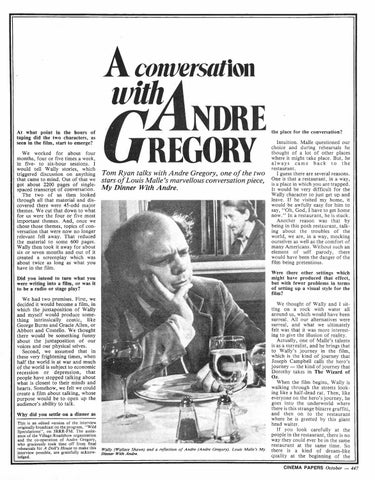
Wally (Wallace Shawn) and a reflection o f Andre (Andre Gregory). Louis M alle’s M y Dinner With Andre.
We thought of Wally and I sit ting on a rock with water all around us, which would have been surreal. All our alternatives were surreal, and what we ultimately felt was that it was more interest ing to give the illusion of reality. Actually, one of Malle’s talents is as a surrealist, and he brings that to Wally’s journey in the film, which is the kind of journey that Joseph Campbell calls the hero’s journey — the kind of journey that Dorothy takes in The Wizard of Oz. When the film begins, Wally is walking through the streets look ing like a half-dead rat. Then, like everyone on the hero’s journey, he goes into the underworld where there is this strange bizarre graffiti, and then on to the restaurant where he is greeted by this giant head waiter. If you look carefully at the people in the restaurant, there is no way they could ever be in the same restaurant at the same time. So there is a kind of dream-like quality at the beginning of the CINEMA PAPERS October — 447