Pauline Kael
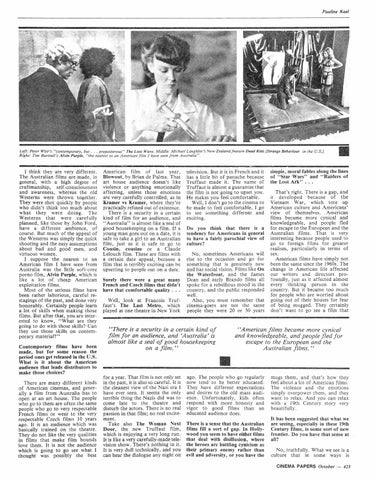
Left: Peter Weir’s “contemporary, b u t . . . preposterous” The Lost Wave. Middle: Michael Laughlin’s New Zealand feature Dead Kids [Strange Behaviour in the U.S.J. Right: Tim Burstall’s Alvin Purple, “the nearest to an American film I have seen fro m Australia”.
I think they are very different. The Australian films are made, in general, with a high degree of craftmanship, self-consciousness and awareness, whereas the old Westerns were thrown together. They were shot quickly by people who didn’t think too much about what they were doing. The Westerns that were carefully planned, like those by John Ford, have a different ambience, of course. But much of the appeal of the Westerns was simply the quick shooting and the easy assumptions about bad and good men, and virtuous women. I suppose the nearest to an American film I have seen from Australia was the little soft-core porno film, Alvin Purple, which is like a lot of cheap American exploitation films. Most of the serious films have been rather laborious, careful re stagings of the past, and done very honorably. Certainly people learn a lot of skills when making those films. But after that, you are inter ested to know, “ What are they going to do with those skills? Can they use those skills on contem porary material?” Contemporary films have been made, but for some reason the period ones get released in the U.S. What is it about the American audience that leads distributors to make those choices? There are many different kinds of American cinemas, and gener ally a film from Australia has to open at an art house. The people who go to them are often the same people who go to very respectable French films or went to the very respectable Czech films 10 years ago. It is an audience which was basically trained on the theatre. They do not like the very qualities in films that make film hounds love them. It is not the audience which is going to go see what I thought was possibly the best
American film of last year, Blowout, by Brian de Palma. That art house audience doesn’t like violence or anything emotionally affecting, unless those emotions are very carefully controlled, as in Kramer vs Kramer, where they’re practically refined out of existence. There is a security in a certain kind of film for an audience, and “ Australia” is almost like a seal of good housekeeping on a film. If a young man goes out on a date, it is safe to take a girl to an Australian film, just as it is safe to go to Cousin, cousine or a Claude Lelouch film. These are films with a certain date appeal, because a film that is terribly exciting can be upsetting to people out on a date. Surely there were a great many French and Czech films that didn’t have that comfortable quality . . . Well, look at Francois Truf faut’s The Last Metro, which played at one theatre in New York
television. But it is in French and it has a little bit of panache because Truffaut made it. The name of Truffaut is almost a guarantee that the film is not going to upset you. He makes you feel comfortable. Well, I don’t go to the cinema to be made to feel comfortable. I go to see something different and exciting. Do you think that there is a tendency for Americans in general to have a fairly parochial view of culture? No, sometimes Americans will rise to the occasion and go for something that is genuinely new and has social vision. Films like On the Waterfront, and the James Dean and early Brando films all spoke for a rebellious mood in the country, and the public responded well. Also, you must remember that cinema-goers are not the same people they were 20 or 30 years
“There is a security in a certain kind o f film fo r an audience, and ‘Australia’ is almost like a seal o f good housekeeping on a film . ”
for a year. That film is not only set in the past, it is also so careful. It is the cleanest view of the Nazi era I have ever seen. It seems the only terrible thing the Nazis did was to come late to the theatre and disturb the actors. There is no real passion in that film; no real excite ment. Take also The Woman Next Door, the new Truffaut film, which is enjoying a very long run. It is like a very carefully-made tele vision show. There’s nothing in it. It is very dull technically, and you can hear the dialogue any night on
simple, moral fables along the lines of “Star Wars” and “ Raiders of the Lost Ark” . . . That’s right. There is a gap, and it developed because of the Vietnam War, which tore up American culture and Americans’ view of themselves. American films became more cynical and knowledgeable, and people fled for escape to the European and the Australian films. That is very interesting because people used to go to foreign films for greater realism, particularly in terms of sex. American films have simply not been the same since the 1960s. The change in American life affected our writers and directors pro foundly, just as it affected almost every thinking person in the country. But it became too much for people who are worried about going out of their houses for fear of being mugged. They certainly don’t want to go see a film that
“American film s became more cynical and knowledgeable, and people fle d fo r escape to the European and the Australian film s .”
ago. The people who go regularly now tend to be better educated. They have different expectations and desires to the old mass audi ence. Unfortunately, kids often respond with more honesty and vigor to good films than an educated audience does. There is a sense that the Australian films fill a sort of gap. In Holly wood you seem to have either films that deal with disillusion, where the heroes are battling cynicism as their primary enemy rather than evil and adversity, or you have the
mugs them, and that’s how they feel about a lot of American films. The violence and the emotions simply overpower them, and they want to relax. And you can relax with a 19th Century story very beautifully. It has been suggested that what we are seeing, especially in these 19th Century films, is some sort of new frontier. Do you have that sense at all? No, truthfully. What we see is a culture that in some ways is CINEMA PAPERS October — 423