E.T. The Extraterrestrial
We o f the Never Never
the actress’ range even when the dif fused screenplay is giving her the slightest assistance. Instead, it usually asks only cliche responses of her and she is unable, by her physical presence or by a sense of inner conviction, to transcend these. Against her unexpres sive, inflexible performance, Arthur Dignam’s intelligent brick-building with the script’s straws goes for little, and the sense of relationship goes out the window. The idea of the white woman estab
as feckless, unreliable creatures; of Jeannie’s bringing Bett-Bett into the house despite Aeneas’ claim that “ you can’t take her away from her people” ; and so on. There is an attempt to lift this sporadic interest to the level of drama as she tries to save Goggle-Eye (Donald Blitner) from dying: “ I’m sick of people telling me there’s nothing I can do.” When he dies, she asks, in plaintive anach ronism, “ Where did we go wrong?” The jejuneness of the film’s racial
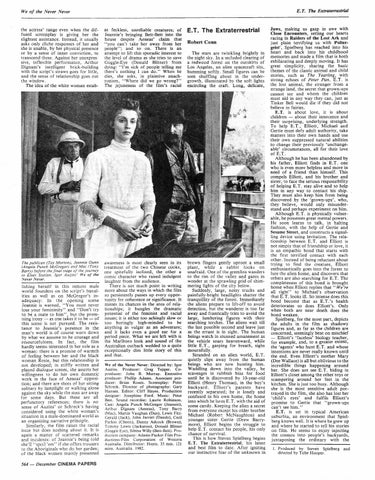
The publican (Tex Morton), Jeannie Gunn (Angela Punch McGregor) and Mac (Tony Barry) before the final stage o f the journey to Elsey Station. Igor Auzins’ We o f the Never Never.
awareness is most clearly seen in its treatment of the two Chinese cooks, one spitefully inclined, the other a comic character who raised indulgent laughter from the audience. There is not much point in writing more about the ways in which the film so persistently passes up every oppor tunity for coherence or significance. It misses its chances in the area of rela tionships; it bungles the dramatic potential of the feminist and racial issues; it is either too achingly slow or too boringly high-minded to be anything as vulgar as an adventure; and it lacks even a good ear for a period piece. What we are left with is the Marlboro look and sound of the Australian outback wedded to a quite exceptionally dim little story of this and that.
lishing herself in this remote male world founders on the script’s banal ities as well as on McGregor’s in adequacy: In the opening scene Jeannie is warned, “ You must never lose your femininity” and “ Don’t try to be a mate to him” , but the prom ising irony — as one takes it to be — of this scene is not pursued. The resis tance to Jeannie’s presence in the man’s world is of course worn down by what we assume to be courage and resourcefulness. In fact, the film hardly seems interested in her role as a woman: there is a promise of warmth of feeling between her and the black woman Rosie, but this relationship is not developed; in stiffly written and played dialogue scenes, she asserts her willingness to do her own domestic work in the face of Aeneas’ opposi tion; and there are shots of her sitting solitary by lamplight or walking alone against the sky while the men are away for some days. But these are all perfunctory references; there is no sense of Auzins’ or Schreck’s having considered using the white woman’s situation in a male-dominated world as an organizing narrative principle. Similarly, the film raises the racial issue but does nothing about it. It is again a matter of scattered remarks and incidents: of Jeannie’s being told she’ll “ spoil ’em” if she offers trousers to the Aboriginals who do her garden; of the black women mainly presented 564 — D e c e m b e r CINEMA PAPERS
We of the Never Never: Directed by: Igor Auzins. Producer: Greg T epper. C o producer: Jo h n B. M urray. Executive producer: Phillip A dam s. Associate p ro ducer: Brian Rosen. Screenplay: Peter Schreck. D irector o f photography: Gary H ansen. E ditor: C liff H ayes. P roduction designer: Josephine F ord. M usic: Peter Best. Sound recordist: Laurie Robinson. Cast: Angela Punch M cG regor (Jeannie), A rthur D ignam (Aeneas), T ony Barry (Mac), M artin V aughan (D an), Lewis Fitz G erald (Jack), Jo h n Ja rra tt (D andy), Cecil Parkes (Cheon), D anny A dcock (Brown), Tom m y Lewis (Jackaroo), D onald Blitner (Goggle Eye), Sibina Willy (Bett-Bett). P ro duction com pany: A dam s Packer Film P ro ductions-Film C orporation o f W estern A ustralia. D istributor: H oyts. 35 m m . 121 mins. A ustralia. 1982.
E.T. The Extraterrestrial Robert Conn The stars are twinkling brightly in the night sky. In a secluded clearing of a redwood forest on the outskirts of Los Angeles, an alien spacecraft sits, humming softly. Small figures can be seen shuffling about in the under growth, illuminated by the soft lights encircling the craft. Long, delicate,
brown fingers gently uproot a small plant, while a rabbit looks on unafraid. One of the gremlins wanders to the rim of the valley and gazes in wonder at the sprawling grid of shim mering lights of the city below. Suddenly, large, noisy trucks and painfully-bright headlights shatter the tranquillity of the forest. Immediately the aliens prepare to lift-off to avoid detection, but the wanderer is too far away and frantically tries to avoid the large, lumbering figures with their searching torches. The aliens wait till the last possible second and leave just as the errant is in sight. The human beings watch in stunned amazement as the vehicle soars heavenward, while little E.T., gasping for breath, sighs mournfully. Stranded on an alien world, E.T. quietly slips away from the human beings who are now hunting him. Waddling down into the valley, he scavenges in rubbish bins for food until he is discovered by 10-year-old Elliott (Henry Thomas), in the boy’s backyard. Elliott’s parents have recently separated; he is lonely and confused in his own home, the home into which he lures E.T. with the aid of some candy. Keeping the alien a secret from everyone except his older brother Michael (Robert McNaughton) and younger sister Gertie (Drew Barry more), Elliott begins the struggle to help E.T. contact his people, his only chance of survival. This is how Steven Spielberg begins E.T. The Extraterrestrial, his latest and best film to date. After igniting our instinctive fear of the unknown in
Jaws, making us gasp in awe with Close Encounters, setting our hearts racing in Raiders of the Lost Ark and just plain terrifying us with Polter geist1, Spielberg has reached into his
heart and back into his childhood memories and made a film that is both exhilarating and deeply moving. It has great simplicity, sharing the basic themes of the classic animal and child stories, such as The Yearling, with strong echoes of Peter Pan. E.T. is the lost animal, the stranger from a strange land, the secret that grown-ups cannot see and whom the children must aid in any way they can, just as Tinker Bell would die if they did not believe in fairies. E.T. is about love, it is about children — about their innocence and their surprising, underlying strength. To help E.T., Elliott, Michael and Gertie must defy adult authority, take matters into their own hands and use their own suppressed natural abilities to change their previously ‘unchange able’ circumstances, all for their love of E.T. Although he has been abandoned by his father, Elliott finds in E.T. one who is even more helpless and more in need of a friend than himself. This compels Elliott, and his brother and sister, to face the serious responsibility of helping E.T. stay alive and to help him in any way to contact his ship. They must also keep him from being discovered by the ‘grown-ups’, who, they believe, would only misunder stand and perhaps experiment on him. Although E.T. is physically vulner able, he possesses great mental powers. He soon learns to talk, in halting fashion, with the help of Gertie and Sesame Street, and constructs a signal ling device using levitation. The rela tionship between E.T. and Elliott is not simply that of friendship or love, it is an empathic bond that starts with the first terrified contact with each other. Instead of being reluctant about trying to find the creature, Elliott enthusiastically goes into the forest to lure the alien home, and discovers that others are also searching for E.T. The completeness of this bond is brought home when Elliott replies that “ We’re all right” to Michael’s observation that E.T. looks ill. So intense does this bond become that as E.T.’s health deteriorates so does Elliott’s. Only when both are near death does the bond weaken. Spielberg, for the most part, depicts the adults in the film as shadowy figures and, as far as the children are concerned, seemingly bent on mischief — Elliott’s ‘faceless’ biology teacher, for example, and, to a greater extent, the ‘agents’ who hunt E.T. and whose intentions are never really known until the end. Even Elliott’s mother Mary (Dee Wallace) is all but oblivious to the incredible things happening around her. She does not see E.T. hiding in Elliott’s closet among the other toys or scampering around her feet in the kitchen. She is just too busy. Although she is the most sensitive adult por trayed in the film, she also has lost her ‘child’s eyes’ and fulfils Elliott’s promise to Gertie that “ grown-ups can’t see him.” E.T. is set in typical American suburbia, an environment that Spiel berg knows well. It is where he grew up and where he started to tell his stories on film. He seems to enjoy injecting the cosmos into people’s backyards, juxtaposing the ordinary with the 1. Produced by Steven Spielberg directed by T obe H ooper.
and