THE QUARTER
Liberal governm ent fo r some tim e. Honourable members opposite might take a leaf out of the Victorian Liberals’ book as they just scraped home by the skin of their teeth at the last elections. The following people, members of the Victorian Film Corporation, received funds in the following manner: Natalie Miller for In Search of Anna, Fred Schepisi for The Chant of Jimmie Blacksmith; Tim Burstall for Last of the Knucklemen; and Nigel Dick, consultant to Crawford Productions, for Young Ramsey and The Sullivans. Let us not think there was anything strange about the fact that the New South Wales Film Corporation made funds avail able and was involved in The Journalist. Just let us think it strange that that is one of the new films in which our corporation has invested and has not been a success at the box-office.
A F IB O A R D ELEC TED Following the take-over of the National Film Theatre of Australia by the Australian Film Institute, an election was held to ap point a new board of directors. The new members are: Ina Bertrand (a lecturer at La Trobe University; John Flaus (a tutor in film at Caulfield In stitute of Technology); Pat Gordon (a long-standing committeemember of the NFTA, and a committee member of the Melbourne Film Festival); Barry Jones (a member of Federal Parlia ment who has been actively involved in the development of the Australian film industry, including the establishment of the Austra lian Film and Television School and Vic torian Film Corporation); , Ian Macrae (a film director); Scott Murray (a filmmaker, and an editor of Cinema Papers); and David Roe (head of marketing of the New South Wales Film Corporation). Ina Bertrand, John Flaus, Barry Jones and Ian Macrae were previously members of the board, while Scott Murray, Pat Gordon and David Roe are new appointments. The pre vious chairman of the AFI, Barry Jones, was re-elected to that position.
“There could be dozens of collections of comparable importance in the U.S., but there are none to our knowledge in Aus tralia” , Edmondson said. “ Added to the material we have already, it will give the National L ibrary A u stra lia ’s largest holdings of film literature and documenta tion.” The books — 1200 of which are by or about screen personalities — include 30 autographed by the personalities con cerned. One of these bears the signatures of Thomas Edison, Mary Pickford, Cecil B. de Mille, Carl Laemmle, Adolf Zukor and 20 other film stars and producers. Six hundred of the books deal with film histories in different countries, with more than 30 relating to Nazi cinema and the development of German silent film up to 1931. The German publications are regarded as important contemporary records. Among the periodicals are substantial sets of four key American trade papers: MetroGoldwyn-Mayer’s in-house paper The Lion's Roar and sets of two famous German program magazines, lllustrier Film Kurier and Film Buhne, which reproduced stills and the story-line of a popular film in each weekly issue.
HOYTS TO BE D ELIS TE D One of Australia’s leading film exhibitors, Hoyts Theatres Ltd, will be delisted from the Stock Exchange. At a shareholders’ meeting In Sydney in mid-October, 90 per cent of preferential shareholders voted to sell their shares for $2 million to 20th Century-Fox. Fox, the U.S. parent company of Hoyts, already controls the subsidiary. It has 100 per cent ownership of ordinary shares. The move to delist Hoyts has been criticized by James Mitchell, the director of the Film and Television Production Associa tion of Australia. Mitchell claimed that two of the three distribution companies monopolizing the in dustry would now be private. He said the delisting would mean Hoyts could not be forced to issue box-office statistics, which would be to the detriment of Australian film makers. He said his association had been lobbying the Australian Film Commission for three years to sponsor a change in the Bureau of Statistics so that box-office figures would be available to the industry. Hoyts, however, denied that the delisting would affect the industry, and that there was no reason to suppose that the attitude of 20th Century-Fox to the Australian film industry would change.
NEW PERSONNEL
The new Chief Commonwealth Censor, Janet Strickland.
NEW C H IE F CENSOR The Federal Attorney-General, Senator Peter Durack, recently announced the appointment of Janet Strickland as the new Chief Commonwealth Film Censor. Strickland, 38, a former Deputy Chief Cen sor and a foundation member of the Austra lian Broadcasting Tribunal, succeeds Dick Prowse who resigned last month. Senator Durack said the position of Chief Commonwealth Film Censor "required exceptional skills, first of all to be able to as sess community attitudes and then to be able to take this into account when examining films. “As the Film Censorship Board applied uniform classifications on behalf of the State Governments there was a need to interpret the views of the States in formulating censor ship standards.” The Attorney-General said Strickland had admirable qualifications for the position of Chief Film Censor. She held an Arts degree from the University of Sydney and an honours degree in Anthropology from the University of Witwatersrand in South Africa, and taught for several years before her appointm ent as a member of the Film Censorship Board in 1971. In 1974, she was appointed Deputy Chief Censor, and acted as Chief Censor on several occasions until she was appointed to the Australian Broadcasting Tribunal in 1976. She resigned from the Tribunal earlier this year.
The V ictorian Film C o rpo ra tio n has recommended the appointment of writer and director, Ross Dimsey, to replace Jill Robb as Chief Executive Officer. Dimsey’s appoint ment has yet to be ratified by the Victorian Government’s Executive Council. Since Robb’s resignation earlier this year, the VFC has virtually ground to a halt. Very few new productions have been funded. Dimsey has made one feature film, Blue Fire Lady, and written two others, Fantasm, and Fantasm Comes Again. He is directing his second feature, Final Cut, for producer Mike Williams.
Peter Faiman.
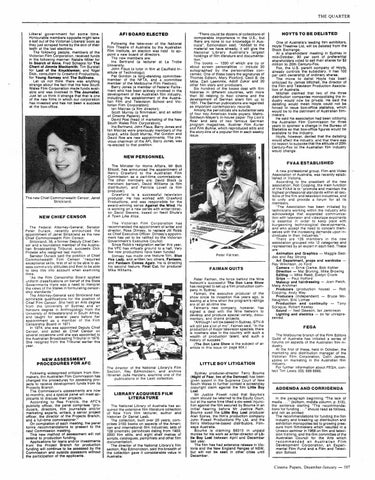
FAIMAN Q U IT S Peter Faiman, the force behind the Nine Network's successful The Don Lane Show has resigned to set up a film production com pany in Sydney. Faiman, the executive producer of the show since its inception five years ago, is leaving at a time when the program’s ratings are at an all-time low. Faiman’s new company, however, has signed a deal with the Nine Network to develop and produce special variety, docu mentary, and drama projects. “ Although I will be based in Sydney, GTV-9 will still see a lot of me” , Faiman said. “ In the production of major television specials, there is nowhere else in the country with such a wealth of production talent, and such a history of success.” (The Don Lane Show is the subject of an article in this issue on page 604.)
NEW ASSESSM EN T PRO CED UR ES FOR AFC Following widespread criticism from film makers, the Australian Film Commission has changed the procedures for assessing pro jects to receive development funds from its Projects Branch. The Commission’s assessments are now bi-monthly, and a special panel will meet ap plicants to discuss their projects. According to Rea Francis, the AFC’s publicity officer, the panel comprises “ pro ducers, directors, film journalists and/or marketing experts, writers, a senior project officer, the director of the Projects Branch, and a full-time commissioner.” On completion of each meeting, the panel forms recommendations to present to the next Commission meeting. This new method of assessment will not extend to production funding. Applications for loans and/or investments from the Project Branch for production funding will continue to be assessed by the Commission and outside assessors without the participation of the applicants.
FVA A E STA B LIS H ED
The Minister for Home Affairs, Mr Bob Ellicott, has announced the appointment of Henry Crawford to the Australian Film Commission as a part-time commissioner. The other members are: David Block (a merchant banker), David Williams (a film distributor), and Patricia Lovell (a film producer). C raw ford is a successful television producer. He has worked with Crawford Productions, and was responsible for the award-winning series Against the Wind. He is working on a new series with writer/director David Stevens, based on Nevii Shute’s A Town Like Alice.
LITTLE BOY LIT IG A T IO N The director of the National Library’s Film Section, Ray Edmondson, and archive librarian Julie Harders, examine one of the publications in the Leab collection.
LIB RA RY A C Q UIRES FILM LITE R A TU R E The National Library of Australia has ac quired the extensive film literature collection of New York film lecturer, author and historian Dr Daniel Leab. The collection, built over 20 years, com prises 3100 books on aspects of the Ameri can and international film industries; sets of 128 cinematic periodicals dating" from 1903; 2000 film stills; and eight shelf metres of scripts, catalogues, pamphlets and other film documentation. The director of the National Library’s film section, Ray Edmondson, said the breadth of the collection gave it considerable value in Australia:
Sydney producer-director Terry Bourke (Night of Fear, Inn of the Damned) has been given assent in the Supreme Court of New South Wales to further contest a screenplay copyright claim against the film Little Boy Lost. Mr Justice Powell ruled that Bourke’s claim should be referred to the Equity Court, but at the same time lifted a six-week injunc tion against the film secured by Bourke in an initial hearing before Mr Justice Rath. Bourke sued the Little Boy Lost producer Alan Spires, the film’s production company John Powell Productions Pty Ltd, and the film ’s Melbourne-based distributors, Filmways Australia. Bourke is claiming $6310 in unpaid monies for his work as writer-director of Lit tle Boy Lost between April and December last year. The film has had extensive release In Vic toria and the New England Ranges of NSW, but will not be seen in other cities until December.
A new professional group, Film and Video Association of Australia, was recently estab lished in Victoria. According to the president of the new association, Rob Copping, the main function of the FVAA is to “ promote and maintain the highest professional standards within all sec tions of the film and television industries, and to unify and provide a forum for all its members. “ The Association has been initiated by technicians working within the industry who acknowledge that expanded communica tion with television and videotape exponents is essential in order to keep pace with burgeoning technological developments, and who accept the need to concern them selves with the increasing demands upon in dividuals in their industries.” There are 126 members in the new association grouped into 12 categories and represented by an expert in each field. These are: Animation and Graphics — Maggie Geddes and Ray Strong Art Department, props and wardrobe — Ray Wilkinson, Jo Ford Camera — Ernie Clarke, Bob Kohler Direction — Mai Bryning, Mike Browing Editing — Mike Reed, Evelyn Cronk Grips — Paul Holford Makeup and hairdressing — Joan Petch, Marg Archman Producers (production house) — Rob Copping, Andy Way Producers (independent) — Bruce McNaughton, Eric Lomas Production and continuity — Tony Sprague, Robert Kewley Sound — Ned Dawson, Ian Jenkinson Lighting and electrics — so far unrepre sented.
FE G A The Melbourne branch of the Film Editors Guild of Australia has initiated a series of forums on aspects of the Australian film in dustry. At the first of these, held in October, the marketing and distribution manager of the Victorian Film Corporation, Colin James, spoke on marketing in the Australian film industry. For further information about FEGA, con tact Tim Lewis (03) 699 6666.
A D D EN D A AND CORRSGENDA In the paragraph beginning “The lack of media . . .” (bottom, middle column, p. 515), the sentence starting “ The recommenda tions for funding .. .” should read as follows, and not as printed: The recommendations for funding the film industry and breaking up distribution and exhibition monopolies led to growing pres sure from filmmakers which resulted in a Unesco seminar in 1968 on film and televi sion training, and the film committee of the Australian Council for the Arts which re c o m m e n d e d an A u s tra lia n Film Development Corporation, an Experi mental Film Fund and a Film and Televi sion School.
Cinema Papers, December-January — 597