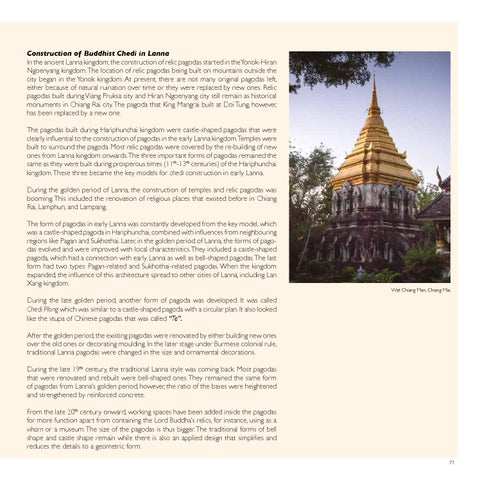
Construction of Buddhist Chedi in Lanna In the ancient Lanna kingdom, the construction of relic pagodas started in the Yonok-Hiran Ngoenyang kingdom. The location of relic pagodas being built on mountains outside the city began in the Yonok kingdom. At present, there are not many original pagodas left, either because of natural ruination over time or they were replaced by new ones. Relic pagodas built during Viang Pruksa city and Hiran Ngoenyang city still remain as historical monuments in Chiang Rai city. The pagoda that King Mangrai built at Doi Tung, however, has been replaced by a new one. The pagodas built during Hariphunchai kingdom were castle-shaped pagodas that were clearly influential to the construction of pagodas in the early Lanna kingdom.Temples were built to surround the pagoda. Most relic pagodas were covered by the re-building of new ones from Lanna kingdom onwards.The three important forms of pagodas remained the same as they were built during prosperous times (11th-13th centuries) of the Hariphunchai kingdom. These three became the key models for chedi construction in early Lanna. During the golden period of Lanna, the construction of temples and relic pagodas was booming. This included the renovation of religious places that existed before in Chiang Rai, Lamphun, and Lampang. The form of pagodas in early Lanna was constantly developed from the key model, which was a castle-shaped pagoda in Hariphunchai, combined with influences from neighbouring regions like Pagan and Sukhothai. Later, in the golden period of Lanna, the forms of pagodas evolved and were improved with local characteristics. They included a castle-shaped pagoda, which had a connection with early Lanna as well as bell-shaped pagodas.The last form had two types: Pagan-related and Sukhothai-related pagodas. When the kingdom expanded, the influence of this architecture spread to other cities of Lanna, including Lan Xang kingdom.
Wat Chiang Man, Chiang Mai.
During the late golden period, another form of pagoda was developed. It was called Chedi Plong which was similar to a castle-shaped pagoda with a circular plan. It also looked like the stupa of Chinese pagodas that was called “Ta”. After the golden period, the existing pagodas were renovated by either building new ones over the old ones or decorating moulding. In the later stage under Burmese colonial rule, traditional Lanna pagodas were changed in the size and ornamental decorations. During the late 19th century, the traditional Lanna style was coming back. Most pagodas that were renovated and rebuilt were bell-shaped ones. They remained the same form of pagodas from Lanna’s golden period, however, the ratio of the bases were heightened and strengthened by reinforced concrete. From the late 20th century onward, working spaces have been added inside the pagodas for more function apart from containing the Lord Buddha’s relics, for instance, using as a viharn or a museum. The size of the pagodas is thus bigger. The traditional forms of bell shape and castle shape remain while there is also an applied design that simplifies and reduces the details to a geometric form. 71