12
UNSOLVED
LEWISTON TRIBUNE
M O N D AY, M AY 1 9 , 2 0 1 4
M O N D AY, M AY 1 9 , 2 0 1 4
UNSOLVED
LEWISTON TRIBUNE
13
KRISTIN DAVID
Shrouded in
DARKNESS UI senior was bicycling between Moscow and Clarkston when she disappeared, her dismembered body found in the Snake River soon afterwards. The case is not closed, but the leads have all dried up
I
By SANDRA L. LEE FOR THE TRIBUNE
t will soon be 33 years since 22-yearold Kristin David disappeared while riding her bicycle from Moscow to Clarkston. But even after all those years, the cause of her death is still carefully protected by law enforcement officials. They refuse to divulge everything they know about what happened after she died, before her body was found in multiple pieces in the Snake River below Red Wolf Crossing. Someday, Lewiston police officers said recently, there may be a break, someone may be found who knows those details. And then they will finally close the case. A few years ago, an FBI agent at Lewiston, Ron Miller, made a simple request: If someone mistakenly says how David died, please don’t print the information. It was a difficult case from the beginning. David disappeared June 26, 1981, while biking alone from Moscow where she was a senior at the University of Idaho majoring in broadcast journalism and political science. Her family, many of them LewistonClarkston Valley residents, reported her missing the following day. A massive search was organized, with volunteers walking along ditches and back roads looking for any trace of her or her bicycle. Eight days later, on the Fourth of July, a boater on the Snake River found the first of her remains, a headless torso and a leg, about half a mile below Chief Timothy State Park. The next day, more body parts were found, some nearby, some upstream about three miles below Red Wolf Crossing. Blood reportedly was found on the bridge, but law enforcement refused to confirm it was hers. Her bicycle was never found. A Lewiston Tribune reporter and photographer, both summer interns, were working
Christina White, 12, at Asotin in 1979 and three young adults in what is commonly called the Lewiston Civic Theatre murders are the work of one person. In the theater case, the two women, Kristina Nelson and Jacqueline (Brandi) Miller, and a man, Steven Pearsall, are believed to have been in or near the converted church the night they disappeared. Only the bodies of the women were eventually found on a hillside near Kendrick. But the man, although never found, has not been a solid suspect, according to officers. Those who believe all three cases are connected point to the prime suspect in the Asotin County and theater cases having access to a brown van. David also worked for a time at the theater and could have been acquainted with the suspect.
Kristin David holiday shifts that July 4. They came back to the newsroom late at night with stories of clambering over rocky banks in the dark, encountering rattlesnakes — and something more horrible.
I
n a recent interview, Lewiston Police Capt. Roger Lanier and Tom Greene, who recently retired from the department, said they’re not certain how the department became the lead investigative agency, given the multiple jurisdictions involved. David could have been kidnapped in Latah County, or it could have been Nez Perce County. She was found in Whitman County. Asotin County was involved, and the FBI. Early on, however, Lewiston Police Capt. Duane Ailor did a summary of the case and Lewiston officers began conducting interviews. “In law enforcement, there always seems to be a case that defines a career,” Lanier said. “I would bet Duane Ailor, who worked hard on Kristin David — and cops hate to lose — he probably took that to his grave.” Ailor died of cancer in 1997, the same year
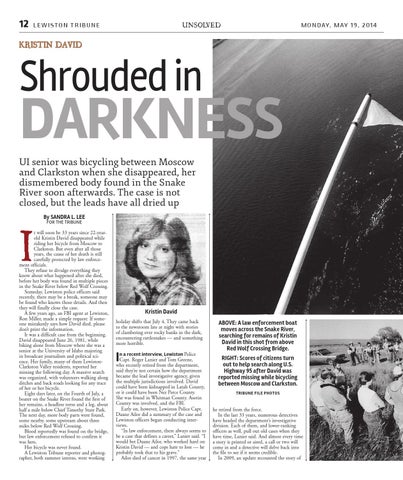
ABOVE: A law enforcement boat moves across the Snake River, searching for remains of Kristin David in this shot from above Red Wolf Crossing Bridge. RIGHT: Scores of citizens turn out to help search along U.S. Highway 95 after David was reported missing while bicycling between Moscow and Clarkston. TRIBUNE FILE PHOTOS
he retired from the force. In the last 33 years, numerous detectives have headed the department’s investigative division. Each of them, and lower-ranking officers as well, pull out old cases when they have time, Lanier said. And almost every time a story is printed or aired, a call or two will come in and a detective will delve back into the file to see if it seems credible. In 2009, an update recounted the story of
a Genesee man who during the initial investigation said under hypnosis on the day David disappeared that he saw a man in a brown van with Oregon license plates apparently helping a young woman on a bicycle alongside U.S. Highway 95 south of Genesee. Soon after, a woman called the Tribune with her own story. It was the same summer David died, she said, and she was jogging on U.S. Highway 12 west of Clarkston when she was accosted by a man driving a brown van. He was persistent, insistent that she should accept a ride, she recalled. She didn’t make the connection then. She had heard of David’s murder, but had never seen the details or heard of the brown van until she read that story 28 years later, she said. No one knows what other stories or evidence might be out there, or how it might help solve the case. Evidence is still stored in a special cold-storage unit maintained by the FBI in Salt Lake City. It predated DNA, but given the conditions and the length of time, its value is questionable. Everything deteriorates with time, Lanier said. As technology advances, evidence is re-examined. In the David case, evidence was reprocessed by the FBI lab at least twice, once in the 1990s and again in 2008, Miller said. David’s case was one of five deaths that were prominent between 1979 and 1982. Some officers believe they were all connected; some believe David’s was the odd one out. The generally held opinion is that the disappearance of
P
eople also talk about the oddities, like the similarity in the three of the four female victims’ names, Christina, Kristina and Kristin. Now-retired Detective Donald Schoeffler of Yuma, Ariz., believes the cases were too dissimilar to include David. He said in those 2009 interviews he always wished he had been given the opportunity to interview a suspect in an unsolved Colorado case. He and a Whitman County detective did interview two other serial killers, Ottis Toole in Florida and Henry Lee Lucas in Texas, and came away satisfied they weren’t involved here. Detectives looked at serial killer Robert Yates of Spokane and Harry Anthony Hantman, who also lived in the Northwest, including 20 years in Joseph, Ore., under the alias Thomas Andrew Dorian. Hantman/Dorian had escaped from a hospital for the criminally insane in 1973 where he was being held for the rape and murder of an 11-year-old girl. He was arrested in Lewiston in 1993. Both were ruled out. Time goes on. Many family members have moved from the area. The case, instead of being stored in a dusty box, has been converted to electronic files, easily accessible if any new information surfaces. Cases like this, Lanier said, are inactive, not closed. “Inactive means we are not out looking for stuff. At this point, we don’t know where to go or look. We’re looking for that big break, I guess.”
Lee can be contacted at city@lmtribune.com.