J. Vance Lewis: The Astounding Impact of “Houston’s First Black Lawyer”
“Van Court”: J. Vance Lewis House Serves as a Symbol of Progress, Culture, History, and Hope A Courageous Pursuit: Houston’s First African American Attorneys
The Many Titles of Tasha Schwikert Moser A Legacy in the Making: Judge Vanessa D. Gilmore

BUench
Volume 61 – Number 4 January/February 2024 in side...
lawyer
THEHOUSTON











J. Vance Lewis: The Astounding Impact of “Houston’s First Black Lawyer”
By GeorGe “Trey” Gifford iii
“Van Court”: J. Vance Lewis House Serves as a Symbol of Progress, Culture, History, and Hope
By ryan a. CunninGham with assistance from Charles l. sharman
A Courageous Pursuit: Houston’s First African American Attorneys
By r miChelle Boldon
The Many Titles of Tasha Schwikert Moser
By dave louie
A Legacy in the Making: Judge
Vanessa D. Gilmore of the U.S. District Court for the Southern District of Texas
By Brandi d. Pikes
The U.S. Supreme Court’s Affirmative Action Decision
• College and University Admissions
After Students for Fair Admissions, Inc
By Professor r. randall kelso
• Thurgood Marshall School of Law—Still We Rise
By assoCiaTe dean CrysTal ridGley
• University of Houston Law Center’s Pre-Law Pipeline Programs
By mariesha keys
• Advancing Diversity to Foster Inclusive Excellence
By donna davis
The Texas Lawyer’s Creed Turns 35
By eriC d’olive and Jeff oldham
HBA Ambassadors Program
By TraCi a. GiBson and Jake Johnson
24 The Houston Lawyer (ISSN 0439-660X, U.S.P.S 008-175) is published bimonthly by The Houston Bar Association, 1111 Bagby Street, FLB 200, Houston, TX 77002. Periodical postage paid at Houston, Texas. Subscription rate: $12 for members. $25.00 non-members. POSTMASTER: Send address changes to: The Houston Lawyer, 1111 Bagby Street, FLB 200, Houston, TX 77002. Telephone: 713-759-1133. All editorial inquiries should be addressed to The Houston Lawyer at the above address. All advertising inquiries should be addressed to: Quantum/SUR, 10306 Olympia Dr., Houston, TX 77042, 281-955-2449 ext 1, www.thehoustonlawyer.com, e-mail: leo@quantumsur. com. Views expressed in The Houston Lawyer are those of the authors and do not necessarily reflect the views of the editors or the Houston Bar Association. Publishing of an advertisement does not imply endorsement of any product or service offered. ©The Houston Bar Association/QuantumSUR, Inc., 2024. All rights reserved.
The h ouston l awyer contents January/february 2024 volume
FeAtURes 27 10 10 20 17 24 14 14 20 32 27 34 34
61 number 4
2 January/february 2024 thehoustonlawyer.com
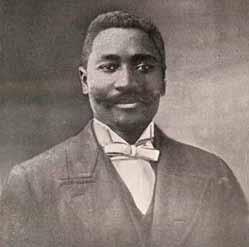
On the Cover: (From top to bottom) A portrait of “Houston’s First Black Attorney,” J. Vance Lewis (Out of the Ditch: A True Story of an Ex-Slave), and Mr. Lewis holding a meeting in his home (Schomburg Center for Research in Black Culture, Jean Blackwell Hutson Research and Reference Division, The New York Public Library. (1910). Law office of J. Vance Lewis; H. H. Letheridge, L. Franks, conferring with J. Vance Lewis; Miss Bernice Griggs, stenographer Retrieved from https:// digitalcollections.nypl.org/items/510d47df-b78a-a3d9-e040-e00a18064a99.)




Local Solutions. Global Reach.








PresidenT’s messaGe
Honoring J. Vance Lewis and Pioneers in Law
By diana Gomez
from The ediTor
The Black Attorneys Who Have Shaped the City of Houston
By liz malPass
lawyers GivinG BaCk
Houston Bar Foundation: Supporting Access to Justice For All Houstonians
law in The family –The Sandill Family –The Bennett Family –The Engelhart Family
off The reCord
An Unstoppable Wave of Humanity
By The honoraBle GeorGe C. hanks, Jr. a Profile in Professionalism
Chanler A. Langham Partner, susman Godfrey l.l.P.
CommiTTee sPoTliGhT
HBA Historical Committee: Preserving Houston’s Legal History for Future Generations
By Bill kroGer
seCTion sPoTliGhT
The International Law Section: Connecting Lawyers Locally and Abroad
By daniel Ávila ii media reviews
Jury Duty: A Humorous Look at the True Heroes of Our Court System reviewed by The honoraBle kyle CarTer
Witness to a Prosecution: The Myth of Michael Milken reviewed by Carey worrell
leGal Trends
Diversity, Equity, and Inclusion Programs at Texas Higher Education Institutions
By BriTney Brown
Free Speech and Mandatory Bar Associations: The Fifth Circuit’s Recent Clarification of the “Germane” Standard
By sushanT mohan
liTiGaTion markeTPlaCe contents January/february 2024 depARtments 6 8 volume 61 number 4 36 37 40 41 42 The h ouston l awyer 43 40 41 6 36 44 45 48 43 37 4 January/february 2024 thehoustonlawyer.com


Behind the Lines: The Houston Lawyer Podcast
Behind the Lines: The Houston Lawyer Podcast features in-depth conversations with Houston attorneys and judges, providing insight about the latest legal developments, as well as personal stories of the opportunities and challenges of serving the law. The podcast is the companion to The Houston Lawyer, where each episode focuses on the same themes as the magazine.
Learn more about the podcast and how you can subscribe by visiting hba.org/thehoustonlawyer
thehoustonlawyer.com January/february 2024 5
 By Diana Gomez Chamberlain Hrdlicka
president’s message
Honoring J. Vance Lewis and Pioneers in Law
The law—like time—never stands still. Our profession, and those who practice on the bench and the bar, constantly grapple with both precedence–the laws, cases, and people who have come before us— and change—developments that prompt new legal standards. Within Houston’s large, diverse legal community, we are eager to champion and celebrate trailblazers—the pioneering individuals in law who pave the way for others seeking to serve. I am grateful to all of those who paved the way for me and supported me to serve as the first Latina president of the Houston Bar Association in the organization’s 153-year history.
In this issue, we honor “Houston’s First Black Lawyer,” J. Vance Lewis, and several of the individuals who were among Houston’s first generation of African American attorneys. J. Vance Lewis was an extraordinary individual, leader, and attorney. Born into slavery in the 1860s, Mr. Lewis become the first Black lawyer to secure an acquittal of a Black man accused of murder in Harris County. Mr. Lewis’ home, dubbed “Van’s Court,” served
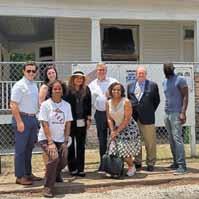
as a hub for Freedmen’s Town in Houston’s Fourth Ward. I had the pleasure of visiting the home with members of the HBA Historical Committee last summer, where the Rutherford B.H. Yates Museum is overseeing renovations to restore the home as a Museum of Legal Professions and Educators with Galleries. It was fascinating to walk through the same rooms where Mr. Lewis and his wife, Mrs. Pauline Gray-Lewis, hosted friends, families, colleagues, and members of the community. You can read more about Mr. Lewis’ life, his home, and the lives of Houston’s first-generation African American attorneys in this issue, written by members of the HBA Historical Committee. I also encourage you to visit hba.org/historical to learn more about the renovation efforts underway to preserve Mr. Lewis’ home and legacy.
The law will continue to evolve, but the virtues of law—professionalism, access to justice, and the rule of law— remain the same. And as we begin a new year, I invite you to consider how you can champion your colleagues to ensure the law is inclusive to all.
The h ouston l awyer
6 January/february 2024 thehoustonlawyer.com
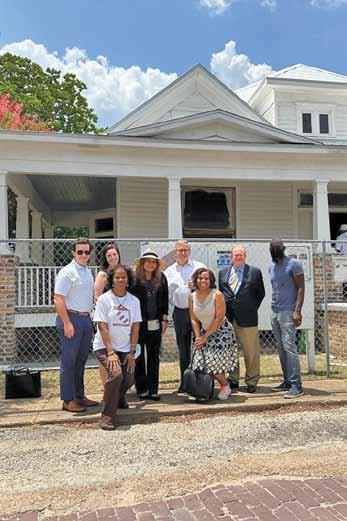
HBA President Diana Gomez and the HBA Historical Committee (L to R: Ryan Cunningham, HBA Liaison Maggie Martin, Chair Bill Kroger, R. Michelle Boldon, and Mark Goldberg) joined historic researcher Debra Blacklock-Sloan (left) and a Freedmen’s Town descendent (right) for a visit to J. Vance Lewis’ home in Freedmen’s Town in July 2023.


BOARD OF DIRECTORS
President
Diana Gomez
President-elect
David Harrell
first vice President
Kaylan Dunn
second vice President
Greg Ulmer
secretary
Collin Cox
Treasurer
Daniella Landers
immediate Past
President
Christopher V. Popov
DIRECTORS (2023-2025)
Carter Dugan Greg Moore
Jeff Oldham Colin Pogge
DIRECTORS (2022-2024)
Keri Brown Robert Painter
Samantha Torres
DIRECTORS
(2023-2024)
Seepan V. Parseghian
EDITORIAl STAFF
editor in Chief
Liz Malpass
associate editors
Anna M. Archer Sydney Huber Bateman
Nikki Morris Lane Morrison
Andrew Pearce Braden Riley
editorial Board
Anietie Akpan Jaclyn Barbosa
Nicholas Beekhuizen Natasha Breaux
Hon. Kyle Carter Dasha K. Hodge
Teresa Hudson Kristen Lee
Harrison Long David T. Lopez
Dave Louie Eli Medina
Raymond Panneton Ciara Perritano
Hon. Josefina Rendón Jennifer Smith
Kyle Steingreaber Rachael Thompson
Mark Yablon
managing editor
Maggie Martin
HBA OFFICE STAFF
executive director Mindy G. Davidson
associate executive director Ashley G. Steininger
executive assistant and director of Board affairs Gina Pendleton
Controller Sarah Kole
director, marketing and Communications Maggie Martin
Communications specialist Briana Ramirez
education Coordinator Alli Hessel
director, Projects and events Bonnie Simmons
Projects and events assistant Georgina Peña
director,
and Technology services Ron Riojas
ADvERTISIng SAlES
DESIgn
Publisher Leonel E. Mejía
Production manager advertising
Marta M. Mejía Mary Chavoustie


membership
& pRODuCTIOn
TX
• www.quantumsur.com
QuanTum/sur 10306 Olympia Dr., Houston,
77042 281.955.2449
thehoustonlawyer.com January/february 2024 7

assoCiaTe ediTors
 Anna M. Archer U.S. District Court
 By Liz m a L pass Baker Botts L.L.p.
from the editor
A True Legacy: The Black Attorneys Who Have Shaped the City of Houston


Less than a mile from the glass and steel skyscrapers that cluster in downtown Houston, the sound of pounding hammers and buzzing saws heralds yet another construction project. This time, it’s not the typical highrise apartment complex or pair of townhouses, but a resurrection of a 1907 house that has, over the years, fallen into ruin. Now, the once-dilapidated home and law office of J. Vance Lewis, Houston’s first Black attorney, is being restored. Once the renovation is complete, the house will serve to honor J. Vance Lewis’ legacy and to educate Houstonians about his work. Lewis, like the other pioneering Black attorneys featured in this issue—rose above the prejudice of his times to become a tremendously successful lawyer and community leader.
This is one of my favorite issues of The Houston Lawyer. In partnership with the HBA Historical Committee, this issue weaves together the past and the present of our city through the rich histories of Black attorneys and judges who have left their mark on the bar.


george “Trey” gifford III describes the life history, early successes, and profound impacts of J. Vance Lewis on Houston and the legacy he left for those who followed in his footsteps. Ryan A. Cunningham and Charles l . Sharman write about the J. Vance Lewis home itself—both its centrality to the community during Lewis’ life, as well as the efforts to preserve and restore the home for future generations.
R. Michelle Boldon’s article about the city’s first prominent African American attorneys in Houston and the surrounding area is both inspiring and fascinating. Boldon parsed through primary resources (including scanned images of torn, yellowed news -
papers from the late 1800s and early 1900s) to uncover the stories of these African American attorneys from Houston’s past.
In addition to paying homage to the past, this issue also shines the spotlight on the Black attorneys and judges doing incredible things today.
Our editorial board member and guest editor for this issue, Dave louie, has beautifully told the story of the many lives of Tasha Schwickert Moser —a former Olympic gymnast, attorney, survivors’ advocate, mom, and (lucky for our city) new Houstonian. The issue also features an interview with the Honorable vanessa D. gilmore about her reflections on a lifetime of service and leadership, and her advice to other attorneys. The Honorable george C. Hanks, Jr. describes his transcendent experience running a marathon in Africa. The Honorable Alfred H. Bennett and his wife, Tanyel Harrison Bennett, write about their family life in the “Law in the Family” profile, and Chanler A. l angham offers trial advice in this issue’s “Profile in Professionalism.”
The Houston Lawyer also explores the issues that will be affecting Black attorneys now and into the future. A constitutional law professor provides context to the Supreme Court’s affirmative action decision, and each of Houston’s three law schools talk about the information and resources they provide for prospective and current students.
Thank you to guest editors Dave louie and Anietie Akpan for their work on this inspiring issue of the magazine. Thank you also to Catherine Roberts and Debra Blacklock-Sloan with the Rutherford B.H. Yates Museum for their efforts reviewing the historical details of the articles on J. Vance Lewis and the restoration of his home.
Thank you for reading The Houston Lawyer
The h ouston l awyer
Nikki Morris BakerHostetler
Andrew Pearce BoyarMiller
Lane Morrison Bush Seyferth
Braden Riley Cozen O’Connor
8 January/february 2024 thehoustonlawyer.com
Sydney Huber Bateman Horne Rota Moos



thehoustonlawyer.com January/february 2024 9
By GeorGe “Trey” Gifford iii
The Astounding Impact of “Houston’s First Black Lawyer”
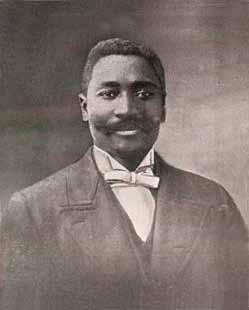
J.Vance Lewis is often cited as “Houston’s First Black Lawyer.”1 As incredible as that sounds, the title serves only as simple shorthand for the list of accomplishments Mr. Lewis achieved throughout his tenured life. J. Vance Lewis was born an enslaved person and, after emancipation, immediately secured multiple degrees at universities in both the post-war American South and North. He was licensed in Michigan and Illinois but chose to return to the South to represent people in need below the Mason-Dixon line. He was admitted to practice in Louisiana and Texas. Not only was he the first Black lawyer to
practice in Harris County, but he also first did so while securing a capital acquittal for another Black person. All of which were done in the early portions of his life and career.
While it would be impossible to review every chapter of Mr. Lewis’ extraordinary life, this article seeks to introduce readers to this unheralded leader in Houston’s legal history. The following extraordinary episodes from Mr. Lewis’ time exemplify the courage and resolve displayed by him and others during this formative period of Houston’s legal and cultural development.2
Historical Background
J. Vance Lewis was born and raised on a plantation in Terrebonne Parish, the southeastern corner of Louisiana. In his autobiography, Mr. Lewis wrote that his first exposure to a legal proceeding was on the sugar plantation of his birth.3 There, the recently emancipated laborers had to resolve an animal dispute. Mr. Lewis’ father, Doc Lewis, was appointed judge in this dispute and successfully resolved the matter through mindful questions and careful thought.
As rudimentary as the proceeding may have been, Mr. Lewis recognized the thoughtfulness his father had put into the matter. Doc Lewis passed away shortly after this episode. After his death, Mr. Lewis desired to uphold the perceptions he held of his father’s fairness and pursue a career in law.
To further this dream, J. Vance Lewis attended Leland University in New Orleans. Afterward, he taught in Orange and Lufkin, Texas, where he made enough money to continue his education at Lincoln University in Pennsylvania. While traveling throughout the Northeast, Lewis was astonished to find Black lawyers successfully litigating before white juries. After finishing his studies in Pennsylvania, Lewis studied law in Ann Arbor, where he graduated in 1894 and was admitted to the Supreme Court of Michigan. He continued his ravenous review of the law and
J. VanCe Lewis:
10 January/february 2024 thehoustonlawyer.com
a young, licensed, J. Vance Lewis e sq.5
pursued a subsequent law degree at the Chicago School of Law, where he graduated. Three years later, he was admitted to practice in Illinois.
early successes
In Illinois, Mr. Lewis quickly received his first case when a judge who had seen him observe the judge’s court recommended him to represent a needy criminal defendant.4 Mr. Lewis was introduced to John Donavan, a deeply prejudiced man, who refused to cooperate with his newly appointed Black counsel. Despite Lewis’ inability to retrieve a witness list or any evidence from his client, Lewis so thoroughly cross-examined the state’s witnesses that his spiteful client was found not guilty of murder.
J. Vance Lewis followed this initial win with a string of successes throughout the Northeast. Despite his success, Lewis longed for his home in the South. After a brief stint in his home state of
Louisiana, Lewis heard of a dynamic city along the bayou and decided to pursue his career in Houston, hanging his shingle in Houston’s lively Fourth Ward. In the midst of such a region lies the beautiful city of Houston, Texas, the garden spot of the world, nestled in the meshes of the bayous, whose banks are covered with fragrant mint and decorated with violets and giant magnolias. Nature did its best works here and I felt that I could do mine.6
Lewis’ Firsts in Houston’s Fourth ward
Upon arriving in Houston, J. Vance Lewis was engaged by two Black men, Max Harris and Jim Riley, who were facing the death penalty regarding a murder in Harris County. The district attorney of Harris County also approached Mr. Lewis, informing him that a Black lawyer had never appeared before the Harris County Bar. The district attorney hoped to intimidate him into taking a plea.7 After J. Vance Lewis spurned his
demands, the district attorney leaned into his prejudice throughout closing arguments.
Reflecting on this first Texas trial, J. Vance Lewis remembered, “If the District Attorney failed to carry out his threats it was certainly no fault of his... I have rarely heard a more stirring address to a jury. Every form of invective was used…He dwelt upon the cruelty and heartlessness of these men until it seemed that torment would be too good a place for them to go.”8 In response, Lewis utilized the same skills he had seen from his father as a boy in Louisiana. Confronting a jury of white faces as a Black man for the first time in Houston’s history, Lewis maintained calm, sensibility, and earnestness. He asked the jury only for fair play and begged them to treat the defendants as they would want to be treated.
After thirty-five minutes of deliberation, the jury returned with a verdict of not guilty. Not only was J. Vance Lewis

thehoustonlawyer.com January/february 2024 11
Houston’s First Black Lawyer, but in his first trial in a Harris County court, he also secured a verdict in favor of his Black clients faced with the death penalty.9 Max Harris and Jim Riley were free men.
Lion of the Hour: into the Jaws of Death
Following his unprecedented initial success, Mr. Lewis was inundated with work requests from across the country—Black and white. Of particular note is an astounding display of resolve and bravery in Liberty County.
In 1908, Lewis became employed by three Black men indicted in Liberty County. Upon his arrival, Lewis began his argument to the court regarding a motion to quash the indictment. In it, he argued that no Black men were included on the jury commission or the grand jury and, thus, any indictment was faulty. After his argument, an individual beckoned Lewis into the anteroom and threatened him, informing him that men were outside the courtroom ready to shoot him at a moment’s notice if he did not leave the city on the next train.
to conclude the trial. In response, Lewis agreed to return to the county that attempted to lynch him. When he did so, he secured a successful verdict for his clients. Regarding his decision to return to Liberty, the Industrial Era paper called him the “lion of the hour” for venturing back “into the jaws of death for a client.”12
Conclusion
‘‘
Following his unprecedented initial success, Mr. Lewis was inundated with work requests from across the country—Black and white.”
At this point, J. Vance Lewis was confronted with a choice. He could quietly relent to the demands of his attacker, or he could act. Mr. Lewis decided to alert the court of the “white cappers”10 who had gathered to attack him. The court promised his protection and the sheriff and his deputies escorted J. Vance Lewis to the train and accompanied him to Houston.
After his departure, Judge Hightower of Liberty County purportedly addressed the would-be mobbers, saying “[y]ou have done Liberty County more harm by refusing Lewis the legal rights the law has guaranteed him before this bar than a flood would do a growing crop in a year of prosperity.”11 Judge Hightower then begged Lewis to return
When I was in law school, there was a professor renowned for his theory that the jury system should be discarded. His position was not without basis or reason; he had dedicated his life to studying wrongful convictions, and he diligently came to his conclusions. He understood the massive impact of defective people magnified through an imperfect system. Out of my bright eyes and through a bushy tail, though, I refused to believe such sacrilege. The jury system was as sacred to me as the most basic tenants of our legal system.
Recently, I have reconsidered that professor’s position. As our media, our interests, and our circles grow smaller and smaller— infinitely more curated and individualized—I have questioned if there is a common thread strong enough to justify our current jury system. Without a bond of culture, duty, or love, what power binds us enough to keep the jury system (or any communal scheme) working effectively?
While researching J. Vance Lewis, I was struck by people’s enduring resolution to do what is right. It is immediately seen by Lewis himself, who, in a letter to his wife before returning into the “jaws of death,” wrote: I am going to Liberty to defend a poor unfortunate of my race, and I feel it my duty to go and repre-
sent him. I am of the opinion that my people need able counselors to defend them at the bar of justice in these United States…I want you to know that it is not ambition that causes me to go into the very jaws of death, but duty and the love of my fellow-man…This invitation may not be a decoy, but if it is I will make the best of it. If while in the courthouse I am unharmed, I will, my love, return to your arms, but should I be killed in doing my duty, I don’t want you to weep. I want you to remember that my death may be the salvation of my people in the courts of the South.13
Mr. Lewis wrote continuously of the threads of goodness that surrounded his life. While not as immediately courageous as Lewis’ own actions, it’s important to remember the bravery of the jurors that sided with him during his first cases in Houston. These were men in the heart of the Jim Crow South, immediately after the Civil War, who denied the prejudice around them to further justice for their Black neighbors. A cynic may rightfully claim these jurors were doing the jobs they should have always done. J. Vance Lewis, though, had great faith in a world that had not always been fair. While consoling a Black client indicted with the murder of her white assailant, Mr. Lewis told her to, “[r]emember that you are to be tried by reasonable men, and men that believe virtue, purity, sanctity of home...you can and will go to their hearts and be a free woman.”14 Sure enough, Mrs. Jackson was found not guilty of the murder of her abuser. If J. Vance Lewis can believe in reasonable men, so can I.
This sense of duty was mirrored in Liberty County, where Lewis escaped with his life from an angry mob. When Mr. Lewis decided to alert the court of the “white cappers” who had gathered to attack him, Sherriff Cherry of Liberty County “immediately summoned his deputies” and “other citizens” to protect Mr. Lewis, saying that he was duty
12 January/february 2024 thehoustonlawyer.com
bound to this office and would “die in his boots in defense of that office.”15 J. Vance Lewis was escorted safely to the train, where concerned citizens and officers rode with him back to Houston.16
I am reminded that it takes a great deal of bravery to address our enemies, but also a great deal of courage to stand up to our friends. I am glad there were those strong enough to follow Mr. Lewis’ extraordinary example in the furtherance of our country’s liberties.
The story of J. Vance Lewis, to me, is a hopeful and inspiring one. This is chiefly because of the resolve and fortitude shown by Mr. Lewis himself. But it’s also because of the mirroring commitment to goodness and duty that was reflected back to him by those around him. It refracts a positive light on a contemporary environment that feels so dark and hopeless sometimes.
In 1908, after an arduous 15 years of litigating, J. Vance Lewis secured gubernatorial pardons of two Black men who had been found guilty of murder. On Christmas Day of that year, more than 1,000 people came to see the three men’s train steaming into Corsicana. Through his own tears and the joyous shrieks of the men’s families, Mr. Lewis handed the boys to their mothers and said, “I am your Santa Claus by law; take your present in God’s name.”17 This past holiday season, as I researched and wrote this article, J. Vance Lewis offered me the best present I could have asked for. Learning about Mr. Lewis and others who were dedicated to character, duty, and faith— from a time as caustic as our own—was a wonderful experience.

endnotes
1. For a fuller review of J. Vance Lewis’ life, please see his autobiography Out of the Ditch: A True Story of an Ex-Slave, which is out of print but is available at the Kindle E-Reader Store and through University of North Carolina’s free online resource at https://docsouth.unc.edu/neh/lewisj/lewisj.html.
2. Id
3. Lewis, supra note 2, at Ch. 2–3.
4. Regarding this appointment and his early career, Lewis’ words continue to ring true more than a hundred years later: “A friend on the bench is invaluable to a young lawyer.” LEWIS, supra note 2, at 33.
5. Lewis, supra note 2, Frontispiece Image.
6. Lewis, supra note 2, at 73.
7. This District Attorney told Mr. Lewis, “You had better plead guilty... and the jury will give them short terms, but if you don’t, I’ll see to it that they go to the pen for life.” After Mr. Lewis rebuffed his threat, the District Attorney replied “If you clear... I will eat my hat and resign the District Attorneyship and see that you serve the State the balance of my term.” LEWIS, supra note 2, at 74. It is unclear whether or not Mr. Lewis declined the man’s attorneyship or whether the offer was revoked. The status of the man’s hat is equally unknown to this author.
8. The District Attorney’s racist language is not included here. Lewis, supra note 2, at 75.
9. Lewis, supra note 2, at Ch. 9.
10. Lewis, supra note 2, at 110.
11. Lewis, supra note 2, at 113.
12. Lewis, supra note 2, at 112.
13. Lewis, supra note 2, at 114.
14. Lewis, supra note 2, at 78.
15. Lewis, supra note 2, page 110.
16. Lewis, supra note 2, at 110; see also J. Vance Lewis, Negro Lawyer Gets Scare, THE LIBERTY VINDICATOR, March. 13, 1908.
17. Lewis, supra note 2, at 116

George “Trey” Gifford III
III is a second-year associate at Crain Caton and James, working in the fiduciary and probate litigation department. He is a member of the HBA Historical Committee.

You wanted fast, convenient, reliable Texas legal malpractice insurance, with exceptional customer service, online applications, 24-48 hour turnarounds and continually prompt service. We listened. Be Heard. TLIE.ORG or (512) 480-9074 12/1/23 6:17 PM thehoustonlawyer.com January/february 2024 13
FAST.
By ryan a. CunninGham
l. sharman
“Van C Ourt”:
J. Vance Lewis House Serves as a Symbol of Progress, Culture, History, and Hope

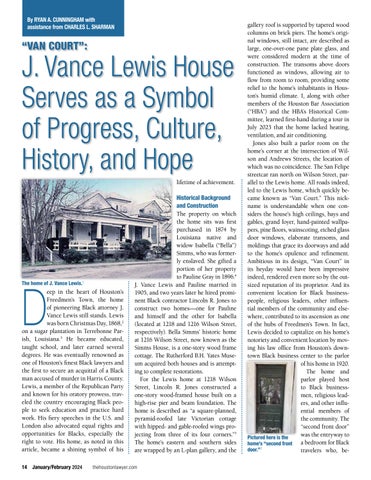
Deep in the heart of Houston’s Freedmen’s Town, the home of pioneering Black attorney J. Vance Lewis still stands. Lewis was born Christmas Day, 1868,2 on a sugar plantation in Terrebonne Parish, Louisiana.3 He became educated, taught school, and later earned several degrees. He was eventually renowned as one of Houston’s finest Black lawyers and the first to secure an acquittal of a Black man accused of murder in Harris County. Lewis, a member of the Republican Party and known for his oratory prowess, traveled the country encouraging Black people to seek education and practice hard work. His fiery speeches in the U.S. and London also advocated equal rights and opportunities for Blacks, especially the right to vote. His home, as noted in this article, became a shining symbol of his
lifetime of achievement.
Historical Background and Construction
The property on which the home sits was first purchased in 1874 by Louisiana native and widow Isabella (“Bella”) Simms, who was formerly enslaved. She gifted a portion of her property to Pauline Gray in 1896.4 J. Vance Lewis and Pauline married in 1905, and two years later he hired prominent Black contractor Lincoln R. Jones to construct two homes—one for Pauline and himself and the other for Isabella (located at 1218 and 1216 Wilson Street, respectively). Bella Simms’ historic home at 1216 Wilson Street, now known as the Simms House, is a one-story wood frame cottage. The Rutherford B.H. Yates Museum acquired both houses and is attempting to complete restorations.
For the Lewis home at 1218 Wilson Street, Lincoln R. Jones constructed a one-story wood-framed house built on a high-rise pier and beam foundation. The home is described as “a square-planned, pyramid-roofed late Victorian cottage with hipped- and gable-roofed wings projecting from three of its four corners.”5 The home’s eastern and southern sides are wrapped by an L-plan gallery, and the
gallery roof is supported by tapered wood columns on brick piers. The home’s original windows, still intact, are described as large, one-over-one pane plate glass, and were considered modern at the time of construction. The transoms above doors functioned as windows, allowing air to flow from room to room, providing some relief to the home’s inhabitants in Houston’s humid climate. I, along with other members of the Houston Bar Association (“HBA”) and the HBA’s Historical Committee, learned first-hand during a tour in July 2023 that the home lacked heating, ventilation, and air conditioning.

Jones also built a parlor room on the home’s corner at the intersection of Wilson and Andrews Streets, the location of which was no coincidence. The San Felipe streetcar ran north on Wilson Street, parallel to the Lewis home. All roads indeed, led to the Lewis home, which quickly became known as “Van Court.” This nickname is understandable when one considers the house’s high ceilings, bays and gables, grand foyer, hand-painted wallpapers, pine floors, wainscoting, etched glass door windows, elaborate transoms, and moldings that grace its doorways and add to the home’s opulence and refinement. Ambitious in its design, “Van Court” in its heyday would have been impressive indeed, rendered even more so by the outsized reputation of its proprietor. And its convenient location for Black businesspeople, religious leaders, other influential members of the community and elsewhere, contributed to its ascension as one of the hubs of Freedmen’s Town. In fact, Lewis decided to capitalize on his home’s notoriety and convenient location by moving his law office from Houston’s downtown Black business center to the parlor of his home in 1920. The home and parlor played host to Black businessmen, religious leaders, and other influential members of the community. The “second front door” was the entryway to a bedroom for Black travelers who, be-
with assistance from Charles
the home of J. Vance Lewis.1
Pictured here is the home’s “second front door.” 7
14 January/february 2024 thehoustonlawyer.com

cause of Jim Crow laws, were not allowed to stay in hotels. The elegant main front door welcomed J. Vance Lewis’ clients, confidants, and others who either sought Lewis’ counsel or merely wanted to make an appearance at “Van Court.”
In its time, “Van Court” also stood as a bastion of professional and cultural defiance. The members of “Van Court” blazed the trail for Black-owned businesses, discussing the arts, philanthropy, politics, the law, oppression, and most importantly, the path forward. Lewis continued to practice law at “Van Court,” but also supported the community’s economic interests. For example, he co-founded the Lone Star State Bar Association and the Twentieth Century State Bank and Trust Company of Houston, joined the Colored Commercial Club, supported Black-owned businesses, and ran for criminal district judge in 1920.
J. Vance Lewis died on April 24, 1925 and was buried in Olivewood Cemetery.8 His widow, Pauline, continued to live in “Van Court” after his death. She remarried twice—first to a fellow teacher, Leonce Lubin, and then to Samuel B. Byars, a welder. Pauline died the day after Christmas in 1963.
Pauline bequeathed “Van Court” to her close friend, Johnnie Route, who she thought of as a son. Routte then sold the property in 1966 to Joseph M. Fillipone, whose family used the home as a rental property for 41 years.9 In 1985, the home was designated as a “contributing property of high significance” in the Freedmen’s Town National Register Historic District.10 The Rutherford B.H. Yates Museum purchased the J. Vance Lewis home in 2007.11
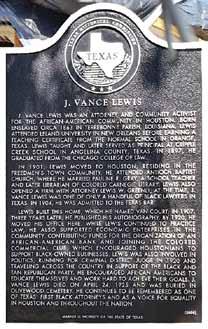
That same year, the home achieved City of Houston Protected Landmark designation status12 and received a Texas Historical Commission marker.13
efforts to Preserve and restore “Van Court” to Glory
The years have not been kind to “Van Court” or other structures in Freedmen’s Town. Unfortunately, due to natural wear and tear and neglect by previous owners, “Van Court” fell into disrepair. For example, the home’s foundation piers have deteriorated significantly over the years, and roof leaks have damaged sections of the interior. “Van Court” is thus in dire need of restoration and preservation. Fortunately, such efforts are well underway, as thanks to the Rutherford B.H. Yates Museum’s dedicated team, devoted volunteer citizens, local students, and the museum’s staff have already commenced a daunting restoration task. Nonetheless,

much more help is needed.
As part of the “Building Racial Bridges Capital Campaign,” the Rutherford B.H. Yates Museum is spearheading efforts to raise capital to ensure the restoration and preservation of the J. Vance Lewis home, as well as other historical landmarks in Freedmen’s Town.15
While restoration and preservation efforts are proceeding, the home’s historical landmark designations make these efforts more expensive. As a result, the museum needs to continue fundraising to restore this historical home to its place as a shining symbol of hope.
 above: photograph from the corner of wilson and andrews streets, showing the old san Felipe streetcar tracks leading to “Van Court.” 6
thehoustonlawyer.com January/february 2024 15
Lewis Home renovations14
‘‘
While restoration and preservation efforts are proceeding, the home’s historical landmark designations make these efforts more expensive.
The restoration process involves meticulous research, architectural planning, and skilled craftsmanship. It is a labor of love to ensure that every detail of the original structure is restored and preserved. From the intricate woodwork to the ornate detailing, every effort is being made to bring back the home’s original charm and appeal. The museum has also partnered with the Prairie View A&M School of Architecture program and local schools so that students can learn about the history of Freedmen’s Town and help in the restoration process. One such group donated their time (and labor) to help restore original wooden beams, work that included countless hours of scrubbing with tools and even toothbrushes so as not to disturb the original wood.
As a result, the museum needs to continue fundraising to restore this historical home to its place as a shining symbol of hope.”
The restoration efforts not only aim to revive the home’s physical structure, but also to preserve the stories and memories associated with the home. The home serves as a reminder of Houston’s past and the people who shaped its history. By rebuilding and saving “Van Court,” dedicated individuals are not only honoring the architectural heritage of Houston, but also creating a space for future generations to learn from and appreciate. The home and the efforts to restore it are testaments to the community’s dedication to preserving its history and creating a vibrant future.
While the restored home will pay homage to J. Vance Lewis, the great man who
built it, the house will serve primarily as a museum of legal professionals and educators. And the home, once restored, will yet again stand as a beacon of hope for a brighter and more inclusive future.
You can book a tour of the J. Vance Lewis home, as well as the other historic Freedmen’s Town homes, at https://freed menstownmuseums.org/tour-our-historicproperties/. To donate to the J. Vance Lewis home’s restoration, please visit www.rbhy. org or email rbhyates@gmail.com

Ryan A. Cunningham focuses his practice at Locke Lord on construction and commercial litigation/ arbitration, as well as real estate and contract drafting/negotiation. He moved from New York City to Houston at the age of 11, and is a graduate of Memorial High School, The University of Texas at Austin, and South Texas College of Law Houston. He has been named a Texas Rising Star by Super Lawyers, a top lawyer by U.S. News & World Report’s Best Lawyers and Houstonia Magazine. He is a member of the HBA Historical Committee.
Charles L. Sharman practices commercial litigation at Bradley Arant Boult Cummings LLP in the firm’s Houston office. He was born and raised in Houston, received his bachelor’s degree in art history, with a minor in English, from Trinity University (San Antonio), and received his law degree magna cum laude from Marquette University Law School. He is a member of the HBA Historical Committee.
endnotes
1. See FREEDMEN’S TOWN MUSEUMS, HTTPS://FREEDMENSTOWNMUSEUM.SQUARESPACE.COM/LEWISHOUSE (last visited January 2, 2024).
2. DOB 1868 based upon his death certificate, 1869 on his passport, and 1863 in JVL’s book. Some slaveholders set birthdates.
3. For more information on J. Vance Lewis, see the article by George “Trey” Gifford III herein.
4. Isabella Simms, already widowed at the time, purchased the properties on Wilson Street in 1874. According to the 2007 Protected Landmark Designation Report, Simms purchased these proper-
ties after being encouraged by her pastor, Reverend Jack Yates of the Antioch Baptist Church. Simms worked as a domestic servant to several prominent families. Prior to his death, her husband, Charles Simms, worked as a wood hauler. Simms continued to save money after her husband’s death, gave her savings to Reverend Yates, and Reverend Yates conducted the purchase for her. Reverend Yates also paid the taxes on the property until his death in 1897, when the deed was returned to Simms. After Simms’ death in 1915, the Lewis family used the home in 1916 as a rental property. See City of Houston Archaeological and Historical Commission, Protected Landmark Designation Report (Jun. 27, 2007), https://www.houstontx. gov/planning/HistoricPres/landmarks/07PL43_J-Vance_Lewis_House_1218_Wilson.pdf.
5. See Protected Landmark Designation Report.
6. See HISTORICAL MARKER DATABASE, https://www.hmdb. org/PhotoFullSize.asp?PhotoID=579319 (last visited January 1, 2024).
7. The museum has saved three houses that have two front doors. Into the 1960s, Black people traveling to Houston were not allowed to stay in a hotel. Some travelers were directed to Freedmen’s Town to look for a house with “two front doors.” Homes with two front doors were homes of families who provided lodging in one room of their homes. Traveling lodgers who stayed with Freedmen’s Town two-front-door families included visiting ministers, merchants, and entertainers. These historic doors are a major part of the restoration efforts. Each door costs between $1,800 and $5,000 to restore. Each historic window costs between $5,000 and $8,000 to restore. All these doors and windows are painted with lead paint; thus, they need to be sent to a qualified restoration workshop with special equipment to remove the paint and restore the wood to its original varnished finish, before reinstalling into these homes. The J. Vance Lewis home specifically needs to purchase and restore its main front entry door. The second front door is still original but needs restoration.
8. FamilySearch (https://familysearch.org/ark:/61903/1:1:VZDN4F5 : 24 May 2014), J. Vance Lewis, 24 Apr 1925; from “Texas, Death Index, 1903-2000 database.”
9. Harris County Deed Records: File Number: C368944/ Film Code Number: 059330938. (September 6, 1966).
10. Texas Historical Commission Historic Resources Library, https://www.thc.texas.gov/public/upload/preserve/ survey/ survey/survey%20catalog%202021%2008%2006.pdf.
11. Harris County Deed Records: File Number: 20070068457/ Film Code: RP038910673 (February 2, 2007).
12. Houston Office of Preservation (HOP) https://www.houstontx. gov/planning/HistoricPres/historic_landmarks.html.
13. The Historical Marker Database: https://www.hmdb.org/m. asp?m=170863.
14. See FREEDMEN’S TOWN MUSEUMS, HTTPS://FREEDMEN STOWNMUSEUM.SQUARESPACE.COM/LEWISHOUSE (last visited January 2, 2024).
15. The “Building Racial Bridges $7,500,000 Capital Campaign 2021-2025” is a 14-project initiative to create an African Heritage International Research, Education, and Tourism destination for Texas. The museum complex is located in Freedmen’s Town National Register Historic District-4th Ward, Houston, Texas. Projects include preservation and restorations of eight museum houses on 13 archaeology sites, as well as an historic plant green house/tea room. Archaeology field methods research investigations have been conducted by Rice University, Houston Community College, the University of Houston, and Lone Star College and have produced thousands of 19th & 20th century artifacts that demonstrate the economic progress, migration patterns, and cultural global connections of this marginalized population that lived during the Jim Crow era. The Rutherford B.H. Yates Museum will continue to provide tours, field trips, student internships, and archaeology field courses. The museum will also conduct educational programs in the restored historic houses and churches in partnership with the Alley Theatre, law schools, and universities. Visitors will enjoy the meticulously preserved and restored museums while learning about the historic contributions of formerly enslaved families and their descendants. For more information contact: rbhyates@gmail.com or visit www.rbhy.org
16 January/february 2024 thehoustonlawyer.com
By r. miChelle Boldon
a C O uraG eO us Pursuit:
Houston’s First African American Attorneys
“W
e create our future, by well improving present opportunities however few and small they are,” said Lewis Howard Latimer, a late nineteenth-century and early twentieth-century inventor. As an engineer, Latimer understood how ingenuity, resolve, and creativity could propel transformation.
Nicknamed by historians as the “Renaissance Man,” Latimer, a Black man, thrived as an inventor, skilled draftsperson, poet, and pioneer during the Reconstruction era following the Civil War. Latimer’s innovation and determination is a great depiction of the resilience and fortitude Houston’s first-generation African American attorneys must have possessed. Houston’s first-generation Black attorneys were trailblazers in the South during the same time Latimer was carving out his place in history, a turbulent period in America’s history when the lives of many African Americans were drastically altered as they sought to bring meaning to their newfound freedom.
Regrettably, much of the history of Houston’s first-generation African American attorneys was not recorded, and minimal scholarship has been dedicated to the research and telling of the important stories of these early lawyers. Details such as birthplaces, birth dates, their early years, and the dates of milestones, such as when a lawyer was admitted to practice law, may be lost in the annals of time. The information that has been preserved, however, reveals the important roles these first-generation attorneys played in Houston’s history.
Like other cities in the post-Civil War and Emancipation Proclamation era, Houston had to learn to navigate the unchartered territory of a new social, cultural, and political order. After June 19, 1865, two and half
years after the Emancipation Proclamation, 250,000 enslaved Black people in Texas were free by executive decree when Union troops landed in Galveston, Texas and announced U.S. Major General Gordon Granger’s General Order No. 3, which pronounced that all enslaved people in Texas were now free.1 After Granger’s announcement, some of the newly freed African Americans moved to Houston, which was still segregated at that time. These new residents formed Houston’s first African American community, Freedmen’s Town, just southwest of downtown along the south bank of Buffalo Bayou, which is part of Houston’s Fourth Ward
today. Throughout the 1880s and 1890s, Freedmen’s Town became the cultural, economic, and professional center for the African American community. It housed the first Black churches, schools, and political organizations and, by the early twentieth century, most African American physicians and attorneys worked and resided in Freedmen’s Town.
J. Vance Lewis migrated to Houston after earning a law degree in Michigan in 1894, graduating from law school in Chicago in 1897, and practicing law in other parts of the country. Lewis was the first African American lawyer to successfully defend an African American client in a murder trial before a Harris County jury (of note, until the 1950s, jurors in Harris County were exclusively white men).2 In his autobiography,3 Lewis recounts how the district attorney threatened and addressed Lewis in a derogatory manner, giving readers an idea of the courage it took for an African American to practice law in those times and to stand true to their convictions.4
Lewis’ contemporaries included L.W. Greenly, George Olympus (G.O.) Burgess,

thehoustonlawyer.com January/february 2024 17
Winston M.C. Dickson, A.G. Perkins, M.H. Broyles, J.M. Adkins, and L.V. Allen, who were among the attorneys who represented Houston’s African American population of approximately 30,000.5
In his autobiography, Lewis writes that L.W. Greenly was a “brilliant young man.”6 When Lewis moved to Houston, he began his law practice after forming a partnership with Greenly. Greenly practiced in other jurisdictions, as well. The Brenham Daily Banner published in its September 5, 1900 issue that Greenly assisted John C. Cain, the only African American in the Brenham bar, in representing a defendant in the district court, the first instance where an African American attorney appeared before the county’s district court.7 Greenly also practiced in San Antonio, where his court appearances, like those of other attorneys of the time, were often documented in local newspapers. For example, the October 28, 1911 edition of the San Antonio Express described Greenly’s representation of a client in a criminal matter.8
G.O. Burgess (1876–1950) was born on March 15, 1876, in Millican, Brazos County, Texas.9 Burgess was admitted to the bar after attending Sprague School of Law in Detroit, Michigan. In 1906, Burgess began practicing law in Palestine, Texas, and, in 1913, relocated to Houston, where he continued his law practice in Houston.10 He resided in, and was elected as the first mayor of, Independence Heights, the first African American municipality established in Harris County.11
Winston M.C. Dickson attended Tillotson College in Austin, Texas and then Pomona College in Claremont, California. Dickson was the first African American graduate of any college or university in Southern California.12 He earned a Bachelor of Jurisprudence in 1905 from Harvard Law School and a Master of Jurisprudence in 1907 from Boston University.13 Dickson was prominent in the community and was known as one of the most well-respected African American attorneys in Houston during his 50 years of practicing law. Dickson mainly handled divorce and probate cases in his practice. Dickson, along with the founders of the Houston Lawyers Association (“HLA”), challenged the Houston Bar Association (“HBA”) when the HBA did not allow Black lawyers to join.14 The HLA was founded as a result
of this prohibition and continues to pursue its mission of ensuring equality and justice and providing a voice for the community through advocacy, mentoring, professionalism, and coalition-building.15
A brief biography of A.G. Perkins is included in The Red Book: A Compendium of Social, Professional, Religious, Education and Industrial Interests of Houston’s Colored Population16 (“The Red Book”). The Red Book was published only once, by Sotex Publishing Company, and is a directory of professionals, educators, schools, businesses, restaurants, clubs, lodges, pastors, and churches in Houston’s African American community existing in 1915. As noted in The Red Book, Perkins was the valedictorian of his class at Central High in Galveston, Texas, after which he continued his studies at Bishop College in Marshall, Texas before being admitted to practice law in 1900. Along with his law practice, Perkins had a land and loan business, with offices in Houston and Galveston.
M.H. Broyles was born in Anderson County, South Carolina, on November 10, 1863. He graduated with honors from Claflin University, South Carolina Agricultural College and Mechanics’ Institute on May 23, 1888. Broyles was admitted to the Texas Bar on August 12, 1905.
There is not much information available about attorneys J.M. Adkins and L.V. Allen. Their law firms are listed in the classified sections of the newspaper publications of their day and, on occasion, the local paper would report on daily life, like their attendance at civic or club meetings. For example, J. M. Adkins was praised for a speech he gave at a corner stone laying ceremony for Houston Academy, an African American school;17 Allen has an advertisement in the January 19, 1924 edition of The Houston Informer;18 and the October 14, 1910 edition of The Houston Daily Post reported that M. H. Broyles was unanimously elected by the African American community who supported the city’s deep waterway project.19 Original files of the cases where Adkins and Allen made appearances in Harris County courts, as well as the original case files of the above-mentioned attorneys, are available for viewing at the Harris County District Clerk’s Charles Bacarisse Historical Documents Room.
William A. (W.A.) Price must also be in-
cluded among the ranks of the above attorneys, although Price practiced outside of Houston in Fort Bend County during Reconstruction—before J. Vance Lewis and many of the other attorneys discussed above began practicing law in Houston. Price is widely considered to be Texas’ first African American lawyer.20 (A case could possibly be made for Allen W. Wilder to hold this distinction, though it would likely be unsuccessful. The 1870 census identified Wilder as a mechanic or engineer, but by the 1880 census, he was identified as a lawyer. However, neither the date on which Wilder became a lawyer, nor the place where he received his legal education, is known. Strong support exists nevertheless, as Wilder was in an election for the office of “presiding justice” in February 1876.)21
Like the other African American lawyers during W.A. Price’s time, little is known about Price’s early years. However, it is known that Price was born a free man in 1848 and was of African American and Native American heritage. He was formally educated at Wilberforce University in Xenia, Ohio before migrating to Texas. Price initially landed in Matagorda County in October 1873, around the time of the collapse of Reconstruction and less than a decade after General Granger’s order was announced in Galveston. Price later relocated to Fort Bend County and was elected Fort Bend County Attorney in 1877, becoming the first African American county or district attorney. Price was also Texas’ first African American judge. Price later relocated to Kansas and, in 1888, he became the first African American elected to the Kansas State Legislature. While in Kansas, Price handled several civil rights matters in his practice, notably, Price was cocounsel to the plaintiffs in Knox v. Board of Education of the City of Independence, where Price argued against school segregation, a prelude to Brown vs. Board of Education (1954). Price was victorious in Knox, a case that was instrumental in the fight for integration and against the disparities caused by school desegregation.
Houston’s first-generation African American lawyers, along with Ford Bend County’s W.A. Price, created a foundation on which future lawyers could stand. They improved their present opportunities by audaciously pursuing the practice of law despite the challenging environment in which they had
18 January/february 2024 thehoustonlawyer.com
to practice. These attorneys were leaders in their communities and were accomplished in other areas outside of the legal field. Several of these attorneys were educators, entrepreneurs, and activists, and some even held public office. A.G. Perkins was an economist and involved in several civic organizations. Perkins also was United States inspector of customs, connected with the United States Census Department at Galveston in 1900 and the United States Census Department at New York City in 1910, and involved in several civic organizations.22 J. Vance Lewis practiced medicine, and G.O. Burgess was an elected official.
Despite the scarce information about these early lawyers, their legacies and the important roles they played in Houston’s legal community are undeniable. They practiced law during the oppressive Jim Crow era, when discrimination based on race was legal and indignities against African American lawyers abounded, and when the number of potential clients, as well as the type of law they could practice, was limited. Yet, they practiced law with pride and integrity.23 Their audacity and resilience would inspire future lawyers, like African American barrister Robert W. Hainsworth, who challenged the Harris County Law Library’s “one chair” rule, which allowed Black lawyers to use only one particular chair at the library,24 as well as the rule that all “Black cases” be handled at the end of the court’s docket, which often resulted in having their cases heard late at night.25 The opportunities that were present for those first-genera-
tion attorneys were indeed few and limited, but these trailblazers persisted and helped to transform and create a better future for the bar and the Houston community.

R. Michelle Boldon, a native Houstonian, is an IT consultant turned attorney and a member of the HBA Historical Committee. She is in-house counsel at MEGlobal Americas Inc., one of the world’s largest producers of ethylene glycol.
endnotes
1. Galveston Historical Foundation, Juneteenth and General Orders, No. 3, https://www.galvestonhistory.org/news/juneteenth-and-general-order-no-3 (last visited Jan. 29, 2024).
2. Michael Hagerty, Texas’ First Woman Juror Was in Harris Co. in 1954 – So Why Did it Take So Long?, HOUSTON MATTERS, Aug. 7, 2014, available at https://www.houstonpublicmedia. org/articles/shows/houston-matters/2014/08/07/209960/ texas-first-woman-juror-was-in-harris-co-in-1954-so-whydid-it-take-so-long/.
3. J. VANCE LEWIS, OUT OF THE DITCH: A TRUE STORY OF AN EX-SLAVE (REIN & SONS CO., 1910), available at https:// docsouth.unc.edu/neh/lewisj/lewisj.html (hereinafter “Out of the Ditch”).
4. See J. Vance Lewis: The Astounding Impact of “Houston’s First Black Lawyer” and VVan Court: The J. Vance Lewis House Serves as a Symbol of Progress, Culture, History, and Hope.
5. Patricia Prather, Lewis, Joseph Vance (1863–1925), TEX. ST. HIST. ASS’N (Nov. 6, 2013), available at https://www.tshaonline.org/handbook/entries/lewis-joseph-vance.
6. Out of the Ditch at 73.
7. A Day in the Courthouse, THE BRENHAM DAILY BANNER (Sept. 5, 1900), available at https://texashistory.unt.edu/ ark:/67531/metapth483430/m1/1/zoom/?q=%22L.%20W.%20 Greenly%22&resolution=3&lat=6530.6364038241245&l on=4732.195490435069.
8. SAN ANTONIO EXPRESS (Oct. 28, 1911), available at https:// texashistory.unt.edu/ark:/67531/metapth431767/m1/18/ zoom/?q=%22L.%20W.%20Greenly%22&resolution=4&lat=5 627.253998733154&lon=2853.9833528211207.
9. Robert J. Duncan, Burgess, George Olympus (1876–1950), TEX. ST. HIST. Ass’n (updated Aug. 30, 2022), available at https://

www.tshaonline.org/handbook/entries/burgess-george-olympus.
10. THE RED BOOK: A COMPENDIUM OF SOCIAL, PROFESSIONAL, RELIGIOUS, EDUCATION AND INDUSTRIAL INTERESTS OF HOUSTON’S COLORED POPULATION 107 (Sotex Pub. Co. 1915), available at https://archive.org/details/ redbookofhouston00sote/page/106/mode/2up?q=burgess (hereinafter “The Red Book”).
11. The Red Book at 107.
12. Saahil Desai, The Erasure of Winston M.C. Dickson: Inside the Forgotten Life of Pomona’s First Black Graduate, MEDIUM (Dec. 19, 2015), https://medium.com/@saahil_desai/the-erasure-ofwinston-m-c-dickson-d459d67796ae.
13. Id
14. Eric L. Fredrickson, A COMMITMENT TO PUBLIC SERVICE: THE HISTORY OF THE HOUSTON BAR ASSOCIATION (GULF PUBLISHING COMPANY, 1992) at 78.
15. See HOUSTON LAWYERS ASSOCIATION, https://houstonlawyersassociation.org/history (last visited February 6, 2024).
16. The Red Book at 142.
17. The Houston Post. (Houston, Tex.), Vol. 21, No. 52, Ed. 1 Saturday, May 6, 1905, newspaper, May 6, 1905; (https://texashistory.unt.edu/ark:/67531/metapth603236/m1/8/: accessed February 5, 2024), University of North Texas Libraries, The Portal to Texas History, texashistory.unt.edu
18. Available at Richardson, Clifton F. The Houston Informer (Houston, Tex.), Vol. 5, No. 35, Ed. 1 Saturday, January 19, 1924, newspaper, January 19, 1924; Houston, Texas. (https://texashistory.unt.edu/ ark:/67531/metapth1637452/: accessed February 1, 2024), University of North Texas Libraries, The Portal to Texas History, https:// texashistory.unt.edu; crediting Rice University Woodson Research Center.
19. The Houston Post (Houston, Tex.), Vol. 26, Ed. 1 Friday, October 14, 1910, newspaper, October 14, 1910; Houston, Texas. (https://texashistory.unt.edu/ark:/67531/metapth605075/ m1/3/?q=%22M.%20H.%20Broyles%22: accessed February 1, 2024), University of North Texas Libraries, The Portal to Texas History, https://texashistory.unt.edu.
20. John G. Browning & Chief Justice Carolyn Wright, Undaunted: William A. Price, Texas’ First Black Judge and the Path to a Civil Rights Milestone, 43 T. MARSHALL L. REV. 583, [pincite] (Spring 2019).
21. John G. Browning and Chief Justice Carolyn Wright, Unsung Heroes: The Earliest African-American Lawyers in Texas, 77 TEX. BAR J. 11, 960–63 (Dec. 2014).
22. The Red Book at 143.
23. Saahil Desai, The Erasure of Winston M.C. Dickson: Inside the Forgotten Life of Pomona’s First Black Graduate, MEDIUM (Dec. 19, 2015), https://medium.com/@saahil_desai/the-erasure-ofwinston-m-c-dickson-d459d67796ae.
24. H.C.R. No. 206 (2005), available at https://capitol.texas.gov/ tlodocs/79R/billtext/pdf/HC00206F.pdf.
25. Id.; Desai, The Erasure of Winston M.C. Dickson

thehoustonlawyer.com January/february 2024 19
By dave louie
The Many Titles of Tasha Schwikert Moser

Olympic Medalist. World Champion. College Athlete. Stuntwoman. Agent. Lawyer. Survivor and Survivors’ Advocate. Wife and Mom. These are all titles that Tasha Schwikert Moser has earned throughout her life. At 39, and now living in Houston, the Las Vegas native and former Olympic gymnast has had two accomplished careers and dabbled in a third and fourth. Tasha graciously sat down to discuss her life, past and present.
Olympic Medalist
Tasha’s journey to earning an Olympic medal started at two years old. Her mom, Joy Schwikert, was a former professional tennis player who competed in storied events, such as the French and Australian Opens.1 Joy wanted gymnastics to
be a placeholder until she could teach Tasha tennis. But a mother’s best laid plans sometimes go awry. Tasha loved gymnastics and disliked tennis. The adrenaline and competitive successes drew Tasha in.
Tasha was driven, but level-headed. She recalls just how grounded she was: “I remember being seven years old and friends and family telling me I would eventually compete in the Olympics. I would remind them that there were only seven girls on the Olympic team.” Where others might let the praise go to their head, Tasha remained disciplined, focusing on the goals in front of her. “I just tried to be the best at each level of competition,” she says.
The journey of a would-be-Olympian is physically and mentally grueling. Tasha estimates that an Olympic gymnast’s prime is between sixteen and nineteen years old, with most girls competing while still in high school. Gymnastics has an ever-present risk for injury, with slim margins for error. “Everything has to have perfect timing. If you’re tumbling on the beam and are slightly off, you will be completely thrown off of the beam. People don’t appreciate the danger involved in gymnastics,” she explains. These razor-thin margins exact a toll over time. Able prospects are lost to injury. The lifestyle can also be mentally taxing, causing some gymnasts to burn out from the exhausting pace of training, while trying to maintain a semblance of teenage life. Tasha, however, endured it all. Unsurprisingly, she says she thrives under pressure and is not wired to fail or give up. “Fear of failure is a driver,” she says.
In 2000, the combination of Tasha’s talent, hard work, and endurance paid off. She was invited to the 2000 Olympic games in Sydney with the USA Gymnastics (“USAG”) team, beginning as an alternate. Tasha prepared meticulously, remaining consistent throughout practices by hitting her routines. Her consistency propelled her into competition after a teammate was injured. The Olympic stage was an intense and surreal environment, with a sea of worldwide fans screaming and waving the U.S. flag. Tasha says it felt like having the weight of the world on her shoulders, but her ability to thrive
20 January/february 2024 thehoustonlawyer.com
under pressure exacted her focus on the competition. This approach helped her post strong scores in three of four events. Tasha and the USAG team eventually secured bronze medals.
world Champion
The 2000 Olympic games were just the start. Tasha continued competing at an all-world level, helping lead the U.S. team to a bronze medal at the 2001 World Artistic Gymnastics Championships in Ghent.2 But that was only a precursor to what Tasha recounts as one of the biggest highlights of her gymnastics career.
In 2003, Tasha captained the U.S. team at those same World Championship games, this time in Anaheim, California. Injuries had decimated the team, leaving only five members to compete instead of the usual six. Under normal circumstances, the lowest of the six scores is dropped, leaving the team with a slight margin for error. With only five members competing, all five teammates had to be mistake-free. In the face of adversity, the team rose to the occasion, earning the U.S. its first-ever gold medal in the World Championships.3
College athlete
In the fall of 2004, Tasha enrolled at the University of California, Los Angeles (“UCLA”) on a full athletic scholarship. The decision was a zag. Tasha says most Olympians turned pro rather than pursuing college because of the lesser collegiate competitive landscape at the time.
Tasha quickly dominated the competition, winning the NCAA National Championships all-around title in her first year. Injuries marred her 2005-2006 season, but Tasha persevered, triumphantly returning in her junior year to win the PAC-10 all-around title, gold medals for the floor exercise, balance beam, and vault, and the distinction of PAC-10 and West Region Gymnast of the Year. But Tasha was not done. In her senior year, she won her second all-around title at the 2008 NCAA National Championships, capping a storied collegiate career. She was later inducted into the UCLA Hall of Fame and was named Pac-12 Gymnast of the Century.4 Tasha fondly reflects on her
time in college. She loved competing, the camaraderie with her teammates, and being a UCLA Bruin.
stuntwoman and agent
After graduating, Tasha simultaneously dabbled in two new careers. She was recruited to work as an actress and stunt double on the ABC Family show Make It or Break It and spent the next two years working on the family drama about teenage gymnasts striving to make the 2012 Olympic Games.5 During the same time, Tasha also joined Wasserman—a sports marketing and talent management agency—where she focused on representing Olympic athletes. Yet, despite pursuing two exciting paths, Tasha was undecided on her long-term plan. She wanted to remain connected to sports and wanted to help female gymnasts make a better living since they were notoriously underpaid.
At Wasserman, Tasha focused on securing her clients as many deals as possible to boost the market for female athletes. But because the associated con-
tracts required legal review, contracts for male athletes were more lucrative, and their review often took priority over those of Tasha’s clients. Tasha wished she could do more, wanting to manage the contracts herself. This desire led Tasha to law school at University of Nevada, Las Vegas’ (“UNLV”) William S. Boyd School of Law in her hometown.
the Lawyer
Tasha began law school in 2012. The same year, she also began dating Mike Moser, a college basketball player whom she had met at UCLA a few years before, and who had just transferred to play for UNLV.

Tasha graduated in 2015. She and Mike were married the same year. By then, Mike was pursuing a professional basketball career overseas, while Tasha began her first
Personalinjury Wrongfultermination Intellectualproperty Commercialdamages/lostprofits Businessvaluations Whenyouneedanumber callournumber 281.846.6132 DAMAGES WWW.THOMASRONEYLLC.COM thehoustonlawyer.com January/february 2024 21
year in practice as a judicial clerk in Nevada’s Eighth Judicial District Court—a specialized court with five judges managing complex business litigation. After her clerkship, she joined a national law firm where she litigated construction defect cases. But about one year into her tenure, Mike was offered an opportunity to play basketball in Italy. Living in Italy was a dream, so Tasha resigned from her firm and prepared to move overseas. But before the move happened, a contract issue led to Mike being released due to a failed physical, and he instead signed with a Qatari team. Tasha decided to remain stateside and took another judicial clerkship in Nevada’s Eighth Judicial District Court, this time working on civil and criminal cases.
In 2018, after her clerkship ended, Tasha joined another national law firm in its Las Vegas office. Her practice focused on construction and corporate work. In 2019, Mike’s professional playing career was winding down overseas, and he began looking to the next chapter, ultimately taking a player development role with the Dallas Mavericks.6 Mike’s new stateside role let the family reunite in Dallas. Tasha’s firm, however, did not have a Dallas office and remote work was not an option, so she began looking for a new firm. Tasha was eventually introduced to the law firm Munck Wilson Mandala (“MWM”), which she was immediately drawn to. Tasha liked that Bill Munck had been a collegiate athlete before becoming a successful lawyer. She also was impressed with the number of women lawyers at the firm. Tasha joined MWM, where she currently practices as a senior associate.
At MWM, Tasha has an exciting and diverse practice that includes mergers and acquisitions, real estate matters, and traditional business work, such as entity formation and general contract issues. The firm has also given Tasha the opportunity to leverage her athletic resume. Tasha now co-chairs the growing sports practice, through which she is developing her own niche focused on issues in amateur athletics. She currently supports university athletic departments, companies, and brands with name, image, and likeness issues—the new system that allows collegiate athletes to profit from their name,
image, and likeness. She also provides outside general counsel services for small and midsize sports agencies and handles legal business matters for several current and former professional athletes.
Tasha feels fortunate to be with MWM. In addition to providing opportunities to expand her practice, the firm was supportive of her and her family’s need to work remotely for Mike’s blossoming coaching career, including a 2021 move to Oregon when he was an assistant coach with the University of Oregon women’s basketball team,7 and a 2022 move to Boston when he was a player enhancement coach with the Boston Celtics.8 More recently, Mike joined the Houston Rockets coaching staff as an assistant coach, which brought Tasha and the family to Houston. Tasha praises MWM for supporting her throughout these moves. She says the support is not unique to her; rather, the firm finds ways to help accommodate its lawyers because MWM is invested in them.
Looking ahead, Tasha is excited about continuing to build MWM’s sports practice and expects it will take a life of its own.
survivor and survivors’ advocate
The road Tasha has traveled was not always easy. Many of her successes came with sacrifice, pain, and even trauma. Tasha said she battled an eating disorder throughout her athletic career. She also survived the sexual abuse of the disgraced predator, Larry Nassar, while competing with USAG.
In 2018, Tasha and other victims filed lawsuits against USAG and the U.S. Olympic Committee (“USOC”) for their failure to prevent Nassar’s abuse. USAG eventually filed for bankruptcy, and all of the victims became creditors in the bankruptcy case. Tasha felt that her legal training equipped her to do more as an advocate for fellow survivors, so she cochaired the Survivors Creditors’ Committee in the bankruptcy proceedings.9
Tasha’s role on the committee lasted for almost five years. The work was demanding. She describes it as “hard, traumatic, and emotional” because it opened old wounds. Tasha told her story of abuse and
survival at mediation with the USAG, the USOC, and their insurers. Tasha knew she had to be vulnerable, even in a room of what she estimated to be nearly 100 people, including approximately 75 insurance adjusters. The horrors that had occurred under the watch of the USAG and the USOC had to be told.
Tasha’s bravery contributed to the ultimate resolution of the lawsuits. In 2021, the USAG, the USOC, and their insurers agreed to settle the survivors’ claims for $380 million.10 As part of the settlement, the U.S. Olympic and Paralympic Committee (“USOPC”)–successor to the USOC—agreed that the survivors would have a seat on the USAG’s governing board of directors. The survivors elected Tasha to serve as their representative— a role she will have through 2026. The board is focusing on the athletes’ health and wellness, and healthy coaching, which is a change from the former toxic, win-at-all-costs culture. The role is a time commitment, but Tasha felt that it was her calling because of her legal training. She knows she can help improve the safety of future generations of athletes. Tasha says she knows she cannot change what happened, but she can help change things going forward.
Tasha’s drive as an advocate did not stop there. Amid her work with the Survivors’ Creditor Committee, Tasha was also driving change in Texas for survivors of sexual abuse. Until recently, Texas’ statute of limitations to bring claims for sexual abuse that occurred while the survivor was a minor was fifteen years after the age of majority (i.e., when the survivor reaches 33). Studies, however, show on average, survivors are 52 years old before they realize what happened. Michelle Simpson Tuegel, one of Tasha’s lawyers for the USAG/USOG lawsuit, helped get Tasha involved with nonprofits and several Texas representatives to change this law. In 2019, Tasha told the story of her abuse before the Texas Senate State Affairs Committee. The work of Tasha and others resulted in the Legislature doubling the statute of limitations to 30 years after a survivor reaches the age of majority.11 Tasha’s bravery in testifying was immediately recognized. As Tasha
22 January/february 2024 thehoustonlawyer.com
was leaving the Legislature after testifying, a woman anonymously passed Tasha a note, thanking her for her work, as she, too, had survived sexual abuse.
Mom and wife
Tasha says she is proud of the path she has taken. Beyond the many highlights, she loves being married to Mike, the journey of being a coach’s wife, and watching his career grow. She says life is even more rewarding when they can both pursue their careers while living in the same city.
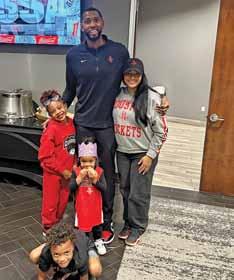
But Tasha says the biggest highlight and best title in life is being a mom. With all of the titles, accomplishments, and work, Tasha finds time to also be a doting mother to two daughters (8 and 3) and a son (5). She says she loves seeing life through their eyes and loves watching them reach each milestone. Even though the children have two highly successful, athletic parents, Tasha says she wants them to have the freedom to pursue their own interests, even if those interests are outside of sports.
Tasha’s supportive approach makes sense. Throughout her life, she has accomplished great things when she had the freedom and support to pursue her interests. She thrived when she was able to choose gymnastics over tennis. Tasha has excelled at a law firm that has supported both her commitment to family and expanding her career. She has made generational impacts as a survivors’ advocate. When Tasha is free to pursue her interests, the possibilities seem endless. One can only imagine what other interests Tasha Schwikert Moser will discover,
and what titles she will earn next.

Dave Louie is lead counsel with LyondellBasell, a global petrochemical company, and an editorial board member for The Houston Lawyer. He is a member of the HBA Historical Committee.
endnotes
1. International Tennis Federation, Joy Schwikert (available at: https://www.itftennis.com/en/players/joy-schwikert/800175517/usa/wt/s/activity/#pprofile-info-tabs).
2. USA Gymnastics Hall of Fame, Tasha Schwikert (available at: https://usagym.org/halloffame/inductee/schwikerttasha/).
3. Id
4. UCLA Hall of Fame, Tasha Schwikert (available at: https:// uclabruins.com/honors/hall-of-fame/tasha-schwikert/16).
5. IMDB, Tasha Schwikert (available at: https://www.imdb. com/name/nm1801393/).
6. Nate Krueger, Former Duck Mike Moser Joins Women’s Basketball Coaching Staff, UNIV. OF OREGON ATHLETICS, May 31, 2021.
7. Id
8. Rosa Baceras, Oregon’s Mike Moser to Join Udoka’s Staff as An Assistant Coach, RSN, July 21, 2022.
9. Joe Hernandez, Nassar Abuse Survivors Reach $380 million deal with USA Gynmastics, Olympic Committee, NPR, Dec. 13, 2021.
10. Id
11. TEX. CIV. PRAC. & REM. CODE § 16.0045(a).


thehoustonlawyer.com January/february 2024 23
 By Brandi d. Pikes
Judge Vanessa D. Gilmore of the U.S. District Court for the Southern District of Texas
Below is an interview with Judge Vanessa D. Gilmore, former United States district judge for the Southern District of Texas, conducted by Brandi D. Pikes, who served as Judge Gilmore’s law clerk from 2020 to 2022.
Brandi Pikes: Judge, how does a young attorney who is not native to the city develop strong ties to the community?
Judge Gilmore: I think it is important to determine the things you are passionate about. If you have some cause or issue that is important to you, you can connect yourself to like-minded people and use that as an opportunity to showcase your commitment to a particular issue. There is no shortage of opportunities for young people to get involved, but it needs to be something that you feel really good and passionate about so that when you are there, you are committing to the projects in a way that shows your level of commitment and causes people to call upon you for other important opportunities. You must first be willing to show a commitment to our community.
Brandi Pikes: Early in your career, there were no social media platforms. How did
you manage to build your professional brand and sustain relationships over time without the use of social media?
Judge Gilmore: In those days, actual phone calls were very important. We sent a lot of written correspondence. We showed up for events because it was important to both develop and sustain relationships. There were a lot more one-on-one engagements. You went to lunch and dinner with others. In my view, I think the fact we met so often also made for more civil discourse between people who may not be on the same side of the issue.
I think when you have that kind of social, face-to-face interaction without social media, you realize that you have more in common with people than not. All of us are concerned about the same things: the safety of our community, the future of our children, our legacy or mark we are leaving on our society. Today, a lot gets lost in translation—emails, text messages, and online posts.
Brandi Pikes: I want to talk to you a little about your civic engagement and pathway to the bench. How much of a role do you think your civic engagement played in attracting the eyes of U.S. senators and President Clinton?
Judge Gilmore: I became extremely involved in the Houston civic community. I was the president of the YWCA of Houston and I was on the board of the End Hunger Network. I also served as a counselor in the area of election law, because I was very interested in preserving and protecting the right to vote. As a result, I was fortunate to be invited by the late Congressman Mickey Leland for a meeting that he organized for young leaders across the state of Texas who he thought had leadership potential. Congressman Leland also encouraged us to support each other and find opportunities for each other to become more involved in the community. As a result of the people I met there, we formed a small organization called the Texas Black Leadership Congress.
One of the gentlemen I met through that group became the chief of staff to Texas Governor Ann Richards. We had previously agreed that we would look for opportunities for each other to be of service
a LeG aCy in t He MakinG :
24 January/february 2024 thehoustonlawyer.com
Judge Vanessa D. Gilmore
in our community and, as a result, Carl S. Richie talked to the governor about me. Governor Richards invited me to Austin for a meeting because it was her goal to make sure the boards and commissions of the state of Texas were as diverse as the people of Texas.
At the time I became president of the YWCA of Houston, it was at risk of being closed. I fought for that organization. I raised money and got that organization back up and running. Governor Richards said she heard about the work I did for the YWCA of Houston and that the Texas Department of Commerce was then at risk of being sunsetted in the next legislative session. Governor Richards said she needed someone with a big voice and big ideas who would fight for the Texas Department of Commerce “the same way you fought for the YWCA.”
At the Texas Department of Commerce, I was responsible for business development, tourism, and job training for the state of Texas. I recruited a lot of new businesses to the state of Texas from all over the country. I worked on the NAFTA treaty. Now, this was not a job. This was a volunteer opportunity. I served on this board and traveled all over the country, all while working full-time as a trial attorney. I often worked with Bob Krueger, who at the time was the chairman of the Texas Railroad Commission but was later nominated as a U.S. senator. I asked Senator Krueger if I could serve as a member of his committee to help select potential candidates to serve as federal judges in Texas. The chairman, Lee Godfrey, asked me not to serve on the committee because they were planning to submit my name for consideration. Essentially, I got kicked off the committee and nominated against my will to the federal bench.
I called my minister at the time to ask his advice. Reverend Lawson asked me two questions: “Can you do a good job?” and “Will it be good for the community?” I said yes, I can do a good job, and he said it will be good for the community. He told me to call him back when I had a real problem and hung up.
I then called Governor Richards to ask for her thoughts. She did not think it would be a good idea for me. She wanted
me to stay available and run with her for a position on the Railroad Commission.
I finally called my mother about the nomination. She said, “I never heard you say that you wanted to run for statewide office. If you had said even once that you wanted to run for statewide office, I would say go ahead, do it.” Then she said, “Sometimes you get on the fast train and you think you can pull the bell and get off whenever you want to. Instead, you end up on the fast train to someone’s destiny.” She ended by saying, “Maybe it’s time for you to pull the bell and get off.” So, I pulled the bell and I got off. I went to the federal bench.
All of my work in community service and civic engagement was directly responsible for the success I had in getting appointed to the Texas Department of Commerce and going on to the federal bench.
Bob Krueger ended up losing the next Senate race and all of his judicial nominees were at risk because the new senator was Kay Bailey Hutchison. She had been treasurer of the state of Texas when I was serving on the Department of Commerce. She and I had a long relationship based on

my service to the state of Texas. As a result, I made it through the confirmation process when there were no Democratic senators. Kay Bailey Hutchison sat with me at the table during my confirmation hearing. We had a personal relationship. You can see how much personal relationships matter.
Brandi Pikes: When I was clerking for you, you gave a number of speeches on various topics. What is your most requested speech to date?
Judge Gilmore: My two most requested speeches are (1) what was my path to the federal bench and (2) unconscious bias in the courts.
Brandi Pikes: What is the most interesting thing about unconscious bias in the courts?
Judge Gilmore: The Federal Judicial Center undertook a study on implicit bias in the courts to bring to judges’ attention our own unconscious bias. I think that once we focus on and are aware of our biases, we do better. I think that when you know better, you do better.

Durham, Pittard & Spalding, LLP is pleased to welcome Lara Hudgins Hollingsworth as managing partner in the Houston office Lara joins Dana Levy and Lauren Harbour in our new office located at Durham, Pittard & Spalding, LLP is an appellate boutique handling civil appeals and providing strategic litigation support across Texas and New Mexico 2000 West Loop South, Suite 2200 Houston, TX 77027 (713) 401-9901 www dpslawgroup com thehoustonlawyer.com January/february 2024 25
We all come to wherever we are with our own set of experiences and our own view of the world. I think all of us as lawyers must guard against unconscious bias in the work that we do. At the end of the day, our work is about getting justice for people, and we need to be able to do it in a way that is fair to all. I think there is work to be done by both people trying to break systemic barriers and people interested in supporting diversity efforts.
Brandi Pikes: Is it difficult for women lawyers who have had the kind of professional success you have achieved to have balance in their lives?
Judge Gilmore: Yes, because when you work as hard as we do in our profession, sometimes you either accidentally or intentionally put your personal life on the back burner. I think there really is no such thing as work-life balance. Instead, it is a constant game of moving things from the front burner to the back burner. In some ways, I left my personal life on the back burner so long that it burned up.
I realized in my early 40s that parenting was not something I intended to forgo, and at 44, I adopted my son. Now, as I move into this stage of my life and I have finished raising my son, I need to get back to me. Having a fulfilling personal life is also very important to me.
Brandi Pikes: What are you most excited about in 2024?
Judge Gilmore: For the last two years I have worked at JAMS as a mediator and arbitrator, which is a good use of my skills as a judge.
In 2024, I am joining the law firm of Roberts Markland LLP in an of counsel role to do high-impact civil litigation. Returning to work as a trial lawyer is a full circle moment for me. I began my career as a trial lawyer, then I worked almost 28 years as a federal judge where I tried hundreds of cases. I have spent two years as an arbitrator and mediator, and now I’m going to also have the privilege of directly helping people who are seeking justice in the court system.

I am also going to be reopening a tearoom that I started in 2022.
Brandi Pikes: One last question, Judge. You are very intentional about the start of a new year. What is your one word for the year? And why?
Judge Gilmore: “Legacy” will be my theme for 2024. It speaks to both my personal and professional goals. Part of my legacy on the personal side is about the fact that my son just graduated with a degree in finance. I know that he will be a part of my legacy. On the professional side, I hope that the work I have been doing and am about to embark upon will be a part of my legacy of service to the community.

Brandi D. Pikes was Judge Gilmore’s law clerk from 2020 to 2022. She is an associate attorney at Winston & Strawn LLP.

26 January/february 2024 thehoustonlawyer.com
The U.S. Supreme Court’s Affirmative Action Decision
Last summer, the U.S. Supreme Court struck down affirmative action in college admissions. The Houston Lawyer invited Professor R. Randall Kelso from South Texas College of Law Houston, who specializes in constitutional law, to provide context to the ruling. We also invited each of Houston’s three law schools to talk about the information and resources they provide for prospective and current students.
College and University Admissions After Students for Fair Admissions, Inc.
By Professor r. randall kelso
From the very beginning, explicit race-based affirmative action in the context of education has been controversial. The first Supreme Court case to involve race-based affirmation action occurred in 1978 in Regents of the University of California v. Bakke. In that case, the University of California-Davis medical school had set aside 16 places out of 100 for minorities in its first-year class. The critical fifth vote in the case belonged to Justice Powell.1 He said that while the attainment of a diverse student body was a constitutionally permissible goal for an institution of higher education, a set-aside of 16 of 100 places for minority applicants was more burdensome than necessary to achieve a diverse student body. Justice Powell concluded that using race as a factor in the admissions process, but rejecting a quota system, would be effective in achieving the government’s interest of a diverse student body. Four more conservative justices dissented from this use of race.
In 2003, a five-justice majority reaffirmed Justice Powell’s approach that race could be used as a factor in Grutter v. Bollinger. 2 On the same day, however, a five-justice majority stated in Gratz v. Bollinger that a rigid absolute point system preference, which gave the same extra points to aid admission to every member of a minority group, was unconstitutional.3 The Court made clear that only using race as a factor in an individualized consideration of each applicant’s file would be constitutional. Again, four more conservative justices dissented from this use of race.
At the same time, all justices have always agreed that universities could consider an applicant’s discussion of how race affected his or her life, be it through discrimination, inspiration, or otherwise. Chief Justice Roberts’ four-justice plurality in Parents Involved in Community Schools v. Seattle School District No. 1, for example, indicated a willingness to consider as legitimate a broader concept of socioeconomic diversity based upon “many possible bases for diversity admissions, [such as] admittees who have lived or traveled widely abroad, are fluent in several languages, have overcome personal adversity and family hardship, have exceptional records of extensive community service, and have had successful careers in other fields.”4 He reaffirmed this stance in the recent SCOTUS affirmative action decision, Students for Fair Admissions, Inc. v. President and Fellows of Harvard College, stating in the Court’s rendition that, “[T]he student must be treated based on his or her experiences as an individual—not on the basis of race.”5 Even before Students for Fair Admissions, however, a number of states, including California and Michigan, had state provisions which
banned race-based affirmative action.6 Those states have thus long been operating under the doctrine that Chief Justice Roberts laid out in Seattle School District No. 1 and Students for Fair Admissions
Going forward, it is unclear what the impact of Students for Fair Admissions may be, though some schools have already begun developing race-neutral solutions with the potential to promote diversity without employing racial preferences. For example, the University of North Carolina has announced it will offer free tuition for students whose families make less than $80,000 per year.7 This will disproportionately help students from non-white families given current statistics regarding income distribution, but since it is based on economic considerations, not race, it will likely be viewed as constitutional. No doubt many schools will seek to reinforce their commitment to achieving diversity through reading impact statements, as suggested in Chief Justice Roberts’ opinions. It is also true that traditional affirmative action programs have been most successful in schools with relatively selective admissions criteria—the top 25th percentile of schools.8 For the other 75% of college and universities, admission is not so selective and a vigorous affirmative action program may not be as critical to achieve a racially diverse student body.9 Another potential result of the end of race-based affirmative action may be refocusing efforts on the problem of the pipeline to college and universities, that is, the quality of K-12 education being given to all students, but particularly students of color in both urban and rural settings. Additionally, as with other recent politically charged decisions, proponents of racebased affirmative action programs and policies may be invigorated to turn out and vote, both to ensure more progressive statutory policies in the short run and a possibly more liberal Supreme Court in the long run.

Professor R. Randall Kelso is the Spurgeon E. Bell Distinguished Professor of Law at South Texas College of Law Houston. He teaches and writes primarily in the area of constitutional law. He earned his B.A. in Mathematics from the University of Chicago in 1976, and his J.D. from the University of Wisconsin-Madison in 1979.
The views represented in this article are those of the author alone and are not intended to represent the views of South Texas College of Law Houston or any other individual or institution.
thehoustonlawyer.com January/february 2024 27
Thurgood Marshall School of Law—Still We Rise
By assoCiaTe dean CrysTal ridGley
The recent SCOTUS affirmative action decisions have made it crucial for law schools to enhance their recruiting efforts and foster diversity within their applicant pools. Texas Southern University Thurgood Marshall School of Law (“TMSL”) recognizes the importance of moving forward and creating a more inclusive legal education environment rather than solely reacting to the ruling. By actively seeking ways to expand our outreach and attract a diverse range of applicants, our law school is determined to make a lasting impact on the future of legal education in Houston. For nearly seven decades, TMSL, a public law school in Houston, Texas, has played a critical role in sparking bold discussions and promoting fairness, inclusivity, and prospects in alignment with the principles and beliefs of our namesake, Justice Thurgood Marshall.
Established in June 1947, the law school has held complete accreditation from the American Bar Association since 1949. For more than 70 years, TMSL has empowered the disenfranchised and underserved. Enrolling approximately 600 full-time law students, it provides programs for the regular full-time juris doctorate and an LL.M. in immigration law. The demographic composition of the incoming class of 2022 consisted of 52% African American, 31% Hispanic, 6% White, 5% Asian American, and 5% of two or more races, with overseas students comprising the remainder of the class. TMSL has been dedicated to promoting social justice and equality in the legal field. With a diverse student body, it aims to create a supportive and inclusive learning environment. By offering specialized programs in immigration law, the law school demonstrates its commitment to addressing the needs of marginalized communities. TMSL significantly contributes to the legal profession and society.
TMSL proudly serves as a school of opportunity. Historically, we have admitted many students not admitted by other law schools because of their traditional objective credentials. We have opened our doors to students whose admission credentials may include nontraditional factors, such as life experience, maturity, and extraordinary dedication to their future successes. TMSL is committed to allowing those students to join the legal profession. We remain committed to an accurate, holistic model for our student body. To continue our focus on preparing diverse attorneys to meet current legal challenges, TMSL intends to recruit and retain more competitive applicants. We are committed to admitting students likely to pass the bar and practice successfully without compromising our school’s historic social mission or continuing commitment to diversity.
In fall 2022, the TMSL faculty voted for the admissions office to start accepting the Graduate Record Examinations (“GRE”) as part of the application process and as an acceptable, reliable test for admission to law school. Accepting the GRE will give TMSL access to a larger applicant pool, an increased academic discipline diversity pool, and increased racial diversity. In addition, using the GRE will reduce the application barrier and create more opportunities for potential law students. The GRE is offered once every 21 days, much more often than the LSAT, which is offered four times a year. TMSL will be the first HBCU to accept the GRE for the fall 2024 admissions cycle.
TMSL will also continue to explore the enhancement of current processes and the initiation of new strategies to broaden the admission “pipelines” to attract and enroll qualified candidates for admission. As an example, the admissions office, in collaboration with Texas Southern University’s Thomas F. Freeman Honors College, is in the process of evaluating a 3+3 agreement within the university that would allow students to substitute their final year of undergraduate education with the first year of law school. This initiative aims to provide a more streamlined path for highly qualified students to pursue a legal education. In addition to expanding the 3+3 agreements, TMSL will prioritize outreach efforts to historically underrepresented communities, including hosting virtual information sessions and participating in college fairs.
In spring 2024, we will conduct our second annual Black Men of Excellence (“BME”) virtual panel hosted by the BME student organization at TMSL. This event promotes and recruits black males interested in attending law school. By actively seeking out diverse candidates and offering various pathways to admission, TMSL is committed to creating a more inclusive and accessible legal education experience.

Associate Dean Crystal Ridgley joined Texas Southern University Thurgood Marshall School of Law with more than 16 years of higher education administration experience in enrollment management, student affairs, and diversity and inclusion. As the new associate dean of admissions, she mainly focuses on developing and implementing a strategic plan to engage and recruit new students into the school of law. Her most substantial contributions have been her role in improving the persistent equity gaps in educational attainment across all student demographic categories and increasing the admission numbers at each institution she has served.
University of Houston Law Center’s Pre-Law Pipeline Programs
By mariesha keys
The award-winning University of Houston Law Center PreLaw Pipeline Programs (“Pipeline Programs”) are designed to enhance the law school applicant pool by providing college students and graduates with law school preparatory resources, such as LSAT instruction, introductory law school classes, law-
related internships, and professional development sessions. Our Pipeline Programs have always been race-neutral and welcome a wide variety of students of all backgrounds who have a genuine interest in attending law school and pursuing a legal career. They focus on college students and graduates who are first-generation,
28 January/february 2024 thehoustonlawyer.com
low-income, or are members of groups underrepresented in the legal profession.
The recent Supreme Court opinion in Students for Fair Admissions v. Harvard, 600 U.S. 181 (2023), which overturned the use of race in higher education admissions, has no impact on the Pipeline Programs since they have always been dynamic, race-neutral, pre-law preparatory programs. These programs imbue the next generation of aspiring lawyers with the necessary resources using the best higher education practices to provide college students and graduates with an exceptional pre-law educational experience.
Since the launch of the first of our Pipeline Programs in 2015, our participating Pipeline Programs’ students have been accepted to, and some have already graduated from, 140 different law schools nationwide. More than 70% of these Pipeline Programs’ students attend law schools other than University of Houston Law Center (“UH Law”). Some may ask why UH Law engages in this effort when only a fraction of Pipeline Programs’ participants actually enroll in UH Law. We say that we see it as our contribution to the profession. Pipeline Programs’ students have received scholarship awards totaling more than $11.1 million. College students and graduates who participated in our LSAT prep curriculum have seen a median LSAT score increase ranging from six to 14 points, with the highest individual LSAT score
increase of 27 points.
UH Law also created Aspiring Lawyer, an award-winning digital magazine designed to provide helpful hints and advice to students who aspire to be lawyers. Because space in our Pipeline Programs is limited, we created this magazine in 2022 to inform students of the various pathways to success in achieving a law degree. We want to ensure that the process of applying to law school is demystified and transparent and that college students of all backgrounds have the knowledge and information necessary to succeed in the law school admissions process.
We aim to continue these efforts by equipping our Pipeline Programs’ participants with the necessary tools to navigate all stages of their legal careers: from the admissions process to law school academic performance to entering their desired area of legal practice or field of work.

Mariesha Keys is passionate about helping others. As the newly appointed program director of Pre-Law Pipeline Programs at University of Houston Law Center, she brings prior knowledge and experience as a former law school admissions representative, law school graduate, and Pre-Law Pipeline Programs alumna.
Advancing Diversity to Foster Inclusive Excellence
By donna davis
South Texas College of Law (“STCL”) Houston is a private and independent institution and Houston’s oldest law school, having celebrated its centennial year in 2023. Its mission is to provide a diverse body of students with the opportunity to obtain an exceptional legal education while preparing graduates to serve their community and the profession with distinction.
Through a generous donation from lawyer, philanthropist, and alumnus Benny Agosto, Jr., STCL Houston created the Benny Agosto, Jr. Diversity Center (the “Center”), whose leaders are myself, as senior director, and Shelby A.D. Moore, vice president & professor of law. The Center provides strategic leadership, resources, programming, and training for all students centered around diversity, equity, inclusion, access, and social justice (“DEIAJ”). More specifically, the Center focuses on creating an environment in which diverse individuals are provided the resources, support, education, and community that enables them to succeed in law school and the legal profession.
At STCL Houston, diversity includes race, ethnicity, gender, sexual orientation, disability status, national origin, and age, as well as religious belief, economic status, life experience, and point of view, among other characteristics. The Center’s primary focus areas are:
• Education and professional development training
• Internal campus culture and climate
• External community engagement
• Diversity representation
Program Highlights
In 2023, the Center launched a year-round DEI Professional Development Education Workshop Series for faculty, staff, and stu-
dents. The sessions further support STCL Houston’s intentional commitment to DEIAJ while addressing the dialogue examining race, bias, and cultural competency required by ABA Standard 303(c). Series workshops cover the following topics:
• Unconscious bias
• Anti-Racism: A dialogue
• Cultural competency
• Understanding privilege
• Sexual orientation (LGBTQIA+)
• Microaggressions
• Gender identity and expression
• Gender
• Understanding ability challenges
• Religion
• Generational differences
• Allyship and bystander intervention
STCL Houston’s Pipeline Program engages academically talented pre-law students from various backgrounds who may represent first-generation college, socioeconomically disadvantaged, and historically marginalized characteristics. STCL Houston is working directly with four universities to expand participants access to legal education, broaden the universe of individuals applying to law school, and ensure STCL Houston serves the legal education needs of the diverse Houston and Texas communities.
The Diversity Fellows Program provides a one-year monetary stipend to selected students who work directly with the Center. Fellows assist with building a welcoming internal community focused on inclusivity and creating a sense of belonging for cur-
thehoustonlawyer.com January/february 2024 29
rent and prospective law students. Fellows also conduct research, serve as liaisons to the student bar association, and help enhance the cultural, academic, and professional student experience.
additional initiatives and activities
The Center oversees additional DEI initiatives and activities at STCL Houston, including:
• The Agosto Diversity Lecture Series
• An annual symposium with the STCL Houston Hispanic Journal of Law and Policy
• Executive coaching and counseling
• Sustained dialogue small group sessions
• Continuing Legal Education
• Networking receptions
• DEIAJ curriculum guidance
• STCL Houston systemwide DEIAJ protocols
• Diversity, Equity, and Inclusion Excellence Award
endnotes
1. See generally Regents of the Univ. of California v. Bakke, 438 U.S. 265 (1978).
2. See generally Grutter v. Bollinger, 539 U.S. 306 (2003).
3. See generally Gratz v. Bollinger, 539 U.S. 244 (2003).
4. Parents Involved in Cmty. Schs. v. Seattle Sch. Dist. No. 1, 551 U.S. 701, 722 (2007).
5. Students for Fair Admissions, Inc. v. President and Fellows of Harvard Coll., 143 S. Ct. 2141, 2176 (2023).
• Community service projects
STCL Houston embraces the opportunity to create an intentionally diverse and inclusive environment and will continue to take a proactive stance in ensuring that diverse law students at all levels of the institution are actively exhibiting a commitment to DEIAJ internally and throughout the legal profession.

Donna Davis is responsible for advancing the diversity, equity, and inclusion mission, initiatives, programming, and training for South Texas College of Law Houston. In her role, Davis engages stakeholder groups through the Benny Agosto, Jr. Diversity Center. She has 23 years of experience in higher education and has held various key positions at law schools and universities nationwide.
6. Emily Mae Czachor, What is affirmative action? History behind race-based college admissions practices the Supreme Court overruled, CBSNEWS (June 29, 2023, 5:07 PM), https://www.cbsnews.com/news/ what-is-affirmative-action-history-college-admissions-supreme-court/ (“Nine states—Arizona, California, Florida, Idaho, Michigan, Nebraska, New Hampshire, Oklahoma and Washington—have previously banned affirmative action policies at public universities.”).
7. UNC-Chapel Hill Accessibility Effort: A Commitment to N.C. Families, UNIV. OF NORTH CAROLINA AT CHAPEL HILL, https://studentaid.unc.edu/tuition-commitment/ (last visited Jan. 12, 2024).
8. Richard Arum & Mitchell L. Stevens, For Most College Students Affirmative Action Was Never Enough, N.Y. TIMES, June 3, 2023, https://www.nytimes.com/interactive/2023/07/03/opinion/for-mostcollege-students-affirmative-action-was-not-enough.html.
9. Id

30 January/february 2024 thehoustonlawyer.com
Equal Access Champions
The firms and corporations listed below have agreed to assume a leadership role in providing equal access to justice for all Harris County citizens. Each has made a commitment to provide representation in a certain number of cases through the Houston Volunteers Lawyers.
abraham, Watkins, nichols, agosto, aziz & stogner
akin gump strauss hauer & feld LLp
angela solice, attorney at Law
archie Law pLLC
Baker Botts L.L.p.
Bakerhostetler LLp
Balch & Bingham LLp
Beck redden LLp
Blank rome LLp
Bracewell LLp
Centerpoint energy, inc.
Chamberlain hrdlicka
Chevron Usa
Coane & associates
dentons Us LLp
elizabeth s. pagel, pLLC
eversheds sutherland Us LLp
exxon mobil Corporation
fleurinord Law pLLC
foley & Lardner LLp
frye and Benavidez, pLLC
fuqua & associates, p.C.
gibbs & Bruns LLp
gibson, dunn & Crutcher LLp
gray reed
greenberg traurig, LLp
halliburton
hasley scarano, L.L.p.
haynes and Boone, LLp
hunton andrews Kurth LLp
Jackson Walker, LLp
Jenkins & Kamin, LLp
Jeremy northum, attorney at Law
King & spalding LLp
Kirkland & ellis LLp
Law Office of Cindi L. Rickman
Law Office of Norma Levine Trusch
Law Office of Robert E. Price
Law Offices of Omonzusi Imobioh
Limbaga Law
Locke Lord LLp
LyondellBasell industries
Martin R.G. Marasigan Law Offices
mcdowell & hetherington LLp
mcgarvey pLLC
morgan, Lewis & Bockius LLp
norton rose fulbright
o’melveny & myers LLp
painter Law firm pLLC
reed smith LLp
royston, rayzor, Vickery & Williams, LLp
sanchez Law firm
shell Usa, inc.
shipley snell montgomery LLp
shortt & nguyen, p.C.
sidley austin LLp
sorrels Law
squire patton Boggs
the ericksen Law firm
the Jurek Law group, pLLC
travis Bryan Law group, pLLC
Vinson & elkins LLp
Weycer, Kaplan, pulaski & Zuber, p.C.
Wilson, Cribbs, & goren, p.C.
Winstead pC
Winston & strawn LLp
Yetter Coleman LLp
By eriC d’olive and Jeff oldham
The Texas Lawyer’s Creed Turns 35
In 1989, amidst reportedly increased abusive tactics by some lawyers (including so-called “Rambo” litigation), the Supreme Court of Texas and the Texas Court of Criminal Appeals promulgated The Texas Lawyer’s Creed—A Mandate for Professionalism. 1 Thirty-five years later, it speaks to today’s profession just as plainly and relevantly as it did to its original audience.
Entire articles have been written about how the Texas Lawyer’s Creed came about and its impact.2 Abusive tactics by a minority of lawyers, including litigation characterized by an at-all-costs style that featured increased use of discovery sanctions, was a major part of the reported problem. Other factors included a decreased public confidence in lawyers and challenges from the evolving business of law.
‘‘ The creed, written in the first-person and calling on every Texas lawyer to follow the highest principles of professionalism, remains as relevant as ever today, even as the challenges to our profession evolve.”
Sensing a need for action, Justice Eugene A. Cook asked the Supreme Court of Texas to create the Advisory Committee on Professionalism and was the architect and champion of the creed. He built a balanced committee, led by vice chairs Fred Hagans, a plaintiff’s lawyer, and Blackie Holmes, a defense lawyer. Their work, which drew on earlier creeds adopted by the HBA and by the Dallas Bar Association, culminated in the aspirational Texas
Lawyer’s Creed that made Texas the first state where the highest courts had adopted such a code. It was widely distributed across Texas and received national recognition. Justice Cook has been called the “father of professionalism” in Texas in recognition of his work on the creed, and the HBA annually presents the Justice Eugene A. Cook Professionalism Award to a lawyer or judge who exemplifies the highest level of professionalism and legal ethics.
The creed, written in the first-person and calling on every Texas lawyer to follow the highest principles of professionalism, remains as relevant as ever today, even as the challenges to our profession evolve. “In 1989, the increase in unprofessional conduct demonstrated that the profession was becoming more divided than united,” said Hagans, one of the creed’s authors. “The purpose of the Creed was to motivate better behavior and provide clear guidelines for what that behavior looks like. With the social fractionalization present today, lawyers can provide a role model for good behavior. We can be better lawyers by being more professional and we can be better citizens as well.”
As we promote professionalism among
lawyers, we should continue to raise awareness about the creed, which the courts reaffirmed in 2013. Recently, as part of the HBF’s and HBA’s 2023 Harvest Celebration, Chief Justice Nathan L. Hecht and former Chief Justice Tom Phillips did exactly that in a lively discussion remembering the creed’s history and celebrating its impact. The discussion was led by HBA Past President President Warren W. Harris, who was Justice Cook’s law clerk when the creed was developed.
The HBA Professionalism Committee’s mission is to promote professionalism within the legal community, and the creed has featured prominently in committee events. The HBA will commemorate the creed’s 35th anniversary at the annual Day of Civility in the Law event on April 4. As a voluntary code of conduct, the creed’s strength derives from lawyers accepting and adhering to it, and we can all promote that by practicing, and exposing others to, these highest principles of professionalism


endnotes
Eric D’Olive and Jeff Oldham are the 2023-2024 co-chairs of the HBA Professionalism Committee.
Mr. D’Olive is general counsel of Emmanor Group Inc. Mr. Oldham is an appellate partner at Bracewell LLP and serves on the HBA Board of Directors.
1. Order of the Supreme Court of Texas and the Court of Criminal Appeals (Nov. 7, 1989), available at https://www. txcourts.gov/media/276685/texaslawyerscreed.pdf; Letter from Justice Eugene A. Cook to lawyers announcing adoption of creed (Dec. 22, 1989). Justice Cook’s letter, among other historical documents relating to the creed, can be found at https://www.legalethicstexas.com/resources/rules/ downloads/.
2. See, e.g., Eugene A. Cook, Fred Hagans, & James H. Holmes, III, A Guide to the Texas Lawyer’s Creed: A Mandate for Professionalism, 10 Rev. Litig. 673 (1991); Justice Don Willett & Kelly Frels, Lawyer’s Creed Curbed “Sharp Practices,” HOUSTON CHRONICLE (Nov. 22, 2009); Alicia Grant, Comment, The Texas Lawyer’s Creed: Exploring Its Origin and Impact over the Last Quarter Century, 6 ST. MARY’S J. ON LEGAL MAL. & ETHICS 120 (2016).
32 January/february 2024 thehoustonlawyer.com

HBA Ambassadors Program
By TraCi a. GiBson and Jake Johnson
The Houston Bar Association’s (“HBA”) Ambassador Program is back for the 2023-2024 bar year. Upon taking office in May of 2023, HBA President Diana Gomez tasked the HBA Diversity, Equity and Inclusion Committee with the responsibility of reinstituting the HBA Ambassador Program as one of her focus areas. In line with that vision, the HBA selected 11 individuals from a variety of backgrounds across the Houston legal landscape to represent the HBA. These talented professionals were chosen for their leadership potential, networking skills, community engagement, and commitment to the HBA.
Houston Bar Association’s 2023-2024 Ambassador Class


The purpose of the HBA Ambassador Program is to identify rising leaders within the HBA and broader Houston legal community to provide leadership opportunities and foster a stronger bond between the HBA and other Houston bar associations. HBA Ambassadors will engage in facilitated leadership training and attend HBA programs and events as representatives of the HBA, where they interact with attendees in an effort to increase knowledge of the HBA and its initiatives and to help members network. Ambassadors will also engage with nonmembers to tell them about the HBA member experience.
simone r. Bray practices her passion of criminal defense as an assistant public defender in the Felony Trial Division of the Harris County Public Defender’s Office. She also serves as the president of the Houston Lawyers Association, the African American bar of Houston. Simone enjoys traveling, sports, and playing with her dog, Lucy.
emma Brockway received her law degree at the University of Houston Law Center and currently handles a wide variety of plaintiff’s litigation at Doyle Dennis LLP. Her principal areas of practice are employment law, personal injury, and civil rights litigation. Emma is a member of the Stonewall Law Association of Greater Houston (SLAGH) and the Houston Bar Association’s LGBTQ+ Committee. Outside of the legal community, Emma serves on the boards of directors for the Texas Freedom Network and the Prism Foundation.


sophia George is an associate at Husch Blackwell LLP, where she practices commercial litigation. Sophia has handled matters involving real estate transactions, title disputes, breach of contract matters, and insurance defense matters. Sophia is also the current president of the South Asian Bar Association of Houston. In her position, she pushes SABA’s three initiatives for the year–mentorship, professional development, and community outreach.
traci a . Gibson is a native Houstonian and graduate of Texas A&M University and the University of Houston Law Center. Traci began her legal career as a solo practitioner, then honed her litigation skills at the Harris County District Attorney’s Office and is now an associate at Roberts Markel Weinberg Butler Hailey PC in the litigation section. Traci is very active in the legal community and currently serves as president-elect of the Houston Lawyers Association, board member for the Houston Lawyer Referral Service, and a new member of the 2023-2024 leadership class for the State Bar of Texas

Jake Johnson is a third-year law student at South Texas College of Law Houston, where he serves as an articles editor for South Texas Law Review and as a student ambassador. A graduate of Texas A&M University, Jake served in the United States Marine Corps as an infantry officer for seven years on active duty before starting law school. Jake’s legal experience during law school includes serving as a legal intern at Kuiper Law Firm, PLLC, and as a summer associate at Kirkland & Ellis LLP in Houston.
34 January/february 2024 thehoustonlawyer.com


Farah kamal graduated from South Texas College of Law Houston and went into private practice right after graduating. She started Kamal Law Firm, PLLC, focusing on family law and immigration law. Farah has served on the diversity committee for SBOT for the last three years and also served on the board for the Muslim Bar Association of Houston and Fort Bend Women’s Center.
Jose r. Lopez, ii is a second-generation Mexican-American native Houstonian who graduated from St. Mary’s University in 1980 and from South Texas Law School in 1987. In 1996, he started his own firm, the Law Offices of Jose R. Lopez II. In addition to his active law practice, Jose is a mediator for the courts; a special court-appointed attorney to represent children’s interests, serves as a special commissioner, and as a part-time judge with the City of Houston. Jose is also a director of the Mexican American Bar Association of Houston (MABAH), and a director of the Dispute Resolution Center.

audrey Momanaee is the managing partner of Balch & Bingham’s Houston, Texas office and leads the firm’s litigation practice in the state. Audrey was named a 2022 Pro Bono Excellence Award Winner by the State Bar of Texas. She serves on the boards of directors of Houston Volunteer Lawyers, Houston Community Family Center, and Houston Association of Women Attorneys, and is a fellow of both the Houston and Texas Bar foundations. In 2023, Audrey was appointed to serve on the Houston Independent School District’s Board of Managers.
Daniel rodriguez earned his bachelors in philosophy from Oral Roberts University, Master of Business Administration from the University of St. Thomas, and juris doctorate from the University of Houston Law Center. Daniel served five years as a Marine officer and deployed twice in support of Operation Iraqi Freedom. In 2021, Daniel opened DHR Firm, a business law firm that serves small businesses and startups, and now works as director of talent for Harris County Commissioner Precinct 4. Daniel is an officer for the Hispanic Bar Association of Houston (HisBA), an active volunteer for Consejos Legales, which provides free legal advice in Spanish, serves as a co-chair for the HBA LegalLine Committee, and is a member of the HBA’s Communities In School Committee.


rachel sedita is a shareholder at Diggs & Sadler, where she has practiced family law since becoming licensed to practice. Rachel is a litigation attorney who practices by the mantra of “prepare for war, so that we can negotiate for peace.” Outside of the practice of law, Rachel is a mother of two children and a soccer enthusiast.
Myra siddiqui is an Assistant United States Attorney for the Southern District of Texas. Prior to joining the U.S. Attorney’s Office, Myra worked in private practice in commercial civil litigation.
January/february 2024 35
thehoustonlawyer.com
HOustOn Bar
Serving Houstonians
At the time of this writing, the Houston Bar Foundation, the charitable arm of the Houston Bar Association, is preparing to host its Annual Luncheon on March 7, where the Foundation will present Texas Supreme Court Chief Justice Nathan L. Hecht with the 2024 James B. Sales Pro Bono Leadership Award. The Foundation will thank outgoing Chair Monica Karuturi for her strategic leadership, as well as the board of directors for their dedication, and welcome incoming Chair Linda Hester and new board members. We also look forward to recognizing the generosity of our outstanding Fellows, board members, and volunteers, and celebrating the winners of the Harris County Bench Bar Pro Bono Awards and other award winners.
the nonprofit organization’s efforts for over 25 years and dedicating 25 houses!
The HBF sponsors prizes for local winners of the essay, photo and poster contests based on the American Bar Association Law Day yearly theme. This year’s theme is “Voices of Democracy.”

The mission of the HBF is to support programs “that provide legal representation to the indigent, promote community understanding of our legal system and foster the administration of justice.” One of the Foundation’s most well-known events is the HBF’s and HBA’s Annual Harvest Celebration in the fall. The event brings together Houston’s diverse legal community to support essential pro bono legal services provided by Houston Volunteer Lawyers, the HBA’s service arm. In 2019, the Foundation launched its campaign for the Kay Sim Endowment to Maintain Access to Justice in Houston. The purpose of the campaign was to ensure sustainability of annual funding for HVL pro bono civil legal services. The campaign honored Kay Sim, former executive director of the HBA and secretary of the HBF, who dedicated her more than 40-year career to helping Houston lawyers and the people of Harris County. The Kay Sim Endowment Campaign raised approximately $1.7 million.
In addition to the Harvest Celebration and Kay Sim Endowment, there are other ways that HBA members give back through the Foundation throughout the year. Some examples of HBA programs funded through the Foundation that make a difference for our Houston neighbors include:
The HBA Eikenburg 8K Fun Run, which benefits The Center for Pursuit, a nonprofit, United Way agency that provides employment, enrichment, residential, and health care services to individuals with intellectual and developmental disabilities (IDD) and autism in Houston. Since its inception, the HBA has donated over $1.7 million through the Fun Run.
The HBF and HBA collaborate with Houston Habitat for Humanity to provide homes for hard working local families through home builds and fundraising efforts. The HBA has served as Houston Habitat for Humanity’s longest-running sponsor, supporting
The HBA’s Annual Golf Tournament is preparing to mark its 76th year on March 28, benefiting the 26th HBA Habitat for Humanity house and charitable services through the Foundation.
With an investment portfolio of over $20 million, the Foundation is at an exciting inflection point to broaden its impact in our Houston community. Under the leadership of HBF Chair Monica Karuturi and HBA President Diana Gomez, the Foundation is working on a strategic plan to guide its vision for the future.
At the Annual Luncheon, the Foundation will announce one of the first outcomes of the strategic planning process—the launch of a $50,000 annual grant program. The first of the grants under this program was a $30,000 grant for the purchase of one of the lactation pods to be installed in the Harris County Court Complex. This is an important access to justice initiative led by HBA President Diana Gomez, along with Judge Latosha Lewis Payne, Judge R.K. Sandill, Judge Michael Gomez, and Judge Cheryl Elliott Thornton, as well as the Harris County Commissioners Court, led by Commissioner Lesley Briones. The HBA Gender Fairness Committee and current and former HBA and HYLA female presidents spearheaded fundraising efforts. The installation of increased lactation/wellness facilities in the Harris County Court Complex underscores the importance of women in the legal profession and provides a welcoming and safe nursing environment for clients, judges, staff, and the millions of members of the general public served by the Harris County Court Complex every year. As HBA’s first female president, Lynne Liberato, said “Lactation pods not only make it easier for young mothers to nurse, but also act a reminder that women belong in the courthouse.”
Also, as part of its strategic planning, the Foundation is reimagining its Fellows Program. The Fellows Program is the lifeblood of the Foundation. Only HBA members are eligible to be Fellows of the Foundation. Through its annual nomination process, the Foundation invites all HBA members to join the Fellows Program to provide critical annual support for the Foundation’s charitable programs and its recipients. Please visit hba.org/foundation to learn how you can join us in galvanizing the power of our bar to make a difference to our Houston community.
LaWYers giVing BaCK
FOunDatiOn:
36 January/february 2024 thehoustonlawyer.com
The Houston Lawyer
The Sandill Family
Kelly Sandill is a partner in Hunton Andrews Kurth LLP, focusing on litigation over commercial issues and governmental affairs. Judge Ravi Sandill has been judge of the 127th Civil District Court for over 15 years. Their 17-year-old son, Asher, is a junior at Lamar High School, where he plays football. Both Kelly and Ravi are the children of military service members, and both are first-generation lawyers. Asher, who was born in Guatemala, has grown up in the judiciary. He has a budding interest in the law, though he is more interested in the plaintiff’s bar than the defense bar, where his mother practices.
kelly: Ravi and I met our very first day at the University of Houston Law Center. We graduated in May 2001. That fall, Ravi started his clerkship at the First Court of Appeals with Judge Murry Cohen, and I started as a litigation associate at what was then Andrews Kurth. We were engaged about a month later.
ravi: A few months before our wedding, I experienced rapid weight loss and developed a high fever. Kelly took me to urgent care, and that led to a scary diagnosis of Hodgkin’s lymphoma.
Guatemala, and I had the amazing experience of living there while the adoption process was finalized. My firm was ahead of its time in giving me leave during that whole period. Ravi was working in private practice by then, and he juggled his docket and visiting Guatemala every few weeks.
ravi: Kelly and Asher came home in May of 2007, and I had big news. I had been approached about running for judge, and I found myself gravitating toward the idea. My family gave me a strong sense of public service, and I was excited at the opportunity to help advance the cause of justice. I have been blessed to serve as a judge for over 15 years. Every day, I get to see the best of our profession and to play an active role in administering justice. My favorite part is the opportunity to interact with jurors.
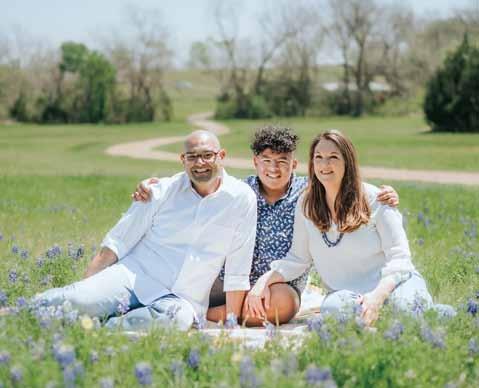
kelly: I have remained at the same firm throughout my legal career and learned from some fantastic lawyers. I am privileged to have tremendous clients who have trusted me to work on cutting-edge issues in Texas law. It has been incredibly demanding but also incredibly rewarding.
kelly: Even though Ravi was in treatment, we moved forward with our wedding, which was a beautiful event surrounded by the love of family and friends. After about six months, all signs were good that the cancer was gone, and we began to reclaim our lives.
ravi: That turned out not to be the case, however. The cancer quickly returned, and my only option was a stem cell transplant. So we spent our first wedding anniversary in Methodist Hospital. It was hard, but it worked! I was able to return to practice and have been in remission for more than 20 years.
kelly: We gave ourselves a few years to focus on work and then our thoughts turned to growing our family. We were lucky to adopt our son, Asher, when he was an infant. He was born in
asher: Having a judge Dad and a lawyer Mom has not always been easy. They always expect me to support my positions with sound evidence and reasoning; “just because” never works. As I think about my own future, law certainly has its appeal. I like to right wrongs, and I have a very competitive spirit.
kelly and ravi: We believe strongly in the legal profession and in the sanctity of the judicial system. We strive to do our jobs the best we can, to treat others with respect, and to mentor younger lawyers who might benefit from our experiences and insights. We are grateful to have had so many opportunities and even for the struggles we have faced along the way; they have made us better professionals, better parents, and better citizens.
thehoustonlawyer.com January/february 2024 37
LaW in the famiLY
The Bennett Family
Judge Alfred H. Bennett grew up in Ennis, Texas. Judge Bennett’s interest in public service was sparked early on by his own family’s community service. Judge Bennett is past president of the Houston Lawyers Association, a past chair of the Committee on Lawyer Referral & Information Services for the State Bar of Texas, and a past member of the Constitution & Bylaws Committee (NBA); Texas Access to Justice Commission; the Dropout & Literacy Committee (TYLA); the Administration of Justice Committee (HBA); the Harris County Bench Bar Pro Bono Awards Committee (HBA); and the Boy Scouts of America and Sam Houston Area Council boards of directors.
Tanyel Harrison Bennett is a thirdgeneration native Houstonian. She has enjoyed a well-rounded labor and employment practice. She has practiced with the government, a plaintiff’s firm, a defense firm, in-house, and now as a business owner. Tanyel views her most important role as being a wife and mother. She was a constant volunteer at her sons’ schools, serving six years as the PTO president. Tanyel is also proud to have held officer or board positions for several organizations, including Jack and Jill of America, Houston Chapter; Missouri City Chapter of the Links, Inc.; and the Junior League of Houston.
We both attended the University of Houston for undergraduate studies, Al as a political science student and Tanyel as a sociology and communications major. Despite having some mutual friends, we ran in different social circles. We both decided on law school as our next move.
distance relationship for three years before Tanyel returned to Houston. We will celebrate our 30th anniversary later this year.
Early in our marriage we decided to divide and conquer. Al started his own law firm and focused on bar-related endeavors. He served as president of the Houston Lawyers Association and worked on various committees for the National Bar Association, the State Bar of Texas, the Houston Young Lawyers Association, and the Houston Bar Association. Tanyel took her labor and employment practice in-house and focused on community organizations.

Tanyel went west to attend Texas Tech Law School. Al attended the University of Texas School of Law. During the summer of 1990, we attended an ABA Law Student Division conference in Houston. It was then that our paths crossed. We both clerked in Houston that summer and decided to accompany each other to clerk functions. We have been a couple ever since.
After graduating from law school in 1991, Al started his career at Fulbright & Jaworski in Houston, and Tanyel headed to Dallas to work for the U.S. Department of Labor. We had a long
Eventually, Al sought elective office. In 2006, he ran (and lost) a race for state representative. In 2008, he was elected to Harris County’s 61st Civil District Court. In 2015, Al received the highest honor of his career when President Barack Obama appointed him as an U.S. district judge for the Southern District of Texas. Tanyel, after demanding jobs with BFI, Lyondell, and British Petroleum, left corporate America to pursue her entrepreneurial dreams. She attended McDonald’s Hamburger University and became a certified owner-operator. She now owns and operates five McDonald’s franchises with over 240 employees.
Most importantly, we are the proud parents of two young adult men. Charles is a senior at the University of Oklahoma majoring in international business relations. Shane is a junior at the University of Houston majoring in consumer and retail science. Both were active in several high school sports and were boy scouts in Troop 242. Al served as a cub scout den leader and later assistant scoutmaster while the boys advanced from Tiger Cubs to Eagle Scouts.
As far as hobbies go, Al is an avid golfer and Tanyel is an accomplished quilter and enjoys baking. All four of us enjoy attending sporting events and traveling.
As a couple, we realized early on that while we were lawyers, the legal field was only a portion of our lives. We work hard. We family hard. And we protect and respect these two separate spaces our lives exist in.
38 January/february 2024 thehoustonlawyer.com
LaW in the famiLY
The Engelhart Family
Eva Engelhart was born in Korosten, Ukraine. Her family immigrated to the United States in 1982 when Eva was a child. The family settled in Fort Worth, Texas, where Eva’s mother still lives. Eva graduated from Crowley High School in 1990 and Brandeis University in 1993. She then went to the University of Houston Law Center and received her J.D. in 1996. She has spent her career to date practicing at Ross Banks May Cron & Cavin P.C., one of the oldest creditor rights law firms in Houston.
Judge Mike Engelhar t grew up in North Central New Jersey. After graduation from high school, he attended the 2023 National Champion University of Michigan, where he was a drummer in the Michigan Marching Band. He had enough winter and applied almost exclusively to southern law schools, choosing the University of Houston Law Center, where he graduated in 1995. He started working for John O’Quinn out of law school, and married Eva in 1996. They had two boys, Joey and Zachary, in 1999 and 2002. He then became a partner in Engelhart & Greenwood, LLP where he worked through 2008, winning his first election in November of that year.
District Court for the past 15 years.
Eva earned a B.S. in Economics magna laude from Brandeis University in 1993. Mike received a B.A. in Political Science and Spanish from the University of Michigan in 1992. Both have J.D.’s from the University of Houston Law Center.
Eva and Mike Engelhart have been married for 28 years. They met in 1993 on Eva’s first day of law school at the University of Houston Law Center. It was the first day of Mike’s second year. Mike was helping at the Jewish Law Students Association table, which was next to the Houston Law Review table. Eva was in line to learn about Law Review and they started chatting. A few weeks later, they found out they were invited to the same dinner party and Mike offered Eva a ride. She had a ride already but ditched the other guy and rode with Mike instead. They have been together ever since.
They are both the only lawyers in their families. Eva is a Chapter 7 bankruptcy trustee and has a collections and receivership docket. Mike has been the judge of the 151st Civil
Eva and Mike have two sons, Joey(24) and Zachary (21). Joey graduated from the University of Texas in December 2020 with a B.S.A. in Computer Science and Math and a minor in History. Zachary is a senior at Texas A&M University and will be completing a master’s in Accounting and Statistics next year. Neither chose the law, nor were they pushed to be lawyers. Joey started work in Houston and quickly headed to New York City to find his fortune in finance. Zachary will sit for the CPA exam in 2025.
Judge Engelhart and Eva both work hard at their jobs. Eva has a very demanding law practice and Mike has a court to run and is also usually in the community. This does not leave as much time as they’d like for date nights or downtime. However, since the boys are grown, every evening together is a date night.
Michael became a judge in January 2009 when the boys were only nine and six years old. Campaigning prior to every election was hard on the family and Eva was a single parent most nights during those times, while still working very hard at her practice. Mike was active with the boys’ activities, such as Boy Scouts, sports, and Model U.N. as time allowed. The family tried to take one vacation each summer with the grandparents, which really fostered very close ties between the boys and their now aging grandparents. They also made it a point to travel to far-away places, like Europe and Japan, with the boys.
Eva and Mike recently downsized to a condo and have had fun remodeling and decorating. They look forward to catching up on lost time together and to regular visits with their kids and extended families.
in the
thehoustonlawyer.com January/february 2024 39
LaW
famiLY
An Unstoppable Wave of Humanity
By The honoraBle GeorGe C. hanks, Jr.
“I never knew of a morning in Africa when I woke that I was not happy.” Ernest Hemingway, True at First Light
There is nothing like an African start line on race morning. I will never forget the power and resonance of runners in the starting corrals singing Shosholoza/ Move Forward with one voice, one goal as they prepared for the challenge that lay ahead. This powerful song of unity, once sung by Nelson Mandela and the political prisoners of apartheid on Robben Island, beckoned us all to be steady, constant, enduring, persevering, and resilient in the face of adversity. To never give up, especially when the going got tough, and to remember that the best things in life are not easily won. To remember that when we stand together, anything is possible. As I watched the multicultural crowds of runners singing and dancing rhythmically up and down like a slow-moving steam engine leaving the station, an unstoppable wave of humanity, I put on my sunglasses so no one would see the tears welling up in

my eyes. I have never felt such an emotional connection to a race or my fellow runners before. This morning, while we came from all over the world, we stood as one, so grateful for the privilege of sharing this special moment together.

As long as I live, I will never forget my meaningful, yet brief, conversation with one of my fellow runners as we were about to begin our journey together. He asked me where I was from. When I responded that I was from the United States, he looked at me with a knowing smile and said, “You may not live in Africa my brother, but Africa will always live in you.” So it will, and so it will.
The Honorable George C. Hanks, Jr., is a United States district judge who serves in the Houston Division of the Southern District of Texas. He is an avid runner and has completed at least one marathon on each of the seven continents

The Houston Lawyer off the reCord
40 January/february 2024 thehoustonlawyer.com
t he Honorable George C. Hanks, Jr. pictured above (and his medal, pictured upper right) at the 2023 s anlam Cape town Marathon.
FA Profile in
p R o F ession A lism
inal words of the district court judge after taking a verdict in our favor: “Counsel, again, thank you for your professionalism. Congratulations to Globus.” These are the words you want to hear after a long-fought battle over $86 million in alleged patent infringement damages. As an 18-year trial lawyer at Susman Godfrey, I’ve learned that professionalism in contentious, high-stakes, bet-the-company litigation is not always easy. Tempers sometimes flare. Snide remarks sometimes surface. And emotions sometimes get the best of you while battling it out at trial. But here are a few tips that I’ve learned along the way:
1. professionalism requires preparation: To avoid the frustration of disruptions, gaffes, surprises, and outbursts that often accompany trial, you should meticulously prepare your outline and anticipate the hardest questions and answers before your witness ever takes the stand.
2. Keep your game face: When the unexpected happens–because it will–you must still keep your game face. No laughing, no snickering, no big gestures, and no comments under your breath. The judge and jury will appreciate it.
3. Address the judge, not opposing counsel: When arguing objections or motions, your focus and words should be directed towards the judge. Turning and arguing directly with opposing counsel is only asking for trouble.
4. Reach agreements whenever possible: You and opposing counsel are fully capable of reaching agreements and narrowing issues without involving the court. An open dialogue about potential objections to exhibits, demonstratives, and deposition designations is often the key to a smooth and professional trial.
5. Create a pre-trial checklist: Concerning potential agreements and courtroom decorum. Susman Godfrey Partner Erica Harris has a great example on the firm’s website at susmangodfrey.com
Professionalism is not only important for your reputation. Professionalism wins trials and earns you respect before the judge and jury. Good luck on your next one.
thehoustonlawyer.com January/february 2024 41
Chanler a. lanGham Partner, Susman Godfrey L.L.P.
HBa HistOriCaL COMMittee :
Preserving Houston’s Legal History for Future Generations
By BiLL KRoGeR
The Houston Bar Association’s longstanding Historical Committee focuses on preserving historical information about the HBA and its members. This is an important service for the people of Houston.
Lawyers have played a critical role in the founding and development of this city. The Harris County District Courts are among the oldest and largest judicial systems in Texas, dating back to the first days of the Republic of Texas. Texas history has always been rife with conflicts, and many historical disputes have spilled over into the courthouse and been argued and decided by lawyers. Many of our important industries—timber, oil and gas, real estate, healthcare, and technology—heavily depend on lawyers and law firms for their existence. And of course, Texas lawyers played a role in perpetuating slavery and the Jim Crow laws, and then later worked to address those horrific structures.
Houston’s legal history is found in the archives of our courts and law firms and in the memories of our lawyers. As an amateur historian, I find these stories—even the dark ones—to have a bright side to them, because it makes me better appreciate the progress that we have made as a community over many decades. If you believe the past was sunnier than the present, you have not spent much time in court archives.
To pick one example, it is one thing to know that Joseph Dahr Jamail II was a great lawyer, but it is much more difficult to understand who he was as a real person, the qualities that made him a great lawyer, and the reason he won his major cases.

That is why the HBA Historical Committee is so important. This year, members of our committee will continue recording oral histories of significant Houston lawyers, so that their memories, experiences, advice, and reflections can be shared with future generations. We have already created a remarkable archive of such testimonies, which you can find at hba.org/historical
The committee will also continue to write about earlier generations of lawyers, taking advantage of the huge court record archives which Harris County has preserved with the help of Houston lawyers. This year, we are focusing on the previously unstudied professional lives of the first-generation of Houston lawyers, including J. Vance Lewis, who practiced during the difficult decades of Reconstruction and its Jim Crow aftermath. We are also working with the Rutherford B.H. Yates Museum in its efforts to preserve Lewis’ home and law office in the Fourth Ward.
It is also true that much of Houston’s legal history is in danger of being lost. Very few lawyers can name more than a handful of the great lawyers of the prior generation, let alone those from the many generations that preceded them. Information about the practices, challenges, and accomplishments of great lawyers from the city’s past is hard to obtain and easily lost.
We always need more volunteers and participants. If you would like to join the Historical Committee, please contact HBA Marketing and Communications Director Maggie Martin at maggiem@hba.org.
Bill Kroger is the practice group chair of Energy Litigation at Baker Botts L.L.P. and the firm’s historian. He is a past president of the Houston Bar Association and has been involved in historical court record preservation for 20 years.
Committee spotLight
The Houston Lawyer
42 January/february 2024 thehoustonlawyer.com
a look at the exterior of the historic J. Vance Lewis and Pauline Gray-Lewis home in Freedmen’s town in February 2024. t he home is currently undergoing renovations led by the rutherford B.H. yates Museum.
tHe internatiOna L Law seC tiOn:
Connecting Lawyers Locally and Abroad
By DAnieL ÁViLA ii
The Houston Bar Association’s International Law Section (the “ILS”) is comprised of hundreds of members from diverse nationalities and legal backgrounds. The section’s umbrella covers all aspects of international law, including international litigation and arbitration, international transactions, customs and trade, immigration, and regulatory, among others.
The ILS hosts in-person and virtual monthly CLE programing and social events, which usually include a networking session following the presentation. Our presentations typically feature a panel of experienced corporate counsel, external counsel, arbitrators, and legal scholars. The ILS has hosted panelists from local law firms and companies, as well as experts from countries abroad. As Houston continues to be the hub for international energy business, the ILS seeks to provide its members with the latest updates in the area.
invest in the next generation of international attorneys through its collaborations with the local law schools’ international law sections and journals. This year, the ILS joined forces with the University of Houston Law Center’s Houston Journal of International Law and Career Center to host a panel on “Careers in International Law.” I participated in the panel with Julia Valencia, corporate counsel at Topsoe; Carlos Rosas, immigration lawyer for several high-profile clients in entertainment and sports; and Chantel Carriere, international transactional lawyer. We discussed our paths to practicing international law and provided advice to law students on how to seize opportunities in this practice area.
A few of the section’s events include:
• “Regulating Cryptocurrency Assets Around the World”
• “U.S. Sanctions on Russian Imports: Is the Rise of Venezuelan Oil Production Near?”
• “The Rise of AI in International Arbitration”
• “Anticorruption Compliance in LATAM: Perspectives and Best Practices”
• “Challenges and Opportunities for the U.S. and Mexico One Year after the Ratification of the USMCA”
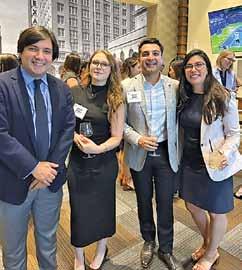
The ILS also hosts several social events for its members, either as stand-alone events or after the CLE presentations, including its recent fall cocktail event. The ILS continues to
The HBA ILS and the HBA Appellate Practice sections will co-host a roundtable featuring Justice Rebeca Huddle, Justice Harriet O’Neill, Justice Eva Guzman, and Judge Marieke Witkamp (Netherlands) on March 6 called “Perspectives on Advocacy in Domestic and International Forums, and Advancement of Diversity in Law.” This year’s executive board includes Daniel Ávila II, Reed Smith LLP (chair); Angela Di Blasi, Tricon Energy, Inc. (vice-chair), Julia Valencia, Topsoe (treasurer), and Grace Haidar, K&L Gates LLP (secretary).
Daniel Ávila II is an associate at Reed Smith’s international arbitration group, practicing in the areas of international arbitration, complex commercial litigation, and transnational investment law. Daniel is chair of the HBA International Law Section, the pro bono head for the Houston office of Reed Smith, and the global associate chair of UNIDOS, Reed Smith’s Latinx/Hispanic business affinity group.
seCtion spotLight
(L to r ) Daniel Ávila, Julia Valencia, Carlos rosas, and Chantel Carriere.
thehoustonlawyer.com January/february 2024 43
(L to r ) Prof. Julian Cardenas Garcia, Grace Haidar, imán k han, and Daniel Bravo.
media reVieWs
Jury Duty: A Humorous Look at the True Heroes of Our Court System
directed
by
Jake szymanski
streaming on amazon freevee reviewed by The honoraBle kyle CarTer
These days there is no shortage of courtroom dramas on both broadcast and streaming services. Many of us are familiar with shows such as Law and Order, Suits, Goliath, and The Lincoln Lawyer. But for those of you that are searching for a courtroom comedy series, look no further than Jury Duty, which you can find streaming on Amazon Prime Video (Freevee). Recently, I was approached by an attorney who emphatically said “Judge, you have to see this new show, Jury Duty.” While I typically get my fill of actual courtroom drama during my normal business hours, the thought of a comedic courtroom reality show, built around the jury duty experience, was too good to pass up.
Jury Duty is filmed as a realistic documentary, think The Office in a courtroom, with a twist. The jury is comprised of paid actors participating in a faux jury trial with one interesting detail: one of the jurors has no idea that the trial is fake or that all of the other participants from the fellow jurors, the attorneys, judge, to even the bailiff are paid actors.
While in a normal trial, jurors would be prohibited from discussing the case, in Jury Duty, the jurors are interviewed in documentary fashion during the trial proceedings. This allows the viewers to gauge the reactions of the jurors to the events as they unfold. The central character is immersed in a myriad of comical situations designed to strain the patience of any normal human being: from the oddly scientific juror who insists on The Houston Lawyer
wearing “chair pants,” to the jury being sequestered for the duration of the trial due to paid paparazzi, our protagonist, Ronald Gladden, takes it all in stride. You will have to watch the show to see just how it ends.
However, what I really appreciated about Jury Duty was the attention to detail. Rarely does a courtroom series detail the proceedings from the jurors’ perspective. Jury Duty wastes no time by jumping into the voir dire process. The exemption process was quite amusing and remarkably realistic, with each juror’s attempt to avoid jury service becoming more outlandish than the last. Adding to the entertainment value is the running commentary by the jurors being interviewed in true documentary fashion.
Throughout the series’ eight 26-minute episodes, the focus is on authentic court procedures. From opening statements, the evidence, to the final arguments, the audience gets a firsthand look at the reactions of the jury. The similarities to a real court proceeding are apparent and thoughtful. The production crew operated out of an adjacent courtroom in what appeared to be an actual courthouse. And while it’s unclear just how much of the show is scripted, it was quite enjoyable to watch. I found the reactions of the actor playing the part of the judge to be especially entertaining.
Overall, I found Jury Duty to be a comical foray into the world of jury trials, with a surprising amount of realism. Lawyers may actually learn something about jury trials by watching this show. Jury Duty is also an interesting reflection on how the public perceives our jury system. In this instance, Hollywood in many ways got it right. If not just the process itself, Jury Duty’s ultimate message is quite accurate. Jurors are the true heroes of the court system, and we must all recognize the tremendous sacrifice of those who give their time and attention to serve in our court system. If you haven’t yet watched Jury Duty, consider
this your summons to appear in front of the television for a very entertaining take on our justice system.
The Honorable Kyle Carter is the judge of the 125th District Court. Judge Carter has over 15 years’ experience on the bench and has presided over hundreds of jury and bench trials. Judge Carter is board certified in civil trial law and specializes in all areas of civil litigation. He is a member of The Houston Lawyer editorial board.
Witness to a Prosecution: The Myth of Michael Milken
By richard v sandler
Published by forbes Books
reviewed by Carey worrell
It’s rare that a business book brings me to tears. In fact, I think it’s unprecedented…until now. Richard Sandler’s heartfelt defense of Michael Milken in Witness to a Prosecution: The Myth of Michael Milken is part financial history and part personal narrative, and it covers both genres well. Witness to a Prosecution focuses on the investigation and prosecution of financier Michael Milken in the late 1980s and early 1990s when his innovative financing schemes disrupted the financial establishment and attracted the attention of SEC investigators and the U.S. Attorney’s Office headed by Rudy Giuliani.
From start to finish, the investigation and prosecution of Michael Milken lasted about 12 years, and author Richard Sandler was a front-row observer the entire time. As Milken’s childhood friend and long-time legal advisor, Sandler offers a unique perspective on the story that is both informative and moving. As a lawyer, he successfully outlines the case against Milken, Milken’s defense, and the motivations of the major players.
44 January/february 2024 thehoustonlawyer.com

But it is the story he tells as a friend that makes this book so powerful.
Readers looking for an unbiased treatment of the story of Michael Milken might want to seek out other sources, as Sandler is unabashedly biased towards Milken’s cause. The book portrays a Justice Department in the business of personal vendettas, lead by inexperienced prosecutors who will stop at nothing to make a name for themselves in the spotlight, regardless of the lives they destroy in the process.
In Sandler’s version of Milken’s story, the U.S. attorneys in the Southern District of New York would stop at nothing to convict Milken or force him to plead guilty, even though there was little to no evidence substantiating most of the claims against him. They tried the case in the press by vilifying Milken as a financial charlatan who became a billionaire at the expense of everyday investors, while completely ignoring the tens of millions of dollars and thousands of hours Milken dedicated to public service in meaningful and world-altering ways.
The Milken investigation and prosecution happened while I was still in grade school, so this book is my first exposure to this story in any depth. Honestly, it was heartbreaking. The book made me question what it means to pursue justice in the criminal context and examine the systemic limits on fairness for the accused. There is a commonly held belief that people with limited resources fare worse in the justice system, and this is undoubtedly true, but Witness to a Prosecution adds another dimension by telling a story of a man with unlimited resources who likely spent millions of dollars on a legal defense and still came up short. Sandler makes a strong argument that the rules governing criminal investigations are heavily stacked against defendants and structured so that the government has disproportionate access
Continued on page 48

Diversity, Equity, and Inclusion Programs at Texas Higher Education Institutions
By BriTney Brown
In 2023, many higher education institutions across the country witnessed diversity initiatives virtually eliminated on their campuses as a result of a changing legal landscape regarding diversity, equity, and inclusion programs. In June 2023, the U.S. Supreme Court issued a pair of landmark decisions striking down race-conscious college admissions programs in Students for Fair Admission, Inc. v. President and Fellows of Harvard College and Students for Fair Admission, Inc. v. University of North Carolina, et. al 1 Even before these decisions, several states had introduced legislation prohibiting, or severely limiting, college DEI programs.2 Texas was one of the earlier states to introduce anti-DEI legislation during the 88th Legislature— and on June 17, 2023, became one of a handful of states to formally adopt such legislation when Governor Greg Abbott signed Texas Senate Bill No. 17 (“SB 17”), an act “relating to diversity, equity, and inclusion initiatives at public institutions of higher education” into law.3
SB 17, which became effective January 1, 2024, and is now codified in Texas Education Code Section 51.3525, generally prohibits Texas public higher education institutions from operating diversity, equity, and inclusion offices, requiring diversity statements, and mandating DEI training.4 The bill broadly defines a “DEI office” to include not just the offices or departments carrying the DEI moniker, but also offices or units that, among other things, conduct activities, influence hiring, or promote policies regarding race, color, or ethnicity, and in some cases, sex,
gender identity, or sexual orientation.5
Institutions that fail to comply with the law’s requirements risk losing access to state-appropriated funding.6 Accordingly, many public colleges and universities throughout the state began eliminating departments and implementing widespread changes in the months leading up to the new law’s effective date.7 Students will undoubtedly notice these changes as campuses attempt to comply and better understand the confines of the law, but the law includes several exceptions that will still allow institutions to support students—albeit to a lesser degree.8 Specifically, the law’s prohibitions do not apply to academic course instruction, scholarly research, registered student organization activities, student recruitment and admissions, guest speakers, data collection, and generally applicable activities to enhance student achievement.9
It remains to be seen how these changes will ultimately affect student outcomes, but the Texas Higher Education Coordinating Board, the state agency charged with coordinating and leading the Texas higher education system, will biennially review how these changes affect student grade point averages and application, acceptance, matriculation, retention, and graduation rates 10
Britney Brown is an in-house attorney at Lone Star College focusing on transactional, employment, and general legal matters
endnotes
1. Students for Fair Admissions, Inc. v. President & Fellows of Harvard Coll., 600 U.S. 181 (2023).
2. DEI Legislation Tracker, THE CHRONICLE OF HIGHER EDUCATION, https://www.chronicle. com/article/here-are-the-states-where-lawmakersare-seeking-to-ban-colleges-dei-efforts (last visited on January 15, 2024).
3. Act of June 17, 2023, 88th Leg., R.S., S.B. 17, (codified at Tex. Educ. Code § 51.3525).
4. Id
5. Id
6. Id
7. See, Johanna Alonso, Texas Colleges Prepare for the End of DEI, INSIDE HIGHER ED (December 19, 2023) https://www.insidehighered.com/news/stu-
media reVieWs
LegaL trends
thehoustonlawyer.com January/february 2024 45
dents/diversity/2023/12/19/texas-institutions-prepare-anti-dei-law-go-effect#.
8. Act of June 17, 2023, 88th Leg., R.S., S.B. 17, (codified at Tex. Educ. Code § 51.3525).
9. Id 10. Id
Free Speech and Mandatory Bar Associations: The Fifth Circuit’s Recent Clarification of the “Germane” Standard
By sushanT mohan
Lawyers in the United States belong to two different groups. And no, I’m not referring to trial lawyers and non-trial lawyers (though that makes for a fascinating divide). Rather, it’s whether lawyers belong to mandatory bar associations or voluntary bar associations. The key difference—to state the obvious—is that attorneys practicing in a state that has a mandatory bar association must join the state bar to practice law.
The mandatory bar structure, which now exists in a world where state bar social media accounts are the norm, has resulted in numerous legal challenges. Recently, in Boudreaux v. Louisiana State Bar Association, 1 the Fifth Circuit provided insight into its stance on the speech of mandatory bar associations, such as those in Texas and Louisiana. Although the opinion focuses on mandatory bar organizations, legal organizations that disseminate content within the Fifth Circuit’s jurisdiction—whether via email, publications, or social media—should take note of the court’s guidance on how to steer clear of any future challenges that on the horizon for organizational speech.
the speech at issue
In Boudreaux, the Louisiana State Bar Association (“LSBA”) “took positions on antidiscrimination laws for LGBT individuals, com-
pliance with a state equal pay act, a rewriting of the state’s high school civics curriculum, a moratorium on executions in Louisiana pending certain criminal justice reforms, licensure of midwives, and concealed carry by school officials.”2 This did not sit well with the plaintiff-appellant, Boudreaux, who joined LSBA in 1996.3 Boudreaux sued LSBA, claiming that mandatory membership in the organization violated his rights to free speech and association.
the standard: “Germane to a Bar association’s Purposes”
Under the current standard, a mandatory bar association’s speech must be “germane” to a bar association’s purposes; that is, it must be “necessarily or reasonably incurred for the purpose of regulating the legal profession or ‘improving the quality of the legal service available to the people of the State.’”4
was LsBa’s speech Germane? no.
The Fifth Circuit ruled that posts on X relating to the health and well-being of lawyers were not germane to the LSBA’s purposes.5 Specifically, LSBA “tout[ed] the purported benefits of walnuts,” “urg[ed] readers to... work out at least three times per week,” and encouraged lawyers to get “sunlight.” Those statements failed the germaneness test “because they do not sufficiently relate to legal practice or the legal profession.” The court reasoned that if a bar association may tout health benefits, may it also advise attorneys to practice Vinyasa yoga or get married and have children, if it believes that those activities improved attorney wellness and therefore the quality of legal services in the state?6
Next, the court found that speech relating to the 69th Annual Red Mass at St. Louis Cathedral and holiday charity drives were not germane.7 The court noted that although [g]eneric Christmas and Halloween charity drives may be helpful to the community, and they may even—in some diffuse sense—increase goodwill toward the legal profession…unlike the pro bono provision of legal services, they are not sufficiently germane to the regulation of the legal profession or the improvement in quality of legal services.
Similarly, the court looked unfavorably upon LSBA sharing a news article relating to student debt of young attorneys. Although the court conceded that “the article is specific to lawyers,” it held that “[t]he test…is not about whether speech is ‘law-related,’ but whether it is related to ‘regulating the legal profession and improving the quality of legal services.’” The court did not see how “merely reading the article would improve a lawyer’s practice.”
Last, the court scrutinized a link LSBA provided to a history.com article about gay rights, which featured a large rainbow flag icon that read “LGBT Pride Month.” Although LSBA argued that Pride Month is nationally recognized and related to diversity in the profession, the court did not find the argument convincing and instead ruled that “there is a difference between diversity in the profession and diversity in broader society, with which LSBA lawyers may be concerned[;] [o]ne is germane, the other not.”
The Fifth Circuit has made clear that, for mandatory bar associations, speech must be “germane” to its purpose of regulating the legal profession or improving the quality of legal services. It will behoove organizations— mandatory or voluntary—to keep this test in mind when disseminating content
Sushant Mohan is a partner in BakerHostetler’s Commercial Litigation group, serves as a director for the Texas Young Lawyers Association, and as the south regional lead for the Leadership Council on Legal Diversity. Outside of work and service, Sushant enjoys being outside and staying active.
endnotes
1. Boudreaux v. Louisiana State Bar Ass’n, 86 F.4th 620, 624 (5th Cir. 2023).
2. Id. at 625.
3. Id. at 626.
4. Id. at 629.
5. Id. at 632.
6. Id. at 632-33.
7. Id. at 633-34.
8. Id. at 634.
9. Id. at 635.
10. Id. at 635-36.
LegaL trends The Houston Lawyer
46 January/february 2024 thehoustonlawyer.com
Join the HBa 100 Club!
The Houston Bar Association 100 Club is a special category of membership that indicates a commitment to the advancement of the legal profession and the betterment of the community. The following law firms, government agencies, law schools and corporate legal departments with five or more attorneys have become members of the 100 Club by enrolling 100 percent of their attorneys as members of the HBA.
Firms of 5-24 attorneys
Abraham, Watkins, Nichols, Agosto, Aziz & Stogner
Ajamie LLP
Alvarez Stauffer Bremer PLLC
Baker, Donelson, Bearman, Caldwell & Berkowitz, PC
Buck Keenan LLP
Christian Levine Law Group, LLC
Coats | Rose
Crady, Jewett, McCulley & Houren, LLP
De Lange Hudspeth McConnell & Tibbets LLP
Dentons US LLP
Dobrowski Stafford LLP
Doyle Restrepo Harvin & Robbins LLP
Ewing & Jones, PLLC
Fisher & Phillips LLP
Fizer Beck Webster Bentley & Scroggins
Fogler, Brar, O’Neil & Gray LLP
Frank, Elmore, Lievens, Slaughter & Turet, L.L.P.
Funderburk Funderburk Courtois, LLP
Germer PLLC
Gordon Rees Scully & Mansukhani, LLP
Hagans
Henke, Williams & Boll, LLP
Hirsch & Westheimer, P.C.
Holm | Bambace LLP
Horne Rota Moos LLP
Hughes, Watters & Askanase, L.L.P.
Husch Blackwell LLP
Jackson Lewis P.C.
Jenkins & Kamin, LLP
Johnson DeLuca Kurisky & Gould, P.C.
Jordan, Lynch & Cancienne
Kean Miller
Kilpatrick Townsend & Stockton LLP
Law Feehan Adams LLP
Linebarger Goggan Blair & Sampson, LLP
Liskow
McGinnis Lochridge
McGuireWoods LLP
McKool Smith
MehaffyWeber PC
Morris Lendais Hollrah & Snowden
Murrah & Killough, PLLC
Nathan Sommers Jacobs
Ogletree Deakins Nash Smoak & Stewart, P.C.
Paranjpe Mahadass Ruemke LLP
Peckar & Abramson, P.C.
Phelps Dunbar LLP
Pillsbury Winthrop Shaw Pittman LLP
Ramey, Chandler, Quinn & Zito, P.C.
Rapp & Krock PC
Reynolds Frizzell LLP
Roach & Newton, L.L.P.
Ross Banks May Cron & Cavin PC
Royston, Rayzor, Vickery & Williams, L.L.P.
Rusty Hardin & Associates, LLP
Schirrmeister Diaz-Arrastia Brem LLP
Schwartz, Page & Harding, L.L.P.
Scott, Clawater & Houston, L.L.P.
Shannon Martin Finkelstein
Alvarado & Dunne, P.C.
Shearman & Sterling
Shellist | Lazarz | Slobin LLP
Shipley Snell Montgomery LLP
Smith Murdaugh Little & Bonham LLP
Sorrels Law
Spencer Fane
Sponsel Miller Greenberg PLLC
Stuart PC
Taunton Snyder & Parish
Thompson & Horton LLP
Tindall England PC
Tracey & Fox Law Firm
Ware, Jackson, Lee, O’Neill, Smith & Barrow, LLP
West Mermis
Weycer, Kaplan, Pulaski & Zuber, PC
Williams Hart & Boundas, LLP
Wright Abshire, Attorneys, PC
Wright Close & Barger, LLP
Ytterberg Deery Knull LLP
Zukowski, Bresenhan & Piazza L.L.P.
Firms of 25-49 attorneys
Adams and Reese LLP
Andrews Myers, P.C.
Beck Redden LLP
BoyarMiller
Bradley Arant Boult Cummings LLP
Bush & Ramirez, PLLC
Cokinos | Young
Gibbs & Bruns LLP
Hogan Lovells US LLP
Kane Russell Coleman & Logan PC
Littler Mendelson P.C.
Martin, Disiere, Jefferson & Wisdom LLP
McDowell & Hetherington LLP
Wilson Cribbs & Goren PC
Yetter Coleman LLP
Firms of 50-99 attorneys
AZA Law
BakerHostetler LLP
Brown Sims, P.C.
Chamberlain Hrdlicka
Greenberg Traurig, LLP
Haynes and Boone, LLP
Jackson Walker
Morgan, Lewis & Bockius LLP
Susman Godfrey L.L.P.
Winstead PC
Firms of 100+ attorneys
Baker Botts L.L.P.
Bracewell LLP
Hunton Andrews Kurth LLP
Locke Lord LLP
Norton Rose Fulbright
Porter Hedges LLP
Vinson & Elkins LLP
Corporate Legal Departments
CenterPoint Energy, Inc.
EOG Resources, Inc.
MAXXAM, Inc.
Plains All American Pipeline, L.P.
Quantlab Financial, LLC
Rice University
S & B Engineers and Constructors, Ltd.
Law school Faculty
South Texas College of Law Houston
Thurgood Marshall School of Law
University of Houston Law Center
Government agencies
Harris County Attorney’s Office
Harris County District Attorney’s Office
Harris County Domestic Relations Office
Metropolitan Transit Authority of Harris County, Texas
Port of Houston Authority of Harris County, Texas
1st Court of Appeals
14th Court of Appeals
Local Bar association Boards of Directors
Hispanic Bar Association of Houston

thehoustonlawyer.com January/february 2024 47




From page 45
to information and influence with the ability to cut off access to favorable evidence and testimony from the defense team. I was challenged to look at nuances I had not previously considered.



However, the truly devastating part of this story revolved around the role of Milken as a dad and a husband who was sentenced to a decade in prison during the prime of his life based on scant evidence supporting claims that he committed crimes which had never been previously prosecuted. Sandler paints the picture of a man who truly was trying to make his mark on his industry and the world when he was unwittingly caught in the crosshairs of federal prosecutors. Sandler also argues that the negative outcome in Milken’s case was exacerbated by his mild-mannered and non-confrontational personality, which led him to rely on the justice system to work the way he imagined it would while refusing to make a case for himself in the media. I finished Sandler’s book feeling like sometimes a prosecution looks more like a persecution, and that Milken’s treatment really could happen to anyone—even me.
Carey Worrell is the CEO and managing attorney of SimpleLawTX.
LITIGATION MARKETPLACE The Houston Lawyer Video Mediations available Professional Services classified ads: mary Chavoustie mary@quantumsur.com 281.955.2449 ext. 3 media reVieWs
classified ads: mary Chavoustie mary@quantumsur.com 281.955.2449 ext. 3 DEnnIS ClIFFORD Mediating Complex Employment Disputes quantumsur.com
secure your tickets at hba.org 48 January/february 2024 thehoustonlawyer.com