By The Hon. Charles A. Spain
The Bar Comes Out in Houston
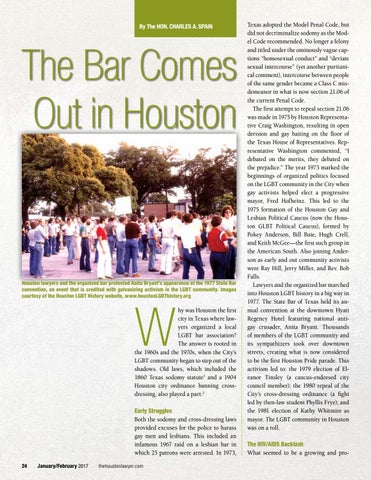
Houston lawyers and the organized bar protested Anita Bryant’s appearance at the 1977 State Bar convention, an event that is credited with galvanizing activism in the LGBT community. Images courtesy of the Houston LGBT History website, www.houstonLGBThistory.org
W
hy was Houston the first city in Texas where lawyers organized a local LGBT bar association? The answer is rooted in the 1960s and the 1970s, when the City’s LGBT community began to step out of the shadows. Old laws, which included the 1860 Texas sodomy statute1 and a 1904 Houston city ordinance banning crossdressing, also played a part.2 Early Struggles Both the sodomy and cross-dressing laws provided excuses for the police to harass gay men and lesbians. This included an infamous 1967 raid on a lesbian bar in which 25 patrons were arrested. In 1973, 24
January/February 2017
thehoustonlawyer.com
Texas adopted the Model Penal Code, but did not decriminalize sodomy as the Model Code recommended. No longer a felony and titled under the ominously vague captions “homosexual conduct” and “deviate sexual intercourse” (yet another puritanical comment), intercourse between people of the same gender became a Class C misdemeanor in what is now section 21.06 of the current Penal Code. The first attempt to repeal section 21.06 was made in 1975 by Houston Representative Craig Washington, resulting in open derision and gay baiting on the floor of the Texas House of Representatives. Representative Washington commented, “I debated on the merits, they debated on the prejudice.” The year 1973 marked the beginnings of organized politics focused on the LGBT community in the City when gay activists helped elect a progressive mayor, Fred Hofheinz. This led to the 1975 formation of the Houston Gay and Lesbian Political Caucus (now the Houston GLBT Political Caucus), formed by Pokey Anderson, Bill Buie, Hugh Crell, and Keith McGee—the first such group in the American South. Also joining Anderson as early and out community activists were Ray Hill, Jerry Miller, and Rev. Bob Falls. Lawyers and the organized bar marched into Houston LGBT history in a big way in 1977. The State Bar of Texas held its annual convention at the downtown Hyatt Regency Hotel featuring national antigay crusader, Anita Bryant. Thousands of members of the LGBT community and its sympathizers took over downtown streets, creating what is now considered to be the first Houston Pride parade. This activism led to: the 1979 election of Eleanor Tinsley (a caucus-endorsed city council member); the 1980 repeal of the City’s cross-dressing ordinance (a fight led by then-law student Phyllis Frye); and the 1981 election of Kathy Whitmire as mayor. The LGBT community in Houston was on a roll. The HIV/AIDS Backlash What seemed to be a growing and pro-