SHOW REPORT
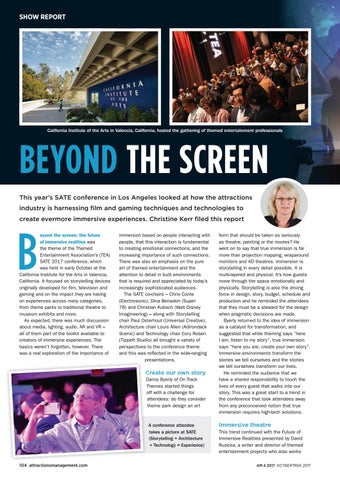
California Institute of the Arts in Valencia, California, hosted the gathering of themed entertainment professionals
BEYOND THE SCREEN This year’s SATE conference in Los Angeles looked at how the attractions industry is harnessing film and gaming techniques and technologies to create evermore immersive experiences. Christine Kerr filed this report
B
eyond the screen: the future of immersive realities was the theme of the Themed Entertainment Association’s (TEA) SATE 2017 conference, which was held in early October at the California Institute for the Arts in Valencia, California. It focused on storytelling devices originally developed for film, television and gaming and on the impact they are having on experiences across many categories, from theme parks to traditional theatre to museum exhibits and more. As expected, there was much discussion about media, lighting, audio, AR and VR – all of them part of the toolkit available to creators of immersive experiences. The basics weren’t forgotten, however. There was a real exploration of the importance of
immersion based on people interacting with people, that this interaction is fundamental to creating emotional connections, and the increasing importance of such connections. There was also an emphasis on the pure art of themed entertainment and the attention to detail in built environments that is required and appreciated by today’s increasingly sophisticated audiences. The SATE co-chairs – Chris Conte (Electrosonic), Dina Benadon (Super 78) and Christian Kubsch (Walt Disney Imagineering) – along with Storytelling chair Paul Osterhout (Universal Creative), Architecture chair Louis Allen (Adirondack Scenic) and Technology chair Cory Rosen (Tippett Studio) all brought a variety of perspectives to the conference theme and this was reflected in the wide-ranging presentations.
Create our own story Danny Byerly of On Track Themes started things off with a challenge for attendees: do they consider theme park design an art
A conference attendee takes a picture at SATE (Storytelling + Architecture + Technology = Experience)
104 attractionsmanagement.com
form that should be taken as seriously as theatre, painting or the movies? He went on to say that true immersion is far more than projection mapping, wraparound monitors and 4D theatres. Immersion is storytelling in every detail possible. It is multi-layered and physical. It’s how guests move through the space emotionally and physically. Storytelling is also the driving force in design, story, budget, schedule and production and he reminded the attendees that they must be a steward for the design when pragmatic decisions are made. Byerly returned to the idea of immersion as a catalyst for transformation, and suggested that while theming says “here I am, listen to my story”, true immersion says “here you are, create your own story”. Immersive environments transform the stories we tell ourselves and the stories we tell ourselves transform our lives. He reminded the audience that we have a shared responsibility to touch the lives of every guest that walks into our story. This was a great start to a trend in the conference that took attendees away from any preconceived notion that true immersion requires high-tech solutions.
Immersive theatre This trend continued with the Future of Immersive Realities presented by David Ruzicka, a writer and director of themed entertainment projects who also works AM 4 2017 ©CYBERTREK 2017