MUSEUMS
Bunkering Down Architecture firm BIG expands a Danish WWII bunker to create a museum camouflaged among the dunes Kim Megson, journalist, Attractions Management
photo: Rasmus Hjortshoj
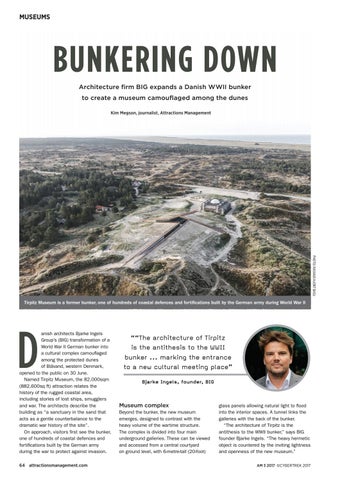
Tirpitz Museum is a former bunker, one of hundreds of coastal defences and fortifications built by the German army during World War II
D
anish architects Bjarke Ingels Group’s (BIG) transformation of a World War II German bunker into a cultural complex camouflaged among the protected dunes of Blåvand, western Denmark, opened to the public on 30 June. Named Tirpitz Museum, the 82,000sqm (882,600sq ft) attraction relates the history of the rugged coastal area, including stories of lost ships, smugglers and war. The architects describe the building as “a sanctuary in the sand that acts as a gentle counterbalance to the dramatic war history of the site”. On approach, visitors first see the bunker, one of hundreds of coastal defences and fortifications built by the German army during the war to protect against invasion. 64 attractionsmanagement.com
““The architecture of Tirpitz is the antithesis to the WWII bunker ... marking the entrance to a new cultural meeting place” Bjarke Ingels, founder, BIG
Museum complex Beyond the bunker, the new museum emerges, designed to contrast with the heavy volume of the wartime structure. The complex is divided into four main underground galleries. These can be viewed and accessed from a central courtyard on ground level, with 6-metre-tall (20-foot)
glass panels allowing natural light to flood into the interior spaces. A tunnel links the galleries with the back of the bunker. “The architecture of Tirpitz is the antithesis to the WWII bunker,” says BIG founder Bjarke Ingels. “The heavy hermetic object is countered by the inviting lightness and openness of the new museum.” AM 3 2017 ©Cybertrek 2017