HORI Z ON S QUARTERLY
fall 2021
VOLUME 30, ISSUE 4
5
6
12
14
On the cover: A red maple leaf is surrounded by colorful shades of blue and orange reflected on the water at Heron Creek (Lake Zurich).
more than
31,000 acres are protected by the
lake county forest preserves .
A MESSAGE from ANGELO D. KYLE PRESIDENT LAKE COUNTY FOREST PRESERVES AKYLE@LAKECOUNTYIL.GOV
BOARD of COMMISSIONERS PRESIDENT
Angelo D. Kyle, Waukegan VICE PRESIDENT
John Wasik, Grayslake TREASURER
Paul Frank, Highland Park ASSISTANT TREASURER
Gina Roberts, Beach Park
As we get into fall and the holiday season is soon upon us, this is traditionally a time to give thanks. While there is much to be thankful for, this year it may be more difficult for some to experience the fullness of joy that often accompanies this season. If you find yourself in that situation, I encourage you to read on. This magazine contains updates and inspirational stories about the forest preserves intended to renew a spirit of gratitude in all of us, especially during this holiday time. No one has been immune to events of the past 18 months. Some members of our community have been particularly at risk and may be feeling isolated from the world around them. During this time, the mission of the Forest Preserves has become more important than ever. Visiting local parks, trails and open spaces is essential for our mental and physical well-being. The preserves and trails are experiencing record-high usage levels as visitors turn to nature as an escape. Staff regularly receive positive testimonials from preserve patrons, praising the peace found during time spent outdoors and thanking us for keeping these spaces open and well maintained. Lake County residents work alongside us to help protect and restore ecological habitats and the free benefits they provide to human health and economies. Ongoing support from donors, volunteers and other partners makes it possible for the Forest Preserves to continue its mission, focusing on preservation, restoration, education and recreation initiatives for the residents of Lake County, without interruption. When we look beyond today’s headlines, there are many reasons to be grateful. Residents can take great pride in how their forest preserves make their communities more livable and the local economy more dynamic. Our vibrant communities will thrive, and future generations will protect and cherish these remarkable resources and the highly desirable quality of life that they provide. THANK YOU for your continued support! May the stories in the following pages enhance your spirit of gratitude and joy this holiday season.
Marah Altenberg, Buffalo Grove Dick Barr, Round Lake Beach Carissa Casbon, Lake Villa Jennifer Clark, Libertyville Mary Ross Cunningham, Waukegan Michael Danforth, Fox River Grove Bill Durkin, Waukegan Sandy Hart, Lake Bluff Diane Hewitt, Waukegan J. Kevin Hunter, Ingleside Ann B. Maine, Lincolnshire Paras Parekh, Highland Park Linda Pedersen, Antioch Catherine Sbarra, Lake Zurich Julie Simpson, Vernon Hills Jessica Vealitzek, Hawthorn Woods Terry Wilke, Round Lake Beach EXECUTIVE DIRECTOR
Ty Kovach
HORIZONS
VOLUME 30, ISSUE 4 Fall 2021 EDITOR AND DESIGNER
Jeanna Martinucci Cristino Horizons@LCFPD.org CONTENT CONTRIBUTORS
Kim Mikus Croke, Allison Frederick, Brett Peto, Rebekah Snyder PHOTOGRAPHY
Garen Johnson (cover), Jeff Goldberg, Joel Gettleman, Phil Hauck, John D. Kavc, John Weinstein, Adam S. Johnson, Chip Williams, Tim Elliott, Dan Maculay, Ronnie d'Entremont, Matt Misewicz SUBSCRIBE, UNSUBSCRIBE, UPDATE ADDRESS: 847–968–3335 | Horizons@LCFPD.org
Horizons is the quarterly publication of the Lake County Forest Preserve District. Subscriptions are free. Subscribers may also receive mailings from the Preservation Foundation of the Lake County Forest Preserves. Photo and videos are periodically taken of people participating in Forest Preserve District programs and activities. All persons registering for Forest Preserve District programs/activities or using Forest Preserve District property thereby agree that any photo or video taken by the Forest Preserve District may be used by the District for promotional purposes including its website, promotional videos, brochures, fliers and other publications without additional, prior notice or permission and without compensation to the participant.
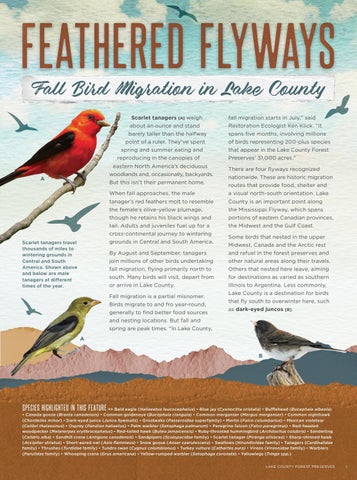
Fall Bird Migration in Lake County Scarlet tanagers
[A]
weigh
Restoration Ecologist Ken Klick. “It
barely taller than the halfway
spans five months, involving millions
point of a ruler. They’ve spent spring and summer eating and reproducing in the canopies of eastern North America’s deciduous woodlands and, occasionally, backyards.
A
But this isn’t their permanent home.
of birds representing 200-plus species that appear in the Lake County Forest Preserves’ 31,000 acres.” There are four flyways recognized nationwide. These are historic migration routes that provide food, shelter and
When fall approaches, the male
a visual north-south orientation. Lake
tanager’s red feathers molt to resemble
County is an important point along
the female’s olive-yellow plumage,
the Mississippi Flyway, which spans
though he retains his black wings and
portions of eastern Canadian provinces,
tail. Adults and juveniles fuel up for a
the Midwest and the Gulf Coast.
cross-continental journey to wintering grounds in Central and South America.
Scarlet tanagers travel thousands of miles to wintering grounds in Central and South America. Shown above and below are male tanagers at different times of the year.
fall migration starts in July,” said
about an ounce and stand
Some birds that nested in the upper Midwest, Canada and the Arctic rest
By August and September, tanagers
and refuel in the forest preserves and
join millions of other birds undertaking
other natural areas along their travels.
fall migration, flying primarily north to
Others that nested here leave, aiming
south. Many birds will visit, depart from
for destinations as varied as southern
or arrive in Lake County.
Illinois to Argentina. Less commonly,
Fall migration is a partial misnomer. Birds migrate to and fro year-round, generally to find better food sources
Lake County is a destination for birds that fly south to overwinter here, such as dark-eyed juncos
[B] .
and nesting locations. But fall and spring are peak times. “In Lake County, A B
SPECIES HIGHLIGHTED IN THIS FEATURE >> Bald eagle (Haliaeetus leucocephalus) • Blue jay (Cyanocitta cristata) • Bufflehead (Bucephala albeola) • Canada goose (Branta canadensis) • Common goldeneye (Bucephala clangula) • Common merganser (Mergus merganser) • Common nighthawk (Chordeiles minor) • Dark-eyed junco (Junco hyemalis) • Grosbeaks (Passeroidea superfamily) • Merlin (Falco columbarius) • Mexican violetear (Colibri thalassinus) • Osprey (Pandion haliaetus) • Palm warbler (Setophaga palmarum) • Peregrine falcon (Falco peregrinus) • Red-headed woodpecker (Melanerpes erythrocephalus) • Red-tailed hawk (Buteo jamaicensis) • Ruby-throated hummingbird (Archilochus colubris) • Sanderling (Calidris alba) • Sandhill crane (Antigone canadensis) • Sandpipers (Scolopacidae family) • Scarlet tanager (Piranga olivacea) • Sharp-shinned hawk (Accipiter striatus) • Short-eared owl (Asio flammeus) • Snow goose (Anser caerulescens) • Swallows (Hirundinidae family) • Tanagers (Cardinalidae family) • Thrushes (Turdidae family) • Tundra swan (Cygnus columbianus) • Turkey vulture (Cathartes aura) • Vireos (Vireonidae family) • Warblers (Parulidae family) • Whooping crane (Grus americana) • Yellow-rumped warbler (Setophaga coronata) • Yellowlegs (Tringa spp.) LAK E COUNTY FOR E ST PRE S E RVES
1
PREPARING FOR TAKEOFF Declines in food availability, length of daylight, and temperature can trigger migration. So can habitat condition. For example, frozen soil and ice formations on lakes and wetlands push some birds south. Flying up to thousands of miles is tough. To prepare, birds eat more in late summer, said Environmental Educator Mark Hurley.
C
“Birds don’t have the urge to mate right now,” he said. “They eat berries, seeds, insects and occasionally fish, replenishing energy reserves.” Long distances expose birds to predators, bad weather and humanmade obstacles. Deforestation and development of natural areas, power lines, cellphone towers, roaming cats, skyscrapers, bright lights and more can disrupt migration. Climate change, too, is increasingly shifting the timing and abundance of food sources. The 2021 drought affecting Lake County is one example.
D
ACROSS THE MAP Short-distance migrants relocate within flitting distance of their starting point. Red-headed woodpeckers
[C] ,
for instance,
sometimes migrate 10 to 50 miles south of Lake County to follow the annual acorn crop in oak woodlands. Medium-distance migrants fly across the same state or several states. Long-distance migrants travel from the U.S. and Canada to Central and South America. Increasing the complexity are species that seem to live locally year-round but are medium-distance migrants. “The blue jays
E
[D]
that nested in northern Wisconsin may
appear at our bird feeders in winter, while the jays that nested in your backyard could spend the winter in southern Illinois,” said Director of Education Nan Buckardt. The pace of migration differs in fall. “In spring, it’s all about getting to the breeding grounds and reproduction,” Buckardt said. “Fall migration is typically more casual and some species may stick around longer.” This can reverse the order in which birds arrived during spring. Yellow-rumped warblers [E] and palm warblers [F] land in early spring but are often the last warbler to leave Lake County in fall.
F
Flight Plans
Scientists don’t fully understand the intricacies of bird navigation. However, according to current research, birds rely on external cues and internal instincts. Genetic predisposition to fly in certain directions during certain seasons plays a role. Migratory restlessness, referred to by the German word zugunruhe, affects even caged birds. Geographical landmarks, the positions of the sun and stars, seasonal patterns in food and weather, and even the Earth’s magnetic field serve as navigation guidelines.
Sharp-shinned hawk
Ruby -throated hummingbird
This species is eastern North America’s only breeding hummingbird. They beat their wings around 53 times per second and often cross the Gulf of Mexico in a single flight. NESTING HABITAT: Deciduous woodlands, shrubby prairies BREEDING GROUNDS: Eastern U.S., southern Canada WINTERING GROUNDS: Central America PEAK LOCAL MIGRATION: Mid-September WHERE TO SEE: Backyards
Short-eared owl
Explore grassy areas near sunset this winter to see these owls. NESTING HABITAT: On the ground in grasslands BREEDING GROUNDS: Northern U.S. and Canada WINTERING GROUNDS: Midwest to Mexico PEAK LOCAL MIGRATION: October WHERE TO SEE: Rollins Savanna (Grayslake), Middlefork Savanna (Lake Forest)
These are common migrating raptors. Look for small birds with short, rounded wings, very long tails, and long legs. NESTING HABITAT: Dense forests with closed canopies BREEDING GROUNDS: Upper Midwest, northern New England, Canada, Idaho, Montana WINTERING GROUNDS: Southern U.S., Mexico and Central America PEAK LOCAL MIGRATION: End of September WHERE TO SEE: Fort Sheridan (Lake Forest)
Common goldeneye
Look for this species’ yellow eyes. Males have iridescent green heads but appear mostly black and white. Females have brown heads and gray bodies. NESTING HABITAT: Holes in trees near lakes, rivers and wetlands BREEDING GROUNDS: Canadian boreal forest WINTERING GROUNDS: Ice-free lakes and rivers PEAK LOCAL MIGRATION: November–January WHERE TO SEE: Fox River (Port Barrington), Independence Grove (Libertyville) LAK E COUNTY FOR E ST PRE S E RVES
3
LAKE COUNTY LAYOVERS
Hawkwatch volunteer group. North of that, the observa-
July brings the first fall migrants: shorebirds. A visit to the
Harbor) is another good birding spot. See pages 10–11.
Lake Michigan shoreline at Fort Sheridan Forest Preserve (Lake Forest) finds sanderlings, sandpipers
[G]
and
tion tower at Spring Bluff Forest Preserve (Winthrop
yellowlegs. Many migrating shorebirds have just finished
NAVIGATING NOVEMBER
raising young in the Arctic Circle’s perpetual daylight.
November delivers a recognizable scene, often heard
Near the end of August, swallows and common night-
before seen: sandhill cranes
hawks
[H]
congregate for South American destinations.
Nighthawks sometimes catch the first cold front for a tailwind ride south. “Six kinds of swallows can be seen
[K]
and Canada geese
[L]
flying overhead in V-shaped formations. With luck, you could spot a federally endangered whooping crane. Look for a large, white crane with black wingtips
skimming lakes and ponds, catching insects,” Klick said.
among groups of migrating sandhills.
“Each evening, swallows gather in large flocks before
Some waterfowl, such as snow geese [M] , move through
resting on power lines, bridges, buildings or treetops
in November. Bucking the north-south trend, tundra
for the night.”
swans fly east to winter in the Chesapeake Bay area.
September brings the highest bird numbers and diversity.
Other waterfowl return to overwinter here. Look for
Passerines, or perching birds—think warblers, vireos, tanagers, grosbeaks
[I]
and thrushes—are common.
buffleheads, common goldeneyes and common mergansers
[N]
on lakes and rivers with open water
through winter.
RAPTOR RAPTURE
There are always oddballs and outliers during bird
Lake County’s position on the western shore of
rhythms and patterns,” Klick said. “Each month
Lake Michigan provides stupendous hawk viewing opportunities. In October, strong winds blow migrating raptors—hawks, falcons, ospreys, eagles and other birds of prey—toward the Great Lake. The water
migration, but this annual event “unfolds in nature’s provides unique birding experiences. Yet they’re fairly predictable for those who look.”
concentrates raptors along the shoreline, since there
FINDING FEATHERED FRIENDS
are no thermals, or rising columns of warm air, over
If your birdwatching is taking flight, obtain some gear.
the lake to improve flight. On a given day, “thousands
“A field guide to the birds of the eastern U.S. is key. You
of raptors can pass silently at dizzying heights, some
can purchase a copy or check one out from a library,”
singly and some in groups called kettles,” said Klick.
Hurley said. “Buy or borrow a pair of 7- or 8-power
Between August and November, volunteers with
binoculars.” Also consider using free bird identification
the Fort Sheridan Forest Preserve Hawkwatch log meticulous data on raptor migration and abundance.
and monitoring apps from the Cornell Lab of Ornithology, National Audubon Society and other organizations.
Coordinator Adam Sell said the group observes 15 or more raptor species each year. Ospreys and peregrine falcons
[J]
come first in September. Sharp-shinned
hawks, merlins, red-tailed hawks, bald eagles [BELOW]
and turkey vultures all follow in
October and November.
“ Repeat visits to your favorite preserve or place help you, over time, note
”
what's typical and what’s unusual. —NAN BUCKARDT, DIRECTOR OF EDUCATION
The best conditions to spot raptors, Sell said, are often in mid-October and involve westerly winds, no moisture, partly cloudy skies and an overnight or predawn cold front. New volunteers may visit the group’s Facebook page— search “Fort Sheridan Hawkwatch.” A bit farther north, Illinois Beach State Park is also home to an active
Spotting birds in fall can prove challenging. Most adults rarely sing and have molted into subdued winter colors. Foliage also interrupts lines of sight. Accompany other birdwatchers and become familiar with migration locations. Learn more at
LCFPD.org/birdwatching.
Raptors are birds of prey. They are carnivores, hunting and eating other vertebrate animals that are large in comparison to the size of the hunter.
G
H
Unexpected Visitors Occasionally, birds appear in areas well
outside their normal range, a phenomenon called vagrancy. While not completely understood, likely causes of vagrancy include weather conditions—storms that blow birds off course—and wonky navigation. A rare Mexican violetear
[BELOW]
hummingbird recently hung out in the yard of Mundelein couple
I
J
Jeanna and Jason Cristino. Jeanna is a Communications Specialist at the Forest Preserves and editor of this magazine. Over August 21 and 22, the hummingbird, usually found in forested areas from Mexico to Nicaragua, flew back and forth between nearby oak trees and the Cristinos’ bird feeder, stocked with homemade nectar. Jason informed a family friend of the feathered find. Soon after, more than 100 birders armed
K
L
with binoculars and viewing scopes visited the yard to watch the violetear. Many noted it was a "life bird," meaning this was the first time they had observed it. Only one other formal record exists of a Mexican violetear visiting Illinois. An individual bird was seen in Fayetteville in southern Illinois 12 years ago, according to Geoff Williamson, secretary of the Illinois Ornithological Records Committee.
M
N
LAK E COUNTY FOR E ST PRES E RVES
5
PRESERVENEWS National Award Received Another round of congratulations is in order for Environmental Communications Specialist Brett Peto. Earlier this year, Peto won the 2021 Excellence in Interpretive Support Award from the National Association for Interpretation (NAI), Heartland Region. The regional awards committee elevated his nomination to the national competition, and he won! The award is given to an individual or organization that has shown recognition of the value of interpretation through exceptional and sustained support. Peto’s colleagues in our Education Department nominated him in appreciation of his dedication, skill and hard work promoting education programs, events and special projects. NAI will formally honor him at its annual conference in late fall.
NEW AND RETURNING VOLUNTEERS WELCOME Ecological restoration workdays at dozens of preserves countywide have resumed—involving invasive plant removal, tree and shrub planting, and seed collection and processing. Volunteers can teach about the cultural and natural history of Lake County at education programs. The Native Seed Nursery (Grayslake) is accepting volunteers to assist with planting, weeding, and seed collection and processing. A new visitor engagement volunteer position at the Dunn Museum (Libertyville) to begin this fall will include greeting visitors, guiding school groups and conducting visitor surveys. Garden volunteers are welcome to assist with caring for the 2.5-acre Independence Grove Native Garden (Libertyville). Stay up-to-date with protocols and opportunities, and complete a volunteer interest form at LCFPD.org/volunteer or call 847-367-6640.
NEW UNDERPASS TO OPEN LATE FALL A new trail extension and pedestrian tunnel connecting Raven Glen and Ethel’s Woods forest preserves (Antioch) are expected to open in late fall 2021. Pedestrians, cyclists and equestrians will find safe passage below Route 45 through a 145-foot concrete tunnel. The underpass is long enough to accommodate a future Illinois Department of Transportation project to expand the road to five lanes, according to Preserve Planner Greg Walenter. Also joining the two preserves is 0.8 mile of new paved and crushed limestone trail. The tunnel and trail form a critical connection in the Millennium Trail and Greenway. View the project map at LCFPD.org/projects.
6 HORI ZONS QUARTERLY FALL 2 02 1
PRESERVENEWS National Recognition STRATEGIC PLAN UPDATE | Sustainability To make the Ryerson Welcome Center (Riverwoods) even more sustainable, an array of solar photovoltaic (PV) panels is being added to its metal roof this fall. We received a $76,000 grant from the Illinois Clean Energy Community Foundation and a $50,000 anonymous gift to pay for the solar PV system. The 50-kilowatt system will be installed on the south side of the building. Completed in 2006, the Welcome Center is Platinum LEED Certified, the highest level granted by the U.S Green Building Council. The building’s many sustainable technologies, such as a geoexchange system, have generated significant environmental and financial benefits over time. View our complete 100-Year Vision and Strategic Plan, and full set of Road Map to 2025 objectives and tactics at LCFPD.org/vision.
Observations by local artist Pat Chaney
The Lake County Forest Preserves and two of its volunteers have earned national awards. The National Association of County Park and Recreation Officials (NACPRO) comprises 122 park and special recreation districts from across the country, of which we are a member organization. The Association issued the awards. Lake Villa residents Joyce and George Proper were awarded the Outstanding Volunteer award. The couple has volunteered for decades and collectively donated more than 10,000 hours in the last 15 years alone. They serve as preserve stewards at Grant Woods Forest Preserve (Ingleside), where they led thousands of workdays to restore natural areas at the preserve and encouraged and trained other volunteers in native plant identification, invasive species management, seed collection and planting. The "Growing Through Change" project at Grant Woods earned the Conservation Award. The award recognizes an exceptional effort to acquire, restore, preserve, operate or develop unique or significant conservation and natural areas or programs. We have launched a research project at Grant Woods to restore 180 acres of former farmland within the preserve using a climate-adapted, regionally sourced native seed mix.
"Isn't it a relief to know we can just stay here and snuggle in the mud?!"
LAK E COUNTY FOR E ST PRE S E RVES
7
Be a voice for nature by making a tax-deductible donation to the Preservation Foundation, the
charitable partner of the Lake County Forest Preserves. Gifts of all sizes are meaningful and help support projects and initiate programs that may otherwise go unfunded or take many years to complete. Learn more at LCFPD.org/donate or call 847-968-3110.
WE WELCOME BOB SHEARS TO THE PRESERVATION FOUNDATION BOARD OF DIRECTORS This summer, Bob Shears was named to the Preservation Foundation Board of Directors. The Mundelein resident has a strong connection to the Forest Preserves. He served as executive director of the Youth Conservation Corps (YCC) in Waukegan until 2018 and continues to serve as a board member. YCC has partnered with the Forest Preserves for decades to support summer jobs and college scholarships for dozens of Lake County youth each year. In addition to his experience on other charitable boards and a background in finance and international business, Bob brings a deep love and dedication to the Forest Preserves. For the past three years, he has gone through intensive training to become a volunteer site steward. This summer, Bob began as the site steward at Lyons Woods Forest Preserve (Waukegan) and has been organizing workdays for YCC and YouthBuild Lake County students, as well as weekly workdays for other local community members. His goal is to build a strong connection between the preserve and the community he has gotten to know so well over the years.
New Preservation Foundation Board Member Bob Shears (fourth from left) recently led a workday with YouthBuild Lake County volunteers, collecting 14 bags of invasive dame's rocket (Hesperis matronalis) at Lyons Woods Forest Preserve.
8 HORI ZONS QUARTERLY FALL 2 02 1
Guardian Society Members Enjoy a Night at the Native Seed Nursery Any gift to the Preservation Foundation is appreciated and helps the Forest Preserves do more. For donations at a leadership level of $1,000 or more annually, we offer invitations to special events and behind-the-scenes tours. This summer, Guardian Society members enjoyed a reception and tour of the Native Seed Nursery at Rollins Savanna. In 2020, more than 450 pounds of native seed from 306 species were collected and processed at the Native Seed Nursery. Many of these seeds are cost-prohibitive to purchase or simply unavailable in the marketplace, making this work truly priceless. Manager of Landscape Ecology Pati Vitt and Stewardship Ecologist Kelly Burdick led tours and explained the importance of the facility and its operations to the conservation mission of the Forest Preserves.
TOGETHER, ACHIEVING MORE FOR THE FOREST PRESERVES.
GRANTS MAKE CIVIL WAR COLLECTIONS AVAILABLE TO THE PUBLIC With funding from two grant awards, Dunn Museum Archives staff recently began work on two important components of our Civil War collection. Orson V. Young was 16 when he enlisted from Newport Township in Lake County. The Orson V. Young collection is comprised of his letters home, providing researchers insight into the “common soldier.” The 334 records of the Company B, 96th Illinois Infantry Collection include muster rolls, quartermaster reports, and leaves of absence. They offer valuable details of the company’s inner workings and rare insight into an individual soldier’s service. Both collections are currently only available to the public on-site and by appointment at the Teich Family Reading Room. An effort is underway to transcribe, digitize, and make both collections available for free to the public through the Illinois Digital Archives. Learn more at LCFPD.org/museum/collections. The project is supported in part by an award from the Illinois State Historical Records Advisory Board, through funding from the National Historical Publications and Records Commission, National Archives and Records Administration. Additional funding was provided by a grant from the Preservation Foundation Annual Fund.
1
2
1. Photograph of Orson V. Young (1845–1899). Circa 1860. 2. Letter from Orson V. Young while at Camp Fuller in Rockford, Illinois, to his father and stepmother, William and Sarah Young. 1862.
3 3. Receipt for military pay issued to Corporal Willard Whitney, 1864.
Love of Turtles Inspires Others to Give
The panelists (clockwise from top left): Junior Miss Lakemoor 2020 Olivia Eisenmenger, Environmental Educator Mark Hurley, Wildlife Ecologist Kathryn McCabe, Manager of Conservation Ecology Gary Glowacki.
Eight-year-old Olivia Eisenmenger loves turtles. As Junior Miss Lakemoor 2020, she decided to use her platform to educate and inform the public about Lake County’s endangered Blanding’s turtle population—and inspire them to give. Working with Forest Preserve ecologists and educators, Olivia turned one of our regular “Ask an Educator LIVE” programs into a fundraiser, offered via Zoom and streamed on Facebook @LCFPD. She exceeded her $400 goal during the one-hour event, raising $645 to support the Blanding’s Turtle Recovery Program – enough to purchase three radio trackers, which we use to track turtles released in the wild. Thanks, Olivia!
LAK E COUNTY FOR E ST PRE S E RVES
9
10
Featured Preserve
SPRING BLUFF
S
PRING BLUFF (Winthrop Harbor) contains primarily wetlands with oak savanna
and prairie. It is home to nine endangered plant and animal species and 114 bird species. A tiered observation deck rising 15 feet above the ground gives visitors a 360-degree view of the dramatic landscape, habitat restoration and Lake Michigan.
7TH ST
P
SPRING BLUFF FOREST PRESERVE 229 ACRES | WINTHROP HARBOR
Thanks to an Open Space Land Acquisition and Development Program Grant from the Illinois Department of Natural Resources,
PRESERVE AREA
WATER
we built the handicapped-accessi-
MARSH
ble, galvanized steel structure and
PRAIRIE
provided improved public access
SAVANNA
at the 229-acre preserve.
ADELINE JAY-GEO KARIS ILLINOIS BEACH STATE PARK PRESERVE TRAILS
An existing deteriorated asphalt roadway was converted into a
RAILROAD
0.7-mile recreational trail. The trail
ENTRANCE
connects to existing trails at the
P
PARKING
TRAIL ACCESS
adjacent Illinois Beach State Park. Parking is available at the first lot
OBSERVATION PLATFORM
on the right when you arrive at
METRA STATION
North Point Marina.
NORTH POINT MARINA
ACTIVITIES & AMENITIES BENCHES
The trail and observation deck gives visitors an opportunity to view the landscape that has been undergoing
BIKING
restoration to its native state for
CROSS-COUNTRY SKIING
more than 10 years. The success of
HIKING PUBLIC PARKING
GETTING HERE The entrance is located on 7th Street east of Sheridan Road. Follow signs to the parking lot shared with North Point Marina and the Illinois Beach State Park northern multi-use trailhead. Park in lot only. Parking along roadway is not permitted.
HORI ZONS QUARTERLY FALL 2 02 1
the restoration is visible.
Discover a 360-degree view of this preserve's dramatic landscape atop a 15-foot-tall tiered observation deck. THE NATURAL SCENE The preserve is located in the Lake Michigan Dunes
and blazing star can also be found here. “You can find
Section of the Northeastern Morainal Natural Division.
more than 900 native plants and 300 animal species,”
It is a complex of beach-ridges and dunes that formed
Glowacki said.
between 3,000–4,000 years ago, when Lake Michigan water levels were about 20 feet higher than the present. “The site offers so many scenic views and lessons in ecology,” said Gary Glowacki, Manager of Conservation Ecology.
In 1992, Spring Bluff became an Illinois Nature Preserve because of its high-quality natural resources. The preserve is an important part of the 6,000-acre lakeshore area known as the Chiwaukee Prairie Illinois Beach Lake Plain, covering 15 miles of Lake Michigan
This ridge and swale topography has given rise
shoreline in southeastern Wisconsin and northeastern
to a variety of plant communities, including sand
Illinois. Eight public entities own the properties that
prairie, sand savanna, marsh, and graminoid fen,
were designated a Ramsar Wetland of International
which provide habitat for notable breeding wildlife
Importance in 2015. The Ramsar Convention is an
species. Records include red-headed woodpeckers
intergovernmental treaty formed for
(Melanerpes erythrocephalus), willow flycatchers
the protection of exemplary wetland
(Empidonax traillii), cedar waxwings (Bombycilla
systems worldwide.
Cedar waxwing (Bombycilla cedorum)
cedrorum), Virginia rails (Rallus limicola), Wilson’s snipe (Gallinago delicata) and killdeer (Charadrius vociferus). A rich diversity of plants, including lilies
HISTORY OF THE PRESERVE Purchase of the land began in 1963, just five years after the Forest Preserves formed. Spring Bluff was one of the first 10 sites we acquired due to its high-quality natural features. In 1839, federal surveyors determined the soil was sandy, wet and “unfit for cultivation.” As a result, land use by local farmers was largely limited to grazing cows and sheep. In 1871, a post office was established on Sheridan Road with the name Spring Bluff. A couple years later, the name was also used for the Chicago & North Western Railway station on Third Avenue.
LAK E COUNTY FOR E ST PRE S E RVES
11
12
FEATURED EVENTS
Woolly bear caterpillar (Pyrrharctia isabella)
Education Programs, Activities and Resources In-person and virtual nature and history programs, school field trips, and digital resources are available. For a full list of events, descriptions, pricing and tickets, visit LCFPD.org/calendar or call 847-968-3321.
FAMILY PROGRAMS Looking for a fun, engaging and educational program designed for the whole family? Programs feature a variety of topics on history and nature.
View all family programs and find registration details at LCFPD.org/calendar. A few upcoming family programs: November 17 Homeschool Companion: Ansel Adams November 21 Family Nature Club: Wild Turkeys November 23 Art in Your Backyard
SCOUT PROGRAMS We offer hands-on, expertly guided scout programs designed around badge requirements. View all scout programs and find registration details at LCFPD.org/calendar. A few upcoming scout programs: November 20 Boy Scouts: Indian Lore November 20 Webelos: Earth Rocks December 18 Boy Scouts: Virtual Indian Lore January 8 Brownies: Painting January 8 Brownies: Dinosaurs
VIRTUAL PROGRAMS FOR ADULTS Join our history and environmental educators from the comfort of your home for a variety of programs, from local history lectures and gallery tours to Q&A discussions. View all virtual programs for adults and find registration details at LCFPD.org/calendar. A few upcoming virtual programs for adults: November 17 Conversation Starters: Environmental Perspectives December 16 Crofton Cookbook Club
GUIDED WALKS Get exercise and learn about your local forest preserves. Join an educator and find out about preserve history, native plants and wildlife. View all guided walks and find registration details at LCFPD.org/calendar. A few upcoming guided walks: November 13 Walk with a Naturalist November 20 Guided Hike Lake County November 21 Sunday Stroll
HORI ZONS QUARTERLY FALL 2 02 1
NOVEMBER 6, 2021–MARCH 27, 2022 • DUNN MUSEUM Got a burning question about Lake County history or nature? Our educators have the answer. Email: AskAnEducator@LCFPD.org
Experience the power of nature captured by photographer Ansel Adams. See page 15 for more details or visit DunnMuseum.org.
FIELD TRIPS AND IN-SCHOOL PROGRAMS For Teachers We offer in-person field trips at a forest preserve or other locations, such as Ryerson Conservation Area (Riverwoods), Dunn Museum (Libertyville) and Greenbelt Cultural Center (North Chicago). Teachers may also choose from in-school programs with a visiting educator or virtual programs delivered to their classrooms. Artifacts, live animals and biofacts are used in programs to help students learn about local history and the natural world. Topics include prehistoric Lake County, the Potawatomi, early settlers, geology, animal adaptations, birds, and lake ecology. All school programs support Illinois State Learning Standards. View field trips and in-school programs at LCFPD.org/schools.
To book, email AskAnEducator@LCFPD.org or call 847-367-6640.
2021 ONLINE NATIVE PLANT SALE
Do more good with your garden.
2021 Online Native Plant Sale
Now through December 31
1:23
1:23
LCFPD.org/PlantSale
Have gaps in your garden? Shop online for native
perennials, trees and shrubs. Our partners at Possibility Place Nursery will ship them straight to your doorstep. Species available while supplies last. Minimum purchase of 18 pints, in any combination of plants, required for safe, efficient delivery.
Get started: LCFPD.org/plantsale Add to Cart
Need tips for native landscaping? Visit our resources hub at LCFPD.org/landscaping. LAK E COUNTY FOR E ST PRE S E RVES
13
Take the Hike Lake County Challenge ( Actias luna)
P R E S E RVES F
m oth
2019
O
Y
enjoying time outdoors.
NT
reconnecting with nature and
ST
preserves across the county while
na
your recreational experience in
Lu
is a great way for you to expand
2021
RE
Our annual fall walking program
AKE COUNT HIKE L Y
LAKE COU
14
Like to Hike? How It Works 1 Visit LCFPD.org/HLC to download the Travel Log,
get details and begin your hiking challenge.
2
To participate, walk seven of the 12 designated "Hike Lake County" trails selected by our educators
(or complete all 12). At each preserve, look for the
Hike Lake County logo signs at the trailhead to get
started on the right route.
3
Complete your walks by November 30 and you'll earn a free zipper pull or shield for your walking
stick. Use the Travel Log to record each hike. Every
walker needs their own. Bicycling or horseback
riding do not count toward the program. If you're
walking with your dog, record their name on your
Travel Log and they will receive a free dog tag.
4
To receive your free commemorative zipper pull, shield, or dog tag, submit your completed Travel
Log by January 31, 2022. You can submit online, in
person at our General Offices (Libertyville) or the
Ryerson Welcome Center (Riverwoods), or mail
it to Lake County Forest Preserves, 1899 West
Winchester Road, Libertyville, IL 60048. Walking
sticks can also be purchased at the Dunn Museum
gift shop.
HORI ZONS QUARTERLY FALL 2 02 1
2021 Hike Lake County Trail Locations
Mileage
Fox River, Port Barrington
2.1 miles*
On Roberts Rd, west of River Rd.
Grassy Lake, Lake Barrington
On Kelsey Rd, west of Old Barrington Rd.
Half Day, Vernon Hills
On Route 21 (Milwaukee Avenue) at the light for Woodlands Pkwy, south of Route 60 (Townline Rd) and just north of Route 22 (Half Day Rd).
Heron Creek, Lake Zurich
On Old McHenry Rd, south of Route 22.
Lyons Woods, Waukegan
On Blanchard Rd, just west of Sheridan Rd and south of York House Rd.
Middlefork Savanna, Lake Forest On Waukegan Rd (Route 43), north of Route 60 and south of Route 176.
Prairie Wolf, Highland Park
On Route 22 (Half Day Road), east of Route 43 (Waukegan Road).
Raven Glen (West), Antioch
On Route 173, between Route 45 and Deep Lake Rd.
Rollins Savanna (Drury Lane), Lake Villa On Drury Lane, north of Route 83 and south of Rollins Road.
Sedge Meadow, Wadsworth
On the south side of Wadsworth Rd, east of Route 41 and west of the Des Plaines River Trail.
Sun Lake, Lake Villa
On the south side of Grass Lake Rd, just west of Deep Lake Rd and east of Route 83.
Waukegan Savanna, Wadsworth
On York House Rd, west of Delany Rd.
Wild Card–You Pick!
Choose a 2-mile walk on any Lake County Forest Preserve trail.*
*counts as two trails
1.8 miles 1.1 miles 1.6 miles 1.9 miles 2.6 miles* 1.7 miles 1.8 miles 1.9 miles 2.3 miles* 2.6 miles* 1.8 miles 2 miles*
ANSEL ADAMS:
Early W orks November 6, 2021–March 27, 2022
1899 W. Winchester Rd.
Libertyville
DunnMuseum.org • 847-968-3400
Ansel Adams (1902–1984) was a giant in the field of landscape photography. His images of the unspoiled Western landscape were informed by his belief in the transcendental concept of the sublime—a complex combination of overwhelming awe and fear. Adams was a poet of light, both in the field and in the darkroom. Many viewers are familiar with Adams’ heroic, high-contrast prints from the 1970s. Ansel Adams: Early Works focuses on the artist’s masterful, less well-known small prints from the 1920s through 1950s. By capturing the power of nature, Adams changed our understanding of landscape photography, solidifying it as a legitimate form of modern art. Sponsored by This exhibition is organized by art2art Circulating Exhibitions, LLC. All works are from the private collection of Michael Mattis and Judith Hochberg.
Dan and Shirley Mayworm
Photographs by Ansel Adams. © The Ansel Adams Publishing Rights Trust. Top right: Mount Clarence King, ca. 1925; Bottom left: Coastal road, 1952-53; Bottom right: Storm, Yosemite Valley, California, 1938.
16
SPECIAL FACILITIES Directory
GENERAL OFFICES
OPERATIONS AND PUBLIC SAFETY
1899 West Winchester Road Libertyville, Illinois 60048
19808 West Grand Avenue Lake Villa, Illinois 60046
847-367-6640 tel 847-367-6649 fax 847-968-3155 TDD
847-367-6640 tel (Operations) 847-968-3404 tel (Public Safety) 847-245-3735 fax
For hours, visit our website.
For hours, visit our website.
INDEPENDENCE GROVE
RYERSON CONSERVATION AREA
BRAE LOCH GOLF CLUB
16400 West Buckley Road Libertyville, Illinois 60048
21950 North Riverwoods Road Riverwoods, Illinois 60015
33600 North U.S. Highway 45 Grayslake, Illinois 60030
847-968-3320
847-968-3100 Tee Times 847-968-3441 Golf Gift Cards 847-489-1931 Golf Outings
847-968-3499 Main
IndependenceGrove@LCFPD.org IndependenceGrove.org 847-247-1111 Banquets, Meetings
Info@eventsig.com EventsAtIndependenceGrove.com
LCFPD.org/ryerson Welcome Center For hours, visit our website.
LCFPD.org 911 emergency 847-549-5200 nonemergency public safety issues
BraeLochGolfClub.org
BESS BOWER DUNN MUSEUM
COUNTRYSIDE GOLF CLUB Prairie and Traditional Courses
Visitors Center For hours, visit our website.
1899 West Winchester Road Libertyville, Illinois 60048
Beer Garden, Marina and Café For seasonal hours and fees, visit our website.
Dunn@LCFPD.org DunnMuseum.org
847-968-3100 Tee Times 847-968-3441 Golf Gift Cards 847-489-1931 Golf Outings
Gallery and Gift Shop For hours, visit our website.
CountrysideGolfClub.org
Vehicle window stickers allow entry without having to verify Lake County residency. Fee is $5, available at the Visitors Center.
General Admission $6 adults/$10 nonresidents $3 seniors, youth/$6 nonresidents Free, children ages 3 and under
A Robert Trent Jones Jr. championship golf course
Nonresidents $6 per car Monday–Thursday $12 per car Friday–Sunday and holidays
Discount Tuesdays $3 adults/$5 nonresidents $1.50 seniors, youth/$3 nonresidents
Parking Fee Lake County residents FREE
847-968-3400
THUNDERHAWK GOLF CLUB
28500 West Roberts Road Port Barrington, Illinois 60010
First and Third Thursdays On the first and third Thursdays of every month, enjoy free programs and admission from 6–8 pm.
847-381-0669
Sponsored by:
FOX RIVER MARINA
FoxRiverMarina.org Boat Launch and Marina For hours and fees, visit our website. GREENBELT CULTURAL CENTER 1215 Green Bay Road North Chicago, Illinois 60064 847-968-3477 Banquets, Meetings
Greenbelt@LCFPD.org GreenbeltCulturalCenter.org Office Hours By appointment only
HORI ZONS QUARTERLY FALL 2 02 1
20800 West Hawley Street Mundelein, Illinois 60060
®
39700 North Lewis Avenue Beach Park, Illinois 60099 847-968-3100 847-968-3441 847-489-1931 847-968-3450
Tee Times Golf Gift Cards Golf Outings Banquets
ThunderHawkGolfClub.org
FOREST PRESERVE Entrance/Parking
FORT HILL TRAIL Planned Section
FOREST PRESERVE EASEMENTS
CHAIN O’LAKES BIKE PATH Planned Section
More than 31,000 acres make up your Lake County Forest Preserves.
STATE LAND
Most preserves are open 6:30 a m – sunset, daily. If a preserve gate is open before 6:30 a m , the preserve is considered open for use.
DES PLAINES RIVER TRAIL (DPRT)
MAP CURRENT AS OF
Monday, November 8
LCFPD.org
MILLENNIUM TRAIL Planned Section
OPERATIONS AND PUBLIC SAFETY BEER GARDEN
MIDDLEFORK TRAIL Planned Section
CANOE LAUNCH
M CCLORY TRAIL / NORTH SHORE PATH
COMMUNITY GARDEN
PATRIOT PATH Planned
DOG PARK
SPRING BLUFF
!
!
! ! ! !
!
!
MILL CREEK
! !
FOURTH LAKE
LYONS WOODS
!
!
!
!
WAUKEGAN SAVANNA
! !
! !
! !! !
!
!!
BONNER HERITAGE ! FARM
!
!
GRANT WOODS
!
!
! !
DUCK FARM
!
!
McDONALD WOODS
!
! !
! ! ! ! ! !!
! !
!
!
!!
!!
!!
! ! ! !! !
! ! ! ! ! ! ! ! ! ! ! ! ! !
!!
!! !!
! ! !
!!! ! ! ! !! !! ! ! ! !
HASTINGS LAKE
Adeline Jay Geo-Karis Illinois Beach State Park
THUNDERHAWK GOLF CLUB
ETHEL'S WOODS
!
! ! !
! !! !
! !
Des Plaines River
WADSWORTH SAVANNA
!
!
OAK-HICKORY
!
! !!
! ! ! ! ! ! ! ! ! ! ! ! ! ! ! ! ! ! ! ! ! ! !!
! ! ! !
RAVEN GLEN
! !
! !
! !
! ! ! ! ! ! ! ! ! ! ! ! ! ! ! ! ! !
!
SUN LAKE
! ! ! !
DUTCH GAP
!
!
Cedar Lake State Bog
!
PRAIRIE STREAM
!!
BLUEBIRD MEADOW
!
! !
SEQUOIT CREEK
! ! ! ! ! ! ! !
LAKE MARIE
Chain O'Lakes State Park
VAN PATTEN WOODS
! ! !
! ! ! !
! !
! !
!
! ! !! ! !
! ! ! ! ! ! ! ! ! ! ! ! ! ! ! ! ! !
! ! ! ! ! ! ! ! ! ! ! ! ! ! ! !! !! ! ! !
! ! ! ! ! ! ! ! ! ! ! ! ! ! ! !
! ! ! !
Red Wing Slough State Natural Area
Fox River
!! ! !
Use our interactive trail map online to navigate your next adventure. To view the map, open the camera app on your phone and hover over the QR code below.
PINE DUNES
GANDER MOUNTAIN
! !
TRAIL MAP
GENERAL OFFICES AND DUNN MUSEUM
DPRT TO LYONS WOODS Planned Section
CASEY TRAIL PRAIRIE CROSSING TRAIL/GRAYSLAKE BIKE PATH
GRAND ILLINOIS TRAIL Planned
SEDGE MEADOW
!
!
! !
ROLLINS SAVANNA
! ! ! ! ! ! ! !
TANAGER KAMES Volo Bog State Natural Area
LAKE CARINA
!
! !
! ! ! ! ! ! ! !
MARL FLAT
! !
ALMOND MARSH
! ! !
GREENBELT
KETTLE GROVE
! !
Black !! ! ! ! ! ! ! ! ! ! ! Crown ! ! SINGING !! Marsh! ! ! ! State HILLS Natural ! ! Area ! !
KESTREL RIDGE
!
INDEPENDENCE GROVE
!
! !
! !
! ! ! !
! !
! ! ! !
!!
!!!!
!!
! ! ! ! ! ! ! !
! ! ! ! ! !
!
!
ATKINSON STORMWATER FACILITY
WILMOT WOODS
!
RAY LAKE
Lake Michigan
! !
! !
!!
! ! ! ! ! ! ! ! ! ! ! ! ! ! ! ! ! ! ! !
! !
! !
!!
! !
!
VISITORS CENTER
!
!! ! ! ! ! ! ! ! ! ! ! ! ! ! ! ! ! ! ! ! ! ! ! ! ! ! ! ! ! ! ! ! ! ! ! ! ! ! ! ! !
! !
NIPPERSINK !
GREENBELT CULTURAL CENTER
!
BRAE LOCH GOLF CLUB
!
!
! ! ! ! ! !
!
! !
! !
! ! ! !
Des Plaines River
OLD SCHOOL
COUNTRYSIDE GOLF CLUB
!
FOX RIVER
°
!
!
MacARTHUR WOODS
LAKEWOOD
!
ORIOLE GROVE
!
MIDDLEFORK SAVANNA
!
NORTH NORTH
! ! ! !
! !
!
!
! ! ! !
!
!! ! !
! !
! !
!
PRAIRIE WOLF
!
EGRET MARSH
HERON CREEK
EDWARD L. RYERSON CONSERVATION AREA
!
CUBA MARSH
BUFFALO CREEK
!
WELCOME CENTER !
CAHOKIA FLATWOODS
!
DUFFY STORMWATER FACILITY
!
FORT SHERIDAN
! ! ! ! ! !! !! !
!
! !
HALF DAY
!
CAPTAIN DANIEL WRIGHT WOODS
! !
!
!
! !
!
GRASSY LAKE
! !
ADLAI E. STEVENSON ! HISTORIC HOME
Fox River
! ! ! ! ! !
! ! ! !
GRAINGER WOODS CONSERVATION PRESERVE
!
MARINA
!
SKOKIE RIVER WOODS BERKELEY PRAIRIE
LAK E COUNTY FOR E ST PRE S E RVES
17
LAKE COUNTY FOREST PRESERVES GENERAL OFFICES 1899 WEST WINCHESTER ROAD LIBERTYVILLE ILLINOIS 60048
PLEASE DELIVER PROMPTLY—
t
TIME- SENSITIVE MATERIAL
HORI Z ON S SUBSCRIPTION SERVICES HOTLINE: 847–968–3335 email : Horizons@LCFPD.org
q
SHELTER RENTALS
THIS PUBLICATION IS PRODUCED USING 100% RECYCLED PAPER, ALLOWING US TO SAVE 85 MATURE TREES, 6,380 GALS WATER, 12,246 LBS GREENHOUSE GASES
Reservations for 2022 shelter rentals began on Monday, October 18. Purchase permits online, by phone or in person. Details: LCFPD.org/permits
Lake County History Symposium In January 2022, the Dunn Museum (Libertyville) will host the 7th Annual Lake County History Symposium. The event is open to the public and will be held virtually and in person. The symposium brings together those interested in the history of Lake County. The theme is The Built Environment: Architecture and Landscapes in Lake County and focuses on the landscapes, architects, city planning and other topics relating to shaping Lake County's appearance. Professional, amateur and student historians are invited to submit proposals for presentations. Submissions are due by November 20. To submit or learn more: LCFPD.org/symposium
FLICKR PICK Wild turkeys (Meleagris gallopavo) live in mature upland woods with clearings. They scratch through leaf litter in search of acorns, hickory nuts, berries and the occasional invertebrate. Photo taken at Lakewood Forest Preserve (Wauconda) by local photographer John D. Kavc. Connect with us @LCFPD on Facebook, Instagram, Twitter, Flickr, LinkedIn, and YouTube. Listen to our award-winning Words of the Woods podcast on your favorite podcast app.