THE FOILING FEATURE — D
id something change in the sailing world when footage of the foiling Optimist went viral? This was by no means the first nonAmerica's Cup boat to fly. Cruising boats have been experimenting with foils for years, and kite- and windsurfers have been testing a variety of foil setups for at least a decade before the current proliferation. And let's not forget the multitude of foiling dinghies, such as the Moth, WASZP, UFO and iFLY15. The 2020 Tokyo Olympics will see its first foiling class, the Nacra 17. Even Lasers — the most popular sailing boat in the world — have foiling kits available. In fact, foiling boats are over 100 years old, and it's easy to find blackand-white photos of motor boats zooming above the water on their strange underwater wings. But the flying Opti — which was designed and built as a novelty and is not a production boat — seemed to open a door, if only in people's imaginations. If one of the most basic and ubiquitous boats in the world could fly, then maybe foiling was something for the masses after all. Maybe the space-age technology could trickle down, at least a little, to all of us common sailors. The expansion of foiling is a convergence of a century-old idea that came to fruition in sailboats with the advancement of lighter, stronger materials, and the injection of millions of dollars from the research and development of the modern America's Cup. The spread of foiling begs the question: Will the future be foiled? What will sailing look like in 25 years? In 50? A
WIKIPEDIA
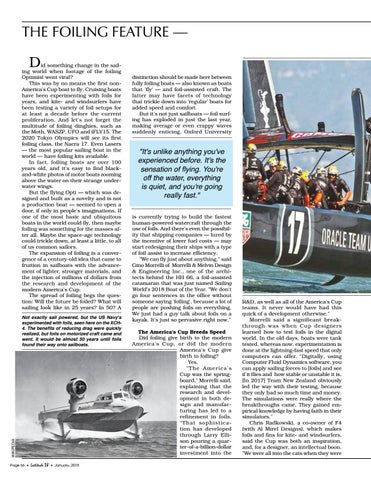
Not exactly sail powered, but the US Navy's experimented with foils, seen here on the XCH4. The benefits of reducing drag were quickly realized, but foils on motorized craft came and went. It would be almost 50 years until foils found their way onto sailboats.
Page 66 •
Latitude 38
• January, 2018
distinction should be made here between fully foiling boats — also known as boats that 'fly' — and foil-assisted craft. The latter may have facets of technology that trickle down into 'regular' boats for added speed and comfort. But it's not just sailboats — foil surfing has exploded in just the last year, making average or even crappy waves suddenly enticing. Oxford University
"It's unlike anything you've experienced before. It's the sensation of flying. You're off the water, everything is quiet, and you're going really fast." is currently trying to build the fastest human-powered watercraft through the use of foils. And there's even the possibility that shipping companies — lured by the incentive of lower fuel costs — may start redesigning their ships with a type of foil assist to increase efficiency. "We can fly just about anything," said Gino Morrelli of Morrelli & Melvin Design & Engineering Inc., one of the architects behind the HH 66, a foil-assisted catamaran that was just named Sailing World's 2018 Boat of the Year. "We don't go four sentences in the office without someone saying 'foiling', because a lot of people are pushing foils on everything. We just had a guy talk about foils on a kayak. It's just so pervasive right now." The America's Cup Breeds Speed Did foiling give birth to the modern America's Cup, or did the modern America's Cup give birth to foiling? Yes. "The America's Cup was the springboard," Morrelli said, explaining that the research and development in both design and manufacturing has led to a refinement in foils. "That sophistication has developed through Larry Ellison pouring a quarter-of-a-billion-dollar investment into the
R&D, as well as all of the America's Cup teams. It never would have had this quick of a development otherwise." Morrelli said a significant breakthrough was when Cup designers learned how to test foils in the digital world. In the old days, boats were tank tested, whereas now, experimentation is done at the lightning-fast speed that only computers can offer. "Digitally, using Computer Fluid Dynamics software, you can apply sailing forces to [foils] and see if it flies and how stable or unstable it is. [In 2017] Team New Zealand obviously led the way with their testing, because they only had so much time and money. The simulations were really where the breakthroughs came. They gained empirical knowledge by having faith in their simulators." Chris Radkowski, a co-owner of F4 (with Al Mirel Designs), which makes foils and fins for kite- and windsurfers, said the Cup was both an inspiration, and, for a designer, an intellectual boon. "We were all into the cats when they were