WILL OXLEY
ALFRED A. KNOPF
QUID PRO QUO BOOKS
THE TED TALKS OF SAILING
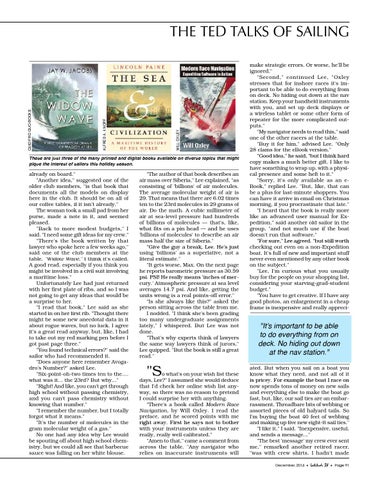
These are just three of the many printed and digital books available on diverse topics that might pique the interest of sailors this holiday season.
already on board." "Another idea," suggested one of the older club members, "is that book that documents all the models on display here in the club. It should be on all of our coffee tables, if it isn't already." The woman took a small pad from her purse, made a note in it, and seemed pleased. "Back to more modest budgets," I said. "I need some gift ideas for my crew." "There's the book written by that lawyer who spoke here a few weeks ago," said one of the club members at the table. "Widow Wave," I think it's called. A good read, especially if you think you might be involved in a civil suit involving a maritime loss." Unfortunately Lee had just returned with her first plate of ribs, and so I was not going to get any ideas that would be a surprise to her. "I read that book," Lee said as she started in on her first rib. "Thought there might be some new anecdotal data in it about rogue waves, but no luck. I agree it's a great read anyway, but, like, I had to take out my red marking pen before I got past page three." "You found technical errors?" said the sailor who had recommended it. "Does anyone here remember Avogadro's Number?" asked Lee. "Six-point-oh-two times ten to the.... what was it... the 23rd? But why..." "Right! And like, you can't get through high school without passing chemistry, and you can't pass chemistry without knowing that number." "I remember the number, but I totally forgot what it means." "It's the number of molecules in the gram molecular weight of a gas." No one had any idea why Lee would be spouting off about high school chemistry, but we could all see that barbecue sauce was falling on her white blouse.
"The author of that book describes an air mass over Siberia," Lee explained, "as consisting of 'billions' of air molecules. The average molecular weight of air is 29. That means that there are 6.02 times ten to the 23rd molecules in 29 grams of air. Do the math. A cubic millimeter of air at sea-level pressure had hundreds of billions of molecules — that's, like, what fits on a pin head — and he uses 'billions of molecules' to describe an air mass half the size of Siberia." "Give the guy a break, Lee. He's just using 'billions' as a superlative, not a literal estimate." "It gets worse, Max. On the next page he reports barometric pressure as 30.59 psi. PSI! He really means 'inches of mercury.' Atmospheric pressure at sea level averages 14.7 psi. And like, getting the units wrong is a real points-off error." "Is she always like this?" asked the person sitting across the table from me. I nodded. "I think she's been grading too many undergraduate assignments lately," I whispered. But Lee was not done. "That's why experts think of lawyers the same way lawyers think of jurors," Lee quipped. "But the book is still a great read."
"S
o what's on your wish list these days, Lee?" I assumed she would deduce that I'd check her online wish list anyway, so there was no reason to pretend I could surprise her with anything. "There's a book called Modern Race Navigation, by Will Oxley. I read the preface, and he scored points with me right away. First he says not to bother with your instruments unless they are really, really well calibrated." "Amen to that," came a comment from across the table. "Any navigator who relies on inaccurate instruments will
make strategic errors. Or worse, he'll be ignored." "Second," continued Lee, "Oxley stresses that for inshore races it's important to be able to do everything from on deck. No hiding out down at the nav station. Keep your handheld instruments with you, and set up deck displays or a wireless tablet or some other form of repeater for the more complicated outputs." "My navigator needs to read this," said one of the other racers at the table. "Buy it for him," advised Lee. "Only 28 clams for the eBook version." "Good idea," he said, "but I think hard copy makes a much better gift. I like to have something to wrap up, with a physical presence and some heft to it." "Sorry, it's only available as an eBook," replied Lee. "But, like, that can be a plus for last-minute shoppers. You can have it arrive in email on Christmas morning, if you procrastinate that late." "I heard that the book is really more like an advanced user manual for Expedition," said another old sailor in the group, "and not much use if the boat doesn't run that software." "For sure," Lee agreed. "but still worth checking out even on a non-Expedition boat. It's full of new and important stuff never even mentioned by any other book on the subject." "Lee, I'm curious what you usually buy for the people on your shopping list, considering your starving-grad-student budget." "You have to get creative. If I have any good photos, an enlargement in a cheap frame is inexpensive and really appreci-
"It's important to be able to do everything from on deck. No hiding out down at the nav station." ated. But when you sail on a boat you know what they need, and not all of it is pricey. For example the boat I race on now spends tons of money on new sails and everything else to make the boat go fast, but, like, our sail ties are an embarrassment. Threadbare bits of webbing or assorted pieces of old halyard tails. So I'm buying the boat 40 feet of webbing and making up five new eight-ft sail ties." "I like it," I said. "Inexpensive, useful, and sends a message..." "The best 'message' my crew ever sent me," remarked another retired racer, "was with crew shirts. I hadn't made December, 2014 •
Latitude 38
• Page 91