Being a de La Salle guadaloupe sister in Africa. A way of love for God and humanity Vicar General of the De La Salle Guadalupana Sisters rebeccavickyhgs@gmail.com
children have the task of becoming involved in this by their witness of life and various actions. We also speak today of the urgency of the new evangelisation but there are places where you need to begin with the first evangelisation. For the month of May 2017 the intention of Holy Father Francis was “Evangelisation particularly in Africa”. Lasallian presence has had a major role in the evangelising role of the Church on this continent by the everactive presence of the Guadaloupan Sisters consecrated to the human and Christian education of children and youth as a means of evangelisation.
38
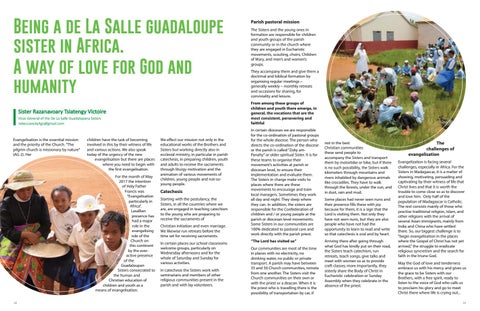
The Sisters and the young ones in formation are responsible for children and youth groups of the parish community or in the church where they are engaged in Eucharistic movements, scouting, choirs, Children of Mary, and men’s and women’s groups. They accompany them and give them a doctrinal and biblical formation by organising regular meetings – generally weekly – monthly retreats and occasions for sharing, for conviviality and leisure. From among these groups of children and youth there emerge, in general, the vocations that are the most consistent, persevering and faithful
Sister Razanavoary Tsiatengy Victoire
Evangelisation is the essential mission and the priority of the Church. “The pilgrim church is missionary by nature” (AG 2). Her
Parish pastoral mission
We effect our mission not only in the educational works of the Brothers and Sisters but working directly also in ecclesial ministry, in particular in parish catechesis, in preparing children, youth and adults to receive the sacraments through liturgy motivation and the animation of various movements of children, young people and not-soyoung people.
Catechesis Starting with the postulancy, the Sisters, in all the countries where we are, are engaged in teaching catechism to the young who are preparing to receive the sacraments of Christian initiation and even marriage. We likewise run retreats before the time set for receiving sacraments. In certain places our school classrooms welcome groups, particularly on Wednesday afternoons and for the whole of Saturday and Sunday for various activities. In catechesis the Sisters work with seminarians and members of other religious communities present in the parish and with lay volunteers.
In certain dioceses we are responsible for the co-ordination of pastoral groups for the whole diocese. The person who directs the co-ordination of the diocese or the parish is called “Zoky amPanahy” or older spiritual Sister. It is for these teams to organise their movement’s activities at parish or diocesan level, to ensure their implementation and evaluate them. The Sisters in charge make visits to places where there are these movements to encourage and train local managers. Sometimes they work all day and night. They sleep where they can. In addition, the sisters are responsible for the Confederation of children and / or young people at the parish or diocesan level movements. Some Sisters in our communities are 100% dedicated to pastoral care and work directly with the parish priest. “The Lord has visited us” Our communities are most of the time in places with no electricity, no drinking water, no public or private transport. A parish may have between 35 and 50 Church communities, remote from one another. The Sisters visit the Church communities on their own or with the priest or a deacon. When it is the priest who is travelling there is the possibility of transportation by car, if
not in the best Christian communities these send people to accompany the Sisters and transport them by motorbike or bike, but if there is no such possibility, the Sisters walk kilometers through mountains and rivers inhabited by dangerous animals like crocodiles. They have to walk through the forests, under the sun, and in dust, rain and mud. Some places had never seen nuns and their presence fills these with joy because for them, it is a sign that the Lord is visiting them. Not only they have not seen nuns, but they are also people who have not had the opportunity to learn to read and write so that catechesis is oral and by heart. Arriving there after going through what God has kindly put on their road, the Sisters teach catechism, run retreats, teach songs, give talks and meet with women so as to provide craft classes; more importantly, they sisterly share the Body of Christ in Eucharistic celebration or Sunday Assembly when they celebrate in the absence of the priest.
The challenges of evangelisation Evangelization is facing several challenges, especially in Africa. For the Sisters in Madagascar, it is a matter of showing, motivating, persuading and captivating by their witness of life that Christ lives and that it is worth the trouble to come close so as to discover and love him. Only half of the population of Madagascar is Catholic. The rest consists mainly of those who practise traditional religion, Islam, and other religions with the arrival of several Asian immigrants, mainly from India and China who have settled there. So, our biggest challenge is to "begin evangelisation in the places where the Gospel of Christ has not yet arrived," the struggle to eradicate religious syncretism and the search for faith in the triune God. May the God of love and tenderness embrace us with his mercy and gives us the grace to be Sisters with our Brothers, with a free spirit, ready to listen to the voice of God who calls us to proclaim his glory and go to meet Christ there where life is crying out... 39