A
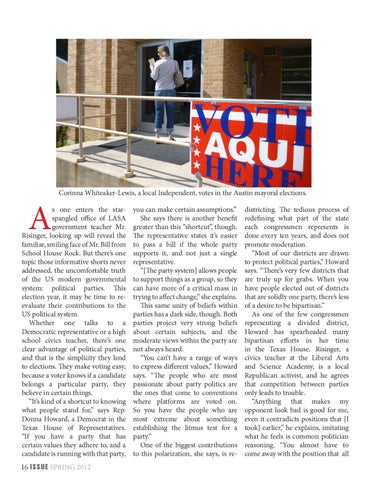
Corinna Whiteaker-Lewis, a local Independent, votes in the Austin mayoral elections.
s one enters the starspangled office of LASA government teacher Mr. Risinger, looking up will reveal the familiar, smiling face of Mr. Bill from School House Rock. But there’s one topic those informative shorts never addressed, the uncomfortable truth of the US modern governmental system: political parties. This election year, it may be time to reevaluate their contributions to the US political system. Whether one talks to a Democratic representative or a high school civics teacher, there’s one clear advantage of political parties, and that is the simplicity they lend to elections. They make voting easy, because a voter knows if a candidate belongs a particular party, they believe in certain things. “It’s kind of a shortcut to knowing what people stand for,” says Rep. Donna Howard, a Democrat in the Texas House of Representatives. “If you have a party that has certain values they adhere to, and a candidate is running with that party, 16 ISSUE SPRING 2012
you can make certain assumptions.” She says there is another benefit greater than this “shortcut”, though. The representative states it’s easier to pass a bill if the whole party supports it, and not just a single representative. “[The party system] allows people to support things as a group, so they can have more of a critical mass in trying to affect change,” she explains. This same unity of beliefs within parties has a dark side, though. Both parties project very strong beliefs about certain subjects, and the moderate views within the party are not always heard. “You can’t have a range of ways to express different values,” Howard says. “The people who are most passionate about party politics are the ones that come to conventions where platforms are voted on. So you have the people who are most extreme about something establishing the litmus test for a party.” One of the biggest contributions to this polarization, she says, is re-
districting. The tedious process of redefining what part of the state each congressmen represents is done every ten years, and does not promote moderation. “Most of our districts are drawn to protect political parties,” Howard says. “There’s very few districts that are truly up for grabs. When you have people elected out of districts that are solidly one party, there’s less of a desire to be bipartisan.” As one of the few congressmen representing a divided district, Howard has spearheaded many bipartisan efforts in her time in the Texas House. Risinger, a civics teacher at the Liberal Arts and Science Academy, is a local Republican activist, and he agrees that competition between parties only leads to trouble. “Anything that makes my opponent look bad is good for me, even it contradicts positions that [I took] earlier,” he explains, imitating what he feels is common politician reasoning. “You almost have to come away with the position that all