With the number of people with dementia predicted to reach a staggering two million by 2051, designing dementia-friendly retirement homes or other buildings that are suitable for dementia sufferers is an essential consideration that shouldn’t be ignored.
“
“
DEMENTIA FRIENDLY DESIGN FOR LIFTS Dementia remains one of the biggest problems facing our ageing population, causing more disability in later life than cancer, heart disease or strokes. It costs the UK an estimated £34.7 billion a year, which is set to rise sharply to £94.1billion by 2040.
suffering from dementia, can be aggravated by certain building designs; which with careful planning can easily be avoided at little extra cost.
The Alzheimer’s Society reports there are currently around 850,000 people with dementia in the UK. This is projected to rise to 1.6 million by 2040, so, it’s hardly surprising that this now needs to be a key consideration for both existing and new buildings.
The challenge of designing buildings that are suitable for use by everyone, including senior living. Increasingly, NHS trusts, private nursing care providers, local authorities and housing associations are looking for spaces designed for dementia care.
Studies have shown that the cognitive impairment, which affects people who are
The Dementia Services Development Centre (DSDC), works to improve the lives of people
Dementia-friendly design
living with dementia, with an ethos to make communities more dementia-friendly through design. Over 25 years of research by the DSDC shows that buildings following dementia-friendly design guidelines can significantly help to minimise psychological effects of the disorder, as well as physical symptoms such as falls and incontinence.
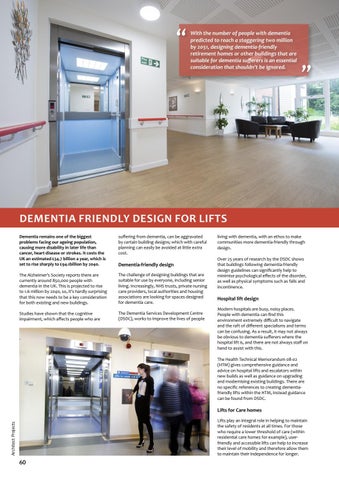
Hospital lift design Modern hospitals are busy, noisy places. People with dementia can find this environment extremely difficult to navigate and the raft of different specialisms and terms can be confusing. As a result, it may not always be obvious to dementia sufferers where the hospital lift is, and there are not always staff on hand to assist with this. The Health Technical Memorandum 08-02 (HTM) gives comprehensive guidance and advice on hospital lifts and escalators within new builds as well as guidance on upgrading and modernising existing buildings. There are no specific references to creating dementiafriendly lifts within the HTM, instead guidance can be found from DSDC.
Lifts for Care homes Architect Projects
Lifts play an integral role in helping to maintain the safety of residents at all times. For those who require a lower threshold of care (within residential care homes for example), userfriendly and accessible lifts can help to increase their level of mobility and therefore allow them to maintain their independence for longer.
60