Campus news
Editor ANNE WATSON
The Voice, WEDNESDAY, NOVEMBER 30, 2011
3
Boom in ESL students puts college in a squeeze The premier wants more international students, but Langara does not have the room to accomodate them By JENNIFER FONG
T
he province may be preparing for an influx of international students, but Langara isn’t prepared to handle them. Premier Christy Clark hopes to increase the number of international students by over 50 per cent in the next four years. The province already has over 94,000 international students, each bringing in an estimated $50,000 to the economy. A recent agreement will bring 2,500 students from China. “We’re going to need more space,” said Gordon McNeil, Langara’s director of international education. “At the moment we’re full, but we’re not the only ones.” McNeil said the news was “a surprise in the sense that there was a time frame and it was sizeable.” Langara currently has 1100 international students, including part-time students. “The reason we have so many students is we’ve worked hard to try and put things in place that are attractive to the students,” McNeil said. He said Langara could only accommodate 900 full-time international students and students have been turned away due to space constraints. Langara has the biggest homestay program in the country and what McNeil says is one of the best ESL programs in the world. Langara also provides support for these students, including workshops and programs such as Langara PLUS. McNeil said Langara hasn’t yet decided how it will react to the boom of international students, but he believes Langara could find a way to accommodate them. “What’s going to be exciting about that is, you don’t know how we’re going to get there,” he said. “I say we can do it, but at the moment, it’s too early to say how.” Not all colleges are unprepared for the incoming students. “It’s great because our school revolves solely in international students,” said David Shin, student councilor at Canadian College. “The best scenario is we get a certain portion [of the 2500].”
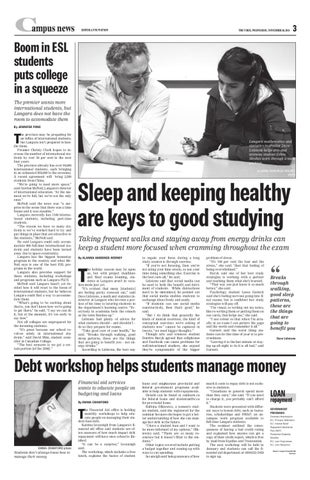
Langara mathematics and statistics instructor Dave Lidstone helps arts and sciences student Zohra Moshta work through a math problem. ALANNA HARDINGE-ROONEY photo
Sleep and keeping healthy are keys to good studying Taking frequent walks and staying away from energy drinks can keep a student more focused when cramming throughout the exam By ALANNA HARDINGE-ROONEY
T
he holiday season may be upon us, but with project deadlines and final exams looming, students at Langara aren’t in vacation mode just yet. “It’s evident that many [students] are feeling pretty stressed out,” said Dave Lidstone, a math and statistics instructor at Langara who devotes a portion of his time to tutoring students in the department’s learning centre. “Everybody in academia feels the crunch as the term finishes up.” Lidstone had plenty of advice for what students should – and shouldn’t – do as they prepare for exams. “Take good care of your health,” he said. “Breaks through walking, good sleep patterns, these are the things that are going to benefit you – not energy drinks.” According to Lidstone, the best way
to regain your focus during a long study session is through exercise. “If you’re not focusing, then you’re not using your time wisely, so use your time doing something else. Exercise is the best cure-all,” he said. Lidstone said that social media can be used to both the benefit and detriment of students. While distractions need to be minimized, he pointed out that social media enables students to exchange ideas freely and easily. “If students can use social media constructively, then that’s good,” he said. “But I do think that generally the kinds of mental exercises, the kind of conceptual exercises we’re asking of students now” cannot be captured in tweets, “we need bigger thoughts.” Though arts and sciences student Deirdre Buryk agreed that cellphones and Facebook can cause problems for well-intentioned studiers, she argued they’re symptomatic of the bigger
problem of stress. “It’s 100 per cent the fear and the stress,” she said. “Just that feeling of being overwhelmed.” Buryk said one of her best study strategies is working with a partner and teaching them what she’s learned. “That way you just know it so much better,” she said. Psychology student Leesa Garnett said she’s feeling nervous going into final exams, but is confident her study strategies will pay off. “I’m visual, so writing out my notes, like re-writing them or putting them on cue cards, that helps me,” she said. “I use colour so that when I’m actually in an exam I can picture the page and the words and remember it all.” Garnett said the worst thing students can do this time of year is to procrastinate. “Leaving it to the last minute or staying up all night to do it is all bad,” said Garnett.
“
Breaks through walking, good sleep patterns, these are the things that are going to benefit you Dave Lidstone
Debt workshop helps students manage money Financial aid services wants to educate people on budgeting and loans By EMMA CRAWFORD
T
EMMA CRAWFORD photo
Students don’t always know how to manage their money
he Financial Aid office is holding monthly workshops to help educate people on managing their student loan debt. Katrina Iuvancigh from Langara’s financial aid office said students are often unaware of how much impact debt repayment will have once school is finished. “It can be a surprise,” Iuvancigh said. The workshop, which includes a free lunch, explains the basics of student
loans and emphasizes provincial and federal government programs available to help students with repayments. Details can be found at canlearn.ca for federal loans and studentaidbc.ca for provincial loans. Balbina Olkiewicz, a women’s studies student, said she registered for the seminar because she hopes to get a better understanding of how she can manage her debt in the future. “I have a student loan and I want to be more informed of my options,” Olkiewicz said. “There are so many resources but it doesn’t filter to the students.” Other topics covered include putting a budget together and coming up with ways to cut spending. Iuvancigh said being unaware of how
much it costs to repay debt is not exclusive to students. “Canadians in general spend more than they earn,” she said. “If you need to charge it, you probably can’t afford it.” Students were presented with different ways to lessen debt, such as bursaries, scholarships and SWAP, an oncampus work program available to full-time Langara students. The seminar outlined the consequences of having a bad credit rating and explained how anyone can get a copy of their credit report, which is free by mail from Equifax and Transunion. The next workshop will be held in January and students can call the financial aid department at (604)323-5456 to sign up.
LOAN
repayment government programs Extended Amortization B.C. Principle Deferment B.C. Interest Relief Repayment Assistance Plan (RAP) Permanent Disability Benefits B.C. Loan Forgiveness B.C. Loan Reduction Source: Langara Financial Aid Services