to Canada active searches. Some even suggest oak wilt could be a native disease, and thus not of concern. There is good and bad news on this invasive about to breach our borders. First, the condition has existed in the U.S. since 1942, so research is abundant. The bad news: we have no treatment options and prevention is the only control. There are no known resistant red oaks in the entire U.S. As a highly urban plague, oak wilt will bring business to landscape workers who are prepared.
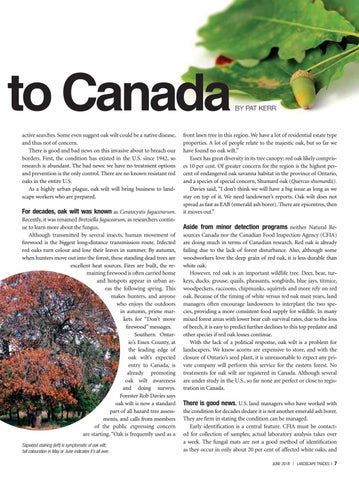
For decades, oak wilt was known as Ceratocystis fagacerarum. Recently, it was renamed Bretziella fagacearum, as researchers continue to learn more about the fungus. Although transmitted by several insects, human movement of firewood is the biggest long-distance transmission route. Infected red oaks turn colour and lose their leaves in summer. By autumn, when hunters move out into the forest, these standing dead trees are excellent heat sources. Fires are built, the remaining firewood is often carried home and hotspots appear in urban areas the following spring. This makes hunters, and anyone who enjoys the outdoors in autumn, prime markets for “Don’t move firewood” messages. Southern Ontario’s Essex County, at the leading edge of oak wilt’s expected entry to Canada, is already promoting oak wilt awareness and doing surveys. Forester Rob Davies says oak wilt is now a standard part of all hazard tree assessments, and calls from members of the public expressing concern are starting. “Oak is frequently used as a Sapwood staining (left) is symptomatic of oak wilt; fall colouration in May or June indicates it’s all over.
BY PAT KERR
front lawn tree in this region. We have a lot of residential estate type properties. A lot of people relate to the majestic oak, but so far we have found no oak wilt.” Essex has great diversity in its tree canopy; red oak likely comprises 10 per cent. Of greater concern for the region is the highest percent of endangered oak savanna habitat in the province of Ontario, and a species of special concern, Shumard oak (Quercus shumardii). Davies said, “I don’t think we will have a big issue as long as we stay on top of it. We need landowner’s reports. Oak wilt does not spread as fast as EAB (emerald ash borer). There are epicentres, then it moves out.”
Aside from minor detection programs neither Natural Resources Canada nor the Canadian Food Inspection Agency (CFIA) are doing much in terms of Canadian research. Red oak is already failing due to the lack of forest disturbance. Also, although some woodworkers love the deep grain of red oak, it is less durable than white oak. However, red oak is an important wildlife tree. Deer, bear, turkeys, ducks, grouse, quails, pheasants, songbirds, blue jays, titmice, woodpeckers, raccoons, chipmunks, squirrels and more rely on red oak. Because of the timing of white versus red oak mast years, land managers often encourage landowners to interplant the two species, providing a more consistent food supply for wildlife. In many mixed forest areas with lower bear cub survival rates, due to the loss of beech, it is easy to predict further declines to this top predator and other species if red oak losses continue. With the lack of a political response, oak wilt is a problem for landscapers. We know acorns are expensive to store, and with the closure of Ontario’s seed plant, it is unreasonable to expect any private company will perform this service for the eastern forest. No treatments for oak wilt are registered in Canada. Although several are under study in the U.S., so far none are perfect or close to registration in Canada. There is good news. U.S. land managers who have worked with the condition for decades declare it is not another emerald ash borer. They are firm in stating the condition can be managed. Early identification is a central feature. CFIA must be contacted for collection of samples; actual laboratory analysis takes over a week. The fungal mats are not a good method of identification as they occur in only about 20 per cent of affected white oaks, and JUNE 2018 | LANDSCAPE TRADES |
7