OIL SPILL RESPONSE
TOOLBOX APPROACH ‘CAN STAVE OFF DISASTER’
High-speed oil response technology finds a market in Caribbean ew developments in oil spill response technology have opened the way for response teams to deal more quickly and effectively with any given spill – and in particular to prevent the oil from reaching the shore – say European experts. The idea is to use conventional booms and skimmers in tandem with recently developed high-speed systems that can recover oil over a wider area, even in difficult conditions. This approach has been dubbed the ‘toolbox concept’.
N
30
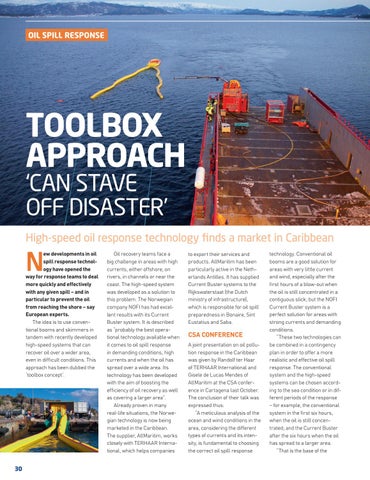
Oil recovery teams face a big challenge in areas with high currents, either offshore, on rivers, in channels or near the coast. The high-speed system was developed as a solution to this problem. The Norwegian company NOFI has had excellent results with its Current Buster system. It is described as “probably the best operational technology available when it comes to oil spill response in demanding conditions, high currents and when the oil has spread over a wide area. Its technology has been developed with the aim of boosting the efficiency of oil recovery as well as covering a larger area”. Already proven in many real-life situations, the Norwegian technology is now being marketed in the Caribbean. The supplier, AllMaritim, works closely with TERHAAR International, which helps companies
to export their services and products. AllMaritim has been particularly active in the Netherlands Antilles. It has supplied Current Buster systems to the Rijkswaterstaat (the Dutch ministry of infrastructure), which is responsible for oil spill preparedness in Bonaire, Sint Eustatius and Saba.
CSA CONFERENCE A joint presentation on oil pollution response in the Caribbean was given by Randolf ter Haar of TERHAAR International and Gisele de Lucas Mendes of AllMaritim at the CSA conference in Cartagena last October. The conclusion of their talk was expressed thus: “A meticulous analysis of the ocean and wind conditions in the area, considering the different types of currents and its intensity, is fundamental to choosing the correct oil spill response
technology. Conventional oil booms are a good solution for areas with very little current and wind, especially after the first hours of a blow-out when the oil is still concentrated in a contiguous slick; but the NOFI Current Buster system is a perfect solution for areas with strong currents and demanding conditions. “These two technologies can be combined in a contingency plan in order to offer a more realistic and effective oil spill response. The conventional system and the high-speed systems can be chosen according to the sea condition or in different periods of the response – for example, the conventional system in the first six hours, when the oil is still concentrated; and the Current Buster after the six hours when the oil has spread to a larger area. “That is the base of the