the enVironMent “A ship owner of today wants to cut unnecessary costs and at the same time run an environmentally sustainable business. The good news is that we are now able to help the owners with
stringent regulation requirements. “Achieving high reliability and low effluent oil discharges in the treatment of bilge and sludge is highly complicated,” says Lars
“ACHIEVInG HIGH RELIABILITY And Low EffLuEnT oIL dISCHARGES In THE TREATMEnT of BILGE And SLudGE IS HIGHLY CoMPLICATEd” this regarding the handling of sludge and bilge,” says Marc Tarbox, Sales Manager, Wärtsilä Caribbean, Inc. in Puerto Rico.
Olsson, Manager, Service Solution, Wärtsilä Sweden. This is due to the complex composition of oil, chemi-
treatMent IMO requires that vessels over 400 GWT have an oily water treatment system installed within three years and that the oil content in the discharged water is less than 15 ppm (parts per million). Shipping companies also experience increasing costs for disposal and handling of sludge and bilge water. Therefore owners of these ships are likely to be interested in the Wärtsilä Senitec M-series of oily water treatment systems. Shipping makes it possible to move large quantities of load with a minor impact on infrastructure. As one of the important actions for keeping the seas clean, spills of fuel oil on board should end up in the sludge tank. Simple separators do not work efficiently enough when it comes to surpassing
38
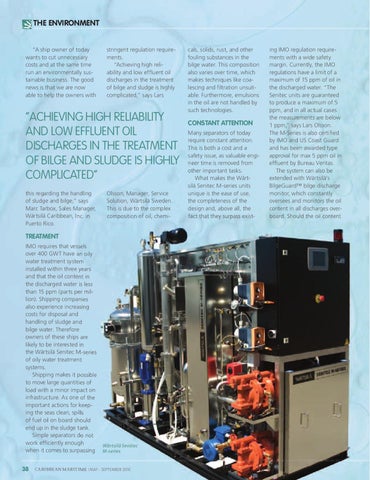
Wärtsilä Senitec M-series
CARIBBEAN MARITIME I MAY - SEPTEMBER 2010
cals, solids, rust, and other fouling substances in the bilge water. This composition also varies over time, which makes techniques like coalescing and filtration unsuitable. Furthermore, emulsions in the oil are not handled by such technologies.
constant attention Many separators of today require constant attention. This is both a cost and a safety issue, as valuable engineer time is removed from other important tasks. What makes the Wärtsilä Senitec M-series units unique is the ease of use, the completeness of the design and, above all, the fact that they surpass exist-
ing IMO regulation requirements with a wide safety margin. Currently, the IMO regulations have a limit of a maximum of 15 ppm of oil in the discharged water. “The Senitec units are guaranteed to produce a maximum of 5 ppm, and in all actual cases the measurements are below 1 ppm,” says Lars Olsson. The M-Series is also certified by IMO and US Coast Guard and has been awarded type approval for max 5 ppm oil in effluent by Bureau Veritas. The system can also be extended with Wärtsilä’s BilgeGuard™ bilge discharge monitor, which constantly oversees and monitors the oil content in all discharges overboard. Should the oil content