HISTORY
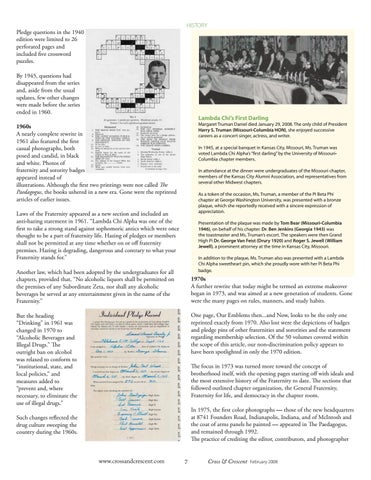
Pledge questions in the 1940 edition were limited to 26 perforated pages and included five crossword puzzles. By 1945, questions had disappeared from the series and, aside from the usual updates, few other changes were made before the series ended in 1960.
Lambda Chi’s First Darling
Margaret Truman Daniel died January 29, 2008. The only child of President Harry S. Truman (Missouri-Columbia HON), she enjoyed successive careers as a concert singer, actress, and writer.
1960s A nearly complete rewrite in 1961 also featured the first casual photographs, both posed and candid, in black and white. Photos of fraternity and sorority badges appeared instead of illustrations. Although the first two printings were not called The Paedagogus, the books ushered in a new era. Gone were the reprinted articles of earlier issues.
In 1945, at a special banquet in Kansas City, Missouri, Ms. Truman was voted Lambda Chi Alpha’s “first darling” by the University of MissouriColumbia chapter members. In attendance at the dinner were undergraduates of the Missouri chapter, members of the Kansas City Alumni Association, and representatives from several other Midwest chapters. As a token of the occasion, Ms. Truman, a member of the Pi Beta Phi chapter at George Washington University, was presented with a bronze plaque, which she reportedly received with a sincere expression of appreciation.
Laws of the Fraternity appeared as a new section and included an anti-hazing statement in 1961. “Lambda Chi Alpha was one of the first to take a strong stand against sophomoric antics which were once thought to be a part of fraternity life. Hazing of pledges or members shall not be permitted at any time whether on or off fraternity premises. Hazing is degrading, dangerous and contrary to what your Fraternity stands for.”
Presentation of the plaque was made by Tom Bear (Missouri-Columbia 1946), on behalf of his chapter. Dr. Ben Jenkins (Georgia 1943) was the toastmaster and Ms. Truman’s escort. The speakers were then Grand High Pi Dr. George Van Feist (Drury 1920) and Roger S. Jewell (William Jewell), a prominent attorney at the time in Kansas City, Missouri. In addition to the plaque, Ms. Truman also was presented with a Lambda Chi Alpha sweetheart pin, which she proudly wore with her Pi Beta Phi badge.
Another law, which had been adopted by the undergraduates for all chapters, provided that, “No alcoholic liquors shall be permitted on the premises of any Subordinate Zeta, nor shall any alcoholic beverages be served at any entertainment given in the name of the Fraternity.”
1970s A further rewrite that today might be termed an extreme makeover began in 1973, and was aimed at a new generation of students. Gone were the many pages on rules, manners, and study habits. One page, Our Emblems then...and Now, looks to be the only one reprinted exactly from 1970. Also lost were the depictions of badges and pledge pins of other fraternities and sororities and the statement regarding membership selection. Of the 50 volumes covered within the scope of this article, our non-discrimination policy appears to have been spotlighted in only the 1970 edition.
But the heading “Drinking” in 1961 was changed in 1970 to “Alcoholic Beverages and Illegal Drugs.” The outright ban on alcohol was relaxed to conform to “institutional, state, and local policies,” and measures added to “prevent and, where necessary, to eliminate the use of illegal drugs.”
The focus in 1973 was turned more toward the concept of brotherhood itself, with the opening pages starting off with ideals and the most extensive history of the Fraternity to date. The sections that followed outlined chapter organization, the General Fraternity, Fraternity for life, and democracy in the chapter room. In 1975, the first color photographs — those of the new headquarters at 8741 Founders Road, Indianapolis, Indiana, and of McIntosh and the coat of arms panels he painted — appeared in The Paedagogus, and remained through 1992. The practice of crediting the editor, contributors, and photographer
Such changes reflected the drug culture sweeping the country during the 1960s.
www.crossandcrescent.com
Cross & Crescent
February 2008