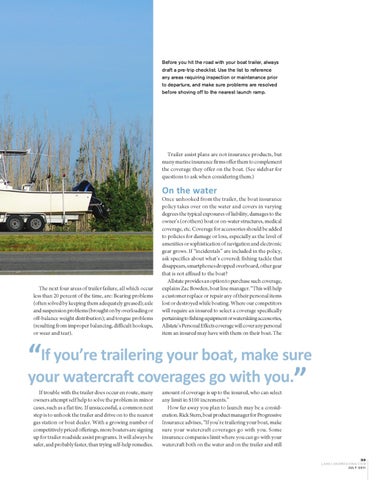
Before you hit the road with your boat trailer, always draft a pre-trip checklist. Use the list to reference any areas requiring inspection or maintenance prior to departure, and make sure problems are resolved before shoving off to the nearest launch ramp.
Trailer assist plans are not insurance products, but many marine insurance firms offer them to complement the coverage they offer on the boat. (See sidebar for questions to ask when considering them.)
On the water
The next four areas of trailer failure, all which occur less than 20 percent of the time, are: Bearing problems (often solved by keeping them adequately greased); axle and suspension problems (brought on by overloading or off-balance weight distribution); and tongue problems (resulting from improper balancing, difficult hookups, or wear and tear).
Once unhooked from the trailer, the boat insurance policy takes over on the water and covers in varying degrees the typical exposures of liability, damages to the owner’s (or others) boat or on-water structures, medical coverage, etc. Coverage for accessories should be added to policies for damage or loss, especially as the level of amenities or sophistication of navigation and electronic gear grows. If “incidentals” are included in the policy, ask specifics about what’s covered; fishing tackle that disappears, smartphones dropped overboard, other gear that is not affixed to the boat? Allstate provides an option to purchase such coverage, explains Zac Bowden, boat line manager. “This will help a customer replace or repair any of their personal items lost or destroyed while boating. Where our competitors will require an insured to select a coverage specifically pertaining to fishing equipment or waterskiing accessories, Allstate’s Personal Effects coverage will cover any personal item an insured may have with them on their boat. The
If trouble with the trailer does occur en route, many owners attempt self help to solve the problem in minor cases, such as a flat tire. If unsuccessful, a common next step is to unhook the trailer and drive on to the nearest gas station or boat dealer. With a growing number of competitively priced offerings, more boaters are signing up for trailer roadside assist programs. It will always be safer, and probably faster, than trying self-help remedies.
amount of coverage is up to the insured, who can select any limit in $100 increments.” How far away you plan to launch may be a consideration. Rick Stern, boat product manager for Progressive Insurance advises, “If you’re trailering your boat, make sure your watercraft coverages go with you. Some insurance companies limit where you can go with your watercraft both on the water and on the trailer and still
“If you’re trailering your boat, make sure your watercraft coverages go with you.” 33 LAKELANDBOATING.COM J U L Y 2 011