CERS Consolidated Emergency Response / Contingency Plan – Page 4 of 4
Rev. 06/27/11
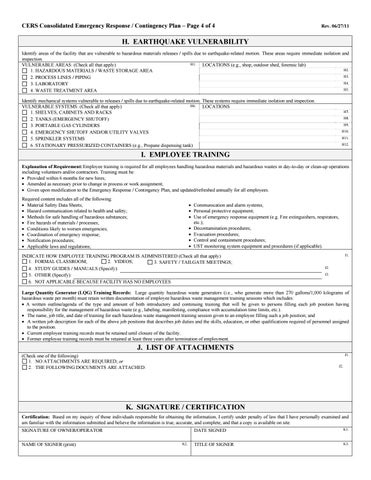
H. EARTHQUAKE VULNERABILITY Identify areas of the facility that are vulnerable to hazardous materials releases / spills due to earthquake-related motion. These areas require immediate isolation and inspection. H1. VULNERABLE AREAS: (Check all that apply) LOCATIONS (e.g., shop, outdoor shed, forensic lab) H2. 1. HAZARDOUS MATERIALS / WASTE STORAGE AREA H3. 2. PROCESS LINES / PIPING H4. 3. LABORATORY H5. 4. WASTE TREATMENT AREA Identify mechanical systems vulnerable to releases / spills due to earthquake-related motion. These systems require immediate isolation and inspection. H6. VULNERABLE SYSTEMS: (Check all that apply) LOCATIONS 1. SHELVES, CABINETS AND RACKS 2. TANKS (EMERGENCY SHUTOFF) 3. PORTABLE GAS CYLINDERS 4. EMERGENCY SHUTOFF AND/OR UTILITY VALVES 5. SPRINKLER SYSTEMS 6. STATIONARY PRESSURIZED CONTAINERS (e.g., Propane dispensing tank)
H7. H8. H9. H10. H11. H12.
I. EMPLOYEE TRAINING Explanation of Requirement: Employee training is required for all employees handling hazardous materials and hazardous wastes in day-to-day or clean-up operations including volunteers and/or contractors. Training must be: • Provided within 6 months for new hires; • Amended as necessary prior to change in process or work assignment; • Given upon modification to the Emergency Response / Contingency Plan, and updated/refreshed annually for all employees. Required content includes all of the following: • Material Safety Data Sheets; • Hazard communication related to health and safety; • Methods for safe handling of hazardous substances; • Fire hazards of materials / processes; • Conditions likely to worsen emergencies; • Coordination of emergency response; • Notification procedures; • Applicable laws and regulations;
• Communication and alarm systems; • Personal protective equipment; • Use of emergency response equipment (e.g. Fire extinguishers, respirators, etc.); • Decontamination procedures; • Evacuation procedures; • Control and containment procedures; • UST monitoring system equipment and procedures (if applicable).
INDICATE HOW EMPLOYEE TRAINING PROGRAM IS ADMINISTERED (Check all that apply) 1. FORMAL CLASSROOM; 2. VIDEOS; 3. SAFETY / TAILGATE MEETINGS; 4. STUDY GUIDES / MANUALS (Specify): 5. OTHER (Specify): 6. NOT APPLICABLE BECAUSE FACILITY HAS NO EMPLOYEES
I1. I2. I3.
Large Quantity Generator (LQG) Training Records: Large quantity hazardous waste generators (i.e., who generate more than 270 gallons/1,000 kilograms of hazardous waste per month) must retain written documentation of employee hazardous waste management training sessions which includes: • A written outline/agenda of the type and amount of both introductory and continuing training that will be given to persons filling each job position having responsibility for the management of hazardous waste (e.g., labeling, manifesting, compliance with accumulation time limits, etc.). • The name, job title, and date of training for each hazardous waste management training session given to an employee filling such a job position; and • A written job description for each of the above job positions that describes job duties and the skills, education, or other qualifications required of personnel assigned to the position. • Current employee training records must be retained until closure of the facility. • Former employee training records must be retained at least three years after termination of employment.
J. LIST OF ATTACHMENTS J1.
(Check one of the following) 1. NO ATTACHMENTS ARE REQUIRED; or 2. THE FOLLOWING DOCUMENTS ARE ATTACHED:
J2.
K. SIGNATURE / CERTIFICATION Certification: Based on my inquiry of those individuals responsible for obtaining the information, I certify under penalty of law that I have personally examined and am familiar with the information submitted and believe the information is true, accurate, and complete, and that a copy is available on site. SIGNATURE OF OWNER/OPERATOR NAME OF SIGNER (print)
K2.
DATE SIGNED
K1.
TITLE OF SIGNER
K3.