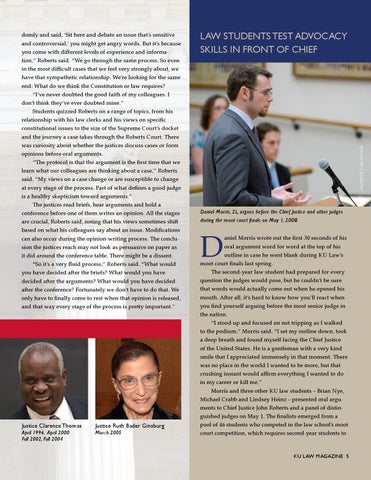
Justice Clarence Thomas April 1996, April 2000 Fall 2002, Fall 2004
Justice Ruth Bader Ginsburg March 2005
Law students test advocacy skills in front of Chief
University Relations
domly and said, ‘Sit here and debate an issue that’s sensitive and controversial,’ you might get angry words. But it’s because you come with different levels of experience and information,” Roberts said. “We go through the same process. So even in the most difficult cases that we feel very strongly about, we have that sympathetic relationship. We’re looking for the same end: What do we think the Constitution or law requires? “I’ve never doubted the good faith of my colleagues. I don’t think they’ve ever doubted mine.” Students quizzed Roberts on a range of topics, from his relationship with his law clerks and his views on specific constitutional issues to the size of the Supreme Court’s docket and the journey a case takes through the Roberts Court. There was curiosity about whether the justices discuss cases or form opinions before oral arguments. “The protocol is that the argument is the first time that we learn what our colleagues are thinking about a case,” Roberts said. “My views on a case change or are susceptible to change at every stage of the process. Part of what defines a good judge is a healthy skepticism toward arguments.” The justices read briefs, hear arguments and hold a conference before one of them writes an opinion. All the stages are crucial, Roberts said, noting that his views sometimes shift based on what his colleagues say about an issue. Modifications can also occur during the opinion-writing process. The conclusion the justices reach may not look as persuasive on paper as it did around the conference table. There might be a dissent. “So it’s a very fluid process,” Roberts said. “What would you have decided after the briefs? What would you have decided after the arguments? What would you have decided after the conference? Fortunately we don’t have to do that. We only have to finally come to rest when that opinion is released, and that way every stage of the process is pretty important.”
Daniel Morris, 2L, argues before the Chief Justice and other judges during the moot court finals on May 1, 2008.
D
aniel Morris wrote out the first 30 seconds of his oral argument word for word at the top of his outline in case he went blank during KU Law’s moot court finals last spring. The second-year law student had prepared for every question the judges would pose, but he couldn’t be sure that words would actually come out when he opened his mouth. After all, it’s hard to know how you’ll react when you find yourself arguing before the most senior judge in the nation. “I stood up and focused on not tripping as I walked to the podium,” Morris said. “I set my outline down, took a deep breath and found myself facing the Chief Justice of the United States. He is a gentleman with a very kind smile that I appreciated immensely in that moment. There was no place in the world I wanted to be more, but that crushing instant would affirm everything I wanted to do in my career or kill me.” Morris and three other KU law students – Brian Nye, Michael Crabb and Lindsey Heinz – presented oral arguments to Chief Justice John Roberts and a panel of distinguished judges on May 1. The finalists emerged from a pool of 46 students who competed in the law school’s moot court competition, which requires second-year students to
KU LAW MAGAZINE 5