T
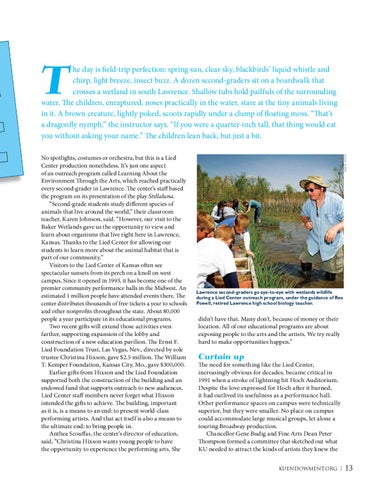
he day is field-trip perfection: spring sun, clear sky, blackbirds’ liquid whistle and chirp, light breeze, insect buzz. A dozen second-graders sit on a boardwalk that crosses a wetland in south Lawrence. Shallow tubs hold pailfuls of the surrounding water. The children, enraptured, noses practically in the water, stare at the tiny animals living in it. A brown creature, lightly poked, scoots rapidly under a clump of floating moss. “That’s a dragonfly nymph,” the instructor says. “If you were a quarter-inch tall, that thing would eat you without asking your name.” The children lean back, but just a bit. steve puppe
No spotlights, costumes or orchestra, but this is a Lied Center production nonetheless. It’s just one aspect of an outreach program called Learning About the Environment Through the Arts, which reached practically every second-grader in Lawrence. The center’s staff based the program on its presentation of the play Stellaluna. “Second-grade students study different species of animals that live around the world,” their classroom teacher, Karen Johnson, said. “However, our visit to the Baker Wetlands gave us the opportunity to view and learn about organisms that live right here in Lawrence, Kansas. Thanks to the Lied Center for allowing our students to learn more about the animal habitat that is part of our community.” Visitors to the Lied Center of Kansas often see spectacular sunsets from its perch on a knoll on west campus. Since it opened in 1993, it has become one of the premier community performance halls in the Midwest. An estimated 1 million people have attended events there. The center distributes thousands of free tickets a year to schools and other nonprofits throughout the state. About 80,000 people a year participate in its educational programs. Two recent gifts will extend those activities even farther, supporting expansion of the lobby and construction of a new education pavilion. The Ernst F. Lied Foundation Trust, Las Vegas, Nev., directed by sole trustee Christina Hixson, gave $2.5 million. The William T. Kemper Foundation, Kansas City, Mo., gave $300,000. Earlier gifts from Hixson and the Lied Foundation supported both the construction of the building and an endowed fund that supports outreach to new audiences. Lied Center staff members never forget what Hixson intended the gifts to achieve. The building, important as it is, is a means to an end: to present world-class performing artists. And that act itself is also a means to the ultimate end: to bring people in. Anthea Scouffas, the center’s director of education, said, “Christina Hixson wants young people to have the opportunity to experience the performing arts. She
Lawrence second-graders go eye-to-eye with wetlands wildlife during a Lied Center outreach program, under the guidance of Rex Powell, retired Lawrence high school biology teacher.
didn’t have that. Many don’t, because of money or their location. All of our educational programs are about exposing people to the arts and the artists. We try really hard to make opportunities happen.”
Curtain up
The need for something like the Lied Center, increasingly obvious for decades, became critical in 1991 when a stroke of lightning hit Hoch Auditorium. Despite the love expressed for Hoch after it burned, it had outlived its usefulness as a performance hall. Other performance spaces on campus were technically superior, but they were smaller. No place on campus could accommodate large musical groups, let alone a touring Broadway production. Chancellor Gene Budig and Fine Arts Dean Peter Thompson formed a committee that sketched out what KU needed to attract the kinds of artists they knew the KUENDOWMENT.ORG |
13