KONSHUU | Volume 56, Issue 4 the large amount of time the film spends developing his character and surroundings is perhaps its best part. Surprisingly, the canonization of Broly is not only the best part of his film, but it’s also a genuinely welcome element for the franchise’s world, as much as I wish it ended with GT. Broly’s interactions with more civilized society are fairly wholesome and heartwarming. The audience really gets to understand why the character is the way he is and how he can be redeemed. It’s almost like Toei Animation is aware of how to write good, compelling characters, or something. What I dislike is the canonization of Dragon Ball Minus. For those unaware, Jaco the Galactic Patrolman was a short twelve chapter manga released by Toriyama Akira in Weekly Shounen Jump in 2012. As a fun, fairly self-contained narrative featuring a wacky alien in his misadventures with a teenage girl and misanthropic old man, Jaco’s connection to Dragon Ball is made apparent at its very end, when it is revealed that the threat Jaco was to stop from arriving on Earth was an infant Son Goku. As a paperback extra, the volume version of Jaco the Galactic Patrolman featured a short story called Dragon Ball Minus. Retconning Toei’s original incarnation of Bardock in the first Dragon Ball Z special episode, Minus does away with the interesting contrast of having Son Goku’s father as a heartless genocidal individual in favor of a loving person who opposed his people’s ways. Minus’ Bardock discards an interesting narrative in favor of presenting a character who sends his son away to Earth as protection. It’s literally just a worse version of Superman. Gone is the interesting dynamic of having a mass murderer attempt to, and ultimately fail in, redeeming himself. Minus essentially replaces what was an interesting situation with the series’ protagonist originally being fated to destroy the world but, via his own circumstances, ending up as its savior. With Broly’s first stretch being an extended version of Dragon Ball Minus, this inclusion is perhaps the single worst part of the film as it even ruins the film’s own themes. The idea of Broly being a foil to Son Goku is lacking when Goku’s arrival on Earth was in of itself an altruistic deed. Moreover, it boils the characters’ differences down to two things: the circumstances of their fathers and their innate powers. Rather than showing how Goku’s adventures molded him into a capable and strong man, this part of the film basically implies that he is the way he is purely because he was naturally just a kind person. His father really was an honorable person, which goes against much of the pathos of the original manga’s Saiyan and Frieza arcs, which showed Goku come to terms with his troubled heritage. It removes the world of a difference between a Kakarot and a Son Goku. On rewatches of this film, I choose to ignore the first twenty-five or so minutes as it actively takes away from its messages and is downright contradictory to the series as a whole. For that matter, much of the film at some point devolves into an action spectacle after a certain point, when Frieza brings Broly to Earth to fight against Goku and Vegeta. It isn’t necessarily bad, as the choreography is compelling and the colors are pretty. Still, the film reeks of appealing to the more fight-focused portions of Dragon Ball fans.
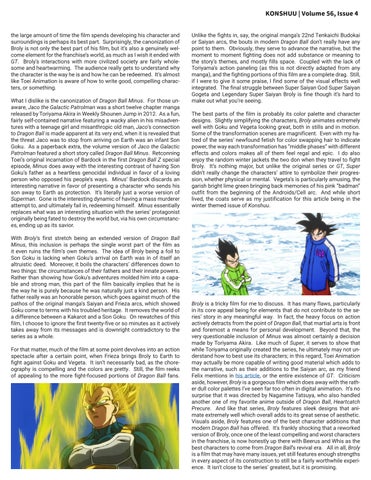
Unlike the fights in, say, the original manga’s 22nd Tenkaichi Budokai or Saiyan arcs, the bouts in modern Dragon Ball don’t really have any point to them. Obviously, they serve to advance the narrative, but the moment to moment fighting does not add substance or meaning to the story’s themes, and mostly fills space. Coupled with the lack of Toriyama’s action paneling (as this is not directly adapted from any manga), and the fighting portions of this film are a complete drag. Still, if I were to give it some praise, I find some of the visual effects well integrated. The final struggle between Super Saiyan God Super Saiyan Gogeta and Legendary Super Saiyan Broly is fine though it’s hard to make out what you’re seeing. The best parts of the film is probably its color palette and character designs. Slightly simplifying the characters, Broly animates extremely well with Goku and Vegeta looking great, both in stills and in motion. Some of the transformation scenes are magnificent. Even with my hatred of the series’ newfound fetish for color swapping hair to indicate power, the way each transformation has “middle phases” with different effects and colors makes all of them feel regal and epic. I do also enjoy the random winter jackets the two don when they travel to fight Broly. It’s nothing major, but unlike the original series or GT, Super didn’t really change the characters’ attire to symbolize their progression, whether physical or mental. Vegeta’s is particularly amusing, the garish bright lime green bringing back memories of his pink “badman” outfit from the beginning of the Androids/Cell arc. And while short lived, the coats serve as my justification for this article being in the winter themed issue of Konshuu.
Broly is a tricky film for me to discuss. It has many flaws, particularly in its core appeal being for elements that do not contribute to the series’ story in any meaningful way. In fact, the heavy focus on action actively detracts from the point of Dragon Ball, that martial arts is front and foremost a means for personal development. Beyond that, the very questionable inclusion of Minus was almost certainly a decision made by Toriyama Akira. Like much of Super, it serves to show that while Toriyama originally created the series, he ultimately may not understand how to best use its characters; in this regard, Toei Animation may actually be more capable of writing good material which adds to the narrative, such as their additions to the Saiyan arc, as my friend Felix mentions in his article, or the entire existence of GT. Criticism aside, however, Broly is a gorgeous film which does away with the rather dull color palettes I’ve seen far too often in digital animation. It’s no surprise that it was directed by Nagamine Tatsuya, who also handled another one of my favorite anime outside of Dragon Ball, Heartcatch Precure. And like that series, Broly features sleek designs that animate extremely well which overall adds to its great sense of aesthetic. Visuals aside, Broly features one of the best character additions that modern Dragon Ball has offered. It’s frankly shocking that a reworked version of Broly, once one of the least compelling and worst characters in the franchise, is now honestly up there with Beerus and Whis as the best characters to come from Dragon Ball’s revival era. All in all, Broly is a film that may have many issues, yet still features enough strengths in every aspect of its construction to still be a fairly worthwhile experience. It isn’t close to the series’ greatest, but it is promising.