General Instructions
Step 4 Referring to project photo, position and fuse all pieces of one appliqué design at a time onto background.
Tip: An Appliqué Pressing Sheet is very helpful when there are many elements to a design. Place your pattern (reverse image from pattern provided) under the pressing sheet as a guide. Arrange pieces on sheet and press following manufacturer’s instructions. Allow piece to cool, remove appliqué unit and arrange on background to fuse unit in place. If the piece is not cooled, the fusible web could remain on the sheet instead of the fabric.
Step 5 If using a machine, cut a piece of stabilizer larger than appliqué area and pin to wrong side of fabric. Stabilizer is used to achieve an even stitch. Using a satin stitch, blanket stitch or other decorative stitching to secure appliqué in place. Start stitching from the background to the foreground. Option: use a hand embroidery stitch instead.
Hand Appliqué If project specifies quick-fuse you will need to reverse all patterns and add 4”- wide seam allowance. The steps that follow will add the seam allowance after pattern is traced onto fabric.
Step 1 Make a template of all pattern pieces and indicate where pieces overlap. Place template on right side of selected fabric.
Step 2 Trace around template using a removable fabric marker. This will be your turn under guide. Cut out shapes approximately 4” beyond traced line. Step 3 When layering and positioning pieces always work from the background to the foreground.
Step 4 Enter from the wrong side of applique shape bringing the needle up on the traced line. Using the tip of the
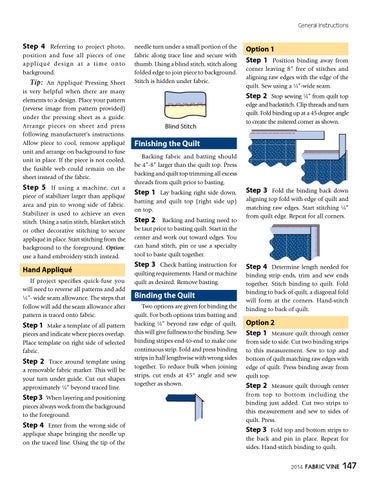
needle turn under a small portion of the fabric along trace line and secure with thumb. Using a blind stitch, stitch along folded edge to join piece to background. Stitch is hidden under fabric.
Option 1 Step 1 Position binding away from corner leaving 8” free of stitches and aligning raw edges with the edge of the quilt. Sew using a 4”-wide seam.
Step 2 Stop sewing 4” from quilt top
Blind Stitch
Finishing the Quilt
edge and backstitch. Clip threads and turn quilt. Fold binding up at a 45 degree angle to create the mitered corner as shown.
Diagram 1
Backing fabric and batting should be 4”-8” larger than the quilt top. Press backing and quilt top trimming all excess threads from quilt prior to basting.
Step 1 Lay backing right side down, batting and quilt top (right side up) on top.
Step 2 Backing and batting need to
Step 3 Fold the binding back down aligning top fold with edge of quilt and matching raw edges. Start stitching 4” Diagram 2 for all corners. from quilt edge. Repeat
be taut prior to basting quilt. Start in the center and work out toward edges. You can hand stitch, pin or use a specialty tool to baste quilt together.
Step 3 Check batting instruction for quilting requirements. Hand or machine quilt as desired. Remove basting.
Binding the Quilt Two options are given for binding the quilt. For both options trim batting and backing 4” beyond raw edge of quilt, this will give fullness to the binding. Sew binding stripes end-to-end to make one continuous strip. Fold and press binding strips in half lengthwise with wrong sides together. To reduce bulk when joining strips, cut ends at 450 angle and sew together as shown.
Step 4 Determine length needed for binding strip ends, trim and sew ends together. Stitch binding to quilt. Fold binding to back of quilt, a diagonal fold will form at the corners. Hand-stitch binding to back of quilt.
Option 2 Step 1 Measure quilt through center from side to side. Cut two binding strips to this measurement. Sew to top and bottom of quilt matching raw edges with edge of quilt. Press binding away from quilt top.
Step 2 Measure quilt through center from top to bottom including the binding just added. Cut two strips to this measurement and sew to sides of quilt. Press.
Step 3 Fold top and bottom strips to the back and pin in place. Repeat for sides. Hand-stitch binding to quilt. 2014 FABRIC VINE
147