There are certain events that we use to mark the passing of time, whether that is the New Year, birthdays, sporting events, or that yearly meet-up with old school friends that happens the first weekend of June every year, where you marvel at how old you are all getting and swap horror stories of your children’s behaviour.
One of those markers for me is the Yellow Table, our yearly ranking of the world’s 50 biggest original equipment manufacturers (OEMs) by sales. I’ve been at numerous press conferences held by some of these OEMs and heard them specifically mention their ranking in the Yellow Table in their presentations; it’s always great to hear how much these multi-billion-dollar goliaths value the information that we pull together.
As well as the individual rankings of the OEMs, the Yellow Table is also insightful when it comes to looking at wider industry trends, to see how the market is generally performing. Turn to page 16 to see the most recent table.
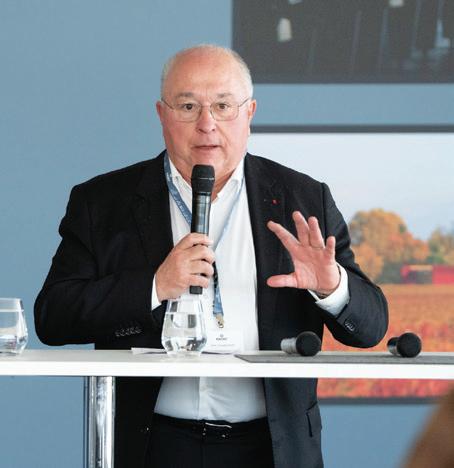
In this issue, we also have two interviews with representatives from companies that are staples in the table – Caterpillar and Fayat. At ConExpo in Las Vegas I sat down with Jaime Mineart, CTO, Caterpillar, and Jean-Claude Fayat, CEO of the Fayat Group for a chat. You can read both interviews in this issue, and more leading OEM interviews will be served up for your pleasure in the next magazine.
It seems like everyone has an opinion on AI but, whatever your take, there is no doubt that it is being increasingly embedded into construction and that it has the potential to significantly boost productivity. We spoke to some experts to get their take, as well as my own custom LLM.
I hope that you enjoy the issue and that perhaps – for some of you at least – the Yellow Table is one of your own markers of the passing of time.
Neom terminates $4.7bn Trojena contract; tall buildings report; numbers in for ConExpo.
World’s largest tropical greenhouse completed.
EDITOR Andy Brown andy.brown@khl.com | +44 (0)1892 786224
CONSTRUCTION BRIEFING EDITOR
Neil Gerrard
TECHNICAL EDITOR Julian Buckley
DIRECTOR OF CONTENT Murray Pollok
EDITORIAL MANAGER Alex Dahm
GROUP EDITORS Lindsey Anderson, D.Ann Shiffler, Euan Youdale
Charlotte Kemp charlotte.kemp@khl.com | +44 (0)1892 786262
CLIENT SUCCESS & DELIVERY TEAM
Alex Thomson, Ben Fisher, Olivia Radcliffe
GROUP DESIGNER Jade Hudson
DATA MANAGER Anna Philo
DATA EXECUTIVE Vicki Rummery
HR MANAGER Sharron Brown
FINANCE MANAGER Yasmin Toumi
EVENTS MANAGER Steve Webb
EVENTS DESIGN MANAGER Gary Brinklow
CREATIVE DESIGNER Kate Brown
CLIENT SUCCESS & DELIVERY DIRECTOR Peter Watkinson
VP SALES, CONSTRUCTION DIVISION Peter Collinson
GLOBAL VP SALES Alister Williams
CHIEF FINANCIAL OFFICER Paul Baker
CHIEF EXECUTIVE OFFICER James King STAFF LIST
Neil Gerrard on the Italian construction sector.
The numbers are crunched by Scott Hazelton.
The top 50 OEMs in the world by sales are revealed.
Caterpillar’s chief technology officer, Jaime Mineart, talks all things tech with Andy Brown.
The equipment that lets contractors go deeper and faster into the ground are examined by Neel Madsen
President Jean-Claude Fayat explains to Andy Brown about their acquisition strategy.
ON SITE EQUIPMENT
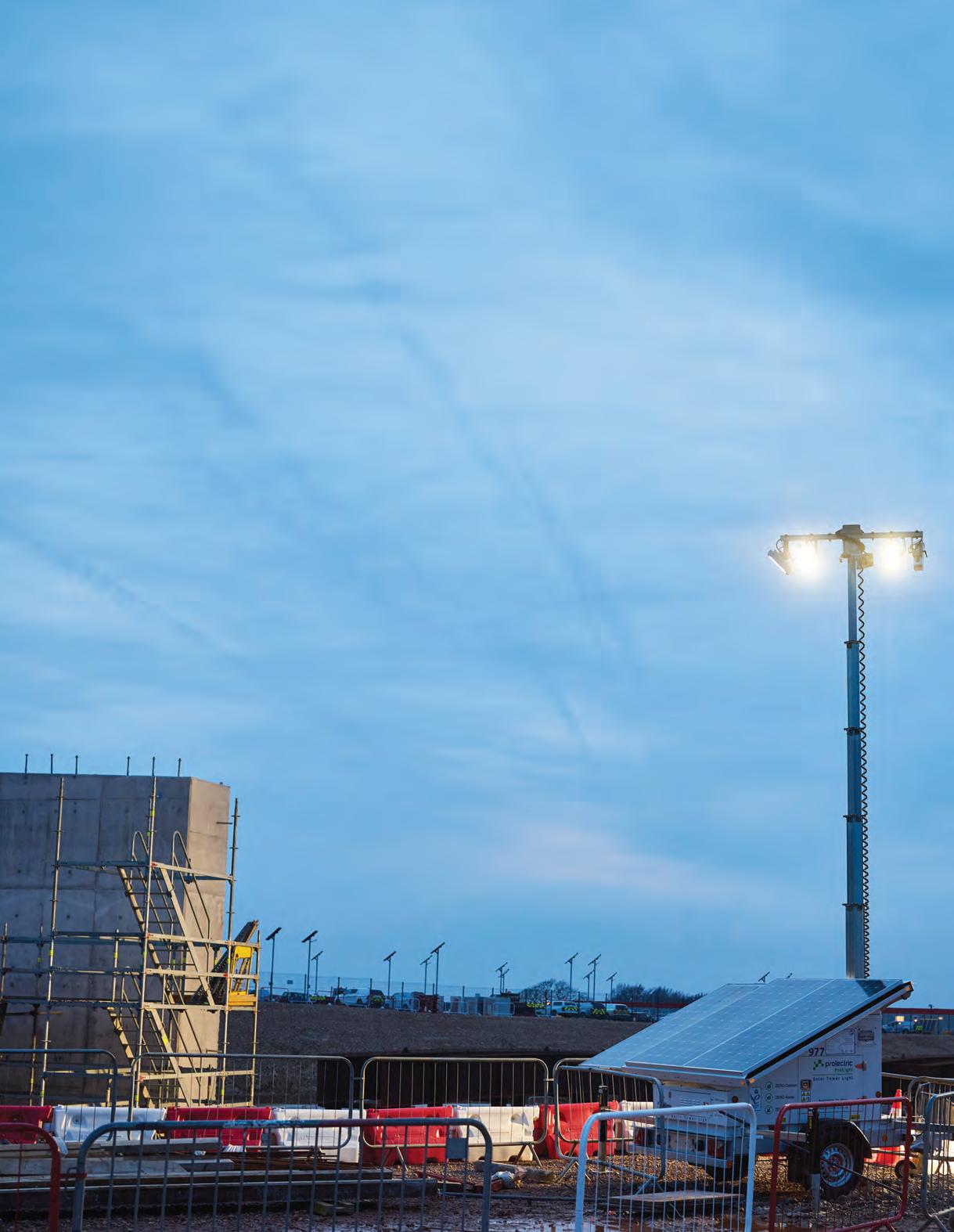
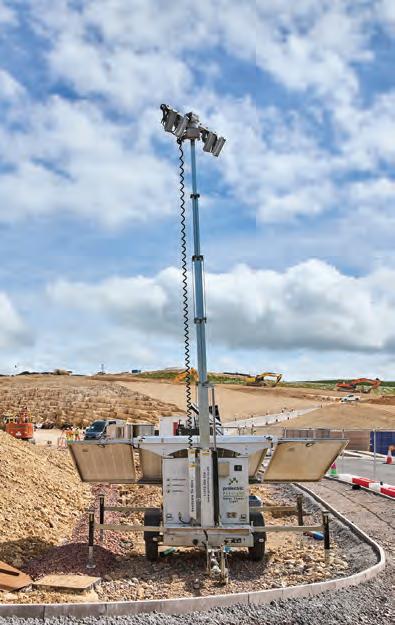
Neil Gerrard focuses on lighting towers, an unsung construction site essential.
The impact of AI on construction, and its potential, is examined by Andy Brown
show.
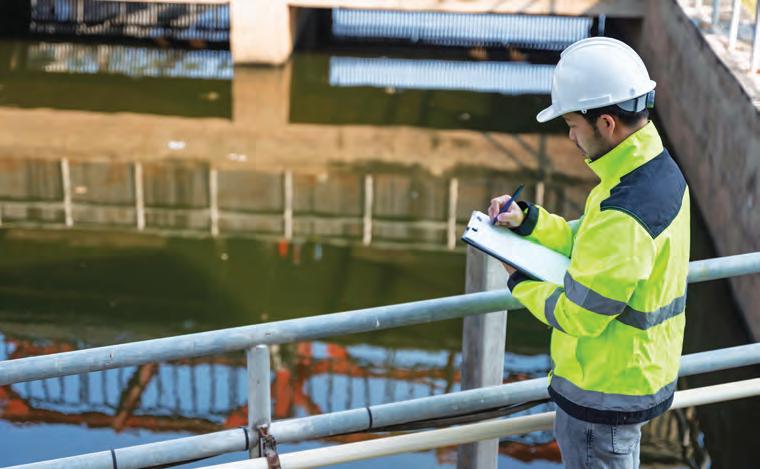
Why engineering expertise matters in a water crisis.
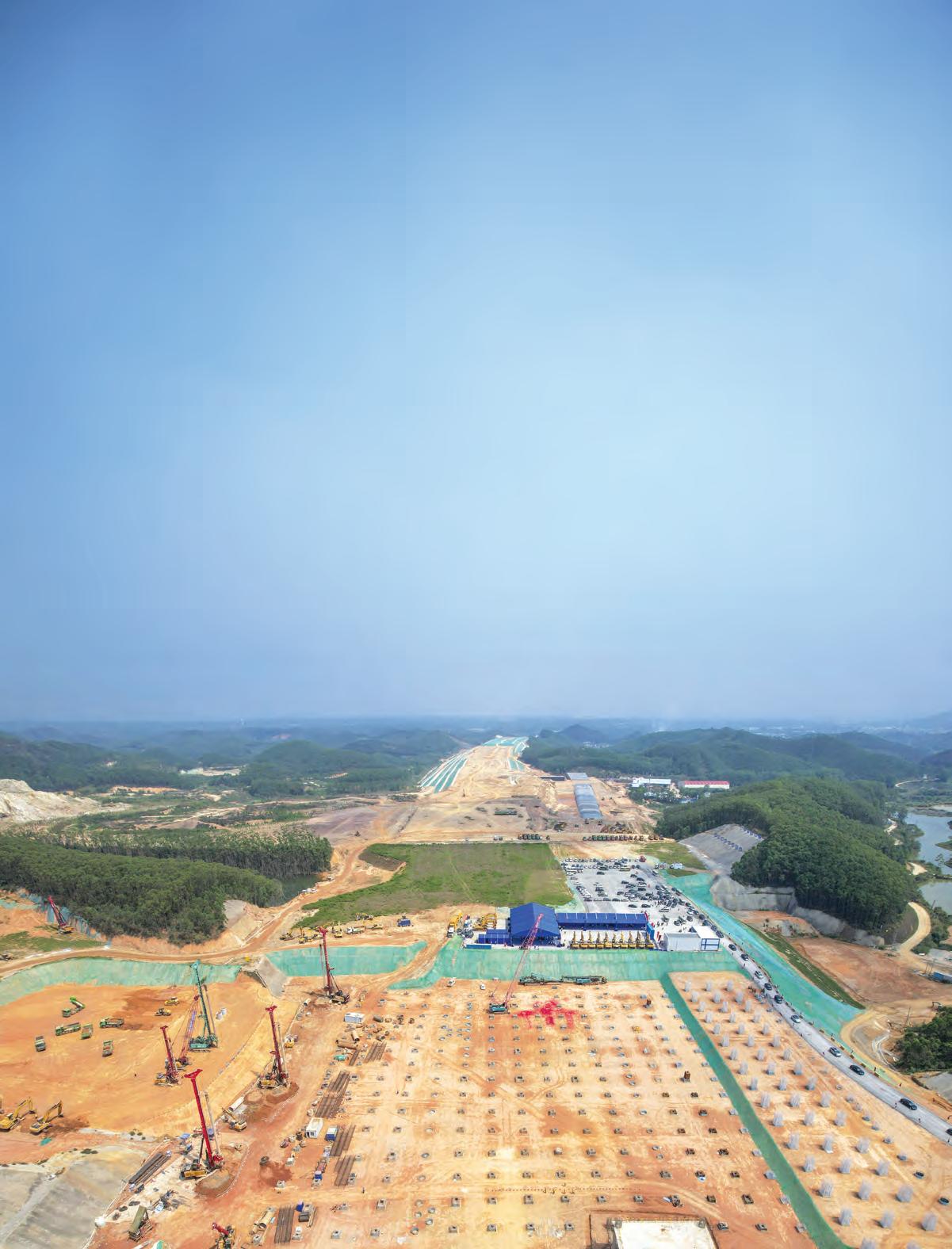
Guangzhou
AUSTRALIA Laing O’Rourke and Aecom have won the delivery partner contract for the Brisbane 2032 Olympic and Paralympic Games in Australia. Working together under the Unite32 joint venture, the two firms will act as delivery partners on the A$7.1 billion (US$5 billion) infrastructure programme for the games. Unite32 will be responsible for 17 new and upgraded venues and monitoring of two other locations across Queensland. Laing O’Rourke said that the joint venture comprises some of its most senior experts who have been involved in the delivery of every Olympic and Paralympic Games programme since London 2012.
US Fluor Corporation and Advanced Technologies business have signed a limited notice to proceed with TeraWulf for a large-scale brownfield data centre campus in North Central Kentucky, US. The agreement covers master planning and pre-construction services for the project that will have access of up to 480 megawatts of grid-connected power.
The agreement enables Fluor to begin early engineering, master planning and pre-construction activities.
CHINA Sany Group has announced that over the next five years it will spend RMB 30 billion (US$4.3 billion) on research and development as it looks to transform itself from a traditional manufacturer into an ‘AI-native’ robotics company.
The figure of RMB 30 billion is 5% of its annual sales revenue and is the same amount that the company invested over the last five years. Sany said that its previous investment had fuelled the launch of over 1,000 new products, with more than half targeting international markets. The OEM added that in 2025 its new energy equipment sales reached RMB 8.64 billion (US$1.2 billion).
COLOMBIA Holcim has signed an agreement to expand in Latin America by acquiring building materials and solutions operations in Colombia from Cemex that represent projected 2026 net sales of US$360 million. The transaction will expand Holcim’s footprint in the country by adding more than 20 production sites. They include Caracolito cement plant, Santa Rosa grinding station, as well as more than 20 ready-mix concrete, aggregates, mortars and admixtures plants.
In London, the cost of a new office building has risen by 40% since 2020 IMAGE: ADOBE STOCK
EQUIPMENT SALES
WHAT HAPPENED?
Growth returned to the global construction market in 2025 after three years of declining sales, according to Off-Highway Research.
The 2% increase was mostly due to continued strength in emerging markets, with China and the rest of the world up sharply, supported by a gentle up-tick in South America.
India was an exception, where the prebuy activity in 2024 ahead of new emissions regulations translated into a subdued market.
The developed regions were not so strong. The market in Europe in 2025 was essentially flat. North America declined by 1%, which was not as bad as many had feared given the impact of President Trump’s tariffs.
The normally stable Japan market fell 12%.
Source: Off-Highway Research
GLOBAL SALES OF CONSTUCTION EQUIPMENT BY REGION, 2020-2029 (UNITS)
1,400,000 1,200,000 1,000,000
800,000
600,000
400,000
200,000 0
NEOM TERMINATES WEBUILD’S $4.7BN TROJENA CONTRACT
Saudi Arabia’s Neom has terminated Italian contractor Webuild’s contract to build three dams at the Trojena project, worth US$4.7 billion.
Webuild had signed a deal to create a 2.8kmlong freshwater lake at Trojena, as well as ‘The
Bow’, a hotel overhanging the mountain’s valley below.
It was part of Saudi Arabia’s plan to host the 2029 Asian Winter Games under Saudi Arabia’s Vision 2030 programme. However, Saudi Arabia announced in January that the Games had been postponed indefinitely.
Webuild confirmed that Neom has “exercised the termination for convenience” of the contract to build a system of three dams that would feed a freshwater lake, as well as ‘The Bow’. The termination, which also affects other contractors, became effective on 29 March. It comes as works are around 30% complete, with a remaining project backlog for Webuild of approximately €2.8 billion (US$3.2 billion).
Neom has terminated Italian contractor Webuild’s contract to build three dams at Trojena IMAGE: WEBUILD
WHAT IT MEANS
A growth in sales is always a positive, but Off-Highway Research cautioned that, while it expects global equipment sales to continue to rise for most of the rest of the decade, its forecasts are for subdued growth.
The company points to lacklustre global economic growth, low investment and trade volumes and somewhat persistent inflation for its subdued outlook.
Equipment sales in China will continue to grow in the coming years but, due to the postpandemic crash, the market is likely to stay below a healthy and natural volume until the end of the decade. Most growth will come from electric equipment sales.
In Europe, the weak housing market remains a drag on future growth, particularly for some
VOLVO CE TO CLOSE ROKBAK
Volvo Construction Equipment (Volvo CE) will close its Rokbak articulated hauler business due to rising costs and global trade challenges and concentrate resources on its portfolio of other hauling solutions.
For more than four decades, Rokbak, formerly Terex Trucks, has delivered off-highway articulated haulers to customers worldwide. However, rising operational and supply chain costs, combined with global trade challenges such as US tariffs, have significantly impacted financial performance, making continued operation unsustainable, according to Volvo.
Production of Rokbak articulated haulers is expected to stop in the second half of 2026, subject to a consultation process.
The cost of constructing tall buildings is increasing sharply, raising questions about the viability of high-rise developments in several major cities, according to a new report from Turner & Townsend.
The Tall Buildings Construction Guide 2026 highlighted inflation, labour shortages, supply chain challenges and more complex building requirements as key factors pushing up costs for high-rise construction projects worldwide.
The report, which examined the tall buildings market in six global cities, found that they face disproportionately higher cost pressures compared with mid-rise developments, driven by their structural complexity, specialist labour requirements and increasingly stringent sustainability and safety standards.
In London, the cost of a new office building has risen by 40% since 2020. In Seoul, construction costs are up 30%. In Tokyo the cost of a tower is now 50% higher than it was five years ago and the cost of building a residential block in Dubai is up 35% since 2020.
“Rising costs are reshaping the feasibility of tall buildings,” the report said, noting that developers are being forced to reassess project height, design and construction methods to maintain financial viability.
Labour availability remains a major challenge across multiple markets, particularly for specialist trades required for tall buildings. At the same time, materials such as steel and façade systems have seen price volatility, further adding to uncertainty in project planning.
WHAT’S NEXT?
high-volume compact equipment types such as mini excavators.
With the disruption of a pre-buy surge in 2024 and disappointing sales in 2025 now a distant memory, the Indian market is expected to resume its growth trajectory and enjoy a 6% rise in equipment sales this year.
Sales fell 1% in North American in 2025 and Off-Highway Research remains cautious on the outlook for this year, with President Trump’s actions hard to predict.
The forecasting company highlights inflation as a problem, particularly in terms of materials and labour costs in the construction market along with the large fleet of young machines available in the region after five years of historically high sales of equipment.
CONEXPO DRAWS 140,000
The ConExpo show in Las Vegas, US, has announced that more than 140,000 construction professionals from 128 countries attended the event.
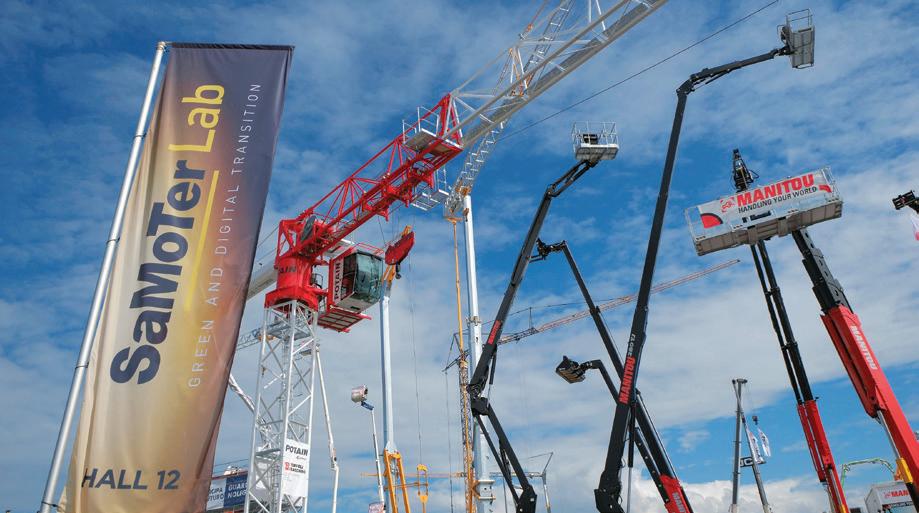
Held from March 3-7, 2026, the show brought together contractors, manufacturers, technology leaders and workforce advocates to showcase new equipment, emerging technologies and solutions designed to help the construction sector build more efficiently, safely and sustainably.
Show attendance was slightly up on the last time that ConExpo was held – in 2023 the AEM, the organisers of the event, said that more than 139,000 people attended ConExpo 2023.
Companies typically release their first quarter 2026 results in mid to late April – these results will give an indication as to how figures for the year may look. With the world dealing with the uncertainties brought on by tariffs, wars, and inflation, it is challenging to predict exactly what is next.
Taking the longer-term view is slightly less fraught. Chris Sleight, managing director says, “In the longer-term construction equipment sales always go up and that is because the demand for housing and roads and infrastructure is increasing every year.”
Off-Highway predict that global construction equipment sales will increase year-on-year until 2030. While these increases may be slight, they do indicate that the market should grow.
STEEL–CONCRETE GUIDANCE
A revised version of Eurocode 4 has been published, introducing updated guidance for the design of composite steel-concrete structures used widely in buildings and infrastructure across Europe.
The standard sets out how engineers should design structures combining steel and concrete – a construction method used in more than 75% of multi-storey office buildings in the UK and in a significant share of global high-rise and bridge projects.
Developed by an international committee of experts from 34 countries, it reflects advances in both research and construction practice, with a focus on improving efficiency, reducing material use and lowering embodied carbon.
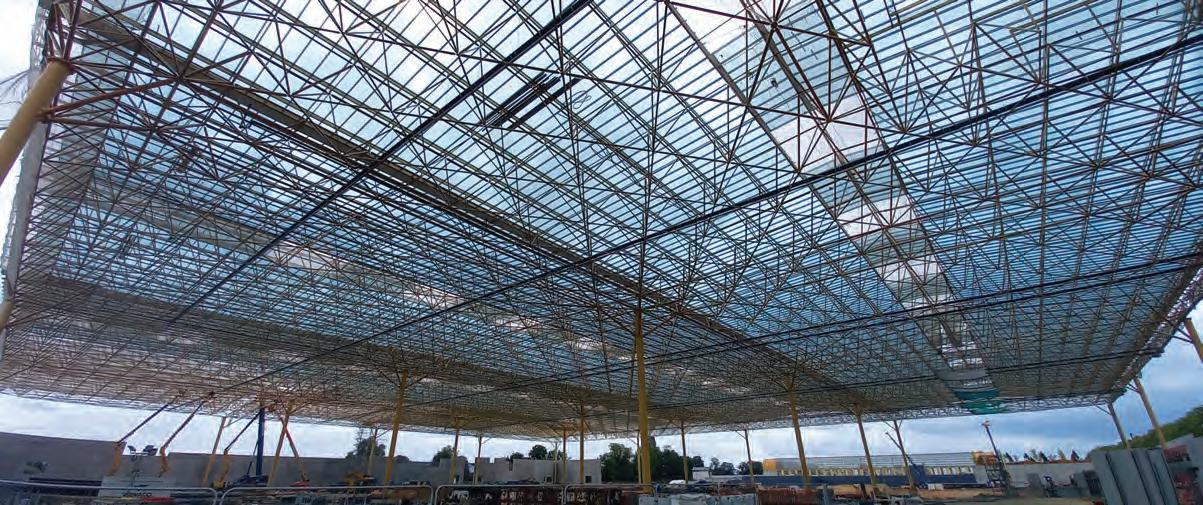
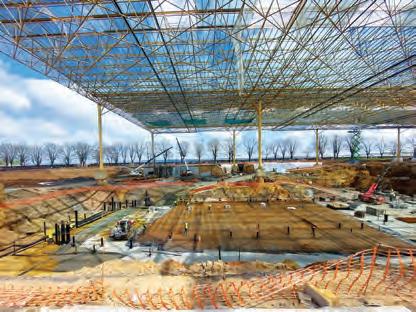
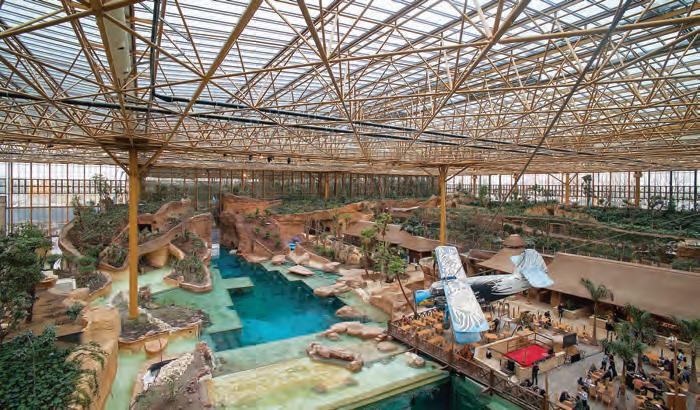
Construction has been completed on what is said to be the largest tropical greenhouse in the world, located in Belgium.
With a surface area of no less than 40,000m² and a height of 25m, Edenya was built by Deforche Construction Group and took three and a half years to complete.
The roof structure consists of 16 modules, each spanning 2,500m². These were first assembled at ground level and then lifted piece by piece to 20m, with each lift taking just ten minutes.
The construction of the modules on the ground took three weeks, while cladding and finishing at a height of 20m required two and a half months per module.
Throughout construction Forzon – the division within Deforche Construction Group specialising in glass roof structures – translated
the architectural design into a fully executable construction process.
“This involved comprehensive engineering, including structural load calculations, the optimisation of glass, steel and aluminium configurations, and the development of technical solutions for a number of highly complex construction details,” explains Jeroen De Cock of Deforche Construction Group.
Prefabrication and on-site assembly were also coordinated by Forzon, ensuring continuous
alignment between design and execution.
For the installation of Edenya, techniques from both football stadium construction and greenhouse engineering were combined.
This approach allowed the roof structure and the underlying zones to be constructed in parallel, independent of weather conditions, enabling the works to progress efficiently, according to Deforche.
Edenya was opened to the general public for the first time at the beginning of February. iC
Construction in Italy has been the beneficiary of billions of Euros' worth of European funding. But, as the funding window closes, is new work going to be harder to come by for the sector?
Neil Gerrard reports
Italy has been a major beneficiary of NextGenerationEU funding
In recent years, Italy has been a welcome bright spot for European construction.
The country has been a major beneficiary of NextGenerationEU (NGEU) funding, with €191.5 billion (US$219.9 billion) of the €750 billion (US$861.5 billion) stimulus package flowing to Rome over a five-year period from 2021 to 2026. That’s approximately 26% of the total fund going to Italy.
Alongside other sources of funding, a total of more than €260 billion (US$298.6 billion) worth of grants and loans were pulled together to back Italy’s National Recovery and Resilience Plan (NRRP).
Under the NRRP, there was plenty of construction work, not least €25.4 billion (US$28.8 billion) of investments in
BRENNER BASE TUNNEL EXCAVATIONS NEARLY COMPLETE
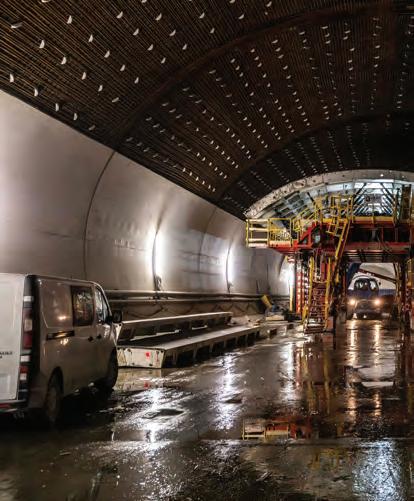
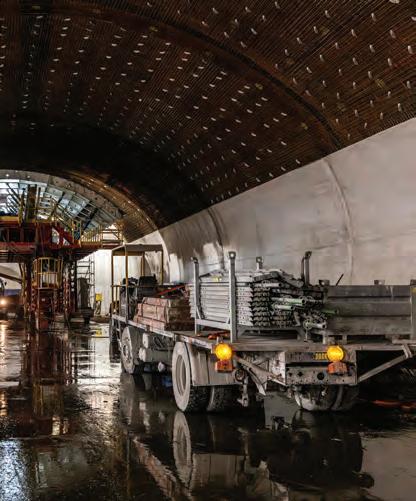
One of the major civil engineering projects in Italy that is already well advanced is the 55km-long Brenner Base Tunnel (BBT) running between Austria and Italy beneath the Brenner Pass.
Divided into several different lots, the project involves a total of 230km of tunnels, including 108km of railway tunnel, 57km of exploration or service tunnel, and 49km of access, rescue and logistics tunnels. So far 93% (or 214km) of tunnels have been
excavated. The project reached a key milestone late last year when tunnel boring machines broke through on the H41 Sill Gorge-Pfons section south of Innsbruck. Contractors Implenia, Webuild and CSC used two Herrenknecht tunnel boring machines (TBMs) to excavate more than 8km of tunnel on the lot.
Excavation of the tunnel has depended on the geological conditions of the rock, geotechnical findings and forecasts, and
infrastructure for sustainable mobility (which included a glut of railway projects), €30.9 billion (US$36.1 billion) in education and research, and €15.6 billion (US$17.9 billion) in health.
Contractor confidence high
Such high levels of stimulus help explain why confidence among Italian contractors has remained higher than their counterparts in the EU since 2022, according to analysis by Dutch bank ING.
However, there are signs that the construction market in Italy has now peaked, with potentially leaner times ahead.
“Italy will be one of the slowest-growing European markets from here, as the NGEU-
Work underway on the final lining of the cross-over point between railway tunnels on the €959 million H53 Pfons-Brenner construction lot, where Porr Bau, Marti, and Marti Tunnel are working as a consortium IMAGE: BBT
IMAGE: ADOBE STOCK
MILAN’S A2A TOWER TOPS OUT
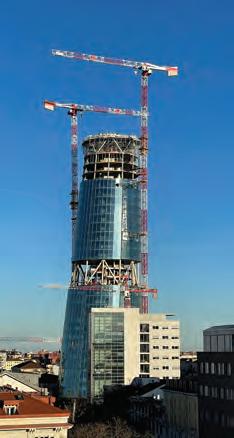
The A2A Tower in Milan topped out in March this year. Also known as the Torre Faro and designed by architect Patricia Viel and ACPV Architects, the new office complex will be 145m tall.
It is being constructed by a joint venture between Colombo Construzioni and CMB and will feature a 60-metre-high sky garden, followed by another ten floors of offices and an observation deck at the top.
The new tower forms part of the redevelopment of the historic Porta Romana railway yard and will house the new headquarters of energy company A2A.
The A2A tower in Milan topped out in March 2026 IMAGE: FEDE23345, CC0, VIA WIKIMEDIA COMMONS
funded projects wind down and there isn’t much to replace them,” says Dr Nicholas Fearnley, head of global construction at Oxford Economics.
A Q4 2025 report by the company forecast a 0.3% decline in total construction work in 2025 and 0.2% in 2026.
“The Italian construction sector emerged
as the main positive outlier in Europe after receiving strong incentives. But as the government has scaled back these incentives, residential investment is suffering and will act as a drag on total construction activity in the near term,” the report said.
Civil engineering work was still expected to grow by 6% in 2025 but then decline by 0.8% in 2026 as investment starts to fall back in line with government investment.
Residential work is forecast to decline by 4.3% in 2025 and 0.5% in 2026.
Non-residential building work looks a little brighter, with growth of 3.6% in 2025 and then 0.5% in 2026. But, the report cautioned, global trade uncertainty remains a “key downside risk” to the forecast, with weak external demand for Italy’s exports likely to weigh on demand.
Labour challenges and rising prices
The recent rapid growth of Italy’s construction sector, alongside countries such as Spain and Greece, has seen their labour markets struggle to keep pace.
construction logistics and economic considerations. Some sections have been excavated by drilling and blasting, while others have been built using TBMs.
According to a status update from BBT, the company overseeing the project, lots H21 Sill Gorge, H33 Tulfes-Pfons, and H52 Hochstegen in Austria, as well as H71
Isarco River Underpass are all complete.
The H41 Sill Gorge-Pfons lot and H53 Pfons-Brenner lots in Austria and the H61 Mules 2-3 lot in Italy are all still active.
Running from Innsbruck in Austria to Fortezza in Italy, the tunnel is scheduled to be completed by 2032.
A European Commission survey published last year found that both Italy and Greece were still reporting significantly higher labour shortages than the historical average.
But Fearnley suggested that the forecast declines in the sector in Italy would help “return some capacity to the industry”, as a fall in the volume of work eases the challenges around labour.
Less likely to fall are prices. ING found that Italian construction companies were more likely to raise prices over the three months from February 2026 than companies in other major EU countries, albeit the balance of companies in Italy saying they would raise prices was relatively low at around +9-10%.
Meanwhile, the latest Hamburg Commercial Bank (HCOB) Italy Construction Purchasing Managers Index (PMI), which surveys construction buyers, reported the highest level
The Ponte del Mare bridge in Pescara, Italy – civil engineering work is expected to grow by 6% in 2025 when the figures are confirmed IMAGE: ADOBE STOCK
BALANCE OF CONSTRUCTION COMPANIES THAT EXPECT INCREASE -/- DECREASE OUTPUT PRICES
NEXT 3 MONTHS) IN FEBRUARY 2026
of construction cost inflation in three years in February 2026.
In February, buyers reported that industry activity had edged back into expansion territory, with a score of 50.4 (where 50.0 indicates no change), up from 47.7 in January.
Growth was linked by survey panellists to improved order books and the opening of new sites. Residential building activity increased at the fastest rate for more than a year but only marginally overall, while commercial construction also grew modestly.
However, in line with expectations over the end of NGEU funding, they reported a “solid” contraction in civil engineering during the month.
Jonas Feldhusen, junior economist at Hamburg Commercial Bank, said, “These are encouraging data points for Italy’s construction sector. After three consecutive months of declining activity, February marked a return to expansion, with growth momentum more broad-based. Firms reported an improvement in overall order volumes, and employment continued to rise, albeit at a slightly more measured pace.
“The positive demand impulse observed in February has left its mark on firms’ purchasing
Italian contractors expect to increase prices in February 2026 more than their counterparts in other countries
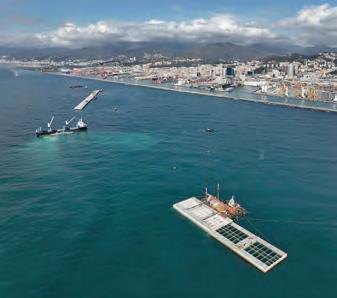
A new 11-storey-high caisson has been laid on the seabed for the New Genoa Breakwater, after a period of poor winter weather IMAGE: WEBUILD
behaviour. For the first time in four months, construction companies reported an increase in input purchases. However, this seems to have immediately translated into supplier capacity strains and longer delivery times. Consistent with this, cost pressures have intensified.
“The relevant price index climbed to its highest level in more than three years, underscoring persistent supply constraints. Still, it is important to note that current cost dynamics remain far removed from the price surge witnessed around 2022,” said Feldhusen.
Volatile global situation
However, those comments came before the start of the Iran War and the impact on the Strait of Hormuz.
Source: European Commision, ING Research
The price of oil and gas reamins volatile, which could push inflation even higher and eventually see interest rates rise too, which has implications for construction prices and demand. Whether it results in the price surges witnessed in 2022 when Russia invaded Ukraine remains to be seen.
While the post-stimulus slowdown may temper growth, the outlook for Italy’s construction sector is far from bleak. Continued infrastructure investment, improving order books, and a gradual easing of labour pressures could help the market stabilise at a healthier, more sustainable level following several years of rapid expansion. If inflationary pressures remain contained and geopolitical risks ease, Italy’s construction sector may yet demonstrate the resilience that has made it one of Europe’s standout performers in recent years. iC
WEBUILD RESUMES LAYING CAISSONS FOR GENOA PROJECT
Italian contractors have resumed laying caissons on the seabed for the New Genoa Breakwater project, after adverse weather hampered progress over the winter.
The PerGenova Breakwater consortium, led by Webuild, has a €928 million (US$1.06 billion) contract to build the first phase of the breakwater, which will protect the port of Genoa from severe storms and create new manoeuvring spaces for safe docking of a new generation of ships up to 400m long.
In February this year, Webuild laid the 16th caisson, a concrete structure comparable in size to an 11-storey building, after months of poor weather and sea conditions.
Work has also started in parallel on the construction of the breakwater’s superstructure, which will become a long, continuous wall that is designed to dissipate the force of the waves. The superstructure will be built offshore, where a floating worksite will operate.
Construction spending in Italy should see a steady, if not spectacular, uptick in the near future, with growth led by the infrastructure segment, writes Scott Hazelton
While the Middle East conflict presents downside risks, real Gross Domestic Product (GDP) growth in Italy is forecast to average 0.6% in 2026–27, supported by EU investment inflows and a lessrestrictive budget.
Even with an energy price spike triggered by the Middle East conflict, consumer price inflation should not exceed the Eurozone’s 2% target in 2026–27.
Despite considerable fiscal consolidation, Italy’s formal exit from the EU’s Excessive Deficit Procedure in 2026 could be frustrated by weaker growth prospects. The government will continue to pursue fiscal rationalisation, with EU recovery funds partially offsetting the impact on growth. Italy will continue to face an elevated public debt ratio, with debt as a percentage of GDP forecast to peak in 2026.
Investment faces a mixed near-term outlook with EU-financed investment through the Recovery and Resilience Fund (RRF) accelerating ahead of the end-2026 deadline. Italy has received nearly €140 billion (US$163 billion) of its total allocation of €194 billion (US$226 billion) from the RRF payouts, with
the remaining funds likely to be disbursed in 2026 and spent into the first half of 2027. However, underutilisation of EU funds is an issue, with only about half of Italy’s RRF funds received so far allocated to projects.
Italy has also requested to receive approximately €14.9 billion (US$14.4 billion) in low-interest loans by 2036 from the EU’s Security Action for Europe (SAFE) fund to strengthen its defence industry and national security.
Higher energy prices
Under the assumption that the increase in energy prices will be temporary, we still expect the European Central Bank (ECB) to refrain from raising interest rates this year. However, communication will become more hawkish, stressing that the ECB will be ready to act if there are indications that higher energy costs are taking inflation expectations to a level not consistent with its 2% target.
Easing interest rates are unlikely to have a significant impact on increasing credit-fuelled home purchases given that variable rate contracts account for only about 10% of the total.
Real total construction spending in Italy will likely see a modest improvement in growth from an estimated 1.8% in 2025 to 2.4% in 2026, with significant variation across the sectors. While residential construction is expected to remain in decline amid reduced tax incentives for housing renovations, nonresidential construction will continue to
OUTLOOK FOR KEY CONSTRUCTION TYPES
expand at a solid pace as lower interest rates encourage investment and the inflow of RRF funds progresses in 2026.
However, increased trade protectionism and persistent global uncertainties will continue to weigh on sentiment. Challenges related to the supply and cost of raw materials and labour will also continue, while underutilisation of RRF funds remains a key risk to the outlook.
The latest Hamburg Commercial Bank Construction Purchasing Managers’ Index survey showed that the Italian construction sector’s downturn extended into 2026. The January data showed a third consecutive month of decline in total activity driven by a sharper fall in housing construction activity.
Commercial building activity also saw a further, albeit marginal, decline, while civil engineering recorded slight growth. New order volumes and purchasing activity registered faster reductions, while cost pressures picked up due to higher transportation, energy and raw material costs, as well as the impact of the Carbon Border Adjustment Mechanism (CBAM). Despite this, construction firms increased hiring and remained optimistic about activity over the next 12 months.
Residential construction spending in Italy is expected to decline by 3.2% in 2025 and by a further 0.5% in 2026 due to the reduction or withdrawal of various tax incentives for housing renovations. The decline in the number of permits issued for residential buildings during the first three quarters of 2025 should also limit new-build activity during the year.
Construction spending growth in nonresidential structures is expected to strengthen to 5.3% in 2026 from an estimated 4.8% in 2025, even though global trade policies and geopolitical tensions will continue to weigh on business investor sentiment. This is due to an expected increase in the inflow of EU funds and plans to transform Milan’s Winter Olympic Village after the Games conclude in March 2026. A pipeline of data centre projects should support growth in 2026 and beyond.
Demand for high-quality and sustainable space, particularly in offices, retail and logistics, will remain high as landlords and investors seek to address environmental, social and governance requirements, although high construction costs will continue to impact schemes in the near term.
CONSTRUCTION OUTLOOK FOR SEGMENT DETAIL
(COMPOUND ANNUAL GROWTH, REAL 2019 EURO)
Optimistic outlook for infrastructure
The outlook for the infrastructure segment remains particularly bright, with real construction spending expected to rise by 6% in 2026 after estimated growth of 12.5% in 2025. This owes to an expected increase in the utilisation of RRF funds, which should support growth in all subsegments.
Transportation is set to record the highest growth in 2026 due in part to high-speed rail developments and work commencing on the Strait of Messina Bridge project. Energy
infrastructure construction is also expected to experience strong growth, driven by investments in renewable integration, modernisation of electricity grids and interconnection projects.
As said, Italy is the largest beneficiary of the EU’s RRF. As of now, Italy has received €153.2 billion (US$179.1 billion) – equivalent to 79% of total the resources allocated – in prefinancing and eight payments for both grants and loans, with the remaining funds expected to be disbursed in 2026.
Despite these disbursements, the utilisation
S&P GLOBAL is an American publicly traded corporation headquartered in Manhattan, New York City. Its primary areas of business are financial information and analytics. It is dedicated to sharing essential economic intelligence with those working in and affected by global markets. Its experts provide a 360-degree perspective across countries, risks, industries, and commodities.
of these funds has been slow. As such, concerns remain over the full implementation of Italy’s NRRP by the August 2026 deadline.
Construction spending in Italy is expected to face a 1.7% compound annual growth rate between 2024 and 2029, with growth led by the infrastructure segment.
In the longer run, growth will slow to a 1.3% compound annual rate between 2029 and 2034. The residential segment will demonstrate the highest growth over the forecast period, showing the strength of this sector. iC
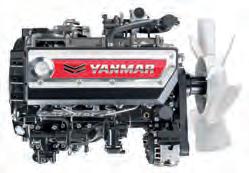
WITH A STRIKING 105KW, THE 4TN101 IS ALL YOU NEED TO GET THE JOB
Having the best in class engine under the hood, the 4TN101 engine is your best excuse to take on any job. Giving you 105kW and a staggering 550Nm of torque, it can handle anything you put it up to. With over 100 years of experience and our renowned Japanese engineering, Yanmar is your partner in high performance engines and true reliability. More info? Visit yanmar.com/eu/industrial
Sales for the world’s biggest OEMs hits its highest ever figure, as sector shrugs off global challenges
The headline figure of this year’s Yellow Table, our exclusive ranking of the sales figures of the world’s top 50 OEMs for 2025, is that the total revenue generated was – once again – a record. This is the third time in five years that the total generated has been at an all-time high, with the exception being the 2024 table where sales declined just 2.39%.
Ever since the Covid-19 pandemic sales for the Yellow Table have been historically high. This year’s table is no exception with a total
METHODOLOGY
Positions in the Yellow Table are based on sales in the 2025 calendar year in US dollars. Currencies have been converted to dollars based on the average exchange rate over the course of 2025 to try and ensure fairness. Data was gathered from a variety of sources including audited accounts, company statements and reputable third-party sources.
In Japan and certain other countries, the use of the fiscal year (ending 31 March) has made it impossible to establish calendar year information. In these cases, fiscal year results were used. In some cases International Construction has made an estimate of revenues based on historical data and industry trends. Where this has occurred, it has been clearly marked with two asterixs.
While every effort has been made to ensure this report’s information is accurate, International Construction does not accept any liability for errors or omissions. If you would like to comment on the Yellow Table, or feel your company should be included, please e-mail the editor at: andy.brown@khl.com
figure of US$246.6 billon, which is a 3.8% increase from last year.
An essential industry
In some ways, it is remarkable that sales have been so strong considering all that the industry has had to contend with: wars, supply chain blockages, shortage of skilled workers, global
political volatility. But, in another way, it is not surprising at all: construction is a truly essential industry and no matter the global issues, the world will always need roads building and repairing, new transport hubs, and new cities constructed to meet the world’s expanding population.
The year that the sales figures are taken from,
SHARE OF YELLOW TABLE REVENUES
When it comes to individual countries, the ‘big three’ remain firmly in place. Between them, companies based in the US, Japan and China provide sales of more than 66% of the total generated in the Yellow Table.
Those companies based in the US and Japan saw their percentage of total sales dip slightly, while China-based OEMs saw an increase. This makes sense as, even though China’s OEMs are increasingly international, their home market is still very important for them and equipment sales in 2025 in China were better than in 2024.
This is also borne out in terms of regions, with OEMs from Asia equating to 45% of the total sales of the Yellow Table, up slightly from last year’s 44.3%. North American firms contributed 27% of the total, down from last year’s 27.5% and those companies headquartered in Europe contributed 28%, the slimmest of increases from last year’s 27.9%.
Please note that these figures represent the revenues of the OEMs listed in the Yellow Table, and are not representative of the revenues generated with the regions themselves or individual countries.
2025, was one that market forecaster OffHighway Research said global construction equipment sales increased by 2%. In broad terms, the market in Europe was flat, North America was down slightly (but from a high figure) and China saw growth, as did most of the emerging markets.
Looking up
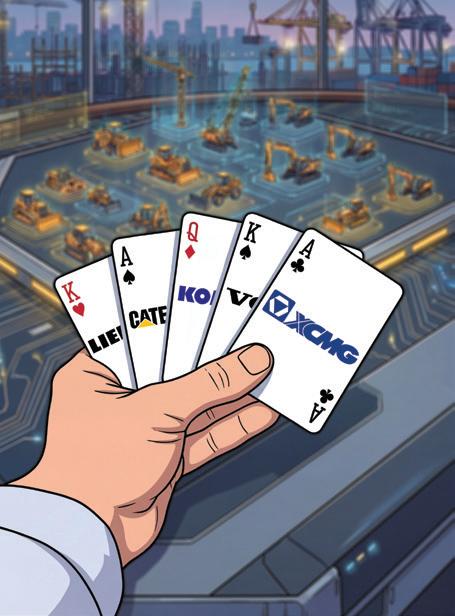
It wouldn’t be a Yellow Table without Caterpillar sitting at the top – the US-based OEM reported sales figures for 2025 very similar to those it had in 2024. This was more than enough to comfortably keep its position as the world’s biggest OEM by sales. Komatsu takes up their customary place in second and then there is some movement, with Chinabased XCMG becoming the third largest OEM in the world by sales.
This is the highest that a Chinese OEM has ever been on the Yellow Table and is the logical conclusion to what has been, at times steady, but often spectacular climbing up the rankings from the big Chinese OEMs. It is also the result of these OEMs looking increasingly to international markets, with many of the biggest Chinese players now seeing more than half of their revenue coming from international markets.
John Deere moves down one to fourth place, with their increase in sales from last year not enough to hold off XCMG’s charge. Liebherr remains in fifth place, as does Sany in sixth before Volvo CE moves up one to seventh, swapping places with Hitachi, which is down one in eight. The top ten is rounded off by JCB and Sandvik, occupying the same places that they did last year.
Points of matter
In this year’s table we have combined two entries that were listed as separate last year –Hyundai and Develon. The two brands fall under HD Construction Equipment, which is in itself part of the HD Hyundai Group. Due to combining the sales figures for Hyundai and
Develon this new entity is now at number 15 in the list.
The final company in this year’s table at number 50 is Kato Works, a Japanese global construction equipment manufacturer of mobile cranes, excavators and other equipment. It should be noted that getting accurate information from some of the firms towards the bottom of the list can be challenging, so if there are companies that think they should be placed in the list, they are encouraged to contact the editor.
Most of the rises and falls in the table are by one place or two. Sinoboom, which first entered the Yellow Table in 2024, are now number 44 – the kind of climb we have seen many times before from Chinese OEMs. The biggest faller
is Kobelco, which can perhaps be explained by the problems in its home market of Japan. The normally stable Japanese construction market dived 12% in 2025, with the market taking huge hits form spiralling materials costs, labour shortages, much-reduced public investment and weak consumer confidence.
Crystal ball time
The volatility that exists in the world doesn’t seem to be decreasing – one only has to look at the current situation in the Middle East to see that. Any predictions have to be made with caveats; at the time of writing ships are not passing freely through the Straight of Hormuz, which is having a real impact on the movement of goods around the world and fuel availability.
Assuming that some degree of normality does return then next year’s Yellow Table will, in all probability, look similar to this one in terms of the total figure generated.
Off-Highway Research predicts a small uptick in global equipment sales in 2026, and the essential nature of the industry will remain. Whether the final figure is up or down by a few percentage points is harder to say, but what can be said with more confidence is that the figure will be one that, in historical terms, is high. It may not be another record-breaker, but it will, in all likelihood, show a sector that remains in good health, despite the seemingly never-ending set of challenges that the world continues to throws at it. iC
HITTING THE HEIGHTS (AGAIN)
It is becoming something of a trend for sales in the Yellow Table to reach record heights. Since 2020, when the table dropped 5.5% due to the impact of the Covid pandemic, the figures generated by the 50 companies on the table have been very healthy.
For the lowest figure since 2020 to be 2022’s US$230.6 billion is remarkable, given that they table did not pass the US$200 billion mark until 2019. Since the Covid-impacted 2020 Yellow Table, sales have also been consistent, with increases and drops of a few percent. This indicates that the market is at its right level, that sales are sustainable.
Looking to the future brings challenges – arguably more now than ever, with global volatility – but it’s probably a safe bet to say that the next Yellow Table will continue with the pattern that has been set in recent years. Sales should continue to be at a high level –even if they decline by a percentage point or two.
ICON
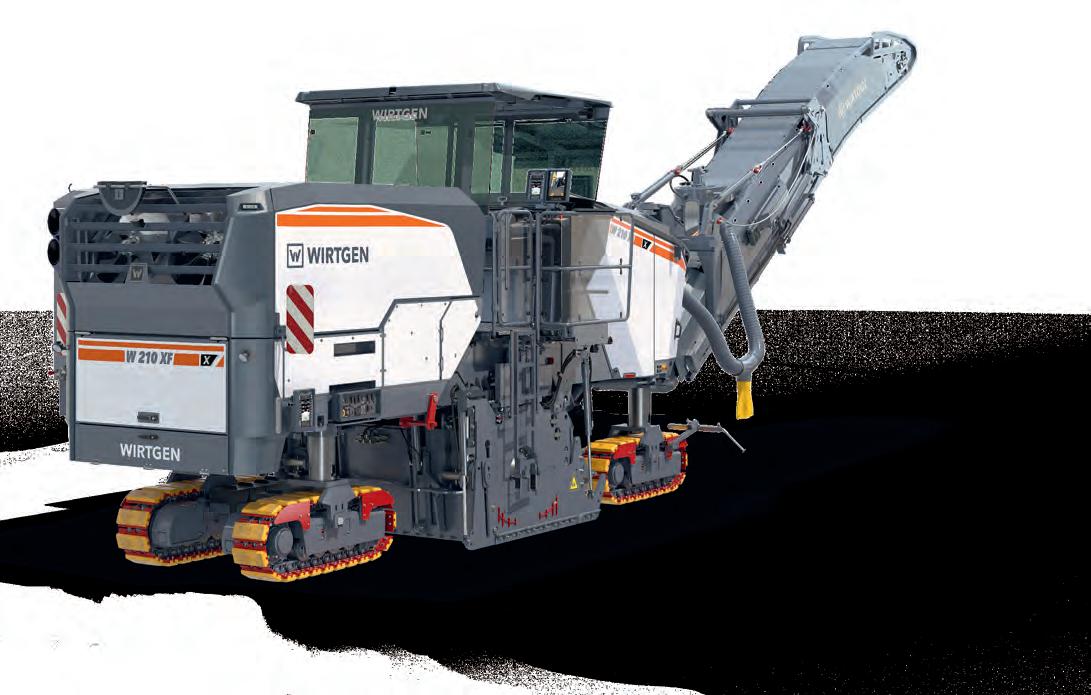
W 210 XF: The large milling machine offers a wide range of applications from surface course rehabilitation to complete pavement removal. MILL ASSIST shows the specific CO2 emissions directly on the machine display and always sets the most favorable working ratio between performance and costs in automatic mode. The torque characteristic of the 18 l JD engine has been adapted to the requirements of cold milling. The DUAL SHIFT powershift transmission enables a wide range of milling drum speeds. Maximum precision in levelling and machine positioning is achieved with the integrated LEVEL PRO ACTIVE levelling system. The Wirtgen Group Performance Tracker Milling is available for automated job site documentation.
Caterpillar’s CTO, Jaime Mineart, speaks to Andy Brown about the innovations that could define construction equipment
Caesars Palace in Las Vegas, US, looks very different at eight in the morning than it does at eight in the evening. There are still people milling around the tables, hoping to strike it lucky, but the drinks are more likely to be coffee than beer and the mood is noticeably less raucous.
It is early in the morning when International Construction meets Caterpillar’s chief technology officer (CTO), Jaime Mineart, in a room where CEO Joe Creed and the new group president of Construction Industries, Rod Shurman, are preparing for the company’s quarterly earnings call, which will be livestreamed around the world.
Afterwards, we move to a cavernous meeting room across the hall – large enough to throw an American football back and forth – where Mineart comes across as composed, thoughtful and careful with her words.
Construction has long had a reputation for being slow to adopt new technology but, given the rate of change over the last decade, that reputation increasingly feels unfair. What’s Mineart’s assessment? “In general, everyone’s getting quicker to adopt technology because they have to; they have to stay competitive. That is how their businesses are going to stay at the forefront.
“There’s more demand for construction than our customers have the ability to serve. They are really pulling for whatever technological advancements, whatever digital tools and capabilities we can provide in order to help them keep their businesses ahead, serve more customers and run their operations more efficiently and effectively.”
Caterpillar is incorporating more technology than ever into its machines as standard, something Mineart says is a direct response to customer demand. She adds that the pace of technological advancement will continue to increase and that part of the challenge for OEMs is ensuring that machines produced today are “future-ready” and can easily be updated with new technologies as they emerge.
Autonomy and construction
Autonomy is nothing new to the mining industry or to Caterpillar – the OEM says it has moved more than 11 billion tonnes of material autonomously through its mining trucks. But autonomy is one thing on a mining site – a fixed environment closed to the public with fewer machine types and contractors working together – and quite another on construction sites. However, Mineart hints, construction may be edging closer to autonomy.
“Even a couple of years ago, bringing autonomy into construction felt impossible. It’s very chaotic. You have to make split-second decisions. There’s constant change in the operation. There’s a lot of construction that’s not repeatable,” she says.
“But now with edge computing, AI models, data and simulation we can use all of that information to train our models for a more variable jobsite, enabling us to bring a lot more autonomy into a construction site.”
It’s interesting that Caterpillar’s CTO brings up AI as an enabler of autonomy and links the two, as they are arguably two of the biggest trends in the global construction industry. Making up the hat-trick (or the triumvirate, if we want to nod to Caesars Palace) would be alternative power, specifically electrification, which Mineart says is also linked.
“In my mind, you really need autonomy to maximise the value of electrification. How and when you’re going to charge, that optimisation of the work site for our customers is going to become critical,” she says.
Mineart uses the example of a mining site to illustrate her point about electrification and automation. “If you were to bring electrification into a mine site, you need to have that charging infrastructure and orchestration of the mine site – when you charge, when you use electricity.
“It’s the same on a construction site. That orchestration of when you charge to make sure you stay productive, what the cost of energy is, the optimisation of the total operating costs of the site and the total productivity of how you
Even a couple of years ago, bringing autonomy into construction felt impossible. It’s very chaotic
Mineart says that, regarding automation, significant strides have been made in recent years for the
construction industry
Technology is increasingly integrated into Cat’s wide range of construction equipment
do the job is important to get the value out of the technology.”
HAL 9000
Artificial Intelligence (AI) has been around for many years. HAL 9000 in 1968’s 2001:
A Space Odyssey was an early example of AI in popular culture, but the last two years feel like they have been a tipping point for how imbued into all kinds of services and products AI is.
Mineart says that Cat is, “excited about what AI is going to create for our customers and how it’s going to help solve their toughest challenges.” However, she also makes the point that it is a tool to help humans.
“We don’t use AI without a human in the loop. We have stringent data policies, so we’re making sure that we’re using it in a way that our customers would expect and that we’re keeping that data safe. The human is an important part of everything we do.
“As we use AI to help our customers be more productive, to help serve up more actionable insights, that human is in there. We believe it’s about elevating those individuals on the job site to help them use the human judgment and skill in a way that’s more valuable.”
When asked if she uses AI in her personal life, Mineart breaks into a laugh and says, “I use AI a lot, and it is to augment my own judgment. It’s to help me, whether it’s research, to be more productive in my personal life and in my
professional life so that I can focus on the value that I really bring to the work that I do, or to the life that I lead. I see it the same inside our organisation and with our customers.”
Game-changing tech is here now
It’s interesting to hear Mineart link three of the biggest construction technology trends – AI, automation and electrification – and how she believes they will complement each other. Caterpillar showed an automated soil compactor at the ConExpo show and, while full automation in construction is a way off, for a sector with more work than it can handle and an ongoing skills shortage, the potential of autonomy is a mouthwatering one.
For now, though, there is technology that is commercially available in 2026 that has the potential to transform the sector’s productivity.
Payload tools that can measure the exact amount of material that is in a bucket and grade technology that can take a 3D design file and control the blade of a machine so that it does exactly what is on the file are not as attentiongrabbing, but they are making operations more productive and, as a welcome byproduct, more sustainable.
As the interview starts to wrap up, Mineart considers what the construction technology landscape could look like in the next four to five years. “I think it’ll be an evolution and I think a lot of the technology that you’re seeing today will still be here and will still be creating value,” she says, with the manner of someone who has delivered countless presentations.
“We’ll have incorporated a lot more autonomy into workflows, into work sites to help our customers solve challenges around safety, labour, productivity. I don’t know exactly the pace at which technology is going to move and which of our customers are going to adopt and incorporate these technologies into their operations.
“We’re going to do our level best to get it into the hands of customers and help them create value with the technology. It’s not a step change; it’s a spectrum in which they can incorporate the technology when they’re ready. We’ll continue to help them create value with the technologies as we develop them.”
Technology that can boost construction productivity is already here. When the next step towards mainstream adoption of autonomy and alternative power occurs is open to debate. There’s little doubt, though, that as the world’s largest OEM by sales, Caterpillar will be central to this process. And the company’s CTO, in her seemingly unflappable way, will be helping guide the technology roadmap for Caterpillar –and perhaps, in the process, help to shape the future direction of construction.
Across the world, drilling and foundation equipment is going deeper, faster and further into the ground, as Neel Madsen finds out
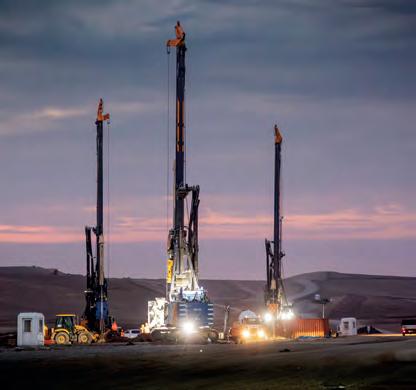
Whether it’s for large-scale infrastructure – overground and underground – or small urban projects, drilling and foundation equipment plays a pivotal role in ensuring success.
Contractors are faced with many site constraints and safety risks, along with a multitude of other challenges, while under pressure to deliver projects safely, on time and within budget.
They are up against the elements, quite literally, dealing with a variety of unpredictable ground and soil conditions, groundwater issues, adverse weather and many other environmental factors.
The latest equipment designed to alleviate these pressures met visitors at ConExpo 2026 in Las Vegas, US. Among the many solutions
BUILDING BIG INFRASTRUCTURE
Across the world, drilling and piling equipment is clearing the way for faster connections and quicker access. Bauer equipment is in use in central Turkey where a new 142 km rail line is under construction between the cities of Yerköy and Kayseri. The project, which broke ground in July 2022, includes 15 tunnels, 118 underpasses, 18 bridges and two new stations.
A joint venture between Doğuş, Çelikler and Özkar is executing the specialist foundation works. The JV has deployed a total of 28 machines from Bauer to tackle the pile installation and ground improvement measures. The fleet includes BG 33, BG 36 and BG 45 drilling rigs and RG 22 S and RG 27 S pile drivers, complemented by a number of CMS 30 mixing plants.
The rigs are installing piles down to a depth of 30 m using the Kelly drilling method. These piles provide ground improvement for the rail line and serve as foundation elements for bridges and viaducts.
Designed for speeds of up to 250 km/h, the new line will reduce the travel time from 3.5 hours to under 60 minutes. This means that travellers from Ankara can reach Kayseri in around two hours instead of seven.
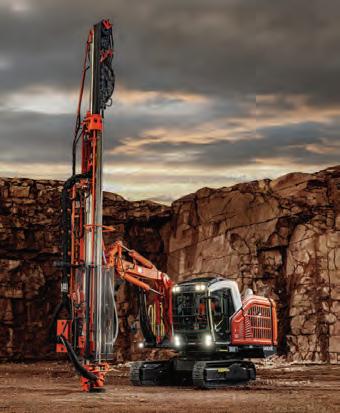
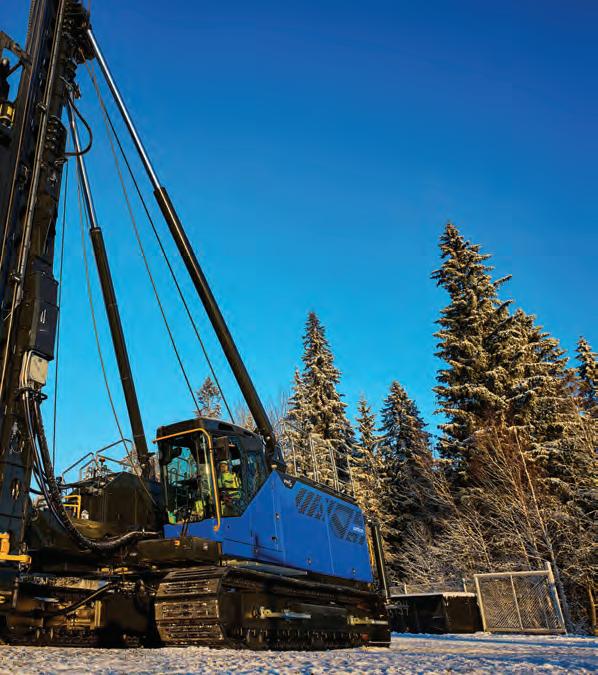
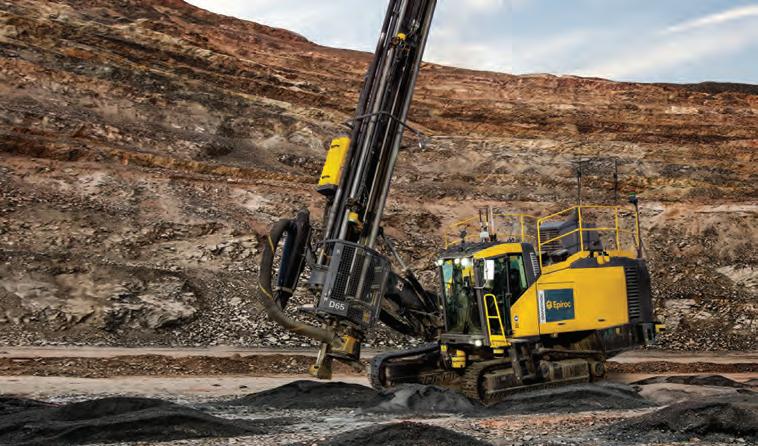
on show were the PM5 pile-driving rig from Junttan and Sandvik’s new Ranger DX1010i drill rig. Epiroc demonstrated the SmartROC D65 fully autonomous drilling rig, while Liebherr showcased the latest generation of its LB 35 drilling rig, the LB 35.1, with a new lattice boom extension.
Driving in the piles
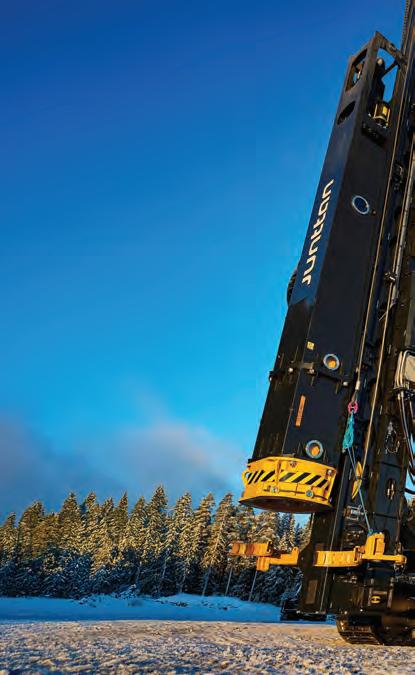
With the new PM5 pile-driving rig, Finlandbased Junttan expanded the Evolution Series, which first came to market in early 2025 with the DR5 drilling rig. The new rig offers a maximum pile length of 20 to 27m and represents a complete redesign. The company says that it is aimed at raising standards in productivity, accuracy and ease of operation, according to the company.
Among the key features of the PM5, according to the company, is the optimised kinematic design and revised component layout. The
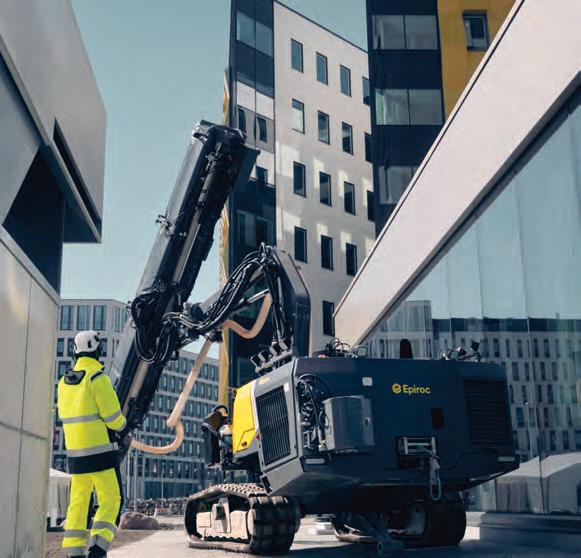
Sandvik’s Ranger DX1010i tophammer surface drilling rig has a new long-feed system IMAGE: SANDVIK
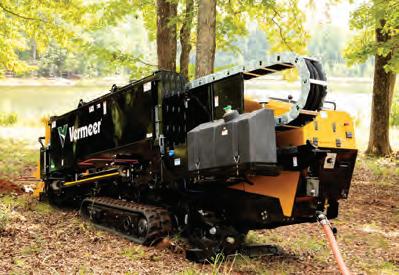
Vermeer’s D24 HDD is designed for installation of utilities in urban areas
In Turkey, 28 Bauer drilling rigs and pile drivers are helping build a new railway line IMAGE: BAUER
IMAGE: VERMEER
telescopic mast has been engineered to allow the rig to handle both extreme vertical pile lengths and high inclination work in shorter leader configurations.
Transportation and mobilisation have also been key priorities. The PM5 can be transported as a complete, work-ready unit, which helps to minimise logistics costs and downtime. There is also the option to configure the rig with a remote-control system, so operators can perform most positioning and setup actions from outside the cab.
Another safety feature is the patent-pending hydraulically locking leader connection capability for tool-free operation, which reduces the need for working at heights.
Going horizontal
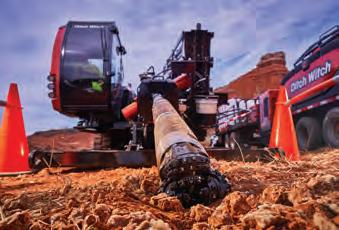
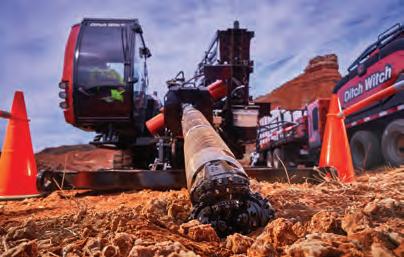
As underground environments become more congested, the demand for Horizontal Directional Drilling (HDD) equipment is growing steadily in step with the acceleration of infrastructure projects, according to Seth Matthesen, HDD product manager for Ditch Witch.
He told International Construction that contractors are expanding and modernising their HDD fleets to handle longer crossings, tighter project timelines and more complex installations. He noted that broadband fibre expansion and the rapid growth of data centres are still among the strongest drivers.
“Broadband buildouts require thousands of miles of new conduit installations, often in developed areas where open trenching is not practical. HDD allows crews to install fibre quickly with minimal disruption to roads,
NEW OPERATOR TRAINING METHODS
Digitalisation and automation developments are not confined to machine integration, data analysis and workflows. Operator training in drilling and foundation work is moving into the virtual world with simulators doing the job of supervisors and instructors.
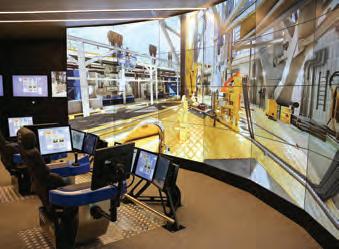
Saipem has introduced a Drilling Training Centre to develop the technical skills of operators. The centre offers training that integrates theory and practice, using the latest technologies and an immersive approach.
Designed to replicate operational scenarios, the full-scale simulator reproduces the dimensions and perceptions of a real-life drilling rig projected onto an 8 x 3m screen composed of 24 monitors. Operators sit in control seats that are equipped with HMIs while the system simulates the drilling experience.
Saipem’s
New York Concrete Corp has taken delivery of an LB 45.1 with new lattice extension
neighbourhoods and existing utilities,” he explained.
Data centres require large volumes of fibre, high-capacity power lines and extensive water infrastructure for cooling systems. Each system depends on reliable underground installation methods.
“AI has added a powerful new catalyst,” agreed Dave Wisniewski, VP of Vermeer Environmental and Infrastructure Sales. He pointed to the latest figures from the US Energy Information Administration, which projects that data centres could consume up to 12% of the nation’s electricity by 2028, up from 4.4% in 2023.
Efforts to move electric transmission and distribution lines underground to improve grid resiliency, particularly in wildfire-prone and high-storm areas is also increasing the need for HDD capabilities.
“Natural disasters have repeatedly exposed the grid’s vulnerabilities. Strengthening and protecting those systems is now a priority, and trenchless technology plays a vital role in that work,” stated Wisniewski.
Cory Maker, Ditch Witch technology product manager, also highlighted that modern HDD machines can capture detailed operating data with more than 150 parameters, such as rotation speed, thrust, and drilling fluid flow.
“That information gives contractors a clearer picture of how machines are performing and helps crews adjust drilling strategies in real time,” said Maker.
The company’s Orange Intel telematics platform allows contractors to monitor machine utilisation, diagnostics and maintenance needs
IMAGE: LIEBHERR
Junttan has expanded its Evolution Series with the new PM5 drilling rig IMAGE: JUNTTAN
new Drilling Training Centre replicates real-world scenarios
IMAGE: SAIPEM
Ditch Witch All-Terrain technology uses a dual-pipe drilling system
IMAGE: DITCH WITCH
across their HDD fleets. This data can improve uptime and help crews stay on schedule.
Longer feed, deeper holes
The latest addition to Sandvik’s Ranger drilling solutions is the DX1010i, a tophammer surface drilling rig for mining and quarrying. Among the new features is a long-feed system that produces up to 6.4 m of single-pass drilling capability and a boost in compressor output.
Capable of drilling holes with a diameter of 89 to 140mm, the DX1010i is equipped with a 30kW hydraulic rock drill.
Sandvik explained that the high-capacity compressor delivers a flush rate of 11 cubic metres per minute, which effectively clears deeper boreholes. Moreover, the water system offers an optional extra tank, increasing capacity to 500 litres, for longer drilling sessions.
The new rig includes the “safe and comfortable” iCab cabin with air conditioning as well as connectivity for Sandvik’s digital solutions, improved one hole automation with collaring automatics and the iClean drilling automation system.
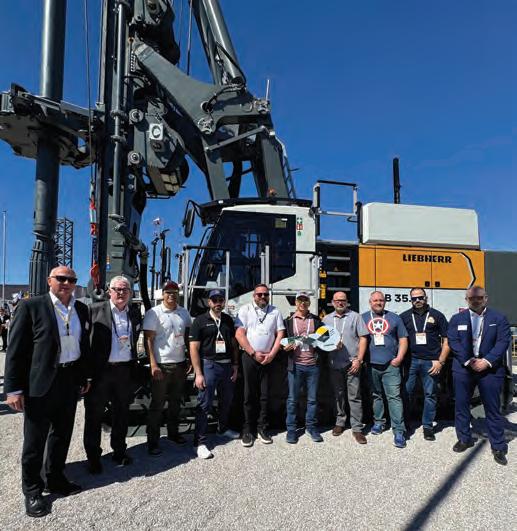
At the Las Vegas event, Liebherr presented its LB 35.1 rig fitted with a new lattice boom extension for reaching greater drilling depths. Like all LB models, the new generation rig is designed for deep foundation applications, such as Kelly drilling, continuous flight auger drilling or double rotary drilling.
The lattice boom extends the maximum drilling depth to 37.5m for applications using full or partial displacement, which Liebherr notes corresponds to an increase of 6 m.
This new feature, says the company, creates the advantage for customers that the compact LB 35.1 can be deployed even for large pile
urban sites. As well as wanting the extended reach capability, the company also chose the rig for its compactness and ease of transport.
Smart and connected
Another noticeable trend in drilling and foundations is the shift toward highly connected, data-driven jobsites.
Data monitoring has become standard practice, supporting more efficient operations, improving operator safety and enabling better prediction of maintenance needs. This shift is clearly reflected in equipment development, where connectivity and automation are increasingly built into modern systems.
depths. In addition, it can be retrofitted to any LB 35.1 and LB 45.1 model rigs.
One of the first to take delivery of a Liebherr drilling rig with the new lattice extension is US-based New York Concrete Corporation, which has invested in an LB 45.1.
The company works for both public and private sector clients in the metropolitan area, thus having access to a wide variety of complex
Liebherr’s LB 35.1 can be equipped with a series of automated systems. These include a drilling assistant that automates the concreting process during continuous flight auger (CFA) operations, as well as a slack rope monitoring system designed to prevent rope loosening. Additionally, the machine can be configured with an automatic leader alignment feature to further improve precision during operation. Whether it is deeper drilling, longer crossings or more connected jobsites, the technology on show at ConExpo and other industry events suggests that drilling and foundation equipment is evolving quickly to meet growing infrastructure demands.
As projects become more complex and timelines tighten, the ability to go deeper, faster and further will continue to define the next generation of equipment, and the contractors that rely on it. iC
CHINESE-BUILT TBM ACHIEVES
BREAKTHROUGH
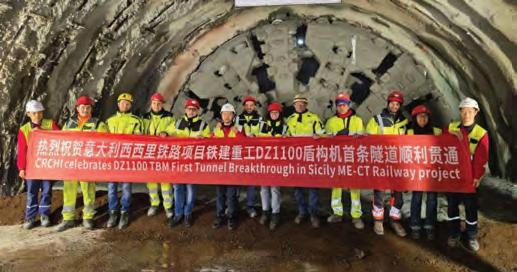
A tunnel boring machine (TBM) developed by China Railway Construction Heavy Industry Corporation (CRCHI) has completed the first tunnelling breakthrough on the Messina–Catania railway project in Sicily, Italy. The project is part of the Messina-Catania highcapacity railway line project, and the main contractor is Webuild.
The 9.36-metre diameter earth pressure balance (EPB) shield machine finished excavation of the first 2.44km section of tunnel, marking the first breakthrough on the project. The TBM is expected to excavate approximately 12.54km in total as part of the railway scheme.
According to CRCHI, the tunnelling route passes through complex geological conditions including shale, conglomerate, basalt and sandstone.
The machine was developed in collaboration with the project’s construction contractor and is said to incorporate several technologies designed to improve efficiency and automation during tunnelling operations.
A TBM developed by CRCHI has completed the first tunnelling breakthrough on the Messina–Catania railway project in Sicily, Italy
These include a permanent magnet synchronous drive system, automated excavation parameter control, automatic segment lifting and intelligent equipment management systems.
CRCHI said the technology aims to improve tunnelling efficiency while reducing energy consumption and labour requirements. The TBM achieved a maximum daily advance of 30.6m.
Epiroc’s SmartROC 65 was demoed as a fully autonomous drilling rig at ConExpo
IMAGE:
Neel Madsen speaks to Robin Edsborn, global product line manager at Epiroc, about the state of the market and the company’s response to its challenges
Eprioc’s SmartROC T25 R is said to be more flexible and adaptable than before
What is the current market situation?
When we talk about drilling for blasting from a global perspective, it’s been quite a challenging few years, especially after Covid. But there have been some pockets in the market with very strong demand.
Infrastructure for clean energy, such as solar and wind power, has picked up quite a bit, and data centres have also become a big part of it, driven largely by the US.
In other markets, for example Scandinavia, there’s still slightly lower activity, mainly due to the interest rate rises a few years ago, which slowed investment, but now we are starting to see that market pick up again.
Which innovations have had the most impact?
Technologies for ensuring hole accuracy and straightness are key for efficient blasting. The reason is downstream efficiencies: if you know exactly where the hole is positioned and that it is straight, you get a better blasting result.
Customers are also getting more from the data insights that rigs provide today. They can obtain this information directly from the machine software, so they know where drilling starts, where the hole is aimed and at what angle. That leads to better fragmentation in the next step, which reduces costs.
In some markets, especially in urban areas, there is also a regulatory demand to report how drilling was planned, the hole positioning and the execution.
How are drilling rigs changing?
Epiroc has always aimed for higher flexibility in our rigs, and we continue to develop in
that direction. With the SmartROC T25 R and T30 R tophammer surface drill rigs, we took this strategy a step further by making the machinery even more flexible, enabling customers to handle the widest range of jobs. So, they are definitely becoming more flexible and adaptable.
How far has automation progressed?
When we first started using GPS-based systems for hole navigation 15–20 years ago, adoption was slow, but today almost all contractors use a Hole Navigation System (HNS), whether they choose an Epiroc system or retrofit other ones. That has been a very big change in the market.
Another key development has been full drill cycle automation, where the machine drills holes to the required depth automatically. About 18 months ago, we extended this technology, so our tophammer rigs now also pick the rods and everything up automatically.
Are hybrid and fully electric rigs viable today?
With current technology, you can’t run a full shift on batteries because unfortunately battery energy density today is not sufficient for drilling equipment, which is very energy intensive. The most practical option is using a battery for flexibility, combined with a grid-connected cable. That’s what we’ve used in demonstrators so far, and it’s likely the most realistic
Robin
Edsborn, global product line manager
path forward until the technology matures. Hybrids don’t make much sense in most cases as rigs are already very fuel-efficient. Adding hybrid systems increases cost without delivering enough benefits, except in specific applications, not typically for foundation work.
What other constraints is the industry facing?
The lack of skilled operators is a growing challenge. Customers are finding it increasingly difficult to recruit experienced operators, and it’s also hard to attract younger people into this type of work.
To address this, we need to make machines easier to operate and reduce the learning curve. The goal is for new operators to achieve results similar to experienced ones as quickly as possible.
Years ago, operators could listen to the drill and know if it was set correctly. Today, we need to replicate that expertise through machine software, guiding operators on how to set up and optimise performance.
What is the biggest misconception about drilling?
That it’s boring. There is always a lot happening and many variables to manage. Every job is different, so contractors benefit from equipment that can handle multiple applications, whether that is trenching, foundation work, small core quarry and more.
Having versatile machines reduces capital expenditure, because they can do more with a single piece of equipment. That flexibility is key. iC
President Jean-Claude Fayat explains to Andy Brown why the group is buying companies like Mecalac and LeeBoy – while allowing brands to keep their autonomy
One of the biggest trends in the global construction industry is acquisitions –large companies getting even bigger by purchasing other firms. This is a general trend in business, not just in construction, but it does feel that the number and size of acquisitions in the construction industry has increased in recent years.
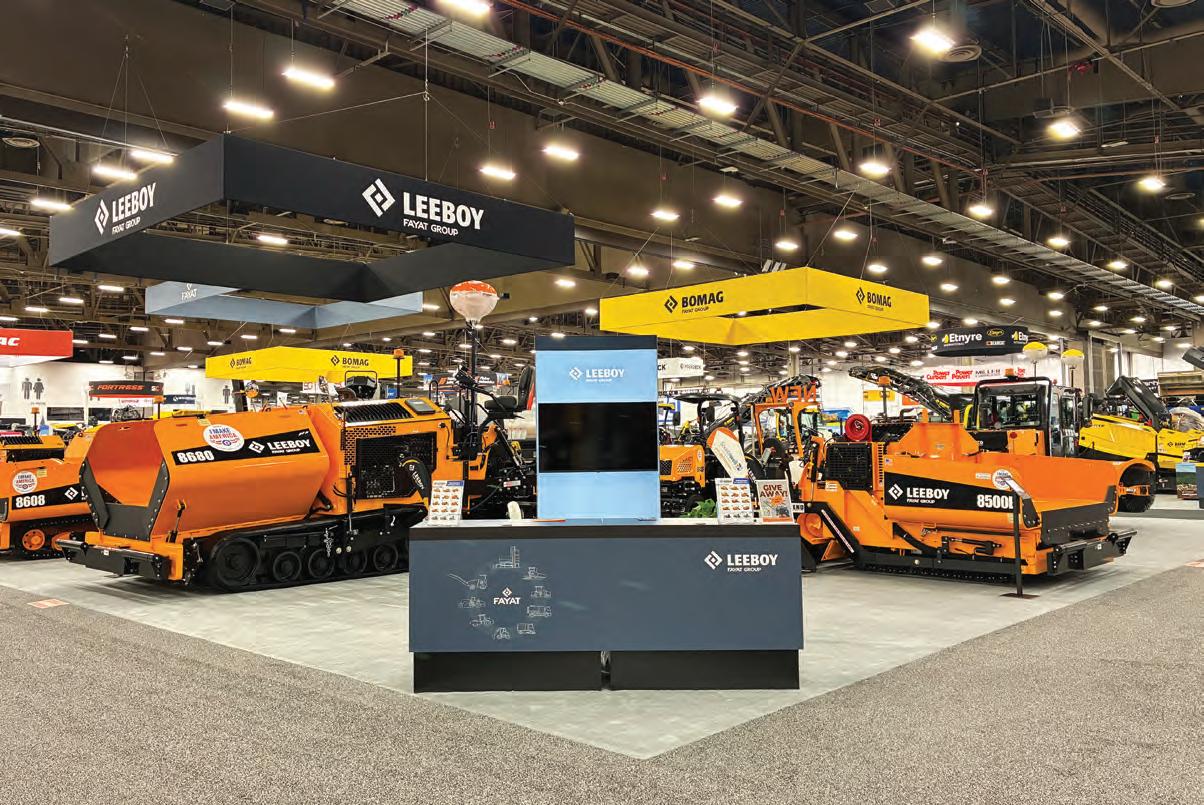
In 2025, the Fayat Group was responsible for two of the more notable acquisitions in the industry with the purchases of Mecalac and LeeBoy. Mecalac is a France-based international manufacturer of wheeled excavators, crawler excavators and wheeled loaders and dumpers, while US-based LeeBoy’s products include commercial pavers, compact motor graders, and road maintenance equipment.
The acquisitions significantly expanded Fayat’s presence in both earthmoving in urban
jobsites and road equipment, strengthening its position in sectors where global consolidation among manufacturers has been accelerating.
When International Construction meets the President of the group, Jean-Claude Fayat, at ConExpo in Las Vegas, US, he is crystal clear on the importance of brands retaining their own identity and culture after they have been purchased.
“We leave to each brand its own autonomy to develop itself and to be agile. Because if you lose agility, you probably lose part of the commitment of the people. Our policy is to leave a large autonomy to the people [running the different brands], to have them to be very committed. It’s important that we keep the DNA of the different brands,” he says.
“But, of course, we’re a group and there are some rules. The most important rule for us is
Electrification in our business is still a small activity
transparency. When you have autonomy, of course you can make mistakes. We all make mistakes. The most important thing when you make mistakes is to talk about it, not to try to hide it.”
Jean-Claude Fayat is President of the Fayat Group
LeeBoy was acquired by the Fayat Group in 2025 to help with their ambitions in the US
Mr Fayat says that the different brands that make up the road equipment division – Bomag, Dynapac, Mecalac, LeeBoy, Marini, Ermont, Secmair, ADM and SAE – share some technical solutions and common platforms but he makes the point that they, “encourage exchanges but don’t force them.”
Looking to the US
Sitting on a sofa at the company’s stand at ConExpo, Mr Fayat is a genial presence, quick with a smile and giving the impression that there is nowhere else he would rather be than at the Las Vegas show. When it comes to acquisitions, he says, “We’re doing both organic growth and external growth. This is the DNA of our group. But we are not growing just to grow – we are trying to build something.”
As someone so keen on keeping the autonomy of brands, it is no surprise to hear him say that, “to buy a company is easy. The most difficult thing is to integrate a company and to create value with this company. If you destroy value, then it’s a failure.”
The purpose behind the LeeBoy acquisition was to grow the company but it also played into a key strategy for the company going forwards: targeting expansion in the US.
LeeBoy is an established presence in the US and the acquisition helped the Fayat Group to reinforce its presence in the country, particularly regarding asphalt.
“We have space to grow in North America. We have become a significant player in North America, but there is still a place for us to grow. We can still improve, doing more products locally with a more local vision of our products and improve our sales networks,” he says.
“We will do this with an American team – not European. This is also our culture inside the group; we want to have local teams. Because the
culture is different in the US. Even in Europe, the culture in France, in Germany, it’s not the same. You need locals to understand that.”
The US is the largest market in the world for construction equipment sales and one that all major players want to expand in. However, there is a sense that, for the Fayat Group, it is an especially important focus.
“Our intention at our group is to develop our presence in the US. I hope that we’ll be able to do that,” he says.
“In the future, I would like to balance our turnover between Europe and US. I think it’s a good solution. These two markets are very important and, as an international group, to balance our turnover between these two areas of the world is very important.”
Digitisation and electrification
Despite electric equipment being commercially available for a number of years in the construction industry, take-up has been slow, and much slower than its advocates would have liked. Mr Fayat puts this down to the high initial cost of the equipment, which can be twice as much as their diesel equivalents.
“Electrification in our business is still a small activity for everybody, not only for ourselves. Of course we need to be present there, we need to offer products. The difficulty is the price today. Our customers don’t have a correct ROI (return on investment). That’s why the development is slow. I think that at one moment it’ll come and it’ll be a balance between diesel machines and electric machines.”
Mr Fayat also mentions the difficulties with the global supplier network for electric equipment, pointing out the advantages Chinese companies have due to government electrification policies introduced more than a decade ago, which leads to them being able to
offer electric equipment at a cheaper price than European or US-based firms. Despite these challenges, he remains cautiously optimistic regarding electric equipment. “It will come –it’ll take time, but it will come.”
The President of Fayat Group is more bullish on the impact of digitisation on the road equipment segment. Technology is now being built into these machines as standard and, out of the whole suite of equipment that works on a construction site, road equipment arguably makes the most sense to be automated. Whereas, in the past, the biggest changes were to the equipment itself or mechanical, the biggest changes are now digital.
“We are working a lot on digitalisation. This is probably the biggest evolution that we’ll see on the machines, on the equipment, in the next months and years. The next big evolution of the machine will be digitisation. It is already here, and I’m sure that we are not at the end.”
Regarding automation, he says that it will depend on the job site – on bigger sites with fewer people and more space it makes more sense compared to smaller and urban sites where there may be more people and the issue of safety is more complex.
He also makes the point that it is a question of culture and people getting used to seeing something new – he says, partly in jest and partly seriously, that airplanes are now mostly flown by a computer, but he wouldn’t get into a plane if it didn’t have a pilot. Regarding autonomous rollers, the technology is there but there are legal and cultural barriers to be overcome.
Mr Fayat clearly takes a keen interest in new technology and says that he enjoys speaking to the research and development teams from the company’s various brands. However, given his views on brand autonomy, it is no surprise when he says, “Of course, I enjoy being informed and if I have an idea I will give it. But it works without me. It has to work without me. They have the freedom to move and not to wait for me.”
As consolidation continues across the construction equipment sector, Fayat’s approach of combining acquisitions with strong brand autonomy stands out. The group is expanding its footprint in key markets such as the US while allowing its companies to retain their own identities. At the same time, the industry is entering a period of rapid technological change, with digitalisation, automation and electrification altering how equipment is designed and used.
In a sector being reshaped by consolidation and new technologies, that balance between autonomy and integration may prove to be one of the Fayat Group’s most valuable strengths. iC
Jean-Claude Fayat believes that individual brands must have autonomy in order to retain the commitment of staff
Push limits. Smash barriers. Break boundaries. And when you’ve conquered all those obstacles? You discover your full capacity for greatness. World of Concrete delivers all the real-world solutions that will crush your challenges and take your expertise to new heights. Growth opportunities are everywhere, whether you’re getting hands-on with game-changing tools and tech or shaking hands with your future partners. Ready for maximum success? Nothing’s standing in your way.
EXHIBITS: JANUARY 19-21, 2027
EDUCATION: JANUARY 18-21, 2027
LAS VEGAS CONVENTION CENTER
ACHIEVE PEAK PERFORMANCE VIEW GLOBAL EVENTS
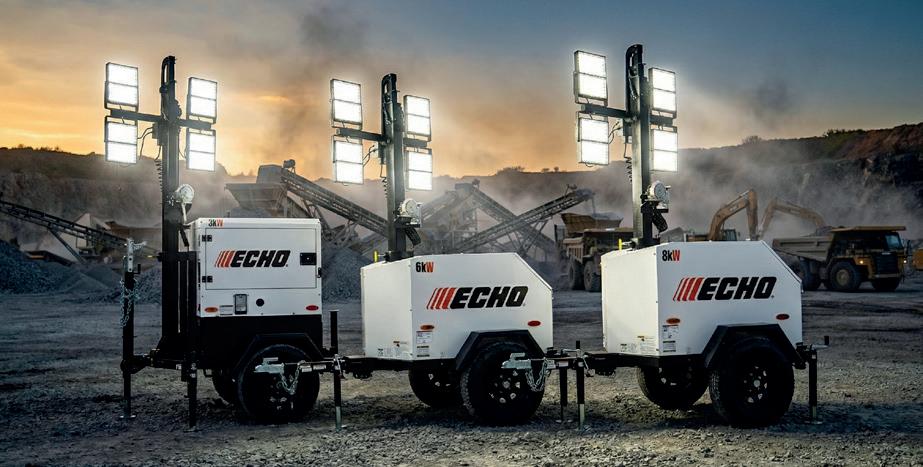
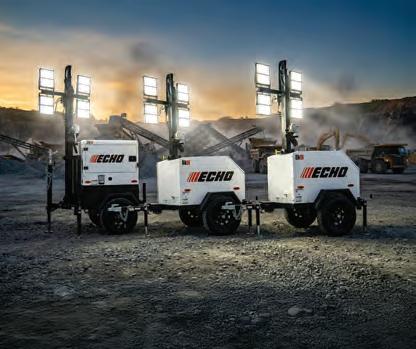
An unsung construction site essential, the lighting tower is undergoing a quiet revolution, with new levels of controllability and an increasing number of power options. Neil Gerrard turns to experts in the sector for illumination
Construction site lighting is one of those essentials that tends to go unnoticed. A reliable source of light when working outside of daylight hours or in dark spaces is vital for safety and productivity.
And while it may not be immediately obvious, how lighting is specified, powered and controlled is changing.
Across the sector, a relatively simple piece of equipment is being reshaped by tighter environmental rules, urban working constraints and the economics of fleets. The result is a shift away from simple, stark illumination towards more targeted, efficient and connected systems.
It’s not just about the output
In the past, lighting towers tended to be judged on maximum output, with more light meaning better performance. That assumption is now being challenged, according to Kathryn Adams, director of product at UK-based solar power and lighting specialist Prolectric.
“Contractors have become far more outcome-focused in recent years. It is no longer about simply deploying the brightest tower possible, but more about achieving the right lux levels consistently across the working area,” she says.
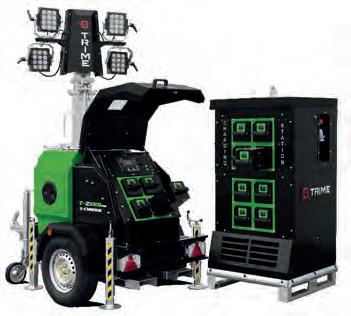
That shift is echoed by Paul Hay, managing director of Trime UK, who says expectations now centre on “precise lux levels and uniform light distribution”, alongside glare reduction and directional control, particularly on urban and infrastructure projects.
In practical terms, that means contractors
are considering how light is distributed across a work zone, how they can minimise shadows and how glare affects operators, road users, railways, and nearby residents. Mast height, once a proxy for coverage, is now just one of several variables.
That’s thanks in part to LED technology. Modern LED systems provide higher usable light output with lower power demand, reduced heat generation and significantly longer operating life.
That efficiency gain has shifted the design focus. Where lighting towers were once defined largely by generator capacity, now optics, control systems and energy management are all key.
Control, not constant
If LED tech has enabled more efficient lighting, control systems are redefining how it is used.
“Contractors and rental customers increasingly want controllability built in,” Adams
Contractor Kier and Prolectric introduced solar lighting across the A417 Missing Link project in England for National Highways last year, replacing multiple diesel generators
says. “They actively look for features such as dimming capability, segmented or independently controllable heads, multiple brightness settings and sensor-driven operation.”
Lighting towers are no longer expected to operate at full output throughout a shift. Instead, they are being configured to match lighting levels to the task.
Motion sensors, daylight sensors and programmable timers are becoming more common, particularly on battery-powered and solar-assisted units where managing energy consumption is critical. By reducing unnecessary runtime, these systems extend operating hours and reduce the need for recharging or refuelling.
Ryan Fredrickson, senior product marketing manager at Echo IPE, says that in North America, controllability is less high up the agenda. Nonetheless, he notes that his firm’s
lighting towers are capable of switching themselves on at dusk and off at dawn by using geolocation.
Prolectric asserts that there is a growing emphasis on remote management, with telematics systems allowing operators to schedule lighting, monitor usage and identify inefficiencies. For rental companies, this data can be used to improve utilisation rates and reduce operating costs. For contractors, it provides greater visibility over site operations and energy use.
“Remote monitoring and reporting help fleet managers identify inefficient patterns. For example, when towers are left on continuously, and support better site discipline without relying on manual checks. Intelligent control technologies help reduce fuel consumption, emissions and operating costs,” says Adams.
Urban constraints reshape demand
The shift towards smarter lighting is closely linked to the environments in which construction projects are being delivered.
Urban development, night-time infrastructure work and projects near sensitive locations such as hospitals or residential areas are placing new constraints on site operations. Once considered a relatively straightforward piece of equipment, contractors now need to pay more attention to where and how lighting towers are deployed.
“Low-noise and zero-emission is a significant differentiator, particularly on urban infrastructure projects,” Adams says. “Noise and emissions are now tied directly to risk
ECHO EXPANDS RENTAL-READY LIGHTING AND POWER RANGE
Echo Industrial Power Equipment expanded its construction offering in early 2026 with the launch of three mobile LED light towers and a 400kVA generator, showcased at ConExpo in Las Vegas.
Trime’s X-Change lighting tower in its T-Zero Pro range features swappable lithium batteries and offers a 2,000 sq m illuminated area
management where complaints, restricted working hours, and local air quality concerns can all impact programme delivery.”
Battery-powered and solar-powered lighting towers are one response. Systems such as Trime’s hybrid- and battery-powered T-Zero range can operate silently and without emissions at the point of use, making them ideal for some jobs, such as city centre projects.
These systems are now capable of covering typical construction shifts. Hay notes that battery-powered towers can operate for extended periods, often exceeding a full working shift, particularly when combined with efficient LED lighting and control systems. Swapping interchangeable li-ion batteries is becoming easier.
However, adoption is not uniform. Contractors must balance environmental
The 3kW, 6kW and 8kW light towers (DLT3, DLT6, and DLT8) are designed for rental fleets and infrastructure applications, offering up to 310 hours of runtime between refuelling and near 360-degree mast rotation. Shore power capability is standard, allowing units to operate from grid electricity when available.
Echo has also emphasised durability, with all-steel construction aimed at improving reliability and reducing repair costs. The accompanying DGK400F generator targets highdemand applications, with an Isuzu 6WG1X Tier 4 Final engine and low-noise operation suited to urban environments.
Solar lighting can operate silently and without emissions at the point of use
Echo IPE launched three new mobile LED light towers at ConExpo
Cost-effective all-in-one solution
A unique combination of diagnostic and access systems
High-tech with extremely simple operation
Support for usage tracking systems
Functional enhancements via automatic software updates
Real-time data in GEDA CENTRAL
Data and configuration interface (API) for construction site management systems
The access system is compatible with all standard RFID/NFC tags and smart cards
Add: Not available in all regions/countries.
requirements against operational realities, including site access, duty cycles and the availability of charging infrastructure.
Despite the growing focus on electrification, diesel-powered lighting towers remain widely used. Rather than disappearing, they are being refined.
Manufacturers are improving fuel efficiency, extending runtime and reducing emissions while maintaining the reliability required on construction sites.
Atlas Copco’s HiLight M+ range illustrates this approach, combining LED lighting with lower fuel consumption and extended service intervals.
The ability to illuminate large areas with fewer units is also important. By increasing coverage per tower, contractors can reduce the number of machines required on site, lowering logistics costs and fuel consumption.
Echo Industrial Power Equipment has focused on flexibility as well as efficiency. Its latest light towers combine extended runtime with the ability to switch between diesel and grid power.
“One of the trends that we’re seeing is a desire to have a unit that can be used both outdoors and indoors,” says Fredrickson. “As buildings become enclosed, you can’t run an engine indoors, at least not safely, but you often have access to utility power.”
That has led to the adoption of shore power capability, allowing towers to operate from a standard electrical supply when available. The approach reduces noise and emissions while maintaining operational flexibility.
Fredrickson also points to the potential for improving efficiency by linking multiple towers together, allowing one engine to power several units. This reduces fuel consumption and simplifies site logistics.
Rental-driven
Changes in how lighting towers are powered are being matched by changes in how they are used.
“We’ve started to see some trends of customers looking for maybe a little bit shorter and more easily portable light tower where perhaps a person could push it around,” Fredrickson says. This reflects the realities of modern construction, particularly on indoor projects or confined sites where layouts change frequently. Smaller, more mobile units can be repositioned quickly without the need for additional equipment.
Rental companies are a key influence on these
trends. As one of the primary customers for lighting towers in many markets, they prioritise transport efficiency, ease of deployment and utilisation rates.
Fredrickson describes how one rental customer specified a light tower capable of extended runtime while maximising transport density, resulting in a design that allows 22 units to be transported on a single flatbed truck.
Trime reports similar priorities, with compact footprints, quick deployment systems and simplified operation designed to reduce handling time and improve safety.
These are particularly important when it comes to large infrastructure projects, where multiple towers may be deployed across a wide area and repositioned frequently as work progresses.
While lighting towers are becoming more advanced, some fundamentals remain unchanged. Fredrickson notes that contractors, who are significant direct buyers of lighting towers, want units that operate reliably in demanding conditions.
“In addition to the growing desire for compact, flexible and quiet mobile lighting, we’re also seeing demand for ruggedness and reliability, particularly on remote and challenging jobsites,” Fredrickson says.
Design considerations include resistance to extreme temperatures, protection against dust and moisture, and the ability to withstand high wind conditions. In some cases, this leads to trade-offs between different technologies.
Fredrickson notes that while LED lighting offers clear advantages in most applications, some customers in extreme cold continue to use traditional metal halide systems because of their performance characteristics in those environments.
Material choices are also
part of this equation. Echo has adopted allsteel construction to improve durability and simplify repairs, allowing individual panels to be replaced rather than entire housings.
Battery and solar
Battery and solar-powered lighting towers are gaining traction, but they still aren’t a universal solution.
Battery-powered systems are now viable for many duty cycles, particularly where lighting demand can be controlled through dimming and sensor-based activation. Solar-first systems extend this capability by reducing reliance on fuel and enabling off-grid operation.
Prolectric argues that these technologies are becoming increasingly important as contractors seek to reduce emissions and manage energy costs.
As the world digests the implications of conflict in the Middle East and what that could do to energy prices, Adams notes, “As fuel markets remain unpredictable and supply chains increasingly fragile, more organisations are recognising the strategic value of futureproofing and diversifying their onsite energy sources. As a result, off-grid renewable power is rapidly becoming an intrinsic part of a site operator’s risk-management business strategy and no longer just perceived as an isolated tick box sustainability exercise.”
Similarly, Hay predicts, “Hybrid and battery-powered lighting towers will continue to grow rapidly as construction sites move toward lowcarbon and zero-emission operation.”
But there are still limitations. Battery performance can be affected by extreme temperatures whether it is heat or cold, requiring additional systems either to warm batteries up or cool them down that increase complexity and cost.
“What we need to work through is having the battery be effective in the extreme conditions,” Fredrickson says. “Integrating battery and solar are common themes that we need to evaluate, but it’s finding that right balance of power density in the battery and doing it in a little bit more of an affordable method,” he adds.
For contractors, the implications are practical. Lighting is no longer just about visibility. It is part of how sites manage energy, control costs and meet environmental targets, while maintaining the reliability that remains essential to keeping work moving.
A hybrid Trime T-Zero lighting tower with six LED lighting heads
IMAGE: TRIME UK
Trime’s T-Zero Pro X-Eco Hybrid Lithium light tower
IMAGE: TRIME UK
From estimating to uptime and automation, AI is increasingly embedded into workflows – often without users even realising it, writes ANDY BROWN
Artificial Intelligence has been around for some time in different forms, but a good indication of how much its popularity and profile exploded in 2025 is that last year an AI tool (Gemini) was the most popular global search on Google.
While AI is firmly at the heart of mainstream culture, in construction it is interesting that those working in the sector tend to say that what they really want is the technology to work away in the background. In crude terms, construction doesn’t really care how things work, as long as they work and can save them the precious commodity of time.
INTERESTED IN OUTCOMES
Speaking to International Construction at ConExpo in Las Vegas, US, Mark Schwartz, senior vice president, AECO Software, Trimble, says, “We have dozens of agents running in our products today. Customers don’t really know that. They don’t have to know that. Some of the bigger customers will ask ‘what are you doing with AI?’
“But most of them just want
the outcome. Our agents are embedded in the software performing tasks for them. And they don’t know. We’ve done this technologically by linking the agents together into a single interface.”
This sentiment is echoed by Scott Young, President of North America, Volvo Construction Equipment (Volvo CE). “I find the customer isn’t necessarily asking about AI,” he says. “They’re actually asking about the outcome, how to get more precise. How do I get more information quicker to help me take decisions?
“I really like to talk about AI as an
MARK SCHWARTZ, SENIOR VICE PRESIDENT, AECO SOFTWARE, TRIMBLE IMAGE: TRIMBLE
enabler for us to support our customers in our business and that customer facing portion of the business. There are examples where we’re using AI in our backend support systems. When we’re helping to provide uptime for our customers, we can use AI to help evolve and build out scenarios faster for our equipment as a service contract.
“It’s really an enabler to give us more precision, more opportunities, more options. I don’t think they’re looking to say, ‘are you using AI?’ It’s more, how do you get this information and the solution to me faster?”
Another important distinction is that AI is not used as a default in all products and services. “At Hexagon, AI is not a bolton feature. It only goes into a product if it meaningfully improves outcomes for the
AI TOOLS HAVE THE ABILITY TO SPEED UP CONSTRUCTION’S PROCESSES
IMAGE: ADOBE STOCK
Q&A WITH BEN HOXIE, SENIOR DIRECTOR, SOLUTIONS, AND ANIRUDDH DESHPANDE, DIRECTOR, IOT, DANFOSS POWER SOLUTIONS
Where is AI embedded in Danfoss products and where is it still proof-of-concept?
If we expand the general term AI into multiple forms of advanced computing, including machine learning, we see it deployed into multiple products, including algorithms that adapt to changing operating and machine conditions. One of the interesting areas enabled by advanced computational power, including elements of AI, is our PLUS+1 Autonomous Control Library, which has enabled Level 3 autonomy in off-highway machinery. Specific high-value features like obstacle detection, GPS-free navigation, and geofencing enable machine builders to rapidly develop systems that improve precision and productivity while enhancing safety.
How are you using AI internally in R&D?
AI is a clear focus area in our business strategy, and we are deploying it across operations, customer engagement, and product development. For example, we are using AI for first-pass software generation and legacy code conversion, making our programmers’ work more efficient. Near term, we are finding many ways to improve our productivity and analytical processes through ever more capable tools.
Five years from now, what will differentiate a ‘smart’ hydraulic or power system from what we see today?
We view this trend as a continuation of increasing machine intelligence across the industry. Within our own solutions, we continue to embed more advanced intelligence. We already see the industry adopting sophisticated capabilities that help solve challenges such as scheduling maintenance, remotely updating machine code, and enabling operator assistance and automation. Five years from now, we will see these features more widely adopted, and likely even more advanced functionality becoming mainstream as we improve the technology.
DANFOSS SAYS THAT AI IS A CLEAR FOCUS AREA IN ITS BUSINESS STRATEGY AND IT IS BEING DEPLOYED ACROSS ITS OPERATIONS
IMAGE: DANFOSS
WE WON’T ADD AI FOR AI’S SAKE; WE EMBED IT WHEN IT CAN BOOST EFFICIENCY, ACCURACY, OR AUTOMATION"
customer,” states Johannes Maunz, senior vice president AI, Hexagon.
“We won’t add AI for AI’s sake; we embed it when it can boost efficiency, accuracy, or automation in a way our users notice. In practice, this often involves pairing AI with our high-precision sensor data so that the AI’s reasoning is grounded on reliable data. If an AI cannot be trusted, for instance due to poor
CONSTRUCTION TECHNOLOGY AI
data quality or opaque logic, it doesn’t belong in our software. In short, we treat AI as a value-multiplier – used only when it can make the end-result measurably better in safety, quality, and productivity.”
VALUE ADDED
Having established that customers are more interested in results and outcomes rather than how they are achieved and that AI is only used when it makes sense and adds value – where specifically is that value?
When this question is put to Schwartz, he gives several examples, including one about an AI submittals agent. Historically, companies could have very large submittal packages where they had to pull out the right information and file in the right place, a process that was both tedious and timeconsuming.
“Now all they have to do is they take the file and drop it in and the [AI] agent will just unpack it. It happens in seconds instead of days and that’s millions of dollars in savings,” says Schwartz. “A customer would not generally care that it was an agentic AI workflow. What they care about is my hugely complex submittals file is now properly distributed into the items I need to go order the materials I need, build my schedule, create my delivery.”
with lots of moving parts – if AI can help to make some of these processes simpler and smoother by just 10%, then the potential in saved time and money is enormous.
“If we look at construction specifically, AI is applied deliberately to remove friction in real construction workflows,” says Matthew Desmond, President AGTEK, part of Hexagon.
cycles have shortened and recruiting skilled workers is harder than ever, productivity gains are essential. Our focus is on embedding AI directly into the tasks that consume the most time and introduce the most risk, such as preparing PDF plans for takeoff, extracting usable data, and standardising inputs before estimating begins.
Construction is a hugely complex industry
“In the current industry climate, where bid-
AI IN CONSTRUCTION PROMISE, PRAGMATISM AND PATIENCE
The
custom AI LLM of editor ANDY BROWN gives its view of AI in construction
AI is often framed as a transformative force for construction, but the reality is likely to be more incremental – and arguably more valuable – than the headlines suggest. Across the industry, the most immediate gains are emerging in areas such as planning, estimating, risk management and site monitoring, where AI can process large volumes of data and surface insights faster than traditional methods.
Research from organisations including McKinsey & Company and Deloitte has repeatedly highlighted that construction’s productivity challenge stems largely from fragmentation, poor data flow and inefficient workflows. AI is well suited to addressing these issues, particularly when paired with digital twins, connected equipment and improved data capture across the project lifecycle.
However, adoption is unlikely to be uniform. Construction remains a risk-averse industry, and rightly so.
Safety-critical decisions, engineering design and structural calculations still require human oversight. As a result, AI is more likely to augment decision-making than replace it.
There is also a practical reality: AI is only as good as the data it receives. In an industry where data quality and interoperability are still evolving, progress will depend as much on improving digital foundations as on advancing AI itself.
Ultimately, AI’s impact on construction may be less about dramatic breakthroughs that some have predicted, and more about helping projects run more smoothly, improving predictability and supporting better decisions.
“We use AI in our software solutions to automate repetitive, manual tasks. This allows estimators and project teams to move from plans to dependable quantities and progress updates far quicker and with greater consistency,” says Desmond.
MATTHEW DESMOND, PRESIDENT AGTEK, PART OF HEXAGON IMAGE: AGTEK
AI IS ONE OF THE WORLD’S MOST DISCUSSED TOPICS, BOTH IN A POSITIVE AND NEGATIVE LIGHT
IMAGE: ADOBE STOCK
SPEED OF ADOPTION
In the UK, a report carried out last year by the Association for Project Management found that the use of AI within projects has almost doubled in two years, with 70% saying their organisation currently uses AI compared to 36% who said so in 2023.
This data is just from the UK, but rapid adoption is happening globally and, while it shows that construction is not the slowmoving sector it is often painted as, such rapid adoption does bring its own challenges.
“AI is advancing faster than the construction industry’s ability to restructure itself around it. Many firms are struggling to unlock true business benefit,” says Dave Adamson, solutions director at Creative ITC.
“Legacy IT systems, siloed data, disconnected project workflows, and uneven skillsets make it difficult to deploy AI, exposing firms to unreliable outputs, slow adoption, and increased operational risk. To move beyond isolated pilots, firms need a clear understanding of AI’s real-world value and the barriers that limit its impact.”
IT HAPPENS IN SECONDS INSTEAD OF DAYS AND THAT’S MILLIONS OF DOLLARS IN SAVINGS"
While it is true that construction may require some restructuring from those making the decisions about workflows and implementing it, for those using AI it is more often than not embedded into the workflow. As mentioned earlier, customers will often not even know that they are using AI. However, an issue that everyone connected to AI is all too aware of are hallucinations.
According to a definition supplied by the Nielsen Norman Group and suggested by Google’s AI Overview, AI hallucinations are, “confident but false, illogical, or fabricated responses generated by large language models (LLMs). Caused by flawed training data,
overfitting, or poor context, these errors make AI appear to ‘hallucinate’ facts, legal cases, or coding solutions. They are considered a fundamental challenge, often increasing with model complexity, and require verification.”
AI making mistakes, says Schwartz, is to be expected. “AI agents will inherently make mistakes because they’re probabilistic outcomes. You know what else is? Doctors. You give them a list of symptoms and, based on their history and knowledge, they can tell you, it’d be this, or maybe this. That’s an LLM; it’s very good at providing a probabilistic outcome.
“There are certain applications where that’s
CONSTRUCTION TECHNOLOGY AI
great – probabilistic outcome is good enough. But you don’t want to be on the 52nd floor of a probabilistic outcome of steel design. For us, we’re not going to put technology capabilities in the hands [of AI] when that’s not a safe or good idea. There are use cases today where it’s exceptionally good at what it does. We stay focused on those.”
The point of using AI where it has most value rather than just universally putting it into all processes is one that Volvo CE’s Young also makes. “Let’s be pragmatic and make sure that we leverage it for the things that we can do, but let’s also be intelligent about it and make sure it isn’t something we put everywhere.”
When AI is being used there are also
IT’S UP TO US AND OTHER TECHNOLOGY COMPANIES TO PUT IT WHERE IT MAKES SENSE AND NOT PUT IT WHERE IT DOESN’T"
sophisticated processes being put in place by technology companies and OEMs to ensure that, if mistakes do happen, they are flagged.
“When we integrate AI into a product, we also implement technical guardrails. This includes filters to prevent inappropriate or harmful outputs, mechanisms to protect sensitive data, and compliance checks for security and privacy requirements,” says Maunz from Hexagon.
“Because many Hexagon solutions are used in safety-critical contexts, like construction, we know even a small mistake can have realworld consequences. We design our AI to assist experts rather than replace them. Humans always have override control and the AI’s reasoning is made as explainable as possible.”
AI IS JUST A (CLEVER) TOOL
AI is a very clever and useful tool, but it is still a tool and there is a long way to go – if we ever get there – before humans are not in the loop.
“Have you written an email with AI? How often do you edit the email after it writes it?” asks Schwartz. “The answer is a hundred percent of the time. When it starts doing that
JOHANNES MAUNZ, SENIOR VICE PRESIDENT AI, HEXAGON PIC: HEXAGON
a hundred percent of the time without anybody having to touch it, then you go, okay, it’s ready for the next thing. But we’re not at that phase of the game.
“It’s up to us and other technology companies to put it where it makes sense and not put it where it doesn’t. That’s our social responsibility in terms of the usage. Mistakes can erode trust and credibility in technology. I mean, think of the blast radius of the damage it could do if used wrongly to create a billiondollar mistake.”
For all the noise around AI – both positive and negative – the reality is that its biggest impact in construction may be the least visible. Rather than replacing people or radically transforming sites overnight, AI is removing friction, speeding up workflows and helping teams make better decisions. If that continues, its success will not be judged by how advanced it sounds, but by how effectively it helps construction deliver projects faster, safer and more predictably.
WORLD’S PRESS HEAD TO FAIR VERONA
A networking event welcomed exhibitors and trade journalists to preview innovations and technologies in the runup to the 32nd SaMoTer.
Held on Friday 13 March, the B2Press networking event was organised by Veronafiere ahead of the triennial international construction machinery exhibition.
Hosted in Veronafiere’s Congress Centre, it previewed technological innovations and product developments. It was attended by 18 top brands in the sector and 32 Italian and international journalists.
“B2Press confirms SaMoTer’s strategic role as a landmark for the construction, earthmoving and road-building machinery sectors,” said Matteo Pasinato, SaMoTer event manager.
“It is a perfect opportunity for establishing long-lasting relationships between companies and the international press, thereby creating the conditions for qualified visibility and targeted networking.”
Six halls, outdoor areas and more than 500 exhibitors to highlight innovation across the equipment supply chain
With six show halls and three outdoor areas, SaMoTer is one of the key events in Europe for the construction machinery supply chain. The show will cover sectors from earthmoving, hoisting/lifting, demolition, drilling and crushing, alongside quarry and construction site vehicles, as well as concrete, road building, engine components, spare parts, logistics, services and ICT solutions.
“SaMoTer 2026 is expected to welcome more than 500 exhibitors,” said event manager Matteo Pasinato, before adding that this number is likely to increase in the coming weeks.
In addition to the exhibition, the SaMoTer Arena in Hall 9 will host a programme of conferences, technical workshops and indepth insight sessions.
Including trade associations, institutions and operators, these will discuss and analyse
Road construction brands will be at the Italy-based event
During 15-minute one-to-one meetings, exhibiting companies had the chance to preview features of their technological offerings and highlight the products that will be on show in May.
The event included discussions of product innovations, automation, environmental sustainability, emission reduction and digitalisation of construction sites.
the future of the construction sector on a national and international scale, helping guide strategic choices.
Construction supply chain
The Exhibition – organised by Veronafiere in collaboration with UNACEA and CECE – says it will bring together technologies, solutions and services for every segment in the construction supply chain, with a special focus on the earthmoving sector.
The show features outdoor areas with live demonstrations
INNOVATION AWARD UP FOR GRABS
SaMoTer is holding an innovation award for technical and technological development in the construction equipment sector.
The aim is to reward the results of innovative investments while offering professionals the chance to extend their knowledge of the technical-construction and functional evolution affecting various aspects of site activities.
Companies can participate in the competition with machinery, equipment, plant and prototypes boasting new concepts and practical innovations and/ or fundamental improvements of existing machines.
The products admitted should offer effective innovation in the company’s product range and, despite having already appeared in some forms on international markets, must be premiered in the Italian market for the first time in 2026.
The innovative features taken into consideration may refer to energy saving, productivity optimisation, resolution of ergonomic or safety questions and sustainability aspects in the construction processes and of machines, as well as other aspects that ensure an evident added value for the product or service.
For the 2026 show a host of leading OEMs will be present, including a return to the show from Volvo Construction Equipment – which has chosen SaMoTer 2026 to launch its new range of machines and services.
Other companies present include CGT, part of the TESYA group and Caterpillar dealer, Doosan Bobcat, Develon, Dieci, Hidromek, Hitachi, Hyundai, Kemroc, Kobelco, Komatsu, Leica Geosystems, LiuGong Italia, Massucco T, Merlo, Messersì, Takeuchi Italia, Oilquick, Officine Malaguti, Sany, SDLG, Spektra, Sunward Europe, Topcon, Simex, Cangini Benne, VF Venieri, Wacker Neuson and XCMG.
Leading players in the industry
They will be flanked by leading players in the world of concrete such as CIFA, Faresin Formwork, and Simem, who will all showcase their latest production, transportation, and installation solutions, with a growing focus on sustainability, digitalisation, and process automation.
There will also be a crushing and demolition section, with companies such as Indeco, MB Crusher, Keestract, Gasparin, Sandvik, and Trevi Benne, plus a road building sector with Ammann Italy, Sumitomo, and more.
“SaMoTer has been the ‘be there’ event for the construction machinery industry for over 60 years by keeping pace with the future. The return of major international brands also confirms the consolidated calibre of the project and the market’s confidence in its ability to generate value for companies and trade operators,” said Adolfo Rebughini, general manager of show organiser Veronafiere.
“Against a background of unprecedented change – driven by digitalisation and automation – SaMoTer 2026 comes forward as the platform where innovation translates into strategies and business opportunities for the entire supply chain.” iC
Some of the world’s largest OEMs –including Komatsu – will be at the show
Make the best decisions for your business
Sign up for our Construction Briefing today and gain access to high-quality analysis of key issues and global best practices. Our briefing is designed to help you make the best decisions for your business and stay ahead of the competition.
Don’t miss out on this valuable resource that will help your business thrive!
SIGNING UP IS QUICK, EASY AND FREE... JUST SCAN THIS QR CODE
THE SPECIALISTS IN GLOBAL CONSTRUCTION EQUIPMENT RESEARCH
Off-Highway Research specialises in the research and analysis of international construction and agricultural equipment markets. Since 1981 clients have leveraged our reports, databases and expertise to understand global markets, identify trends & opportunities, analyse the competitive landscape and grow their businesses profitably.
With an emphasis on primary research and with six offices on three continents, we can provide unrivalled insights to clients anywhere in the world.
For further information contact: mail@offhighwayresearch.com
Last year the EU adopted its first Water Resilience Strategy, which is meant not only to be applied in the Member-States, but also used as an example and source of best practices across the world
IMAGE: ADOBE STOCK
When European policymakers, industry leaders and financiers gathered in Brussels in March for a Strategic Business Workshop on Water under the EU’s Global Gateway initiative, the focus was anchored in knowledge, innovation, regulatory frameworks and cooperation.
The workshop explored how European engineering companies can help unlock European private investments, apply business models and deliver sustainable water solutions in regions facing mounting water stress.
The timing could hardly be more critical. Last year, the EU adopted its first Water Resilience Strategy. This is meant not only to be applied in the Member States, but also used as an example and source of best practice across the world. Moreover, in January 2026, the United Nations issued a report warning that the world has entered an “era of global water bankruptcy”.
ABOUT EFCA
Founded in 1992, EFCA has member associations in 27 European countries representing over 10,000 companies and more than one million staff in engineering and related services. It is the only federation to represent the engineering consultancy industry in Europe.
www.efcanet.org
In many regions, decades of over‑extraction, pollution and mismanagement have pushed river basins and aquifers beyond recovery. Climate change has accelerated this decline. Countries are not facing a temporary crisis, but a structural condition in which water systems can no longer return to historical norms.
Water infrastructure is vital
The scale of this challenge is something humanity has never seen before. Around three quarters of the global population live in countries classified as water‑insecure or critically water‑insecure. The implications should be clear: not only future growth, but also maintaining today’s living conditions, will depend on the ability to design, build and manage water systems that work under permanent scarcity.
Water insecurity has recently become a geopolitical risk. Recent conflicts in the Middle East are an example of how exposed water infrastructure can be. In most of the Gulf countries, desalination plants provide between 70% 90% of drinking water. Concentrated along coastlines and also linked to energy facilities, these plants have increasingly been targeted by military action. The attacks on desalination facilities in Iran, Bahrain and Kuwait raised alarm over the consequences of targeting water systems that millions depend on for survival.
Against this backdrop, the role of engineering companies becomes crucial. Designing water infrastructure that is resilient, sustainable and adaptable requires far more than construction capacity alone. It demands advanced ‘resilient by design’ planning, risk assessment, digital monitoring, climate modelling and long‑term operation strategies. But it also requires the
The European Federation of Engineering Consultancy Associations on why the global water emergency is both a responsibility and an opportunity for Europe’s engineering sector
necessary planning and tender specifications from the clients to request them.
Furthermore, water infrastructure needs to be properly integrated into the economic ecosystem of the area, particularly when it comes to the energy and ICT infrastructure. This is where the European engineering firms come into play – global leaders in integrated water management, desalination design, wastewater treatment, reuse, and smart water systems — combining technical and management excellence with high environmental and social standards.
Discussions in Brussels highlighted that many water projects fail not because of a lack of funding, but because of weak preparation. Poor feasibility studies, unrealistic risk allocation and short‑term tendering and contracting models undermine performance. By contrast, early involvement of engineering expertise improves project bankability, delivers better outcomes for communities, and creates a more reliable pipeline for investors and contractors tasked with delivery.
For Europe’s engineering sector, the global water emergency is both a responsibility and an opportunity. With the right policy, contractual and funding framework, European engineers can help both EU and partner countries tackle water scarcity, strengthen resilience in fragile regions and protect water infrastructure.
EFCA is already working on a water resilience report that will soon be published, highlighting solutions from policy updates to technical solutions and successful projects.
The Brussels workshop marked an important step in positioning engineering expertise at the heart of Europe’s global water engagement. Turning that expertise into delivered impact will now be the real test. iC
China Railway Construction Corporation (CRCC) has started work on Guangzhou New Airport, in Foshan City, Guangdong Province, China.
The new international airport, the first phase of which is reported to cost CNY42 billion (US$6.1 billion) will have three runways and two terminals.
Covering a total area of 1,213 hectares, the first phase of the project has been designed to handle 30 million passengers and 500,000 tonnes of cargo per year.
China Railway Construction Corporation’s
construction work includes bridge and tunnel engineering in the T1 terminal area, earthworks, foundations, piling, main structure engineering, and construction work for projects in the North Terminal area.
The first phase is expected to be completed within China’s 15th Five-Year Plan period, which runs from 2026 to 2030.
CRCC said the new airport would help to address shortcomings of civil aviation airports on the west bank of the Pearl River Estuary, better meeting the air travel needs of residents in Foshan, Zhaoqing, Jiangmen, and Yunfu. It also aims to support the functioning of airports in Guangzhou Baiyun, Shenzhen Bao’an, Hong Kong, and Macau.
A second phase of development aims to make the airport capable of meeting the demand of 60 million passengers annually by 2050.
That would place it on a par with some of the world’s biggest international airports currently including Frankfurt Airport in Germany, which
Where is it? Foshan City, Guangdong Province, China
Completion date? 2030
Did you know? It is designed for 30 million passengers and 500,000 tonnes of cargo annually upon phase one completion
handled 63.2 million passengers in 2025, and Paris Charles de Gaulle, which has handled 6470 million passengers annually in recent years. Hartsfield-Jackson Atlanta International Airport is reportedly the world’s busiest in terms of annual passenger numbers, at 104105 million passengers annually (2023-24). iC
Workers begin construction of Guangzhou’s new airport project in Gaoming District, Foshan, south China’s Guangdong Province, 25 March 2026
IMAGE: REUTERS CONNECT
Artist’s impression of Guangzhou New Airport, China IMAGE: CRCC
The Worldwide Leader in Concrete Paving Technology