

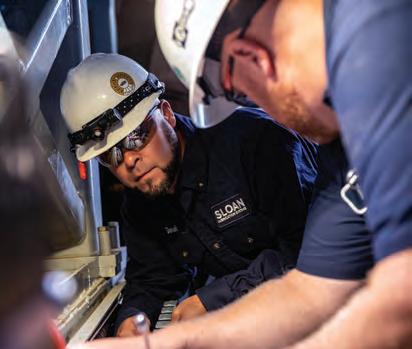
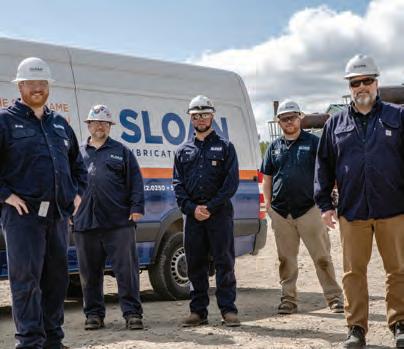

When you have lubrication needs, we have lubrication solutions. From engineering design and evaluation, to installation, maintenance and emergency response, the Sloan Lubrication Systems team is ready to answer your lubrication questions and provide reliable solutions that help your operation avoid unnecessary and costly downtime.
One call is all it takes to keep your critical equipment performing efficiently with service done right the first time.
Sloan Lubrication Systems. The first name in lubrication.
Editor Jack Burke
jack.burke@khl.com
Vice President of Content, Power
Becky Schultz
becky.schultz@khl.com
Client Success & Delivery Manager
Charlotte Kemp
charlotte.kemp@khl.com
Group Designer Jade Hudson
Subscriptions circulation@khl.com
Data Manager Anna Philo
anna.philo@khl.com
Data Executive Vicki Rummery
vicki.rummery@khl.com
Events Manager Steven Webb
steven.webb@khl.com
SALES
Brand Manager
PLUS USA/Mainland Europe
Kristin Pride
+1 720 298 8546 | kristin.pride@khl.com
China
Cathy Yao
+86 (0)10 6553 6676 | cathy.yao@khl.com
Italy
Giuseppe Di Leva
+44 (0) 7593 586562 | giuseppe.dileva@khl.com
Japan
Michihiro Kawahara
+81 (0)3 32123671 | kawahara@rayden.jp Scandinavia/UK/Benelux
Greg Roberts
+44 (0) 7950 032224 | greg.roberts@khl.com
Vice President Sales, Power Division
Tony Radke
480 478 6302
tony.radke@khl.com
Global Vice President Sales
Alister Williams
+1 312 860 6775
alister.williams@khl.com
Chief Executive Officer
James King
Chief Financial Officer
Paul Baker
© Copyright KHL Group, 2025
KHL GROUP AMERICAS LLC
14269 N 87th Street, Suite 205, Scottsdale, AZ 85260. americas@khl.com
That’s
The latest Dallas Federal Reserve Energy Survey paints a picture of an oil and gas sector still struggling for momentum. Business activity stayed in negative territory during the third quarter of 2025, production was essentially flat, and executives voiced growing doubts about the future. Rising costs and weak service margins added to the gloom.
But the same week that those survey results came out, GPA Midstream members in San Antonio heard a very different message. Doug Giuffre of S&P Global Commodity Insights laid out how a wave of new data centers—driven by artificial intelligence and cloud computing—could rewrite the power sector’s demand outlook. His conclusion was blunt: natural gas is the near-term winner.
This tension between caution and opportunity captures the state of the gas market today. On one side, producers and service providers feel squeezed by costs and hesitant to invest. On the other, structural changes in electricity demand are pointing to a surge in natural gas use, with major implications for midstream operators.
In the Dallas Fed poll, executives reported flat or declining production. The natural gas production index stayed negative at -3.2. Costs, meanwhile, kept climbing. Exploration and production firms cited sharp increases in both finding and development costs and lease operating expenses.
Respondents expect Henry Hub to average $3.30 per MMBtu at year-end and drift toward $4.50 by 2030, but the ranges were wide. Few executives were willing to call the market with confidence.
U.S. power demand, which has grown sluggishly for decades, is accelerating thanks to the rapid expansion of data centers. Even at 2% annual growth—twice historic norms—the U.S. will see more load added in the next 10 years than during any postwar industrial surge. If growth reaches 2.5%, the strain on supply could be extraordinary.
For midstream companies, the picture is complicated. The Dallas Fed survey shows the pressure of rising costs, weak margins, and cautious producers. Yet the data center boom suggests pipelines and compressors will be in high demand within a few years.
So is the natural gas sector weak and uncertain, or poised for a rebound? The answer may be both. The Dallas Fed survey captures the industry’s near-term fatigue: higher costs, flat volumes, and executives too wary to invest. Giuffre’s presentation, meanwhile, points to a structural shift in U.S. power markets that will pull more gas into the system whether producers are ready or not. That duality explains why the gas market feels rudderless.
Jack Burke Editor | jack.burke@khl.com

25 to 500 Bar at 250kg/hr
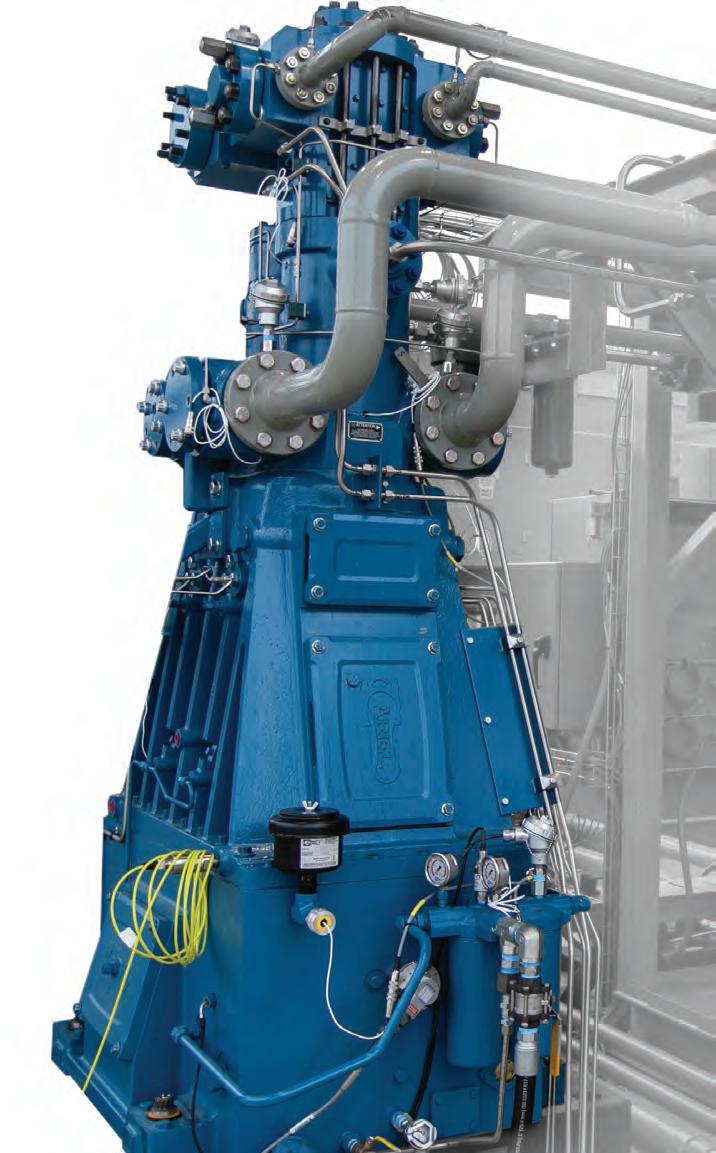

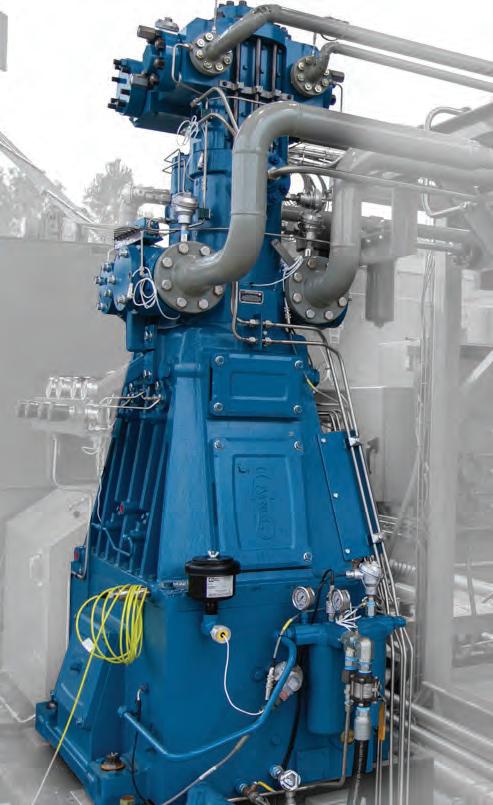
Ariel’s KBH is a vertically oriented, non lubricated, reciprocating compressor designed to maintain high gas purity, featuring the latest advanced materials allowing for optimal compression efficiency and reliability. Ariel KBH compressors can compress hydrogen gas to pressures up to 7,250 psig (500 barg) for trailer filling, hydrogen mobility, and other hydrogen storage and transport needs.

Find out more at arielcorp.com/hydrogen

20 What AI may mean for the Midstream market 28 Maintenance tips: Precision cleaning
Run to fail, or run to damage?
VOLUME 30 | NUMBER 9
COMPRESSORTECH2 ISSN 1085-2468, is published monthly with combined issues of January/ February and August/September by KHL Group Americas LLC, 14269 N 87th, Suite 205, Scottsdale, Arizona, 85260, USA. Periodicals postage is paid at Scottsdale, AZ, and additional mailing offices (if applicable).
POSTMASTER
Send address changes to KHL Group Americas LLC, 14269 N 87th, Suite 205, Scottsdale, Arizona, 85260, USA.
24 Top company executives address what they see coming for the industry 3 Editor’s Comment: Half full or half empty?
Industry News: Rio Grande LNG expansion moves ahead


Gas Lines: Russia’s energy export mix undergoes major shift
Company News: IPS expands piping line
Monitoring Government: EPA looks to kill emissions reporting requirement
Shale Play by Play: Antero marketing Ohio Utica assets
Euro Gas Report: Electric gas compression first
Events
Tech Corner: Factors to consider in
Cornerstones of Compression: The evolution of pipelines, Part 4



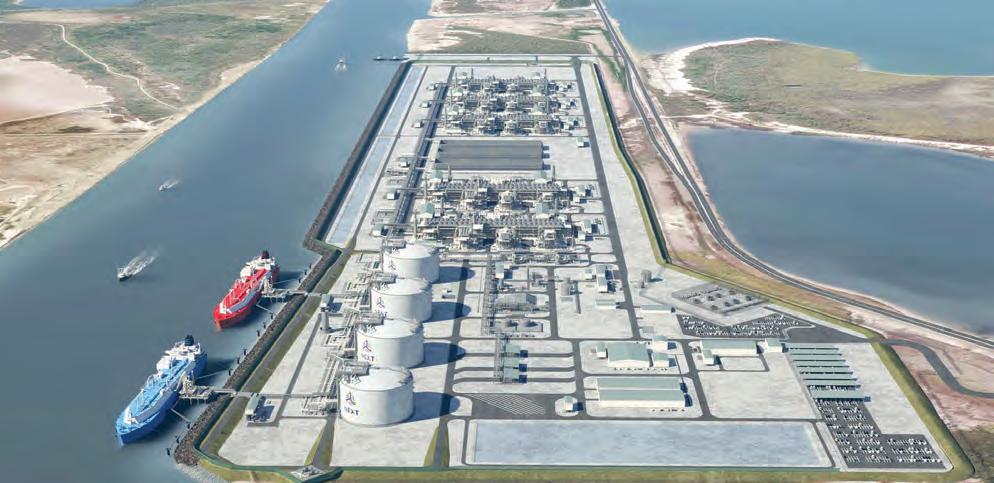
TotalEnergies and its partners have taken a final investment decision (FID) to move forward with Train 4 at the Rio Grande LNG project.
TotalEnergies and its partners have taken a final investment decision (FID) to move forward with Train 4 at the Rio Grande LNG project in South Texas, marking another expansion milestone for one of the largest liquefaction developments in North America.
The decision was made jointly by NextDecade, which holds a 40% stake in the new train, Global Infrastructure Partners (36.9%), TotalEnergies (10% directly, plus an indirect 7% through its 17.1% shareholding
Everllence has been chosen by EPC contractor Saipem to provide core compressor and expander technology for Stockholm Exergi’s Bioenergy with Carbon Capture and Storage (BECCS) project — one of the world’s largest bioenergy-based carbon removal initiatives.
in NextDecade), GIC (7.9%) and Mubadala (5.2%). Train 4 will add 6 million tons per annum (mtpa) of export capacity, bringing the total nameplate capacity at the facility to about 24 mtpa when operations begin in 2030. The project will be financed with roughly 40% equity and 60% debt.
Stéphane Michel, president of gas, renewables and power at TotalEnergies, said the FID strengthens the company’s U.S. LNG export platform.
“We are very pleased with the FID of
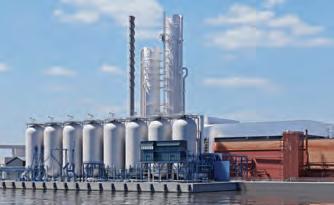
The facility, located at the Värtaverket biomass power plant in Stockholm, will capture and permanently store biogenic carbon dioxide released during the combustion of sustainably sourced forest residues. Once operational, it is expected to remove up to 800,000 tons of CO2 annually.
Everllence will supply its electrically driven MAX1 compressor train, including the AG110 axial compressor and EN080 axial expander, to manage the plant’s high-volume flue gas. The technology is designed for high-efficiency performance in continuous large-scale operation, ensuring reliability while maximizing energy recovery. The captured CO2 will be transported for permanent storage beneath the North Sea through the Northern Lights infrastructure.
RGLNG Train 4. This project from which we will offtake 1.5 mtpa strengthens our LNG export capacity from the United States,” Michel said. “It gives TotalEnergies access to competitive LNG thanks to its low production costs. The LNG from this fourth train will increase TotalEnergies’ U.S. LNG export capacity to over 16 mtpa by 2030, further enhancing our ability to contribute to gas supply and building on our 10% market share worldwide.”
TotalEnergies is the world’s thirdlargest LNG player, with a global portfolio of about 40 million tons per year in 2024 and interests in liquefaction plants across multiple regions. The company also holds regasification capacity of more than 20 mtpa in Europe and has expanded into LNG bunkering and trading. CT2
WOODSIDE ENERGY has signed a memorandum of understanding (MOU) with Japan Suiso Energy, Ltd. (JSE) and The Kansai Electric Power Co., Inc. (KEPCO) to advance the development of a liquid hydrogen supply chain between Australia and Japan.
The agreement sets the stage for hydrogen produced at Woodside’s proposed H2Perth Project in Western Australia to be transported in dedicated liquid hydrogen carriers to receiving terminals in Japan. The initiative brings together Australian

Wison New Energies and Siemens Energy have signed a strategic Memorandum of Understanding (MoU) at Gastech 2025 in Milan to advance collaboration on sustainable offshore energy projects.
The agreement calls for the two companies to jointly develop optimized configurations of Siemens Energy’s SGT750 gas turbine and motor compressor packages for use in Wison’s floating LNG (FLNG) and floating production storage and offloading (FPSO) projects. In addition, the partners will establish a Frame Agreement toolbox intended to standardize technical and commercial processes, reducing project lead times.
Wison New Energies, headquartered in Shanghai, has emerged as one of the most active global players in the floating LNG sector. The company has been developing mid- and large-scale FLNG solutions for more than a decade, with projects targeting gas-to-power, offshore monetization, and small-scale LNG supply chains.
For Siemens Energy, the collaboration strengthens its presence in LNG infrastructure.
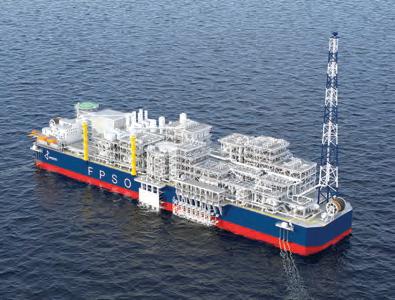
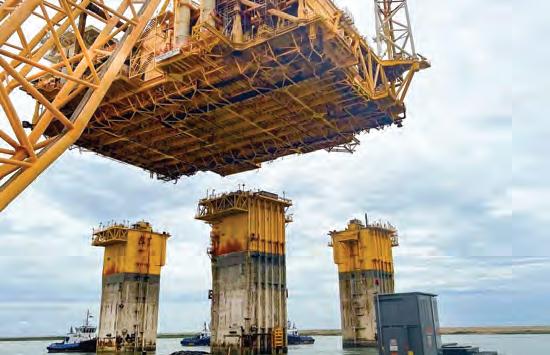
LLOG Exploration Offshore, L.L.C. has started production from its Salamanca floating production unit (FPU) in the deepwater Gulf of Mexico, marking a milestone in the company’s latest development push. The project, located in Keathley Canyon 689 in about 6,400 feet of water, is producing from a well in the Leon field.
Additional production is expected to ramp up through the end of the year. A second Leon well and the first Castile field well are forecasted to come online in the fourth quarter, with another Leon well planned for completion in early 2026 and
an additional Castile well scheduled later that year. LLOG operates the Salamanca FPU and both discoveries, with Repsol and O.G. Oil & Gas holding non-operating working interests.
Chief Executive Officer and President Philip Lejeune said the Salamanca facility represents the first successful refurbishment of a Gulf of Mexico production unit for commercial use. By redeploying an existing facility rather than constructing a new one, LLOG shortened development timelines and achieved significant environmental benefits.
production capabilities with Japanese demand, reflecting a shared ambition to accelerate the energy transition.
The H2Perth facility is planned for the Rockingham and Kwinana Industrial Zones near Perth. The project would produce liquid hydrogen using natural gas reforming technology, with plans to achieve net-zero Scope 1 and 2 greenhouse gas emissions from the start of operations.
Cooper Machinery Services has acquired substantially all assets of Power Parts Supply, a well-established provider of
CT2
LLOG Exploration Offshore, L.L.C. has started production from its Salamanca floating production unit (FPU) in the deepwater Gulf of Mexico. The project is in Keathley Canyon 689.
replacement parts and solutions for largebore engines and compressors. The move strengthens Cooper’s refurbished parts and Unit Exchange (UX) business and reinforces its position as a global supplier of engine and compression system solutions.
Founded in 2003, Power Parts Supply has built a reputation for reliable exchange solutions designed to extend the performance and longevity of critical equipment. The acquisition supports Cooper’s strategy to provide a full suite of OEM and aftermarket services.
Russia’s energy export mix has undergone a major restructuring since its full-scale invasion of Ukraine in February 2022, with natural gas and coal shipments to Europe falling sharply and new trade flows developing in Asia, according to a report from the U.S. Energy Information Administration (EIA).
While Moscow has successfully redirected crude oil exports eastward with minimal infrastructure changes, natural gas and coal have proven more difficult to reroute due to capacity limits in pipelines and railways.
Natural gas exports to Europe, once the cornerstone of Russia’s energy trade, have dropped by more than two-thirds. EU imports fell from 14.7 billion cubic feet per day (Bcf/d) in 2020 to just 4.4 Bcf/d in 2024.
Although the EU has not directly sanctioned Russian gas, a combination of sanctions, diversification policies and market adjustments has cut reliance on Moscow’s supplies.

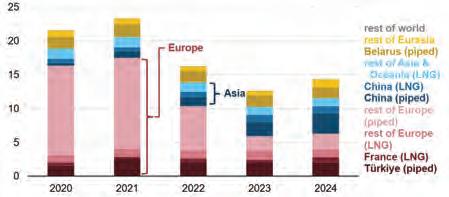
To offset these losses, Russia has looked East. The Power of Siberia 1 pipeline, completed in 2019, has become the primary conduit for shipments to China. Since the Chinese portion was finished in December 2024, flows have run near the system’s 3.7 Bcf/d design capacity. A second line, the proposed Power of Siberia 2, could connect western Siberian reserves to
eastern China, but the project would require more than 2,000 miles of new pipeline. Despite years of negotiations, Beijing and Moscow have yet to finalize terms.
Coal exports have faced similar constraints. European sanctions on Russian coal took full effect in August 2022, cutting off markets that once received nearly one-third of Russia’s supply.
Asia has emerged as Russia’s primary outlet for coal. China has been the dominant buyer since 2020 and in 2024 took slightly more than half of Russia’s coal exports. India has also become a fast-growing customer, raising imports from 9.1 million short tons (MMst) in 2020 to nearly 24.8 MMst in 2024. Together, the trends highlight the uneven success of Russia’s pivot to Asia. The lack of sufficient infrastructure continues to limit the flow of natural gas and coal. CT2


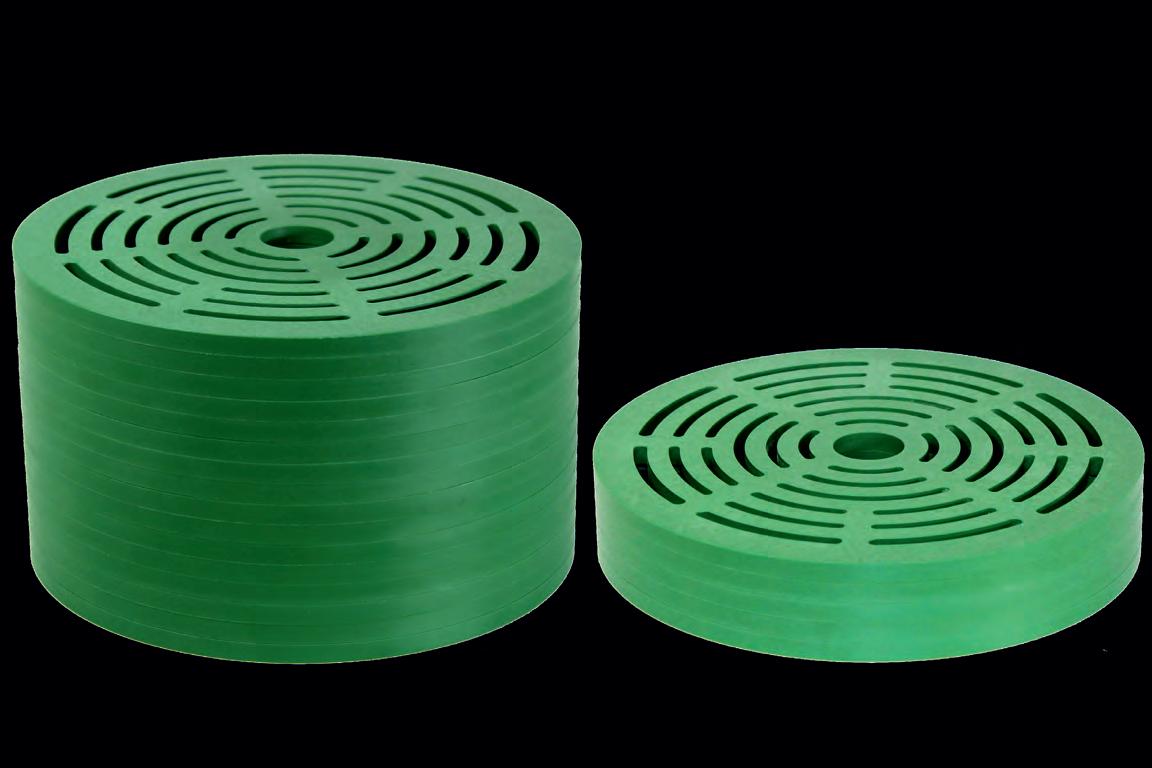


Baker Hughes has secured a major award from Petrobras to supply as many as 50 subsea tree systems and related services for offshore oil and gas developments in Brazil.
The contract, awarded through an open tender, expands Baker Hughes’ role in one of the world’s largest deepwater markets.
Under the agreement, Baker Hughes will
manufacture Petrobras’ pre-salt standard subsea trees along with subsea distribution units, in-line tees and vertical connection systems. The company will also provide topside control cabinets that allow subsea equipment to be monitored and managed from floating production, storage and offloading (FPSO) vessels.
The subsea systems will be deployed
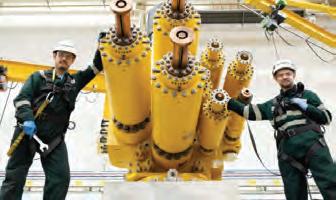
across a mix of mature and emerging fields. They are expected to enhance recovery at established sites such as Albacora, Jubarte and Barracuda-Caratinga, while also supporting newer pre-salt projects at Mero and Buzios, two of Petrobras’ flagship offshore developments. The company said procurement and manufacturing activities are set to begin this quarter. CT2
Monkey Island LNG has selected ConocoPhillips’ Optimized Cascade liquefaction technology for its proposed 26 million tonnes per annum (MTPA) natural gas liquefaction and export facility in Cameron Parish, Louisiana.
The decision follows what Monkey Island LNG described as an extensive review of available technologies. According to the company, ConocoPhillips’ process was chosen for its operational flexibility, quick restart capabilities, high efficiency,
KB DELTA INC., a global manufacturer of compressor valves and related products, has appointed Gregory Bailey as global consultant.
Bailey, who recently retired as director of aftermarket sales at Ariel Corporation, brings nearly 30 years of leadership experience in the gas compression industry. During his tenure at Ariel, he played a key role in strengthening relationships across the original equipment manufacturer (OEM) and aftermarket sectors, while overseeing compressor parts logistics, customer support
and track record of exceeding nameplate capacity.
The 246-acre project site is located on Monkey Island in Cameron Parish, strategically positioned with access to deepwater shipping channels and abundant U.S. natural gas supply. With ConocoPhillips’ technology at the core of the design, Monkey Island LNG aims to position itself as a reliable and efficient source of LNG to international buyers.
ConocoPhillips’ Optimized Cascade

and global distribution.
In his new role, Bailey will advise KB Delta on strategic expansion into key international markets, supplier alignment and customer service optimization. The company said his expertise in both OEM and aftermarket operations will help advance its goal of delivering high-performance compressor valve solutions worldwide.
“We are honored to welcome Gregory to the KB Delta team,” said George Giourof, CEO of KB Delta. “Greg’s reputation speaks
technology, first deployed in the 1960s, has been used in more than 20 LNG trains worldwide.
According to the company, the process uses a series of refrigeration cycles with different refrigerants to cool natural gas into liquid form, providing a combination of high efficiency and stable operations.
The technology has been licensed for projects in the U.S., Qatar, Australia, Angola and Nigeria, among others.
for itself—he’s respected across the globe for his integrity, technical knowledge and unwavering dedication to customer success.”
ENERFLEX LTD. has named Paul E. Mahoney as president and chief executive officer. Mahoney will also join the company’s board of directors, succeeding interim CEO Preet S. Dhindsa, who will return to his role as senior vice president and chief financial officer.
The Calgary-based natural gas compression and processing company said the decision follows an extensive global
XRG P.J.S.C. closed its acquisition of an 11.7% equity stake in Phase 1 of the Rio Grande LNG project in Brownsville, Texas. The investment, covering Trains 1–3, is part of a joint venture between XRG and Global Infrastructure Partners (GIP), a BlackRock company.
Rio Grande LNG is one of the largest liquefied natural gas export projects under development in the United States. When fully built, the facility could have capacity of about 48 million tons per annum (mtpa).
Construction of the first three trains is underway, while a final investment decision for Train 4 was reached in early September.
“As LNG demand is projected to grow by 60% by 2050, the investment in Rio Grande LNG advances XRG’s strategy to build a leading global gas and LNG business to meet structural demand from industry, AI, and broader economic growth,” said Mohamed Al Aryani, president of XRG International Gas.
Al Aryani added that XRG’s international gas portfolio now spans the Caspian region, Africa and the Americas, reflecting the company’s long-term investment approach.
search supported by an executive search firm.
Mahoney most recently served as group president, production and automation technologies at ChampionX Corp., a leading provider of production technologies for the upstream and midstream oil and gas markets. ChampionX was acquired by SLB in July 2025. Earlier in his career, he led Dover Corp.’s artificial lift division.
Enerflex said Mahoney will work with senior leadership to advance three near-term strategic priorities: strengthening profitability
Mitsubishi Heavy Industries Compressor International Corp. has successfully delivered syngas and ammonia refrigeration compressor trains for the Beaumont New Ammonia Project in Beaumont, Texas.
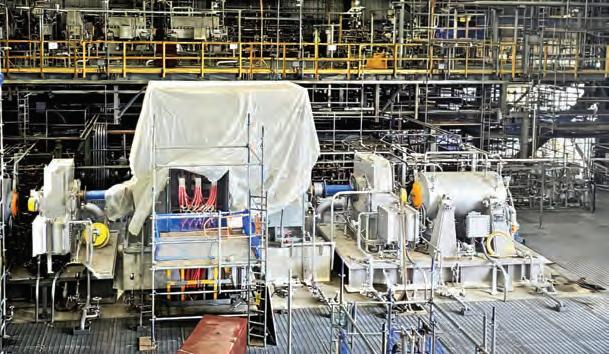
Mitsubishi Heavy Industries Compressor International Corporation (MCO-I) has delivered syngas and ammonia refrigeration compressor trains for the Beaumont New Ammonia Project in Beaumont, Texas. The facility, now owned by Woodside Energy after being developed by OCI Global, is set to become the world’s first large-scale, lowercarbon greenfield ammonia plant.
MCO-I’s scope of supply included two API 617 compressors and a double-ended synchronous motor for the syngas train, as well as an API 617 compressor train driven by an API 612 steam turbine for ammonia refrigeration service. The project was executed in collaboration with Mitsubishi Heavy Industries Compressor Corporation (MCO), involving project management, procurement, manufacturing, and quality assurance.
in core operations, capitalizing on expected increases in natural gas and produced water volumes in its main operating regions, and maximizing free cash flow.
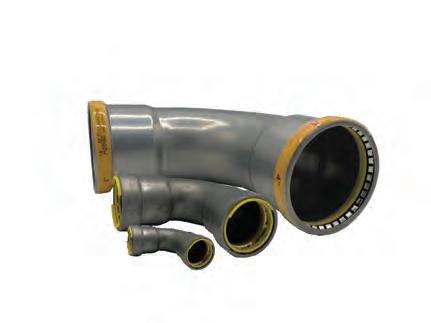
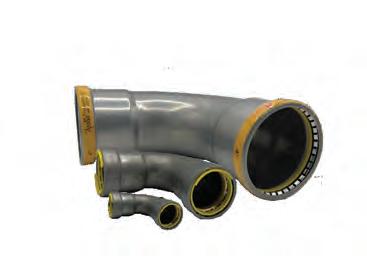
AALBERTS INTEGRATED PIPING SYSTEMS (IPS) has expanded its Apollo PowerPress line with new large-diameter (LD) options designed for demanding oil and gas applications. The extension introduces pipe sizes of 2, 3 and 4 inches, offering greater flexibility for large-scale projects such
Michael McCurry of MCO-I said the company was proud to support construction of one of the largest clean energy ammonia plants in North America. He noted MCO’s long track record in ammonia projects, including turbomachinery supplied to more than 35 world-scale plants worldwide.
Manufacturing and packaging were split between MCO’s Hiroshima, Japan, facility and MCO-I’s Pearland Works facility near Houston, with contributions from local contractors and suppliers. All equipment has been delivered to the site, and MCO-I field service teams are supporting installation and pre-commissioning activities.
The Beaumont facility will have capacity to produce 3,000 metric tons per day of lower-carbon ammonia, incorporating carbon capture and sequestration technology. CT2
as gas distribution networks, oil processing facilities and fuel transfer lines.
The Apollo PowerPress LD incorporates HNBR sealing elements and zinc-nickel coatings to enhance corrosion resistance and deliver reliable, long-lasting seals for liquids and gases including LP/natural gas, fuel oil and hydraulic fluids. The system also features Leak Before Press technology, which prevents unpressed connections from holding pressure, improving both safety and installation integrity.
Want to improve operational efficiency and maximize compressor reliability?

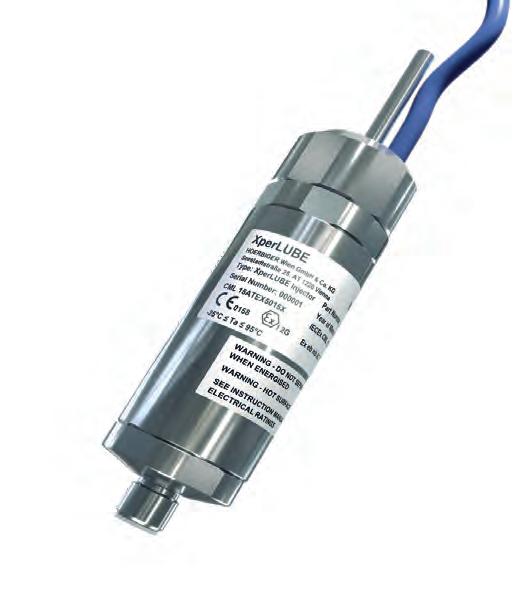
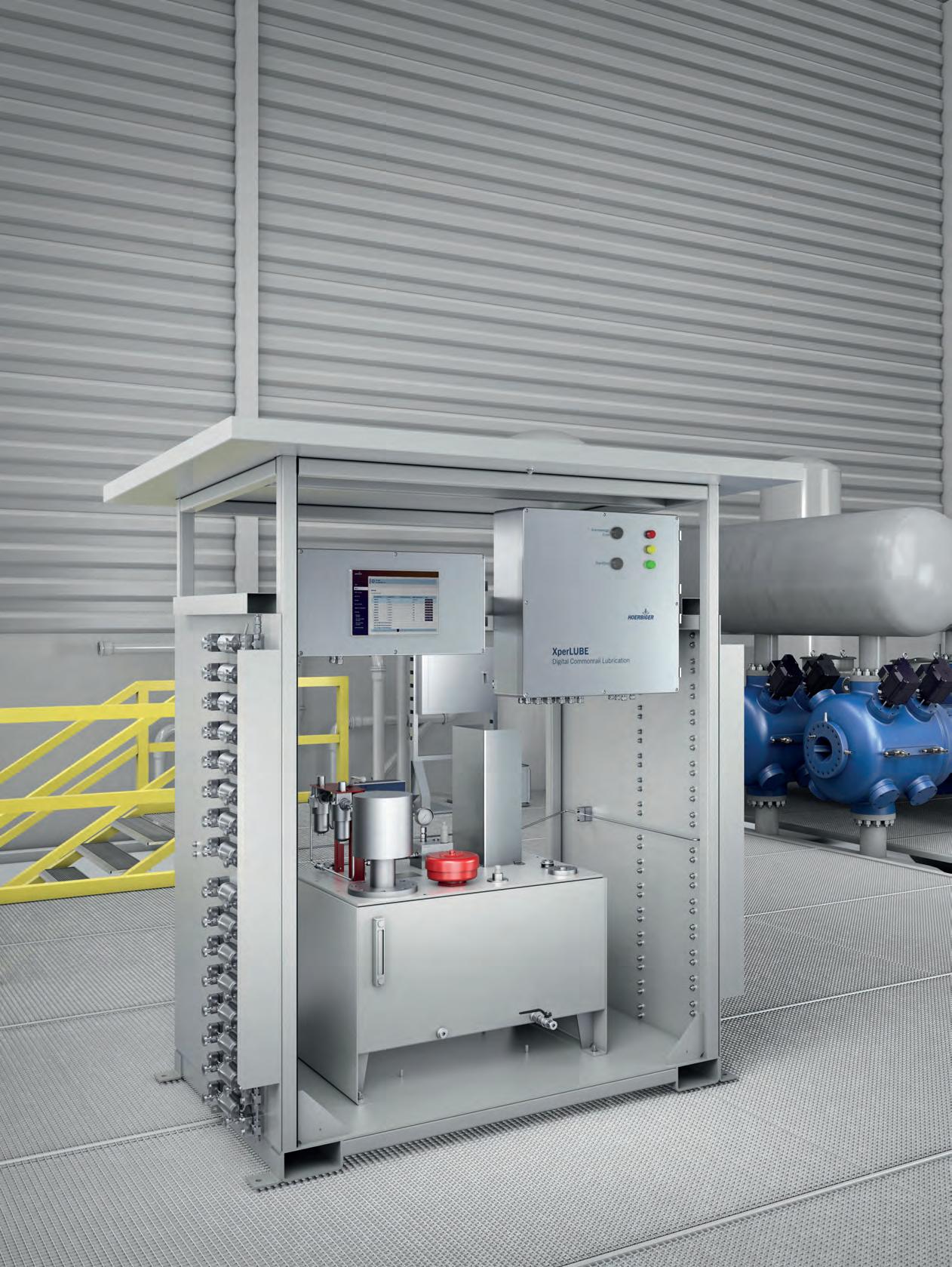
For reciprocating compressors, reliable and precise cylinder lubrication is critical. Inconsistent or excessive lubrication can lead to unplanned downtime, accelerated wear, and system issues. XperLUBE, our Digital Commonrail Lubrication System, delivers targeted, real-time lubrication exactly where and when it’s needed. The system features a standardized, modular architecture that simplifies integration across various compressor configurations. The result: optimized oil consumption, streamlined maintenance, and fast system adaptation for minimized downtime and enhanced overall compressor reliability.
Enabling change. For a better tomorrow.
Learn more by visiting www.hoerbiger.com/xperlube today!
About 8,000 facilities across 47 industries, including natural gas distribution systems, would no longer be required to report their greenhouse gas emissions to the federal government under a new rule proposed by the U.S. Environmental Protection Agency (EPA).
On top of that, onshore natural gas transmission compression and a host of other oil and gas activities would not be subject to emissions reporting requirements until 2034, in accordance with the One Big Beautiful Bill Act, which was signed into law on July 4 by President Donald Trump.
In making the September 12 announcement, EPA Administrator Lee Zeldin said the Greenhouse Gas Reporting Program “is nothing more than bureaucratic red tape that does nothing to improve air quality.”
“Instead, it costs American businesses and manufacturing billions of dollars, driving up the cost of living, jeopardizing our nation’s prosperity and hurting American communities,” Zeldin continued. The EPA estimates that cutting the reporting requirements would save businesses $303 million per year from 2025 to 2033.
The greenhouse gas reporting rule was mandated by Congress in

fiscal year 2008 and was promulgated under the Clean Air Act. As such, the EPA has been collecting greenhouse gas data since 2010. The program requires reporting of greenhouse gas from large emission sources, fuel and industrial gas suppliers, and carbon dioxide injection sites. However, the EPA now maintains there is no requirement under the Clean Air Act to collect greenhouse gas emission data from businesses.
If the new rule that eliminates the greenhouse gas reporting requirements is finalized, no industries would need to submit reports with 2025 data. However, the EPA said it was proposing to extend the March 31, 2026, reporting deadline to June 10, 2026, which would allow the agency time to issue a final rule.
The EPA held a virtual public hearing for the proposal on October 1. Representatives of the Environmental Law & Policy Center (ELPC) urged the agency to reconsider its actions.
Max Lopez, an associate attorney with the ELPC, said the greenhouse gas emissions data “is essential in quantifying emissions from utility operations, oil and gas systems, and power plants – allowing clear comparisons between fossil fuel infrastructure and electrification alternatives to rationally plan for the long term.”
Also, emissions reporting is needed to track methane leaks from oil and gas systems, helping improve grid reliability, conserve energy resources, and lower costs for consumers, Lopez said. He added, “EPA’s claim that it lacks authority under the Clean
Air Act to collect this data is inconsistent with decades of agency practice and the statute’s explicit language.”
The Carbon Capture Coalition also opposes the EPA proposal. In a September 12 statement, the coalition said the cancellation of parts of the greenhouse gas reporting rule would jeopardize federal tax credits for carbon capture projects. Regulations require those claiming the tax credit for secure geologic storage to demonstrate the amount of carbon dioxide stored using the greenhouse gas reporting requirements.
“Today, these reporting mechanisms enjoy broad support and buy-in across the carbon management industry and stakeholder community,” the coalition said.
Regarding methane emissions, The Environmental Partnership (TEP), which comprises members of the oil and gas community, maintains the industry already is doing a good job of reducing such emissions by itself. On September 16, The TEP released its seventh annual report, noting a 42% decline in methane emissions from U.S. onshore production regions between 2015 and 2023.
“Reducing methane emissions is an important and complex challenge—there’s no one-size-fits-all solution,” said TEP Director Emily Hague in a press release. “TEP helps operators explore the full range of solutions, make informed choices for their unique operations, and continuously improve strategies to deliver America’s essential oil and natural gas efficiently and responsibly.” CT2
Your reliable partner for turnarounds, strategic planning, and maintenance, ensuring minimal downtime during overhauls and swift emergency responses with top-quality, safety-focused crews.

We provide turn-key on-site and shop repair services for pumps, compressors, turbines and gearboxes.






With our team of specialists and strategic partnerships, we deliver innovative and optimized performance solutions, including re-engineering, retrofit, modernization and other technical services.

Our experts manufacture and source parts to keep your machinery running in high health. We manage parts inventory and supply spare parts kitting.

WBI secures $500 million state guarantee
WBI Energy received a $500 million financial guarantee from the North Dakota Industrial Commission to support its $1.2–$1.6 billion Bakken East Pipeline, which will move 1 Bcf/d of gas across the state by 2030.
Chord to acquire XTO Williston assets
Chord Energy will buy 48,000 net acres and 9,000 boe/d of production from ExxonMobil’s XTO Energy for $550 million. The deal includes roughly 90 net drilling locations and is expected to close by year-end.
Bureau raises $38 million from lease sales
The U.S. Bureau of Land Management raised $38 million from a lease sale across Montana and North Dakota, citing renewed interest due to improved economics from three-mile lateral drilling in the Bakken and Three Forks formations.
Chevron considers $2 billion asset sale
Chevron is evaluating the sale of DJ Basin pipeline assets valued at over $2 billion, acquired in its 2020 purchase of Noble Energy.
Bank of America is managing the process.
Antero marketing Ohio Utica assets
Antero Resources, the nation’s fifth-largest gas producer, is reportedly preparing to sell its Ohio Utica holdings for $900 million to $1 billion.
Hart Energy reports about 82,000 net acres and associated midstream infrastructure are on the market. Potential buyers include Expand Energy, Gulfport Energy and Infinity Natural Resources (INR).
INR expands acquisition strategy
Infinity Natural Resources CEO Zack Arnold
Harvest Midstream buying MPLX assets
Harvest Midstream said it has agreed to acquire MPLX’s Wyoming, Utah, and Colorado gas gathering and processing assets for $1 billion, adding 1,500 miles of pipeline and 845 MMcf/d of capacity.
Closing is expected in late 2025.
James Willis highlights the latest news from the major North American shale plays
said at DUG Appalachia that the company has widened its acquisition focus beyond small, local deals and is now pursuing larger Utica and Marcellus transactions that could exceed $1 billion.
Northern Utica drilling resumes
EAP Ohio (formerly Encino Energy, now part of EOG Resources) brought one of Mahoning County’s first new horizontal wells in years online.
The Wehr Spring Valley Farm well in Ellsworth Township, fractured in June, signals renewed interest in the northern Utica.
Prairie Operating grows
DJ footprint
Prairie Operating said it completed two bolt-on acquisitions totaling 16,000 acres in the DJ Basin.
The deals, funded from working capital, expand inventory and permitted drilling locations.
Targa Resources announced a non-binding open season for its Forza Pipeline Project, a proposed 36-mile, 36-inch interstate pipeline to move 750 MMcf/d from Lea County, New Mexico, to the Waha Hub. Startup is targeted for mid-2028.
Targa
Targa unveiled several Permian Basin projects, including the $1.6 billion, 500-mile Speedway NGL Pipeline to Mont Belvieu, starting at 500 MBbl/d and expandable to 1,000 MBbl/d. It also plans the 275 MMcf/d Yeti gas plant and four more plants totaling 1.4 Bcf/d of capacity by 2027.
Brazos expanding Midland Basin footprint
Brazos Midstream is building the $185 million Sundance II processing plant in Martin County. The 300 MMcf/d facility will double its Midland Basin capacity to 500 MMcf/d when operational in late 2025.
Phillips 66 adds Dos Picos II
Phillips 66 started up its 220 MMcf/d Dos Picos II plant in Midland County, doubling the Dos Picos complex’s total capacity to 440 MMcf/d.
Mach acquires Permian and San Juan assets
Mach Natural Resources completed a $1.3 billion deal for Sabinal Energy’s Permian assets and IKAV Energy’s San Juan assets, adding 700,000 acres and 71,000 boe/d of production. CEO Tom Ward said the deal nearly doubles output and diversifies operations across three basins.
Enbridge sanctions Algonquin expansion
Enbridge reached FID on the $300 million Algonquin Reliable Affordable Resilient Enhancement (AGT Enhancement) project, adding 75 MMcf/d of Marcellus and Utica capacity to supply New England.
EQT targets return to top U.S. gas producer
After losing the top spot to Expand Energy, EQT aims to reclaim it by 2030. CEO Toby Rice said the company could grow from 6.2 Bcf/d to nearly 9 Bcf/d by serving AI data
Pipeline fire near Cheyenne
A section of Kinder Morgan’s Colorado Interstate Gas pipeline ruptured and ignited Sept. 21 west of Cheyenne, Wyoming, causing a visible fire but no injuries or hazardous releases.
The NTSB is investigating.
centers, new gas plants and southeastern markets via the Mountain Valley Pipeline.
co-developing
Burket and Marcellus
PennEnergy Resources is drilling both
JERA pursuing GEP Haynesville II
Japan’s JERA is reportedly in advanced talks to acquire GEP Haynesville II—a joint venture of GeoSouthern Energy and Williams—for about $1.7 billion. The deal would mark JERA’s first shale gas investment, securing supply for LNG exports.
Citadel eyeing Comstock assets
Citadel is reportedly negotiating to acquire roughly 38,000 acres and 150 MMcf/d of legacy Comstock Resources assets as a bolt-on to its $1.2 billion Paloma Natural Gas acquisition.
Oklahoma Gas Gathering LLC is deploying Bridger Photonics’ aerial methane detection technology across its Anadarko Basin system to improve leak detection, emissions management, and safety.
TotalEnergies will acquire a 49% non-operated interest in Continental Resources’ Anadarko Basin gas assets, with gross production potential of 350 MMcf/d by 2030. The move strengthens its U.S. LNG supply portfolio and complements recent Eagle Ford and Barnett acquisitions.
Marcellus and Burket Shale wells in western Pennsylvania. President Ben Bates called the Burket “incredibly economic.” The company plans to grow output 50% to 900 MMcfe/d within five years.
Following its $5.6 billion Encino Energy acquisition, EOG Resources now controls over 1 million Utica acres and 1,000 wells. The company bought a 170,000-sq.-ft. New Albany facility near Columbus as its Utica headquarters.
The D.C. Circuit Court ruled in favor of Antero Resources, vacating FERC’s approval of Tennessee Gas Pipeline’s two-tier fuel rate structure. The court said FERC’s decision violated cost-causation principles.
NextEra Energy sold its 39% stake in Meade Pipeline Co. LLC to Ares Management for $1.1 billion.
FERC reissued Williams’ certificate for its $1 billion Northeast Supply Enhancement project, allowing the long-delayed 23-mile offshore segment under Raritan Bay to proceed. CT2
Anna Kachkova provides information on the latest gas compression news from Europe
Ukraine boosts gas imports after Russian strikes
Ukraine plans to increase gas imports after Russia launched its largest attacks on Ukrainian gas facilities since the war began. State-owned Naftogaz said 35 missiles and 60 drones struck production sites in the Kharkiv and Poltava regions, cutting output sharply. Bloomberg reported that

ANNA KACHKOVA is an independent oil and gas writer based in Edinburgh, Scotland. She has over 17 years’ experience of covering the energy industry, including five years in Houston, Texas, as NewsBase’s North America editor. Her email address is: aikachkova@gmail.com
roughly 60% of Ukraine’s gas production was taken offline.
To meet winter demand, Ukraine may spend EUR1.9 billion ($2.2 billion) to import up to 155.4 Bcf (4.4 bcm) of gas—nearly 20% of its annual consumption. Kyiv has appealed for repair equipment, financial support, and additional air defense systems.
The European Bank for Reconstruction and Development will finance part of the imports, and Naftogaz has secured a UAH3 billion ($72 million) loan from Oschadbank.
“The need to import additional volumes arises from massive enemy attacks on our infrastructure,” said Naftogaz CEO Sergii Koretskyi. “We’re working with partners to ensure a stable heating season despite ongoing strikes.”
Ukraine plans to boost gas imports
Ukraine plans to increase gas imports by up 155.4 Bcf after Russian attacks severely damaged the country’s natural gas facilities, cutting output sharply.
Amber Grid, MT Group sign deal for first electric compressor
Lithuania’s gas transmission operator, Amber Grid, has signed a contract with MT Group to install the country’s first electric gas compressor at the Jauniūnai station. The 5-MW compressor will improve system flexibility and cut both transmission costs
Amber Grid and MT Group sign €30.9 million contract for the installation of Lithuania’s first electric gas compressor.
Equinor starts Phase 2 of Åsgard subsea compression
Equinor and its partners have launched Phase 2 of subsea compression at Åsgard in the Norwegian Sea to maintain production
and greenhouse gas emissions, the company said.
The EUR30.9 million ($35.9 million) contract covers design and construction, including a 15-km high-voltage line from Širvintos to Jauniūnai.
Work began in September 2025 and will take 42 months, with startup planned for the second quarter of 2029. The compressor will operate on renewable electricity.
“We will install a 5-MW electric compressor along with all necessary infrastructure, including modern control
by boosting pressure between the field’s wells and the Åsgard B platform.
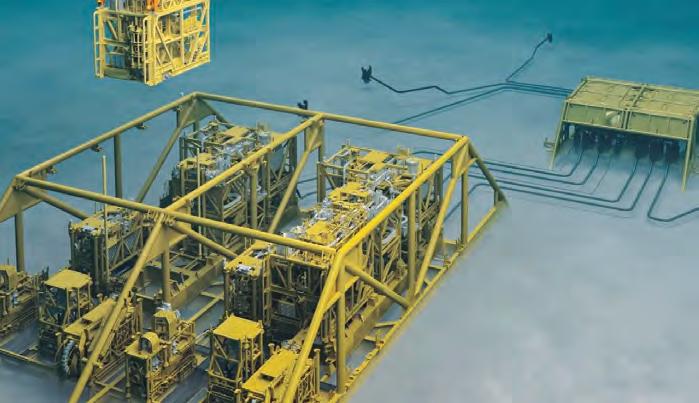
Located 270 meters underwater at the Midgard field, the Åsgard subsea compression (ÅSC) station houses two parallel 11.5-MW electric compressor trains
after Russian missile and drone attacks on facilities in Kharkiv and Poltava regions shut down about 60% of its production.
Serica trims output forecast after Triton outage
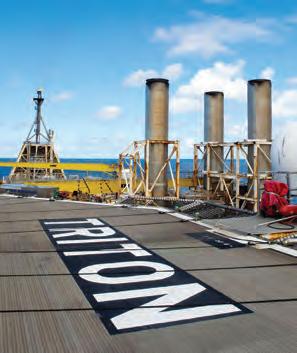
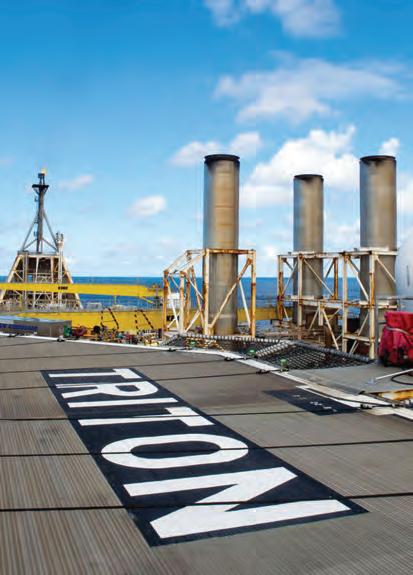
Serica Energy said production at the Triton FPSO in the UK North Sea has been halted since September 30 following a flare system issue. Operator Dana Petroleum expects production to resume soon, but Serica warned rates will remain limited until the cause is resolved.
The company now expects 2025 production to fall below its 29,000–32,000 boepd guidance. The outage follows a September vibration problem in Triton’s compression trains that required repairs to the A compressor.
systems,” said MT Group CEO Mindaugas Zakaras. “It will run on zero-emission electricity, enhancing reliability and flexibility.”
Amber Grid CEO Nemunas Biknius said the unit will enable operation in multiple modes to better respond to market needs.
The two companies are also collaborating on other infrastructure projects, including upgrades to gas shut-off devices and reconstruction of the Elektrėnai distribution station.
and remains the world’s largest subsea processing plant. A spare train stored in Kristiansund enables rapid replacement of components, while several refurbished parts from older modules have been reused.
Åsgard A began production in 1999 and Åsgard B in 2000. The first phase of ÅSC entered service in 2015 as the world’s first seabed gas compression facility. Under Phase 2, one compressor module was replaced in 2023 and the second has now been installed. Everllence supplied the new compressors, OneSubsea provided the modules, and Aker Solutions handled construction.
“It is incredibly frustrating to again report problems on a non-operated asset that should perform better,” said Serica CEO Chris Cox. “We are in talks with the operator to deliver more reliable performance.”
Triton handles production from several fields including Bittern, Guillemot West, Gannet E, and Evelyn. Oil is exported by shuttle tanker, and gas is sent to the St Fergus terminal via the Fulmar Gas Line. Other partners include Waldorf Production UK and Waldorf Petroleum Resources. CT2
At GPA Midstream in San Antonio, S&P Global
Doug Giuffre, senior director at S&P Global Commodity Insights and head of its North American Power Markets Analysis team, told GPA members that data centers are ushering in a new era of growth for the U.S. grid.

much of it in the Southeast and Midwest.
“This is a near-term boom for gas,” Giuffre said. “There’s simply no other scalable resource that can meet this level of demand growth over the next three to five years.”
Jack Burke
outlined how artificial intelligence (AI) data centers are reshaping U.S. electricity demand. For the midstream natural gas sector, the message was clear: natural gas is set to carry the load in the near term. By
“Even at 2% annual load growth, the U.S. will see more electricity demand added in the next decade than in any 10-year stretch in history—including the postwar manufacturing booms,” Giuffre said. “And if growth pushes closer to 2.5% or higher, the strain on supply will be extraordinary.”
For midstream operators, the implications are significant. After years of sluggish growth and declining interest in new thermal projects, gas-fired generation is experiencing a sharp rebound.
Gas turbine orders jumped from just 3–4 GW in 2024 to 14 GW last year, the highest since 2015. In the first half of 2025 alone, developers booked another 18 GW. S&P Global expects 50–60 GW of new gas capacity to be online by 2030,
That means more call on natural gas supply, more demand for compression, and growing pressure on pipelines to deliver. But pipeline bottlenecks remain a constraint. While production is expected to ramp up in 2026, LNG feed gas requirements will also climb, tightening balances and putting upward pressure on prices.
Regional hotspots
PJM Interconnection, covering northern Virginia and parts of the Midwest, remains the epicenter of data center construction. But PJM is already short on capacity and may struggle to meet additional demand without new gas-fired plants or delayed coal retirements.
Texas (ERCOT) and the Midwest (MISO) are seeing strong data center growth as well. ERCOT’s deregulated market complicates investment in large-scale gas projects, while MISO’s hybrid structure allows for rate-based investments that could favor natural gas additions.
The Southeast, where vertically integrated utilities can work with commissions to rate-base new assets, may provide the most straightforward path for new gas-fired generation. For midstream companies, that means watching these markets closely for new offtake opportunities.
Midstream implications: timing and infrastructure
The surge in load is colliding with the

long timelines required to build new infrastructure. Data centers can be built in two to three years, while pipelines and new gas plants often take five to eight. That mismatch could create short-term reliability issues, particularly in markets like PJM and MISO, where demand growth is steepest.
Meanwhile, some data centers are opting for behind-the-meter solutions, including smaller gas turbines in the 30 MW range that can be deployed more quickly than utility-scale plants. S&P Global is tracking
■ 35 GW — Data center capacity in service by end of 2024
■ 9 GW — Additional capacity under construction, expected online in 2025
■ 2–2.5% — Projected annual U.S. load growth through 2035, double prior forecasts
■ 65 GW — Slack capacity currently available on the U.S. grid
■ 60 GW — Potential new data center load connecting within five years
■ 14 GW — Gas turbine orders in 2024, highest since 2015
■ 18 GW — Gas turbine orders booked in the first half of 2025 alone
■ 50–60 GW — New U.S. gas capacity expected by 2030
■ 24 GW — Confirmed behind-the-meter generation projects tied to data centers
■ 55 GW — Total potential behind-themeter capacity by 2030
about 24 GW of confirmed on-site projects, with ambitions reaching as high as 55 GW by 2030.
For midstream, that points to a dual opportunity: large-scale power plants that will require long-term pipeline capacity and compression, and distributed behind-themeter projects that will need flexible supply solutions.
Giuffre also warned that rising retail prices could spark political pressure, particularly in regions already pursuing aggressive electrification policies. Still, he emphasized that natural gas will be the backbone resource for meeting AI-driven demand in the near term.
“We know the load is coming,” he told GPA Midstream attendees. “The real question is how quickly natural gas infrastructure can respond — and how the industry manages that growth alongside LNG exports and regional pipeline constraints.” CT2
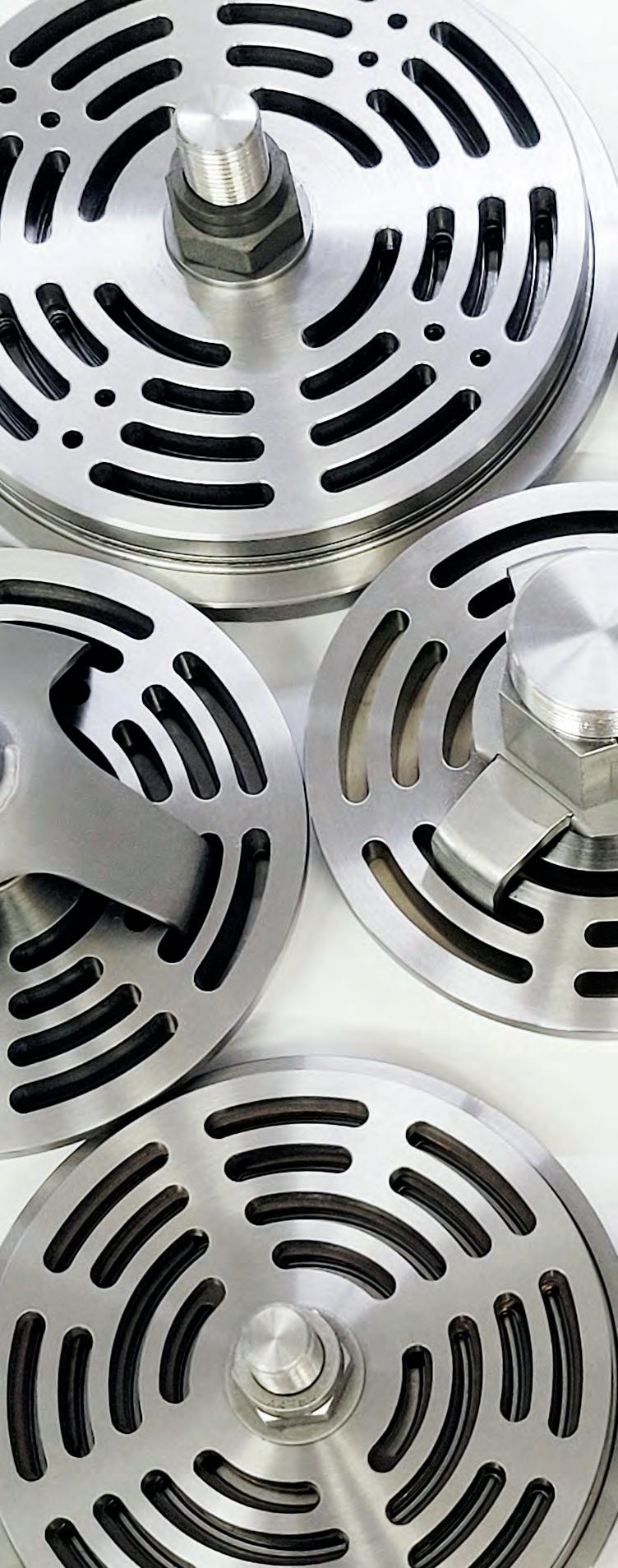
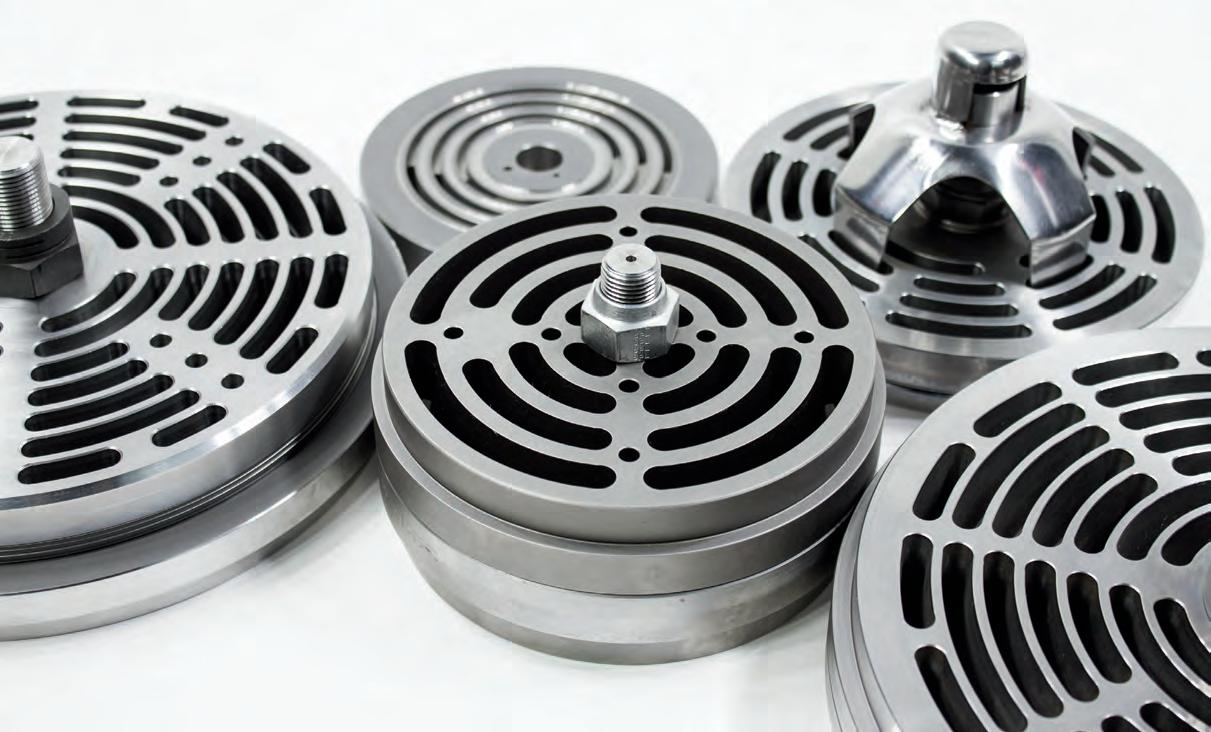
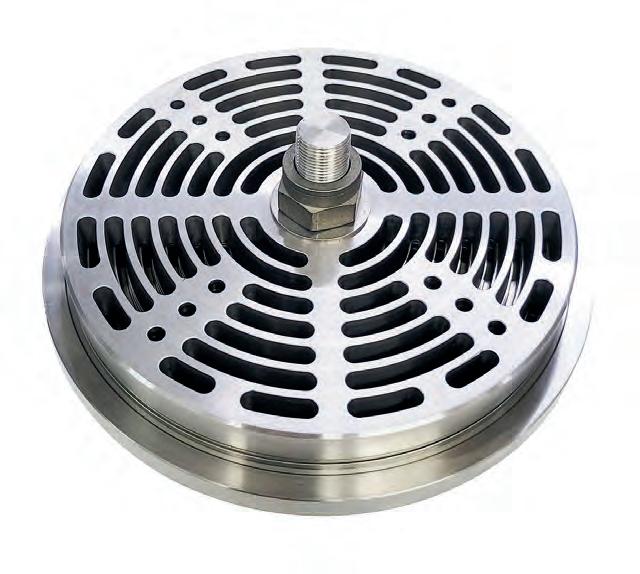

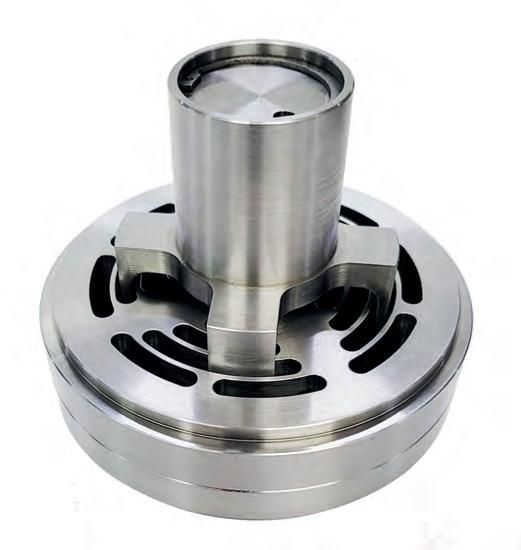
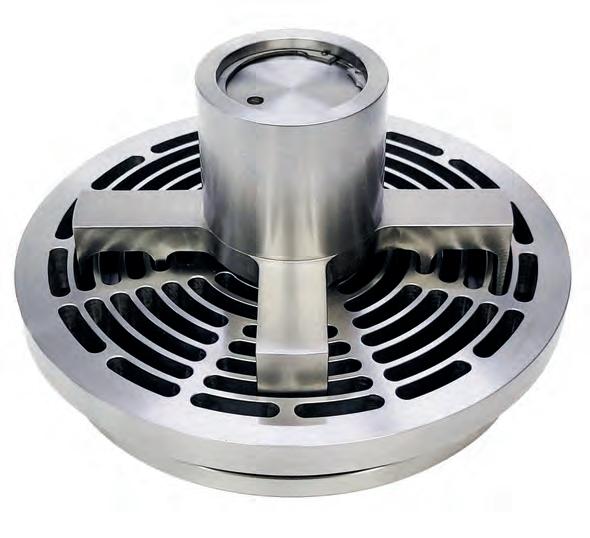
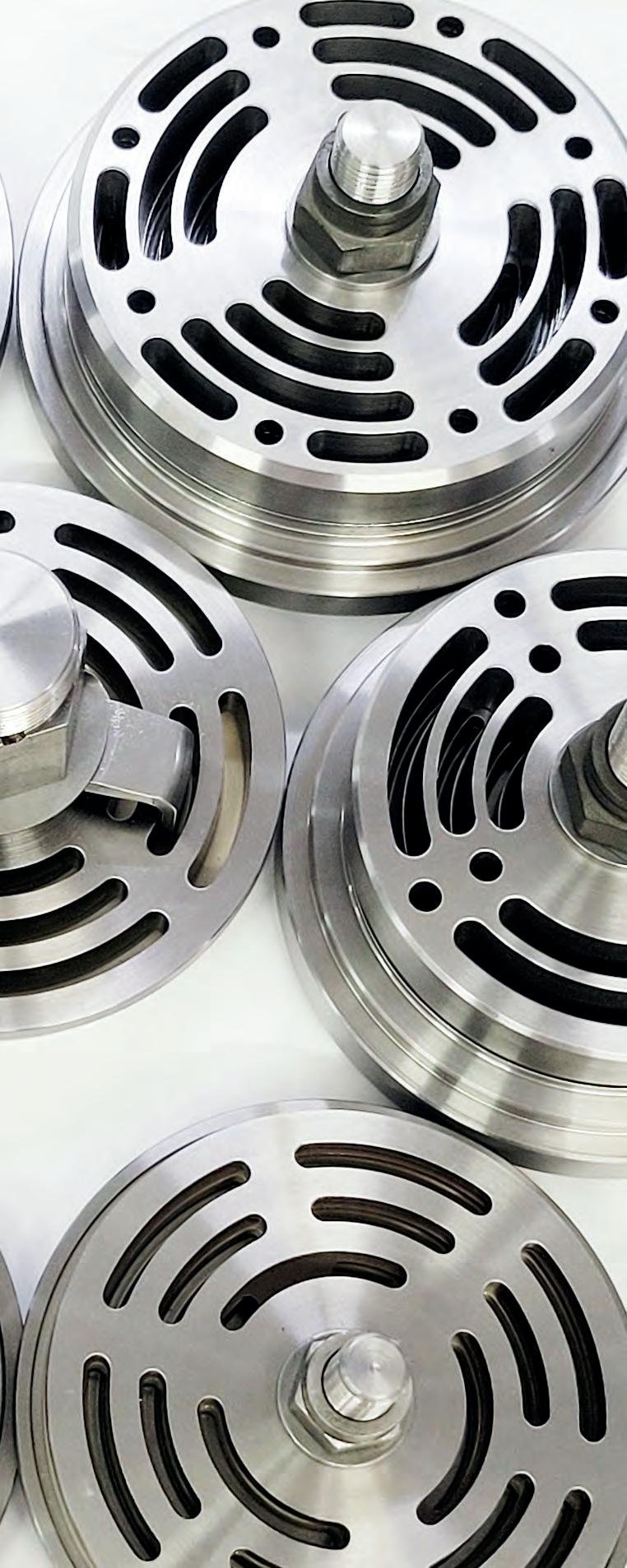
TAKING CARE OF ALL YOUR COMPRESSOR VALVE NEEDS.
24 hrs 7 days
The compression industry is entering a pivotal period as natural gas demand accelerates both domestically and abroad. U.S. LNG export expansion, rising power generation needs from AI-driven data centers, and ongoing decarbonization efforts are reshaping expectations for performance, reliability and emissions.
To understand how leading companies are navigating these trends, COMPRESSORTech2 spoke with executives representing three distinct perspectives: Mike Robbins, CEO of Berkshire Hathaway Energy Compression Services (BHE Compression Services); John Griggs, CFO of Kodiak Gas Services; and the new CEO of FW Murphy.
Their insights reveal a common thread: the next decade of gas compression will be defined by workforce readiness, supply-chain resilience, and smarter, loweremission technology.
CEO sees long-term growth in large-horsepower compression and low-emission technology
Mike Robbins, BHE Compression Services CT2 spoke with Mike Robbins, president and CEO of Berkshire Hathaway Energy Compression Services (BHE Compression Services), about market momentum for large-horsepower compression, supplychain challenges, and the company’s CleanMachine technology designed to lower methane intensity.
Michael Robbins brings more than 25 years of experience in compression and gas operations. A co-founder of TCB Energy
Services, he previously held leadership positions at USA Compression, Universal Compression and Exterran, and began his career at Red Cedar Gathering. Robbins studied electrical engineering at the Colorado School of Mines.
AS THE INDUSTRY NAVIGATES BOTH ENERGY TRANSITION PRESSURES AND GROWING GLOBAL GAS DEMAND, HOW DO YOU SEE THE ROLE OF COMPRESSION SERVICES EVOLVING OVER THE NEXT DECADE?
Robbins: Large-horsepower compression services demand will continue to grow over the next decade in support of increased domestic needs, AI and data centers, and overall electrification, as well as international consumption tied to LNG exports. At the same time, we must continue working to lower the environmental impact of our operations, especially in emissions reduction, regardless of regulatory pressure.
LARGE-HORSEPOWER COMPRESSION OFTEN COMES WITH UNIQUE RELIABILITY AND MAINTENANCE DEMANDS. WHAT ARE THE BIGGEST OPERATIONAL CHALLENGES YOU SEE TODAY, AND HOW IS YOUR TEAM ADDRESSING THEM?
Robbins: The largest operational challenge is finding qualified technicians. Partnerships are an extremely important part of ensuring we have adequate, experienced staffing to support our customers’ operations. Our strong partnership with TCB Energy Services gives us guaranteed access to a highly skilled, multifaceted
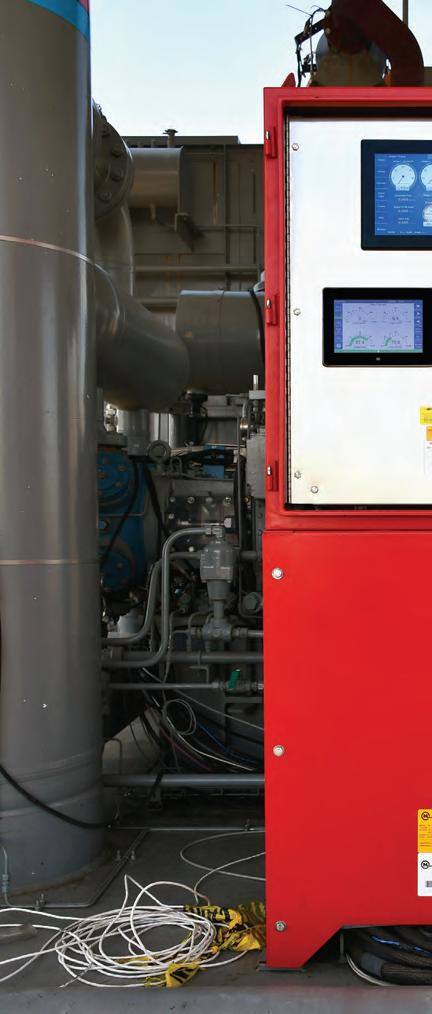
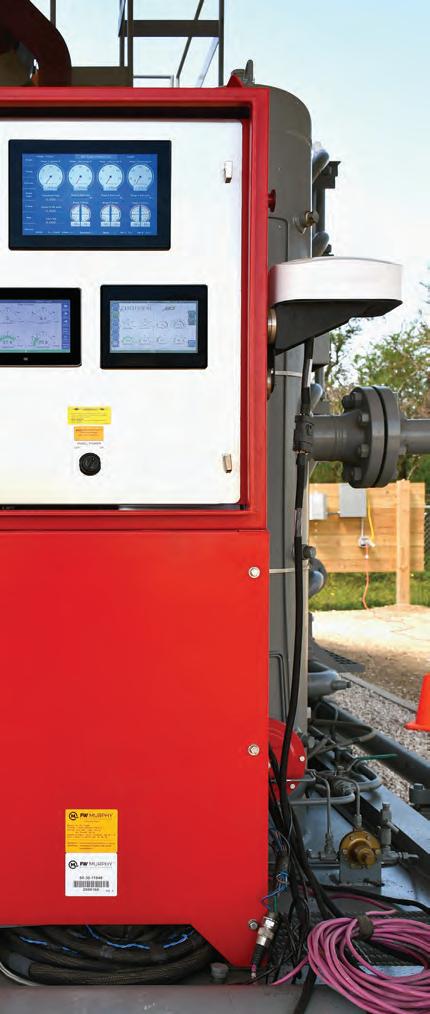
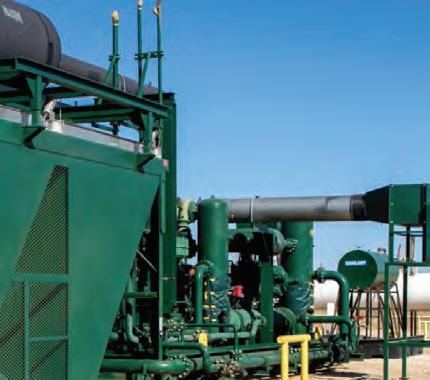
An FW Murphy Production Controls control panel at a facility.
“Large-horsepower compression demand will continue to grow over the next decade in support of domestic needs, AI data centers, and LNG exports.”

MIKE ROBBINS, BHE Compression Services
staff. This has been key to supporting our growth and supplementing our internal team when unique skill sets are required.
THE COMPRESSION SECTOR, LIKE MUCH OF THE ENERGY INDUSTRY, FACES CHALLENGES AROUND EQUIPMENT LEAD TIMES, SKILLED LABOR AVAILABILITY AND BROADER ECONOMIC VOLATILITY. HOW ARE THESE FACTORS INFLUENCING YOUR GROWTH PLANS AND ABILITY TO DELIVER FOR CUSTOMERS?
Robbins: Post-COVID, execution by some key vendors has had a huge impact on our growth potential and that of our customers. Equipment delivery for engine-driven packages has sometimes been delayed by six months or more, pushing new package lead times out to 60 to 90 weeks in extreme cases. Our strategy is to maintain
a reasonable level of inventory for both current and potential customers, which helps offset some of these impacts—but certainly not all.
BHE COMPRESSION HAS PROMOTED ITS CLEANMACHINE TECHNOLOGY AS A BREAKTHROUGH IN REDUCING METHANE AND COMBUSTION EMISSIONS. WHAT MAKES THIS SYSTEM DIFFERENT, AND HOW IS IT CHANGING CUSTOMER EXPECTATIONS?
Robbins: The CleanMachine focuses on three things: eliminating methane emissions where possible, capturing what cannot be eliminated, and continuously monitoring system performance. That allows us to provide a real-time methane intensity number for our equipment. We also provide annual emissions testing and GHG certifications as part of our service.
Year-to-date 2025 data, validated by GHG certifications, show a fleet performance more than 40% lower in methane intensity than a conventionally designed compressor package. This technology was built into our fleet from the beginning—every unit includes it as standard.
MANY MIDSTREAM AND UPSTREAM OPERATORS ARE UNDER PRESSURE TO REDUCE METHANE INTENSITY. HOW DO YOU HELP CUSTOMERS MEET THESE GOALS WHILE MAINTAINING RELIABILITY AND COST COMPETITIVENESS?
Robbins: Our team worked hard to lower total methane intensity while keeping capital costs similar to other fleet designs. That means we can bring this solution to market at competitive rates, not a premium. Our methane-focused diagnostics also provide preventive maintenance insights that improve run time. The way we see it, if a customer can have lower methane intensity for the same cost, why would they choose anything else?
WITH METHANE REDUCTION BECOMING A FOCUS FOR BOTH REGULATORS AND INVESTORS, HOW DO YOU SEE POLICY AND MARKET PRESSURES SHAPING DEMAND FOR LOW-EMISSION COMPRESSION IN THE NEXT FIVE YEARS?
Robbins: Regulatory swings can create uncertainty, but our approach is to make smart, long-term decisions that are
environmentally responsible and cost competitive. Ultimately, reducing emissions is the right thing to do, regardless of political shifts. Our team’s work is paying off—we’re seeing it in the momentum of the business and in the market share BHE Compression Services is winning.
CFO discusses electrification, AI and the road ahead for LNG-driven growth
John Griggs, Kodiak Gas Services
CT2 sat down with John Griggs, executive vice president and chief financial officer of Kodiak Gas Services, to talk about electricdrive compression, the integration of CSI Compressco, workforce development, and the long-term outlook for LNG demand.
Griggs joined Kodiak in 2023 after serving as CFO at Circulus Holdings, Conquest Completion Services and Rubicon Oilfield International. He previously worked in energy private equity at CSL Capital Management and D.E. Shaw Group, and began his career as an investment banker at Simmons & Co. International.
WHAT DEMAND ARE YOU SEEING FOR ELECTRICDRIVE COMPRESSION VERSUS GAS-DRIVE, PARTICULARLY IN THE PERMIAN BASIN WHERE ERCOT TRANSMISSION CAPACITY IS TIGHT?
Griggs: It’s one of the questions we get most often. Kodiak focuses primarily on large-horsepower compression—1,000 horsepower and above. Electric compression adoption has been more prevalent in smaller-horsepower applications, typically 800 horsepower or less.
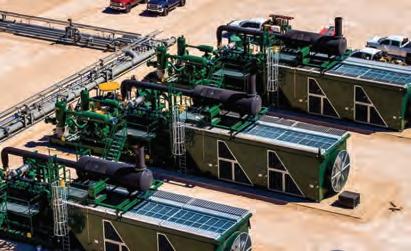
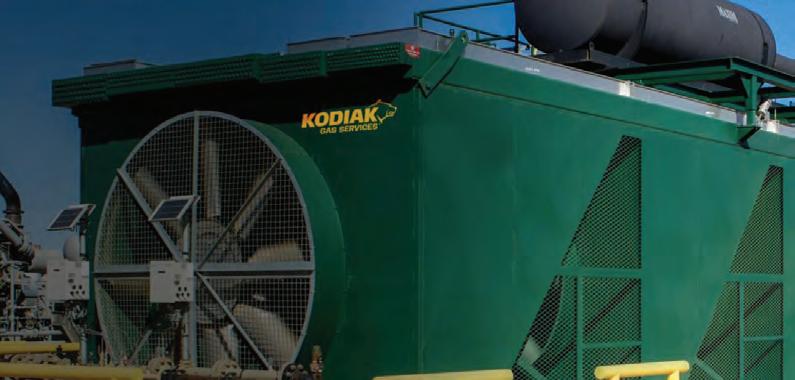
When you move into higher horsepower, the power consumption and voltage requirements are substantial. If a customer doesn’t already have grid access, building out last-mile electrical infrastructure can be costly. That’s a hurdle for many midstream operators weighing electric versus gas drive. That said, the trend is real. About 40% of our new horsepower in 2025 is electric, and 2026 looks similarly strong. Larger customers with ESG commitments continue to push electrification, but smaller independents are taking a more case-bycase approach given the current regulatory climate.
KODIAK MADE HEADLINES WITH THE ACQUISITION OF CSI COMPRESSCO. WHAT HAVE BEEN THE BIGGEST CHALLENGES IN INTEGRATING THOSE ASSETS?
Griggs: The acquisition has been a home run strategically and financially, but it brought challenges.
The first was non-core horsepower. Kodiak has always followed a “Southwest Airlines model” of a standardized fleet. CSI had a more diverse fleet, including smaller units and international operations. Exiting those areas took time and effort.

Second, we needed to modernize the fleet. We invested about $15 million to convert remaining CAT 3516 ULB engines to J configurations, which is now essentially complete.
Third, culture. We developed a companywide “greenprint” of refreshed mission, vision and values to unify more than 1,300 employees. Finally, systems integration—our new ERP platform provides a single source of truth and the foundation for future AI applications.
YOU MENTIONED ARTIFICIAL INTELLIGENCE. HOW IS KODIAK APPROACHING AI ADOPTION?
Griggs: AI is a big focus for us, both in structured industrial projects and grassroots productivity tools.
On the industrial side, we’re working with Bright AI to build systems that improve efficiency in labor and equipment management. One example is a large language model tailored to Kodiak’s fleet that helps technicians troubleshoot faster in the field.
We’re also deploying advanced sensors that monitor performance and enable
“About 40% of our new horsepower in 2025 is electric, and 2026 looks similarly strong.”
JOHN GRIGGS, Kodiak Gas Services
predictive maintenance. As those systems learn, they become smarter and increase horsepower-per-technician efficiency—a key metric in our model.
LABOR REMAINS A CHALLENGE ACROSS THE COMPRESSION INDUSTRY. HOW ARE YOU ADDRESSING IT?
Griggs: People are always the governor on our growth. We recruit aggressively through technical schools and run one of the most comprehensive training programs in the industry—BEARS Academy. Our IGNITE program brings in younger employees, trains them through BEARS, pairs them with mentors, and places them where they’re most needed. It’s a proactive, pipeline-based approach to workforce development.
LNG EXPORTS ARE EXPANDING RAPIDLY. HOW DO YOU SEE KODIAK POSITIONED OVER THE NEXT FIVE YEARS?
Griggs: The outlook is very strong. Roughly 70% of our horsepower is in the Permian Basin, which benefits from oil, gas and NGL revenues. We compete on reliability, not
price—uptime is our brand.
Looking forward, LNG is the key driver. The U.S. LNG buildout underway through the 2030s will require massive new compression capacity, and Kodiak is well positioned to support that demand.
FINALLY, WHAT KEEPS YOU UP AT NIGHT?
Griggs: Labor and energy policy. Compression assets have 30- to 40-year lifespans, so stable, rational policy is critical. The industry needs balance—recognizing hydrocarbons will remain essential while advancing environmental responsibility and reliability of supply. The uncertainty created by political swings is what keeps me up at night.
New VP/GM focuses on execution, smart controls and sustainable growth in compression
Levent Caglar, FW Murphy
CT2 spoke with Levent Caglar, who became VP/GM of FW Murphy in August, about his leadership priorities, the company’s path forward in controls and automation, and the technologies reshaping natural gas compression.
Caglar joined FW Murphy following leadership roles at Caterpillar and CSI Compressco, bringing deep experience in both equipment manufacturing and contract compression. In his new role, he is focused on aligning FW Murphy’s engineering and commercial strategies to accelerate innovation, strengthen customer relationships and expand the company’s footprint in emissions-compliant and digital control solutions.
YOU’VE WORKED WITH MAJOR PLAYERS LIKE CATERPILLAR AND CSI COMPRESSCO. WHAT LESSONS FROM THOSE ROLES WILL YOU BRING TO FW MURPHY?
Caglar: My time at Caterpillar and CSI Compressco gave me a front-row seat to what operational excellence and customercentric strategy truly look like. At FW Murphy, I’m focused on execution with precision — aligning our engineering resources with our customers’ most important initiatives. Both of my previous roles required constant coordination between engineering, sales and product teams. I’ll bring that collaborative mindset here to ensure our strategic initiatives are aligned across departments and driven by shared goals. Ultimately, I’m here to help FW Murphy scale with intention — building systems, teams and strategies that deliver lasting impact.
HOW IS FW MURPHY’S TECHNOLOGY EVOLVING TO HELP OPERATORS REDUCE EMISSIONS, IMPROVE UPTIME AND OPTIMIZE FLEET PERFORMANCE?
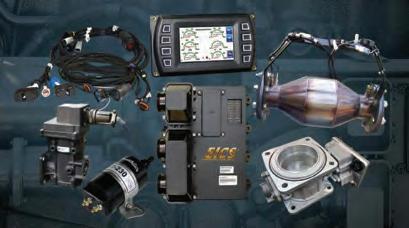
Caglar: FW Murphy’s technology is evolving in direct response to the industry’s most pressing challenges, and I see three major areas where we’re making a strategic impact. First, reducing emissions through smarter controls. Our turnkey Engine Integrated Control System (EICS) allows customers to optimize engine performance while maintaining emissions compliance. These solutions help operators meet regulatory standards without compromising performance.
Second, improving uptime
with predictive intelligence. Our remote monitoring platforms — including M-LINK and Centurion — give operators real-time visibility into asset health. That means faster diagnostics, fewer unplanned shutdowns, and smarter maintenance planning, all of which drive uptime.
Finally, optimizing fleet performance with data-driven insights. By integrating IoT-enabled controls and analytics, we help operators benchmark performance across fleets, identify underperforming assets, and make informed decisions about utilization and lifecycle management.
“We’re enabling operators to run cleaner, smarter and more resilient operations.”— Caglar
FW MURPHY HAS A LONG HISTORY IN CONTROLS, MONITORING AND AUTOMATION. WHERE DO YOU SEE THE COMPANY’S GREATEST OPPORTUNITIES FOR GROWTH IN THE NATURAL GAS COMPRESSION MARKET?
Caglar: Our goal at FW Murphy isn’t just to keep pace with the industry. We aim to help define the next chapter in compression technology. I see several strategic growth opportunities ahead:
1 Digital transformation and smart controls. We’re seeing increased demand for intelligent systems that support remote diagnostics, predictive maintenance and real-time analytics. FW Murphy’s Centurion and M-LINK platforms are evolving to meet these needs.
2 Emissions compliance and sustainability. With tightening environmental regulations, operators are looking for turnkey solutions that help them stay compliant. Our EICS systems are becoming essential tools for cleaner operations.
3 Fleet optimization and lifecycle management. Our integrated monitoring and control systems allow centralized oversight, enabling smarter decisions on dispatching, maintenance and performance benchmarking.
4 Global expansion and strategic partnerships. As natural gas demand grows globally, our proven, reliable systems are well-suited for deployment in remote, high-demand environments. Our alignment with Dover Precision Components also opens doors for co-developed solutions and expanded market access.
“Our opportunities align with the industry’s digital transformation.”— Caglar
YOUR BACKGROUND INCLUDES STRUCTURING MASTER SERVICE AGREEMENTS AND WORKING ON MERGERS AND ACQUISITIONS. DO YOU SEE OPPORTUNITIES FOR FW MURPHY TO EXPAND THROUGH PARTNERSHIPS OR ACQUISITIONS, OR IS ORGANIC GROWTH THE NEAR-TERM FOCUS?
Caglar: In the near term, our focus is organic — scaling adoption of smart control platforms like Centurion, M-LINK and EICS, and deepening our role in emissionscompliant compression solutions. We’re also leveraging Dover’s infrastructure to streamline operations and reach new markets.

“We’re enabling operators to run cleaner, smarter and more resilient operations.”
LEVENT CAGLAR, FW Murphy
Looking ahead, we’ll explore partnerships or acquisitions that complement our portfolio and help us build more integrated solutions. My background equips me to evaluate these opportunities with precision and ensure they align with Dover Precision Components’ long-term strategy while delivering measurable impact.
“Executing with precision means aligning engineering, sales and product teams around customer priorities.” — Caglar CT2
Reliability is everything. Compression stations, pipelines, and associated hydraulic and turbine systems are under constant pressure (both literally and figuratively) to perform without fail. As operating conditions grow more intense and tolerances tighten, controlling the hidden threat of lubricant-derived varnish has become an operational imperative.
Precision cleaning using system cleaners is emerging as a new standard of best practice, especially as operators push for more efficient maintenance strategies and asset reliability.
The shifting role of cleanliness in system reliability
Hydraulic and turbine systems that support natural gas operations often face extreme loads and thermal stress. These conditions accelerate the breakdown of lubricants, resulting in the formation of insoluble degradation products. Over time, these products can agglomerate into a sticky, resin-like material known as varnish. Left unchecked, varnish accumulates on component surfaces, narrows clearances, interferes with valve movements, and leads to performance degradation or unexpected failures.
In the past, varnish was largely viewed as a nuisance. Today, it’s recognized as a leading cause of reliability issues in highperformance systems. In mission-critical applications like gas compression, where downtime can cost thousands of dollars per hour, even small performance losses due to varnish buildup can have major implications.
Case in point: A U.S. gas operator dealing with varnish-related turbine issues turned to a proactive system cleaning solution and was able to resolve sticking valve problems that had triggered multiple shutdowns. This shift in thinking from treating symptoms to removing the root cause shows how midstream operators are modernizing their approach to system maintenance.
What makes a system cleaner safe and effective?
A major barrier to the adoption of system cleaners in the past has been uncertainty: Would they damage seals? Disrupt lubricant
By Allen Craig, Regional Technical Specialist, Chevron
chemistry? Leave behind residues that compromise performance?
Fortunately, modern system cleaners built with patent-pending polyalkylene glycol (PAG) chemistries are designed to work safely within lubricant systems while delivering powerful cleaning action. These advanced chemistries act as polarity “bridges,” dissolving soft contaminants, dispersing varnish precursors, and safely flushing degradation products without destabilizing the base lubricant.
Key features of an effective system cleaner include:
■ Compatibility: Fully miscible with both inservice oils and fresh fill lubricants.
■ Neutral pH: Non-acidic and non-caustic, reducing risk to metallurgy.
■ Seal Safety: Extensively tested for compatibility with common elastomers and system components.
■ Deposit Softening: Designed to dissolve or suspend soft contaminants for easy removal via filtration.
Using an appropriate system cleaner may help reduce varnish potential, as measured by Membrane Patch Colorimetry (MPC) values, within a single cleaning cycle, and typically without system disruptions.
The relationship between varnish control and lubricant life extension
In many cases, varnish isn’t just a sign of
lubricant breakdown, it’s also a contributor to accelerated lubricant aging. Deposits can trap heat, catalyze oxidation, and compromise the effectiveness of antioxidant additives. That means poor cleanliness doesn’t just hurt hardware, it shortens oil life, too.
System cleaners can prevent this altogether. By restoring baseline cleanliness, they can help preserve the health of both the lubricant and the machine. When used prior to an oil change, these cleaners remove legacy deposits that might otherwise contaminate the new fill, giving fresh oil a clean slate for optimal performance.
We’ve seen this success in the field firsthand: Midstream operators who’ve incorporated system cleaning into pre-fill maintenance have reported not only better reliability but longer intervals between oil changes and less frequent need for varnish mitigation technologies.
When to introduce system cleaning into preventive maintenance
System cleaners are no longer just a reactive solution. Increasingly, they are being built into preventive maintenance schedules as part of a broader reliabilitycentered maintenance strategy. Key points to consider:
■ Before fluid changeouts: Cleaning before

introducing a fresh oil charge can prevent old deposits from contaminating new oil and extends lubricant life.
■ During seasonal turnarounds: When equipment is offline for inspection or overhaul, cleaning can provide an opportunity to restore system cleanliness.
■ When varnish symptoms appear: If operators observe sticking valves, elevated MPC levels, filter plugging, or hot spots, a system cleaner may help reverse damage before major intervention is needed.
■ As a routine health measure: Some operators choose to implement cleaning annually or biennially to reduce the need to reactive maintenance altogether. A proactive approach can be beneficial.
In documented field applications, operators have observed MPC values drop significantly, sometimes from above 50 to below 10, within a matter of weeks when system cleaners are used effectively. These results have generally been achieved without requiring system shutdowns, and reported benefits have included improved component responsiveness, lower operating
temperatures, and increased overall uptime.
For those in the midstream gas sector, equipment uptime is directly tied to operational profitability. Precision cleaning using scientifically formulated system cleaners can help operators minimize unplanned downtime, reduce total cost of ownership, and extend the life of both equipment and lubricants.
Just as filtration once revolutionized the maintenance of hydraulic and turbine systems, system cleaners are now helping operators meet the rising demands of cleaner, more efficient operations. As system complexity increases and tolerances narrow, cleanliness is not optional, but required for peak performance.
The adoption of system cleaners is not about fixing problems after they happen, it’s about building reliability into the DNA of midstream operations. CT2


By Sloan Lubrication Systems
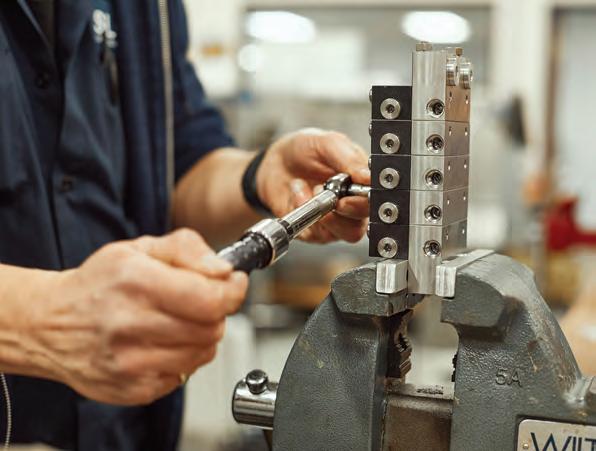
Why do so many compressor operators continue to have reliability problems with their lubrication systems? A compressor lubrication system that is properly designed for the application will operate reliably for years, sometimes even decades if maintenance is performed. Lack of preventative maintenance is the most common cause of failure, and those failures can cause a lot of damage.
Too often, compressor lubrication systems are ignored. This can be attributed to a lack of knowledge. When an accessory system operates reliably for years without issue, it is easy to forget about it. And with regular turnover, knowledge is lost, maintenance is not performed, and eventually reliability problems manifest.
Operators may think that the lubrication system can “run to fail,” not knowing that without preventative maintenance the system can no longer “fail safe.”
The result? Costly damage to power and compressor cylinders, packings, and unscheduled downtime. The cost of this damage far surpasses the cost of doing regular preventative maintenance.
For these reasons, training is a key component of a comprehensive preventative maintenance program. If operators are going down a maintenance check list that includes a task to “test divider blocks,” but they do not know how, they run the risk of unknowingly putting a bad divider block back into service.
To provide an example of the impact of this mistake, in one case an integral compressor received a total overhaul, and no maintenance was performed on the lubrication system. When the compressor was put back into service, the power cylinders failed. The damage was extensive and costly. Repairs were performed, and again the lubrication system was not addressed. When the compressor was put back into service the result was the same. When the compressor operator called in a lubrication system service provider to help, the discovery was made that the divider blocks were bad. The expense and downtime could have been prevented with a couple hundred dollars in parts and several hours of preventative maintenance.
A comprehensive preventative
maintenance program also considers the specific operating conditions of the compressor application. A common misconception is that it is acceptable to skip regular divider block testing and just replace them every 2 - 5 years. While this may work in most cases, consider the risk. Perhaps a divider block has failed. If this divider block is not detected, it may lead to damage similar to the case above.
By testing regularly, operators get valuable information about the health of their system, and the expected life of their components. Equally as important, they may find that there are needed changes to their system to ensure long-term reliability. For example, they may find that they need to add balancing valves if the wear to their divider blocks from pressure differentials is leading to unsatisfactory lifespan.
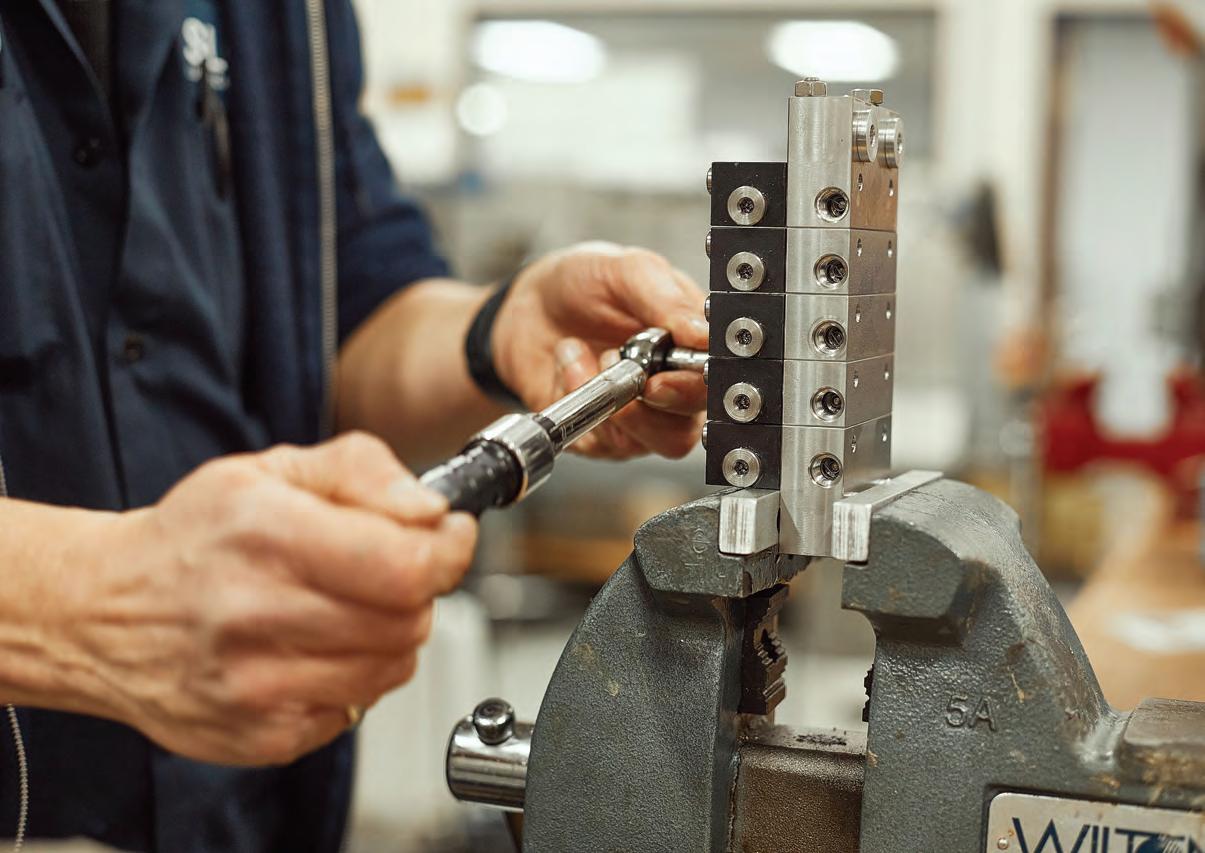
Divider block testing is the most time consuming and critical preventative maintenance task, but it is not difficult. To do it properly, operators need to be equipped with the correct tools – a test stand or a test pump that can generate and hold 3000 PSI, and knowledge of the testing steps. There are two tests that need to be performed, the flow test and the bleed-down test.
The flow test verifies that the divider block can cycle freely. With no back pressure, the block is cycled slowly with a test pump. If the block takes less than 500 PSI to cycle, it passes this test. The second test that
needs to be performed on divider blocks is the bleed-down test. In this test, each outlet is capped causing the divider block to deadhead when it is pressured up to 3000 PSI. If the pressure on the test gauge does not drop more than 500 PSI over one minute on each outlet, this block passes. This test is verifying that the piston to bore clearance in each divider block piston section is tight enough that oil will not bypass from one outlet to another, causing lube rate
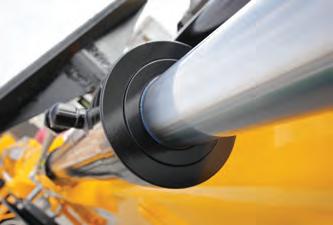
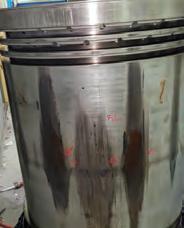
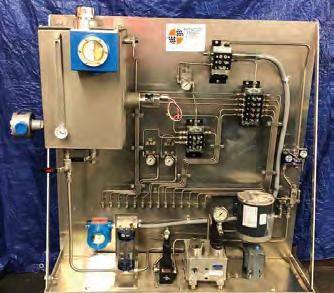
A damaged power cylinder.
inaccuracy, and compromising the failsafe. that is key to the lubrication system’s ability to “fail safe.”
Other preventative maintenance tasks may vary depending on the design of the system, but they typically include changing filters, inspecting oil supply tanks, changing reduce and lube box fluids, changing rupture disks and testing relief valves.
Properly maintained, compressor lubrication systems can operate reliably for many years. The tasks that need to be performed can take some time and expertise, but time, training and replacement parts are a small price to pay compared to the damage caused by system failure. CT2

Maximize your reciprocating compressor’s full potential
As your compression partner, we offer comprehensive engineering expertise to better support you:
Enabling

ADIPEC
Nov. 3-6
Abu Dhabi Adipec.com
JANUARY

POWERGEN
Jan. 20-22, 2026
San Antonio, TX www.powergen.com
ADI Forum
Jan. 28-30
Houston, TX www.adi-forum.com

OTC Asia
March 31-April 2
Kuala Lumpur, Malaysia www.otcasia.org

HANNOVER MESSE
April 20-24
Hannover, Germany www.hannovermesse.de
MAY

Sensor+Test
May 9-11
Nuremburg, Germany Sensor-test.de
EASTERN GAS COMPRESSION ROUNDTABLE
May 12-14
Pittsburgh, Penn. www.egcr.org
JUNE

ASME Turbo Expo
June 15-19
Milan, Italy Asme.org

SEPTEMBER

TPS 2026
Sept. 22-24
Houston, Texas Tps.tamu.edu
GPA MIDSTREAM
Sept. 20-23

San Antonio, TX www.gpamidstream.org

GMRC Sept. 28-Oct.1 Louisville, KY www.gmrc.org
BOLDFACE indicates shows and conferences in which COMPRESSORTECH2 is participating

b. Legitimate Paid and/or Requested Distribution (By Mail and Outside the Mail)
(1) Individual Paid/Requested Mail Subscriptions Stated on PS Form 3541.
(2) Copies requested by Employers for Distribution to Employees by Name or Position Stated of PS Form 3541
(3) Sales Through Dealers and Carriers, Street Vendors, Counter Sales, and Other Paid or Requested Distribution Outside USPS®
(4)
d. Nonrequested Distribution (By Mail and Outside the Mail
(1) Nonrequested Copies Stated on PS Form 3541
(2) Nonrequested Copies Distributed Through the USPS by Other Classes of Mail
(3) Nonrequested Copies Distributed Outside the Mail (Include Pickup Stands, Trade Shows, Showrooms and Other Sources)
(4) Nonrequested Copies Distributed Outside the Mail (Include Pickup Stands, Trade Shows, Showrooms and Other Sources)
e.
f.
h.
i.
and/or Requested Circulation
• Pipe Supports & Clamps
• Epoxy Grout
• Anchor Bolts
• Flywheel Locks
• Lubrication Systems
• Spark Plugs
• AMOT Controls
SERVICES
• Field Machining • Casting Repair • Crankshaft Machining
Machine Shop • Broken Bolt Repair • Frame Reinforcements
Alignment Services



Ethylene plants rely on their crackedgas or charge-gas compressors along with refrigeration compressors for the complete process to work properly. Damage caused to any of these compressors due to a surge event costs thousands of dollar in both equipment repair and lost production. Compressor operation must be fine-tuned to maximize performance and to reduce spurious trips that result in downtime and unnecessary maintenance. By increasing operating efficiency, boosting unit availability and production, and reducing maintenance costs, plant operators can increase their plant’s throughput to meet market demands. But these goals do come with challenges.
Cracked-gas compressors (CGCs), sometimes called process-gas or
charged-gas compressors is the single most critical piece of equipment in an ethylene plant. This asset can cost as much as $50 million and operates 24/7 under demanding conditions. Because it has no backup, ethylene plant operators know that if their compressor trips – whether the trip was caused by excess vibration, a surge, an instrument malfunction or other problems –their entire process may be brought to a halt for up to a week. If a trip occurs, operators may only have a 10- to 30-minute window during which they must assess the trip’s cause and determine whether it’s safe to restart the machine. After that, the rest of the plant will move too far from its normal operating conditions and the process will be saturated. A compressor shutdown has a domino effect on the rest of the plant that can necessitate product flaring and even a full plant shutdown.
Spurious trips can be problematic, but a compressor surge must be avoided at all costs. Operators must rely upon the reaction time of the compressor’s anti-surge valve, which utilizes a dedicated control system, to both optimize process operations and react quickly and accurately to prevent compressor surge. In the case of an emergency, the anti-surge valve may have to travel up to 20 inches in .75 seconds.
Unless it is very tightly controlled, such a large stroke in a short time could cause the valve to overshoot. Precise process control is critical.
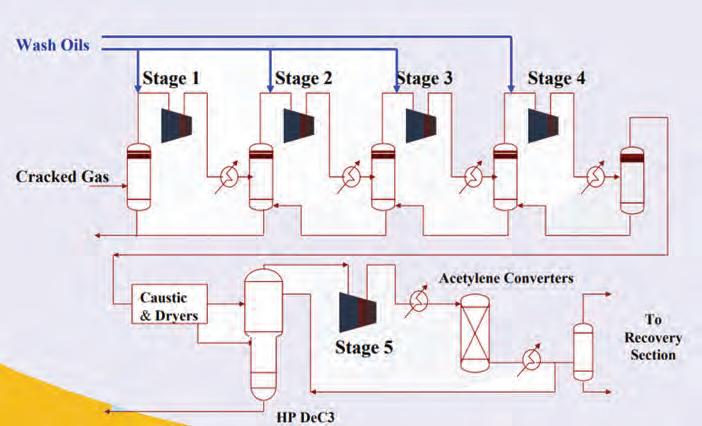
CGCs are high-power compressors that draw gas from the cracking furnaces through various quench coolers and separation sections of the plant. The compressor pressurizes the gas for further separation and provides large volume, high mass flowrates at low pressures and usually needs multiple compressor stages or sections to meet the required discharge pressure. The CGCs typically have three to five compressor stages across two or three compressor bodies of varying configurations. Reference Figure 1.
The large volume requirement along with the need to reduce the head pressure at each stage makes a double-flow configuration more suitable for the first stage process of a cracked-gas compressor. This is because of the fouling caused by residue buildup on the compressor blades. A double-flow compressor basically arranges two smaller compressors back to back with a common discharge. This configuration enables a much higher volume flow within a smaller and less-expensive compressor.
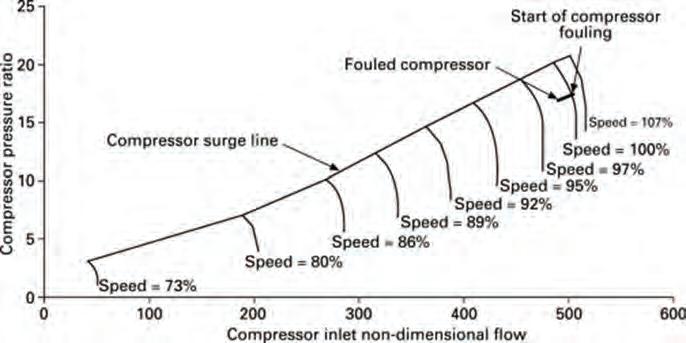
The cracked gas contains trace amounts of compounds that can polymerize within the gas stream and stick to the flow path in the compressor. This fouling degrades the performance of the compressor and often the actual surge line of the compressor tends to shift towards right side of performance curve as residue builds up. Reference Figure 2.
The compressor control should compensate for the fouling that occurs over time and provide a safety “barrier” for subsequent surges. The control will automatically shift the surge control line as fouling occurs keeping the machine operating properly in a possible surge event. Furthermore, the formation of fouling increases the gas temperature. To reduce
processes can sometimes reverse interstage flows in the refrigeration compressor.
this gas temperature increase, atomized water is injected into the gas stream through nozzle located in the return channel. A quench controller built inside the compressor control will maintains the gas temperature by modulating the feed rate of the atomized water.
Due to the multistage operations of CGCs, it is critical to de-couple interactions between stages. Each stage’s flow is affected by the previous stage and subsequent stages of the operation. Therefore, an efficient compressor control must be able to manage the interaction between each stage’s control loops, “decoupling” their responses. Decoupling the control loops ensures that one stage’s control loop adjusts its response in advance based on the movement of the other stage’s control loops to minimize or eliminate the interaction between the control loops.
Refrigeration compressors are multisectional or stage machines with side loads or extractions depending on the process design. Propylene refrigeration compressors are commonly a 4 stage compressor, but sometimes is 3 stages. Reference Figure 3. Mismatches of the head pressure required for each stage and large
swings in flowrates (between design and off-design performance) may impact overall compressor efficiency.
Refrigeration compressors differ from other process compressors in that the head across the entire compressor remains nearly constant at all flowrates. The discharge pressure is set by the condensing temperature of the refrigerant regardless of flow; the inlet pressure is directly related to the required duty temperature of the evaporators. These properties play an important role in dealing with centrifugal compressors in refrigeration services in offdesign cases.
As the duties change, the mass flowrate from the evaporator(s) into the compressor changes, and thus the operating point on the head vs. volumetric flowrate compressor curve also changes. The compressor supplier makes design decisions to best meet the customer’s requirements. Early collaboration between compressor supplier, end user, and process designer allows for a better understanding of the long-term operation of the equipment and the design goals.
The refrigeration process enhances its efficiency by refrigeration recuperation from the demethanizer reboilers and the ethylene fractionator. As these energy recovery
So how to provide a cool vapor stream to prevent the refrigerant compressor from surging in order to keep the discharge temperature from getting too high? To address this challenge, hot compressed vapors from refrigerant compressor discharge are used to vaporize liquid refrigerant, in a similar manner to how the process stream is used to vaporize refrigerant in the chillers. Ideally, if the compressor anti-surge vapour flow and temperature control valve on quench liquid are perfectly matched and there is no time lag within the control system, the configuration will work perfectly.
Unfortunately, if there is any mismatch, as often exists in the real world, either too much quench liquid is added to the inlet stream causing the liquid level to rise in the suction drum or not enough quench liquid is added allowing the discharge temperature to rise. In either mismatch case, the refrigerant compressor will shut down from either high liquid level in the suction drum or from high discharge temperature that is caused by the high inlet temperature due to recycling of the hot gas.
The purity of the Propylene refrigeration cooling has a significant impact on the ability of the refrigeration system to work properly. If the propylene refrigerant has a 2% impurity of ethylene, then the compressor discharge pressure needs to be 13 PSI (88 Kpa) higher. This would require a higher discharge pressure, higher compressor speed, and hence higher horsepower. To handle gas impurities variation (2%-4%), the compressor control must be unaffected by a reasonable change in the gas’ molecular weight. The final control variable, the calculated surge process variable that is the distance from surge line, should be independent of any
factors related to gas properties such as the gas’ molecular weight, the polytropic exponent. Also, the compressor’s control should have a de-coupling option to remove possible unstable interactions between the stages of a multistage compressor. Finally, the quench control function should allow a variable set point based upon the dew point curve of propane. This enhances the efficiency of Propane compressors by avoiding excess quenching and therefore lessens the chances of compressor trips while allowing faster startups.
In addition to the specific control system recommendations made above, there are some basic control system characteristics that enhance the Ethylene plant’s compressor’s operation and performance helping them to stay up and fully operational Some of these characteristics include:
■ Advance control algorithms such as a “rate” PID control that anticipates an
impending surge event and takes evasive action to prevent its occurrence.
■ Faster flow signal filtering, such as a 4-point filter which is equivalent to 20 millisecond sampling rate, to provide more precise date the control algorithm to use in its calculations.
■ Control algorithms to “break” surge cycles such as “Surge Minimum Position” lock, so that frequent surges due to upsets can be avoided.
■ The compressor control should have model based simulation option so that a configured control strategy can be tested and simulated before launching in the field.
■ Fast scan rate of signals with 40 msec scan rate along with fast responsive antisurge valves to help avoid surges events altogether.
■ Use temperature control through Quench control using dew-point curve instead of simple temperature PID loop to mitigate excess quenching.
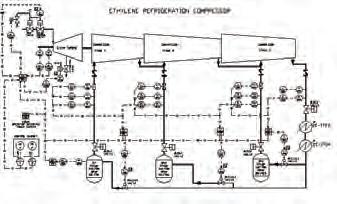
Ethylene plant compressors are highly susceptible to interstage interactions, process variations, and quick changes in process dynamics. An efficient control must have very high scan rates (40 msec), feed gas molecular weight independence, special control routines such as Surge Minimum position, and a Rate PID controller to alleviate surge risks to keep the plant’s compressors doing their job 24 hours a day – 7 days a week for years to come. CT2










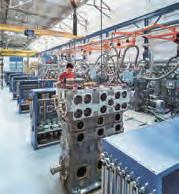

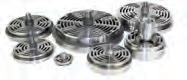






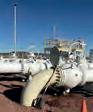





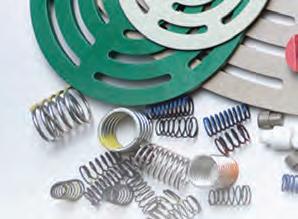

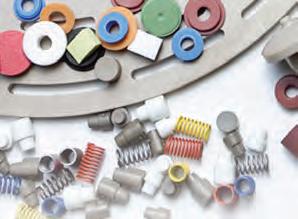
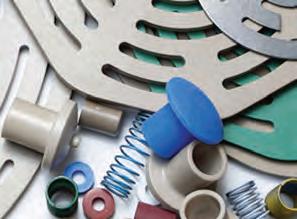
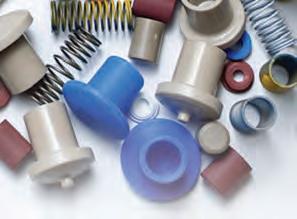


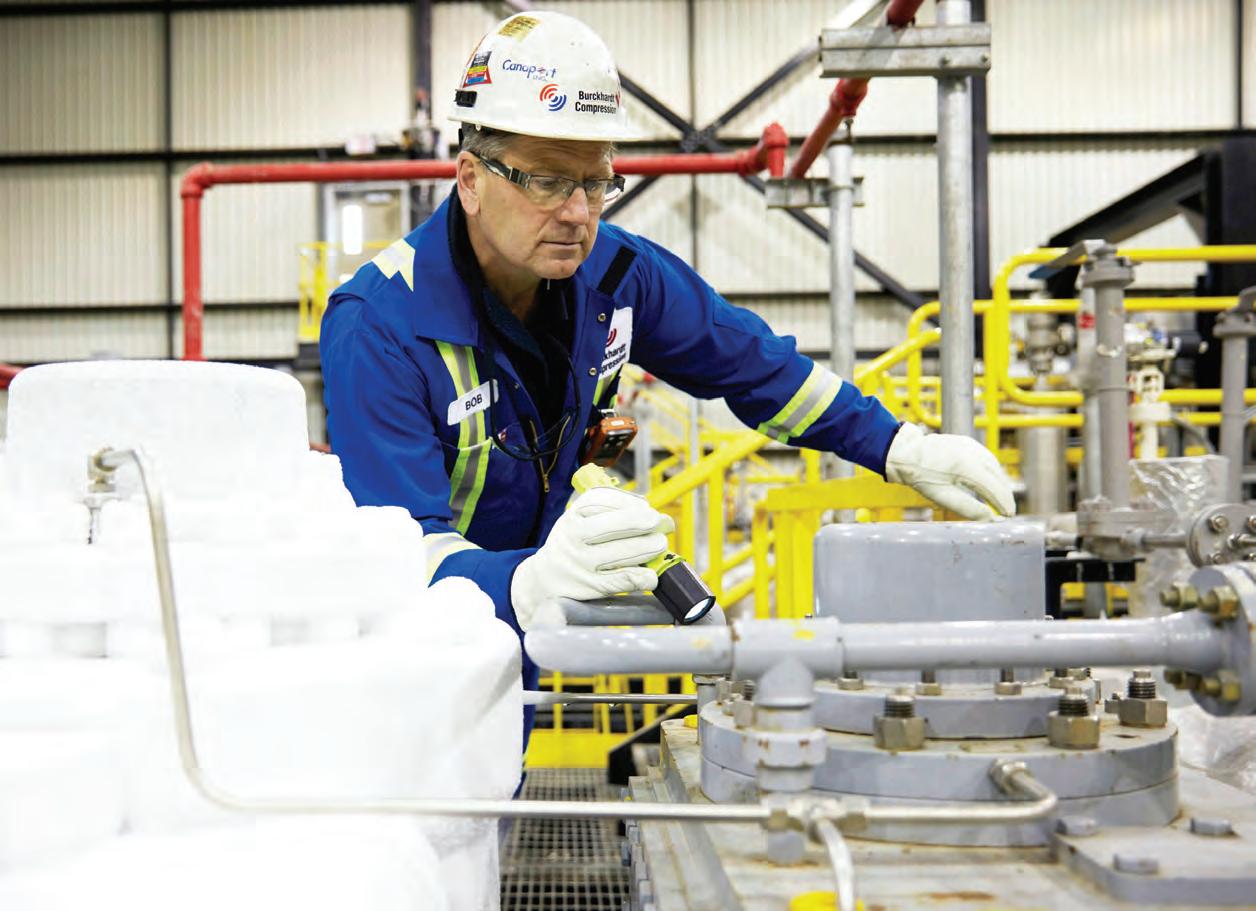



The Cornerstones of Compression series has highlighted many significant products over more than 160 years of continuous progress. This is the fourth of six Cornerstones of Compression corollary articles that provide a look the evolution of natural gas pipelines and compressor stations. By Norm Shade
The Ohio Fuel Gas Company was organized in 1902 as the Ohio Fuel Supply Company, following gas well drilling in central Ohio before the turn of the century. It was formed from the acquisition of smaller gas companies that had sprung up in multiple locations throughout central and southern Ohio. The great Sugar Grove field was followed by the Utica and Homer field. Ohio Fuel Gas was a pioneer, in 1904 building the largest compressor station in the world near Homer, Ohio. With its early headquarters in nearby Mount Vernon, Ohio, it is very likely that they influenced the C. & G. Cooper Company to manufacture early gas engine-compressors under license from the Snow Steam Pump Company.
The next big natural gas strike was in the
Ashland-Lorain field. Of course, the largest production area was in and around Hancock County, where oil production was king and the natural gas was simply flared for many years. But, just after the turn of the century, gas pipelines were built to transport the commodity to Toledo, Ohio, where a booming glass production industry emerged, and to Cleveland, where steel production was prevalent. In 1926, Ohio Fuel Gas Company merged with the Columbia Gas & Electric Corporation, which later grew to become the extensive Columbia Gas System.
A c.1923 journal, neatly hand-printed in blue ink, documented the equipment and brief histories of most of the Ohio Fuel Gas
pipeline compressor stations. The stations ranged from very small to very large. The oldest, Wheeler Compressor Station, was erected in 1901-1902 in northwest Ohio by the Northwestern Natural Gas Company with three 1000 hp (746 kW) Klein/Snow horizontal gas engine-compressors to supply the cities of Toledo and Cleveland. In 1904, three 500 hp (373 kW) National Transit horizontal steam engine-compressors were added. In 1912-1913, the station was again expanded and two 1350 hp (1007 kW) Snow horizontal gas engine-compressors were installed. In 1914, two stations were purchased from the Columbia Gas and Fuel Company and, with another expansion of the Wheeler engine house, the horizontal gas engine-compressors from the two
Columbia stations were moved and installed at Wheeler, including a 1000 hp (746 kW) Klein/Snow and two 1150 hp (858 kW) Snows. With yet another expansion in 1916, an additional 1350 (1007 kW) Snow horizontal was transferred from Treat Station. In 1917, two new 165 hp (123 kW) Miller horizontal engine-compressors were added. Finally, in 1917, two 1200 hp (895 kW) Allis-Chalmers horizontals were added, bringing the station to 14,580 hp (10,872 kW) of compression. Table 1 is a complete list of the major engine-compressors at the Wheeler Station.
The Treat Compressor Station was built in 1904 at Homer, in Licking County, Ohio, with three Snow horizontal gas enginecompressors rated at 1000 hp (746 kW) each. These engine-compressors were actually built for Snow by the C. & G. Cooper Company. Treat Station was said to be the largest gas compressor station in the world when it was built. In 1910, new compressor cylinders were installed, increasing the unit ratings to 1150 hp (858 kW). Three more 1150 hp (858 kW) Snow horizontals were added in 1907 and two more 1350 hp (1007 kW) Snows were added in 1910. As production from the Utica-Homer field declined, one 1150 hp (858 kW) Snow was moved to Ashland Station in 1913 and one 1350 hp (1007 kW) Snow was moved to Wheeler Station in 1916. It is interesting how huge horizontals were removed, disassembled and moved to different stations to be reassembled and installed for further service. As reported in previous issues of this series, moving and installing these behemoths, which averaged 200 lb. per hp, were daunting tasks.
1892
Tonkin Compressor Station was built in Hancock County, Ohio.
The Pine Grove Compressor Station was believed to have been built prior to 1900. It was equipped with four Norwalk horizontal steam engine-compressors. The station was phased out by 1923. The Tonkin Compressor Station was built in 1892 in Hancock County, Ohio. It was initially equipped with three steam engine-compressors, and two more were added in 1893. In 1913, the engine house was destroyed by a fire, and a new station was built and equipped with two 1350 hp (1007 kW) Snow horizontal gas engine-compressors.
The Tonkin Compressor Station was built in 1892 in Hancock County, Ohio. It was initially equipped with three Laidlaw-Dunn-Gordon steam engine-compressors, and two more were added in 1893. In 1913, the engine house was destroyed by a fire, and a new station was built and equipped with two 1350 hp (1007 kW) Snow horizontal gasengine compressors.
The Ashland Compressor Station was built in 1913 in Ashland, County, Ohio. It was initially equipped with one 1150 hp (858 kW) Snow horizontal that was transferred from Treat Station. In 1914, two 475 hp (354 kW) Laidlaw-Dunn-Gordon horizontal steam engine-compressors were transferred to Ashland from the Sugar Grove Station. Sugar Grove had been purchased from the Great Southern Oil and Gas Company in 1901 and phased out as a compressor station in 19121913. In 1917-1918, Ashland was expanded again with the addition of two 425 hp (317 kW) Snow horizontals and one 350 hp (216 kW) Cooper horizontal.
The Elk Compressor Station was built in 1917 in Noble County, Ohio, equipped with a 300 hp (224 kW) Miller horizontal gas engine belt-driving a Norwalk compressor. In 1919, the Zanesville Compressor Station was acquired and dismantled, and a 150 hp (112 kW) Bessemer Type X horizontal was moved to Elk. In 1920, three new 110 hp (82 kW) Cooper horizontals were also added and the original Miller/Norwalk was decommissioned, with the Miller engine then used to belt-drive a generator at another site.
Laurel Compressor Station was constructed in 1917 in Hocking County, Ohio, and equipped with two 165 hp (123 kW) Miller horizontal gas engine-compressors. Creola Compressor Station was built in 1917 in Vinton County, Ohio. It was originally equipped with a 50 hp (37 kW) Reeves vertical gas engine belt-driving an IngersollRand horizontal compressor, and then a 200 hp (149 kW) Rathburn-Jones vertical gas engine-compressor. The Reeves/IngersollRand unit was replaced in 1923 by a 160 hp (119 kW) Cooper Type 75 horizontal. The Plain Compressor Station was built in 1920 in Wayne County, Ohio. It was equipped with two 110 hp (82 kW) Cooper horizontals.
The diversity of manufacturers is a testimony to the simplicity and reliability of these early machines, which station operators were able to keep running with no outside support in remote areas. A few more early Ohio Fuel Gas Company stations will be summarized in the next edition along with a deeper dive into an early Hope Natural Gas station. CT2
1902
The Ohio Fuel Supply Company was organized. It had been the Ohio Fuel Gas Company.
1904 Treat Compressor Station was built in Licking County, Ohio.
1913 Tonkin Compressor Station was built in Hancock County, Ohio.
1917 Elk Compressor Station was built in Noble County, Ohio.
1917
Laurel Compressor Station was constructed in Hocking County, Ohio.

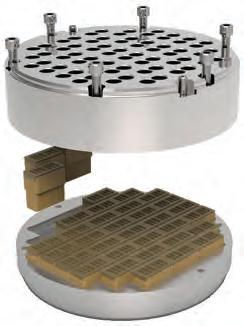
Need valves for a new compressor? Replacing existing valves? Here’s how to spend less and get more.
With conventional compressor valves, you typically spend more than twice what’s needed. That’s because each valve in your compressor requires a duplicate, spare valve set to keep the compressor running while the failed valve set is out for repair. You’ll also need to buy numerous repair kits for them.
With StraightFlo™ valves, there’s no need for duplicate, spare valve sets. Because StraightFlo™ valves are completely refurbished – onsite, in minutes – by simply replacing their interchangeable modules.
How much can you cut your valve acquisition costs? Get a quote today! straightflo-sales@atlascopco.com.
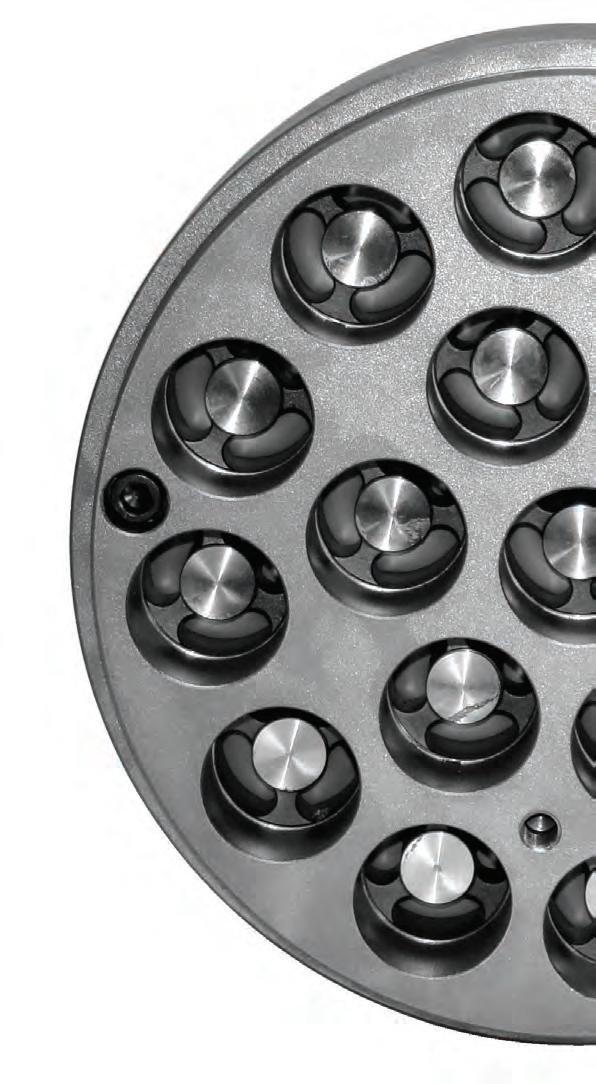
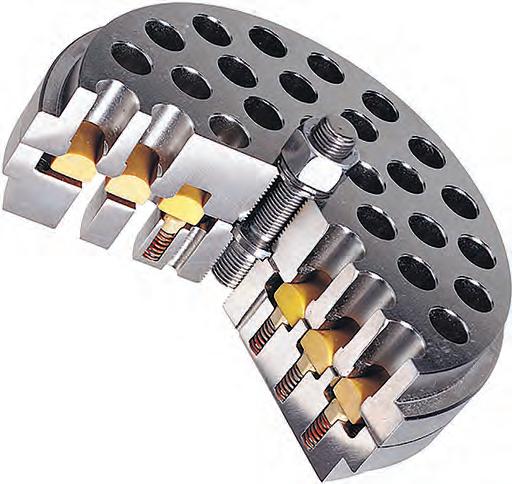
Compressor valve failure is the #1 cause of unscheduled shutdowns, and no single valve design works in all operating environments.
Cook Compression has the depth of experience, engineering know-how, and a toolbox of proven technology to assess your equipment and offer the best solution to increase reliability and uptime – even in the most demanding conditions.
Read how Cook Compression engineered-to-order valves can boost productivity and put an end to unscheduled shutdowns at cookcompression.com/valves.