FEATURES
INSURING SCHOOLS
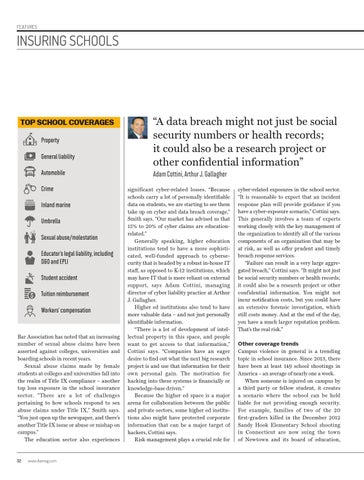
TOP SCHOOL COVERAGES Property General liability Automobile Crime Inland marine Umbrella Sexual abuse/molestation Educator’s legal liability, including D&O and EPLI Student accident Tuition reimbursement Workers’ compensation
Bar Association has noted that an increasing number of sexual abuse claims have been asserted against colleges, universities and boarding schools in recent years. Sexual abuse claims made by female students at colleges and universities fall into the realm of Title IX compliance – another top loss exposure in the school insurance sector. “There are a lot of challenges pertaining to how schools respond to sex abuse claims under Title IX,” Smith says. “You just open up the newspaper, and there’s another Title IX issue or abuse or mishap on campus.” The education sector also experiences
32
“A data breach might not just be social security numbers or health records; it could also be a research project or other confidential information” Adam Cottini, Arthur J. Gallagher significant cyber-related losses. “Because schools carry a lot of personally identifiable data on students, we are starting to see them take up on cyber and data breach coverage,” Smith says. “Our market has advised us that 15% to 20% of cyber claims are educationrelated.” Generally speaking, higher education institutions tend to have a more sophisticated, well-funded approach to cybersecurity that is headed by a robust in-house IT staff, as opposed to K-12 institutions, which may have IT that is more reliant on external support, says Adam Cottini, managing director of cyber liability practice at Arthur J. Gallagher. Higher ed institutions also tend to have more valuable data – and not just personally identifiable information. “There is a lot of development of intellectual property in this space, and people want to get access to that information,” Cottini says. “Companies have an eager desire to find out what the next big research project is and use that information for their own personal gain. The motivation for hacking into these systems is financially or knowledge-base driven.” Because the higher ed space is a major arena for collaboration between the public and private sectors, some higher ed institutions also might have protected corporate information that can be a major target of hackers, Cottini says. Risk management plays a crucial role for
cyber-related exposures in the school sector. “It is reasonable to expect that an incident response plan will provide guidance if you have a cyber-exposure scenario,” Cottini says. This generally involves a team of experts working closely with the key management of the organization to identify all of the various components of an organization that may be at risk, as well as offer prudent and timely breach response services. “Failure can result in a very large aggregated breach,” Cottini says. “It might not just be social security numbers or health records; it could also be a research project or other confidential information. You might not incur notification costs, but you could have an extensive forensic investigation, which still costs money. And at the end of the day, you have a much larger reputation problem. That’s the real risk.”
Other coverage trends Campus violence in general is a trending topic in school insurance. Since 2013, there have been at least 149 school shootings in America – an average of nearly one a week. When someone is injured on campus by a third party or fellow student, it creates a scenario where the school can be held liable for not providing enough security. For example, families of two of the 20 first-graders killed in the December 2012 Sandy Hook Elementary School shooting in Connecticut are now suing the town of Newtown and its board of education,
www.ibamag.com
30-33_Ad Led Non Profit-SUBBED.indd 32
16/10/2015 5:26:23 AM