FEATURE / MGAs RESPOND
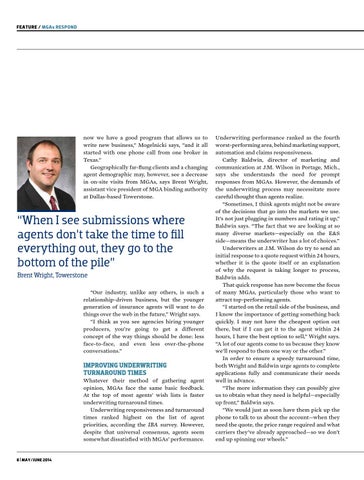
now we have a good program that allows us to write new business,” Mogelnicki says, “and it all started with one phone call from one broker in Texas.” Geographically far-flung clients and a changing agent demographic may, however, see a decrease in on-site visits from MGAs, says Brent Wright, assistant vice president of MGA binding authority at Dallas-based Towerstone.
“When I see submissions where agents don’t take the time to fill everything out, they go to the bottom of the pile” Brent Wright, Towerstone “Our industry, unlike any others, is such a relationship-driven business, but the younger generation of insurance agents will want to do things over the web in the future,” Wright says. “I think as you see agencies hiring younger producers, you’re going to get a different concept of the way things should be done: less face-to-face, and even less over-the-phone conversations.”
IMPROVING UNDERWRITING TURNAROUND TIMES Whatever their method of gathering agent opinion, MGAs face the same basic feedback. At the top of most agents’ wish lists is faster underwriting turnaround times. Underwriting responsiveness and turnaround times ranked highest on the list of agent priorities, according the IBA survey. However, despite that universal consensus, agents seem somewhat dissatisfied with MGAs’ performance. 8 | MAY/JUNE 2014
Underwriting performance ranked as the fourth worst-performing area, behind marketing support, automation and claims responsiveness. Cathy Baldwin, director of marketing and communication at J.M. Wilson in Portage, Mich., says she understands the need for prompt responses from MGAs. However, the demands of the underwriting process may necessitate more careful thought than agents realize. “Sometimes, I think agents might not be aware of the decisions that go into the markets we use. It’s not just plugging in numbers and rating it up,” Baldwin says. “The fact that we are looking at so many diverse markets—especially on the E&S side—means the underwriter has a lot of choices.” Underwriters at J.M. Wilson do try to send an initial response to a quote request within 24 hours, whether it is the quote itself or an explanation of why the request is taking longer to process, Baldwin adds. That quick response has now become the focus of many MGAs, particularly those who want to attract top-performing agents. “I started on the retail side of the business, and I know the importance of getting something back quickly. I may not have the cheapest option out there, but if I can get it to the agent within 24 hours, I have the best option to sell,” Wright says. “A lot of our agents come to us because they know we’ll respond to them one way or the other.” In order to ensure a speedy turnaround time, both Wright and Baldwin urge agents to complete applications fully and communicate their needs well in advance. “The more information they can possibly give us to obtain what they need is helpful—especially up front,” Baldwin says. “We would just as soon have them pick up the phone to talk to us about the account—when they need the quote, the price range required and what carriers they’ve already approached—so we don’t end up spinning our wheels.”