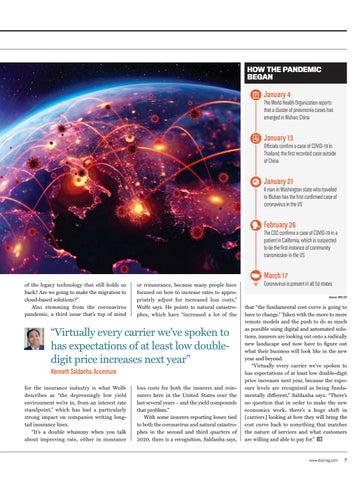
HOW THE PANDEMIC BEGAN
January 4 The World Health Organization reports that a cluster of pneumonia cases has emerged in Wuhan, China
January 13 Officials confirm a case of COVID-19 in Thailand, the first recorded case outside of China
January 21 A man in Washington state who traveled to Wuhan has the first confirmed case of coronavirus in the US
February 26 The CDC confirms a case of COVID-19 in a patient in California, which is suspected to be the first instance of community transmission in the US
March 17 of the legacy technology that still holds us back? Are we going to make the migration to cloud-based solutions?” Also stemming from the coronavirus pandemic, a third issue that’s top of mind
or reinsurance, because many people have focused on how to increase rates to appropriately adjust for increased loss costs,” Wolfe says. He points to natural catastrophes, which have “increased a lot of the
“Virtually every carrier we’ve spoken to has expectations of at least low doubledigit price increases next year” Kenneth Saldanha, Accenture for the insurance industry is what Wolfe describes as “the depressingly low yield environment we’re in, from an interest rate standpoint,” which has had a particularly strong impact on companies writing longtail insurance lines. “It’s a double whammy when you talk about improving rate, either in insurance
loss costs for both the insurers and reinsurers here in the United States over the last several years – and the yield compounds that problem.” With some insurers reporting losses tied to both the coronavirus and natural catastrophes in the second and third quarters of 2020, there is a recognition, Saldanha says,
Coronavirus is present in all 50 states Sources: WHO, CDC
that “the fundamental cost curve is going to have to change.” Taken with the move to more remote models and the push to do as much as possible using digital and automated solutions, insurers are looking out onto a radically new landscape and now have to figure out what their business will look like in the new year and beyond. “Virtually every carrier we’ve spoken to has expectations of at least low double-digit price increases next year, because the exposure levels are recognized as being fundamentally different,” Saldanha says. “There’s no question that in order to make the new economics work, there’s a huge shift in [carriers] looking at how they will bring the cost curve back to something that matches the nature of services and what customers are willing and able to pay for.”
www.ibamag.com
06-07_News Analysis-SUBBED.indd 7
7
20/11/2020 3:04:20 am