ANNUAL GUIDE
NEWS
UK
WORLD
Parking is top amenity need for business travellers
Seoul voted Best Business Travel City in 2011
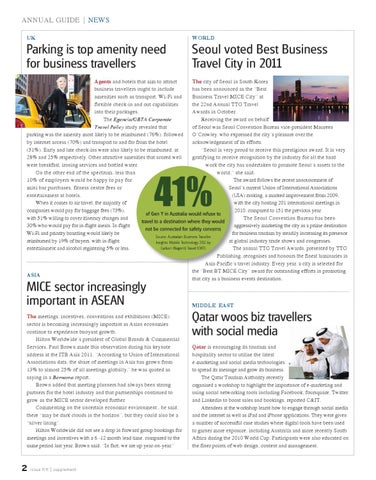
Agents and hotels that aim to attract business travellers ought to include amenities such as transport, Wi-Fi and flexible check-in and out capabilities into their packages. The Egencia/GBTA Corporate Travel Policy study revealed that parking was the amenity most likely to be reimbursed (76%), followed by internet access (70%) and transport to and fro from the hotel (51%). Early and late check-ins were also likely to be reimbursed, at 28% and 25% respectively. Other attractive amenities that scored well were breakfast, ironing services and bottled water. On the other end of the spectrum, less than 10% of employers would be happy to pay for mini bar purchases, fitness centre fees or entertainment at hotels. When it comes to air travel, the majority of companies would pay for baggage fees (73%), with 51% willing to cover itinerary changes and 30% who would pay for in-flight meals. In-flight Wi-Fi and priority boarding would likely be reimbursed by 19% of buyers, with in-flight entertainment and alcohol registering 5% or less.
The city of Seoul in South Korea has been announced as the “Best Business Travel MICE City” at the 22nd Annual TTG Travel Awards in October. Receiving the award on behalf of Seoul was Seoul Convention Bureau vice-president Maureen O’Crowley, who expressed the city’s pleasure over the acknowledgement of its efforts. “Seoul is very proud to receive this prestigious award. It is very gratifying to receive recognition by the industry for all the hard work the city has undertaken to promote Seoul’s assets to the world,” she said. The award follows the recent announcement of Seoul’s current Union of International Associations (UIA) ranking, a marked improvement from 2009, with the city hosting 201 international meetings in 2010, compared to 151 the previous year. The Seoul Convention Bureau has been aggressively marketing the city as a prime destination for business tourism by steadily increasing its presence at global industry trade shows and congresses. The annual TTG Travel Awards, presented by TTG Publishing, recognises and honours the finest luminaries in Asia-Pacific’s travel industry. Every year, a city is selected for the “Best BT MICE City” award for outstanding efforts in promoting that city as a business events destination.
ASIA
MICE sector increasingly important in ASEAN The meetings, incentives, conventions and exhibitions (MICE) sector is becoming increasingly important as Asian economies continue to experience buoyant growth. Hilton Worldwide’s president of Global Brands & Commercial Services, Paul Brown made this observation during his keynote address at the ITB Asia 2011. “According to Union of International Associations data, the share of meetings in Asia has grown from 13% to almost 25% of all meetings globally,” he was quoted as saying in a Bernama report. Brown added that meeting planners had always been strong partners for the hotel industry and that partnerships continued to grow as the MICE sector developed further. Commenting on the uncertain economic environment , he said, there “may be dark clouds in the horizon”, but they could also be a “silver lining”. Hilton Worldwide did not see a drop in forward group bookings for meetings and incentives with a 6 -12 month lead time, compared to the same period last year, Brown said. “In fact, we are up year-on-year.”
2
issue 11.11
supplement
MIDDLE EAST
Qatar woos biz travellers with social media Qatar is encouraging its tourism and hospitality sector to utilise the latest e-marketing and social media technologies to spread its message and grow its business. The Qatar Tourism Authority recently organised a workshop to highlight the importance of e-marketing and using social networking tools including Facebook, foursquare, Twitter and Linkedin to boost sales and bookings, reported C&IT. Attendees at the workshop learnt how to engage through social media and the internet as well as iPad and iPhone applications. They were given a number of successful case studies where digital tools have been used to garner more exposure, including Australia and more recently South Africa during the 2010 World Cup. Participants were also educated on the finer points of web design, content and management.