Profile
Nagashima Ohno & Tsunemaysu
in substantially the same manner as written voting forms. These two methods have a lot in common in terms of functions and purposes. Solicitation for proxies must be conducted in accordance with the proxy solicitation regulations under the Financial Instruments and Exchange Law (formerly, the Securities and Exchange Law), which includes certain procedural requirements. However, solicitation for “for” or “against” votes in writing is not generally regulated and is not subject to the proxy solicitation regulations. Such discrepancy of regulatory regimes causes practical issues. For example, it is sometimes difficult to figure out when a shareholder should start to comply with the procedural requirements under the proxy solicitation regulations if the shareholder first solicits for “against” votes in writing and then starts solicitation for proxies as a series of contests.
companies’ proposals. These practices had generally not been considered problematic until recently. However, IDEC Corporation, a shareholder who lost the proxy fight against Moritex Corporation, a TSE-1 listed company, filed suit to rescind the resolution of the shareholders meeting of Moritex on the grounds that Moritex’s provision of prepaid cards to shareholders fell under the category of the prohibited provision of economic benefits. The value of each card was only 500 yen and Moritex provided one to each of its shareholders who exercised their voting rights, regardless of their support for IDEC’s or Moritex’s proposals or method of voting (in attendance in person, by proxy or by writing). The Tokyo District Court rescinded, on December 6, 2007, the resolution of the shareholders meeting of Moritex, holding that one of Moritex’s purposes in providing prepaid cards was the acquisition of affirmative votes for Moritex’s proposal.
3 Offer of economic benefits to shareholders in return for exercise of votes
4 Conclusion
The Companies Act prohibits a company from providing economic benefits in relation to the exercise of shareholders’ rights. On the other hand, it has been common practice in many Japanese listed companies to give token gifts to attendees of shareholders’ meetings so long as these fall within the ambit of social etiquette. In addition, some companies give token gifts to shareholders who exercise their voting rights in writing to encourage shareholders to return written voting forms irrespective of whether any given shareholder votes for or against the
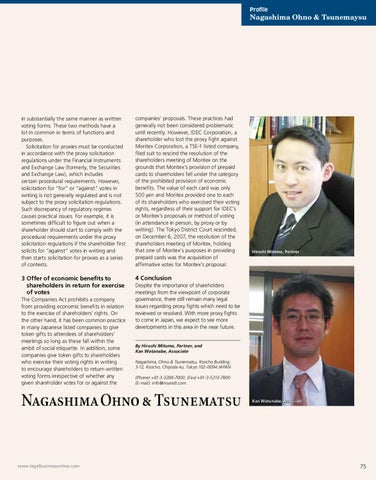
Hiroshi Mitoma, Partner
Despite the importance of shareholders meetings from the viewpoint of corporate governance, there still remain many legal issues regarding proxy fights which need to be reviewed or resolved. With more proxy fights to come in Japan, we expect to see more developments in this area in the near future. By Hiroshi Mitoma, Partner, and Kan Watanabe, Associate Nagashima, Ohno & Tsunematsu, Kioicho Building, 3-12, Kioicho, Chiyoda-ku, Tokyo 102-0094 JAPAN (Phone) +81-3-3288-7000; (Fax) +81-3-5213-7800 (E-mail): info@noandt.com
Kan Watanabe, Associate
www.legalbusinessonline.com
75