opinion corporate health
Penny Lovett, HR director at Bupa Australia, outlines how an external consultant can get you the right wellness program for your organisation
Corporate health
A
wellness program is a complicated and specialised tool used to motivate and maximise the output of a corporate workforce. It is also a relatively new concept to Australia, and as such is somewhat of an incomplete science. Despite its relative infancy and the lack of absolute hard numbers, the productivity and employee retention benefits to the bottom line can be substantial – a fact that more and more Australian businesses are beginning to realise. For many companies, the real challenge lies not in deciding if you need a corporate health program, but rather how best to implement one. A question I’m often asked is: what is the best way to approach a company-wide implementation? Is it best for HR or an external company to establish and manage the program? Or is a combined approach the best way? As an HR practitioner, your initial reaction may be to take responsibility for driving the program yourself. This is a natural response given it is an employee-facing program, and one that in part aims
46
www.hcamag.com
to address the productivity of the organisation. Having seen numerous programs implemented – with varying degrees of success – I believe the best way to achieve a high uptake of a wellness program that will maintain good longevity over time is to combine both internal and external resources. External experts generally provide advice and insight based on experience for this specialised field which is still relatively new. They will help develop a best practice strategy while providing advice on common challenges, promoting a smooth transition of the program into the company culture. Our experience has shown us that the most important reason external consultants are called in is to provide objectivity by acting as an independent source of advice. The key value add of an external consultant is that they are able to provide advice, best practice solutions and operational information, as well as create customised initiatives that identify health risk and deploy relevant wellness programs. External consultants can use their expertise to help an organisation implement the right program, but it is integral that the program is viewed as an important aspect of company culture. While a consulting group can simply walk in and provide advice on strategies to embed a corporate wellness program in an organisation’s culture, it is the internal leaders that will carry the wellness programs to fruition, and ultimately ensure the longevity of it. While HR may initially appear as the logical owner within an organisation, it is best to view the function’s role as a facilitator of a business need. It may be useful to look at this in a similar context to managing training. While sales may ‘own’ the business need for training to be done, HR are the facilitators rather than owners of the process. Wellness needs to be embedded into the structure of the business and its daily operations to promote longevity and encourage uptake. If the wellness program is positioned as being owned and run by the employees and the company it will deliver intrinsic value and ultimately create a better and more productive work environment. HC
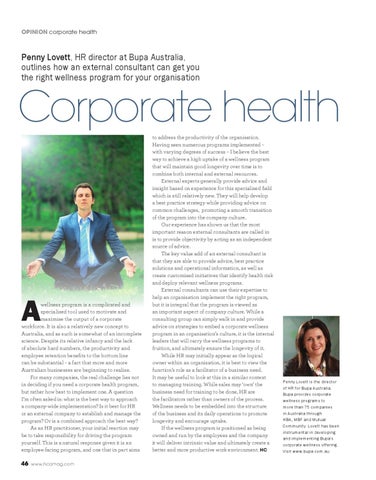
Penny Lovett is the director of HR for Bupa Australia. Bupa provides corporate wellness programs to more than 75 companies in Australia through HBA, MBF and Mutual Community. Lovett has been instrumental in developing and implementing Bupa’s corporate wellness offering. Visit www.bupa.com.au