I n t e rv i e w
RON HELLER NFL CHAMPION Interview by
Trish Gannon
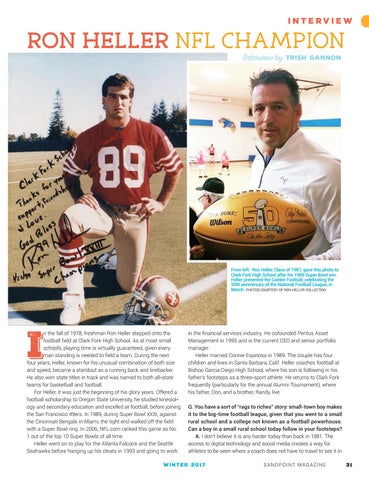
From left: Ron Heller, Class of 1981, gave this photo to Clark Fork High School after his 1989 Super Bowl win. Heller presented the Golden Football, celebrating the 50th anniversary of the National Football League, in March. PHOTOS COURTESY OF RON HELLER COLLECTION
I
n the fall of 1978, freshman Ron Heller stepped onto the football field at Clark Fork High School. As at most small schools, playing time is virtually guaranteed, given every man standing is needed to field a team. During the next four years, Heller, known for his unusual combination of both size and speed, became a standout as a running back and linebacker. He also won state titles in track and was named to both all-state teams for basketball and football. For Heller, it was just the beginning of his glory years. Offered a football scholarship to Oregon State University, he studied kinesiology and secondary education and excelled at football, before joining the San Francisco 49ers. In 1989, during Super Bowl XXIII, against the Cincinnati Bengals in Miami, the tight end walked off the field with a Super Bowl ring. In 2006, NFL.com ranked this game as No. 1 out of the top 10 Super Bowls of all time. Heller went on to play for the Atlanta Falcons and the Seattle Seahawks before hanging up his cleats in 1993 and going to work
in the financial services industry. He cofounded Peritus Asset Management in 1995 and is the current CEO and senior portfolio manager. Heller married Connie Espinosa in 1989. The couple has four children and lives in Santa Barbara, Calif. Heller coaches football at Bishop Garcia Diego High School, where his son is following in his father’s footsteps as a three-sport athlete. He returns to Clark Fork frequently (particularly for the annual Alumni Tournament), where his father, Don, and a brother, Randy, live. Q. You have a sort of “rags to riches” story: small-town boy makes it to the big-time football league, given that you went to a small rural school and a college not known as a football powerhouse. Can a boy in a small rural school today follow in your footsteps? A. I don’t believe it is any harder today than back in 1981. The access to digital technology and social media creates a way for athletes to be seen where a coach does not have to travel to see it in
W I N T E R 2 0 17
003-036_SMW17CC.indd 31
SANDPOINT MAGAZINE
31
10/25/16 9:27 AM