C
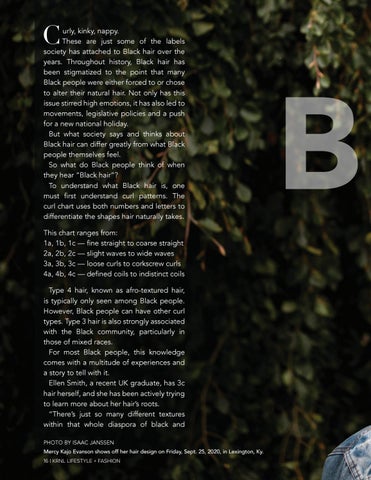
urly, kinky, nappy. These are just some of the labels society has attached to Black hair over the years. Throughout history, Black hair has been stigmatized to the point that many Black people were either forced to or chose to alter their natural hair. Not only has this issue stirred high emotions, it has also led to movements, legislative policies and a push for a new national holiday. But what society says and thinks about Black hair can differ greatly from what Black people themselves feel. So what do Black people think of when they hear “Black hair”? To understand what Black hair is, one must first understand curl patterns. The curl chart uses both numbers and letters to differentiate the shapes hair naturally takes. This chart ranges from: 1a, 1b, 1c — fine straight to coarse straight 2a, 2b, 2c — slight waves to wide waves 3a, 3b, 3c — loose curls to corkscrew curls 4a, 4b, 4c — defined coils to indistinct coils Type 4 hair, known as afro-textured hair, is typically only seen among Black people. However, Black people can have other curl types. Type 3 hair is also strongly associated with the Black community, particularly in those of mixed races. For most Black people, this knowledge comes with a multitude of experiences and a story to tell with it. Ellen Smith, a recent UK graduate, has 3c hair herself, and she has been actively trying to learn more about her hair’s roots. “There’s just so many different textures within that whole diaspora of black and PHOTO BY ISAAC JANSSEN Mercy Kajo Evanson shows off her hair design on Friday, Sept. 25, 2020, in Lexington, Ky. 16 | KRNL LIFESTYLE + FASHION
B