E S K’ ND IC ZIN E UK A HN GA TH AC I-ET MA BL LT IAN U M IST R CH
ISSUE 145
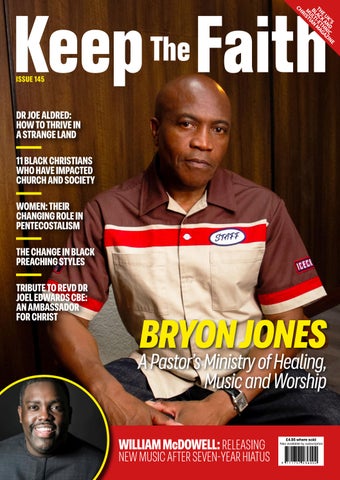
DR JOE ALDRED: HOW TO THRIVE IN A STRANGE LAND 11 BLACK CHRISTIANS WHO HAVE IMPACTED CHURCH AND SOCIETY WOMEN: THEIR CHANGING ROLE IN PENTECOSTALISM THE CHANGE IN BLACK PREACHING STYLES TRIBUTE TO REVD DR JOEL EDWARDS CBE: AN AMBASSADOR FOR CHRIST
BRYON JONES
A Pastor’s Ministry of Healing, Music and Worship WILLIAM McDOWELL: RELEASING NEW MUSIC AFTER SEVEN-YEAR HIATUS
£4.95 where sold
MINEHEAD 29 MARCH – 2 APRIL SKEGNESS 5–9 APRIL BOOK NOW AT SPRINGHARVEST.ORG Or call 0330 100 9330
YOU WERE MADE FOR SOMETHING
GREATER WILLYOU SAYYES... TO THE GREATEST ADVENTURE OF ALL? COME AND JOIN US AT SPRING HARVEST 2027. 2027. GO ALL IN WITH JESUS, DIG DEEPER INTO THE BIBLE, MAKE SPACE FOR THE HOLY SPIRIT. EXPECT THE UNEXPECTED. GATHER. GROW. GO.
SPRINGHARVEST.ORG
Editor’s Note
EDITOR Marcia Dixon MBE editor@keepthefaith.co.uk
GRAPHIC DESIGNER Becky Wybrow
SUB-EDITOR Jackie Raymond
ADVERTISING Valerie San Pedro advertising@keepthefaith.co.uk T: 0203 868 0664
MARKETING Karen Seronay karen@keepthefaith.co.uk Mairem Honrada-Magarro mairem@keepthefaith.co.uk
ACCOUNTS AND SUBSCRIPTIONS finance@keepthefaith.co.uk
PUBLISHED BY MTD Publishing Ltd 71 -73 Sheldon Street London WC2H 9JQ T: 0845 193 4431 www.keepthefaith.co.uk Facebook keepthefaithmag X @keepthefaithmag Instagram keepthefaithmag
THE PUBLISHER WOULD LIKE TO THANK:
Dr T Ayodele Ajayi, Shirley Anstis, Pastor Alton Bell, Ryan Bruce, O’Neil Dennis, Akosua DF, Leondre Douglas, Maxine Edgar, Chioma Fanawopo, Juliet Fletcher, Roy Francis, Vanessa Grossett, Rev Wale Hudson-Roberts, Kirly Sue, Esther Kuku, Dr Jacky McLeod, Dr David Muir, Pastor Elaine Palmer-Taylor, Shantelle Richardson, Joy Roxborough, Carol Stewart, Revd Nathaniel Turner, Verona White, Pastor Fred Williams, our advertisers and supporters The opinions expressed in this publication are not necessarily those of the Publisher.
Dear Readers After experiencing an extremely hot summer, the recent change in weather and cooler temperatures remind us that we have entered a new season – autumn. Autumn signifies change. Trees and plants have begun shedding their leaves. Farmers are harvesting crops. Individuals (some) are doubling down on their efforts to achieve the goals they set at the beginning of the year. And young people have started a new academic year. Autumn also heralds the approach of Black History Month (BHM). In this BHM edition of Keep The Faith, you’ll be reminded of the central role Christianity plays in the lives of many Black people – how it is contributes to our successes, our charitable endeavours and our concerns about justice.
Faith in God has enabled Black communities to develop spiritual strength; build mental resilience; find inspiration to pursue success; and maintain hope, as they continue to push through the challenges to achieve. I hope that, as you read this magazine, you’ll see how faith in God has empowered Black people to turn their dreams into reality and make a positive difference. If He has done it for others, He can do it for you too. Happy reading!
If you enjoy reading this magazine, do consider supporting us by subscribing to the magazine. It costs just £25 for an individual subscription, or perhaps consider giving a donation. Our account details are: Account name: MTD Publishing Ltd Account no: 30121325 Sort code: 06-04-05 Bank: Tide (Clearbank) Once you’ve made a payment, email your postal address to finance@keepthefaith.co.uk and we will set up your subscription.
www.keepthefaith.co.uk
03
contents ISSUE 145
10
05-08 Latest news 10 StepFWD Gospel News By O'Neil Dennis 10 Beyond the Pulpit: A Pastor’s Ministry of healing and worship By Juliet Fletcher 18 Dreams, revelations & moments: The return of Pastor William McDowell By Akosua DF 20 11 Black Christians who have shaped the Church and wider society By Marcia Dixon MBE 26 Theological reflection on Professor Arday By Rev Wale Hudson-Roberts 28 Leaders in higher education By Marcia Dixon MBE
31 From Black-majority to Black-led By Leondre Douglas
32 Decolonising the Gospel of Jesus Christ By Alton Bell 34 How to thrive in a strange land By Dr Joe Aldred 36 New call, new response? By Revd Nathaniel Turner
20
38 How vulnerability during struggle becomes a powerful testimony of faith By Shantelle Richardson 39 Fearfully and wonderfully made: Raising neurodivergent children By Chioma Fanawopo
40 Passing the faith on: Honouring our communities across generations By Carol Stewart 41 Mixed heritage: What does it mean for
the future of the Black Pentecostal Church? By Roy Francis
28
18
42 The business of death in Black communities By Maxine Edgar 44 The changing role of Black women in British Pentecostalism since 1948 By Dr Elaine Palmer-Taylor 45 Do you need an identity makeover? By Dr T Ayodele Ajayi
48 Pour into yourself and support the collective By Shirley Anstis 50 Revd Dr Joel Edwards CBE: A faithful
ambassador of Christ By Dr R David Muir
54 Nigerian Christians need our help By Pastor Fred Williams
26
55 What’s in a name? By Joy Roxborough 56 Dear Black women, you are more than your resilience – you need rest By Esther Kuku 57 Food 4 Thought By Marcia Dixon MBE 58 Understanding, protecting and celebrating Black skin By Dr Jacky McLeod 60 Can Black authors succeed in
traditional publishing? By Vanessa Grossett
61 The hair blueprint our ancestors left behind By Verona White 62 Bring some Caribbean sunshine to your plate By Kirly-Sue
04 Find us on X and Facebook: @KeepTheFaithmag
BHM EVENT CELEBRATES MUSIC AND FAITH OF WINDRUSH GENERATION UK PENTECOSTAL DEVELOPMENT AGENCY TO CELEBRATE 20TH ANNIVERSARY RAFFA – the International Development arm of the Church of God of Prophecy UK (COGOP) – is getting ready to celebrate its 20th anniversary with a special banquet at The New Parklands, Birmingham, on 7th November, 2026. When RAFFA was launched at the House of Lords in 2006, COGOP was the only Black Pentecostal denomination in Britain to start a charity dedicated to supporting international development, helping communities in need and responding to natural disasters. RAFFA has worked alongside governments, churches, charitable organisations, community groups and international partners to achieve its aims. Its first CEO was Rudi Page. Angela Clarke BEM took over the role in 2017. Over the years, RAFFA has provided humanitarian aid and supported development initiatives. Beneficiary countries include Mexico, the Philippines, Nigeria, Ghana, Botswana,
Dominican Republic, Syria and Turkey. Just last year, RAFFA mobilised a massive humanitarian relief effort to provide aid worth £200,000 to the survivors of Hurricane Melissa that swept through Jamaica last December. Aside from its overseas work, RAFFA has been involved with numerous community initiatives in the UK, including supporting organ donation, encouraging people to give blood, and raising awareness of sickle cell anaemia. Angela Clarke BEM is looking forward to spearheading RAFFA’s forthcoming celebration. She stated: “For 20 years, RAFFA has demonstrated the power of faith translated into action. Its greatest achievement is not simply the projects delivered, but the lives transformed and the hope restored. As we celebrate this remarkable milestone, we honour all who have contributed to this journey and look forward to an even greater future of service and impact.” Visit www.raffa.org.uk
Church, music and worship helped to sustain Caribbean migrants during their early years of settlement in Britain during the 50s and 60s. In recognition of this, a series of special Black History Month events entitled The Front Room Experience: Church will take place from October 22–25 in Croydon. Written by Dave Prince and Sam Facey, and directed by Ray Shell, The Front Room Experience: Church brings together storytelling, live gospel music, faith, humour and community. Artists taking part include Jason Nicholson-Porter. “Church is about more than what happened on a Sunday,” Dave Prince explained. “The Front Room was a place where our culture, our music, our faith and our sense of community came together. We want audiences to step into that room, experience something of that generation and recognise how much of what they created still lives with us today.” Visit http://bit.ly/ FrontRoomBHM2026 to get tickets.
LEADING BUSINESSWOMAN APPOINTED PATRON OF CANCER CHARITY Christian businesswoman Claudine Reid MBE has been appointed as a patron for Black Women Rising (BWR), a charity that provides a range of services designed to provide support and assistance to Black female cancer sufferers, as well as create opportunities for them to share their stories and gain access to appropriate care. Claudine, a breast cancer survivor, will seek to use her experience, connections and networks to extend the reach of BWR’s work, supporting Black women through their cancer journey. She told Keep The Faith: “Becoming a patron of Black Women Rising is deeply personal for me. Having faced a life-altering breast cancer diagnosis in 2019, I understand the fear, uncertainty and resilience that shape this journey. I am honoured to use my voice, experience and platform to stand alongside Black women, offering hope, visibility and strength.” Visit www.blackwomenrising.org www.keepthefaith.co.uk
05
SECOND ROBERT BECKFORD LECTURE TAKING PLACE DURING BHM The Queen’s Foundation, Birmingham, is set to host the second annual Robert Beckford Lecture during BHM on October 22nd at 7.30pm. Launched in 2025, the Lecture aims to honour the work of Dr Robert Beckford, considered one of the most influential Black British theologians. This second lecture will be delivered by Dr William Ackah, an internationally respected scholar on African diaspora studies and Black community development. His lecture title is ‘The Blacker than Saka Effect: Theological Necessities in the Face of Black Diasporic Realities in Britain’. Email hospitality@queens.ac.uk for ticket details.
COGIC UK INSTALLS NEW NATIONAL LEADER Clergy, church members and wellwishers attended the installation service of Bishop Geoff Folkes as the new leader of the Church of God in Christ UK (COGIC UK), which was held at its headquarters in Luton. Ministers in attendance included Bishops John Francis, Claion Grandison, Eric Brown, Delroy Powell and Mike Royal. Bishop Brandon B Porter, Secretary of the General Board of Church of God in Christ US, conducted the installation part of the service and also preached the sermon.
LIVING, LOVING, SERVING TO BE BROADCAST ON TBN
Keep The Faith is proud to announce that its debut documentary, Living, Loving, Serving: Women Leaders in the Church (LLSWLC), is earmarked to be aired on leading Christian channel TBN during Black History Month. LLSWLC explores the lives, calling and impact of women in Christian ministry and offers an inspiring look at the faith, leadership and service of women helping to shape the 21st century Church. The women featured are: the Rt Revd Dr Rosemarie Mallett, Pastor Yvonne Brooks, Apostle Marjorie Esomowei, Tanya Hughes OBE and Pastor Rhona Mpologoma-Tackie. Marcia Dixon MBE, Keep The Faith publisher said: “I’m thrilled that this documentary will bring the powerful impact of female leaders in the Church and society to a much wider Christian audience. Huge thanks to Laurelle Jones for directing, and to our donors and sponsors, Pentecostal Community Bank and Abigail Otchere, whose support made it possible. This is just the beginning – we’re ready to do more!” Living, Loving, Serving – Women Leaders in the Church will be broadcast on TBN (Sky Channel 582) on October 19th at 9.30pm.
06 Find us on X and Facebook: @KeepTheFaithmag
Following his installation, Bishop Folkes told the congregation that God had been good and shared how he had felt in the weeks leading up to the service. He said: “People have been saying ‘Geoff, are you excited?’ but I couldn’t say I was, because I know what this office is and the weight it brings. But what encouraged me was that people came and said: ‘I’ve been praying for you. Our church has been praying for you.’ That gave me strength to know that the people of God are with me.” Bishop Folkes now presides over a denomination that has 20 congregations and 1,500 members (excluding children) across the UK. His vision includes strengthening current leaders, developing future leaders, nurturing the youth, equipping and empowering families and planting churches. Visit www.cogic.org.uk
Get away from the
distractions of life When you take your church away, you make room for deeper fellowship and time with God. At High Leigh, The Hayes and Highgate House, you’ll find welcoming manor house venues dedicated to Christian groups, with comfortable en-suite bedrooms for everything from team retreats of 12 to conferences of up to 400. Hearty home-cooked meals are prepared and served throughout your stay, so you can focus on people rather than planning. Each venue offers inspiring spaces that encourage worship, teaching and fellowship, with sensible prices and especially low family rates so that no one misses out on time away together.
Where the Church gathers
cct.org.uk
up d e l l fi ack t b o Ge g o yt d ld a e r d an t into the wor ou
Michael De Souza
Father2Father Storytelling Men-a-Thon
CHILDREN’S BLACK BOOK FAIR:
T
THE LARGEST EVENT EVER HELD IN A HACKNEY LIBRARY
he third annual Children’s Black Book Fair UK (CBBF UK), held in Dalston CLR James Library, was a great success; it has also made Hackney history. Over 2,500 people attended the fair, making it the highest attendance ever at a Hackney Library event. The CBBF UK – Europe’s only free annual celebration of young Black authors and storytellers – took place at a moment of cultural significance. Data from Inclusive Books for Children reveals that just 1.9% of children’s books published in the UK in 2024 featured a Black main character.
Linton Kwesi Johnson opening CBBF UK
Run by LIT Stars CIC – which was founded by former senior deputy headteacher Juliet Coley Bremmer and her son Romeo Bremmer BCyA – the CBBF UK was opened by legendary dub poet Linton Kwesi Johnson to a packed library. Children were able to take part in a host of activities at the CBBF UK that included: • CBBC’s Dr Ronx, hosting the National Year of Reading Storytelling Marathon • book reading by Michael De Souza, creator of BBC hit cartoon series Rastamouse • EastEnders legend Rudolph Walker OBE, taking part in SuperDads Reading Men-a-Thon – a reading zone for children, hosted by charity Father2Father • the UK’s first-ever children’s panel on race and representation in publishing • young author marketplace • live Back-to-School hair braiding, in partnership with Rooted app and • free giveaway of 1,000 books
08 Find us on X and Facebook: @KeepTheFaithmag
The fair also saw the unveiling of the Hackney Writers Legacy Steps – a new installation on the library staircase, honouring 48 Black writers, poets, publishers and songwriters with connections to Hackney. People featured included Dame Malorie Blackman, Michaela Coel, Diane Abbott MP and Linton Kwesi Johnson. Margaret Busby CBE, the UK’s first Black female publisher, said she was honoured to be selected and came down on the day to take a photograph on her step. Juliet Coley shared: “Born and raised in Hackney, I didn’t have much, but one thing I did have was a library card. Even though we couldn’t afford to go on a plane, because I was an avid reader, I went all over: Bethlehem. Narnia. Wonderland... We hope that, through our event, children will fall in love with reading.” Marcia Dixon MBE, Keep The Faith publisher, stated: “Keep The Faith welcomed the opportunity to be a media sponsor of the CBBF UK. How could we say no to an event that encourages children and teenagers to read? And we are pleased that the CBBF UK is the most successful event ever held in a Hackney library. We look forward to supporting next year’s book fair.” Visit www.younglitstars.com Images: Laura Rose - Thepinkrosephotography
Rudolph Walker reads Mervin Cato’s Book
MADE FOR SOMETHING GREATER There is a question at the heart of Spring Harvest 2027. Will you say yes to the greatest adventure of all? Because perhaps, somewhere deep down, you already know you were made for something greater. More than getting through the week. More than the routines, responsibilities and expectations that can so easily fill our lives. You were made for purpose, for relationship, for adventure, and for a life with God. Perhaps that is why, every now and then, we find ourselves asking whether there is more. More to life than this. More that God might want to do in us. More that He might want to do through us. The truth is, we were never made simply to stand still. We were made to follow, to grow and to step into all that God has created us for. But discovering what that life looks like is not always straightforward. What does it really mean to follow Jesus? Where is he calling you? What might happen if you were brave enough to say yes? They are big questions. Perhaps they are questions you have been asking for years. Because saying yes to Jesus does not mean suddenly having all the answers. In many ways, it is just the beginning. The beginning of discovering the life you were made for. The beginning of an adventure. An adventure that could take you somewhere you never expected, introduce you to people you would never otherwise have met, or ask you to step beyond what feels comfortable, familiar or safe. Or perhaps the place God is calling you to is much closer than you think. When Jesus spoke to his disciples in Acts 1:8, he gave them a challenge that would change everything. They were to be his witnesses in Jerusalem, Judea, Samaria and to the ends of the earth. We could call that the here, there, and everywhere!
It sounds enormous. But perhaps it starts much closer to home. What if your Jerusalem is your family? Your workplace? The school gate? Your street? What if living the life you were made for begins not by travelling thousands of miles, but by taking one step beyond where you are now? Where the Adventure Begins For nearly 50 years, Spring Harvest has been a place where people have come to explore questions like these. Last Easter, more than 11,000 people gathered across two weeks. Families, individuals and churches. Different generations, traditions and denominations. All coming together with a shared desire to encounter God and discover what he might be saying. Amazing things can happen when we gather. When we step away from the everyday and make space to worship, open the Bible, ask questions and encounter the Holy Spirit. And perhaps, somewhere in the middle of all that, hear an invitation. Every year, we hear stories of what begins when people gather at Spring Harvest. Families transformed. Callings confirmed. New ministries started. Relationships restored. Lives changed. Sometimes it begins with a conversation. Sometimes with a challenge. Sometimes with
www.springharvest.org
a moment when everything suddenly looks different. Spring Harvest can be a launch pad. A place to pause, to listen, to encounter God and perhaps discover something more of the life you were made for. The Question Is... In 2027, Spring Harvest invites you to explore No Greater Adventure. Five days to step away from our busy lives and make literal space for something greater. To worship Jesus, open the Bible, encounter the Holy Spirit and explore what it means to say yes to the life God made you for. Here. There. And everywhere. Come with your family. Come with your church. Bring your people. Bring your questions, your doubts and a sense that perhaps there is something more. Because maybe there is (we firmly believe THERE IS) Maybe you were made for something greater (you ARE!) And maybe saying yes is just the beginning. Join us at Spring Harvest 2027 for No Greater Adventure. Will you say yes to the greatest adventure of all?
GOSPEL NEWS
RYAN J BRUCE
Music biz consultant and author of The Future-Proof Artist. Follow on Instagram @iam_ryanj
20 YEARS OF IMPACT:
Gospel News is curated by O’Neil Dennis – the founder of AStepFWD.com, the UK Christian Charts, StepFWD Awards and more. To get in touch, email info@astepfwd.com
10 PEOPLE WHO SHAPED UK GOSPEL MUSIC Ryan J Bruce names 10 individuals he believes have played a pivotal role in moving the UK gospel scene forward from 2006 to the present day
I
suspect this list may cause a few debates and perhaps a strongly worded WhatsApp message, so let me get something out of the way. This is not a list of ‘The 10 Greatest UK Gospel Artists’ or ‘The 10 Greatest Christians’, who have helped gospel music over the last 20 years. Instead, I wanted to recognise 10 Christians who, in my opinion, have played a significant role in progressing UK Gospel over the past two decades through platforms, artist development, documentation, mainstream visibility or industry infrastructure. There are obviously plenty of people who could make a case
for inclusion, and somebody’s favourite will likely be missing. That does not automatically mean I forgot them. Putting this list together reminded me that the scene has probably progressed more than we sometimes give it credit for. Major gaps remain in infrastructure, investment, mainstream support and artist development. But, compared to 2006, we’ve come a pretty long way! And, before anybody emails Keep The Faith, asking why their favourite person is not on here, please remember the title said 10, not ‘Top 10’. Plus, I had to stop somewhere!!!
rarely pays much attention unless something particularly significant happens. Platforms like UKGospel.com, therefore, became important archives of what was actually taking place. And anybody who ran an independent music website during the pre-social media era knows this required a level of dedication bordering on unreasonable. You had to source the stories, write them (with no help from ChatGPT!), upload them, maintain the website and, somehow, convince people to actually visit it. Yinka did that consistently. Twenty years later, UKGospel.com remains part of British Gospel’s transition into the digital age. Visit www.ukgospel.com
MERCY B
Founder, Time2Shine
YINKA AWOJOBI
Founder, UKGospel.com Long before Instagram pages became the default news source for practically everything, UKGospel.com was documenting British gospel music online. Founded by Yinka Awojobi in the early 2000s, the platform has spent much of the last two decades covering artists, releases, events and wider developments across the scene. Independent gospel media has historically carried a disproportionate responsibility for documenting the genre, mainly because mainstream music media
10 Find us on X and Facebook: @KeepTheFaithmag
At a time when the market for TV talent competitions was booming, Mercy B took the concept and created something specifically for gospel music with the launch of Time2Shine Gospel Talent Search. First airing in 2011 on the now-defunct Sky Television channel OHTV! and just one year after The X Factor reached its peak viewership, Time2Shine gave emerging gospel singers an opportunity to develop, perform and compete before a live audience. This gave new UK Gospel talent something the scene has historically struggled to provide consistently: a grassroots national discovery platform.
Whatever your personal feelings are about talent competitions, Time2Shine was a major financial undertaking for an independent gospel platform with no corporate sponsorship. So, while UK Gospel spent years talking about needing more platforms, Mercy ‘put her money where her mouth is’. Granted, none of the show’s winners went on to make particularly significant waves within gospel music, but that may say more about the wider infrastructure around them. There were still relatively few places for emerging gospel artists to go next, and perhaps too much expectation was placed on Time2Shine to carry contestants beyond the competition.
KAREN GIBSON MBE
BAZIL MEADE MBE
Director, The Kingdom Choir It would be almost impossible to discuss major UK Gospel moments from the last 20 years without mentioning 19 May 2018, when Karen Gibson MBE led The Kingdom Choir in their performance at the Royal Wedding of Prince Harry and Meghan Markle. The performance placed a British gospel choir at the centre of one of the biggest global television events of the decade. For the record, Karen’s contribution did not begin at Windsor Castle. Gibson had already spent years directing choirs within British Gospel before most of the world knew her name. That moment, however, took UK Gospel somewhere it is infrequently afforded the opportunity to exist: right in the middle of a major British cultural institution, with the world watching. The Kingdom Choir subsequently signed with Sony Music and toured internationally. Visit www.kingdomchoir.com
Co-founder, London Community Gospel Choir Technically, Bazil Meade had already made a pretty substantial contribution to UK Gospel before the starting point of this list. Just a “small” one called the London Community Gospel Choir. Founded by Meade in 1982 alongside Lawrence Johnson, Bishop John Francis and Bishop Delroy Powell, LCGC helped pioneer the contemporary gospel choir movement in Britain and has spent decades carrying the sound beyond the traditional church environment. Part of what earns Bazil a place on a list covering 2006 to 2026 is the continued influence of that work. Throughout the past two decades, LCGC has continued performing on major stages and alongside some of the world’s biggest mainstream artists. In 2013, during LCGC’s 30th anniversary concert at the Royal Festival Hall, the choir set a new Guinness World Record for the most people performing gospel music indoors. To date, I believe they are the only act representing British Gospel in the Guinness Book of World Records. Visit www.lcgc.co.uk
MARCIA DIXON MBE
Publisher, Keep The Faith magazine; Founder, MD PR Full disclosure, writing about the editor of the very magazine this article is appearing in might appear biased. However, leaving Marcia Dixon off a list like this simply because of that would probably be the real injustice. For decades, Marcia has worked across journalism, PR and events, writing extensively about gospel music and Britain’s Black Christian community through Keep The Faith and The Voice, whilst handling publicity for countless artists, churches, concerts and Christian organisations. UK Gospel has never had an abundance of mainstream media coverage, so specialist journalists and publications have often documented much of our own history. Marcia has spent years making sure the artists, events and stories within this space actually get covered. Visit www.keepthefaith.co.uk
www.keepthefaith.co.uk
11
LORRAINE WRIGHT MBE
Founder, University Gospel Choir of the Year
ANU OMIDEYI
Festival Director, Liverpool Gospel Music Festival
In 2011, Lorraine Wright founded the University Gospel Choir of the Year (UGCY), creating a national platform for university gospel choirs across Britain to compete and perform. UGCY has since become an established fixture within UK Gospel and, in my opinion, its wider impact is probably bigger than the competition itself. University gospel choirs provide an entry point into the genre for hundreds, if not thousands, of young people, including plenty who may not otherwise interact with the traditional gospel scene. From those choirs come singers, musicians, directors, future artists and new audiences, and that creates something every genre needs: a pipeline. It is easy to focus exclusively on whoever is successful right now but building platforms that continually introduce new people into the ecosystem is arguably just as important. More than a decade after its launch, UGCY (now run by AStepFWD) has done exactly that.
Anu Omideyi has worn quite a few hats within UK Gospel over the years, including serving as Chief Executive of the Gospel Music Industry Alliance. More recently, her work in Liverpool has introduced an important new piece to the landscape. As Festival Director of the Liverpool Gospel Music Festival and through her work with the National Gospel Music Centre, Anu has helped create a platform combining live gospel music, education, heritage and artist development. The festival, launched in 2023, is particularly notable for positioning gospel within a mainstream festival environment, rather than restricting it exclusively to the church circuit. Anu’s work surrounding gospel heritage is equally important here. We have a slightly unfortunate habit within UK Gospel of making history and then doing a terrible job of documenting it. Projects disappear, websites vanish, recordings become impossible to find and eventually somebody has to explain an important event with “I think it happened around 2004”. Creating infrastructure that celebrates gospel’s present and preserves its history is something we need considerably more of.
Visit www.ucgy.co.uk
Visit www.liverpoollighthouse.com/lgmf
MUYIWA OLAREWAJU OBE
Station Director, Premier Gospel Artist, presenter, broadcaster, executive, Muyiwa Olarewaju apparently decided one job within gospel music simply was not enough. While he has enjoyed a successful career as an artist, becoming the only act to represent British Gospel on BET’s former Celebration of Gospel broadcast, his work with Premier Gospel is perhaps even more important when discussing the wider progress of the genre. Muyiwa became Station Director of Premier Gospel at its launch in 2010, helping lead what has become the most popular broadcasting platform for gospel music in Britain. Mainstream radio support for gospel remains limited, particularly for British artists, meaning dedicated broadcasters have played a crucial role in keeping the genre visible. For more than 15 years, Muyiwa has established and overseen one of the biggest of those platforms. Add his own accomplishments as an internationally recognised UK gospel artist and I think his inclusion here is pretty difficult to argue against. Visit www.premiergospel.org.uk
12 Find us on X and Facebook: @KeepTheFaithmag
it historically lacked significant industry measurement and recognition. For years, UK Gospel has not had reliable data to properly measure what is happening within the genre. We have often relied on statements such as “This song is doing really well” without much data to explain exactly what “really well” means. AStepFWD’s charts gave us more meaning behind those kinds of statements. There is probably not another independent industry body in the UK with anywhere close to as much data on UK Gospel songs as AStepFWD.
development of CalledOut Music is perhaps the clearest example of what that support can lead to. CalledOut, whose monthly Spotify listenership consistently outperforms several of his US peers, including Erica Campbell, Kierra Sheard and Pastor Mike Jr, has grown from an emerging UK gospel artist into an internationally recognised act with a considerable audience across Africa, the US and Europe. Visit www.hfp-music.com
Visit www.astepfwd.com
CHIBUZO OKORO
Director, HFP Music
O’NEIL DENNIS
Founder, AStepFWD O’Neil Dennis founded AStepFWD, which has developed the UK Christian Chart, the StepFWD Awards, and numerous other initiatives focused on promoting, recognising and documenting UK Christian & Gospel Music. Perhaps the biggest development has been AStepFWD’s recent work with the Official Charts Company to establish a Christian & Gospel Singles Chart, further expanding the presence of both genres in a space where
One thing UK Gospel has certainly never lacked is talent. Infrastructure around that talent is another conversation. Through HFP Music, Chibuzo Okoro has helped build an independent Christian music company offering support across A&R, distribution, publishing administration, branding, marketing, management, touring, legal support, funding, analytics and revenue collection. That work is especially important in UK Gospel, where artists have often worn far too many hats because the specialist infrastructure around them has been limited. His involvement in the
Help shape the next generation of Theologically trained leaders.* London School of Theology is committed to raising and equipping the next generation of Christian leaders and missionaries to be faithful witnesses for Christ in their families, neighbourhoods, workplaces, and the world at large. *Your giving could enable London School of Theology to provide ongoing financial support to students who find it difficult to cover their tuition fees and living costs each year.
Discover opportunities to give:
lst.ac.uk/donate
London School of Theology, Green Lane, Northwood, Middlesex HA6 2UW. Company limited by guarantee. Registered in England and Wales No. 381332. Registered Charity No. 312778
www.keepthefaith.co.uk
13
BEYOND THE PULPIT: A Pastor’s Ministry of Healing and Worship
Nowadays, we hear too many stories about our churches and church leaders not doing this or not being that! But I can’t say this about Bryon Jones. Not to be confused with Byron Jones, the NFL player, Bryon Jones is a singer, songwriter and worship leader – part of a respected British Gospel family and pastor of Eden Church, in Ilford, east London. Eden Church is part of The Apostolic Church, a denomination whose roots stretch back to the 1904
14 Find us on X and Facebook: @KeepTheFaithmag
Welsh Revival, which served as a precursor for the Azusa Street Revival and Pentecostalism across the world. Eden Church has seen extraordinary growth, and signs, wonders and miracles of healing are currently commonplace. So, what’s ‘different’ about Bryon’s ministry? I sought answers, as he shared snapshots of his journey into church leadership and his new worship album Chapters.
FAMILY LEAD TO LEAD SINGING Bryon is the eldest of five children and the only son, born in Jamaica, while his four sisters – Beverly, Candace, Tryphena and Priscilla, the youngest – were born in the UK. He recalls music starting at home around an upright piano, played by his sister Tryphena. BRYON JONES (BJ): Being the only son and the eldest made me responsible and protective. It shaped me into a natural leader early on – a role I’d describe as something that was “thrust upon” me, rather than sought! It’s a pattern that has been repeated throughout my life, including later, at church. JULIET FLETCHER (JF): So, tell us, how did the music side emerge? BJ: As a family, we were based in Wolverhampton, where my father was an Apostolic Church UK elder during the late 70s. I have always been creative; my first group was with some guys. We called ourselves The Pilgrim Brothers. I joined as lead singer. We weren’t traditional, and that suited me because they were keen to write their own songs. That’s what got me into songwriting.
“Being the only son and the eldest made me responsible and protective. It shaped me into a natural leader early on.” JF: Who was inspiring you? BJ: Some secular artists, but in gospel it was Andraé Crouch and The Winans. Our success was more regional. After five or six years, I left the group and began focusing on my sisters, leading them as a family group called Jones & Co. We would rehearse at home daily. Funnily, I was watching the film of the Michael Jackson story recently, and how his father, Joseph, harshly drove the group. There were elements I recognised in the way we were. But it wasn’t our parents driving us, it was me (LOL)! I wasn’t like him, though. I was passionately striving for excellence. And we did achieve national and international acclaim, winning awards with the Black Gospel Association (BGA), founded by Arthur Torrington CBE in the 1980s, and performing further afield in Europe and beyond. JF: I remember Jones & Co. Great harmonies! Out of that, your youngest sister, Priscilla, emerged as an amazing part of the acclaimed soul/gospel group Nu Colours, and became a vocalist and vocal trainer to the stars, working with artists like Stevie Wonder, Elton John and Chaka Khan.
MARKET LEADER But you went in a totally different direction; you became a creative in the advertising world. BJ: Yes! The music side was always ongoing, but I was studying Communications and, soon after qualifying and marrying, I came to London for work. In time, I co-owned my independent company, The Red Box Agency and then Leigh Jones. JF: It all sounds very Saatchi & Saatchi (the advertising moguls)! BJ: Well, I was very inspired by their story. They’re Jewish and, as a Black person in a competitive field, I had to find a way to procure clients. It culminated in an opportunity for me to head up the North America advertising account for L’Oréal, the world’s largest cosmetic and beauty brand. It was at this pinnacle that the call into church ministry came. I ate and slept advertising – I really loved it. I was actually in my hotel room in Manhattan, negotiating to take the job at L’Oréal, which would also mean migrating to the States.
I heard God speak to me to walk into ministry. It was a battle. I felt totally unprepared and unqualified! JF: So what happened? What proof did you have of this calling? BJ: When I came back to England, a visiting member from America prophesied to me that I would be the next pastor. I thought: “You’re crazy! You’re mad! I don’t want to hear it!” Then one of my sisters shared a significant dream she had. Finally, my brother-in-law and I were travelling to work and he asked me a simple question: “Do you believe God is calling you into ministry?” Immediately, it was like the roof of the train tube was lifted off and the glory of God came down on me in a packed train on a Monday morning! I just started to weep from north to central London, crying and laughing there and then. Ever since, whenever God comes upon me that way, it’s like He’s giving me assurance and I know it’s Him. When I accepted the call, I asked God what my focus should be. The answer was: “Great preaching and excellent music.” At the time we had over 20 members. www.keepthefaith.co.uk
15
The Holy Spirit moved, and now membership is 20 times more, and we hold two services on a Sunday. We have a miracle service on Wednesdays and frequent online prayers.
MIRACLES JF: Eden Church is acknowledged for frequent miracles. Give me some examples, please. BJ: One of the first was a gentleman who had heard about the Wednesday miracle services. He had chronic hepatitis B. He missed the service but arranged to see me the next day. He heard me singing and began to join in. I could see he was going to fall under the power. I ran out of my office and began to pray for him. He had become as stiff as a bar of iron. I could tell that unclean spirits were leaving him. Days later, he rang me to say that, after examination, the doctors found no trace of hepatitis B in his body. JF: Oh my! Wow! BJ: Another miracle occurred one Sunday, as I was preaching about the woman with the issue of blood (Luke 8:43–48). A lady I had never met before was travelling by bus to see her son, who had just come off crack cocaine. On her mind was the desire to get her son to a good church. The bus was diverted, so she had to get off and walk. It took her past our church, where she heard the singing, as it
“The healing ministry is something God has graced me in, and I think it began with my own healing.”
16 Find us on X and Facebook: @KeepTheFaithmag
was during the altar call. She came forward by faith and the power of God caused her to fall. When we were praying for her, she told us she had been diagnosed with stage 4 cancer. After receiving prayer, she went to the hospital for a check-up, which we always ask people to do, and the hospital confirmed that she was totally cancer-free. JF: Why do you think this has happened for you and your church? BJ: The healing ministry is something God has graced me in, and I think it began with my own healing. I was sick for about 15 years. Each day from 7am–12pm, one side of my face would swell. Doctors couldn’t find a cause. I cried out to God in faith and, one day in my bedroom, I felt something leaving my head. Since then, I have never experienced an occurrence. Following this season, I went to Kenya and saw blind eyes open and the crippled walk. I encourage the church that they can operate in the gifts. It’s not exclusive to church leadership. Paul wrote: ‘Imitate me as I imitate Christ’ (1 Corinthians 11:1). I do believe the pastor has a big part to play in leading the congregation in this type of ministry. We are meant to be building the congregation up in the things of the LORD! JF: What might we see on a Wednesday? BJ: It’s not prescriptive. We are definitely in worship, praise and thanksgiving, and music
plays a big part. We might sing for an hour or more. I may give a word. Testimonies are shared to raise our levels of faith. JF: I just love that. I think you should be seeing me there! BJ: You’re welcome!
MUSIC IS STILL CENTRAL JF: So, is music still central for you? BJ: Oh yes! My forthcoming album, Chapters, focuses more on songs to God and about God, with titles like ‘Possible’ and ‘Trust’. I humbly say that, these days, many so-called praise and worship songs are more ‘Bless me... Do this for me... Pour out Your Spirit on me... Give me this... Give me that... Heal me... Deliver me...’ They are songs more about “me” instead of to God. We need songs going upward, instead of just the blessings coming down – simple melodies people can sing. Saying a lot with fewer words, which is something I learned in advertising. Pastor Bryon Jones believes in the power of song, the Word and the Holy Spirit. Look out for Chapters on all major digital platforms. Visit www.edencc.org and www.facebook.com/BryonleeJones
JULIET FLETCHER
Creative Director of Green Tree and Windrush Church and Music. Founder of Songshare www.songshare.co.uk
Winners Chapel reaffirms commitment to community safety through ongoing knife crime prevention initiative
O
n Saturday 15 August 2026, Winners Chapel International Birmingham became a hub of hope, action, and community collaboration as Winners in the Community, the humanitarian arm of Winners Chapel International hosted a highly impactful Knife Crime Awareness Event. Bringing together survivors, civic leaders, youth advocates, police representatives, community organisations, and residents, the event demonstrated a united determination to tackle one of the most pressing challenges facing young people and communities across the United Kingdom. Winners in the Community’s journey in addressing knife crime began in 2024 when awareness events were launched in Bristol, Manchester, and Croydon. The initiative brought together community leaders, statutory agencies, voluntary organisations, and residents to confront the growing impact of knife crime on young people and families. Following the positive response, the programme expanded in 2025 to Birmingham, Dartford, and Manchester. Recognising the need for sustained action Winners in the Community developed the initiative into an ongoing programme, with a four-point strategy to guide its response to knife crime: Prevention: Raising awareness, educating young people, and promoting positive alternatives to violence. Intervention: Providing support for those at risk of becoming involved in violence. Restoration: Supporting victims, families, and individuals affected by knife crime to rebuild and recover. Integration: Encouraging long-term community involvement, belonging, and positive social connections. These four pillars provide a framework that responds to immediate concerns and address the root causes of violence. To maximise impact in 2026, Winners Chapel adopted a more focused approach by hosting the event at Winners Chapel Birmingham. The event featured an impressive line-up of speakers and stakeholders. Contributors included Ayoub Khan MP, Member of Parliament for Birmingham Perry Barr; Councillor James Hinton; Councillor Morriam Jan, founder of the Stop the Bleed initiative; Asma Begum of West Midlands Police; Danni Adams from Blades Down; Anoushka Dunic of the Ben Kinsella
Trust; and community advocate Moses Nwanji. Each speaker brought unique expertise and experience, sharing practical insights on prevention, youth engagement, education, partnership working, and community-led solutions. Attendees also benefited from life-saving information, including Stop the Bleed training, which equips members of the public with the skills needed to respond effectively in emergency situations. The discussions were both informative and challenging, highlighting the devastating consequences knife crime can have on individuals, families, and entire communities, while also emphasising the collective power of communities to drive positive change. The strong attendance and overwhelmingly positive feedback from the event reinforced the importance of maintaining momentum in the fight against knife crime. The message that emerged from the Birmingham event was clear: preventing knife crime is not the responsibility of one organisation or one sector alone. It is a shared responsibility that requires collective action. One of the most tangible outcomes of Winners Chapel’s commitment was the donation of Amnesty Bins in Birmingham and Bristol, providing a safe and anonymous means for individuals to dispose of knives and removing these potentially dangerous items from circulation. The event reflects the wider mission of Winners in the Community whose objective is to create lasting positive impact through practical humanitarian interventions. This commitment is expressed through partnerships, charitable giving, education and skills
development, foodbank provision, homelessness support, and initiatives that address societal and environmental issues. Serving communities in 63 cities across the United Kingdom, Winners Chapel’s CSR work is delivered through six key pillars: • Education and Skills Development • Foodbank and Poverty Alleviation • Tackling Homelessness • Improving Health, Safety and the Environment • Working in Partnership • Charitable Donations Through these activities, community partnerships, and practical interventions, Winners in the Community seeks to transform compassion into practical support and good intentions into meaningful action. Believing that lasting change is achieved when faith groups, residents, schools, businesses, community organisations, and law-enforcement agencies work together with a shared commitment to building safer and stronger communities. Looking ahead, Winners Chapel is committed to expanding its community engagement, strengthening strategic partnerships, and creating further opportunities for education, dialogue, and collaborative action.
For further information about Winners Community initiatives visit https://www.winnersinthecommunity.org.uk or email national.csr@winners-chapel.org.uk
Dreams, revelations & moments: The return of
Pastor William McDowell Akosua DF explores the impact of pastor and worship leader William McDowell, who has just released his latest album after a seven-year hiatus
I
n February 2009, a shift occurred in the landscape of modern worship. Pastor William McDowell’s breakout single, ‘I Give Myself Away’, gave congregations worldwide a simple yet radical anthem of complete surrender. The song’s power lay in its vulnerability, inviting deep personal reflection, and compelling listeners to pause and evaluate the true condition of their hearts. McDowell’s anthem was more than a spiritual reset; it was a global phenomenon. Beyond serving as a clarion call drawing believers back to a posture of sanctification and consecration, the song also raced to the top of Billboard’s Hot Gospel Songs Chart, quickly cementing its place as one of the most recognised worship songs of the modern era. Unknown to the world, this was just the first wave of a tsunami of Spirit-fuelled worship songs and albums from McDowell. With each release, the clarion call resounded even louder. The 2011 album, Arise: The Live Worship Experience, centred on taking a stand of unwavering faith and boldly stepping into spiritual breakthrough and authority. ‘Withholding Nothing’ in 2013 admonished us to live in unreserved devotion and total abandon to God. Desiring the outpouring of the Holy Spirit was the core message of Sounds of Revival (2016), but that wasn’t enough – in 2017, McDowell challenged us to press deeper with Sounds of Revival II: Deeper. The journey continued with the 2019 release, The Cry, showcasing the Bride of Christ groaning desperately for a move of God. After The Cry it would be seven years before McDowell blessed the world with another musical offering. The hiatus marked his unofficial retirement from the gospel music industry, with a renewed focus to prioritise his local church and protect the sacredness of his altar. The fruit of that season of yielding to the Lord is evident in his latest project, Dreams, Revelations & Moments. The 18-track album represents an evolution in McDowell’s sound and approach to putting together an album. Unlike previous projects, Dreams, Revelations & Moments wasn’t recorded during a pre-planned live session; instead, a carefully curated tapestry of songs was captured over a three-year period, seamlessly woven together by the Holy Spirit. As the title suggests, the album’s tracks were birthed from dreams, revelations, and unscripted moments of worship, which were captured across three continents. The album opens with a rich, modern orchestral interlude, inviting listeners ‘Into His Courts’. This overture then transitions into praise with bursts of joy. The project seamlessly shifts from high-energy praise to intimate moments interconnected by lingering interludes,
catapulting the listener into deeper dimensions of devotion and worship. While there are several standout tracks on the project, ‘He’s as Close’ seems to have particularly resonated with McDowell’s 500,000-strong Instagram following. After sharing that the song was an unplanned moment, fans were delighted to learn that a full-length video on YouTube would follow. The gentle refrain, ‘Jesus’, serves as a reminder that ‘He’s the reason we have gathered ... He’s the object of our praise.’ The collaborations on Dreams, Revelations & Moments showcase a variety of modern voices. While Western vocalists – like Daniel Johnson, Melvin Crispell III, Chris Lawson, amongst others – deliver their signature sounds, the inclusion of African gospel powerhouses – Nathaniel Bassey, Dunsin Oyekan, Joe Mettle, Sunmisola Agbebi, and Ntokozo Mbambo – highlights William McDowell’s deep appreciation for African psalmistry. McDowell frequently refers to Bassey as his “covenant brother” and openly credits all five featured African ministers as vital influences during his personal times of worship. Gospel music from the African continent has in recent times established a prominent presence on the world stage. African worship leaders are no longer merely contributing to global gospel music; they are redefining its trajectory through spiritual depth and musical excellence. The sound coming out of Africa today is calling millions back to prayer, devotion and reverence – proving that when authentic worship rises from the motherland, the entire
world stops to listen. It feels deeply intuitive that McDowell concludes the album journey with ‘The Maranatha Song’. A gentle yet poignant reminder of the Church’s anticipation of Christ’s return, the final track anchors the entire listening experience in quiet hope. William McDowell’s Dreams, Revelations & Moments is one of those rare projects with no skippable song, as each helps weave the overarching journey together. In McDowell’s words, each song is a piece of a puzzle which the Lord put together. Simply put, Dreams, Revelations & Moments isn’t just a collection of songs; it is a continuous, unbroken worship experience that draws you into a place of deep reflection and devotion. With the recurring central theme ‘Jesus’, the heart behind this project reverberates loudly: to help listeners refocus their attention on Jesus and allow Him to take His rightful place on the throne of their hearts. When all is said and done, may the quiet cry of our hearts remain simple: ‘I just want Jesus.’ Dreams, Revelations & Moments is available at all digital music stores. Visit https://bit. ly/WilliamMcLondon to get tickets for his upcoming Encounter Tour in Rotterdam, Birmingham and London.
AKOSUA DF
UK-based broadcast journalist and media personality with a love for all things gospel. Follow @akosuadf on social media
www.keepthefaith.co.uk
19
11 Black Christians who have shaped the Church and wider society
PASTOR MATTHEW ASHIMOLOWO
T
he Black Christian community – the Black Pentecostal Church, in particular – has played an important role in Black British society. It has enabled its members to overcome racism; encouraged Black potential; emphasised the importance of education; and provided opportunities for individuals to develop and utilise their talents and giftings. The Windrush Generation laid the foundations of what is described as the ‘Black Pentecostal Church’. Large-scale African migration to the UK, from the 80s onwards, has built on that foundation. Alongside this development, Black Christians have been making strides in what is described as Britain’s ‘traditional mainstream churches’. The history and development of the Black Church in Britain since 1948, as well as the achievements of Black Christians across the denominational spectrum, is inspiring. Keep The Faith has listed key individuals, past and present, who have made great contributions to the Church and wider society.
REVD KINGSLEY APPIAGYEI
REVD KINGSLEY APPIAGYEI A leading figure in the Baptist movement, Revd Appiagyei is Founder of Trinity Baptist Church (TBC) in Croydon, Surrey – one of the largest Baptist congregations in the UK and seen as a model to follow. TBC has planted churches across Britain, Europe and Ghana. Revd Appiagyei served as President of the Baptist Union of Great Britain from 2009 to 2010.
PASTOR MATTHEW ASHIMOLOWO Pastor Matthew has made an indelible mark on Black British Pentecostalism. In 1998, he made history when he opened the 4,000-seater
Miracle Centre in Hackney, east London. At the time, it was the largest church to open in the UK for 100 years. The land on which the church was sited was later bought to make way for the Olympic Park. Pastor Matthew was also one of the first UK-based Black church leaders to use media to broadcast his ministry, as well as organise an annual church conference attracting thousands across the denominational spectrum.
REVD DR KATE COLEMAN A well-known church leader within the Baptist Church, Ghanian-born Revd Coleman made history in 1996, when she became the first Black woman to be accredited as a minister within the Baptist Union of Great Britain (BUGB).
BISHOP SYDNEY DUNN
THE RT REVD ROSE HUDSON-WILKIN MBE
REVD LES ISAAC OBE
REVD CARMEL JONES
organisations. Upon his passing, such was the high regard in which Bishop Dunn was held that three funerals were held in his honour.
McLachlan, later joined her in the UK and served as the first national bishop before they returned to Jamaica in 1963.
THE RT REVD ROSE HUDSON-WILKIN MBE
REVD LES ISAAC OBE
Image includes AI-generated models
She went on to achieve other firsts, which included being appointed as the first Black President of the BUGB between 2006 and 2007, and serving as the first Black female Chair of the Evangelical Alliance (2012-2014). She currently runs a leadership consultancy.
BISHOP SYDNEY DUNN Jamaican-born, Bishop Dunn was Founder of Bethel United Church of Jesus Christ Apostolic (BUCJC). At its peak, the church had 42 congregations across the UK. Under his leadership, BUCJC opened the 2,500-seater Bethel Convention Centre – the first Blackowned conference building in the UK, built by a Black Pentecostal church. The West Midlands venue is used by Christian and secular
Jamaican-born Revd Rose Hudson-Wilkin, Bishop of Dover, in the Diocese of Canterbury, is one of those most influential Black church leaders in Britain. In 2019, she became the first Black woman to be appointed as a bishop in the Church of England. She started her ministry as a deacon in 1991 and became a vicar in 1994. In 2007, she was appointed as Chaplain to Her Majesty the Queen and made history in 2010 when she was appointed as the first female Chaplain to the Speaker of the House of Commons, providing pastoral care to MPs and staff at Westminster.
MOTHER MARY McLACHLAN
REVD DR KATE COLEMAN
A passenger on HMS Windrush, Mother McLachlan is responsible for founding the Church of God in Christ (COGIC) UK, the first Black Pentecostal church in Britain post 1948. Mother McLachlan started prayer meetings in her home in Navarino Road, Hackney, before moving to a rented Hall in Brixton to accommodate the growing congregation. COGICUK was officially incorporated into COGIC in 1952 by Bishop Charles H Mason, who founded the international church in 1918, when he visited the UK for the World Pentecostal Conference. Her husband, Lawrence Oswald
He is one of Britain’s most well-known Black Pentecostal church leaders. In 2003, he co-founded Street Pastors, the largest charity to be started by Black Christians in the UK. Street Pastors is part of the Ascension Trust, a charity that seeks to empower churches to contribute positively to society and improve the lives of the disadvantaged and vulnerable. In 2022, a sermon Revd Les preached at the Parliamentary Prayer Breakfast set in motion events that led to the resignation of the British Prime Minister Boris Johnson, and the election of Britain’s first Asian Prime Minister.
REVD CARMEL JONES An ordained Church of God in Christ minister, Revd Carmel Jones laid the foundation for Britain’s first Black-owned Bank, the Pentecostal Community Bank (PCB), following the establishment of the Pentecostal Credit Union (PCU), which he launched in 1980. The PCU was founded at a time when Black people found it challenging to get loans from mainstream financial institutions. The PCU provided loans to individuals, business owners and churches. Several church leaders were able to buy churches with a PCU loan. PCU transitioned into the Pentecostal Community Bank in 2024. www.keepthefaith.co.uk
21
Bishop and served in the role up from 1953 to 1978. Revd Lyseight came joint second in a list of 100 great Black Britons, published in 2004.
BISHOP WILFRED WOOD
REVD DR OLIVER LYSEIGHT
REVD DR OLIVER LYSEIGHT In 1953, Revd Dr Oliver Lyseight planted the first New Testament Church of God (NTCG) UK congregation at the YMCA Wolverhampton. What started as a prayer meeting led to the formation of Britain’s largest Pentecostal denomination with Caribbean roots here in Britain. NTCG is part of the Church of God, a denomination with churches across the world, with its headquarters in the US. Revd Lyseight went on to become NTCG’s first Administrative
Renowned as a man of faith, with a commitment to social justice, Bishop Wood made history in 1985 when he was named as Bishop of Croydon, the first Black man to occupy the role. He received 703 letters of congratulations upon his appointment, and St Paul’s Cathedral was filled to capacity when he was officially installed as Bishop. Aside from his church work, Bishop Wood was a board member of the Housing Corporation, and was a foundermember of several housing associations. Prior to his retirement, he was either president or patron of 26 charitable organisations. In 2002, he came joint second on a list of 100 Great Black Britons.
England in 1974, fleeing the oppressive and vicious regime of Idi Amin. He served as the Bishop of Stepney and then Birmingham before his elevation to Archbishop. A popular public figure, Revd Sentamu spoke out about injustice of the regime of Zimbabwean president Robert Mugabe; was an adviser to the Stephen Lawrence Inquiry; and chaired the Damilola Taylor Review. During his time in public life, he also served as President of Youth for Christ and the YMCA.
THE RT REVD JOHN SENTAMU Ugandan-born Revd Sentamu made history in 2005, when he was installed as the first Black Archbishop of York in the Church of England. A lawyer by profession, he came to
THE RT REVD JOHN SENTAMU
Keep The Faith has compiled a list of Britain’s foremost Black Pentecostal churches BETHEL UNITED CHURCH OF JESUS CHRIST APOSTOLIC UK Leader: Bishop Dexter Edmund Head Office: Bethel Convention Centre Kelvin Way, West Bromwich B70 7JW Founded: 1955 Website: www.betheluniteduk.org.uk BIBLEWAY CHURCHES UK Leader: Apostle Caleb McIntosh Head Office: Jupiter Drive Hemel Hempstead HP2 5NU Founded:1957 Website: www.biblewaychurches.uk CHURCH OF GOD IN CHRIST (COGIC) UK UK Leader: Bishop Geoff Folkes Head Office: 127 Dunstable Road Luton LU1 1BW Founded: 1948 Website: www.cogic.co.uk CHURCH OF GOD OF PROPHECY UK Leader*: Bishop Tedroy Powell Head Office: 6 Beacon Court Birmingham Road, Great Barr Birmingham B43 6NN Founded: 1953 Website: www.cogop.org.uk
22 Find us on X and Facebook: @KeepTheFaithmag
(*Bishop Llewelyn Graham to be appointed UK Leader from 1st October) THE CHURCH OF PENTECOST UK UK Leader: Apostle Dr Lord Elorm Donkor Head Office: 746 Green Lane Dagenham, Essex, RM8 1YX Founded: 1989 (1937 in Ghana) Website: www.copuk.org DEEPER CHRISTIAN LIFE MINISTRY UK Leader: Pastor WF Kumuyi Head Office:Transformation House
66 St John’s Hill, Clapham Junction London SW11 1AD Founded: 2012 (1973 in Nigeria) Website: www.dclm.org/locations/europe/uk/ THE GOSPEL FAITH MISSION INTERNATIONAL UK Leader: Pastor Dr Wale Olaniyi Head Office: The Clockhouse Clockhouse Community Centre Woolwich, London SE18 5QL Founded: 1983 (1956 in Nigeria) Website: www.gofamint.org.uk
NEW COVENANT CHURCH Leader: Revd Akinola Abiona Head Office: 506–510 Old Kent Road Bermondsey, London, SE1 5BA Founded: 1986 Website: www.newcovenantchurch.org.uk NEW TESTAMENT ASSEMBLY Leader: Bishop Sean Samuel Head Office: 7 Beechcroft Road Tooting, London SW17 7BU Tel: 020 8672 9416 Founded: 1961 Website: www.ntaworldwide.org.uk
KINGSWAY INTERNATIONAL CHRISTIAN CENTRE (KICC) Leader: Pastor Matthew Ashimolowo Head Office: Prayer City Buckmore Park, Maidstone Road Chatham, Kent ME5 9QG Founded: 1992 Website: www.kicc.org.uk MOUNTAIN OF FIRE & MIRACLES MINISTRIES UK UK Leader: Pastor Ayo Oluwalgba Head Office: 21 Queensway Ponders End, London EN3 4SZ Founded: 2002 (1989 in Nigeria) Website: www.mfm.org.uk
NEW TESTAMENT CHURCH OF GOD Leader: Bishop Claion Grandison Head Office: 3 Cheyne Walk Northampton NN1 5PT Tel: 01604 824242 Founded: 1953 Website: www.ntcg.org.uk
RUACH CITY CHURCH Leader: Bishop John Francis 110 Streatham Hill, London SW2 4RD Founded: 1992 Website: www.ruachcitychurch.org VICTORY BIBLE CHURCH UK Leader: Bishop Clement Asihene Head Office: Sanctuary Centre 33-35 Spray Street, London, SE18 6AP Founded: 1991 (1985 in Ghana) Website: https://vbci.org.uk/ WESLEYAN HOLINESS CHURCH UK UK Leader: Revd David Whyte UK Head Office: Holyhead Road Handsworth, Birmingham B21 0LA Founded: 1958 Website: www.wesleyanchurch.org.uk
REDEEMED CHRISTIAN CHURCH OF GOD (RCCG) UK Leader: Pastor Leke Sanusi UK Head Office: Redemption House Gunnels Wood Park, Gunnels Wood Road Stevenage SG1 2TA Founded: 1988 (1952 in Nigeria) Website: www.rccgcentraloffice.church/ rccg-united-kingdom/
A lot of styles from £15
All our frames include standard single-vision lenses Book an eye test at specsavers.co.uk Frames displayed are from £15 to £100 ranges. Frames subject to availability. Conditions apply. Ask in store for details.
A lot
for a little
ONE KNOCK ON A DOOR CHANGED EVERYTHING.
WHAT COULD YOUR LEGACY DO?
L-R: Michael, Winston, Ruby, Georgina, Kenneth, Brandon, Annalisa
Will you help to create a lasting legacy that benefits future generations of families across London? What difference can one act of faith make? For Ruby, it started with a simple knock on the door… When London City Mission missionary Michael and church member Winston knocked on Ruby’s door, they couldn’t have known what God had planned. It seemed like an ordinary conversation. But that single invitation would mark the beginning of a remarkable story of transformation.
One Invitation. Five Lives Changed. Ruby accepted the invitation to church and invited her friend Georgina to come along. Georgina was searching for peace. Within weeks, both women had come to faith in Jesus and began attending church regularly.
That was the start of the story, but it didn’t end there. During her teenage years, Georgina’s relationship with her dad, Kenneth, had become estranged, and following her new life in Christ she prayed to God for them to be reconciled. ‘God, take the broken things of my life and fix it!’, she cried out. God answered in a powerful way. Their relationship was restored, and
Kenneth began attending church too. Before long, he was baptised, describing his experience ‘as though a heavy weight had been lifted’ from him.
The transformation didn’t go unnoticed. Seeing the change in his dad and sister, Georgina’s brother Brandon also started attending church, where he, too, came to faith. Kenneth gets emotional when he recalls his children knowing the Lord. He says, ‘For a father to see his children in front of the biggest Father you can ever get, Jesus Christ, I’ll
Winston and Michael evangelising in Peckham
remember that day till the end of my days.’
But then the ripple gets even bigger. Brandon brought his girlfriend, Annalisa, along to church. She also got saved and felt ‘the weight of the world lifted off her shoulders’. Annalisa sums up this ripple-effect of encounters beautifully: “I don’t believe in coincidences, so the fact that this is happening, it’s the Holy Spirit, and I’m seeing it translate through the family… we’re all now under the same roof in the same church.”
You do not need to decide today. But if you’ve ever wondered how you might leave a lasting impact, we would love to help you explore the possibilities, a few are mentioned here:
L-R: Annalisa, Brandon, Georgina, Kenneth
ONE KNOCK ON A DOOR... A RIPPLE EFFECT OF LIFE-CHANGING ENCOUNTERS WITH JESUS Stories like this happen because LCM missionaries work alongside local churches across London, equipping and encouraging Christians to share the good news of Jesus with confidence and compassion. Michael was partnering with Rye Lane Chapel in Peckham where he helped Winston develop confidence in evangelism. Winston says: “I was quite fearful and nervous about going up to someone on the street, but once Michael started taking me out to do door-knocking, I began to lose that fear.” Together they stepped out in faith. God did the rest. Every day, LCM missionaries are helping local churches to build meaningful relationships with people who may never otherwise hear about Jesus by meeting people on doorsteps, in neighbourhoods, at community groups and through everyday conversations.
Your Legacy could continue this work. By remembering London City Mission with a legacy in your Will, you can help ensure that future generations hear the hope of Christ through missionaries, churches and everyday Christians like you, sharing their faith across London. A legacy in your Will is more than a financial decision. It is a powerful expression of your faith and a lasting investment in God’s kingdom.
Why consider leaving a legacy? Many supporters tell us they want their values and faith to continue shaping lives long after they are gone. After ensuring your family and loved ones are looked after first, many supporters choose to leave a small gift to causes that reflect their values. A legacy in your Will means your commitment to the gospel can continue beyond your lifetime, helping future generations across London to encounter Jesus for themselves.
WHAT A LEGACY IN YOUR WILL COULD HELP MAKE POSSIBLE: • • • • • •
More missionaries and passionate church members on the streets of London, like Michael and Winston More life-changing conversations like the one that reached Ruby More family members reconciled like Georgina and Kenneth More people discovering freedom and hope in Christ like Brandon and Annalisa More churches equipped and encouraged for mission across London More opportunities for people on the margins to hear the gospel
£75 could help an LCM missionary, like Michael, to train a local church to support its senior citizens on a local estate, with their practical needs, prayer support and by inviting them to church £300 with one in four Londoners belonging to another faith, your legacy gift could help equip a church to reach out to their neighbours from other faiths
£500 could support primary aged school children to learn about the life of Jesus through our Life Expo programme, working alongside churches and schools Take Your Next Step. Whether you’re simply curious, ready to start writing your Will, or would like a confidential conversation, we’re here to help:
Request your free Legacy Guide: Discover how a gift in your Will could bring the gospel to people on the margins in London.
Write Your Will for Free: Find out about our free Will-writing service. Scan the QR code to request your free Guide or to find out about our free online Will writing service.
Speak to our Legacies Team. We’d be delighted to answer any questions, with no obligation and complete confidentiality. T: 020 3832 3671 E: giftsinwills@lcm.org.uk W: lcm.org.uk/legacy
Get in touch today, because London needs Jesus.
THEOLOGICAL REFLECTION ON PROFESSOR JASON ARDAY Revd Wale Hudson-Roberts shares a Christian reflection on the media hounding and death of Professor Jason Arday, and calls on the Church to be an advocate for justice
Image includes AI-generated model
Y
ou could be forgiven for thinking that slavery, and the terror that followed it, had brought an end to the kind of lynching carried out by the KKK against Black bodies such as Emmett Till’s. Accused of “flirting” with a white woman, Till was abducted, mutilated and later found in the Tallahatchie River. The age of public spectacle looks different now, but its moral architecture has not disappeared. The extremities of physical torture may no longer be visible in the same way, yet individuals – such as Misan Harriman, Eniola Aluko MBE, Diane Abbott MP and now Professor Jason Arday – remind us that modern public lynchings are executed through the press, accelerated through social media, and enabled by a watching society. Professor Arday is the most recent example of a Black public figure being subjected to a modern form of public lynching, carried out through broadsheets and amplified across social media. This was no ordinary ‘scrutiny’ nor was it simply a debate about academic standards. It became a coordinated spectacle of suspicion, ridicule and dehumanisation, in which repeated headlines helped to construct Arday not as a person, but as a symbol to be disciplined, controlled and destroyed. That is why the language matters. For days, hostile phrases circulated across broadsheets and social media: ‘Cambridge’s
26 Find us on X and Facebook: @KeepTheFaithmag
within universities’; ‘The Arday scandal exposes the creeping decay of Britain’s great universities’; ‘A PhD is no longer a sign of brilliance – take it from Arday’. Taken together, these were not isolated criticisms but a pattern of public shaming. Two hundred and forty-nine articles over 22 days did not happen in a vacuum. They were the work of a mob – in print and online – emboldened by culture wars, the far right, and an increasingly racialised national mood. An out and out public lynching.
“THE CHURCH CANNOT STAND AT THE EDGE OF THIS MOMENT AND SAY NOTHING.”
diversity poster boy’; ‘Cambridge bosses face staff revolt over diversity poster boy row’; ‘Jason Arday is merely a symptom of academia’s moral disease’; ‘The Cambridge fantasist is proof that stupid intellectuals are poisoning Britain’; ‘Arday reflects a much deeper rot
On 14th August, Arday was found dead. To name this as a public lynching, however, is not to reach for metaphor lightly, but to recognise a pattern of public punishment, humiliation and death that has long been used to shame and control Black and Brown people. Jason’s death must not be treated simply as a media scandal or an individual tragedy. It is a mirror held up to the wider forces that made such public violence against Black and Brown people possible: a press willing to pursue, a public willing to consume, institutions slow to intervene, and
a society too quick to justify racialised harm. Given this ruthlessly orchestrated strategy by parts of the press, and its amplification by the far right, the question surely must be wider than media conduct. What does Jason’s death tell us about the society that enabled it, the Church that has struggled to name it, and the Jesus who is always found among the wounded, shamed and publicly crucified? While I fully understand why much of the blame has been attributed to the media, we get it wrong if we fail to recognise that society at large may have played a significant part in Jason’s death, both wittingly and unwittingly. The press is not acting in isolation; they are mirroring society’s positioning. They are because we are. This truth broadens their responsibility and widens their circle of accountability. For now, Andy Burnham and his team may be preventing the far-right parties from gaining greater traction in the polls. Yet, a history of perceived ‘tolerance’ towards the global majority has been replaced by examples of increasing intolerance. Anti-immigrant protests, matched with increasingly troubling immigration policies, point to a definite lurch towards the right. Farage’s success in the Clacton by-election is one of many signs of a cultural landscape that has changed.
Considering this context, in a society where public and media lynching is tolerated, excused, explained away and consumed, the Church is left with an unavoidable question: Where is its voice?
“SILENCE IS NOT AN OPTION. NEUTRALITY IS NOT AN OPTION.” I may be wrong, but at the time of writing this article, I have found only one denomination, the URC, that has publicly named this evil and condemned it for what it is. The Church cannot stand at the edge of this moment and say nothing. Professor Arday’s death is not simply the passing of one man; it is a warning flare, illuminating a deeper moral collapse: a society that has normalised racism, and a press that understood that normalisation well enough to weaponise it. The press seized the moment because society had already prepared the ground. So, if the Church cannot find its voice here, if it cannot speak when a Black neurodiverse man is publicly shamed, hunted, broken and finally dies, the question is no longer simply what society has become, it is what kind of Church we have become. God does not advocate from a distance
but comes near in the Person of Jesus Christ, therefore, national and local churches do not have the luxury of silence. As Revd Dr Martin Luther King Jr (who was also accused of plagiarising parts of his PhD and who also suffered a public lynching) once said: “Our lives begin to end the day we become silent about things that matter.” So, whether this means writing to a local MP; decolonising our national and local structures and theologies; making reparations for harm done; journeying closely with Black and Brown people who feel unsafe just walking down the street... the call to the Church is clear: Repent, act and repair. Silence is not an option. Neutrality is not an option. If Jesus is found among the wounded, the shamed and the publicly crucified, then the Church must be found there too – not tomorrow, not after another public inquiry, not when the headlines fade from the Jason affair, but now. In short, the role of the Church is to speak prophetically against what is fast becoming the sin of our age: systemic racism.
REV WALE HUDSON-ROBERTS
Church leader, Baptists Together Justice Enabler; a founder member of the Racial Justice Advocacy Forum (RJAF)
Theological training to help you thrive in Christian ministry Come to an Open Event 7 November · 8 December · 13 March and Online
Book now at oakhill.ac.uk/opendays
www.keepthefaith.co.uk
27
LEADERS IN HIGHER EDUCATION
DR WILLIAM ACKAH
Reader in Social Sciences and African Diaspora Studies, Birkbeck University of London Dr Ackah is a key Black academic figure in the UK, working at the intersection of race, religion and politics. He taught at the Universities of Liverpool and Edge Hill before joining Birkbeck, where he teaches and researches in the fields of geography, social sciences and education. He has written numerous publications, including Pan-Africanism: Exploring the Contradictions, Politics, Identity and Development in Africa
28 Find us on X and Facebook: @KeepTheFaithmag
and the African Diaspora; Religion, Culture and Spirituality in Africa and the African Diaspora; and The Black PhD Experience: Stories of Strength, Courage and Wisdom in UK Academia. He is a Fulbright Research scholar and has academic leadership roles in international organisations, The Transatlantic Roundtable of Religion and Race and the African Diaspora Consortium. In the UK, he is Chair of the Black Research Consortium and co-convenor of the African Diaspora Postgraduate Network. He is a member of the editorial boards of the journals Ethnic and Racial Studies and Black Theology: An International Journal. Connect on LinkedIn @William Ackah
DR VALENTINA ALEXANDER
Image credit: The Queen’s Foundation
DR WILLIAM ACKAH
Tutor, Centre for Black Theology, The Queen’s Foundation
Dr Valentina Alexander is a theologian operating in the field of Black contextual liberation and womanist theology with a focus on the UK. Her PhD thesis, completed in 1996, was the first from a British Black academic to explore UK Black Church dynamics in relation to liberational praxis. Her research interests include historical and developing aspects of womanist and eco-womanist theology, as well as documenting and unearthing the significance of African and Caribbean spiritual heritage within Britain. Valentina also participates in numerous educational initiatives that include supplementary schools, Rites of Passage
B
ritain’s Black Christian community is filled with professionals working in leading higher education establishments. With this in mind, Keep The Faith is shining a spotlight on Christian academics, educationalists and researchers in our midst, who are playing their part in teaching and training the next generation, as well as carrying out academic research into the issues that affect us.
DR VALENTINA ALEXANDER
PROFESSOR DAWN EDGE
PROFESSOR DAWN EDGE
Professor of Mental Health and Inclusivity, University of Manchester
Image includes AI-generated models
programmes, a community bookshop, and church- and community-based education projects. These have been central to her development as a theologian.
DR ROBERT BECKFORD Professorial Research Fellow, The Queen’s Foundation
Dr Robert Beckford is an academic whose work touches the worlds of academia, books and media. He is the first Black man to teach theology in a British university, and last year witnessed the inauguration of a lecture in his name – The Beckford Lecture at the Queen’s Foundation, Birmingham, where he started his academic career. Latterly, he has been lecturing on climate change. Dr Beckford has written over 12 books and is a BAFTA award-winning documentary filmmaker, whose work has been broadcast on the BBC, Channel 4 and Discovery USA. His debut radio drama, Jesus Piece – about a gang member turned Pentecostal preacher-detective – was broadcast on the BBC Regions in 2017, and he also produced The Jamaican Bible Remix Project – a practical theo-musicological project. Robert is currently Professor of Climate and Social Justice at the University of Winchester, with associate roles as a Professor of Black Theology at the Queen’s Foundation in Birmingham and Professor of Theology at VU University in Amsterdam. Connect on Facebook @Robert Beckford
Dawn Edge made history when she became Manchester University’s first Black female professor in its 200-year history. Currently Professor of Mental Health and Inclusivity, she was previously the Academic Lead for Equity, Diversity & Inclusion (EDI) on Race, Religion and Belief. Aside from her academic work, Professor Edge has served as a governor of The Health Foundation, a non-executive director on NHS Trust Boards, and as a trustee of organisations committed to tackling disparities in health and care. An expert health services researcher, Dawn is committed to using her research to reform policy and practice, thus creating more equitable, effective and accessible care, treatment and outcomes for Black and other marginalised communities.
DR DULCIE DIXON-McKENZIE
Dawn believes strongly that the Church has an important role in advocacy and service, including improving the health and well-being of its members and wider community. Connect on LinkedIn
DR DULCIE DIXON-McKENZIE
Director, Centre for Black Theology, Queen’s Foundation, Birmingham Dr Dulcie Dixon-McKenzie leads theological training for students – the majority from Black-majority/Pentecostal churches across Britain, in her role as Director at the Centre for Black Theology. She is the first academic to study the history of Black gospel music in Britain, drawing on Black theology and other academic disciplines to demonstrate the significance of the Black Church. Dulcie has co-edited a book, Black British Gospel Music: From the Windrush Generation to Black Lives
DR ROBERT BECKFORD
DR PAULINE MUIR
www.keepthefaith.co.uk
29
Matter. Her most recent academic writing was published last year, Give Me That Old-Time Religion: Towards a Black Pentecostal Aesthetics, where she wrote about the significance of oldtime Pentecostal choruses shaping the identity and heritage of Black British gospel music. Connect on LinkedIn
DR PAULINE MUIR
Senior Lecturer in Arts Management and Co-Programme Director of the BA (Hons) Arts Management programme, Goldsmiths, University of London Dr Pauline Muir has a research and teaching profile that spans music, arts management, culture, faith, identity and social change. Dr Muir carries out research on Black British gospel music, congregational music, race and identity, Pentecostal worship, and music discourse analysis. Her publications include the co-edited volume Black British Gospel Music: From the Windrush Generation to Black Lives Matter. Her forthcoming book, Sounds Mega: The Music Discourse of Black-Majority Churches, set for a 2027 release, will examine the musical, cultural and theological dimensions of worship within Black-majority churches in Britain. Dr Muir is a Senior Fellow of the Higher Education Academy, a Fellow of the Royal Society of Arts (FRSA), and a member of the New Testament Church of God, Chrisma, in Woolwich.
Academic Dean of Birmingham Christian College and has mentored leaders across Europe, Africa and Asia. Dr Nyanni is a member of the inaugural Catholic-Pentecostal Dialogue in England and Wales, and is the first non-white Chair of the European Pentecostal Theological Association (EPTA). He is also Executive Director at the Centre for African Christian Spirituality at the Pentecost University, Ghana, and a visiting lecturer at the Centre for Black Theology (Queen’s College, Birmingham). His research interests include pneumatology, diaspora studies, apologetics, and generational studies.
PROFESSOR ANTHONY G REDDIE
DR MARVIN SANGUINETTI
DR MARVIN SANGUINETTI PhD, SFHEA
Senior Lecturer, Christ the Redeemer College; Visiting Lecturer at the University of Roehampton and Birmingham Christian College
PROFESSOR ANTHONY G REDDIE
Professor of Black Theology, University of Oxford; Director of the Centre for Black Theology, Regent’s Park College, University of Oxford; Extraordinary Professor of Theological Ethics and Research Fellow at the University of South Africa
REVD DR CALEB NYANNI
Principal, Waverley Abbey College Revd Dr Caleb Nyanni made history earlier this year by becoming the first Black man to be appointed Principal of Waverley Abbey College, one of the largest providers of counselling and chaplaincy education for Christians in the UK. Prior to joining Waverley, Dr Caleb served as
30 Find us on X and Facebook: @KeepTheFaithmag
Connect on LinkedIn
Visit www.waverleyabbeycollege.ac.uk
Connect on Facebook @Pauline Muir
REVD DR CALEB NYANNI
for ‘exceptional and sustained contribution to Black Theology in Britain and Beyond’. He is a member of the Archbishops’ Commission for Racial Justice in the Church of England.
Professor Anthony Reddie is a history maker. He is the first person to be appointed as Professor of Black Theology at Oxford University – the first appointment of its kind in 900 years. He is also the first Black person to get an ‘A’ rating in Theology and Religious Studies in the South African National Research Foundation, making him a leading international researcher. He is a prolific author of books, articles and chapters in edited books. His latest book, co-edited with Seidel Abel Boanerges with Pamela Searle, is Intercultural Preaching. Other books include Theologising Brexit: A Liberationist and Postcolonial Critique – the first theological exploration of the Brexit phenomenon. He is the editor of Black Theology: An International Journal. He is a recipient of the Archbishop of Canterbury’s 2020 Lanfranc Award for Education and Scholarship, given
Dr Marvin Sanguinetti is a theologian who teaches at undergraduate and postgraduate level, and provides theological education within Christian communities. He is a Senior Fellow of the Higher Education Academy (SFHEA), and a member of the Society for Pentecostal Studies (SPS). His academic interests include Biblical Studies, Christian Theology, Christology and Pentecostal Theology, with a particular focus on Jewish and Christian understandings of Monotheism. His research contributes particularly to discussions and published articles surrounding Oneness Pentecostal Theology and its engagement with wider Christian scholarship. He is the author of Patterns of Christological Categorisation: Oneness Pentecostalism and the Renewal of Christian and Jewish Monotheism, published in 2023. Alongside his academic work, Dr Sanguinetti has nearly four decades of experience in Christian ministry and uses his social media platforms to generate interest and discussion in theological matters. Connect on Facebook @Marvin Sanguinetti
‘BREAKING BARRIERS, SHAPING SCHOLARSHIP AND INSPIRING THE NEXT GENERATION.’
FROM BLACKMAJORITY TO BLACK-LED
Leondre Douglas makes a call for the Black-Led churches of the future to provide a spiritual home for people of all races and cultures
F
or many years, conversations about the future of the Black Church in Britain have centred on growth, influence and diversity. Often, the assumption is that the next stage is attracting White, Asian and other ethnic groups into our congregations. The reality is that most of us are not there yet. Before we can become genuinely multicultural churches, many of our congregations are still navigating the challenge of bringing African and Caribbean Christians together under one roof. Historically, Black churches have reflected the cultures from which they emerged. Some have been predominantly African, others overwhelmingly Caribbean. Yet something is changing. A new generation of Black British Christians is emerging. Millennials and Gen Z believers have grown up in the same schools, neighbourhoods and communities. Many no longer see themselves primarily through the lens of their parents’ countries of origin. They are Black British Christians. Black British Christian culture is becoming a distinct expression of faith. Drawing from African, Caribbean, British and American influences, it is not confined to any single tradition. The churches that flourish in the coming decades will be those willing to embrace this emerging identity. This raises a deeper question: What does it mean to move from being a Black-majority church to becoming a Black-led church? MORE THAN NUMBERS A church can be Black-majority simply because Black people attend it. A Black-led church is something different. It is a church whose vision, culture and leadership are shaped by Black Christians, while creating space for people from every background to belong, contribute and flourish. One is about attendance; the other is about influence. The transition from Black-majority to Black-led is not about becoming “less Black”.
It is about rejecting the idea that Black leadership is only for Black people and embracing the reality that God has equipped the Black Church to serve, disciple and lead far beyond its own community. A BIGGER MISSION Perhaps the greatest threat to the future of the Black Church is not secularisation or declining attendance. Perhaps it is our inability to imagine a mission bigger than ourselves. Black people make up less than 5% of the British population. If our vision is limited to serving only Black communities, we will inevitably limit our reach. NO MOVEMENT CAN TRANSFORM A NATION IT IS UNWILLING TO SERVE For decades, the Black Church has strengthened families, nurtured faith and provided refuge for communities facing exclusion. It has fulfilled that mission admirably. But every movement must eventually ask itself a difficult question: Are we building for preservation or expansion? A church focused solely on preserving its culture eventually turns inward. A church focused on God’s Kingdom learns how to share its culture while extending its mission beyond itself. BEYOND OUR COMFORT ZONES Many of our largest and most influential churches are concentrated in areas with significant Black populations. These communities remain vital and must continue to be served. Yet, the future flourishing of the Black Church may depend on our willingness to plant, serve and lead in places where there is little Black presence at all – not because we are abandoning our communities, but because the Gospel has always called the Church beyond its comfort zone. A KINGDOM ALTERNATIVE The rise of nationalism and increasingly polarised debates around identity present a
challenge to the Church in Britain. At a time when many are retreating into cultural tribes, the Black Church has an opportunity to model something different – a vision where Africans, Caribbeans and Black Britons build together, and where people from every background can be discipled and led by confident Black leaders. This is not diversity for its own sake. It is a practical demonstration of the Gospel. Acts 13 presents a leadership team drawn from different backgrounds. Revelation presents people from every nation, tribe and language worshipping before God’s throne. The Kingdom of God is united without being uniform. THE FUTURE IS BLACK-LED In some churches, we are already seeing signs of what is possible: an African senior pastor, a Caribbean elder and a Black British youth leader serving under one vision. The flourishing Black Church of tomorrow will not simply be African or Caribbean. It will increasingly be shaped by Black British Millennials and Gen Z leaders who can honour the past while speaking confidently to the realities of modern Britain. The goal was never simply to build Black-majority churches. The goal is to build Kingdom churches – churches where Christ is Lord, every culture is valued, and Black leadership is not an exception to be explained but a gift to be celebrated. Perhaps that is the next great story of the Black Church in Britain: not a Church growing larger within its own communities, but a Church confident enough to help lead a diverse nation towards the Kingdom of God.
LEONDRE DOUGLAS
Preacher, faith adviser and chaplaincy development officer. Connect on LinkedIn @Leondre Douglas
www.keepthefaith.co.uk
31
Decolonising the Gospel of Jesus Christ Alton P Bell explores how Christianity has been used historically to justify slavery, colonialisation and economic exploitation, and why it’s time for the Gospel to be decolonised
T
he Gospel of Jesus must be separated from the colonial and imperial systems that historically used Christianity to justify conquest, racial hierarchy, slavery and economic exploitation. Decolonising the Gospel means returning to the biblical Jesus and His message of God’s Kingdom – centred on liberation, justice, reconciliation, service and care for the oppressed. True Christian authority is therefore expressed not through domination or status, but through humble service, symbolised by Jesus washing His disciples’ feet.
The colonised Gospel The Gospel did not originate in the capitals of the ten European empires who carved up Africa in 1884–85. Jesus was not European. He was a first-century Jew living under Roman imperial occupation. His proclamation did not announce the superiority of a European civilisation. It announced something far more radical: “The time is fulfilled, and the kingdom of God has come near; repent and believe in the good news” (Mark 1:15). The central political-theological declaration of Jesus was therefore not “Europe has come” nor “Christendom has come” nor even “the
32 Find us on X and Facebook: @KeepTheFaithmag
institutional Church has come”. It was “the kingdom of God has come near”. When Christianity becomes identified with human empire, the Gospel can be distorted to justify conquest and domination. Although some missionaries opposed colonial abuses, Christianity was also incorporated into European imperial projects. Decolonising the Gospel therefore means separating the teachings of Jesus from the political, cultural and imperial additions of colonialism. Jesus proclaimed a kingdom, not an empire The New Testament presents ‘the Kingdom of God’ as the central theme of Jesus’ mission. Jesus announces the Kingdom (Mark 1:14–15) and teaches His disciples to pray: “Your kingdom come. Your will be done, on earth as it is in heaven” (Matthew 6:9–10). Jesus describes His mission in language of liberation, viz: “The Spirit of the Lord is upon me, because he has anointed me to bring good news to the poor. He has sent me to proclaim release to the captives and recovery of sight to the blind, to set free those who are oppressed” (Luke 4:18). Moreover, when His disciples reproduce the world’s obsession with rank, Jesus explicitly contrasts kingdom leadership with gentile political power:
“The kings of the Gentiles lord it over them; and those in authority over them are called benefactors. But not so with you” (Luke 22:25–26). Those five words – “But not so with you” – constitute a direct challenge to imperial Christianity. Jesus recognised authority based upon hierarchy, status and domination and told His disciples that His community must operate differently. Jesus’ Kingdom turns conventional hierarchy upside down. The greatest becomes the servant. The first becomes last. The leader becomes one who serves. The King enters Jerusalem on a donkey. The Lord kneels before His disciples with a towel. The Kingdom proclaimed by Jesus therefore cannot simply be identified with the political systems of those who later professed Christianity. Indeed, Jesus’ own encounter with imperial power culminated not in Caesar giving Jesus a throne, but in Roman authority putting Him on a cross. The cross should therefore make Christianity permanently suspicious of empire. Roman empire to imperial Christianity The Western Roman Empire fell in AD 476, although the Eastern Byzantine Empire
continued until 1453. Christianity’s relationship with imperial power had already changed dramatically before 476. The persecuted Church of the first centuries increasingly became an imperial religion after King Constantine converted to Christianity, and, by the end of the 4th century, Nicene Christianity was the religion of the Roman imperial order. As political authority fragmented in Western Europe, bishops and other ecclesiastical institutions assumed social, administrative and political functions previously associated with Roman civic structures. The Bishop of Rome gradually acquired exceptional influence in Western Christianity, eventually contributing to the medieval papacy and what became the Roman Catholic Church. The Church increasingly possessed property, jurisdiction, courts, administrative territories and political influence. At various moments medieval popes claimed extraordinary authority over Christian monarchs, while monarchs themselves attempted to control bishops, church appointments and ecclesiastical wealth. The relationship between throne and altar was therefore complex and contested; however, a seismic theological importance had occurred. A movement, whose founder said: “I am among you as one who serves” (Luke 22:27), had become capable of reproducing many of the visible structures of imperial society. The Church resembling empire The institutional Church developed increasingly elaborate structures of authority. Dioceses, bishops, archbishops, priests, deacons, archdeacons, cardinals and, ultimately, the papacy became parts of the ecclesiastical organisation of Western Christianity. The only biblical offices are bishop and deacon. The problem, therefore, is not organisation itself. Every community requires order. The problem begins when function becomes status, service becomes rank and leadership becomes domination. Over time, elaborate clerical hierarchies created an enormous social distance between clergy and laity. Ministry became a career ladder. Ecclesiastical clothing signified rank. Forms of address emphasised status. Moreover, access to education and theological knowledge became concentrated among clerical elites. The Church reproduced ‘the pyramid of empire’, with one supreme figure at the top, descending ranks of authority beneath him, and a large population at the bottom expected to obey. Yet the New Testament’s dominant metaphor is not a ladder to be climbed. It is a body in which different members serve one another (1 Corinthians 12). Therefore, greatness is not upward mobility but downward service. The New Testament states that the Church is a body (1 Corinthians 12). The people of God
constitute a royal priesthood (1 Peter 2:9). Gifts are distributed throughout the body. Leadership exists to equip God’s people for ministry rather than monopolise ministry (Ephesians 4:11–12). Decolonisation therefore means returning the Bible, theological education, ministry and responsibility to the people. Clerical titles The language Christians use about leadership deserves similar examination. Psalm 111:9 declares concerning God: ‘Holy and reverend is his name’. This is the only occurrence of the English word ‘reverend’ in the King James Bible, and there it describes the Name of God rather than establishing a clerical title. This does not by itself prove that every modern use of ‘reverend’ is sinful; reverend is an English translation choice and later ecclesiastical convention rather than a New Testament ministerial title. But that is precisely the point. The question for a decolonised Church is not merely: Is this tradition permissible? But does this tradition help us resemble Jesus? Jesus repeatedly warned religious leaders against pursuing public recognition, prestigious seating and honorific forms of address (Matthew 23:5–12). His concern was not vocabulary alone but the human appetite for religious status. Decolonisation therefore requires examination of every ecclesiastical title and distinction that creates artificial distance between the giver and recipient of ministry. The Church must recover the understanding that ministry is not elevation above God’s people; it is service among God’s people. Colonial Christianity From the 15th century onwards, European expansion accelerated and travelled overseas. The Cross and crown became dangerously intertwined. European rulers claimed territories, issued Papal pronouncements, royal charters and theological arguments that legitimised conquest and possession. Missionary activity followed military and commercial penetration. There were also devastating contradictions: • A gospel proclaiming liberty coexisted with enslavement. • A gospel commanding love of neighbour coexisted with racial hierarchy. • A gospel centred upon a man who owned no empire accompanying the seizure of continents. • A gospel warning against greed coexisted with enormous systems of extraction. • A gospel declaring humanity’s relationship to one Creator was preached inside societies that classified African human beings as property. Biblical interpretation was manipulated to justify colonialism, emphasising selective texts
while suppressing biblical themes of justice, dignity, liberation, and resistance to oppression. Conclusion The decolonisation of Christian leadership must therefore become practical. Churches should seriously reconsider the proliferation of titles that separate ministers from the people they serve. The issue is larger than whether words such as Reverend, Very Reverend, Right Reverend, Archbishop, Apostle, Prophet, Bishop or other honorifics can be defended historically. The question is what kind of ecclesiology they create. Do our titles communicate function or superiority? Do they identify responsibility or manufacture prestige? Have we recreated a Christian aristocracy? Have our platforms become thrones? Have our robes become royal garments? Have our processions become demonstrations of rank? Have our conferences become places where Christian leaders compete for visibility? Have we created a ladder Jesus never instructed us to climb? There is nothing inherently wrong with identifying responsibility. A community needs to know who carries pastoral, teaching, administrative or oversight responsibilities. But function does not require personal exaltation.
“The decolonised Church still has leaders, but its leaders kneel.” Jesus said: “The greatest among you will be your servant” (Matthew 20:27). The solution to clericalism is not disorder. It is servant order. The decolonised Church still has leaders, but its leaders kneel. A hierarchical Church does not merely create elevated clergy. It creates dependent laity. When ordinary believers are taught that spiritual understanding belongs primarily to a professional religious class, they surrender responsibility for reading Scripture, discerning truth, exercising spiritual gifts and participating meaningfully in the mission of God. A leader should not create followers who remain permanently dependent. Christian leadership should produce mature disciples of Jesus Christ.
ALTON BELL
Senior Pastor of Wembley Family Church and Chair of the Movement for Justice and Reconciliation. Visit www.mjr-uk.com
www.keepthefaith.co.uk
33
HOW TO THRIVE IN A STRANGE LAND With the rise of racialised politics, Dr Joe Aldred talks with Keep The Faith about his book Flourishing in Babylon which encourages Black people to thrive in spite of what’s happening around them
KEEP THE FAITH (KTF): In your book Flourishing in Babylon, what inspired your shift from focusing on oppression and liberation to flourishing, and why is this important for Black Britain today? DR JOE ALDRED (DJA): The purpose of writing this book is to challenge our UK Black British people! I don’t think we’re doing badly, but I believe we could do a whole lot better were we to truly focus on flourishing. During the transatlantic slave trade, chattel slavery and colonialism, our people were oppressed and in need of liberation. Thank God that through their blood, sweat and tears they achieved it. We owe them an unpayable debt, and it smacks of ingratitude to them for us to continue to say that we are oppressed and in need of liberation. We should be highly suspicious of and refuse to join the naysayers who deny the hard-won freedom of our ancestors. To succeed in our time, we need an intentional mindset shift towards a relentless pursuit of flourishing through our God-given agency and self-determination. KTF: The Lord, through Jeremiah, encouraged the exiles to ‘settle, build and grow’ (Jeremiah 29:5). How does that message speak to today’s Black British experience, particularly in a society that can still feel uncertain or contested? DJA: Jeremiah’s urging of the Jews in exile to settle, build and grow certainly contains a message for us today. Being part of an intergenerational diaspora raises key issues that, if left unresolved, can keep us off balance and unable to settle. Questions about faith, ethnic identity, culture and home can easily
34 Find us on X and Facebook: @KeepTheFaithmag
morph into suggested inferiority in relation to the majority culture – and culture wars benefit no one. Through the Jews in exile, Jeremiah’s call to us is to hold fast our identity in history while hybridising ‘there’ and ‘here’. Too many of us are inclined to abort historic links with Africa and lay claim to being English, British and European. It is only as we embrace our historic roots and the hybrid nature of our status that we have the settled strength to build, grow and flourish. KTF: Historically, Black churches are more than places of worship. What has been the UK Black Church’s greatest contribution to helping Black communities flourish? DJA: In my book, I both applaud and chasten Britain’s Black Church. There are aspects of our theologising and discipling that can thwart holistic growth. Undoubtedly, in the years after WW2, Black worshipping spaces were oases of rescue, affirmation, community and safety. The most notable characteristic of the Black Church in Britain, apart from its diversity, is its financial independence. Supported by members and friends, each local church has been spared the fragility of dependence upon funding from external agencies. These churches have extended beyond local financing and acquired educational, housing and health facilities that contribute to the well-being of their members and wider community. KTF: In the current political and social climate with the rise of Reform and open racism, how should Black churches equip communities to face today’s challenges with confidence and hope? DJA: Jeremiah’s letter went to a people in
forced exile, in an empire that had little regard for them. The prophetic word was to find a way to flourish there, notwithstanding prevailing political winds. In the book, this is a mindset I urge upon us, always remembering that racism, in its many guises, has never been far from us over the past 500 years. The Black Church might attend to two things in particular. First, we must be responsibly engaged in politics, as registered voters, campaigners, candidates, and holding politicians to account for pre-election promises. Second, we must cooperate and collaborate to maximise our political weight as part of impactful and prophetic presence punching above our weight. And church facilities are excellent venues for organising community action – not just prayer meetings! KTF: You write about agency and selfdetermination. How can churches inspire their members, young and old, to pursue opportunities, despite the barriers they may encounter? DJA: Sadly, we have ventured into a phase of
our history where ease of achievement takes priority over grit and determination. Our churches need to remind us that in every situation there are opportunities and obstacles. Help especially young people to understand the value of determination in pursuing their dreams. Racism in a country where there are appropriate anti-racism laws represents a challenge, not an insurmountable block on one’s ambition. Let’s see what happens when the immovable wall meets the unstoppable force... and we know that, through God, we are more than conquerors! KTF: How can the Black Church balance speaking prophetically about injustice, while also encouraging personal responsibility, resilience and a mindset of flourishing? DJA: Thanks for asking this. I fear since George Floyd and now Jason Arday, we are in danger of approaching the subject of ‘justice’ in a manner not supported by Scripture or sound theology. What I see happening is a lot of
chatter about justice, but little evidence of actual justice. This is not surprising as, throughout Scripture, God demands justice and ends up exacting punishment because it was not administered. Justice doesn’t come easily. The Church can helpfully show the true, often slow, nature of justice alongside keeping focused upon how to flourish, which requires us to settle, build and grow, being resilient and responsible. KTF: Looking ahead, what does the future hold for the Black Caribbean Church in Britain? How can it remain relevant, while honouring its rich heritage and embracing a new generation? DJA: I think we can already see signs of the future of the Black Church in Britain. As Black British people live on through the generations, I expect there will be few if any exclusively Black congregations. In the spirit of ‘settle, build and grow’, this is the time to create and strengthen agencies resourced by the Black Church to coordinate and promote cross-denominational local and national memorialisation. There is likely too to be a majority of ethnically and theologically mixed congregations galvanising around less centralised denominationallydetermined liturgy and doctrines. The future need not be feared; let’s go where the Holy Spirit blows. KTF: Drawing on your wide experience, what qualities will the next generation of Black Christian leaders need to flourish in an increasingly diverse and secular Britain? DJA: Let me highlight an area of underdeveloped praxis: the area of intercultural ecumenism. Individual churches tend towards claiming to be ‘the church’ to the exclusion of all others. I have found it transformational when the principle is held that there is only one Church of Jesus Christ in the earth, and we all are part of it. The Jews in Jeremiah’s day were part of a wider Hebrew family, but needed reminding that, in spite of perceived differences, they all
belong to the same root. This reminder is the work of ecumenism that helps to remind this and future generations of leaders of the need to shift from being denominationally and ethnically fixated to becoming Jesus-centred, while paying attention to areas of significance in life. There is so much to give, receive, learn, teach and share in this greater open space of the small ‘c’ catholic Church that we are all part of. When leadership, scholarship and mindsets diversify beyond our selfimposed silos, agencies meet and mutual flourishing is made more likely. KTF: If you could leave – both churches and individuals – with one key message and principle from Flourishing in Babylon, what would it be? DJA: God-given agency and self-determination exist in everyone. It’s a birthright. And, because we are made in the image and likeness of Creator God and inferior (or superior) to no one, we must not allow anyone to deceive us into handing our power to be ourselves over to them. Not to our church, not a holy man, not a self-appointed saviour-hero, not to well-meaning allies... no-one. A chapter in my book deals with false prophets, who were the bane of Jeremiah’s life, always sugarcoating and falsifying the word of the Lord to produce what they believed the people wanted to hear. I say, beware the false prophets of our day. They will lead us astray, preoccupying us with distractions dressed up as profundity. We know them by whether their work contributes to our flourishing or drains us of the will to do what is necessary to flourish – even in adversity! Dr Joe Aldred is a former Pentecostal bishop, ecumenist, speaker, writer and a director of the National Church Leaders Forum. Visit www.scmpress.hymnsam.co.uk or www.amazon.co.uk to buy his latest book, Flourishing in Babylon: Black British Agency and Self-Determination www.keepthefaith.co.uk
35
NEW CALL, NEW RESPONSE?
The change in Black preaching styles Preaching, a highly respected and impactful form of oratory within Britain’s Black communities, has changed over the decades. Revd Nathaniel Turner explores how
B
lack preaching is an art form. It’s unique and diverse, complex yet simple. It has the power to transform mindsets, birth change and mobilise activists. Just like other art forms, it is appreciated and critiqued by consumers and producers alike. I often think about the changes in preaching styles over the years and wonder how it will look, sound and feel in the future. THE CALL The sermon is not simply a message produced by the preacher and consumed by the congregation. Historically, within Black Pentecostalism, preaching has been a co-created event. The preacher calls, and the congregation responds with a loud “Amen!”, spurring the preacher to go deeper into the text. A harmonious dialogue then ensues. The Windrush era ‘call’ was heavily Caribbean and Spirit-filled. Observers might comment: “The preacher was on fire today!” As second-generation migrants further engaged in formal theology, and professional experience was added to the mix, there was a challenge to preaching that had an emphasis on eliciting an emotional connection without transforming the mind. Preaching styles evolved to include definitions of the Hebrew and Greek text to engage the brain that congregants had previously left at the door. Now we have preachers who use slide decks, minimalist stages, and refer to their sources of research. THE RESPONSE Images of the 1960s Black Church show congregants shouting with the preacher, sermons escalating to speaking in tongues and dancing in the Spirit. By the 1980s, African American Pentecostal influence had brought music into the sermon’s climax, accompanying the foot-stomping, toe-tapping “shout”. The congregation of today is more sophisticated. In a world proliferated by podcasts, we are less accustomed to participating in the preaching event; some simply think: “It doesn’t take all that.” THE CHANGE The congregation isn’t merely listening to the sermon. The “Amen” and “Yes, Preacher” provide positive feedback. In my youth, a church mother told me the congregation should never “sit down on a
22 Find us on X and Facebook: @KeepTheFaithmag 36
preacher”; they should always “back them”. In Preach It!, Carol Tomlin codifies this through the African Communication System (ACS), where the congregation echoes or adds to the speaker within an oral tradition. She describes a symbiotic relationship – involving co-signing, which signals agreement and encouragement – that affirms the preacher. Black preaching isn’t just an art form. It’s also a science. In the pursuit of developing the craft, we must be careful not to diminish the charisma. Producing polished sermons is great, but the challenge for the future is balancing Pentecostal style and Pentecostal substance. The substance is the faith that is stirred. The Church is a beacon of hope that inspires prophetic imagination for a better day. The substance is a supernatural encounter, where miracles, signs and wonders are demonstrated, evidenced by healing and deliverance. The substance is the embodiment of God’s transforming power, as congregants bring liberation to their communities.
searching questions for clarification, and to avoid the quagmire of endless debating.
GOING DIGITAL During the pandemic, the balance seemed out of kilter when Mike Todd (Transformation Church) preached from Mark 8 and wiped his spit on a male congregant’s eye to illustrate that “receiving vision from God might get nasty”. The intended shock overwhelmed the substance, generating widespread social media criticism in view of COVID restrictions that were in place at the time. The incident raised questions about preachers being “theologically light”.
REVD NATHANIEL TURNER
It also highlighted that congregants may choose not to jump and shout in church, but they will certainly do so online. With full sermons and clips being available on social media, accompanied by the beloved comments, we have entered a new form of call-and-response where, particularly in the case of sermon clips, there needs to be an awareness of the context of statements. The preacher and congregant should use the opportunity to continue the dialogue, to ask Image includes AI-generated model
RECOVERING THE CONVERSATION Black preaching has traditionally been less monologue and more dialogue. As the Church progresses, preacher and congregant must understand the history, methods and modes of that conversation. Pentecostal fire should not be lost in the pursuit of theological rigour. We need Spirit-filled, thinking preachers to co-produce messages of radical transformation with congregations that are equally engaged. Both must play their part intentionally and maximise the preaching moment. In this way, Black preaching will continue to evolve without losing its distinctive voice. The call may change and the response may sound different, but the conversation must continue. Let’s use our learning to inform our practice and praxis, so the preaching event brings the power of the spirit of change to our communities.
Senior Pastor, New Testament Church of God, Muntz Street, Birmingham Visit www.ntcgmuntzst.org.uk
YOUR GROUP MAY NEED MORE THAN ANOTHER MEETING
W
hen you hear “conference”, you might picture a vast auditorium, hundreds of strangers, and a packed programme. A residential conference can be much simpler… and far more personal. It’s your church, ministry, or leadership team spending a few nights away to worship, to eat together, and to rest. For once, nobody’s rushing back to work, collecting the children, or planning what happens next. Perhaps your group has never considered doing this before. But it may be exactly what you need.
Time feels different when nobody has to rush home
You may already meet every Sunday or work together throughout the week. Yet busyness can keep people serving alongside one another without truly connecting. Going away changes the rhythm. A conversation started over dinner can continue over coffee. Someone quiet in a group session may open up during a walk. After worship, nobody needs to leave because the building is closing. That time helps friendships deepen, new people feel included, and leaders listen properly. It turns individuals into a stronger community.
Space to be honest
Christian groups are often full of people who spend their lives giving to others. Pastors, volunteers, charity workers, and ministry leaders carry responsibilities that are not always visible on a Sunday morning. Church Mission Society in Northamptonshire recently brought mission partners from more than 15 countries to Highgate House. Some serve amid conflict, poverty, and isolation. Gathering gave them space to process difficult experiences, receive encouragement, and be strengthened by people who understood. Laura Hayes from Church Mission Society
explained: “It is a critical necessity for us to gather people physically: to pray, to network, and to process what we have been through.” Your group may serve in very different circumstances, but the principle is the same: people who continually pour out also need somewhere they can be poured into.
The moments you cannot put in the programme
Some of the most important parts of a conference will never appear on the timetable. During the Church Mission Society gathering, people shared experiences around the dining table that may never have surfaced in a planned online meeting. They spoke about answered prayer, but also weariness, disappointment, and situations that had not gone as hoped.
Let someone else handle the practical details
Organising time away can feel daunting. Where will everybody sleep? Who will prepare the food? What about dietary requirements, meeting rooms, and sound equipment? Christian Conference Trust exists to make
this simple. We run three exclusively Christian residential centres: The Hayes in Derbyshire, High Leigh in Hertfordshire, and Highgate House in Northamptonshire. Groups from 12 to 400 can stay together with en-suite accommodation, meals, unlimited hot drinks, meeting spaces, Wi-Fi, and AV included. We recently opened a brand-new 320-seater auditorium at High Leigh, complete with modern AV and the option to divide the space into two separate rooms. It gives larger groups room to gather together, while still allowing smaller sessions to take place under the same roof. Our teams take care of the practical details in the background so your leaders can concentrate on the people in front of them. Being well looked after protects the purpose from unnecessary distractions. This is one of the gifts of being away together. Meals stop being a break from the meaningful part of the event and become part of it. Laughter in the lounge, prayer in a quiet corner, and an honest conversation before bed can be just as valuable as the main sessions.
What could your group carry home?
After their gathering, the Church Mission Society team returned to their work rested, spiritually strengthened, and ready for the challenges ahead. That is what time away can give your group: deeper relationships, renewed faith, a clearer sense of purpose, and memories that continue long after everybody has gone home. A conference doesn’t take your group away from its mission. It creates space to remember the mission, strengthen the people carrying it, and listen together for where God may be leading next.
If your group has never been away together, perhaps now is the time to begin. Visit cct.org.uk or call us on 0300 111 4444 for a tailored quote.
HOW VULNERABILITY DURING STRUGGLE BECOMES A POWERFUL TESTIMONY OF FAITH Shantelle Richardson explores why being vulnerable during life challenges can increase understanding, deepen connection and create opportunities to share the Gospel
“Don’t air your business.” For many of us raised in Caribbean households, that wasn’t just advice. It was a way of life. I learned this early. As a child, I proudly announced at church that my gran had turned 60. I was delighted; she was not! The rebuke that followed made me realise that sharing something publicly could be seen as a kind of betrayal – an abandonment of a deeper cultural instinct to protect what’s personal. From then on, I learned to keep certain things quiet. As we celebrate Black History Month, it’s worth reflecting on how our history and heritage have shaped us. I suspect many of us have similar instincts, which can affect how we think about vulnerability, including the way we share our faith. The Windrush Generation came to Britain to build, work hard and prove themselves in a society that was ready to dismiss them. They arrived in a country where people were looking at them – and they knew it. Presenting yourself impeccably was survival, not vanity. You didn’t give people reasons to question you; you kept things together. That posture was passed down. What began as necessity has, in many ways, become part of our identity. Understanding this is essential. When we encourage vulnerability within certain cultures, we are not simply asking people to overcome fear or pride. We are asking them to work against something that was built to protect them. Then there’s shame. In many Caribbean communities, shame goes deeper than embarrassment, and openness carries the risk of being defined by your struggles rather than your strengths. In tight-knit communities, where relationships are strong and reputations matter, that risk feels even greater. Yet the
38 Find us on X and Facebook: @KeepTheFaithmag
Gospel points us in a different direction. Our faith is centred on a God who enters human suffering. Jesus meets people in weakness, grief and disappointment. He never asks us to pretend we are stronger than we are. Yet, even in church, we can feel pressure to present a finished story. Growing up, I loved our church’s testimony services. There was something beautiful about declaring: “Look what God has done.” But testimonies are often told in the past tense. They come with resolution, breakthrough and conclusions. What’s harder to share is the ongoing struggle. The prayers that aren’t yet answered. The pain that doesn’t yet make sense. Sometimes, we rush too quickly to reassure. We say: “God has a purpose” or “He’s working it out.” But, when spoken too soon, they leave little room for lament. Scripture offers a fuller picture. The Psalms are filled with raw honesty, grief and unanswered questions. The Bible doesn’t rush people through suffering. It makes space for it and models a way that maintains our trust in God. Many people outside and inside church are carrying burdens that can’t be packaged into a finished testimony yet. And that’s where vulnerability becomes important for evangelism. When I began attending a mums and tots group with my son, I remember a moment where I found myself admitting to a room full of women I barely knew, that the early months of motherhood had been genuinely overwhelming. In the tiredness and struggle, I was met with a shared understanding. It was not the kind of thing the “Don’t air your business” script would permit. But the conversation it opened about my faith was worth it.
For those of us shaped by cultures where openness doesn’t come naturally, that is an important reminder. Vulnerability is not revealing everything to everyone. It can be wise, gradual and appropriate. But it does mean allowing people to see that our faith operates in the middle of real life, not only after problems have been resolved. The question is not whether Christians should be vulnerable. The question is how we create communities where vulnerability is safe. One of the greatest strengths within Black Church traditions has always been community. Black History Month gives an opportunity not only to celebrate resilience and achievement, but also to consider how our churches can become places where people are honest about their victories and their struggles. For Black British Christians, this may mean holding two things together: honouring the wisdom of our cultural inheritance, while allowing the Gospel to gently reshape our understanding of strength and sharing. Perhaps true strength is not always found in holding it together, but in allowing others to see where God is holding us. When that happens, our witness becomes more credible, compassionate and Christlike. Sharing Jesus stops being about presenting a perfect story and becomes an invitation into a real one. Find out more about strength in vulnerability in LCM’s Everyday Evangelism podcast at lcm.org.uk/resources/podcasts
SHANTELLE RICHARDSON
Director of Communications, London City Mission
Fearfully and wonderfully made: raising neurodivergent children
T
Chioma Fanawopo shares much-needed insight on how to raise neurodivergent children, so they fulfil their potential and are set on a path to achieve success
he shocking news surrounding Professor Jason Arday, one of Britain’s youngest professors – and the way his story was portrayed in the British press – was deeply upsetting. I was lost for words! I attended Jason’s vigil in Trafalgar Square, where more than 10,000 people gathered. Standing among thousands of people was incredibly moving. It reminded me that behind every headline is a human being, whose life, contribution and story deserve dignity and respect. Jason was neurodivergent. Yet his life reminds us that neurodivergence does not diminish a person’s intelligence, gifts, wisdom or contribution to society. My son is neurodivergent. I did not recognise his neurodivergence until he was 14. Like many parents, I was learning as I went, trying to understand how he processed the world and what support he needed. Today, he is 21 and has achieved a first-class degree in software engineering. His journey has taught me something powerful: never allow a label to become a ceiling over a child’s potential. At 14, I was learning to understand my son. At 21, I am watching him step into adulthood with skills, knowledge and possibilities that I could not have fully imagined. That is why the conversation about neurodivergent children matters so much to me. Fearfully and wonderfully made Psalm 139:14 says: ‘I praise You because I am fearfully and wonderfully made.’ What would happen if we truly believed this about every child? What if we looked beyond the diagnosis, the behaviour, the educational difficulties or the things a child may struggle with and, instead, asked: What gifts has God placed inside this child? Every neurodivergent child is different, with their own strengths, needs, personality, interests and experiences. Some children may need significant support. Others may have needs that are less visible. Some may excel academically but struggle socially or emotionally. Others may demonstrate exceptional creativity, problemsolving abilities or particular areas of interest. Our responsibility is not to make every child fit the same mould. It is to understand them and help them flourish.
See the child, not just the challenge As parents, educators and communities, we must learn to look beyond behaviour. Sometimes, what we interpret as defiance, laziness, withdrawal or poor communication may actually be a child communicating that they are overwhelmed, anxious or struggling to process something. So, instead of asking: “What’s wrong with this child?”, perhaps we should ask: “What does this child need?” Parents should not be afraid to seek help. Speak to teachers, SENCOs and appropriate professionals. Learn about neurodivergence. Ask questions. Advocate for your child. Build their self-esteem Children who are different can sometimes grow up hearing a constant list of what they cannot do. We need to deliberately help them discover what they can do. Celebrate their strengths. Encourage their interests. Give them opportunities to succeed. Help them develop independence. Teach them that asking for help is a strength, not a weakness. And remind them that their diagnosis is not their identity. They are so much more. Proverbs 22:6 reminds us: ‘Start children off on the way they should go ...’
“Never allow a label to become a ceiling over a child’s potential.” CALM parenting creates connection In my Amazon bestselling book, Parenting as Leadership: A Trauma-Informed Guide to Raising Confident, Connected Children, I share my CALM framework: Connect: Build a relationship where your child feels safe, seen and valued. Acknowledge: Recognise their emotions, experiences, strengths and challenges. Listen: Listen to understand rather than immediately correcting or judging. Manage: Help your child develop practical ways to manage emotions and challenges, while learning to manage our own responses as parents. CALM is not about perfect parenting. It is about creating connection before correction. What kind of world are we creating? Jason Arday’s story has made me think deeply about the messages we send children about
difference. We cannot tell children they are fearfully and wonderfully made on Sunday and then allow society to treat difference as something shameful the rest of the week. We need schools that recognise different ways of learning; workplaces that value different perspectives; media that treats people with dignity; and communities that challenge stigma. Genesis 1:27 tells us that humanity was created ‘in the image of God’. That means our starting point should always be dignity. Image-bearer That is what our children are. If you are raising a neurodivergent child, learn, seek support, advocate, build their confidence and celebrate their strengths. And, above all, remind them: You are fearfully and wonderfully made. You are not a mistake. You are not your diagnosis. You are not defined by what you find difficult. You were created in the image of God, with gifts, wisdom, purpose and potential. Our job as parents is not to decide how far our children can go. Sometimes, our job is simply to make sure they know they can go further than they ever imagined.
CHIOMA FANAWOPO
Certified, award-winning parent and teen coach, author, and mother of two children. Follow on Instagram @chioma.fanawopo
www.keepthefaith.co.uk
39
Image includes AI-generated models
Passing the faith on: Honouring our communities across generations Carol Stewart calls on the Black Church to take steps to encourage people to worship intergenerationally and give people of all ages opportunities to lead, serve and share
T
he Black Church was once a place where multiple generations gathered, worshipped, learned and supported one another. If we truly want to honour the legacy of the Windrush Generation, we must intentionally rebuild intergenerational communities where everyone belongs and everyone contributes. The Windrush Generation was very much family focused and, for many of that generation, the whole family regularly went to church. With the theme of ‘Honouring Our Communities’ for Black History Month this year, now is a good time to pause and reflect on how much the Black Church is reflective of an intergenerational community. The Black Pentecostal Church community appears to be divided between churches that remain very much ‘old school’ – with ageing congregations and dwindling numbers of young people – and those that are attracting young people in their droves but for which, once you pass 50, you become invisible. Across the Black Church, there are differing experiences. Some congregations have struggled to retain the younger generations, while others have successfully struck the right balance, creating environments where children, young people, adults and older members all feel they belong, feel connected and feel valued.
40 Find us on X and Facebook: @KeepTheFaithmag
The Black Pentecostal Church helped provide the Windrush Generation with a sense of belonging when they were excluded from mainstream churches. With that generation now ageing, how intergenerational is the Black Pentecostal Church now? An intergenerational church is about more than bringing people of different ages together to sit in the same building on a Sunday morning. It is about creating opportunities for generations to learn from one another and building meaningful relationships that enable faith to be passed from one generation to the next. How to strengthen those bonds is the challenge every church now has to face. Older members bring wisdom, resilience and lived experience of God’s faithfulness through difficult times. Younger members bring fresh perspectives, energy and new ways of engaging with the world. When generations become disconnected, the whole church loses something of its richness and strength. For many of us, our faith journey was shaped by parents, grandparents, aunts, uncles, Sunday school teachers, youth leaders or church elders who invested their time in us. They prayed for us, encouraged us and modelled what it meant to follow Christ. Today’s younger generation needs that same investment, just as older members need to know that their wisdom,
experience and contribution are still valued. The Church is meant to reflect the family, bringing together people from different generations. Should we not therefore strive to make our churches more intentionally intergenerational? Families thrive when different generations value and learn from one another. The same principle applies to the Church. The Windrush Generation built churches that became places of refuge, identity and belonging when wider society often excluded them. Honouring their legacy means more than celebrating their sacrifices once a year. It means ensuring our churches remain places where generations worship together, learn from one another and serve side by side. The challenge is that society has become increasingly age-segregated. Children, young people, working-age adults and older people often live, socialise and engage in separate spaces. These divisions can unintentionally find their way into church life, too. Differences in worship style, communication preferences and cultural expectations can create barriers between generations when there is little opportunity for meaningful interaction. Building an intergenerational church requires intentionality. It means making space for older and younger people to serve together, pray together and learn from one another. It means valuing testimony as much as innovation, experience as much as enthusiasm. It also means creating leadership opportunities that draw on the gifts of every generation, rather than focusing exclusively on either youth or seniority. It may even mean challenging some of our assumptions about who has something valuable to contribute. The churches established by the Windrush Generation were never just places of worship. They were places where practical support, friendship, mentoring and belonging could be found. They functioned as extended families for many people navigating the challenges of life in Britain. As we honour their legacy, perhaps we should ask ourselves whether our churches still provide that same sense of family across the generations. In a culture that often separates people by age, the Church has an opportunity to model something different. As Psalm 145:4 reminds us: ‘One generation shall praise thy works to another, and shall declare thy mighty acts.’ Perhaps the greatest way we can honour our communities is by ensuring that the generations remain connected, so that faith, wisdom and hope continue to be passed on.
CAROL STEWART
Award-winning executive coach, coaching psychologist and founder of www.aboundingsolutions.com. Follow on LinkedIn
Mixed Heritage: What does it mean for the future of the Black Pentecostal Church? Roy Francis looks at how the rise in the numbers of people describing themselves as mixed-race will impact Britain’s Black Pentecostal Church
O
ne of the most pressing issues of our time – and one scarcely discussed in any formalised or organised way, certainly not within our churches – is the issue of mixed-race or, rather, multi-ethnic groups, as is the correct term used today. It’s a matter, if the statistics are anything to go by, that affects virtually every Caribbean family. Some would say it’s a crisis, and for others, possibly an existential one. Not too long ago, if you referred to a person of Caribbean origin, you’d be talking about a person with two Black parents. Today, that has significantly changed, with most people of Caribbean heritage having a white parent or a white grandparent. It’s a reflection of the demographic changes and rise in interracial marriages that have taken place in Britain. The statistic is revealing. According to the 2021 Census for England and Wales, almost 4.9% (around 3 million people) in the UK currently identify themselves as ‘mixed or multi-ethnic’ and are one of the largest and fastest ethnic groups in Britain. There are even projections that speculate that, by the end of the century, 30% of the UK population (which currently numbers 69.9 million) will be ‘mixed- or multi-race’. This change raises important questions. What are the implications of this to the development of the Black Church and the Black community, as well as (or more particularly for) Britain’s indigenous community? Britain today is a much more inclusive and tolerant place for people of colour, where Caribbeans, Africans and various ethnic groups have evolved into a multicultural society. It’s a place where diversity is not only accepted but celebrated, and where overt discrimination that once characterised it is now outlawed. In this society, there is now a willingness to create opportunities for Black people and for people of colour, and the monocultural identity that once defined the society is fast disappearing, replaced by a more diverse and multinational one. This ‘globalised hybrid’, the historian David Olusoga argues, represents a new vision of Britishness and the future. It’s one, he says, which should be celebrated, yet there are many people who are not so sure. For example, as the demographic trend is towards a mixed-race Britain, you would
think that racial divide would become less pronounced, outdated or even eliminated. Yet, nothing could be further from the truth. Paradoxically, Britain today seems to be as polarised along race as it has always been – some would even say more – with the country increasingly looking like America, where race is the significant dividing factor. Love underpins most relationships, especially romantic ones, and this is where Christians and the church community find themselves in a quandary. The Bible says ‘God is love’ and includes that all-encompassing message of Paul: ‘There is neither Jew nor Greek, there is neither bond nor free, there is neither male nor female: for ye are all one in Christ Jesus.’ While there is nothing to disagree with any of this – that the Christian message transcends culture; that the human capacity to love is universal; and that love knows no boundary – yet ‘love’ is not neutral; it is culturally contingent. How we love and who we love, the way we love, and who we think is beautiful or not, is often determined by cultural influences, which are shaped by history, traditions, values, culture and identity. These do not go away or become softened in mixed marriages and
relationships, but, on the contrary, are likely to create additional questions, if not problems. Some communities, like the African community, may feel that the trend to mixed-race communities applies more to Caribbeans than to themselves, believing their distinct culture and identity offer protection from such trends. Caribbeans once believed this too; however, as Africans and other new arrivals continue to be shaped by British culture, and as social and cultural blending intensifies, the significance of traditional cultural markers will likely diminish. Africans, like Caribbeans before, will not be immune to any of these, and, in time, will have to find their own identity, navigate a shared experience, seek out new opportunities, and confront their unique challenges, wherever and whenever they find them. It’s not a question of whether interracial relationships are right or wrong – that’s a personal choice – but, as far as the Black community and the Black Church are concerned, the question is, how can the Black Pentecostal faith, its history, traditions and culture be maintained in diverse families? How can these be passed down, so that future generations have a clear understanding of the history and spiritual identity of this important faith that has helped to shape a community and the country? This is the core of the argument, and one that is not about whether mixed relationships are inherently good or bad, for that is simply the reality of contemporary British society. The important question – and one which the Black Church and the wider Black community should be discussing – is how do we preserve our faith, history, culture and heritage, while embracing the changing realities of the society? This is especially pertinent, as our children and grandchildren are increasingly growing up, looking less like us, and, more importantly, perhaps believing that the cultural distinctiveness of Caribbean worship and faith should be submerged into a global hybrid, rather than preserved as a distinctive, cultural faith.
ROY FRANCIS
Former BBC producer, and author of Making Gospel Music Work for You www.royfrancis.co.uk
www.keepthefaith.co.uk
41
D
uring the enslavement of Black people in the Americas, the enslaved did not have the right to a funeral. However, after much protest, slave masters granted this request, and respectful funeral ceremonies were held. Slaves worked by day. Burials took place on the plantations at night. A Black preacher would lead mourners by torchlight and hold a short ceremony by the graveside, followed by a reception of food and beverages until early hours. Henrietta Duterte (1817–1903), an African American pioneer, was the first female funeral director. Her Philadelphia mortuary had been founded by her deceased husband, Francis. Henrietta also played a courageous role in the Underground Railroad, providing a safe haven for those seeking freedom from enslavement. Mary Collins was the first Black female funeral undertaker in London. As the face of the renowned African Caribbean Funeral Directors in Stoke Newington, Mary achieved notoriety as a leading light in the representation of Black funerals. In 2018, I founded BronzeAsh Funeral Directors, the first Black-owned, independent funeral directors in Essex. It has not been an easy feat. Funeral-arranging forms a very small part of my role. I also find myself serving as a mediator, judge, counsellor and therapist. The trauma and instability I have witnessed within grieving families has been eye-opening. Black people grieve differently. Loss is not exclusive to the death of a human being; it can also represent lost time, rejection, missed opportunities and non accomplishments – all of which can become intertwined with the loss of the deceased. For many, loss also represents injustice – what should have been, what could have been, and what will now never be. Historically, the role of the Black undertaker was not one that simply organised funerals. My office has become a safe space where the bereaved lay bare their feelings in prayer, in tears or in anger. Families face legal challenges concerning finance and probate. Arguments arise concerning cemetery or grave and coffin choices. Resentment and bitterness ensue when one child has been the main carer for a parent and, out of the blue, the ‘prodigal sibling’ arrives wanting to take over funeral arrangements. With that, we have ‘unfinished business’. In a moment, plans for a final viewing in the chapel can change. Before entering, memories of sexual abuse and domestic violence can be relived. Past events are conjured up in minds and thoughts, and traumatised mourners often leave the funeral
42 Find us on X and Facebook: @KeepTheFaithmag
The business of death in Black communities Maxine Edgar explores the history, customs and rituals of funerals in the Black community
home without ever entering the chapel. Sometimes, seeing the person who has died means confronting far more than death. Grief uncovers issues. Eight siblings attended to arrange their mother’s funeral. Three hours later, they left declaring: “We did not realise that we had problems.” The funeral arrangements were put on hold for another day. Around 85% of UK funerals are cremations. Once shunned by religious and Black communities, cremation is now widely chosen. While cheaper than burials, greater emphasis is now being placed on wakes, receptions and the aesthetics of the day. It is not unusual for the reception to be paid for before the funeral itself. I love my work serving the community. I know we make a difference in the lives of the bereaved. The ‘calling’ has become ‘ministry unto the Lord’ but my community lacks knowledge. In 2018, I ran a workshop called ‘Can We Talk About Death?’ It remains evident that Black families do not plan for funerals, yet have the largest funeral budget. The churches showed little interest in the workshop. Then COVID happened. We do not like to talk about death, but COVID demonstrated the importance of getting our houses in order. In Scripture, Joseph of Arimathea had prepared for the inevitable (Matthew 27:57–60).
He had prepared his own grave, and it was there that the body of Jesus was laid. I often think of Henrietta, who was an entrepreneur but also a Civil Rights activist, and how she took risks to lead her people to freedom. I think of Mary Collins, working in the 90s, now in her 80s and still quietly serving the funeral profession where she can. I think of how she paved the way for Black funeral directors like myself, in the process receiving much hostility from other funeral operatives who did not look like her. The Black community execute wonderful funerals. The subject of death is vast. Whilst studying for my masters in Death, Religion and Culture, there was much to learn from the different practices and rituals globally. I’m reminded of our ‘liminal space’ and our status in death, which is unaffected by flowers, limousines, horses and music. I’m also reminded that our ‘rite of passage’ is only ever correctly executed within a living relationship with God. It is my prayer that my community understands the value of ‘life’ over ‘death’.
MAXINE EDGAR
Founder, BronzeAsh Funerals Visit www.bronzeashfunerals.co.uk Email bronzeashfunerals@outlook.com to book a workshop.
What we
THINK WE USE
What we
ACTUALLY USE We use almost 5x as much water as we think we do. Every. Single. Day. Search Let’s Save Water
The changing role of Black women in British Pentecostalism since 1948 Pastor and author Dr Elaine Palmer-Taylor charts the rise of more women in leadership roles within churches – including her own
N
early half a century ago, I sat at the back of a church business meeting with something to say. I was not permitted to speak because I was female. The women, referred to as ‘sisters’, would write notes and pass them to a ‘brother’, who would speak on their behalf at church business meetings. A custom that continued through to the 1990s. Today, I am the first woman to chair the Board of Directors of Assemblies of God Great Britain, a movement of more than 600 churches. Working strategically alongside the National Leader, our Board helps shape the Movement’s governance, development and future. It is a privilege to chair a Board whose wisdom and faithfulness strengthen the work we do. I also serve as Senior Pastor of an Assemblies of God church in Redditch, Worcestershire.
ideas about women and men are partly shaped by society. While I am not suggesting the Church should follow society, we should consider whether practices regarded as biblical were also shaped by historical context.
Two Pentecostal worlds
Caribbean migration When I first became a Christian, in the 1970s, I could not have imagined occupying either position. Women did not lead denominations. Women overseers and bishops were unheard of in the church tradition I was raised in – or in any other Pentecostal denominations I knew. Leadership at that level was a male domain. Despite this, I loved my church and my Pentecostal beginnings. My parents migrated from Jamaica to Britain in the 1960s and later joined the Church of God of Prophecy. I was raised there, among those I call “Caribbean trailblazers”. I use this term for Caribbean migrants who came to Britain between 1948 and the early 1970s, including the Windrush Generation and those, like my parents, who followed, often flying with BOAC. Through migration, they helped shape a distinct Black-majority-led expression of Pentecostalism in Britain, although some churches belonged to US denominations with distinct histories and leadership. Women were central to church life. They prayed, evangelised, taught, raised funds and supported families. Yet leadership remained predominantly male. A few women pastors served but were often restricted from administering Communion and participating fully in church business.
A changing church in a changing world One of the greatest changes in Black-majorityled Pentecostal churches since 1948 has been
44 Find us on X and Facebook: @KeepTheFaithmag
the growing recognition of women in formal leadership roles. That said, some still believe women should not occupy the pulpit or certain positions. Despite objections to women preachers and pastors in some Pentecostal circles, Black female leaders were not new. Before 1948, Lucy Farrow (c.1847/1851– 1911) – an African American preacher and pastor associated with the Azusa Street Revival – preached, pastored and undertook missionary work in Liberia. Black women exercised significant spiritual leadership from the outset of modern Pentecostalism. Since 1948, the position of Black women in Britain has changed considerably. Daughters and granddaughters of Caribbean migrants entered higher education, professional life and leadership. Legislation challenged discrimination and unequal pay, while women’s expectations shifted. Today, some Black Christian women have moved beyond Black-majorityled denominations to establish independent churches and ministries, serving as apostles, bishops, pastors and prophets. Their reasons are varied and cannot simply be attributed to exclusion, but their emergence marks a significant development: women are increasingly establishing and leading church structures themselves. Social constructionism recognises that
My Christian Pentecostal journey led me to Assemblies of God Great Britain, a Pentecostal movement established in 1924, more than two decades before Empire Windrush. The local church I now serve was established in 1957 and once held that church leadership should be male. However, in 2020, when I was appointed Senior Pastor, the congregation concluded that its resistance to women in leadership stemmed from tradition rather than from biblical conviction. The contrast is striking. The girl who had no voice in a church business meeting now chairs the board of a national Pentecostal movement! It is more than a personal story. It tells us how far Pentecostalism has travelled and invites us to consider how far we still must go. Even though my reflections are steeped in love, questions remain. How did Pentecostalism, born of the promise that sons and daughters would prophesy, sometimes fail to hear its daughters? I explore these questions through history and my own journey in The Colour of Pentecostalism: A Black Woman Pastor’s Journey Through Pentecostal Fire and Its History.
DR ELAINE PALMER-TAYLOR Chair, senior pastor, CEO, author, international speaker. Visit www.palmerandtaylor.co.uk Dr Taylor’s book is available on www.amazon.co.uk
DO YOU NEED AN IDENTITY MAKEOVER? Dr T Ayodele Ajayi writes that if we are repeating old negative behaviours, we need a Christ-based mindset change and identity
I
f you keep finding yourself in the same cycle – starting well, hoping deeply, praying sincerely, yet somehow returning to familiar patterns – it may be time to look beneath the behaviour and examine the identity that is driving it. Many of us try to change our lives by changing our actions alone. We promise to work harder, pray longer, save more, lead better, love differently or serve more faithfully. Yet, sooner or later, our outer life often drifts back towards our inner picture of ourselves. That inner picture is identity. It is the deep story we carry about who we are, what we deserve, where we belong and what we can become. Scripture reminds us that the inner life matters. Proverbs 4:23 says: ‘More than anything you guard, protect your mind, for life flows from it.’ Proverbs 23:7 also points us back to the truth that what is happening in the heart has power to shape the life. This is not simply motivational language. It is spiritual formation. Identity shapes behaviour. Behaviour develops habits. Habits create stories. Over time, those stories become the narratives we live by. If the narrative is “I am not good enough”, “People like me do not get those opportunities”, “I am too old”, “I am too young”, or “I am damaged beyond repair”, then even open doors can feel unsafe. We may step forward briefly, but self-sabotage pulls us back to what feels familiar. Many Black Christians carry not only personal wounds but also the weight of generational struggle, racial trauma, rejection, stereotypes and systems that have often questioned our worth. After repeated knockbacks, it is possible to begin believing a lie: that we are less capable, less called, less worthy or less welcome. But the Gospel
speaks a better word. In Christ, we are not defined by rejection, racism, failure, family history, economic pressure or past mistakes. We are beloved children of God, redeemed by the blood of Jesus, filled with the Holy Spirit and called to bear fruit in our generation. Jesus understood the power of identity. When He called Simon and Andrew, He did not merely ask them to behave better; He gave them a new picture of themselves: “Follow Me, and I will make you fishers of men.” Christ invited them into a larger destiny. He takes what seems ordinary and reveals kingdom purpose within it. So, how do we experience an identity makeover? First, recognise the story. Ask yourself: what are the stories I keep telling myself that limit my obedience, confidence, relationships, ministry or career? Ask with courage. When God met Jacob in Genesis 32, the question was “What is your name?” It went to the centre of his struggle. Jacob had lived under an identity connected to striving and manipulation. Before his future could change, his name – his identity – had to be confronted. Second, challenge the story. Not every thought is truth. Some thoughts are fear wearing the clothes of wisdom. Some are old wounds speaking with authority they no longer deserve. Ask yourself: where did this belief come from? Is it rooted in God’s Word or in disappointment? Is it the voice of the Father, or the echo of rejection? The most dangerous stories are often not completely false; they are just believable enough to keep us bound. Third, rewrite the story with God. Sit down and write, in faith, who you are becoming in Christ. Be specific. What kind of disciple,
parent, leader, professional, servant, spouse, friend or minister are you called to be? What do you truly desire but have been afraid to ask God for? This is not fantasy but an agreement with divine possibility. We are not trying to invent ourselves apart from God. We are learning to see ourselves through His eyes. Fourth, rewire the identity through faithful action. Identity is strengthened by practice. If you believe you are called to lead, take the leadership step. If you believe you are called to build, begin building. If you believe God has given you a voice, use it with humility and excellence. Small acts of obedience become evidence. Over time, they train the heart to accept what God has already spoken. Remember this: gold does not struggle to shine, because shining is part of its nature. In the same way, you do not have to strive to become worthy of God’s love. You are already loved. You are God’s workmanship, created in Christ Jesus for good works. You are chosen, called, gifted and sent. An identity makeover begins when we surrender the old names, reject limiting narratives and receive the truth of the Gospel afresh: in Christ, we are not stuck, forgotten or disqualified. We are becoming who God always intended us to be.
DR T AYODELE AJAYI MBChB FRCPsych
Consultant psychiatrist, founder and convenor of the Tripart Care Emotional Wellbeing Hub and has a YouTube channel called Tripart Care.
www.keepthefaith.co.uk
45
POUR INTO YOURSELF AND SUPPORT THE COLLECTIVE Shirley Anstis argues for Black communities to continually celebrate their heritage and success, and to use Black History Month to connect with themselves and with others
I
find I’m resistant to write about the trauma and challenge that comes with being Black in the world – not just in the UK but globally – as there are also many joyous moments and celebrations in being Black. Since its inception in the UK in 1987, Black History Month (BHM) has given us a space in the calendar to look back at our history; celebrate our achievements; and educate others. Writers, such as David Olusoga and Afua Hirsch, have shown that Black history is also British history. Increasingly, we can see the impact of history in our communities and our world. Historians can explain the conditions in parts of Africa and the Caribbean in terms of colonialism and the legacy of slavery, but we do not exist in a sociological study, and there are many other factors that affect the human experience. We have fewer good leaders globally willing to tackle the difficult questions for humanity. As citizens, we are more stressed, more self-centred and less empathic, so our tolerance for other people’s problems is at an all-time low. Meanwhile, skilled manipulators have perfected how to enrage large parts of populations, whilst they sit back and reap their ‘rewards’. All this to say that the question of reparations is no longer whispered in hushed tones. In March 2026, members of the United Nations voted to designate the transatlantic trafficking of enslaved Africans as “the gravest crime against humanity”. Barbados’ Prime Minister, the very impressive Mia Mottley, is vocal on this. In their book, The Big Payback, Sir Lenny Henry and Marcus Ryder use a wide range of sources to propose ways in which reparations could work. At the same time, we have diversity, equity and inclusion initiatives being rolled back in the UK and USA. We have leaders deciding to remove books on Black history from libraries, colleges and other places of learning – spaces that are pro education and learning, deciding to reduce and restrict its learning about the global majority! So much is decided by money and power. Where does this all leave faith groups and therapists? We work with people’s hearts and souls, helping them to heal trauma and offering hope. Whilst we’re very good at listening to the people we serve, we can also add our voices to those wanting a more inclusive
48 Find us on X and Facebook: @KeepTheFaithmag
society. Fighting racism is exhausting and takes energy away from other pursuits, but Black excellence seems insufficient to guarantee good outcomes. It’s a conundrum that many of us must navigate. As a counsellor, I do believe that healing ourselves and working through past trauma, including racism, will put us in a better place to navigate life. Therapy can also help you/me/ us to find joy after grief, love after relationship breakdown, confidence after low self-esteem and peace after conflict. Counselling can heal intergenerational rifts and lighten the personal baggage we carry in the world. In my coaching, I help people to lean into different aspects of their identity and develop the resourcefulness for the life they want or already have. Yes, we can care for our children, parents and partners, but we must also look after ourselves. In this Black History Month, we can pledge to look after ourselves so that we can also look after our loved ones and help our communities. The inspirational Oprah Winfrey talks about being filled so that we can pour into others. I like the idea of pouring into others and being poured into.
Of course, that involves lifting each other up. • Where we disagree with people, we can give critical notes privately. • Stop believing in false scarcity narrative, where we are led to think there is only one position for a Black person. • How others see us is not the only way we can see ourselves. • By slowing down and going inward, we may come to know ourselves better than any surface level judgment made by others. As continuously growing adults, we have many roles – public and private. My vision for myself and for you is to be able to relate to the different parts of ourselves and appreciate all that we are. This helps us to be resilient – whether dealing with racism or other life challenges. Look after yourself and build your community of people to encourage and support you. Faith and courage are good partners for this journey we call life.
SHIRLEY ANSTIS
Counsellor, writer & coach Follow on Instagram @shirleyanstis Visit www.envisioncounselling.co.uk
CRE UNVEILS LANDMARK NEW CONFERENCES FOR CHURCH LEADERS AND BUILDING TEAMS The Church Resources Exhibition (CRE), the UK’s leading event for churches and Christian organisations, has announced the full programmes for its major conference streams taking place at Sandown Park, Esher, on 14-15 October 2026. In a major expansion of its educational programme, CRE has unveiled two entirely new conferences designed to help churches navigate a rapidly changing ministry landscape. Bringing together some of the UK’s most respected Christian leaders, ministry practitioners, and sector experts, the Church Leaders Conference and Building Resources Conference will explore the opportunities, challenges and innovations shaping the future of the Church in Britain. Covering everything from leadership, mental health and worship to church growth, sustainability, community engagement and major building projects, the conferences are designed to equip churches with practical solutions, fresh thinking and proven strategies for ministry in the modern age. A major highlight of the Church Leaders Conference will be a keynote address from renowned evangelist, broadcaster and speaker Canon J.John. The programme will also feature sessions on leadership, worship, mental health, generosity, team building and the journey from vision to impact. A timely panel on Ethnoreligious Nationalism will explore how Church Leaders can engage confidently in public life while navigating growing social division, online influence and questions of national identity. The Church Leaders Conference will be hosted by Andy Flannagan, Executive Director of Christians in Politics, who will moderate discussions featuring speakers including Patrick Regan OBE, Kathy Spooner, Bejoy Pal, Matt Summerfield, Amy Summerfield, Daniel Jones, Noel Robinson, Dr. Lisa Pal, Dr. Jonathan Chaplin, Les Moir and Nick Spencer. Meanwhile, the Building Resources Conference will provide church leaders and property teams with practical guidance on maintaining, adapting and future-proofing church buildings. Topics include major redevelopment projects, net-zero initiatives, church heating, fundraising, heritage management, technology infrastructure and creating multi-use church spaces. Featured speakers include Claire Walker, Chief Executive of the National Churches Trust, who will deliver a keynote examining the future of church buildings and how churches can balance heritage, innovation and mission in the decades ahead.
CLAIRE WALKER
CANON J.JOHN
NOEL ROBINSON
DR. LISA PAL
Other speakers include specialists from JBKS Architects, the Diocese of London’s Net Zero Carbon Programme, Snug Architects, Archangel Ltd, BCHN Architects and MTS Live. The programme also places a strong emphasis on mission and community engagement, with contributions from Rural Missions and OSCAR exploring how churches can effectively reach local communities, share faith across cultures and respond to changing demographic realities across towns, cities and rural areas. “Churches today are navigating unprecedented change,” said Tony Crinion, Managing Director of Quartz Business Media, organisers of CRE. “Whether it’s growing congregations, supporting community wellbeing, managing complex building projects or responding to cultural challenges, church leaders need access to practical ideas and trusted expertise. “These two new conferences represent a significant investment by CRE in supporting
the UK’s churches. We’ve brought together an outstanding line-up of speakers and practitioners who are not simply talking about these issues, but actively leading change and making a difference. Combined with the exhibition and networking opportunities, CRE 2026 will be an unmissable gathering for anyone involved in church leadership, ministry or stewardship.” Alongside the conferences, visitors will have access to hundreds of suppliers, charities, and service providers, making CRE one of the most comprehensive gatherings of church resources, expertise and inspiration in the UK. REGISTER NOW Tickets are free for all Keep the Faith magazine readers when you register using the discount code CRE26KTF at the checkout. Register today at https://www.creonline.co.uk/register.
For further information, visit: www.creonline.co.uk www.keepthefaith.co.uk
49 39
Revd Dr Joel Edwards CBE: A Faithful Ambassador of Christ
Dr David Muir pays tribute to his former pastor and work colleague, the late Revd Joel Edwards, one of the foremost leaders to come from Britain’s Black Pentecostal Church movement
E
very now and then in history, someone comes along and changes everything. They leave an indelible mark on us. They change what we feel about the world, our faith and ourselves. They change us and give us hope. We accept them as a blessing, even as a gift from God. Joel Edwards was such a person. Thomas Carlyle, one of the great 19th century conservative thinkers, would designate them as ‘great men’. Indeed, his philosophy of history can be summarised as the history of the deeds of ‘Great Men’ – these ‘great ones’, sent among us as a ‘natural luminary shining by the gift of Heaven... in whose radiance all souls feel that it is well with them’. Joel Edwards would not have seen himself in that category; his natural modesty would prevent him from accepting such panegyrical praise. But, to some of us, his character, leadership style and Christian life and example encapsulate many of the qualities described above. For those who knew him, Joel Edwards was proud to be a faithful ‘ambassador of Christ’. Like all the best leaders, he was a ‘dealer in hope’.
Early years and spiritual formation
Revd Dr Joel Patrick Edwards CBE was born in October 1951 in Jamaica, and came to the UK in 1960 – two years before Jamaica got its independence. Arriving in the UK was a real culture shock for Joel. He relates the experience in his book Lord, Make Us One – But Not All the Same! Seeking Unity in Diversity (Hodder & Stoughton, 1999). In this autobiographical reflection, he wrote: ‘I was shocked and deeply disappointed. Revd Joel at college
In Jamaica, we had our own house in its own yard. Here, it seemed, I was being brought to live in a factory.’ According to an 8-year-old Joel, it had to be a factory because he had seen ‘Dickensian drawings in my books at school, and I knew
that all homes in England were quaint snow-capped cottages’. The other culture shock for him was going to school, where the kids were given free school milk and ate fish and chips in newspapers!
School and the Black Church
Joel went to school in 1960s Britain – a period when many children had the label ‘educationally sub-normal’ (ESN) attached to them, a label that denied them opportunities to flourish and blighted their adult lives. Indeed, this scandalous treatment of Black kids in the 1960s British education system was brought to the public’s attention by Bernard Coard in his book, How the West Indian Child Is Made Educationally Sub-Normal in the British School System: The Scandal of the Black Child in Schools in Britain. These ESN schools, previously called ‘schools for the mentally subnormal’, had disproportionate numbers of Caribbean children enrolled in them. While Joel would have undoubtedly
suffered some of the racism and prejudice experienced by many Caribbean children, he survived and even thrived at school – against the odds. At his Carlton Primary School in Kentish Town, Joel stated that there were ‘only a handful of Black children’, and that he became ‘an object of curiosity and intrigue’. There is in Joel’s experience a poignant (dare I say painful) memory of what schooling was like for many Black kids in this period: ‘Everyone in school reminded me of my difference. For reasons I could not fully understand, school lessons suddenly became more difficult: it felt almost as though the rules about learning had changed.’ Secondary school was a little better for Joel. Although he failed his eleven plus exams, he did relatively well at Sir William Collins Secondary School in Camden. He was elected house captain in the fifth year, and two years later became the school’s first Black school captain (Head Boy). This was quite an achievement. Joel says there was something ‘vaguely incongruous about a head boy on free school meals, who occasionally represented the school at the Rotary Club and met distinguished visitors on the headmaster’s behalf.’ He left secondary school with three A-Levels. Whilst school presented challenges for
the young Joel, he was also struggling with the identity question as a young Jamaican in Britain: ‘inhabiting two worlds’ and the ‘unconscious development of a cultural dualism’. It was his Pentecostal church community and his faith in God that gave him his ‘greatest stability and clearest point of reference’. It was this faith and stability that would later catapult him to Christian leadership and international prominence. When he gave his life to Christ at 11, it began as a schoolboy prank. In Joel’s words, the challenge with his friend Bunny was: ‘Last one to the altar is a monkey.’ And as Joel didn’t want to be a monkey, he dashed to the altar only to see Bunny stuck in his seat and laughing at him.
A prank between two boys became a defining moment and conversion experience for Joel. Of course, Joel’s mum was pleased to see him at the front, at the altar, to receive Christ. Joel describes the moment that would change his life thus: ‘It is not easy to describe what happened next, except to say that I was overwhelmed by the most unworldly recognition of guilt and forgiveness, and wept uncontrollably for what seemed like a lifetime... I was, in CS Lewis’s words, “surprised by joy”. ’ The experience made him feel ‘clean inside’, marking the beginning of his conscious decision to follow Christ. Those teenage days in the New Testament Church of God (NTCG) were significant for Joel and how he would lead and minister in the Church and the wider world. As a ‘classical Pentecostalist’, he unashamedly talks about his experience of receiving the Holy Spirit at 19, with the phenomenon of ‘speaking in tongues’, as recorded in the book of Acts, chapter 2:1–4. Although Joel operated effectively in ecumenical circles, he remained quintessentially Pentecostal at heart. He believed in Spirit baptism, a non-cessationist view of charismatic gifts, the centrality of preaching and the power of worship. Joel took the Bible seriously, but not literally. He believed passionately that it offered hope for all and he wanted to proclaim it.
We know that church is the people and not the building. But the church building is where the family of God comes together, offers hospitality, and participates in the civic life of a neighbourhood.
For help with buying or leasing premises for your church and stewarding the resources God provides, talk to our legal experts.
info@edwardconnor.com
01858 411568
edwardconnor.com
www.keepthefaith.co.uk
51
From Bible school to history maker
After leaving school, Joel trained at the London Bible College (now the London School of Theology) from 1972–1975. Having spent 10 years in the Probation Service, his formal ministry started at Mile End NTCG. In 1988, he became the General Secretary of the West Indian Evangelical Alliance (later renamed the African Caribbean Evangelical Alliance). In this role, he devoted enormous time and energy, encouraging Black and white Christians to work together for the common good. He also provided a platform for Black ministers to discuss some of the problems and challenges facing them as leaders of diaspora congregations. From 1992–1997, he was UK Director of the Evangelical Alliance (EA), providing leadership to the team in Northern Ireland, Wales and Scotland. In 1997, Joel Edwards made history. He became the first Black Pentecostal person to be appointed General Director of the EA, an organisation founded in 1846. Leading the EA for 11 years, Joel sought to transform society and rehabilitate evangelicalism in his unique way with several national initiatives. Whether it was the Respect campaign, the Agenda for Change tours, or his work with Dr Marijke Hoek on the Forum for Change, Joel wanted the voice of evangelicals (actually, all Christians) to be a credible one in the public square. At the centre of his ministry were three big ideas: making Christ credible in the public square; mediating the Gospel as ‘good news’; and uniting evangelicals to transform society. As a regular contributor to BBC Radio 4’s Thought for the Day, Joel’s voice, insight and wisdom were heard nationally and internationally. Joel had a passion for justice, which he embodied as International Director for Micah Challenge. He was evangelical about
Revd Joel and his wife and children
campaigning for the global poor and for the Millennium Development Goals (MDGs). In 2019, he was recognised in the Queen Elizabeth II’s New Year’s Honours List with a CBE for ‘services to tackling poverty and injustice’. He received many accolades: he became an honorary Canon of St Paul’s Cathedral in 2001; the Prime Minister’s Medal of Appreciation for Services to Jamaica; an honorary doctorate from the Caribbean Graduate School of Theology in 2006; and was later appointed a Distinguished Fellow of the Graduate School; and the Langton Award for Community Service by the Archbishop of Canterbury in 2016 for ‘uniting evangelical Christians across the UK in challenging global injustice’. Joel, the
consummate diplomat and bridgebuilder, was also a member of the Equality and Human Rights Commission and the Tony Blair Foundation. I was privileged to work closely with Joel. Theologically, he was astute but accessible, as seen in his books The Cradle, The Cross and the Empty Tomb (2000) and An Agenda for Change: A Global Call for Spiritual and Social Transformation (2008). Historically, he had a keen sense of the culture and emergence of the Black Church in Britain and its impact and contribution to society. Joel didn’t see himself as a ‘great man’ in Carlyle’s sense, but he certainly was an exemplary Christian leader and a faithful ambassador of Christ the King.
DR R DAVID MUIR
Academic dean at Christ the Redeemer College; postgraduate supervisor for students at Westcott House, Cambridge University; former director of Public Theology & Public Policy at the EA.
To mark the quinquennial of his passing, and what would have been his 75th birthday, friends and colleagues at Christ the Redeemer College (CRC) and the Joel Edwards Legacy Group (JELG) are hosting the Annual Joel Edwards Inaugural Lecture at CRC in October. For more details, go to the website: https://joeledwardslegacy.org/ You can also write to us: infojelg@ christredeemer.ac.uk
52 Find us on X and Facebook: @KeepTheFaithmag
Could This Be Where Your Faith Takes Its Next Step? Go Away. Grow Together. Draw Nearer to God. Retreat Spaces • Four Christian centres across the UK. • Welcoming Christian staff who help create more than just a weekend away. • Inspiring outdoor surroundings that support reflection and connection. Worship & Community Space • Meeting rooms for prayer and worship. • A place to encounter God in community. Outdoor & Indoor Space Instructor or Self-led Activities • Options for indoor and outdoor activities. • Experiences that build confidence, character and shared Christian values. Pricing Prices start from £49 for a self-catered weekend, depending on the centre.
Adventure with Purpose. Faith at the Centre. Memories that Last.
Your Church Family
hosted by OuRS ROCK UK CENTRES Whithaugh Park - Scottish Borders Summit Centre - South Wales Frontier Centre - Northampton Carroty Wood - Kent
ROCK UK www.rockuk.org 03333 44 66 52 Registered charity No. 1107724 (England & Wales) No. SC040118 (Scotland)
W
ord has finally got out that something truly terrible is happening in northern Nigeria. However, as the plight of millions across the region is finally being treated seriously in the world’s media, it appears that others have been downplaying the seriousness of the situation. Certain leaders in Nigeria have been trying to shut down the narrative that Christians have been targeted in the violence that is happening in Nigeria’s middle belt. I was born in Hackney, but I lived and worked in Jos (a city in central Nigeria) for three decades. I have learnt about the horrific violence firsthand, so I have been asked to compile evidence of what is really happening – using film, photographs, testimonies – to show what has been happening to Christians. And so, I have travelled across Plateau State to capture interviews. There are so many horrors to document, as the violence here has been unrelenting. Earlier this year, 27 people were slaughtered by members of the Fulani people, who have become radicalised by militant Islamism. There are no mortuaries, and not enough coffins to offer a proper resting place for those killed. Across the region, we have become very good at digging mass graves. Right now, I am compiling the evidence to send across the world. I have had to stop three times because I was so traumatised. I was looking at footage of pregnant women with their stomachs slit open, young children with their necks slit, visuals of people beheaded, and so much more. Sometimes, the militants make the killing so graphic just to send a signal, and it’s truly traumatising. Even though I see myself as a seasoned journalist, I broke down in tears on several occasions. I work as a community leader and creative director of the LoveBack Project in Plateau State. We work with Christians whose lives have been torn apart by the violence. But we also work with the largely Muslim Fulani people. We are working to help rebuild the communities that are being broken down by the extremist violence that has created a toxic religious divide where once there was peaceful coexistence. It’s impossible to overstate how much the violence has grown. It isn’t just “getting worse”; it’s exponential. It has become so regular, that it is no longer making the news. The people living in many of these villages are being traumatised and re-traumatised. While they are busy trying to bury their loved ones, they’re suddenly attacked again. Christians have long been in the sights of the militant Fulani groups, but the attacks have gone beyond Christians now. They are
NIGERIAN CHRISTIANS NEED OUR HELP Pastor Fred Williams writes about the violence being faced by Christians in northern Nigeria, and calls on the Church to find constructive ways to respond and offer support attacking military installations. Many of these kidnappers have raised millions and they invest the money in weapons. They are so bold now that they are not afraid to show their faces online. However, there’s something else I’m deeply concerned about as a pastor: how Christians are responding to the violence. You have a select few churches who are resolute and who have decided they will follow the teachings of Christ, which is not ‘an eye for an eye’. However, that response is becoming very rare. Many of the communities have said they have turned the other cheek and now there’s no other cheek left to turn. You can see vigilante groups gathering. We just don’t know what to do. This is the time that the global Church and the international community need to understand that we need your voice. The suffering Christians of Barkin Ladi, Riyom, Miango, Mangu Bokkos – and hundreds more villages – need your comfort and to know that you are standing by us and speaking up for us. I know that, around the world, we Nigerians are known for our prayers and we should never stop praying. However, I think we should go further and become truly proactive. How can we help people in the region build new communities out of the millions who have
been driven from their homes? How can we empower them? How can we clothe them? As I have been looking at all the horrific footage over the last few days, I have wanted to avert my eyes so many times. But we need to face the shocking truth. Then we need find constructive ways to respond.
4,849 CHRISTIANS KILLED WORLDWIDE BECAUSE OF THEIR CHRISTIAN IDENTITY, DURING OPEN DOORS’ WORLD WATCH LIST 2026 REPORTING PERIOD
3, 490
OF THEM WERE KILLED IN NIGERIA – THAT’S NEARLY 72% OF THE INTERNATIONAL TOTAL
3.4 MILLION NIGERIANS HAVE BEEN DISPLACED FROM THEIR HOMES BY THE VIOLENCE
PASTOR FRED WILLIAMS Founder of the LoveBack project and has been working in Pateau State, Nigeria, for 30 years. Pastor Fred Williams was speaking to Ben Cohen of Open Doors.
Visit www.opendoorsuk.org/act/arise-africa/ to learn more about the work of Open Doors in sub-Saharan Africa
54 Find us on X and Facebook: @KeepTheFaithmag
WHAT’S IN A NAME? Joy Roxborough delves into the importance of names, how they shape identity and a person’s sense of self, and why a name change can make a major difference. likely to live up to it than if you don’t hear it and it doesn’t become a part of you? Equally, having one’s name stripped away and changed to something else can be a good thing. Here, Sarai changed to Sarah; Abram changed to Abraham; Jacob changed to Israel; and Simon changed to Peter come to mind. In each case, the new name amplifies the individual’s purpose and calling in life.
“Names are actually very important personal collateral. A name often signifies who a person is; it speaks to identity.” Even more importantly, think of your own name change when you became a Christian. Your name and identity were changed from ‘sons of disobedience’ (Ephesians 2:2) and ‘children of the devil’ (1 John 3:10) to children of God (1 John 3:1) or sons and daughters of God (2 Corinthians 6:18). Your identity as a slave to sin was stripped away (Romans 6:6) and you became an heir with Jesus (Romans 8:17). Your identity as someone of weakness was transformed to someone who possesses strength (2 Corinthians 12:10). We could go on... We often hear these days, too, about the increasing prevalence of mental health problems in our society, especially but not exclusively among younger people. There are many reasons for these problems in an increasingly complex world, and the solution(s) is(are) therefore by no means simple. However, I do believe that
if people can grasp, early on, a firm sense of their identity as valuable human beings, this would help to protect them against many of the onslaughts in society that tend to tear down people’s self-esteem, sense of identity and value as individuals. I believe that within family, church and even work settings, parents, guardians and leaders have an important role of setting the tone for fostering that sense of value among those they lead and are responsible for. Also, as individuals, we each have a God-given role to ensure that people feel valued in our friendships and other relationships. Wouldn’t that be fulfilling God’s mandate to esteem others more highly than ourselves (Philippians 2:3)? In an ideal world, if everyone subscribed to this, it would mean that no one would be excluded, since every individual would have someone else valuing them highly. While none of these actions would involve physical name changes, voluntary or otherwise, they would encourage cumulative shifts in identities for the better. People would be transformed, healed mentally, and would perceive themselves differently simply because someone else sees the importance of bestowing upon them reasons for walking in a new and better identity.
JOY ROXBOROUGH
Creative industry professional, writer and entrepreneur joyroxborough@yahoo.com
Image includes AI-generated models
I
t’s becoming more fashionable these days for people to change their names. Sometimes, people opt for such changes as they are become more conscious of their Black heritage. It is well known that slaves customarily had their names changed – in biblical times, as well as in more recent times, such as under the Transatlantic Slave Trade. I imagine it must be quite liberating for people to be able to change their names today to more culturally traditional names that are more meaningful to them. Names are actually very important personal collateral. A name often signifies who a person is; it speaks to identity. I imagine this is part of the reason that, oftentimes, children who are adopted eventually seek out their birth parents to settle that question of “Who am I?” To have one’s name stripped away and to be forced to go by another name is, in essence, an assault on an individual. Think of Daniel and the three Hebrew boys in the Old Testament story. Their names that honoured Jehovah God were changed from Daniel, Hananiah, Mishael and Azariah to names that honoured Babylonian gods, i.e. Belteshazzar, Shadrach, Meshach and Abed-nego, respectively. And while Jehovah God was more than able, as the story shows, to use them despite the negative name changes, I believe the legacy of their true names was more for their own benefit than for God’s. Imagine, if you are referred to by your God-honouring name every day, you hear it every day, it gets into your psyche every day..., are you not more
Dear Black women, you are more than your resilience – you need rest Esther Kuku shares why it’s important for women to take time out from the pressures of life and to rest
B
lack women often carry unspoken burdens: microaggressions, assumptions, stereotypes and the emotional labour of being seen as ‘the strong one’. This article is not an exploration of equality, diversity and inclusion, as I am not an expert in that field. However, I have lived as a Black woman for many years and know many other Black women. We struggle to down tools and look after ourselves. I have been on a whistle-stop tour of some of my friends in recent weeks, and there has been a theme: the need to constantly perform – the pressure to work twice as hard, speak twice as clearly and to show up flawlessly just to be seen as equal in the workplace. Even in 2026, discrimination has not vanished; it has simply become more subtle, more coded and even more exhausting. UK evidence indicates that Black women encounter workplace stressors more frequently than White women, including racism, microaggressions, unequal scrutiny, employment insecurity and barriers to progression. These repeated experiences can create an additional emotional and psychological burden. While striving, it is easy to forget to rest. God
never asked us to carry the world on our backs. Psalm 23:3 states: ‘He restores my soul; he guides me along the right paths for his name’s sake.’ Restoration is not optional. It is God’s antidote to the burnout that comes from constantly proving, performing and protecting yourself in spaces that don’t always protect you. Having a safe community of friends and family will interrupt the cycle of burn out. It allows us to embrace the reality that we are more than our resilience. It gives us permission to exhale. Ecclesiastes 4:9–10 says: ‘Two are better than one. If either of them falls, one can help the other up.’ It isn’t just about the professional spaces we occupy. In my new book, Stepping UP: A devotional for stepfamilies, I have a devotion called ‘Comparison: The thief’. It is easy to fall into the trap of comparison in our personal lives. We look at other families – blended or traditional – and wonder if we measure up. Many single women face an unnecessary pressure to be married. Comparison steals our joy and our peace. Stop worrying about the things you do not have and embrace the freedom of not caring about what other people think. I have been married for 14 years and have two children of my own, as well as two adult stepchildren. I am also an author, senior leader, daughter and sister. I cannot fulfil these roles well without rest.
None of us can navigate the layered realities of our lives successfully without putting ourselves first. For me, self-care is a strategy. It’s about doing the quiet intentional work of tending to my heart as it constantly pours out. I am getting better at it, I am learning to say no and I’ve released myself from the opinion and approval of others. Going for daily prayer walks is non-negotiable. What can you do to look after yourself? Recently, someone asked me what my hobbies were. I realised that I rush around taking my children to all their different activities, but I don’t have a hobby of my own. I plan to start karate; I will let you know if that happens. Do you have a hobby? Why not start one? If we are going to stay whole enough to love well and lead boldly, we all need spaces where we can be poured back into. Places where we can be still, without having to explain. Self-care is releasing the weight of external judgment, being prayerful. Jesus Himself modelled this freedom, choosing obedience to the Father over the expectations of the crowd. Give yourself permission to rest, regularly.
ESTHER KUKU
Author of Stepping UP: A Devotional for Stepfamilies, available from BRF Resources, or wherever you get your books from. brf.org.uk
“We are more than our resilience. We must give ourselves permission to exhale.”
56 Find us on X and Facebook: @KeepTheFaithmag
FOOD 4 THOUGHT BY MARCIA DIXON MBE
marciadixonpr.co.uk
THRIVING IN SPITE OF RACISM We are in a poignant and, dare I say it, worrying time where race relations in Britain are concerned. The media hounding of Professor Jason Arday and his subsequent death seem to not only have brought racists to the fore, but emboldened them too. It has made social media a very unpleasant place to be right now. I am astounded, surprised and saddened by some of the racist comments I have seen under social media posts expressing solidarity with Professor Arday. All this bigotry, especially in the lead-up to Black History Month, has got me thinking, and I’ve concluded we should never be surprised by racism; it’s always lurking in the background. It just needs an issue or an incident to expose it. From the time Black Caribbean people started arriving in the UK en masse in 1948 – at the invitation of the then Tory Government – they have experienced racism. When Caribbeans went looking for homes to rent, they saw signs saying ‘No Blacks, No Irish, No Dogs’. Many came here as skilled workers, but could only find low-paid, menial work, because their skills weren’t recognised or respected due to their race. Racism was everywhere – even in churches. There are many accounts of Black Christians
visiting churches where they were asked by white leaders not to come back. This rejection helped fuel the growth of the burgeoning Black Pentecostal Church movement of the 1950s and 60s. Fast forward to the present day, and it’s evident Black people have come a long way. Several anti-racist laws, fought for by Black people, have been implemented to stop racial discrimination. Black people are present in all strata of society. Our influence is everywhere. We are richer. More educated. Enjoying great careers. And our churches, founded by Black Christians, remain the most stable institutions within our community... yet racism remains. Let’s be clear. Racism’s existence does not mean the Black community can’t thrive. It just means we have to do what our parents always told us: dream big, get an education, work hard, be resilient and trust that God will make a way. We should also join forces with allies willing to work alongside Black communities campaigning for a more just, equitable and anti-racist world. Lastly, now is a great time for all churches to give hope; remind the nation that we are all made in the image of God; and proclaim that racism has no place in our world.
Is this the beginning of the end for relationships? There’s an interesting and surprising trend happening on social media where relationships are concerned. Women of all ages, races and cultures are stating publicly that they are choosing peace over relationships with men, due to their behaviour which includes gaslighting, controlling behaviour, emotional, physical, financial or spiritual abuse, infidelity or plain old selfishness. I find this trend worrying – not because there’s anything wrong with being single, but rather the reasons why women are choosing peace: mainly the negative and sometimes dangerous behaviour men have shown towards women. I believe this provides an opportune moment for Christian men to demonstrate to their non-Christian counterparts how to treat women in a way that will inspire love and respect. The founder of Christianity – Jesus Christ – respected women and was merciful
to women whose behaviour fell short of biblical standards. Men will have to improve their character and behaviour if they want this upward trend of women rejecting relationships to stop.
marciadixonpr
Marcia-Dixon-Public-Relations
THERE’S STILL A PLACE FOR OUTREACH SERVICES Earlier this year, I attended a church conference/evangelistic outreach at the Copper Box Arena, organised by CRC London. I hadn’t been to a large outreach service in ages, and doing so brought back precious memories. I got saved at a youth outreach, and I remember the time when evangelistic meetings were a major feature in the Black Church calendar. During the 90s and noughties, London was the scene of numerous mass evangelistic/large conferences, led by men like Billy Graham, Luis Palau and Morris Cerrulo. Is there still an appetite for such meetings? I think so. American pastor Philip Anthony Mitchell attracted thousands when he preached at an outreach service held at the Excel, London in February. What astounded me at the CRC London conference was the large number of people who responded to the altar call (about 100) that followed the evangelistic message by Pastor At Boshoff. It served as a powerful reminder that large outreach events, focused on seeing individuals converted to Christ, can achieve great results. Any church desirous for more converts should seriously consider organising outreach events. Although personal evangelism remains an effective way of reaching nonChristians, room should be made for the occasional outreach service. The effort made to arrange them is usually worth it.
www.keepthefaith.co.uk
57
Understanding, protecting and celebrating Black skin Dr Jacky McLeod provides in-depth insight into the beauty of Black skin and how to deal with skin issues
I
t may come as a surprise to know that your skin is your body’s largest organ. It forms a vital barrier against germs and environmental irritants; allows you to sense and respond to the world around you; helps regulate your body temperature; and, when exposed to sunlight, enables your body to manufacture vitamin D, which is essential for healthy bones and teeth.
MELANIN: YOUR SUPERPOWER!
Melanin is the pigment that gives your skin its colour and provides natural protection against harmful ultraviolet (UV) radiation from the sun. It also has antioxidant properties that help protect your skin from environmental stressors. Melanin-rich skin is generally more resistant to sunburn and some visible signs of premature ageing, including freckles, fine lines and wrinkles – helping Black skin stay smooth, healthy and youthful for longer.
BLACK UNDER ATTACK!
Your natural skin tone does not need correcting; however, advertising, media, music and entertainment can all reinforce the message that lighter skin is more desirable and linked to opportunity, status or success. Growing up with these messages can make skinlightening seem ‘normal’. What starts as an
58 Find us on X and Facebook: @KeepTheFaithmag
attempt to fade dark spots or ‘even out’ skin tone can lead to stronger and more harmful treatments, causing skin problems that affect confidence, self-esteem and emotional well-being.
HIDDEN RISKS OF SKIN-LIGHTENING PRODUCTS
Skin-lightening creams offer no health benefits but can cause serious harm. They reduce melanin – your skin’s natural protection – leaving it more fragile and vulnerable to damage, premature ageing and skin cancer. • Unregulated products sold illegally online, in shops or on market stalls can be particularly risky because ingredients may not be clearly stated. Some have been found to contain mercury, hydroquinone or very strong steroids – substances that can pass through the skin into the bloodstream and adversely affect internal organs or a pregnancy. • Mercury is highly toxic and banned from cosmetic products in the UK. Repeated application can seriously damage the kidneys, brain and nervous system. • Hydroquinone is a prescription-only medicine that should only be used under medical supervision. Incorrect use can cause
severe irritation and lasting blue-black or grey discolouration of the skin. • Very strong steroids, such as clobetasol, are also prescription-only medicines. Incorrect or prolonged use can cause skin thinning, stretch marks, aggressive acne, redness and poor wound healing, and also contribute to long-term health problems, such as high blood pressure, diabetes and weight gain.
could you adopt a child?
Across the region, there are children waiting for a permanent home where they can feel loved, understood and secure. Black children wait longer. Adoption Central England (ACE) is keen to support people from all walks of life to explore whether adoption could be right for them and those children waiting. Adopters come from a range of backgrounds, cultures and experiences. If you are over 21, single, married, in a civil partnership or living with a partner, you may be able to provide the stability and care a child needs. What matters most is your commitment to offering a nurturing home and a brighter future. ACE provides expert guidance throughout every stage of the adoption journey. From initial enquiry to assessment, training and ongoing support, prospective adopters are never alone. The team is dedicated to helping families build strong foundations and ensuring children receive the care they deserve. Choosing to adopt is a life-changing decision, but it can also be one of the most rewarding experiences imaginable. If you have ever considered adoption, now is the perfect time to learn more.
Visit: www.aceadoption.com/1
Call: 0300 369 0556
Email: enquiries@aceadoption.com
A brighter future for a child could start with you. ACE is the regional adoption service covering Herefordshire, Worcestershire, Warwickshire, Solihull and Coventry.
DARK SPOTS AND PATCHES (HYPERPIGMENTATION)
Darker skin can be more susceptible to hyperpigmentation and uneven skin tone. Even minor inflammation or injury, such as an insect bite, acne spot, eczema flare-up or irritation from a skincare or haircare product, can stimulate the skin to produce additional melanin, leaving a dark mark behind. The encouraging news is that most marks gradually fade as the skin naturally renews itself; however, this can take several months, so patience is essential. Trying to speed things up with harsh treatments often makes matters worse. Scrubbing, rubbing, scratching and picking can further traumatise the skin, potentially causing deeper pigmentation, infection or scarring. Instead, treat your skin gently. Use a fragrance-free soap substitute, apply it with your fingertips, rinse carefully and pat dry. Moisturise regularly to reduce dryness and soothe itching. Avoid products that can irritate your skin, like bubble baths, shower gels and biological detergents. Do not assume that a product is safe simply because it is labelled “natural”. Plant-based and botanical ingredients can still cause irritation, allergic reactions or pigmentation changes. Instead, ‘patch-test’ it on a small, hidden area
of your skin, such as behind your ear or the inner bend of your elbow, before considering applying it to your face or body. For many people, concealers and colour correction can provide an immediate, low-risk way to create a more even appearance and make a meaningful difference to their confidence and well-being, whilst underlying pigmentation issues improve. However, if you are concerned about persistent or altered pigmentation, consult your GP. For accurate diagnosis of conditions, such as melasma, vitiligo or lupus, a dermatology referral is important, as this provides access to a prescription-strength treatment plan that can be safely administered; long-lasting skin camouflage matched to your skin tone; and psychological support, if necessary.
PROTECT YOUR SUPERPOWER
Melanin provides valuable natural protection, but it cannot block all UV radiation. Strong sunshine can darken existing pigmentation and contribute to new age-related spots, so practise sun safety and top up your natural protection with a broad-spectrum sunscreen of SPF 30 or above, with 5-star UVA protection. A tinted sunscreen containing iron oxides can provide additional protection against light-induced pigmentation.
Your skin is working for you every day, and your melanin is an important part of that natural protection. Rather than trying to change your natural skin tone, focus on keeping your skin healthy, comfortable and protected. Treat it gently, give it time to heal and seek professional advice when you need it. Black is beautiful whatever your skin tone. Love the skin you are in, celebrate it... and pass that confidence on to the next generation!
DR JACKY McLEOD
Senior GP, educator and Chair of The Gratitude Initiative
www.keepthefaith.co.uk
59
CAN BLACK AUTHORS SUCCEED IN TRADITIONAL PUBLISHING? Vanessa Grossett explores the challenges facing Black authors seeking mainstream success in the publishing industry
Lately, there has been controversy within the publishing industry, concerning Black authors. Firstly, an article written in The Bookseller – the leading magazine about the publishing industry – highlighted that book sales by Black authors in the first 24 weeks of 2026 accounted for 0.9% of total book sales, compared to 1.6% in 2025. In other words, sales by Black authors seem to be in decline. Naturally, there was uproar on social media. Some said publishers were not investing in books written by Black and Brown authors, while others stated people wanted books by Black and Brown authors, but the industry didn’t want them. I agree with what was voiced on social media. People do want to read books by Black authors, but the publishers are not willing to publicise the books – unless they are authored by people who are already known, and even then, the publicity is marginal. New authors are left to fend for themselves; furthermore, there is not enough diversity with editors nor with the leadership. This doesn’t give authors of colour much of a chance within the industry. Another controversy recently occurred when three authors had their six figure deals withdrawn because publishers believed they had used AI to help write their manuscript. All three authors were Black. Though people on social media were outraged and it sparked debate, I however have another view to this. If publishers invested monies back into marketing, then maybe some authors wouldn’t feel the need to use AI. Writers are unable to focus on writing efficiently, as they know having a big audience matters more to the publisher than the writing. Since that matters more, then
60 Find us on X and Facebook: @KeepTheFaithmag
why should they spend more of their energy writing and perfecting their craft, when they could use AI and focus on marketing? Though the AI cases are allegations, I am not going to ignore the fact that some authors use AI within their manuscript. I have seen it myself in submissions. I don’t like the use of AI as you lose the author’s voice, but because there is a lot more pressure on the author I understand why it is used. In the past, to get a book deal, an individual had to be a good writer, but now it is about trends. Yes, authors need to be marketable, but it is supposed to be a partnership, not having the authors do everything themselves. To some writers of colour, it seems like publishers are being hypocritical. Publishers are advertising for Black authors, yet when they get the submissions, the editors say the books are not marketable. Then one asks the questions: “Why advertise specifically for authors of colour? Is it just to boast about their own statistics?” This goes back to the question of whether Black authors still stand a chance in traditional publishing – even with the controversies. Yes, they do. Nevertheless, Black writers should not go into this industry ignorantly. Be prepared to be the token. You might be the only one or one of the few Black authors within a particular publishing house. This is particularly the case in Christian publishing – both in the UK and USA – as the editorial team as well as the leadership are not diverse. Be prepared that your editors may not understand the vision of your book, the cultural things you write, and more than likely will ask you to change it. But stand your ground and explain to them why you have included
certain things in your manuscript. Be prepared to do your own marketing. Depending on the publisher, they may initially push your book to boost their branding by publicising they have a Black author; however, once they become familiar and accustomed to having a Black author, marketing activity will go down. More than ever, Black writers have to rely on and believe in themselves. Even if they get an agent and a traditional publishing deal, branding and marketing activity must be continual. Having an agent can help an author get their foot in the door, but if there is a disagreement, they can stop providing representation. There are Black writers with agents who have gone into the traditional publishing space and have pointed out they don’t feel supported. They literally have to do things on their own. Black authors are still so reliant on the traditional publishing houses; however, sometimes it is forgotten that, as a community, we have the power and ability to do things ourselves. We just need to support each other and unite. It is OK for authors to want to be traditionally published and get an agent. However, it’s important for authors to not get sidetracked when they achieve their goal, as they still need to focus on building their brand. Happy writing.
VANESSA GROSSETT Literary agent and founder of The Authors Care Agency www.theauthorscare.co.uk
THE HAIR BLUEPRINT OUR ANCESTORS LEFT BEHIND
A
Verona White delves into the beauty, culture and historical meaning of Black hairstyles
s a young girl growing up in Birmingham, I was always fascinated by hair. I was surrounded by friends with straight and wavy hair, yet mine behaved so differently. At the time, I didn’t fully understand why. Like many young Black girls, I spent more time trying to manage my hair than appreciating it. Looking back now, I realise I wasn’t simply learning about hair; I was beginning a journey that would eventually become my life’s work. Thirty-five years later, I still find myself asking questions. As my knowledge has grown, so has my curiosity about where our hair journey truly began. When I look back at African history, I am constantly amazed by the creativity and wisdom of our ancestors. How did they create such intricate hairstyles without electric clippers, ceramic straighteners, heated brushes or the endless range of products we have today? Their skill wasn’t built on technology but on knowledge, observation and experience, passed from one generation to the next. One hairstyle that continues to fascinate me is the cornrow. Today, it is celebrated on fashion runways, in salons and by celebrities across the world, but its story stretches back thousands of years. Cornrows were never simply a hairstyle. They were practical, protective and purposeful. They helped reduce daily manipulation, retain moisture and keep tightly coiled hair healthy. In many African communities, the patterns could represent family, tribe, age, marital status or social standing. Hair became
a language, telling stories before a single word was spoken. As a hairstylist, this speaks to me, because one lesson has remained true throughout my career: every hairstyle begins with a blueprint. Whether I am creating cornrows, twists, locs, a silk press, extensions or a bespoke wig, success always starts with understanding the foundation. Great hairdressing is not simply about producing a beautiful finish; it is about respecting the structure beneath it. Our ancestors understood that principle centuries before modern hair education gave it a name. Another symbol that has always fascinated me is the Afro comb. More than just a styling tool, it became an emblem of confidence, identity and pride. Designed with long teeth to lift and shape natural Afro hair without crushing its texture, the Afro comb celebrated hair in its natural state rather than trying to change it. To me, it represents far more than grooming; it represents a generation that embraced its heritage with confidence and encouraged others to do the same. Black history is filled with remarkable pioneers whose influence still shapes our industry today. Annie Turnbo Malone developed specialist haircare products for textured hair. Madam CJ Walker became one of America’s first self-made female millionaires, transforming Black haircare through products, education and entrepreneurship. Although she did not invent the hot comb, she helped popularise professional haircare and
empowered thousands of Black women to build successful businesses. Marjorie (née Stewart) Joyner later revolutionised hairstyling with her permanent waving machine, proving that Black innovation has always driven our profession forward. Today, our tool kits include ceramic straighteners, precision clippers, steamers, scalp scanners and advanced trichology equipment. While technology has transformed our profession, I often wonder whether we sometimes rely more on the tools than the knowledge behind them. Our ancestors achieved incredible results without sophisticated equipment because they understood the hair they were working with. They respected it, protected it and worked with its natural texture instead of against it. As someone who now spends much of her time educating others about scalp health, I believe that lesson is more important than ever. We often become so focused on achieving the latest hairstyle that we overlook the very thing supporting every style: the scalp. Healthy hair doesn’t begin with the latest product or trend; it begins with understanding the foundation. Black History Month gives us the opportunity to celebrate far more than beautiful hairstyles. It allows us to honour the innovators, educators and entrepreneurs who transformed our industry while preserving traditions that have existed for centuries. As I celebrate 35 years in the hair industry, I feel privileged to continue learning from the blueprint our ancestors left behind. Every client I meet, every student I teach and every article I write is influenced by their wisdom. They gave us more than hairstyles. They gave us resilience, innovation, creativity and pride. Trends will continue to change, and new technology will continue to emerge, but one truth will always remain. Every great hairstyle starts with a blueprint, and our heritage is one of the greatest gifts we can pass on to future generations. Verona White will be a guest speaker at BHM event, ‘Hair, Roots & Culture’ at Brasshouse Community Centre, Birmingham on October 30. Search Eventbrite for tickets.
VERONA WHITE
Hairstylist, wig technician, author and educator. Follow on Instagram @afrohairgrowthchallenge
www.keepthefaith.co.uk
61
BRING SOME CARIBBEAN SUNSHINE TO YOUR PLATE
W
hen people think about healthy eating, they often imagine expensive ingredients or complicated recipes. The truth is that some of the healthiest meals can be made with simple vegetables that are already sitting in your fridge. One of my favourite ways to enjoy vegetables is with a colourful stir-fry. Not only is it quick to prepare, but it is also packed with flavour, texture and nutrients. This month’s recipe, Jamaican Stir-Fry Veg, is inspired by the vibrant flavours of the Caribbean and is a fantastic way to add more vegetables to your diet. The beauty of this dish is its simplicity. Fresh cabbage, broccoli, peppers, carrots and sweetcorn come together with fragrant thyme, garlic and spring onions to create a delicious side dish that can easily become the star of the meal. The combination of colours makes it visually appealing, while the variety of vegetables provides an excellent source of vitamins, minerals and fibre.
By Susanne “Kirly-Sue” Kirlew Broccoli is rich in vitamins C and K; carrots are packed with beta-carotene; and peppers provide antioxidants that support overall well-being. Together, these ingredients create a nourishing dish that is both satisfying and full of goodness. I often encourage people to think of vegetables as more than just a side dish. With the right seasonings and cooking techniques, they can be exciting, flavourful and incredibly satisfying. This stir-fry pairs beautifully with tofu, beans, lentils, chickpeas or your favourite plant-based protein, making it a versatile meal for busy weekdays or relaxed family dinners. Healthy eating doesn’t have to mean giving up the foods you love. It’s about finding simple ways to add more nourishing ingredients to your plate, while enjoying every bite. By filling our meals with colourful fruits and vegetables, we can support our health and discover a whole world of delicious flavours. So, why not bring a little Caribbean sunshine into your kitchen this week and give this easy stir-fry a try?
JAMAICAN STIR-FRY VEG SERVES 2–4
INGREDIENTS • 1/2 small white cabbage • 1/2 head broccoli • 1 medium carrot, peeled and finely chopped into strips • 1/4 yellow pepper, chopped • 1/4 red pepper, chopped • 1/4 green pepper, chopped • 1 spring onion, chopped • 1 clove garlic, finely chopped • 1/2 white onion, chopped • 2 sprigs thyme • 1/4 cup sweetcorn • 1 tablespoon coconut oil • 1 teaspoon mixed herbs • 1/2 teaspoon season-all • 1 tablespoon soy sauce • 1 knob vegan butter • Salt and pepper to taste METHOD 1. Chop the cabbage and place in a bowl. 2. Add the carrot, peppers, spring onion, garlic, onion, thyme and sweetcorn. 3. Heat the coconut oil in a large pan. 4. Add the vegetable mixture. 5. Season with salt, pepper, mixed herbs, season-all and soy sauce. 6. Stir well and add the vegan butter. 7. Cover and cook on a medium heat for 4–5 minutes, stirring regularly to prevent burning. 8. Remove from the heat and serve with a plant-based protein of your choice.
For more recipes, scan the QR code and subscribe to my YouTube channel today.
KIRLY-SUE
Specialises in cooking vegan food. Find her on social media @KirlySuesKitchen
“Speak up for those who cannot speak for themselves, for the rights of all who are destitute. Speak up and judge fairly; defend the rights of the poor and needy.” Proverbs 31:8–9
Will you help us keep fighting the good fight ? For over 160 years, we have been fighting for people who are vulnerable and marginalised. Will you help us be there – and stand up and speak out for people who need us most in years to come? At The Salvation Army, we believe that every life is worth fighting for. That’s why, tonight and every night, our Lifehouses offer people who are experiencing homelessness a safe place to sleep.
LPR092606
It’s why our officers are out there, in the poorest communities, week in and week out, helping families feed their children. And it’s why our doors are always open to older people who urgently need our friendship and support. Inspired by our belief in God and his love for all people, we fight for
everyone who needs us – without judgment or discrimination. It’s a fight we continue with love and compassion, 24 hours a day, 365 days a year.
The Salvation Army in your Will. You can find out more in our Will guide – which you can get absolutely free today.
To do this, we depend on gifts in the Wills of friends like you. With you on our side, we will continue our shared mission: fighting – without discrimination – for our disadvantaged brothers and sisters for generations to come. We understand that your main priority is to provide for your family. But once you have done this, it’s easy to include a gift to
0800 954 1057
Take the next step with your FREE guide
Quoting code
TSA6 Simply call or visit salvationarmy.org.uk/gifts-wills/keepthefaith The Salvation Army, UK Territorial Headquarters,1 Champion Park, LONDON SE5 8FJ. A Christian Church and Registered Charity No. 214779, and in Scotland SC009359.
Scan code Scan thisthis QR QR code to to download your guide now download your guide now
With the Heritage Orchestra Book tickets
RoyalAlbertHall.com
Wed 16 Dec