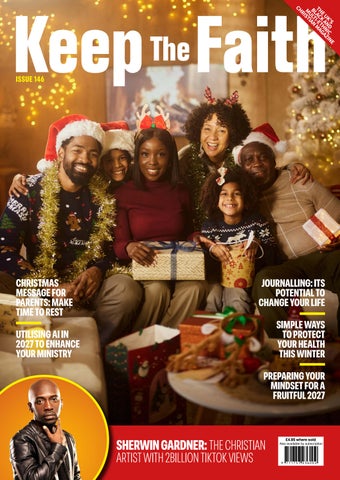
E S K’ ND IC ZIN E UK A HN GA TH AC I-ET MA BL LT IAN U M IST R CH
ISSUE 146
CHRISTMAS MESSAGE FOR PARENTS: MAKE TIME TO REST
JOURNALLING: ITS POTENTIAL TO CHANGE YOUR LIFE SIMPLE WAYS TO PROTECT YOUR HEALTH THIS WINTER
UTILISING AI IN 2027 TO ENHANCE YOUR MINISTRY
PREPARING YOUR MINDSET FOR A FRUITFUL 2027
SHERWIN GARDNER: THE CHRISTIAN ARTIST WITH 2BILLION TIKTOK VIEWS
£4.95 where sold
Strengthen
friendships
gin e b d n ...a ew ones n
Stepping away for a Christian retreat gives your church time with God and one another. The Hayes, Derbyshire
All-inclusive Christian conference venues
High Leigh Hertfordshire
Exclusively for Christian groups From £99 per person per night*
Highgate House Northamptonshire
cct.org.uk
Where the Church gathers *Price is per person, per night. Offer subject to availability, valid for a limited time only. Minimum group size and Terms and Conditions apply.
Editor’s Note
EDITOR Marcia Dixon MBE editor@keepthefaith.co.uk
GRAPHIC DESIGNER Becky Wybrow
SUB-EDITOR Jackie Raymond
ADVERTISING Valerie San Pedro advertising@keepthefaith.co.uk T: 0203 868 0664
MARKETING Karen Seronay karen@keepthefaith.co.uk Mairem Honrada-Magarro mairem@keepthefaith.co.uk
ACCOUNTS AND SUBSCRIPTIONS finance@keepthefaith.co.uk
PUBLISHED BY MTD Publishing Ltd 71 -73 Sheldon Street London WC2H 9JQ T: 0845 193 4431 www.keepthefaith.co.uk Facebook keepthefaithmag X @keepthefaithmag Instagram keepthefaithmag
THE PUBLISHER WOULD LIKE TO THANK:
Dr T Ayodele Ajayi, Shirley Anstis, Pastor Yvonne Brooks, Gary Clayton, O’Neil Dennis, Akosua DF, Chioma Fanawopo, Juliet Fletcher, Silvano Griffith-Francis, Camelle Ilona, Uzoma Isichei, Keziah Job, Kirly Sue, Esther Kuku, Richard McLean, Dr Jacky McLeod, Revd Ronald Nathan, Noah Reddie, Ven Spence, Revd Nathan Turner, Verona White, Danielle Wong, our advertisers and supporters The opinions expressed in this publication are not necessarily those of the Publisher.
Dear Readers Can you believe that 2026 is almost over? Where has the time gone? It seems that the older we get, the faster the years seem to fly by! Whatever kind of year you’ve had, it’s important to remain grateful to God for the gift of life, because where there is life, there is hope. And with hope comes the strength and determination to take steps towards making our lives better. The Christmas and New Year season is a time filled with hope, reflection and the promise of new beginnings. As you read this Christmas and New Year edition of Keep The Faith – our final issue of 2026 – I hope you’ll be encouraged and inspired by the articles we’ve brought together. Several explore the power of prayer and the remarkable transformations that can take place in our souls, bodies, spirits and circumstances when God answers prayer.
My prayer is that, throughout this Christmas season, you will encounter the presence of Christ, experience His peace and be filled with His joy. And, as you look towards 2027, may you do so with renewed anticipation, hope and faith. Wishing you a blessed Christmas and a happy, hope-filled New Year! Happy reading
If you enjoy reading this magazine, do consider supporting us by subscribing to the magazine. It costs just £25 for an individual subscription, or perhaps consider giving a donation. Our account details are: Account name: MTD Publishing Ltd Account no: 30121325 Sort code: 06-04-05 Bank: Tide (Clearbank) Once you’ve made a payment, email your postal address to finance@keepthefaith.co.uk and we will set up your subscription.
www.keepthefaith.co.uk
03
contents ISSUE 146
14
00
05-08 Latest news 10 StepFWD Gospel News By O’Neil Dennis 12 Sherwin Gardner: The Christian artist making waves across the world By Juliet Fletcher
14 Turning chairs and heads, Warehouse Worship’s Turah Sadiq By Akosua DF
16 A promise fulfilled: Singer celebrates first Christmas as a mother By Marcia Dixon MBE 18 The forgotten Black pioneer who built hope in Liverpool By Revd Ronald A Nathan 20 Prayer: The key to church growth, fulfilment and healing By Marcia Dixon MBE 22 Velveta Thompson: The walking miracle By Marcia Dixon MBE
24 When Christmas does not look like it used to By Pastor Yvonne Brooks
12
26 Christmas, Krampus and St Nick By Gary Clayton
27 Home for Christmas: Top tips for stepfamilies By Esther Kuku 28 Did Barbados really ruin my favourite
time of the year? By Silvano Griffith-Francis
30 Giving not getting: What Christmas means to me By Noah Reddie
31 Sermons: Their ability to comfort
during hard times By Revd Nathan Turner
22
32 Christmas message for parents: Make time to rest By Chioma Fanawopo 33 Why did you allow this, God? By Danielle Wong
34 Looking back to step forward and embrace life By Shirley Anstis
35 Science and faith can have a positive interaction By Richard McLean
10
36 Croydon, gangs and God: A novel about the battle beyond the streets By Paula A Grant
37 Operation Restoration: Bringing hope through education By Marcia Dixon MBE
16
38 Utilising AI to enhance your ministry By Uzoma Isichei 40 Food 4 Thought By Marcia Dixon MBE 42 Preparing your mindset for a winning year By Dr T Ayodele Ajayi 43 Dear me, this time next year... By Camelle Ilona 44 Stay well this winter: Simple ways to protect your health By Dr Jacky McLeod
45 A touch of glamour, a season of change By Verona White
46 Kirly-Sue’s Kitchen: Vegan food column By Kirly-Sue
04 Find us on X and Facebook: @KeepTheFaithmag
BLACK-MAJORITY CHURCHES GIVE BOOST TO SHINE YOUR LIGHT CHRISTMAS MISSION
New documentary chronicles life and faith of Archbishop Tutu Church leader, civil rights activist and humanitarian Archbishop Desmond Tutu is the subject of a soon-to-be released documentary entitled Tutu. Directed by acclaimed documentarian Sam Pollard, known for his work chronicling the African American experience, this new documentary sees Pollard tracing Archbishop Tutu’s rise as the unwavering voice of the oppressed in South Africa, where he stood alongside those who fought against apartheid. It includes never-before-seen archival footage and first-hand accounts from those who walked beside him. The documentary also gives us a glimpse of the man behind the public figure and global icon he became, to explore his partnership with his wife, Leah. At its heart. however, Tutu is about the transformative power of forgiveness. When the documentary premiered at the London Film Festival on October 10th, it was highly praised. Sam Pollard said: “This film is my way of bringing audiences an intimate portrait that allows Desmond Tutu to speak directly to viewers in his own words and on his own terms. I wanted Tutu’s voice to be the heartbeat of the story, to let his humanity, humour and moral conviction lead us through his world.” Tutu will be released in UK cinemas on 11th December 2026.
OUT NOW: NEW KTF SERVANT LEADERS PODCAST SERIES
THREE major Black-majority churches have given their support to one of the UK’s largest Christmas evangelistic initiatives: Shine Your Light 2026. The Redeemed Christian Church of God (RCCG), New Testament Church of God (NTCG) and Foursquare GB have committed their networks to the campaign, bringing nearly 1,000 churches into the growing movement. Shine Your Light aims to mobilise 500,000 Christians to share the Gospel with five million people during the Christmas season, with a national focus on 11th–13th December 2026. This year’s campaign is placing special emphasis on reaching prisoners and young offenders, the lonely, residents of large council estates and refugees. Dr Jonathan Oloyede, Founder of Shine Your Light, welcomes the involvement of three Black denominations in this initiative. He said: “This is a wonderful moment for Shine Your Light, and a powerful demonstration of the contribution Black-majority churches are making to the spiritual life of our nation. “I am deeply grateful to the leaders of RCCG, New Testament Church of God and Foursquare GB for their commitment and leadership. Together, we have an extraordinary opportunity to bring hope to people who might otherwise feel forgotten this Christmas.” Churches of every denomination and tradition are encouraged to register and take part at: www.shineyourlight.org.uk/ registration
The second series of the Keep The Faith servant leadership podcast is out now. The podcast provides a platform for listeners to learn from church leaders as they share insights into their journey to faith, ministry and approach to servant leadership. Interviewees include Bishop Geoffrey Folkes, head of Church of God in Christ UK; Olivia Amartey, Executive Director of Elim Pentecostal Church; Pastor Andrew Wignal, leader of the New Testament Assembly, Tooting; and District Superintendent David Whyte, leader of the Wesleyan Holiness Church UK. To listen, visit https://bit.ly/SLPGFolkes2026
www.keepthefaith.co.uk
05
NEW NATIONAL LEADER FOR CHURCH OF GOD OF PROPHECY
Bishop Llewellyn Graham has been installed as the new leader of the Church of God of Prophecy (COGOP) UK, at a special service held at the denomination’s Aberdeen Street branch in Birmingham. During the same service, former COGOP UK leader Bishop Tedroy Powell was consecrated into the role of General Presbyter of Wider Europe and the Middle East. Bishop Tedroy
served as head of COGOP UK from 2017 until September 2026. Special guests present at the service included Bishop Claion and Sonia Grandison, Bishop Derek Webley, and Bishop Melvin and Pastor Yvonne Brooks. Bishop Llewellyn has stepped down from his role as CEO of Nehemiah Housing to serve in his new role. He worked at Nehemiah Housing since its launch in 1989. Nehemiah Housing provides housing for older members of the African Caribbean community and currently has 1,250 affordable homes across the West Midlands. Bishop Graham said: “My decision to step down as Chief Executive therefore comes with many emotions. However, service has always been at the heart of my work – both at Nehemiah and within the Church – and I am humbled to have been called to serve as National Bishop of the Church of God of Prophecy UK.”
LCGC TO TAKE CENTRE STAGE AT THE ROYAL ALBERT HALL
ARTISTS UNITE TO HELP HURRICANE MELISSA SURVIVORS Artists from the world of gospel, CCM and R&B joined together under the name One Voice Collective to record charity single, ‘Jamaica, The Land We Love’. The newly released single will raise money for the survivors of Hurricane Melissa and remind them they have not been forgotten. The artist line-up includes Chevelle Franklin, Beverley Knight, Sabrina Washington, Philippa Hanna, Faith Child, Volney Morgan, Uniekgrace and Noel Robinson.
NOEL ROBINSON
The London Community Gospel Choir (LCGC) will headline the Royal Albert Hall this Christmas. Since 2018, LCGC has become a key part of the London venue’s festival celebrations, and their show on Wednesday 16th December will feature Christmas tunes and gospel classics, performed alongside a lineup of special guests. The choir will be accompanied by The Heritage Orchestra, conducted by Tom Richards, fresh from a sell-out collaboration with Raye at the Hall, while guests will include Kara Marni, Clinton Jordan, Mo Brandis and Katie Coleman. Mo Brandis and B Munro (of KAMOBii). Other artists in the Christmas season include organist Anna Lapwood, jazz star Jamie Cullum, and Take That. For more information or to buy tickets, visit www.royalalberthall.com
06 Find us on X and Facebook: @KeepTheFaithmag
FAITH CHILD
Lawrence Johnson, who led this initiative, said: “This is more than just music; it is a global call to action. Gospel music has always been a voice for healing, and now it can also be a lifeline for those who need support most.” Support generated through the initiative will direct vital assistance through its selected charity, The Jarrett Foundation, connecting the creative energy surrounding the record with practical support for communities in need on the ground.
A LIFETIME IN MINISTRY:
AN EYE-OPENING JOURNEY OF DISCOVERY After more than 18 years in ministry, Reverend Laurel Woodstock reflects on returning to theological study, discovering new perspectives and the importance of continuing to learn.
F
or over 20 years, I worked as a Theatre Specialist Nurse, while also serving in ministry with the New Testament Church of God for more than 18 years. I pastored Faith Temple in Walsall for 16 years and, since 2024, have had the privilege of pastoring NTCG Oldbury. Over those years, it became evident that the world in which we minister is constantly changing. Consumerism, individualism, materialism and changing attitudes towards faith all present challenges for the Church. We need to understand the world around us if we are to communicate the good news of salvation faithfully and intelligently. Therefore, it was crucial that I continue learning and deepening my understanding of Scripture. My journey to The Queen’s Foundation began with encouragement from my former District Manager, Bishop Albert Watson. Although I had undertaken theological training before, I decided to join the Centre for Black
Theology postgraduate Taster Course in 2024-25. I wasn’t quite sure what to expect, but I found the experience eye-opening. It made me think differently about how I read Scripture and encouraged me to consider its meaning through different lenses, particularly in relation to transformative ministry. I am now studying at Master’s level, and I continue to find the experience both challenging and rewarding. It has strengthened my ability to engage critically with Scripture, particularly when examining patriarchal assumptions and thinking about how these affect people’s lived experiences. I would encourage anyone involved in ministry, or seeking to develop their understanding of faith, to consider theological education. For me, Queen’s has been a place where Scripture, lived experience, critical reflection and ministry practice meet. Visit www.queens.ac.uk
BLACK THEOLOGY
POSTGRADUATE TASTER COURSE ONLINE | MA SCHOLARSHIPS AVAILABLE
Explore progressive, rigorous theology through the contextual and liberative lens of Black Theology. Study with pioneering tutors and gain access to a range of scholarships for the Masters Degree.
Apply by 9 January DR DULCIE DIXON MCKENZIE
PROFESSOR ROBERT BECKFORD
DR VALENTINA ALEXANDER
DR MUNYURANGABO BENDA
for the January entry
Applications welcome throughout the year. For more information email: cbt@queens.ac.uk
www.queens.ac.uk/black-theology
Scan the QR code to find out more and apply
www.keepthefaith.co.uk
07
FOUNDATION LAUNCHED TO HONOUR THE LEGACY OF PIONEERING CHURCH LEADER
W
ell-wishers, friends, former church members, former employees, church leaders plus family members were present at the launch of The Revd Dr Io Smith Legacy and Foundation, (RDISLF), named after the renowned Black Pentecostal church pioneer. Held at the New Testament Assembly in Leytonstone, east London – the church planted by the late Pastor Io Smith and Pastor Violet Bailey – the launch was organised and hosted by her daughters, Revd Dr Sheila Belgrave and Jacqui O’Donnell. Pastor Smith, as she was affectionately known, was a highly respected church leader. She led a vibrant congregation and was seen as a community champion who set up projects for young people, those experiencing mental health challenges and the elderly. During the launch and celebration of Pastor Smith’s life, Revd Sheila shared how her mother would go and ‘camp’ at the offices of Waltham Forest Council until someone would see her about funding one of her many community projects. Marie Brown runs the Black People’s Mental Health Association (BPMHA), founded by Pastor Smith in 1991, and travelled all the way from Hampshire to honour her former employer. The BPMHA has helped thousands of people over the years.
There were musical contributions from saxophonist Pauline Doyley and gospel singer Dawn Thomas. Bishop John Francis of Ruach City Church also gave an address. The launch also saw the presentation of the RDISLF Legacy Awards, which recognised individuals who have made significant contributions to ministry, leadership and community life. Five people received Legacy awards in the following categories: Outstanding Achievement: Revd Les Isaac OBE Women in Ministry: Tanya Hughes OBE Emerging Trailblazer: Romeo Bremmer BCYa Community Impact: Marie Walker Outstanding Christian Leadership: Pastor Nathan John
08 Find us on X and Facebook: @KeepTheFaithmag
Four people received recognition awards: Outstanding Achievement: Juliet Coley BCAe Women in Ministry: Pastor Antonnette Bertram Christian Media: Marcia Dixon MBE Community Impact: Yvette McDonald Revd Sheila and Jacqui O’Donnell have big plans for RDISLF’s future. They aim to start a Youth Development Programme to empower youth, establish an accredited Leadership Academy, and carry out community outreach work in Pastor Io’s honour. Speaking to Keep The Faith, Revd Dr Sheila Belgrave and Jacqui O’Donnell said: “The launch of the Revd Dr Io Smith MBE Foundation was an incredibly moving and proud moment for us. To see so many people come together to honour our mother’s life, ministry and extraordinary legacy was truly humbling. But this Foundation is not simply about remembering the past; it is about continuing the work she began.” They continued: “Our mother believed that faith must be demonstrated through action, by uplifting people, challenging injustice and creating opportunities for others. Our hope is that the public will embrace the Foundation as a vehicle for positive change, supporting us through volunteering, donations, partnerships and community involvement. Every contribution, however small, can make a difference. We are ensuring that her vision of faith, justice, education and community empowerment continues to transform lives for generations to come.”
Bishop Tony Thomas and Bishop John Francis
Romeo Bremmer, Bishop John Franis and Juliet Coley
Revd Dr Sheila Belgrave, Marie Brown and Jacqui O’Donnell
For more information visit www.revsmithfoundation.org
LET YOUNG CHRISTIANS HELP SHAPE WHAT COMES NEXT
W
hen Silvanos and the Gospel Temple Youth committee first considered organising a conference, it was new territory. It was their first time planning one, and the idea felt daunting. Their first Revival Youth Camp brought around 100 young people from churches across the Midlands to The Hayes in Derbyshire. The Hayes is one of three residential venues run by Christian Conference Trust, a Christian not-for-profit that has served churches for more than 100 years. The centres welcome Christian groups for conferences, training retreats, and church weekends, with accommodation, meals, and meeting spaces on site. The Trust’s role is to give Christian groups a welcoming place to spend time together beyond their usual setting.
discipleship. The Revival Youth Camp at The Hayes offers a glimpse of how meaningful engagement can take shape: the young committee took responsibility for turning an idea into a gathering for around 100 peers from churches across the Midlands. Their initiative gave young people the chance to help shape an event where they could worship, learn, and spend time together. A residential conference can bring Christians together beyond their own congregation, with time for worship, learning, and conversation. In shared experiences, people can begin to know one another outside the roles they usually occupy in church. That time can make young people’s perspectives, questions, and gifts more visible across the church family.
A gathering with room to connect
Silvanos described the way eating, spending informal time, and worshipping together shaped their conference. The young people spent time with one another throughout the day, with fellowship continuing around the programme. That shared rhythm gave the group time to focus on faith and get to know each other. The committee’s part in the story began before anyone arrived. They took responsibility for an idea they believed mattered and helped create an opportunity for their peers. Organising a conference involved practical work and uncertainty, but the young team carried it forward. Their experience shows one way young Christians can contribute to church life: by helping shape the gatherings and opportunities that matter to them. At The Hayes, one attendee’s experience showed the personal significance a gathering
can hold. A pastor’s son who had not attended church for 15 years came to the conference after a friend told him about it. Following the first worship evening, he told the organisers he felt revived and wanted to take the things of God seriously again. Daytime Bible studies helped young people reflect on what God was saying, while time between activities gave them room to talk and spend time together. His story sits alongside that of the committee members, whose faith led them to invest time in creating a gathering for their peers.
What the numbers point to
A survey of church leaders reported by Keep The Faith found that 62% of respondents identified engaging younger generations as a major challenge for churches. The same proportion named growing attendance and
Making room for what comes next
This kind of time together is part of what Christian Conference Trust supports. The Trust’s three venues are exclusively for Christian groups, with meeting spaces, accommodation, and meals on site. Groups can spend time together across the day, moving from Bible study or worship to a shared meal and back again. The practical arrangements are taken care of, leaving space for the purpose of the gathering and the people who make it meaningful. Young Christians are already worshipping, serving, asking questions, and responding to God in their own lives. At The Hayes, the young organisers helped create an opportunity for others to gather and grow in faith. Their story is a reminder that the Church’s future can be shaped by young people today.
For more information, visit cct.org.uk or call 0300 111 4444 today!
GOSPEL NEWS Gospel News is curated by O’Neil Dennis – the founder of AStepFWD.com, the UK Christian Charts, StepFWD Awards and more. To get in touch, email info@astepfwd.com
Gospel reggae on the rise with a message of hope and lasting legacy Ven Spence and Keziah Job sat down with Birmingham-based reggae gospel artist and pastor Owen Uriah, who spoke to them about his music, journey to faith and ministry. VEN SPENCE and KEZIAH JOB (VS/KJ): Tell us, how did you get involved in gospel reggae music? Owen Uriah (OU): Growing up, I was listening to the likes of The Abyssinians and Dennis Brown, and these were the songs that brought me to Christ, as they were singing about God. I was baptised in 1985 and, the following year, I recorded a gospel reggae song. It was more of a lovers kind of song, because that was the arena I was from. It didn’t go down very well! I didn’t get a great start, as the style of music I was singing wasn’t accepted. As I came to the gospel scene, there were people like Shekinah Sound Ministries, who were already on the scene, and a few other sound systems around the UK, which opened the door for me to minister. When Papa San got saved, I had the opportunity of doing my first gospel show with him at the Gideon Promotions event at the Grand Hotel, Birmingham, and at Fairfield Halls in Croydon, London. Over time, I have ministered with Junior Tucker, Carlene Davis, Chevelle Franklyn and the late great Lieutenant Stitchie.
VS/KJ: What was music promotion like for artists? OU: Back then, we would create a CD and try to get it to the DJs, radio presenters, sound systems and anyone who would play it, in the hope it would become popular. There were some structured labels and platforms, but the struggle was to get the airplay and recognition at a rate that would be effective. VS/KJ: Why did you leave your music ministry? OU: In 2008, I went to New York. I was booked for a few concerts, but, when I got there, everything had been cancelled, and I was upset because I felt it was my ministry. I had started to go down the road of allowing the music to overtake me, because things didn’t go my way. Whilst there, Mike Roots, a radio DJ, invited me to stay with him. As I was there for the week, I went to his church service on the Sunday. That’s where I heard the words of a song for the very first time: ‘When the music fades, and all is stripped away...’ God spoke to me in that still small voice and told me to take the ministry back to the local church. So, when I got back to England, I went back to Bible school, I trained and entered full-time ministry in 2011. That’s the journey I’ve been on and I’m still in full-time ministry. VS/KJ: What is the inspiration behind your new song ‘Forward Christian Soldiers’? OU: I had a resurgence when I had surgery, and I believe the Lord has called me to encourage the Church and to build us up again. VS/KJ: How did you deal with knowing you needed major heart surgery? OU: In September 2025, I had surgery to replace my aortic valve. My heart had become damaged due to high blood pressure, which was diagnosed after I collapsed at church after a morning service. The procedure was supposed to be seven hours, however, due to complications, it took nine and a half hours. My father always used to say: “Who feels it, knows it!” The initial recovery process was difficult, as my movement was very limited and I don’t like sitting still. Sleep was interrupted constantly, as I couldn’t lie down as normal. I found this frustrating as I like to be active.
10 Find us on X and Facebook: @KeepTheFaithmag
Thankfully, I was still able to support and help my church through a phone ministry. My approach to my surgery was pragmatic. I have officiated at dozens of funerals and know the importance of taking care of personal business. I truly believe in God’s healing power, but I have a policy of keeping it real! Therefore, I made preparations to ensure my family would be looked after and my funeral was arranged. I had everything prepared and even advised my wife which suit I wished to be buried in! That may sound over the top, but I have seen the mess that can happen when we do not prepare for such occasions. The Scripture says: ‘O death, where is thy sting...?’ Let me clarify: I do not fear death; I fear not being prepared for such a time. For the next three months, the nights were long. I was constantly waking up, awaiting the rising of the sun. The stitches in my chest kept me still, but God got my attention. It was in the midst of my pain and discomfort that I believe God was able to speak to me. Psalm 23 says: ‘He makes me to lie down.’ I had meditated on this psalm throughout the surgery, and I now realise that sometimes God has to ‘make us lie down’ to get our attention – especially those of us who can become too busy doing for the Lord, instead of living for the Lord. This experience has resulted in a redirection in my music ministry and a new perspective on my life and message. (Praise God!!!) VS/KJ: What message of hope would you give to someone who is ready to give up on their dream? OU: I encourage every person to tap into the gift, the vision, the dream that God has given them. Recognise that it is Christ in you, the hope of glory (Colossians 1:27). Let the dream that God has given you come to fruition, as that dream must be fulfilled. (Selah.) For more information about Owen Uriah, visit owenuriah.com This article was written by Ven Spence, the founder of Reggae Gospel 360, a UK-based specialist PR company, and by Keziah Job, a gospel reggae producer and radio presenter on UGNJAMZ.
From Dancehall Royalty to Kingdom Ambassador: The Legacy of Lieutenant Stitchie
L
ieutenant Stitchie, the Dancehall Governor, was one of Jamaica’s most distinctive voices. Born Cleveland Laing, on 29th September 1965, he rose through Spanish Town’s sound system scene to become a pioneering DJ of the 1980s and one of the few Jamaican artists signed to Atlantic Records. After his conversion in 1997, he became one of gospel reggae’s best-loved ministers, and, in 2021, Jamaica honoured him with the Order of Distinction. Prime Minister Holness called him one of the island’s greatest dancehall DJs. Born in Kingston, Stitchie grew up in Spanish Town, the place he considered home. His mother sang in the church choir and encouraged him to attend Sunday school. He performed Jamaican folk songs at school competitions, while the sound systems around him introduced another musical language, with Ranking Joe and Brigadier Jerry as early influences. Humour became his trademark. His hit song ‘Wear Yu Size’ was inspired by friends struggling with ill-fitting slippers in the mud. The song helped establish his reputation in the 1980s. ‘Natty Dread’ followed, and the Atlantic deal took his fast-paced delivery beyond Jamaica. Yet he first worked as a biology and physical education teacher, and education was never just a footnote in his story. Explaining his 2019 album Masterclass, he said: “The globe has become my classroom.”
In 1997, following bereavement and a serious car accident on the way to Reggae Sumfest, Stitchie embraced Christianity. He didn’t discard the sound that made him famous. Albums including Real Power and Kingdom Ambassador brought his faith into reggae rhythms, offering church audiences a different way to hear dancehall, and challenging assumptions about which rhythms belong in Christian worship. That choice resonated in Britain. Author and TV producer Roy Francis and others have documented that churches had once resisted reggae. At the Oraclez Gospel Festival in London in May 2010, amid violence in Kingston, Stitchie urged British Christians to pray for Jamaica rather than see it only through troubling headlines. Writing for Keep The Faith in 2014, Juliet Fletcher recalled him performing at her church as part of an alternative evening service designed to welcome people through gospel music. These were spaces where Caribbean musical heritage met British church life. Stitchie died on 28th September 2026. His contribution reaches beyond the story of a dancehall star who found faith. He showed that a familiar rhythm could carry a new message without losing its roots. The schoolboy who sang his lessons never really stopped teaching. His classroom simply grew bigger. RIP Lt Stitchie.
SHERWIN GARDNER THE CHRISTIAN ARTIST MAKING WAVES ACROSS THE WORLD
Wow! I’m so excited to be interviewing my first Trini artist – Sherwin Gardner. And a super record breaker for gospel music, too! If you don’t know him, take this moment for a deep dive into his music and ministry. You’ll discover an original innovator who is carving out a dynamic path of achievement. He’s not the proverbial overnight success. Musically, his artistry spans reggae, dancehall and soca, undergirded by a strong songwriter’s ethic and whose music has garnered two billion views on TikTok. He’s also a praise and worship leader! Here’s a glimpse into key landmark moments of this multi-award winner with entrepreneurial ambitions.
MIRACLE BEGINNINGS
Sherwin, born in Trinidad, is third in a line of seven siblings. He’s known as the ‘miracle baby’ of the family, because his mother didn’t know she was pregnant with him. When medics diagnosed his mum’s pregnancy, from the scans, they advised her to abort him, but she said: “No. God gives life and He is the one to take life.” Sherwin was born a healthy baby. Alongside his parents, particularly his mum, Sherwin is entrenched in church life and leadership. Many of his family members are musical or in ministry, but he’s the only one who has taken it to a professional level. At the age of five, during a family gathering, his renowned Trinidadian gospel-singer uncle, Kennedy Patterson, got him to sing for Rough Tops Biscuits (a popular snack), which resulted the very next day in Uncle Kennedy putting him on a big church stage.
SHERWIN GARDNER (SG): And from that day to this interview, I have never stopped singing. That was 42 years ago! JULIET FLETCHER (JF): Amazing! But you’re singing reggae and dancehall music. That music wasn’t accepted back then. SG: No, it wasn’t. In those early years, during Uncle Kennedy’s time and throughout my youth, it was mainly hymn-based songs and choruses – “Old Skool”. Songs like ‘People Need The Lord’, ‘To God Be The Glory’ and anthemic choruses like ‘Yes, Lord’. From a church perspective, reggae music was ‘worldliness’; the older generation didn’t really understand or accept it. We got a lot of crazy backlash, including church doors closed. In my teen years, as we began to use reggae in church dramas, acceptance started to filter in. When Carlene Davis, Lt Stitchie, Chevelle Franklin, Papa San and Junior Tucker all got saved around the same time, we started singing reggae as you would hear it from the streets. Young people responded to that.
GOLDEN AGE OF GOSPEL REGGAE
With the young people – and, to some extent, older people as well – beginning to accept the genre, ‘gospel reggae’ came into force. It was like a ‘golden age’. In the late 1990s, Sherwin’s regional impact was felt, especially with Leaning – his first album release on Lion of Zion Records that had Christafari (Valley of Decision) and Stitchie (Real Power) numbered among its stable luminaries. SG: Despite the backlash, my mum saw something in it and said to me: “By your fruits you shall know them” [sic].
12 Find us on X and Facebook: @KeepTheFaithmag
Soon a real change came, and I was travelling around the Caribbean islands and the US. My peers, like Monty G and others of that time, together we did a lot. But when the likes of Stitchie got saved, it began to ease the stress. Although I was doing gospel reggae and dancehall, whenever it came to Sunday, praise and worship was my first love, and I just wrote and wrote. When, in 2016, I recorded my first praise and worship album, Tyscot Records came to the recording and we have retained a working relationship from that day to this. JF: Tyscot is such a legendary label – owned by the Scott family, with Bishop Leonard Scott being CEO – and included the early signing of John P Kee in the late 80s. It has been recording artists for 50 years.
INTERNATIONAL FAME
Sherwin’s ministry and career catapulted him into international fame. Throughout the first two decades of 2000s, Closer produced the No 1 radio single ‘He Died For Me (Hamalhamadla)’, which spent a staggering 21 weeks atop numerous Caribbean radio charts. That song also earned him 2004 Gospel Songwriter of the Year by the Copyright Music Organisation of Trinidad & Tobago (COTT) – the islands’ most recognised music industry body. He was also awarded Most Impacting Artist at the 2002 Barbados Flame Gospel Awards. The following year, he established his own label, Flow Masters Records, building an exciting roster of Trinidadian talent. Sherwin also made a huge impact at the 2004 Marlin Awards, the Caribbean’s official gospel industry association. With a record-breaking 22 nominations, he eventually won five awards including: Ethnic Recording of the Year, Foreign Language Recording of the Year, Engineered Recording of the Year, Calypso/Soca Recording of the Year and Reggae Vocals of the Year, which was the first time a non-Jamaican had ever won this category. SG: Over the span of almost 40 years in music, I’ve had the privilege of not only writing and producing my own music but also working with and producing many other artists across different genres. Throughout those years, I’ve written or co-written close to, if not more than, 1,000 songs, with a significant number of those songs recorded and released. Through my production and publishing work, we’ve also published approximately 700 to 800 songs from different artists. And that doesn’t include ghostwriting (where no official credit is given).
GLOBAL EFFECT
JF: Starting off the biggest and widest reach of your 2024 single ‘Find Me Here’, which went viral, amassing over two billion views on TikTok and 25 million streams across social media platforms, including 11 million
streams on Spotify, what has that been like? SG: To watch a song that came out of my journey reach billions of people and touch lives across the world is something I could never have manufactured myself. After so many years of ministry, God reminded me that He hadn’t forgotten me. It was a pure place of prayer, saying: “God, You’re the reason why I’m doing this. What do You want me to say to the people?” JF: Amidst difficulties, the testimony of grasping HOPE to overcoming struggle, encapsulated in one song... that must be amazing for you to look back and to see your journey, even from the first time you came to the UK. SG: Yes, in 2004 I came with Stitchie and revisited many times after that. It was very good. I then met Noel Robinson, who came on tour in the Caribbean with me through industry developer Audrey Gray. Since then, we’ve always stayed connected. Noel – as a writer, producer and especially from a music business perspective AND even more with prayer – is right on! JF: How much has the music changed over the years? SG: I don’t think it’s the music. It’s the access and how available it has become through social media. JF: Looking ahead, what can you see for Sherwin Gardner?
SG: My journey has been much bigger than just being a recording artist. A major part of my life has been spent behind the scenes – writing, producing, developing artists and helping other people, such as Flow Masters Records, Island Tribe Collective, and the educational and training part that is Island Tribe Foundation. There is so much more, we’re just getting started! Noel Robinson will be joining the Island Tribe Collective for a special LIVE recording in Barbados, and it will be very special.
STILL MINISTERING
Forty years of incredible ministry and music! Nineteen completed albums... I couldn’t fit in all I discovered about Sherwin Gardner. He is a true worshipping leader, uniquely anointed, appointed and placed at the forefront of this great Gospel’s sonic sound. Sherwin now lives in the Bahamas and is an ordained minister and worship leader at Bahamas Harvest Church. He is also author of the book It Starts on Your Knees. Visit weareflowmasters.com and sherwingardner.com
JULIET FLETCHER
Creative Director of Green Tree and Windrush Church and Music. Founder of Songshare www.songshare.co.uk
www.keepthefaith.co.uk
13
TURNING CHAIRS AND HEADS, WAREHOUSE WORSHIP’S TURAH SADIQ Best known as a lead singer for the award-winning gospel collective Warehouse Worship, Turah Sadiq recently took centre stage on The Voice UK. Catching up with Akosua DF, Turah reflects on her whirlwind journey on primetime TV.
Akosua DF (ADF): You’ve built an impressive career and ministry with Warehouse Worship. Beyond the collective and the big stages, who is Turah Sadiq? Turah Sadiq (TS): I’m a child of God who knows she is loved, and I live my life for Him. I hope I’ll still call myself His child even when I’m old, because God is my Father. At heart, I’m a girl with a big heart. I’m an optimistic, creative dreamer who loves life’s beauty and nostalgia. I see the glass as half full and the world as full of possibilities. I love the freedom to explore, love God and others, and learn about the world around me. ADF: The Voice UK introduced your talent to audiences nationwide. How did the opportunity arise, and what gave you the confidence to take that leap? TS: Funnily enough, it came through Warehouse. After Warehouse Worship’s Old School event, we passed the microphone around. Friends filmed me singing ‘Falling in Love with Jesus’ and posted it on Instagram. A talent scout spotted it and contacted me about a show she thought I’d suit. When she revealed on the phone that it was The Voice UK, I was amazed. I said yes immediately, feeling God had prepared me for years. In Year Two, I told my teachers I’d appear on Britain’s Got Talent or The X Factor – a desire I believe He placed in me. At 16, I applied for The X Factor, but it had effectively ended. Later, I was scouted for Britain’s Got Talent, but COVID-19 stopped that opportunity. Looking back, I think God was shaping me because I wasn’t ready. I surrendered my dream and five-year career plan, saying: “God, even if this never happens, You are still God.” Trusting Him to guide my
12 Find us on X and Facebook: @KeepTheFaithmag
steps, I chose to live by His Word and focused on Warehouse Worship – grateful to grow into adulthood in His presence and to learn to worship Him. The Old School event was in winter 2024. I think earlier that year, I’d dreamt of someone singing ‘No Bondage’ at a blind audition on The Voice. Beyoncé was also in that dream. It seemed random, yet by God’s grace I later appeared on The Voice with Kelly Rowland as my judge. That sense of His preparation gave me the confidence to take the leap. ADF: For your blind audition, you chose Whitney Houston and Mariah Carey’s powerhouse duet ‘When You Believe’. Why choose such a big song for your introduction to the nation? TS: It’s a beautiful classic from the Prince of Egypt soundtrack, which is associated with one of my favourite Bible stories – the story of Joseph. Its encouraging message made it especially meaningful. Whitney’s soul, depth and gospel roots, alongside Mariah’s musical style, drew me to the song. Discouraged after trying many songs, I asked the Holy Spirit for help. The song appeared on YouTube – hearing it again gave me chills – and I knew it was the one. Its message of belief and miracles resonated, because I was hoping for a miracle myself. Hallelujah! It felt like a powerful introduction to the nation. By God’s grace, I want everything I share to inspire faith in Him.
“I hope my journey teaches others not to let fear limit them because God’s got us. Be yourself and love Him out loud, on any platform.” ADF: Young singers watching The Voice UK may recognise themselves in your story. What do you hope your journey tells students and church singers preparing to sing on bigger stages? TS: I’m grateful you asked, because the Lord spoke to me about this after the show. He challenged me to praise Him for appearing on the show, even if only for someone to draw inspiration from my journey. Lifelong preparation doesn’t always guarantee the outcome, but we can be imperfect and still bring light and hope. I hope my journey teaches others not to let fear limit them because God’s got us. Be yourself and love Him out loud, on any platform. ADF: What is the most valuable advice or vocal coaching you’re taking away from your time on Team Kelly? TS: After the cameras stopped, Kelly reassured me that she had been in my position before and that my nerves were something we could work through. Her advice was to ground myself
in the song, feel comfortable in the music and sing from the heart. That calmed me. Her advice was to feel the song and let its message gradually reach the audience – to allow it to build and take people on a journey. I’ve taken away a stronger understanding of music’s power and my ability to reach people’s hearts through singing. I want to sing with that awareness, always to the Lord first. When sharing with His people, I want them to feel what is in my heart. ADF: Audiences now know your voice through iconic covers. What can fans expect from your first solo single or EP? TS: Oooh, imagine music that feels like a good Saturday or a nostalgic hug, combining the edge and swagger of the 90s and early 2000s with the beauty of a ballad and the refreshing message of the Gospel. That’s the Turah Sadiq sound – a little of all those things. By God’s grace, I want to bridge genres and reach people who might not usually listen to gospel music. Gospel has a recognisable sound, but my music will explore other genres. The message will remain the Gospel, and you may hear its influence in my voice. Its spiritual heart will be there, even when the musical style sounds different.
ADF: If you had the opportunity to open for any touring artist, who would that be? TS: What a brilliant question! It’s so hard to choose. I’d love to open for Tori Kelly or the Clark Sisters – it would be such an honour. Opening for Kelly Rowland one day would be a wonderful full-circle moment. I’m not sure whether Fred Hammond is still touring, but if he is, I’d love that opportunity too. And Jennifer Hudson! There are quite a few on my list. ADF: A fun one to finish – no cheating [chuckles]. Which three songs are on repeat in your personal playlist right now? TS: Off the top of my head? My stats show I’ve been listening to CeCe Winans and Fred Hammond this week. My top three songs are ‘I Will Exalt You’ by Hillsong, ‘Jesus Is My Healer’ by Gateway Worship and ‘No Weapon’ by Fred Hammond. I’ve been reflective this week, drawn to songs that help me to be still. Follow on Instagram @turahsadiq
AKOSUA DF
UK-based broadcast journalist and media personality with a love for all things gospel. Follow @akosuadf on social media
www.keepthefaith.co.uk
15
KEEP THE FAITH (KTF): Sarah, before we delve into your music and journey to motherhood, tell us a little about yourself. Who is Sarah Wonders and what has shaped your faith? SARAH WONDERS (SW): I am the eldest of four children. My favourite sports at school were netball and hockey. I also did horse riding; I love shopping and eating out. I’m a wife. I love movies and I love spending time with friends and family. My parents led a church, so I was born into the church but, as I grew older, waiting to have a child has shaped and refined my journey as a woman of faith. I was able to use the wait to deepen my intimacy with God and it’s something I continue to do.
A promise fulfilled: Singer celebrates first Christmas as a mother After 13 years of praying and waiting, praise and worship singer Sarah Wonders and her husband Daniel will enjoy their first Christmas as parents. Sarah spoke to Keep The Faith about waiting on God, motherhood, her Christmas plans and The End of the Matter, her new album that contains songs written during her wait for God to answer her prayer for a child.
16 Find us on X and Facebook: @KeepTheFaithmag
KTF: After 13 years of marriage, God has blessed you with a child. What was that season of waiting like for you, and how did you deal with the challenges of the long wait? SW: In the beginning, I had faith that it would happen but, as the months turned into years, there were a lot of tears and tantrums. At some point, I became tired of longing for something I had no control over and went through a period where I took the stance of “If God wants to give me a child, He will do it.” Along the way, my spiritual maturity surpassed my emotional maturity, and my focus was to seek first the kingdom of God and His righteousness, knowing full well that all other things would be added to me. This helped to give me hope, security and unshakeable assurance that at the divine timing of God I would have my child.
KTF: Waiting for a child can be a challenging experience for a couple. What helped you and your husband remain strong and supportive of each other throughout the journey? SW: My husband is a solid man and I want to take this opportunity to honour him. There were some periods that were more difficult than others, but, through it all, we remained united. We never blamed each other, and we always faced what we understood to be a challenge together. Whenever I was down, he would comfort me and reassure me and I would do the same for him. The dreams God gave us and the prophetic words we received were the solid ground we stood on. Without that, I don’t know what would have become of us.
“I understood early on that the challenge I was dealing with in the wait was not if He was going to do it, it was when, and so I had to be patient because God knows best.” — Sarah Wonders KTF: As a praise and worship minister, you encourage others to trust God. But how did you continue to trust God through the uncertainty and disappointment? SW: I believe the reason I could do this successfully was down to my personal relationship with God. Before I stand to lead other others in worship, I go to God in my secret place. Scripture was instrumental in helping me to understand the ways of God and that destinies are strategically timed, so that God‘s greater plan on earth can be achieved. I understood early on that the challenge I was dealing with in the wait was not if He was going to do it, it was when, and so I had to be patient because God knows best. KTF: What went through your mind when you discovered you were to have a child, and how did that experience change your perspective on God’s faithfulness? SW: I was speechless when I saw the test result; I was in awe of God. I thought I feared God before, but now I have an even greater fear of God. He truly is marvellous and fearfully awesome. Our brains simply cannot contain the full extent of His power and wisdom. Hallelujah! KTF: This Christmas will be your first as a mother. How are you feeling as you prepare to celebrate this special season with your child? SW: For the longest time, we have wanted to do the Christmas family photoshoot. I’m super excited about that! Christmas is about the love
of God and He has showered my family and I with His love. I’ve had sooo long to think about what I want to teach my child about Christmas, so now it’s time to do just that. I’m looking forward to spending the time with family and friends and reading Bible stories to my baby. KTF: How has becoming a mother changed your relationship with God? SW: One of the first things I said after I had my baby was that I don’t think I would ever truly be able to comprehend just how deeply God loves us because I knew that I loved my baby so much but at the same time understood that it’s nothing compared to how deeply God loves us. It made me want to worship and serve God even more. My husband and I can also look back on the journey we have been on and admit that this time was the best time for us. We are grateful that God didn’t give us our hearts desires according to our time, because I’m not so sure we would have stewarded this gift as well as we will now. KTF: You are now navigating life as a wife, mother and worship minister. How has motherhood impacted your daily walk with God and your music ministry? SW: I’m having to guide my time well, be efficient and multitask like never before. My prayer time is not as structured as it used to be, and I now find pockets of time throughout the day to spend time with God. Motherhood has shaped ministry and marriage in the area of service, submission and demonstration. I now have a child, but I must teach how to
live a life that is submitted to God and His will. Well, it’s a great responsibility. KTF: What is the inspiration behind your latest album The End of the Matter and what message do you hope to communicate through the songs? SW: When people listen to the album, it would be very easy to think these songs were written after the answer came but they weren’t. I have been singing the promise of the Lord all these years. The message listeners will take from this album is that God never fails. You’re not foolish for waiting on Him and you have a power and authority to declare the words and will of God for your life and see it come to pass. KTF: Finally, there are people who have been praying and waiting for years for their own breakthrough. What encouragement would you offer to those who are still waiting? SW: I would say the grace of God is sufficient for you. To that person waiting on anything, I would encourage you to spend time gaining understanding from God what it is that He wants to birth from you alongside that thing you’re waiting for. The Bible says that a seed must first fall to the ground and die before it can multiply. This journey of waiting is not to punish you. It is to produce something in you that will help deliver, free, encourage and build-up others. An early understanding of that will ensure you do not miss the timing of God. Visit www.sarahwondersmusic.com www.keepthefaith.co.uk
17
The forgotten Black pioneer who built hope in Liverpool Ronald A Nathan looks at the work of Revd George Daniels Ekarte, who ministered to thousands in the UK during the first half of the 20th century
I
t’s always a good thing to celebrate the well-known giants of history, as well as rediscover heroes whose stories have been overlooked. One such pioneer is Revd George Daniels Ekarte. He was a Nigerian-born minister, whose extraordinary faith transformed lives in Liverpool – long before multiculturalism became part of Britain’s vocabulary. His name may not be as familiar as Dr Martin Luther King Jr or Archbishop Desmond Tutu, yet his ministry embodied the same conviction: that the Gospel of Jesus Christ is not only preached from a pulpit but lived out in the streets. Ekarte’s story is one of courage, compassion and unwavering faith. Born in Calabar, Nigeria, towards the end of the 19th century, George Daniels Ekarte grew up during a period when Christian missionary work was taking root in southern Nigeria. Among those who influenced his early life was the renowned Scottish missionary Mary Slessor, whose fearless commitment to the people of Calabar left an indelible mark on the young Ekarte. From an early age, he learned that genuine Christianity required more than religious observance – it demanded sacrificial service. Around 1915, Ekarte travelled to Liverpool, then one of the world’s busiest ports. Britain offered opportunity, but it also exposed him to the harsh realities of racial prejudice. African seafarers and Black migrants often struggled to find accommodation, employment and acceptance. Many were treated as outsiders, despite contributing to Britain’s economy and war effort. For many people, such experiences would have produced bitterness. For George Ekarte, they produced a calling. After experiencing a renewed commitment to Christ in the early 1920s, he began preaching on the streets of Liverpool and ministering to African sailors. But he quickly realised that sermons alone could not answer empty stomachs, homelessness or racial discrimination. His response would become the defining feature of his ministry. In 1931, Ekarte founded the African Churches Mission in Hill Street, Toxteth. More than a church, it became a sanctuary of hope. It was one of Britain’s earliest Black-led Christian ministries and welcomed both
18 Find us on X and Facebook: @KeepTheFaithmag
Black and White people at a time when racial barriers were deeply entrenched. The Mission offered worship, but it also offered something equally vital: dignity. Hungry people received meals. Homeless sailors found shelter. Young people received an education. Families received pastoral care. Those rejected by society discovered that they mattered to God. During and after the Second World War, the Mission also became a refuge for mixed-race children, often known as the ‘Brown Babies”, born to British women and African American servicemen. Many of these children faced rejection and prejudice, while their mothers often endured social stigma. Ekarte did not ask whether they belonged. He simply opened the doors. His ministry reminds us of Jesus’ words: “I was hungry, and you gave me something to eat... I was a stranger, and you invited Me in.” That was not merely a Bible verse for George Ekarte. It was his ministry philosophy.
Yet Ekarte’s compassion never prevented him from confronting injustice. He publicly challenged discrimination against African seamen, calling for fair wages, decent working conditions and equal treatment. Speaking out came at a cost. His willingness to challenge racial inequality often placed him at odds with local authorities and limited the support his Mission received. Still, he refused to compromise either his faith or his principles. His courage was rooted in the conviction that every person bears the image of God and therefore deserves dignity and justice. Sadly, despite decades of faithful service, Ekarte died in relative obscurity in July 1964, shortly after leaving the Mission premises. The African Churches Mission itself was demolished that same year, and, for many years, his remarkable contribution faded from public memory. Yet history has a way of recovering its true heroes. Today, memorials at the former Mission site and at Ekarte’s graveside honour the man who quietly transformed countless lives. His story is increasingly recognised as an essential chapter in Britain’s Black Christian heritage. Remembering Ekarte is about more than celebrating the past. His life poses searching questions for today’s Church. In an age when ministry can sometimes become preoccupied with buildings, branding and social media visibility, Ekarte reminds us that the Church is strongest when it serves the forgotten. He never separated evangelism from social action. He understood that proclaiming Christ also meant feeding the hungry, housing the homeless and restoring human dignity. His
ministry reflected the pattern of Jesus Himself, who preached the Kingdom while healing the sick, welcoming outcasts and caring for the poor. That lesson remains urgently relevant. Black churches have historically been places of refuge, resilience and hope within their communities. Ekarte’s example challenges today’s leaders to continue that tradition – not only by preaching inspiring sermons but by addressing loneliness, poverty, unemployment, mental health, youth violence and racial inequality with practical compassion. His ministry also demonstrates the importance of standing with the marginalised. Ekarte chose to spend his life among people whom society overlooked: African seafarers, struggling migrants, poor families and children who faced rejection simply because of their background. Modern Christian leadership requires that same willingness to walk alongside those whose voices are often ignored. Whether ministering to refugees, asylum seekers, isolated elderly people or young people searching for identity, the Church is called to reflect Christ’s inclusive love. Another remarkable feature of Ekarte’s ministry was his long-term vision. Rather than building a ministry centred on his own personality, he established an institution that served the community for more than thirty years. He understood that genuine leadership creates a legacy that continues long after the leader has gone. His example encourages today’s leaders to invest in ministries, charities, mentoring programmes and community initiatives that can shape future generations.
Perhaps Ekarte’s greatest lesson is one of humility. He never sought celebrity. He accumulated neither wealth nor influence. Instead, he quietly served ordinary people, often without recognition or adequate financial support. His reward was measured not by applause but by transformed lives. In many ways, his life echoes that of great Christian leaders, such as Martin Luther King Jr, Desmond Tutu and William J Seymour. Like them, Ekarte believed that the Gospel could transform both individuals and society. Justice and evangelism were never competing priorities; they were partners in God’s mission. Revd George Daniels Ekarte deserves to stand among Britain’s great Christian pioneers. His story reminds us that history is often changed not only by those who occupy public platforms, but by faithful servants who quietly open their doors, extend their hands and refuse to stop believing that God’s love can change lives. More than 60 years after his death, George Daniels Ekarte still preaches. Not through sermons preserved on recordings, but through the legacy of a life that embodied the words of Jesus: “Whoever wants to become great among you must be your servant.” That is a message the Church and our nation still need to hear.
RONALD A NATHAN
An elder of the African Methodist Episcopal Zion Church, public theologian, lecturer and World Politics Editor for the Star of Zion newspapers. Email Rancilen@gmail.com
A PRAYER The key to church growth, fulfilment and healing
Marcia Dixon explores the importance of prayer, the impact of praying and lists some prayer points for 2027
20 Find us on X and Facebook: @KeepTheFaithmag
s 2026 draws to a close and 2027 approaches, one spiritual practice the Christian community will home in on is prayer. In January, whether corporately or individually, Christians will be praying for guidance, spiritual strength, church growth, successful missions, Kingdom resources, healing, opportunities, fulfilment of personal goals and much more. And so they should. God wants us to pray. Jeremiah 33:3 states: “Call to me and I will answer you.” And, although we might not get the answers we want, we can be assured our prayers are heard. Prayer is powerful. The Church came into existence after 120 people prayed continuously for 10 days, culminating in the Day of Pentecost where Peter preached the Gospel in Jerusalem and 3,000 people got saved (Acts 2). And, since then, any major move of God has been preceded by prayer. All Christians have heard testimonies of God answering prayers for others or have personally experienced answered prayer. This has been the case for me too. I recall attending a service, where a senior English lady testified she had been a part of a Christian grouping that was led to prayer walk throughout the London Borough of Newham. One of their prayer stops was a disused church, which had once been a place of worship for Pentecostal Christians of the Windrush Generation and their children. They prayed for God to bring spiritual life back to the church. Years later, it became ARC Forest Gate – a vibrant, active and thriving Pentecostal church. It’s good to remember God is also concerned about our personal lives. One young woman asked me to pray that God would help her buy a home. I obliged – believing God would answer her prayer, but unsure of when. Within a week of that prayer, to my great surprise, I received a call. The young lady had heard about a new-build home and put down a deposit. When the work was completed, she moved in. The Lord also provides insight into situations where we don’t have answers or don’t know what to do. I once received a call from a father whose son was in Intensive Care. Doctors hadn’t been able to diagnose what was wrong with him. He requested I ask my social media followers to pray that doctors would be able to identify his son’s illness. People prayed. The next day, the father shared a diagnosis had been made and doctors identified that his son needed a liver transplant. The father then requested I ask my social media followers to pray for a liver to be found. The next day, a liver was found, the son received a transplant and, as far as I am aware, continues to enjoy good health. Like many believers, I can look back on my life and say God has said yes to some of my prayers, no to others and, for some, I still await the answer. However, I remain assured that a prayer, said in faith, can and does transform lives, situations and gives birth to Christian movements that transform the world. What will you be praying about in 2027?
A TESTIMONY OF ANSWERED PRAYER By Dr Norva Semoy Abiona DD
For years, a tiny baby vest hung high on our bedroom wall. It read ‘My daddy is cool’, but there was no baby to wear it. My husband Dr Soji and I had endured miscarriage and a long struggle to conceive. That vest was our act of faith – a daily reminder that the God who gave Sarah and Hannah their children had not changed. In 2010, persistent abdominal pain led to investigations that revealed a tumour in my right ovary. Surgery on 22nd December confirmed a rare ovarian cancer called a malignant teratoma. The tumour had grown to 30cm and had completely destroyed the ovary. I would need chemotherapy and now faced the possibility of never having the child we had prayed for. As soon as we understood what the doctors were telling us, we shared the news with our pastor, family and loved ones near and far, and people began to pray earnestly. Having people around you who believe in the God of miracles is so important. None of us were made to carry our storms alone. We sometimes expect prayer to bring an immediate answer. Mine didn’t come that way. On 14th February 2011, I began chemotherapy. I lost my hair, experienced severe pain and weakness, and suffered complications that nearly required further surgery. There were days when I could hardly walk. Yet, as the prayers of the saints continued to rise, something remarkable sustained me. Even when my body was weak, there was an inner strength in my spirit. I knew God was with me, reminding me that His grace was sufficient and His strength was made perfect in my weakness (2 Corinthians 12:9). I was still going through the test but I wasn’t going through it alone.
PRAYER POINTS FOR 2027 Pray that more people accept the gospel message and follow God’s Word (Romans 10:1). Pray that church leaders/believers are granted new opportunities to preach the Gospel (Colossians 4:3). Pray for wisdom to make good decisions (James 1:5). Pray for the government and those in authority (1 Timothy 2:1–2). Pray for God to raise up more workers to do His work (Matthew 9:38). Pray for the spiritual and physical healing of fellow believers (James 5:16). Pray for signs and wonders (Acts 4:29). Pray for church unity (John 17:20–21). Pray to fulfil God’s will in your life (Hebrews 10:36).
My chemotherapy ended early, in May 2011, because the harm to my body was outweighing the benefits. I was alive but the treatment had brought on early menopause. The doctors warned that my fertility might be permanently lost.
“I was still going through the test but I wasn’t going through it alone.” We kept praying and my husband kept looking up at that baby vest. My cycle returned. Then, five months after I left hospital, a routine cancer follow-up scan revealed a growth. This time it was not cancer. It was a baby! Against the odds and without fertility treatment, I had conceived. On 1st June 2012, our daughter Odelia was born, and the vest finally came down from the wall for her to wear. The following year, God did it again and our daughter Jahzeel was born. The old hymn says ‘Some through the waters, some through the flood, some through
the fire but all through the blood.’ Your trial may look different from mine, but the same God walks through it with you. Sometimes, victory comes suddenly; sometimes, it unfolds through a process. This experience changed my life and the way I pray. Today, I am passionate about helping others understand effective, fervent prayer, hear what God is saying, and live from that place of relationship with Him. The testimony continues, not only through my life but through the lives of those I encourage. So, if your vest is still hanging on the wall, keep praying. God has not promised us a life without trials, but He has promised His grace and His presence. The storm was real but so was God’s faithfulness.
MARCIA DIXON MBE
Publisher/Editor, Keep The Faith magazine
www.keepthefaith.co.uk www.keepthefaith.co.uk
39 21
KEEP THE FAITH (KTF): In Surviving Death – From Coma to Divine Awakening, you share that, prior to your illness, you had a dream that the devil wanted to take your life. Did you believe it was a warning? VELVETA THOMPSON (VT): Yes, looking back, I believe it was a warning. I had a dream in which I sensed the enemy wanted to take my life. I didn’t fully understand what it meant, but it stayed with me. When I later became critically ill and was fighting for my life, that dream suddenly made sense to me. I realised I was in a spiritual as well as a physical battle. But I also came to understand something even more powerful: the enemy may have intended death, but God had another plan for my life. I truly believe God preserved me because my story wasn’t finished. There was still a purpose for me to fulfil and a message He wanted me to bring back. KTF: You were in a coma and close to death. What do you remember of that experience? VT: Although I was unconscious, from a medical perspective, I remember the experience very vividly. I remember being in a place of extraordinary peace, completely different from anything I had experienced on earth. I was aware of what was happening spiritually, even though my body was lying in a hospital bed. I experienced a sense that I was being given a choice: to remain or to go into paradise. There was no fear there. There was peace, beauty and an overwhelming sense of God’s presence. I also became aware of my father, who had already passed away, and an angelic presence ministering to me. It is difficult to put something so profound into ordinary words, but I knew I had encountered something beyond this physical world.
VELVETA THOMPSON
The walking miracle
V
elveta Thompson is a walking miracle. Nine years ago, she was diagnosed, simultaneously, with double pneumonia, septicaemia, meningitis and a bleed on the brain that put her into a five-week coma, with doctors giving her a 2% chance of survival. However, following an intense period of intercessory prayer, Velveta – a wife, mother, grandmother and co-director of Beracah Music – awoke out of her coma. In her new book, Surviving Death – From Coma to Divine Awakening, Velveta recounts her experience of God’s healing power and has spoken to Keep The Faith about her faith, the power of prayer and the message she believes God wants her to share with us.
22 Find us on X and Facebook: @KeepTheFaithmag
KTF: People were praying and worshipping, in church, at their homes and at the hospital while you lay unconscious. What part do you believe those prayers helped in your healing? VT: I believe prayer played a significant part in my survival. While I was critically ill, people
were praying, worshipping and standing in faith for me. My husband Steve especially refused to give up praying for me, as did my children and family. I believe God heard those prayers. I experienced something in the spiritual realm that I cannot fully explain medically, but I know that I was not alone. There was a spiritual battle taking place, and I believe the prayers of my family, friends and church community were part of what sustained me. KTF: When you finally woke up, did you know that something extraordinary had happened to you? VT: Yes, although it took time to fully process it. Physically, I had to begin the long journey of recovery. I had to relearn how to walk and use muscles that had become incredibly weak. My body was recovering from an experience that had brought me so close to death. But internally, I knew I had experienced something that went far beyond the physical. I had encountered a peace and beauty that I could not explain away. I knew I had been given another opportunity to live, and I couldn’t simply return to life as though nothing had happened. I came away with a conviction: I will live and not die. I believe God preserved my life because there was still more for me to do and a story He wanted me to tell. KTF: Your husband was fighting for you through prayer. How did this ordeal impact your marriage? VT: This experience deepened our marriage enormously. Steve wasn’t prepared to accept that I was going to die. While I was fighting physically, he was fighting spiritually through prayer and standing on God’s promises. We have been married for 35 years, but going through something like this reveals what a marriage covenant really means. It isn’t just about the good times; it’s about standing
together when everything is falling apart. Steve saw me at my most vulnerable, and I saw the depth of his love, faith and determination. Our marriage came through the fire with an even deeper understanding of what it means to love, pray and stand together. We learned again that when Christ is at the centre of a marriage, there is strength to face things you never imagined you would have to face. KTF: What did your illness teach your family about faith, love and the fragility of life? VT: It taught us never to take life for granted. One moment life can feel completely normal, and the next you can be fighting for your life. My illness showed my family how fragile our physical existence is, but it also showed us how powerful love and faith can be. We learned that faith doesn’t mean pretending difficulties don’t exist. It means choosing to trust God in the middle of them. Most importantly, we learned to value one another more deeply. Life is a gift. Family is a gift. Time together is a gift. My survival reminded us that every day we wake up is an opportunity to love people, encourage people and fulfil the purpose God has given us. KTF. You came face to face with death. Did it change your understanding of God? VT: Completely. I know God more intimately now than ever before. Through everything I experienced, I came to understand His love, grace, peace and mercy on a much deeper level. Coming so close to death removed many of the things we can become distracted by in everyday life. I was reminded that, ultimately, God is not simply an idea or a religious belief. His presence is real. I no longer view death in quite the same way, because I believe eternity is real. But my experience also made me appreciate life more. God didn’t allow me to experience heaven so that I would simply want to leave this world.
I believe I was brought back because I still had purpose here. That’s why my message is simple: I will live and not die. There is still more to do. KTF: What would you say to someone praying desperately for a miracle today? VT: Don’t stop believing, even when the situation looks impossible. I know what it feels like for circumstances to appear completely hopeless. I was given a very small chance of survival, yet I am here today. I would encourage anyone praying for a miracle to keep bringing their situation before God. Surround yourself with people who will pray with you, encourage you and strengthen your faith. But I would also say this gently: trust God with the outcome. Faith isn’t about controlling God; it’s about trusting Him when we cannot see what He is doing. KTF: What message do you want readers to believe when they reach the final page? VT: I wrote this book because I believe I was given a message to bring back after my experience. I didn’t return simply to tell people that I had seen heaven; I returned with a responsibility to share what God placed in my heart. One of the strongest messages is for young people: you are loved, your life has purpose, and don’t allow the world to convince you otherwise. I want them to know that forgiveness is powerful, that bitterness can destroy us, and that choosing love can change lives. I also want people to understand that God’s love is not distant or reserved for a select few. His love is here on earth for every person. When readers reach the final page, I want them to feel hope and understand that their life has purpose and there is more for them to do. To get a copy, go to www.beracahmusic.co.uk Visit www.beracahmusic.bandcamp.com www.keepthefaith.co.uk
23
Image includes AI-generated models
Pastor Yvonne Brooks explores the issue of loss, change and ‘God with us’ during this Christmas season
T
here is something about Christmas that brings the years into the room with us. A familiar song, the smell of something cooking or a decoration taken out of its box can transport us back to people and places. Suddenly, we remember a voice, a laugh, a kitchen, a gathering. For a moment, we can almost hear everybody again. Then we look around at the Christmas in front of us and realise how many things have changed. The children are grown. Some have families and their own arrangements. People we expected to see every year are no longer here. We are still making plans, buying presents and deciding what to cook, yet, beneath all that activity, is a thought: it doesn’t feel quite like it used to. As I have matured, I understand that Christmas carries mixed feelings. We can be thankful for the family around us and still ache for someone who is missing. We can enjoy the laughter of our grandchildren and remember
24 Find us on X and Facebook: @KeepTheFaithmag
when their parents were the little ones. We can love what we have today, while missing something we cannot bring back. We need to give ourselves permission to be honest about this. My mother is no longer here. My brother is no longer here. Their absence is a part of the story of my life, even when I am enjoying a happy day. There are people whose place in our hearts remains so familiar that it can still surprise us that we cannot simply pick up the telephone and hear their voices. Christmas has a way of making us notice those spaces. For some, this will be the first Christmas after a bereavement. For others, many years have passed, but a particular song or family tradition will still trigger the tears. Please do not measure your faith by whether you cry. You can trust God and miss somebody deeply. You can be grateful for the years you shared and wish there had been more. It may help to say their name, share a
memory or cook something they enjoyed. We do not have to leave our loved ones out of the conversation to make everyone else comfortable. Yet loss is only one reason Christmas changes. Sometimes, the family has grown and sharing Christmas now means sharing people too. There are other grandparents to visit, other homes to consider and new traditions taking shape. We understand this with our heads, but our hearts may need longer to adjust. Those of us who have spent years gathering everyone together can experience difficulty when we are no longer at the centre of every arrangement. We may say: “Whatever works for everybody,” while quietly hoping that everybody will still choose us. There is no shame in admitting that. We love our families and enjoy having them close. But love also asks us to make room for their lives as they develop. A celebration held on another day can still be precious. We can receive
our time together without spending it grieving the timetable we would have preferred. Then there are the changes within ourselves. We may still want to do everything we have always done, while our bodies are asking for a different arrangement. The shopping, cooking, cleaning and hosting can become exhausting. Yet we carry on, because we fear that asking for help will somehow diminish our place in the family. I am learning that being loved does not have to depend on being useful. We can allow others to prepare a dish. We can sit down while someone else clears the table. Our presence matters. Surely, there is room at our own celebrations for us to enjoy being there. In the midst of these changes, I return to the name given to Jesus in Matthew 1:23 – Immanuel, ‘God with us’. ‘God with us’ in the noisy house and the quiet one. ‘God with us’ when the family gathers easily and when relationships are strained. ‘God with us’ when memories make us smile, and when they catch us unexpectedly and we have to step away. We can bring Him the real Christmas we actually have, with its joys, complications and tender places.
But there is something I must consider too. I can spend so much time wishing things were as they used to be that I fail to give my full attention to the people who are here now. I can be sitting with my family while, in my heart, comparing everything with another Christmas. I do not want to lose today by continually measuring it against yesterday.
“We cannot gather all our yesterdays around the table again. But we can give ourselves wholeheartedly to the people sitting there today.” Remembering those I have lost reminds me how precious our time with one another really is. One day, somebody may look back on this Christmas and remember us. They may remember whether we listened, whether we laughed with them, whether there was warmth in our welcome. We may be tempted to walk away because it feels different, but this could become a treasured memory for someone else. That thought makes me want to be present. It makes me want to put down the unnecessary task, sit beside someone and ask more than a passing question. It makes me want to allow younger family members
to bring something of themselves to our traditions. As the New Year approaches, perhaps this is something we can prayerfully consider: have we left room in our expectations for life to be good in a different way? We may need to grieve before we can answer. We may need to speak honestly about loneliness or changes we have found difficult. We can bring all of that to God and ask Him to help us recognise the opportunities for love that remain. This Christmas, I want to honour the people I miss by loving those people I can still reach. Who needs your attention while you are wishing someone else could be there? What might you receive if you allowed this Christmas to have a beauty of its own? We cannot gather all our yesterdays around the table again. But we can give ourselves wholeheartedly to the people sitting there today.
PASTOR YVONNE BROOKS
Co-Pastor at New Jerusalem Community Church; Founder, Woman of Purpose; speaker and author. Visit www.yvonneelizabethbrooks.co.uk
JOIN US AT THE ANNUAL INSPIREURBIZ
BLACK TIE DINNER & SPEED NETWORKING 3 COURSE ME AL, SPE E D NETW ORKI NG & AW ARD W I NNI NG GUEST SPEAKERS
SATU R DAY
12
DE CE MBE R
C E N T RA L L O N D O N : 6 : 0 0 P M MARCIA D IX ON - AN T O N IA O K O N MA S H ITTU - V E E R O B E R TS MARTIN JES S ICA ROGERS - MAR TIN W R IG H T - D R S H E R R Y AN N D IX O N
WWW.INSIGHT2MARKETING. COM/ EVENTS
www.keepthefaith.co.uk
25
CHRISTMAS, KRAMPUS AND ST NICK Gary Clayton delves into the stories and myths that have been inspired by the Christmas story, and shares why we must always be aware of the Reason for this season
A
lthough Christmas is an opportunity to remember Jesus’ miraculous birth, share the good news of His incarnation, and spend time with family and friends, it can also be a profoundly lonely and depressing experience. What about those who have lost their jobs and may be steeling themselves for a future of financial instability and depressing job applications? Or those who have lost loved ones and are now alone, with only the TV or a bottle of wine to keep them company? All this can, for many, make Christmas more melancholy than holy, when life is lonely and bills can’t be paid. So, although the run-up to Christmas should turn our thoughts to the Word becoming flesh and dwelling among us (John 1:14), our spiritual reflections tend to be supplanted by the problems of everyday life and the stress caused by that ubiquitous, red-robed figure and his increasingly costly Christmas list! Some, of course, view Father Christmas as a genial incarnation of St Nicholas, the reputedly gift-giving Bishop of Myra (270–343), a 4th-century Christian bishop. Famous for his kindness to children and the poor, he allegedly resurrected three butchered boys who had been pickled and placed in a barrel, and rescued three girls from being forced into prostitution. Christians, however, believe that Santa Claus not only detracts from Jesus, but has a tendency to usurp Him. As the Puritan pamphleteer Philip Stubbes complained, in The Anatomie of Abuses (1583), ‘Who is ignorant, that more mischief is that time committed than in all the year besides? ... What dicing and carding, what eating and drinking, what banqueting and feasting is then used... to the great dishonour of God and impoverishing of the realm.’ Stubbes also refers to how ‘...the wild heads of the parish flocking together, choose them a grand captain of mischief, whom they ennoble with the title of Lord of Misrule... This done... then have they their hobby horses, their dragons, and other antiques, together with their bawdy pipers, and thundering drummers, to strike up the devil’s dance withal. Then march this heathen company towards the church... their bells jingling, their handkerchiefs fluttering about their heads like mad men, their hobby horses and other monsters skirmishing amongst the throng: and in this sort they go to the church, though the minister be at prayer or preaching, dancing and singing like devils incarnate, with such a confused noise that
26 Find us on X and Facebook: @KeepTheFaithmag
no man can hear his own voice.’ Goodness knows what the godly Stubbes would have made of Krampus – the hairy, cloven-hoofed, long-tongued, sharp-fanged, half-goat, half-demon who, according to pre-Christian Alpine folklore, punishes misbehaving children. It’s said that Krampus – whose name derives from the Old High German word ‘krampen’ or ‘claw’ – visits the homes of children on ‘Krampusnacht’ (Krampus Night). The story goes that on 5 December, the day before the Feast of St Nicholas, Krampus warns youngsters to be good, while beating the badly-behaved ones with birch branches. Although St Nicholas didn’t become popular in Germany until the 10th century, it’s surely a reflection on humanity’s fallen nature – as well as the results of Christian syncretism – that 17th century records show Krampus accompanying St Nick; the dynamic duo visiting children in central Europe and performing a kind of good cop, bad cop routine. In countries, such as Austria, Germany (Bavaria), Slovenia and Hungary, Krampus wears chains around his neck, ankles and wrists, with a large sack around his waist being used to carry bad children away. Who’d have thought that good St Nicholas, who later became associated with the Christmas season, would eventually be
accompanied by Krampus – a devilishly horned figure as frightening as anything one might see at Halloween? Sadly – and perhaps surprisingly – traditional Krampus runs still occur annually in Austria and Germany, with demonically dressed participants parading through the streets. A number of these ‘runs’ end badly, with birch-rod-beaten bystanders injured and the hideously masked assailants wounded due to their victims’ retaliation. Whatever we’ve been going through here in the UK, and whether 2026 has been a good year or a bad one, we can at least give thanks that – barring a Krampuslauf that is due to take place again in Whitby and for the first time in York – Christmas currently appears Krampus-free! This Christmas, let’s seek to provide succour to those who are suffering. And let’s not only be good, but godly – doing all we can so those who are currently living in darkness will be delivered from death’s shadow to see Christ’s great light (Matthew 4:16).
GARY CLAYTON
has been writing/editing for various missionary organisations since becoming a Christian in his early twenties.
Home for Christmas: Top tips for stepfamilies Esther Kuku shares some useful insights that will help stepfamilies to have an enjoyable Christmas and New Year holiday season
C
hristmas is my favourite time of year. I love it. I have this tradition of buying one new decoration for our home every year. I know I am running out of space to put things up but figuring it out makes it even more fun. I also know that, if you are a part of a stepfamily, alongside the twinkling lights and festive music can come a mixture of emotions. There may be excitement, but also sadness, anxiety or disappointment. Children may miss a parent they are not spending the day with. Adults may feel pressured to keep everyone happy. Family traditions can collide and schedules can be difficult to navigate. Everyone is carrying expectations that no one has spoken aloud. Is this your first Christmas as a stepfamily? If you are new to stepfamily life, I am here to help. I have been a stepmum, mum and part of a blended family for 14 years. A successful Christmas in a stepfamily is not about getting everything right; it’s about planning and early conversations. It is about making space for one another and remembering what matters most. The apostle Paul encourages us to: ‘Make every effort to keep the unity of the Spirit through the bond of peace’ (Ephesians 4:3). Peace in a stepfamily rarely comes from perfect circumstances. More often, it grows when we choose patience and focus on connection rather than perfection.
Here are some of the things that I have learnt along the way: I let my husband take the lead on arrangements involving my stepchildren. Together, we shield our two younger children from the complexities of stepfamily life. We explain early that we may not all spend Christmas together but reassure them that celebrating with the four of us and our extended family will still be special. I also plan baking and decorating activities so they can focus on enjoying the season. We keep Christ at the centre of our celebrations, and I would advise you to do the same. The pressure of presents, planning and packed calendars can easily distract us from the true meaning of Christmas. We attend church activities and take time to reflect on how good God has been to us throughout the year. I teach gratefulness and the reality that many children and families do not have the blessing that we experience. The message of Christmas is not that life is flawless. It is that God entered a broken world to bring hope, peace and reconciliation. That message speaks powerfully into the realities of stepfamily life. As Isaiah prophesied: ‘For to us a child is born, to us a son is given... And he will be called Wonderful Counsellor, Mighty God, Everlasting Father, Prince of Peace’ (Isaiah 9:6). This Christmas, remember that successful festivities are not measured by matching pyjamas, nor by the flawless photos that flood
our social media feeds. It is about love, grace, peace and togetherness. Choose grace and offer support Make grace the foundation of your family relationships this Christmas: • Extend grace to every member of your family. • Show understanding toward former spouses, as you navigate shared arrangements. • Be patient with children who did not choose to alternate Christmas between two homes. Not part of a stepfamily? You still have a role to play If you are not part of a stepfamily, consider how you can support those in your congregation who are. Reach out, offer to pray for them and ask how they’re doing. Stepfamilies flourish when a caring community supports them. We reflect the heart of Christ by noticing those around us. When we intentionally pray for and encourage stepfamilies, we become part of God’s work of bringing peace, hope and belonging into every home.
ESTHER KUKU
Author of Stepping Up: A Devotional for Stepfamilies. Visit brfresources.org.uk to purchase, or wherever you get your books
DID BARBADOS REALLY RUIN MY FAVOURITE TIME OF THE YEAR? Avid traveller Silvano Griffith-Francis takes a trip down memory lane and recalls Christmas celebrations she has attended in different parts of the world
L
ike many other children growing up in the Western world, Christmas was my favourite time of the year. Yes, I knew there was something about a little Baby, lying in a manger somewhere, but honestly, Christmas was all about the big man dressed in red. The toys he brought my younger sister and me were phenomenal. Among my favourites was a teddy bear (later named Googey) who was bigger than me, a little ET character and a Cadbury chocolate-dispenser money box. The former two I still have. All that changed when, aged eight, I left the snow-filled streets of Greater Manchester for the sunny island of Barbados. Changing address two weeks before Christmas would be any child’s worst nightmare, I imagine, and I was no different. Despite my mother promising us over and over that Santa had our forwarding address and that another child wasn’t going to end up with our gifts, I had my doubts... My suspicions were aroused when I arrived at our new home. No snow for Santa’s sleigh and no chimney for him to descend should probably have been giveaway enough. But it was the rubbish gift of a large bowl of sweets – from parents understandably stressed by an international move – that finally gave the game away. In my eight-year-old mind, Barbados was solely responsible for ruining Christmas! Returning to the island as an adult, however, gave me a completely different appreciation of the season. It felt far less commercial than Father Frost, Russia
28 Find us on X and Facebook: @KeepTheFaithmag
Christmas in the UK, and even people who weren’t particularly religious throughout the year seemed to make a special visit to church on Christmas morning. I loved the 5am service: starting in pitch darkness and ending with the rising sun. Then the trip to Queen’s Park for ‘Christmas in the Park’, where people from all across the island gathered to show off their finest Christmas outfits, as they strolled through the park to
live music from the Police Force Band. And then there was Christmas dinner – still one of the best I’ve eaten anywhere in the world – with the coveted Farmer’s Choice ham taking centre stage. Since then, I’ve had the privilege of celebrating the Christmas season – even if not always Christmas Day itself – in a few different countries. It was minus 25 degrees in Russia, when I arrived on 26th December to Christmas tree display, Russia
see Father Frost and Christmas decorations everywhere. Yet New Year’s Eve seemed to be the bigger celebration, before the Orthodox Christmas on 7th January. Then there was a family Christmas holiday in Turkey. My adventurous suggestion was vetoed by everyone, in favour of two weeks in an all-inclusive resort – my first and last time doing that! Being in a predominantly Muslim country at Christmas felt strange. There was no Christmas meal or celebration at the hotel, so, my family (nine of us) created our own. One minute, we were in one of our rooms singing carols and reflecting on the birth of Christ; the next, we were staring down the barrel of a rifle as we, Mum included, had our first rifle-shooting lesson. That evening, our waiter, who had never celebrated Christmas, watched with curiosity as each of us reached into a giant Santa sack and pulled out a gift. We explained what we were doing and why, then invited him to have a go. I can’t remember the last time I saw a grown man that excited about receiving a Christmas present! Then there was Christmas in America – even bigger and more commercialised than the UK, if you can imagine that. In our family, we traditionally open presents late into the evening, a tradition that began when Mum
Santa Parade, Russia
insisted we eat dinner and clean up first. We were remarkably cooperative! So, it felt very strange opening gifts on Christmas Eve, as is the tradition for some American families. And, for the first time, I encountered a ham that could almost rival Farmer’s Choice. I’ve also spent the Christmas season in Cyprus, and travelled around the Caribbean on a two-week cruise. Each place has its own customs. As I’ve experienced all this, the question for me always comes back to: what are we really celebrating?
As an eight-year-old, I thought Christmas had been ruined because I’d discovered the truth. Decades later, I realise I had been given an opportunity to understand that Christmas was about something much bigger than what I’d thought. Yes, the food is wonderful and giving and receiving gifts is a joy. But in all the celebrating, we must remember to celebrate Jesus. His birth – and what it means for us today – should remain pivotal to the season. Perhaps that is why, years later, I found myself writing a children’s book about Christmas. I wanted to tell the story of a little girl, discovering the meaning of Christmas for the first time. I didn’t have the heart to put my fictional character through my experience, lol. Instead, I allowed her to discover the wonder of the first Christmas and why we celebrate it. Wherever in the world you spend Christmas, whatever is on the table, whatever traditions you follow and whatever gifts you unwrap, there is one Gift who doesn’t change. Jesus.
SILVANO GRIFFITH-FRANCIS
Actress, speaker, facilitator, writing coach and author of Kala in The Nativity Sparkle. To purchase, visit www.silvanogriffith.co.uk/author
www.keepthefaith.co.uk
29
Image includes AI-generated models
GIVING NOT GETTING: What Christmas means to me now Noah Reddie shares insight on how his attitude to Christmas has changed over the years and what it means to him now that he is a young adult
A
s a child, Christmas was the highlight of my year, even more so than my birthday. The presents I received, seeing family, and the TV shows and movies that were on offer were fantastic. On Christmas Eve, I would be anxious to head to bed, trying to fall asleep. And then, on the day itself, I would wake up – far earlier than I did for school! – jump on my parents’ bed and beg them to let me open my presents. On Christmas Day, my only obligation was to unwrap all my gifts from under the tree. Nobody expected anything from me, and I was fortunate enough that my parents would attach my name, when giving presents to each other. I would argue that children are meant to receive; it is a part of how they learn about what it is truly like to be loved, before they have done anything to earn that appreciation. However, I am no longer a child; I’m a young man with a job and a salary, and a list of Christmas present suggestions on the Notes app on my mobile phone. The idea of Christmas occurring – and me avoiding buying anyone presents – has dematerialised. Ultimately, this newfound responsibility has also changed my outlook on Christmas, and the importance of the day in my life. I noticed this shift in my perspective on Christmas, the year I moved back home after graduating from university. I became aware of how a joyous holiday had become a competition for who can spend the most on a person – even
30 Find us on X and Facebook: @KeepTheFaithmag
if the present is ill-suited to that individual. I now feel as though this season has become about ‘owing’ something to someone; not in the sense of having a burden over me, but similar to when the Bible addresses our relationship to stewardship. I have been blessed to have been given so much by my parents, who themselves have never expected anything in return. However, now that I have some form of income, it feels wrong not to give back, and, in a multitude of ways, it feels discourteous if I don’t at least think about doing so. Christmas as an adult is something nobody prepares you for, and it has dual functions; it is about what is given to you, and what you are now able to give. I now like to consider some of the theological aspects linked to giving and Christmas. In Luke 12:15, we read that we should: “Watch out! Be on [our] guard against all kinds of greed; life does not consist in an abundance of possessions.” Jesus follows this by preaching about the rich man who builds bigger barns to store his surplus but subsequently dies that same night. The parable is challenging, especially in December, when society is promoting the importance of having abundance, acquiring more, and that this year’s haul has to surpass the previous one. We later read in Acts 20:35, where the Apostle Paul quotes Jesus: ‘It is more blessed to give than to receive.’ It is easy to agree with this maxim as a principle, but challenging, when
your bank app is open, and you are weighing up what presents everyone should get. For me, as an adult, the ‘Reason for the season’ is Jesus – the greatest Gift that was ever given. What’s more, the gift of Jesus is free. After Jesus, the second most important aspect of the day is family time and sharing our appreciation of one another. Our culture is good at endeavouring to convert us into following a spending mindset, which sees us going into debt and worrying about how to pay it off in January. Scripture offers a sober alternative, which states that the purpose of life is not nourished by what one accumulates. In Mark 12:43–44, Jesus watches a poor widow drop two small coins into the temple offertory box, and says: “Truly I tell you, this poor widow has put more... than all the others. They all gave out of their wealth; but she, out of her poverty, put in everything – all she had to live on.” As such, giving in its highest regard is about what the gift costs the giver. In Jesus’ case, it cost Him His life. Let us be cheerful givers this Christmas, but ones who appreciate the gift of eternal life via Jesus, and that of family and friends.
NOAH REDDIE Joint Public Issues Team intern (2026–27) and Durham University graduate
SERMONS: THEIR ABILITY TO COMFORT DURING HARD TIMES
S
Pastoral support during life’s most challenging moments can provide major relief. So can a lovingly prepared and delivered sermon. Revd Nathan Turner shares the reasons why
hepherding people at significant life events is the core of pastoral duty. People need the support of the Church to comfort their hearts after their loss, and the preacher has a significant role to play. When my sister Anthea sadly died, aged 35, my family asked Bishop Jonathan Jackson to preach at the funeral. Only in retrospect did I really consider the enormity of the ask. Bishop Jonathan had pastored Anthea and is very close to my family. So, he would have been grieving too. I’m not sure if he compartmentalised his feelings or used them as fuel, but he delivered a funeral sermon that truly embodied ‘words of comfort’. He spoke with passion from Philippians 1:21, saying her early death was painful for all involved, but it was a “biblical possibility”, as Paul has encouraged all to live a life in full service to God, knowing that when death eventually comes, one will be with God, reaping an eternal reward. He movingly declared that she had set an example for all the gathered mourners, in that “she had no weight.” No weight of unfulfilled service, broken relationships, or faulty character. She could be taken by God, as no sin was holding her down. Her godly praxis allowed her to meet her Lord and Saviour and be free from the cares of this life. Hearing these true words resonated with me and I cried tears of grief but also tears of peace. In that moment, the sermon gave me a liberty to express those mixed emotions. The art of preaching is keenly at play in the
funeral sermon. In most Pentecostal contexts, it is called ‘words of comfort’ in our programmes, rather than a funeral sermon. In the biblical sense, comfort is more than consoling someone with an aim to make them feel better. The connotation from texts like 1 Thessalonians 4:18 is to strengthen (comfort) those who mourn in view of the hope they have in Christ’s resurrection. There is a fine balance for the preacher to allow space for grief and hope in 15 minutes. When preparing a sermon for a funeral, the needs of the mix of believers and unbelievers in the congregation should be considered. My mother speaks about funerals in the 60s and 70s being an average of 45 minutes long, with a distinct emphasis on preaching an evangelistic message. I imagine we have become more sensitive in contemporary times and don’t want to be accused of condemning the unbeliever. There may be something in my mother’s reflection, as we are encouraged to preach in season and out of season; so biblically, the funeral space is an important setting to point to Christ’s death and His power over it. The Church is a key institution that helps us to do death well and to navigate all the challenges associated with it. The words of comfort are a tool in the evangelistic mission of the Church. It’s this drive that has prompted my mother to ask me to preach at her funeral. She wants songs of celebrations. Only a few tributes. She wants time for the Word to encourage believers to continue to serve God, and for the unbeliever to start their journey of faith. So, for this tall order to honour her
wishes, I have to consider what resources are available. There are collections of ready-made sermons, general advice and denomination manuals for orders of service. From these, you would be able to choose a biblical text. There is a gap in the resources to help interpret them for the context. There is also a need to understand Pentecostal lament, especially for circumstances of suicide, infant death, and murder. However, I believe the biggest resource is the lived experience of senior ministers who have embodied the preaching space. So, young preacher, connect with someone who has trod the path. Be bold and ask them if you can shadow them in funeral preparation and observe them as they deliver their sermon. In this modern era, we have the phenomenon of funerals being livestreamed and recorded onto YouTube, which presents an opportunity to observe funeral sermons online. I re-watched my sister’s funeral the other day. I was able to learn to celebrate her again. I was strengthened again by the words of comfort from my senior mentor and brother Bishop Jonathan Jackson, who is a skilled preaching practitioner. By the help of the Holy Spirit, he demonstrated there is power in the biblical text and Black preaching – even for the most heartbreaking situations.
REVD NATHAN TURNER
Senior Pastor, NTCG Coventry Visit www.ntcgcoventry.org.uk
www.keepthefaith.co.uk
31
CHRISTMAS MESSAGE FOR PARENTS:
MAKE TIME TO REST Parenting can be exhausting! Chioma Fanawopo encourages parents to find moments to rest this Christmas, and calls on the wider community to support parents who need help
A
story circulating in the media about a Black mother who allegedly left her four children – including a two-month-old baby and a nine-year-old – at home alone, while she went on a three-day cruise, has prompted difficult backlash. Reports suggest she has been arrested and prevented from seeing her children. The full circumstances remain unclear. Leaving children so young, without appropriate care, is dangerous and cannot be excused. However, the story raises an important question: how well do we support parents who are struggling? We should not speculate about this mother’s circumstances. But we can recognise that parents need support, safe opportunities to rest, and spaces where they can admit they are overwhelmed without fear of judgment. As a mother, parenting coach and author of Parenting as Leadership, I know that loving your children deeply does not mean you will never feel exhausted by the responsibility of raising them. Both things can be true. Christmas is often portrayed as a season of joy, family and celebration. Yet, for many parents, it brings additional pressure. There are presents to buy, meals to prepare, school holidays to navigate, family expectations to manage and household budgets to stretch. Separated parents may face difficult arrangements, while those grieving loved ones, experiencing loneliness or facing financial hardship may find the season particularly challenging. Social media can add to the pressure, with images of beautifully decorated homes, matching family pyjamas and elaborate
32 Find us on X and Facebook: @KeepTheFaithmag
celebrations. Parents may feel they are failing if their Christmas does not look the same. Please remember: your children need your presence more than perfection. A simple meal, a peaceful home and quality time together can be more valuable than an expensive Christmas. Our Christian faith reminds us that rest is not a sign of weakness. In Mark 6:31, Jesus said to His disciples, “Come with me by yourselves to a quiet place and get some rest.” Even during ministry and meeting the needs of others, Jesus recognised the importance of rest. If He acknowledged that need, surely parents should not feel guilty for needing it too. Rest must, however, be safe and responsible. It means planning ahead, asking trusted adults for help, sharing responsibilities and never leaving children without appropriate supervision. Over Christmas, this might mean asking a trusted friend to care for the children for a few hours or sharing cooking responsibilities. It may also mean saying no and letting go of unrealistic expectations. There is a saying that it takes a village to raise a child. Yet many parents are raising children without a village of their own. Some live far from relatives. Others are parenting alone or feel unable to admit they are struggling because they fear criticism. Our churches and communities have a vital role to play. Church should be more than somewhere we attend on Sunday. It can be a community where families find encouragement, friendship, practical help and understanding. If you are a parent, consider connecting with your local church, joining a parenting group or reaching out to someone you trust.
If you already have a supportive community, ask yourself “Who might be quietly struggling?” Could you offer practical help, share a meal, invite a family to Christmas lunch or simply ask: “How are you really doing and what would help you this week?” A struggling parent does not always need a lecture. Sometimes, they need someone who will listen, help them identify safe options and remind them they are not alone. If you need help, asking for it is an act of responsibility and love, not failure. Persistent exhaustion, irritability, anxiety, low mood and feeling unable to cope should not simply be dismissed as part of parenting. Speak to your GP or health visitor, if you are struggling. Prayer is powerful, and professional support can be part of God’s provision too. We can pray for strength while also seeking counselling, practical assistance and medical help when needed. Holding people accountable and offering compassionate support are not mutually exclusive. If the mother at the centre of this story regrets her actions, she and her children will need appropriate support – with their safety and well-being at the centre. As we celebrate the birth of Jesus, let us remember that behind every child is a parent who may also need care, because no parent should have to struggle alone.
CHIOMA FANAWOPO
Certified, award-winning parent-and-teen coach, and mother of teenage children. Visit www.chiomafanawopo.com
WHY DID YOU ALLOW THIS, GOD? First-time author Danielle Wong explains how traumatic life challenges deepened her prayer life, increased her understanding of spiritual warfare and drew her closer to God
I
’ve always been dissatisfied with the ending of Job. Satan wants to attack Job and prove that severe trials would turn him from God – and God permits it. Do you wonder whether what you’ve experienced was a targeted attack by Satan? Or what God might permit Satan to do in your life? Perhaps you’ve already had your own Job experience and asked: “Why would God allow this?” I have been through many difficult life experiences; each raised questions about God and prayer. I prayed, believing my dad would be healed from cancer, but he died. “What’s the point of praying if You’re just going to do whatever You want, Lord?” I remember asking. It confronted me with a deeper question: Why do we pray? I learned that whenever we go to God in prayer, He comforts us, helps us endure, heals our broken hearts and teaches us lessons. But He also reveals Himself through difficult times. And then came what I now call my Job experience. My 22-year-old stepson, very dear to my heart, was murdered with a zombie knife in 2023. Three young men were involved, two of whom were my husband’s students. We endured a horrific six-week trial, hearing graphic witness and medical reports, and repeatedly watching CCTV footage, while the stabber laughed as we wept. We left feeling justice hadn’t been served when two of the three were acquitted. As if this wasn’t enough, I broke my leg in five places, requiring surgery and a permanent metal rod. Just weeks later, I experienced a severe demonic attack, which appeared to others as psychosis and resulted in me being sectioned and detained in a mental health hospital. I was released after three days but was now traumatised. I retreated, desperate to hear from God. My prayers became questions. “God, what is going on? Where are You in this?” I knew we had been targeted and were under spiritual attack. “But I can’t fight this invisible enemy,” I cried out. “Why did You permit
the enemy to attack me?” God began to teach me that prayer was a place to be still, to listen, learn, understand and allow Him to speak. Every morning in prayer, I revisited what had happened. God began speaking to me like never before, showing me that He had been there with me, fighting on my behalf. He also did something supernatural. He allowed me to see into the spiritual realm – and what He was doing there.
“What I had mistaken for the absence of God’s protection was actually His protection at work.” Like Elisha’s servant, whose eyes were opened to what was normally unseen, I saw and heard demons at work, but I could also see and hear God working at the same time. I witnessed the battle between good and evil.
What I had previously understood through Scripture and faith, I now experienced in real time. The Lord reminded me of the authority Scripture gives us over the enemy, gave me strength when I was weak, and taught me spiritual discernment. God permitted the attack under strict conditions so that I might understand, but also to protect me. The experience awakened me to the reality of spiritual warfare, and taught me how to recognise it, prevent it, stand and pray more effectively for myself and my family. What I had mistaken for the absence of God’s protection was actually His protection at work. He was right there, and I would never again have to ask: “God, where were You?” My prayers moved from petition to questioning, to conversation, to revelation, until I understood what I had missed about Job’s story. He says: “I have heard of You by the hearing of the ear, but now my eye sees You” (Job 42:5). Job’s ending wasn’t simply about surviving and receiving blessings. Job had encountered God. His blessings didn’t replace what he had lost. Like Job, I entered prayer, looking for answers. What I found was God Himself. Satan sought to destroy us, but he failed. Today, rather than being defeated by his plans, I’m walking in God’s purpose, in God’s plan, sharing my testimony and glorifying the God who carried me through. When we know God more deeply, it doesn’t mean our losses cease to matter. But the best answer to prayer isn’t always receiving what we asked for. Sometimes, it is coming to really know the God we were asking.
DANIELLE WONG
Speaker, author, married with four children. Her book, Under Spiritual Attack: The Devil’s Plan vs God’s Plan, is available from womanoffaith.co.uk and www.amazon.co.uk
www.keepthefaith.co.uk
33
Image includes AI-generated model
LOOKING BACK TO STEP FORWARD AND EMBRACE LIFE Shirley Anstis provides ways in which we can make the most of our lives – and enjoy them too – in the forthcoming year, and gives insight into her plans for 2027
A
s daylight shrinks and the evenings get colder, I find myself slowing down and paying attention to two things – the changing natural landscape and my internal reflective landscape. Nature offers the chance to recognise seasons in the world, and this resonates in our being. I find the end of the year, including Christmas, is a good opportunity to reflect and respond. My big achievement this year was in respect to my self-care. It has been a difficult year, parenting-wise, and there are few ways to get help in that space. With personal insight and resourcefulness, I tried new things and they have been helpful. The main thing I decided to do, and achieved, was joining my local gospel choir. I was a member of an informal church choir in my teens and hadn’t thought of joining another one since then. But I realised I wanted to sing more joyful songs than the ones sung at church. The choir has not disappointed. Each rehearsal takes me out of my everyday stresses, because I become absorbed by the concentration required to connect the words in the songs to the music and my body. This is not always easy for me. Neither had I anticipated having to learn the words for each of the songs, so that has been a surprise. It’s yet another way to keep the brain active in midlife. Alongside the challenge of singing the note and standing on stage, there are many other benefits. The choir members and organisers are lovely people and there is a great sense of accomplishment with each song we learn. There is a real sense of teamwork and community
34 Find us on X and Facebook: @KeepTheFaithmag
too. Plus, I get to experience standing on different stages and spreading a bit of joy. Christmastime offers the space to spend more time with people who matter to us. Whether you’re taking part in the Christmas story and church services, or gift-giving and decorations, it’s an important time of year. It also offers holiday time to reflect on how the year has been, and what you would like more of – and less of – in 2027.
“There is no expiration date on your dreams, so keep working towards your heart’s desire. You’re not too old or too young!” As you approach the next year, I hope you’re able to take time to look back on the challenges you faced or lessons learned. Maybe you even had a few private successes that you’ve decided not to share with anyone. Life is uncertain and we have limited control of anything, but we can still have ideas and try to execute them. There is no expiration date on your dreams, so keep working towards your heart’s desire. You’re not too old or too young! Who do you need to be to face your next phase? Transformation helps us cope with change in a healthy way. It has been a pleasure writing for Keep The Faith magazine for the past few years. I have tackled a few topics in these pages – from introducing my nicknames book (They Call Me...), to sharing insights on regret, ego,
adoption and the impact of social media use on young people. My goal for 2026 was to write for all six editions of the magazine, so I’m very pleased to have done just that. I won’t be writing as regularly in the future, but I expect to pop up here from time to time. I’m intending to write more therapeutically, with a key focus on looking after ourselves and then looking after others. With my career, I am finally accepting that it’s time to have a bit more strategy and align my projects more closely. I give feedback to others, and it’s important that I can accept feedback from those who have the wisdom I need. Even as a former careers adviser, I mostly have an employee mindset rather than that of an entrepreneur. My intention for 2027 is to link good work with financial competence and thereby support more people. I hope you will seek out coaching or counselling if that will help you to live out your calling in our fragile world. I intend to support more parents and carers looking after high needs (young) people. They often forget to look after their own needs and hardly receive thanks or praise. I also want to write more books, create a community and offer more workshops. With every passing year, I become more aware of how short life can be, so I set out to make the best use of my opportunities.
SHIRLEY ANSTIS
Counsellor, writer & coach Connect on LinkedIn and follow on Instagram @shirleyanstis
M
y career as a biomedical scientist started over 30 years ago, learning techniques from experienced scientists, working with eminent consultants and professors, and contributing to research and development (R&D). I currently lead a Blood Sciences laboratory team, supporting delivery of NHS health care. Growing up in a Christian household, I read the Bible from a young age. I developed an interest in the Scriptures – from God creating the Earth and all life, in the book of Genesis, to the miracles of Jesus Christ in the Gospels. In addition to the Bible, I avidly read books about engines and how aeroplanes fly. Curiosity about how things worked, and what was on the inside of objects beyond my view, led to me choosing to study physics, biology and chemistry. I recall a time of personal conflict reconciling events in the Bible with the laws of science and the theory of evolution.
SCIENCE PROVIDES A DISTINCT APPRECIATION OF GOD’S CREATION Science is defined as the systematic study of the structure and behaviour of the natural and physical world, or knowledge obtained about the world by watching it carefully and experimenting. Genesis 2:19 states: ‘And out of the ground the Lord God formed every beast of the field, and every fowl of the air; and brought them unto Adam to see what he would call them: and whatsoever Adam called every living creature, that was the name thereof.’ God’s invitation to Adam to observe and name creatures is related to the modern-day role of a zoologist or taxonomist – two areas of study which stem from biology. A recent news article highlighted the discovery of a new species of cat in Bolivia, named Leopardus Tilcayo. The discovery was obtained via observations and DNA studies by a team of research scientists. Adam used his eyes and other senses to explore the world; scientists today use an array of equipment and techniques – from sophisticated microscopes to imaging systems that encompass the whole electromagnetic spectrum. The excitement expressed by biologists worldwide about one species may have been experienced by Adam on a frequent basis. In this verse from Genesis, we see a special relationship between God and Adam. It is an honour to name something or someone! Naming ceremonies or baby dedications feature significant people to the family of the named baby, such as grandparents or godparents. It should be natural to think that God calls His people to learn about their Creator through both faith and science. God is interested in how we respond to His creation. Our celebration should ascribe the greatness to God.
SCIENCE & FAITH CAN HAVE A POSITIVE INTERACTION Richard McLean explores the close relationship between science and faith, and looks at how they intertwine
Psalm 139:14 states ‘I praise you because I am fearfully and wonderfully made; your works are wonderful, I know that full well.’ Science provides a formal pathway to learn about God’s creation. Through the study of complex systems and scientific laws, a deeper understanding of the interwoven intricacies of God’s creation is revealed – in much the same way that a classically trained musician will appreciate the nuance and complexity of an orchestral score by Ludwig van Beethoven, or a construction engineer will appreciate the ingenuity of Isambard Kingdom Brunel’s Clifton Suspension Bridge.
THE INFLUENCE OF SCIENCE AND FAITH ON DECISIONS Advances in technology support efficiency, accuracy and faster result turnaround times in healthcare sciences. The demand for real-time interpretive data has fuelled the multi-billiondollar point-of-care testing (POCT) industry, where small electronic devices, kits and even smartphones can generate test results. There is a growing reliance on complex software algorithms, cameras, sensors, lasers, expensive reagents, materials and training of professionals to facilitate a modern pathology service. It has often been cited that 70% of clinical decisions are based on laboratory test results. This indicates a strong reliance on scientific information and tangible evidence. Multidisciplinary teams (MDT) draw upon collective
knowledge from specialists to manage complex patient pathways. Challenging cases arise when there is limited or inconclusive information to draw a definitive conclusion and effectively direct treatment strategies. In the absence of detailed information, faith in God provides evidence for a secure decision. Without faith, it would not seem plausible to try new approaches to science, to push beyond the boundary of what is known or accepted as the norm. This last Scripture highlights the approach to healing beyond medical and societal norms: ‘And a woman having an issue of blood twelve years, which had spent all her living upon physicians, neither could be healed of any, came behind him, and touched the border of his garment: and immediately her issue of blood stanched’ (Luke 8:43–44, KJV).
RICHARD McLEAN
Biomedical scientist and operational lead at East & South East London Pathology Partnership, hosted by Barts Health NHS Trust. He is a member of the worship team and leads sessions on the Bible teaching team.
www.keepthefaith.co.uk
35
CROYDON, GANGS AND GOD: A novel about the battle beyond the streets Paula A Grant’s novel From Road to Damascus explores spiritual warfare in an urban setting. She spoke to Keep The Faith about her book
From Road to Damascus – the first in a trilogy – explores crime and gangs in Croydon from a spiritual perspective, using fiction. The writer, Paula A Grant, explained the inspiration behind her book: “I started thinking beyond what we see physically and asked myself: What might be happening spiritually beneath all of this? The Bible talks about principalities and powers, and that led me to explore the idea of spiritually influenced crime and gang activity. “Then another thought came: What happens when someone who is completely ‘from road’ encounters God? Can somebody deeply embedded in that world be brought back to God? That’s how the story was birthed.” She added: “I believe there is a spiritual reality behind the physical world we see. I wanted to imagine what could be taking place in the unseen realm and how those spiritual influences might affect individuals, communities and even the atmosphere of a town like Croydon.” Paula’s novel centres on Michael “Revd” Daniels, a pastor’s son. Raised in church, he has gone down a dark path, and become a senior member in a gang known for discipline, power and carefully controlled violence. He returns to his father’s church and to the faith of his childhood after a major spiritual struggle – a central theme of the book. She explained: “I wanted to explore what could happen when someone who has had that foundation
36 Find us on X and Facebook: @KeepTheFaithmag
experiences deep trauma while their faith is still young. His pain turns into anger, and that anger takes him far away from the life he was raised to live. But what I want readers to understand is that the seed of faith planted in him was never completely destroyed. It may have become faint and buried under years of hurt, anger and bad choices, but it was still there. And God knew exactly where to find it.” Black Church and urban culture are heavily featured in her book. Paula deemed this as important. “I hadn’t come across Christian fiction that reflected the Black British urban church experience I recognised, so I wanted to write something that felt familiar and authentic to me. Someone shouting ‘Hallelujah!’ or ‘Amen!’ in the middle of a sermon is completely normal. Those sounds, personalities and experiences are part of the church culture I have grown up around. And then there’s Croydon itself. I live here and I wanted to put it on the map in a different way. Yes, it has its challenges and its reputation, but Croydon is also home to vibrant communities, countless Black British churches and Christians who are faithfully praying for the borough.” Paula, who is now a wife and mother, admits that the message conveyed in From Road to
Damascus is also very personal. “Before I was saved, I found myself in a really awful predicament. I had been raised in church, so I knew about God, but I was living in a way that was completely contrary to Him. Eventually, I reached a point where I felt I had failed so badly that, surely, I had gone too far. I remember thinking, ‘I’m going to end up in hell anyway, so I might as well keep going.’ And then I heard a voice say: ‘Paula, I have not given up on you.’ That changed everything for me.” Paula is keen that From Road to Damascus reminds people of God’s grace. “I want readers to understand that no matter how far we think we have gone, we are never beyond the reach of God. Sometimes, people imagine God waiting to punish them for every wrong decision they’ve made, but that isn’t the picture of God I see in the story of the prodigal son. I see a Father looking down the road, waiting for His child to come to their senses and come home. Michael has made terrible choices. He has hurt people and travelled a long way from the boy he once was. But grace means his story doesn’t have to end there. God’s arms remain open. And I hope somebody reading his journey realises that those arms are open for them too.”
FROM ROAD TO DAMASCUS IS AVAILABLE ON AMAZON
OPERATION RESTORATION: Bringing hope through education Marcia Dixon spoke to Robert Dixon about Jamaica’s Operation Restoration Christian School; its links with Britain’s Christian community; and its impact on children’s lives
T
he Operation Restoration Christian School (ORCS) – based in Trench Town, Kingston, Jamaica – is unique. It’s a private school that provides education for students aged 12–17 who have learning, literacy and numeracy deficiencies, and, over the years, it has developed a special relationship with Christians in the UK and America. Founded by Panamanian Lorna Stanley in 1994, ORCS stands as a beacon of hope in an impoverished area of the Jamaican capital. The principal, Robert Dixon, regularly travels to the UK to raise funds and support for the school. During his most recent visit, he spoke with Keep The Faith about ORCS. He said: “We provide an atmosphere where pupils can be seen, heard and feel safe. We aim to get rid of every roadblock to education, to ensure that our students come to school.” Aside from academic learning, biblical principles are embedded in the school’s ethos. “We ensure our children have a strong foundation in biblical Christian values,” Robert explained. “We started to sit and eat with them in the mornings. We would then have devotions, so that we could establish a stronger biblical foundation in their lives and share Bible themes that speak into their lives.” Real-life issues are also used to encourage pupils to be compassionate and caring. So, for instance, some pupils accompanied staff, as they delivered packages to survivors of Hurricane Melissa in Westmoreland and St Elizabeth. Many of the pupils at ORCS are deeply impacted by their surroundings, which are characterised by poverty, crime, gangs and shootings. Some experience anxiety as a result, meaning that ORCS provides a critical lifeline for its pupils. Thankfully, however, the school is impacting lives. Robert has numerous
examples of the transformation pupils are experiencing as result. O’Shea is a prime example. He was a quiet teen; he didn’t speak much – even to his mother – and was failing academically. Attending the school changed him. Robert recalled: “He started to speak up. He started to improve in his schoolwork and get the support that he needed. We saw this boy open up, become a leader, and volunteer to speak.” His mother now has a much better relationship with her son and is excited for his future. Married with two children, Robert’s work is God-led and purpose-driven. Prior to joining ORCS, he worked in corporate banking. Whilst studying for an MBA in 2006, he felt a godly nudge to leave banking. He left in 2007 and, by 2008, he was working in Trench Town, firstly as a youth worker. He joined the school, becoming its principal in 2014 and is now spearheading its vision, which includes looking at replicating the ORCS school model in other areas of Jamaica. Numerous churches and believers have supported ORCS’s work, including ARC Church, Micah Community Church, the Ascension Trust, Patrick Regan OBE, and
the Church of God of Prophecy. Some have personally visited the school. Robert welcomes visitors. “We’re open to mission trips. Right now, I’m in talks with some churches about coming.” He is also open to believers offering online mentorship or counselling. With Christmas approaching, ORCS pupils are getting ready to observe this special season. Robert shared: “We want to celebrate Jesus’ birth and the fact that He came into the world, and these children are becoming more and more unchurched.” And the reason for this, in a country renowned for having numerous churches? “I guess, as a result of secularisation of the country, more people are likely to go to a dance than to church.” With the end of the year approaching, Robert can look back with satisfaction at the impact ORCS is making. “We may not have the lawyers or the doctors, but we have people now who are family-oriented, productive, and are making something of themselves, where otherwise there would have just been another youth sitting on the corner.” Visit www.operationrestorationja.com
www.keepthefaith.co.uk
37
UTILISING AI TO ENHANCE YOUR MINISTRY Uzoma Isichei gives some tips on how church leaders, preachers and ministry workers can utilise the benefits of AI to augment and enrich their ministry
I
t’s hard to go even a few days without the topic of AI touching the news headlines. Whether it’s websites being hacked, the chances of it wiping out humanity or even a certain world leader wanting to give it a new name, AI is being talked about for so many different reasons. Due to my daily use and interaction with AI – and my background as a minister – I can see why, as a Christian, you may be cautious about how you use AI. It can, however, be a tool for good. Here are a few ways you could use the tools to help you to be a better minister of the Gospel. When you first install your chatbot – whether that’s Copilot, Gemini, Claude or ChatGPT – it is ‘fresh out of the box’. This means it doesn’t really know how to serve you best. One of the stranger things about these AI tools is that they can be sycophantic – they tend to agree with your ideas by default. However, you could be missing a trick if all it does is say that you’re always right. Instead, look for your Settings option (usually in the bottom left of your AI tool) and then look for the Personalisation tab. This is usually an empty box that you can type into. This allows you to input information that is unique to you. For example, you could type in to it: ‘I am a church pastor in Manchester. I like to use illustrations in my sermons and my focus is outreach in the community.’ If you’re a business owner, you could enter: ‘I sell Nigerian and West Indian food delivery. I’m targeting young families in Birmingham and looking to
38 Find us on X and Facebook: @KeepTheFaithmag
grow my business to a six-figure sum.’ Here’s what happens next. When you use your chatbot for a query, it first looks at your personalisation statements. After that, two things happen: firstly, you don’t have to tell it who you are each time you want to use it and, secondly, it now starts to ‘think’ with that context in mind. So, the next time you type things in, your chatbot could suggest an idea/ illustration for your next sermon or a business concept, even when you’re not thinking about sermons or your business at the time. It’s not quite the same as using Google. Not everyone will have the exact same idea as you, because of the personalisation details you have put in.
WHEN YOU NEED A HUMAN INTERACTION, FIND BALANCE AND DON’T USE AI AS A SUBSTITUTE FOR ONE. To get started with this, pop these words your chatbot: ‘I want to personalise you to make the most of your skills. I would like you to interview me with up to 20 questions about me and what I do and then create a high-quality bio that I can add to your personalisation settings.’ If you have an image in your mind to help illustrate your sermon, feed that into your chatbot (particularly ChatGPT and Google Gemini). You can quote the actual Scripture verbatim and allow it to create the imagery for you. In addition, if you don’t like what you
get, add extra instructions – ‘Make it look realistic/detailed/more colourful’ are some of the ways you can make your illustration unique to you. Even a rough idea can be made into a fully cooked report, presentation or even a book by using AI. You can feed it your existing branding, and, within a few minutes, it will present it to a professional standard. This not only saves you time but can help you feel more comfortable and confident. When you work in a church team, using an AI tool is possibly one of the ways to get support, suggestions and ideas. I have lost count of the number of times when I had to fix something wrong with some technical equipment at church, and I simply took a picture of it and asked for a fix from AI. A few short moments later, it had correctly diagnosed the issue and told me how to fix it. Now, with all these good ideas, it’s always worth remembering: none of these is a human being. When you need a human interaction, find balance and don’t use AI as a substitute for one. Also, never forget that every AI tool says that it can make mistakes, so it’s up to you to do your due diligence and not to act simply on the words you see in an AI chatbot.
UZOMA ISICHEI
Shows people how to use AI to make money, save money and save time. Email uzoma@uzomasolutions.com
LOVE PROTECTS: MAKING OUR CHURCHES SAFER PLACES FOR EVERYONE By Peter Wright, Head of Strategic Communications at Thirtyone:eight “Love is patient, love is kind…” They are some of the most familiar words in the Bible. We hear them read at weddings, preach on them in our churches and perhaps know them almost by heart. But towards the end of that famous passage in 1 Corinthians 13 comes a short phrase that deserves closer attention: “Love always protects.” What might those three words mean for our churches today? Every week, churches across the UK demonstrate love in countless ways. They run children’s and youth groups, foodbanks and community projects. They visit people who are sick or isolated. They support families under pressure, provide belonging, and create places where people can worship, serve, grow and find hope. For many people, the local church is far more than somewhere they go on a Sunday. It is family. It is community. It can be the place they turn to at some of the most difficult and vulnerable moments of their lives. That makes safeguarding fundamental to who we are. Safeguarding can sometimes sound like the less inspiring side of church life: policies, procedures, training, criminal record checks and risk assessments. All of these things matter. Used well, they help us create healthy boundaries and respond appropriately when something goes wrong. But they are the means, not the reason. At its heart, safeguarding is about people. It is about recognising the God-given value of every child and adult and doing what we can to protect them from harm. It is about creating churches where people are respected, where their voices are heard, where concerns can be raised without fear, and where those who have experienced abuse are listened to and supported. Put like that, safeguarding looks much less like an administrative burden and much more like an expression of the Gospel. That is why this year’s Safeguarding Sunday theme was Love Protects. Rooted in 1 Corinthians 13, it invites us to see protecting people not simply as an obligation imposed upon the Church, but as part of what Christian love looks like in practice – it’s “love made real”. Of course, we also have to be honest. Churches have not always protected people well. Abuse has happened within Christian
communities and sometimes the response of churches and leaders has compounded the harm. Safeguarding therefore requires humility as well as good intentions. Love must be more than something we say about ourselves. It needs to be demonstrated in our culture, our leadership and our actions. And there is encouraging work happening. Last year, more than 5,400 churches took part in Safeguarding Sunday. This year, on 15 November, churches from different denominations and traditions across the UK paused to think, talk and pray about how they can become safer communities. The impact can be profound. One participating church told us that a visitor thanked them because their Safeguarding Sunday service had given them the confidence to disclose abuse they had experienced and begin a journey of healing. That is why talking about safeguarding matters. You do not need to be your church’s safeguarding lead to have a part to play. It could mean listening carefully when someone tells you something is wrong, noticing when somebody seems vulnerable or isolated, or simply helping create a church culture in which questions and concerns are welcomed.
And for church leaders, it means making safeguarding visible. Talk about it from the platform. Pray for those responsible for it. Make sure children, young people and adults know whom they can talk to if they are worried. Most importantly, build a culture where speaking up is seen as something that strengthens the church rather than threatens it. Because safer churches are not created by policies sitting on websites. They are created by people who understand why safeguarding matters and choose to make protection, care, and accountability part of everyday church life. Safeguarding Sunday gave every church a simple opportunity to begin or continue that conversation. Thirtyone:eight has created a free guide, ideas and resources that churches can adapt to their own congregation, whether they can devote a whole service or just a few minutes. Our hope is simple: that safeguarding becomes not merely something churches have to do, but part of who we are. Because when the Church loves well, it listens. It notices. It speaks up. And love protects.
Find out more and register for free at SafeguardingSunday.org www.keepthefaith.co.uk
39
FOOD 4 THOUGHT BY MARCIA DIXON MBE
marciadixonpr.co.uk
GOD WANTS TO DO A NEW THING IN YOU AND THROUGH YOU
W
ith the approach of the New Year, the word ‘new’ starts looming large in people’s psyche. Phrases like new beginnings, new goals, new start come to mind. A new year offers the opportunity to reset and recalibrate our lives and move forward with anticipation. There is a biblical precedent for newness. Isaiah 43:18–19 states: “Forget the former things; do not dwell on the past. See, I am doing a new thing! Now it springs up; do you not perceive it? I am making a way in the wilderness and streams in the wasteland.” This Scripture provides some important principles to take note of. Firstly, we should recognise we can’t fully step into something new whilst still reflecting on the past – whether it’s our successes, failures or mistakes. When called by God to do something new, we need to leave our past in the past, so that we can be fully present, aware and prepared for the new thing God is bringing us into. Secondly, we must heighten our discernment – the ability to distinguish between truth and falsehood, right from wrong, and knowing the difference between God’s will, our will and deceptive forces – so we can rightly sense when God is doing a new thing, whatever that new thing is. Be mindful we are more likely to discern God’s voice in stillness and silence. Thirdly, we must recognise the awesome power of God. He can do the impossible. Isaiah 43:19 states: “I am making a way in
the wilderness and streams in the wasteland.” Jesus tells us that “all things are possible to him who believes” (Mark 9:23). We must believe that God can transform us, do what needs to be done through us, and, as the Windrush Generation used to say: “Make a way where there is no way,” whenever we encounter life’s challenges and obstacles. I would encourage you to enter 2027 with the expectation that the Lord wants to do a new thing in you and through you, so that you fulfil His purposes, be a blessing and serve others. Happy 2027.
Lord, help those who can’t forgive When asked by journalist Ross Douthat whether he could forgive his political opponents, US President Donald Trump, head of the free world, admitted he couldn’t. He said: “I do hate some of my enemies – and I always will.” He even went on to say that if he had to forgive his enemies in order to get into heaven, he couldn’t do it. What would this world be like, if most people held onto all the pain, resentment and anger they’d experienced at the hands of others and refused to forgive? There would be a lot of blind and toothless people due to people enacting the Old Testament rule of an eye for an eye and a tooth for a tooth. At the core of the Christian faith are love and forgiveness. We are forgiven by God if we forgive others, and if the leader of the free world refuses to forgive, he needs our prayers because pride comes before a fall. That is all.
40 Find us on X and Facebook: @KeepTheFaithmag
marciadixonpr
Marcia-Dixon-Public-Relations
Age isn’t a barrier when serving God Age shouldn’t be a barrier to serving God – firstly, because you are as young as you feel (notice I didn’t say look, lol) and secondly, because God will always have work for you to do, no matter your age. Working for the Lord is not the preserve of the young. Moses was 80 when he met with God in the burning bush and was commissioned to lead the children of Israel out of Egypt. Caleb was 40 when Moses sent him to spy out the land of Canaan, and 85 when he entered the Promised Land with the strength and vitality of a 40-year-old. Take a look around you. There are living testimonies of people aged 40 and over, who were called at a mature age to take on an assignment for the Lord – whether it’s church, charity, ministry or business. I remember interviewing the late Pastor Amy Williams – a mother of nine – who was 45 when God inspired her to start a church that is still going today.
“GOD ASSIGNS US WORK IN ACCORDANCE WITH OUR ABILITY – NOT OUR AGE.” We must remember that God does not see age as we do. We are His children, whom He loves and has equipped with all we need to do His work. He assigns us work in accordance with our ability – not our age. God has inspired me to do things in my mature years that I would never have done in my younger years, so you can imagine how excited I am about what 2027 has in store. It’s my prayer that you won’t make age a barrier to doing something great for God, because He doesn’t see your age, just the willingness to obey His directives and fulfil His purposes in your life.
LONDON SCHOOL OF THEOLOGY HOSTS A RESEARCH CONFERENCE 2027 Immigration and Migration: Theological Perspectives
Dates: 18-19 March 2027 Location: London School of Theology, Green Lane, Northwood HA6 2UW The world today is more globalised than it has ever been. The question, ‘Where are you from?’, is an all too common one to address to our neighbours, and yet immigration is one of the most divisive issues in our society. In the political sphere, immigration policies are hotly debated, while legal, ethical and, at times, emotional ramifications follow. Theology must be able to speak to these realities as they impact our society, neighbours and even ourselves. London School of Theology’s upcoming research conference will explore theological perspectives on immigration and migration.
CALL FOR PAPERS
We are accepting papers for this conference which address legal and illegal (im)migration, Christian attitudes towards
migrant communities, ethical and political concerns about the treatment of immigrants, or even the range of motives for (im)migration (e.g. economic, asylum, political). An edited volume of suitable papers will be published in the London School of Theology Vox Evangelica Series with Wipf & Stock. While all proposals for a paper will be considered, we are especially interested in those that address the following themes: • Legislation • Hospitality • Kinship
• The Christian lived experience as ‘foreigners’; diasporic identity • Implications for ecclesiology and missiology • Globalisation and nationhood
SUBMISSIONS
A paper proposal should include title; thematic group (if applicable); your name and institutional affiliation; an abstract of maximum 200 words. Paper proposals should be sent to the Postgraduate Assistant Registrar at rachel.rowe@lst.ac.uk before Monday 14th December 2026.
I think Theology for me in its purest sense is the study of getting to know our creator. When I started this degree, I realised that whether I go into ministry or not, this is one of the most important things that I can do in my life. JORDAN B, ONLINE THEOLOGY STUDENT
Study Theology with flexible study options: Full time // Part time // Online // On campus Find out more at: www.lst.ac.uk
www.keepthefaith.co.uk
41
PREPARING YOUR MINDSET FOR A WINNING YEAR Dr T Ayodele Ajayi writes that one of the best ways to prepare for a fruitful New Year is to bring our thinking into agreement with God’s purpose
A
s 2027 approaches, many of us will write resolutions, set ambitious goals and pray for open doors. Yet, before changing our schedules, careers or habits, we must examine the inner place from which every decision flows: the mind. Scripture urges us: ‘Above all else, guard your heart, for everything you do flows from it’ (Proverbs 4:23). A winning year begins not merely with a new plan, but with renewed thinking. Mindset is the collection of beliefs and expectations through which we interpret life. Some thoughts strengthen faith; others quietly impose limits. We may confess God’s purpose while thinking: ‘People like me never get that opportunity’ or ‘It is too late for me.’ Repeated thoughts can become strongholds that shape behaviour.
capacity to reorganise itself by forming and strengthening neural connections through repeated experience, attention and practice. In everyday terms, the pathways we use frequently become easier to travel – but new pathways can also be built, whilst unused ones become redundant. This insight does not replace the work of the Holy Spirit; but reveals its details. It helps us appreciate how wonderfully God has designed us! As we repeatedly focus attention, rehearse truth and practise new responses, the brain can support healthier patterns. Spiritual renewal and disciplined practice can work together: prayer directs our dependence toward God, while repeated obedient action helps make a renewed response more available.
truth through prayer, spoken affirmation, visual reminders and purposeful action. Repeat to embed the process. Be patient with the process. Deep patterns are rarely transformed overnight. Renewal is a marathon, not a sprint. The notion that it takes “21 days to form a new habit” is a myth. Recent research concludes that habit formation can take from 18 to 254 days, based on the complexity of the task. Remember, new habits require rewiring brain connections, so be gentle on yourself in your journey to cultivating a winning mindset. Celebrate small evidence of change with gratitude, and, whenever an old thought returns, do not condemn yourself. Capture it again, answer it with truth and choose the next faithful action.
SCIENCE OF STRONGHOLDS THINK ON WHAT IS TRUE Philippians 4:8 gives believers a practical standard for mental preparation: whatever is true, honourable, just, pure, lovely, commendable, excellent and worthy of praise – think about these things.’ This is not denial, shallow positivity or pretending that pain does not exist. Our communities carry real histories of struggle, resilience, faith and triumph. Biblical thinking faces reality honestly, while refusing to let fear, scarcity, shame or past disappointment have the final word. Preparing for 2027 requires a prayerful mindset audit. What do you believe about your identity, health, relationships, finances, ministry and future? Which thoughts agree with God’s Word, and which came from pain or repeated criticism? Journalling, reflection and trusted support, including coaching and therapy, can reveal patterns that have operated unnoticed.
NEUROPLASTICITY Neuroscience offers an encouraging insight: we are not permanently trapped in unhelpful thinking patterns. Neuroplasticity is the brain’s
42 Find us on X and Facebook: @KeepTheFaithmag
Paul’s instruction in 2 Corinthians 10:3–5 is therefore strikingly relevant. We are called to ‘pull down strongholds, demolish arguments and take every thought captive to obey Christ.’ Interestingly, ultra images of the brain cells depict them like a cobweb network. ‘Imaginations’ include the visual thoughts and inner pictures we repeatedly entertain. If the mind constantly rehearses rejection, disaster or defeat, those images can influence emotion and action. But, when we replace them with truthful, God-honouring pictures of faithful service, wise stewardship, restored relationships and purposeful contribution, we begin to respond differently.
HOW TO RENEW THE MIND Transformation requires more than inspiration. First, recognise the thought. Notice the inner dialogue that appears whenever you face a challenge. Second, rationalise (challenge) it. Ask: is this completely true? Does it reflect the character of God and the identity He has given me? Third, replace it with a specific truth from Scripture. Finally, reinforce that
A CALL TO ACTION FOR 2027 Before this year ends, set aside an hour with your Bible and journal. Write down three recurring thoughts that could hinder God’s purpose in your life. Test each one against Philippians 4:8, then write a truthful, Scripturealigned replacement. Choose one daily practice – prayer, meditation, journalling, accountability or a visible reminder – and follow it consistently for the first 30 days of 2027. Do not enter the New Year carrying every old mental stronghold as though it were permanent. By God’s grace, your mind can be renewed, your brain can learn new pathways and your actions can increasingly align with divine purpose. Examine the thought. Challenge the lie. Replace it with truth. Then step into 2027 ready to think faithfully, act courageously and live fruitfully.
DR T AYODELE AJAYI MBChB FRCPsych
Consultant psychiatrist, founder and convenor of the Tripart Care Emotional Wellbeing Hub. Instagram @tayodeleajayi
Dear me, this time next year...
Y
Camelle Ilona, aka The Journalling Queen, shares how journalling could potentially change your life as you prepare to enter 2027
ou know that funny little space between Christmas and New Year, when you don’t quite know what day it is? Is it Tuesday? Saturday? Are we eating leftovers again? I love that in-between space. The year hasn’t quite ended, but the new one hasn’t yet begun. Sometimes I’m chilling, sometimes clearing cupboards, but every year I make time to reflect, review and plan forward. Before asking God what He’s going to do next, I want to recognise what He’s already done. I’m known as the Journalling Queen. Journalling is where I think, feel, process and find my Divine Flow. Some entries begin as prayers with “Dear Jesus”, while others begin “Dear Me”. I start wherever I am, with whatever is on my heart. From doing more to becoming more For years, I’ve worked in 12-week cycles, setting goals and reviewing progress. It was always about doing. Do this, achieve that, accomplish more. Then, on a beach in St Lucia a few years ago, a statement hit my spirit: “Less doing, more being!” I began shifting my focus from doing more to becoming more. Was I growing in wisdom, courage, kindness, discipline and peace? Becoming more Christlike? Developing the character to carry what I was praying for? I started writing letters to my future self, describing not just what I hoped to achieve, but how I wanted to think, feel and show up. Reading those letters in December, and realising I’d become the woman I’d written about in January, brought a special kind of joy. Not excitement about what’s coming, but the discovery of wow, it’s already happened! Write the vision, then live it One September, while planning my final quarter, I wrote about how I wanted to dress that winter. As a fashion designer, style matters to me, but this wasn’t simply about clothes. I described how I wanted to feel, present myself and impact others. When I reread the
entry in December, I’d lived it out almost word for word! Writing helped me clarify my intentions. It was like drawing my own GPS map before setting off. Habakkuk 2:2 tells us to write the vision and make it plain. We need something to return to, when life gets difficult and we forget why we started. Give your thoughts somewhere to land Not every entry is about exciting possibilities. Sometimes, I arrive with messy emotions and thoughts, like a plate of spaghetti! Writing helps me untangle them, understand what I’m feeling and decide what needs attention now and what can wait. Journalling gives emotions somewhere to land. It helps us recognise patterns, process disappointments and respond differently when challenges return. Progress isn’t always an achievement. Sometimes, it’s noticing that something which once triggered you no longer has the same power. If you set 10 goals but achieved four, be kind to yourself. Perhaps you experienced loss, welcomed a baby or realised some goals
no longer mattered. Reflection helps us recognise what actually happened, rather than judge ourselves against a January plan. Dear Jesus, Dear me Turn your journal entries into specific prayers. Write what you’re asking God for. Record Scriptures, dreams and impressions. Date your prayers and revisit them. There’s something encouraging about recognising answered prayers – even when God’s answer looks different from what you expected. As you prepare for 2027, ask yourself: Who do I want to become? What will it require of me? What is God asking me to make room for? Jesus spoke about counting the cost before building (Luke 14:28). Consider your spiritual growth, relationships, finances and the practical steps ahead. Start with a blank page. Review your year through journals, calendars and photographs. Celebrate what you’ve accomplished, acknowledge what you’ve survived and recognise who you’ve become. Then write a letter to the person you hope to be this time next year. You can’t predict everything the next 365 days will bring, but you can be intentional about who you’re becoming. Write it down. Revisit it. Pray over it. Live intentionally. And remember, God will meet you on the page.
CAMELLE ILONA
Speaker, author and journalling facilitator, helping people think, feel, process and flow. Visit www.camelleilona.com
STAY WELL THIS WINTER: SIMPLE WAYS TO PROTECT YOUR HEALTH
Dr Jacky McLeod provides some useful health tips, so you can enjoy optimum health during the cold winter months
W
inter is a time to enjoy the things that matter most – from spending time with loved ones, to celebrating over Christmas. However, cold weather can put extra strain on your health, particularly if you live with high blood pressure, a heart condition, asthma or chronic obstructive pulmonary disease (COPD). Cold weather can raise blood pressure and make your heart work harder. Breathing in cold air can also irritate your airways, making asthma or COPD symptoms harder to manage. Seasonal respiratory infections, including flu, COVID-19 and respiratory syncytial virus (RSV), can pose additional risks. The good news? - a few practical steps can help you protect your health, manage existing conditions and navigate winter with greater confidence.
A WARM HOME IS KEY Keeping warm is one of the simplest ways to protect your health during winter. Aim to heat the rooms you use most – particularly your living room and bedroom – to at least 18°C, and reduce heat loss by closing curtains in the evenings, shutting room doors and using draught excluders. What you wear matters too – several thin layers usually keep you warmer than one thick layer. Regular hot meals and warm drinks will also help you stay comfortable throughout the day. Keep moving, even when it is cold. Sitting still for long periods can leave you feeling colder, so try to move more indoors, by taking walks around your home to generate warmth and improve your mobility. If walking is difficult, though, move more whilst sitting: stretching your arms and legs, and wiggling your fingers and toes, will improve your circulation and comfort.
STAY SAFE AND ACTIVE OUTDOORS Staying active can benefit your physical health, mood and overall well-being. Check the weather forecast before going out and consider adapting your plans if strong winds are anticipated or if temperatures are
44 Find us on X and Facebook: @KeepTheFaithmag
expected to fall below 4°C – particularly if you have a heart or respiratory condition. Dress warmly in layers, wear a hat and gloves, and choose comfortable shoes with good grip to reduce the risk of falls. If cold air affects your breathing, loosely cover your nose and mouth with a scarf to help warm the air you breathe. If you have angina or a respiratory condition, carry your prescribed medication, such as angina spray or reliever inhaler, when going out, so you can respond promptly if symptoms occur.
PLAN AHEAD TO STAY WELL Reviewing your health needs before winter can help you live well with a long-term condition. If you have high blood pressure, monitor it as advised and seek professional advice if your readings remain high. If you have heart disease, asthma or COPD, consider arranging a review with your healthcare team, especially if your symptoms have changed. If you use an inhaler, ask for your technique to be checked to ensure your medication reaches your lungs effectively. Understand your personal action plan, including what to do if your condition worsens and when to seek medical help. Check that you have enough medication for the winter and holiday period, and order repeat prescriptions well in advance to avoid running short. If you develop a cough, fever or other symptoms of a respiratory infection, rest, drink plenty of fluids and ask a pharmacist for advice on over-the-counter medicines. Limit close contact with others while unwell to reduce the spread of infection. Contact your healthcare team if symptoms
worsen, or you are concerned. You can typically access advice and request same-day appointments through your GP practice website, the NHS App, or by telephone. Seek urgent medical help for severe breathlessness, chest pain or other signs of a medical emergency.
PROTECT YOURSELF AND OTHERS Some people are more likely to become seriously ill from respiratory infections. Check your eligibility for flu, COVID-19 and pneumococcal vaccinations, and arrange vaccination via your practice or local pharmacy where available. Help reduce the spread of infection by washing your hands regularly, covering your mouth and nose when coughing or sneezing, and allowing fresh air to circulate indoors. Briefly opening windows before visitors arrive can improve ventilation while limiting heat loss.
MAKE THIS WINTER DIFFERENT Looking after your health during winter doesn’t need to be complicated. Keeping your home warm, dressing for the weather, staying active, keeping your medication up to date and checking your vaccination eligibility are all practical steps that can help you stay well. A little preparation can go a long way. By taking simple steps to protect yourself and those around you, you can give yourself the best chance of staying warm, safe and well this winter.
DR JACKY McLEOD
Senior GP, educator and Chair of The Gratitude Initiative
A TOUCH OF GLAMOUR, A SEASON OF CHANGE Celebrity hairstylist Verona White provides some new and innovative ways to approach styling hair and nurturing hair health in 2027
‘I will praise thee; for I am fearfully and wonderfully made...’ (Psalm 139:14, KJV). What a beautiful reminder that our beauty begins with how wonderfully God created us. Our hair is part of our individuality, and sometimes a little creativity is all we need to celebrate it. With Christmas approaching and a New Year around the corner, why not step outside your comfort zone? Whether you wear a wig, embrace your natural texture or fancy a dramatic cut, this is your season to shine.
One wig, endless possibilities Before buying another wig, rediscover the ones you already own. A different parting, glamorous curls or decorative clips can create an entirely new look. Fancy a fringe without cutting your wig? Create a removable fringe using a separate headband and matching hair weft. Attach the weft underneath the band with suitable wig-making adhesive or carefully applied hot glue, working away from your head. Allow everything to cool before trimming and shaping. Never apply hot glue directly to hair or skin! Sweep the remaining wig hair into a ponytail, add curls for a flowing finish or pin it into an elegant updo. Complete the look with a pearl slide, sparkling clip or beautiful bow. Always check whether your wig fibres can safely tolerate heat.
Natural hair: Go big, go bold! Natural hair offers endless possibilities. Try an artistic shape with swept-back sides and a fabulous Afro puff at the back. For extra drama, add extensions that match your natural texture, creating beautiful volume. Finish with gold cuffs, decorative pins or statement accessories. A defined middle parting creates sophistication, while a deep side parting adds glamour. Prefer an updo? Try a high or low bun, allowing individual coils or twists to frame your face. This is the season to be adventurous! Why not try something you’ve always admired but never dared to wear?
New Year, new hair diary! We often say: “New Year, new me” but how about “New Year, new hair”? My daughters and I are planning
a hair diary for 2027. Each month, we’ll challenge ourselves to try a different hairstyle, recording our experiences and celebrating our progress. I regularly trim my hair because I prefer a certain length, but this year, I’m considering cutting another two inches and perhaps bringing back some colour. What about you? Could 2027 be the year of your big chop, a fashionable fringe or a completely different style? The Bible reminds us in Isaiah 43:19 – “Behold, I will do a new thing.” Although this Scripture speaks of God’s promise of restoration, it also encourages us to approach new seasons with hope. Our hair journey can be a small, joyful expression of embracing change. Remember, your hair diary isn’t about spending money every month. It’s about discovering new possibilities with what you already have.
Let’s talk about that hairline! Every January, we promise to look after our edges, yet many of us return to tight braids and styles that pull on our hairlines. Make 2027 the year you take that commitment seriously.
Avoid excessive tension, heavy extensions and hairstyles that repeatedly pull around your edges. If you wear braids regularly, review your routine and give your scalp the attention it deserves. Here’s my simple tip: Keep your hairlinecare products beside your toothbrush. Every morning and evening, you’ll have a reminder to check your edges and follow a gentle care routine. Remember, products cannot guarantee regrowth. Persistent thinning, soreness or inflammation should be assessed professionally, as some forms of hair loss can become permanent. One day, you may want to wear all your natural hair out, so start caring for it today.
Your hair, your crown, God’s beautiful creation As we enter 2027, remember that beauty is more than the hairstyle we wear. It’s the confidence, gratitude and joy we carry within. Whether you’re reinventing an old wig, celebrating your natural curls or trying something completely new, embrace the beauty God has given you. Be creative. Be adventurous. Be beautifully you. And remember, your crown deserves care, not just glamour!
VERONA WHITE
Hairstylist, speaker and wig maker. For hair advice or enquiries, inbox @afrohairgrowthchallenge on Instagram or email afrohairgrowthchallenge@yahoo.com
www.keepthefaith.co.uk
45
TASTE OF JAMAICA:
Vegan Cornmeal Pudding with all the flavour B Y S U S A N N E “K I R LY- S U E ” K I R L E W
F
ew desserts capture the warmth and comfort of Jamaican cooking quite like cornmeal pudding. With its creamy coconut base, fragrant spices and signature-sweet custard-like topping, this traditional favourite has long held a special place in my heart and at family gatherings. I’m giving this much-loved classic a plantbased twist (some recipes use sweetened condensed milk), with one simple change: using naturally sweet dates to reduce the amount of sugar needed in the pudding itself. The result is a rich, satisfying dessert that honours its Jamaican roots, while offering a fresh take on a familiar favourite. Rethinking a Jamaican Classic The beauty of cornmeal pudding lies in its simplicity. Golden cornmeal provides its distinctive texture; thick coconut milk brings richness; and cinnamon and nutmeg deliver that unmistakable warmth. Raisins add little pockets of sweetness, while the traditional custard-like topping creates a deliciously sweet finish. In my version, blended dates lend natural sweetness and subtle caramel notes, allowing us to cut back on added sugar without losing the indulgent flavour we expect. The topping still includes brown sugar, preserving the contrast between the gently spiced pudding and its sweet, fragrant crust. Best of all, this recipe is entirely plant-based. Coconut milk and vegan butter take the place
of dairy, proving that traditional comfort food can be reimagined – without compromising on taste. Whether served as a weekend treat, shared with family or enjoyed with a cup of tea, this cornmeal pudding is a delicious reminder that small changes can make room for new traditions.
VEGAN JAMAICAN CORNMEAL PUDDING PREPARATION: APPROXIMATELY 20 MINS BAKING: 45–60 MINUTES OVEN: 180°C / 350°F / GAS MARK 4
INGREDIENTS FOR THE PUDDING
• 225g golden cornmeal • 3 × 400 ml tins thick coconut milk • 18–20 pitted dates • 1½ tsp ground cinnamon • 1½ tsp salt • 1½ tsp ground nutmeg • 75g raisins (optional) • 50g vegan butter or margarine
FOR THE TOPPING
• 125ml coconut milk • 3–4 tbsp brown sugar • ½ tsp ground cinnamon • ½ tsp vanilla essence or vanilla extract
METHOD
A Sweet Tradition, Reimagined Some recipes do more than satisfy a sweet tooth; they tell a story of home, heritage and the memories we carry through food. This Jamaican cornmeal pudding is my way of keeping that story alive, while giving it a fresh, plant-based twist. Tradition doesn’t have to stand still to be treasured. It can evolve, adapt and make room for new ideas without losing its soul. And, if a golden slice of coconut-rich, spice-filled pudding can do all that, then perhaps the sweetest part of this recipe is knowing that the classics we love can continue to find a place at our tables, one delicious slice at a time.
For more recipes, scan the QR code and subscribe to my YouTube channel today.
1. Preheat the oven. Set it to 180°C / 350°F / Gas Mark 4 and grease a suitable baking dish. 2. Blend the dates. Combine the pitted dates and coconut milk in a blender and blend until smooth. Add the cinnamon, nutmeg and salt, mixing well. 3. Prepare the cornmeal. Gradually combine the coconut mixture with the cornmeal – stirring thoroughly to prevent lumps – and create an even consistency. 4. Fill the baking dish. Pour the mixture into the greased dish. If using raisins, lightly coat them in flour before sprinkling them into the pudding. Dot the surface with vegan butter or margarine. 5. Bake the pudding. Place in the preheated oven for approximately 15 minutes, or until the mixture begins to set. Remove from oven and set to one side. 6. Make the topping. Mix the coconut milk, brown sugar, cinnamon and vanilla until combined. Carefully pour the topping over the pudding. 7. Finish baking. Return the dish to the oven for another 30–45 minutes, or until the pudding is set. Cooking times may vary depending on the depth of your dish. 8. Cool and serve. Allow the pudding to cool before slicing. Enjoy it on its own or share it with family and friends.
KIRLY-SUE
Specialises in cooking vegan food. Find her on social media @KirlySuesKitchen
ADVERTORIAL
WATER IS PRECIOUS Protecting it starts with everyday actions. England and Wales may be known for rainfall, but many places do not have enough water. That’s why Let’s Save Water has launched: a national campaign helping everyone use less water through simple changes at home and at work. Most people don’t think about how much water they use. It is part of everyday life. It flows when we need it, whether we’re showering, cooking dinner, washing clothes or cleaning the house. The average person in England uses almost 140 litres of water every day. In Wales, it is closer to 150 litres. Changing weather patterns are also expected to affect how much water is available throughout the year, particularly during hotter weather and at times of peak demand. If nothing changes, England could face a daily water shortfall of five billion litres by 2055. For many Black families, looking after resources is not a new concept. It is something that has often been passed from one generation to the next. Whether it was being taught not to waste food, to switch things off when they weren’t needed or simply to make the most of what you have,those lessons were rarely described as sustainability. They were simply part of everyday life.
Across the country, more communities are reconnecting with growing food, creating community gardens and helping young people understand where food comes from. Anyone who has spent time tending a garden or growing vegetables knows the value of water. You notice when the soil is dry. You see the impact that changing weather patterns can have on plants. You understand that healthy communities depend on a healthy natural environment. The water industry is investing billions to upgrade the network – from fixing leaks to upgrading infrastructure. But everyone needs to help reduce the amount of water they use. Because this isn’t only about the water we use today. It’s about ensuring there is enough for our communities, our green spaces and the generations that come after us.
“Whether we’re growing food, caring for our families or protecting our local environment, water plays a vital role.” SIMPLE CHANGES AT HOME CAN MAKE A BIG DIFFERENCE • Cut two minutes from your shower and save around 28 litres a day • Use a washing-up bowl instead of running the tap
• Fix leaking toilets and dripping taps • Switch your washing machine and dishwasher to eco mode
Gina Osbourne from The Ubele Initiative, which works with Black communities across the UK on community resilience and sustainability, explains:
“Strong communities understand the importance of looking after the things that sustain them. Water is one of our most precious shared resources, yet it is often taken for granted because it is woven into every part of daily life. Whether we’re growing food, caring for our families or protecting our local environment, water plays a vital role. The encouraging thing is that meaningful change doesn’t require dramatic action. Small decisions, repeated across millions of households, can make a lasting difference for our communities and for future generations.”
Search Let’s Save Water or visit letssavewater.com to discover simple ways to save water every day.