CAMPUS
CAMPUS
Iosepa: The Voyaging Classroom
Community gathers to celebrate the Iosepa True Spirit of Aloha was felt by those gathered to watch the Iosepa enter the waters, which will be its home for the next six weeks.
RYAN ANDERSON
S
pectators of all ages, from elementary school children to the community kupuna, watched from Hukilau Beach Tuesday, May 5, as a beautiful ceremony preceded the launch of the Iosepa. Tears were shed, gifts were presented and powerful speeches envisaged a feeling of peace and unity– unity between the community of Laie and BYU-Hawaii. After several remarks from community members–Eric Beaver of Hawaiian Reserves, Inc., Cy Bridges and Von Orgill of the Polynesian Cultural Center, Max Checketts from BYUH and both of Iosepa’s Co-captains, Kamoa’e Walk and Kawika Eskaran–the Laie Elementary students and students from a local Hawaiian immersion program presented gifts to the crew. People strained their legs, and many got callused hands, as they heaved the 57-foot-long, double-hull voyaging canoe into the water. After 20 minutes of pulling, and with the help of a tractor from behind, the Iosepa set sail into the sapphire water. Rose Ram, BYUH’s university librarian and longtime community member, said, “This is a spiritual journey that we are all apart of. It is truly a blessing to see the Iosepa in the water. Personally, I want to thank the Prophet and mucho mahalo to President Wheelwright for letting this happen.” A feeling of pride for Hawaii and all that it stands for swept over the sea of community members as they gathered around to wave and see the Iosepa off. Kawika Eskaran, a Hawaiian master carver, was commissioned by BYUH’s Jonathan Nāpela Center for Hawaiian Language and Cultural Studies to create the vessel in December of 1999. Eskaran, with the help of Mr. Tui’one Pulotu, a master carver originally from Tonga, carved the Iosepa from seven large dakua logs from Fiji. Each log weighed over 6,000 pounds. The seventh, smaller log was used to carve two hoe uli or 20-foot steering oars. (newsroom.byuh.edu) “When you sail, you feel like you’re flying in the ocean,” said Mike Bay, Iosepa crewmember, as he fashioned one of the ropes used to pull the Iosepa towards the ocean.
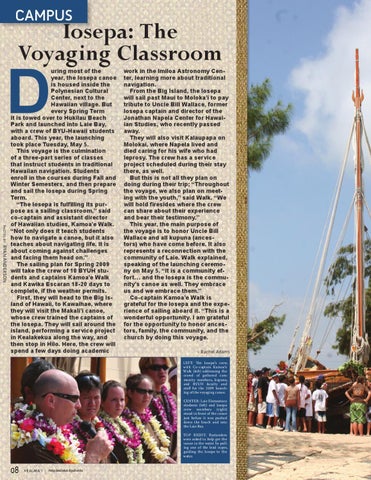
- Rachel Adams LEFT: The Iosepa’s crew, with Co-captain Kamoa’e Walk (left) addressing the crowd of gathered community members, kupuna, and BYUH faculty and staff for the 2009 launching of the voyaging canoe. CENTER: Laie Elementary students (left) and Iosepa crew members (right) stand in front of the canoe just before it was pushed down the beach and into the Laie Bay. TOP RIGHT: Bystanders were asked to help get the canoe in the water by pulling one of the lead ropes, guiding the Iosepa to the water.
08
KE ALAKA`I
page 8 & 9.indd 1
http:kealakai.byuh.edu
MAY 7, 2009
MAY 7, 2009
Among those in attendance was professor and anthropologist Tevita Kaili, who brought all 29 of his anthropology students to the beach Tuesday morning. “This is our classroom right here, enjoying this moment.” Kaili said with a smile. Lizzy Allred, returning crewmember preparing for her second voyage, said she was not nervous, but, “There is plenty of work that goes into it.” Allred was quick to mention that it isn’t all fun and games, “When we get to different islands, we try to do service for anyone who has helped us out.” The Iosepa’s significance runs back to ancient Hawaii, when the first saints came to the island. The late William K. “Uncle Bill” Wallace’s ancestors were among those saints who settled in “Iosepa” years ago. The Iosepa will sail around Oahu, make its way to Hilo on the Big Island, come around to Kena, and finally make its way to Molokai to pay homage to Uncle Bill and his family. Molokai was Uncle Bill’s birthplace. The canoe’s name, Iosepa, is Hawaiian for Joseph, and came to the late Uncle Bill Wallace in a dream. The name Joseph is derived from several significant sources. It not only refers to Joseph in the Old Testament, but to Joseph Smith, founder of the Church, and Joseph F. Smith, who was a missionary in Hawaii in the 1800s. Dr. Phillip McArthur, intercultural studies professor, stood amazed at the side of the hand carved canoe, in awe of the support from the community and the university. McArthur attributes that support to a few things, “This year there has been a very purposeful effort to involve more than BYU and PCC. The center has a new board of fellows, and local kupuna (Hawaiian elders) who all came out to help.” Isaiah Walker, Hawaiian studies professor at BYUH, said, “I think its great. Its cool to see all the support from all the schools. I think we need more of this kind of thing. The canoe bringing everyone together”.
RYAN ANDERSON
PHOTOS BY
work in the Imiloa Astronomy Cen- ter, learning more about traditional navigation. From the Big Island, the Iosepa will sail past Maui to Moloka’i to pay tribute to Uncle Bill Wallace, former Iosepa captain and director of the Jonathan Napela Center for Hawai- ian Studies, who recently passed away. They will also visit Kalaupapa on Molokai, where Napela lived and died caring for his wife who had leprosy. The crew has a service project scheduled during their stay there, as well. But this is not all they plan on doing during their trip;; “Throughout the voyage, we also plan on meet- ing with the youth,” said Walk. “We ZLOO KROG ¿UHVLGHV ZKHUH WKH FUHZ can share about their experience and bear their testimony.” This year, the main purpose of the voyage is to honor Uncle Bill Wallace and all kupuna (ances- tors) who have come before. It also represents a reconnection with the community of Laie. Walk explained, speaking of the launching ceremo- ny on May 5. “It is a community ef- fort… and the Iosepa is the commu- nity’s canoe as well. They embrace us and we embrace them.” Co-captain Kamoa’e Walk is grateful for the Iosepa and the expe- rience of sailing aboard it. “This is a wonderful opportunity. I am grateful for the opportunity to honor ances- tors, family, the community, and the church by doing this voyage.
PHOTOS BY
D
uring most of the year, the Iosepa canoe is housed inside the Polynesian Cultural Center, next to the Hawaiian village. But every Spring Term it is towed over to Hukilau Beach Park and launched into Laie Bay, with a crew of BYU-Hawaii students aboard. This year, the launching took place Tuesday, May 5. This voyage is the culmination of a three-part series of classes that instruct students in traditional Hawaiian navigation. Students enroll in the courses during Fall and Winter Semesters, and then prepare and sail the Iosepa during Spring Term. ³7KH ,RVHSD LV IXO¿OOLQJ LWV SXU- pose as a sailing classroom,” said co-captain and assistant director of Hawaiian studies, Kamoa’e Walk. “Not only does it teach students how to navigate a canoe, but it also teaches about navigating life. It is about coming against challenges and facing them head on.” The sailing plan for Spring 2009 will take the crew of 10 BYUH stu- dents and captains Kamoa’e Walk and Kawika Escaran 18-20 days to complete, if the weather permits. First, they will head to the Big Is- land of Hawaii, to Kawaihae, where they will visit the Makali’i canoe, whose crew trained the captains of the Iosepa. They will sail around the island, performing a service project in Kealakekua along the way, and then stop in Hilo. Here, the crew will spend a few days doing academic
–Marni Vail http:kealakai.byuh.edu
KE ALAKA`I
09
5/7/09 1:24 PM