Follow us:
/oha_hawaii |
/oha_hawaii | Fan us:
/officeofhawaiianaffairs | Watch us:
/OHAHawaii
‘okakopa2019
13
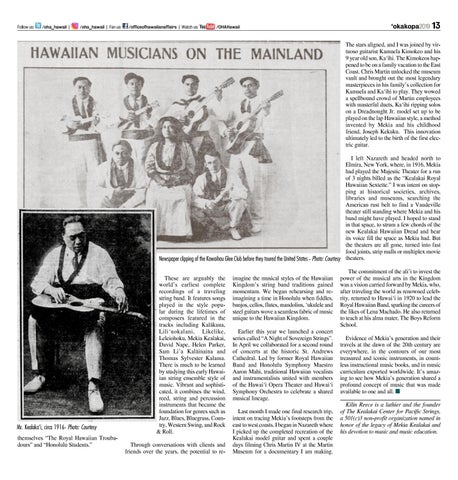
The stars aligned, and I was joined by virtuoso guitarist Kamuela Kimokeo and his 9 year old son, Ka‘ihi. The Kimokeos happened to be on a family vacation to the East Coast. Chris Martin unlocked the museum vault and brought out the most legendary masterpieces in his family’s collection for Kamuela and Ka‘ihi to play. They wowed a spellbound crowd of Martin employees with masterful duets, Ka‘ihi ripping solos on a Dreadnought Jr. model set up to be played on the lap Hawaiian style, a method invented by Mekia and his childhood friend, Joseph Kekuku. This innovation ultimately led to the birth of the first electric guitar. I left Nazareth and headed north to Elmira, New York, where, in 1916, Mekia had played the Majestic Theater for a run of 3 nights billed as the “Kealakai Royal Hawaiian Sextette.” I was intent on stopping at historical societies, archives, libraries and museums, searching the American rust belt to find a Vaudeville theater still standing where Mekia and his band might have played. I hoped to stand in that space, to strum a few chords of the new Kealakai Hawaiian Dread and hear its voice fill the space as Mekia had. But the theaters are all gone, turned into fast food joints, strip malls or multiplex movie Newspaper clipping of the Kawaihau Glee Club before they toured the United States - Photo: Courtesy theaters.
Mr. Kealaka‘i, circa 1916- Photo: Courtesy themselves “The Royal Hawaiian Troubadours” and “Honolulu Students.”
These are arguably the world’s earliest complete recordings of a traveling string band. It features songs played in the style popular during the lifetimes of composers featured in the tracks including Kaläkaua, Lili‘uokalani, Likelike, Leleiohoku, Mekia Kealakai, David Nape, Helen Parker, Sam Li’a Kaläinaina and Thomas Sylvester Kalama. There is much to be learned by studying this early Hawaiian string ensemble style of music. Vibrant and sophisticated, it combines the wind, reed, string and percussion instruments that became the foundation for genres such as Jazz, Blues, Bluegrass, Country, Western Swing, and Rock & Roll. Through conversations with clients and friends over the years, the potential to re-
imagine the musical styles of the Hawaiian Kingdom’s string band traditions gained momentum. We began rehearsing and reimagining a time in Honolulu when fiddles, banjos, cellos, flutes, mandolins, ‘ukulele and steel guitars wove a seamless fabric of music unique to the Hawaiian Kingdom. Earlier this year we launched a concert series called “A Night of Sovereign Strings”. In April we collaborated for a second round of concerts at the historic St. Andrews Cathedral. Led by former Royal Hawaiian Band and Honolulu Symphony Maestro Aaron Mahi, traditional Hawaiian vocalists and instrumentalists united with members of the Hawai‘i Opera Theater and Hawai‘i Symphony Orchestra to celebrate a shared musical lineage. Last month I made one final research trip, intent on tracing Mekia’s footsteps from the east to west coasts. I began in Nazareth where I picked up the completed recreation of the Kealakai model guitar and spent a couple days filming Chris Martin IV at the Martin Museum for a documentary I am making.
The commitment of the ali’i to invest the power of the musical arts in the Kingdom was a vision carried forward by Mekia, who, after traveling the world as renowned celebrity, returned to Hawai‘i in 1920 to lead the Royal Hawaiian Band, sparking the careers of the likes of Lena Machado. He also returned to teach at his alma mater, The Boys Reform School. Evidence of Mekia’s generation and their travels at the dawn of the 20th century are everywhere, in the contours of our most treasured and iconic instruments, in countless instructional music books, and in music curriculum exported worldwide. It’s amazing to see how Mekia’s generation shared a profound concept of music that was made available to one and all. Kilin Reece is a luthier and the founder of The Kealakai Center for Pacific Strings, a 501(c)3 non-profit organization named in honor of the legacy of Mekia Kealakai and his devotion to music and music education.