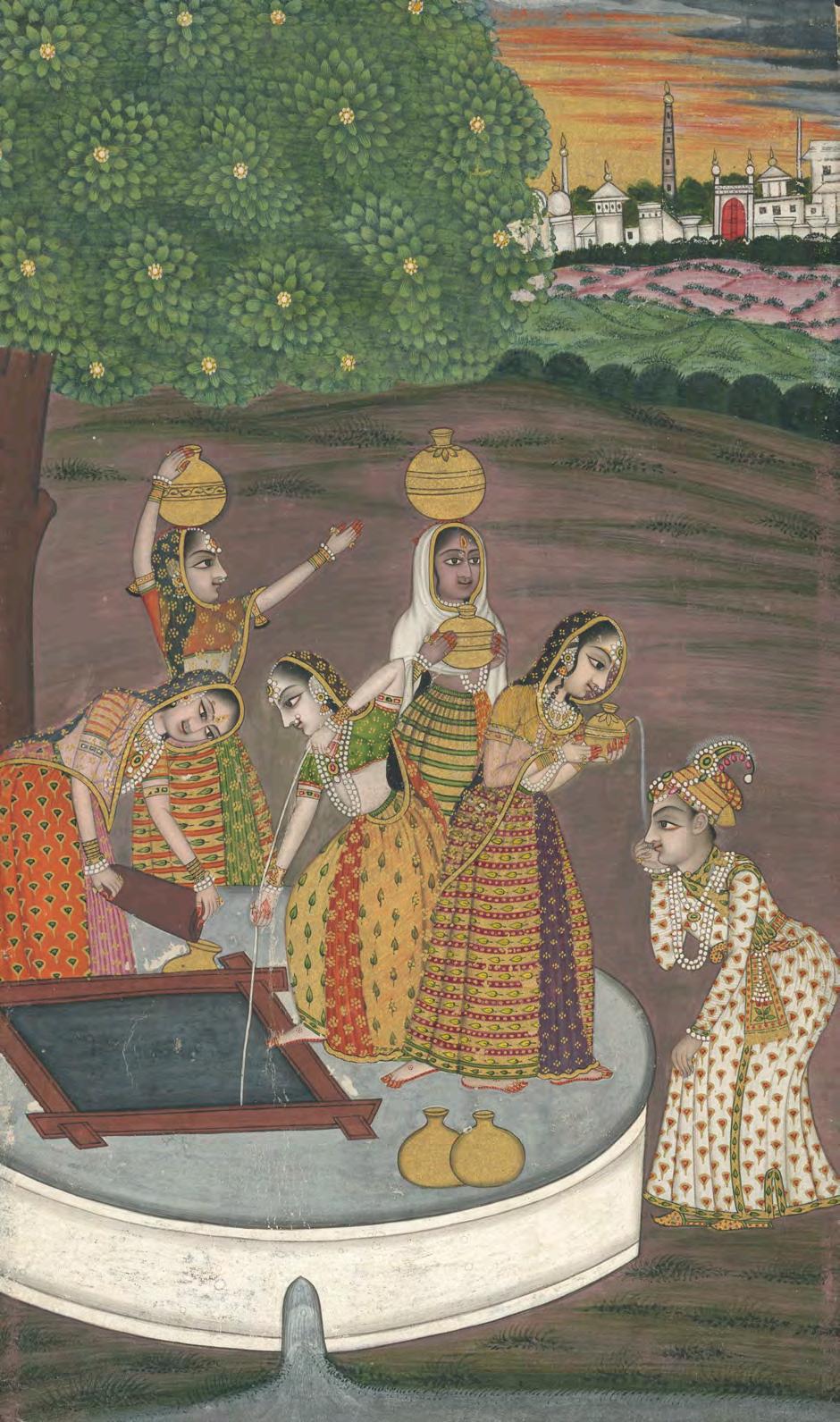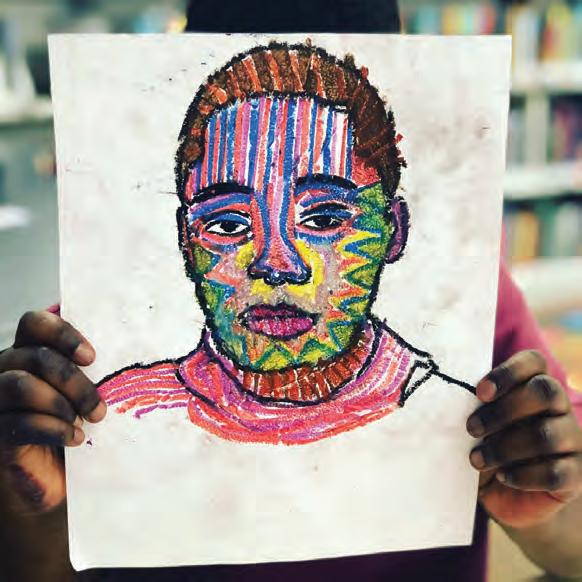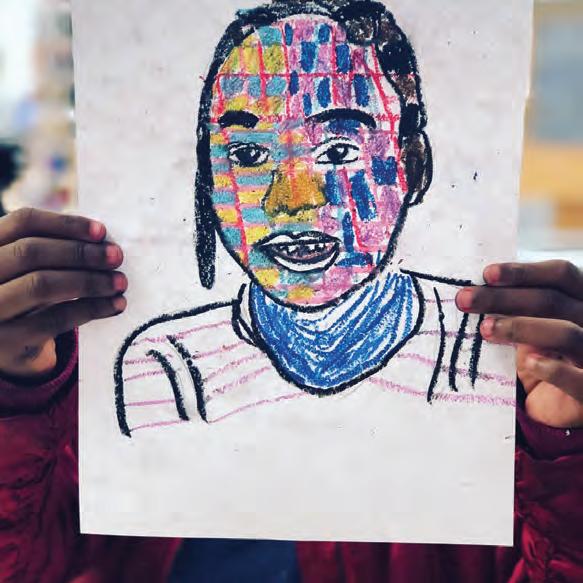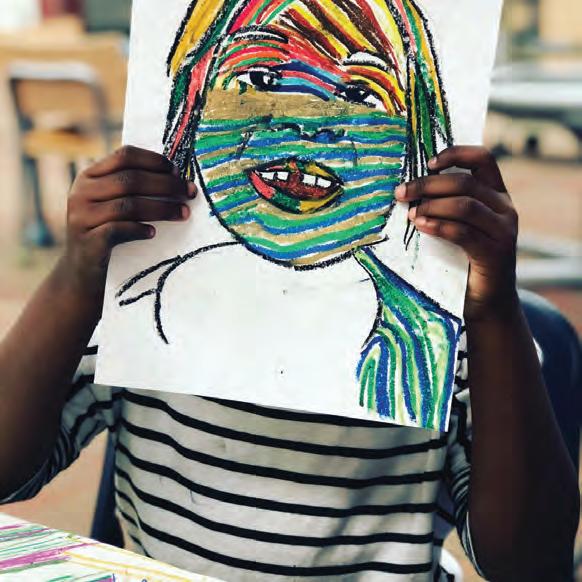

er iece rom i he im l
he o rce o gre ri er like ho e o gre me re o e o c re ome hi e cre ice high o mo i i he ll e o ime he orl ee heir glor o oo h ll i e i h
me h K oor l ci o o o er i i o K oor lo g i h m e ec e o ri or




li he K oor e c o errill
ri e i e ork e ork
ll righ re er e hi ook m o e re ro ce i hole or i r i orm or me
elec ro ic or mech ic l i ho he ri e ermi io o K oor e c
Design l o er i i g
l ci o o o er
elec ho ogr h l ci o o o er
r l io : i i o log ro c io K oor
978-1-733-7900-0-0
ll r io
o er er o loki e h r ee c log m er 7
This Catalog is dedicated in loving memory to my late Grandmother, Urmil Kapoor (1941- 018), and to my late father, ineet Kapoor (1967 - 015)
he pirit is neither orn nor does it die at any time It does not come into eing or cease to e ist It is un orn eternal permanent and prime al he pirit is not destroyed hen the ody is destroyed eapons do not cut this pirit fire does not urn it ater does not ma e it et and the ind does not ma e it dry he pirit cannot e cut urned et or dried It is eternal all per ading changeless immo a le and prime al tma is eyond space and time
The Bhagavad Gita
With great pleasure and pride, I present Kapoor Galleries’ latest catalog. Among other masterpieces, this publication showcases a distinguished Kang i style bronze in the rare form of Chittavishramana Lokeshvara.
This catalog is also a celebration of the gallery’s forty-plus years of success as a family enterprise, and a tribute to my grandfather, Ramesh Kapoor, and late grandmother, Urmil Kapoor, whose pioneering efforts helped bring the field of Indian and imalayan art to where it is today. After India’s partition in 1947, Ramesh left Pakistan along with his parents and migrated from Lahore to Jalandhar, India. There, the government allocated his father, Shri Prashotam Ram Kapoor, an empty store where he could establish his own business. An avid reader, my great-grandfather always carried books with him, which led to a thrift merchant offering him an entire private library. Thereafter, my great-grandfather started a rental library, catering to Indian refugees whose displacement left them with ample time to read.
Purchasing this initial library collection spurred my great-grandfather’s passion for rare books and led to the acquisition of many private libraries. Some included illustrated books and manuscripts, which helped to propel our family into the field of what is now known as the Fine Art of Indian Miniature painting. When my grandfather finished college in 1958 and joined his father in business, the two worked together to establish relationships with museums and universities, supplying these institutions with coveted masterworks.
As the business grew within India, my family moved to elhi in 196 . My grandfather s first major break came in 1964, when he sold the famous imachal bronze Svacchanda Bhairavi to the ational Museum in ew elhi. Since then, it has been featured in many major publications including r. Pratapaditya Pal’s Bronzes of Kashmir.
Ramesh and Urmil married in 1967. Witnessing an increasing uropean and American interest in Indian Art, in March 1975 they immigrated to the United States and established Kapoor Galleries Inc. in ew York City.
Since establishment, Kapoor Galleries Inc. has played an instrumental role in educating the public about the ancient and classical Fine Arts of India and the imalayas while encouraging interest amongst both collectors and institutions. For over forty years we have been dedicated to building strong client-dealer relationships, earning the respect, loyalty, and trust of those with whom we build collections. My grandfather, has guided some of the most significant public and private collections of the 0th century, including The Metropolitan Museum of Art, the Los Angeles County Museum of Art, the Art Institute of Chicago, The San iego Museum of Art, and the irginia Museum of Fine Arts, just to name a few. With his unparalleled e perience, prodigious talent, sharp business mind, and impeccable ethics, my grandfather is a role model for how to be an asset to the art world. In 004, my grandparents made a substantial donation of Indian paintings to the orton Simon Museum in Pasadena California, which formed the core of the museum’s collection of Indian paintings.
I would like to take this opportunity to thank a number of people for their invaluable assistance and support: Henry, Yvonne, and Mete of ADM Advertising for their counsel, their contributions to this catalog, and their endless patience; Richard Wuchte of Toppan Merrill for his assistance in printing; my friends in the art world for offering their support and sharing their wisdom, the scholars whose critical research contributed to the identification and attribution of many of this catalog's works, including: Dr. Pratapaditya Pal who has offered me both guidance and my new personal mantra: “Stay healthy and become wealthy, but do not be stealthy,"; Jeff Watt and the team at Himalayan Art Resources, the numerous scholars and professors I have met during my time at SOAS, Pujan Gandhi, who is now the Jane Emison Assistant Curator of South & Southeast Asian Art at the Minneapolis Institute of Art (especially for his contributions to the portraits section of this catalog), Daniel Ehnbom, associate professor of art history at the University of Virginia, Dr. Gursharan Sidhu, Dr. V.C. Ohri, and last but far from least, Mitche Kunzman. I would also like to thank Clanci Conover for bringing organization to my scattered desktop as well as pioneering and streamlining the concept of an inventory and Livia Gao for her dedication, passion for perfection, temperament which keeps me always on my toes - never allowing for a dull moment, and skilled translation of the objects in this catalog. Without Livia and Clanci, this catalog would not be here for your viewing pleasure today. A special thank you to Douglas Gold- the round ball of joy and boundless energy that he is, equipped to handle any task, and Cameron M. Shay - my good friend and now business partner, who I am forever indebted to for offering me the opportunity to be a part of the legacy that is Graham Shay 1857: Pioneers in the field of 18th- 20th century American and European Art. Finally, I would like to thank my grandfather and late grandmother: for teaching me humility and directing my boundless energy into something constructive, while also making sure to keep my ego in check.
Enjoy this catalog, and I look forward to welcoming you to Kapoor Galleries Inc.
Sanjay Kapoor
很高興為您帶來卡普爾畫廊的最新圖錄,與您共賞包括一尊康熙風格心性安息觀音坐像在內的精品 收藏 。
同時我也希望藉此機會慶祝我們家族畫廊在過去四十多年裡經營順遂,並向我的祖父拉梅什·卡普 爾和剛過世的祖母艾米爾·卡普爾致敬, 感謝他們作為行業先驅, 以畢生的心血共築起印度與喜馬 拉 雅藝術領域繁榮的今天。
1947年印度劃分後, 我的曾祖父母帶著我的祖父從巴基斯坦移民到印度 賈 朗達爾。當地政府分給曾祖父一處空閒店鋪, 希望他可以重整旗鼓,做點小生意養家糊口。我的 曾祖 父, 一個書不離手的讀書人,在偶然的機會下幸運地接手了一整個私人圖書收藏, 於是他在店 舖裡成 立了一個租書店, 為流離徬徨的難民們提供了一處慰藉心靈, 打發時間的去處。
成功收購第一批圖書後,曾祖父對珍稀書籍的興趣愈發濃厚,遂又陸續收購了許多私人圖書收藏。
其中一些古董書中內含精美的原版手繪插圖和手稿,而正是這些珍貴的圖畫,引領我們家族走進了 絢麗多彩的印度細密畫世界。1958年我的祖父拉梅什大學畢業後加入了曾祖父經營的古董行。父子 同心協力下,為當地博物館和大學提供了若干難得的藝術珍品,建立了堅固的友誼。
隨著生意蓬勃發展,1962年古董行遷至德里。2年後,我的祖父迎來了他的首個重大成就:新德里國家博 物館向他收購了著名的喜馬偕爾陪臚銅像。這尊代表著克什米爾最高造像水平的銅像後來頻頻出現 在許多重要出版物中, 包括著名亞洲藝術歷史學家帕爾博士(Dr. Pratapaditya Pal) 所著《克 什米爾 銅像》。如今, 這尊銅像作為重要館藏永久地成列在銅像館中。
1967年,我的祖父母在德里喜結連理。 70年代正逢歐美國家對印度文化、藝術的熱情與日俱增 , 於是 充滿了開拓者精神的祖父母在1975年移居到紐約, 創立了卡普爾畫廊。
自成立以來, 卡普爾畫廊一直積極參與印度和喜馬拉雅古典藝術方面的公教事業, 致力於擴大公眾對 這一藝術領域的關注與興趣。四十多年來, 畫廊十分榮幸地在世界範圍內的藏家間贏得尊重與信任, 建立忠誠的友誼。我的祖父更是為許多20世紀重量級公教機構和私人收藏提供了專業指導 和一流 的藏品, 包括紐約大都會博物館、洛杉磯縣立藝術博物館、芝加哥藝術學院、 聖地亞哥藝 術博物 館、弗吉尼亞美術博物館等。以他無可匹及的經驗才華、敏銳的商業頭腦、嚴於律己的道德修養, 我的祖父堪稱藝術行業從業者的楷模。 2004年, 我的祖父母向加州帕薩迪納市諾頓·西蒙博物館捐 贈了一批數量龐大的印度繪畫。而這份誠摯的禮物也成為了諾頓·西蒙博物館印度繪畫收藏的核心 部分。
我想藉此機會感謝ADM廣告公司Henry, Yvonne, 和Mete和Toppan Merrill公司的Richard Wuchte 以無 限的耐心幫助完成了這本圖錄;感謝我藝術圈的朋友、前輩給予的厚愛與支持,感謝帕爾博 士寶貴的 學術指導和贈言:健康富有,坦坦蕩盪;感謝杰夫·瓦特和所有喜馬拉雅藝術資源網隊慷 慨提供的專家 意見。感謝我在SOAS讀書期間傾囊相授的教授學者們,尤其感謝Pujan Gandhi 現任明 尼阿波利斯美 術館南亞及東南亞藝術部助理策展人,對圖錄肖像部分的撰寫。感謝弗吉尼亞大學藝 術史副教授 Daniel Ehnbom,感謝Gursharan Sidhu博士,V.C. Ohri博士,和Mitche Kunzman等學者無 價的貢獻。其次 我得感謝我的同事夥伴們,感謝Clanci Conover牽頭建立了一個完善的庫存系統, 使我雜亂的桌面和文 檔庫存都井井有條,有序可循;感謝Livia Gao精益求精的精神使我時刻不敢懈 怠,以及她對全冊圖錄中 文部分的翻譯、撰寫,若沒有Clanci和Livia不懈的努力和付出,這本圖錄 定不會如此賞心悅目;另外我 要特別感謝Douglas Gold,感謝他總是熱情洋溢活力四射,勝任所 有工作;還有我的摯友,如今的商業合 夥人Cameron M. Shay,我將永遠感激他讓我有機會成為 Graham Shay 1857的一部分,共同延續18至20世 紀歐美藝術的燦爛輝煌。最後,我深深地感謝我 的祖父母,感謝他們諄諄教導我要謙遜自省,感謝他們 時時鞭策我要勤勉上進。
感謝您的關注,卡普爾畫廊期待與您相見。
金剛薩埵
2 2世紀
西藏
銅鎏金 8 8
82 喜馬拉雅藝術資源網82 號
ro e ce 來源:
oo ri 1930
巴黎古董商 盧,1930年代
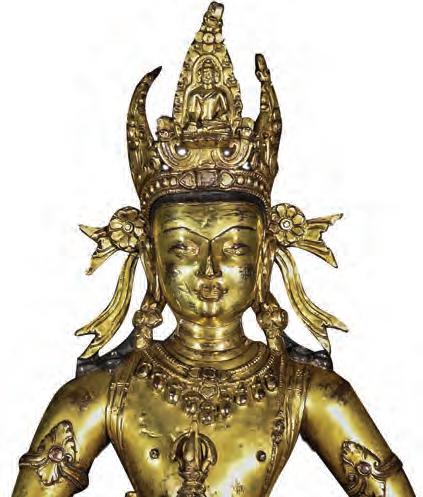
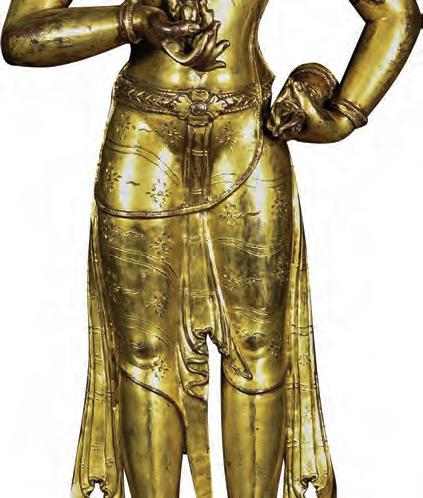
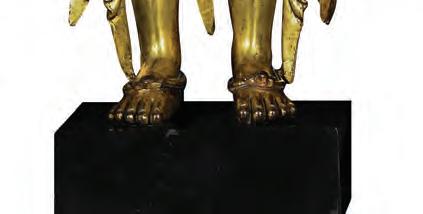
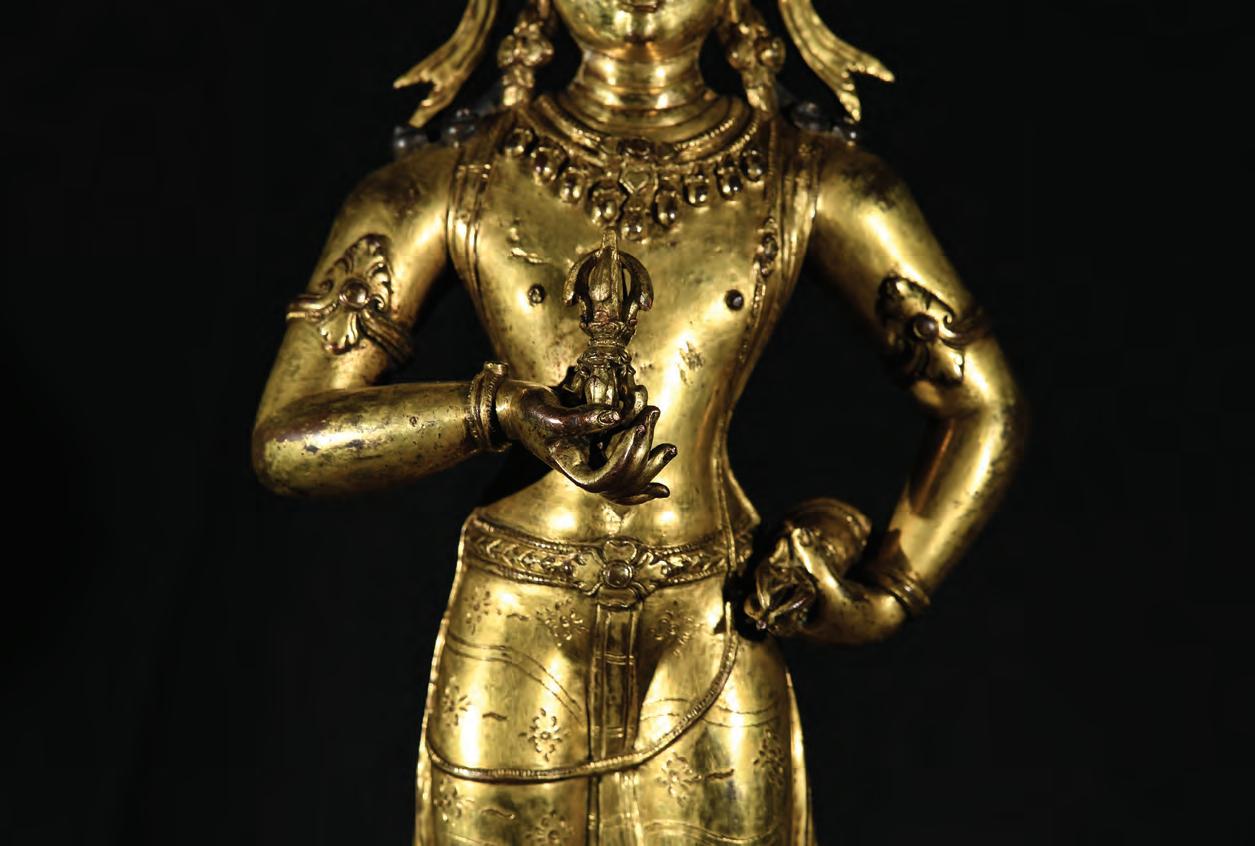
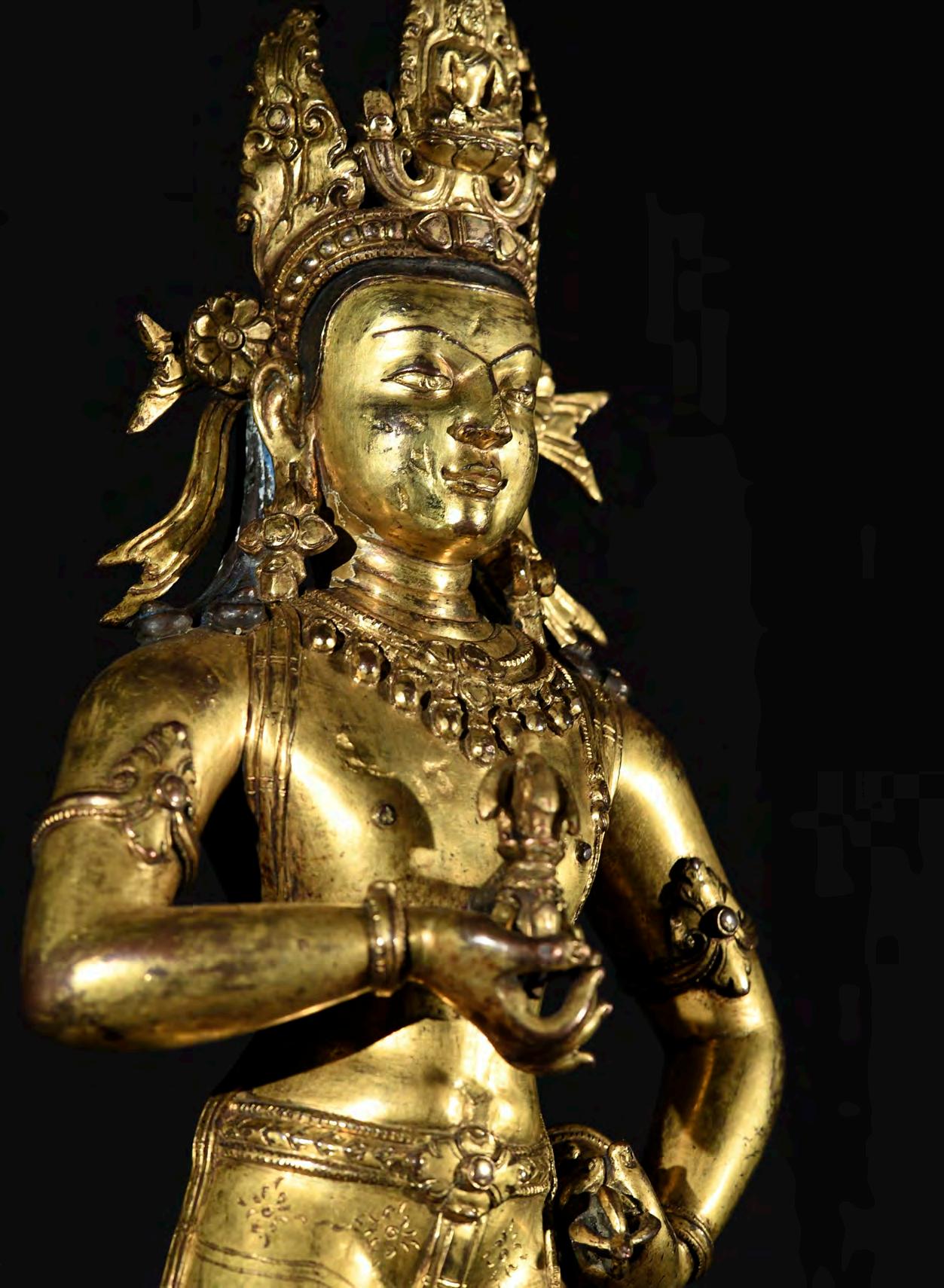
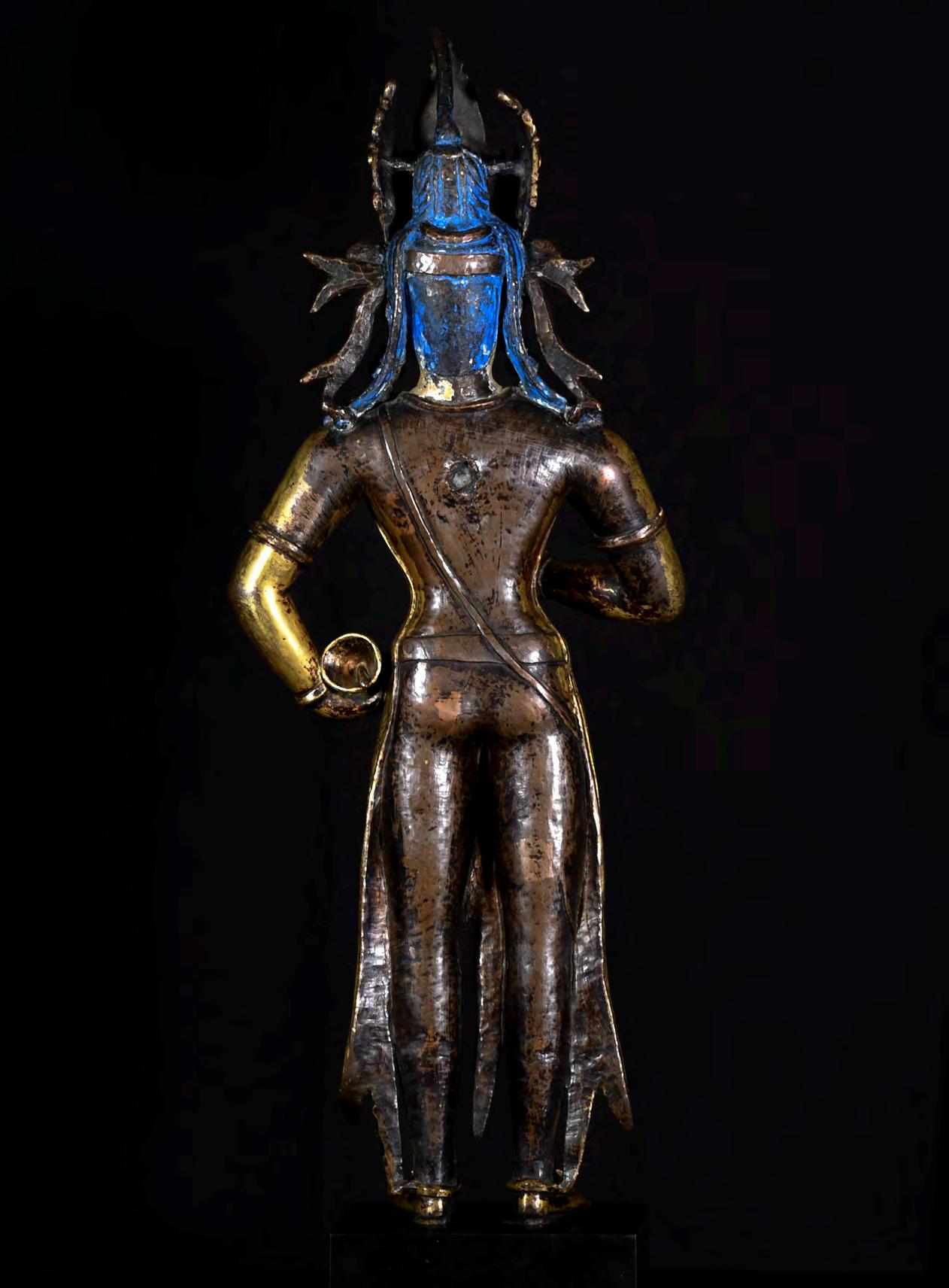
This outstanding large and richly gilded sculpture is a rare early image of Vajrasattva of majestic size and naturalistic detail of the highest quality. The odhisattva is depicted standing tall in a regal poise, adorned in an elaborate crown enclosing an image of Akshobhya, holding a vajra and ghanta. The aristocratic features of his countenance are enhanced by the opulent crown, jewelry and ribbons. Displaying tremendous power and presence, this figure demonstrates the marriage of Pala stylistic elements and the Tibetan sculptural tradition.
Vajrasattva is associated with the sambhogakaya and is invoked as a support for purification practices to dispel obstacles in tantric practice. The odhisattva is depicted here standing holding a vajra in his right hand and a ghanta in his left. The elaborate crown with beaded border is surmounted by a superbly rendered five-pointed crown. The broad, square forehead is offset by the gentle curves of the face. The hair, ile high o he he c c e o er he o er ll mo l e ho l er
he c rre ig re i o e o gro o hree hich re er clo el m che i le ico ogr h i e he ir i he ri i h e m i o her im ge
o r he eco i he le el e m o r i im ge o i re o h ill r e i r i l he r o e l ei e 1974 l 213 214 i c e l 214-21 here he o e he moo h l i i h m ke he ig re e ce io ll gr ce l a description which applies equally to the current sculpture. All three share the same combination of powerful standing posture and graceful curving form, and similar design motifs including the jewelery and other adornments and the intricate floral designs on the dhoti. o e h e W o im l r e o rce h i e i ie hi iece r re orm o r i r her h r
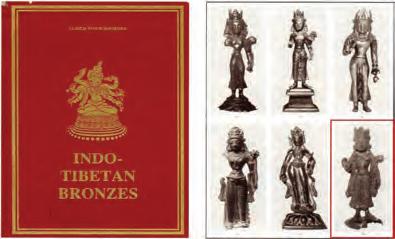
See also similar iconography on a larger figure of Vajrasattva, from the collection of A. and J. Speelman assigned to Central or Western Tibet, eleventh to twelfth century, illustrated in Marylin M. Rhie, and Robert A. F. Thurman, Wisdom and Compassion: The Sacred Art of Tibet, London, 1996, p.464, pl. 219. A possible origin of the unusual three-leaf crown type can be seen on an eleventh century Nepalese figure of Padmapani in the Cincinnati Art Museum, illustrated by Ulrich von Schroder, Indo-Tibetan Bronzes, Hong Kong, 1981, p. 329, pl. 86E.
金剛薩埵,Vajrasattva,其中兩個部分Vajra在梵語中是閃電和鑽石的意思,中文翻譯金剛或金剛杵,有無堅不毀 之意;而sattva意為有情眾生,是菩薩菩薩的字根。因此金剛薩埵也稱為金剛菩薩,代表著無堅不摧的菩提心。密 教中認為修習金剛薩埵法門可止一切惡念,破一切煩惱,淨化罪惡與污穢,並生無量福智。
其形象通常右手執金剛杵,表示摧破十種煩惱;左手執金剛鈴,表示清淨的佛法之音警覺一切有情。在佛教造像 藝術中,金剛薩埵以雙盤坐像較為常見,而此尊金剛薩埵,以挺拔優美的站姿呈現,加上尺寸高大,實屬罕見。
此尊金剛薩埵身形健碩,昂首挺胸之姿彷彿表明了他堅定的意志。柔美的手型為立像注入動感的同時,又引領我 們的目光自下而上,順著掌中的金剛杵,滑過優雅的輪廓和精美的裝飾,最終落在菩薩靜謐的面龐和權威的寶冠 上。
菩薩表情祥和,豐潤的雙唇笑意盎然,所表現出的清淨喜悅之氣令人望之心生嚮往。精巧的三葉寶冠中央端坐著 五智佛之一的阿閃佛,代表大圓鏡智或金剛智,耳璫垂肩,繒帶飛揚於耳際,並均飾有豐碩飽滿的花瓣裝飾。
在早期的西藏,鑄造如此體量的鎏金銅像,不僅需要豐厚的財資基礎,更需要篤定的信仰支撐。歷史千轉百回, 而這份千年前的虔誠恭敬如今通過這件藝術品,完完整整地呈現在我們面前,溫潤而又充滿力量。
菩薩站姿挺拔,軀體弧度優美,肌肉線條結實,周身佩飾華麗精美,較高臂釧體現尼泊爾造像風格在早期西藏造 像中的影響。上身袒露,下身著輕薄貼體及膝長裙,系束帶並打結,衣緣鏨刻梅花紋樣,頗具裝飾意味。
與卡普爾畫廊所藏這尊金剛薩埵在尺寸,造像,和風格上都極為接近的塑像另有兩尊。一尊收藏於大英博物館, 另一尊收藏於美國克利夫蘭藝術博物館。類似造像特徵還可參見Marylin M. Rhie和Robert AF Thurman著“慈悲與 智慧:藏傳佛教藝術大展” ,1996年,第464頁,彩圖219,以及烏爾里希·馮·施羅德著“印度西藏銅像“1981 年,第329頁,彩圖86E。
這尊金剛薩埵立像尺寸高大,做工精湛,鎏金飽滿,金色亮目,實屬早期金剛薩埵造像中極為精妙莊嚴的罕見之 作。
Maitreya 弥勒坐像
Circa 14th century 世紀
Tibet 西藏
Gilt bronze 銅鎏金
16 x 11 2 in. (40.6 x 29 cm.)
82 0 喜馬拉雅藝術資源網82 0號
ro e ce 來源:
ri e E ro e collec io 歐洲私人珍藏
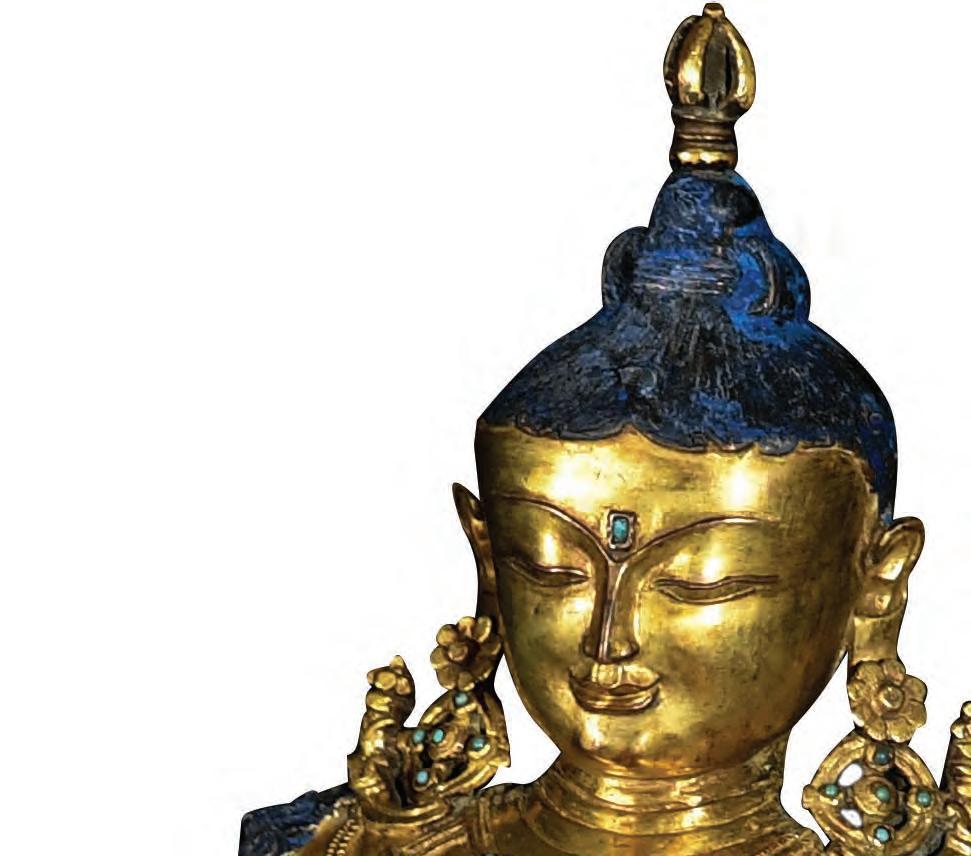
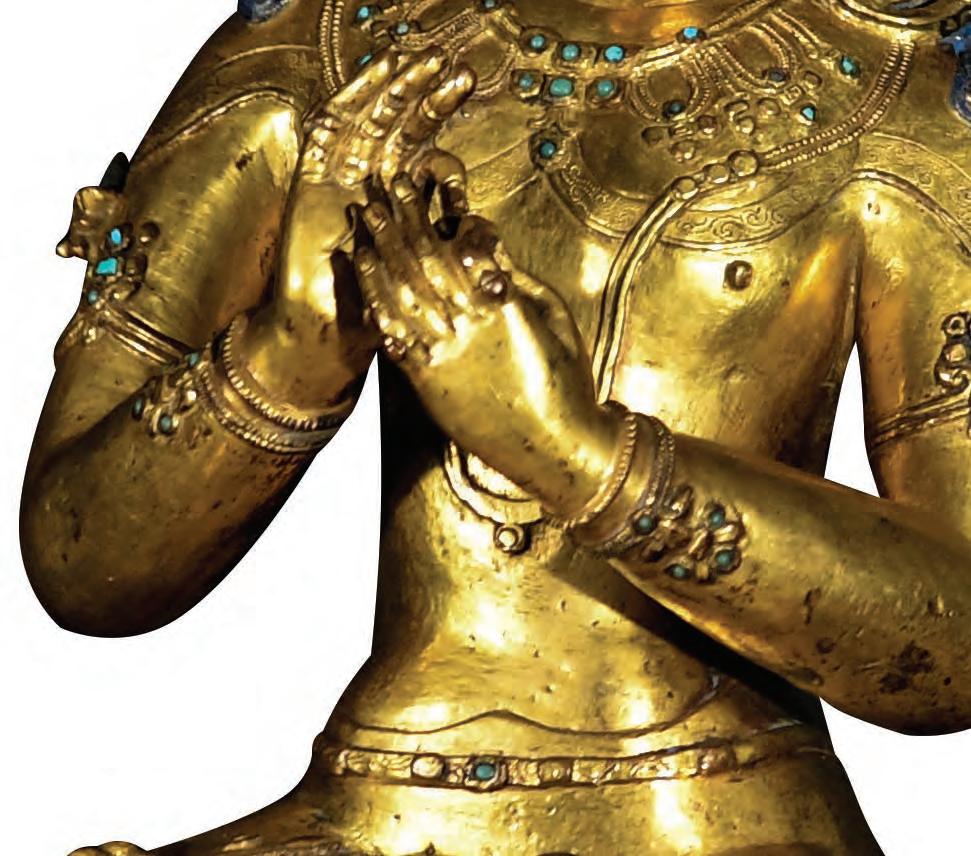









A Newari master most likely cast this rare and commanding sculpture while working under the patronage of a leading monastery in Central Tibet, possibly Shalu. This figure likely represents the Future Buddha Maitreya, but it could possibly be a depiction of Manjushri. Richly gilded and adorned with semi-precious stones, the treatment of the adornments, prominent chin, tresses across the shoulders, and modeling of the body are all consistent with the rendering of the Five Tathagatas in the South Chapel of Shalu monastery, painted in the second quarter of the 14th century.

the Five mona Vajradh relate






Compare with a Manjughosa held in the Shalu monastery, published in von Schroeder, , 2001, pp.959, no.229C. Also see a 14th century Vajradhara in the Jokhang in Lhasa, (ibid., p. 962, no. 231E), and a closely related gure in scale and detail sold at Sotheby’s, New York, 23 March 2007, lot 55.

此尊菩薩手中蓮莖和雙肩上的蓮花已遺失,因此我們無法根據蓮花上的法器準確判斷菩薩 的身份。若蓮花上承寶承佛塔和淨瓶,則可断定其為彌勒菩薩,但若蓮花上承劍和經篋, 則又可推断其為文殊菩薩。
此尊卡普爾畫廊菩薩以紅銅胎底鎏金鑄成,身現微妙金光,皮膚細滑,髮髻高束以青金石 染成青色,面容靜謐圓滿,肩寬圓好,手足柔軟,足踏金輪,氣韻莊嚴靜謐又法喜充滿。
菩薩臉型方正略短,上寬下窄,額頭高廣,五官集中偏下,面呈童子相。眉間白毫呈 矩形,眉眼尾端弧度優雅輕微上揚,雙目低垂呈豆莢狀,唇角含笑上揚,神情歡喜自 在。束發分兩股披於肩上,耳飾團花大圓環型耳鐺,耳鐺下飄帶飛揚,極富藝術感。
菩薩肩披雲肩,造型罕見,下著僧裙,衣物輕薄貼體幾乎不可見,僅以衣緣陰 刻纏枝蓮紋紋及鋪撒於蓮台上的裙褶可辨。衣飾極為簡潔,突出軀體肌肉感。


身後僧裙束帶打結系於腰間,造型立體寫實。菩薩肩膀圓潤,胸肌厚實挺起, 四肢粗壯有力,手足刻畫極具寫實風格,栩栩如生,足見做工之講究。菩薩雙 手指戴戒指,胸前裝飾項鍊瓔珞,手臂,手腕,腳踝以釧鐲為飾,這些裝飾造 型大方而且都鑲嵌精美松石,體現了西藏地區造像的鮮明特點,同時給人以優 雅華美的體驗。
菩薩下承覆仰蓮座,造型大氣,束腰較深。上緣飾一周連珠紋,下緣築高,陰 刻吉祥紋。雙層蓮瓣上層細長下層寬肥,頭部有卷草微微翹起,飽滿有力。
整尊造像體現了濃厚的尼泊爾風格影響,但局部細節又體現了西藏本土審美。


類似的造像可對比參照馮·施羅德著作“西藏佛教雕塑”中收錄的夏魯寺所藏14世紀 五字文殊(卷二,圖229C),夏魯寺藏14世紀銅鎏金金剛總持(卷二,962 頁,231E),以及2007年蘇富比成交的14世紀銅鎏金文殊菩薩像紐約(紐 約蘇富比,2007年3月23日,拍品55)。


西藏
六臂瑪哈嘎拉
y, 世紀
彩繪銅
8 喜馬拉雅藝術資源網 8 號
ro e ce 來源:
oro o ollec io i h i k o o o c 199
hri ie e ork 14 rch 2017 o 209
多倫多藏家於199 年購自倫敦 i k o
紐約佳士得, 2017年3月14日, 拍品209號
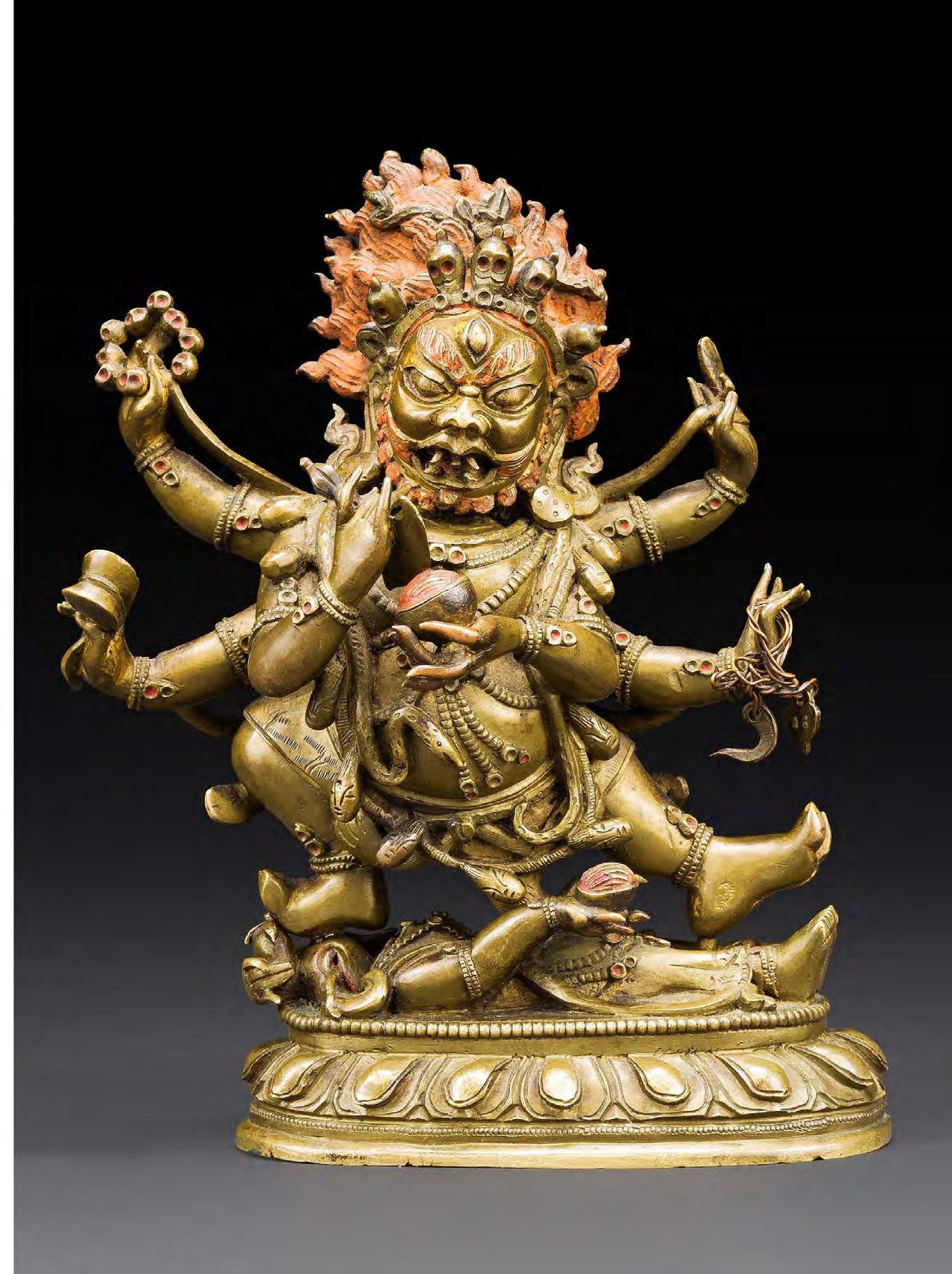
In Sanskrit Maha translates to great and Kala to time/death. Mahakala is the primary Buddhist Dharmapala and is respected in all schools of Tibetan Buddhism. All names and colors are said to melt into Mahakala, symbolizing his all-encompassing nature and lustrous black skin. He is seen as the absolute reality. Shadbhuja, the six-armed Mahakala, is a favorite
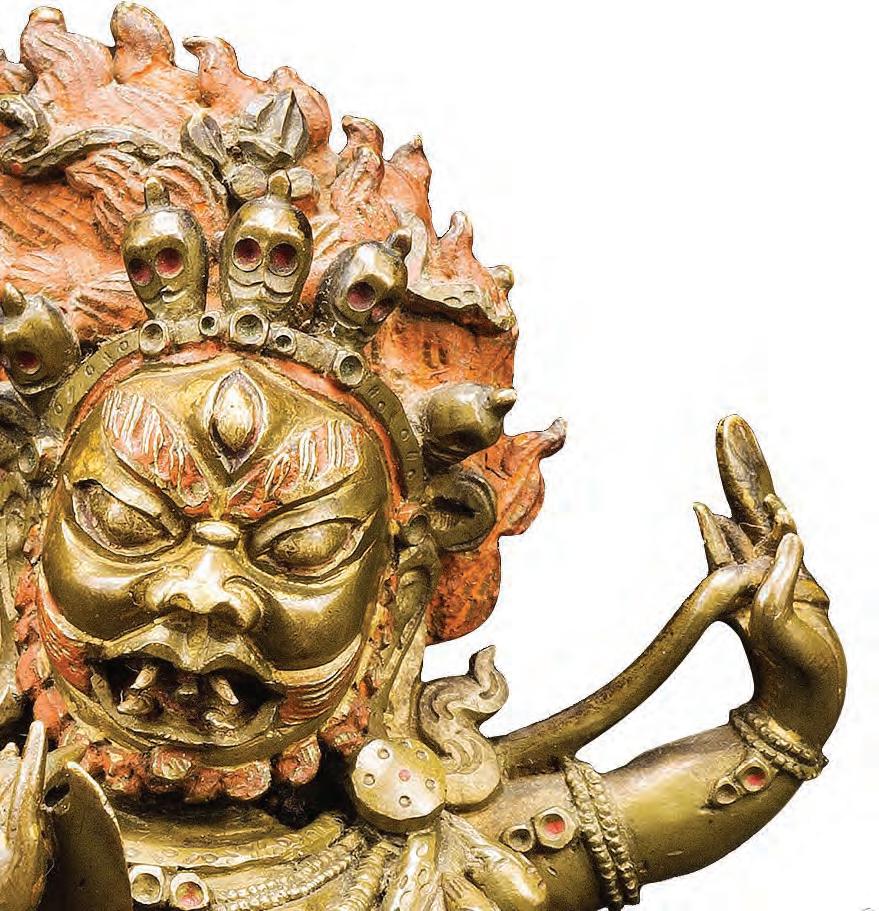
amongst the Gelukpa order of Tibetan Buddhism. Shadbhuja is recognized as the erce, powerful, and wrathful embodiment of the Bodhisattva of compassion Avalokiteshvara. In this elegantly cast piece attention to fine detail is evident throughout the sixarmed form. In the primary le hand is a skull cap (kapala) lled with minced remains of enemies to Dharma. In the primary right hand lies a crescent shaped chopper (katrika) or curved knife, which corresponds to the shape of the skull cap so it can be utilized for making the “mincemeat ” The chopper is a representation of detachment from samsaric existence. Within the secondary right hand lies a damaru,
ho rgl - h e r m hich arouses the mentally-clouded from their ignorant state, putting them back onto the path of Dharma. The sound which emanates from the damaru is supposed to be the same as that which manifested all of existence. A rosary of dried skulls adorns the uppermost right hand; this symbolizes the perpetual activity of Mahakala on a cosmic scale, as rings are inherently continuous. The secondary left hand holds a noose, whose function is to lasso those straying from the divine path of Dharma. The skin of an elephant is held taught across the back of Mahakala in his upper left hand, symbolizing the ability to overcome delusion.
在梵文中, h k l 由 h (意思為大)和k l (時間,黑色) 組成,因此也譯作大黑天。是藏傳佛教諸宗共同推崇的智慧護 法。瑪哈嘎拉依緣起呈現兩臂,四臂,六臂等形象。六臂瑪 哈嘎拉為觀音菩薩的化現,為調伏救度剛強眾生而呈憤怒 相,在格魯派中尤其受推崇。
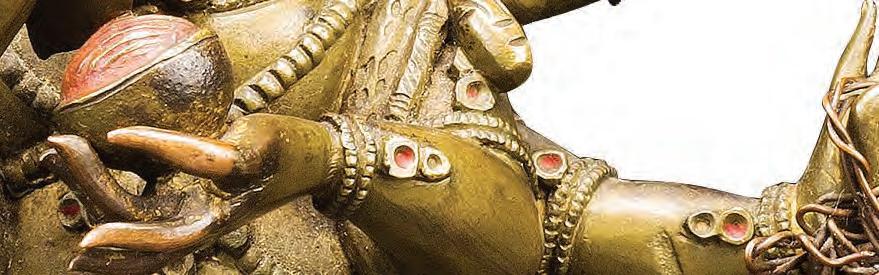
此六臂瑪哈嘎拉鬚髮眉毛呈火焰狀,三目圓睜,咧口卷舌 獠牙外露,面相兇憤。頭戴五骷髏冠,項掛人頭骨大念 珠,上身袒露,下身著虎皮裙。頭頂以蛇束發,脖子上直 垂一條大花蛇,象徵降伏龍王。主臂左手托嘎巴拉碗,右 手持鉞刀,上二臂右手持骷髏念珠,左手結期克印,兩手 同時張開一張象皮披於身後,象徵驅逐無明;下右手持手 鼓,下左手持原配鉤鎖,表示勾縛降伏一切妖魔雙腿屈右 展左,兩足踩在象頭象腿上,表示護法降伏外道。主尊和足下 所踩象頭神都佩戴項圈,珠鍊,釧鐲,雕工極為 精巧繁複。下承覆蓮座,蓮瓣飽滿細長,勁道十 足。
整尊造像雕工十分細膩,栩栩如生,威猛之氣十 足。原配手持物完整,頗為難得。堪稱同類造像 中極上品。

Je Tsongkhapa 宗喀巴大師
Circa 18th century 8世紀 Mongolia 蒙古
Gilt bronze 銅鎏金 17 in. (45 cm.)
HAR no. 8037 喜馬拉雅藝術資源網80 號
ro e ce 來源: rom he collec io he c ire i i he 1970 洛杉磯古董商 he 1970年代收購於紐約
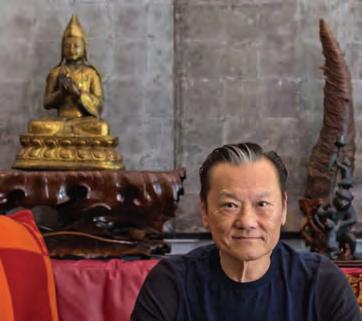
Joel Chen, a renowned antiques and mid century design dealer in Los Angeles, has filled his great room with collected treasures.
Credit: Laure Joliet for The New York Times
Tsongkhapa, also known as Je Rinpoche, was born in the Amdo region of Tibet in 1357. He was a highly respected Buddhist scholar and is credited as being the founder of the Gelug Buddhist sect, known as the “Yellow Hat” sect, one of the most powerful and widespread in the Buddhist religion. Revered as an incarnation of the bodhisattva Manjushri, he was reported to have seen and conversed with the deity from a young age.
om re hi o er l iece i h rel e gil - ro e ig re o o gkh 18 h ce r illr e i i o gre re o i e r ollec io o he c e rch i e m o i e r 70 o 22
宗喀巴大師(13 7年至1419年)為 藏傳佛教格魯派(黃教)創始人, 在藏傳佛教中聲望極高,被視作文 殊菩薩的化身。此尊宗喀巴大師像 雙手於胸前結說法印,手指刻畫柔 軟逼真。頭戴尖頂通人帽,兩側冠 帶垂肩,額寬頤豐,雙眉細長,雙 目微閉,法相寧謐和煦。軀體端正 挺直,身著交領式僧衣,袒右肩, 是西藏僧人的典型裝束。衣著厚重 寫實,富有層次感。衣緣鏨刻清晰 花紋帶,做工精細。此尊宗喀巴結 跏趺坐於束腰雙層仰覆蓮座之上, 蓮瓣飽滿,瓣尖微捲,素雅大氣, 精湛的藝術手法完美地再現了一代 宗師慈悲智慧的精神氣質。
類似造像可參見 i o 和 g 著作“ 西藏藝術的珍寶: c e rch i 西藏藝術博物館藏 品”中收錄18世紀蒙古宗喀巴大師 像( 第70頁,圖22)


Avalokiteshvara 觀音
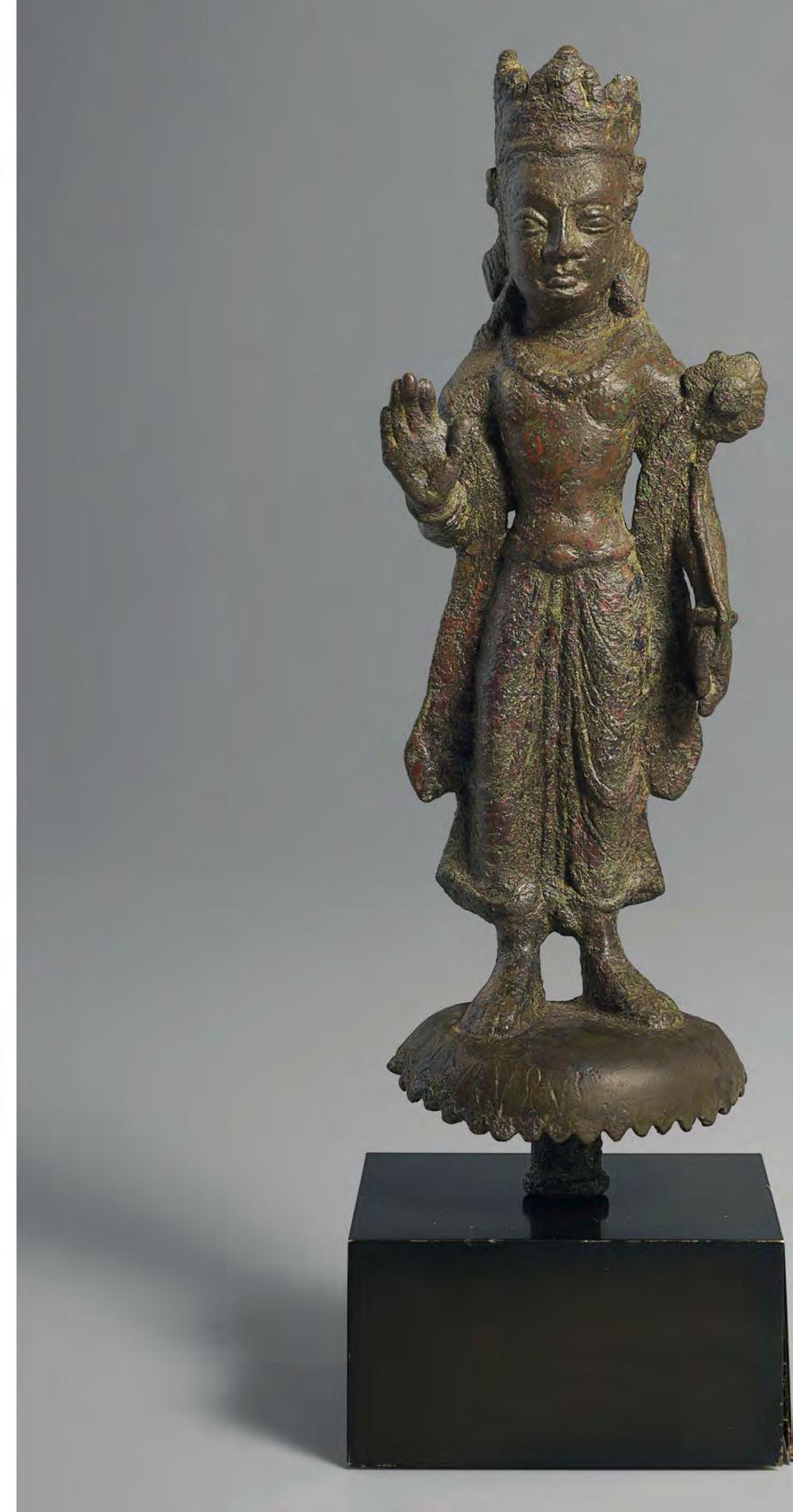
Circa 9th-10th century 9 0世紀 Nepal 尼泊爾 Bronze 銅鎏金 13 1/2 in. (34.2 cm.)
ro e ce 來源: c ire i o o 1977 hri ie e ork e em er 14 2010 lo 70 1977年收藏自倫敦紐約佳士得,2010年9月114號,拍品70號
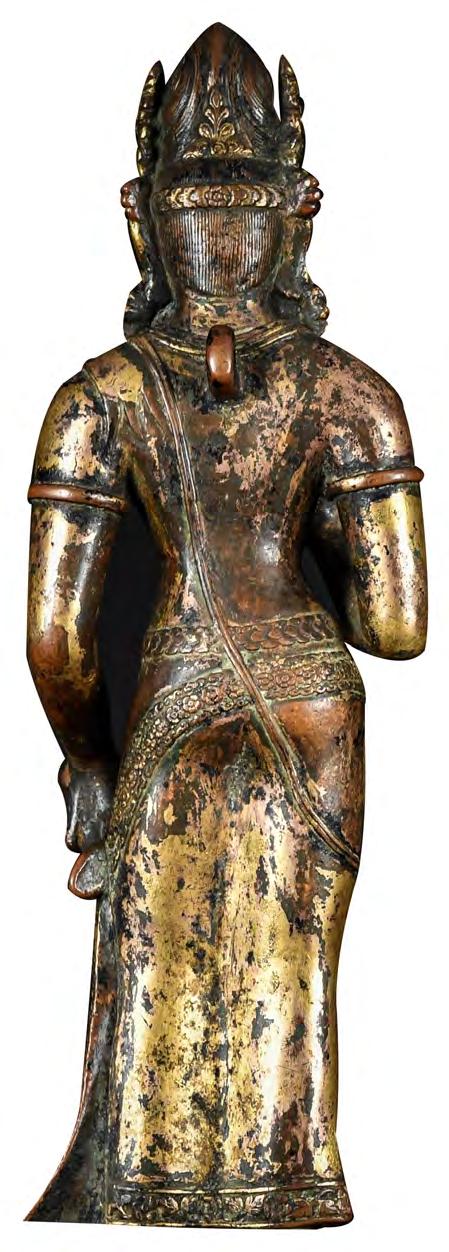
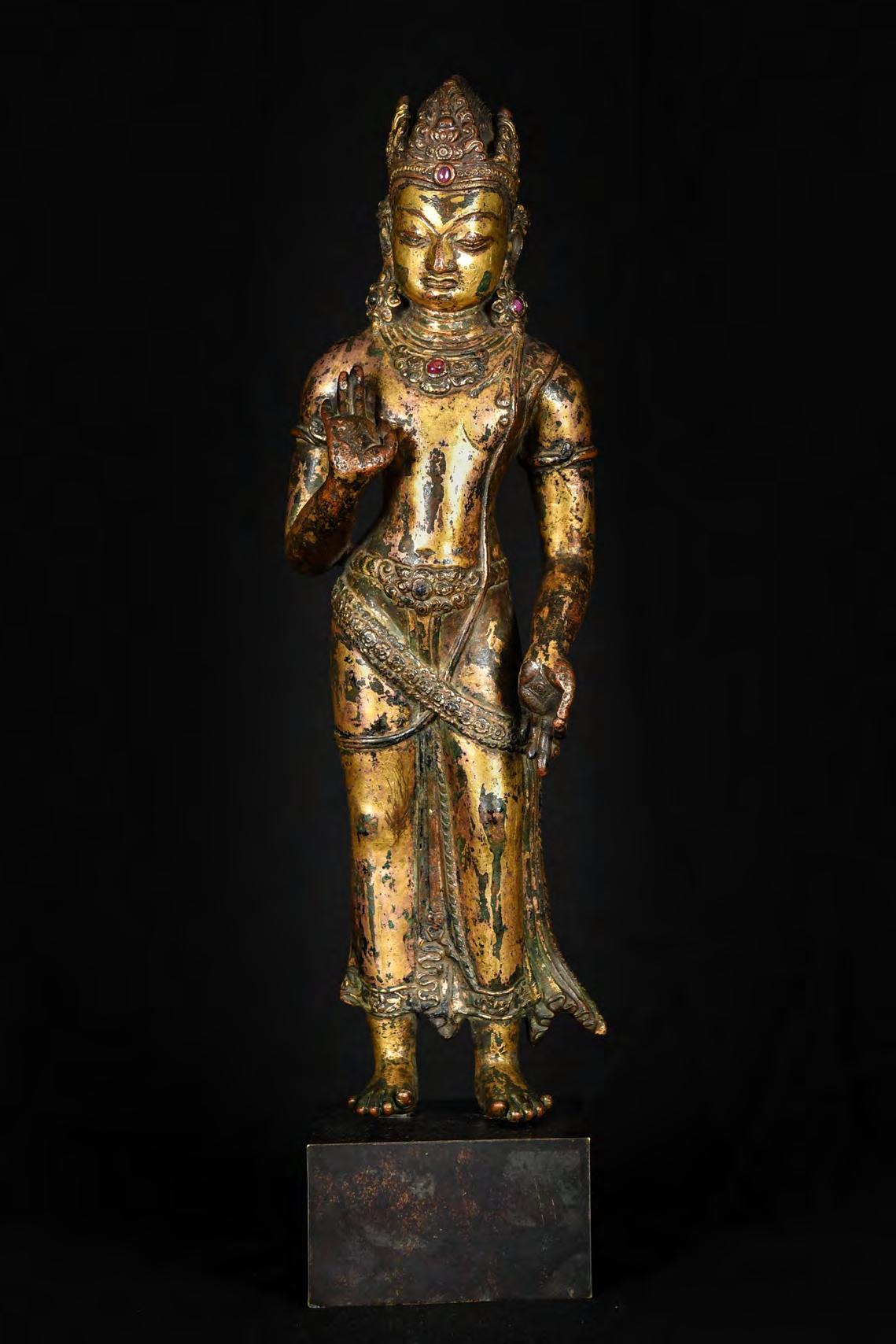
i righ h r i e i he h m r i h ch kr o he lm hi le i r m r he ce i h lmoh e e e rche ro e ri g lo g ho i ec re i h or e el loki e h r reg ll i h hi le leg ligh l e cre hre r e cro hi or o elo e ki cro hi ho l er lor l h ro hi i high he i or e i h i l i e elr he re ce ere hi i el mo ele c lre i er l e ile i h lor l g rl i e g r e
el or e coi re i h i ci e r o h ir re i h erl i g gil i g righ er eco r ire gil i g o e ee i e rl ro e he more o e re e gger e hi e ll or circ 10 h ce r e he cro e r ce r l like eleme hich co l e o e im ge o i re h c e com re i h rel e e m le ormerl i he oh er he or ollec io or im ge e ri g he k ik i he le h ee l ol 1 1974 c o 212 or l er e m le i h imil r ci l e re lor l mo i o he el h o he cro ee l r o e l 198 10 ig 2
此尊观音立像左腿略微弯曲,左手施与 愿印,右手抬起,施无畏印,掌心印有 脉轮图案。菩萨杏眼微垂,与高扬的眉 弓相呼应,优美典雅。尊像束发高髻, 头戴三叶宝冠,其间饰有佛塔。上身袒 露,肩 披羚羊皮与圣索,项戴醒目项 圈。下身薄衣贴体,显出肌肉健美。腿 部与腰间宝带缠绕,嵌有珠宝。整尊造 像造型精致,特征显著,石榴石镶嵌素 雅贵气,发丝雕刻丝丝分明。醒目的红 色底层镀金和明亮二次火烫金使其断代 为早期铜像。造像整体呈现出的健美身 姿和微折的腰肢同样使其断代为10世纪 左右。
此尊造像宝冠中的佛塔亦可使其辨认 为弥勒菩萨,可对比参考 oh er he or 旧藏中类似造像。另外可 对比一尊同时期左手持净瓶造像,参 阅 ( l he r o e l 卷 一,1974,图212) 对于具有类似面部 特征和花卉带饰的较晚期示例,可参 阅 ( l he r o e l 198 ,图 2 )。

Amoghapasha 不空羂索觀音
Circa 15th century 世紀
Nepal 尼泊爾
Copper 紅銅 5 3/4 in. (14.6 cm )
HAR no. 41061 喜馬拉雅藝術資源網 0 號
ro e ce 來源:
ollec io o eo ro ri ce o e er e c ire rom e er o er l o e er e 4 c o er 1972
新澤西普林斯頓 eo ro 先生私人珍藏
1972年10月4日收藏自美國新澤西州 e er o er l o 夫婦
i el mo ele i g i ligh l le e o e o lo e i h oi e e l hi eigh r i i g rm hol i g r ri e lo k ik l o ro r i l i g he ge re o ch ri e chi g hi ro ce i rmo e ll cro ecre i g imi i e mi h e le i hi chig o mogh h re re e ric orm o loki e h r i r ic l rl o l r i e l here he i reg r e he el r ei o he K hm lle he e le e le i o h gr ce l co er i e om re he imil r li he o c c i g ol h co ec i h he lo e o ce ic loki e r li he i o chroe er i e l 2001 02 o 16ee 1997 l 230 om re l o o 1 h ce r h o mogh hel i he ic ori l er e m ( 8-1977)
不空羂索觀音是觀音菩薩的密教化現,象徵觀 音菩薩以慈悲的羂索救度眾生,使其心願不會 落空。不空羂索觀音在尼泊爾地區流傳很廣, 以保護神的形象在加德滿都谷地受到廣泛推 崇。
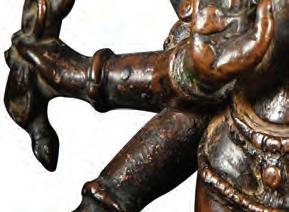
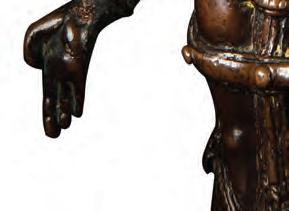
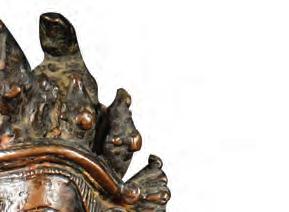
此尊不空羂索觀音以微三折式站姿立於覆蓮底 座之上,一面八臂,左四手分別持經卷,三叉 戟,蓮花,寶瓶,右四手分別持念珠,繩索, 施無畏印和與願印,面容甜美,雙目俯視頭 戴。花冠,佩飾多種瓔珞釧鐲。下身著僧裙, 層次分明,裙角曳地。
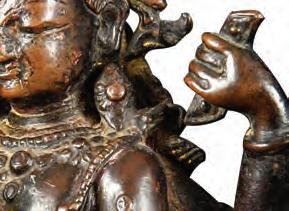
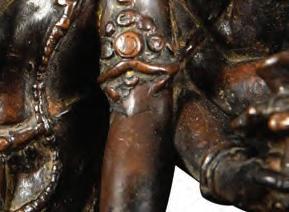
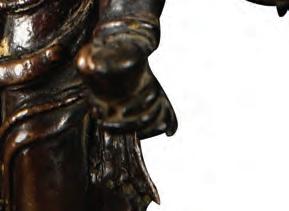
此尊造像莊嚴內省,類似造像特徵可參照烏爾 里希·馮·施羅德著作“西藏佛教雕塑”卷 一:印度與尼泊爾中收錄觀音造像(2001年 版,502頁, o 16 - )和 h r ee 著作 im l ro e (1997年版,彩 圖 230)中收錄的觀音立像。
同時也可對比參照倫敦 & 美 術館藏15世紀不空羂索觀音博巴 ( 8-1977)。

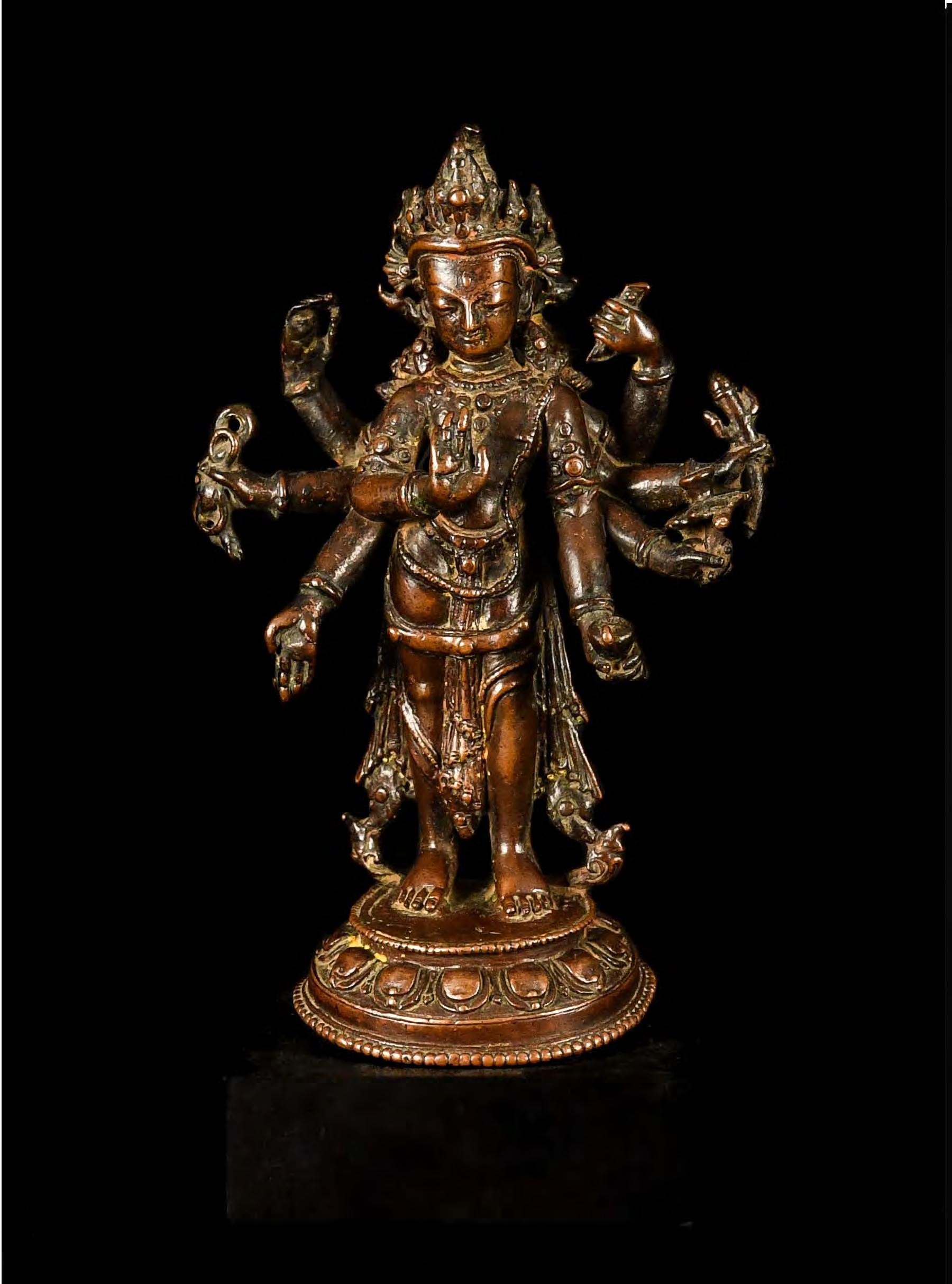
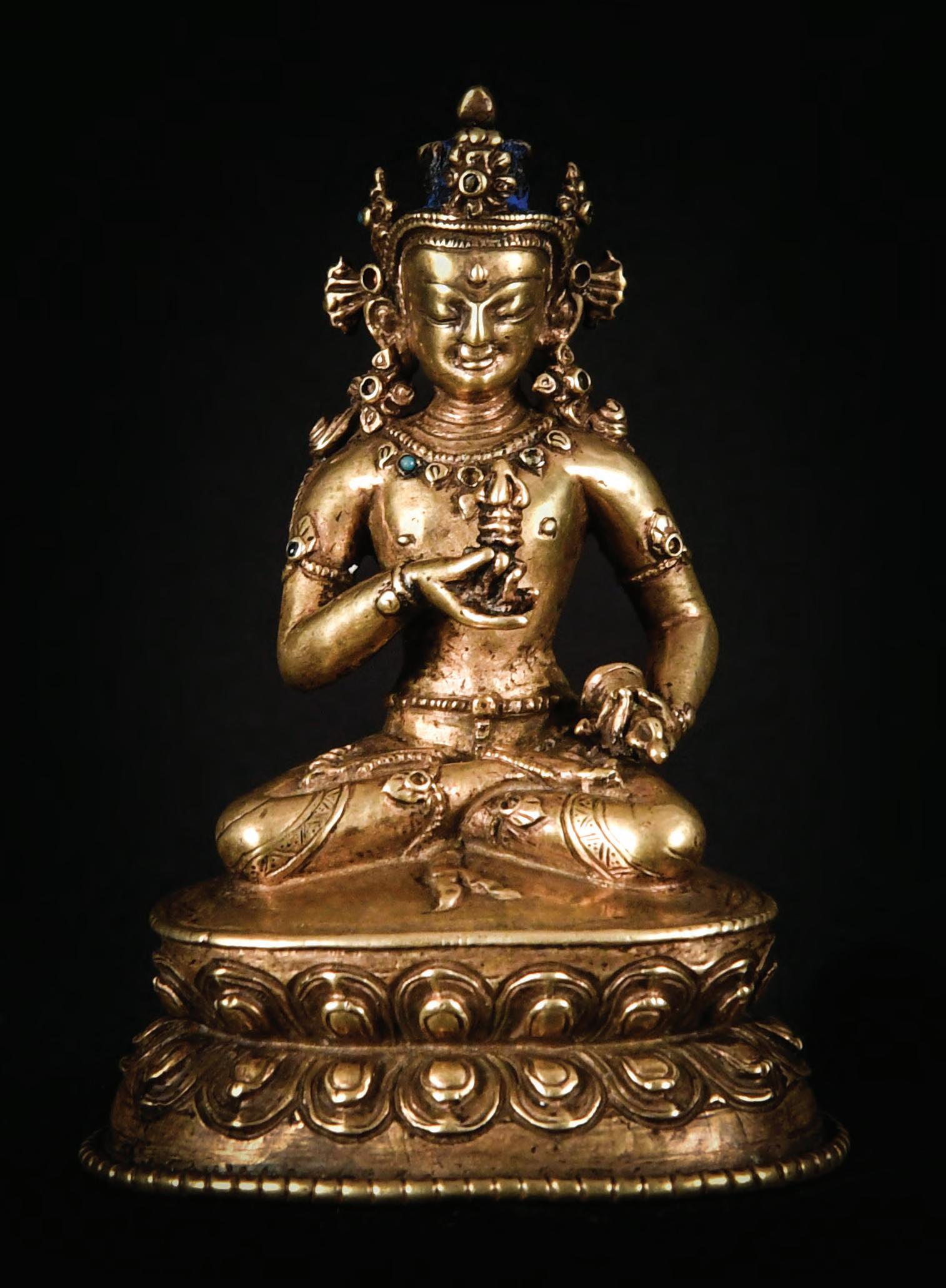
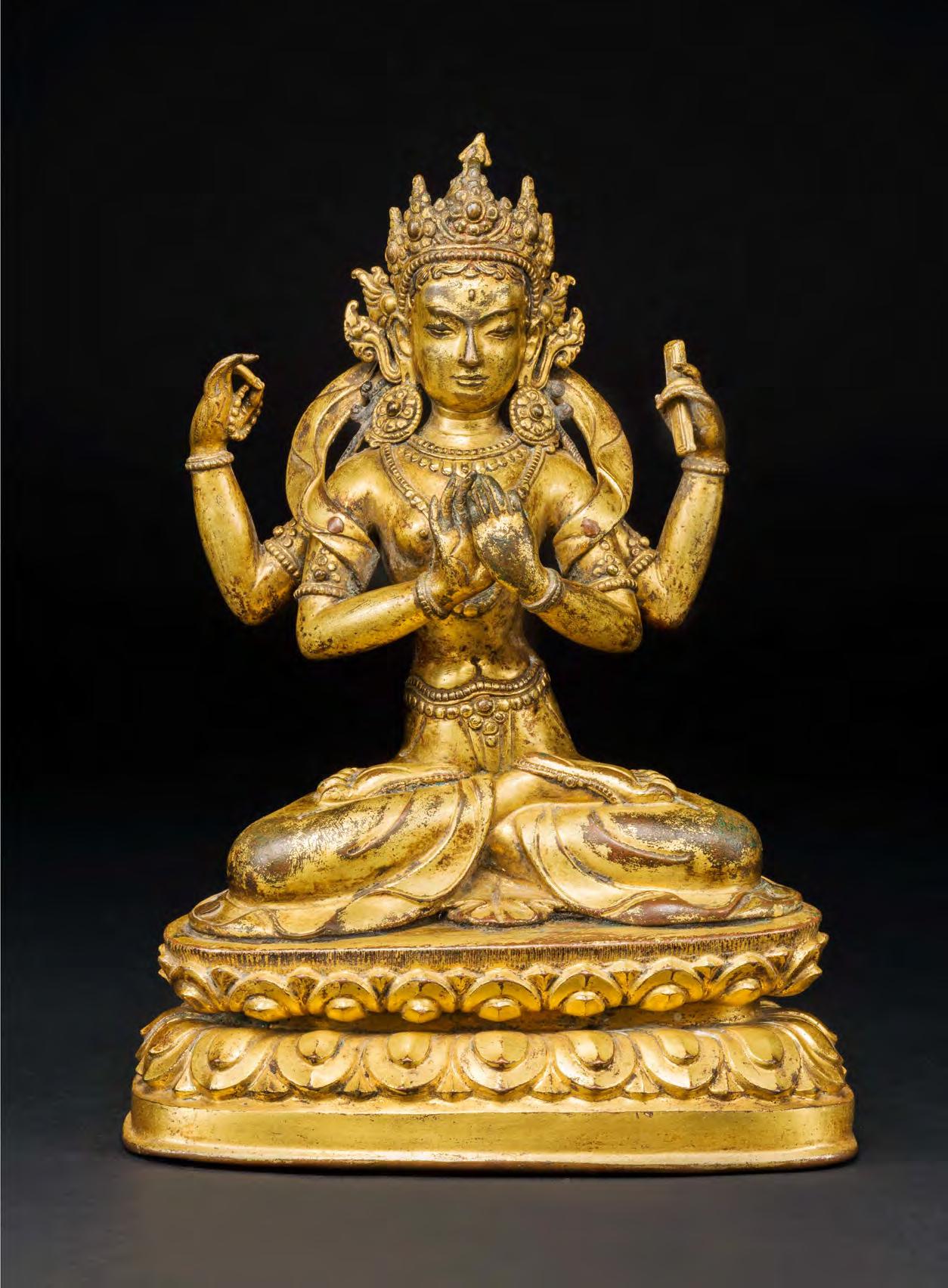
Avalokiteshvara 心性安息觀音
Chitta ishramana Lokeshvara 17th century 世紀
Qing Dynasty, Kangxi Style 清代康熙風格
Gilt Bronze with inlay 銅嵌琉璃 6 in. (15.5 cm.)
HAR no. 8288 喜馬拉雅藝術資源網 8288號
ro e ce 來源: i ri e collec io e 1999 i h Koller c io 111 o 40
瑞士私人收藏
闊樂拍賣行,1999年6月11日至12日,拍品40號
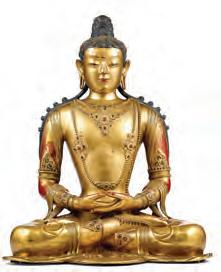
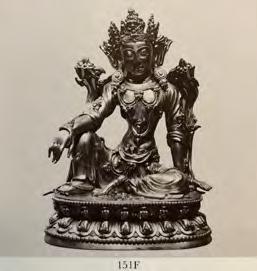
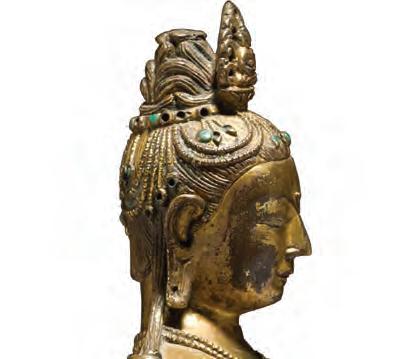
li he ec o e ire i r i e rch 2019 i e 22-23
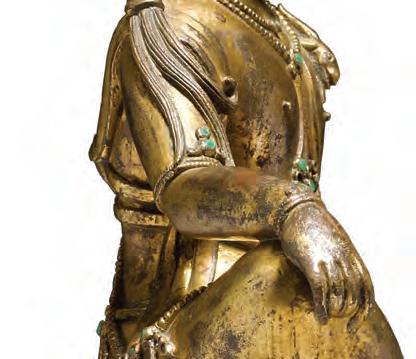
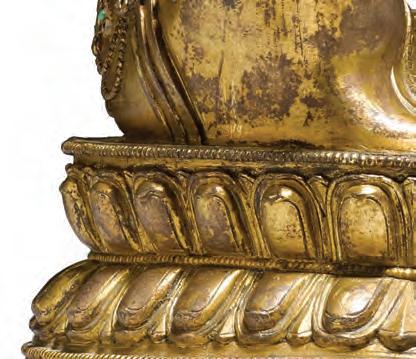


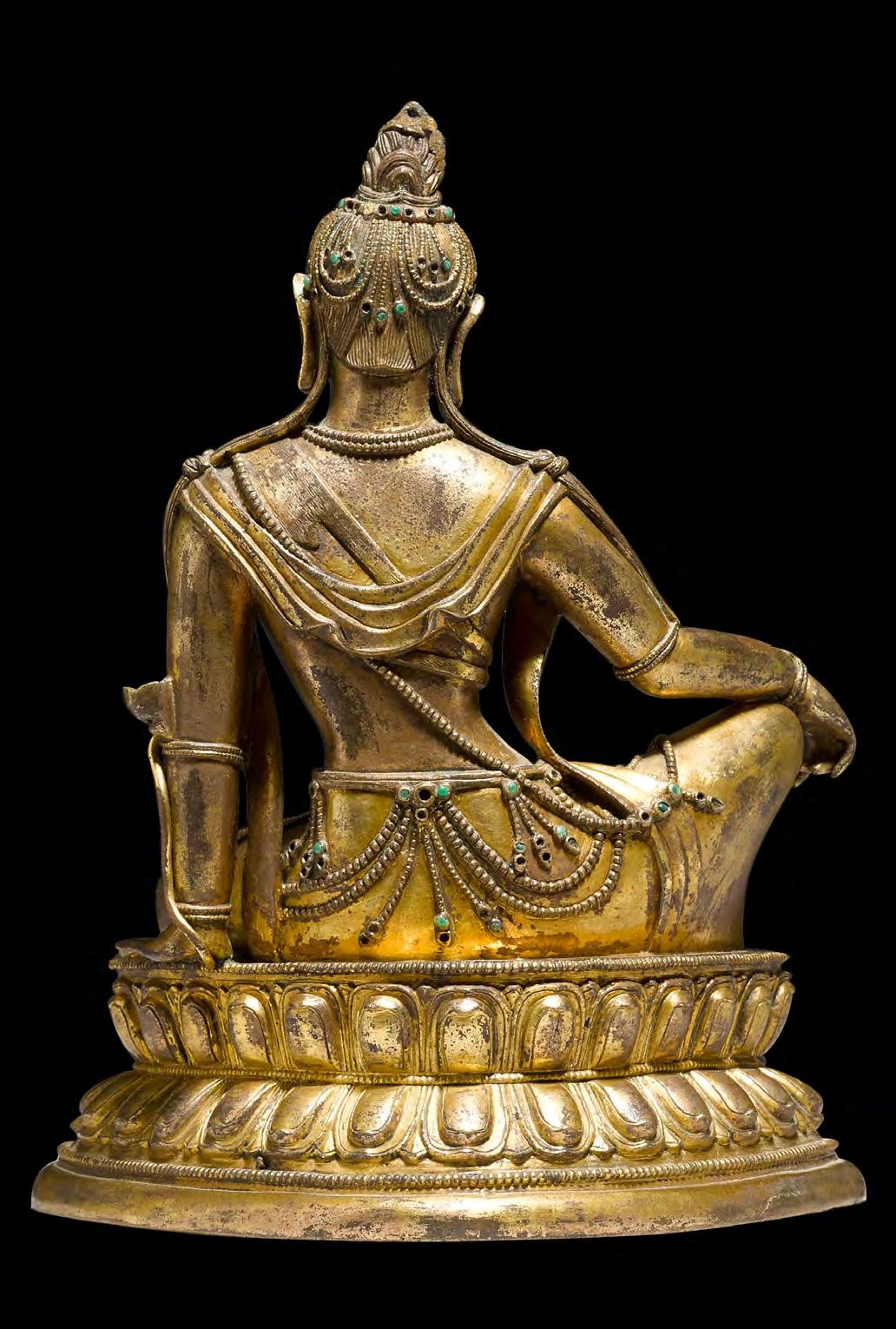
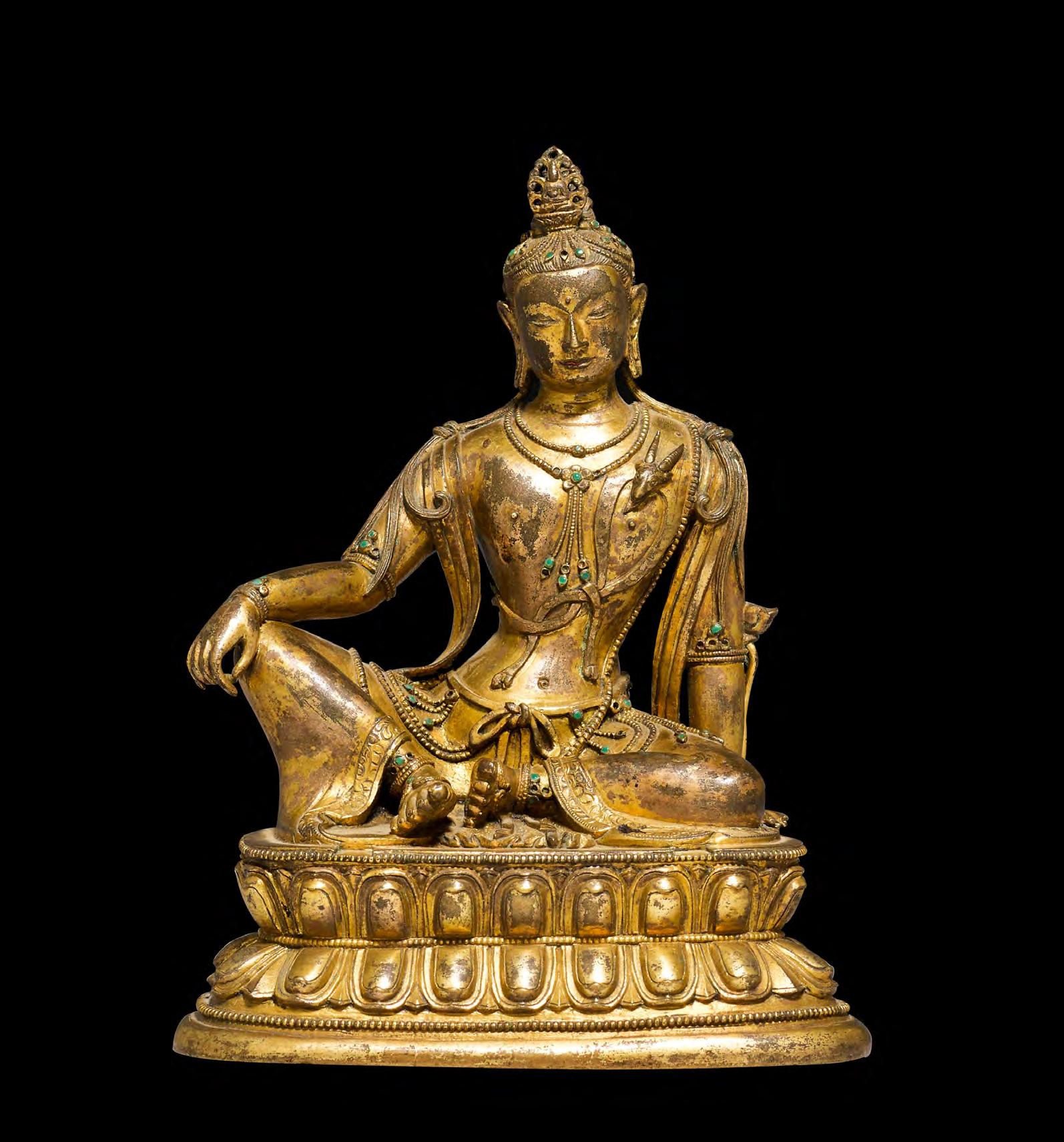
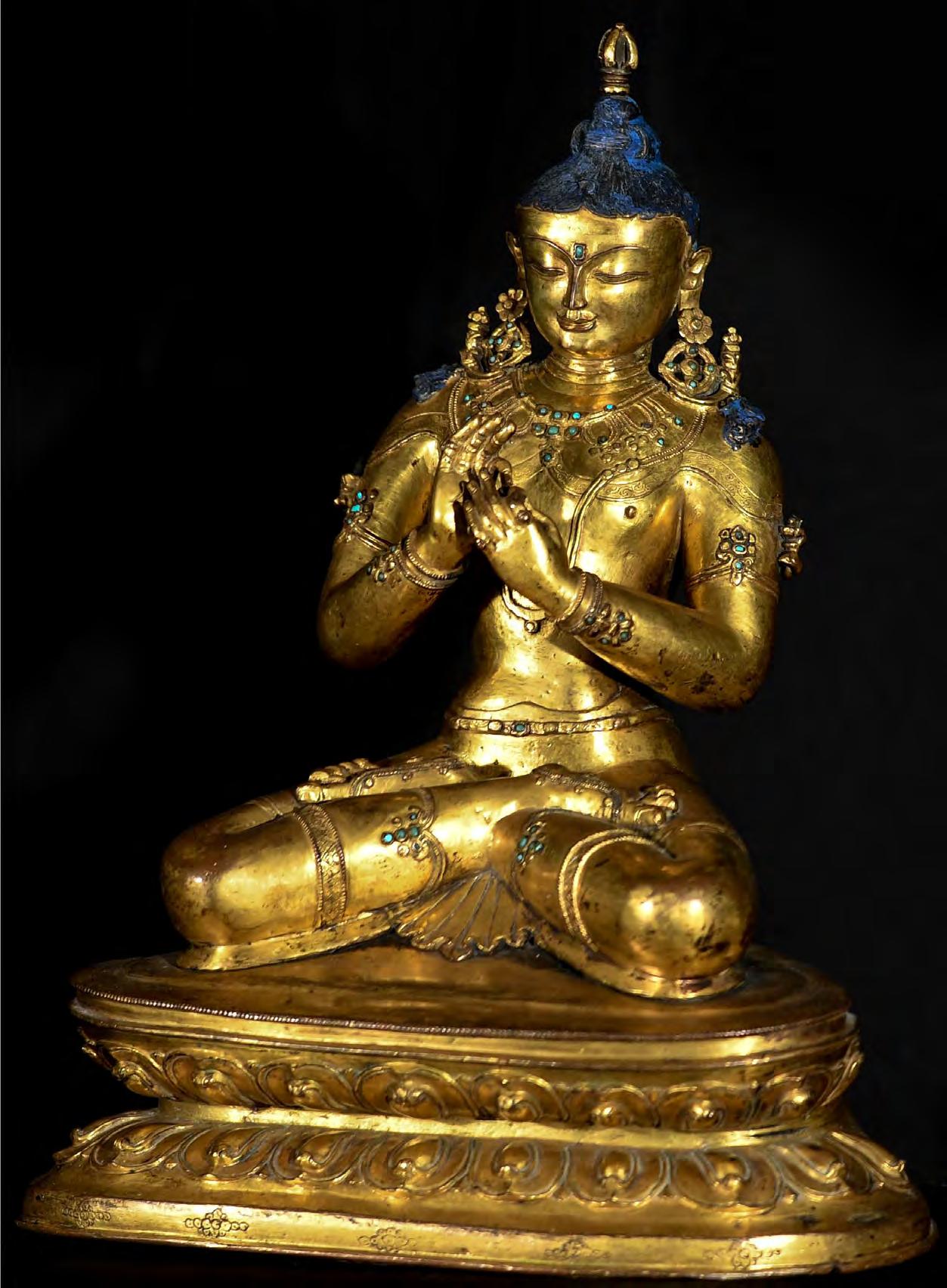
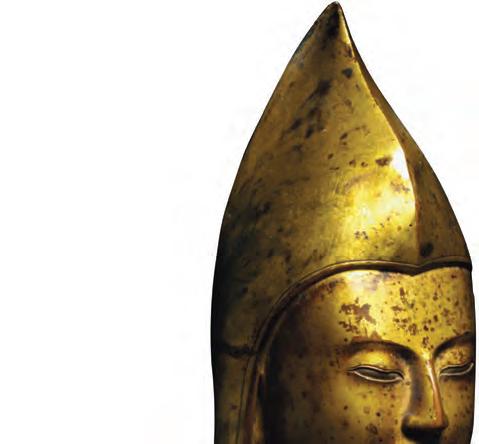
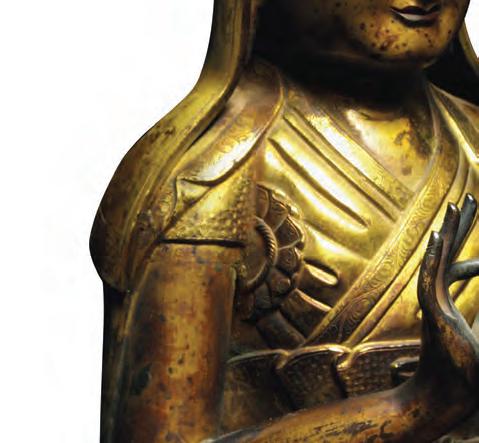
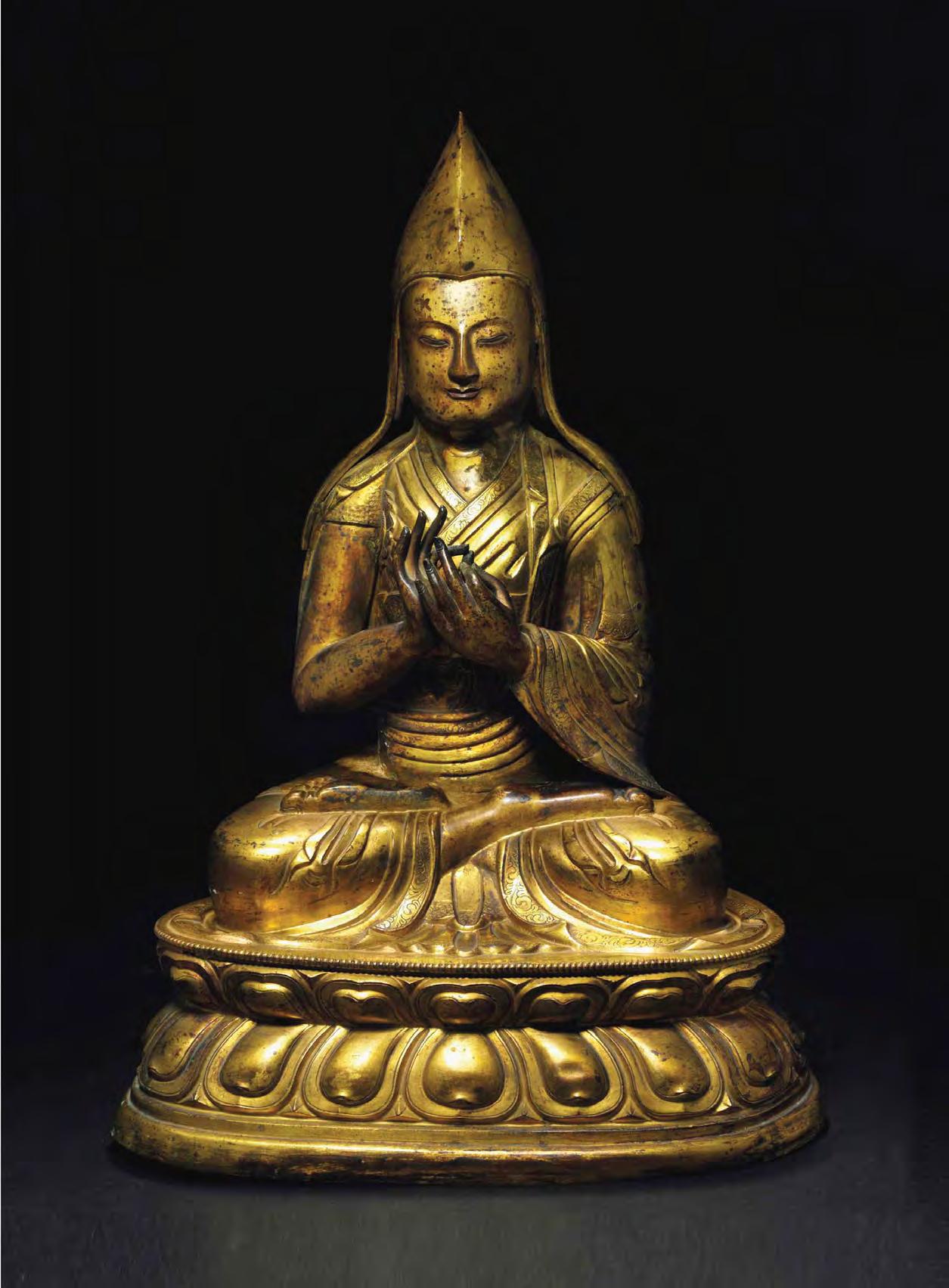
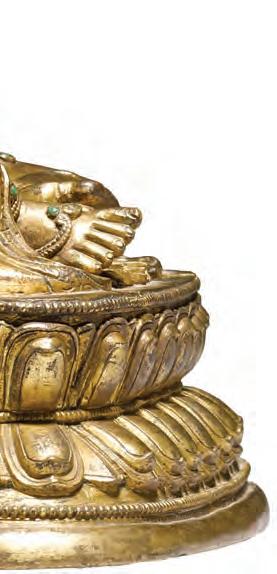
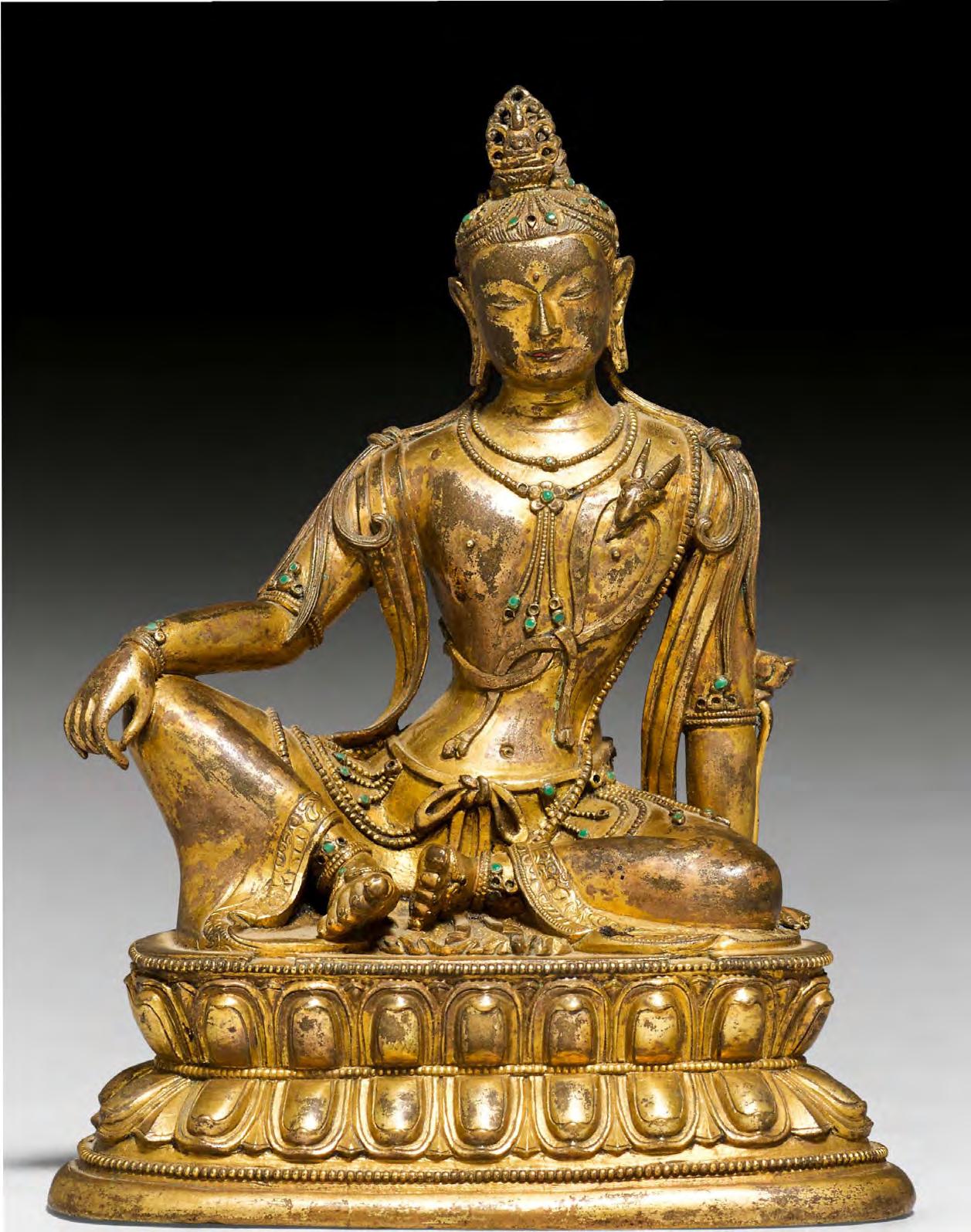
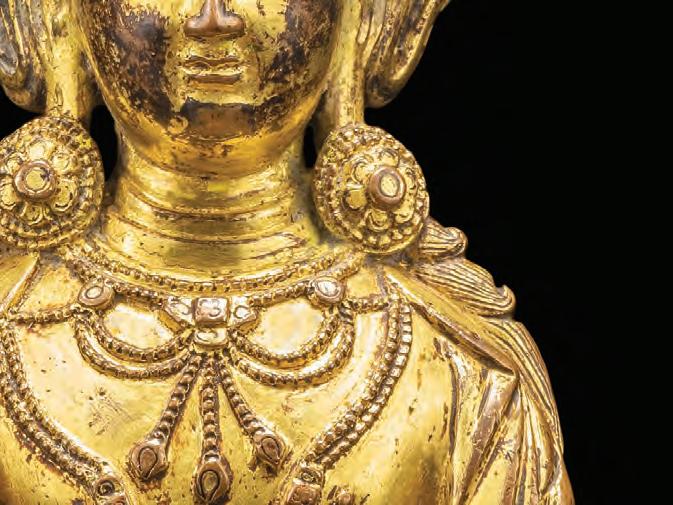
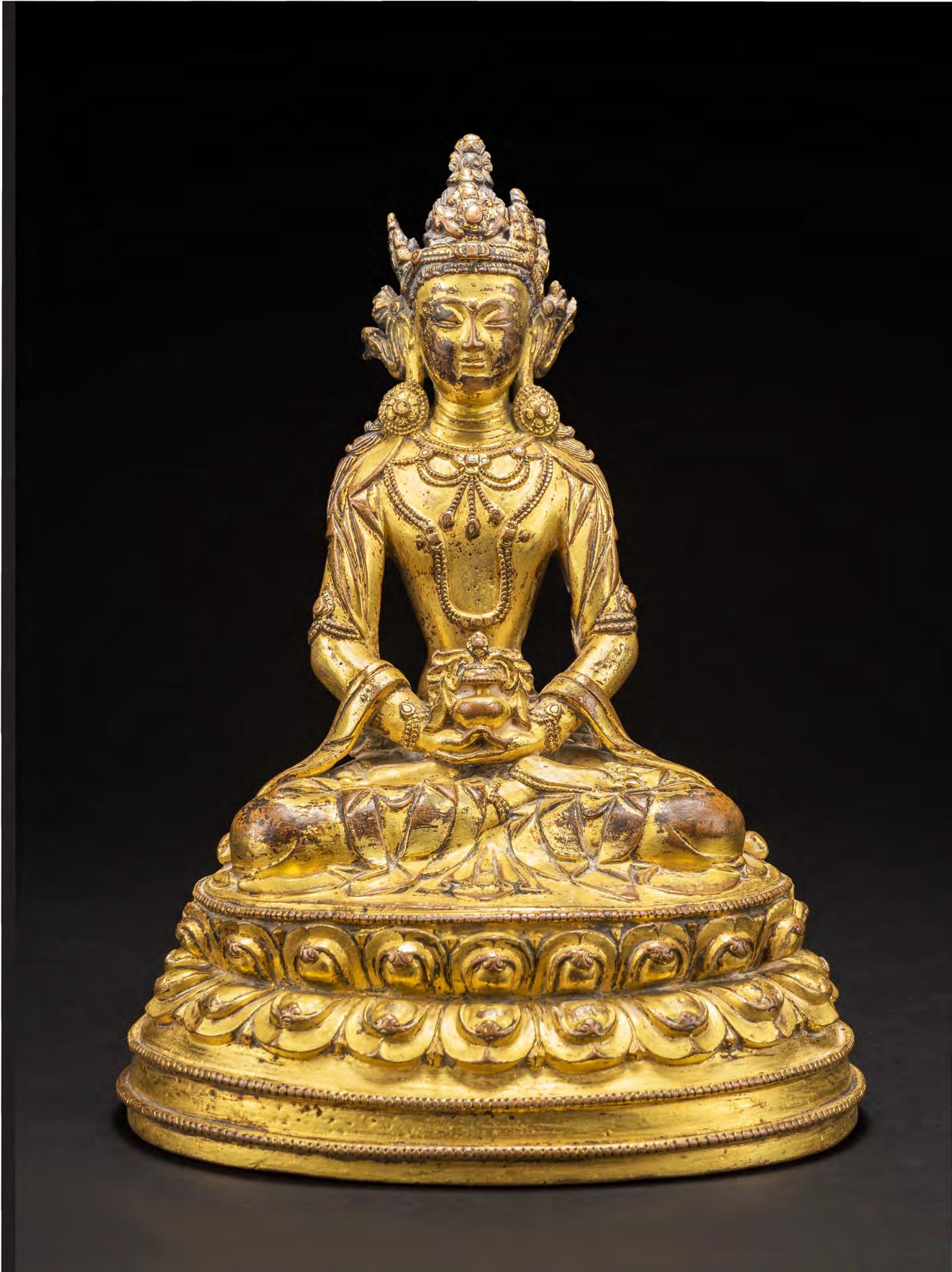
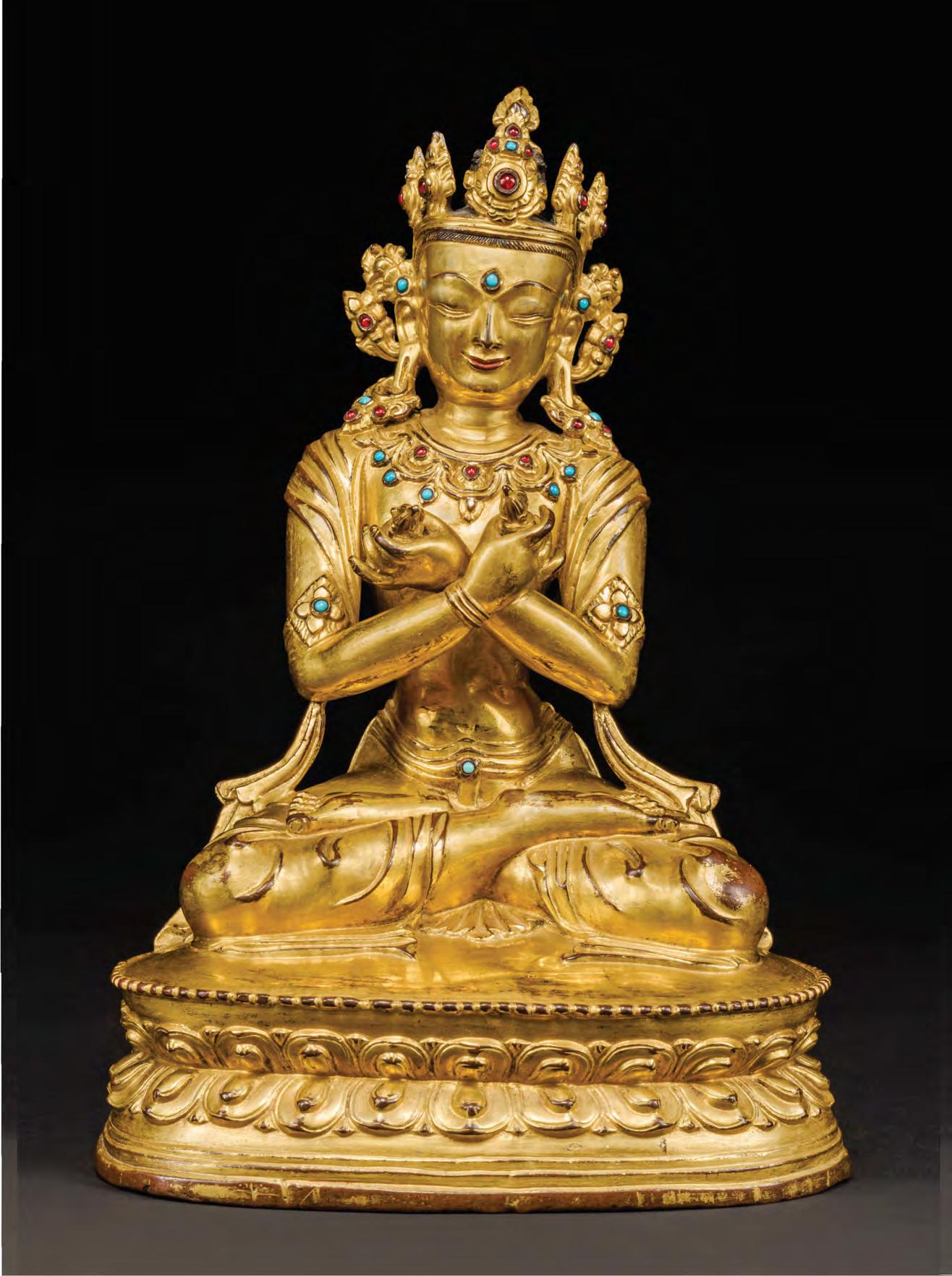
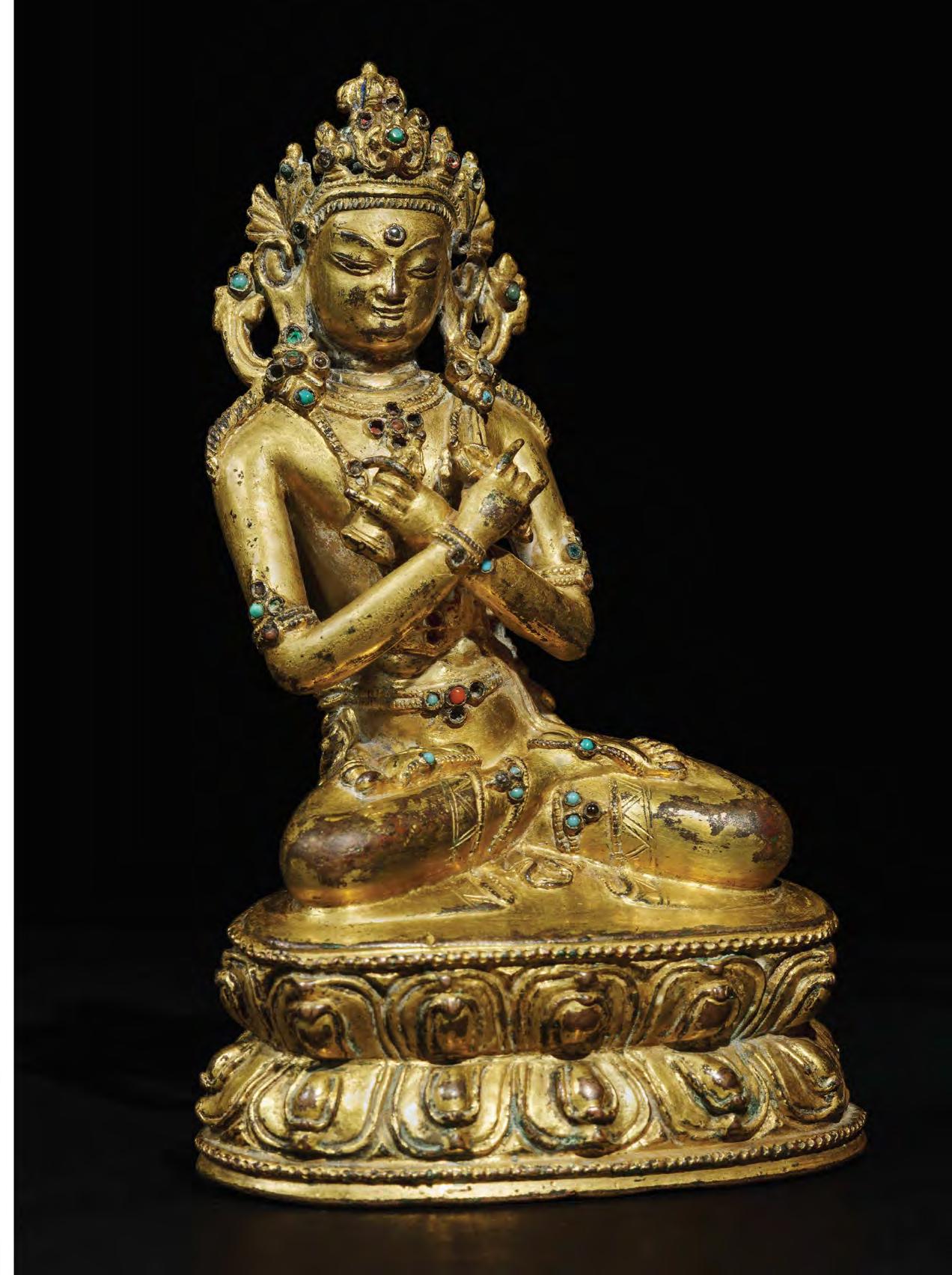
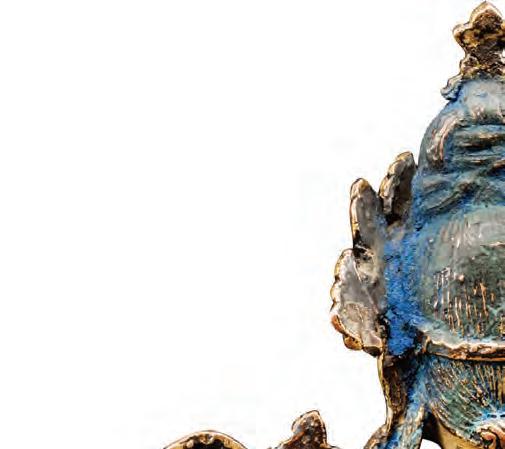
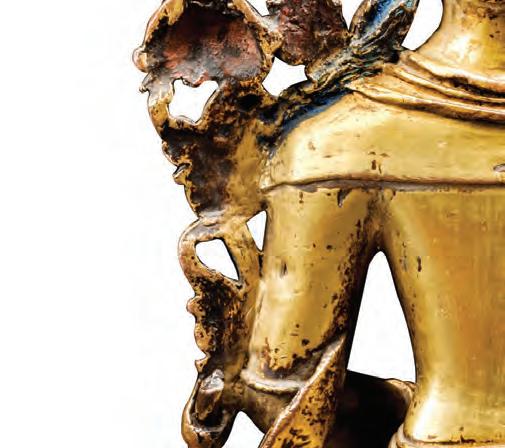
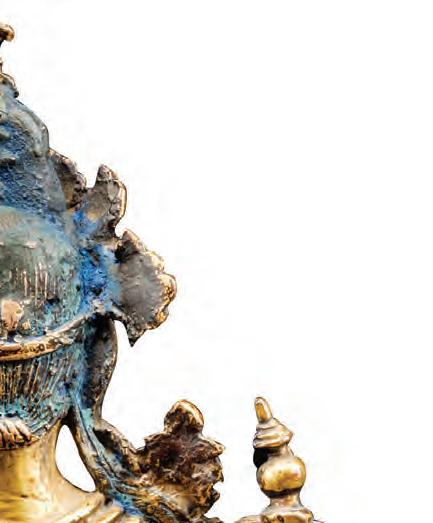
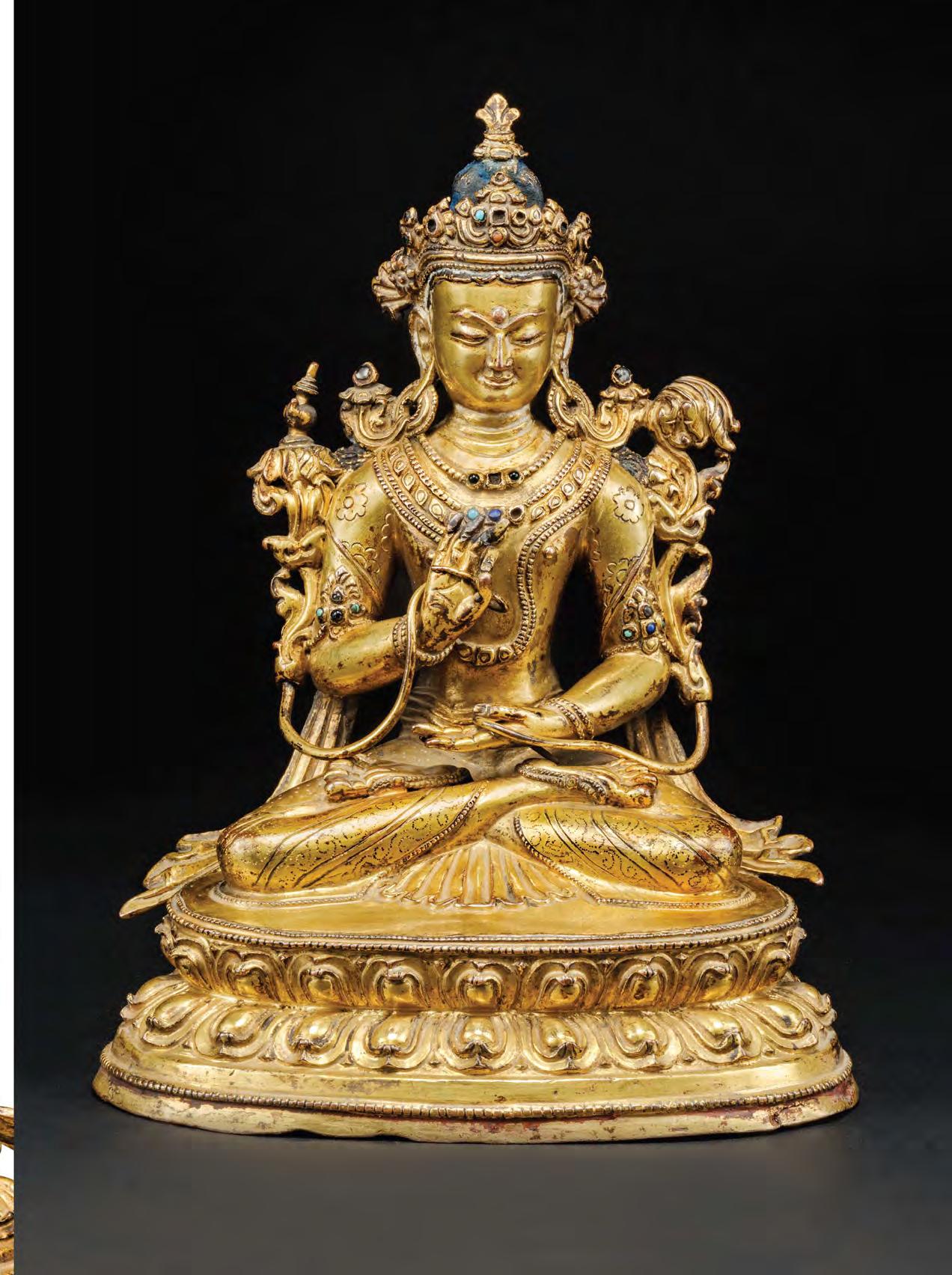
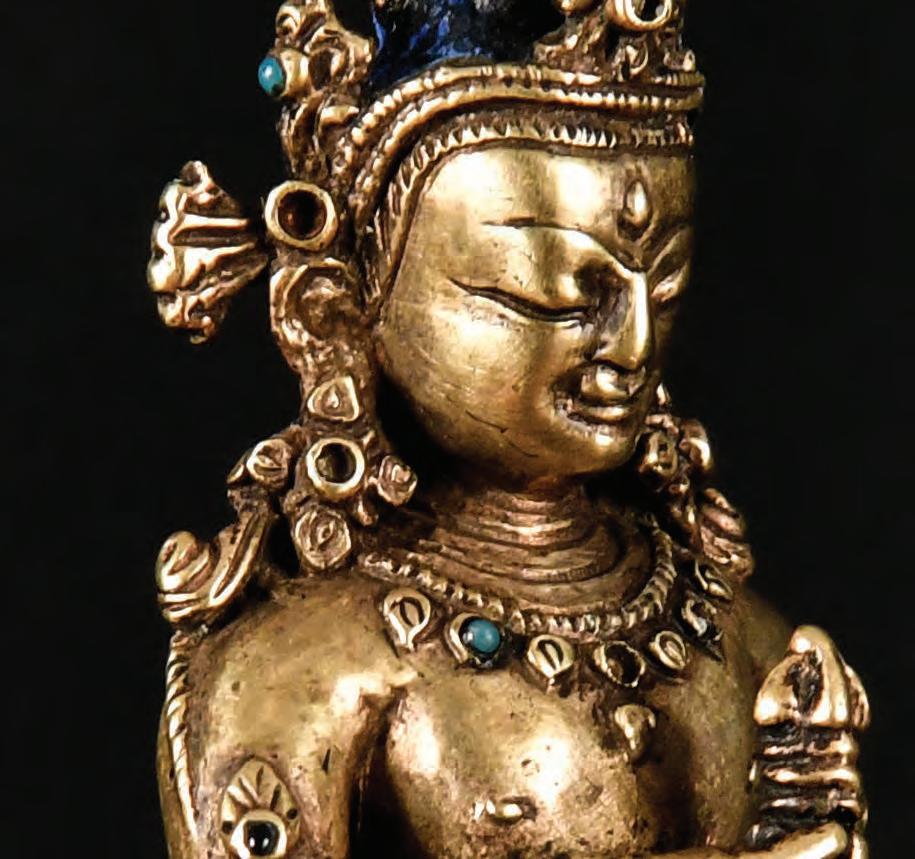
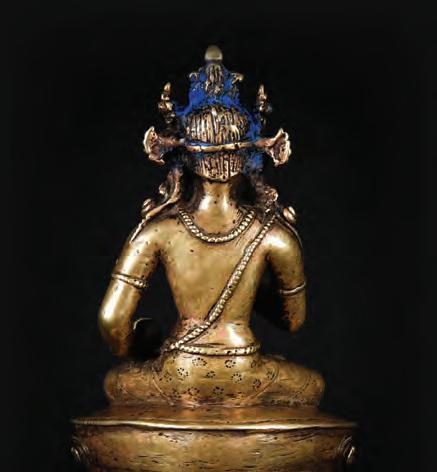
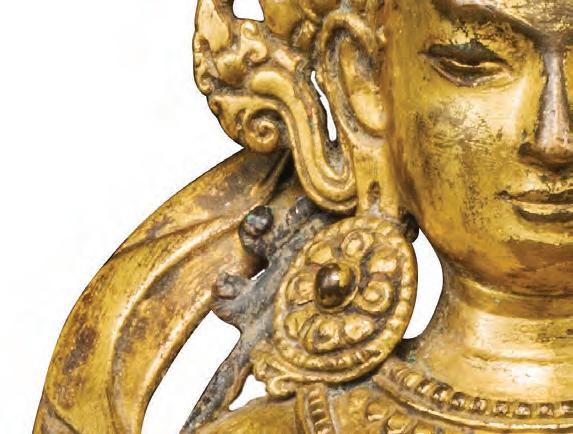
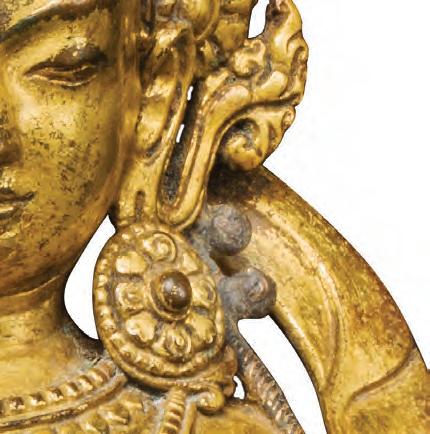
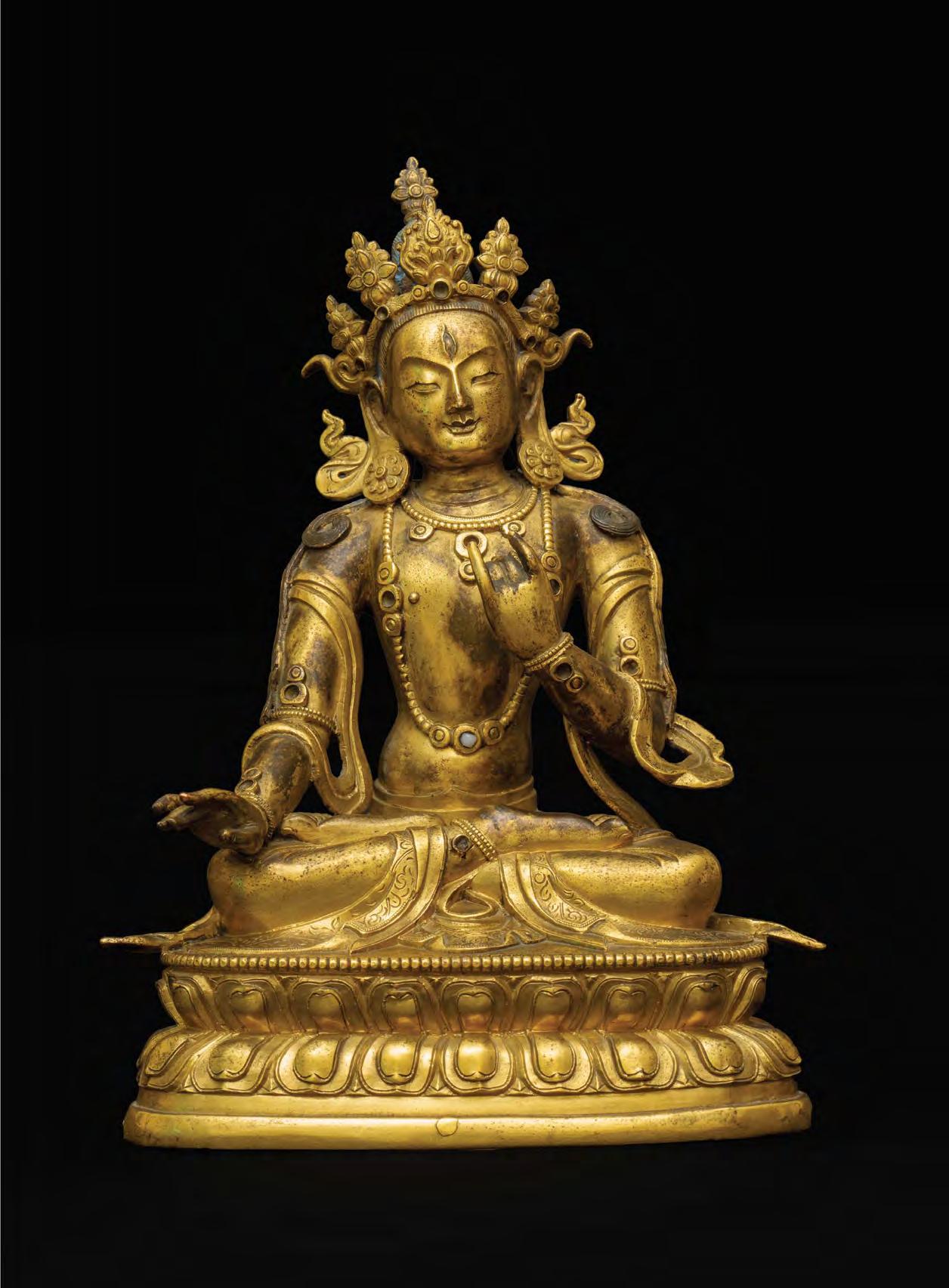
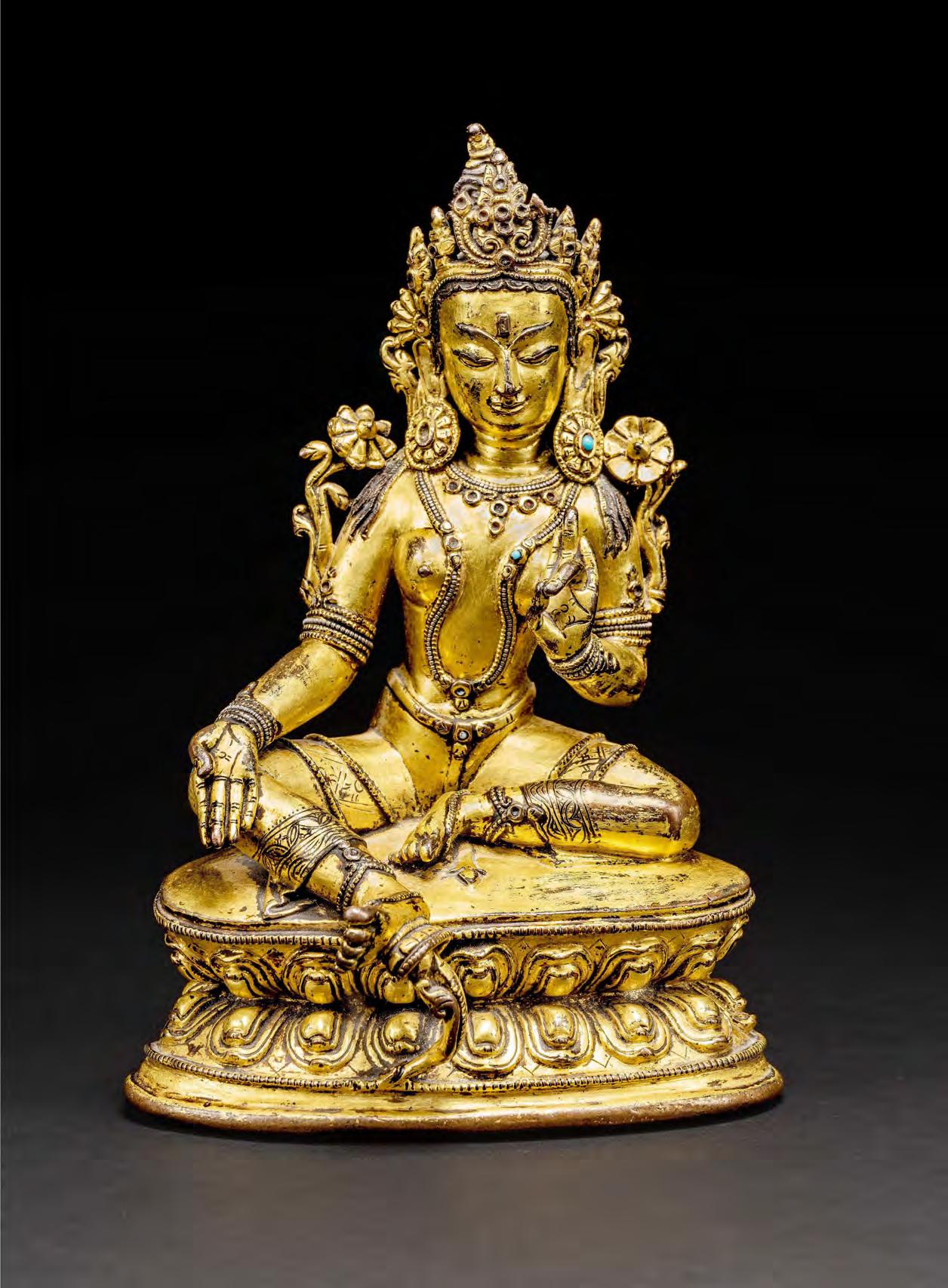
This extremely rare sculpture shows Avalokiteshvara, “The lord who looks down ” in his emanation of Chittavishramana (Semnyi Ngalso), gazing upon all beings with great compassion. Executed by a master hand, this exquisite sculpture encapsulates the distinctive imperial style created during the Kangxi period.
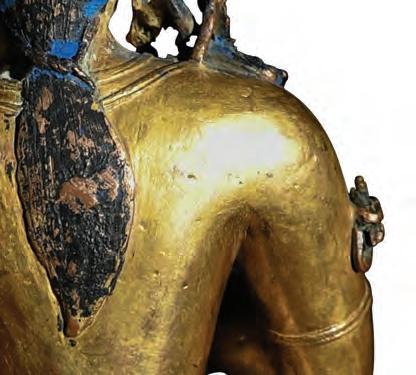
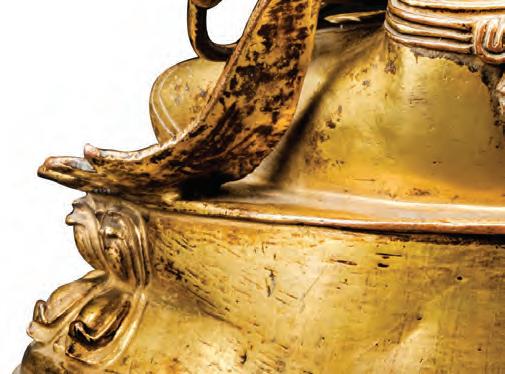
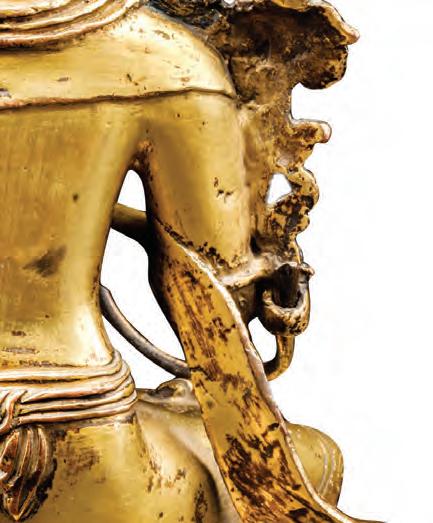
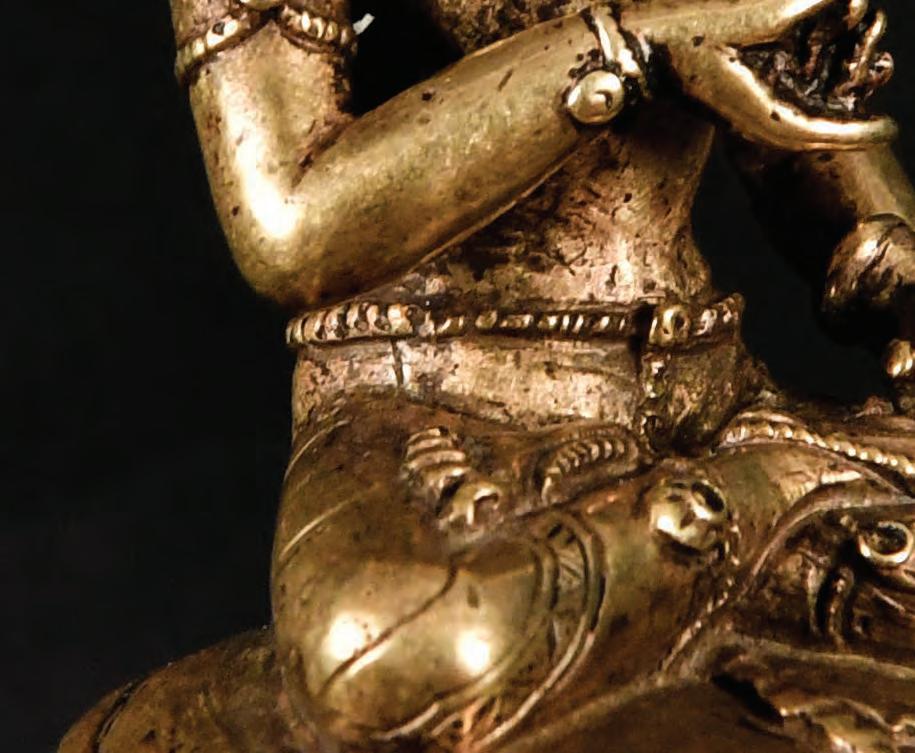
Chittavishramana is the state in which the Bodhisattva has purified all obstacles through the practice of great compassion and wisdom, and is resting in the nature of mind. Seated in this Rajalil sana-esque posture, he is depicted with his right hand extending gracefully over a half raised leg, while his left hand is pressing on the seat behind his left thigh, to effortlessly offer support whilst holding the stem of a lotus. Surmounting the elegantly modeled figure i a chignon with Amitabha in the center, and an antelope skin tied ro hi le ho l er
E m le o hi i hr m oke h r re i i c l or e
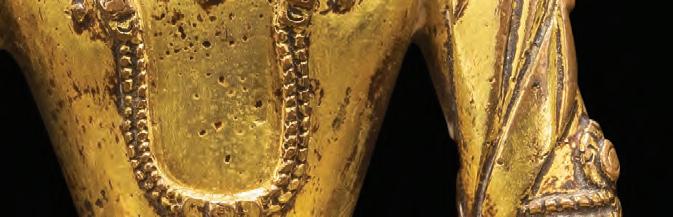
i h he e l g rme e elr he re e ork i o e ce io e i l i hl ecor e i h i i c i e e i g i lor l mo i i gr ce l lime re e ce i he r her e h ce he rilli gree gl i l ork i ho i ol ge l r ll o he e i h he hem e gr e reci el
he li ic re me o hi ig re o re e elr c e r ce r ck he e rl i g erio li he i o chroe er o g Ko g 1981 1 1 o 1 1 ( ee 2)
he o l -mo ele ce e i i e cr m hi r clo e com ri o o o ell-k o K g i ro e o mi hel i he l ce e m ei i g li he i go g o c g e he i i 60 g ch o i o o i g o g
Ko g 2008 238-9 o 227-8 l o com re hi ig re i h
K g i erio mi ol o he o g Ko g c o er 3
2018 lo 3626 ( ee 1)
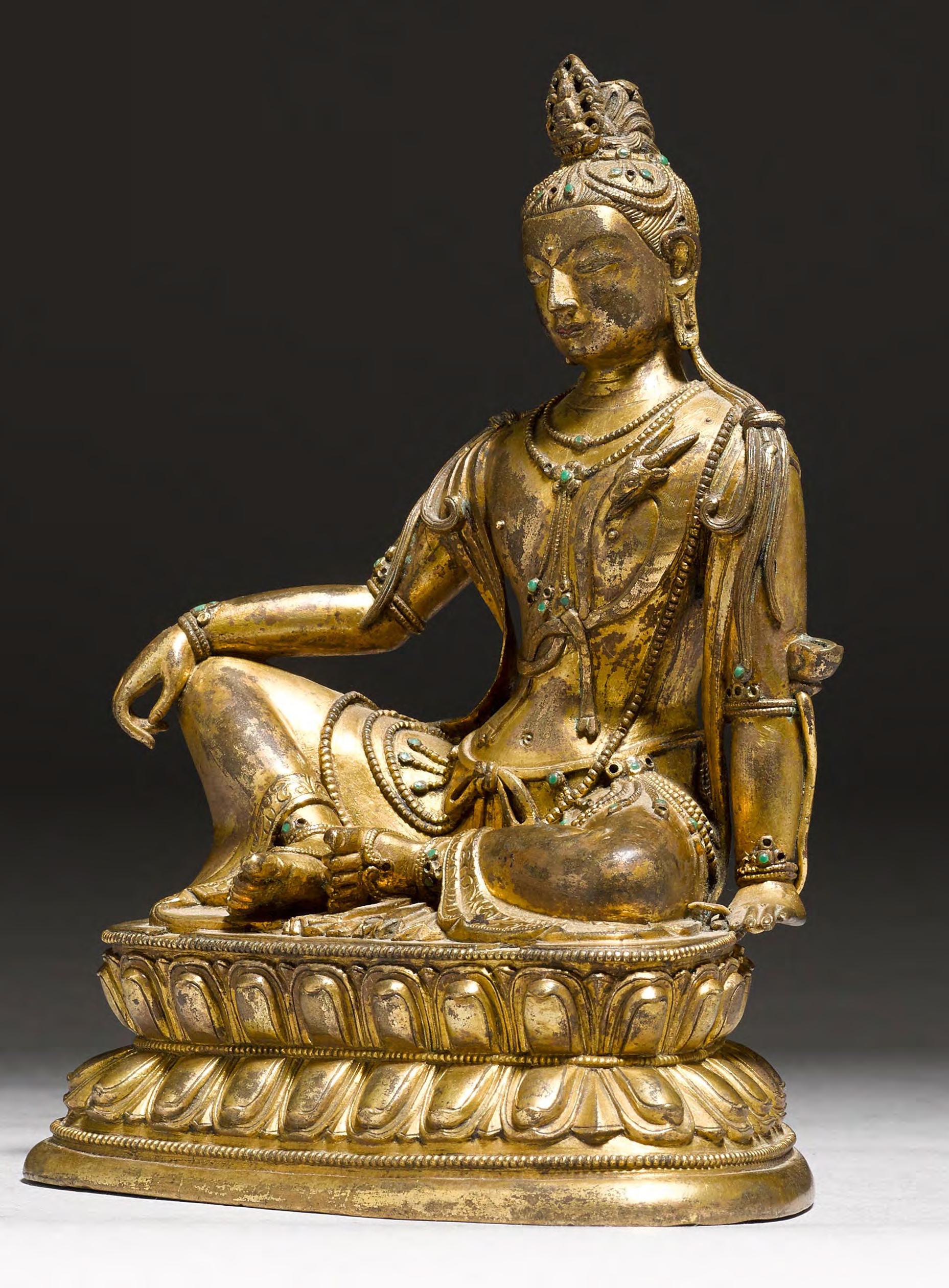
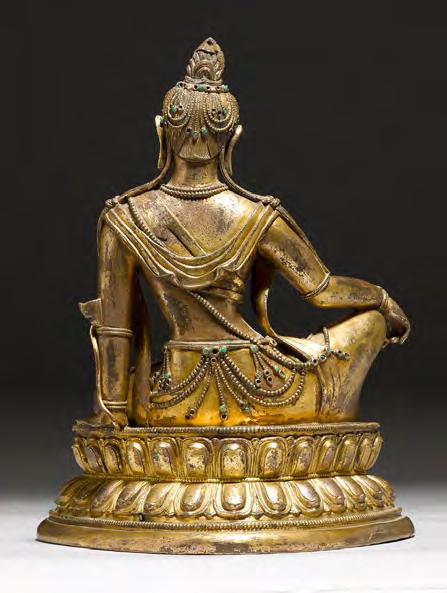
此尊罕見的心性安息觀音坐像氣韻溫厚沉靜, 造型優美,工藝考究,是康熙宮廷風格造像中 難得的精品。
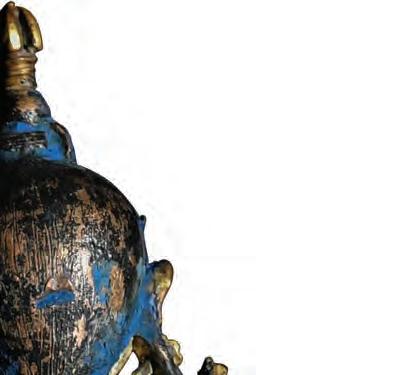
心性安息,是菩薩通過大慈大悲的精神與修 行,淨化了心中所有一切煩惱障礙后,達到的 一個身心清靜圓滿的狀態。此尊心性安息菩薩 坐姿安逸閒適,右手前伸,優雅地憩於膝上, 左手手握蓮莖撐於身後。菩薩盤髮高髻,頂飾
阿彌陀佛坐像,左肩斜系羚羊皮,表現出菩薩 具有密教神格。
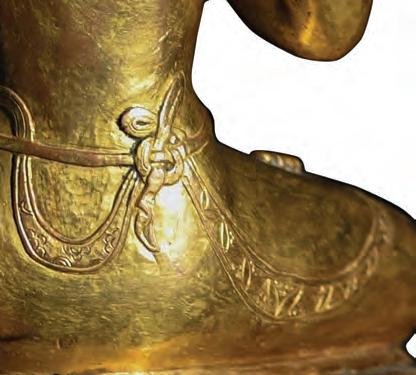
心性安息菩薩法相莊嚴華麗,此尊造像也不例 外。菩薩縷掖繞肩,周身嚴飾珠鏈釧鐲,胸前 花型項鏈簡潔大氣,明淨的琉璃鑲嵌更添華貴 之氣。下身著僧裙衣料厚實褶皺自然,衣緣簪 刻花紋又以顆顆分明的珠鏈鎖邊。 整體造像一 氣呵成,極具皇家氣韻。
此尊菩薩造型及周身珠寶樣式最早可追溯到明 代早期,參見馮·施羅德著《印度西藏銅 像》,香港,1981年,圖143 1 1 - 。
he me e re r li m i e i e i he e re io o o h ce c i imil r re eri g o ere i e e i h he me re me o heir moo hl ro e chi ell- e i e o e ell reci e ro or io o h ork h e ro che le i ike he c rre ig re he o he mi h re e o h ir lli g o e ch ho l er eleg l he i i c i e h ir or me h re i e ic l re me
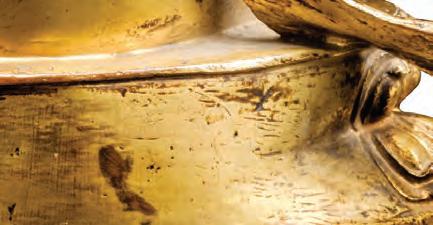
The double lotus base has beads encircling the w ist, a typical form of he Kangxi style base that is seen in the famous gilt-bronze figure of the bodhisattva Avalokiteshvara Shadakshari commissioned by the Kangxi Emperor in 1686 on the occasion of his grandmother’s birthday, from the Qing court collection, preserved in the Palace Museum, Beijing, illustrated in Hong Kong, 2003, p. 237, cat. no. 226
(圖f.2) 造像柔和的面容以及整體精湛的細節處理與 故宮博物院藏兩尊康熙阿彌陀佛銅像類似,參見 《 故宮博物院藏文物珍品全集》60:藏傳佛教造 像,香港,2008,頁238-9, 圖227-8。
同時,與2018年10月3日香港蘇富比拍出的康熙年 間阿彌陀佛造像, 拍品3626號,(圖f.1) 相比較可以 看出,兩尊造像面部細節高度相似,下頜線條圓 潤平滑,鼻樑高挺刻畫清晰,整體比例精準,都 自然流露出靜謐雅緻的內在氣韻。兩尊造像身材 比列都體現出挺括的胸膛和柔軟的腰身。細看蘇 富比阿彌陀佛披於兩肩的髮束及頂戴的珠鏈頭 飾,也與此尊心性安息觀音造像如出一轍。
此尊造像另一吸睛之處即為此三層珠鏈蓮花座造 型。此蓮花座以珠鏈束腰的罕見造型也見於著名 的故宮博物館珍藏的康熙四臂觀音銅像。參見 《 hi e o i e he om le e ollec io o re re o he l ce e m》,香港,2003 年,頁237,圖226。

Vajrapani 金剛手菩薩
Circa 17th century 世紀 Tibet 西藏
Gilt Bronze with Polychrome 彩繪銅鎏金
6 1/2 in. (16.5 cm )
HAR no. 8040 喜馬拉雅藝術資源網80 0號
ro e ce 來源:
rom ri e or h meric ollec io 北美私人珍藏
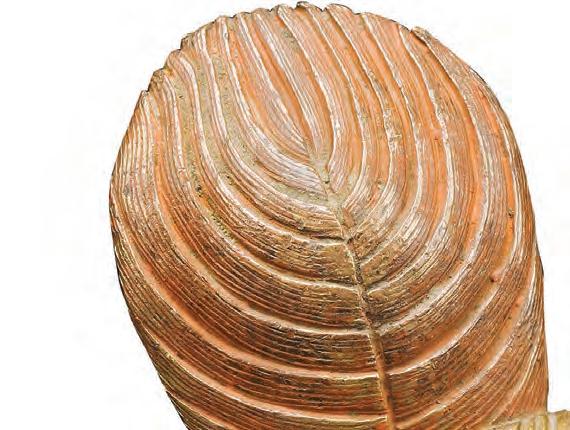
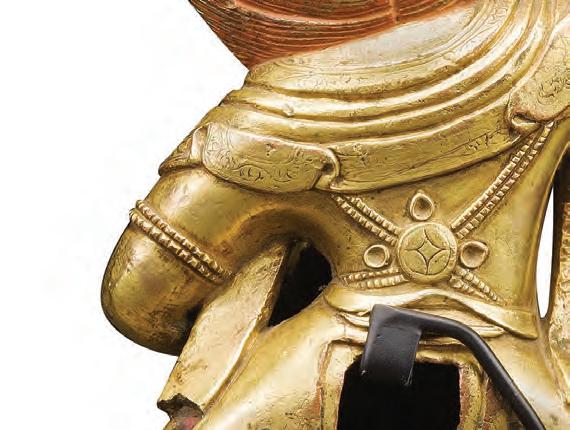
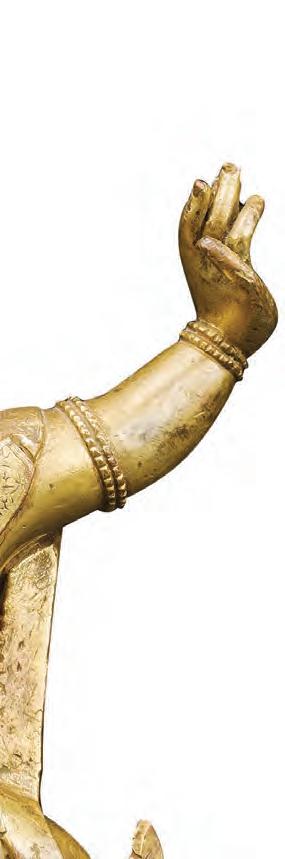
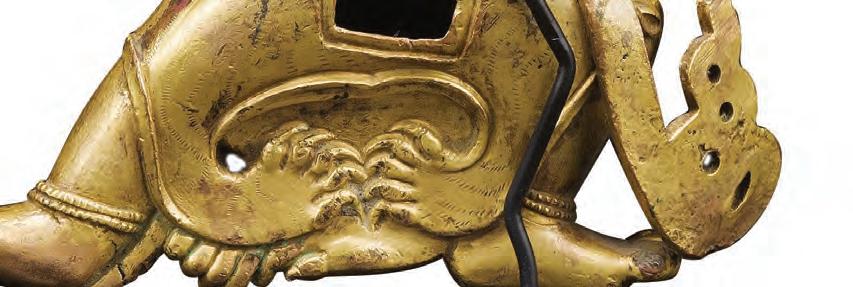
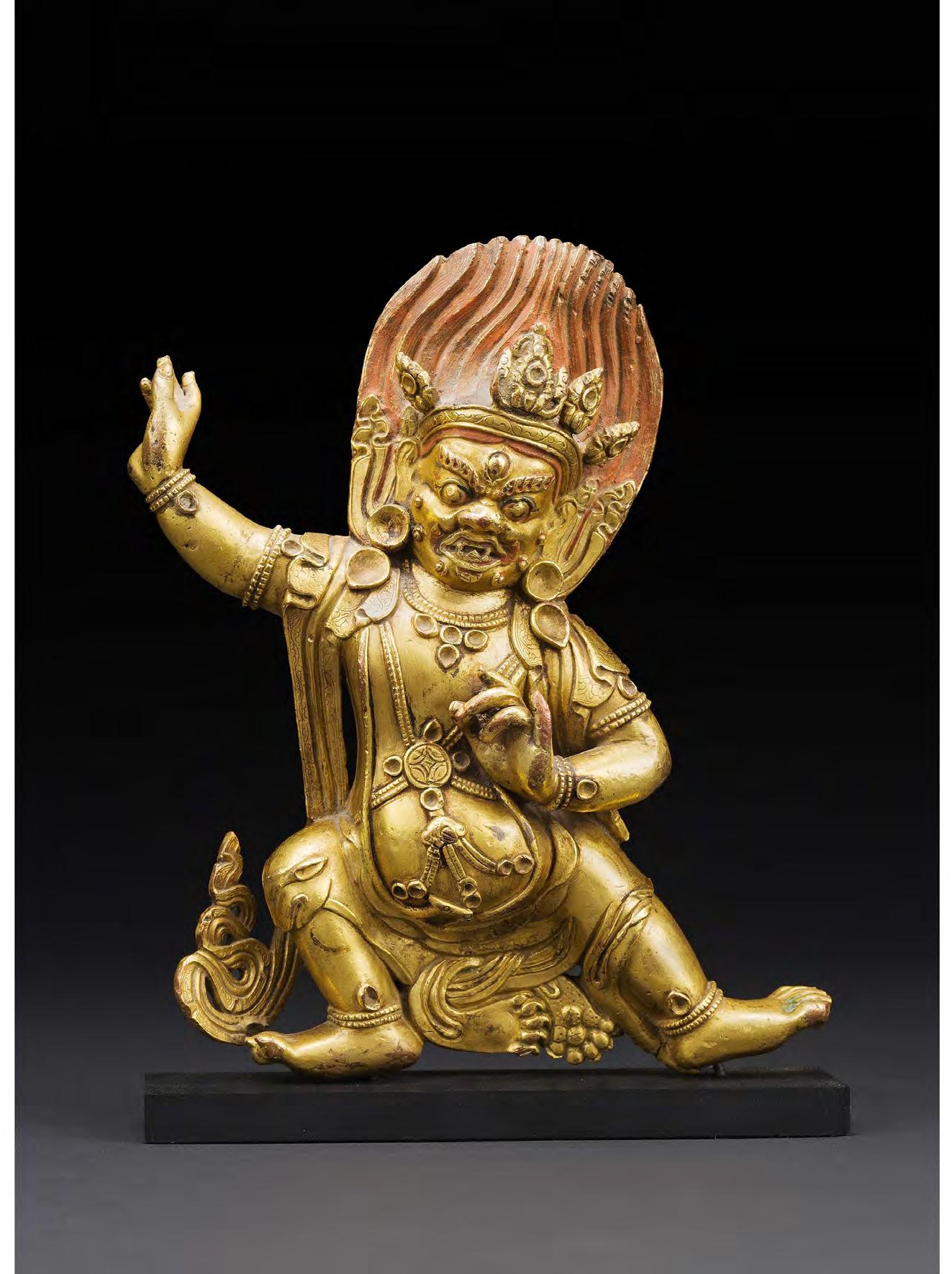
Vajrapani, the bearer of the thunderbolt, in wrathful form represented in a powerful cast stands in alidasana, the warrior pose, wearing a dhoti incised with tigerskin stripes anked by a windswept sash and jewelry adorned around his bountiful midsection, centered with beaded festoons. A thick snake is wrapped around the neck, e wild mane of hair is surmounting Vajrapani’s iconographic third eye. Detailed casting throughout, the face bears a erce and detailed expression.
金剛手菩薩,字面意義為手持剛,是 大勢至菩薩的憤怒相化現。菩薩以勇 士站姿威立,腰間系虎皮裙,披帛自 兩肩垂下尾部飄揚于身後,腹部圓隆 飾有珠鏈式瓔珞,一條長蛇馴服地掛 于菩薩項上,表示菩薩具有降伏邪念 的威力。菩薩紅髮沖冠,三目怒睜, 整尊造像工藝精湛,氣韻十足。
Amitayus 無量壽佛
Circa 16th century 世紀 Tibet 西藏
Gilt Bronze 銅鎏金 9 in. (22. cm )
HAR item no. 8021 喜馬拉雅藝術資源網 號
Provenance 來源:
From a Private Polish collection 波蘭私人珍藏
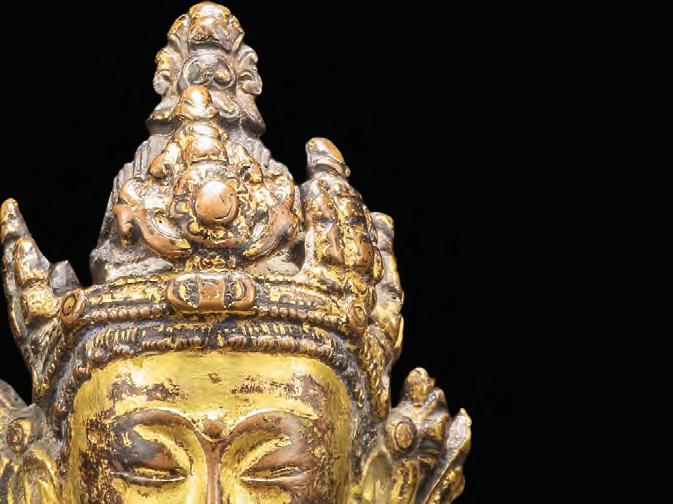
Seated on a double lotus base in dhyanasana garbed in a billowing dhoti flowing between his crossed ankles, Amitayus is heavily adorned with jewelry and chakras inset with turquoise hardstones. is face displays a serene e pression with a gentle smile, elongated and downcast eyes flanked by lotiform earrings, and sharply arched brows surmounted by a foliate tara tiara, the hair in a high chignon and freely cascading down his shoulders.
The surface of this impressive figure is entirely covered in a rich firegilding. Such portrayals of Amitayus are characteristic of imagery from Tibet. e is associated with the rites that ensure long life, especially worshipped by Tibetans, who believe that life can be e tended through long lineages, faith and compassion. It is also believed that one can achieve self-enlightenment and cater to the welfare of other with the help of Amitayus meditation.

此尊無量壽佛結跏趺端坐於覆仰 蓮台上,雙手結禪定印托盛滿甘 露的長生不老寶瓶。頭戴環狀花 冠,髮髻高隆,面容豐潤莊嚴, 眉眼細長,高鼻小口,唇間含 笑。繒帶上揚飄於耳際,長耳垂 肩飾有花型耳鐺。頸部三無礙紋 明顯,象徵佛陀法音傳播千里, 說法無礙。上身挺拔,胸膛寬 厚,腰部細斂,披帛由珠鍊系於 胸前,尾部繞臂而下垂於雙腿 上。下身著長裙,兩腿間的裙褶 自然流暢鋪於座面之上,刻劃生 動,具有明顯漢 藏風格。
蓮座造型規範考究,上下緣各飾 連珠,正面飾雙層蓮瓣,蓮瓣飽 滿有力,頭部飾立體感頗強的捲 草紋。此尊金水純厚飽滿,長期 接受膜拜,局部金色自然磨蝕, 愈顯歲月滄桑。



Buddha Shakyamuni 釋迦牟尼佛 世紀
Tibet 西藏
Bronze 銅鎏金
7 2/3 in. (19.5 cm.)
8 2 喜馬拉雅藝術資源網 8 2 號
ro e ce 來源:
ri e i collec io 瑞士私人收藏
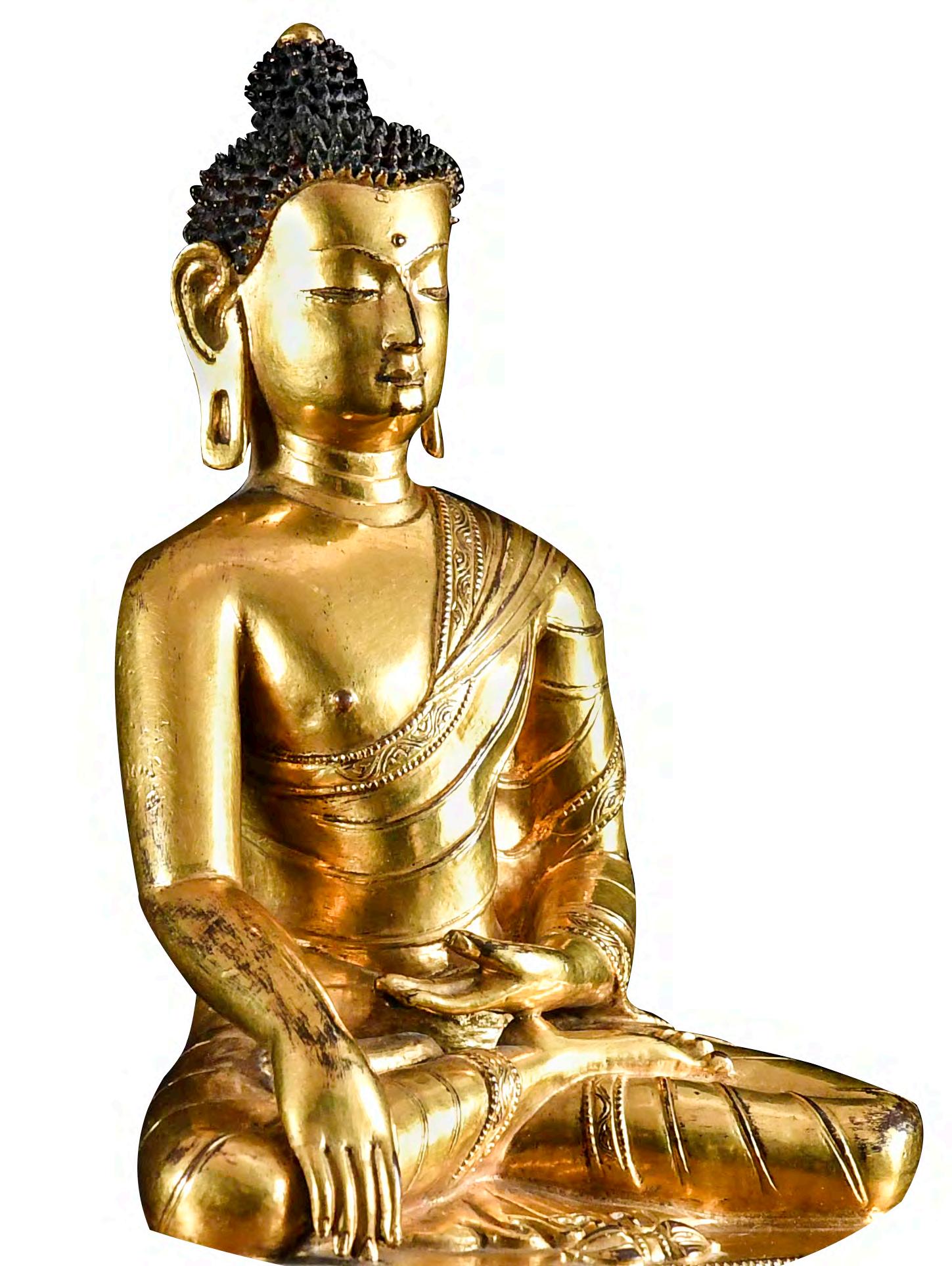
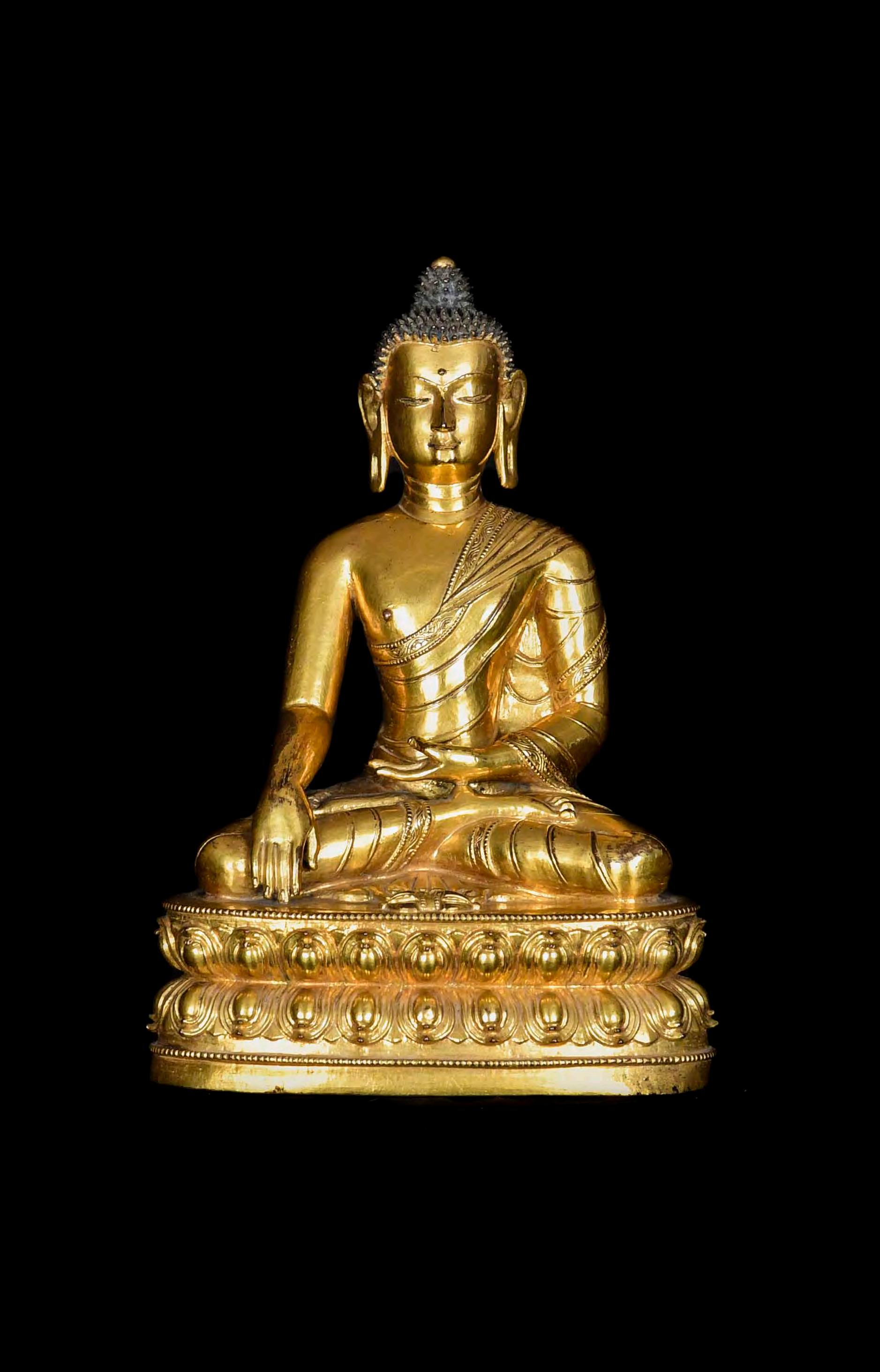
This elegant figure of he Buddha Shakyamuni is cast in the traditional posture of meditation. Seated in dhyanasana on a beaded double-lotus throne, his left hand is in dhyana mudra, while right hand displays he earth-touching mudra, bhumisparsa mudra, calling witness o he e r h to his enlightenment. The vajra placed on the throne identifies the seat as vajrasana, the sacred location under the hodi tree where Shakyamuni attained enlightenment.
He wears a close-fitting sanghati i ci e with beaded hem decorated with i ric e patterns, his robe drape naturally in linear folds around his lithe body. His expression is particularly serene, each detail of his face rendered with precision and care.
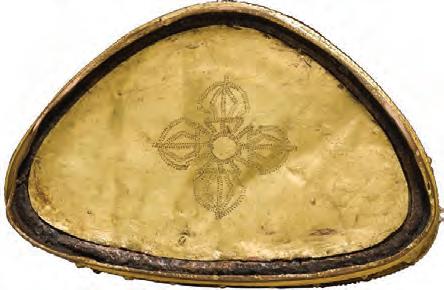
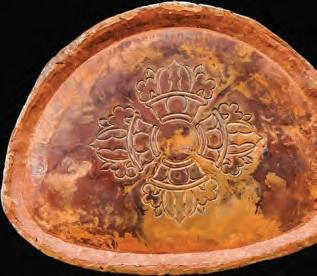
A copper plate marked with a double vajra on the e is evidence of this sculpture’s formal consecration i h he original seal.
此尊释迦牟尼成道像結跏趺坐於雙層蓮台上,左手結 禪定印,右手結觸地印,呈現了釋迦牟尼降除魔道, 向世間昭示其證得開悟的一瞬間。佛陀於印度菩提伽 耶一顆菩提樹下的金剛座上成道,而此尊造像座前橫 放的金剛杵正表明了其下蓮花座即為佛陀成道金剛 座。
尊像軀體飽滿健碩,身著貼體僧袍,其上身及雙腿間 平行弧線顯示出衣褶紋路,衣緣簪刻吉祥紋并以珠鏈 鎖邊,整體素雅大氣又不失尊貴華美之氣。佛陀法相 莊嚴,面容靜謐。其雙目低垂,鼻樑高挺,眉間白 毫,嘴角微含笑。額際高廣,上有螺髮,粒粒分明, 再上有高髻,起寶珠頂嚴。
蓮座底部有原裝十字金剛杵封底裝藏,十分殊勝。
Vajradhara 金剛大持
Circa 1400, 世紀
Tibet 西藏
Gilt Bronze 銅鎏金
9 in. (24 cm )
Provenance 來源:
Private uropean collection
Acquired in the 1950 s
歐洲私人珍藏
收購於1950年間

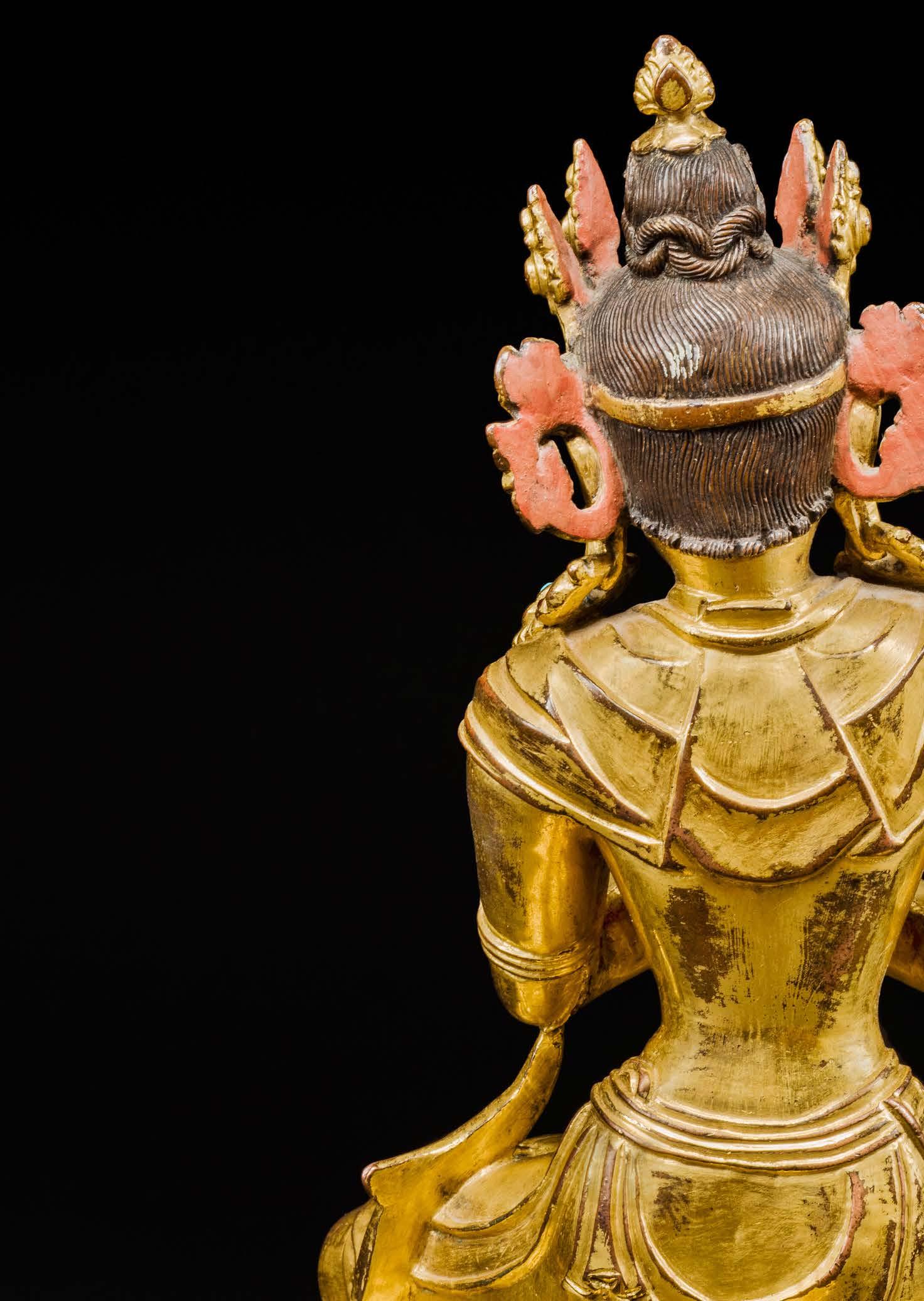
Seated in padmasana on a double-lotus base with his arms in vajrahumkara mudra (highest energy) holding the vajra and ghanta, clad in a dhoti and a shawl draped over his shoulders with jointed hems extending from his elbows and freely flowing symmetrically downward, ajradhara is adorned with a belt and necklaces of bead and pendant swags, anklets, bracelets, and leaf earrings is steadfast expression is serene with an urna of inset turquoise atop his head, his hair pulled into a high chignon secured with a five-leaf tiara and surmounted by a half vajra, accompanied by a sealed base that is consecrated with a double vajra.
此尊金剛大持結跏趺坐於蓮花寶座上,雙手結金剛吽迦 羅印交叉於胸前,左右手分別持金剛杵和金剛鈴,象徵 智慧與慈悲的合一,代表佛教最重要的核心理義。
此尊頭戴五葉花冠,髮髻高束,髻頂安寶珠,耳際寶繒 呈ü型向外翻捲,長耳及肩,下垂與花冠呼應花飾耳 鐺;額部高廣,眉眼慈善,笑容和美。全像體態優美舒 展,肌肉勁健有力,細腰軟腹,充分體現金剛大持悲智 雙圓的宗教特質。上身雙肩披帔帛,末端繞臂而下於肘 部對稱向外飄揚,極富動感,下身著僧裙,腰間束寶 帶。周身裝飾華美,嵌滿寶石,立體感強,體現了鮮明 的漢藏風格。
此尊造像體量較大,封底裝藏,底部中央鏨刻十字金剛 杵,實屬殊勝難得。


Vajradhara金剛大持
Circa 15th century 世紀
Ne a in Tibet 尼藏風格
Gilt Bronze with semi-precious stone 銅鎏金嵌松石
5 1/8 in. (13 cm )
80 9 喜馬拉雅藝術資源網80 9號
ro e ce 來源:
ri e E ro e ollec io 歐洲私人收藏
The figure is shown seated in dhyanasana on a double-lotus base, with his hands crossed before his chest hol i g r gh m oli i g he l im e i o i om com io e i cl i ho i or e i h e elr i h ir i lle i o high chi go o e i h h l r i ec re i e oli e cro i o orme e rri g l k e ch i e re e o h ir c c e o he ho l er he ro e i re omi l e re i i c i e e elr e i g i h r oi e i l he m ll i l re ell or io e i h re r i le i g he e e o er he o i ho i r c i g rom i ll ri g le e il er i l i r echoe i h he r oi e e i g rei orce he le or e e ole e e ce o r h r
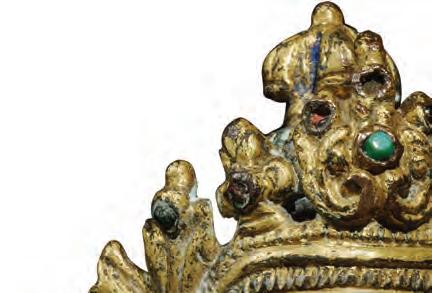
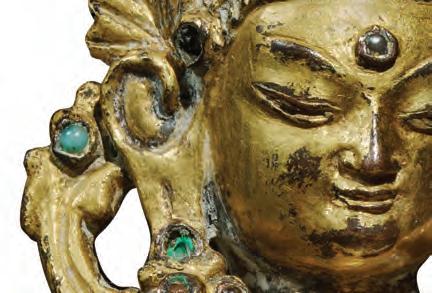
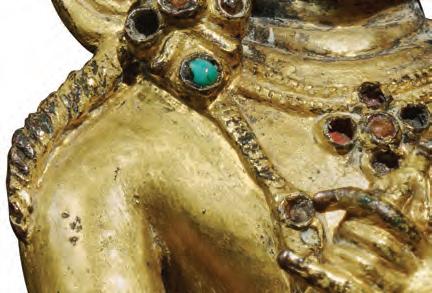
im l r chol r e W ri e hi ork o o m l e e o he imil r re me o e il ho he loki e h r h r h oke h r ig e o m l e (lo 3033 ol o h m e ork rch 19 2018) o m l e ork h lo g ee l e he i cle o i e gil e c l re re re i m e m he e i cl e r h ir i he ie erg e m rich h m i he l ce e m ei i g ( hlig he h o E ligh e me rich 199 168-71 o 114 om le e ollec io o he re re o he l ce e m 60 o g Ko g 1998 192 o 183 re ec i el )
此尊金剛大持結跏趺坐於仰覆蓮花寶座上,雙手當胸 結金剛吽迦羅印,左手持金剛鈴,右手持金剛杵,象 徵菩薩悲智合一的最高境界。尊像頭戴五葉花冠,束 發高髻,頂飾半杵,繒帶呈u字飛揚於耳際,長耳垂 肩,下墜耳鐺。額際高廣,眉間白毫嵌銀,醒目突 出,雙眼俯視,嘴角含笑內收。上軀微傾,結跏趺 坐,寬肩闊胸,上身袒露,下著僧裙,輕薄貼體,裙 擺處陰刻花紋。周身佩戴繁複佩飾,工藝十分精細, 嵌滿松石和珊瑚,精美亮眼。造像整體生動柔美,細 節精彩,令人過目難忘。
以其精美程度,喜馬拉雅藝術資源網專家 e W 認為其為索南堅讚之作。其他索南堅贊作 品可參見紐約邦瀚斯2018年3 月19日以120萬美 金高價成交的十一面千手觀音像 (拍品3033)。




Maitreya 彌勒菩薩
Circa 14th 15th century 世紀 Tibet 西藏
Gilt Bronze 銅鎏金嵌寶石 8 1/2 in. (21.6 cm )
HAR no. 36297 喜馬拉雅藝術資源網 29 號
ro e ce ri e E ro e ollec io
This exquisite and finely cast sculpture depicts Maitreya, the odhisattva of loving kindness and the Buddha of the future. He is seated in dhyanasana atop a double lotus base with his hands in abhayamudra and varadamudra, gently clasping the stems of two lotus blossoms which rise up around his shoulders, his right flower supporting a kundika. He is adorned in finely beaded jewelry and a thin dhoti with intricately incised borders billowing around his legs. His top knot is secured by a five-foliate crown and topped by a stupa. His slightly tilted head and sensitively modeled facial features give him a gentle welcoming demeanor. The present sculpture displays the superior quality and elegance of ino -Tibetan sculpture.
此尊面相慈善法喜充滿的尊像為三 世佛之未來佛的彌勒菩薩。菩薩 以跏趺端坐於覆仰蓮花座上,左
手結禪定印,右手當胸結無畏印, 雙手各執一蓮莖,兩朵蓮花綻放於 肩旁,右側蓮花上承一淨瓶。菩薩頭 戴五葉寶冠,頂飾摩尼寶,大圓環耳 鐺垂肩,下飾飄帶飛揚於耳際,具有
典型14 1 世紀西藏中部藝術特色。
菩薩上身袒露,肩披縷拽繞臂而下, 尾部對稱散開於身後,周身項鍊, 瓔珞,臂釧等裝飾遮蔽住上身大部分, 設計極為富麗華美,生動立體並有寶石 鑲嵌,漢風濃郁,格外醒目。下身著貼 體天衣,鏨刻精美祥雲紋,簡潔大方又 極具裝飾性。整尊造像做工精巧, 氣韻十足,體現典型漢藏風格。

Vajrasattva 金剛薩埵 Circa th century 世紀 Tibet, Pala style 西藏,帕拉風格 Bronze 銅 3 1/2 in. (9 cm.)
item no 喜馬拉雅藝術資源網 號
Provenance 來源: Cees van der Plog, 1995

Vajrasattva is frequently invoked in Vajrayana Buddhism for purification rituals, and is also treated as a yidam in Nyingma school. He is worshiped as the great purifier who helps practitioners to clear negative karmas and obstacles that obscure their Buddha nature.
This sweet figure of Vajrasattva shows him seated in vajraparyankasana, holding a vajra before his chest and a ghanta at his waist. Stylistically, this bronze echoes the high aesthetic accomplishments of the late Pala style, seen in the crown, necklace, armlets and anklets that are inspired by foliate imagery, fan-shaped crown ribbons, and a sweet face that is distinctly Tibetan. Compare with a brass figure of Manjushri sold at Bonhams, New York, 20 March 2018, lot 3210, and a Buddha in a private collection in von Schroeder, Indo i etan ron es, Hong Kong, 1981, p.423, no.109C.
金剛薩埵,為佛教大乘與金剛乘的菩薩,也是寧瑪派的重要 主尊之一。修習金剛薩埵法門,可快速消除一切眾生煩惱業 障,自見清淨佛性。
此尊金剛薩埵造像面容甜美,以金剛跏趺端坐於俯仰蓮台上, 雙手分別持金剛鈴、杵。細看造像中花型寶冠、項圈、 釧鐲,與寶冠兩側扇形帶飾,風格上明顯繼承了晚期 帕拉風格的高超審美造詣,然而造像甜美的面容 則又具有藏地特色。類似造像可比較 018年3月 0日紐約邦瀚斯售出的一尊西藏帕拉風格文殊 菩薩造像 (拍號 10),以及《印度西藏 銅像》中收錄的一尊佛造像 (馮· 施羅德,《印度西藏銅像》,香 港,1981年, 4 頁,圖109C)。
Prajnaparamita 般若佛母 世紀
Tibet 西藏
Gilt Bronze 銅鎏金 8 1/4 in. (21 cm )
HAR no. 8034 喜馬拉雅藝術資源網80 號
ro e ce 來源: ri e E ro e collec io 歐洲私人珍藏
Prajnaparamita means “ he Perfection of (Transcendent) Wisdom” in Mahayana Buddhism. Prajnaparamita refers to this perfected way of seeing the nature of reality, as well as to a particular body of sutras and to the personification of the concept in the Bodhisattva known as the “Great Mother.” The word Prajnaparamita combines the Sanskrit words prajna [wisdom] with paramita [perfection].
Seated in dhyanasana on a double lotus base, her principal hands in dharmachakramudra, and her upper hands in vitarkamudra, the left holding a manuscript and the right holding a beaded mala, earing an ankle-length dhoti secured at the waist with a beaded belt, adorned with various jewelry and a billowing scarf around her shouIders, her face with a serene expression and downcast eyes centered by a raised urna, topped by an elaborate five-leaf crown.
在梵語中般若菠蘿蜜多意為可如實認知一切事 物和萬物本源的完滿智慧,而“般若菠蘿蜜多 經”亦為大乘佛教的基礎。般若佛母是“ 般 若波羅蜜多經”的擬人化,象徵至高的空性智 慧。
此尊般若佛母中間二手當胸結說法印,上二手 各執般若經捲和念珠,跏趺端坐於仰覆蓮花寶 座上。菩薩頭戴五葉寶冠,耳朵繒帶呈字, 耳飾大圓環耳鐺,周身佩戴項鍊,瓔珞,釧 鐲等。上身袒露,縷拽繞肩飄揚於身後,氣 韻高貴莊嚴,下著僧裙,以珠鍊 式腰帶束於腰間,裙擺寬大自 然,為造像增添柔美之氣的同 時極具寫實意味。般若佛 母面容圓潤飽滿,神情空靈 慈悲,巧妙完美地體現了 般若經的核心教義。

Padmapani 蓮花手菩薩 8th Century 8世紀 Swat Valley 斯瓦特 Bronze 銅 8 1/2 in. (20.8 cm.)
HAR no. 24324 喜馬拉雅藝術資源網2 2 號
ro e ce 來源:
o he o o 9 1977 lo 36
o o r rke c ire he re e o er rom he o e 1992
倫敦蘇富比,1977年 月9日,拍品36
前藏家1992年年購於倫敦藝術市場
E hi i e 展覽:
ilg me h ro g r l E hi i io e o o ller iho hi o em er 29 h - ecem er 1 1979 48
日本 e o o畫廊,吉爾伽美甚加冕群像展,1979年11月29-日 12月1 日。圖錄48
li he 著錄:
ilg me h ro g r l E hi i io e o o ller iho hi 1979 c 48 o chroe er o g Ko g 1981 90- 91 ig 9
日本 e o o畫廊,吉爾伽美甚加冕群像展,1979年11月29-日 12月1日。圖錄48 烏爾里希·· 馮 · 施羅德著《印度西藏銅像 》,香港,1981年,90-91頁,圖9H
Like the lotus, whose pristine blossom rises out of the mud, Padmapani has transcended the pain and impurities of the material world, reaching enlightenment in body, speech, and mind. The odhisattva forgoes entering nirvana until he has released all sentient beings from the cycle of death and rebirth. This rare eighth-century bronze figure of Padmapani, an emanation of Avalokiteshvara, displays the convergence of post-Gandharan and early Gupta aesthetic ideals that took place in the Kashmiri/Swat Valley region during the sixth to the eighth centuries. The Swat Valley is located along the upper stream of the Indus River in what was the ancient region of Gandhara. Serving as a link between India and Central Asia, the valley witnessed a constant flow of Buddhist pilgrims, becoming an important melting pot of cultures and an epicenter of Buddhist art production.
The present figure displays a muscular body and a dhoti with long looping pleats - typical traits of the Hellenistic features of Gandhara - while the flesh contours, clipped waist and large almond-shaped eyes suggest influences from the Gupta sculptural school. Compare the trifoliate crown, beaded necklace, facial features and corporal modeling with a Swat Valley bronze figure of Shakyamuni in the Metropolitan Museum of Art (1985.77). The present example is testament to a unique historical moment from which only a small number of bronzes survive. Cover and illustration, U. Von Schroeder, , Hong Kong, 1981, p.91, fig. 9H.
如同蓮花出淤泥不染一般,蓮花手菩薩超越了物質世間種種,身語意皆圓滿清淨。菩薩不入涅槃,誓願渡一 切眾生解脫輪迴之苦。此尊造於8世紀左右的蓮花手菩薩銅像,代表了六世紀至八世紀間,喀什米爾和斯瓦特 谷特有的後犍陀羅至早期笈多王朝過渡期間的藝術審美風格。斯瓦特谷地處印度河上游的古犍陀羅國一帶, 連接印度與中亞地區。其特殊的地理位置使其成為一個文化交融點,見證了無數東西方弘法高僧往來互通, 並逐漸成為一個佛教和佛教藝術的聖地。
此尊造像上身肌肉挺拔勁健,下身著僧裙,衣料厚重,衣褶明顯,具有典型犍陀羅藝術中的希臘古典風格, 同時造像中突出的身體線條,緊實纖細的腰肢和突出的杏眼則顯示出笈多風格的影響。
此尊中頭戴三葉寶冠,項戴珠鍊的造型和面部五官可對比參照一尊大都會博物館藏斯瓦特釋迦牟尼銅造像 (198 77)。斯瓦特佛像存世數量稀少,此尊造像以其鮮明的時代特點和古樸沉靜的氣韻無疑是其中難得的 精品,因此也被收錄於馮·施羅德先生著《印度西藏銅像》中(香港,1981年,頁91,圖9 )。

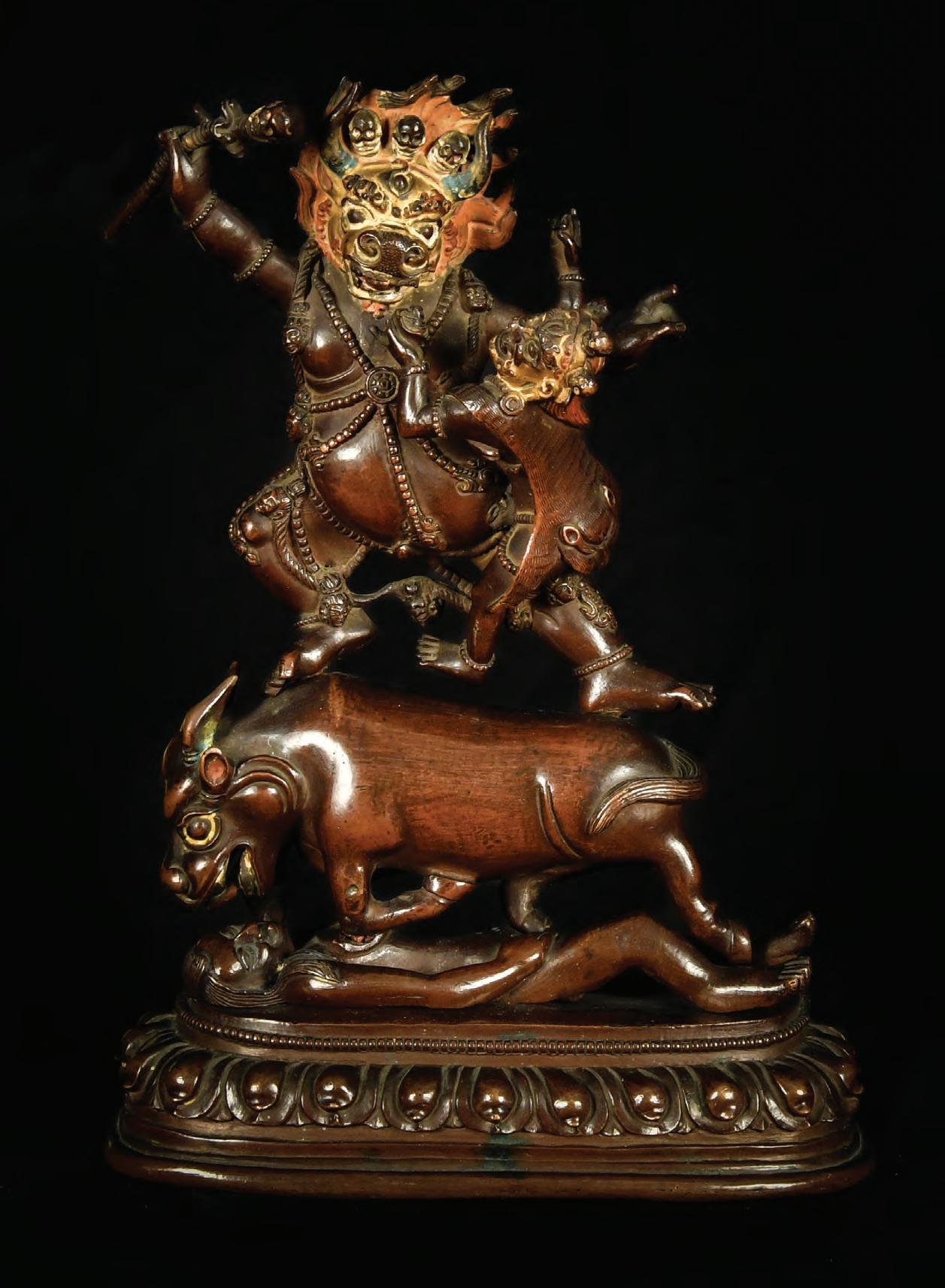
Yama Dharmaraja 地獄主
Circa 18th century, 18世紀
Sino-Tibet 漢藏風格
Bronze 銅
10 in. (25.4 cm.)
HAR item no. 8209 喜馬拉雅藝術資源網8209號
Provenance: 來源:
From the collection of the Swedish artist and designer, Wilhelm Kåge (1889-1960)
From the Collection of the Krook Family
瑞典藝術家Wilhelm Kåge (1889-1960)舊藏
Krook 家族舊藏
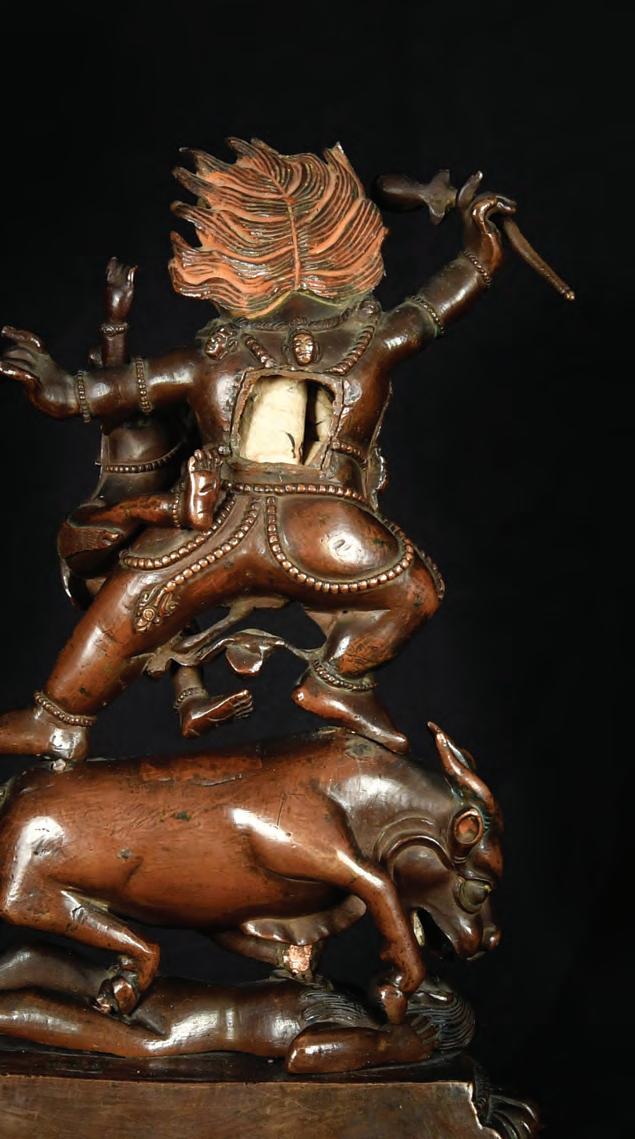
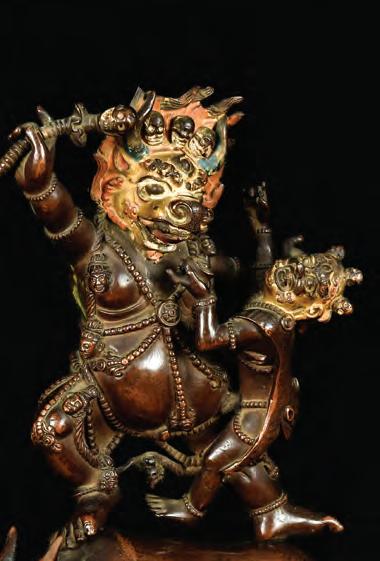
Striding in alidhasana on a buffalo over a prone human figure on a lotus base with his hands extended out to his sides, adorned with beaded jewelry, a garland of severed heads, the face ferocious with the mouth open and tongue extended, the flaming hair topped by a skull tiara, Yami sits astride his leg, offering Yama a skullcup in
her left hand, wearing an animal skin on her back, her face with wrathful expression, a consecration chamber open on the verso of the primary figure, with traces of polychromy on the heads of both figures and the buffalo.
Based on Pala period style bronze work, the deity on the present figure can be compared with an eighteenth century figure of Ekavira Bhairavajra, which displays similar modeling particularly of the head and jewelry (U. von Schroeder, Indo-Tibetan Bronzes, 1981, p.p.472-473, fig.130c). Compare the bull mount with a similarly rendered sow, see U. von Schroeder, uibid, p.p.488-489, fig. 138E.
此尊地獄主以勇士之姿威立于 一頭雄壯水牛之上,水牛下踏 一仰臥異教徒,下乘覆蓮座。
地獄主右手高舉骷髏棒,左手 舒展結期克印,身披珠鏈及骷 髏鬘,水牛頭上面相恐怖,齜 牙外露,紅髮高束如火焰一 般,頭戴骷髏冠。地獄主的明 妃于其左腿上,左手持盛滿人 血人頭骨碗獻給地獄主,赤身 裸體,後背披一張鹿皮。明妃 抬頭仰視地獄主,表示她的順 從恭敬。地獄主背部開口,可 見其內部裝藏有經卷。主尊和 水牛細節部有彩繪。
此尊以帕拉風格為基礎的造像 可對比參照一尊18世紀大威德 金剛像(施羅德,印度西藏銅 像,1981,頁472-473,圖 130c)。牛頭造型可對比一尊 類似造像 (同上,頁 488-489,圖138E)。
Dakini Vajravarahi 金剛亥母
Circa 12th century 2 世紀 Tibet, Pala Style 西藏,帕拉風格
Bronze alloy with semi-precious stone inlay and cold gold 銅嵌寶石 9 1/2 in. (24 cm.)
HAR item no. 8041 喜馬拉雅藝術資源網80 號
ro e ce 來源: ri e i collec io Koller rich 1986
o he e ork rch 19 h 2008 lo 301 瑞士私人收藏
蘇黎世Koller拍賣行,1986年
紐約蘇富比,2008年3月19日,拍品號301
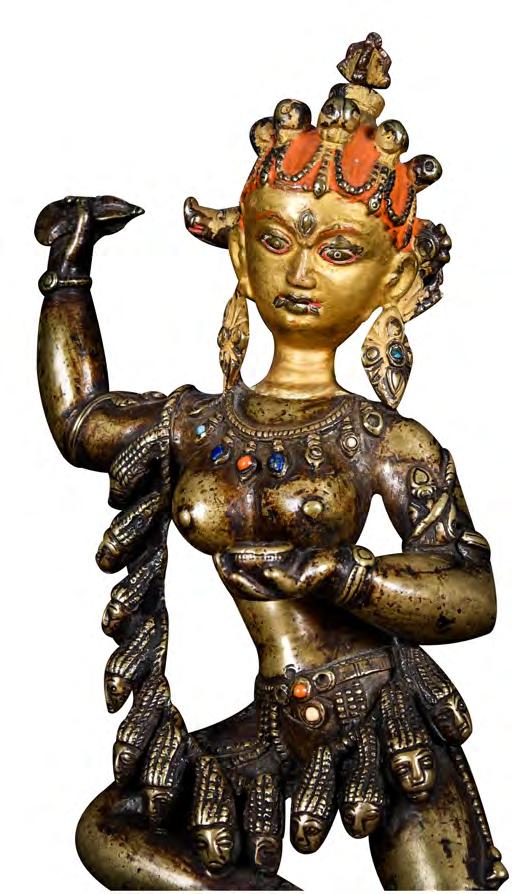
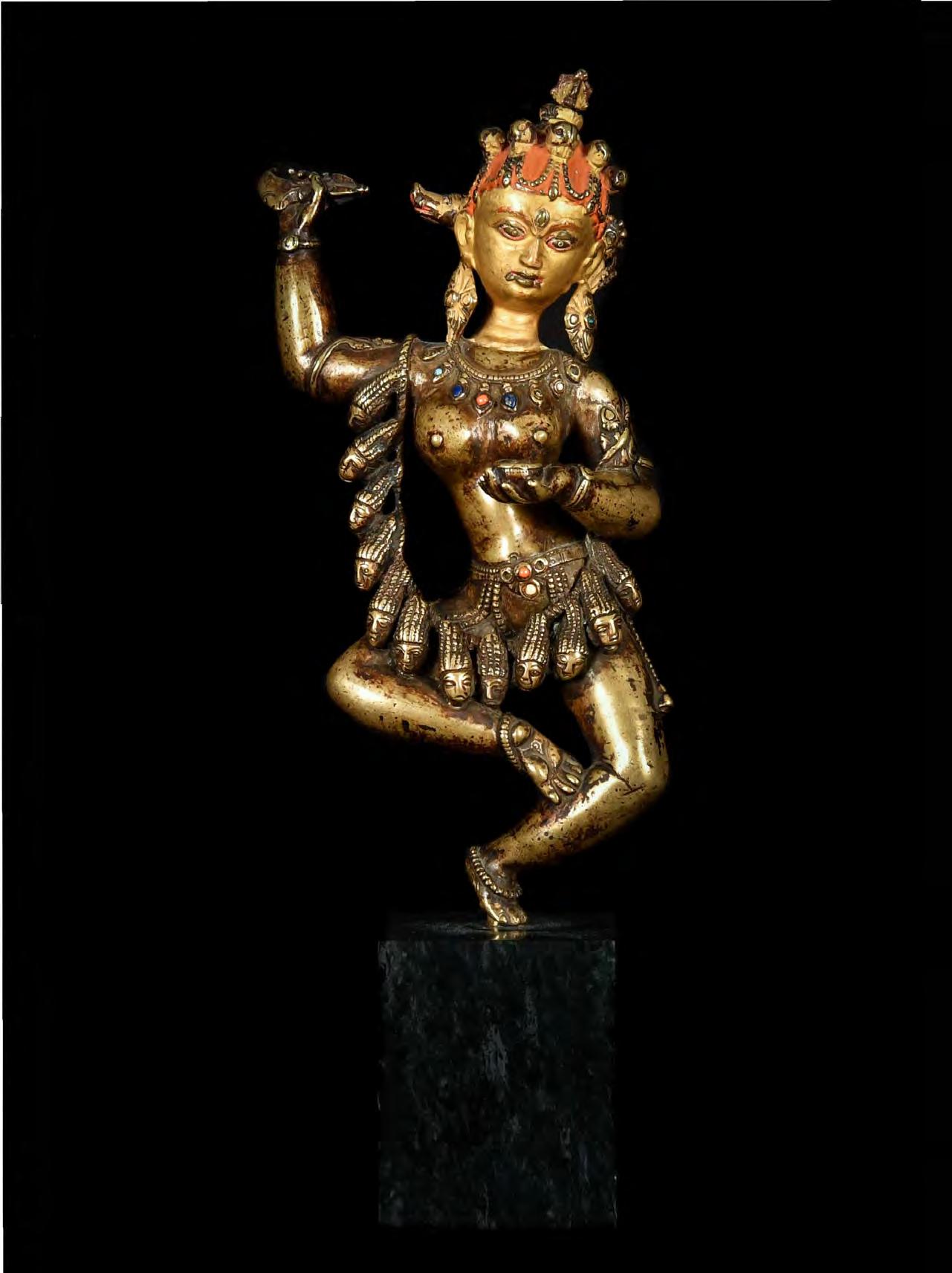
Blending elegance and power, the robust goddess centers her weight effortlessly on flexed toes, achieving an accomplished pose. The sow’s head identifies her as the consort of the great transformative deity Samvara. Holding the kartrika up in her right hand and a kapala in her left, a skull tiara, necklace of pendant jewels and a heavy garland of severed heads hung on twisted rope, a savage expression fixed on the painted face, hair painted orange and a sow’s head emerging, the figure i cast in a lustrous alloy with fine patina. This powerful image of Vajravarahi embodies the intensity of eastern Indian tantrism that was the spiritual inspiration for many Tibetans from the eleventh century onwards. The dakini instructs her initiates with a commanding scowl sharp fangs emerging from the corners of her mouth. Vajravarahi embodies both passion and compassion, and represents the essence of Wisdom, the female prajna.
chilli g icho om er e he c l re i h re hl e ere h m he h gi g rom he ho l er hile recio e el h g rom her le er eck he ol o em le orm o i h he gel re g eel g e
he c l re c i lime llo i i e i h colo r l emi- recio o e i ire he ro e o l i o he ele e h el h ce rie rom here he c l o he ei her el origi e he i l o he o l go e i i e o reincarnate on earth, serving as the abbot o m i g mo er e r h
om re he o re e il ch he e ere he h g o i e ro e i h el h ce r i ro e r k ee lrich o chroe er o g Ko g 2001 29 ig 98E- or gem- e l erio co er llo c l re c erie o ele e h or el h ce r h g ee i i 2 0-2 9 l 78-82
此尊左腳點地、右腳彎提如舞 蹈姿,右側頭部長出野豬頭的 空行母,為金剛亥母,是佛教 金刚乘本尊之一,胜乐金刚与 大悲红观音之明妃。
其形像一面二臂三 眼,頭戴五 髏冠,身材如美少女,飽滿勻 稱, 面相微忿含笑,眼睛圓 睜,開嘴露牙。右手高舉鉞刀, 左手持捧顱缽, 身戴瓔珞及骷 髏幔。金剛亥母主尊光澤 柔 潤,面部鎏金,金水鋥亮,頭髮 漆鮮亮橘色,項鏈及腰帶均鑲有 寶石,整體造型極為美麗,十分 別緻。

Avalokiteshvara 觀音
Circa 18th century, Qing Dynasty 8世紀,清代
China 中原
Bronze 銅 6 in. (17 cm.)
HAR no. 8022 喜馬拉雅藝術資源網8022號
ro e ce 來源: rom ri e meric ollec io 美國私人珍藏
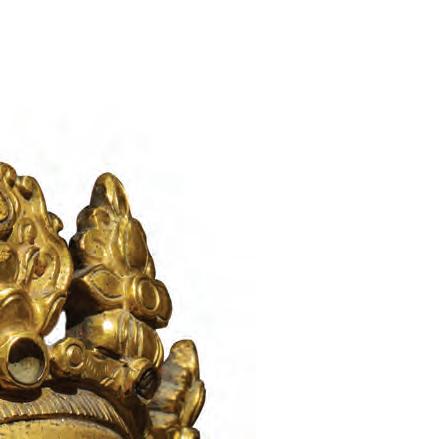
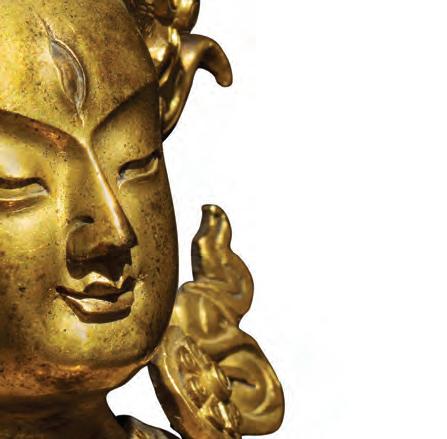
Cast seated in dhyanasana on a double lotus base, the right hand lowered in varadamudra, the le hand raised to chest, wearing an elaborate beaded necklace, the ei ce i e i h downcast eyes and meditative expression framed by a high five-point crown.
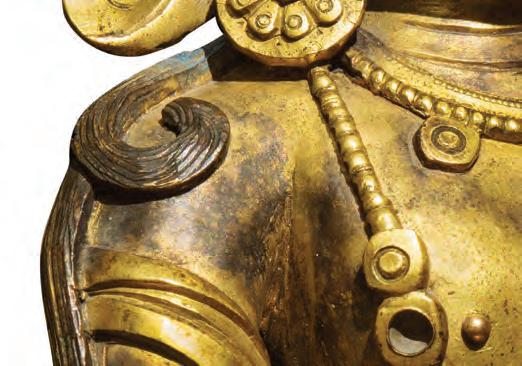
Avalokiteshvara has long been regarded as the patron deity of Tibet, and has been revered in China from the late Ming dynasty through the Qing. Qing court patronage of Buddhism commenced under the Kangxi Emperor and reached epic proportions under his
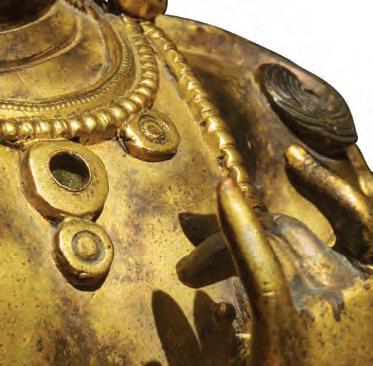

grandson, the Qianlong Emperor. e Buddhist centers of Beijing, Rehol, and Dolonnor produced a vast number of images to keep up with the demand of temples both inside and outside of the capital. The present work exhibits many characteristics common to such i h the languid and slightly effeminate treatment of the face and body, and the tightly waisted double-lotus base with broad petals. This sculpture has a pacifying beauty er e a very fine example amongst the great number of similar Buddhist bronzes proliferated during the Qianlong period.

Green Tara 綠度母
00 世紀
Khasa Malla 卡薩馬拉
Gilt Bronze 銅鎏金
7 in. (17.8 cm.)
HAR o. 8036 喜馬拉雅藝術資源網80 號
ro e ce 來源: ri e i ollec io c ire rom oel oo er he ci ic i ho e ork 瑞士私人收藏
購自 oel oo er
hi e o l mo ele ree r r re or i com i io o ire gil i g il er i l ech i e i e remel re i e ro e ri e o he lo Kh ll Ki g om o We er i e We er e l
Seated in lalitasana on a double-lotus base, her right hand extends in Varada mudra, and her left hand holds up near her heart i e chi g mudra Her hair is pulled into a high chignon, secured with five leaf crown, flanked by two large o rl tendrils cascade down the shoulders. Lotuses are blooming at her shoulders and e ig o mi h e r o o o her chig o he re i i g
h o he lo mil o hich he elo g er elo g e e rlo e re eighe o l rge hoo e rri g i h ri o o o he i re e i ighi i g ho i i ci e i h er i or e i h ro o rio or me i he orm o e i g ome
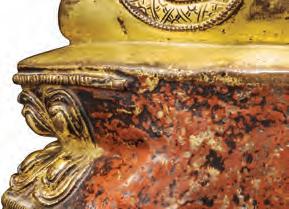
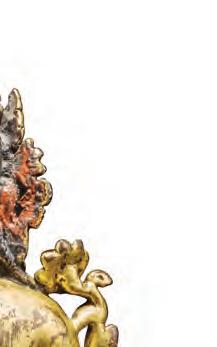
o hich re ecor e i h il er i l Kh ll le ollo r i io l e ri cr m hi
e he ic e ic e here i h he lo h irli e ro orehe he rec g l r r or i g he re ce he ili e o e
m c l r o ill he le i i g i he i el rom rer e le e ork E em l r o he Kh ll r i io he ck o he c l re e i l i i e
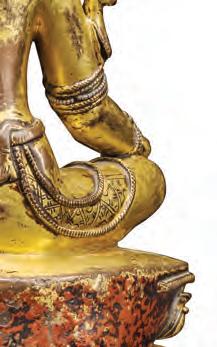
i h re igme he o le -lo
e r cro he ro i e he c el e i e k ckle o
her le ri g i ger righ h m ell he ri o - orm

e ele e rri g re ch i iom e i g he Kh ll le r i io he rice gr i er o her ho i re o e ee o Kh ll c l re (c e oo i ger i e r o r e i i io o le o o 1997 79 o 9) or ll i c io o Kh ll c l re ee l o i rie io o g Ko g e 1994 he romi e e o il er i l i he ro o e i g i e remel r re or hi erio o Kh ll ro e ell i e ro e hi ce ech i e o o l ho he cre i i o he cr m m er l e er i e more im or l i em o ie he highe le el o ir o i o he ro e c er gi e he r ri i ic l o he il er-i l ech i e om re i h he co er lo o m i oke h r ol o h m o g Ko g c o er 2 2018 lo 43 o h h re gre imil ri ie i e il ( ee 1) l o com re i ee h ce r mi li he i o chroe er o g Ko g 1981 3 7 l 94
此尊卡拉馬拉綠度母造像,周身以極為罕見的嵌銀珠鏈裝 飾,以其複雜的工藝堪稱卡薩馬拉造像中的上乘之作。尊 像左腿橫盤,右腿前伸踩蓮,雙手各持與愿印和說法印。
束髮高髻,戴五葉寶冠,繒帶結成扇形飾於耳上,髮辮股 股披於雙肩。雙耳垂肩,飾有大花環加飄帶式耳環。度母 嚴頂阿彌陀佛,肩兩側蓮花綻放,象征其從屬西方蓮花部. 下身天衣貼體,衣緣簪刻米粟紋樣,上身佩戴項鏈、釧鐲 等皆為多層珠鏈式設計,其間一層嵌純銀珠鏈,設計罕 見。
造像額際高廣,額發短齊,方形白毫,較方短臉型上鼻樑 高挺,肌肉飽滿。指節刻畫生動逼真,耳飾呈飄帶型。蓮 座具有典型卡薩馬拉特點,蓮瓣覆蓋正面及兩側,背面無 造型和鎏金且漆成紅色。另外,衣緣上的米粟紋樣也經常 出現在卡薩馬拉造像中(參見 e oo i ger i e r o r e i i io o le 倫敦, 1997年, 79頁, 圖 9)。造像中嵌銀多層珠鏈設計在卡薩馬拉造像,甚至同 時期所有西藏造像中都屬罕見。這種複雜的造型技術不僅 彰顯了匠師新穎大膽的創意和超高的手工藝,更為重要的 是,它飽含著匠師無比的虔誠與恭敬。造像細節可對比參 考香港邦瀚斯2018年10月2日 《誠虔映韻》專場封面塑像 (43號),同時也可對比馮·施羅德著《印度西藏銅 像》, 香港,1981年,3 7頁,圖94c。

Padmapani 蓮華手菩薩
Circa 12th century, Pala Period 世紀,帕拉
Northeast India 印度東北部
Bronze with silver and copper inlay 銅嵌銀和紅銅
3 7/8 in. (10 cm.)
HAR item no. 8032 喜馬拉雅藝術資源網 號
Provenance 來源:
From a private uropean collection 歐洲私人珍藏
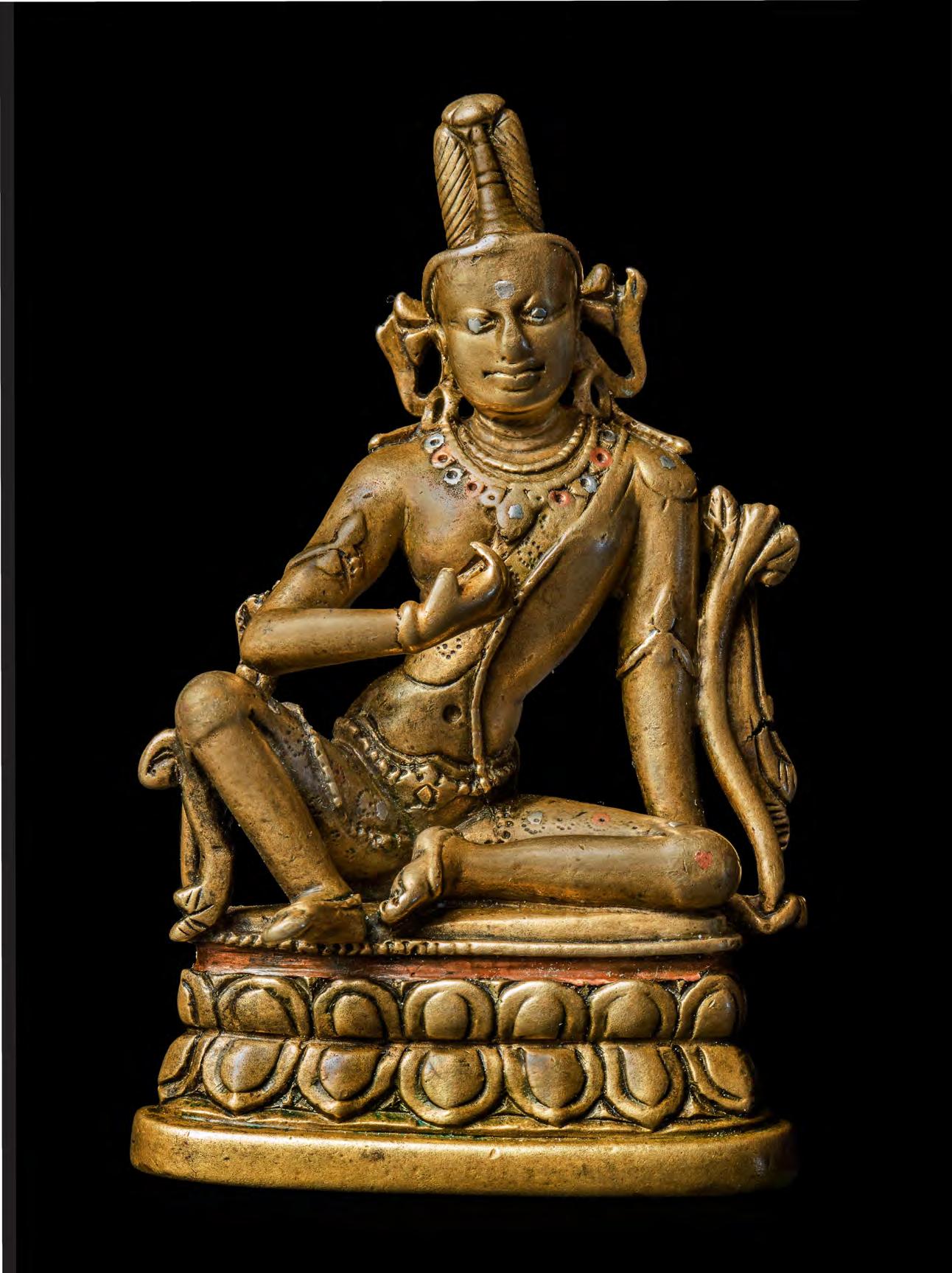
Seated in rajalilasana on a lotus base with his right arm elegantly resting on his raised right leg while the le holds a lotus stem, clad in a dhoti richly inlaid with silver and copper medallions, adorned with silver- and copper-inlaid jewelry and a sacred thread, his face with a benevolent expression with silver
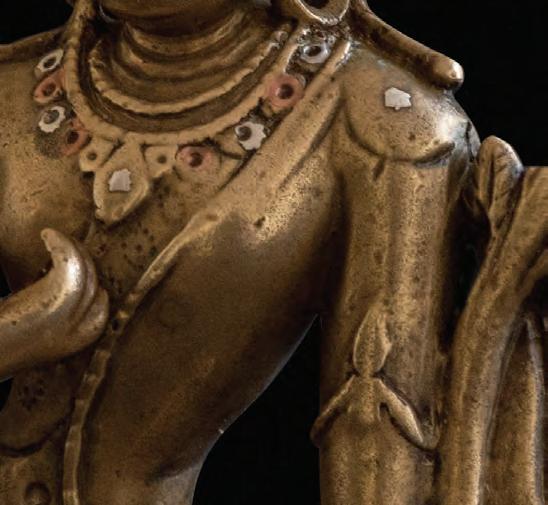
inlaid eyes and urna, his hair styled in a high chignon topped by a knot, centered with a stupa and secured by a tiara
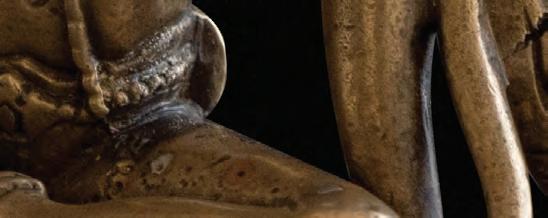
The Pala dynasty, which flourished from the 8th-12th century in northeastern India, was one of the last strongholds of Buddhism, as the country became increasingly Hindu by the 11th century. As Buddhism continued to flourish under the Pala rulers, there was a surge in travel among Buddhist practitioners and laypeople to sacred sites associated with Buddha Shakyamuni. With this came the expanded propagation of Buddhist texts and religious icons, which were easily transported by pilgrims. Bronze sculpture which were especially portable, played a crucial role in the propagation of Buddhist iconography throughout the region. As a result, Pala bronze work achieved an e ceptional level
softness rarely captured in metal. The abundance of shimmering silver and copper inlay suggest this sculpture was an object of particularly special veneration. Compare with another Pala period bronze image of Maitreya in the British Museum, London (U. von Schroeder, Indo i etan ron es 1981, p.282-283. cat no.69D).

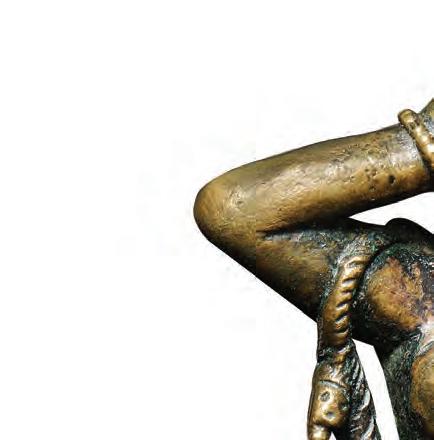
of sophistication and, to this day, is revered as one of the golden eras of the Indian sculptural tradition. This sublime figure of Padmapani the Bodhisattva of the fleshy toes, to the slightly bulging belly and e aggerated curve of the torso and shoulders, every detail is rendered with a compassion, is emblematic of the artistic mastery of Pala period bronze work. Rendered with jewel-like sensitivity, the god sits languidly atop a throne of lush lotus petals. The body is modeled with e ceptional naturalism and sensuality. From
此尊菩薩身姿曼妙婀娜,右膝彎 曲,左足半趺,右臂自然彎曲置 於膝上,左手握蓮花撐於左膝 後,自在坐於雙層蓮花寶座之 上。身著天衣,斜披絡腋,佩飾 瓔珞臂釧,耳鐺垂肩,胸前項鍊 醒目,以銀及紅銅間隔鑲嵌,菩 薩表情祥和靜謐,雙眼及白毫嵌 銀,髮髻高綰,頭戴王冠,頂飾 佛塔。蓮花手菩薩,梵語 Padmapani是最早的觀音形象, 印度地區的蓮花手菩薩,手持蓮 花是最重要的特徵,此尊蓮花手 菩薩呈現了明顯的帕拉風格,身 材曲線流暢圓潤,薄衣貼體,造 型自然優美,肢體細節細膩柔 美,堪稱帕拉銅像中的典範之 作。帕拉王朝,是8-1 世紀統治 印度東北部的一個重要王朝,也 是自11世紀印度教逐漸盛行後最 後一個信奉佛教的印度王室。在 王室鼎力弘揚佛法下,佛教信眾 中產生了遊歷朝聖與釋迦摩尼佛 有關聖地的熱潮,佛教典籍以及 塑像也隨朝聖者傳播至印度其他 地區,由於其便於攜帶,銅像在 帕拉王朝時期佛教的傳播過程中 起到至關重要的作用,因此在造 像藝術性方面也達到前所未有的 高度。

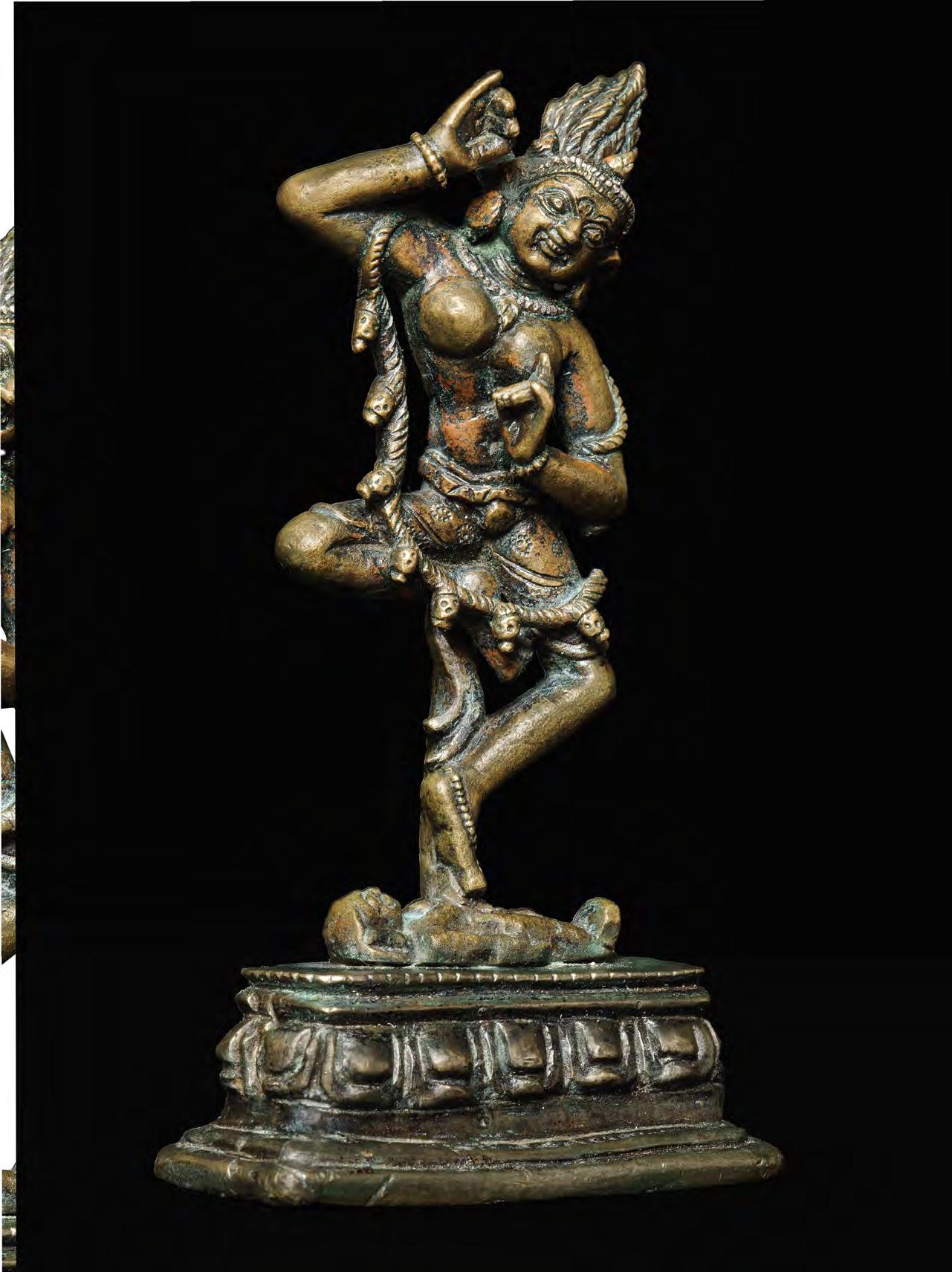
荼吉尼
2 2世紀 西藏帕拉風格
銅嵌銀
80 2 喜馬拉雅藝術資源網80 2號
ro e ce 來源: ri e E ro e ollec io 歐洲私人收藏
ki i hich r l e o klker i cele i l em le ho o e er r l i om o er he i l o c lle r ogi i ic ll e ic e i h erocio e r ce i c lle o i hi ri l r c ice o i i h iri l e elo me he go e gr ce oi e elie he e i o hi oli l c m er iece o l le ro c io i i e he go e i o reme im or ce i he i e hi heo i egr l e e ce o he h kr m r r he i e ecke i h gle ch r c eri ic o he e il le orme o cke e e ch i cl e e i g o emi- recio o e er he o rom ehi her i r gle m chi g he r i e ri l k i e i her righ h elo her or e lo ri e rom le em h e e rom gil e g hich o l h e i e her o o e o i e mo glorio mo me



hi iece highligh he l i mo eme o l le ro e c i g i i e i h eleg o re e ile me l i l


he e ce io l e i i i e il o he re e ki i elie







i m ll i e he i e com o i io ec o hi ork c e com re o imil r c l re o r r hi he e ro oli e m o r cce io o 1987 142 3 6
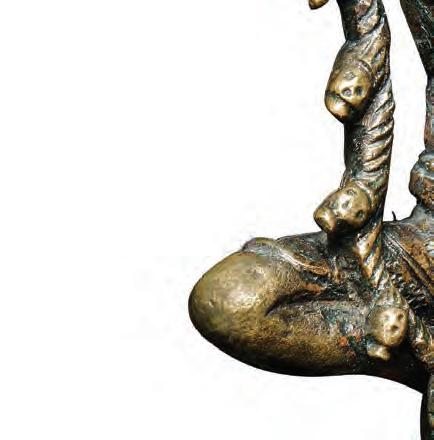
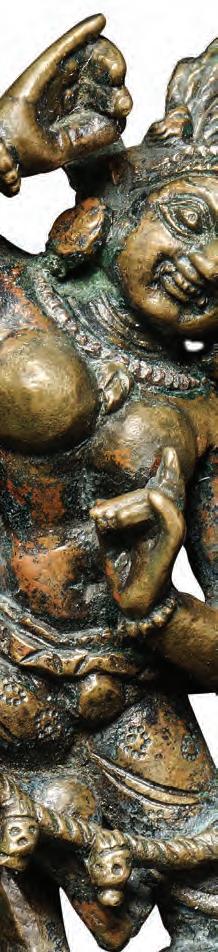
荼吉尼,意為空行母,是天 界或他方佛土的女性金剛乘 修行者,具有超凡的智慧和 能量。空行母通常以憤怒相 出現,在金剛乘修行中幫助 修行者達到證悟。金剛瑜伽 女傳承自勝樂續,是無上瑜 伽密法的女本尊,也是金剛乘 中諸佛菩薩的女性化現。
此尊造像體量精緻小巧,確 充滿動感生機。其尺寸、造 型和神祗特征皆與大都會博 物館藏一尊金剛亥母像類 似。( o 1987 142 3 6)

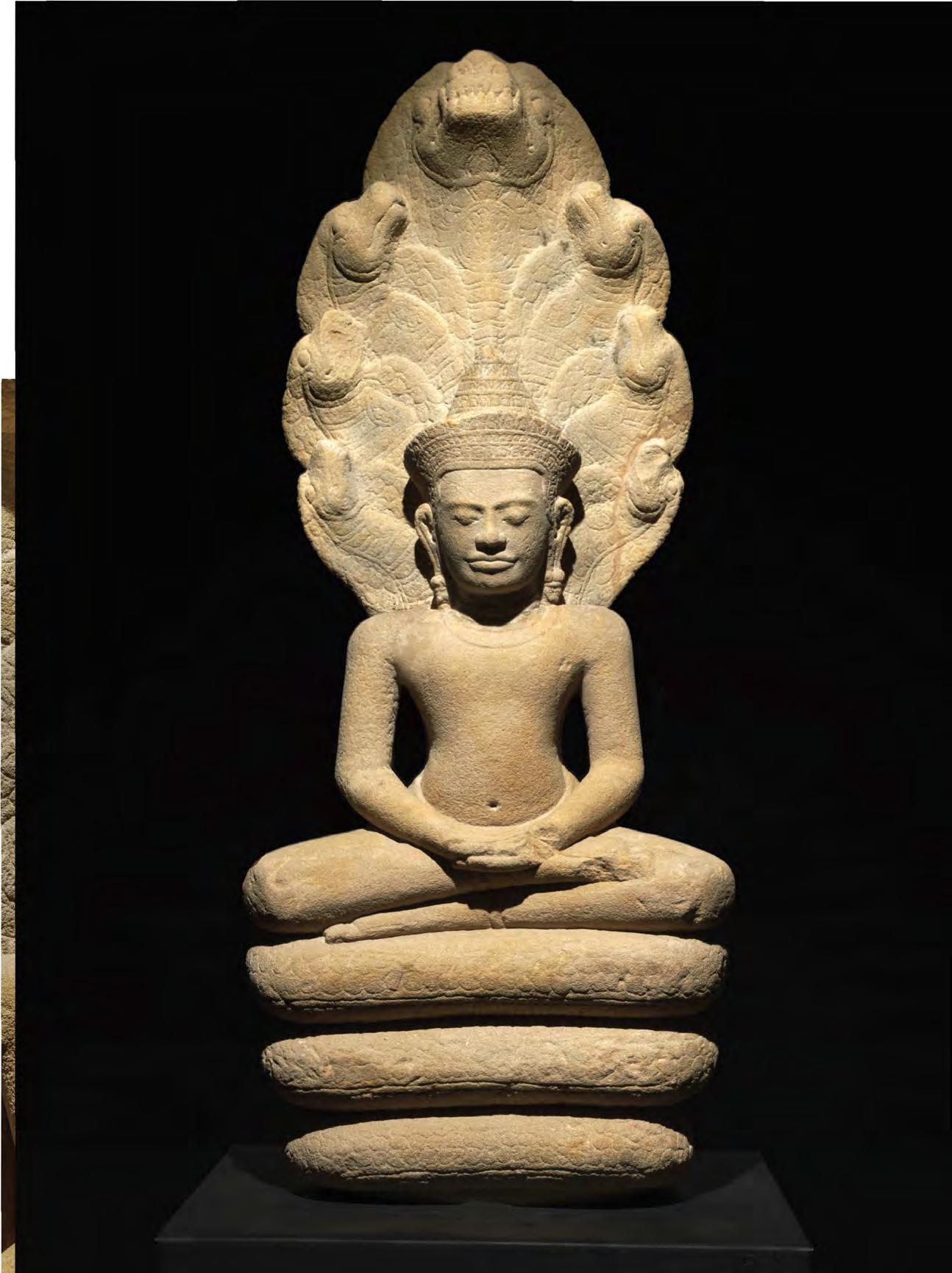
Buddha Muchalinda 目支鄰陀坐像
Circa 13th century 世紀
Thailand 泰國
Sandstone 砂岩 37 in. (94 cm.)
ro e ce 來源:
i k o o o E gl 6 131 11 o 2 倫敦 i k o , 6 131 11 o 2 li herrier ollec io o o orme e ee he e rl 1940 1972 倫敦 li herrier私藏,1940年 - 1972 年 hri ie e ork rch 23 2010 o 276 紐約佳士得,2010年3月23日,拍品276 ri e meric ollec io 美國私人珍藏
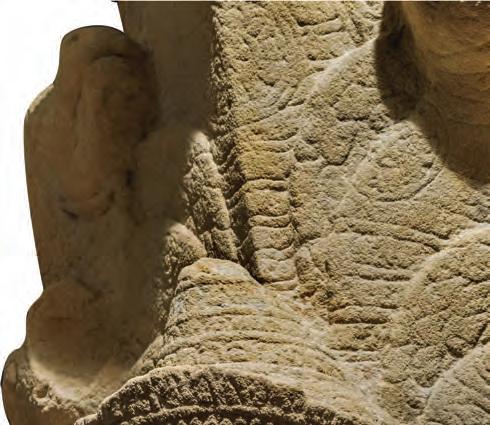
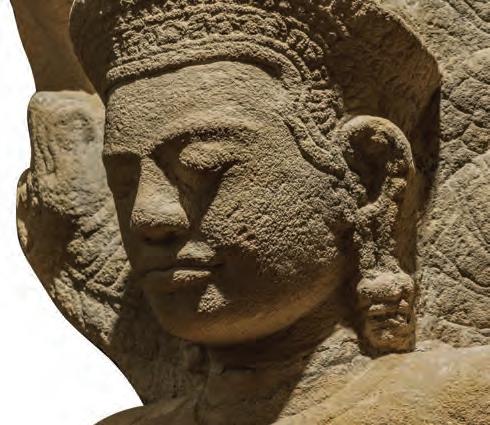
e Buddha Muchalinda represents a moment in the Buddha’s enlightenment. Deep in meditation, he was not aware of rising lake waters, sent by a demon to drown him. e Naga serpent king raised the Buddha on his coils and wrapped his body beneath him during meditation, fanning out his hood with seven cobra heads to protect him from the storm.
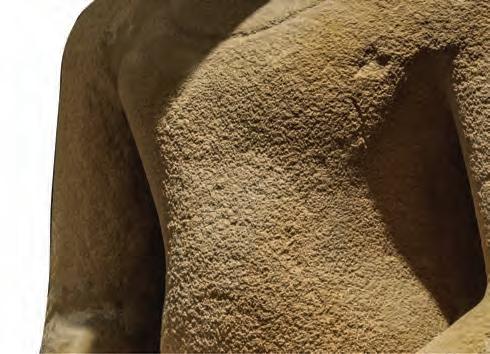
is sensitively carved gure of the Buddha is seated in padmasana with his hands in dhyanamudra, the face with a slight smile and an expression of compassionate serenity. The coiled body of the serpent beneath him is nely incised overall with an imbricated pattern, its seven-headed hood rising up behind the Buddha, His feet as well as the back of the serpent are marked with symbols of the wheel of law.
Compare to an in situ example of a stone sculpture of Buddha Muchalinda, in M. Freeman and R. Warner, Angkor, T , 1990, ill. p. 128.
“ us I heard: at one time the Gracious One was dwelling near Uruvelā, on the bank of the river Nerañjarā, at the root of the Mucalinda (tree), in the rst (period) a er attaining Awakening. en at that time the Gracious One was sitting in one cross-legged posture for seven days experiencing the happiness of freedom. en
at that time a great cloud arose out of season, (bringing) seven days of rainy weather, cold winds, and overcast days.
Then the Nāga King Mucalinda, after leaving his domicile, and surrounding the Gracious One’s body seven times with his coils, stood with his great hood stretched out above his head, (thinking): “May the Gracious One not be cold, may the Gracious One not be hot, may the Gracious One not be a ected by gad ies, mosquitoes, wind, the heat (of the sun), and serpents.”
en with the passing of those seven days, the Gracious One arose from that concentration. en the Nāga King Mucalinda, having understood that the sky was now clear without a cloud, having r ele his coils from the Gracious One’s body, and a er withdrawing his own form, and creating the appearance of a young brāhmana, stood in front of the Gracious One, revering the Gracious One with raised hands.
en the Gracious One, having understood the signi cance of it, on that occasion uttered this exalted utterance: “ ere is happiness and detachment for the one who is satis ed, Who has heard the Dhamma, and who sees, ere is happiness for he who is free from illwill in the world, Who is restrained towards breathing beings. e state of dispassion in the world is happiness, the complete transcending of sense desires, (But) for he who has removed the conceit ‘I am’ - this is indeed the highest happiness.”
-Udana, Exalted Uterrances: Mucalindavaggo

Indra 因陀羅
Circa 13th century 世紀
Nepal 尼泊爾
Wood with polychrome 彩繪木 33 x 16 in. (84 x 40.5 cm.)
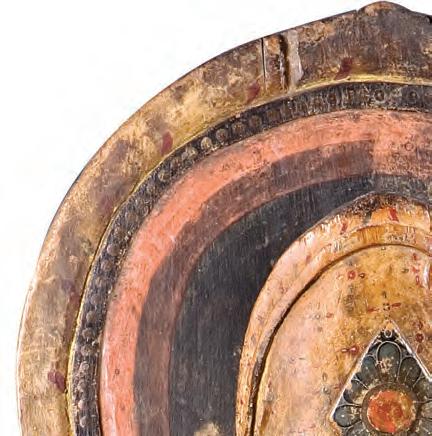
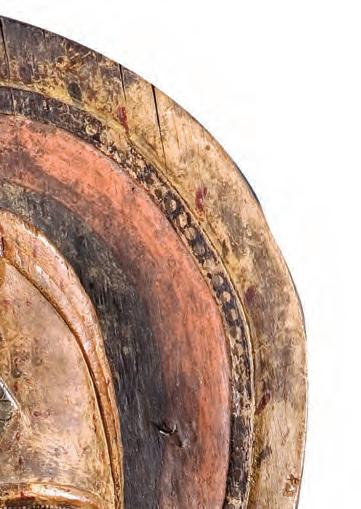
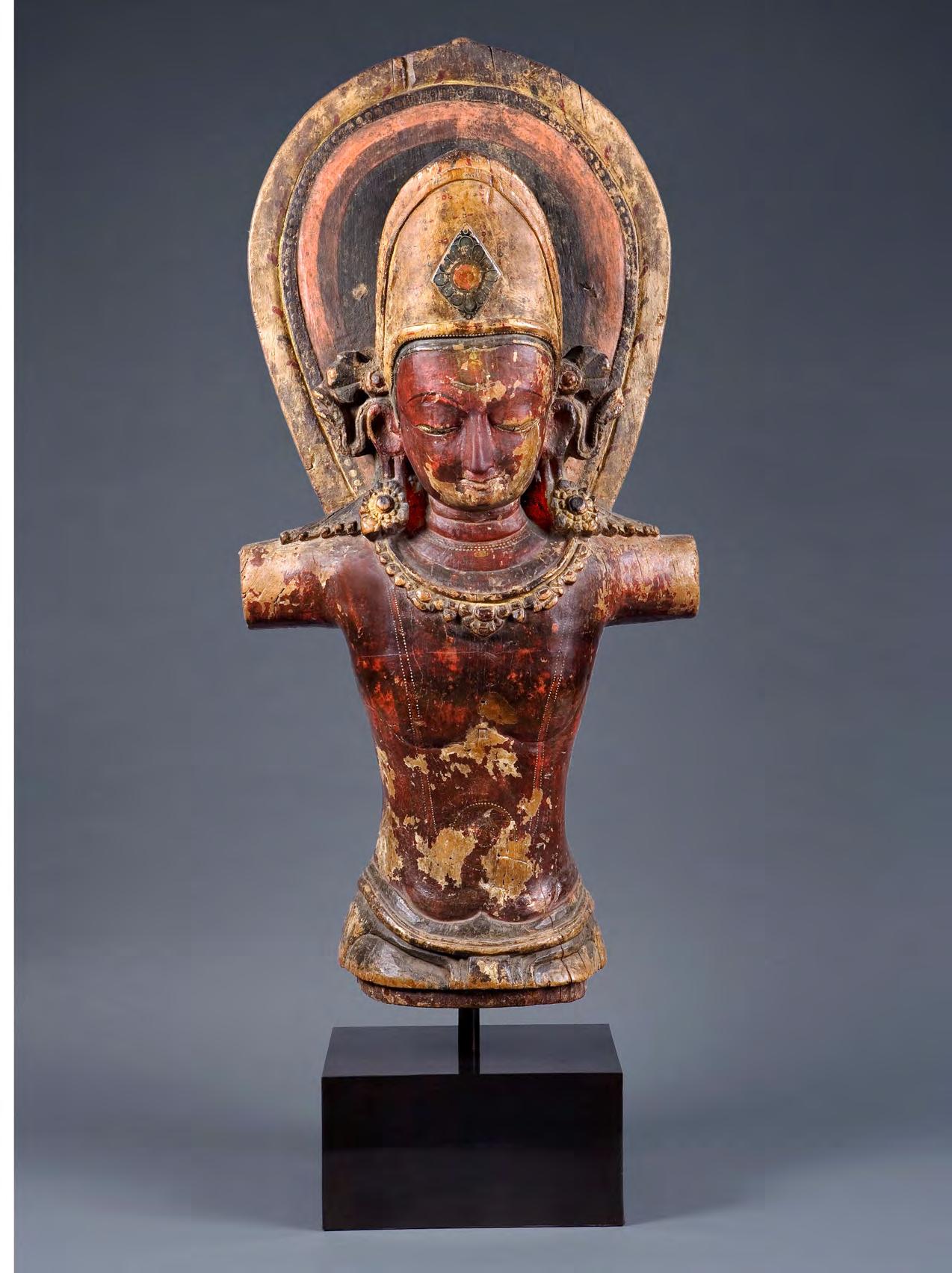
C14 tested to 1180 +/- 130 years, sample # GX-32881 碳十四檢測其年代為 80前後 0年左右,採樣號 288 HAR o. 8026 喜馬拉雅藝術資源網 802 號
ro e ce 來源: er r re collec io c ire i he 1980
法國私人收藏,自1980年間
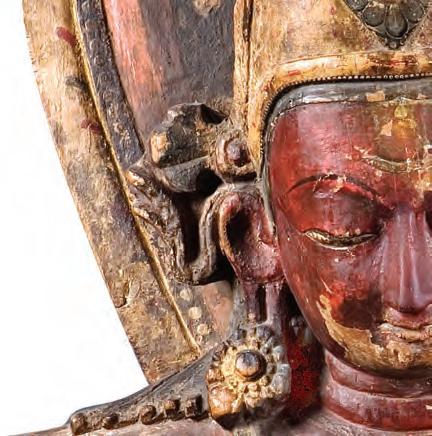
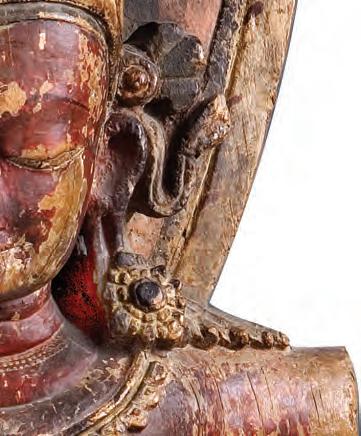
In Vedic times, Indra was the supreme ruler of the gods. He was the leader of the Devas, the god of war, the god of thunder and storms, the greatest of all warriors, the strongest of all beings. He was the defender of gods and mankind against the forces of evil. He had early aspects of a sun-god, riding in a golden chariot across the heavens, but he is more o en known as the god of thunder, wielding the celestial weapon Vajra, the lightning bolt. He also employs the bow, a net, and a hook in battle. He shows aspects of being a creator god, having set order to the cosmos, and since he was the one who brought water to earth, he was er ili go ell e l o h he o er o re i e l i rrior ho h lle i le




Indra is described as being very powerful, with a reddish complexion, and with either two or four very long arms. His parents were the sky god i he e r h go e ri hi i he or ll gro ll rme rom hi mo her i e



More hymns in the Rig Veda (about 250)are dedicated to him than any other god by a sizable amount. He was known as a great drinker of Soma; sometimes he did this to draw strength, and when he did he grew to gigantic proportions to battle his enemies, but more often he merely wanted to get r k Whe o i hi ch rio r ro e o he gre hi e ele h ir ho l ic orio ho h o r k hich re em le cre mo i e was given numerous titles including kr ( o er l ) r ( h erer )




Vajra, , ir ho a kr r r ( e ro er o i ie ) egh h ( i er o he lo ) rg i ( he or o e e )






56 Divinities, Pancaraksa Devi mandala
神守護佛母壇城唐卡
Lhachog Sengge (1468-1535) 拉查·桑傑( 8 年)
Tibet, Ngor monastery 西藏,鄂爾寺
Distemper on cloth, original cloth mount and original red lacquered dowel 棉布礦物顏料
Portrait approx. 16 x 13 1/4 in. (41 x 33.8 cm.)
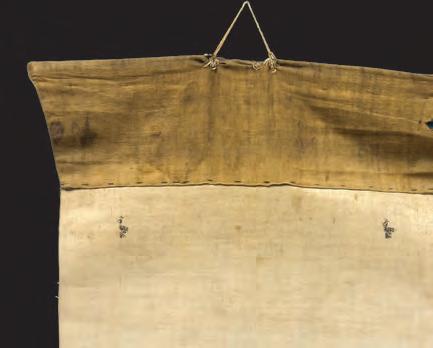
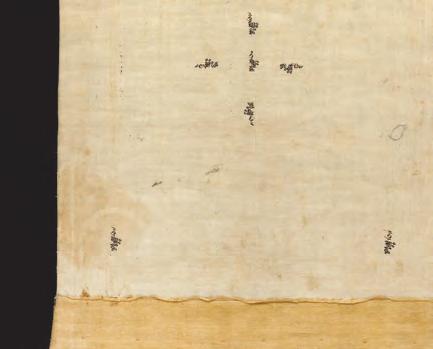
Full dimensions without pole 25.5 x 15 3/4 in. (64.5 x 40 cm.), related mantras o ver , (Hr) 80 9 喜馬拉雅藝術資源網 80 9 號
ro e ce 來源: ie e e ri e collec io ech ic l cer i ic e il le rom ro chrei er c em o i e r ie g 2017 維也納私人藏家,附有維也納藝術學院 chrei er教授2017年8月出具的鑑定證書。
hi h gk e re he im ge o 6i i i c r k e l (i
) rom he Kri r
i i io o he mo com e i m o 139 gor l 1 rom i e he
l i e ic e o he gro o i e em le ro ec i e ei ie ho ere co i ere o e he er o i ic io o i e e rl hi e ( k i ) he ol e i g rom he mi le o he 1 mille i m E ch o he i e i i i ie h e eci ic c io i i heir role o ri g o orl l ro eri l ck re e r l c ro he co er e r re el i e e l ho gh he re erme hich me emo ll o hem re re e ee me i io ei ie ( i ) he e o gre o l ri rim ril i he im l regio i e r l i re e e e er e i hi
he i e i i i ie re e ic e i i er e orm e e i g o he r i io ri l r c ice i ol e r i g or i ce i he m er o he rm ho he gor r i io e re here hich elo g o he hi k chool he eighrme hi e go e h r i r i r ( i ) i h her o r ce i ee i he ce re o he ṇḍ l er m i i ge i hi e he o e o he righ i l e he o e o he le i re he o e ci g he re r i ello he i or e i h or me ro e i he r o e ( k ) her o r righ h rio l hol i g ce er i he orm o h er ol ( k ) rro or heel er o r le h re ec i el hol ri e o e li g rro i g he hi e go e i circle re o r o her em le ei ie ci g he o r he e l irec io e ch irec io h i g ee ig e i o colo r hich re mirrore g i i he
o er lor l colo r iel ho o he e i he re hree-he e el e- rme h m r ri ( i ) o he or h im ge o he gree hree-he e i - rme h ( i ) o he e i he l e o r-he e eigh - rme h h r r m r i ( i ) o he o h he ello hree-he e eigh - rme h m r ( i ) e re l ce e ee e ch o he ei ie
he i e i i i ie re e com e eco circle e ri g he e hi orm o he i go o he e r h ho c ro ec i e ei ie chi g o er he e irec io ( k i ) r
k r hm r g i m k r hi
hir circle co i he i e
l e r i i i ie ( k i
) kr ( e ) ik r
( r ) h ( or o he l e )
Ke ( ome ) i ( ) om
( oo ) ṅg l ( r ) h
( erc r ) ṛ h i ( i er) he o r h circle e re im ge o he 28
ho e o he moo ( k ṣ
i ) he ṇḍ l l ce i
rro e re re er o hich r her 16 cri ici l i i i ie re loc e he l ce ll re eli e e i l e hi e i richl
ecor e g e ei g g r e he
o r ki g o he he e l irec io ( k i )
ir kṣ ( e ) i r ṇ ( or h)
h r ṣ ṭr (e ) ir ḍ h k
( o h) he ṇḍ l i e circle
o ro ec i e ol chrome o er ri g
co i i g o lo le e l me
e o he ṇḍ l here re r her
o r ei ie e ch ig e o cor er o he h gk o he er le here i he re h
i re ( i ) o he righ he o hi r
( i )
irrori g hem o he
lo er m rgi re o e ic io o m h l
( i ) he
g r i o e l h ce ho i o h
hi e ce l gr m i e io E ch
i i i i l ke o icio m ol he ic or er he r ol he re re e he co ch
he ir o gol i h he e le k o he heel he lo
he i i g le i ro gl i l e ce e le e e he ic ho gre re ilec io or re ch r c eri ic
o h gk ll i i g o he
k chool he gor r i io
o he 1 h 16 h ce rie he
colo r le e i i e e i r
he com o i io hole i
l ce mme ric l i orm
o he re er e o he i i g i
er e i e e e ic io hi
em l o i i i ie elo gi g o
he l o me i io ei ie
e ec e i h r
h chog e gge 2
h chog e gge (1468-1 3 ) he
i h o o gor o er i
i e re o i le or he
ro c io o m ork ll o
hich e r imil r i e
e ic io 3
1 o m rg m ho (1983)
i e l he gor
ollec io ol ok o
2 i e i cri io i m k il
khor g i lh hog i rig i
lh mchog e g ge he g
r l io i o erm rom i e
r le er chiller
3 ee him l r org
i em 89798 87012 6 020 6 463 8 8 4 4121 269
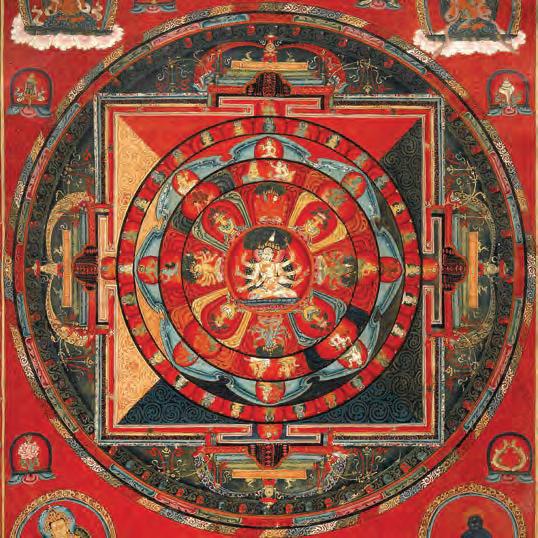
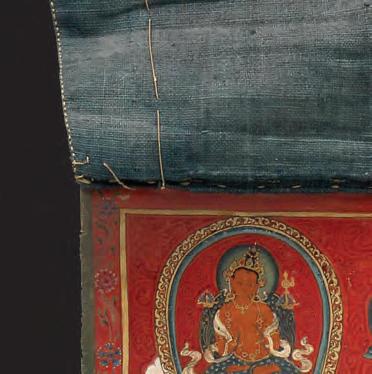
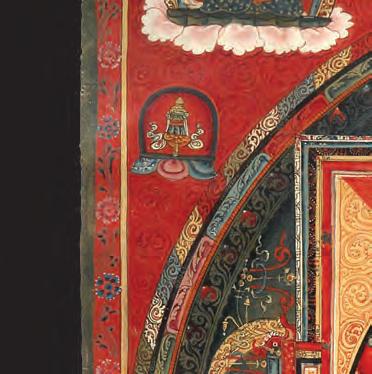
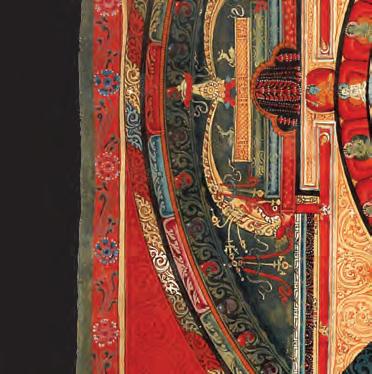
鄂爾寺,又譯作俄爾寺,是西藏地區日喀則地區一座 藏傳佛教薩迦派的寺院。該寺創建於1429年,被視為 薩迦派第二重要的道場,從屬寺院曾多達六千多座, 影響遠及雲南,四川,青海等地。在藝術方面,鄂爾 寺以其豐富的梵文經藏,和沿襲了尼瓦爾繪畫風格的 唐卡作品著稱。據鄂爾寺歷史記載,1429年建寺以後 曾有6位來自加德滿都的尼瓦爾畫師把尼瓦爾繪畫風格 帶到寺裡,在之後的傳承中便逐漸形成了鄂爾寺獨特 而標誌性的繪畫風格0.56神守護佛母壇城唐卡是著名的 鄂爾寺139張壇城唐卡系列中的一張。
該壇城色彩濃烈,以飽滿的朱紅,深藍為主,並以明 亮的黃色提亮。工藝方面,精準的人物細節刻畫以及 背景裡繁複的卷花紋飾等體現著尼瓦爾畫師引以為傲 的精工;而結構佈局方面,該壇城又嚴格按照藏傳薩迦 派的儀軌繪製。
根據畫面底部銘文,這幅壇城由持明者拉查·桑格訂 製。拉查· 桑傑(1468- 1535年)是鄂爾寺第9任座 主,曾訂製了一批風格類似的唐卡,並都有類似銘 文。
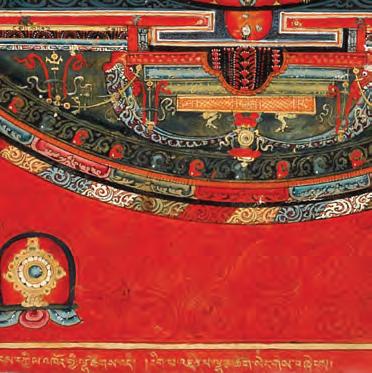
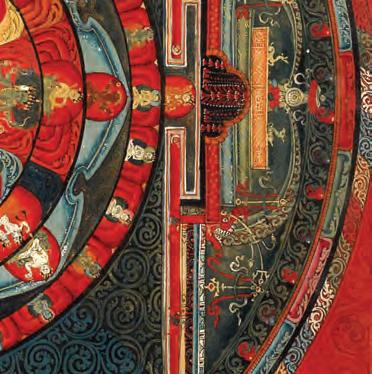
在這幅壇城中,56尊神生動形象,依次可辨。壇城內 圓外方,中央5尊守護佛母由其外3圓1方4圈內的51尊 神祗護持。
五尊守護佛母,對應著早期佛教經典“五護陀羅尼”(陀羅 尼為長篇咒文)中包含的5篇,隨著佛教的發展,5部經典逐 漸演變成5尊具有不同形象的女神形象,分別與獲得財富, 克服疾病,驅散恐懼,長壽得子等世俗願望對應,而人類趨 吉避凶的本能,使得五守護佛母信仰在後世長盛不衰,在喜 馬拉雅,中亞地區,甚至中國和日本都廣受愛戴和尊崇。
“大隨求陀羅尼經”---大隨求佛母 “守護大千國土經”---大千摧碎佛母
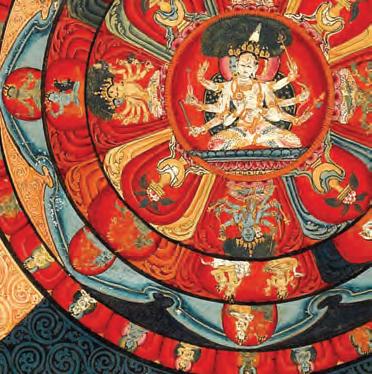
“大孔雀經”---大孔雀佛母 “大寒林陀羅尼經”---大寒林佛母 “大護明大陀羅經”---大秘咒隨持佛母 根據不同的教化需要,五佛母相貌不盡相同。在這幅守護佛 母唐卡中,大隨求佛母結跏趺坐坐於壇城中央。四面八臂, 身體和主面呈白色,右面呈藍色,左面呈紅色,左後一面呈 黃色。右側四手依上往下各執金剛杵,箭,寶劍,和法輪。 左側四手對應各執三叉戟,弓,鉞斧,和索。
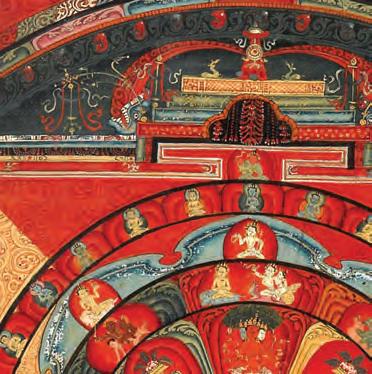
以大隨求佛母為圓心,其外一圈環繞其他四位守護佛母,各 居一方世界。每位佛母與她所在的世界又分別由紅,綠, 藍,黃一種顏色代表。順時針排列,西方大秘咒隨持佛母, 三面十二臂,身呈紅色;北方大寒林佛母,三面六臂,身呈 綠色;東方大千摧碎佛母,四面八臂,身呈藍色;南方大孔雀 佛母,三面八臂,身呈黃色。四個等大淨瓶相間於每位佛母 之間,使畫面工整而殊勝。
五位守護佛母其外一圈由八方,上下總共十尊護法天神守 護,順時針依次為西方水天,西北風天,北方多聞天,東北 伊舍那天,上方梵天,東方帝釋天,東南火天,南方焰摩 天,西南羅剎天,下方地天。
第三個同心圓內九尊神像為九耀化身(九耀為古印度占星術 中對九個天體的統稱,唐代時傳入中國),順時針依次為金 曜,土曜,羅睺,計都,日曜,月曜,火曜,水曜,木曜; 分別對應金星,土星,月球升交點,月球降交點,太陽,月 亮,火星,水星,木星。
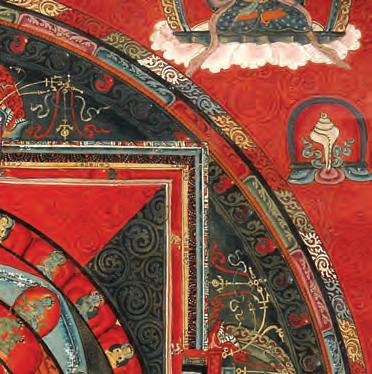
第四個同心圓內28尊神依次對應28星宿。圓環壇城外圈築有 五色基牆,呈方形包圍壇城,四方各有一華麗城門五道牆代 表著佛教裡強調的五力:信力,精進力,念力,定力,慧 力;而五種顏色代表著佛教的五種智慧。
牆內一圈紅色通道內坐16尊小祭祀像,而四個城門口由四大 天王把守,順時針依次為:身纏金龍的西方廣目天王,高舉 寶傘的北方多聞天王,懷抱琵琶的東方持國天王,和手執寶 劍的南方增長天王。城門外兩圈彩色和中間一圈黑色的大圓 環自外向內依次為火焰牆,金剛牆,蓮花牆,分別象徵出離 心,金剛心和菩提心。
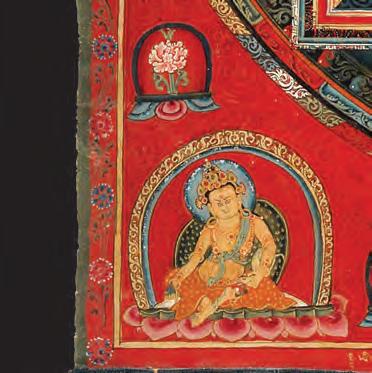
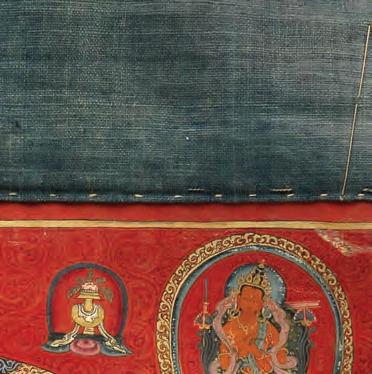
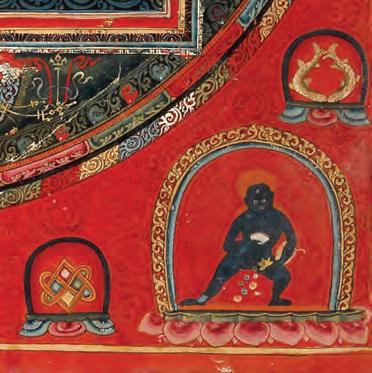
除了壇城內的56尊神外,壇城外4角神像自左上順時針依次 為:彌勒菩薩,文殊菩薩,黑財神與黃財神,並有白蓋,寶 傘,寶瓶,法螺,金魚,盤長,法輪和蓮花等佛門八寶供奉 於前,象徵吉祥,圓滿,幸福。
這幅56神守護佛母壇城唐卡品相完好,具有極高審美價值的 同時,也是中華文明的歷史珍寶。是值得珍藏的難得之作。

Shakyamuni 釋迦牟尼佛唐卡
Circa 18th century 8 世紀
Tibet 西藏
Ground mineral pigments and gold on cloth 棉布礦物顏料
24 x 15 in. (61 x 38 cm )
80 喜馬拉雅藝術資源網80 號
ro e ce 來源:
ollec io o l e oh W l e (192 -2013)
華樂庭(192 年至2013年)舊藏
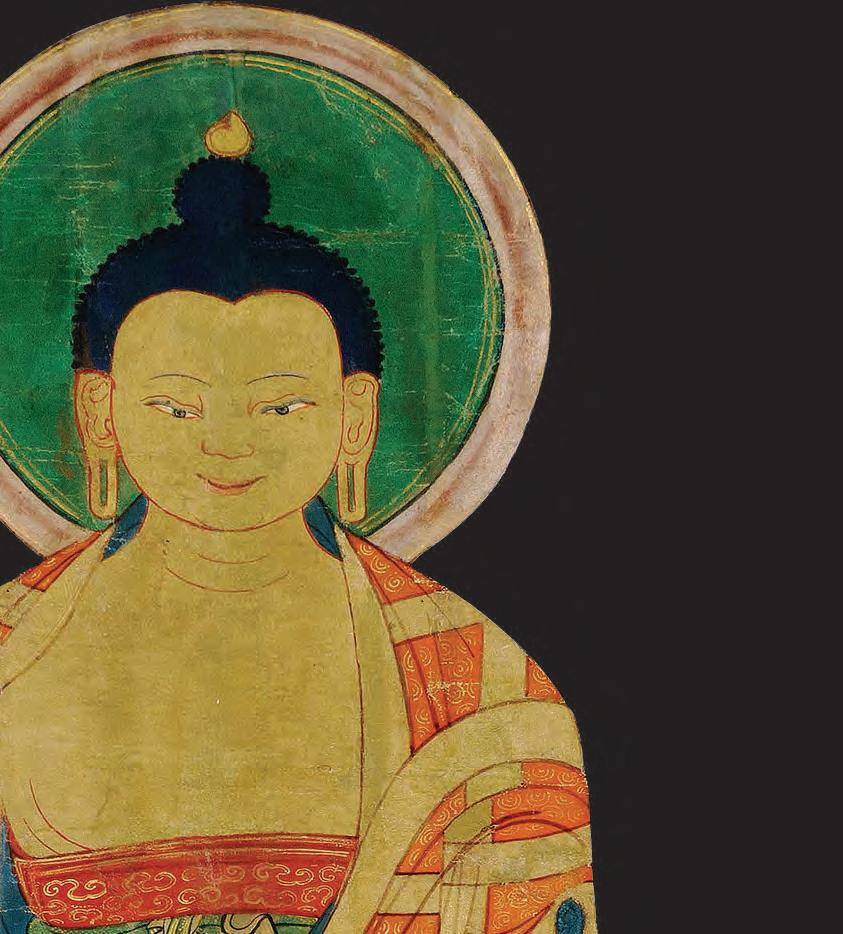
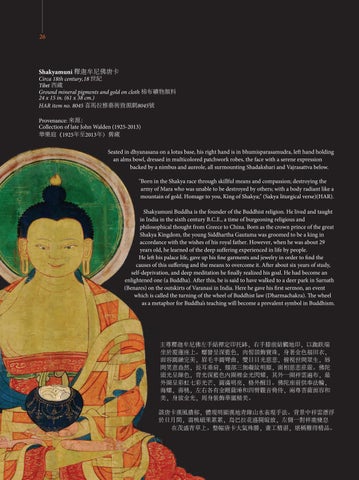
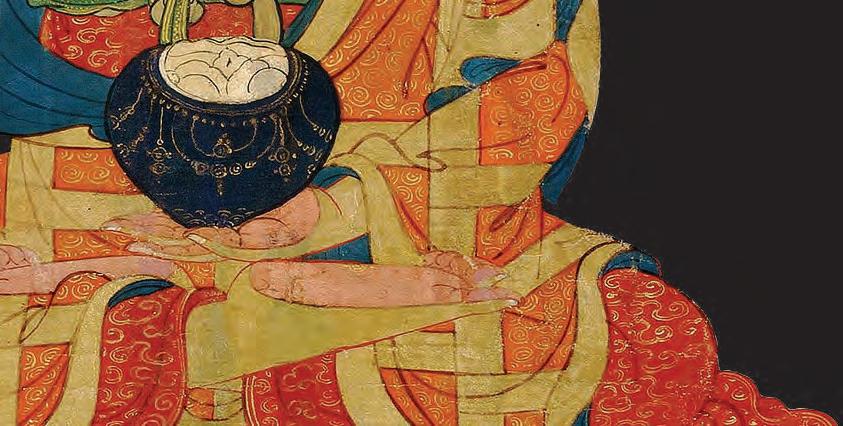
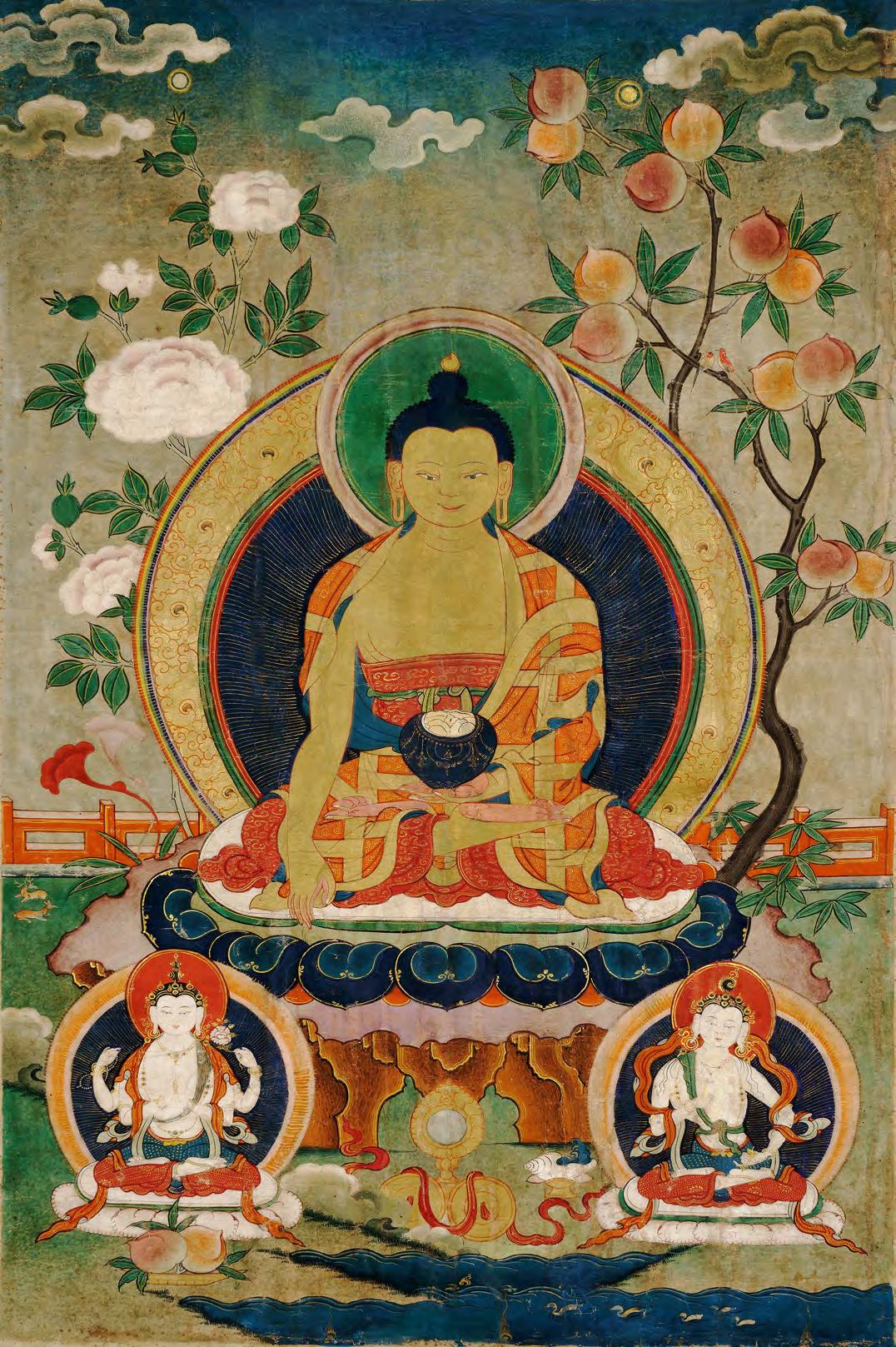
Seated in dhyanasana on a lotus base, his right hand is in bhumisparasamudra, left hand holdi g an alms bowl, dressed in multicolored patchwork robes, the face with serene expression backed by a nimbus and aureole, all surmounting Shadakshari and Vajrasattva below.
Born in the Shakya race through skillful means and compassion; destroying the army of Mara who was unable to be destroyed by others; with a body radiant like a mountain of gold. Homage to you, King of Shakya; (Sakya liturgical verse)(HAR).
Shakyamuni Buddha is the founder of the Buddhist religion. He lived and taught in India in the sixth century B.C.E., a time of burgeoning religious and philosophical thought from Greece to China. Born as the crown prince of the great Shakya Kingdom, the young Siddhartha Gautama was groomed to be a king in accordance with the wishes of his royal father. However, when he was about 29 years old, he learned of the deep suffering experienced in life by people. He le his palace life, gave up his ne garments and jewelry in order to nd the causes of this su ering and the means to overcome it. A er about six years of study, self-deprivation, and deep meditation he nally realized his goal. He had become an enlightened one (a Buddha). A er this, he is said to have walked to a deer park in Sarnath (Benares) on the outskirts of Varanasi in India. Here he gave his rst sermon, an event which is called the turning of the wheel of Buddhist law (Dharmachakra). e wheel as a metaphor for Buddha’s teaching will become a prevalent symbol in Buddhism
主尊釋迦牟尼佛左手結禪定印托缽,右手膝前結觸地印,以跏趺端 坐於覆蓮座上。螺發呈深藍色,肉髻頂飾寶珠,身著金色福田衣, 面容圓融完美,眉毛半圓彎曲,雙目目光慈悲,俯視世間眾生,唇 間笑意盎然,長耳垂肩,頸部三無礙紋明顯,面相慈悲莊嚴。佛陀 頭光呈綠色,背光深藍色內圈裡金光閃耀,其外一圈祥雲遍布,最 外圈呈彩虹七彩光芒,圓滿明亮,格外醒目。佛陀座前供奉法輪, 海螺,壽桃,左右各有金剛薩埵和四臂觀音脅侍,兩尊菩薩面容和 美,身放金光,周身裝飾華麗精美。
該唐卡漢風濃郁,體現明顯漢地青綠山水表現手法。背景中祥雲漂浮 於日月間,壽桃碩果累累,烏巴拉花盛開綻放,左側一對祥鹿棲息 在茂盛青草上。整幅唐卡大氣殊勝,畫工精湛,堪稱難得精品。
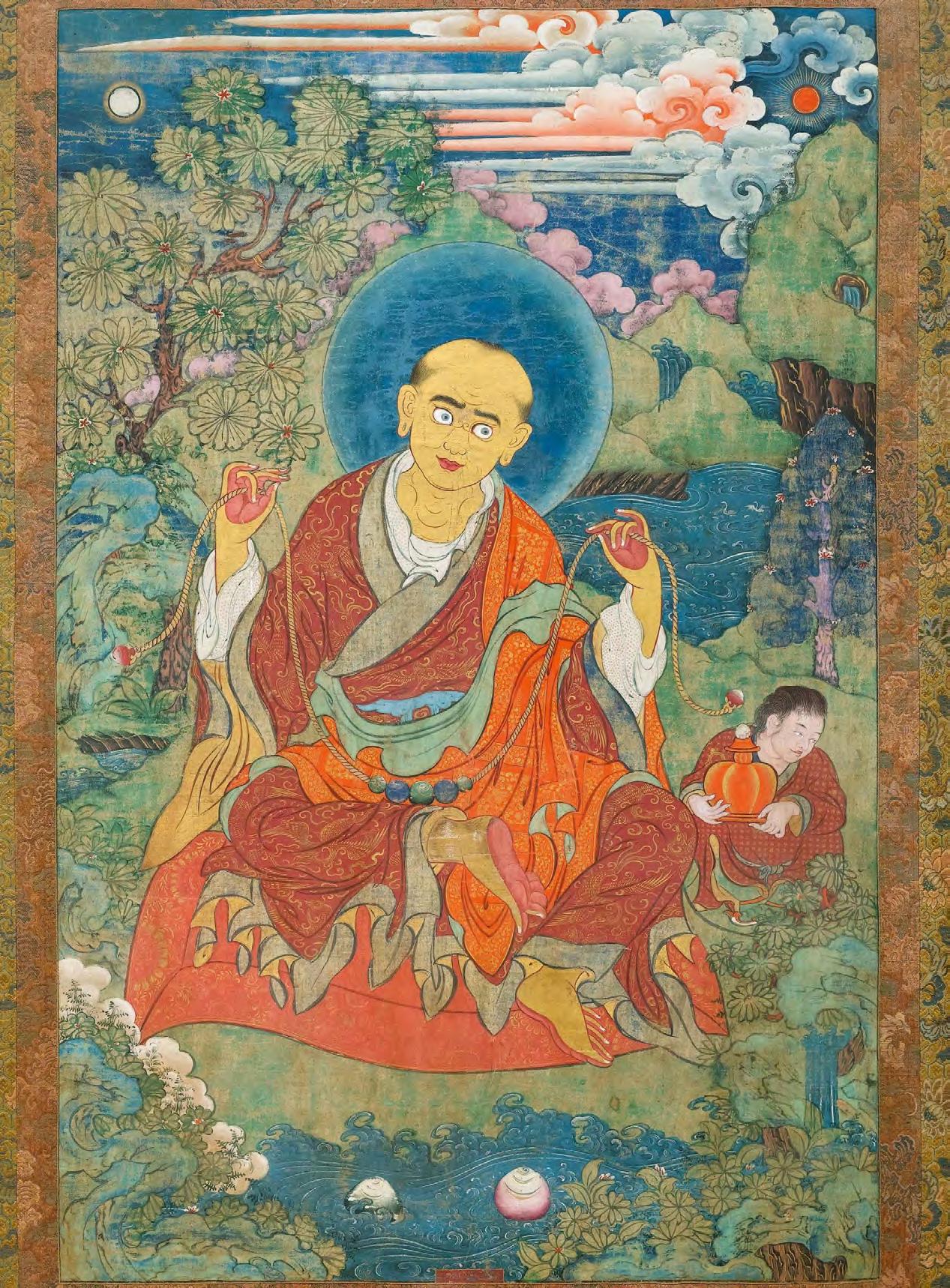
The Elder Arhat Kanakavatsa 十六尊者之迦諾迦伐蹉尊者唐卡
Circa 18th century 8 世紀 Tibet 西藏
Ground mineral pigments on cloth 布繪礦物顏料
36 1/4 x 24 in. (92 x 61 cm.)
HAR no. 36292 喜馬拉雅藝術資源網 292號
ro e ce 來源:
Koller rich e 1978 lo 46
1978年6月由蘇黎世Koller拍賣行拍出,拍品號46
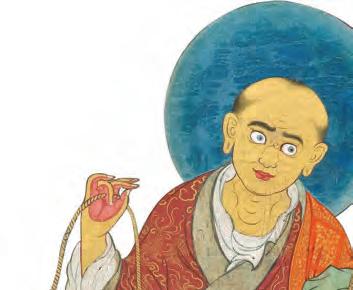
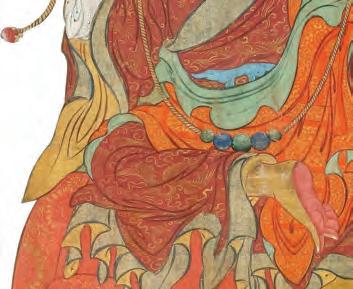
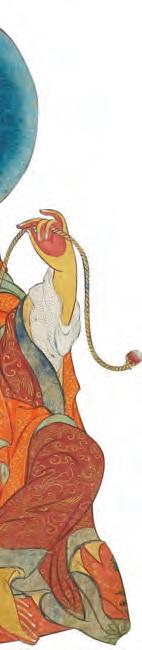
The seventh of the sixteen great Arhats i adorned in a red and orange patchwork robe heightened with gold leaf details. Seen seated on a lush green landscape, surrounded by trees, rocks, and a muttering stream: features characteristically Chinese in style, a syncretic attribute derived from the intimate relationship between China and Tibet created by the conversion of Kublai Khan, the Mongol ruler of China, to Tibetan Buddhism. The haloed and mature saint ho eyes opened wide gazing intently as he holds a jeweled lasso in his hands ccording to the legends the jewels serve to give wisdom and understanding of Buddhist doctrine and were a gift of the Nagas. In the richly colored sky sit the sun and moon. In


l i l li lo er m e he r ri ki g o K hmir ho i i o h e i i e K k One might postulate that the attendant figure in this thangka may also be the “barbarian king of Kashmir” offering a stylized e el i hom ge rh re he i o hi m ollo er o he h ho h e i e ree om rom ig or ce eri g he chool o hi m he rh co i ere o e he hi
羅漢為梵文 rh (音譯阿羅漢) 的簡稱,意為應真,最初意指釋迦 摩尼佛的得道弟子。南傳佛教認為 證得阿羅漢果為佛教徒修行的最高 目標。阿羅漢以其住世護法的特質 在藏傳佛教中也廣受供奉。
這幅唐卡表現的是十六羅漢中位列 第七的迦諾迦伐蹉尊者。唐卡中尊 者身著橘紅金縷僧袍,右腿單盤, 左腿垂足坐於青綠山水之間,以山 石松木為伴,頭頂天空中祥雲遍 布,日月同輝,座前湍湍溪澗間浮 有吉祥如意寶。尊者背靠光環,目 光炯炯有神,雙手提一串有珍寶的 繩索。據傳說珍寶和繩索由神龍所 賜,庇佑修行人智慧增長,究竟佛 法。
i e l i l er h hi m hi role ke o er he o hi rh rem i e im or i i e hi m ro ec or o he oc ri e r er ere i o hem he ere cre i e i h m mir cle ri i h e m


the Nagas. In the richly colored sky sit attendant figure is positioned offering a he Ki g o K hmir ho


, June 1984, pg. 137, plate 4 Dr. Pratapaditya Pal references an early Arhat thangka, possibly of Kanakavatsa, with heavy Chinese influences. In this thangka an attendant figure is positioned offering a bowl to the Arhat. Dr. Pal explains that this iconography can also be seen in an eleventh century description of an Arhat series by k o o g m er i hich K k i or hi e he Ki g o K hmir ho i o he righ -h i e he rh m ke m r e ore him lo er o l i l ce r l e l i h he k eeli g ig re

i hi h gk ( ) e ri g he rich ig re ilk o eri g he
類似題材構圖可參照帕爾博士 ( r i l)著作《西藏藝 術:洛杉磯縣里美術館珍藏圖錄》 中收藏的另一幅漢風濃郁的早期羅 漢唐卡。帕爾博士認為唐卡中表現 的很有可能為迦諾迦伐蹉尊者,旁 邊有侍從手托供盤。帕爾博士指 出,類似的造像形式早在11世紀宋 代就有文字記載“迦諾迦伐蹉尊者 施手印,右側坐有敬拜尊者的克什 米爾國王,面前有蓮花寶盤..... 。
而《西藏藝術:洛杉磯縣里美術館 珍藏圖錄》中收錄的羅漢唐卡中身 著艷麗絲袍,手獻藍寶石花的 跪像可能是敬拜迦諾迦伐蹉尊者 的克什米爾國王.由此可推 測這幅 迦諾迦伐 蹉尊者唐卡中手托寶 瓶的協侍極有可能為克什米爾國 王。
Chakrasamvara and Consort 勝樂金剛
Circa 17th century 世紀
Tibet 西藏
Mineral pigments with gold on cloth 礦物顏料布繪
34 x 25 in. (86 x 64 cm.)
82 喜馬拉雅藝術資源網 82 號
ro e ce 來源: rom he e ollec io c ire i he 19 0 r ce 法國 e 收藏,購於19 0年間 r h i ol r h r ro om i er k k ho
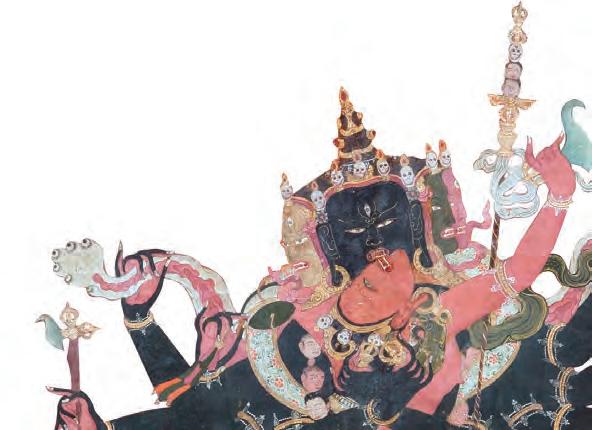
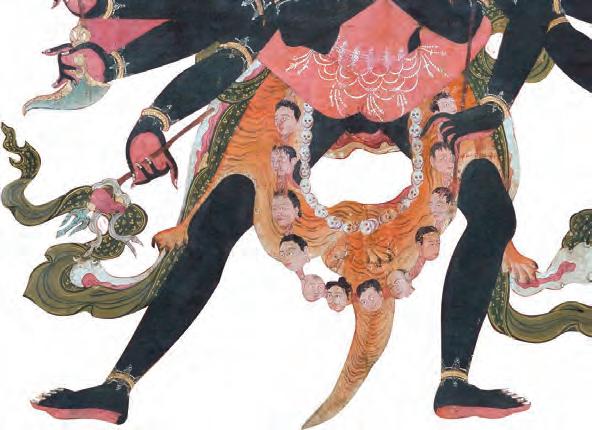
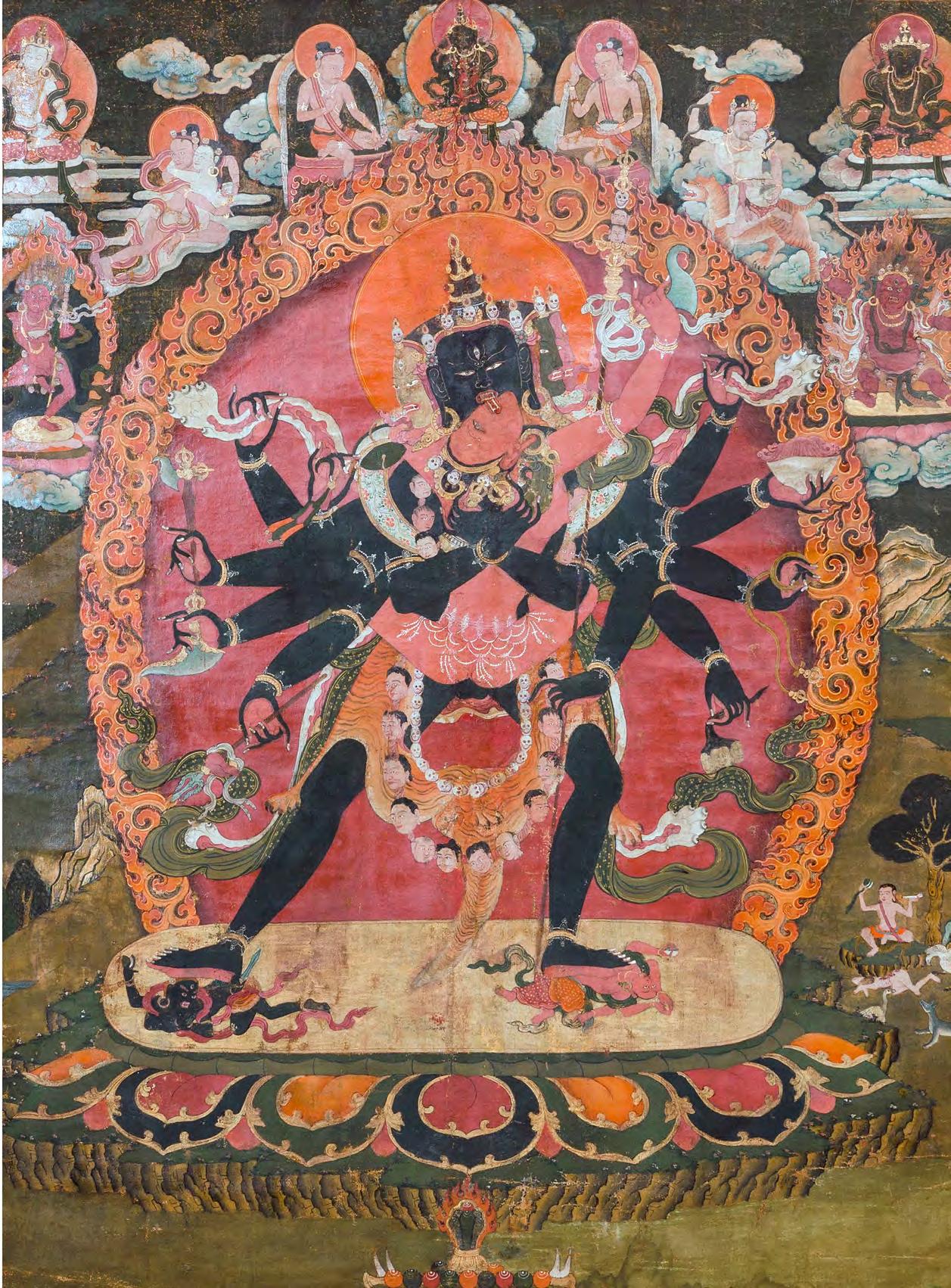
Chakrasamvara, which translates as wheel of bliss, is one of the most popular yidam, or meditational deitie , in Tantric Buddhism after the 11th century. As the principal deities of the Anuttarayoga Tantra of the Vajrayana Buddhist Tradition, Chakrasamvara can appear in several dozen di erent forms, from simple to complex, peaceful to wrathful. Here Chakrasamvara and his consort Vajravarahi are both ho with a wrathful appearance, standing on Red Kalaratri and Black Bhairava, symbolizing the triumph over ego and ignorance.
Chakrasamvara, who is blue in color, has four heads and 12 hands, in which he holds an elephant skin behind his back, a sta , a skullcup, a golden lasso, Brahma’s four heads, a trident, a aying knife, an axe, a drum, a vajra and a bell at center. Both Chakrasamvara and his consort Vajravarahi wear a skull crown, a garland of freshly severed heads are surrounded by the blazing flames of pristine awareness.
A register of deities are at the top of the image. From left to right he are identified as Vajrayogini,
勝樂金剛,取殊勝大樂之意,是藏傳佛教中自11世紀起流行的重 要本尊之一。


勝樂金剛是無上瑜伽部母續中最高成就,可依不 同教化呈現不同寂靜與憤怒化現。此畫面中勝樂金剛及明 妃金剛亥母皆以憤怒相化現,腳踩紅色時母 與黑色陪臚,象征戰勝自大無明。
唐卡中本尊身呈藍色,4面12臂,兩主 臂持金剛鈴杵交於胸前,上二臂於身後 張開一張象皮驅逐無明,其餘各手分別 持天杖、人頭骨碗、金索、梵天四頭、 三叉戟、鉞刀、金剛斧、手鼓。本尊雙 身頭戴五骷髏冠,項戴顱鬘,身處熾燃 火焰中。
唐卡頂部一排尊像從左至右依次為金剛 瑜伽女、金剛薩埵、建札巴祖師、帝洛 巴祖師、金剛大持、那洛巴祖師、东 比巴祖師、阿閃佛以及馬頭明王。本尊 左側脅侍據推測應為84大成就者之夏利 巴祖師。夏利巴祖師沉湎於喪妻之痛無 法自拔,在一高僧點撥下以亡妻尸骨為 空行母打坐修行,最終證得大手印密 法。
kr m r r r
i mo l likel o e K k li o e o he 84 m h i h ho me i e m e r o hi ece e i e ki i he em i e i e he e o m h m r - i hi


White Tara 白度母
Circa 18th century 8 世紀
Tibet 西藏
Ground Mineral pigments on cloth 布繪礦物顏料
Image: 15 3/4 x 10 1/8 in. (40 x 25.5 cm )
HAR no. 8046 喜馬拉雅藝術資源網 80 號
ro e ce 來源:
ri e E ro e ollec io 歐洲私人珍藏
Seated on a lotus platform, her le thumb and fore nger holding the stem of an utpala to the heart with the petals blossoming at the ear, the right bestowing charity held across the knee. In this white form of the deity she appears specifically for he purpose of
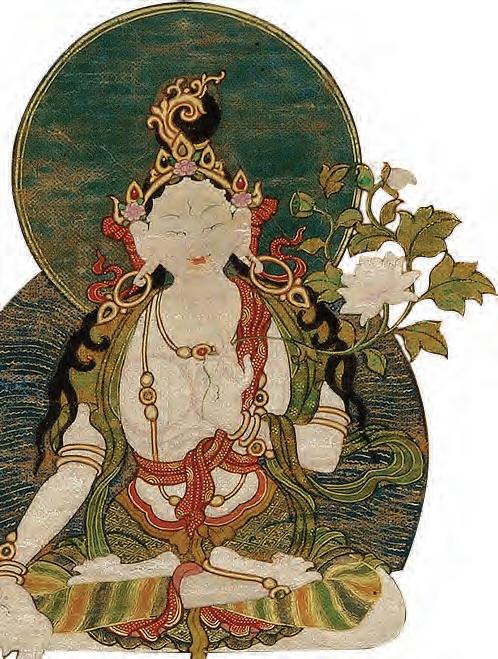
bestowing longevity - long life and health. Revered in all schools of Tibetan Buddhism it can probably be said that Tara is second in popularity only to Avalokiteshvara. Her practices are found in all classes of tantric literature of both the old Nyingma traditions and the new Sarma schools from India.
“...with a hue white like an autumn moon - radiant like a stainless crystal jewel, shining with rays of light, one face, two hands, and having three eyes; with the conduct of having sixteen years of age. e right hand is in the mudra of supreme generosity; the le holds with the thumb and fore nger the stem of a white utpala to the heart with the petals blossoming at the ear. Representing the buddhas of the three times the single stem is divided into three, in the middle is a blossoming ower, the right in fruition, the le in the form of a bud; adorned with various jewel ornaments; having various silk upper garments and a lower garment of red silk; seated with the legs in vajra posture. e palms of the hands and feet each have an eye - the seven eyes of pristine awareness.” (Sachen Ngagwang Kunga Lodro, 1729-1783).
Hayagriva 秘密主三身合一忿怒尊
Circa 18th century 8世紀
Tibet 西藏
Ground mineral pigments on cloth 棉布礦物顏料
Image: 29 1/4 x 20 in. (75 x 51 cm ) 80 喜馬拉雅藝術資源網80 號
ro e ce 來源: rom ri e li ollec io 意大利私人珍藏
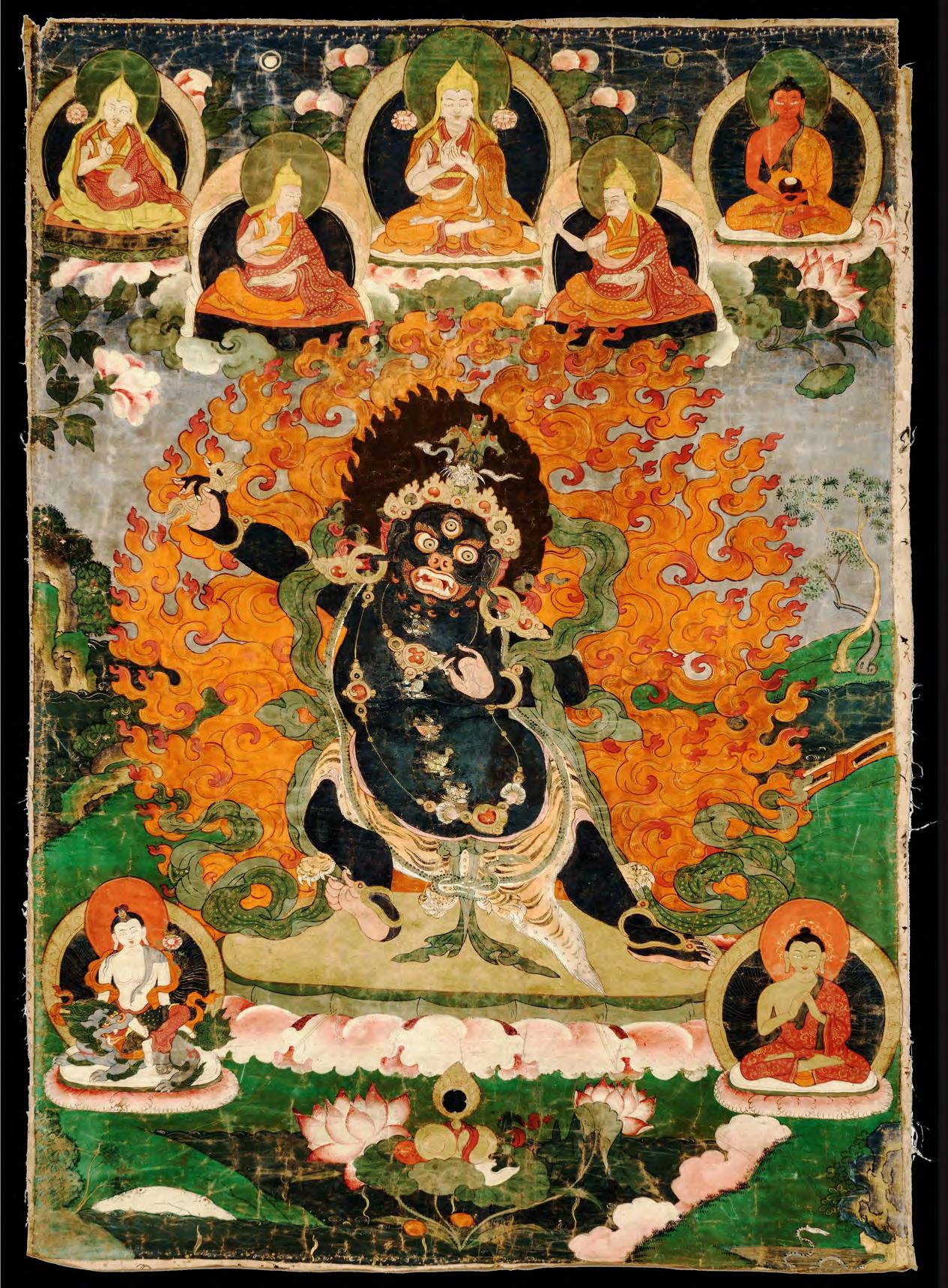
hi i e h gk e ic h i r i i hi r re orm o or r i g hree r h l ei ie r i gri r com i e i o e he hree ei ie re em io o h e ligh e e mi eech o re ec i el h he oge her em o he er ec o er o ll h ro ec ei g rom h rm l iri h cre e i e e i h rmo o cle hi eci l r c ice o
he r i- gri - r ei h lo g li e ge e o rom e o gkh e cher ho r g r che ek i or e (1326-1401) ho h
o i e e ligh e me hro gh he r c ice o r i
he er regi er o hi i i g ho i e ig re i h mi h h o he r righ o r e cher o he le ll e ri g he ic l ello c o
he el g li e ge
i g i li h e ore l mi g reole he r igri - r ei h o l e- l ck i color, i h o e ce o h he righ h hol r he le r i e o he he r i r h l ge re i h ir i i g r mo g hich hor e he eighi g h r l hree ime o er- o eri g he hree e lm he eighi g o he hor e o he righ o er- o er he m le li e ge o e o he le o er- o er he em le li e ge he o e i he mi le e o o eme o he r c i io er elo he hor e i he
Ki g o ir r i h o hi e i color e i g he ori g or e i hi cro o e el i h ir i or e i h
hi e o e ke re re e i g he Ki g r ce e e r lo er g rme o iger ki e ecke i h ll he e el or me
r i- gri - r ei i r ic l rl r c ice i he Kri r cl i ic io gr ro ec io rom g E ec e ric l ccor i g o mo ic cri re he i ccom ie h g r e e o he righ imh loki e h r e e o he le ho elo g o he Kri cl i ic io i o remo e ick e i e e e eci ll ill e c e g
e o her i e i ie e m le re hel or o her e m le o hi r re orm o r i ee he i e r r e m hi h o om il io ei i g i i oh i collec io ( im l r e o rce hi ei r i hree om i e Wr h l e )



Uma-Maheshvara
Circa 11th century
Kashmir or Himachal Pradesh
Copper alloy w ilver inlay
6 8 (16.2 cm )
HAR no. 8038
ro e ce
rr o e e r ollec io o gele 1960 - 2011
E hi i e
li he
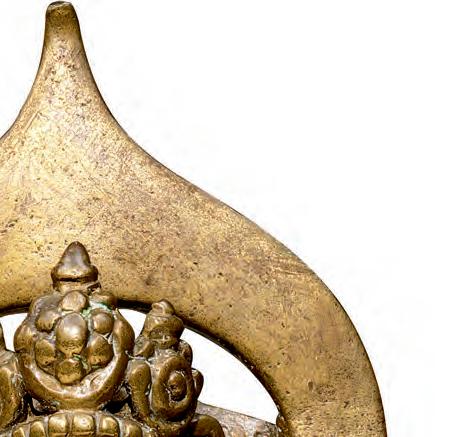
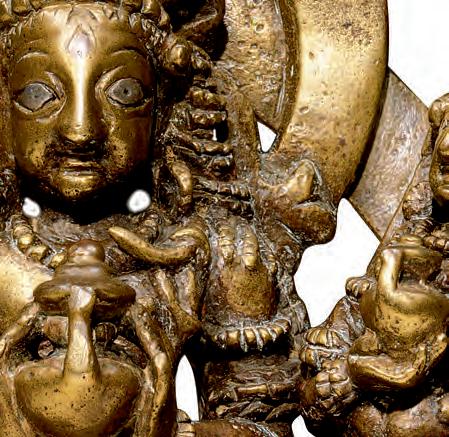
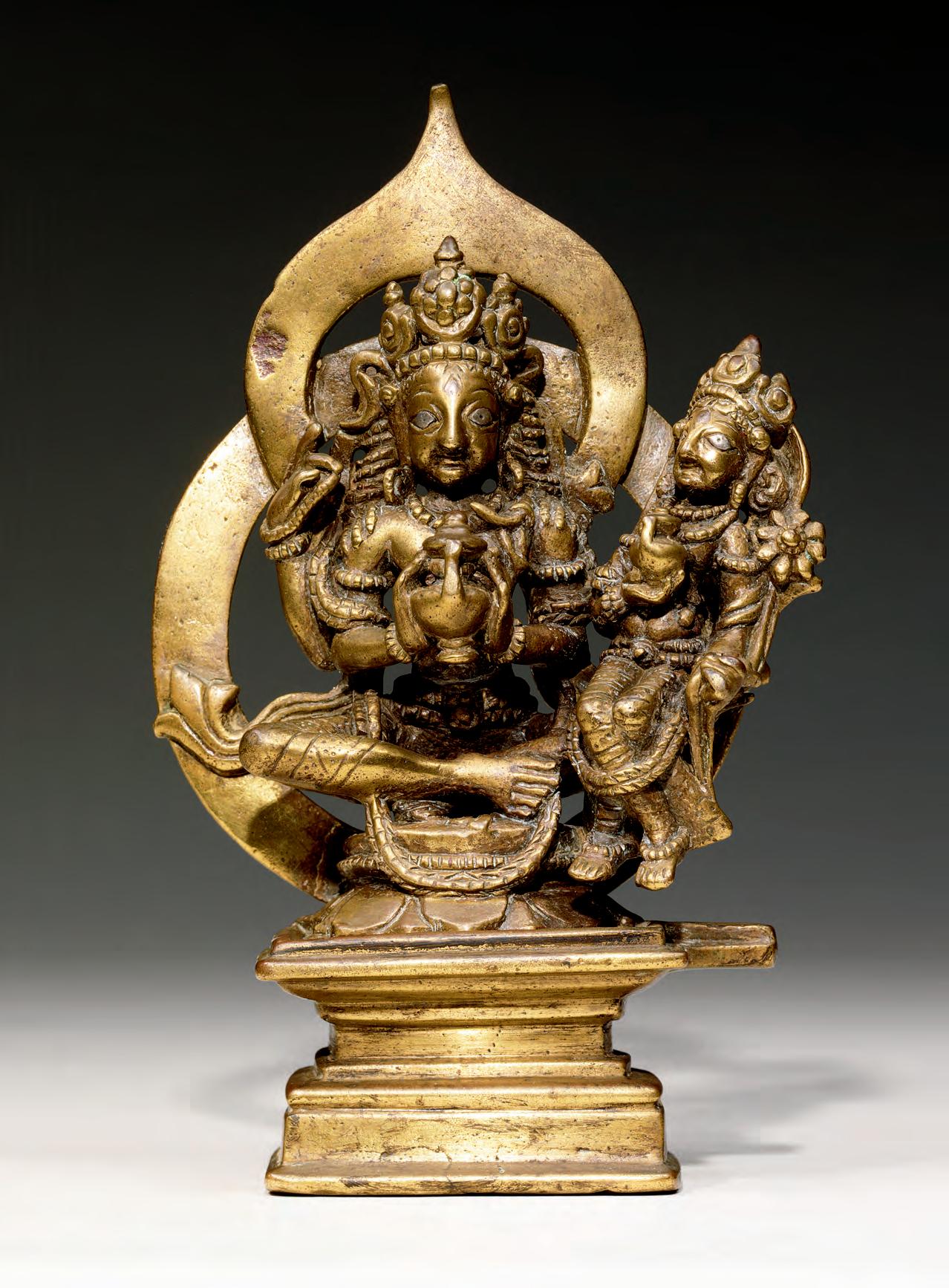
A rare form of Uma-Maheshvara
Shiva is seated in a yogic posture on a lotus, his principal hands holding a waterpot with leaves. His upper right hand grasps a rosary and the le supports Uma, who is gracefully seated on his thigh. Uma too holds a waterpot with her right hand, and in her le a lotus. is rare image is Kumbhesvara, lord of the waterpot. This bronze is one of the e k o im ge o m - he h r from either K hmir or im ch l r e h
According o Shaiva i h
philosophy, Shiva’s in nite power remains concealed until he is in the company of his consort Uma (Sa Uma). In her presence he reveals his benevolence and through her his grace is comprehended. Images of Shiva together with Uma are known as Umasahitamurti and with the addition of their infant Skanda the image becomes Somaskandamurti. Since Shiva was believed to confer his blessings upon devotees most readily in this form it was imperative for every temple to have a Somaskandamurti and this iconographic representation was extremely popular. An early iconographic representation of this form of Shiva is a charming stone relief of circa 7th century date, from the Pallava period, now in he collection of the National Museum, New Delhi (S. Kramrisch, Philadelphia, 1981, cat. 55, p.67). In this tender family portrait we see the divine couple seated in a relaxed posture
with the infant Skanda on his mother Uma’s lap. The iconography was conventionalized in bronze images such as the magnificent 8th century sculpture in the collection of the Government Museum, Madras (K. Khandalavala (ed.), , New Delhi 1988, fig. 4, p.14 ) here hi m re
e e o iere li h or
h r ee m rom r i ic ico ogr hic oi hi rre i g
c l re em o ie he e e i l li ie o hi m heir
io i m ol o com le e e i like or i me i g ( Kr mri ch hil el hi
1981 iii) hi e i e o er l che eem o e i l e i h re h
i ce i h i romi e e re
r i e c lm i i i i
mi m che e rri g m oli e he
i cor or io o o h m le em le e ergie i o i gle o he he
c l re r i e o o l hi
e l o hi m e
re g h he imm le m i cie
ei g ho ge er e he e er l c cle
o cre io e r c io m
li he le orm i em o ime o e er ec io hile her ge l
mili g ce em e iri l
e he ic o er o i r e
ligh l i r o ce her lor hi
ceme i g heir io i i g
hem oge her i e erl i g im ge
o o er m e e e ole ce
r ce e ce o li h
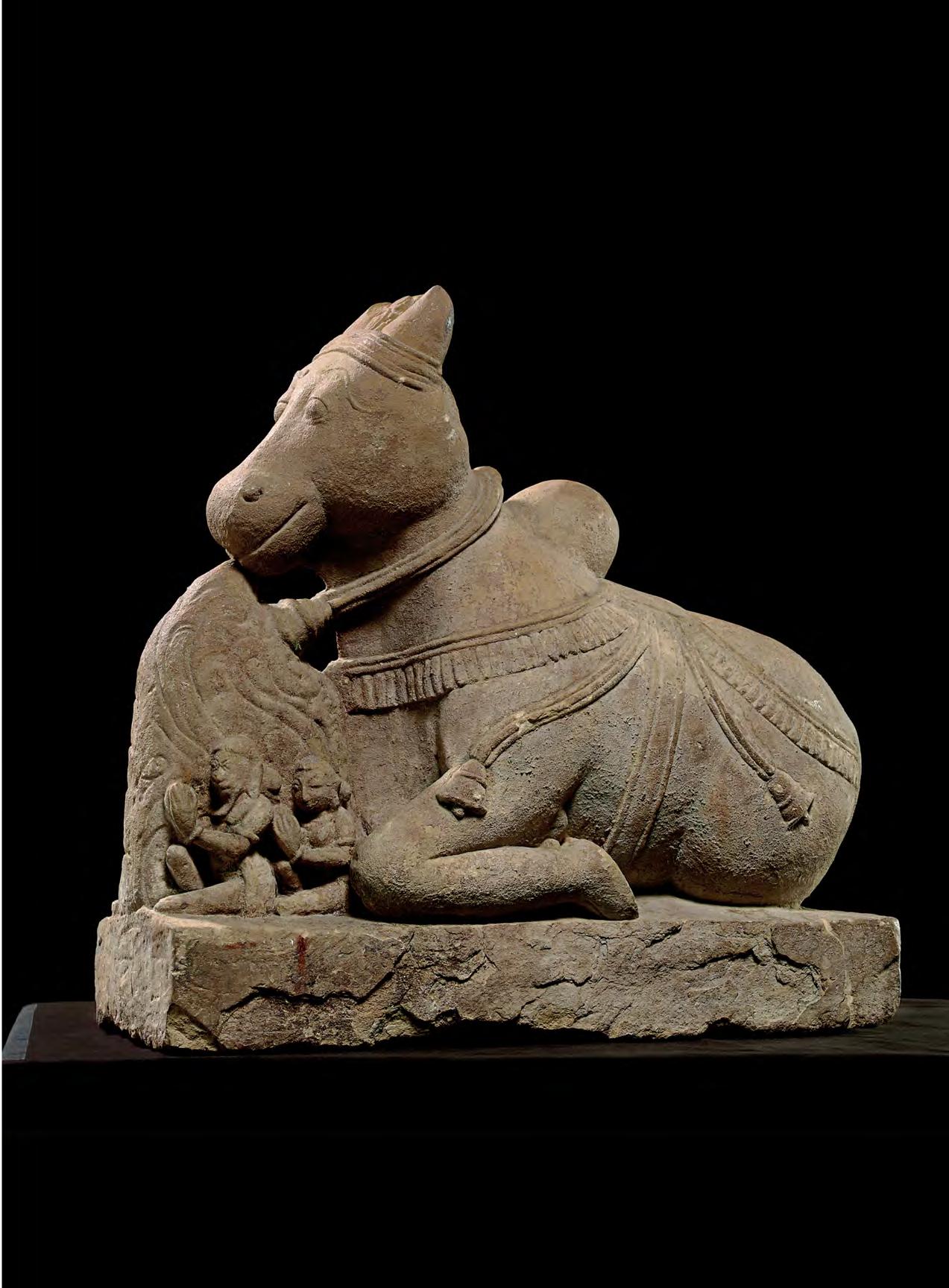
of Nandi
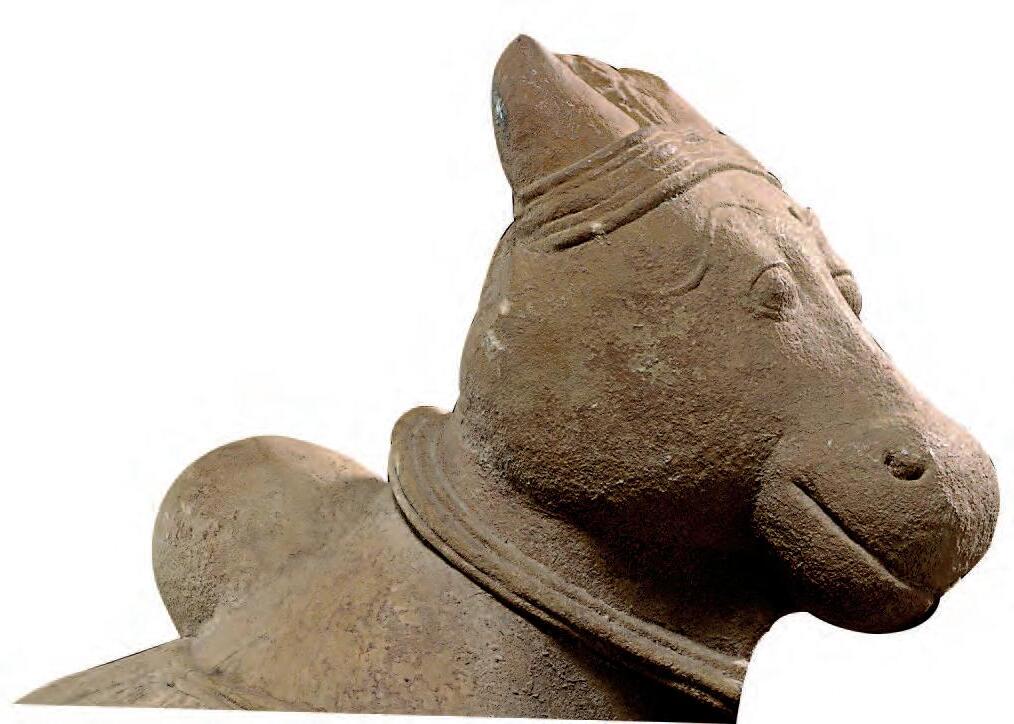
Circa 12th century
Rajasthan or Uttar Paradesh
Sandstone
23 in. (58.3 cm )
ro e ce ri e collec io c ire i 1990 hri ie e ork e em er 21 200 lo 63
Sacred white bull and vehicle of Shiva, Nandi serves as guardian, gatekeeper, and mount to the mighty destroyer god. Nandi has been identified as Shiva’s vehicle, or vahana, as early as the Kushan period in the first century CE and has been a subject of exaltation throughout India, Vietnam, Cambodia, and Indonesia. Some claim that reverence for bovines in the Hindu religion stemmed from the status given to Nandi as Shiva’s vahana, especially in Uttar Pradesh. Sculptural forms of the bull frequently appear outside of temples dedicated to Shiva and are positioned to face the sanctuary where the main representation of Shiva would be located to demonstrate his reverence of the god. In the present figure, the worshippers positioned in front of Nandi were likely included to represent additional devotion, as they would be facing the most highly regarded space in the temple complex. Nandi sculptures are so prolific at these sites of worship that it is rare for a Shaivite temple to be missing an image of the bull.
In the Ramayana, it was Nandi who cursed Ravana, king of Lanka and the Ramayana’s main antagonist who kidnapped Rama’s consort Sita. As gatekeeper, Nandi refused Ravana’s request to meet with Shiva. Ravana taunted and teased Nandi in an attempt to get his way, but this only irritated the bull, causing him to curse the demon king, foretelling that Lanka would be burned to the ground by a monkey. This later came to fruition when Hanuman rescued Sita and destroyed Ravana’s kingdom. Nandi’s importance in Shiva’s wyrd originates from early Indian culture, where dairy farming was the most significant occupation, giving the cow great status. Vahanas represent the overriding and neutralizing power of gods over creation and ability to control and transform energies within the universe. Each vahana is speci c to their deity: Garuda serves Vishnu as the sun god, Ekahamsa (One Swan) serves Brahma as the creator god who initiated creation through water, and Nandi serves Shiva as a symbol of fertility. Since Shiva was worshipped with great fervor in South India where the majority of his temples exist, it is clear why most Nandi sculptures originate from the south. While there are figures of Nandi that hail from the North, they are less common, giving the present figure an added level of dynamism. or imil r h i e m le o i ee c l re rom he collec io o r r l E heim ol hri ie e

Saraswati
Circa 1200, inscribed Rajasthan, India
Stone Stele
17 3/4 in. (44.86 cm.)
ArtLoss no. S00132165
Provenance
From a private Georgia state

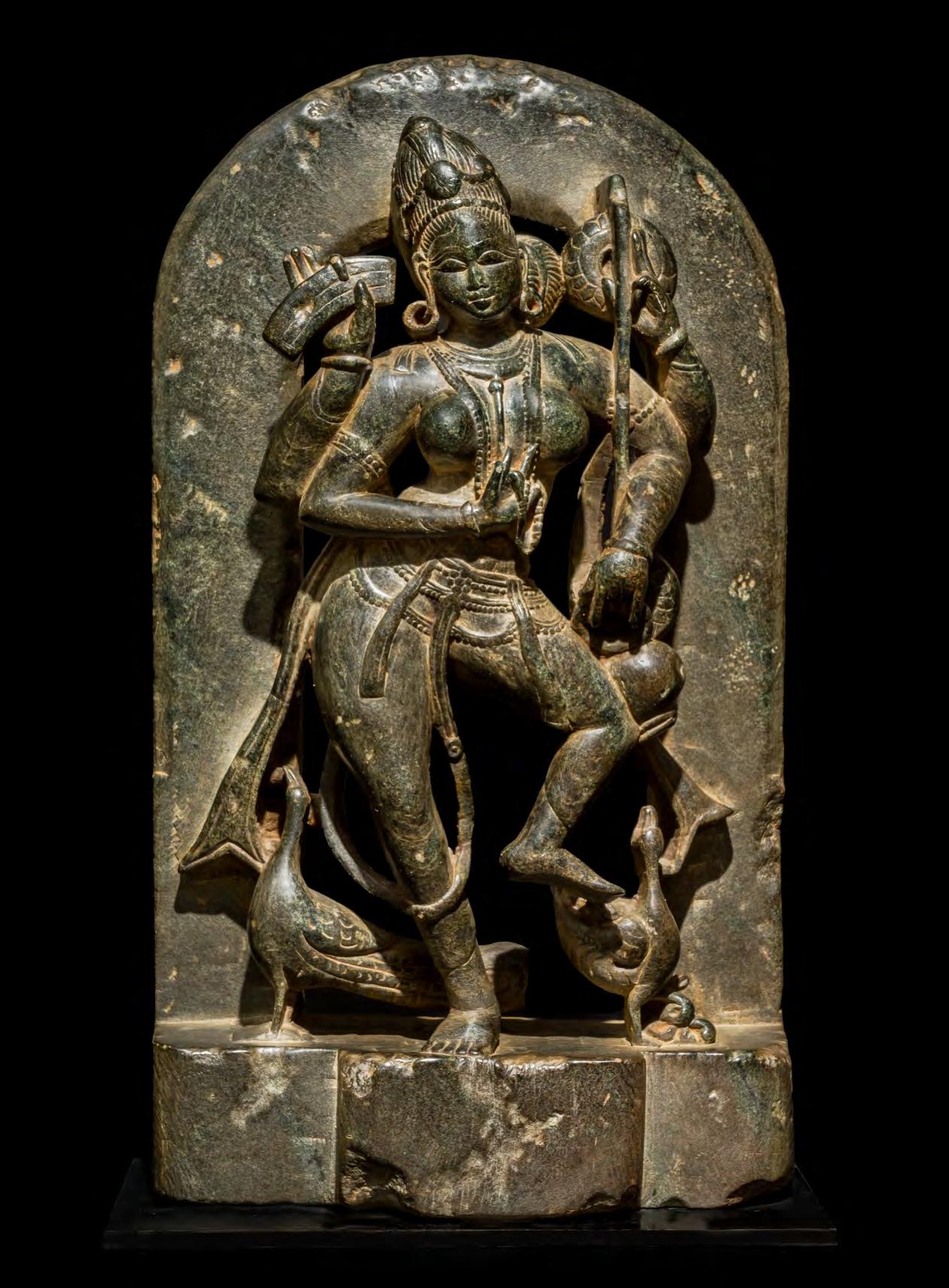
The goddess is sensuously carved, dancing in the foreground rendered with an elegant tribhanga, the veena in her left hand, in her others a mala, rosary, and a sutra, wearing beaded necklaces and a tiara. At her feet her vehicle, the peacock, looks up along with a companion.
Saraswati, the one with the lovely voice, is the goddess of music, literature, poetry and wisdom. She is a part of the trinity along with Lakshmi and Parvati, a counterpart to the Trimurti known as the Tridevi.
All the three forms help the trinity of Brahma, ishnu and Shiva to create, maintain and regenerate the universe respectively through their Shakti. Saraswati is the holy consort of Brahma, complimenting his role as creator through her cultural attributions.
Initially a indu deity, her image was eventually absorbed into Buddhism and became prevalent throughout Buddhist Asia as the epitome of female wisdom and the consort to the Bodhisattva Manjushri.




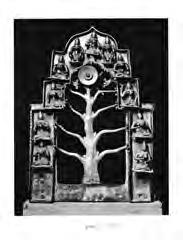
Kalpavriksha, e Wish- Ful lling Tree
Circa 15th century
Western India Brass
28 in. (71 cm )
Provenance:
Ex Collection Jay C Leff [1925-2000], acquired by 1960
Near & Far Eastern Art, Property of Jay C Leff and Another Collector, Parke-Bernet Galleries, 980 Madison Ave, New York, 9-10 May, 1969, Lot 140
o he e ork 26 rch 1998 o 66 li he Exhibited:
, American Federation of Arts, October 1965- October 1967, No. 64 By: John F. Haskins
, Los Angeles County Museum of Art, November 6, 1994 – January 22, 1995, cat. No. 64 By: Dr. Pratapaditya Pal
, Art Gallery of New South Wales, June 12 – August 24, 1997, cat. No. 81 By: Dr. Jim Messelos, Jackie Menzies and Dr. Pratapaditya Pal
Published:
e e o ei r r ol ge 8 r r h ehe i August 2005, Page 10
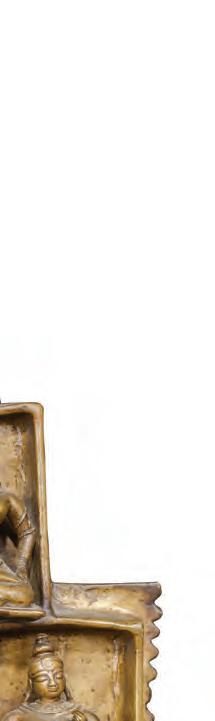
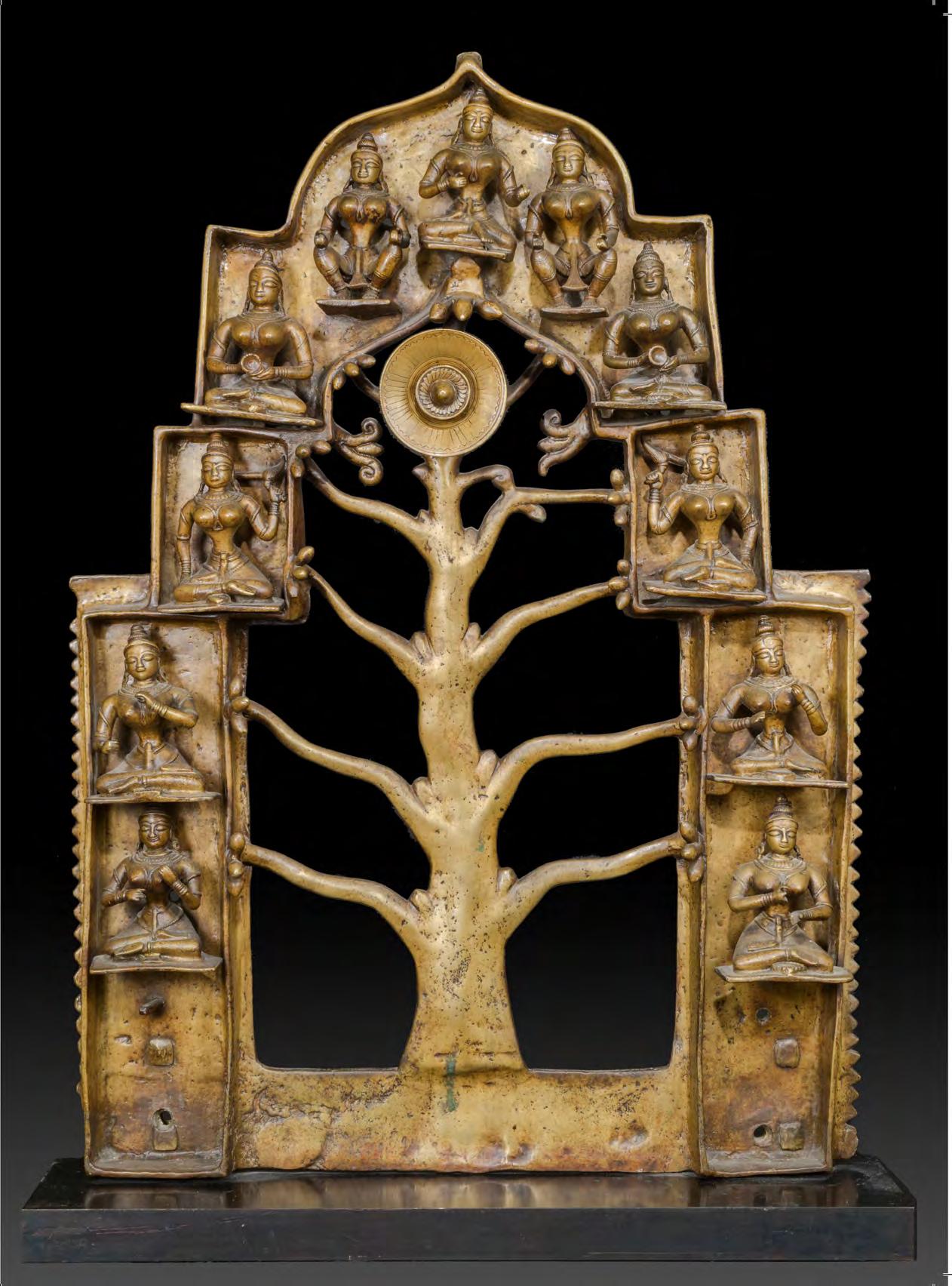
“ is unusual throne-back is fashioned in the form of a large tree surrounded by a framework containing eleven seated female gures. Close inspection of the tree reveals bunches of three mangoes at the juncture of each limb with the outer frame; this indicates that the now missing main image





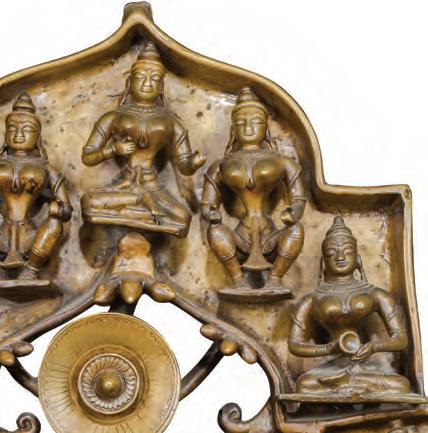
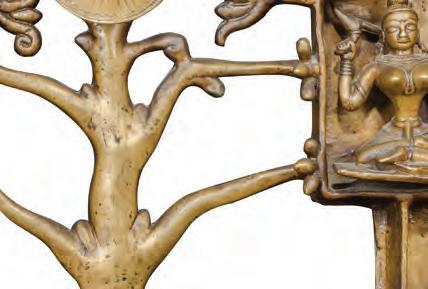





an earlier










the mango tree under which she is frequently depicted. e female gures in the outer frame are all musicians, except for two attendants bearing ywhisks at the level where the head and shoulders of the main image would have been. e two gures directly above the ywhisk bearers hold hand cymbals, and the remaining gures can also be identi ed as musicians, since their hands are in positions typically used to hold musical instruments; these must have been separately cast and have not survived. e juxtaposition of Ambika with a retinue of female musicians and attendants follows an earlier Western Indian tradition, as there are several reliefs at Mount Abu that portray the goddess with such company (Shah 1987A, g. 154; Tiwari 1989,56- 57. gs. 1617). It is possible that the female gures are meant to be devata (subsidiary goddesses), but the position of their hands argues against this since they would have typically held religious attributes in di erent positions (Shah 1987A, g.
148; Tiwari 1989, 83, g. 36). Originally there must have been an additional gure at the base of the frame on each side. ese were either musicians, attendants, or perhaps Ambika’s two sons, Siddha and Buddha. A foliate nial presumably once surmounted the frame. Not only is this a representation of Ambika’s mango tree, but it is also the well-known celestial wish-fulfilling tree (Kalpavriksha). e wish ful lling tree is associated with Ambika in a number of Jain texts, such as the late twel h century Nemichandra’s Lilavati Prabandham (Shah and Dhaky, 38). e Jains believe that there are ten types of wish-ful lling trees, which ‘always give to the people whatever they desire without e ort on their part’ (Shah 1955. 75). e rewards of worship include wine, dishes of delicacies, ne apparel, musical instruments, lamps, wreaths, ornaments, houses, and divine luminosity.” -Dr. Pratapaditya Pal, not survived.


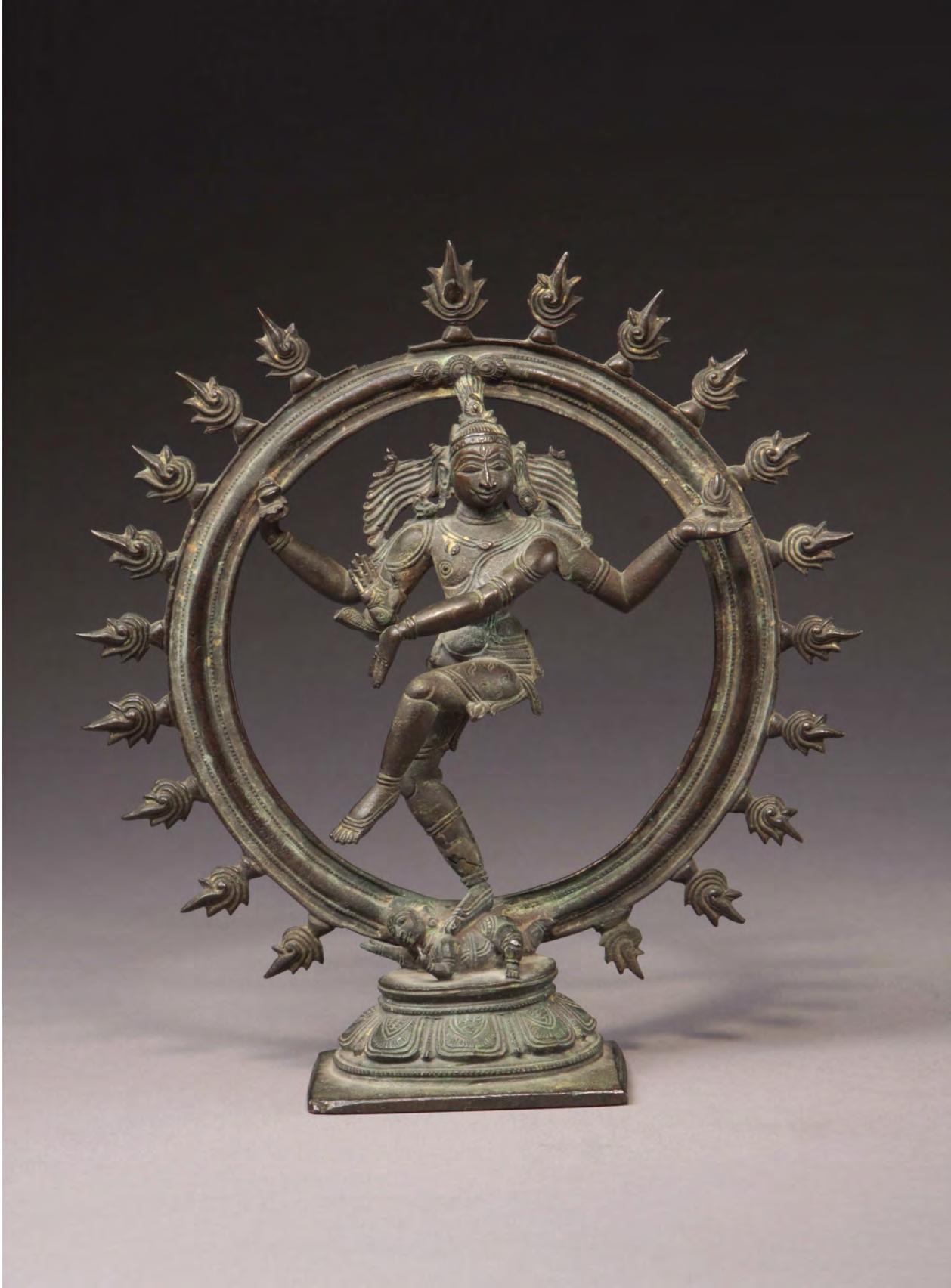
Shiva Nataraja
Circa 16th century
South India Bronze
6 1/2 x 6 x 2 in. (16.5 x 15.3 x 5 cm.)
ro e ce ri e elgi collec io c ire i 1979
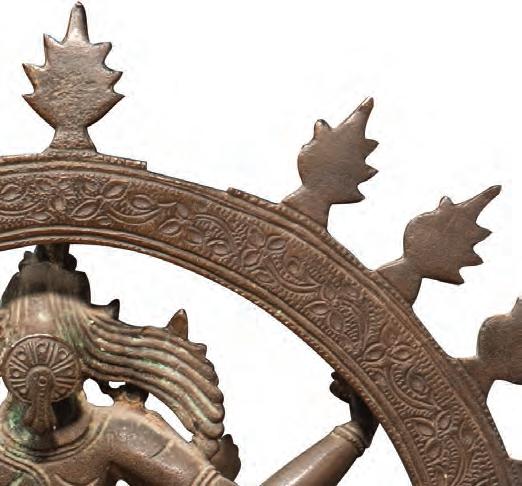
As a symbol, Shiva Nataraja is a brilliant invention. It combines in a single image Shiva’s roles as creator, preserver, and destroyer of the universe and conveys the Indian conception of the never-ending cycle of time. Although it appeared in sculpture as early as the h century, its present, world-famous form evolved under the rule of the Cholas.
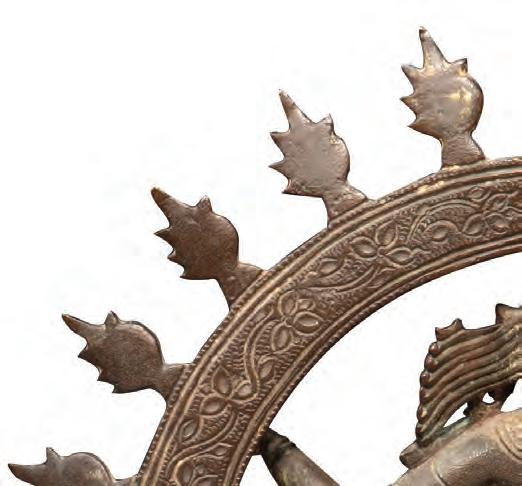
hi ce i e i hi flaming halo. The god holds in his upper right hand the damaru (hand drum that made the first sounds of creation). His upper left hand holds agni (the fire that will destroy the universe). With his lower right hand, he makes abhayamudra (the gesture that allays fear).
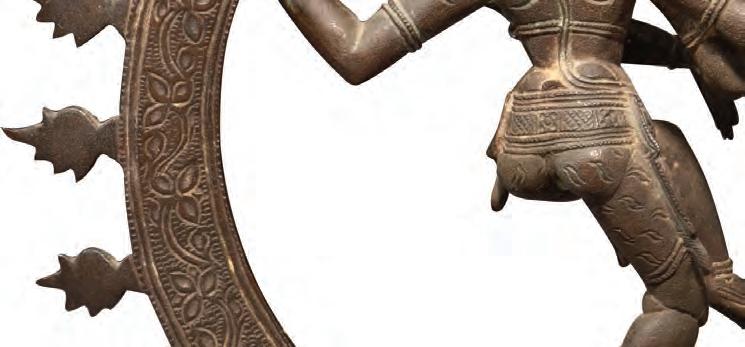
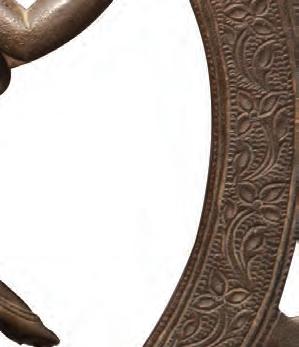
he dwarflike figure being trampled by his right foot represents apasmara purusha (illusion, which leads mankind astray, the dwarf of ignorance). Shiva’s front left hand, pointing to his raised left foot, signifies refuge for the troubled soul. The energy of his dance makes his hair fly to the sides. The symbols im l h through belief in hi hi e o ee can chie e l io


Vishnu
Circa 1300, late Chola Period
South India
Bronze
23 1/4 in. (59.4 cm.)
ro e ce
o he e ork e em er 20 h 200 o 69


e four-armed deity stands erect in samapada on a circular lotus base supported by a multi-tiered square plinth. His principal right hand is in the fear dispelling abhayamudra.
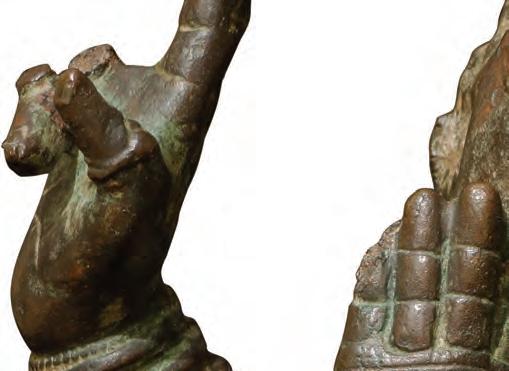
e preserver is adorned in a tall jeweled crown, several necklaces and foliate armbands. His broad shoulders are accentuated by a tapered waist and soft bulging belly His elongated torso supported by muscular legs covered in a nely incised patterned veshti, which is elegantly knotted on both sides and secured by a wide girdle with a kirtimukha at the center. Meant to be viewed in the round, the back of the sculpture is no less masterful than the front. His muscular back and pronounced buttocks project three-dimensional power. His teardrop shaped face is accentuated by arching eyebrows, almondshaped eyes, a straight aquiline nose, and gently smiling lips. e sensuous
modeling coupled with the con dent and assured treatment of form suggests a mature or lateChola date for the sculpture.
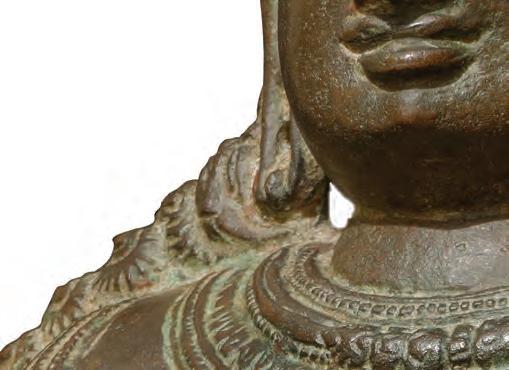
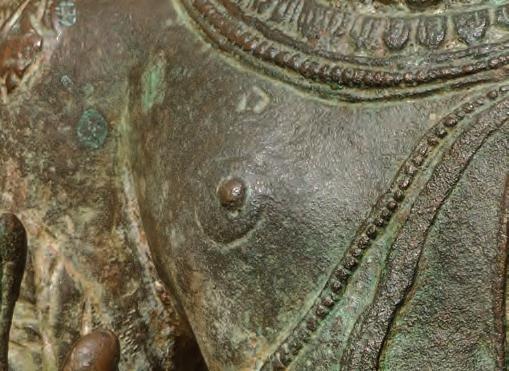

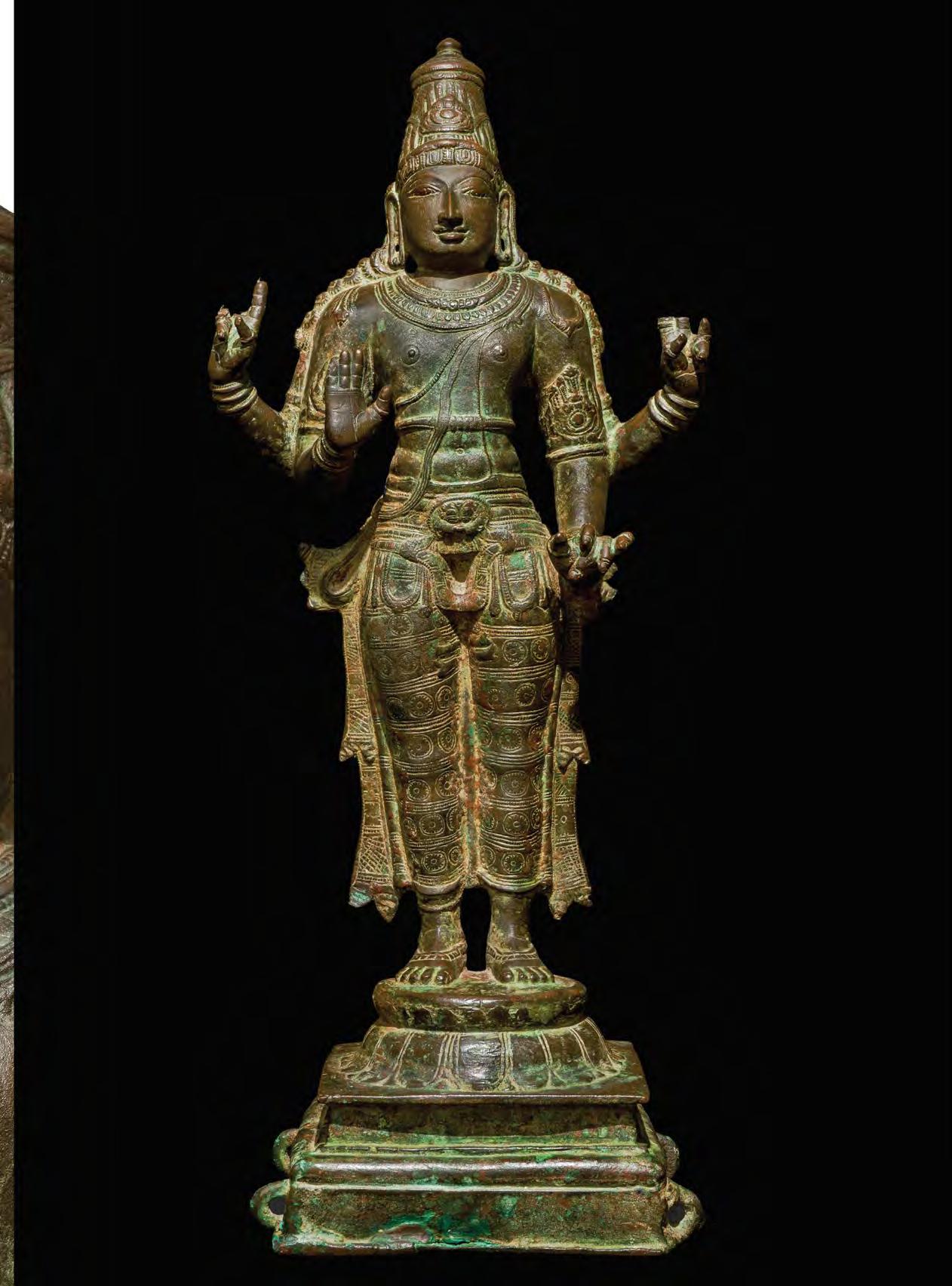
Illustration to the Bhagavata Purana: The Liberation of Nalakuvara and Manigriva
Attributed to Manaku
Circa 1760-1765
Basohli, India
heightened with gold on paper
Image: 9 13 1/2 (35 x 23.5 cm.)
ro e ce
he ollec io o he l e re rr ( 16 h e em er 2011)
i mi h ( 26 h rch 2014)
cri e i r m khi e 3 o o o er o
cri e i kri 10 h h er 10 h ook le 32 i ce er o er o
h g 10 h ch er 10 h ook k o o om o er o

The narrative that this painting illustrates comes from the 10th book of the Bhagavata Purana, with Krishna’s habit for mischief contributing itself to the scene. After being caught repeatedly trying to steal butter by his foster mother Yasodha, she tied him to a wooden mortar to keep him from trouble. Many years prior to this, two yakshas Nalakuvara and Manigriva, sons of Kubera, were cursed for their pride to be bound in the form of two arjuna trees. Through his omniscience, Krishna is aware that the arjuna trees contain the souls of these yakshas, so he carries the mortar on his back and wedges it between the trees, using his great strength to uproot them, the two brothers emerging from the fallen timber. These figures are shown crowned in the center of the painting, offering praise to Krishna to express their gratitude.
s habit for mischief




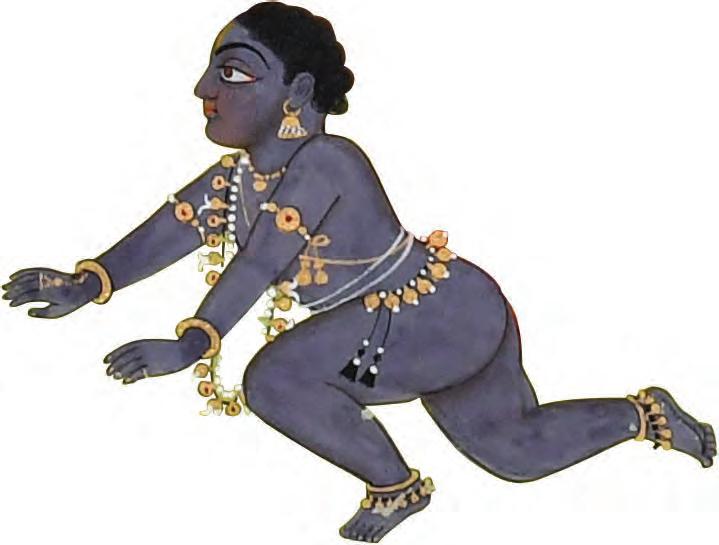
e Bhagavata Purana that this work hails from dates to 1760 - 1765, and is commonly known as the “Large GulerBasohli Bhagavata Purana,” or the “Fi h Guler-Basohli Bhagavata Purana.” is series is known for its use of broad landscape with few gures, exemplary of a transitional Basohli style, and each painting in the series has an identifying inscription on the reverse in gurmukhi and nagari scripts. e leafs have since been dispersed throughout the world, some of which can now be found in the Victoria and Albert Museum, the Philadelphia Museum of Art, and the Archer Collection (see W.G. Archer, , London, 1973; Visions of Courtly India, London and New York, 1976, no. 8, p. 15; and W.G. Archer and Edwin Binney 3rd, , Portland 1968, nos. 55a and 55b, pp.74-5 for other paintings).
Although debated, this painting was likely executed by Manaku, older brother of Nainsukh, even if he was not responsible for completing the entire series. Manaku has been named as the illustrating artist for a Gita Govinda series completed in the 1730s, as well as the Small Guler Bhagavata Purana completed between 1740 and 1750. Similarities between works in both of these earlier series to the 1760’s Bhagavata Purana indicate that Manaku had a part in completing multiple pieces from the later series.
Compare the yakshas in the present work to “The Sage Kardama Renounces the World,” from the Small Guler Bhagavata Purana in the collection of the Lahore Museum (see B. N. Goswamy, , New Delhi, 2017, p. 405, no. B35); the same rendering of facial hair and ornate jewelry nod toward the claim that Manaku was the author of both. In addition, realistic detail is ascribed to the trees across Manaku’s known oeuvre, re replicated in the arjuna trees shown here. Some scholars argue that this later Bhagavata Purana was illustrated by Fattu, son of Manaku, but it is likely that he only completed some of the works in the series. One last thing to note is that these series are typically completed in chronological order, following the progression of the text, meaning that the present example would have been executed earlier than others within the series, making it more plausible that the hand of Manaku was responsible for this painting.
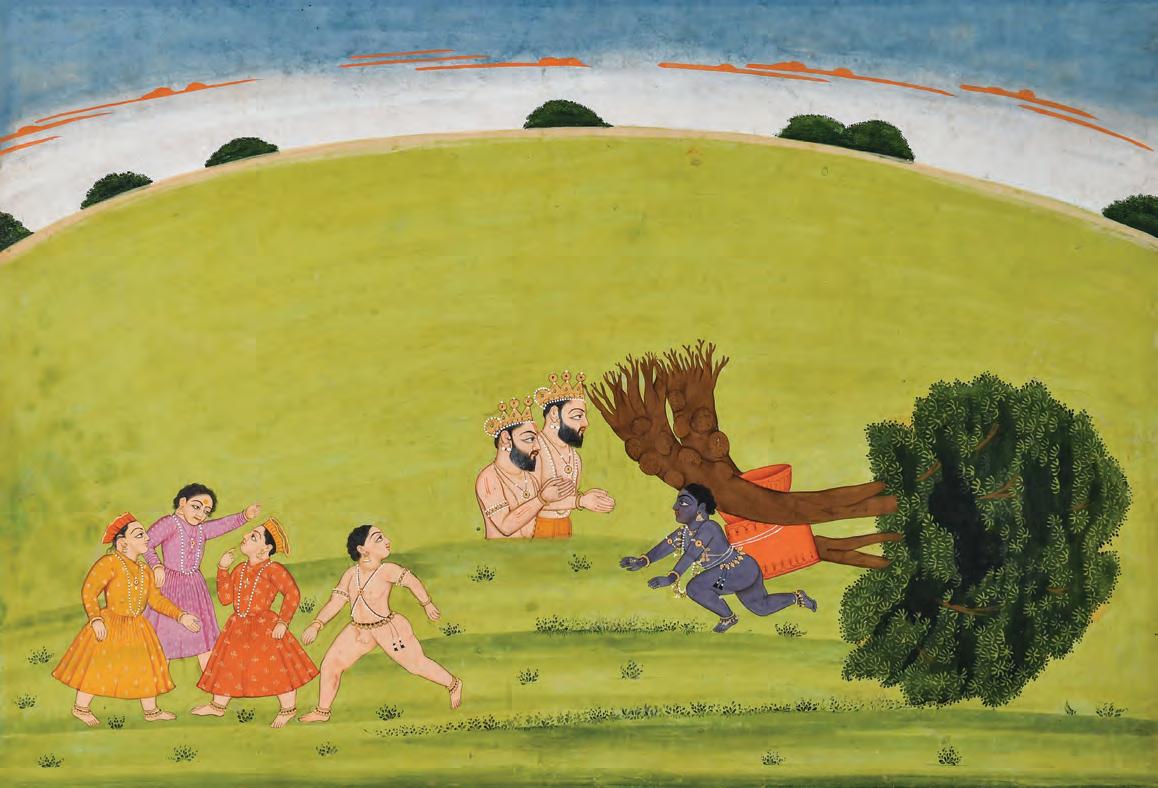
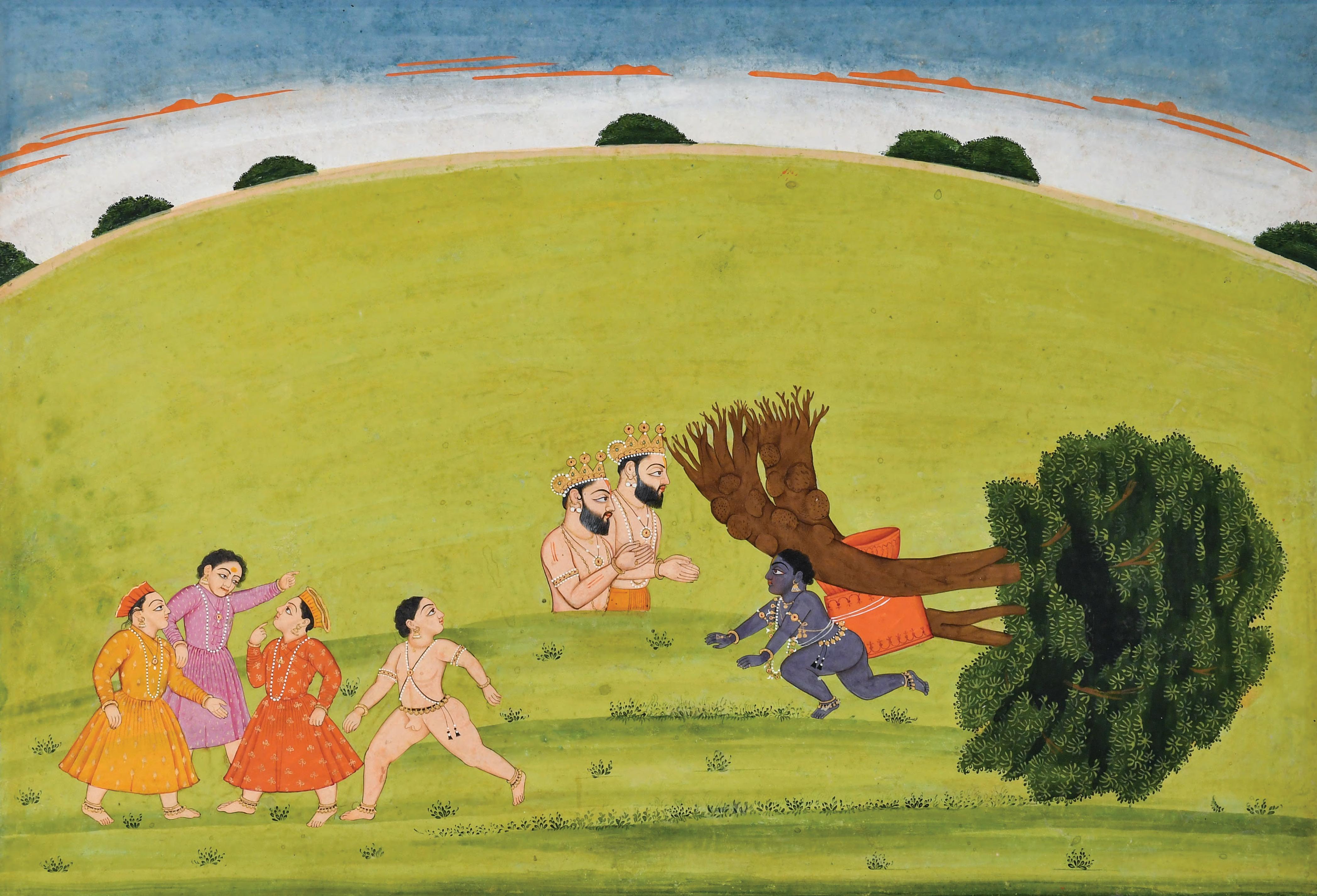
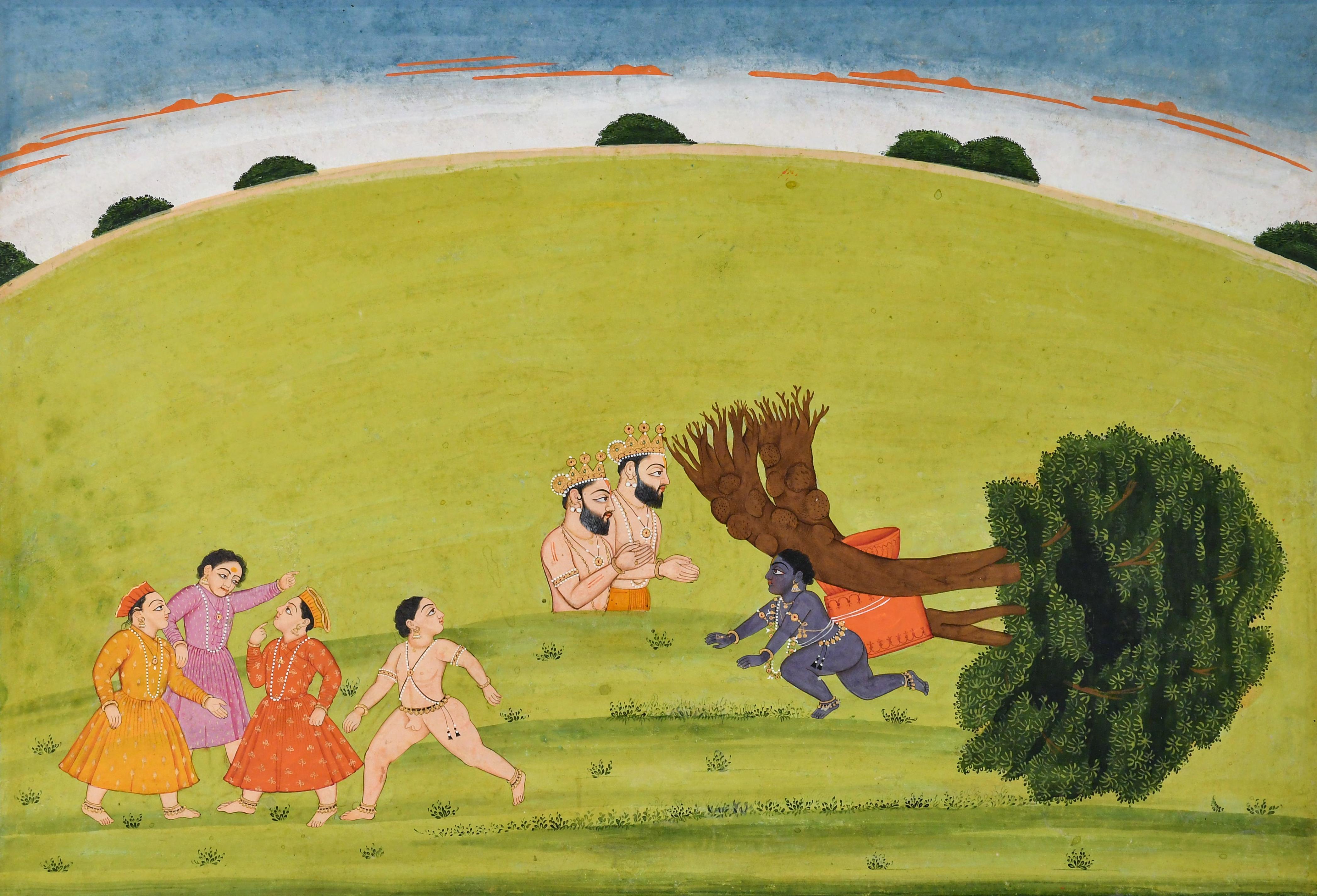
Leaf from a Gita Govinda series: Radha vents her frustrations
First generation after Nainsukh and Manaku Circa 1775- 780 Kangra, India
heightened with gold on paper 7 x 10 5/8 in. (17 x 27 cm )
ro e ce
r coi e l e o relier ri
e eye is rst moved to a landscape showing the forest in spring time. Radha is garbed in a semitransparent skirt comprised of mute colors, brief bodice and bare midri while sitting
beside a bank of the Yamuna surrounded by a grove of trees, gazing over her shoulder to the right as her con dante in a violet skirt and orange wrap draws her attention to the topic of Krishna. Radha’s dress is elegant albeit simple, the upper portion a choli and a ghaghra skirt around her waist cascading into gentle folds. A transparent orhani is draped around her body. Paramount attention to detail can be seen in the diaphanous materials depicted on her outfit as well has her intricate jewelry, copious but not gaudy she is adorned with gold, emeralds, and pearls, as well as a nose ring. e ground is lush, boasting multiple shades of greenery.
e vakula and tamala trees stand proud and lush, their leaves dark and odorous.
e setting is established with meticulous care, great love is placed
into every brushstroke. e small rises of the terrain, undulating ground all give a feeling of vast space and openness, but in such a way that attention is not drawn to wander from the foreground in which Radha and her companion are engaged in discussion. Both the face of Radha and her attendant can be surmised to have been derived from a particular type, the shading of Radha done distinctly more elegantly, demonstrating an intentional status remark. Her face is of “porcelain delicacy ” rounded but in such a matter as to not be “ eshy”. Her features are pronounced and sharp, her lips small (an attractive quality of the time), eyebrows gently arched, eyes gazing so l yet discerningly. “Radha’s body is young and lissome; the limbs tender, the breasts full, hands and feet delicate.” (Goswamy & Fischer, pg 315). Her stance is relaxed and natural, directly mirroring her countenance and echoing her state of mind.
Reference: Goswamy, B.N. and Fischer, E erh r , Niyogi Books, 2009
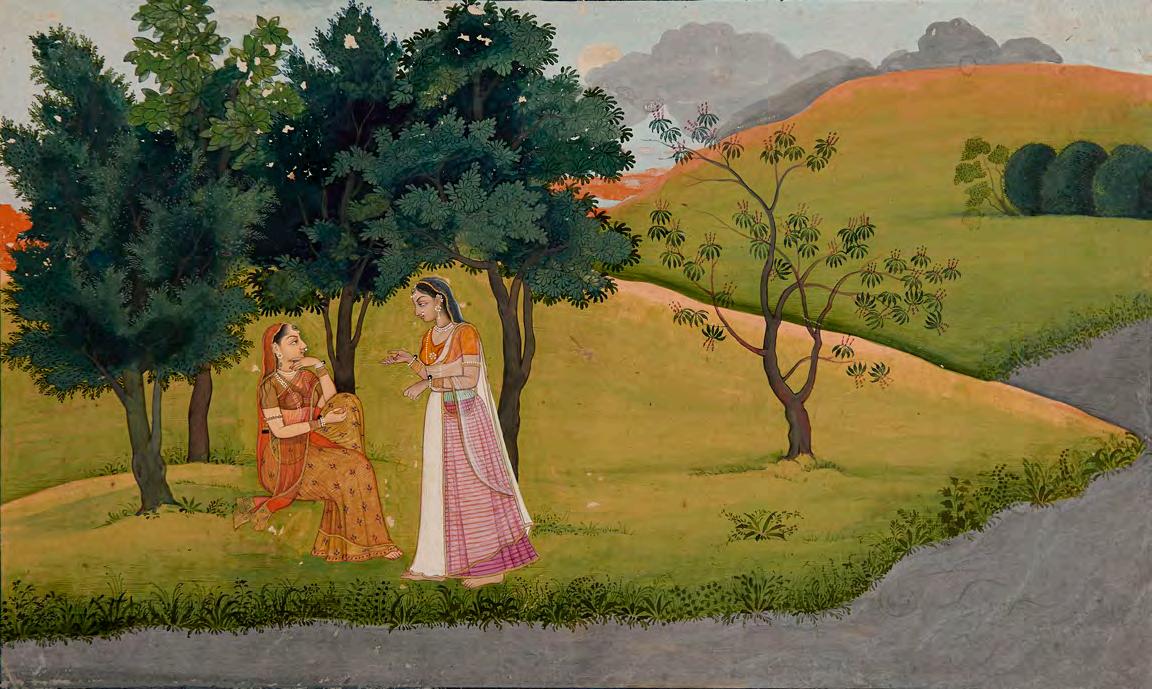
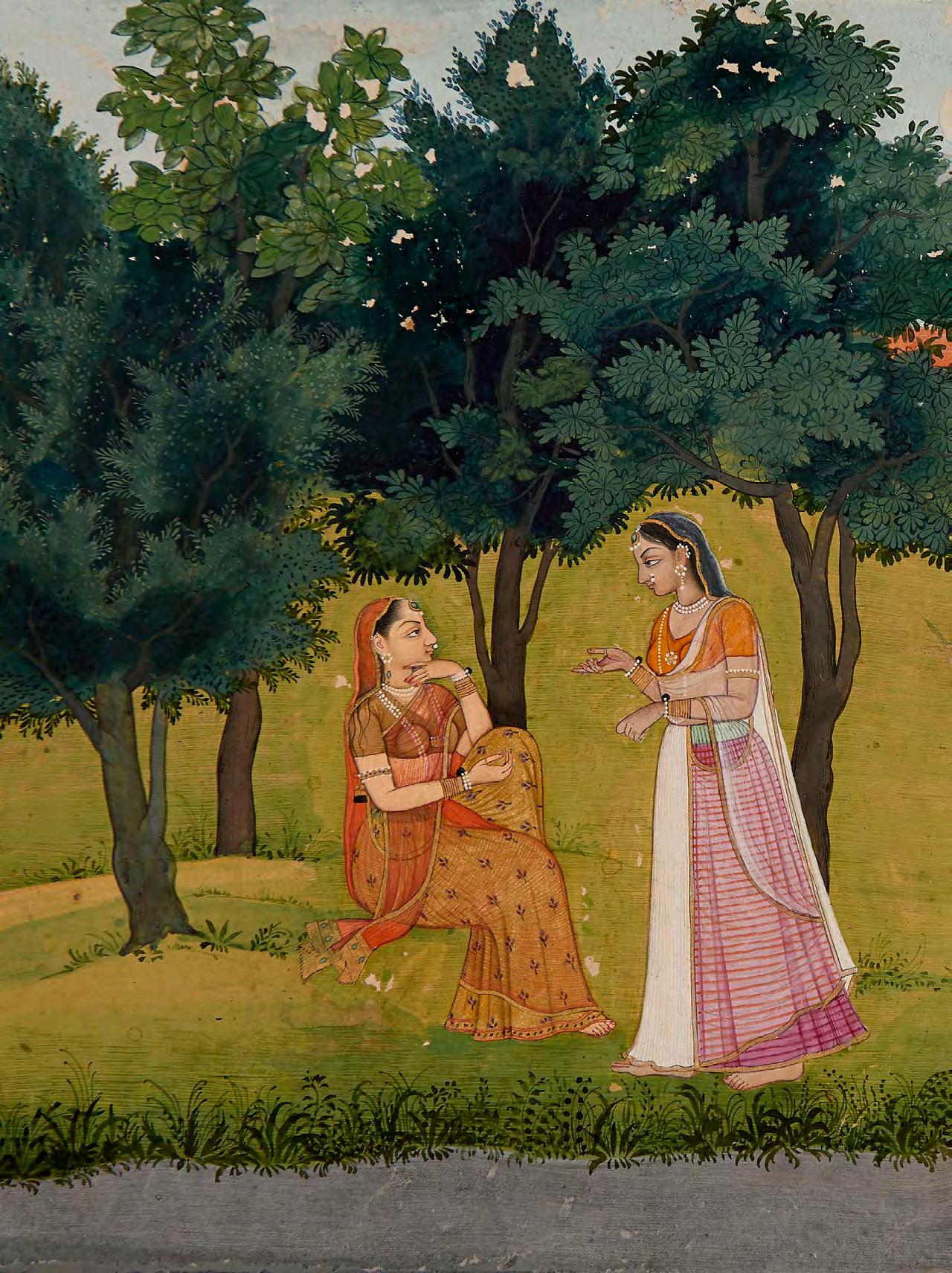
800 28 0 2
ro e ce
rom i i g i he e ork collec io c ire i 1968
cri e o er o i kri h er 7 e 30 i r m khi 24
e e o or e r g er co ere err ce
Kri h hi i e kmi i co er e lei rel re o he i i or h h rri e kmi i i i c r io o he go e k hmi (co or o i h ) re e
ccor i gl i eleg clo he e el he r hm m i or r e o he righ
e eri g he e clo e g r e o mee i h
Kri h
l ho gh he h o ee e ch o her or m e r Kri h m h ee clo e rie r hile
he ere chil re
K o i g h he ch e o ee rie i h Kri h m i e rge him o go o r k k or hel i h i ce he h o hi g o e o or hi ce e e ic he mome here m h e ere r k e ore Kri h re li e he i re e ce or rh l erie e ic i g m e o r k ck ee he ic ori l er e m cce io o
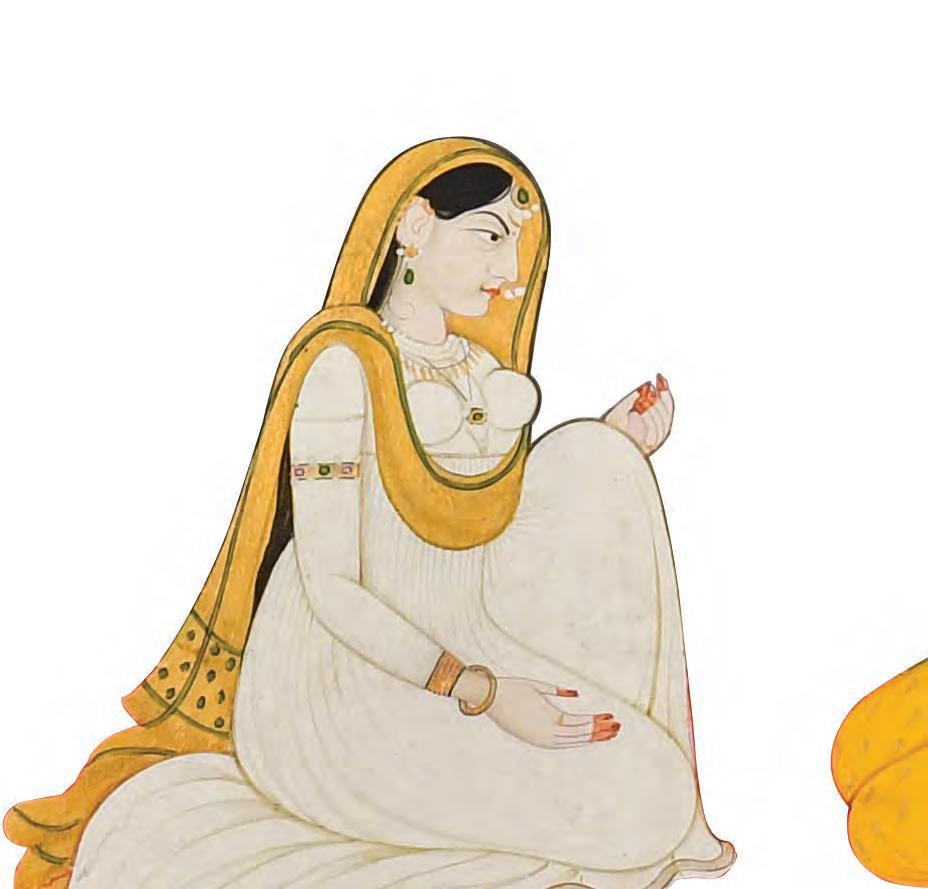
46-19 2
47-19 2
48-19 2
49-19 2
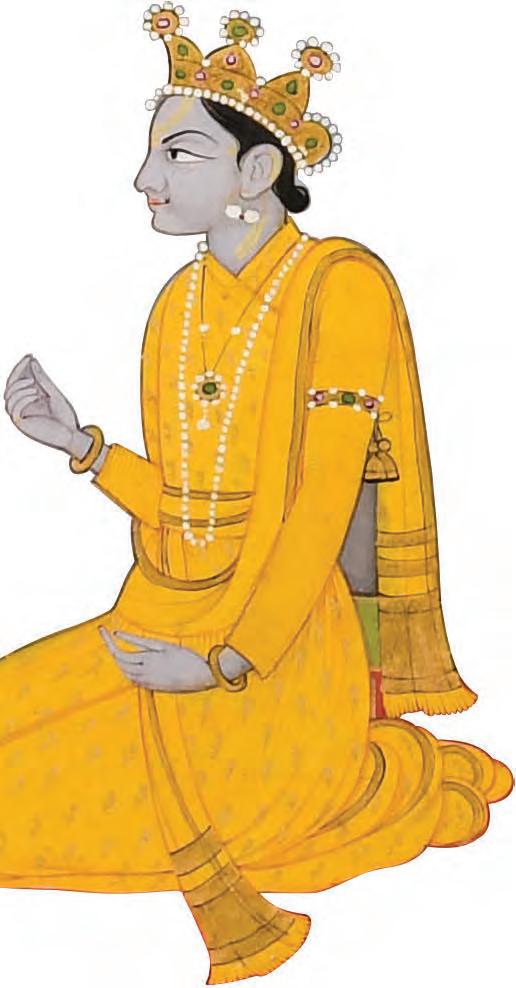
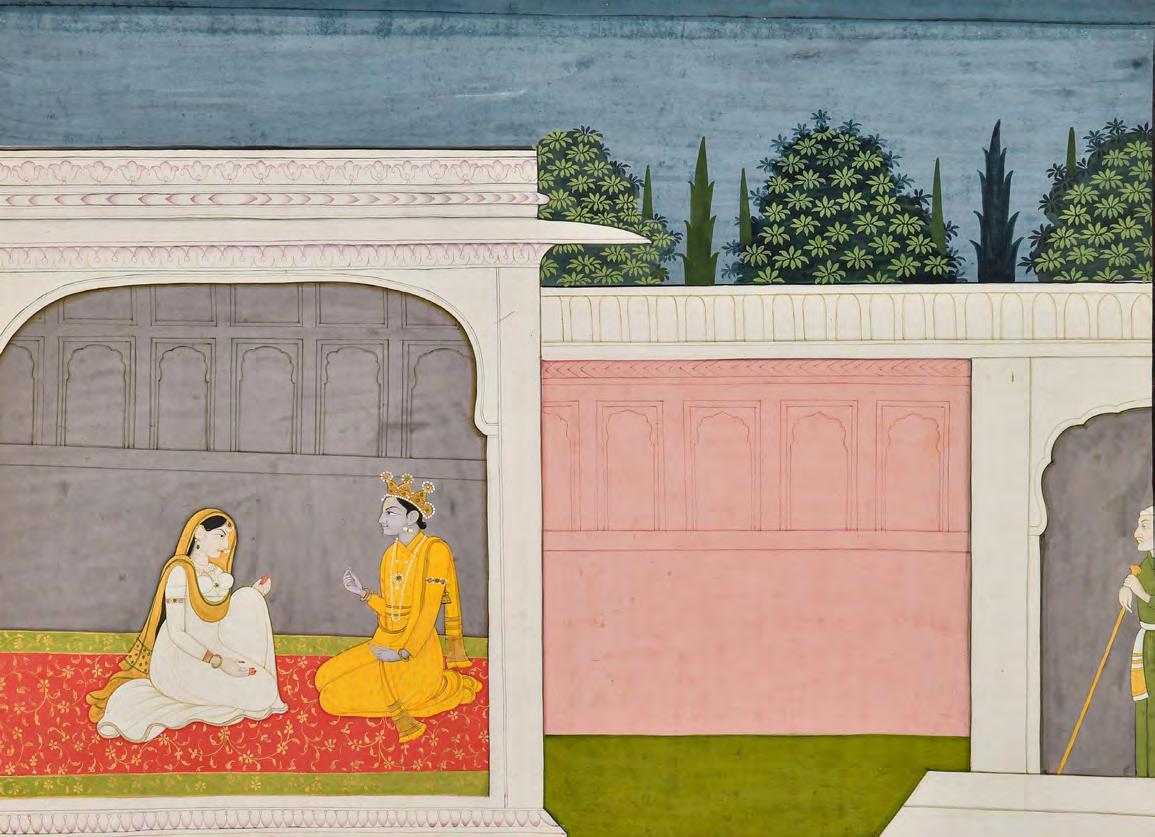
9 0 2
8 29 8 2
ro e ce


rom i i g i he e ork collec io c ire i 1968 1968
E ro e o le om i hree- r er ro l ie - re e i i ee h e r or g e e m er i h le e gree coll re ic o er or ge re e elo e lo i g ello m e c e - e her me c i h o h h er ro c rl h ir i lo g
r i e i h i gle e ele e here or me o her orehe he i he e ge o circ l r r i e hi e i (or erh ell) em lo e er ic l i l e ice o highligh ele e he ec g i he gree gro ri i g o ligh er l o i i e er igri ckgro
er c rl ro h ir ol hree- r er ie ell h he i cer i l o ir her r gi - oreig er ( i r ic l r We er er) i h r ge h i mor l o ec o c rio i ome mocker he o e here i e li e rche l E ro ee igm ic ll i i g l ce he e ge o circ l r i or c hio ri i g er ic ll e e h her - her o c ri g irec l ck
hi i i g re lec he co i o ci io i h E ro e hri i heme e ic e gh l r i heir ro egi i g i h he ir co c i h or g e e e i mi io rie o her i i or o he co r o k r i he i ee h e r he m er o e e ee h e r gh l mi i re e ic i g i gle ig rei cl i g ho e e o im or e e gr i g i i g o We er i lic l heme - he i i ol e g i l co er-o i e gree ckgro he re e ork i o i l er io o e rlier e e ee h e r origi l h likel ro ce elhi i g o he l er Eigh ee h e r

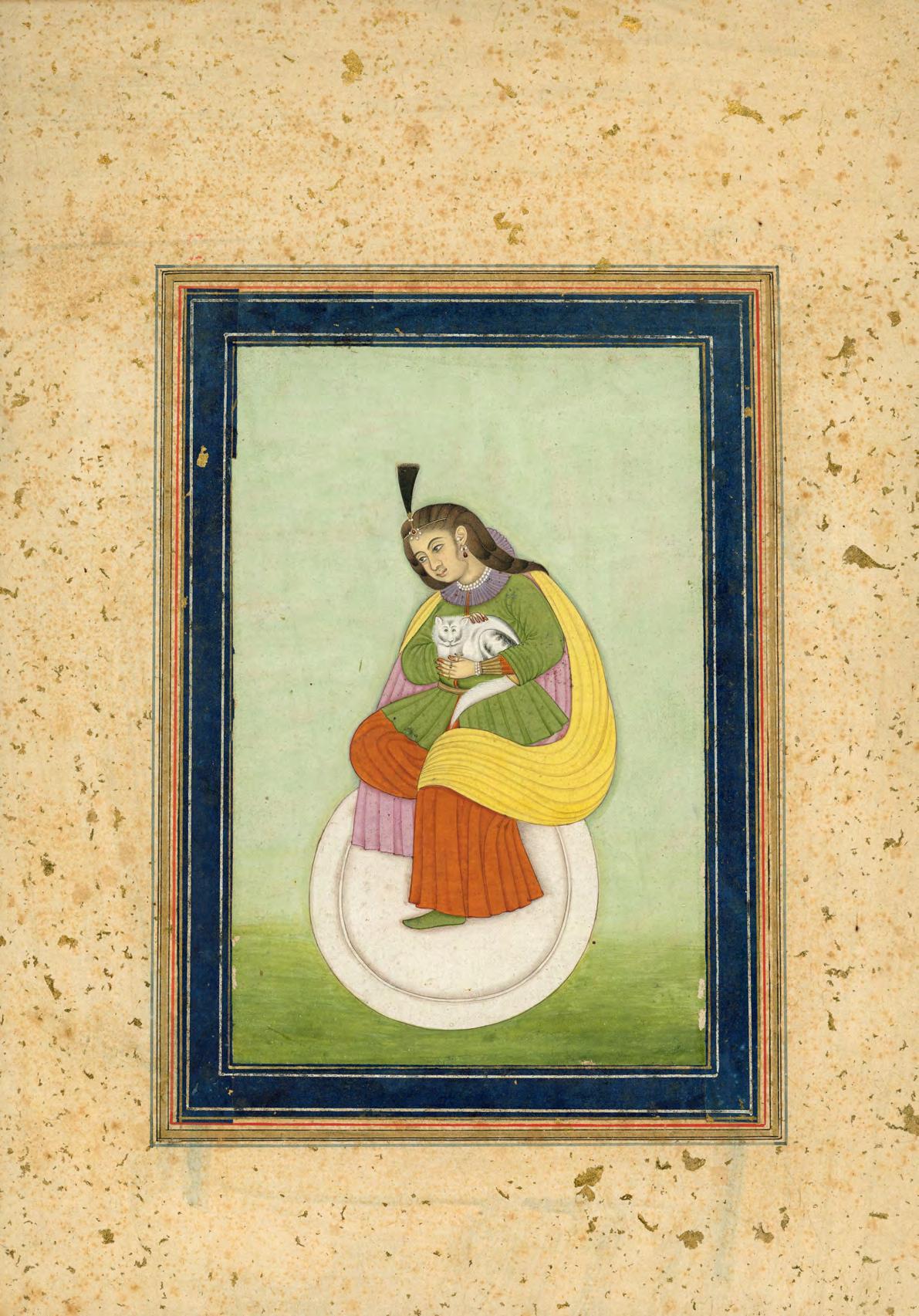
8 2 8 2 2
ro e ce
rom i i g i he e ork collec io c ire 1968
o lem re e or he h i gree m m chi g gri (c ) im rro e ormo iger o i g o rom ehi hillock i r i g re i er k eel ehi - hi h lre lli g hi or rom i c r - i c e he h i g gro e mo g he re ello hill i e o r r i h i li e i k rock or erl li e- o ree rece i g i o he i ce groom hol o llio i he mi le i ce glo i g i k k e o
e e r gh li e - le gri e ri g he gol e - r em lem o he hore cl rmo e e here or me ro hi eck re m l i le r o e rl e el - l r ( or ) gger re cke i hi i
hi i i e li e heroic o h mo or r i o r o rom he r li g hore cl o r r e ic e clo e com i h e remel gero l rge iger - ro l commemor i g hi oric h i g i ci e
l ho gh he me o o r o lem i o i cri e i m e o e h he i o e ic e i h ro l im (h lo) - erh i ic i g he r k o h k r co ec re o e o i ili m e m r i gh hore o g r (1613-1644) i e li e here i h l rge o e l o e e ro h e er-chi - mo or hi heroi m i h ir emerge i ri gle he ck o he eck ell rom he i e r he i e o he e r i r e m che i erh hi mo i i g i hi g ch r c eri ic - i re em le he le o m che ore h r kh i gh o o h r ( 1820-73) ri g ho e reig hi or r i m h e ee ro ce - ro l ro i ci l hik ( ie om) i he or i o r rerh g r




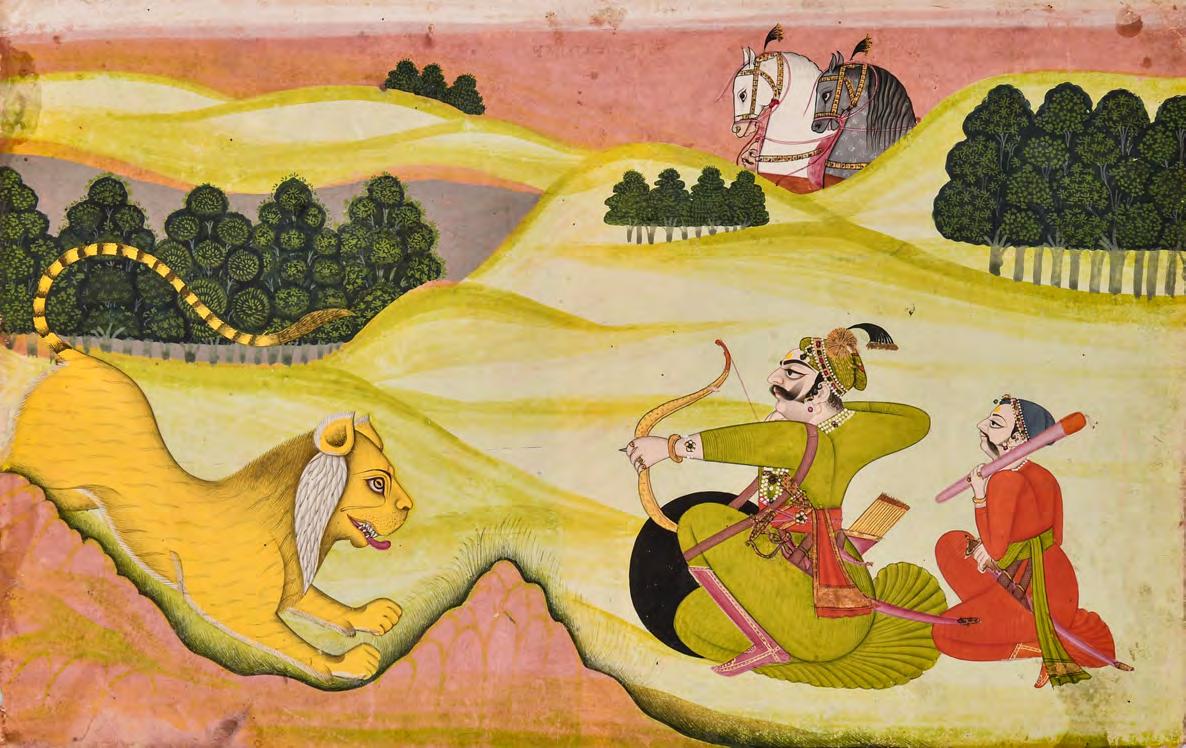
Mahabharata
Circa late 18th - early 19th century Kangra, India
Pen and ink on paper, numerous inscriptions in nagari script 11 1/3 x 12 1/2 in. (29 x 32 cm.)
ro e ce rom ri e E ro e ollec io
he re e r i g e ic ce e rom
he h h r he lo ge oem e er
ri e o e o i gre e e ic
he ge i i o h e ic e ll
100 000 er e o e h he ro
ei o ri er i he 4 h ce r E or
e rlier he rim r rr i e o he
h h r re ol e ro he co lic
e ee he K r ro her reg r i g cce io o he hro e o i r
hi e l o e com e he mo
h g i hich recor co er io e ee Kri h he ri ce r e ore he gre
K r k he r W r
r i g like he o e here ere e ec e re r io or i i g - ig r l o li e o l e com le e rior o he
r i i g o l er o igme o il he mi -20 h ce r h
he e e o r i g ere co i ere ork o r r her h ic eleme
ili e i he cre io o he i i he r ork i el i ce he ho e er i r i g h e g i e more
recog i io r i ic me i m i heir o righ ome o he e r i g c e e e ri e o m er r i e i g
e i i g co ce io o heir oe re hi im ge ho o rmie o he ri k o colli io e ri g h he lio o he righ
i e i r i l ei g o er helme i h olle o rro hi ce e likel e ic o e o he m le h r ge o er he 18 o igh i g ri g he K r k he r W r
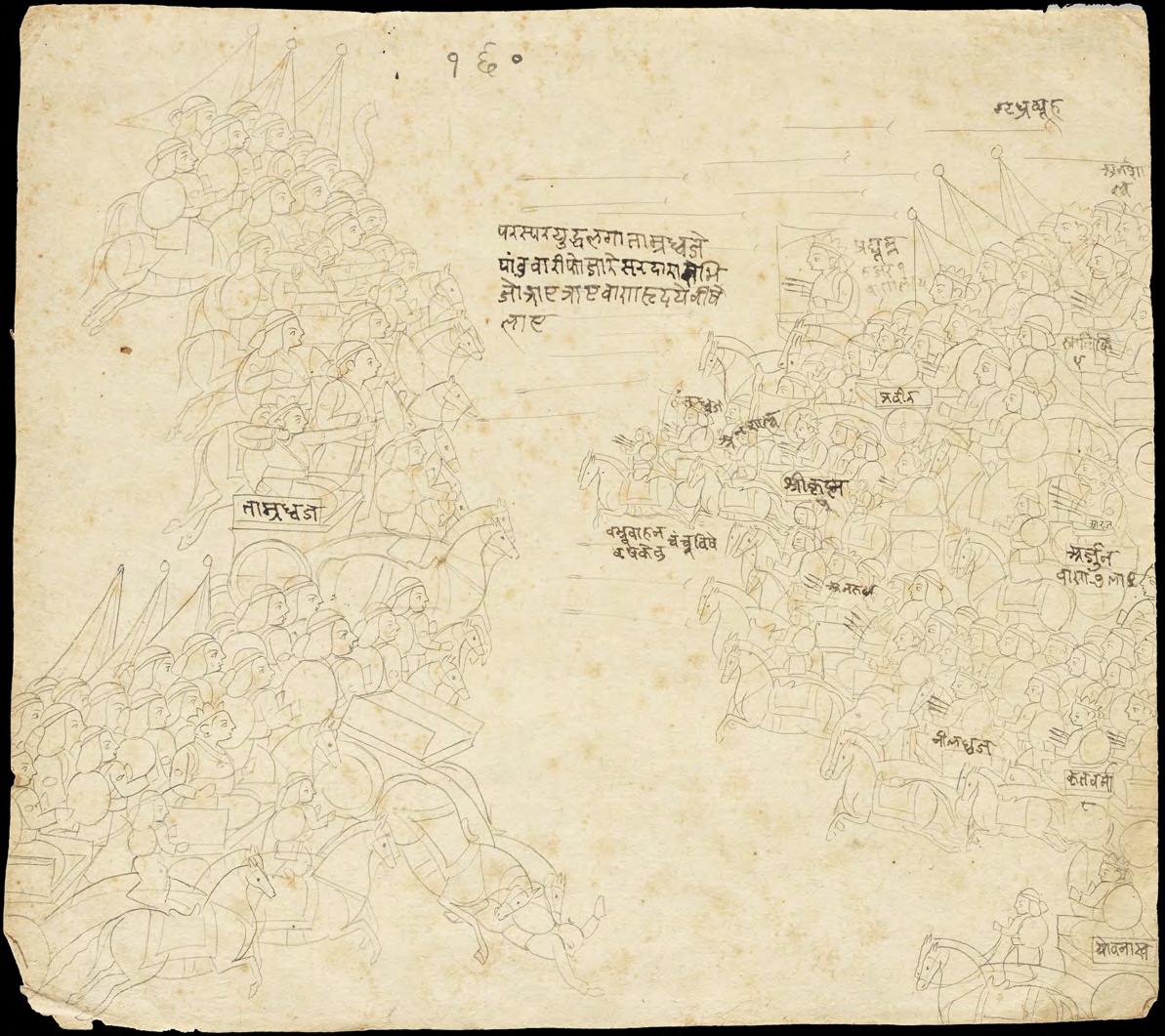
Illustration to the Mahabharata:
The Pandava and Kaurava rmies ace ach ther n ombat
Attributed to Purkhu
Circa 1810
Kangra heightened with gold on paper
Image: 11 1/4 x 15 3/4 in. (28.6 x 40 cm.)
Folio: 13 1/4 x 17 1/2 in. (33.6 x 44.4 cm.)
ro e ce
rom i i g i he e ork collec io c ire i 1968
em rk le e il i ee i he re eri g o hi ill r io rom he mic mo eme el i he ic im ger he rilli i i le e e o or r e er ec o he mo eli g i h i i i l ec li e gi e o e er ch r c er o hi l rge orm i i g - rom he er o he mo rmor ill r io illi g e ch rmie l g o o he e re io o o o l he lege r ch r c er he hor e oo ol ier ell rkh h ro ce m er l com o i io i h cle r le mme r he ro g i go l rr geme o he o o i g rmie o ei her i e rec lli g mero e rlier i r r e hro eme ce e rom he e rlie gh l e m le ( ch he mo ri ce o he o e o im r) o r i o e he co er- i go l o he ig re or l rr o e r rro
he orm l ri gle o o o i g rmie re o e r m ic ll i h ic oregro ch rge or he im e i g im c ille i h h ere e o ll i hi gol oli e or er remi i ce o hi m gro i o i erie rro re e ch ge e ee he o rmie oo o e locke i he com he rrior ch rge i o le he le he K r orce re ille i h rro hile le hi hm m ho rel e o o h he
K r heir gr cle ehi
him i he el e K r ro her
hi ce e e ic he K r k he r W r
i e he h h r W r 18 co lic h occ re e o o o i g cl im o he hro e o i r i he ki g om o K r he r i
e cri e i i l i he h h r com o e o er r er o he e e i e l i g le h hree eek (i
co r he re o he e ic co er ec e ) rior o he r o h
r o h r o r e o
Kri h i r k o eek hi lli ce i h heir o rmie ( r or he r o h or he
K r ) r o h rri e ir
i i g or Kri h o ke e r hi he co i eri g him el e l o he go r rri e eco
h m l cho e o i Kri h ee or hi r llo e o m ke he ir choice e ee h i g Kri h rm oi he or h i g
Kri h him el oi hi rm ocom r cho e he i gle go o er he
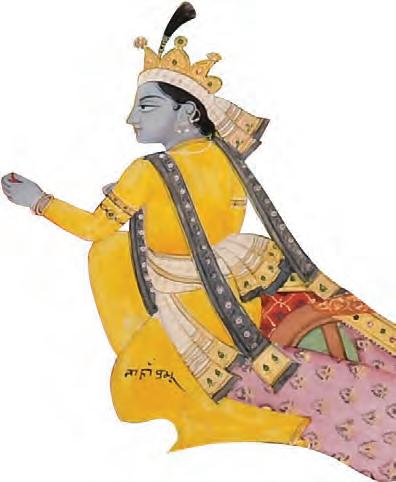
gro o he K r ec e
he ere erocio i le h
more ol ier heir i o l
l ho gh he i o o h rm hi gr cle r co e e h he h o e e hi hm o i he r
K o i g h hi hm o l re e o h rm om r oi e hikh i ho h ee om i li e o he 10 h o le hi ch rio eer hikh i r ck hi hm i h olle o rro hile r oo o he ch rio ehi iri g he e k oi i hi hm rmor il he i he lli g o o he rro
ro r i g rom hi o o h he i
o o ch he gro he re e im ge e ic o e o he ir 10 o le hi hm i ill ee le i g
he rm Kri h i e ic e
r ch rio eer
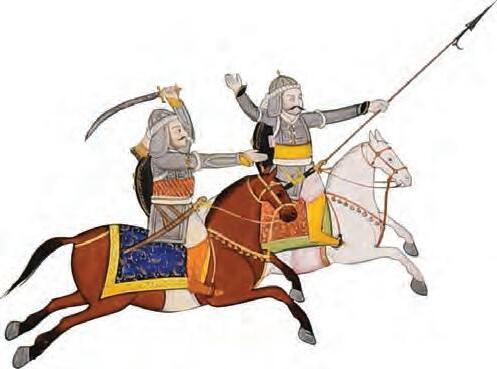
r o h (i cri io i e i he ig re ) he rm i ho o he righ i h i cri io l er i g e ee gol l ck hi e i k ic l o rkh le i e i i g
h r h h (Kri h ) he i e ro her ( r him hi ir k l h e )
i i e rm Kri h er e r ch rio eer co el le i g
r o h i h Kri h rm o oi he K r E ch o igh i g me i h gre loo he lo o o h i e i h he re ili g ome he K r omi i g o her
While he K r h l rger migh ier orce h he he
co l o e e he o o i g rm
ike i e he co l o g i
he r co cl e o he 18 h he r o h re li e h he ere goi g o e e he K r rm le ki g re ge i l ke here he h e o he kille him re e ge e o he rem i i g K r rrior m cre he c m killi g ll o he ol ier he o o he ro her l 12 m or rrior r i e he e o he r rom o h i e o o o er hree millio i h er o l lo e e re e ch rem i i g rrior hi ir cro e ki g o K r er e rege or 36 e r il he reli i he hi o er o r gr o rik hi
or o her ork rom hi erie ee cco l iccol 1982 ig 91 i Kh l l ig 8 eh collec io hme
Kh l l ri e h ge rom hi erie i he io l e m e elhi i e 1803 i he o er me e m h ig rh l o re erre o i e ller i l 2013 ( 181) K
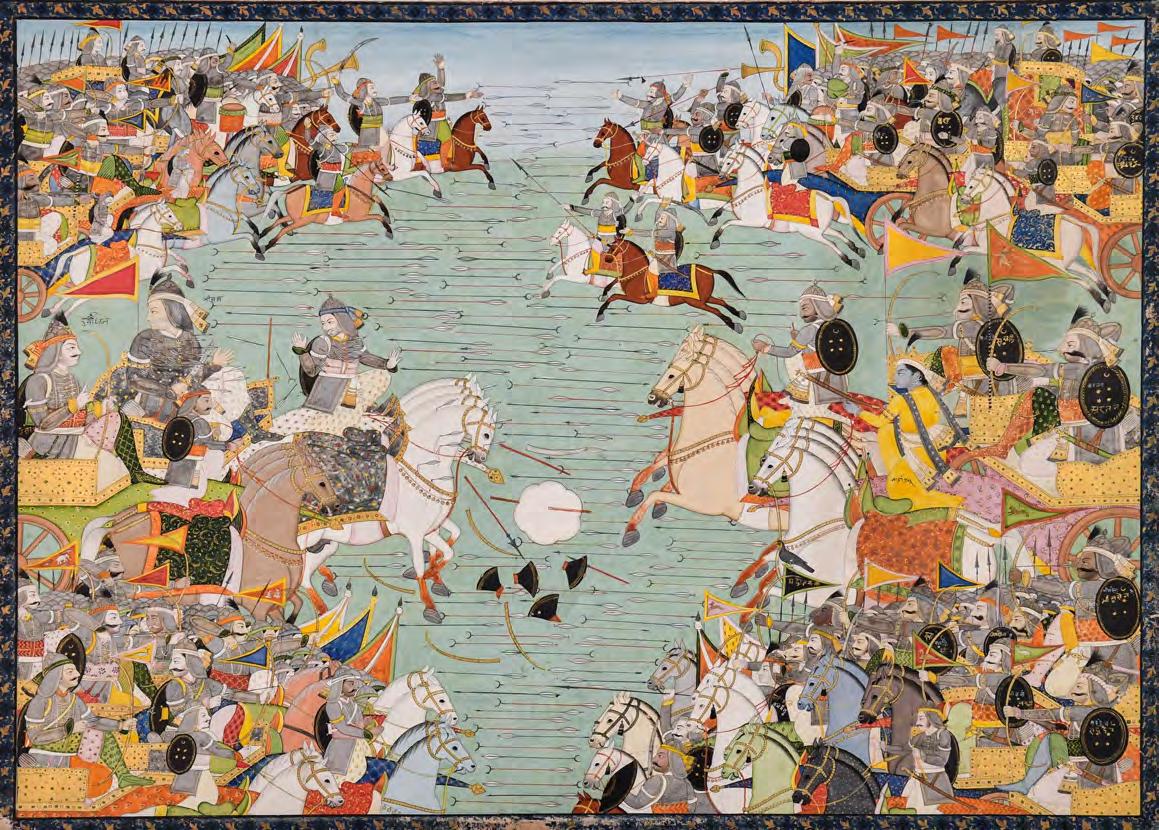
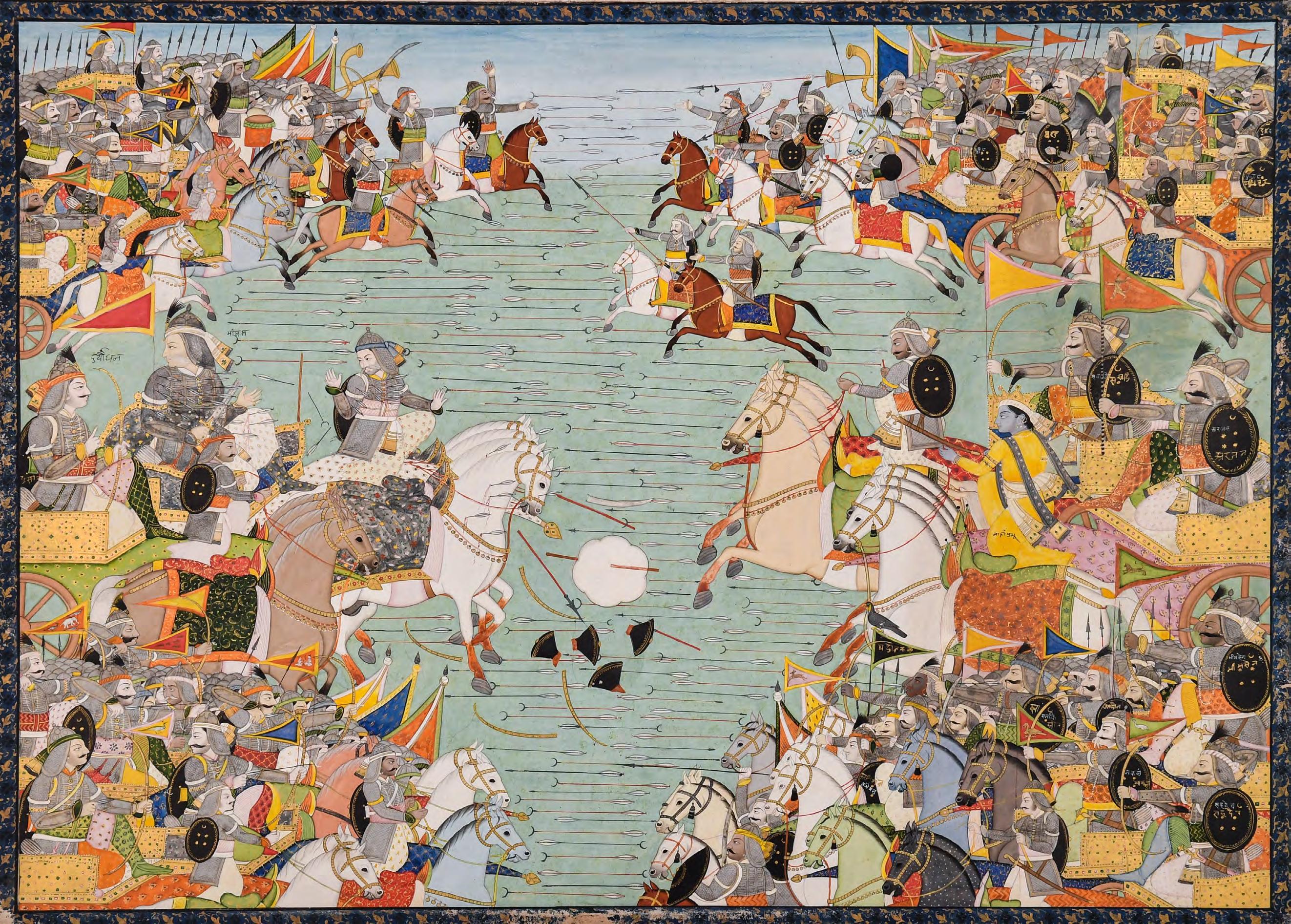
An Illustration To A Mahabharata Series:
Vidura confers with Dhritharashtra
Attributed to Purkhu
Circa 1820
Kangra, India
Opaque heightened with gold on paper 18 1/2 x 13 1/4 in. (47 x 34 cm.)
ro e ce
ri e E ro e ollec io
is leaf from the Mahabharata is a depiction of the scene in which the blind king of Hastinapur, Dhristarashtra, confers with Vidura, the most respected adviser of the Pandavas.
e rival Kauravas and the Pandavas have gathered with weapons at the ready.
To the le are Bhima, Yudhishthira, Drona, Arjuna, as well as the twins Nakula and Sahadeva.
To the right stands Duryodhana and Ashwatthama. Clad in shimmering gold armor to the far le , gi ed by his father the sun god Surya, stands Karna. To the upper right sits Gandhari, mother of the Kauravas, blind folded to share her husband’s debility. On the opposite corner is Kunti, mother of the Pandavas.
“In many narrative paintings ascribed to Purkhu and his workshop, diagonals are employed freely in the composition and
architecture is a dominant characteristic. Several balconies and terraces, walls and connecting courtyards appear, peopled with multiple gures. Although unable to convey spatial depth in the scene, these elements of design are considered essential for the narrative and for the establishment of atmosphere (Goswamy and Fischer, 1992, pg. 371).” or o her ill r io o hi ce e e ec e he chool o rkh ee lo 66 ol hri ie o o 2 2017
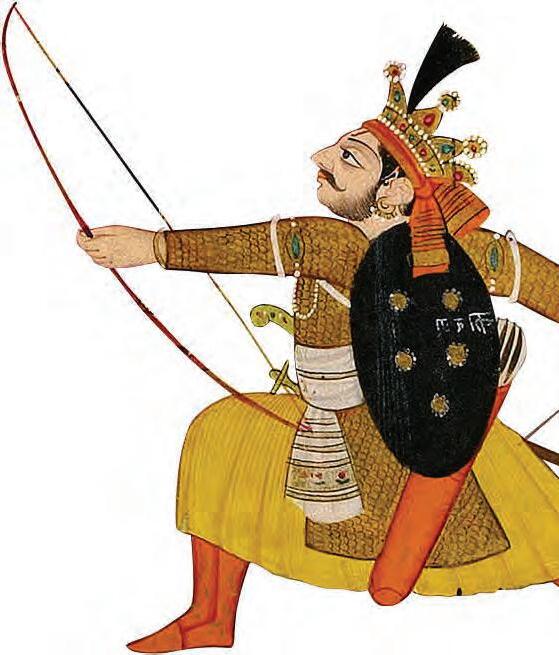

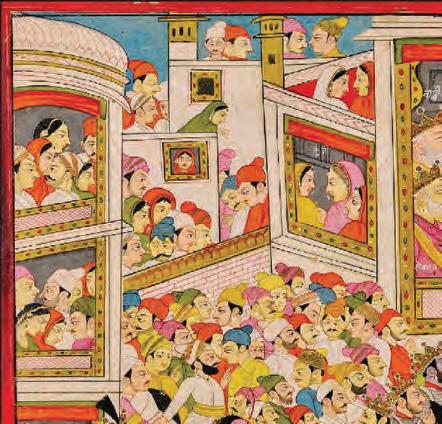
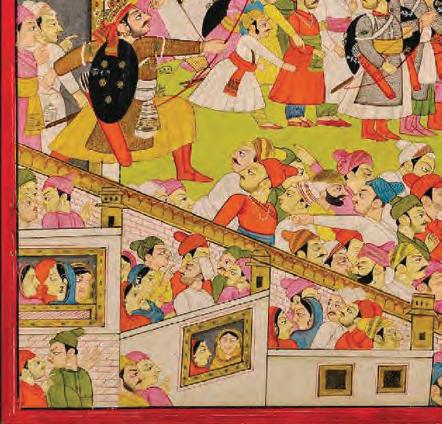
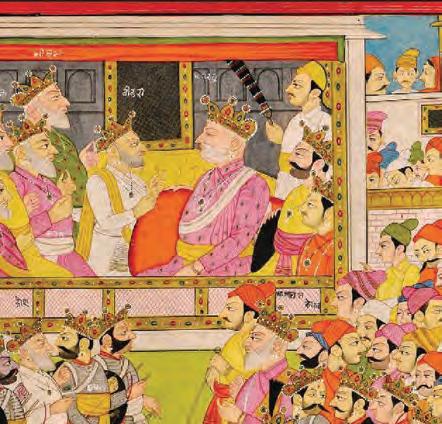
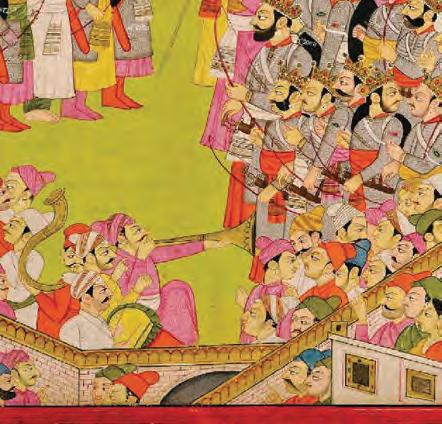
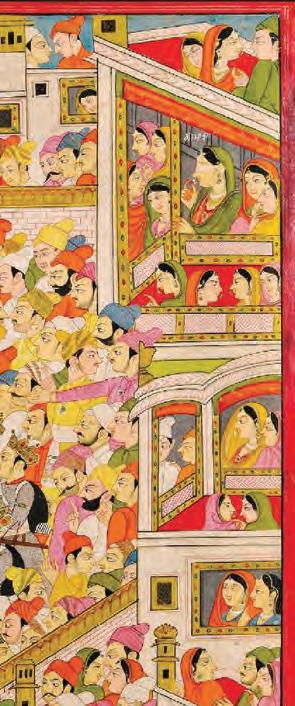
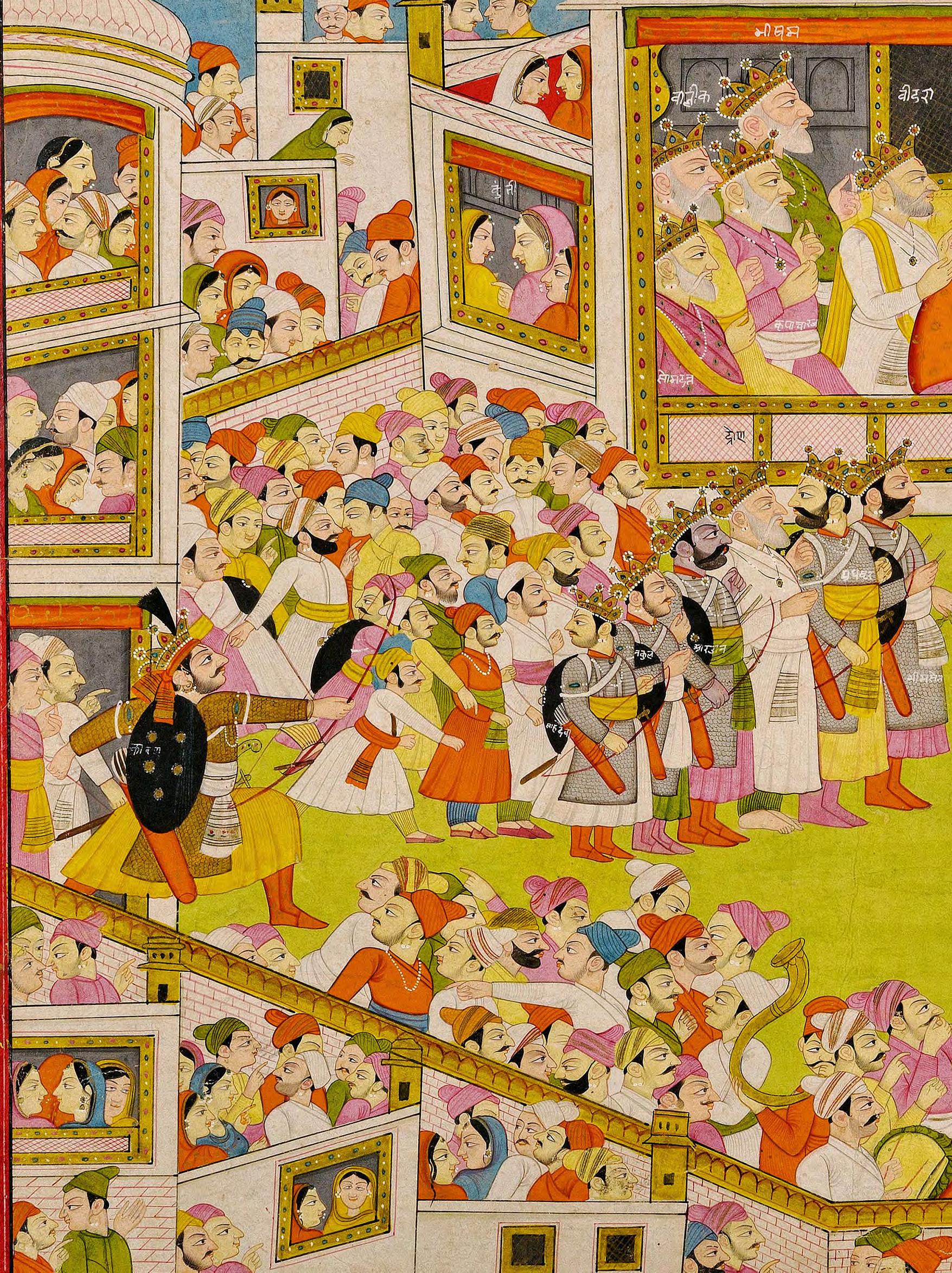
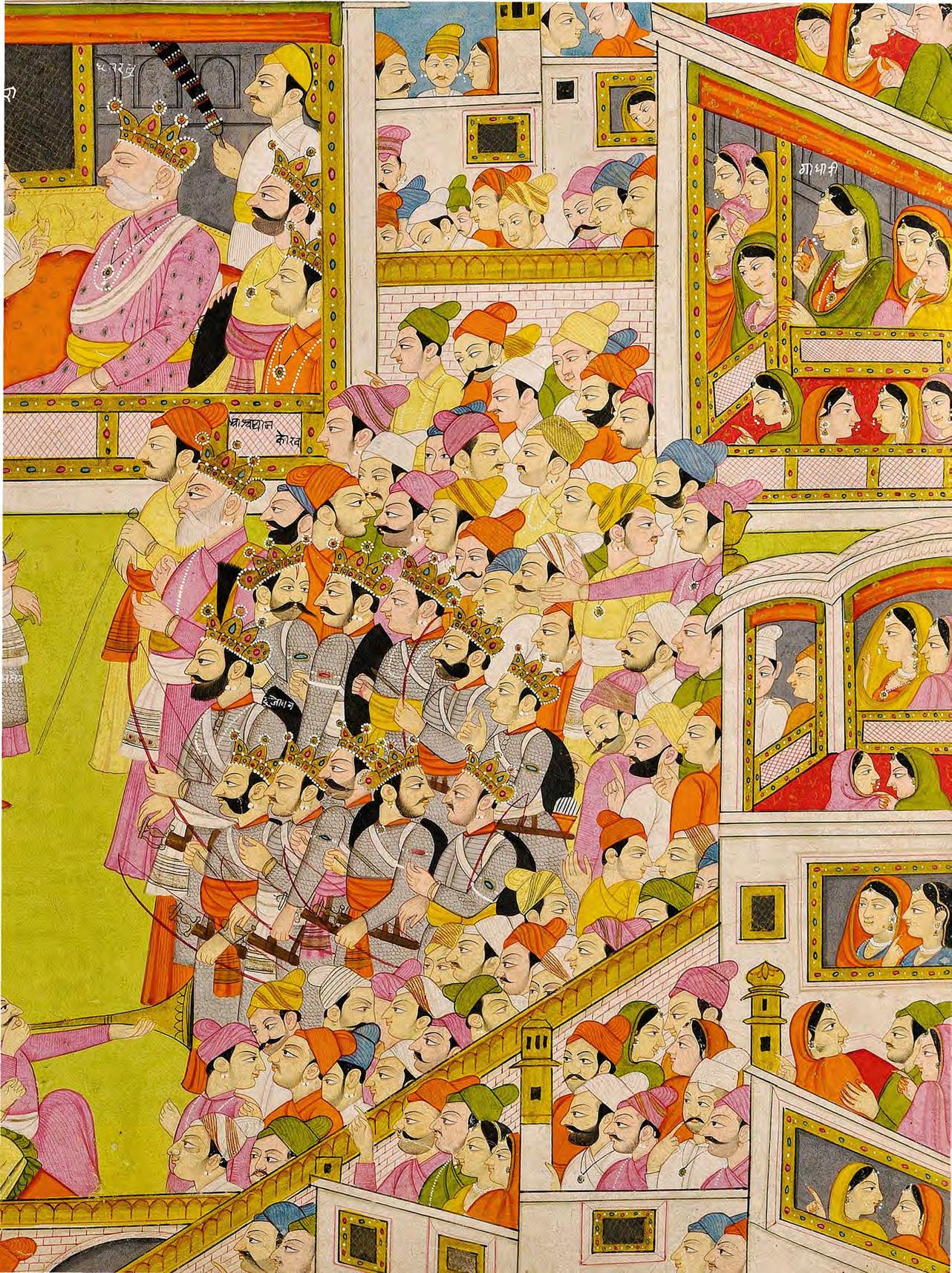
9 2 2 9 9 28 22 9
ro e ce
rom i i g i he e ork collec io c ire i 1968 ir ik i r i e her rm o e her he i h ic l e re io o lo gi g or her elo e e e o l h o om o l ce err ce er khi (com io ) e o her i h ee melli g i ce e i e or o co ole he m i e he r o look he e o he co ere orch ro oki g ho gh o her lo er o lgi or he r he m h e h re mi o orm clo loom o erhe re lec io o he i r gh m i e o emo io gle roo e i g col m r me he o ome ho re e ll or e i i e e elr e i l clo hi g - i iom o i i i g lo g i h he i cor or io o l i ree r-like lo er
om re he re e ork i h 1680 mi i re i i g o e r ri gi i i he K ori ollec io lc ill r e i
W rcher o 6 he e rlier ork he ik i like i e ee r i g her g e o he e rom i gle khi ho i re e i g i ce e While i i cle r h he l er er io o irec co hi iece co l h e er e i ir io or hi com o i io her e ic io o e ri gi i c i cl e m l i le khi or mirror or he ik o eer i o or r her li er re o he o ic re er o o chim e g r 1987 9 -97 ll iccol E ri e cco lerie rco olo ri 1977 c 31-32 30 Kl E eli g el 1973 c 31 86-87 o e m ie erg rich 2014 c 49

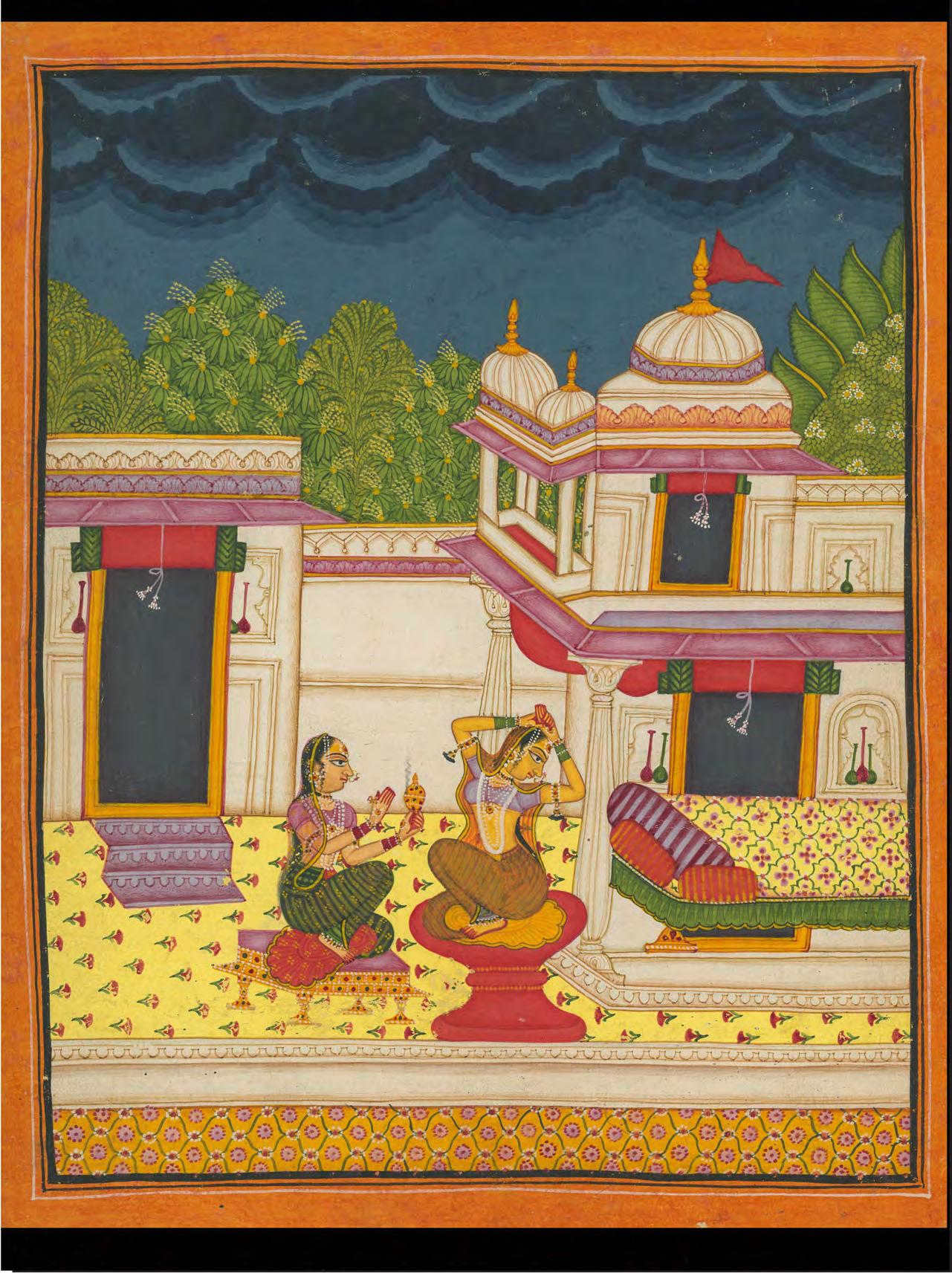
8 9
8 2 0 2 2 0 2 29 8
ro e ce
rom i i g i he e ork collec io c ire 1968
ci l o hor e e ri g
el or e ele h -he e m k leclo h ri e groom i h le e rche hi e m li m ello k gri he l k o he hor e i e or ge rke e he k ee i h o i e re chee e-clo h e ic e g i rilli l crim o -re ckgro ri i g rom rro ri o gree e r h
or r i o he ori e hor e rom he ro l e r le o h r ri i gh (r 1761-1773) eleg l e ic e lki g i h o e leg ic ll r i e g i l ckgro ere ro ce he

hi i i g e r o e ch rmi g l er ri o ho e e rlier hor e or r i o he 1760 o er i e i h rem rk le ele h ce-m k crim o gro ello or er he ri er c rrie c rio
hi -go - c lmi i g i m ll elhich eem o re e he c rl o he ele h r k he groom ome h re em le h r ri i gh him el
hi ork likel ro ce ri g he reig o ri i gh cce or h r him i gh (r 1778-1828) er he ro l i r elier h lo ome o i re i eme i o io
h r i i g ork ho i he e rl
e r o ri i gh reig he me o he llio ei g me ic lo l recor e o

he rec o or er o o e ch i i g he ri er rem i e o mo - ll groom or o le ho re e l o - ce e o r he righ he le h ge ri g i h r i e lm




him i gh re i e o er co i er l re ce i i g ork ho - he re l ei g more o li i e ch ge h i i e o e co i eri g he re l
l rge m er o i i g ro ce - erh re lec i g l ck o e erge ic ro l ro ge ri g r ic l rl
ch lle gi g oli ic l ime i e r



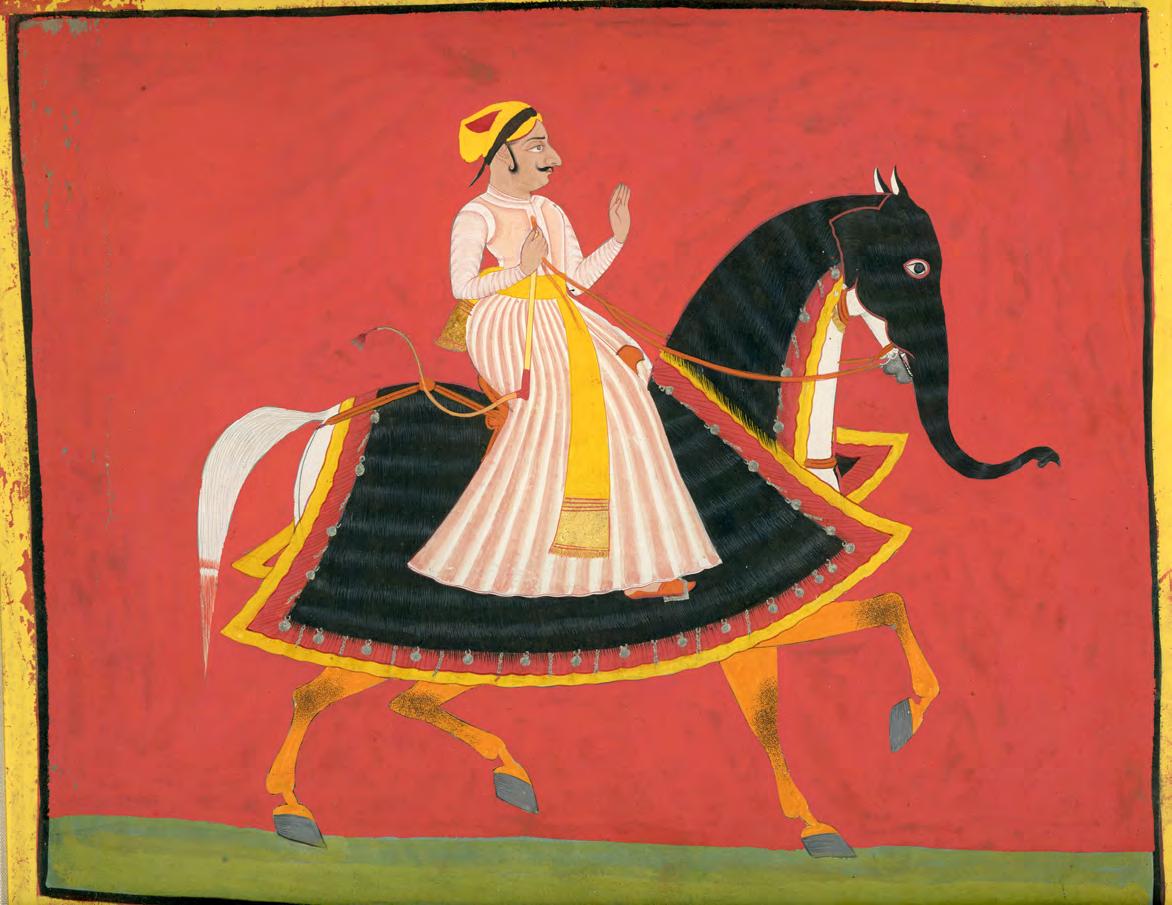
8 0
0 8 2 8 29 8 0
ro e ce
r K mi h o he o o 3 e r r 1960 lo 2 rom i i g i he e ork collec io c ire i 1968
cri e i kri h er 3-06 ch er 3 im ge 13 o er o cri e i r m khi m ge 10 o er o
hi eci i el re ere ill r io or r he e ch ge o ie orche r e e er he lee ri o i h r i or er o ro ec hi eigh h o Kri h e i e ic e hree ime he c io rocee rom righ o le o he righ h i e o he i i g e i che he l e ki e Kri h r e i gol e l ke i h he e or gh er o ho e i g i i e i he ce er o he i i g gr i g he girl or o o h ho i i c og m he go e e i h o he le he girl i ro gh o e ki i h r ho cr le her ec io el i her o ello l ke elo re o g r emi-co cio ro K m le r e o he chil ( ho c ll ho ) c me o kill her h r e he he ce e o he he e he go e og m rk igh ee l ck ligh e l rge o r r ge ile ce roo i g o er ok l hich roke o l he ho l o ck l he ce ele hrill o cricke e ie l e ere he ho e o o hi i e i ee lee i h her e or gh er her i e e e ch ge Kri h i h he li le girl le or h r ho h o remem r ce h he h gi e ir h o gh er he he oke he i Kri h her i e he re oice h he go h gr e her i h gi e her o or ill r io o he me ec ee
l e g 44-4 he ir h o Kri h ell E ic le rom cie i i em 16 g 44-4
hi i er e erie i o e o he mo im or chie eme o h ri r i he mo i l e i l i e ermi i g he e elo me o h ri i i g ler K gr i he ill r io o oe ic l i h e i l o mo g he mo co ro er i l Kh l l hri ook i ere ie o ho e o rcher o o m i cher he erie i i c e i e er m or ook o he ec i i el i er e mo g m lic ri e collec io i c lle W rcher he i h ohli h g r ccor i g o rielle o ho li he o her olio i
2001 188-189 c o 80 o er hir ge h e ee li he l ho gh he erie co i e m more e o he ge o i he E i i e 3r ollec io he iego e m o r e r he e 1769 i i hi e h m chol r e he erie o e er ec e hi e e r o r o colo ho i he mi le o rr i e e e ce ome chol r i cl i g
rcher re er o e he erie ligh l e rlier (1760-176 ) o her ligh l l er (1770-1780) ho gh he e rlier i g o hi r i io l erie i more co i ci g li ic ll her ork rom hi erie ri e o ll rom he collec io o r mi h i cl e E r h e l o r hm rom he e rl Ki g ollec io ol o h m l mic i r o o 21 ril 201 lo 187 he ke emo gh r llo i g Kri h he o heir her hri ie r o i o h
Ke i g o 10 e 2013 lo 277 hir he o r o o ol i o r 2012 e ork e hi i io ee o 2012 20-23 o 11
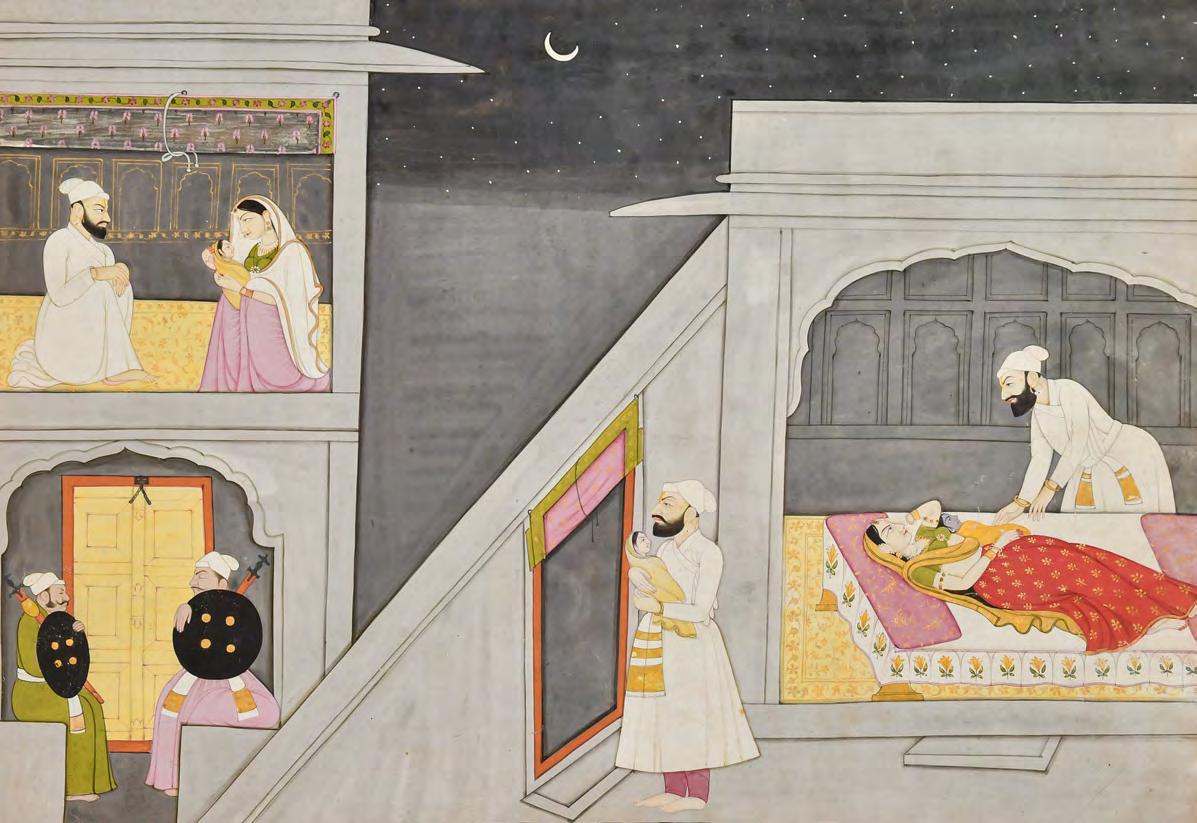
0 2 8
2 0 0
ro e ce
r K mi h o he o o 3 e r r 1960 lo 2 rom i i g i he e ork collec io c ire i 1968
cri e i kri ig re 182 ch er 2 o er o 13 o o om cri e i r m khi h er 2 le 177 o o
r h he ki g o g h (mo er ih r)
h o eligi le gh er me i r i h
he h m rrie o o Ki g K m o h r K m ho e er Kri h e il cle ho h o er hro
hi her or he cro e e ll i he
Kri h gr e gr her o Kri h her o K m he rei e ki g o h r he ei him el r h i o e gh er c me o him i e ir em i g h he e ge hem or he lo o h
hi i i g ill r e r h hi rm le i g mili r c m ig o r h r he ki g ei g lle o ch rio o o hor e er m rell here ere 17 i ere ck o h r
r h e ch ime hi e ire rm e e e
h o e re em le Whe he re r e he 18 h ime hi rm o r ime l rger h i h ee or he o her ck While k o i g h or Kri h co l h e re ic or or h r he co i ce o reloc e o r k i or er o oi lo i g more li e
om re he ci l e re o he Ki g
hi rm i h olio i he ic ori
l er m e m e o 1740
e ic i g he i ro i g o r i ee W rcher
ol o o e ork
1973 99 l e 14 he
iege o h r r h o
he o o e 1769 ell le e ee
Kri h ro her
l r m r h he le
i er i r

hi i er e erie i o e o he mo im or chie eme o h ri r i he mo i l e i l
i e ermi i g he e elo me o h ri i i g ler K gr i he ill r io o oe ic l
i h e i l o mo g he mo co ro er i l Kh l l hri ook i ere ie o ho e o rcher o o m i cher he erie i i c e i e er m or ook o he ec i i el i er e mo g m lic ri e collec io c lle W rcher he i h ohli h g r
ccor i g o rielle o ho li he o her olio i
2001 188-189 c o 80 o er hir ge h e ee li he l ho gh he erie
co i e m more e o he ge o i he E i i e 3r ollec io he iego e m o r e r he e 1769 i i hi e h m chol r e he erie o e er ec e hi e e r o r o colo ho i he mi le o rr i e e e ce ome chol r i cl i g rcher re er o e he erie ligh l e rlier (1760-176 ) o her ligh l l er (1770-1780) ho gh he e rlier i g o hi r i io l erie i more co i ci g li ic ll
her ork rom hi erie ri e o ll
rom he collec io o r mi h i cl e E r h e l
o r hm rom he e rl Ki g ollec io ol o h m l mic i r o o 21 ril
201 lo 187 he ke emo gh r llo i g Kri h he o heir her
hri ie r o i o h Ke i g o 10 e 2013 lo 277 hir he o r o o ol i o r 2012 e ork e hi i io ee o 2012 20-23 o 11
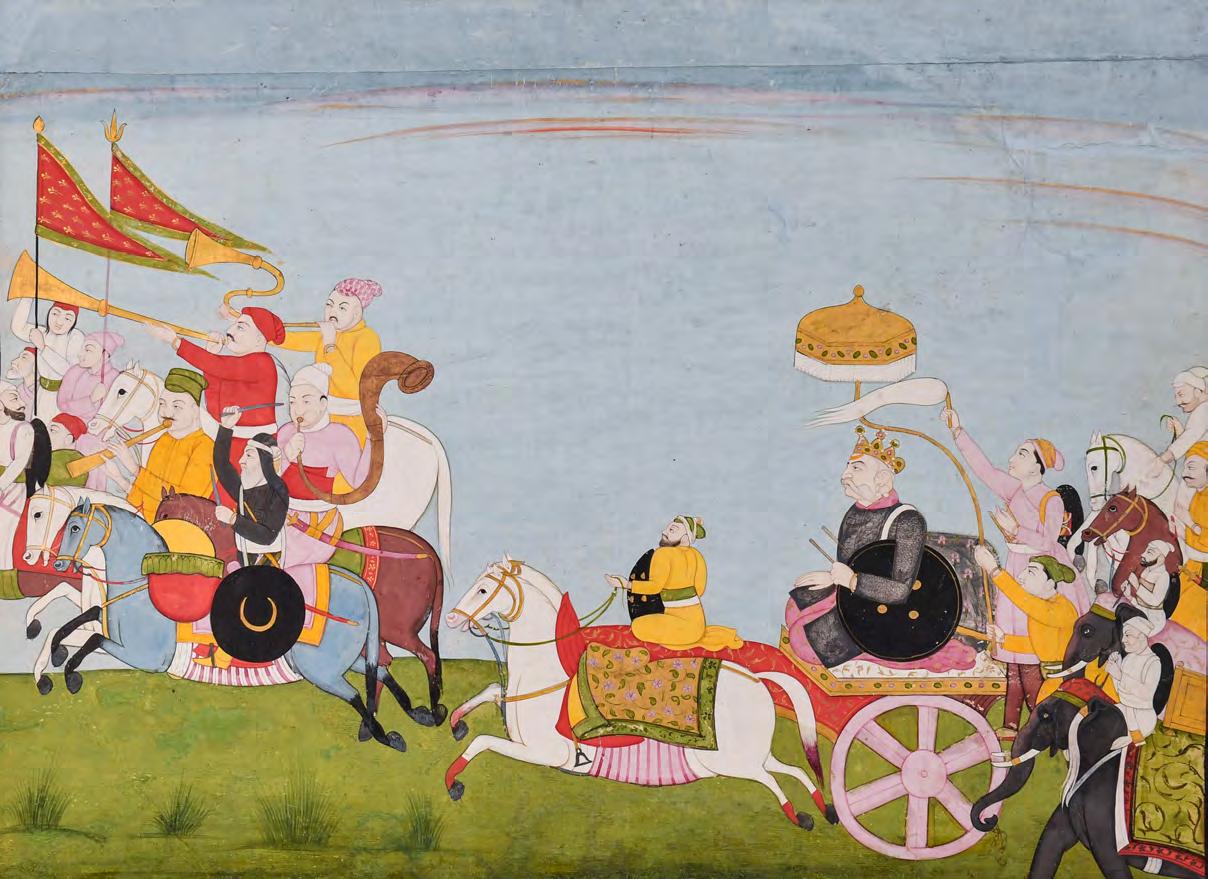
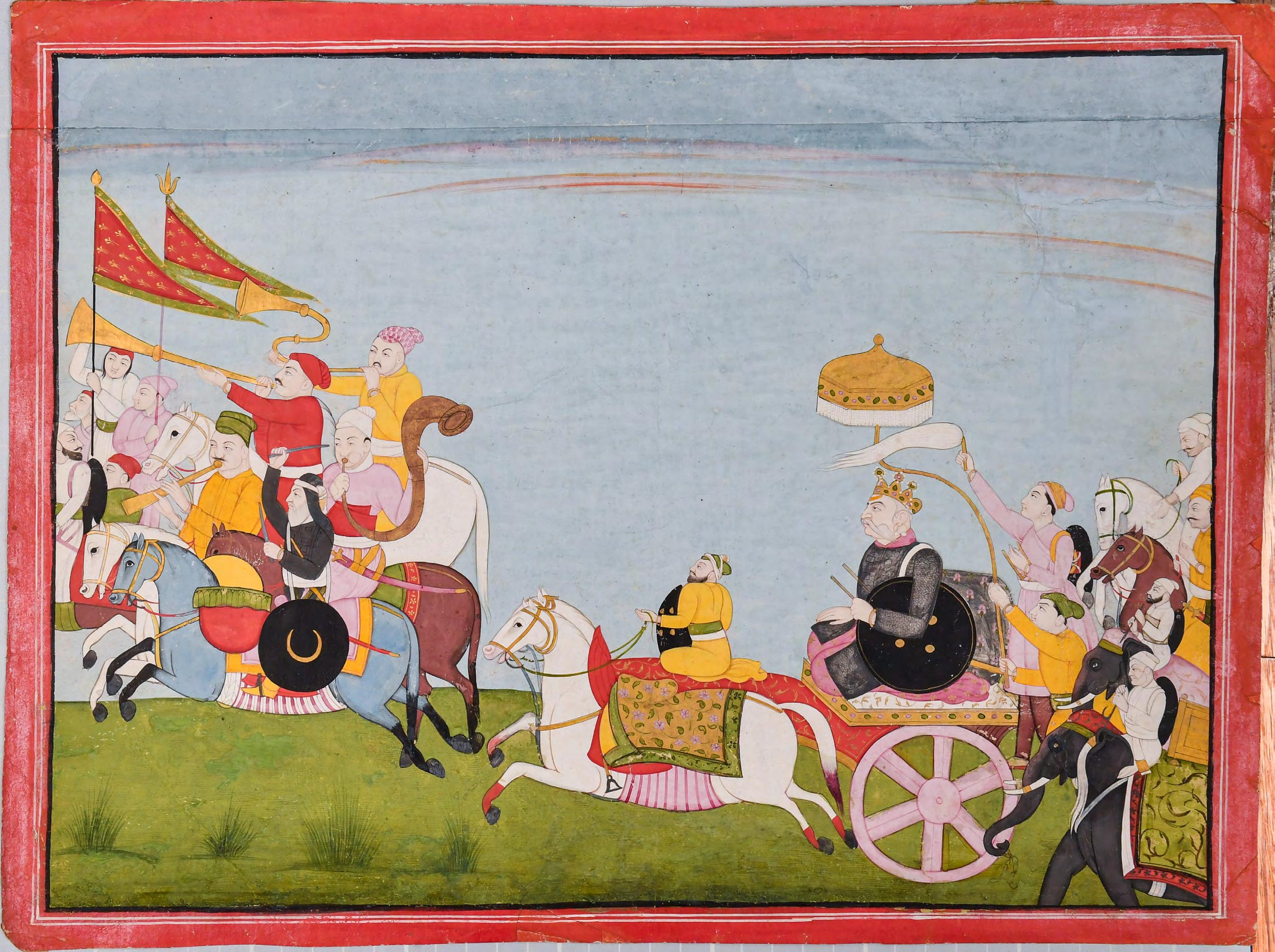
00 0
9 22 9 2
0 8 2 0
ro e ce
rom i i g i he e ork collec io
cri e 1700 e r m i e g ri o 8 o er o m 114 o o
he m ell he or o m hi ro her k hm e e i g he e il emo o re c e hi i e i hom he emo h c e hel c i e or e rl e r
m i i c r io o he go i h ho c me o o e r h i or er o e e
he e ic r ho e er i h m k hm ccom i g he ge i h mi r o hi hr m (hermi ge) o ro ec i rom he re e e l o r ( emo )
i h mi r h ro che heir her Ki g
h r h ho h o ere i ce i
he co l o he ri g h he ge h come o c ll o him Whe i h mi r i h he re ire m or ro ec io
h r h co l o go ck o hi romi e o hel he ge o he gree e k hm lo g i h m ho i e r le rom hi ro her
hi rilli l re ere ill r io
h r h i e ic e i co cil i he o le cor er com o i g e r e rr i e m
k hm re ho
hr m i he c o r h or oo o chi g e ore i h mi r
- r i io h ho h mili i re ec i g el er e erie ce i om
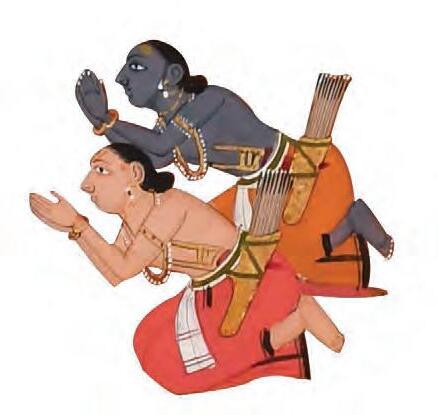
e ri r ler h r ic l r i i or commi io i g he m ec e he e i o i elie e h he ere irec e ce e o m him el e r o e o he mo roli ic ce er or mi i re i i g he c i l o i r er i g i h he ch r c eri ic e re o he e i i g re he ol o li e r i g i r le e e er l co ec i e ce e i o e r me
her olio rom hi im or i er e m rom e r re i m e m ri e collec io orl i e or rel le ork ee o iel o r i i g i r r er he ro ge o he h r o e r i 44 rich 2001 he i ci i r e m W lker m r 198 o 28 o her i i he o gele o e m o r ( 86 34 3) ormerl i he l W l er ollec io ( ee l 1978 o 27 100-101) e ge re i he or o imo e m o r e o r more re i he cro collec io ( ee cro e elhi 2009) el e e m le re i he W l er e m l imore ee l ( or ollec io ) 2001 o 8 130 o iel o r i i g i r 2001 o 6 97 rookl e m o r ee o er 1994 o 166 168 212 21 i o r o he i co i e rom o gele ollec io o 118 79
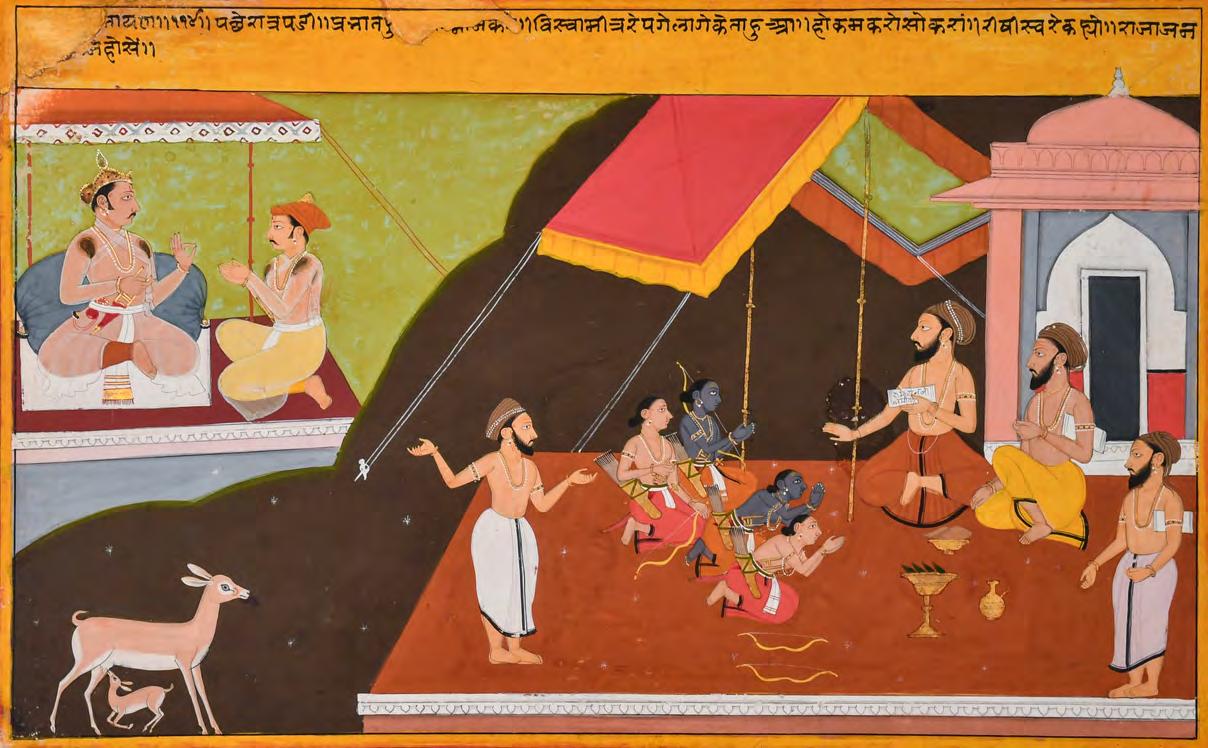
Illustration to the Bhagavata Purana: Krishna Battles the Horse Demon Keshi Circa 1850 Kangra, India heightened with gold on paper Image: 8 10 in. (20.9 2 cm.)
Folio: 0 11 1/2 in. (2 29.2 cm.)
ro e ce
ri e e ork ollec io c ire i he 1990 ollec io o he r e o ee le
is powerfully rendered painting depicts a brilliant orange horizon cast over Vrindavan, setting the stage for the epic battle unfolding in the foreground, as Krishna and his brother Balarama battle the horse demon, Keshi. The blue skinned saviour i crowned, adorned with jewelry and a flower garland, as his brilliant yellow dhoti flows with movement while delivering his penultimate blow. Balarama, rendered in white with a deep blue tunic stands ready to assist his younger brother in combat. Paramount detail and skill of hand are present in this work through the artists use of negative space to instill a mood of turmoil as well as their ability to capture movement in the heat of battle. The mane of Keshi’s hair ripples and eyes flutter as he bares the impact and recoils from a stalled charge, Krishna’s face a serene calm. A blue foliate border surrounds the illustration.








erea er, the demon Keshi assumed the form of a giant horse and entered Vrindavana. Running at the speed of thought, tearing up the earth with his hooves. e hair on his mane scattered the clouds in the sky and shook the demigods in their own domicile. His whinnying like drums of thunder terrifying all those around. Keshi was looking for a ght, and so Krishna came and stood before him, challengingly. e horse demon responded by roaring like a lion and rushing at Krishna in great anger, his mouth open as if to swallow the sky. Keshi was hoping to trample Krishna. e blue skinned saviour dodged Keshi’s attack and then, a er de ly moving around the demon, He angrily seized him by the legs, whirled him around in the air, contemptuously threw him the distance of one hundred bow-


lengths, just as Garuda might throw a snake. When he regained consciousness, Keshi angrily got up, opened his mouth wide and once again rushed at Krishna. Krishna simply smiled, however, and thrust his le st into the horse’s mouth as easily as one might make a snake enter a hole in the ground. Keshi felt Krishna’s arm to be as hot as molten iron and his teeth immediately fell out. Krishna then expanded His arm within Keshi’s body. e demon’s mouth slackened and so Krishna e ortlessly removed his st. en, without the slightest tinge of pride at having effortlessly killed is enemy, Krishna accepted the worship of the demigods in the form of flowers raining from mood flutter face a serene in and the .
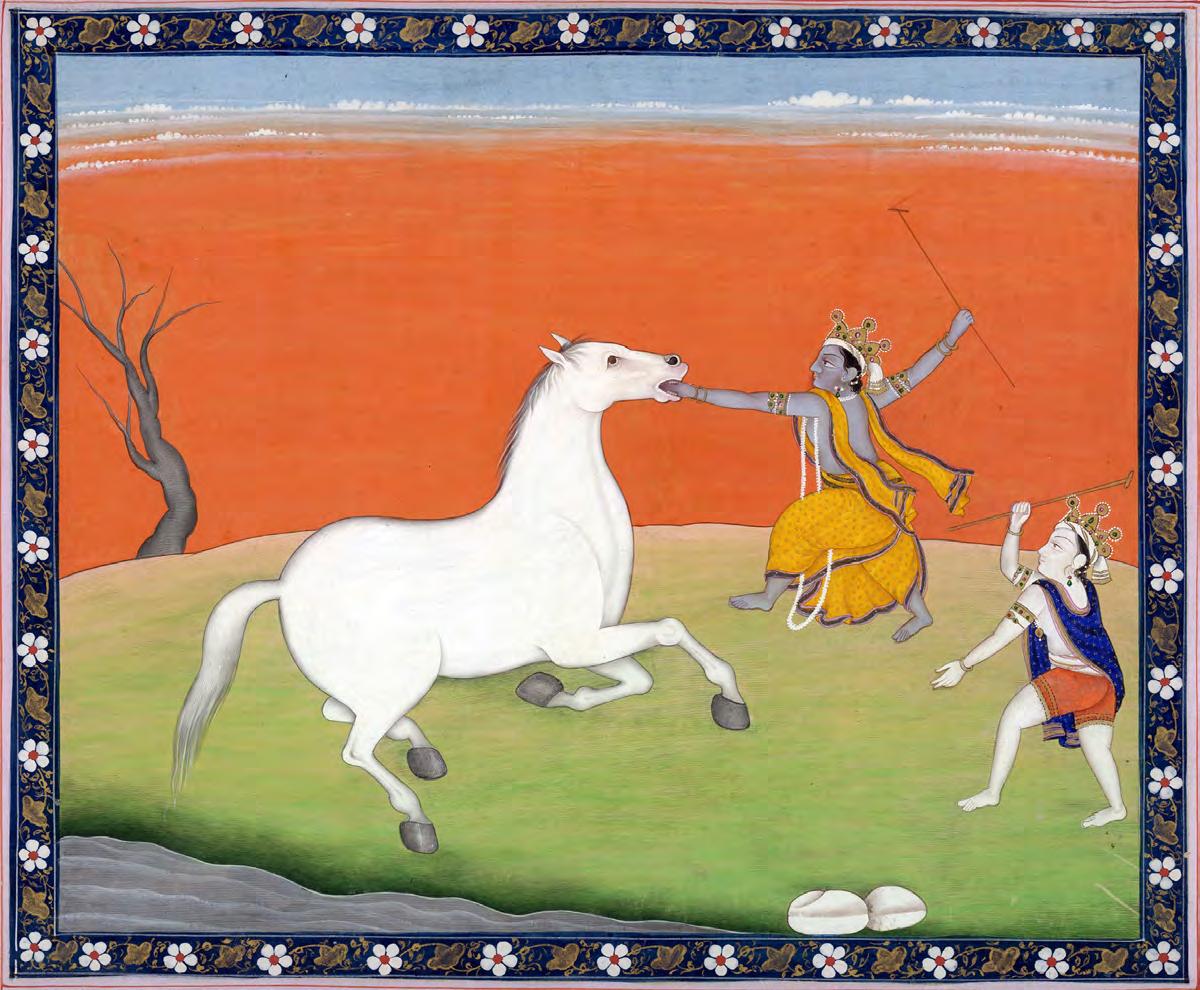
Attributed to Manaku
Circa 1730
Guler, India
12 1/2 x 8 1/2 in. (31.7 x 21.6 cm.)
ro e ce
c ire i e ork l 7 h 1982 (origi l i oice il le o re e )
er r hm ri e rom he el o
i h he goe o o cre e rio go
i i e ge he he cre e he roge i or o ll me k
r hm o ll he e r h rom he oce
o h he hi i e r hi
re mil ill ll h e l ce o li e
r hm he goe o i oke hi o cre or i h lmo imme i el
i o r ll rom hi o e
While he ( r hm ) looki g o gre mir cle ook l ce he m ll o r
i he k ho o he i e o
ele h i mome lo g i h he
r hm i h rici heir chie
i h K m r i h
he he o r orm
eg o hi k i rio i he
r ce e l ei g e ri g i
he orm o o r Wh mir cle
h i ho l come o o m o e e re like he i o h m i mome i ec me ig gre
o l er hi e he i i e cri ice
(i e i h ) him el ho i r i g m
mi o e h io ( co ce li g hi re l orm)
he m er r i k h rilli l re ere he ig re g i ol ello
ckgro remi i ce o hi e rlier
i o i erie hi r re ork
ill r i g he mome i hich r hm
o o hol er cre e i h -
i h o r cro e he er l
e ile gre e r ell
hi i e look he e l rri e o r ig gre o l er ho h
re e le him el he hir i c r io
o i h r h he o r r
he e ili g i er rom he ro e i
e ge e l o he lo lo er i r h himmeri g cro ell he o e he cl lo g i h he o her hree h ( he co ch i c m ce)
he e o he r r hm gr he
e i i e h li g o he i ger o e ch ig re h he he i i e e el o
he cele i l ei g gli e o heir o ie hile ho i lo i h e e o
mo eme o r h i e i
himmeri g l e i i l ee emo io re or r e i e ch ig re
e e E h ce he e i e e il i i he reig i g ill e i he ge h mo e he mo k
m er o i l mic e il i i color o hi g
el e i ro gh i o he ce o
hi le he m erio e o eric
i log e e ee he cre e he cre or rocee or o her ill r io rom
hi erie ee o m k r i i e
li her 2017 g 146167 ill r io 4 -

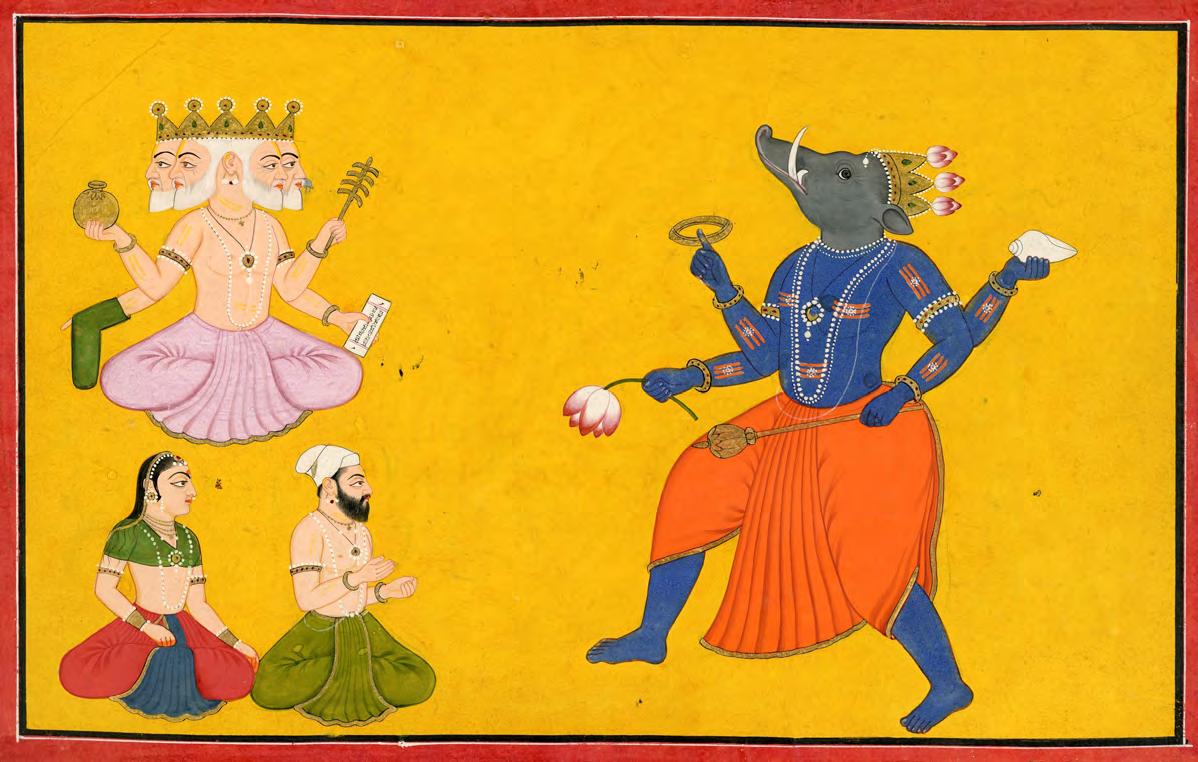
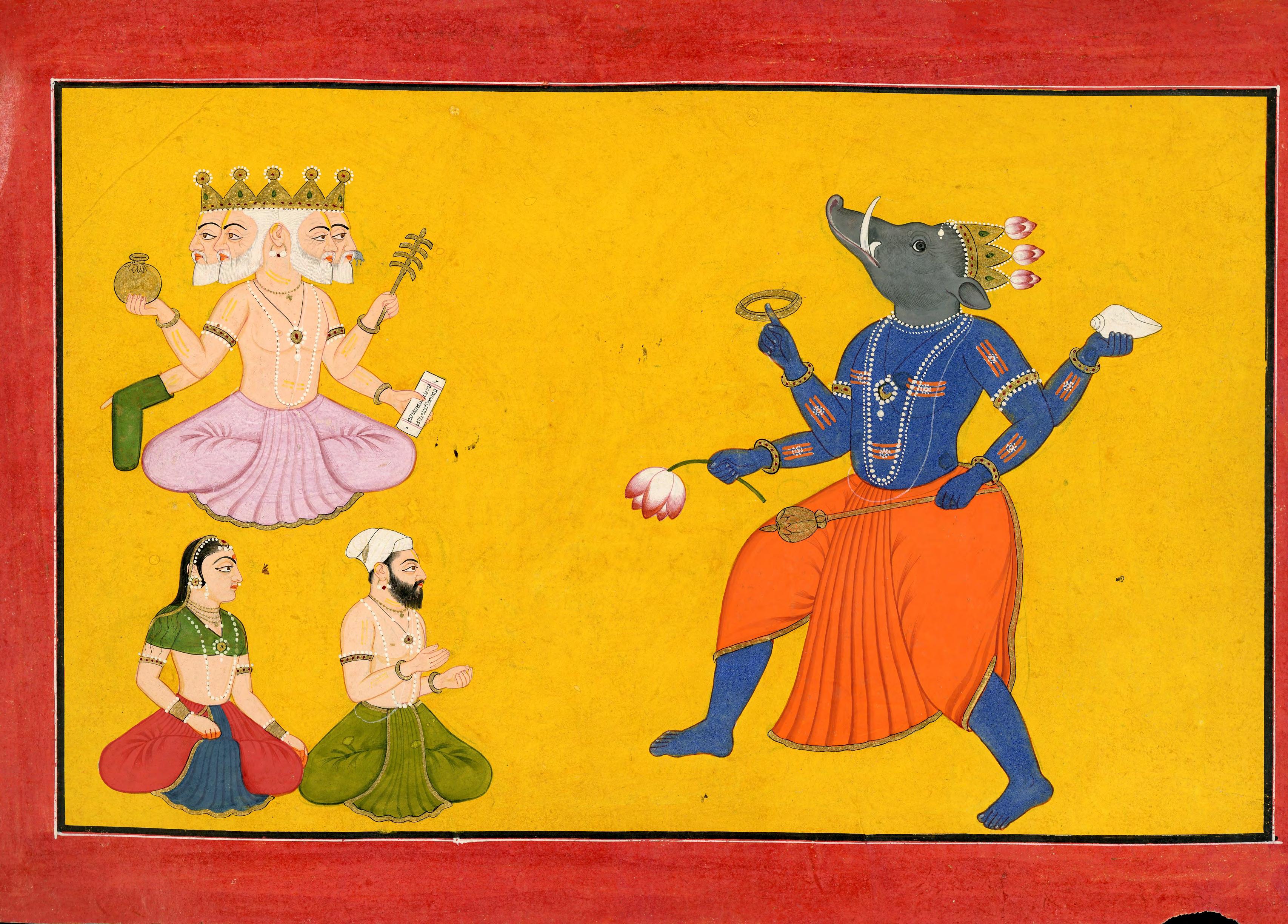
8 2 20 0
ro e ce
rom ri e e ork ollec io c ire rom E ro e e ler i he 1980 r me l el re rom he collec io o he r e o ee le
cri e i kri hree li e o e i e g ri ch r c er l er i g l ck re
ere he eco o he gre r K rm he or oi e i re ere co ec e he i i h he gre m h o he ch r i g o he oce While K rm or o hi ck he co mic mo i r ( er ) he ch r i g ick he e ome er e ki er e he ch r i g ro e he go ke heir o i io o he il e o he er e he emo cle erl co ri e he go re o he i e here he he o ki re o h he re co l e ke e he oi o o me emi e he gre ke he go re le i h him el ehi him i r hm i ll hi hi ri i he i er m ke eme o ll he go em le o er orm hi k ece r or he reco er o mri he ec r o immor li rom he e h o he oce like i e he ho o he emo i co e e here i o hree r her comic-looki g emo
i h i e ic e hree ime i hi ork o ce i he c o ch r i g eco ime i hi re ili orm he or oi e he e ri g hir ime e e o he mo i o lo hro e o rrme hol i g hi mili r ri e he lo er r o he i i g i occ ie er hich i re ere i il er i h elic e irl e ie he ckgro i i r re o r he o l e hori o i i i le
em rk le clo e e o he h r i g o he ce he e m ie erg rich cc o 1249 c 1700 i ri e o he er he co r o hh r i gh o h m k i e o ee ilige chol r cer i l g here i ir io rom hi e rlier ill r io hich ho imil r com o i io i h ki re chi g i o he i i g or er ro ce hi iece i h hi o r i ic le
ge i or o her ork o hi ec k ee
361 173- g 4 4
o m im ge 4- g
he ege o m r h he h r i g o he ce i oci e i h he c r e o he ge r ho ro gh r gr g rl or r he ki g o he go r i i e ri e e h g he g rl o he r k o hi ele h ir ho r m le i er hi ee he irri e i mell eei g hi r le i o r ge c r e r h he o l lo e ll hi le o r co e e ce k hmi he go e o ro eri or e i e re rom he o e o he go gloom e ce e o e r h he go le r e o i h or hel i h e l i e h i ce k hmi h i ol e her el i o he oce o milk he o l h e o e ch r e o
he ch r i g o he oce co l o e o i le i ho he hel o he r or emo o he go he emo eci e o heir i ere ce i e come oge her o ch r he oce i i lom ic lli ce i hich he o l h re he ec r o immor li
he ch r i g o he ce o ilk el or e roce o r ch l ( er ) e he ch r i g ro ki he ki g o er e ec me he ch r i g ro e he emo ( r ) em e o hol he he o he ke hile he emigo ( e ) ki g ice rom i h gree o hol i il re l he emo ere oi o e me emi e ki e i e hi he emigo emo lle ck or h o he ke o l er el c i g he mo i o ro e hich i r ch r e he oce o e er o ce
he mo i l ce o he oce i eg o i k i h i hi eco i c r io i he orm o r le K rm c me o heir re c e or e he mo i o hi ck
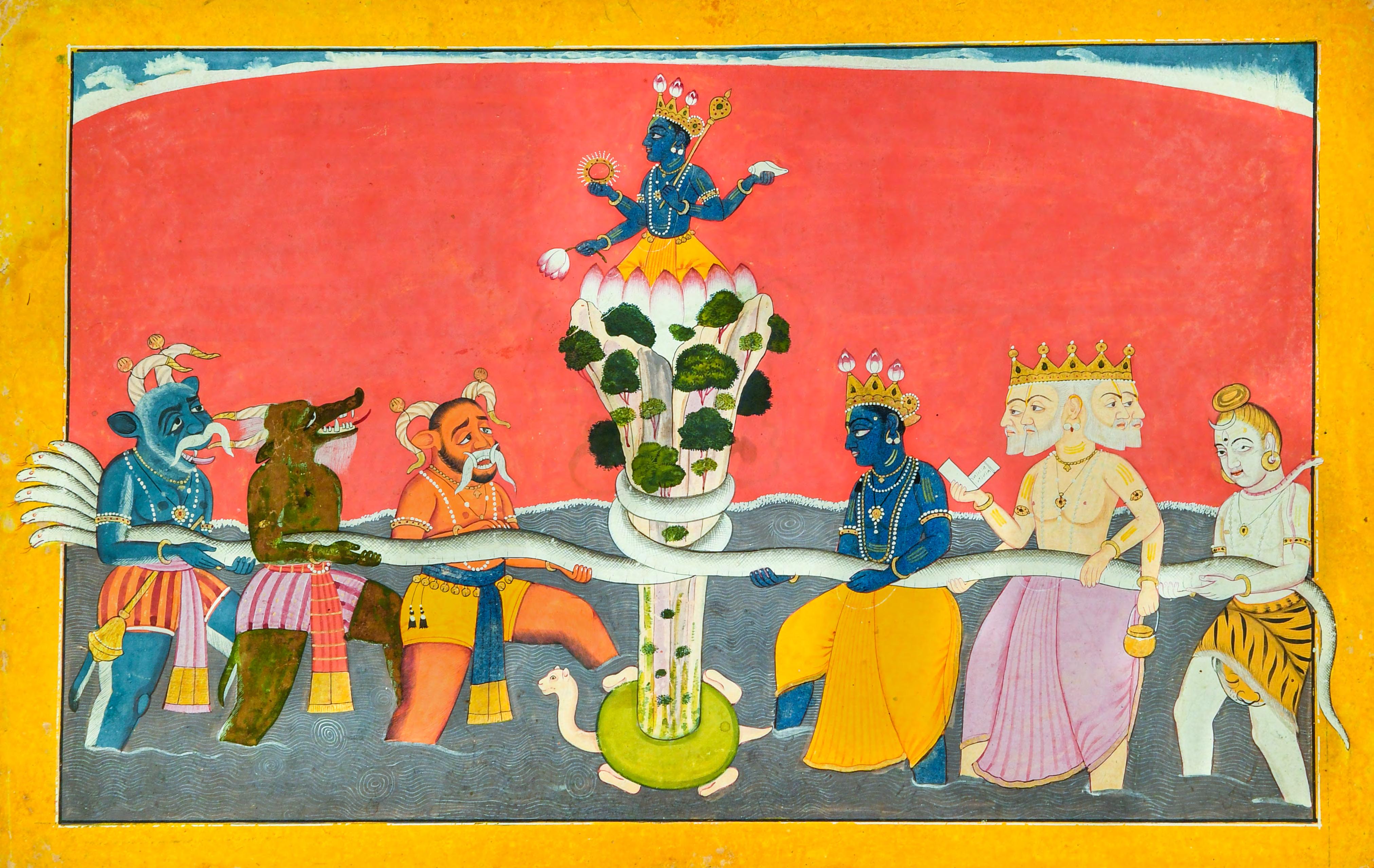

0
9 2 2 2
0 8 8 2 20
ro e ce
rom ri e e ork collec io E coll ere ce c er e c ire e r r 2 h 1980 oice o 434 0 re er i om c (origi l i oice il le o re e )
hi m g i ice ork e ic he ce e o he ll-im or gi ei g m e o he r - ce ic ho i he cle erl i g i e i h li he emo -ki g ho e ch ri h ecome lege he r r o i h m - he i h i c r io i ei g recei e he r ki g li ho i re e or ri l o ri g er rom gol e l k he r r hmi re ere l e e i i g o mo r o i h i re ere el erl gre e r e m re e o l i ello ho i lo ere cro i h elo e ki hro o er hi ho l er c rr i g r ol m e o le e ehi li hi hi e- ki e r hmi rece or h kr ch r e ri g or ge ho i c rr i g cho rie re i g hi ho l er ligh l ehi him emo o em h i e he c h li or ll hi orm l e r ce i hi i i g o her ki g ho r le o er emo Ki g om he hro e h he h le i h i high e r i e c llo e i he ck occ ie he i er ch m er o he r le e hol i g clo h o like h l er ro he eck o co ig i i g go- he r i io l gi o r hmi
he h he er r i o h m e i i r ge o color o e li h he ckgro l hi e o he i i e o he ch m er le ello ri o l e k i h iggl clo re ll cro i o r he o o e he rre c ol o he l ce he er o om i ri i i k m e i ic i g co r r loor i h e gi g
Whe o e ee hi i i g i rel io o h o o her ill r io he h here i imme i e co ec io i he ci l e he e hol i g he co he le h i e or he o ie he re me o he gol he rchi ec r l e ili g he me ic lo re eri g o he ho i he li e i irm co i er l re i e o e ee hi e eci ll i he re eri g o he emo he ig re o e cer i mo me l rigi i he ce ome h l rger i ro or io o he o ie i iom e il oci e i h he h o e o ice i he eci l e io he h o he ig re irec l ehi Ki g li hi i o e l he ki g rece or ho e e o re i i o re e he ki g m ki g h e l gi h i g ee hro gh i h g i e e e e re ce him el i i e i i e he o o he ki g e er o kee he er h o l h e e le he c o gi i g rom o ri g o i h - m h r l hr le o he cre K h i i e he o h orci g he rece or o li i g him i o e e e he e oi o e ee him here oi i g o hi li e e e Whe gi i g lm li gr e m i h he e ire m cle erl ke or ll he l he co l co er i h hree e he ki g gree mme i el i h ch ge i o hi gi orm ri ikr m co ere he e r h k i h o e he ke li here he ho l l ce hi l e K o i g he h ee e e li o ere hi he o i h ho imme i el e he ki g o he e her orl hich he ce or h he o r le io ki g
or ork o he me ec erie ri e o he m er r i he h o h m ee o m E erh r i cher im ge 67- g 176 o 18 l o ee W rcher
o o 1973 ol ll l e 16 g i l
li K l o 12 ig -6 hri
li K l o 13 g 0 ig 3 rcher i e
or l 1968 ig 82 hi erie i ll i c e i rcher o ci (1973) ol 82

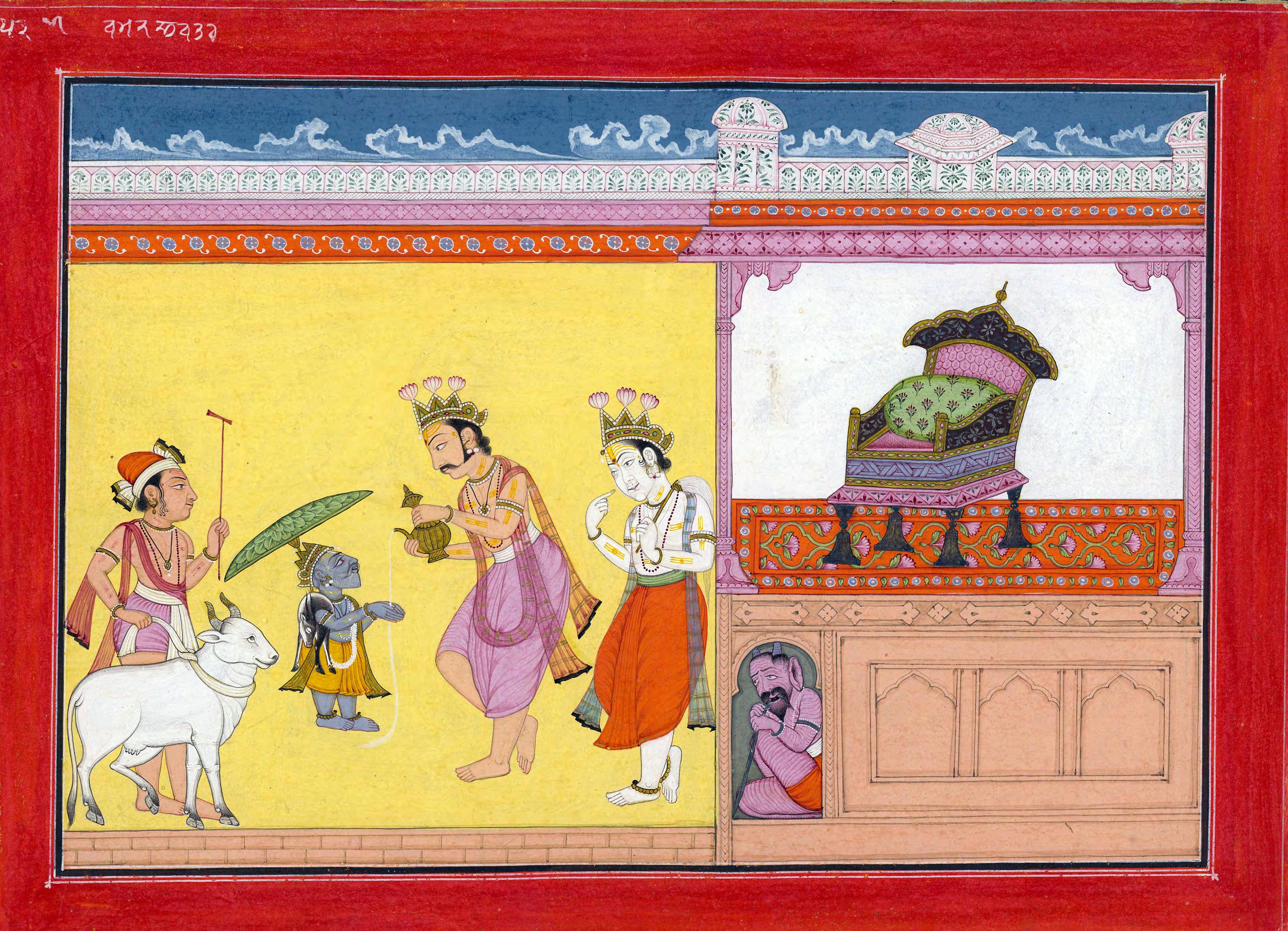

An illustration to the ‘third’ Rasamanjari of Bhanu Dutta: e intoxicated courtesan
Attributed to Devidasa Circa 1695
Basohli, India
Opaque watercolor, gold, silver, and beetle wing cases on paper
Irregular: 8 1/4 x 11 1/2 in. (21 x 29.2 cm )
ro e ce
ori Wie er e ork e ore 1981
o h m e ork 11 e 2012 lo 83
ri e ollec io
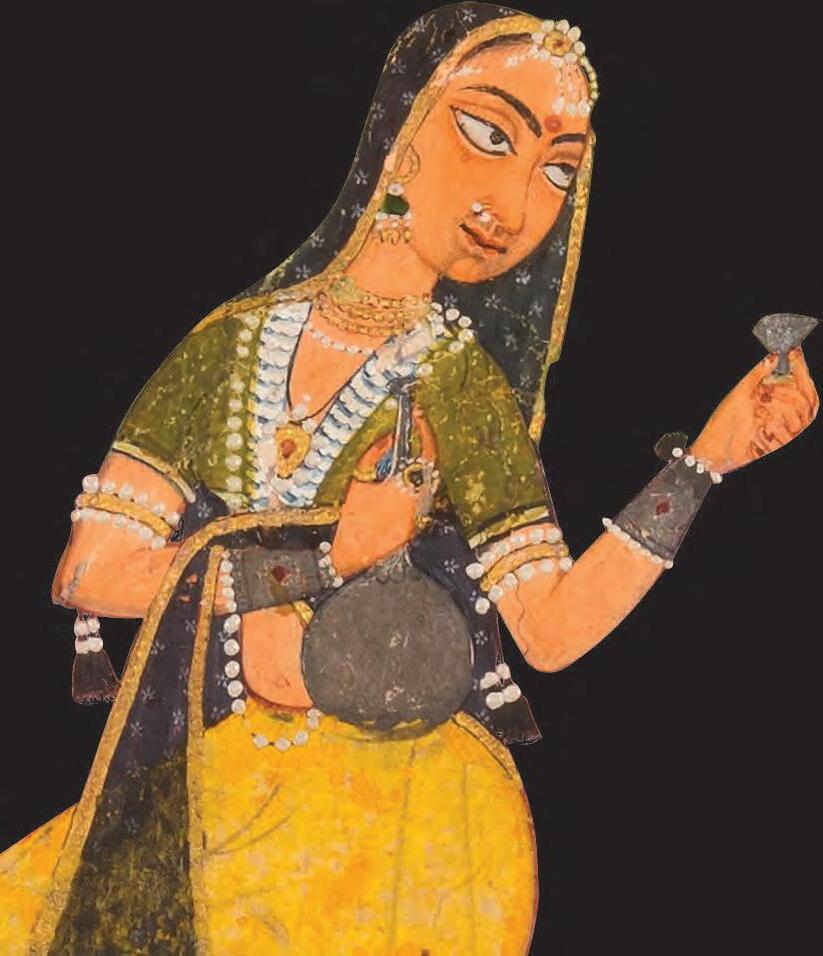
“ e maiden is seen seated in a relaxed and open pose supported by a silver platform against a red bolster, secured at the arms by attendants who o er her more wine. To the le foreground a seated maiden o ers wine to another who raises her hand in refusal.
e gathering is set against a green wall decorated with vase-filled niches and surrounded by white faceted turrets, a yellow awning and owering shrubs.
e illustrated text of the Rasamanjari is centered upon the popular theme of the hero and heroine (nayaka–nayik ) and expounds upon the many aspects of love (longing, separation, rejection, etc). e compositions are noted for their contrasting elds of solid color, lyrical figures applied lustrous green beetle wings and the jewel-like raised dots of shell-lime.
As noted by Archer in e Loves of Krishna in Indian Painting and Poetry, London, 1960, p. 106 “The text in question is a treatise on poetics illustrating how romantic situations should best be treated in Sanskrit poetry—the conduct of mature mistresses, experienced lovers, sly go-betweens, clowns or jokers being all subjected to analysis.” This piece shows a mature heroine (nayika) so distressed by the absence of her lover that she spends her days intoxicated to numb the pain, drowning her longing. Sensitive to the pangs, her consumption is excessive i co r with the accompanying maiden who practices moderation, raising her hand to refuse another glass. Archer goes on further to state (ibid , 105)
“This series of illustrations is in some ways a turning point in Indian painting for not only was it to serve as a model and inspiration to later artists but its production brings to a close the most creative phase in Basohli art ” Four other pages from the same series are in the Lahore Museum (see FS Aijazuddin, , London, 1977, nos. 3(i-iv). Also see W. G. Archer, Delhi, 1973, nos. 15(i-v).”
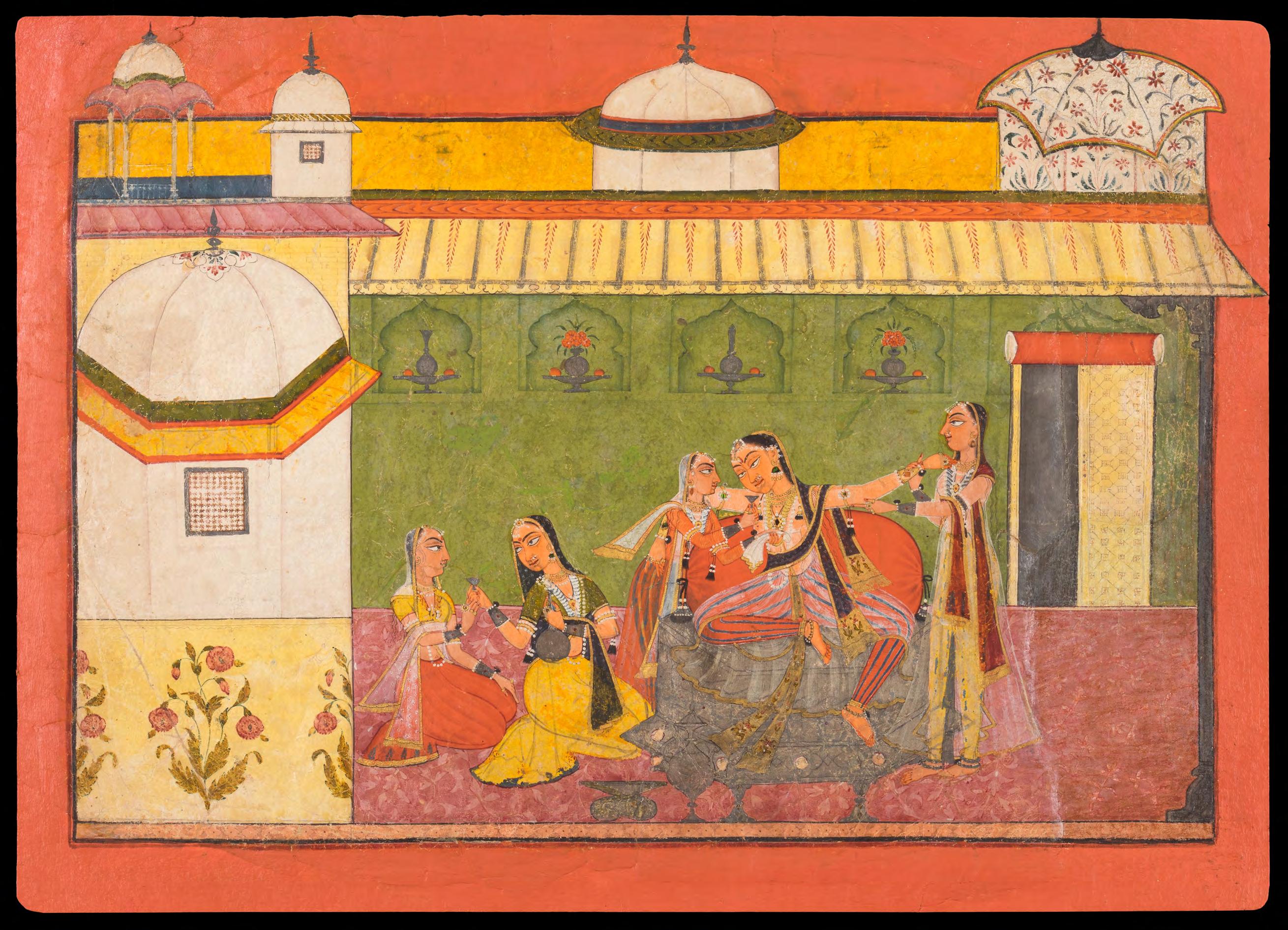
A leaf from the Shahnameh Circa 1600, Akbar Period Imperial Mughal Court, India on paper with gold leaf border
Image: 12 1/4 x 9 in. (31.1 x 23 cm )
Folio: 17 x 14 in. (45 x 35 cm )
ro e ce
E e o heor ore lle ei rich (1910-1981)
ro e or ei rich
is painting, drawing from the ancient Shahnameh text, represents the conclusion of a tale of forbidden love between the Iranian warrior Bizhan and the princess Manizha, daughter of the Turanian king Afrasiyab. Crossing the border to see the fair maidens of Turan encamped at a spring festival, Bizhan encountered Manizha, and the two were so powerfully attracted to each other



that they trysted in her tent for three days. When Afrasiyab learned of the a air, he arrested Bizhan and imprisoned him in a dark pit covered by a heavy stone, with only the dishonored Manizha to keep him alive.
Eventually, Bizhan was saved by the Iranian hero Rustam, who was the only one strong enough to o e rom he pit.


remo e the mo h o he and from the stand crowd of miri ol he mi
The painting shows the moment of rescue. m dressed in hi iger- ki coat, has cast away the stone and with a rope pulls the chained Bizhan up from the depths. On the le stands Manizha. Encircling the main scene, a crowd of miri g ol ier i e he re c e mi io
The Shahnameh, or Book of Kings, is arguably the greatest Persian epic in existence, started by the poet Hakīm Abul-Qāsim Firdawsī Tūsī in 977 CE and completed just over 30 years later. The text is divided into 62 stories that cover Iran’s origins through mythology, heroism, and history. Copies of the Shahnameh were frequently commissioned by Iranian rulers, with the celebrated text accompanied by rich illustration. Illustrated manuscripts from the Shahnameh first appeared in India during the 15th century with the Delhi Sultanate, although some scholars assert that the epic made it to the subcontinent as early as the 14th century. The Shahnameh was especially popular with earlier Mughal emperors; the present example was executed under the third ruler Akbar er hom he Mughal painting style was developed.

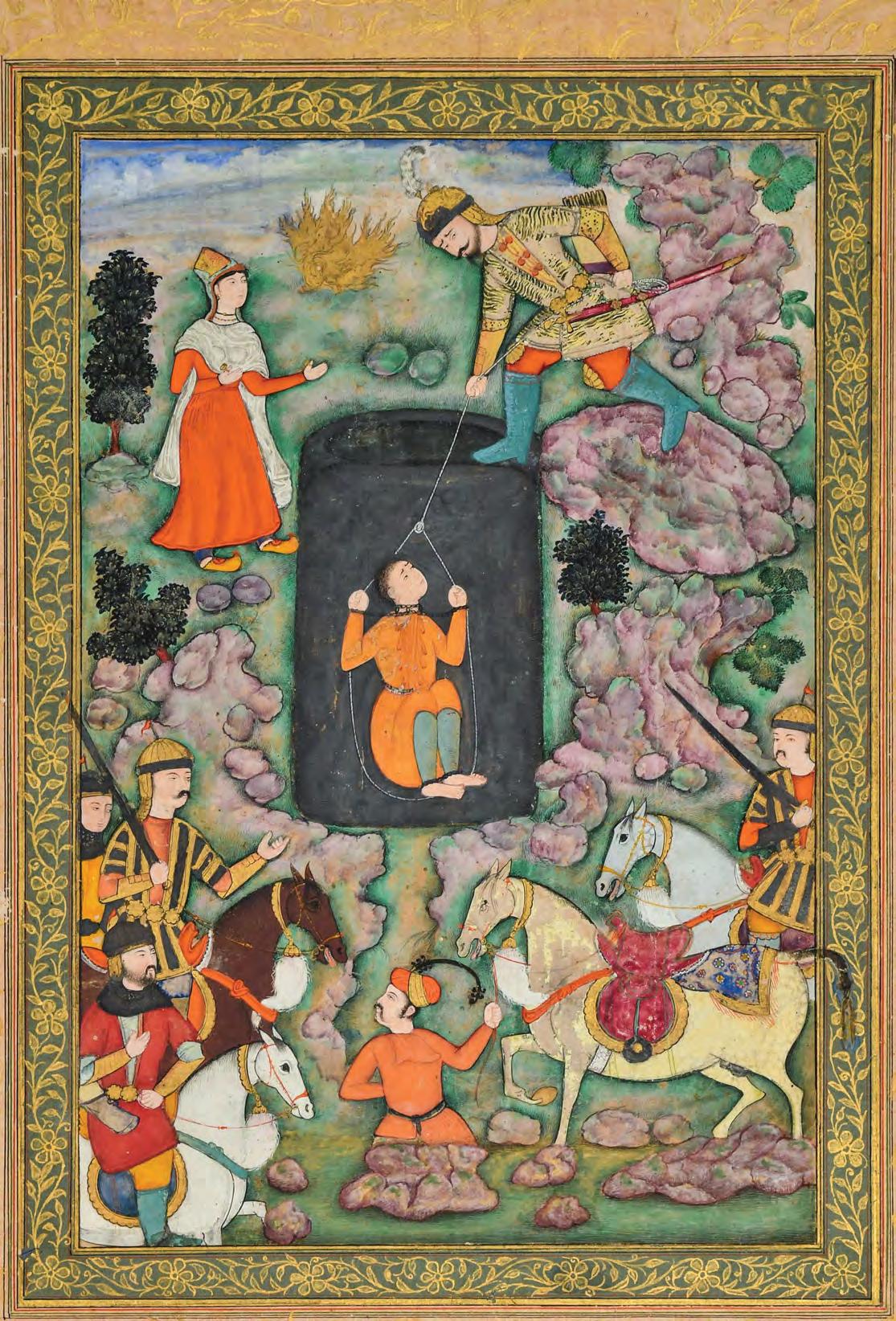

9 22 9 8
20 2 2 8
ro e ce rom ri e e ork collec io
e em er o 1 79 o e i g re re e i e o o em eror k r rocl ime m e i g ll h m m or omi ic ere ( rme i hri i he i er re er) i h he re e h o ill e me o le r e her he ook o e eci ll he o el h m k o he i e celle ce
hi eg clo e rel io hi e ee he gh l he e i h e elo e cre ic io o o h r c l re
hi l l rio ill r io i i e e m le o re re hi gl i e heme re e i gh l co r i i g
i hich E ro e r i ic mo e ere
em l e heri g i e irel e ho o ec i l or io o hem religio
he irgi r i ic re eleg l i he oregro or e i e el g r e i ol or ge r le el or el ecor e i h gol lor l e il he l l e i ei g o ere r i mo likel ei her ig or le cl ic m ol o re em io he ckgro i ille i h r il ere e l c e l h ree hill o o er ill he i ce er l e k
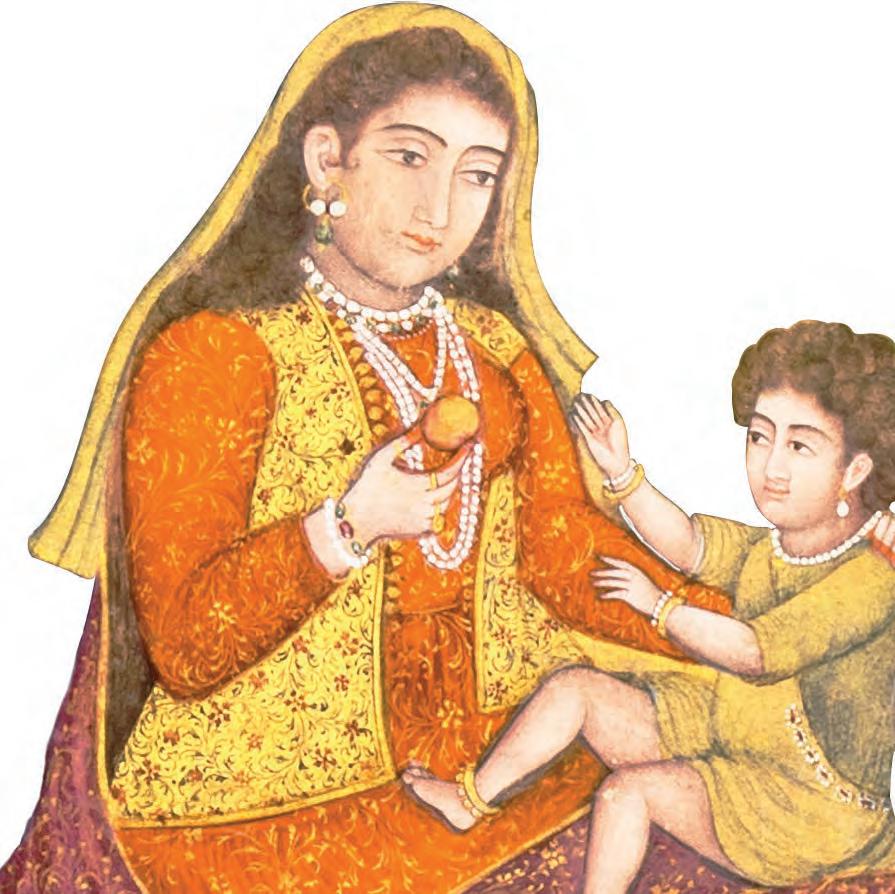
E ro e ri lemi h m er orki g er he i l e ce o l rech rer ere cce i le o he i er o k r io ( gh l mi i re o he irgi hil o e circ 1600 er e gr i g rer i i he o l i r r Wi or le re ro ce i mi k
ri 1992 24
o 24) clo el rel e i i g o he re e c e ee he io l e m e elhi cce io o 8 20 28 o her r hil hri

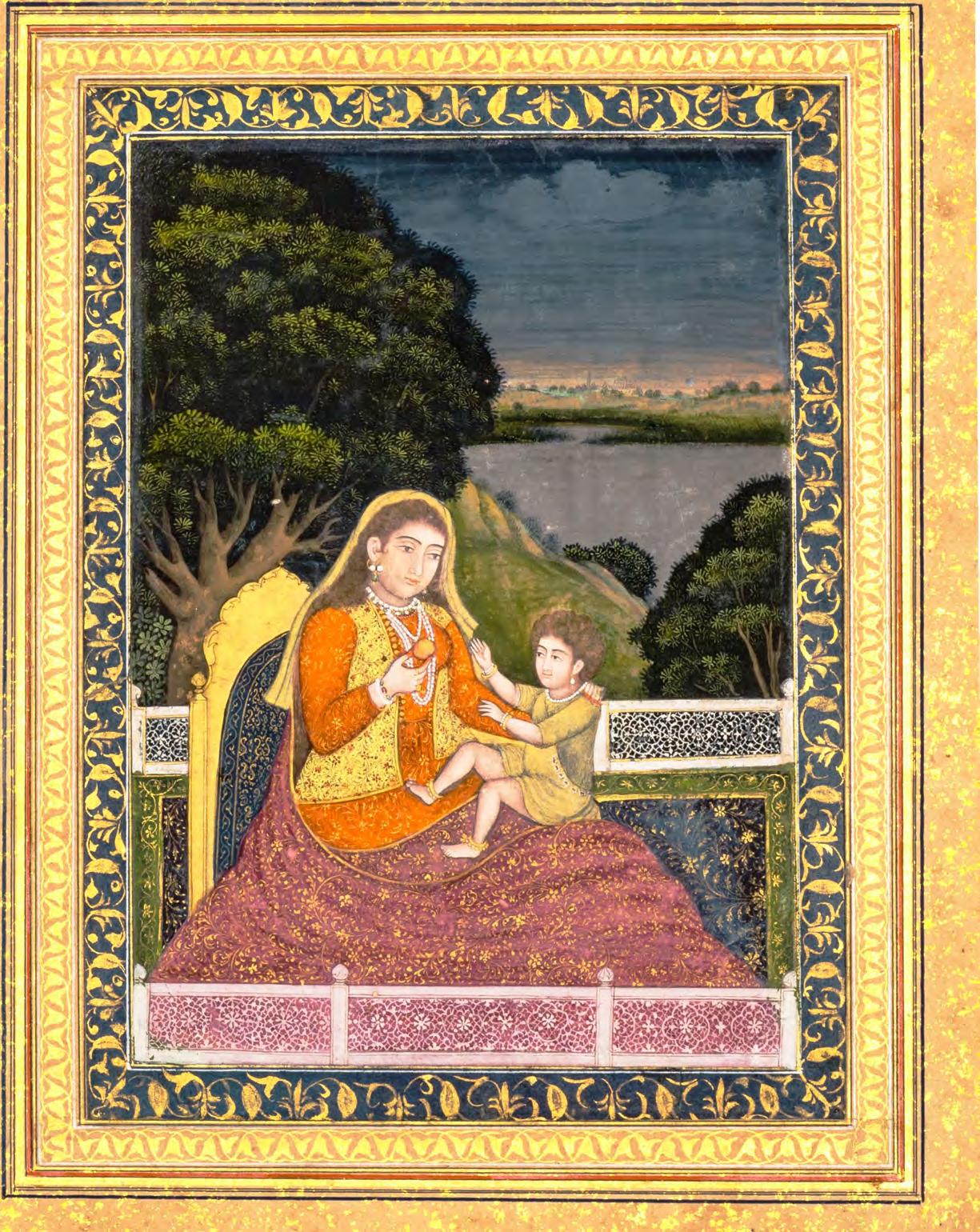
A Drunken Prince Led To Bed Circa 18th century
Lucknow, North India
heightened with gold on paper
Image 9 5 8 x 7 1 2 in. (24.5 x 19 cm.)
Folio 13 x 11 1 4 in. (33 x 28.5 cm.)
ro e ce hri ie o o 4 c o er 2012 o 178
A drunken prince is led to his bedchamber by female attendants and musicians as dawn is heralded by the cockerel and the grey half-light of the new day. Lucknow was given the reputation of being highly elaborate, from their poetry to their culture, indulging in excess and embracing decadence. The present painting illustrates this zeal, showing a finely dressed prince who has reveled into the early morning hours and consequently become intoxicated. Terrace scenes incorporating musicians such as ho e ic re here were popular in Awadh [the region where Lucknow is located], a composition technique adopted from the nearby Mughals.

e Nawabs of Awadh were originally appointed in the 18th century as governors of the rich agricultural province by the Mughal empire, but gained independence as their power faltered.



In the latter part of the century, many Mughal artists, poets, and nobility ed to Awadh in search of stability amidst uncertain times for the Mughal empire. is socio-political climate, along with a growing European presence, prompted the development of an Awadhi substyle. Artists took inspiration from European styles, paying attention to spatial depth and gural volume, hoping to escape the Mughal standards of painting in search of their own. One characteristic and widespread feature applied across Awadh paintings is the aerial perspective, exempli ed in the current work by giving the impression that the viewer is slightly above the gures’ eye level.
e Awadhi region saw itself as a cultural successor to the Mughal dynasty when they showed signs of decline in the 18th century, providing a pool of patrons for artists to work for who commissioned pieces like the painting illustrated here. With gracefully patterned, gold illuminated margins, this work demonstrates the skill and precision possessed by the artists of Awadh before they conformed to the popular Company style in the 19th century.
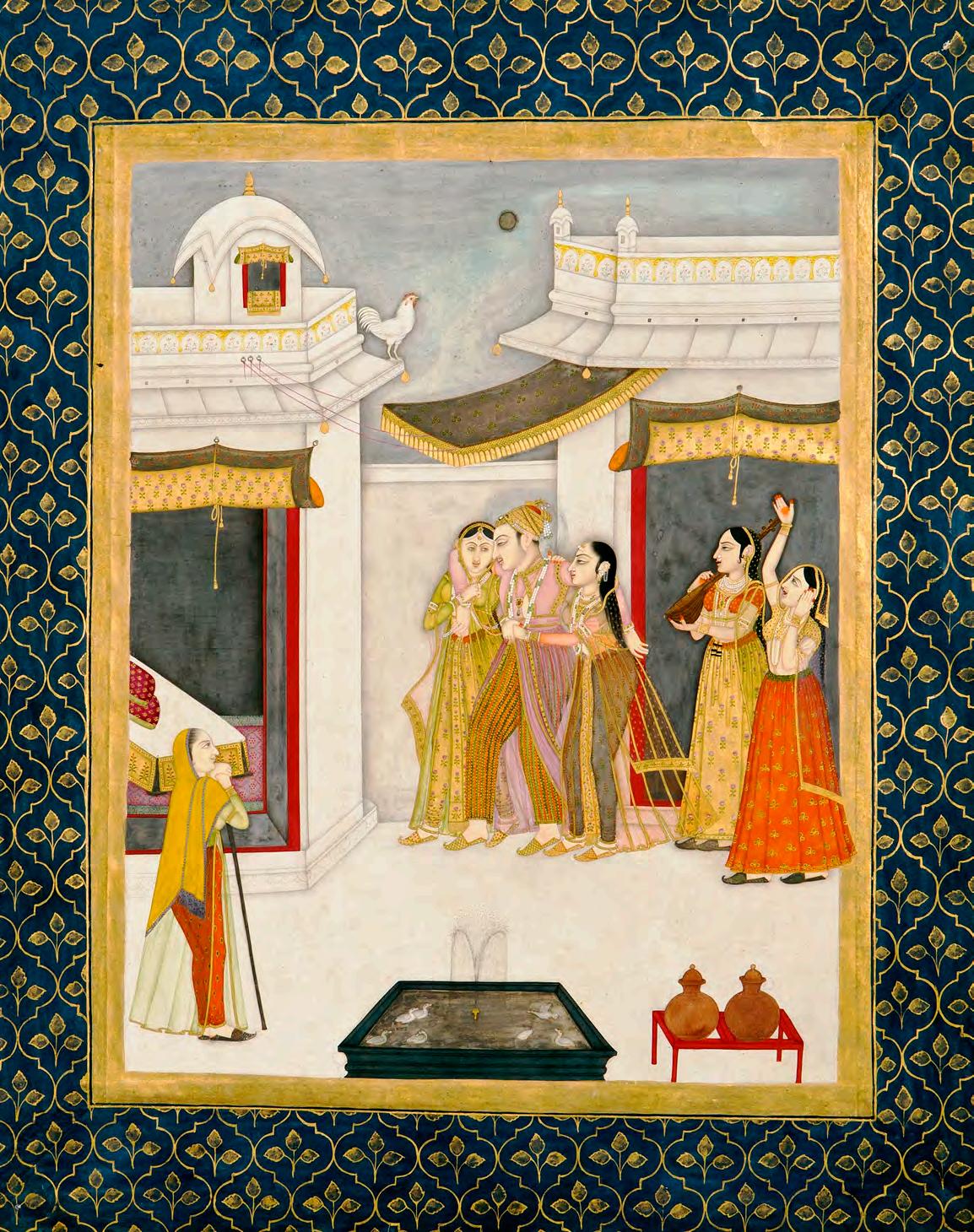
Leaf from the Madhavanala Kamakandla
Circa 0
Mughal, India
12 1/4 x 7 1/4 in. (31 x 18.5 cm.)
gold on paper
ro e ce hri ie o o 4 c o er 2012 o 177
The Madhavanala Kamakandla story is of a Brahmin boy name Madhavanala in the service of King Govindachandra of Pushpavati. A handsome, musically and artistically gifted young man, Madhavanala was envied by the King’s courtiers and they persuaded the King to banish him. Through a series of events Madhavanala is again banished, but not before falling in love with Kamakandla. After being separated for some time Madhavanala learns that Kamakandla has passed, and upon hearing the news he himself dies of grief. As it turns out Kamakandla is in fact still alive and upon hearing of her paramours demise she oo instantly dies of grief. or rem rk l imil r ork ee he i i g i he o l ollec io r ( 100 068 e) h i ri e o he r i i h l (173 -177 )
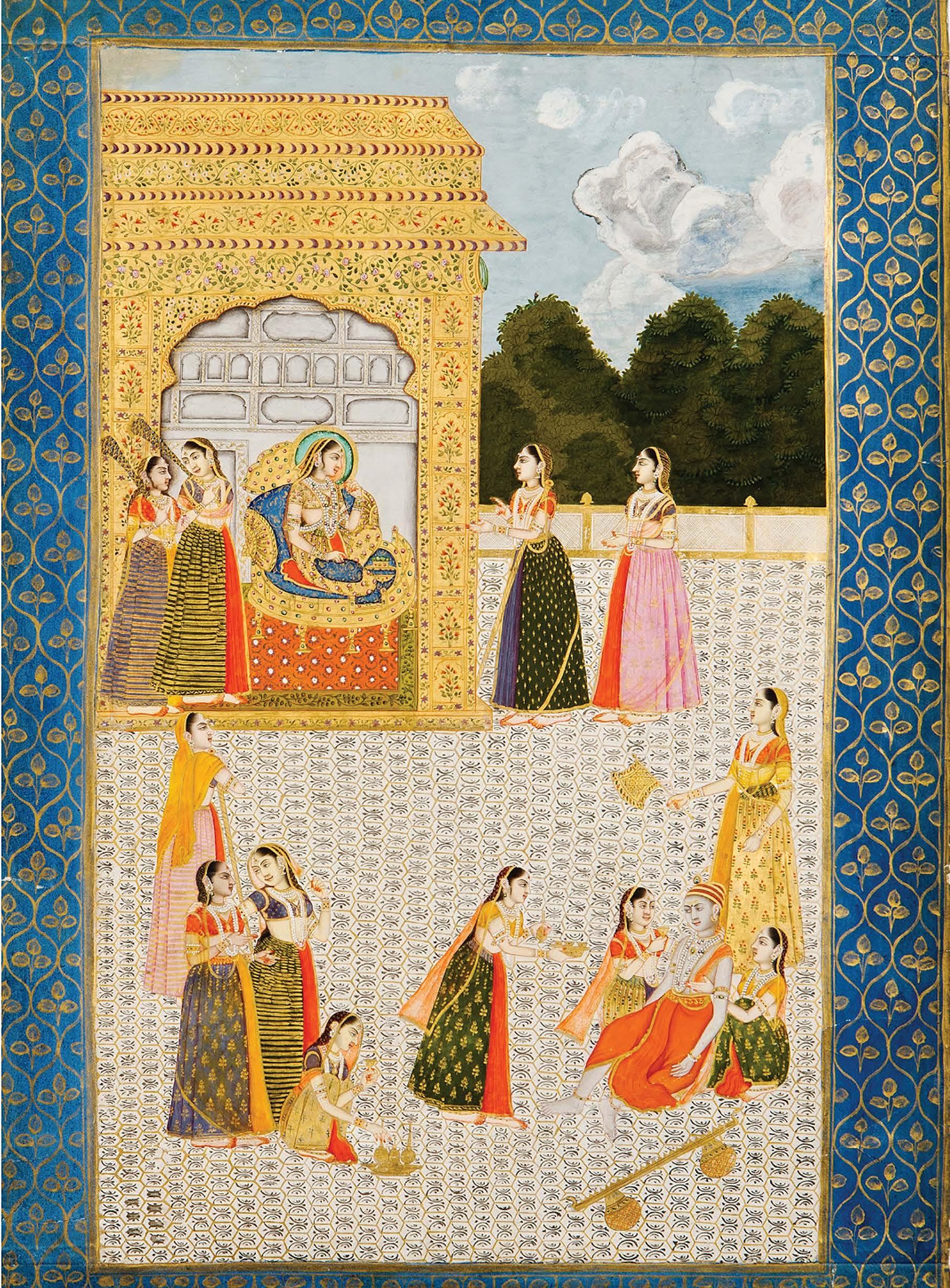
0
9 2 22 8 0 2 29 2

mo g i rich hi oric relig
e ol e o e o e o he mo i l e i l
iece o li er re i he i li r r er i g he i or e e or hi er orm ce e e Wri e o i ire e o io o Kri h e ee he 8 h 10 h
ce rie he e i cl e rr i e o he ei ir h
chil hoo ime mo g he co her hi i i or he go i heir l eri g e o io o him he em hi cle K m o e hi li e
e o he mo im or mome i he Kri h lege
i he he kill h h l religio ceremo co c e hi hir he el e o he i e ro her er he ceremo he ll he i he m i er We ee erie o e e i hi i i g - i he oregro Kri h he i h heir i gle oi - i e r i o her ome c or i he ri er
he r i i cl e ome ch rmi g o che i h ig re i ro i g he er e ge ici l i g e i l mo here o he ig e e i he oregro
er i he or he K r i h heir rm rri e he l ce o he le r o h he
el e o he K r e lo o he le or o hi co i l ce i ricke m gic e ir hi k he loor i er li hi
g rme he h he ke or oor r
i o er he ll i hi ce e i e ic e
o he err ce o he l ce hile Kri h hi hir i i co r i hi hi r re le
i e r i orki g i ik er
m or ce er o i i g i hi h i
he 17 h 18 h ce rie he ci che i o he ig re i ch r c eri ic o ik er
i i g re he i ere le el h
e h o he com o i io l Kri h h
oi e o h here ere le i e m
i he ge e logic l ree o he mr i i er o ik er e re er o hi gro o olio rom he o r h ik eri h g
r
h k o o iel Eh om or i e i i g
he ce e l Kri h or hi ho gh
o he r i or ge e log o he
r i ee l Kri h
he m r i er i er o ik er heir e e log re o iel (e ) m i rg lic io 2000 7-64 gh lic
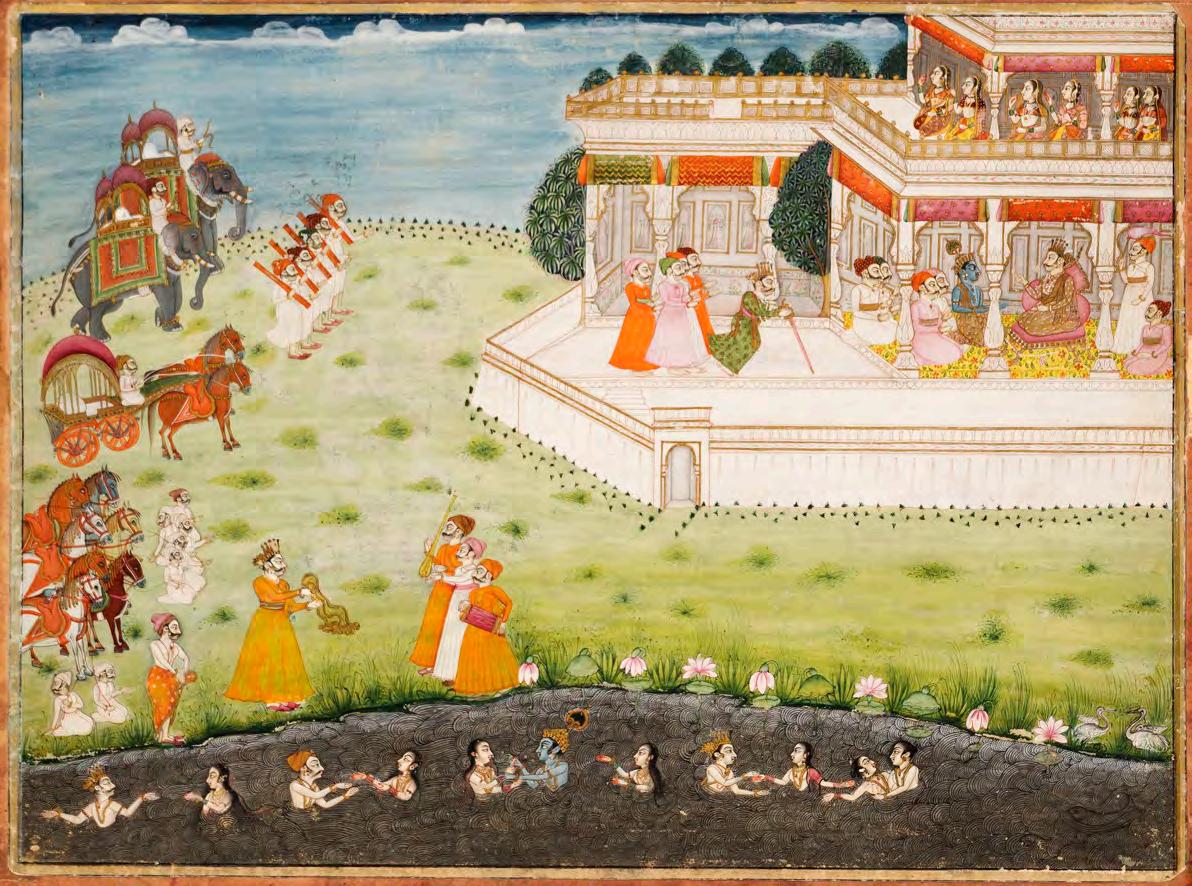
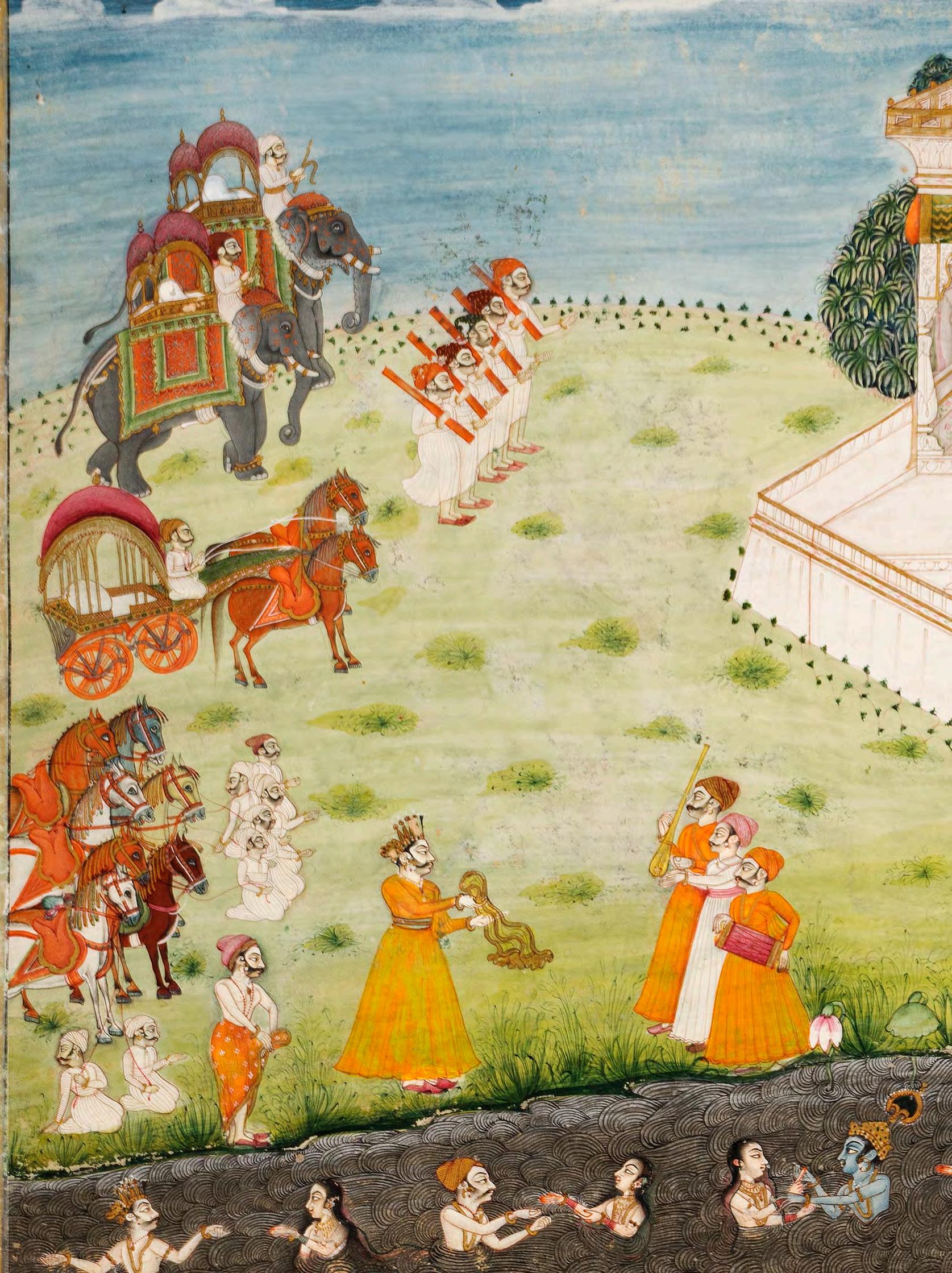
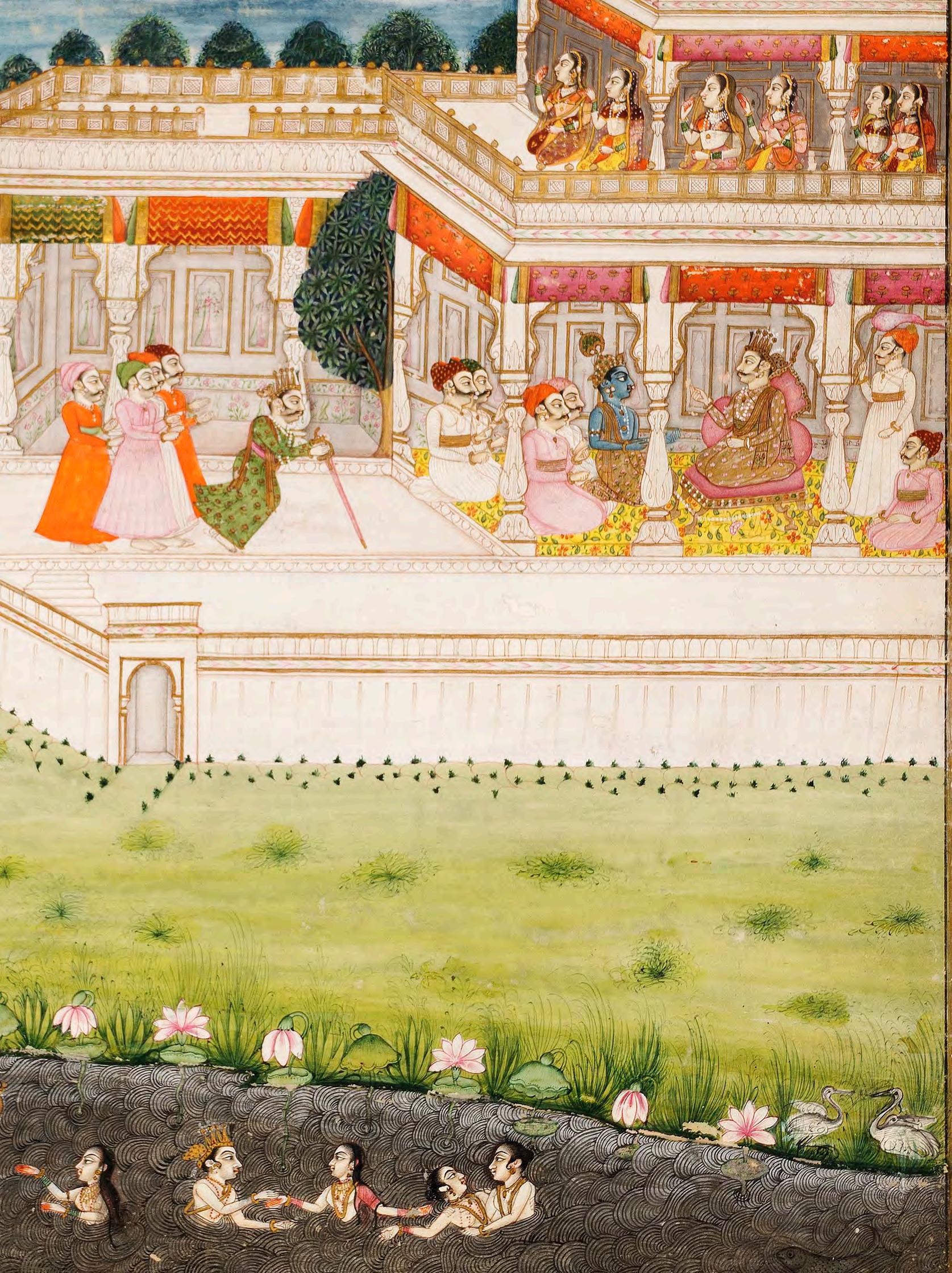
Mid 18th century
Rajasthan, India
Opaque gold on paper
0 8 2 8
ro e ce
o o r rke 2014
hri ie e ork 26-27 e em er 2017 o 228 rom he ollec io o l W l er
ro l c e i h r e e i ric el
e ig e oli ge ol cro he i i g i
clo like mo i e r i he ckgro i e
co o he righ igil o looker io
o i e he o come o he igh e ee Kri h
he ll emo ri h l r m
ehi Kri h g r e rim ril i e elr i h
e o r i e high re o i ho l hi lor l er
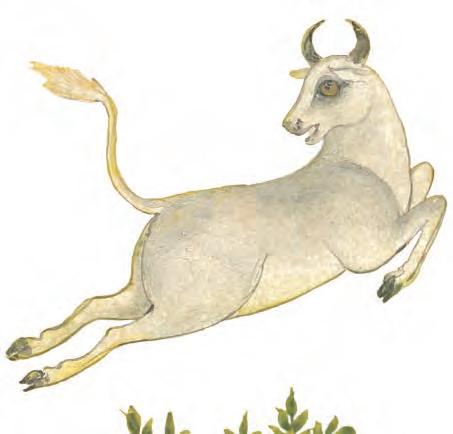
hi ce e origi e rom ch er 36 o ook 10
o he h g r he emo ri h
c me o ri here Kri h re i i g
r e o re k h oc o ge he go e io roo i g ree cki g eo le
o h he r cre mi g or Kri h o
re c e hem e i g o hi co rom he o Kri h he r he crie or hel
re r e o ce ri h he ll ch rge
Kri h h r e he he c gh he hor hro r i ce
er r e he ll g i ch rge he go
hi ime Kri h ri e o e o he hor rom he emo he im le him i h i
cl imi g ic or hi c io i reem i el
ill r e i he c rre e m le e ic i g he
mome righ e ore Kri h ri m h
ri h kick hi ck leg i ro e erk
hi he o o e c e Kri h gr i
i cle r h he ll c o e he migh ei
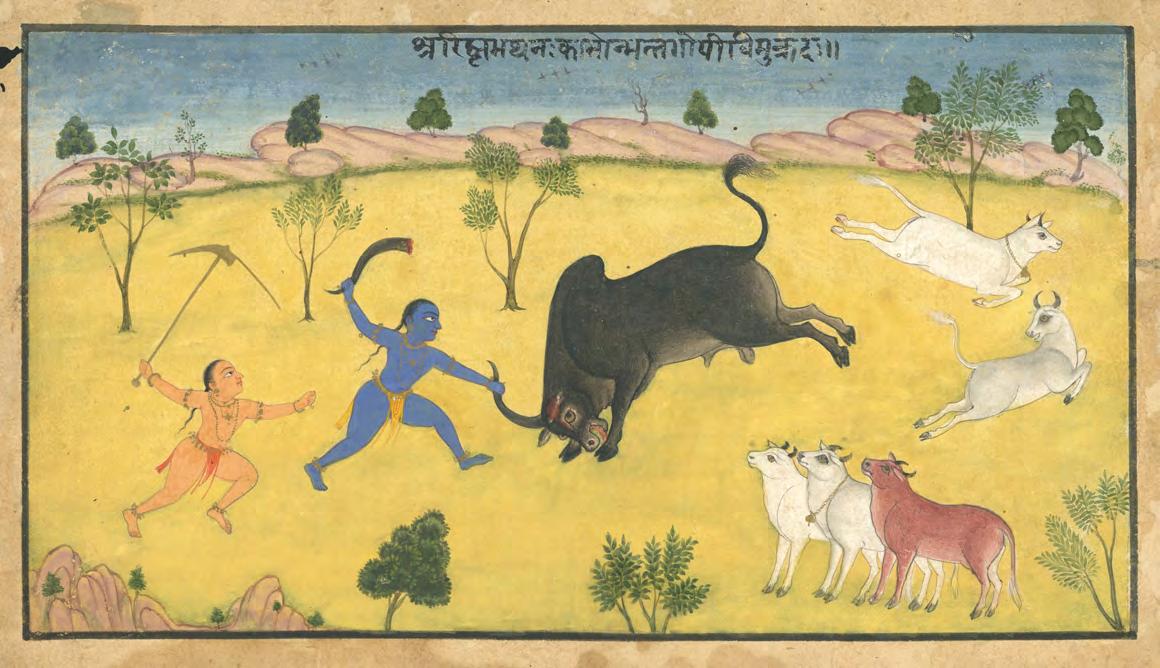
Blind Man’s Buff / Hide and Seek
First generation after Manaku
Circa 1775-1780
Kangra, India
Opaque watercolor heightened with gold on paper 10 x 8 in. (25.4 x 20.3 cm.)
ro e ce ori Wie er e em er 21 1973
e eye is rst drawn to a young seated Krishna, the crowned deity with a mauve complexion adorned in a yellow dhoti. His eyes are shielded by a playful Gopa, the mid-section of the piece “a friezelike interplay of figures ” In the foreground a group of seated cows are arranged in a delicate manner evoking a mood of evening pleasure along with a background of lush owering foliage, typical of the period. Bahadur explains in his footnotes on page 335-336 that coramihicani or “blind mans bu ” is a game in which six or seven players take part. One of them, the thief ” has their
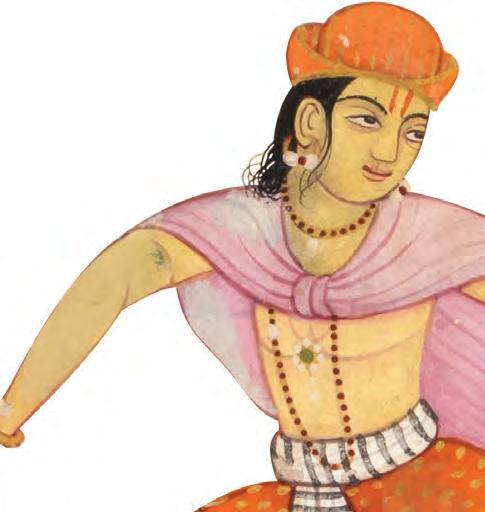
eyes covered while the others hide. e thief then runs in search of the others. ose who have hidden tr y and return to the khutavam, the place where the thief ’s eyes were shielded. If the thief can touch a player before he reaches the khutavam that person becomes the next thief. The subject is a deep allegory, as “everything is illusory: the natural world is subsidiary to Krishna’s game; and to the moral lesson it teaches.”
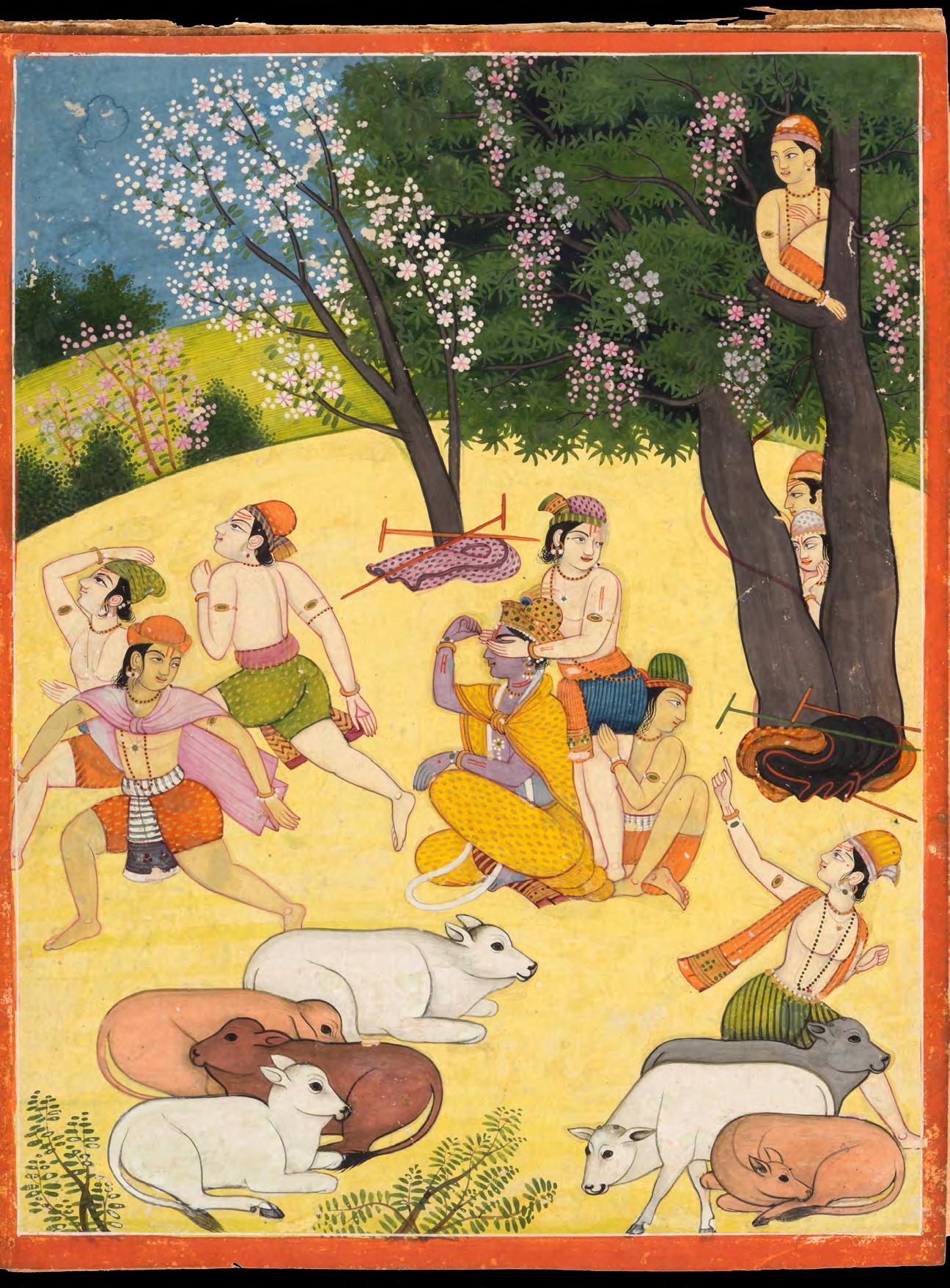
Leaf from The Devi Mahatmya: Durga In A Battle Against Circa 1820-1840
Jaipur, India heightened with gold on paper 8 x 12 in. (20.3 x 30.5 cm.)
ro e ce
h r ller 14 er g r rke e elhi i c ire rom he o e i 1978
E hi i e comi g ollege ller Willi m or e l i 1981
he ir e er i e h em h i e he ig re o he go e he rim r ei he e i h m collec io o oe r h com o e or io o he rk e r i er ll r l i g o lor o he o e he e i h m or r he go e he reme o er cre or o he i er e ri e ome ime e ee 400 600 E hi ork e i e rio orm o he go e i ie r o hole h re i er i e i h o e o her
he ce r l rr i e o he e i h m re ol e ro rg he rrior go e ho re re e he lmigh r h o he go e he r e g i he orce o e il rg i orm o e i he go e K li m ik re orm o e i rg cre e r hm hi i h he le er go o l he lo emo hi h r he go ere e r l h hi h r co l ri g o o l ihil io o he e o e rg i h heir o er he or ll gro gorgeo ic ll e ic e i h eigh or e rm e ch hol i g e o or ri e o o e o he go i e rom hi h r he e i h m e l i h m er o o her r ch he ro her h m h i h m h ho co l o l e l e em le hi ork ho rg o her mo l ke o com io e g gi g i kirmi h i h
i h m h ho h rl hi e r o r her he le i h i h m h h m h heir rm come rom ch er 9 o he e i h m rg goe he o he i h i h m h m l i le ime he ill o e e erre er m l i le
e e he re e ork ill r e he ir le e ee he go e i h m h he e i ickl c i h m h er or i h h r -e ge rro l o hi hiel o hich eigh moo ere ig re Wi h hi hiel li hi or roke he r h rle hi e r h mi ile l o i ce o r her li i o o her i c rg he rocee e o ke i h m h o o l or him o ce e e e e ime g i il he i ll l e he e i
he righ color i cor or e i o hi im ge re highl
ch r c eri ic o he i r chool e eci ll ri g he 19 h ce r r i o hi regio ere kille i ili i g i r o e h
co r rom e com leme o e o her re l i g i mic
ce e h highligh ig r l e il c re he emo io l mo here or e r e i r ill r io o rg igh i g
i h m h h e o 182 -18 0 ee he o gele o e m o r i i g cce io m er 77 118
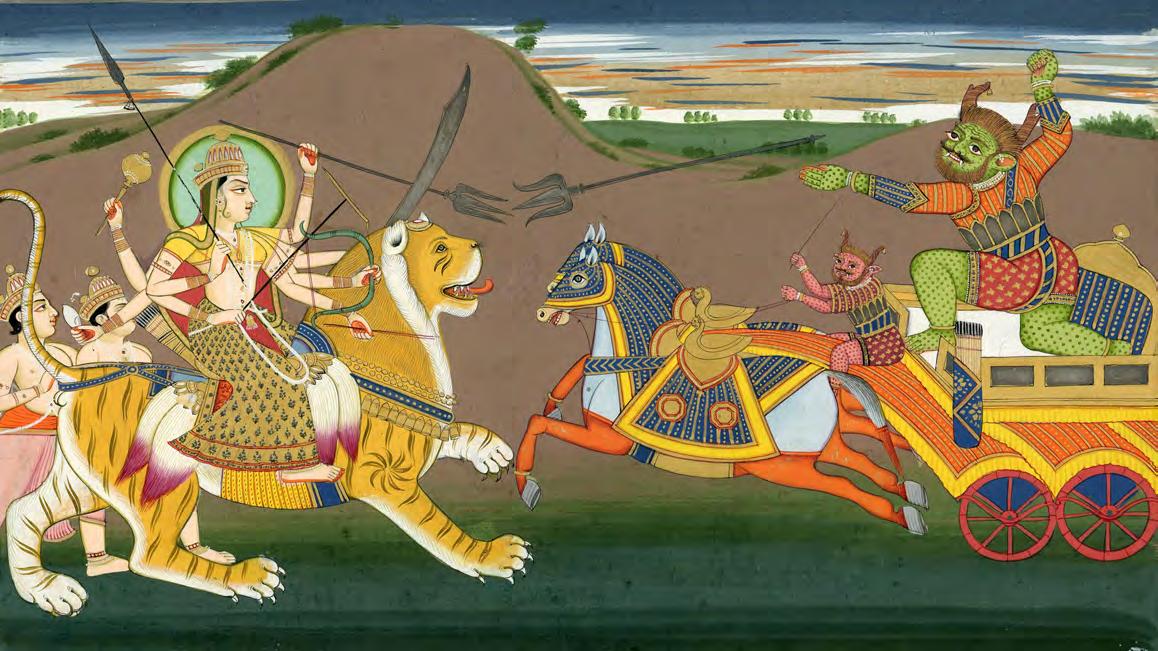
An Illustrat Devi Mahatmya
Circa 1765
Guler, India
Opaque watercolor with gold on paper
6 3/4 x 10 1/2 in. (17.1 x 26.7 cm.)
ro e ce
he E e o r K erm o li he ce e ce i hi he mil he collec io o o h i mi i re c ire i o o E gl ri g he 19 0 1960 here r erm orke re i e h ici
he r h K i h r h
ggre i el o r r hm ho i ro i g rom he el o lee i g i h o lo lo om he ig re re e ic e lo i g o he er e i he o mic ce
i i c om r or i h o re
o o ce he h l ille hi role re or r hm ee i h
l m eri g c ll o he e i o ro e i h o h he m e e he emo - o ce he go h oke he le he emo re il he ri m h rrior ec i i g hi
he re le e or r hm e olle he i com r le o e og i r he ee o he o mo he or er o he Worl he e o he e io i ol io like o he i er e (ch er 1 er e 64-71)
For the next two consecutive folios from the same series see: Leach, L.Y.
1986 Cleveland, Cat 116, pps. 286-87. Pal, P. New York 1983, Cat. P. 25-26,

h m occ rri g rior o he



e emie o h he re o more hro ologic ll hi i o e o he e rlier rr i e i hi he e i h m occ rri g rior o he go mmo i g e i o igh or hem


New 1983, Cat. Also: Doris


Wiener Gallery New York 1974 Cat. 31

or i h recli i g o he

erri le r he i mo
he e o K l - ge he he i er e o e oce i h he er o he el ge he or le or i h recli i g o he er e he h i ic l m er o erri le r he i mo
h K i h r g



h emerge rom
i o ei g rom he o i h e r o gh o l r hm he her o ei g e e i he o h emerge rom i h el eei g he e o ierce r

r i h lee i h

ie o ke i g ri i h

r hm i h co ce r e mi
e olle hri og - i r elli g i
ri e e
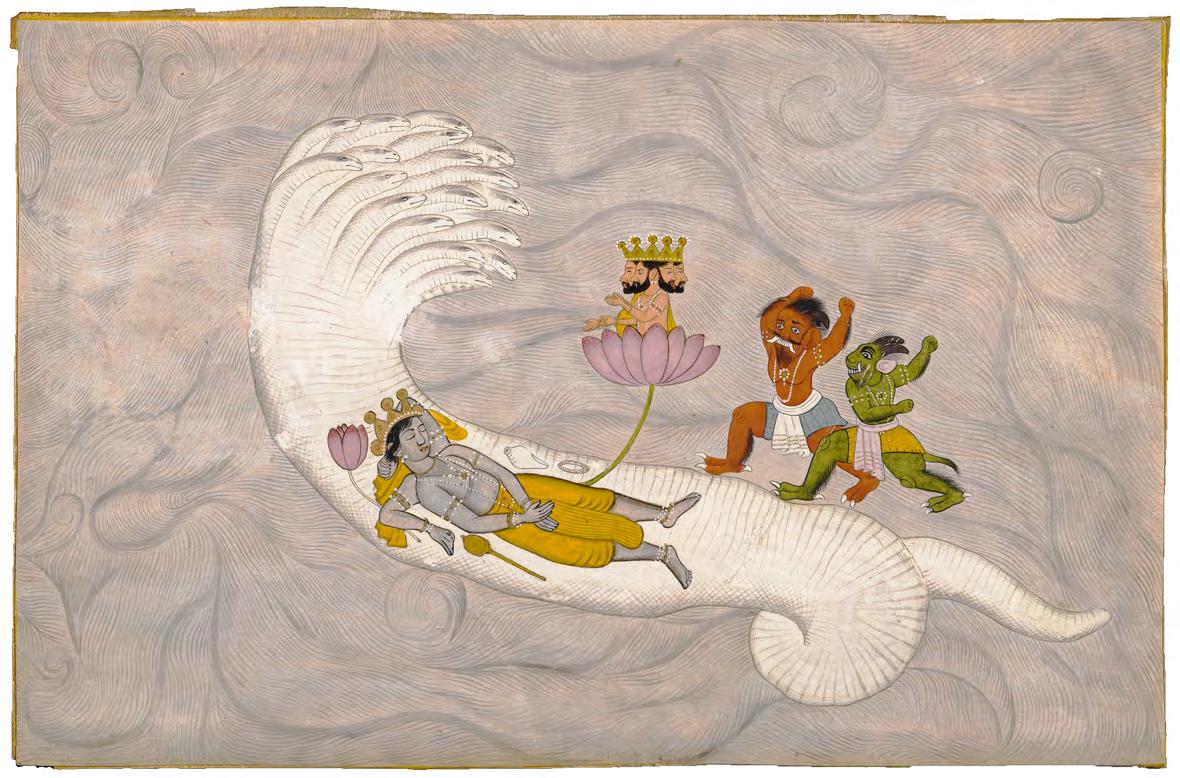
Illustration to the Circa 1810
Guler, India
heightened with gold on paper 8 1/4 x 12 in. (20.9 x 30.5 cm.)
ro e ce hri ie o o 10 c o er 1989 lo 70
“Then Chanda and Munda, two servants of Shumbha and Nishumbha happened to see that Ambika (Kausiki) looking extremely beautiful. They reported to Shumbha:
O great king there is an exceedingly beautiful woman whose queenly beauty is illuminating the Himalaya. No-one has ever seen such sublime loveliness anywhere. Find out who that goddess is and take possession of Her, O Lord of Asuras. She is a gem among women, with exquisitely beautiful limbs which illuminate the four directions with their lustre. There she stands, O King of Demons.
You deserve to see Her.
Lord! Whatever precious stones, jewels, elephants, horses and so on are in the three worlds, all now decorate your house, O King! You have obtained the precious elephant Airavat , also the fabulous tree Parijata, as well as the wonderful horse Ucchaishrava, which was Indra’s. Here in the courtyard stands the gem-studded chariot drawn by swans, brought here from Brahma the Progenitor. Here is the treasure Mahapadma from Kubera and the unfading lotus garland Kinjalkini, the gi from the ocean. Varuna’s umbrella, which showers gold, now stands in your house with the superb chariot that once belonged to Prajapati.
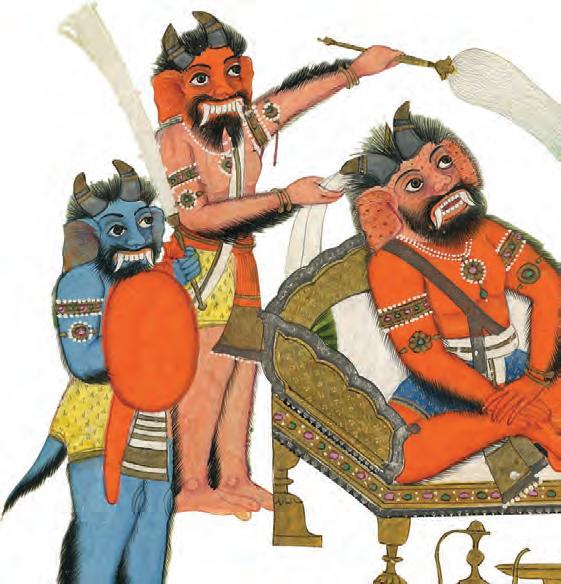

O Demon king, as all these gems have been given you why not also seize this jewel among women?
The Rishi said:
A er listening to all this from Chanda and Munda, Shumbha sent out the mighty demon Sugriva as his messenger to the Devi. He said:
Go and convey my invitation to Her in a gentle way so that She will be affectionate toward me. Going over to the lovely mountain seat of the Goddess, the messenger spoke in a sweet, soothing tone, saying:









Lord! You have snatched Utkrantida, the missile of Yama by which he gives exit to all creatures. Your brother now possesses the noose of the Ocean King. Nishumbha also has all the gems from the Ocean while you have the two reproof garments from Agni.

O Devi, I am the messenger of Shumbha, Lord of the Demons and Sovereign of the three worlds. He has vanquished all his foes among Asuras and even the Gods were unable to resist him. He sent me here to Your presence. Listen to what he says, his message is this:

“All the three worlds are mine. Even the Gods obey me. I eat all the offerings which once were theirs. All the finest jewels of the three worlds are now mine. Even Indra’s elephant, Airavata, I now have. With salutations the Gods have even offered me the glorious horses called Ucchaihsravas which arose at the churning of the milk ocean.
You are indeed

O magni cent lady! All the other objects which belonged to the Gods or Gandhavas or Nagas, all are now in my possession. We regard You, O Devi, as the jewel among womankind. erefore, come to us, we who are the connoisseurs of gems. Come to me or to my powerful younger brother Nishumbha, O Lady of the quick side-glances, You are indeed a sparkling jewel. By marrying me You will gain incomparable wealth. Think of the advantage and become my wife.
e Rishi said:
What you say is true, no doubt. Shumbha is indeed sovereign of the three worlds together with Nishumbha. But how may I nullify My former vow? Please listen to this vow I once made in ignorance: I once declared I would only marry one who could be My equal in strength, one who could defeat Me in battle and remove My pride, only he could be my husband.
So let Shumbha come here,
Asura, let him vanquish me without delay and gently take my hand in marriage.
from the three worlds who is capable of standing against Shumbha and Nishumbha!
In fact all the Gods were unable to face even the other Asuras in battle. So how could You, a single woman do this on your own? If Indra and all the other Godheads united could not defeat Shumbha, how will You, a woman, dare to face him?

The messenger said:


When this was said, the adorable Goddess Durga who sustains and protects the universe, smiled thoughtfully and said:
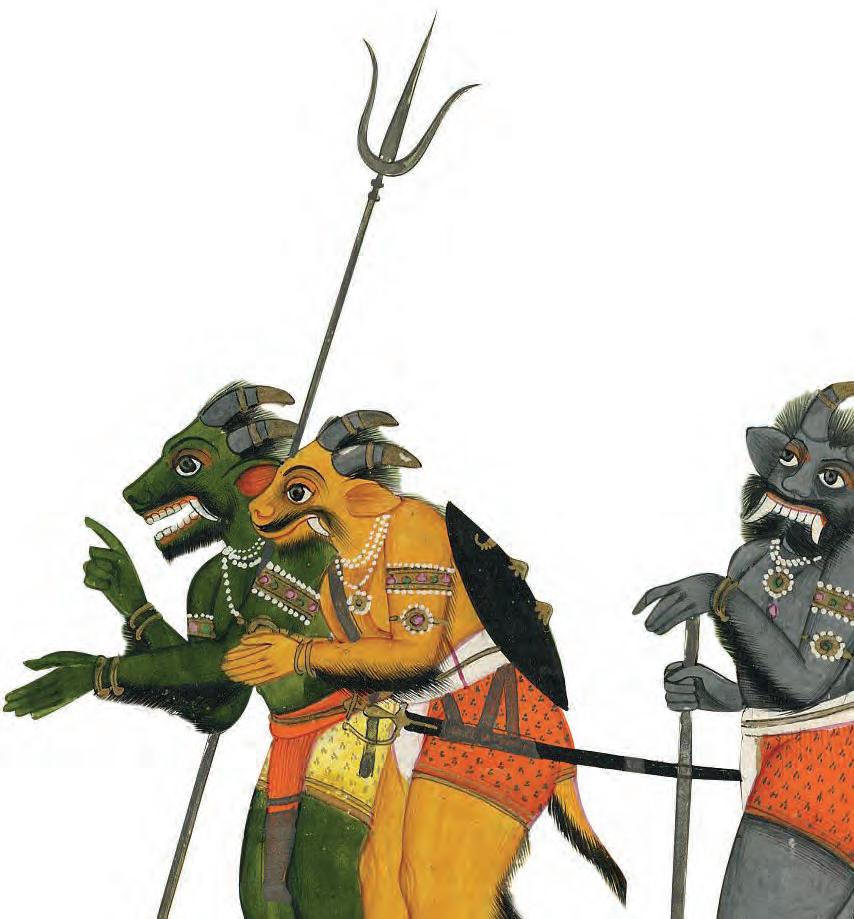
O Devi! This is arrogance! Do not talk this way to me! Name a single god dragged
It would be better that You heed my message and go to Shumbha and Nishumbha yourself. Otherwise you will suffer the humiliation of being dragged there by the hair.
The Devi said:
It is true. Shumbha is strong. Nishumbha is very heroic. But what can o ig or ce m e m o o go ck o he r or ell him oli el h h e i he he m o h e er he le e




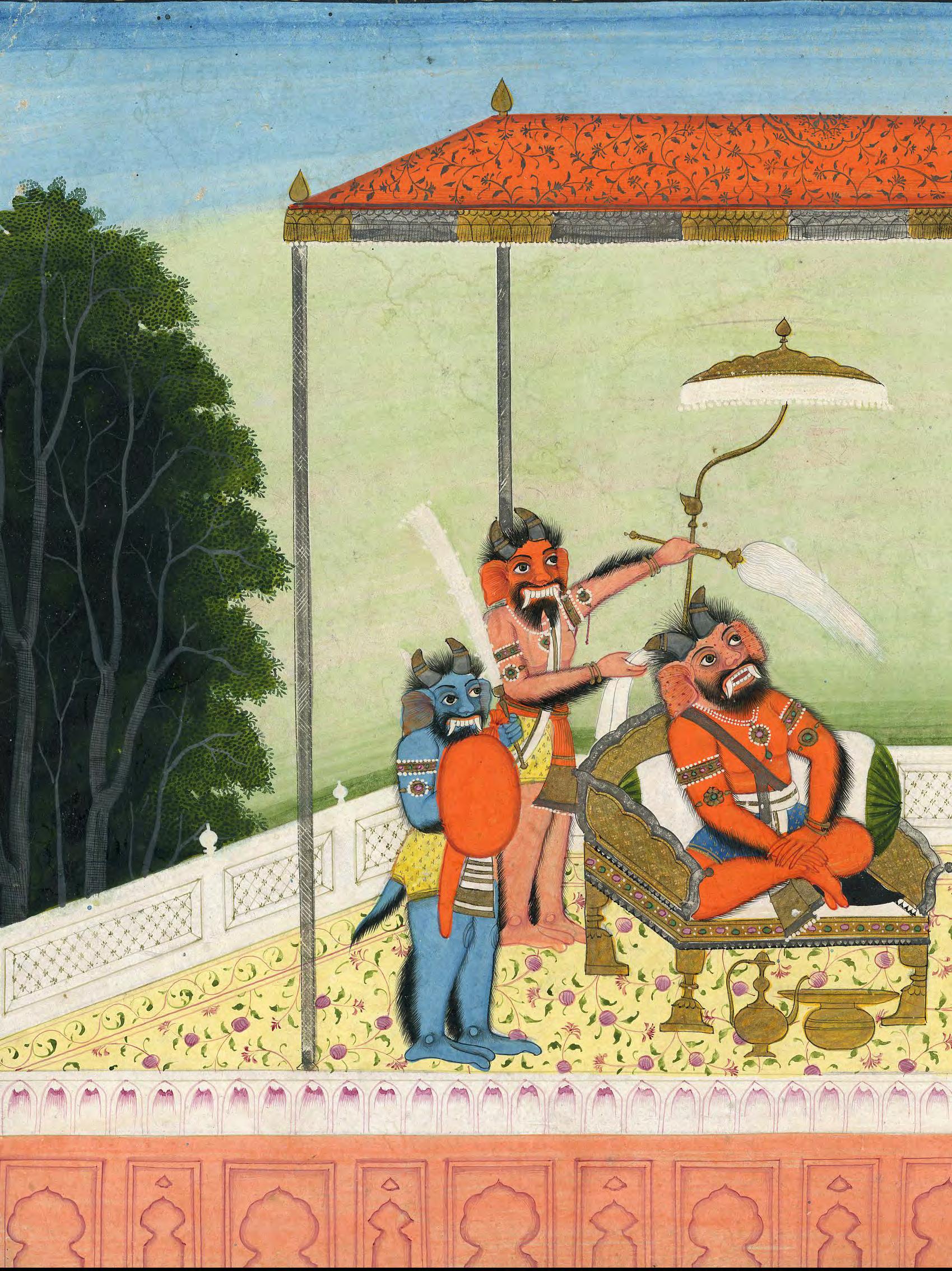
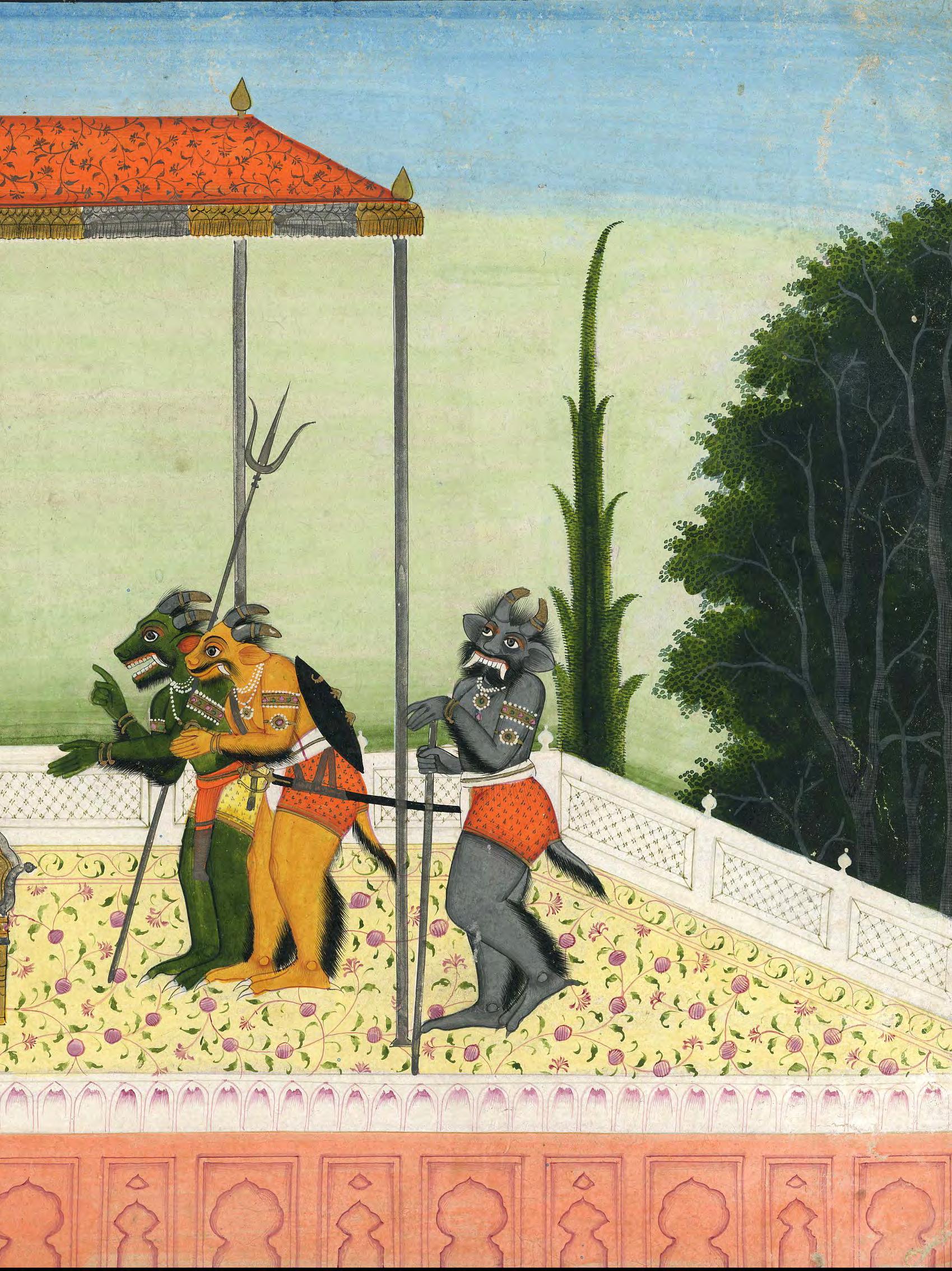

o o 1977 o 41 ( iii i )
47 o chim e o mo o e ri
g r 1991 o 17
67 l 2001 o 4 124
o he e ork rch 22 1989 lo 16
e Goddess Kali
Attributed to Sajnu Circa 1810
Mandi, North India
Opaque watercolor heightened with gold on paper 12 1/2 x 9 1/2 in. (31.8 x 24.2 cm.)
ro e ce ri e i collec io
e goddess depicted in a classical stance after her killing spree, the third eye surmounts her tongue struck out in between protruding fangs, clad in a belt of e ere hands and a necklace of ec i e heads as jagged hair runs down her shoulders. The manifestation of destruction and barrenness is seen brandishing a curved sword (kharga), holding a decapitated head, with a foot over Shiva’s body. Jackals and vultures surround the scene smelling death in the bloodsaturated air. The illustration is centered in an octagonal medallion, the spandrels embellished with gold scrolling foliate tendrils, in black borders with scrollwork, wide pink margins containing further depictions of her emanations, cusped cartouches above and below with a vulture and a rat.
Also known as “Mahakali ” which literally translates to “The Great Kali ” she is revered as the goddess of both time and death. Mahakali represents Shakti, the power of pure creation in the universe, and Shiva represents pure consciousness which is inert in and of itself. While this is an advanced concept in monistic Shaktism, it also agrees i h he o l rik o
K hmir popularly known as Kashmir Shaivism and associated most famously with Abhinavagupta. There is a colloquial saying that “Shiva without Shakti is Shava” which means that without the power of action (Shakti) that is Mahakali (represented as the short “i” in Devanagari) Shiva (or consciousness itself) is inactive; Shava means corpse in Sanskrit and the play on words is that all Sanskrit consonants are assumed to be followed by a short letter “a” unless otherwise noted. The short letter “i” represents the female power or Shakti that activates Creation. This is often the explanation for why she is standing on Shiva, who is her husband in Shaktism, and also the supreme godhead in Shaivism. Another understanding is that the wild destructive Mahakali can only stop her fury in the presence of Shiva the God of Consciousness, so that the balance of life is not completely overrun by wild nature. The distinctive elaborate margins of this work with cusped cartouches containing attendants of Kali and associated animals are similar to those found on a painting of Raja ri e o i or hi i g hi ri e o he r i
(W.G. Archer, Indian Paintings from the Punjab Hills, London, 1973, fig. 46, p. 275).
About Sajnu:
“Painting at Mandi, a relatively large kingdom in the Punjab Hills, did not really get underway until the middle of the eighteenth century. It reached an apogee of creativity during the reign of Raja Isvari Sen, who was under the cultural sway of painting made Kangra and Guler, the two kingdoms which supplied a number of Isvari Sen’s favorite artists. His leading court painter was Sajnu, originally from Kangra or Guler. Sajnu, like Nainsukh and the Basohli Master of the Early Rasamanjari before him, did much to transform the style of painting everywhere in the Punjab Hills. Early nineteenth century Pahari painting was greatly influenced.”
-McInerney, Terence; Kossak, Steven; and Haidar, Navina.
New York:
The Metropolitan Museum of Art, 2016 p. 238. Print.
Illustration to a Harivamsa series: Narada warns Kamsa Purkhu
Circa 1800 1820
Kangra, India
heightened with goldon paper
Image: 16 7/8 x 12 1/2 in. (47.5 x 37 cm )
Folio: 18 1/2 x 14 1/4 in. (47 x 36.2 cm )
ro e ce
c ire le K l i i ri g he 1940 -19 0




e Harivamsa (an account of the Dynasty of Hari [Vishnu]) is a work of three chapters appended to the great epic, the Mahabharata. e rst chapter contains an account of the creations and the genealogy of the Yadavas, the family of Krishna and Vasudeva descended from their Aryan ancestor, Yadu. e second chapter describes the life of Krishna and his a airs with the gopis, where many of the stories are similar to those in the Bhagavata Purana. e last chapter deals with prophecies of the present age (Kali Yuga) and other matters unconnected with the title of the work. In Hindu mythology Narada is revered for both his sage advice and his notorious mischievous ways, creating some of vedic literatures most humorous tales. He is known as a master of the Veena, and is frequently depicted with one (as in this particular scene). is painting illustrates the following excerpt from the Bhagavata Purana:
brilliant like the sun. Narada was a friend of the King of heaven, and thus he told Kamsa, the son of Ugrasena, “My dear hero, you have satis ed me with a proper reception, and therefore I shall tell you something secret and con dential. While I was coming here from Nandakanana through the Caitraratha forest, I saw a great meeting of the demigods, who followed me to Sumeru Parvata. We

traveled through many holy places, and nally

we saw the holy Ganges. While Lord Brahma was consulting




“... e great saint Narada descended from the heavenly planets to the forest of Mathura and sent his messenger to Kamsa. When the messenger approached Kamsa and informed him of Narada’s arrival, Kamsa, the leader of the asuras, was very happy and immediately came out of his palace to receive Narada, who was as bright as the sun, as powerful as re, and free from all tinges of sinful activities. Kamsa accepted Narada as his guest, o ered him respectful obeisances and gave him a golden seat,
the other demigods at the top of Sumeru Hill, I was also present with my stringed instrument, the vina. I shall tell you con dentially that the meeting was held just to plan to kill the asuras, headed by you. You have a younger sister named Devaki, and it is a fact that her eighth son will kill you.” (reference: Hari-vamsa, Visnu-parva 1.2-16) ”
Purkhu is one of the master artists of early Kangra Painting. Active from 1780 – 1820, under the patronage of Maharaja Sansar Chand, he is respected for his brilliant execution of emotionally evocative processional scenes. “Purkhu saw individuals essentially as falling into types. ere is no insensitivity to appearances,

and he was quick to establish distinctions between one person and another… therefore Purkhu was best in rendering large groups: court scenes, processions, statefestivals, private celebrations, and the like. He was able to invest these scenes with the specific character of each occasion (Beach, 2011) In this particular painting our eye is immediately drawn to the foreground, where a courtly meeting surrounded by lush topiary is being held. A chowr y-bearer fans Kamsa (inscribed above crown) as the king watches Narada (inscribed in red), the most travelled sage, y away on the upper right, veena in hand. The lush surroundi g of the court scene re reminiscent of Purkhu’s most famous work for the Gita Govinda series often referred to as the Lambagraon Gita Govinda.
Literature:
Archer, W.G., , London, Parke-Bernet, 1973, I: 294- 295
Beach, M.C. et al, , Zurich, 2011, pgs. 728 - 732
Goswamy, B.N and Fischer, Eberhard, , Zurich, 1992, pgs. 367- 387
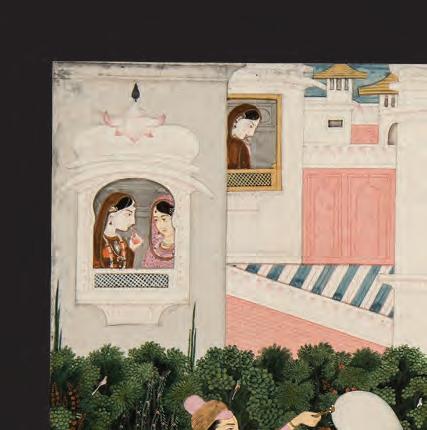
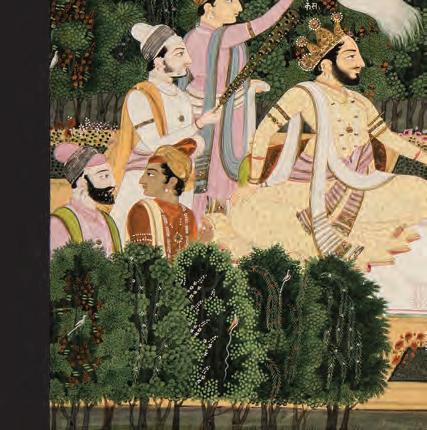
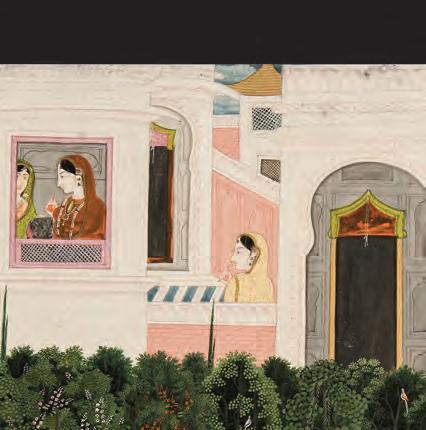
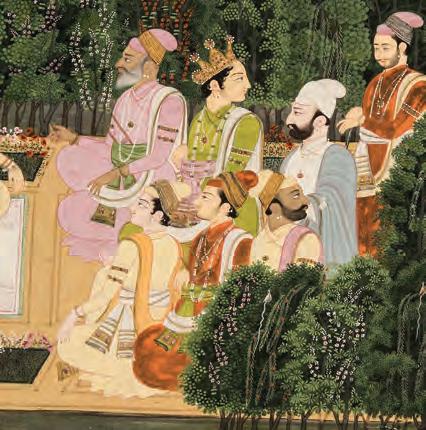
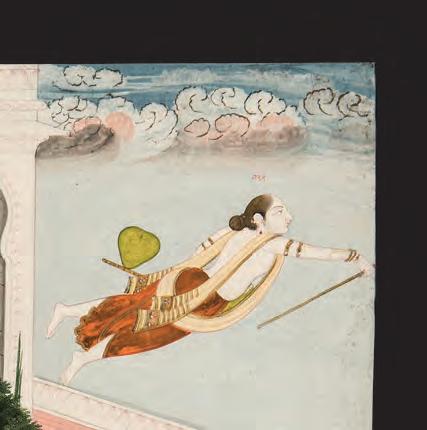
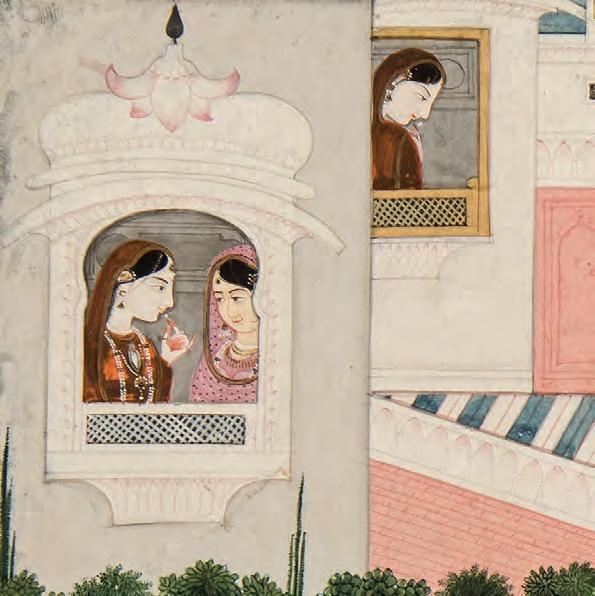
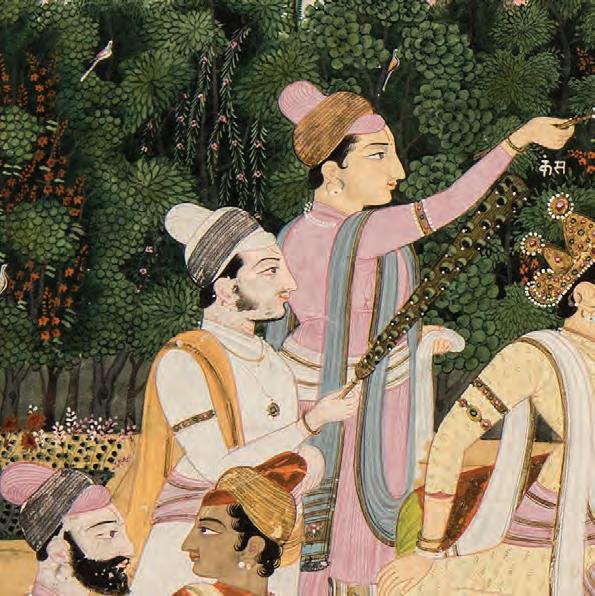
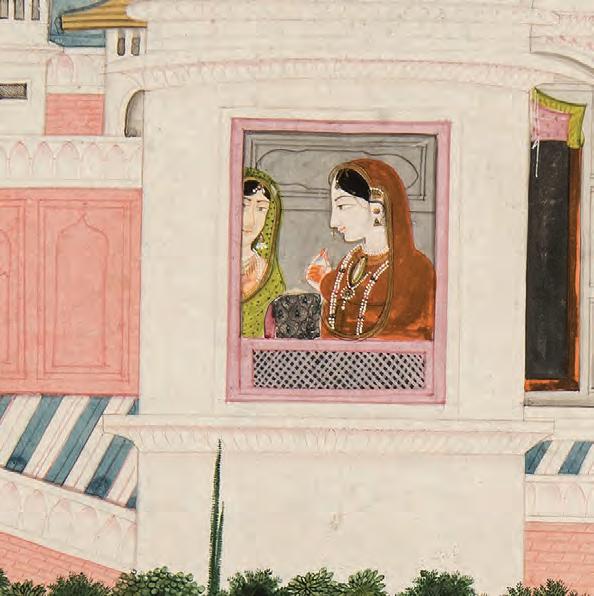
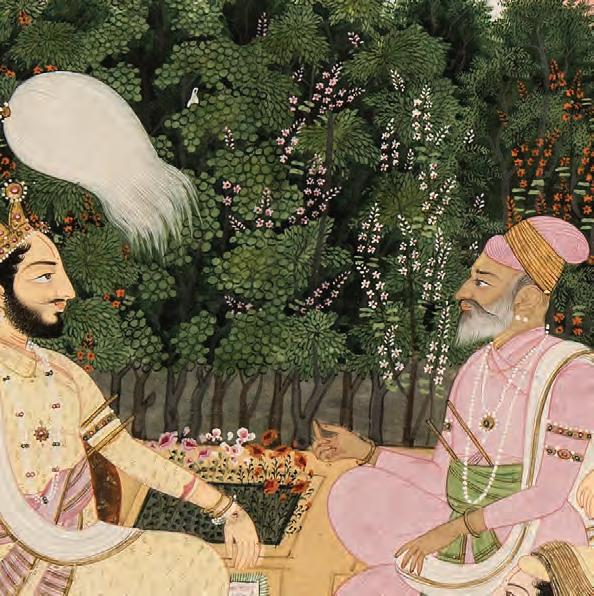
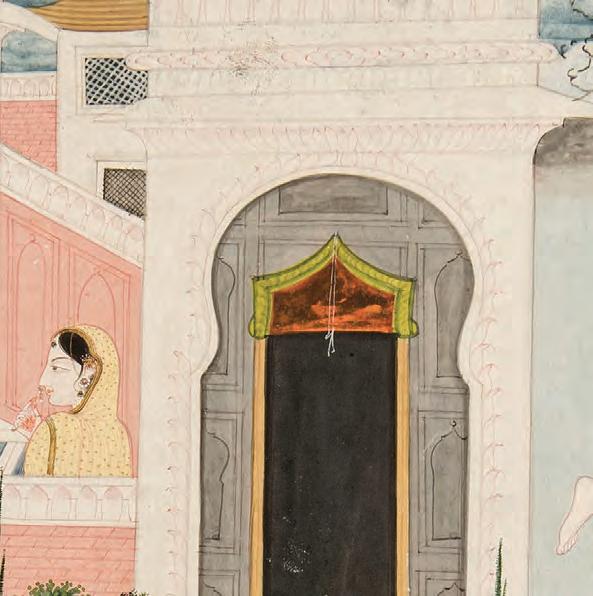
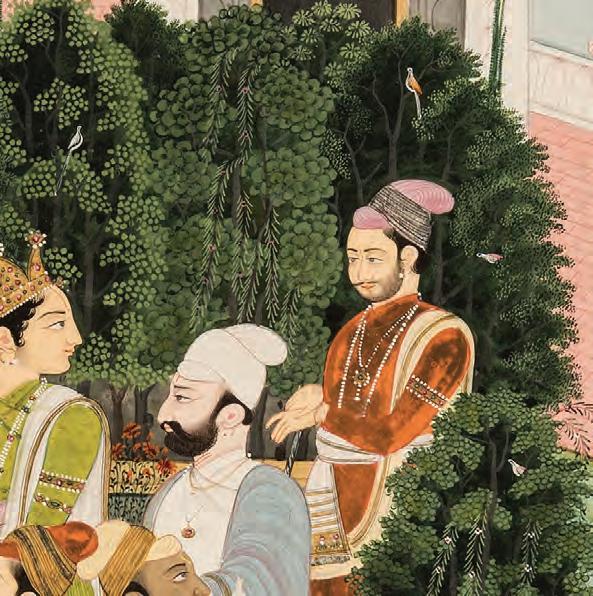
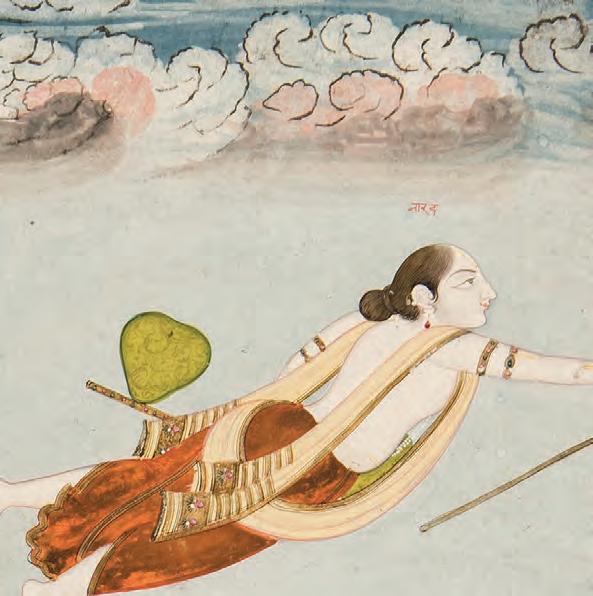
Leaf from the Bhagavata Purana Depicting Vishnu and Garuda:
Circa 18th century Bundi heightened with gold on paper 7 5/8 x 11 1/8 in. (19.4 x 28.3 cm.)
ro e ce ollec io o he r e o ee le ri e e ork ollec io c ire i he 1990
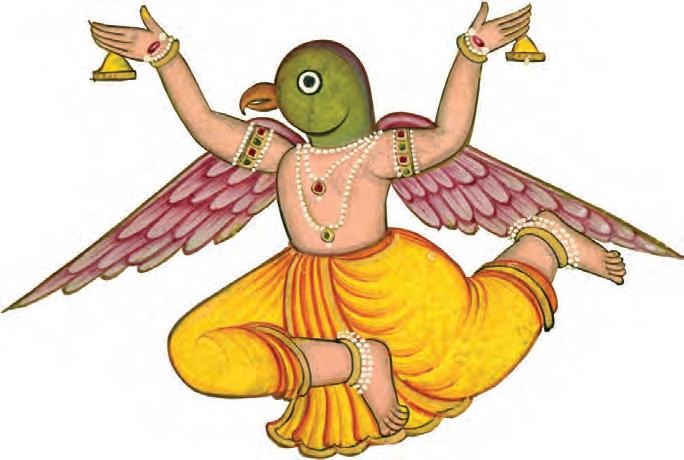
Amidst a rippling current, Vishnu rescues the king of elephants Gajendra from a crocodile makara. Gajendra had gone to bathe in a lotus lled lake when the makara caught the elephant, dragging him down into the water. e elephant struggled against the crocodile with all of his strength, but with each attempt at escape the crocodile’s grip tightened. In a nal e ort to thwart his demise, Gajendra cried out for Vishnu to save him, grabbing a lotus in his trunk to o er to the god. Vishnu heard the elephant’s pleas and appeared
alongside Garuda, vanquishing the makara crocodile demon and granting moksha to Gajendra for putting his faith in Vishnu as savior.
In the rst quarter of the 18th century, Krishna became the prime subject of painting over court scenes and portraits of rulers. Towards the later part of the century, stylistic elements from the Mughal court were likely adopted through the settlement of artists from Delhi or Lucknow in Bundi,
or through the implementation of Mughal aesthetics by Bundi artists. Regardless of the motivation, Bundi painting transformed during the 1700s from a heavily Rajput style to one that paid respect to the Mughal archetype while still maintaining its unique air. e present image is representative of an earlier work, celebrating the divinity and power of Vishnu through the Gajendra Moksha narrative. e scene is meant to convey feelings of surrender and trust, essential components in the devotee’s relationship with god.
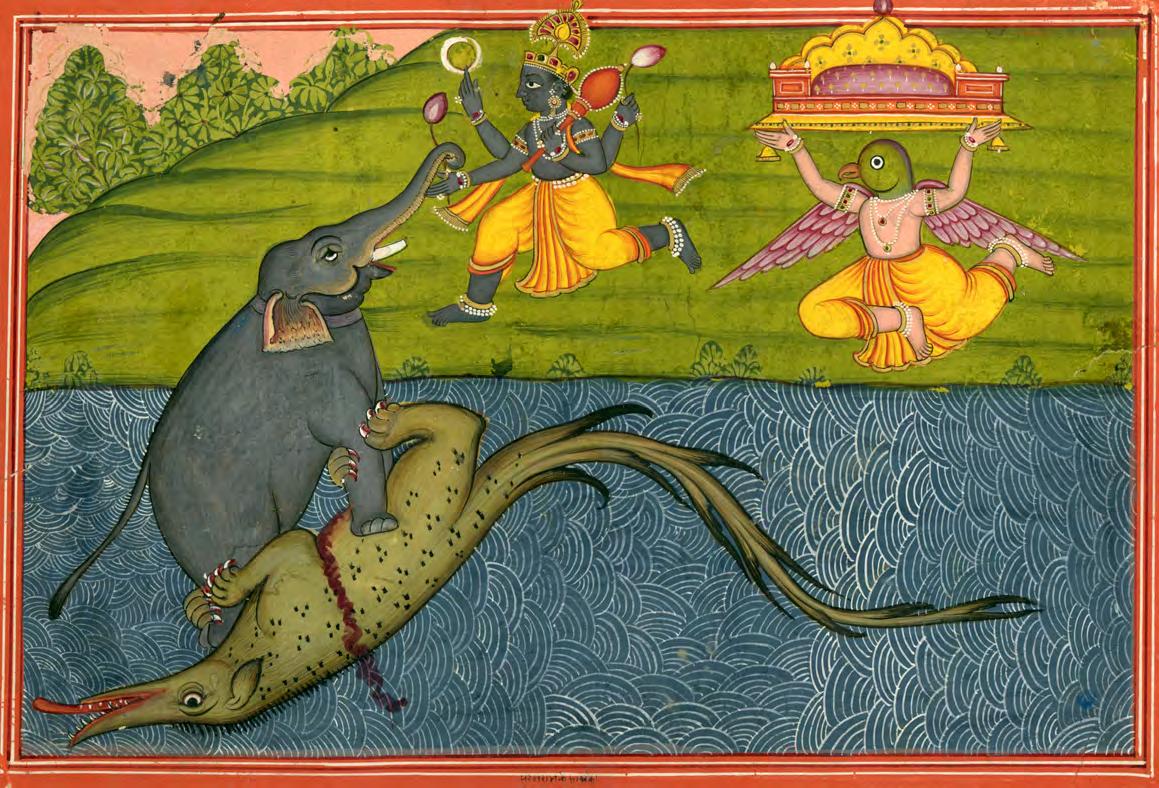
An Illustration To The Hamir Hath: Hamir Consults With His Advisors While His Archers Hold The Fort Attributed to Sajnu Circa 1810
Mandi, North India heightened with gold on paper olio number 16, bearing the royal Mandi library stamp Image: 12 5/8 x 17 3/4 in. (32 x 35 cm.)
Folio: 14 5/8 x 19 7/8 in. (37 x 50.5 cm.)
ro e ce
ri e erm ollec io
o he e ork 1 ril 200 lo 11
o he e ork 19 e em er 2008 lo 212
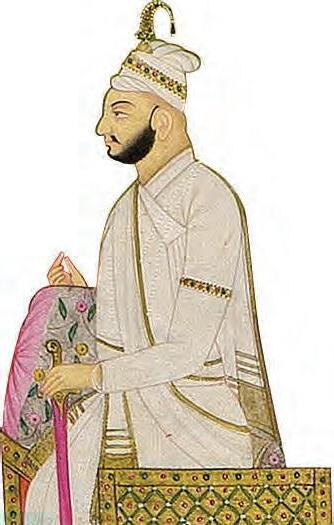
e Chauhan ruler Hamir speaking to his minister Jaja and his daughter Devala while Mahi ma consults with other courtiers within the walls of the Ranthambore fort, Hamir’s archers battle with Alauddin Khilji’s horsemen, Alauddin is depicted seated in a tented encampment with his men and European soldiers in brimmed top hats above, the names of gures inscribed in white and red devanagari script.




The Rajasthani ballad, Hamir Hath (Pride of
Hamir) composed by the bard Sarangdhar, relates the story of Raja Hamir Dev, the heroic but arrogant Chauhan ruler of Ranthambore, who battled with Alauddin Khilji, the Sultan of Delhi. is painting is closely related to a set of twenty-one illustrations to a Hamir Hath series, which were painted by Sajnu in 1810 as a present for Raja lsvari Sen of Mandi. Sajnu presented these to the Mandi ruler a er having le Kangra and his former patron Sansar Chand. e tale of Hamir is strikingly similar to that of Sansar Chand, the despotic ruler of Kangra. It involves the siege of an obdurate ruler in a vast fortress surrounded by dizzy precipices, quite like the Kangra fort. with a disastrous





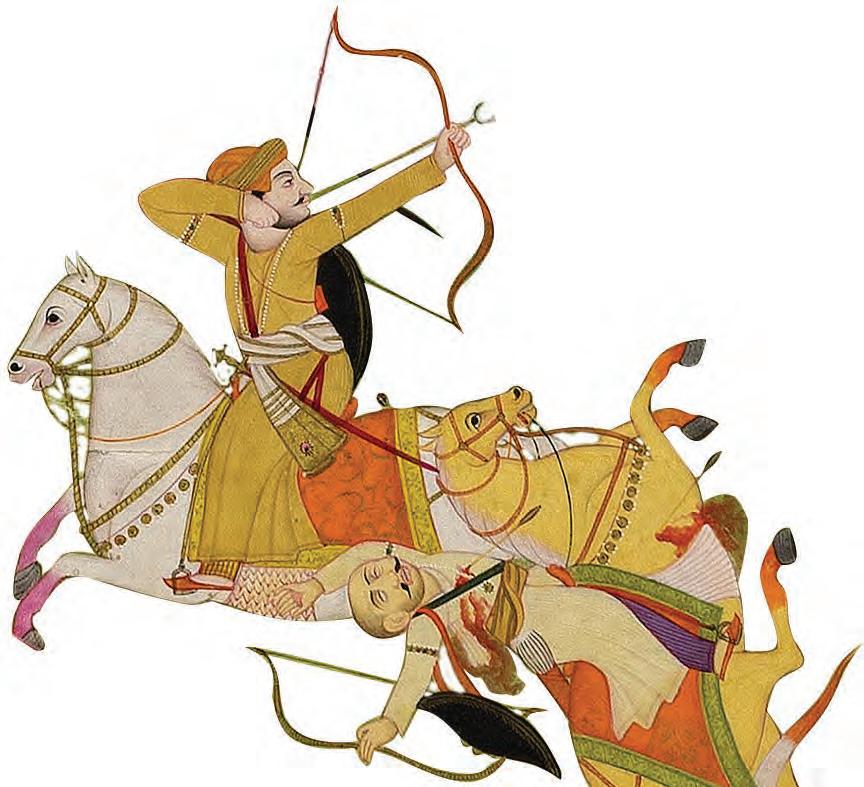
Stylistic characteristics in the painting which are reminiscent of Sajnu include the zigzag geometrical composition,
the ‘jigsaw-puzzle’ rocks, the floral motifs of the carpets, and the juxtaposition of the bright colours of the dresses, carpets and tent panels against the pastel colours employed for the architecture and the rocks. The composition of hi painting is also strikingly similar to ‘Hamir and the dancing girl’ from the presentation series mentioned above. For comparable illustrations and further discussion on the series, see Archer 1973, Vol. I, pp. 360-362, Vol. II, fig. 42(i).(ii), pg. 273. For another folio from this series which sold at auction, see Christie’s New York, 23 September 2004, lot 167.
For more examples from this series and for further discussion see Shastri, October 1915, vol. 17, no. 132, and Khandalavala, 1958, no. 185 & 186, pp. 230 and 232. Also compare with Sotheby’s, London, March 27, 1973, lot 155 and Sotheby’s, London, April 25, 1974, lot 11
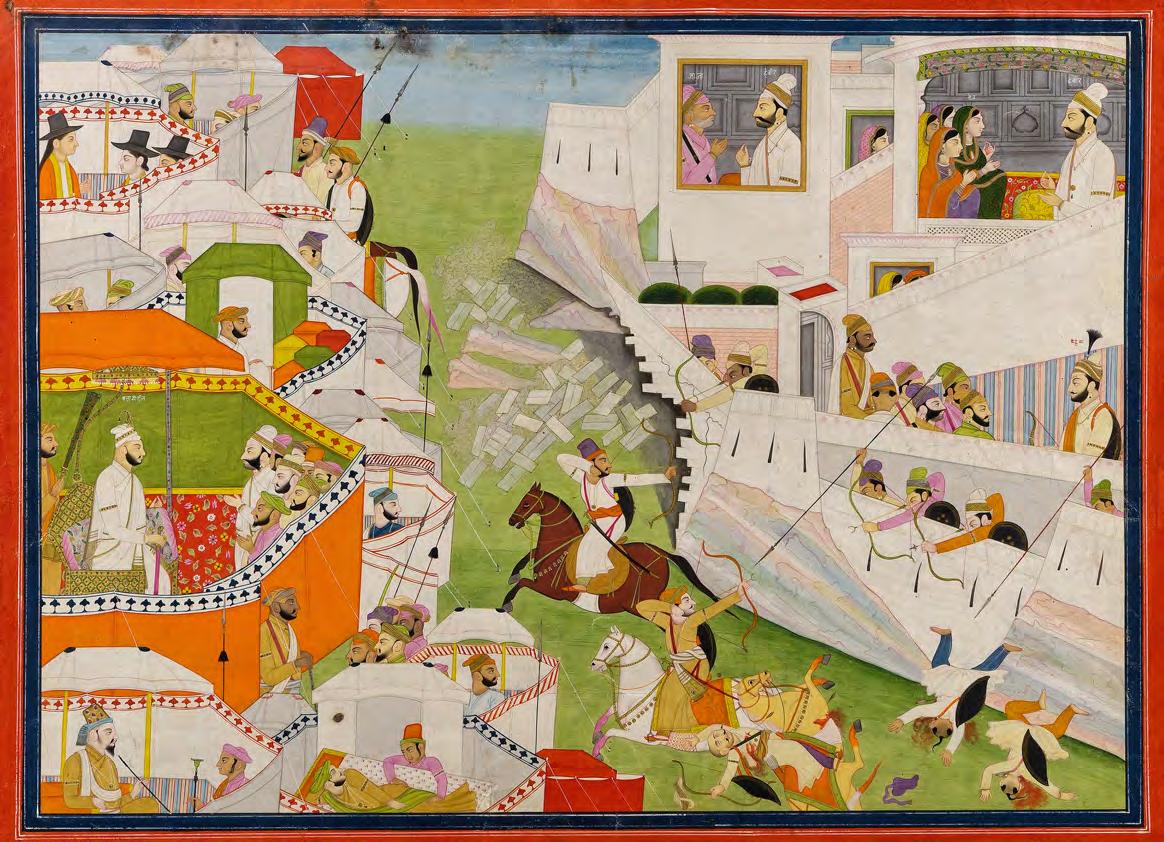
Women in a unting odge
Circa 19th century
Kotah, India heightened with gold on paper 22 9
ro e ce hri ie o o 3 ril 2009 o 3 3







Six women stand on the inside of a Shikaragah (hunting tower), surrounded by lush, vibrant vegetation and an array of different animals. One woman holds a gun on the ground floor, aiming at the ox that has apparently just been overtaken by a pair of lions, two embracing ladies on the terrace viewing the attack in suspense. Hunting scenes were hugely venerated in painting through commissions from the Maharaos, a subject of great royal interest as the hunt was perceived to e a sport for nobility. Kotah was so ell known for its forests that were bursting with lions and tigers that a hunt was frequently initiated to entertain visiting dignitaries like Mughal princes or British officers.
by two Kotah commissions a the nobility known init

he e r li g ce e o
e e l c e h
c mo l ge he cre re o i g he im ge ere employed by court painter heikh ho orke e e i el hro gho he 18 h ce r er ro l ro ge he im ger r her e elo e er heikh ime i h he im or io o e ri r i o er e he eli e i cor or io ech i e rom heir home i o he i i c Ko h le h re re e e he 19 h ce r he re e e m le e ec e i he 19 h
ce r em o ie hi e ol e le hro gh ill r io o mero
rie ie o ege io i el cr e ir h e r cro he com o i io
Typically, hunting scenes would be depicted with one or more men, who were occasionally accompanied by a maiden. While hunting scenes were popular with Kotah rulers, it is unusual to see such an image with only female hunters, devoid of their male counterpart. Compare this piece to an earlier painting in the National Museum, New Delhi, titled Ladies Hunting Tigers (accession no. 47.110/1919) that depicts a woman with her rifle trained on a Tiger from a hunting tower, a female musician and male hunter positioned behind her. In this work, the woman is shown at the forefront as huntress, and while the man is not engaging his weapon and stands out of her way, there is still a male presence overseeing the two women. The current painting depicts only women, making it an important representation of female status and capability that existed at the time. For further reading on Kotah school painting, see Stuart Cary Welch, , 1997.
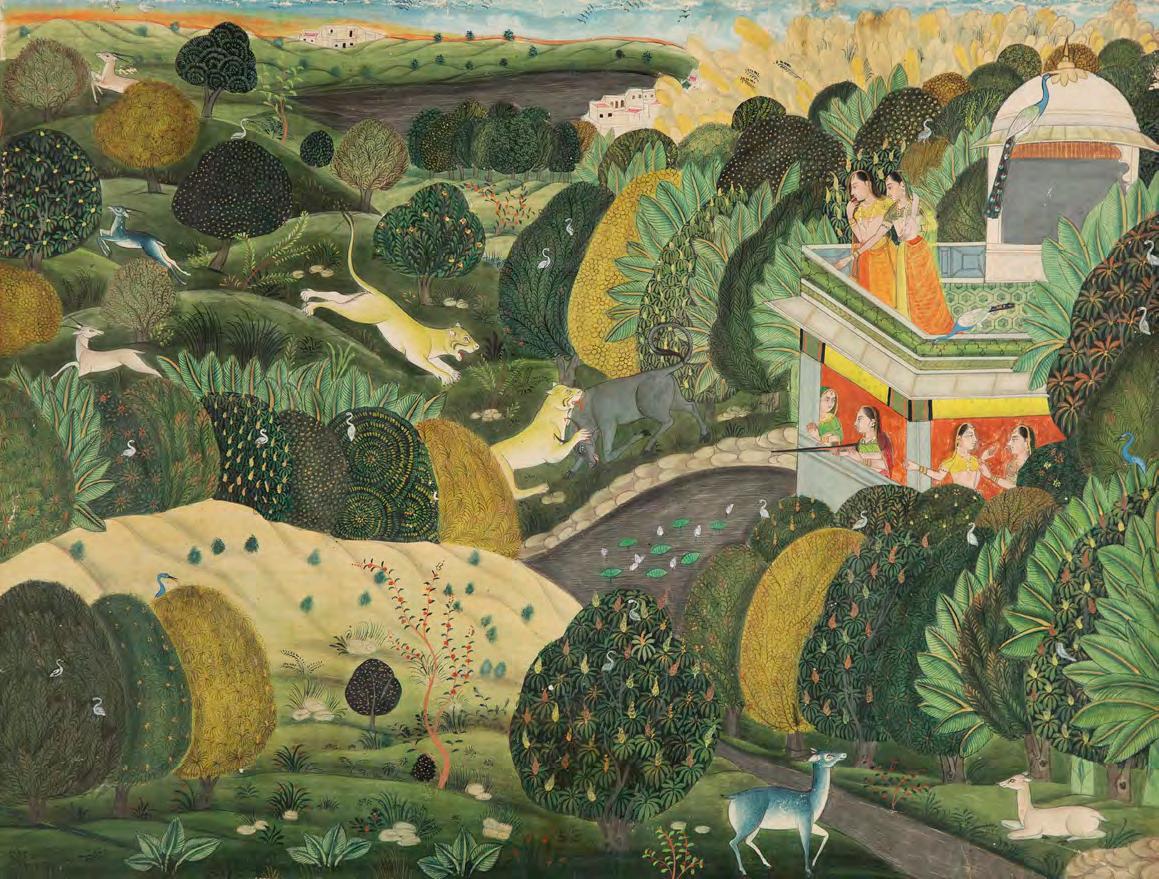
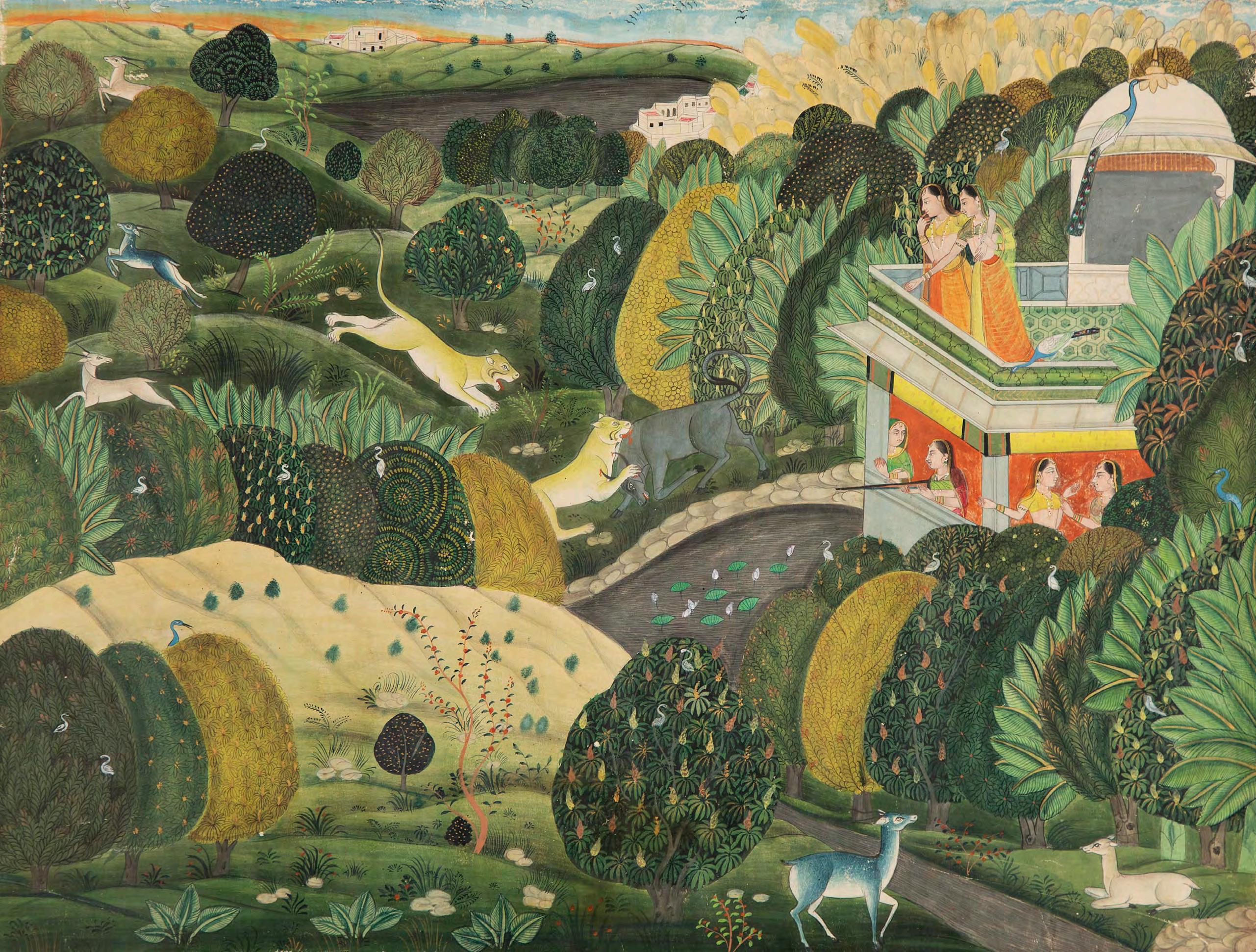
Rama and Sita Enthroned
Circa 1830
Guler, India
heightened with gold on paper Image: 9 x 6 3/4 in. (23 x 17.2 cm.)
Folio: 9 7/8 x 7 3/4 in. (25.1 x 19.6 cm.)
ro e ce ri e E ro e ollec io emo ki g stands with a book opened in his hands
This scene illustrates the Ramayana’s joyful culmination with Rama; the seventh incarnation of Vishnu, and Sita, upon a golden throne (gadi), supported by tiger-shaped legs within a pavilion. Before the auspicious couple Hanuman he mo ke chie ho h i e m i killi g he





The divine couple i enthroned on a deep red Mughal-style carpet with floral motif surmounted by a parasol bedecked in jewels and made of gold. Above, tufts of fabric panel re raised and tied in between concisely modeled arches.

watch from both behind and the

whisk (chauri) i h


knots and texture of the trunk, leading leaves owers hanging ripe with density

A host of onlookers and attendants watch from both behind and the foreground. Amongst the crowd Lakshmana is pictured bearing a fly Jambavan; the king of the bear army. Exceptional detail is given to the blooming tree stemming from behind Jambavan, with a creeping vine gracefully winding its way up the knots and texture of the trunk, leading the eye to the lush green leaves with owers hanging ripe with density giving host to frolicking birds.


For an illustration of this see The San Diego Museum of Art, Accession no. 1990.1283

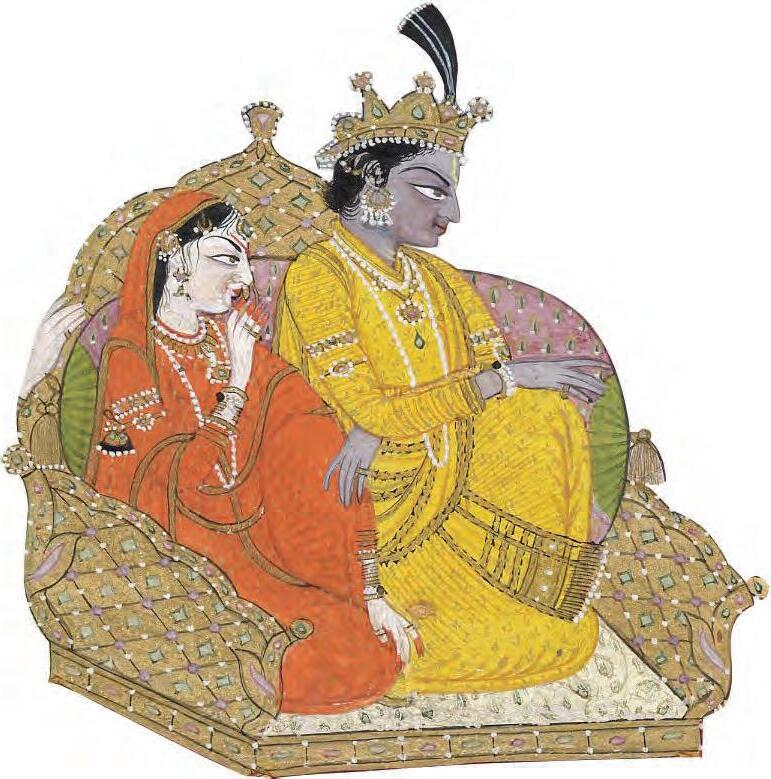
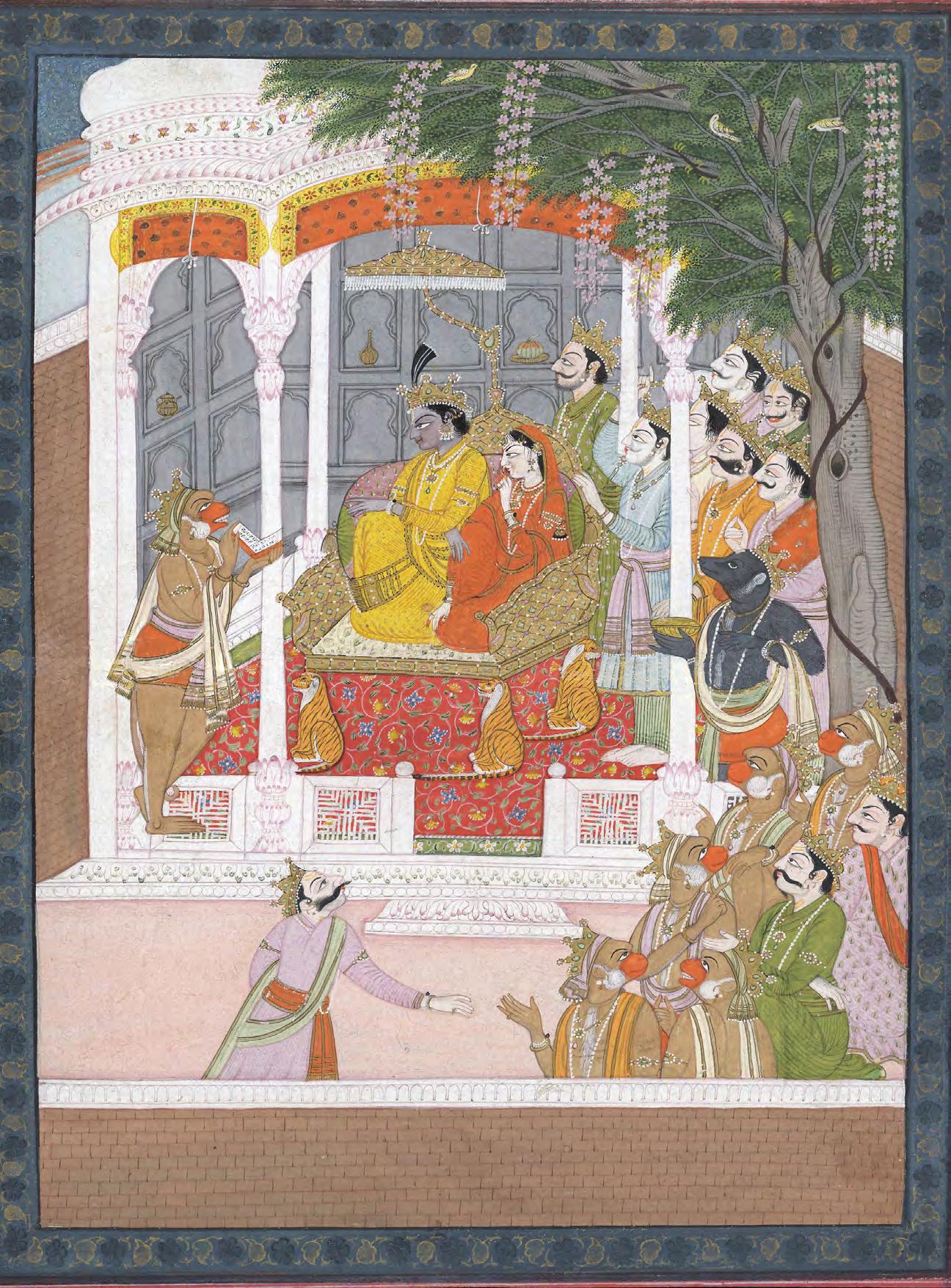
0 8 2 8
ro e ce
E -collec io o r K erm c ire i o o c 19 0 -1960
li he
r r i l ollec i g r i ri i h i ile illo o (e ) rg 2014 32 o 17
cri e h Ki he h r mri r o er o
che ere le o ce h ec me o l r i i
hro gh he 18 h 19 h ce rie i hi he co r o gh l r ler m or o he ri i h E i om
rior o ch r i ic ci g o l e ec e
em le i e i ho or o he re re e e ei ci g or e er i me o l r i er i co r i ro ce o he co i e
hro gh he gh l ki g om he or ch i eri e rom he r kri chch me i g ce
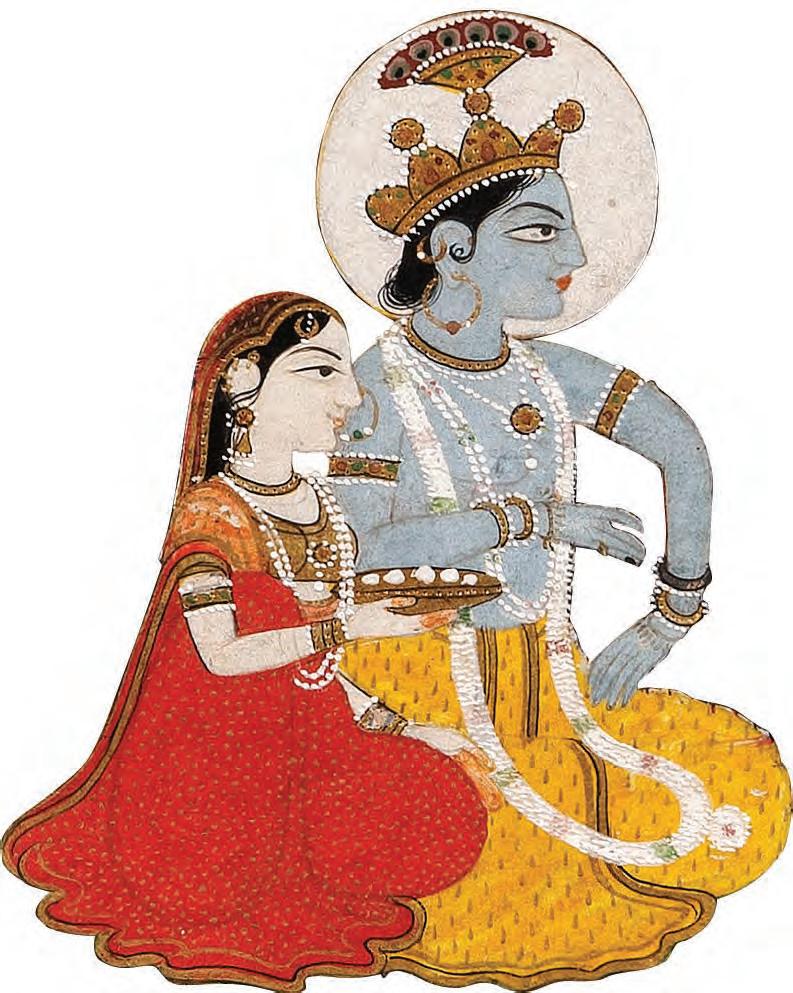
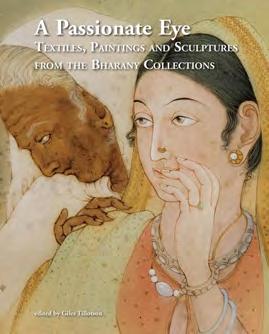
E ro e me o gre le re i chi g ch here ere er e E ro e ome i i he ime i re re hi g o e i he com o ch i e l ie he re e i i g or r h Kri h e hro e o lo o er i g ch i h com o e ehi hem hi ork e ec e ri g ime he ch i e i h i er r or e i l o l e eeme i com le e i ho ch er orm ce ch girl ( cer ho er orm ch) ere co i ere o e ome o e high ocie o e i g ick i re i e m er i e h k o le ge o oe r me or e ri i h r i ri er e cri e ch girl i hi 1813 rie l emoir e remel elic e i heir er o o reg l r i heir e re i h orm o er ec mme r l ho gh e ic e rom i c o heir ro e io he i ge er l re er e ece c mo e i heir eme or hich i more likel o ll re h he h mele e ro er o imil r ch r c er i o her co rie
or el ch e o o le i he 20 h ce r r el ec me e ier more
E ro e ome ere r or e o i
E ro e e i ili ie ere im o e o o er ll ocie
E e he i o l io r e heir ck o ch i i i i co i ere immor l he E ro e o l io he ime e e ll h e o o ocie er echelo or i e h i c io o ch i r i ic e ic io ee e ile
1996

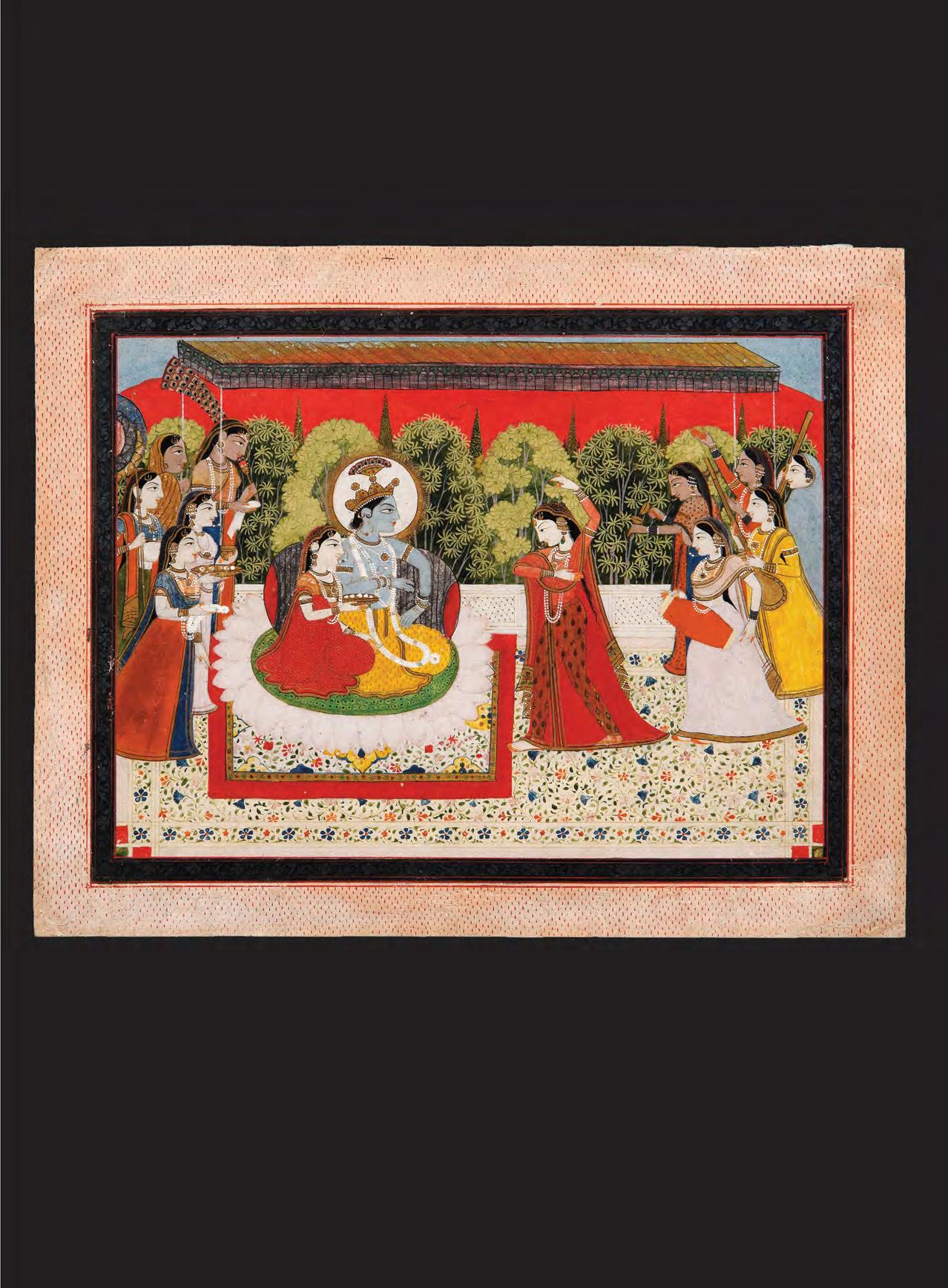
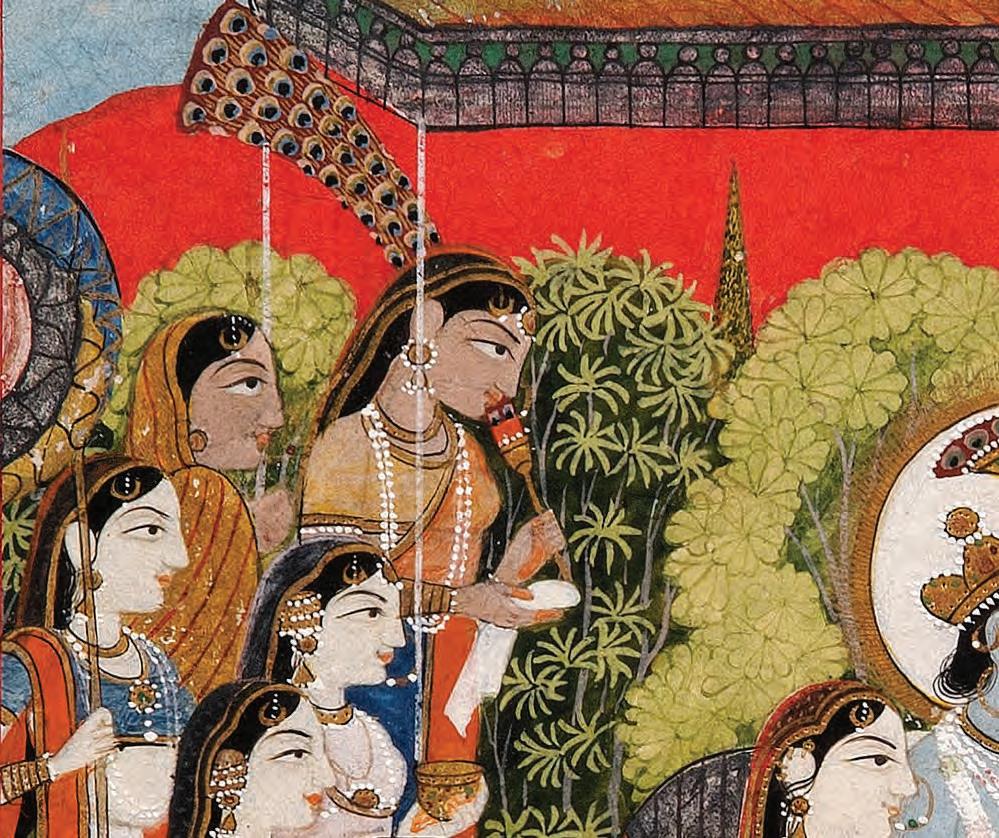
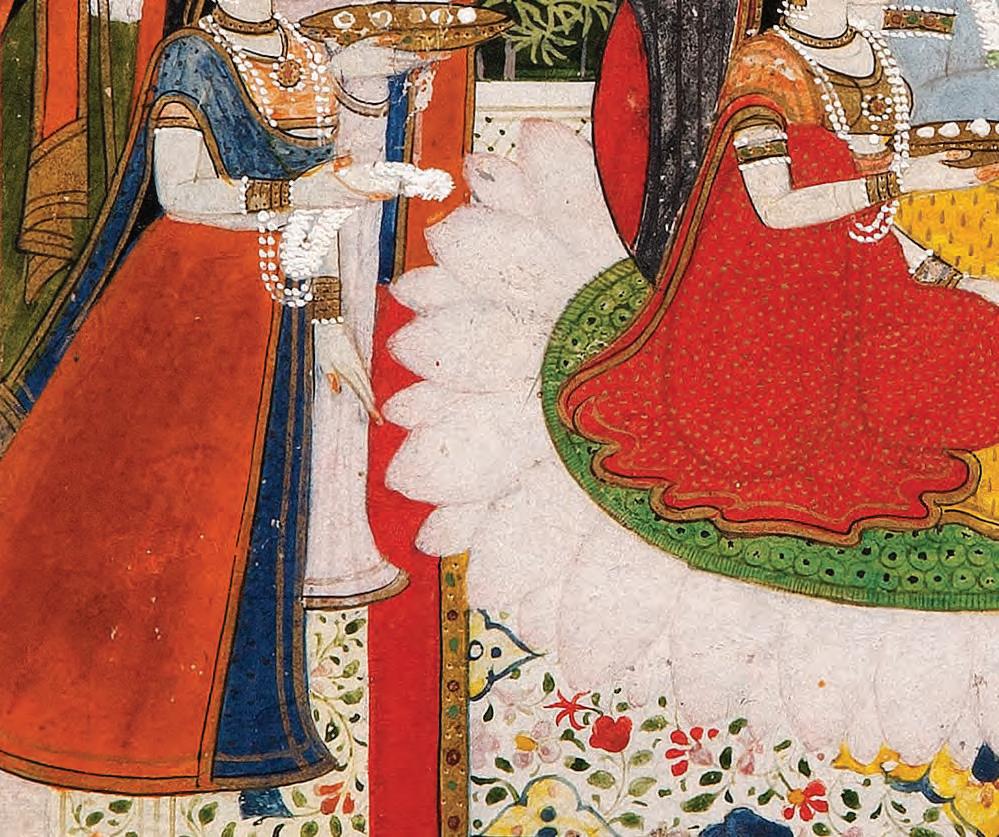
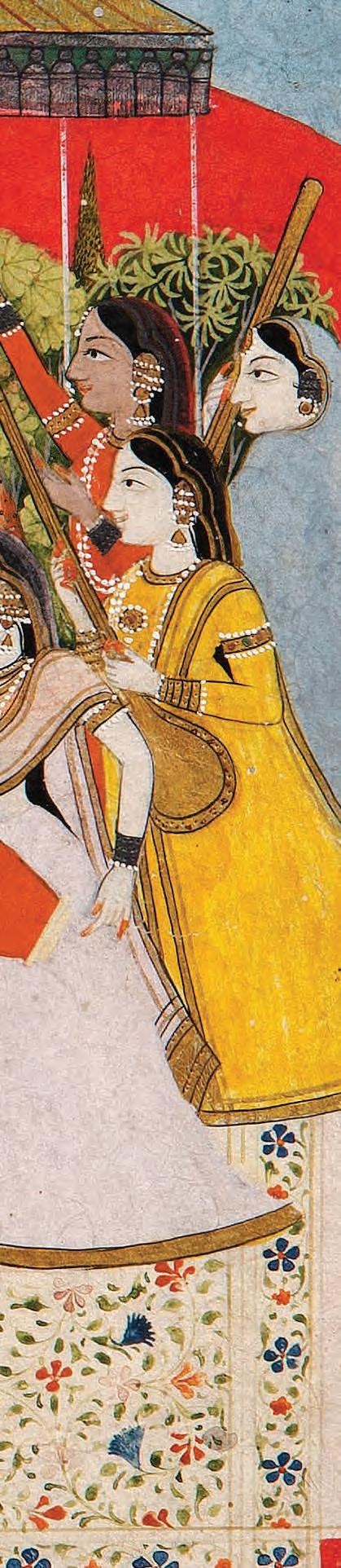
i g e ore c re ll m i i e g r e
he e i l m i e i ho e mi e l
ee i g o e cock i hi l ce gro he look o er her righ ho l er hol g rl o hi e lo er i her le h he e r righ ello g ghr ( kir ) h
co r her ig re o cce e her he m i oc o he im ge he i ecor e i h re e er o rilli gol e il
hor lee e choli he i re- oo e her
oe ell her i ger re i e i re
i h om r e elo her re ee hi i g rom gree o ligh l e h c e ee re lec e i her h lo he i e ri g e rl
choker o o her eckl ce i h e el ro her eck i h o ri g o lo ger
e rl h ll e ee her re cle rl
e i e e e h her o h i he h e elle rm e i h re gree rec g l r gem ir o l ck gol el rilli gle o her ri
r cele i ger h m ri g oge her i h kle he h h ir or me o her orehe ir o e rl i her o ril ro ol e rri g i h e rl ro he rim o he e
e cock i ro o her o her righ h i e hile
e he li le ehi o he le oo ll gr ce ll rom her lm lmo like re m o e rl he hori o oi he k e rl h l he ic re l e i i e i r li ic m er i h clo li e ligh o ir i e he o
hi i i g em lo rio li ic e re h hel o i e i he ork l er
e ec io i he c o o i i mi i re
i i g he e h ill r e i hi hi
im ge ook m l i le ce rie o m er - he
i go l h h e r e ee g r e
e hel o h e he com o i io ehi he
m i e i or er o highligh o h her he oregro ce e hile l o irec i g he e e
o he gr rchi ec re ri i g i he ckgro i h i l h g r e o lo er
he ec o he K k h gi i r l
ri e K k h i e i l o g om
eri g lo e ick e le i g her i e l ce
he e er he ore
g i g i he ro e he e cock cre m orge i g o l o i r ce o her lor
or o her ork o hi er ec ee he
e m o i e r o o cc o 17 2910
he rookl e m o r cc o 623 1 he e m o 111-19
1 8-19 2 48 3 -19 6 he r r
e m o r o 199 122 he ri i h
e m o 1880 0 21 6 he e ro oli
e m o r cc o 2018 44 ell
he i k m e m o - -1993-2 9 KK-1261