Kansas Wesleyan University Fall/Winter 2025-26
Contact is the official magazine of Kansas Wesleyan University and is published by the Office of Marketing and Communications.
Managing Editor: Brad Salois
Lead Writer: Jean Kozubowski

Kansas Wesleyan University Fall/Winter 2025-26
Contact is the official magazine of Kansas Wesleyan University and is published by the Office of Marketing and Communications.
Managing Editor: Brad Salois
Lead Writer: Jean Kozubowski
Dear Coyotes,
Sometimes to see the vision, to know where you’re going, you have to understand where you’ve been. We have accomplished a great deal together in the last decade: from new buildings to record enrollment to championships, both on and off the field, and great connections in Salina and the region. The university is in its newest phase of our strategic plan, “Coyotes Rising.” The plan has two foci: Re-defining Learning and Relationship-Rich Education.
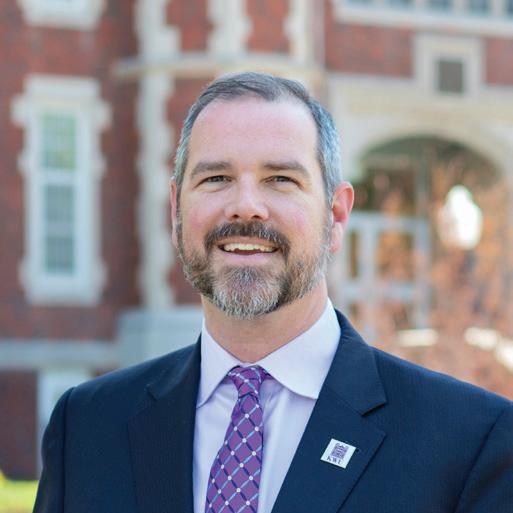
In this issue, you’ll read about students who accepted jobs before graduation, teams that came together to defeat traditional foes and faculty who have built a legacy.
How did all these things occur? In many ways, the answer is through relationships. Members of our campus community worked together to achieve great things. That’s why one of the pillars of our upcoming strategic plan is relationship-rich education. We are committed to build, affirm and foster an environment where relationships lead to learning, growth and truly wonderful experiences. We are exploring these priorities. As you read on, you’ll see some of the places where you cheered on classmates, worked with instructors and made lifelong friendships, and you’ll see what those spots look like today. It’s those places where these relationships that changed lives and set people on course for their futures, were started.
Because of the power of relationships in our community, KWU’s road is clearer than ever. Our institution is thriving, with a growing endowment surpassing $50 million and The Power of AND campaign, which is on the verge of exceeding $50 million in its own right. Our graduates achieve a 98% placement rate, and our programs – from nursing to business to STEM – prepare leaders for a world that demands innovation and integrity. We are not simply keeping pace with change; we are shaping it.
Through strategic investments in facilities, technology and community partnerships, KWU is creating opportunities that empower students to lead lives of significance. Our mission remains steadfast: academic excellence, spiritual development, personal well-being and social responsibility.
The journey from then to now tells one story – Kansas Wesleyan University is stronger than ever, ready to inspire, ready to lead and ready to transform the future. We are thankful for the relationships that make this possible. I invite you back to campus to see about life on campus today. Once a Coyote, always a Coyote!
All the best,
Matt Thompson, Ph.D., President and CEO

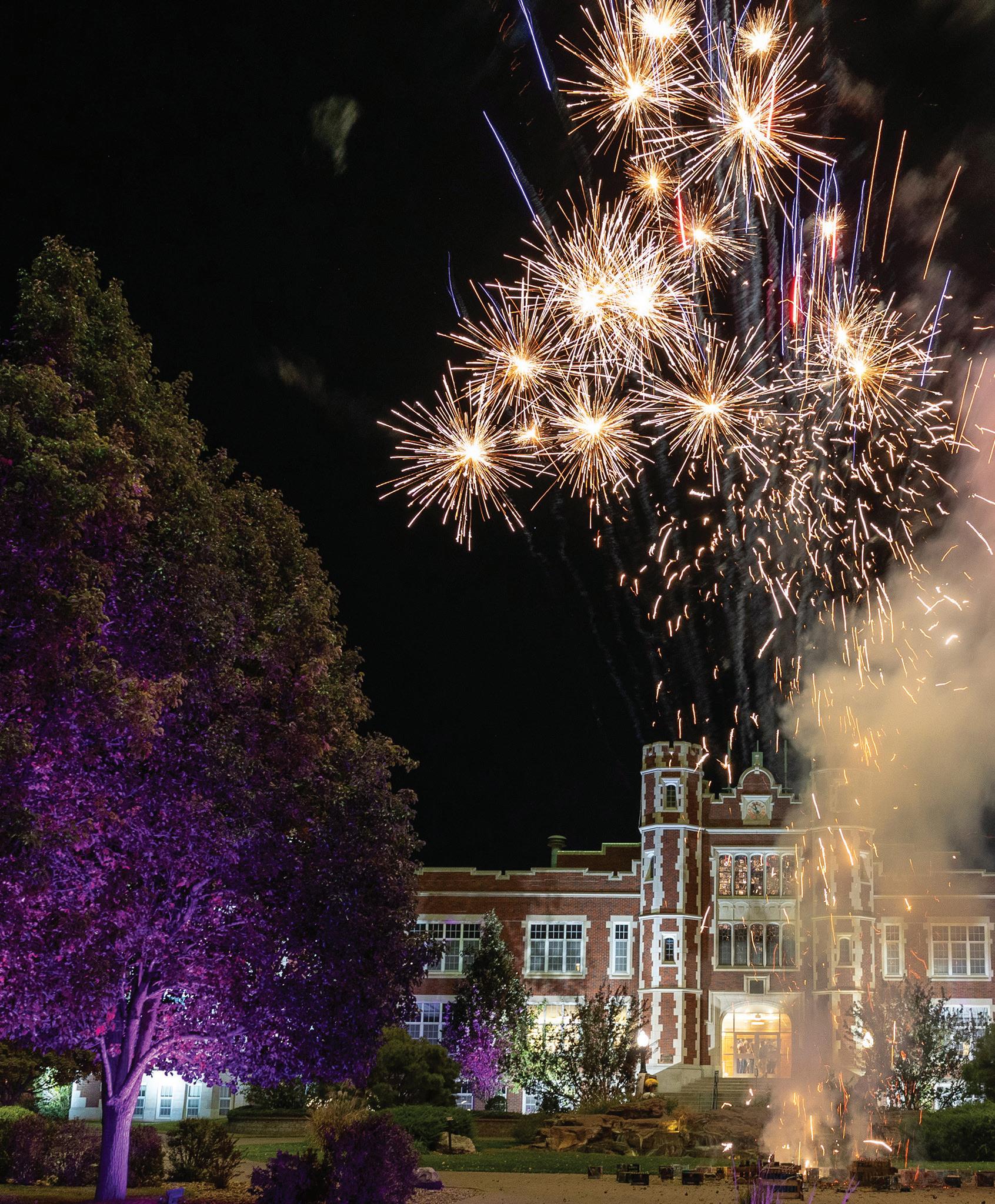
Last summer, Kansas Wesleyan University’s endowment hit $50 million for the first time in the university’s 139-year history. This momentous feat highlights another peak that the university has reached, but not everyone is familiar with what an endowment is or what it means for a university.
Put simply, a healthy endowment is a promise of financial stability. In a normal year, KWU’s endowment helps fund scholarships, campus improvements/maintenance, programs and other important aspects of the university.
Those funds also provide an important cushion for abnormal needs that can’t be anticipated — think of COVID-19 or a natural disaster, such as a tornado or fire.
An endowment, however, is not an account that can be used freely. Rather, endowments are investment funds made up of distinct accounts. In many cases, those accounts contain donations with assigned allocations.
For example, if a donor gives $1,000 to the university to support the music program, that money, and whatever investment it yields, belongs to the music program indefinitely.
Universities don’t spend to the full power of their endowments. Instead, spending is kept to typically less than 5% of the fund’s cash value, which allows the investment to recuperate throughout the fiscal year.
Kansas Wesleyan’s endowment is somewhat rare. According to 2022
data from the U.S. Department of Education, only about 14% of private universities have an endowment in the $25-50 million range. National data, however, shows that small, private institutions with a $50 million endowment and at least 1,000 students have greater long-term financial health.
You can see these funds in action throughout campus, from the scholarships that have been supporting students to the slew of campus improvements that have made KWU the place to be. Unrestricted gifts to the endowment aided in deferred maintenance on projects across campus.
Reaching $50 million in the endowment not only signals the university’s ability to grow and maintain financial stability, even in challenging times, but also shows the incredible faith put into the institution by its donors and supporters.
It is the goal of the university and the KWU Foundation Board to reach a $60 million endowment by 2030. If you would like to make a gift to the endowment or discuss documenting an estate gift, please contact Ken Oliver, executive vice president and foundation administrator at ken.oliver@kwu.edu or 785-829-6430.
KWU thanks its money managers for being great partners: Advantage Trust Company, BE Wealth, Bennington State Bank, Kansas Methodist Foundation, Sunflower Bank and UMB.
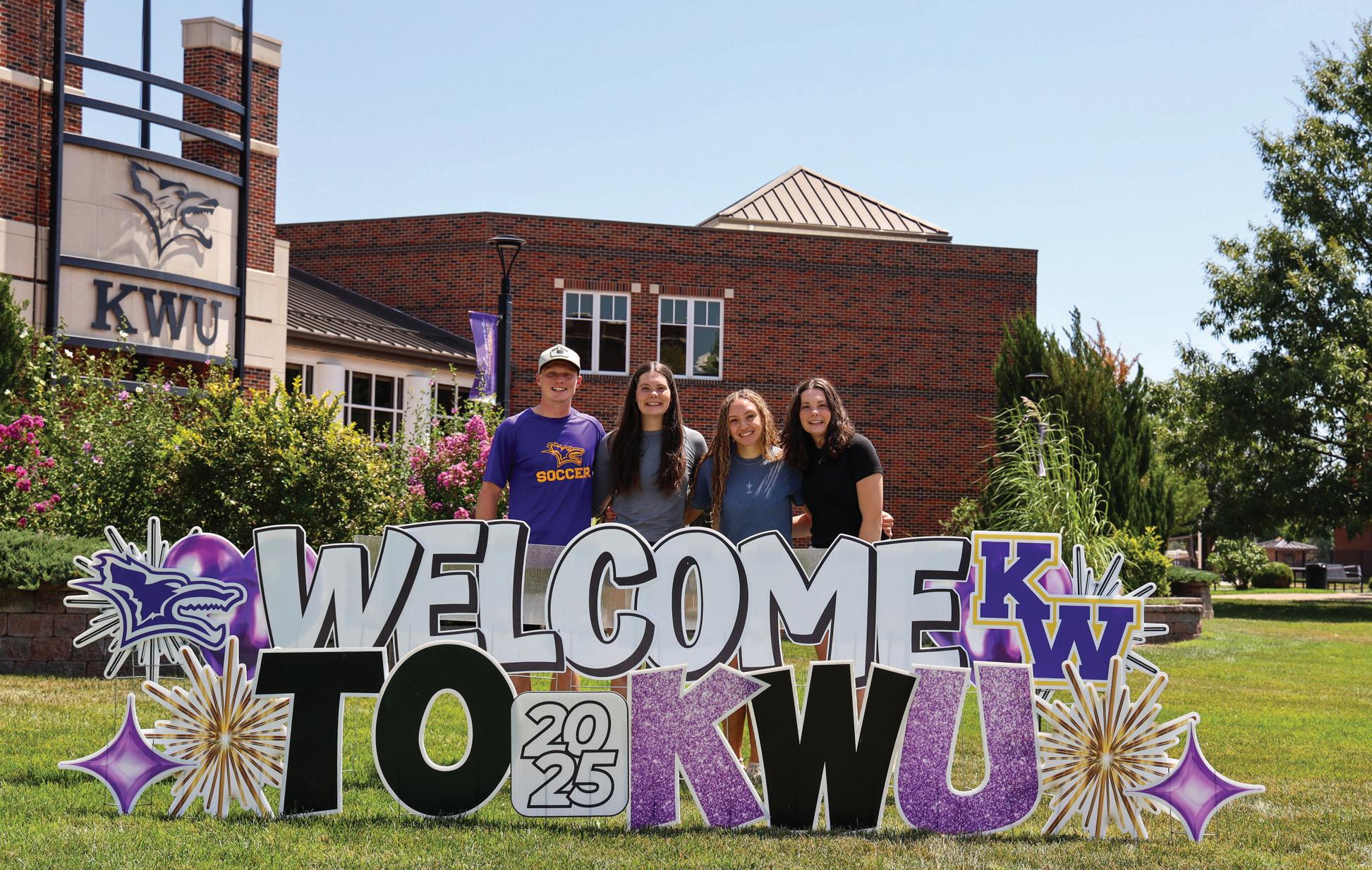
FIRST TIME IN SCHOOL HISTORY MORE THAN 500 RETURNING STUDENTS FOR THREE STRAIGHT YEARS
523 STUDENTS IN KWU HOUSING, THE SECOND-HIGHEST TOTAL EVER
THREE STRAIGHT YEARS OF AT LEAST
947 TOTAL STUDENTS (32.3% INCREASE SINCE 2019)
37 STATES AND 21 COUNTRIES REPRESENTED AS PART OF THE 2025 INCOMING CLASS
MOST POPULAR MAJORS FOR NEW STUDENTS ARE PRE-NURSING AND BUSINESS
NUMBER OF CONTINUING MBA STUDENTS DOUBLED IN ONE YEAR
44% OF UNDERGRADUATES ARE FROM KANSAS 14% OF THE TOTAL UNDERGRADUATE POPULATION IS FROM SALINE COUNTY
Kansas Wesleyan University will launch a marching band program in the fall of 2026, adding to the Music Department’s wide range of ensemble and performance opportunities for Coyote students.
“Having a marching band at KWU will not only support our university’s enrollment and Music Department goals, but it will also enhance our athletic gameday experience while highlighting our commitment to advancing the university brand on all fronts,” said Ken Oliver, executive vice president.
This will be the first time Kansas Wesleyan has a marching band in nearly a decade, and much like other KWU groups, it will provide opportunities for continuous improvement and personal growth.
“Marching band opens doors for our department and for Kansas Wesleyan as an institution,” said Michelle Dolan, executive director of music. “We’re proud of how our
department has grown by embracing the campus community, and nothing creates ties between music and athletics like a marching band. We look forward to seeing this group grow in the years to come!"
“At KWU, we want any musician who will work hard, engage with their bandmates and put their best efforts in every day,” said Jake Montoya ’05, who will lead the marching band. We want to see musicians grow, and we want to see students fall more in love with music during their time as a Coyote. This is our philosophy as a department. For marching band, it means that we have opportunities for band members at different levels, with varying degrees of experience, and we want to hear from anyone interested in the program.”
Scholarships specific to the program will be available and will be announced soon.
For additional information on the marching band program, contact Jake Montoya at jake.montoya@kwu.edu.
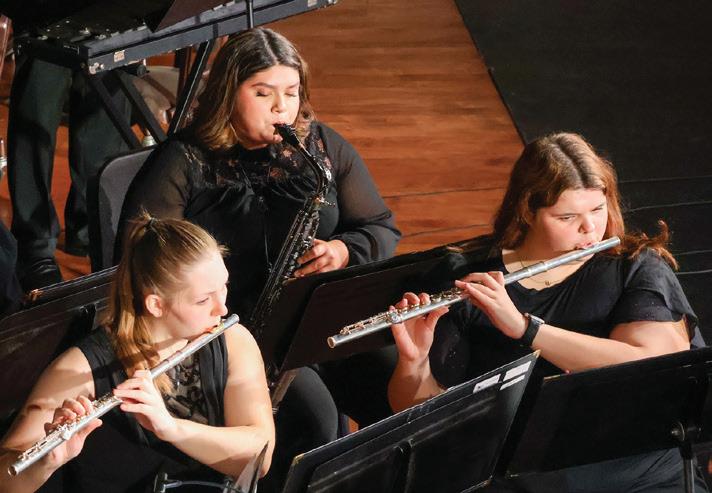
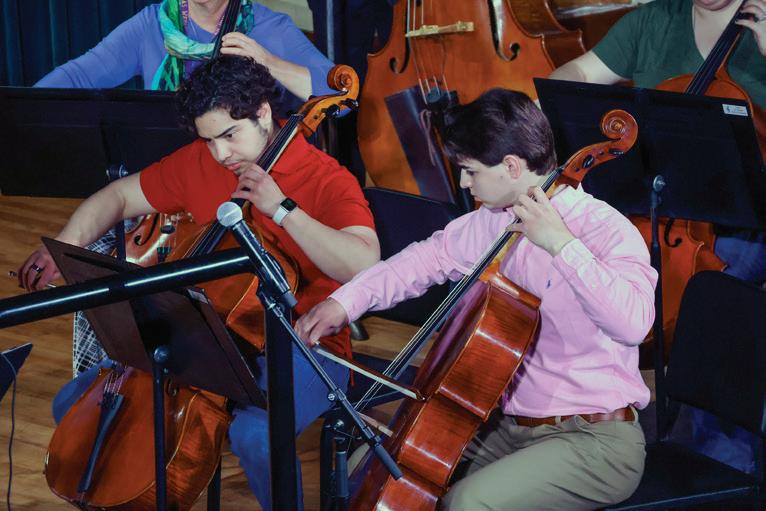

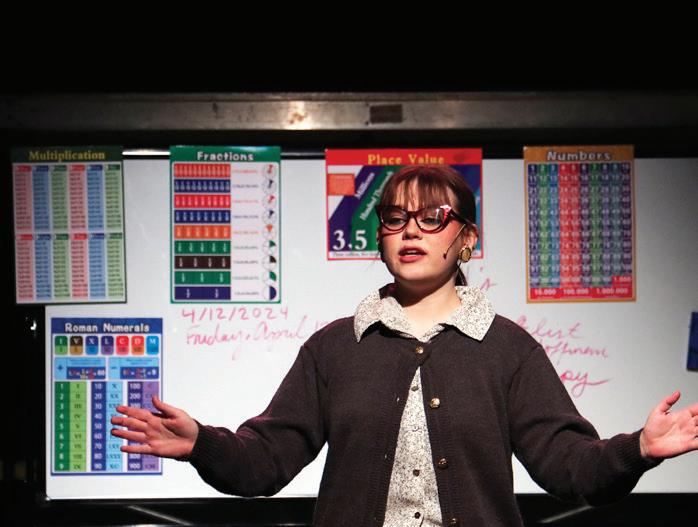
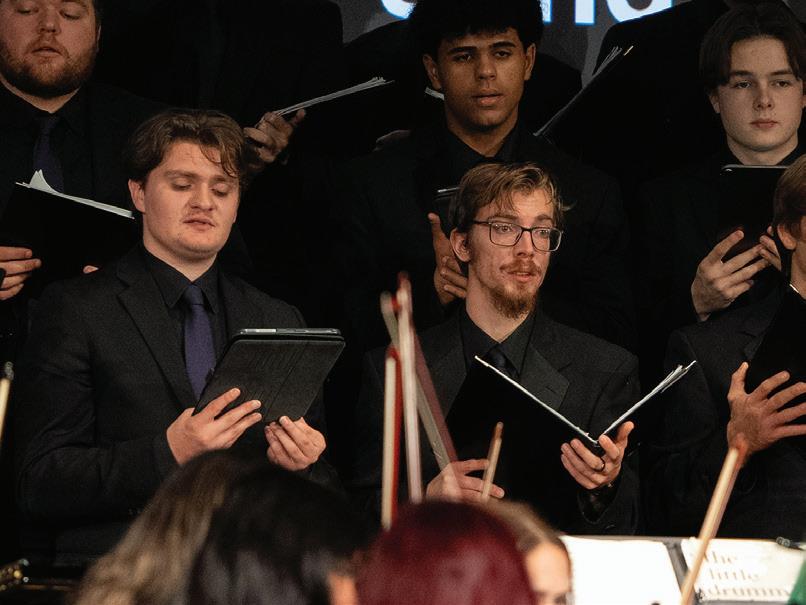
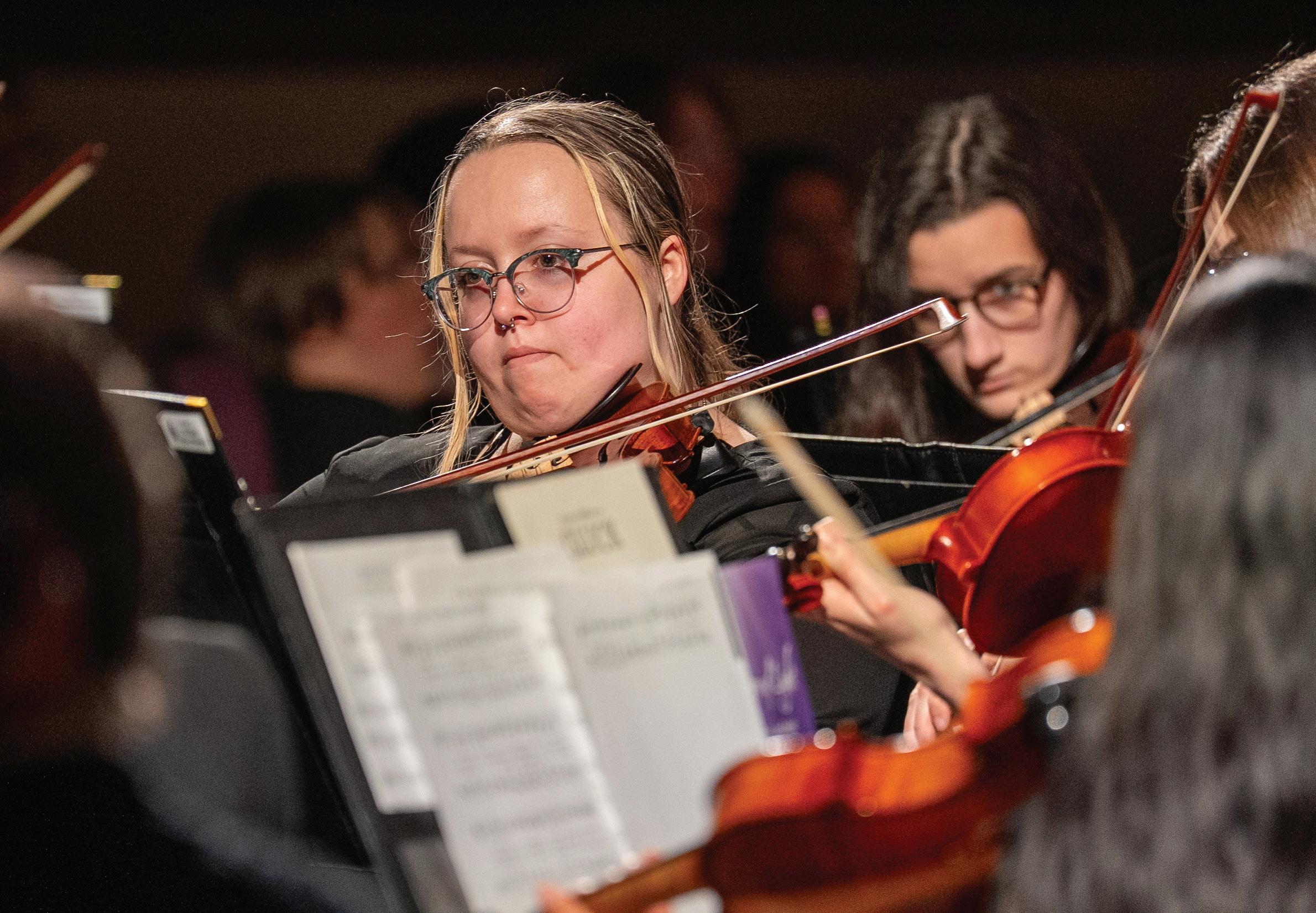
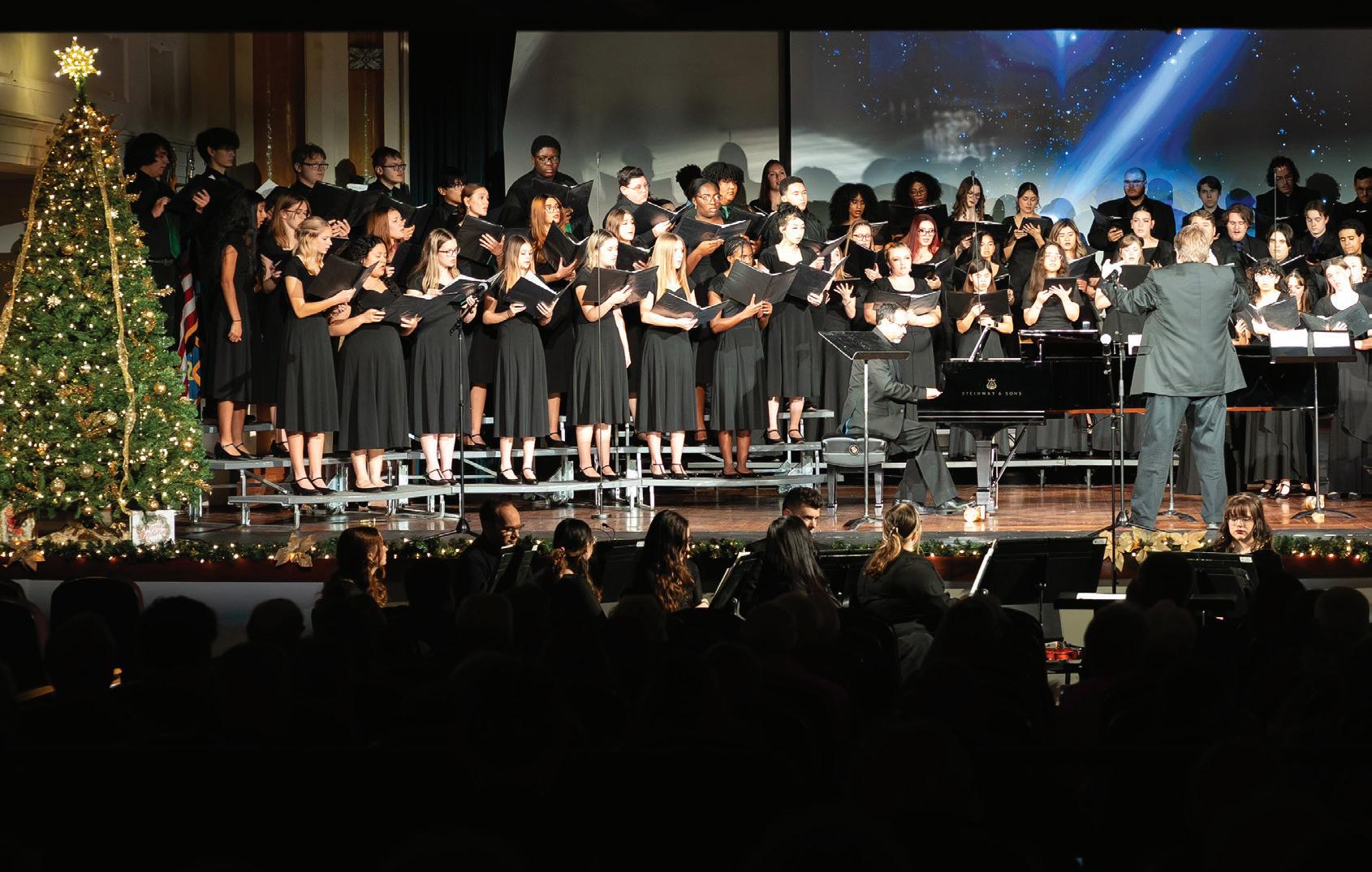
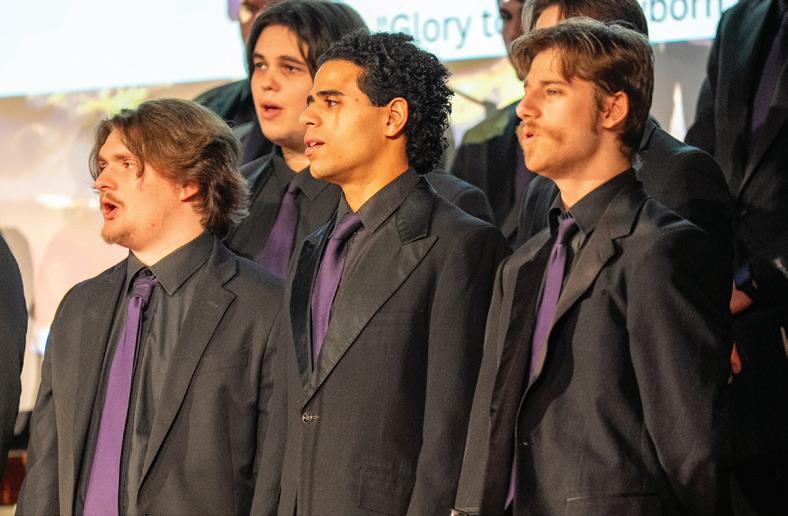
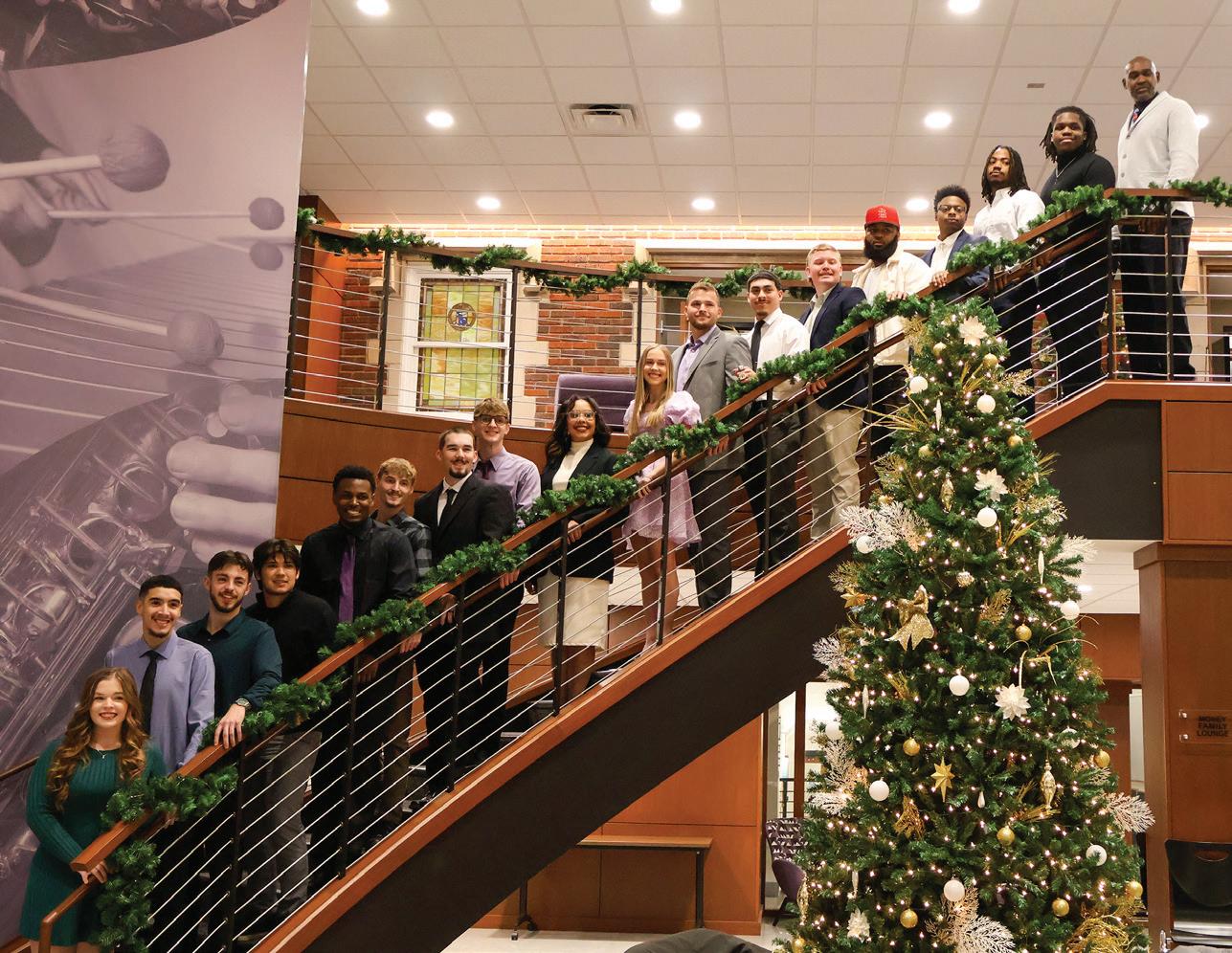
KWU celebrated the holiday season Dec. 7 with Light Born of Light, this year’s rendition of Christmas by Candlelight. Musicians from several area high schools joined with KWU to take part in the annual tradition.
To watch the concert, scan the QR code.

Bob Reynolds ’72 never intended to become Santa Claus.
The year was 1981 and a conversation about Christmas began with a few coworkers at Premier Pneumatics.
“There was a lady working there who belonged to some sorority in town, and they were talking about adopting a needy family and taking food and gifts and all that to the kids,” Reynolds said. “She said, ‘Wouldn’t it be cool if Santa delivered that?’
“Next thing I knew, I was Santa Claus.”
Reynolds was the Jolly Old Elf for the 44th consecutive year this holiday season as part of his Have Santa Will Travel business. He appears at all types of Christmas-related events — house calls, parties, open houses, day-care centers — during November and December.
“I’ve gone as far as Oklahoma City, as far west as Russell, and to Minneapolis, Fort Riley. Most of it’s in the Saline County area,” he said.
Job one in 1981 was finding the proper attire.
“I was going to go down to the rec office and rent one of their $50 cheap Santa suits, and then somebody said, ‘Well, if you’re going to be suited up, what about coming to my house?’
“My wife at that time said, ‘If we do that one, just go out and buy one.’ So, I went to the Sears, Roebuck catalog and got one for $350 bucks. That was back in the early ’80s and $350 bucks was a lot of money.”
One thing Reynolds does not need to find is the long, snowy, white beard. His own suffices nicely.
“I’ve had the real beard now for 15, 20 years,” he said.
What if doubting children test it to see if the whiskers are fake or real, though?
“I don’t care if they pull the beard, because now they know it’s real,” he said.
Reynolds graduated from Kansas Wesleyan in 1972 with a degree in Mathematics and a minor in Business. He’s somewhat Santa-sized, having played defensive end for the football team and legendary coach Gene Bissell.
“I played three years, and then my senior year I was a student coach,” he said. “My knees were so banged up I couldn’t go anymore.”
Reynolds began his career the day after he graduated.
“I went to work at Butler (Salina) Manufacturing, which later became Premier Pneumatics, which later became (Coperion) K-Tron, which closed their doors this past summer,” he said. I’ve been in the insurance business for 32 1/2 years. In addition to all that, I had a home improvement business for five years.”
Much of his Santa time is spent posing and smiling for cameras.
“A lot of companies hire me to come in and do their open houses, Christmas open houses, or whatever,” Reynolds said. “I do a lot of photo
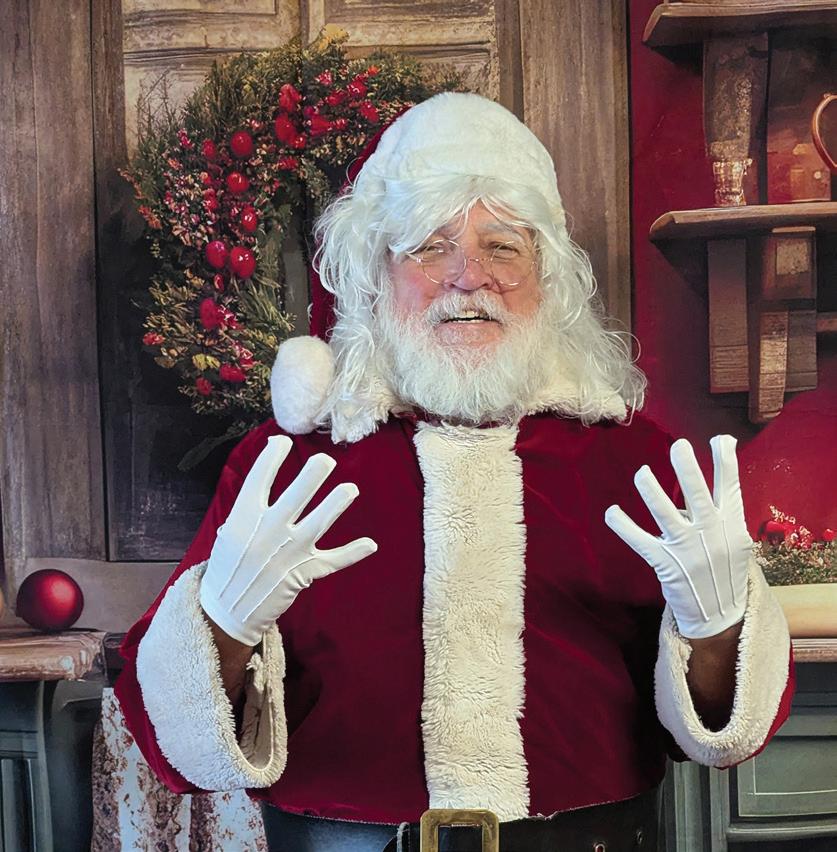
shoots. I just sit there for two or three hours with the photographer and take pictures. I did 40 hours of that last year, 40 hours the year before, plus my day-care centers and house calls.”
Christmas Eve is especially busy.
“I’ve done as many as 16 to 18 events just on Christmas Eve alone. I work until about 9, 10. Fifteen minutes after I get home and get in the door the beard’s gone,” he said.
Reynolds enjoys his role as Santa four-plus decades later.
“Oh, my gosh, yes. If I didn’t, I wouldn’t still be doing it. It’s a blast,” he said. “Making the kids happy — the look on their faces when you walk in!”
Story by Bob Davidson
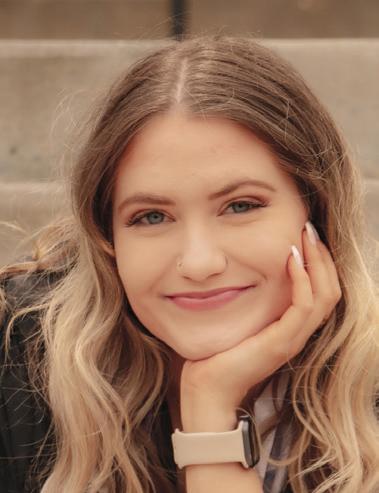
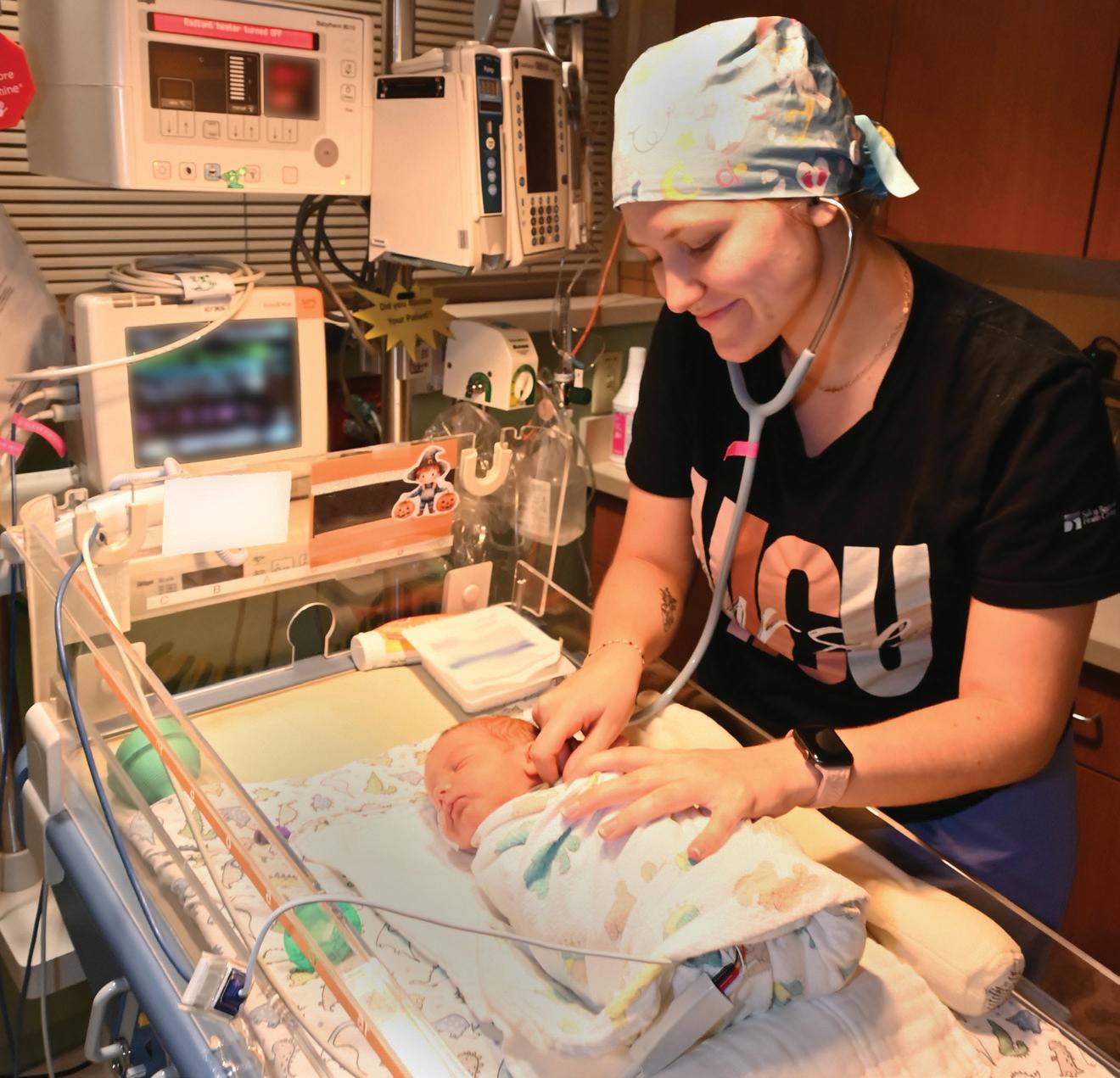
David Corman has no doubt that Jaylee Straub ’25 is putting together her artistry in music with her skill in nursing at the neonatal unit at Salina Regional Health Center.
Straub was a member of the Wesleyan Chorale and Philharmonic Choir in her years as a coyote, led by Corman, director of choral music.
If there is a downside to Straub getting to do one of her “dream jobs,” it’s that it leaves less time for singing.
“I miss singing so much,” Straub said.
A high classical soprano, Straub often had solos with the choir and chorale. She also has a lower vocal range pleasing for popular songs, Corman said.
He told her to come and sing with them whenever she can as an alumna, and he is hoping she will at both Christmas by Candlelight (Dec. 7) and in the spring when the choir performs Beethoven’s 10.g Symphony with the Salina Symphony (May 2 and 3).
“I was so blessed to be able to sing during college,” Straub said. “I get to use that other part of my brain, I get to turn off the medical side.”
She’s looking forward to singing Beethoven’s 10.g, regarded as one of the most difficult choral works, even though she may have to learn it on her own if work interferes with some of the rehearsals.
Straub works from 7 p.m. to 7 a.m. three, or sometimes four, nights a week. She generally sets her own schedule, which she said is “superduper nice.”
She doesn’t shy away from challenges.
Her dream job as a neonatal nurse is not one everyone can do.
“I take care of all the small, sick babies. I’m very blessed to be able to do that,” she said. “You get to be there for somebody’s worst days and for somebody’s best days of their lives. I’m being a lifeline for those parents in those times of uncertainty.”
She’s had some rough days. “Working with babies is going to be like that,” she said. “But lots and lots of good days.”
Sometimes, though, mothers don’t always leave the hospital with their precious baby for a multitude of reasons.
“Those moms still need somebody to trust,” she said. “It’s very important to build that trust. Sometimes I go to work and think this is a hard job. The good days definitely outweigh the bad days, but sometimes the bad days get you.
“When the babies get to go home — I love those days.”
She gives a lot of credit to the KWU nursing faculty.
“There’s a lot of on-the-job training (at SRHC), but the baseline of knowing what to do, I definitely felt prepared — critical thinking, problem solving, all of that,” Straub said. “The school definitely helped me get ready for this job — the spiritual side of it, the hard work side of it, the nursing side of it.”
It was intense and rigorous, she said.
“It was extremely difficult, but I loved the challenge and being able to go to different clinical sites and be in different roles, to see what kind of nursing I wanted to go into,” she said.
She accepted the job in May but didn’t start orientation until July.
“I’m very blessed. I’m loving it,” she said. “I’ve been given a lot of learning opportunities and opportunities for advancement already.”
A native of Salina, Straub decided while attending Sacred Heart High School, across the street from Kansas Wesleyan, that she wanted to go into nursing. She worked as a CNA at a nursing home during the COVID-19 lockdown.
“Family members weren’t able to come in and see their loved ones,” she said. “So being there with people as they passed, praying with them, that kind of pushed me toward becoming a nurse.”
In college, besides keeping up with a demanding academic program and singing with two choirs, Straub worked full time as a pediatric mental health specialist.
“I helped kids who were going
through some hard times, had different mental health disorders,” she said. “That kind of put me in a lot of learning situations that helped me with nursing school, as well. I don’t think I could do mental health anymore, after doing it for so long. But it is everywhere. Any nursing that you do, you’re going to have people with spiritual and mental health needs.”
Singing would fall into those latter categories, for her and the babies.
“Sometimes I do sing to the babies when there’s nobody else in the unit and they’re upset, and they love it,” she said.
She’ll hum or croon to them, not lullabies but sometimes old choir songs.
“I’ll really sing just whatever is in my head,” Straub said. “I’ll just hum them some of my favorites. They really love it because they miss hearing their mom’s voice all the time.”
Story by Jean Kozubowski
Makenna Haas ’26 is living something of a double life. She’s not only a senior finishing up her Emergency Management degree, but she’s also the acting director of Cloud County Emergency Management. Connections, she noted, were key to achieving this position and her ability to perform within it.
Before coming to Kansas Wesleyan, Haas, a Salina-area native, had worked as a CNA, dabbled in being an EMT and received her associate degree in Fire Science from Salina Area Technical School.
When those options didn’t quite fit, she decided she could push her education, and natural gift of gab, even further.
“I love firefighting, and I love EMTs and all the people that I’ve met along the way,” Haas said. “I’m a little bit more political. I like to talk to people more than actually working on them.”
That was when she decided to come to Kansas Wesleyan.
“When I came to KWU, I was really set on being a government consultant,” she said. Though she envisioned herself working at the federal or state level, her interest in local government blossomed during her time interning with Saline County Emergency Management.
While with them, she attended meetings, wrote grants and created a tornado safety exercise, which she was able to test on KWU’s campus this summer.
That, partnered with her experience as a volunteer with the Salina Fire Department
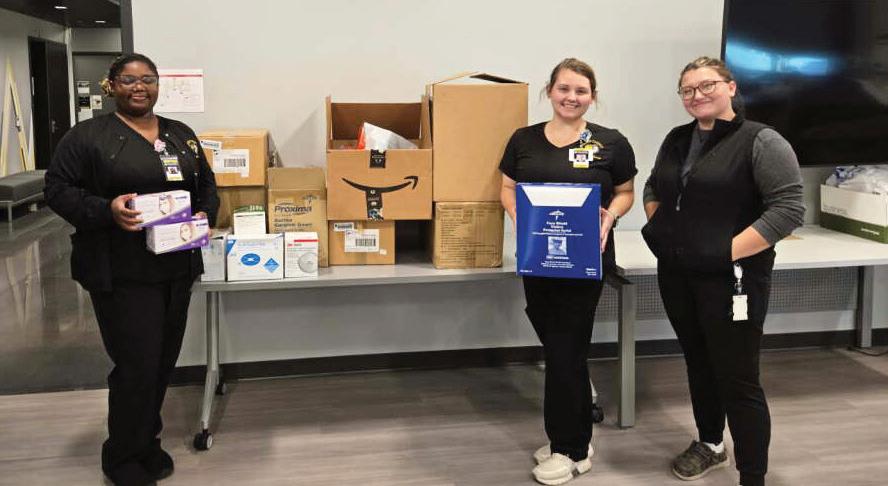
District Five, Kansas Search and Rescue and Saline County Sheriff’s Mounted Patrol Squad, made her unusually qualified for a young professional just entering her field. So, when a job opening for an Emergency Management director opened in Cloud County, her colleagues at SCEM and professors at the university were the first to push her toward it.
“[While interning with Saline County Emergency Management], I got to know all the emergency managers for the region,” she said. Those she met were able to offer endorsements of her accomplishments and work, which helped significantly when she applied for her role.
“Basically, they [Cloud County] were like, ‘You can finish out school and we'll pay you to work,’” she said. “Sign me up.”
She’ll spend her Spring 2026 semester learning online while also working full-time in Concordia.
This arrangement was made possible through the flexibility of Kansas Wesleyan’s Registrar Office and Emergency Management department, both of which worked with Haas to ensure she could work and finish her degree.
“She’s an outstanding student,” said professor Bernie Botson. “We coordinated classes and directed studies through the registrar’s office to get her to graduation. This is a once-in-a-lifetime thing. We had to make it work, and we had to do it in a week.”
Haas was sworn in as Cloud County’s acting director of emergency management on Tuesday, Nov. 4, 2025.
As for whether she’s ready for the challenge of running her department, she’s not worried about what’s to come.
“I like being in charge, and I’m definitely a people person, so it doesn’t bother me at all,” she said. “I am ultimately a department of one. It’s just me, so I have to figure it out.”
She acknowledges that she won’t have to go it alone all the time.
“If I don’t know what I’m doing, somebody I have in my phone is going to know."
Story by Skylar Nelson ’21
Mixing business and pleasure typically is not a sound strategy.
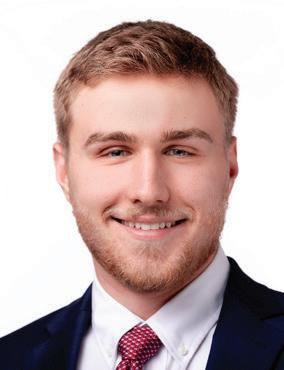
Landon Berquist, though, has found the golf course to be the perfect venue in his work as a brokerage associate for Foundations Commercial Real Estate in Lawrence.
“Being able to swing a golf club has been good for me to talk to people about different ways, different things related to business,” said Berquist, a 2023 Kansas Wesleyan graduate. “It’s about the only place where you can get a fourhour meeting with somebody.”
Berquist earned a double major in Accounting and Business Management and was a member of Alpha Chi, a national collegiate honors society. He played golf for four years and was a member of the Coyotes’ 2021 Kansas Conference championship team that competed in the NAIA Championship in Illinois. His senior year,
he finished tied for seventh at the conference championship and was named to the alltournament team.
Berquist said the two disciplines are mutually beneficial.
“I had accounting in the background, as far as how spreadsheets look with balance sheets and financial statements, along with how that relates to the business environment,” he said. “It was pretty crucial to my understanding, as I got going.”
An out-of-state summer job pointed him toward the real estate world.
“I met a lot of people who were business professionals,” he said. “Several of them had ties to the industry and encouraged me to get into commercial real estate brokerage. It’s a field that is relationship-driven and competitive and lends itself well to people in that realm, as well as former student-athletes.”
A graduate of Lawrence Free State High School, Berquist was happy to begin his career in his hometown. He enjoys the variety of experiences
commercial real estate offers.
“Every day is a little bit different; whether or not a business is growing or downsizing, we’re able to find a way to help them,” he said. Golf, he said, is a stern taskmaster but worth the effort.
“It has kind of a delayed gratification, because you can practice all you want and you might not get any better. Then all of a sudden, you get way better and you’re wondering where that came from. It’s because of all the work you put in early on,” he said.
Berquist credits Coleman Houk ’19, G’21, his coach at KWU, with furthering his development on and off the course.
“Coleman helped push us as far as seeing what potential we had," he said. “He, along with my teammates, were all really good mentors, and I certainly would not be anywhere without them.”
Story by Bob Davidson
The Kansas Wesleyan Amateur Radio Club won’t be talking to the International Space Station this year. Maybe next year.
The KWU STEM Club submitted a proposal to the Amateur Radio on the International Space Station (ARISS) to make radio contact. ARISS rejected the proposal but left the door open to reapply.
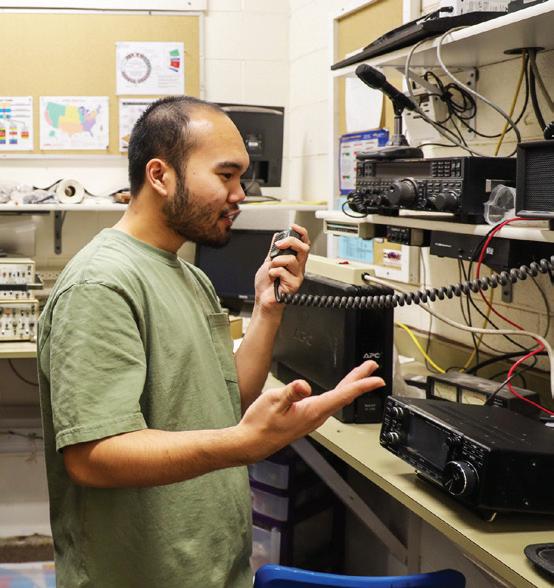
“Our education plan, while it was a good foundation, needed to go more in-depth,” said Elijah Resano ’25, president of the KWU STEM Club.
Through ARISS, students can learn about space technologies and the technologies involved with space communications through exploration of amateur radio.
Resano is not discouraged; the STEM Club will submit a proposal for next year.
“In the meantime, we will be busy constructing, designing and eventually testing the Low-Earth Orbit ground station throughout the fall semester in preparation for the contact next year,” Resano said.
Even if the students don’t talk with the International Space Station, there are good reasons to restore ham radio on campus, said Mazen Nairat, STEM Club advisor and KWU assistant professor of Math and Physics.
“It’s simple, effective and affordable,” Nairat said. “It doesn’t need a huge budget to operate, even though it has amazing applications. We will give the students hands-on experiences to build and know how to operate. It’s going to be good for them, just to give them a unique experience and to give them a kind of history, how these kinds of communications have evolved from ham radio to what we have now — internet, Wi-Fi.”
Nairat sees this as a windfall for Kansas Wesleyan.
“If we are lucky enough to communicate with ISS, that’s going to be big,” he said. “If it’s not, we just might apply for other applications.”
Ham radio can be used for space technology, emergency management and communications, as well as tracking, he said.
He already has a project in mind. Nairat spent the summer as a Watkins Scholar at Wichita State University. One of his mentors there studies gamma rays with CubeSats, miniature satellites, some as small as Rubik's Cubes. Ham radio can track the CubeSats, opening the door to research collaboration with Wichita State and others.
Amateur Radio Society in 1961, call sign KAØKWU. Stucky was a long-time professor at KWU, and the Paul Stucky Optics Lab was named in his honor.
Logbooks still in the ham radio room in Peters go back decades, Resano said. However, the radios are old and the antenna was replaced with cellphone and internet towers. The Central Kansas Amateur Radio Club, based in Salina, meets regularly on the KWU campus. Members of the Salina group were instrumental in helping the student group apply for the grant.
Bernard Botson, assistant professor of Emergency Management, holds the license now for Kansas Wesleyan. Anyone can use the university’s call sign, as long as the license holder is in the building, Resano said. For now, since the antenna has not been finished, when Resano uses the KWU call sign, he goes to the Emergency Operations Center in Peters Science Hall, which has other equipment to access ham radio.
On top of being a research tool, this is definitely a community service, Resano said. Ham radios have been used for communication for decades. In World War 2, for example, various aspects of ham radio were used to support the war effort.
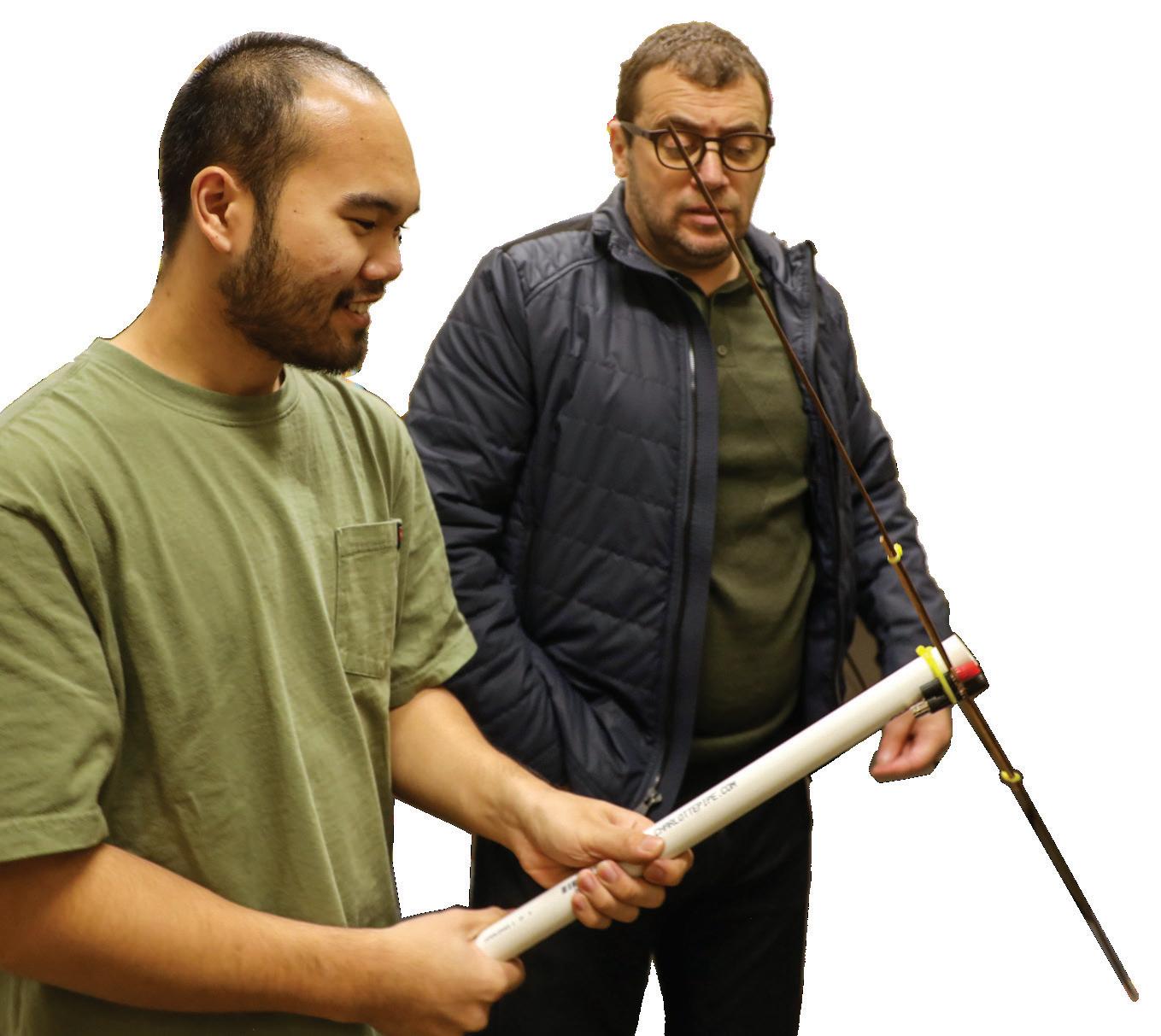
He is also investigating projects with NASA that Kansas Wesleyan might participate in. The station is being built with the help of a $4,950 grant from the Greater Salina Community Foundation. The grant is paying for the parts for a new antenna and a
Amateur radio, also called ham radio, is not new at
the Kansas Wesleyan
Ham radio aligns with Kansas Wesleyan’s core value of community, being a valuable citizen to Salina and the surrounding region and building bridges to the world beyond.
With the new equipment, Resano said, Kansas Wesleyan has the potential to work on anything to do with satellites or space.
“It can be used for so many applications,” Nairat said. “There’s a strong demand in this field, and the real strength of this procedure is that it’s simple and cost-effective.”
Story by Jean Kozubowski
The
Technology,
At Kansas Wesleyan University, Sydney Mitchell ’25 found what many people spend years looking for: a place to belong.
“I came from a community that wasn’t so welcoming,” Mitchell said. “Coming to a campus where you’re immediately one of them, it doesn’t matter who you are, where you came from, or what your background looks like, was so monumental to me.”
In that sense of belonging, she found room to grow and understand herself.
“I always wanted to be an English teacher. That was my lifelong dream,” she said. “I came to school here, and I started doing advocacy and activism. Professors and peers started planting the idea in my head that, ‘You would make an amazing litigator and an amazing lawyer.’”
At first, she didn’t believe that a girl from rural Kansas — or rural Nebraska, where she lived at the time — could possibly achieve that goal. With the support of mentors on campus, she realized how feasible it would be for her to enter the legal field.
When her plans pivoted, she added a Communications minor to her degree.
“Communications in general, learning how to talk to people, to connect with people, has been super important to my growth as a person and an activist,” she said.
Her sophomore year, she was nominated by Rev. Dr. Allen Smith to be Kansas State NAACP Youth & College president, a role she’s now held for the past three years.
Her involvement with the NAACP has opened numerous doors. As president, she’s been a guest speaker in the Capitol Building in Washington,
D.C., met with the NAACP Legal Defense Fund and traveled to a conference in Las Vegas, where she met Benjamin Crump, one of the country’s top civil rights attorneys.
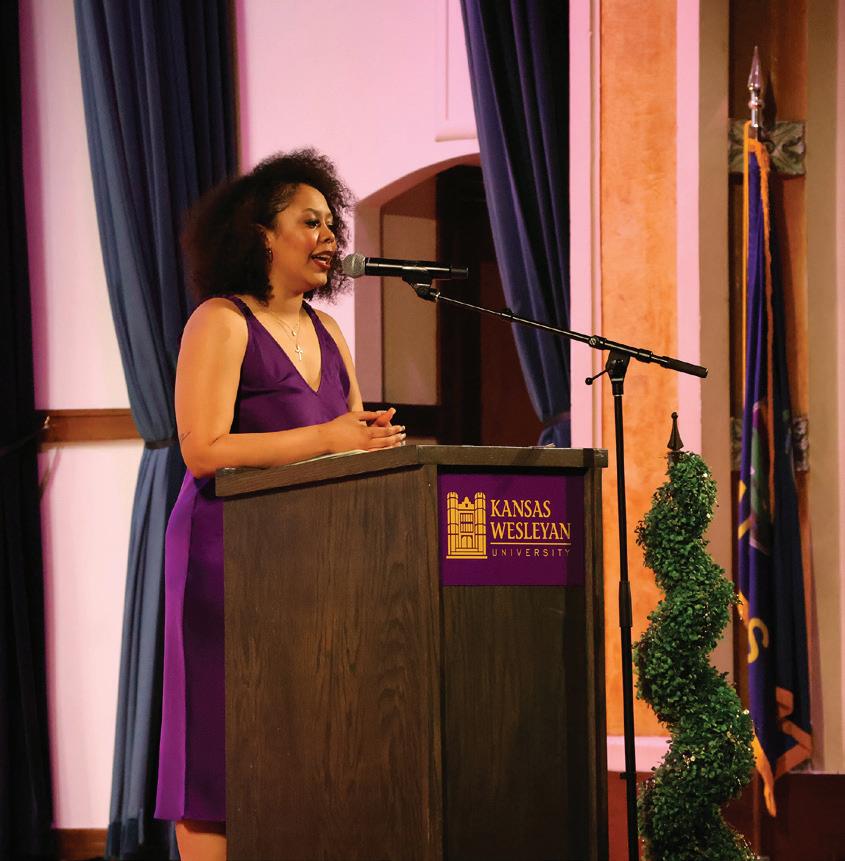
“Since I’ve been in the NAACP, I’ve gotten to do a lot of amazing things. I've been able to network in a way that I’ve never been able to network before and get to be an advocate and activist in my own personal way.”
She’s also been active on campus. She was vice president of the Multicultural Student Union for one year and a member for three, a cheerleader for three years and a writer for KWU Student Media.
She’s also been a fixture at campus events,
having recently shared her story during Homecoming 2025 at the 7x7x7 Speaker Series and at KWU’s annual Women in Leadership Event in April. It was at the latter event that she caught the attention of Judge Angela (Angie) Coble ’94, who has served as a mentor ever since.
“She reached out to leadership on campus [after the event] and said, ‘I need to be connected with this student. I’m so excited for her, I love her story,’” said Mitchell. “Her being a woman in law, and that being my track, having someone that’s been there has been really amazing.”
"After seeing her speak, learning that she grew up near my own small hometown and that she planned to attend law school, I knew I had to meet her,” said Coble, who is a judge on the Kansas Court of Appeals. "I have enjoyed getting to know her and supporting her in her journey to become a lawyer and advocate. I have no doubt Sydney will continue to do amazing things and cannot wait to watch her succeed."
As for her next steps, Mitchell has already taken her Law School Admission Test (LSAT) and begun applying to law schools. Though she performs well in the classroom — she’s been a staple on the President’s or Dean’s list every semester — she said test-taking hasn’t always been her strong suit.
No matter what, her plan involves the legal field.
“If I don’t get in, I plan to be a paralegal,” she said. “I hope the skills that I’ve learned here will translate to the courtroom, and I’ll be a positive and uplifting speaker.”
Story by Skylar Nelson ’21
If
KWU’s Power of AND Campaign is closing in on $50 million raised!
The campaign has influenced every aspect of campus life during its six-year stretch, including the Sams Chapel, Nursing Education Center and Bieber Dining Hall projects, along with a substantial increase in the endowment. We Hope to close out phase three by early 2026, and discussions are underway regarding phase four, which would include a focus on academic and co-curricular support, scholarships, estate plans and the endowment.
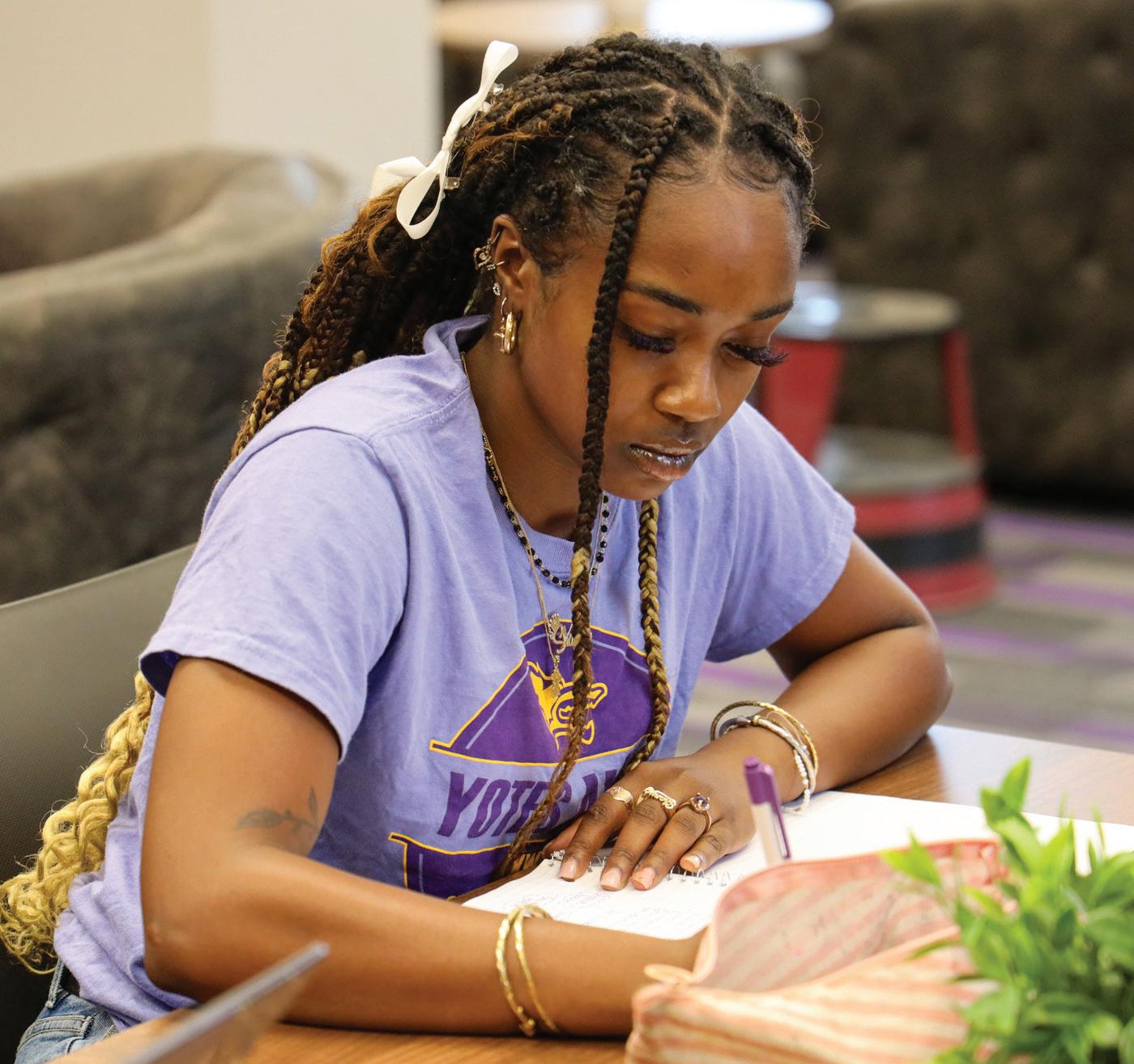
Ah, the all-nighter — caffeine-fueled, pizzapowered. It’s how some of us crammed for the test the next day or wrote that 10-page essay. It was a badge of college honor.
There is a better way to study, Kansas Wesleyan students are learning. It also sets students up for a better college experience that can carry over into their lives, said J.D. Koons, assistant vice president of student engagement and success.
Koons has been in charge of the Student Success coaching program for the past four years.
“The biggest change between last year and this year is we implemented a course for all students to take,” Koons said. “We took the curriculum we used in coaching sessions and put it into a classroom setting. This allows for more face-to-face time with a success coach.”
The interactive program expanded from at least once a month for the academic year to twice a week. First-year students will meet with their success coaches 64 times over the course of the year, he said. Building relationships is key to the success, he said.
When Tissa Salter, English Department chair, joined the faculty in 2001, the student-success coaching program had just started. Its purpose was vague, she said, just a how-are-you-doing approach.
When Koons joined the next year, she said, “A true program began taking shape. Each year, the program has turned into more of a partnership than some sort of academic overseers.
“This fall, I am part of a particularly interesting experiment that I think will help guide even further refinements to that partnership,” she said.
Her class is a hand-picked cohort of first-year football players.
She keeps an eye on how they are doing in school but, “It's about empowering these students through sessions exploring their first-year experience, looking at role models, thinking big thoughts, learning financial management, study skills and using the latest big-tech AI, but also paying attention to details.”
“Most college students don’t know how to study effectively — how much time to study, what to study, how to study, Koons said. “High school and college are two different worlds.”
Lauren Higgins, sophomore Biomedical major, agrees.
“Coming straight out of high school, it was with the hope I would succeed,” Higgins said. “You look over notes before a test and that was it.”
The science behind learning says studying an hour or two before an exam is the least effective way to learn, Dr. Michaela Carlson said. What you want to do is make your brain work as hard as possible.
The Foundations of Success class that Carlson taught last year was “amazing,” Higgins said. Carlson’s appointment is half-time success coaching, half-time associate professor of Chemistry.
“She really set the foundation for what we needed to be successful,” Higgins said.
She learned new techniques, such as the pomodoro method, in which you work hard for 25 minutes, then take a 5-minute break. Do that four times, then take a longer breaker.
“what students need to work on.
She stresses good study habits and how to be a successful student. She also discusses internship experiences, research over the summer, how to read graphs and charts, using the Excel spreadsheet app and how to read a scientific paper.
“The fall class focuses more on the student and makes sure they’re thriving at Kansas Wesleyan and being successful, both academically and personally,” she said. “The spring is going to focus way more on how do you get that career.”
Her students write resumes and curriculum vitae and search for a job or internship they might apply for. Carlson brings in businesspeople and scientists from outside for a career fair, too.
Throughout both semesters, she brings in other faculty from STEM so the students can become acquainted. Most students move from coaches to advisors their second year. Carlson noticed last year that the transition “was a little rough.” This year, she’s making sure students and advisors are acquainted and compatible. If that sounds intense, that’s because, “We tend to have more stress in the STEM field,” she said. Research is showing now that getting mindfulness in the STEM field is important, so that’s a component she, and the other coaches, are teaching.
The most important thing is helping students develop new skills or learn to leverage the skills they already have to be successful in college”.
“And there’s one where you basically almost forget it, then you have to work harder to remember it,” Higgins said. “I feel like that’s OK. I feel that with what I want to go into (forensic science), I have to work harder.”
Carlson was the only coach to teach Foundations of Success last year. This year, all seven coaches teach it, customized to their group of students. Carlson’s group is all STEM students. Salter’s is football players. Others work with exploring-major students, nursing students, business students and other assorted majors.
Carlson found last year that she couldn’t cram everything she wanted into a one-semester Foundations class. This year, the university has set aside 8:30-9:15 a.m. every Tuesday and Thursday for student success classes for first-years or faculty office hours for upper-class students.
The Tuesday sessions are often more traditional lecture-and-discussion format. The Thursday classes, which Carlson called “recitation,” are more open for
For at least a week, students try taking a walk, breathing exercises, yoga or exercising, but not whatever their sport is. Many told her they liked it, Carlson said.
This is a big investment for the university, Koons said, but it doesn’t take away class time, just shifts the schedule.
“The most important thing is helping students develop new skills or learn to leverage the skills they already have to be successful in college,” he said.
Good work and study habits, relaxation techniques, and building relationships with peers and professors lay the foundation throughout their college degree and beyond.
“We are building belonging and self-efficacy,” Salter said.
“Through relationships, to me that is the most important thing,” Koons said.
Story by Jean Kozubowski
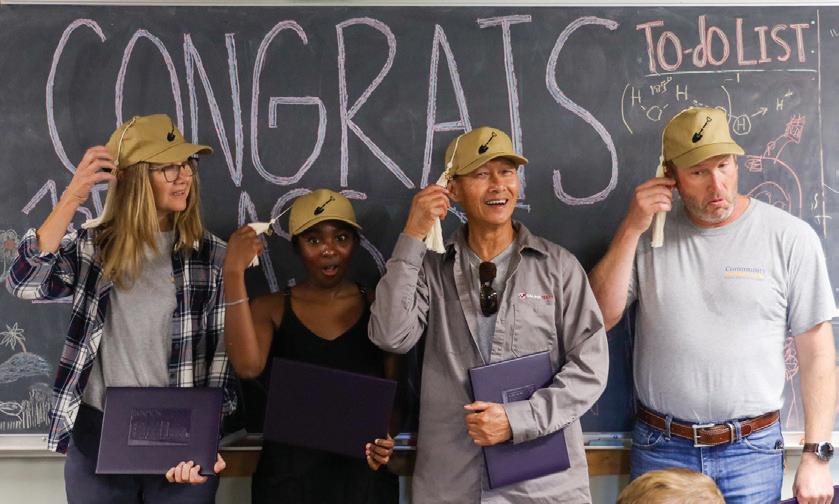
Instead of mortar boards, the graduates wore tasseled field caps. But as in any graduation ceremony, when the certificates were conferred, they moved the tassels from the right to the left.
The first crop of students in the Heartland Rodale Institute Farmer Training (H-RIFT) program went out the door in October, the end of the growing season, to practice, regenerative organic farming and ranching in California, Texas, Montana and Kansas. H-RIFT is a program of KWU’s Community Resilience Hub (CRH) in collaboration with the Rodale Institute.
Preparations have already begun for the next class, which will start in March, the start of the growing season.
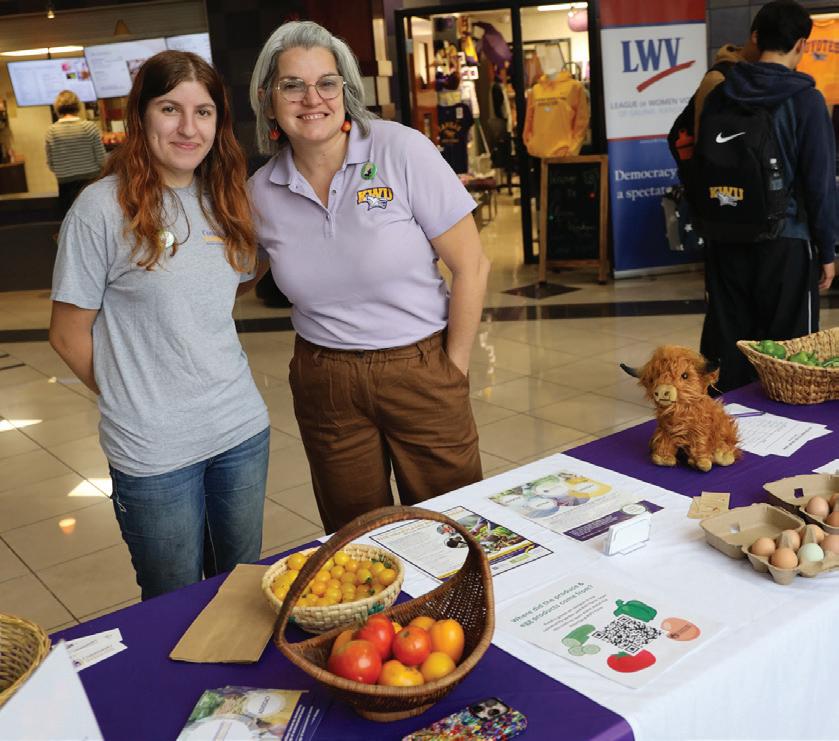
It’s been a busy year for CRH. In addition to the inaugural H-RIFT class, CRH cohosted (with Kansas State University) a Local Food Summit on campus at the end of July. It also shared with the Wesleyan community eggs and produce from the H-RIFT acreage and campus community garden, some of which also was shared with the Salina Emergency Fund / Food Bank. As it has for several years, CRH sponsored a community civil discourse training for the public at Salina Public Library. The speaker, Alan Yarborough, also spoke to KWU classes on the topic.

Kansas Wesleyan’s Community Resilience Hub (CRH) program has a new academic leader, as Jacob Miller-Klugesherz recently accepted the role of the Joe Hale Chair in Regenerative Agriculture.
In this tenure-track position, his main responsibility will be directing the Heartland Rodale Institute Farmer Training (H-RIFT) program at the university. The engaging, handson certificate program instructs students in all aspects of regenerative organic farming — including livestock, crops and business — in the growing season spanning March to October. The certificate program includes classroom learning and fieldwork on an operational farm of 12 acres.
regional significance.
“It’s a pleasure to welcome Jacob to this position,” said Dr. Matt Thompson, KWU president. “His Kansas roots, his passion for bettering farming, the environment and our communities, and his academic experience make him the ideal candidate to direct the H-RIFT program. We look forward to him making the CRH even better.”
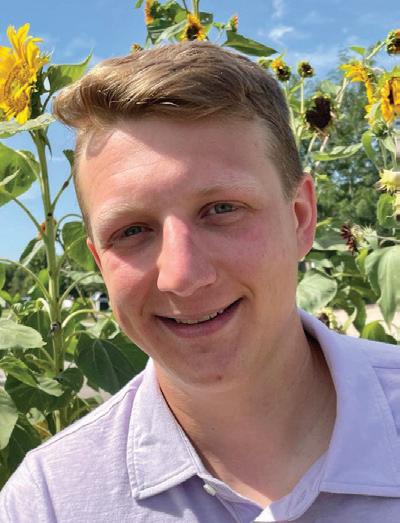
Miller-Klugesherz has both practical and academic experience for the position. A sixth-generation Kansan, his first job, at age 15, was as a farmhand. He spent his childhood on his parents’ 15 acres growing, tending, picking, processing, preserving, consuming and dispersing an array of fruits, vegetables, grains and livestock.
He is a May candidate for a doctorate in Sociology at Kansas State University, with concentrations in community, agriculture, food, environment, and politics and development. He also holds a Master of Arts degree in Communications Studies (ecospheric rhetoric emphasis) from K-State.
Since June 1, he has been KWU CRH’s Education Transformation project lead. He is planning for the June 2026 Education Transformation conference, to be held on campus, an event that is expected to have
“KWU is working to regenerate the culture of agriculture, and that starts with education,” said Miller-Klugesherz.
“We aim to teach students sustainable and resilient ways to farm differently, eschewing the large-scale, commodity conventions that predominate Kansas agriculture. Farming with no chemical herbicides and minimum tillage can and should be done.”
“In this position, I will continue to live out my family’s rich Kansas and KWU legacies of education and alternative agriculture, advance the visions of Joe and Joyce Vanier Hale, and cultivate a diversity of life that supports the interdependent transformation of higher education and conventional agriculture. I'm eager to begin.”
Miller-Klugesherz will begin his position Jan. 1.
The Joe Hale Chair in Regenerative Agriculture was established to promote innovative and sustainable agricultural practices. The position is funded by a generous gift from the estate of Joyce Vanier Hale and is named in honor of her late husband, Joe.
Story by Jean Kozubowski
H-RIFT program ready for next season to use new 10-foot grain drill
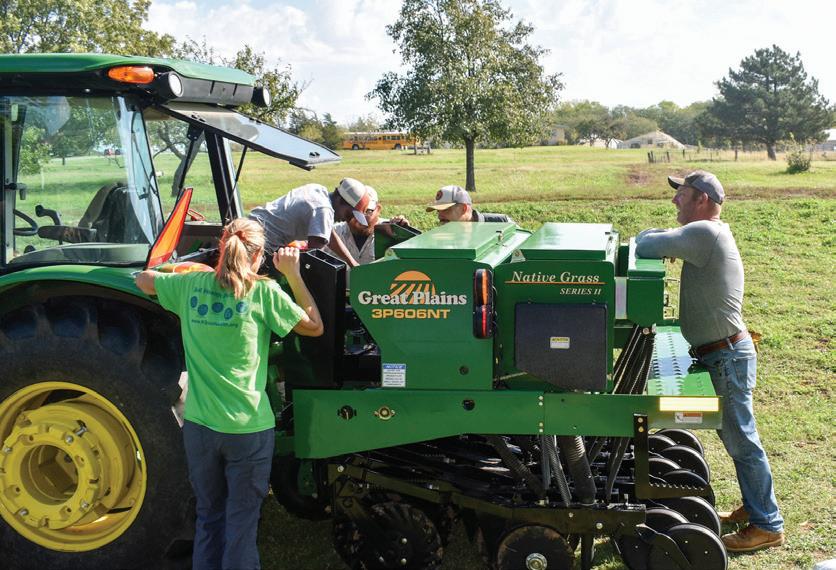
This next class will have the full use of a grain drill donated to the H-RIFT program with an in-kind lease from Great Plains Manufacturing of Salina. A 6-foot drill arrived in October, and sometime next year it will be exchanged for a 10-foot grain drill. This fall, the drill was used to plant a cover crop of cereal rye, winter peas and black oats at the Quail Creek Family Farm property where the H-RIFT students gain practical experience.
Dr. Trish Petak, associate professor of business and accounting, was recently recognized as this year’s Salina Women of Achievement honoree in the field of education. Petak joined six other women, including KWU alumna Heidi FeyerhermSmith ’08, in being honored at the organization’s annual event on Nov. 6 at Theatre Salina.
“To be awarded Educator of the Year is such an incredible honor and is profoundly meaningful because it’s a recognition from my hometown of Salina,” said Petak. “I'm blessed that my career at KWU has allowed me to teach thousands of amazing students while giving back to the lifelong community I love.”
Petak is the longtime leader of KWU’s DECA program, a team that has achieved significant national success with several championship performances. She has held roles with the noon AMBUCS group, the Salina YMCA board and other local nonprofit proceedings, in addition to being a key leader in KWU’s Department of Business and Accounting.
For more information on KWU visit www.kwu.edu/news.
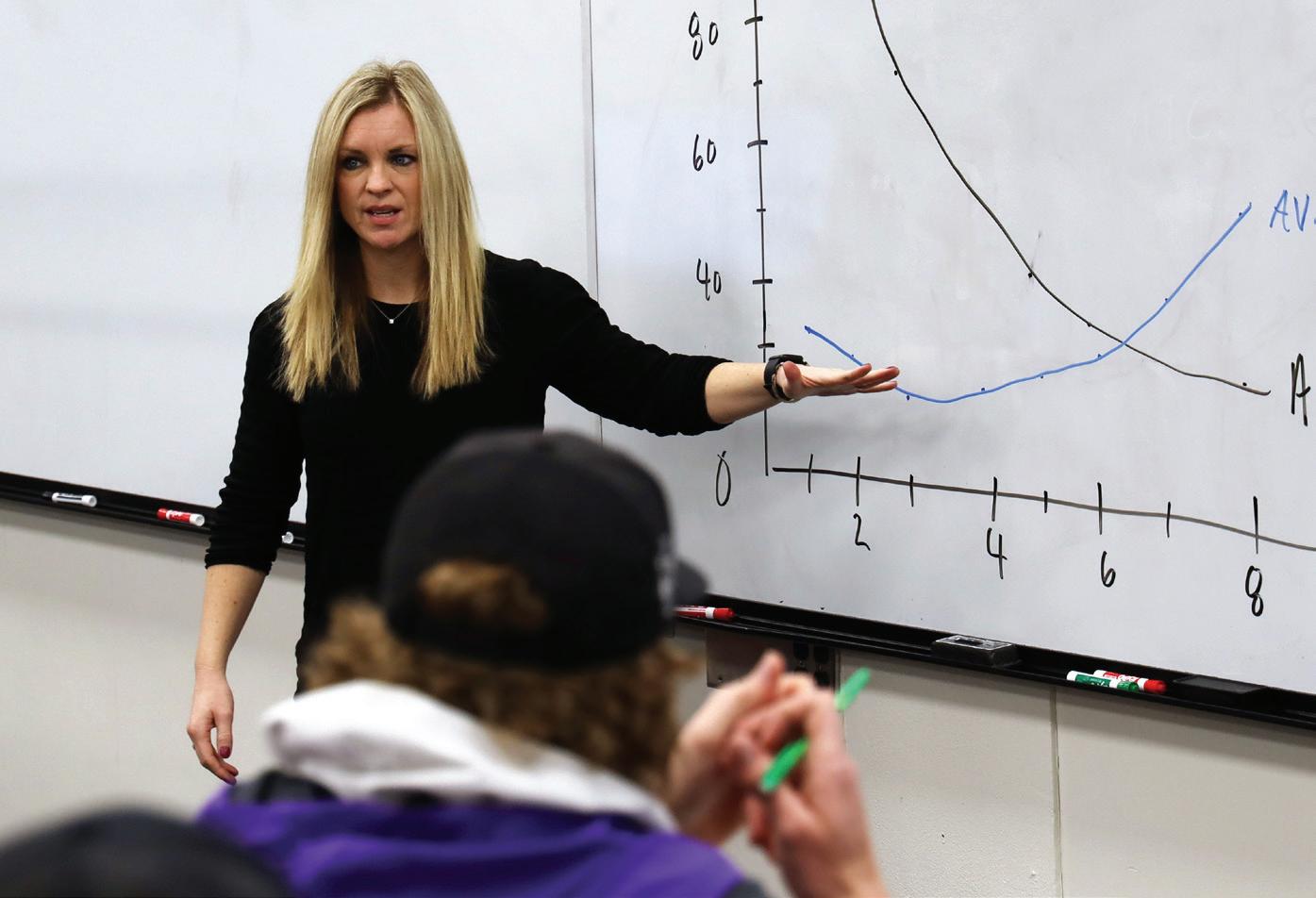
For close to 20 years, Holocaust Remembrance and Genocide Awareness Week has been a fixture on Kansas Wesleyan University’s campus in midApril to early May. The week is the brainchild of Dr. Mike Russell, professor of History, and he’s been at its helm since it began in 2007.
Originally known as Holocaust Remembrance Week, Russell brought the idea with him to KWU from Eastern Washington University. He liked the model of spending a week exploring the Holocaust from various angles: lectures, art, film and, most poignant of all, directly from survivors.
“To me, these people are celebrities,” Russell said. “They may not have famous names, but these are the unspoken heroes. It's just been one of the greatest experiences of my life.”
Since the event launched, KWU has welcomed numerous Holocaust survivors to its campus to share their stories.
“What I have learned and gotten from these people is not specifically the horror story of what it was like to be in Auschwitz or Bergen-Belsen. It’s not what it's like to be the only survivor,” he said. “That’s the story they tell when they speak, but the real message they give is about how they
survived and what their attitude toward life is, because what you hear is the story of resilience. You hear the story of survival, but it's a survival, in many cases, where they've gone beyond the hurt and the pain.”
In 2012, the program expanded its curriculum and its name when it added genocide awareness as a broader topic. Many of its speakers are still Holocaust survivors, but Russell recognizes that change is coming since few survivors remain.
“It's time to segue on to other survivors of genocides who can come here and speak in person, because that's really what our audience wants,” he said.
In 2020 and 2021, no speakers could come to campus due to COVID-19, and subsequent Zoom events have not resonated as strongly as prior years’ in-person presentations and meet-and-greets.
Shifting focus doesn’t mean giving up on teaching younger generations about the Holocaust.
“It's in pretty much any of the academic subjects. You’ll see it in sociology, in ethics. I mean, you could see it in literature,” he said. "We have to keep teaching about it.”
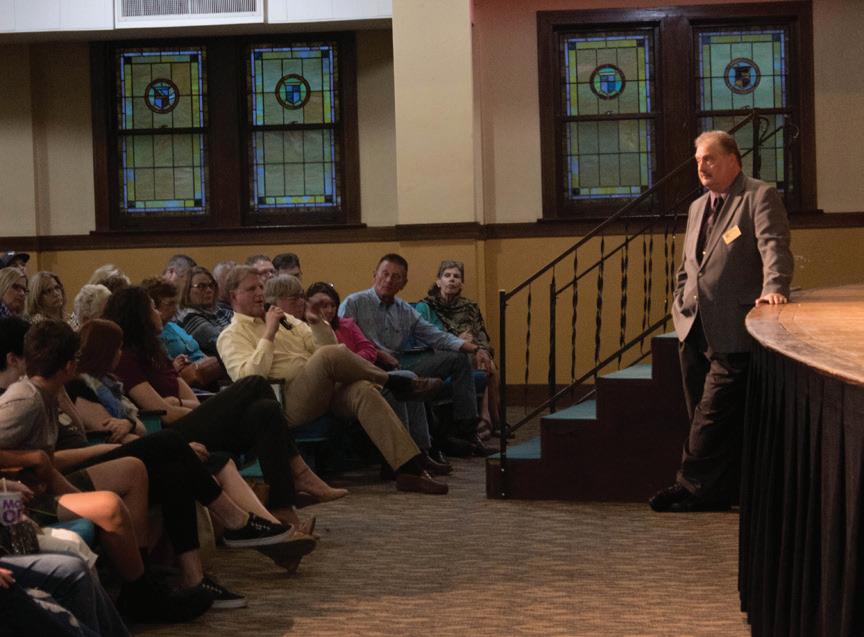
Holocaust Remembrance and Genocide Awareness Week might be evolving, but Russel's goal remains the same: to educate students and the community about the Holocaust, the ways genocide persists in the world and to speak about the power of human resilience in the face of persecution.
Story by Skylar Nelson ’21
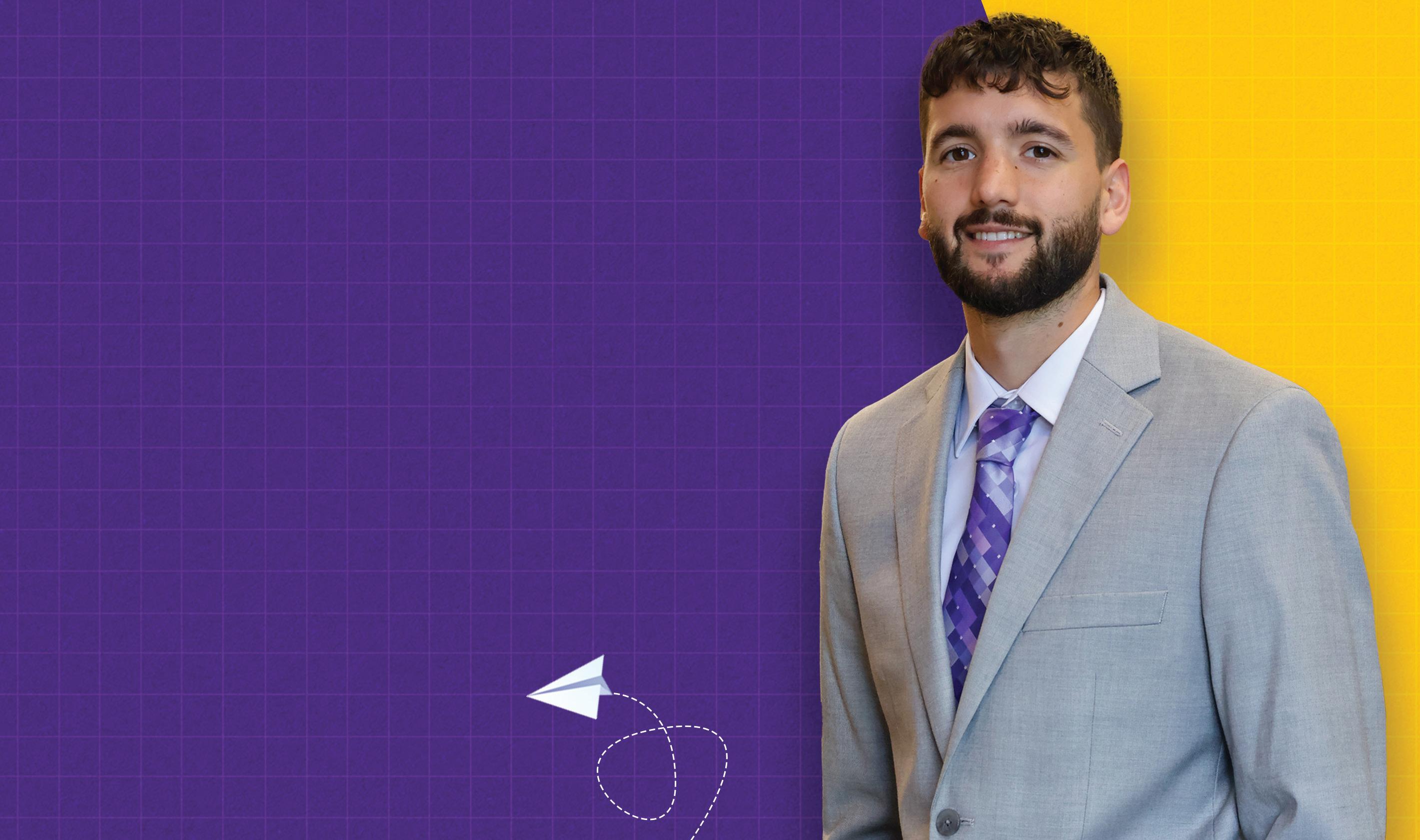
Anyone living or working in Saline County is eligible for $100 off per credit hour in KWU MBA tuition. This lowers the total cost to around $12,000.
You can start at the beginning of any eight-week session, the program is available completely online, and you can finish in as little as one year!
Want to know more?
Contact Dr. Michelle Case, director of MBA program and undergraduate program engagement, at michelle.case@kwu.edu or KWU Admissions (admissions@kwu.edu) by calling 785-833-4305.

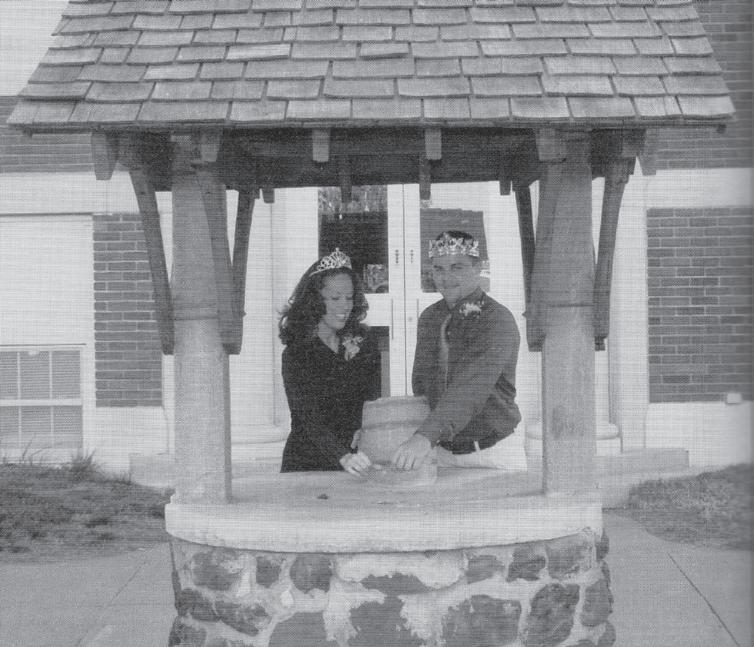
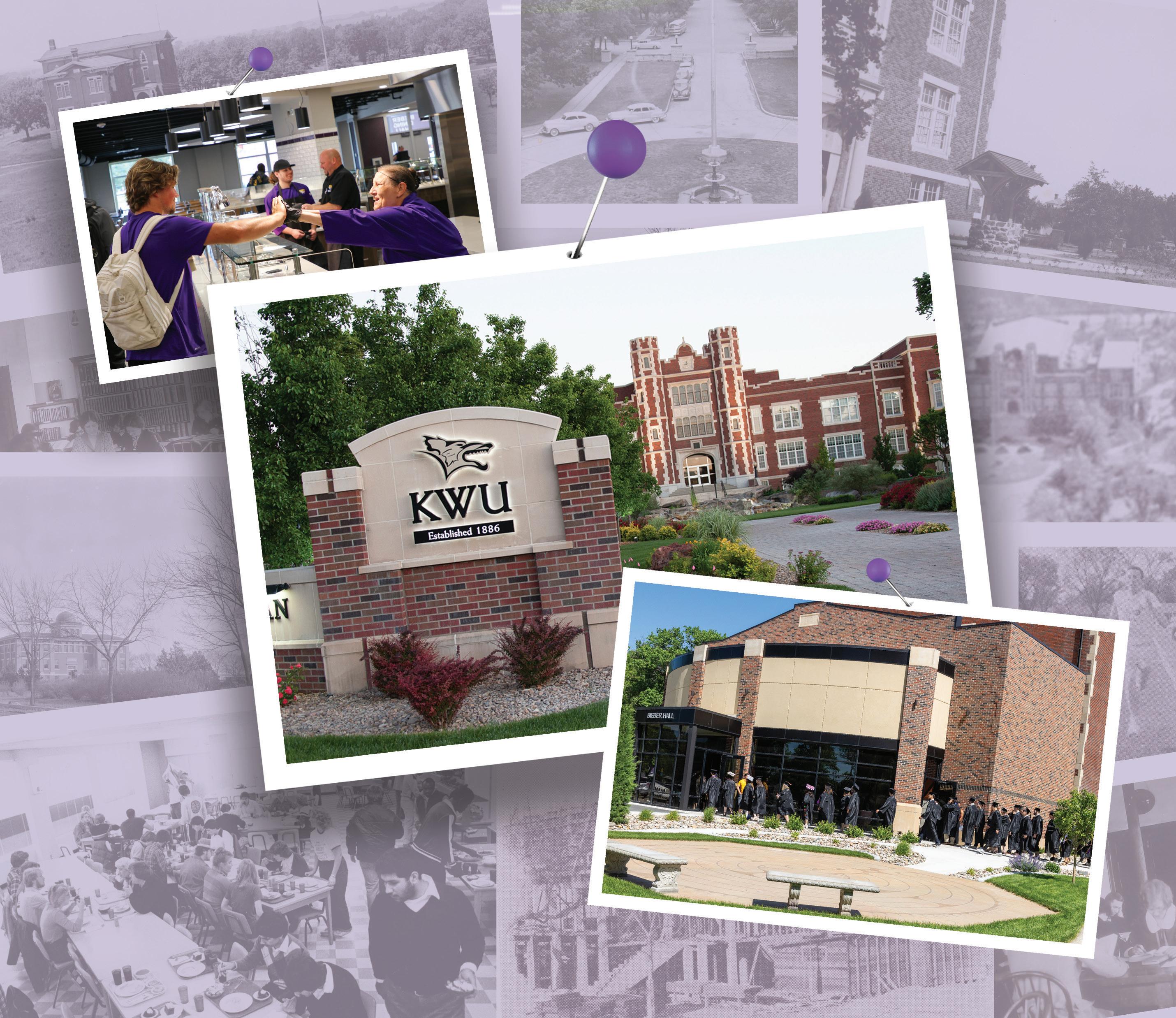
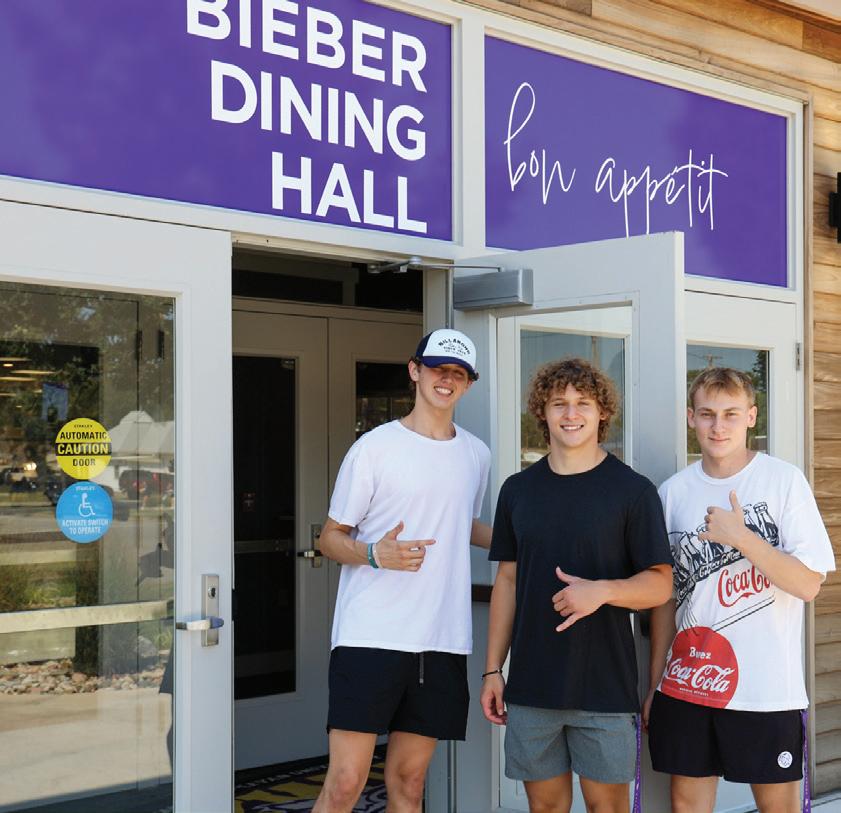
The Bean Wishing Well has moved slightly during its history, but it remains a memorable location on campus. Older alumni may remember it relating to the Lilac Fete, but today, rare is a Homecoming or special event where the wishing well doesn’t have a crowd around it. Pictured at left are the 1988 Mr. and Miss Wesleyan, honored during the Lilac Fete festivities, and (right) the well at its current location, roughly equidistant from Bieber Hall and the east entrance to Pioneer Hall.
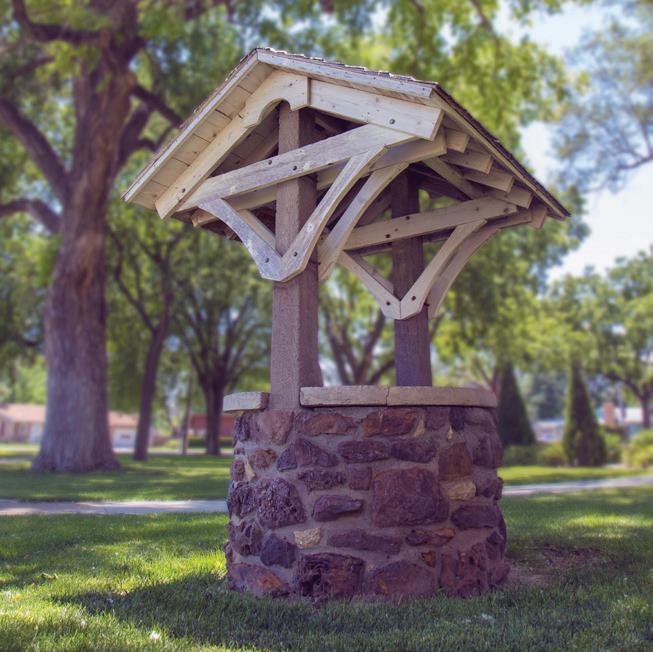
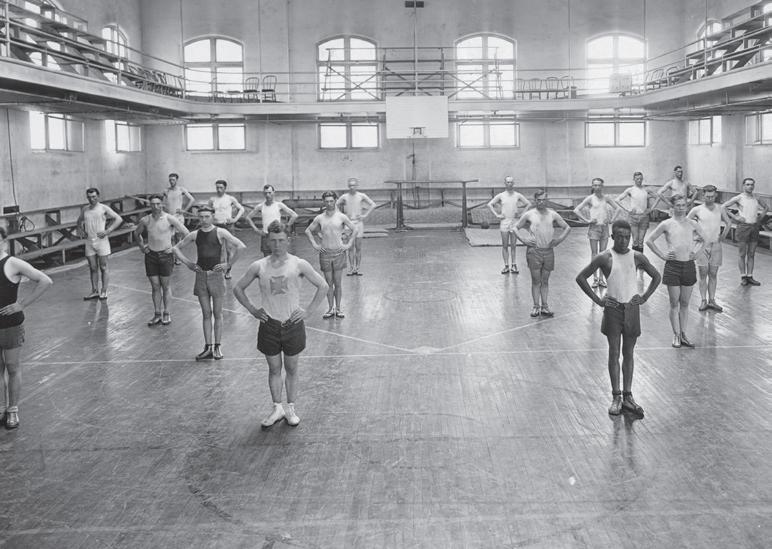
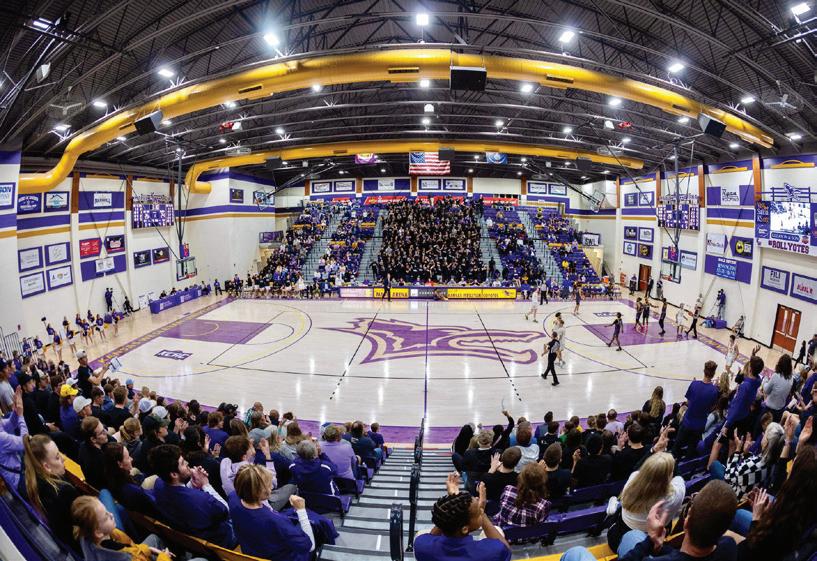
While they don’t occupy the same footprint, the King Gym/Mabee Arena dynamic shows KWU’s growth. While the former was among the best in the area when built, it aged through the decades. In 1979, it was condemned due to storm damage and it would be destroyed by a fire eight years later. The Coyotes moved into the Muir Physical Education Center (now Muir Gym) following its 1981 construction, and that facility would become part of the Student Activities Center when Mabee Arena opened in 2005.
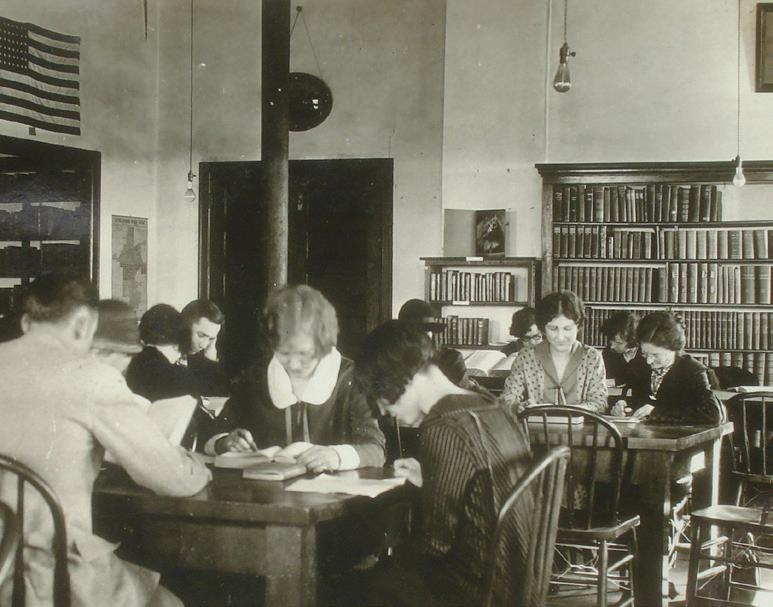
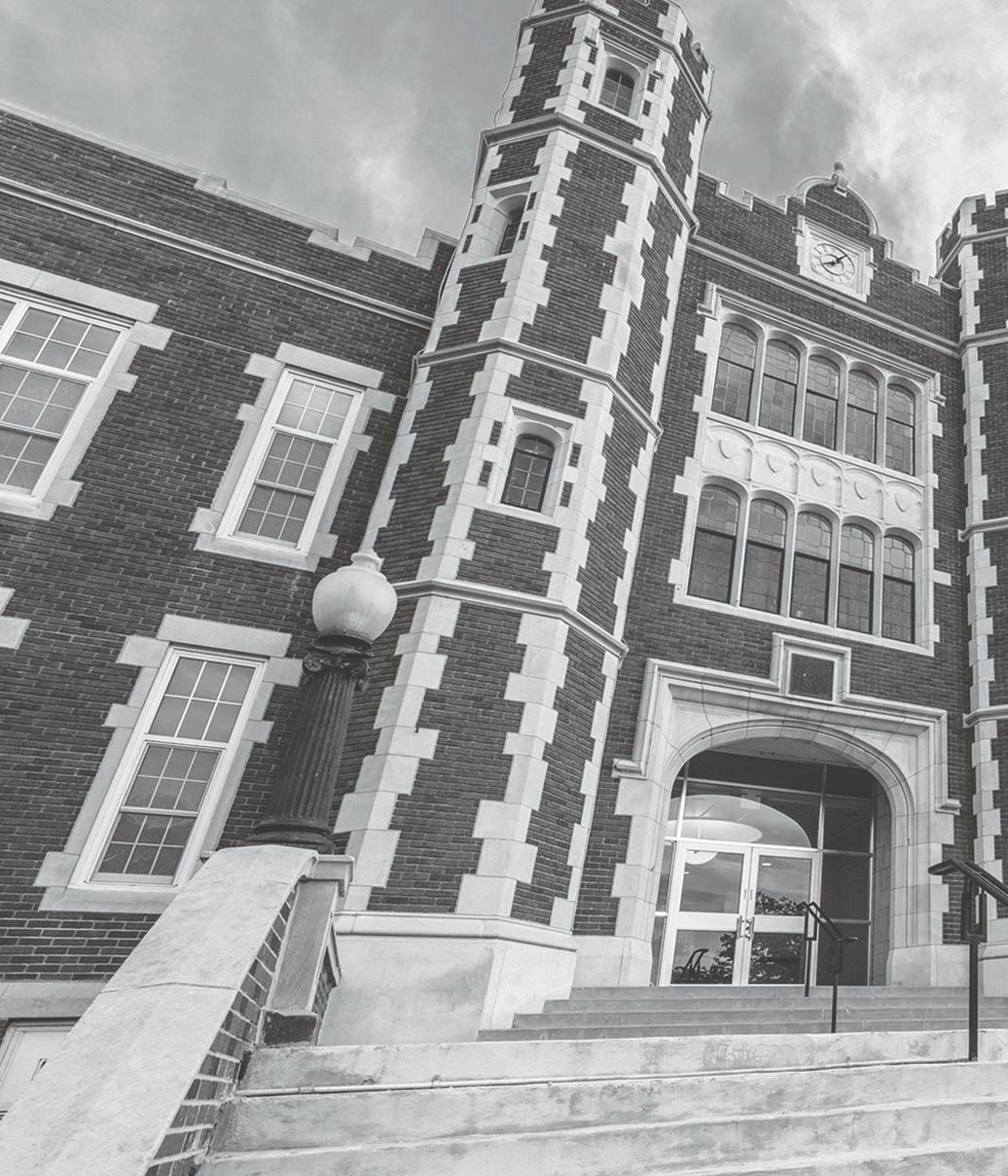
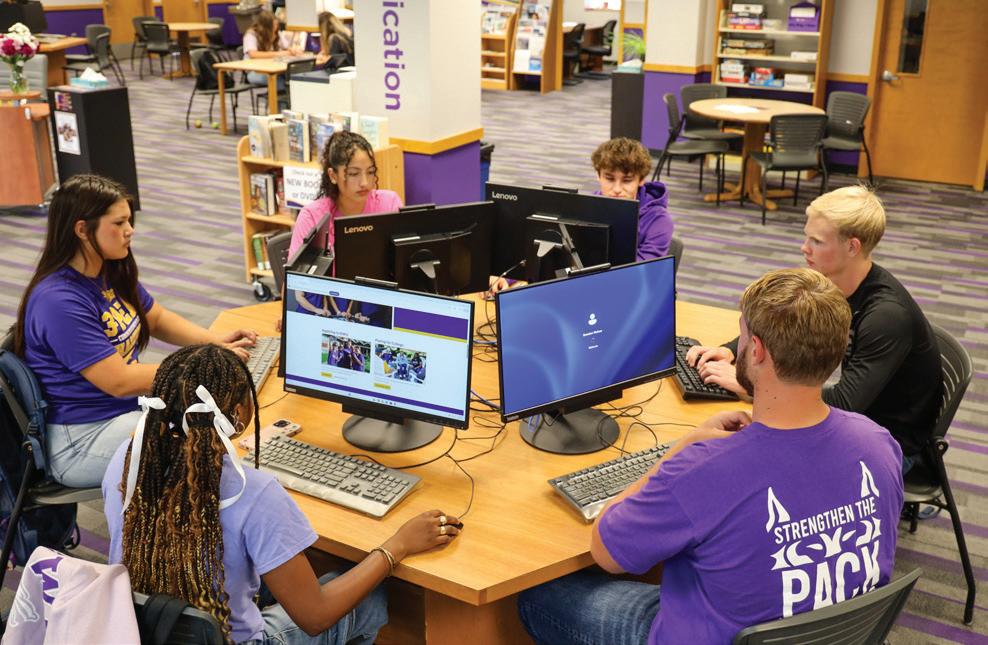
One of the earliest KWU libraries was housed on the third floor of Carnegie Science Hall. It was housed there for nearly 50 years, and the space also included the university’s museum, at one point. Ground was broken for Memorial Library in March 1948 and it opened one year later, when students moved much of the material from Carnegie via stretchers. Memorial Library was renovated in 2023 and 2025, while Carnegie Science Hall was torn down in 1979 to make room for the construction of Muir Gym, which occupies that land to this day.
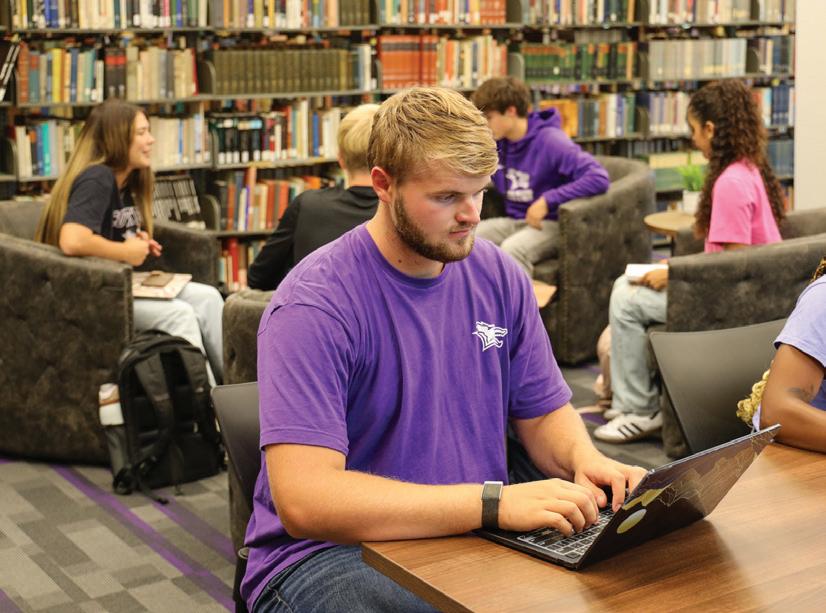
There have been countless changes on campus during the past decade-plus, and as we celebrate these, we remember the events, classes and memories that occurred in some of these spaces previously. All of us at KWU hope this feature inspires memories and gratitude surrounding your time at the institution that means so much to all of us.

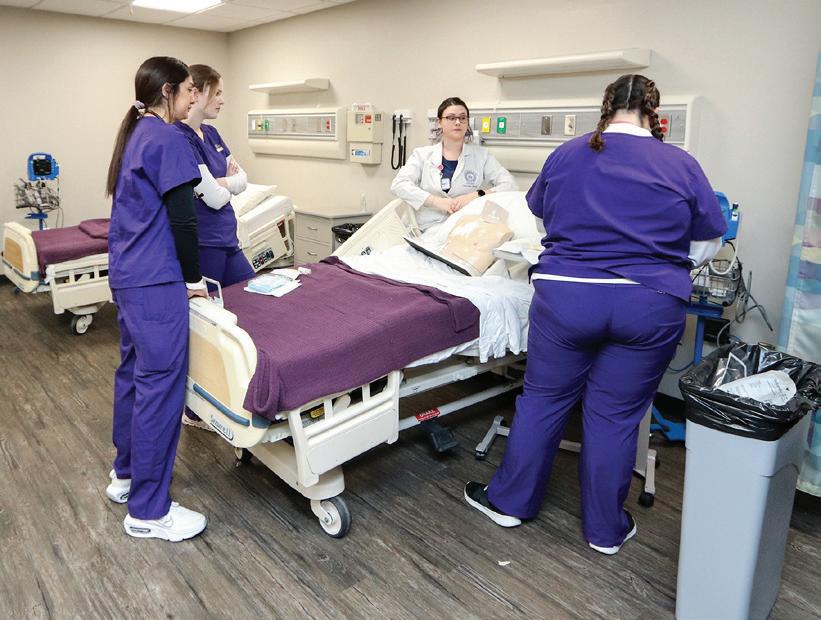
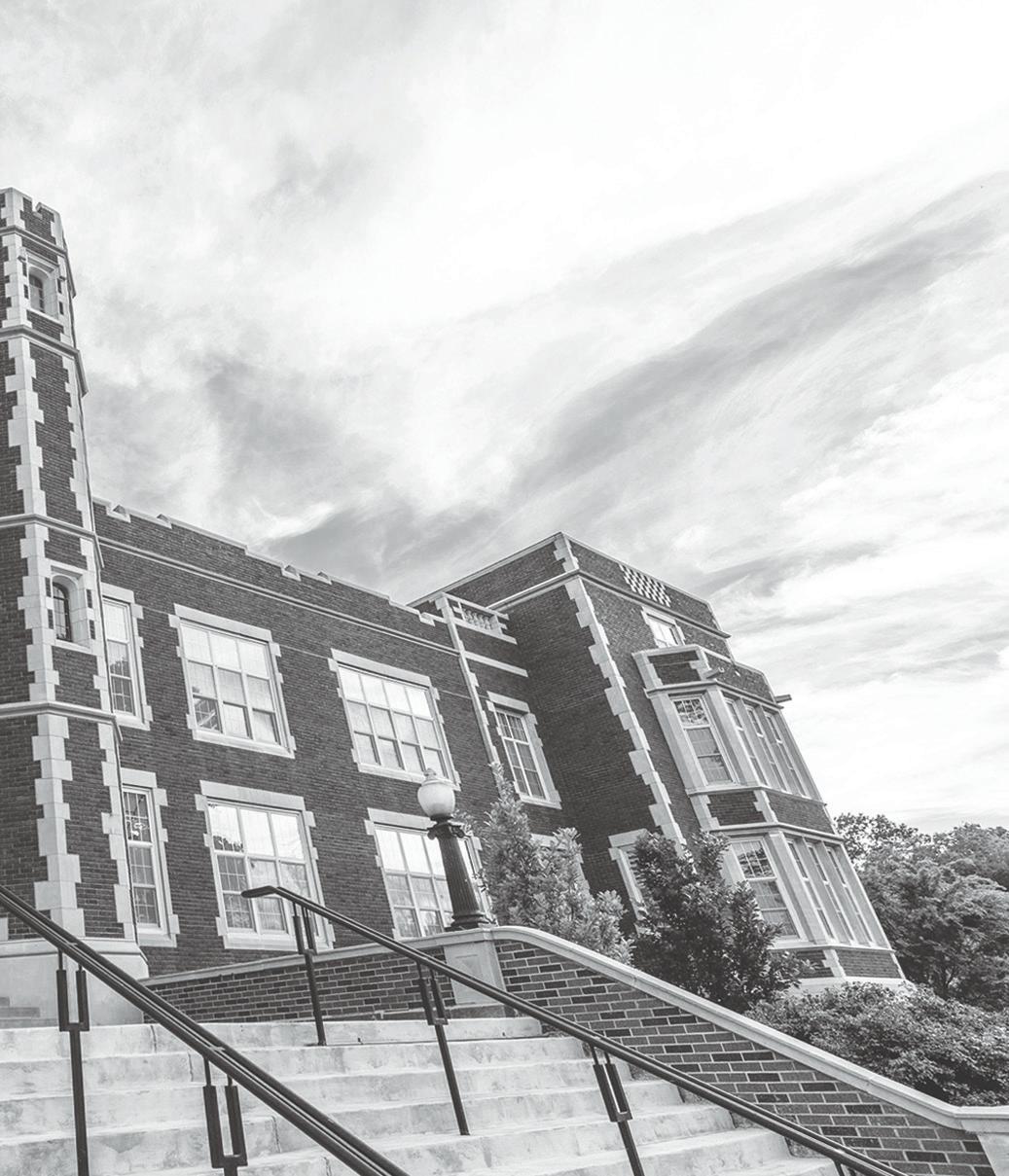
The Nursing Education Center is one of KWU’s newest buildings, but it has its own unique history. It served as a local doctor’s office for many years, including the Salina Women’s Clinic and offices of the late Dr. Merle Hodges, a past mayor of Salina. At left, the basement of the building is shown during renovations. Part of that area would become what is now KWU’s skills lab. The NEC opened in 2021.
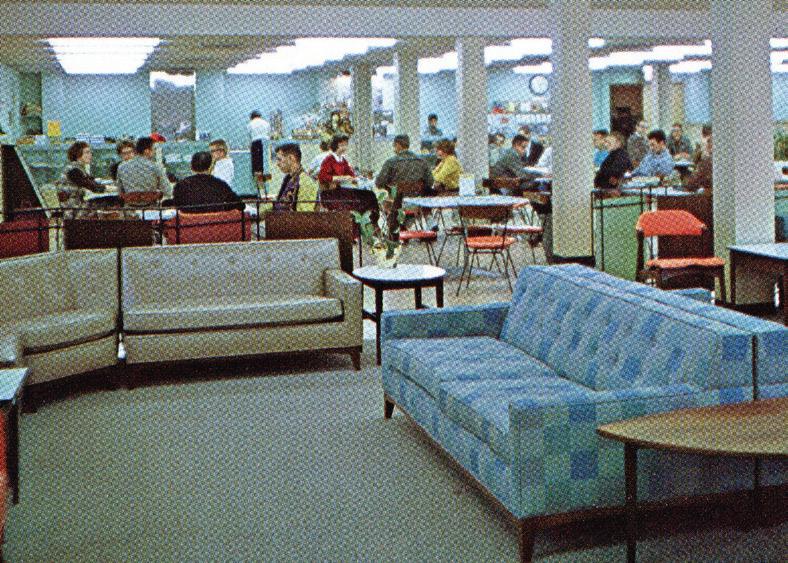
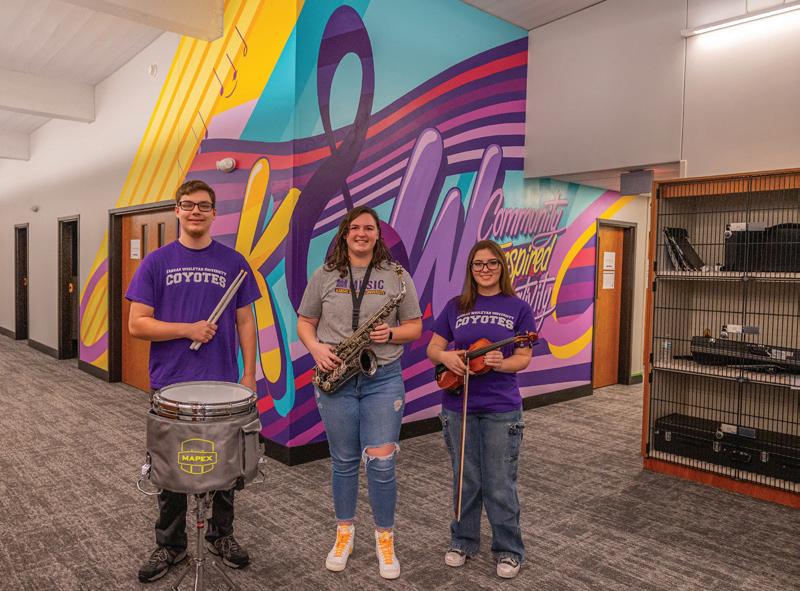
Pioneer Hall’s lower level has held classrooms, offices and more during its existence, but what many alumni remember it for is the McAdams Student Lounge. This was KWU’s primary student gathering space for some time, including in 2001, when it was the main area for news surrounding the Sept. 11 attacks (see Fall 2021 Contact, page 18). At times, both in the late90s/early-2000s and during the early stages of COVID-19, food was offered for purchase in this area. Now this space is the Applequist Family Music Center, featuring classrooms, practice spaces and a lounge/locker area for Music students. Three are pictured right, in front of a mural completed by artist Queen Andrea in early 2024.
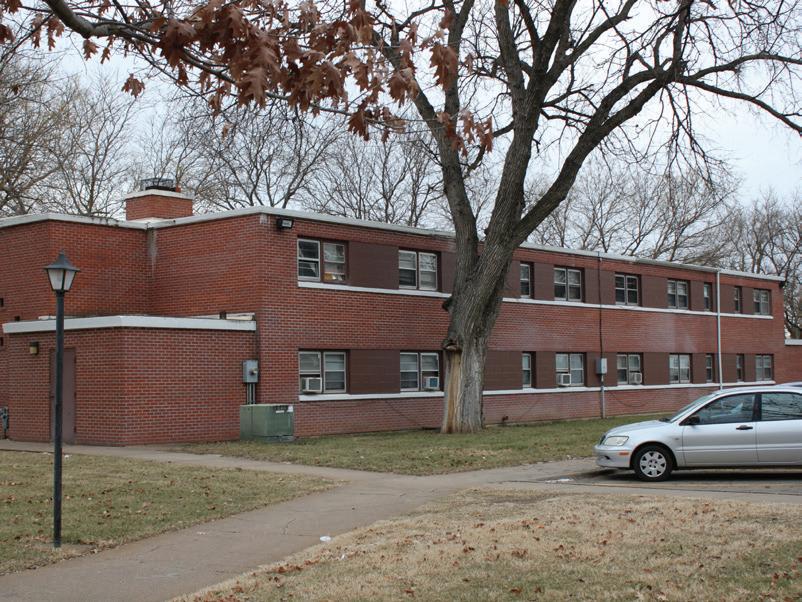
South Hall is now one of KWU’s many green spaces, but alumni may remember it as what was, at the time, home. South Hall, constructed in 1957, provided eight apartment units that, over time, were used by non-traditional, married or over-21 students. It was torn down in 2022.
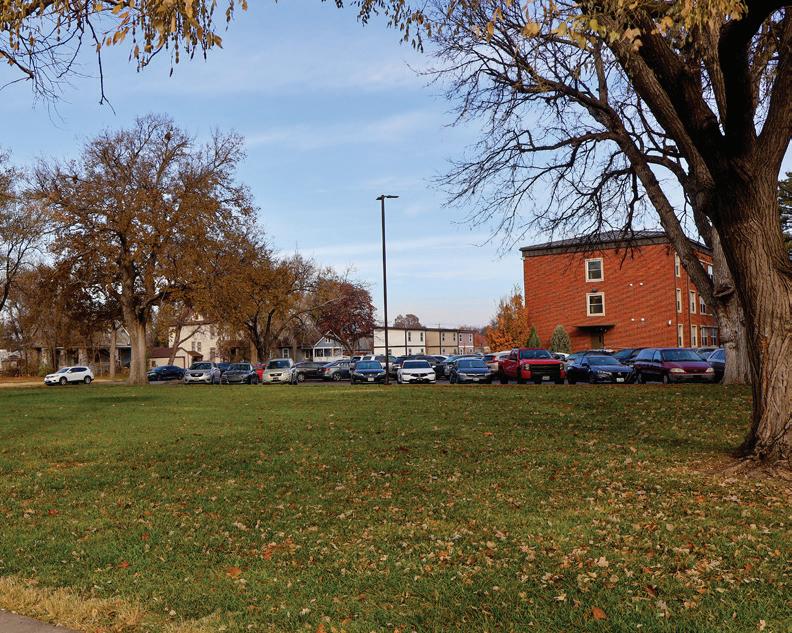


Mark your calendar for Homecoming 2026, Oct. 15-18! 1 2 3 4
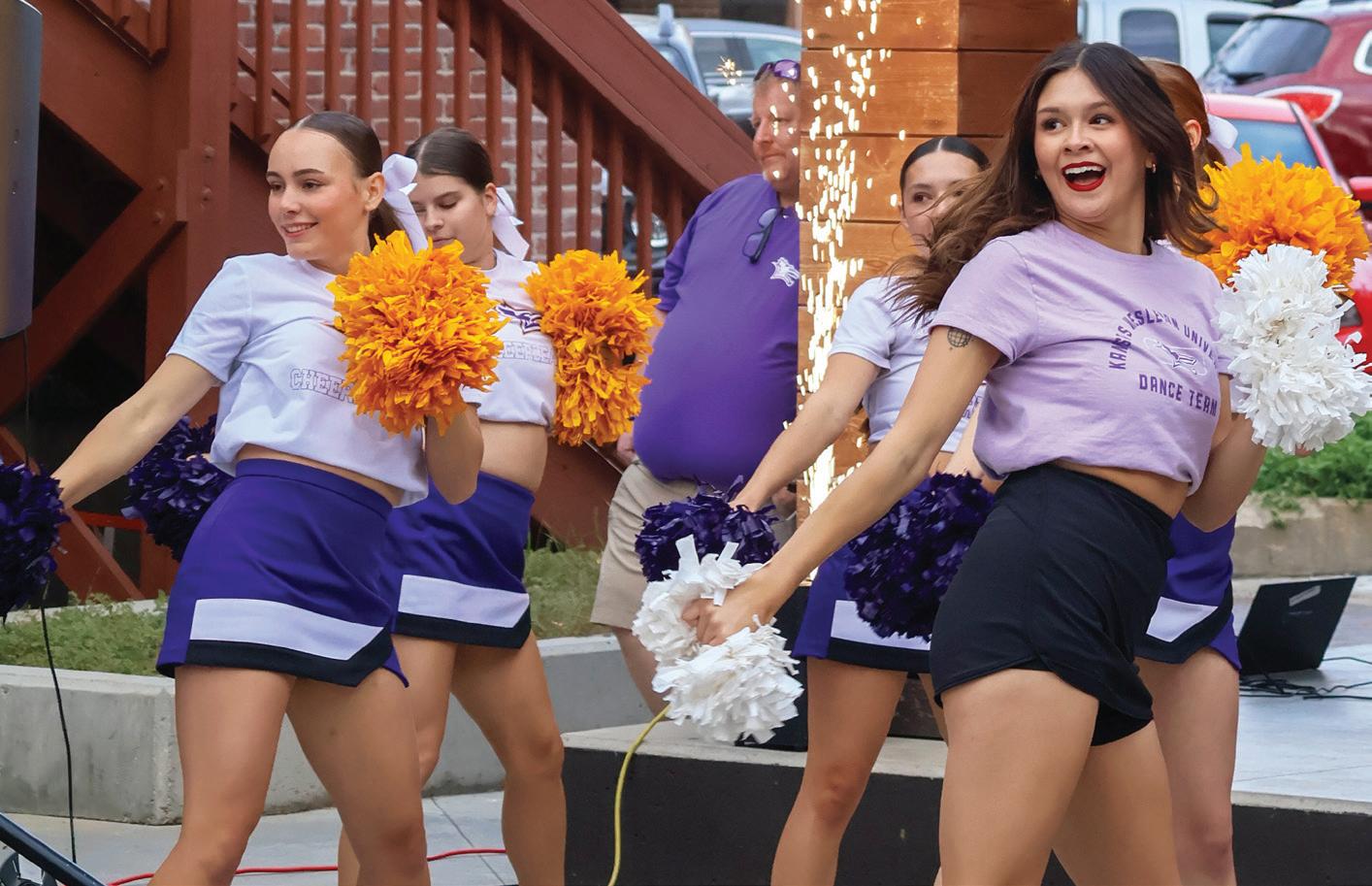
Kansas Wesleyan University celebrated its Homecoming from Oct. 23–26, bringing alumni, students and the Salina community together for a weekend full of tradition and excitement. Attendees enjoyed a wide range of events that showcased the university’s pride and creativity.

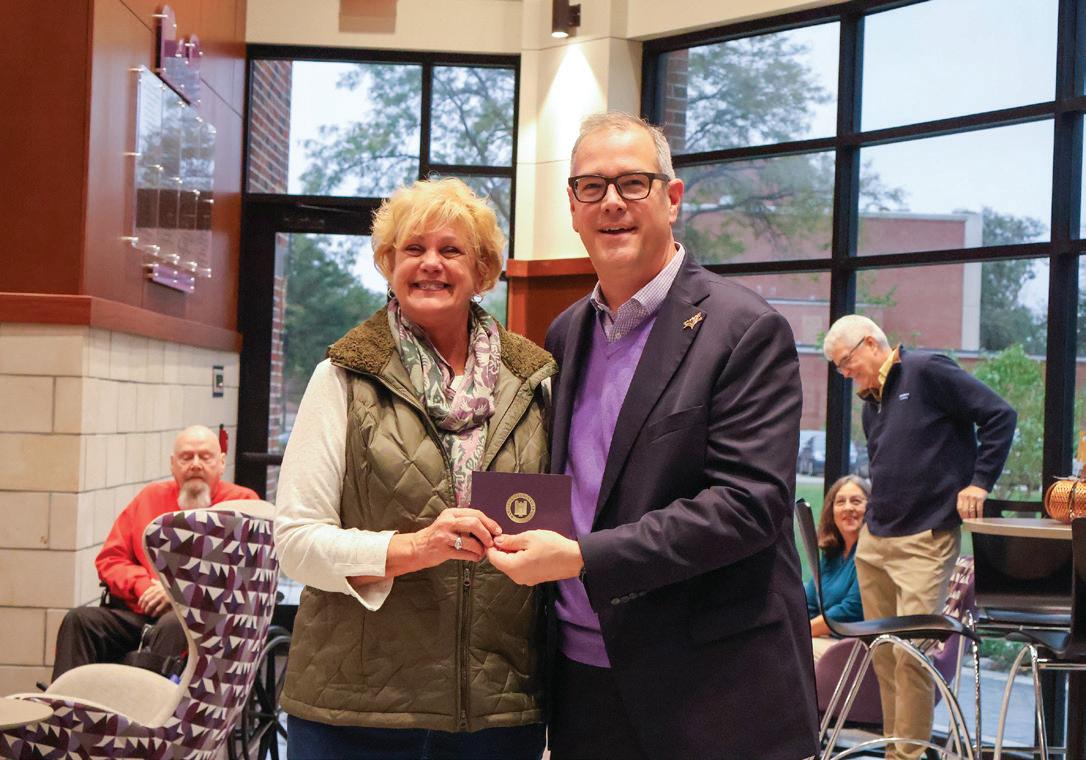
8: Dr. Matt Thompson, KWU president, presents Nancy Bissell-Truhune ’75 with the Golden W recognition at the annual Golden and Purple W social. 5 6 7 8
1: Cheerleaders cheer on students and the community during the pep rally in downtown Salina.
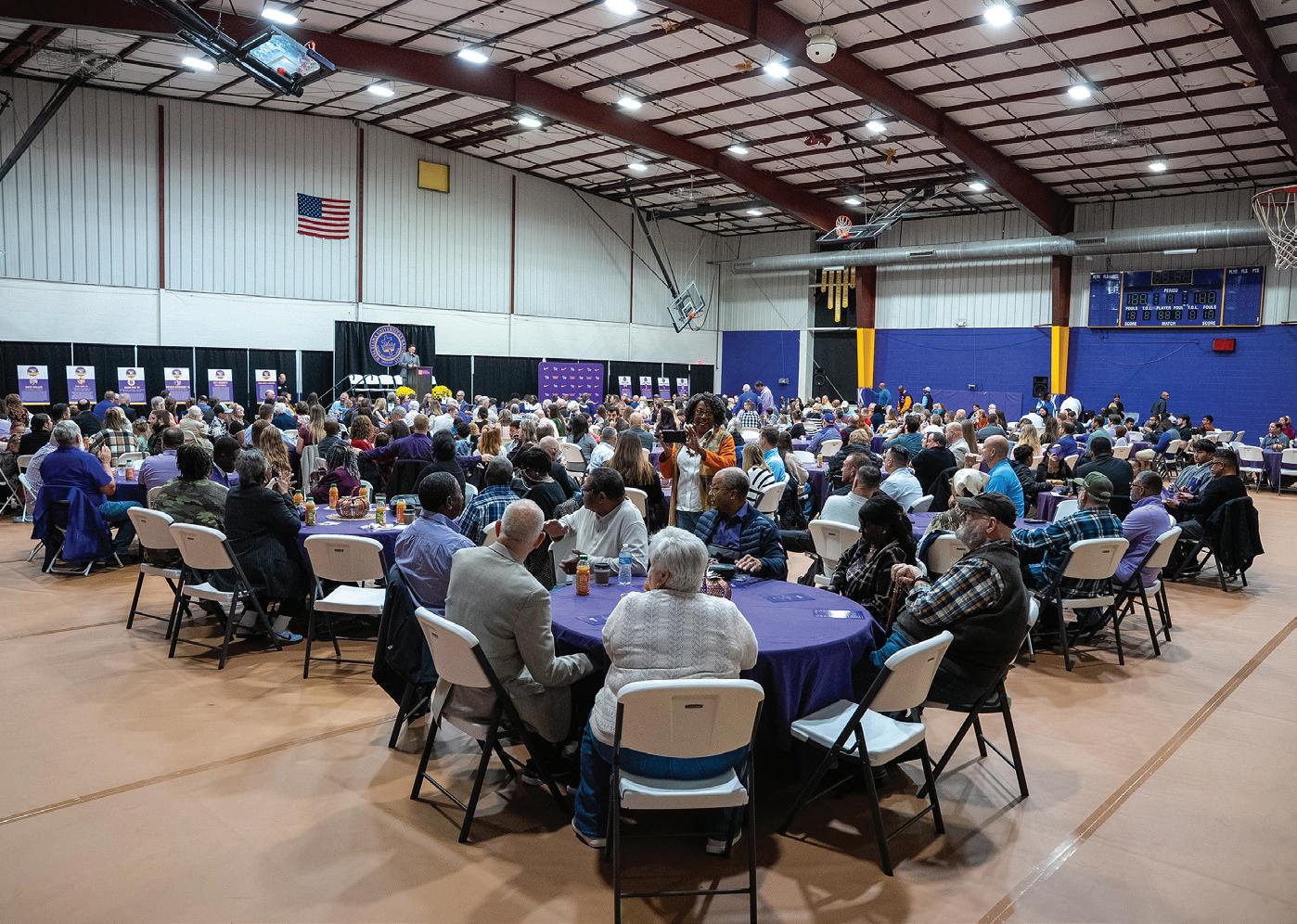
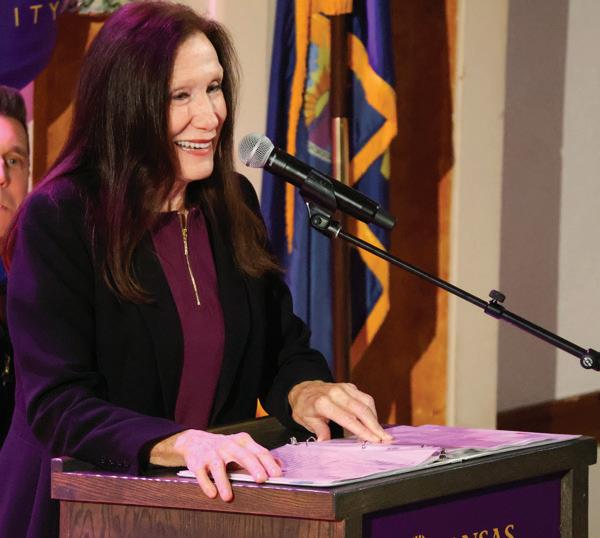
2: A capacity crowd — believed to be a new event record — attended Saturday’s Hall of Fame and Alumni Awards.
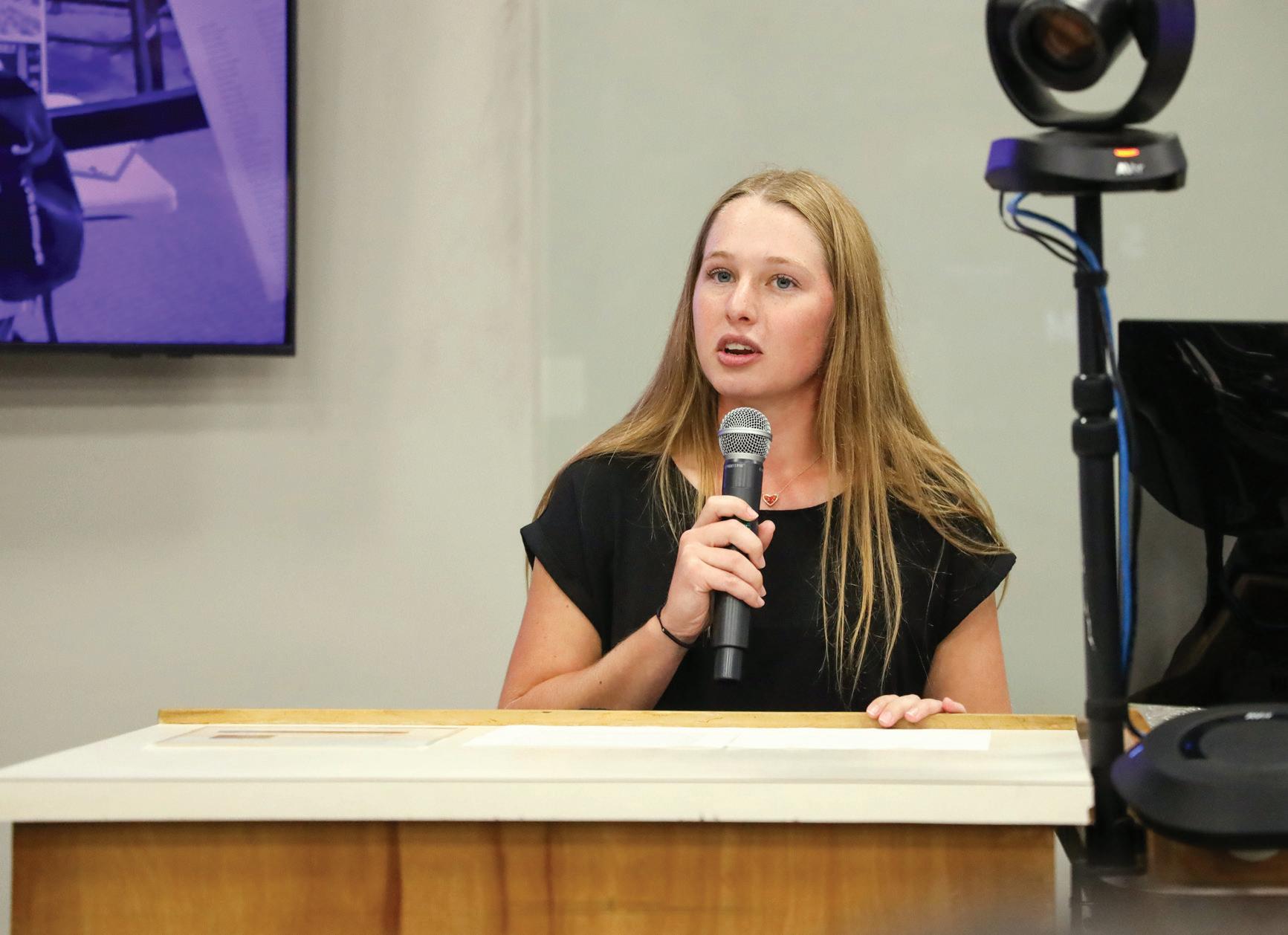
3: Senior Biomedical Chemistry student Ryann Warren talks about her KWU experience at the 7x7x7 Speaker Series.
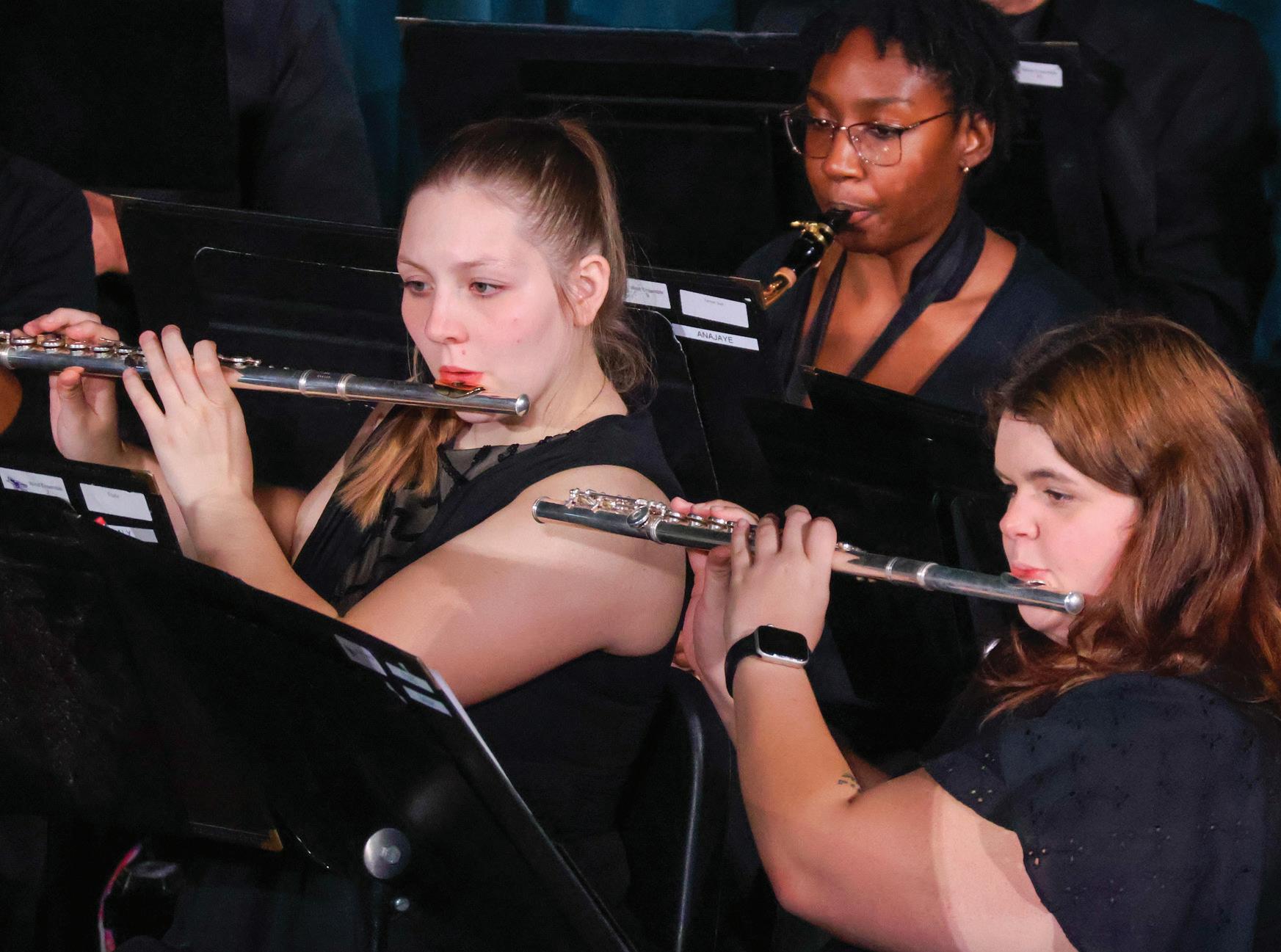
4: Alyissa Brown ’28, Anajaye Smith ’29 and Sara Smith ’28 (left to right) play during the annual Homecoming Concert.
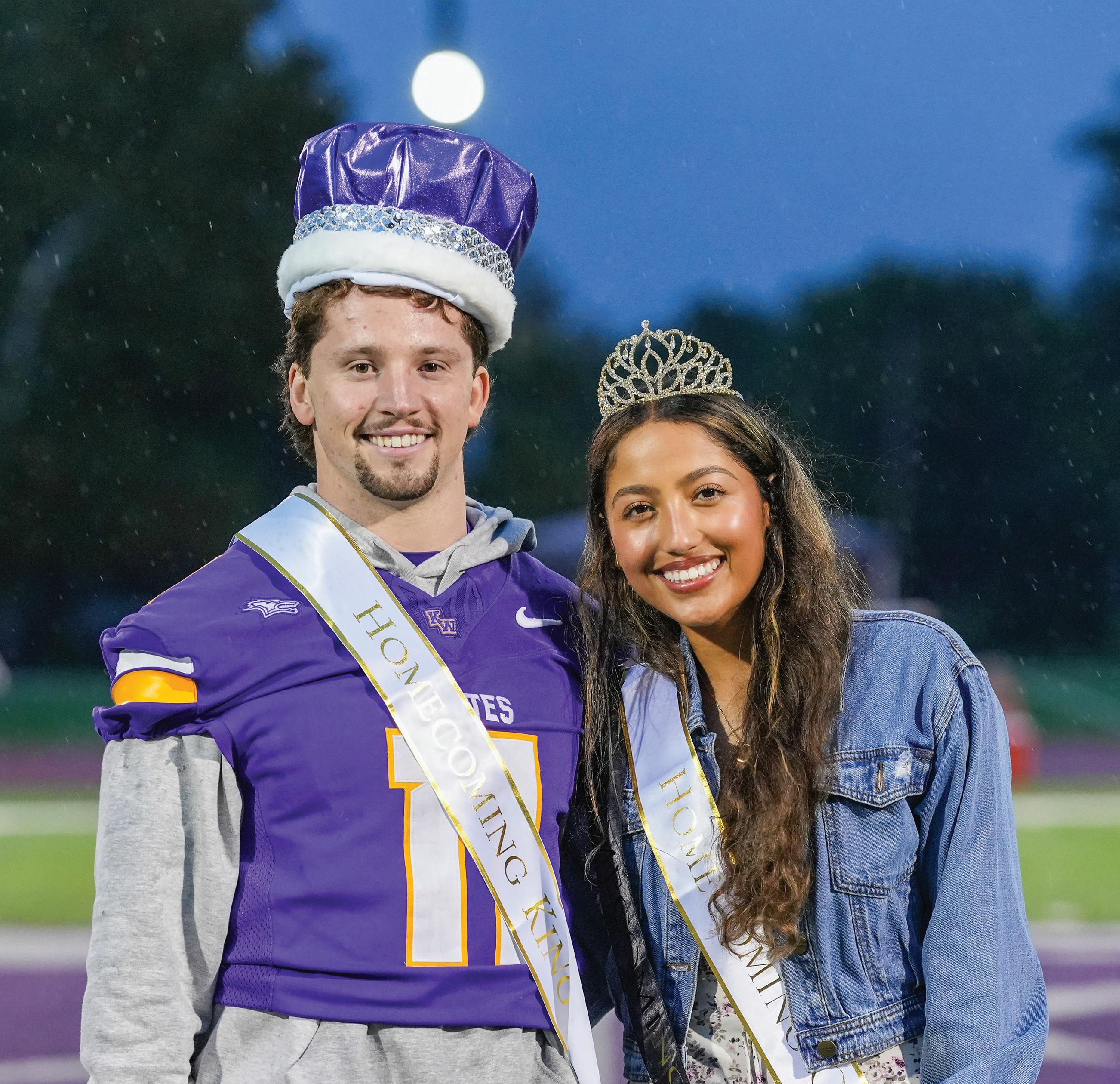
5: Homecoming King and Queen Luke Armstrong ’25 and Deja Rubio ’26 accept their honors at halftime of the Oct. 25 football game.
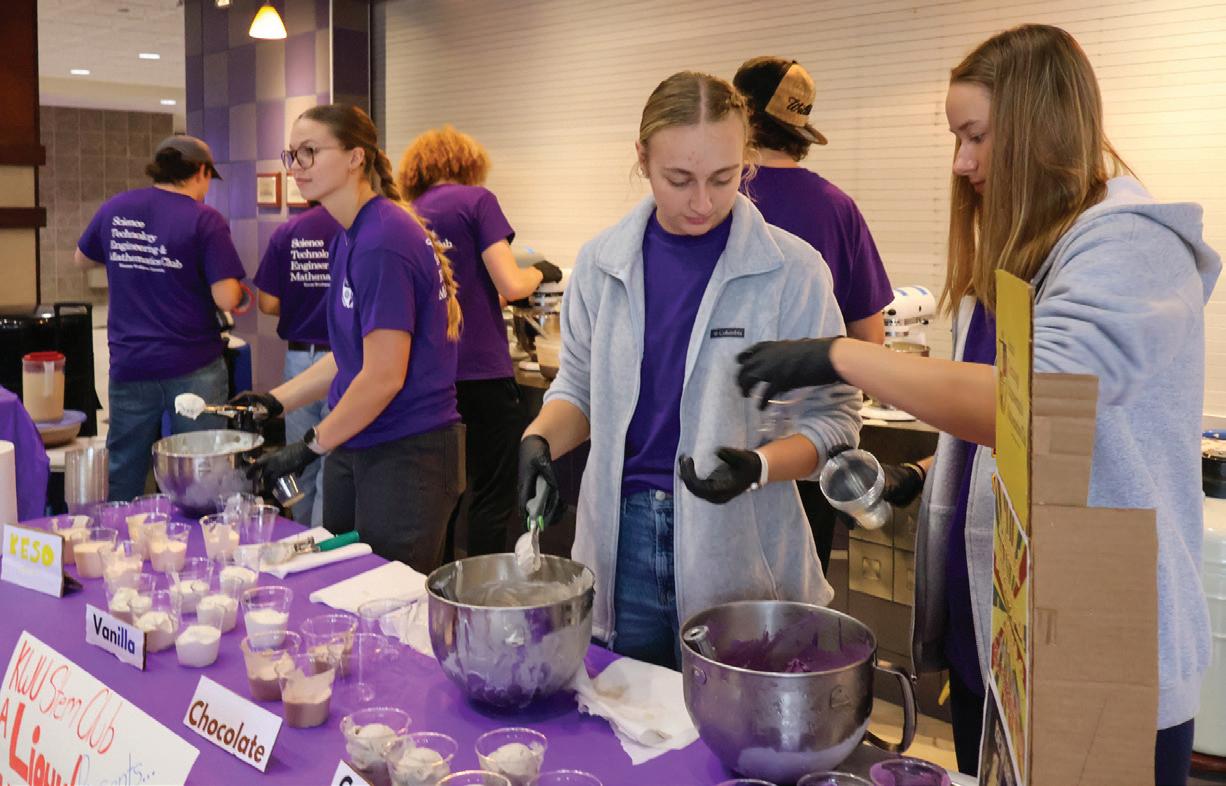
6: Members of the STEM Club prepare nitrogen ice cream for the KWU community.
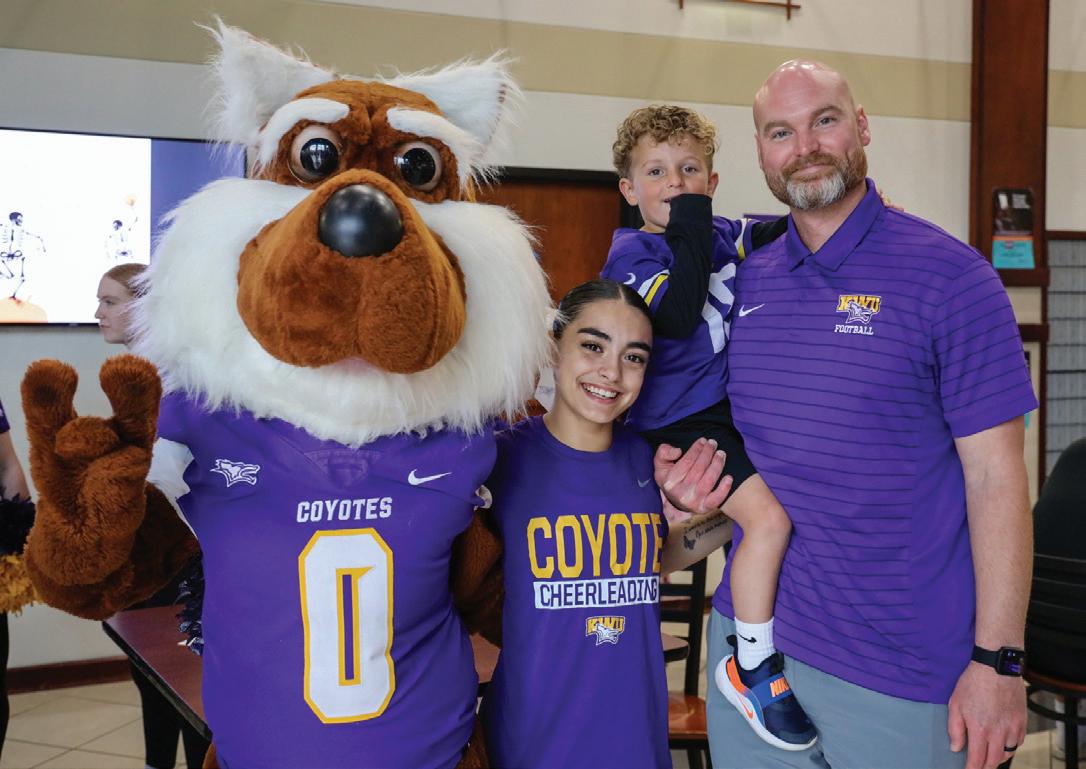
7: Assistant football coach David Leonard and family members pose with Casey the Coyote prior to the football game.
Dr. Marshall Stanton has written only one book.
“It’s enough to tell the story,” said Stanton, former president of Kansas Wesleyan University.
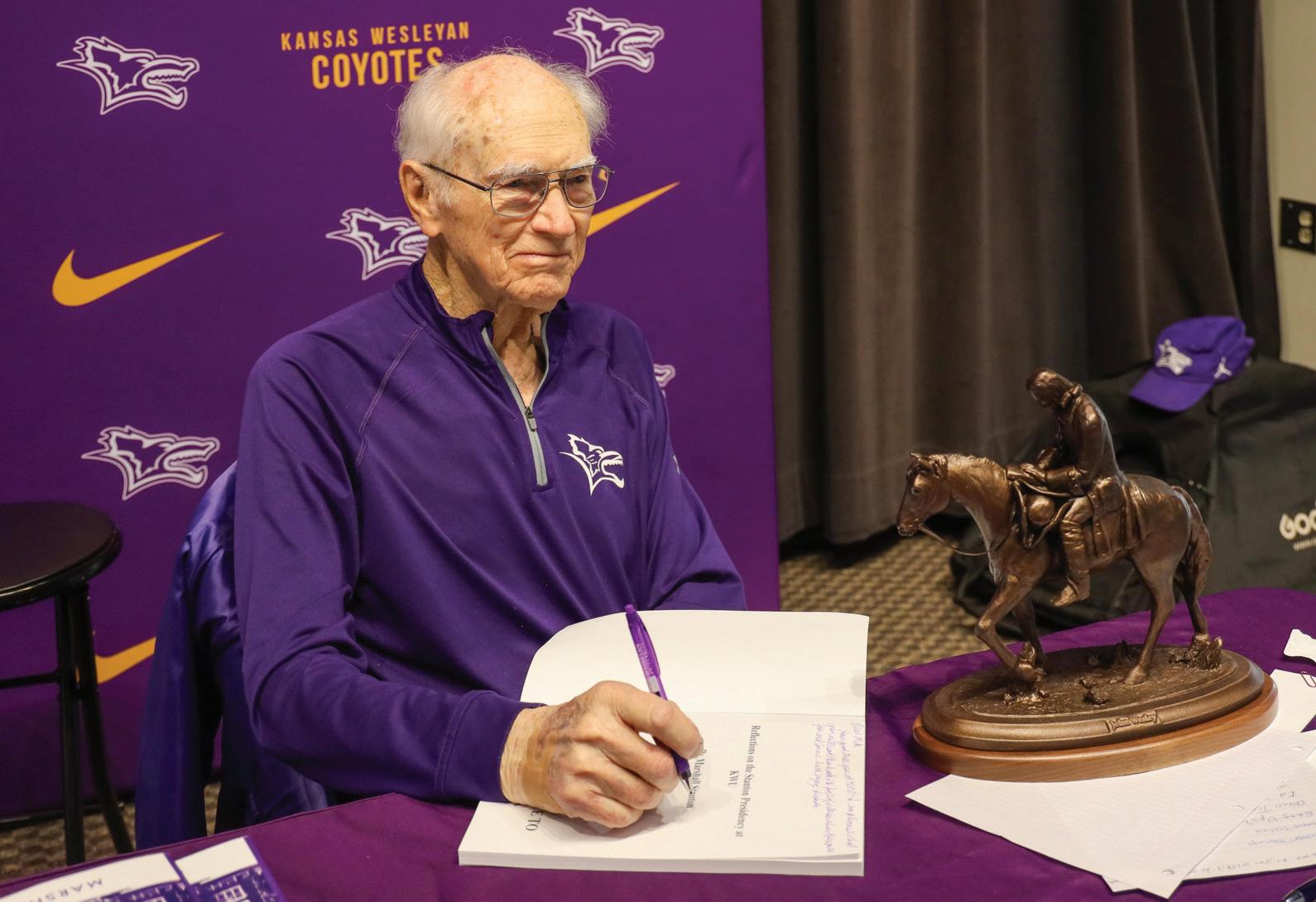
As he’s done so often, Stanton returned to campus recently, but this time was different. He signed copies of his recent book, From a Precipice to Grand Opera: KWU During the Stanton Presidency 1984-2002, on the Friday of Homecoming Weekend.
The book is a collection of anecdotes, notes from his presidency, and facts and figures to document how Kansas Wesleyan turned around from almost closing to stability.
When Stanton became president, the university was nearly ready to close, he said.
“Blind faith is a fundamental part of this book,” he said. “I never felt that we were going to fail even though all the signs were there. We were bankrupt. We had $3.3 million in debt with six buildings, payable to the federal government. That debt was starving the institution.”
He found a way to retire the debt, hired a football coach to turn the team around and expanded academic programs.
That Marshall was even considered as president came as a surprise to everyone, including him. He had no training in academia but had spent 28 years as a parish pastor, then as district superintendent of the Hutchinson District of the Kansas West Conference of the United Methodist Church, a
When he came on board, the endowment was $1.7 million. When he left, it was $17 million.
In between, Stanton turned the university around financially, renovated buildings, beautified the grounds and hired coaches to turn teams around. The theatre and music programs made huge gains, producing, literally, grand operas in conjunction with the Salina Symphony.
Dr.
“There were no books that told the Wesleyan story from the perspective of the intellectual, aspiration and spiritual dimensions,” he told David Burke, a writer from the Great Plains United Methodists for an article. “There are books that are pretty much, ‘This happened then,’ that kind of process. This is a deeply personal dimension of the presidency. What’s it like to sit in that office?”
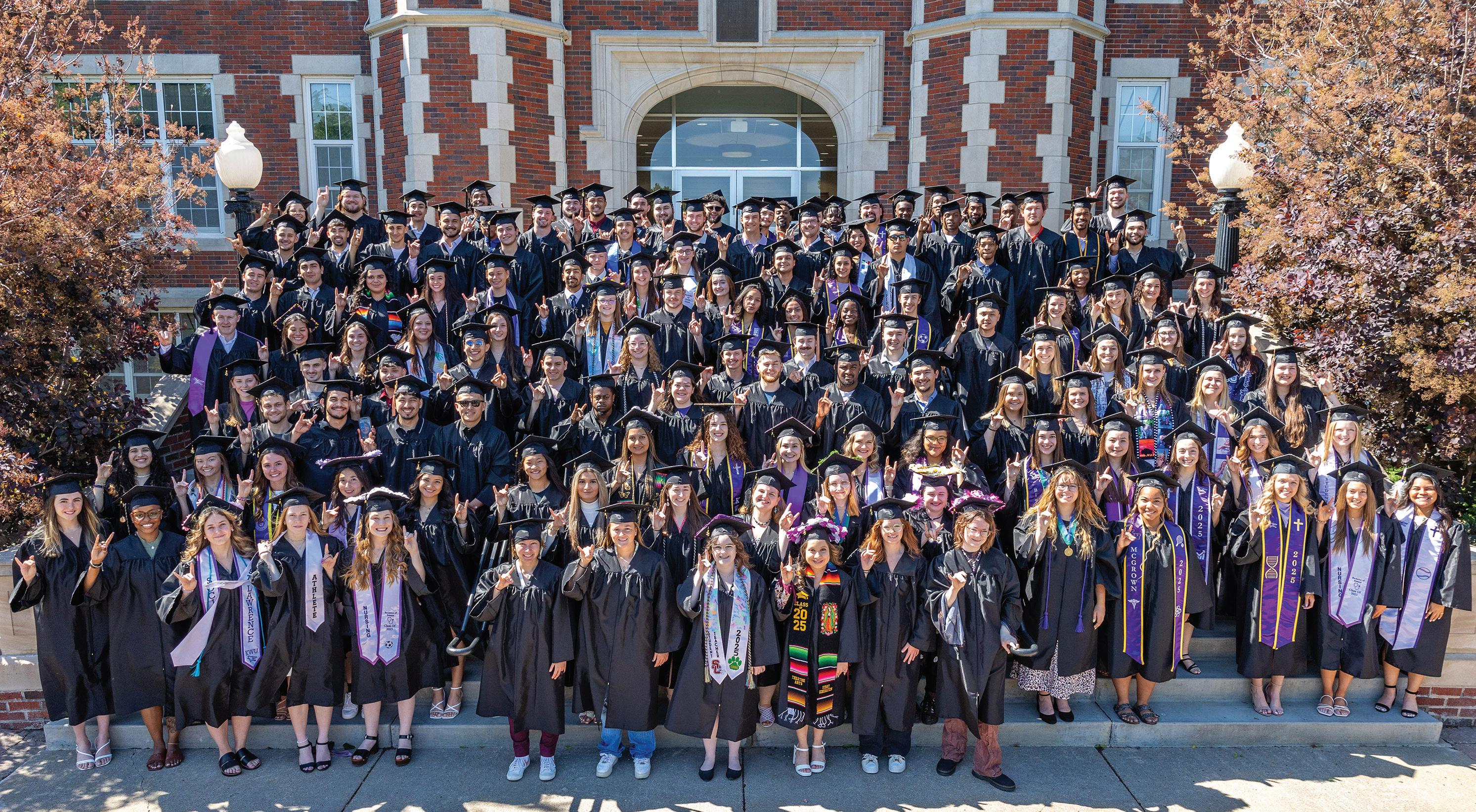
KWU congratulates its fall graduates! The group was honored Dec. 12 at the Fall Graduation Recognition Ceremony in Sams Chapel.
position that placed him on the KWU Board of Trustees. When the previous president resigned, he was asked to fill in as interim, then as permanent president.
He approached the university as he would any parish that was losing energy and membership.
“What I discovered was you add programs to the church and you add interest and members and money. I just transferred that concept here,” Stanton said.
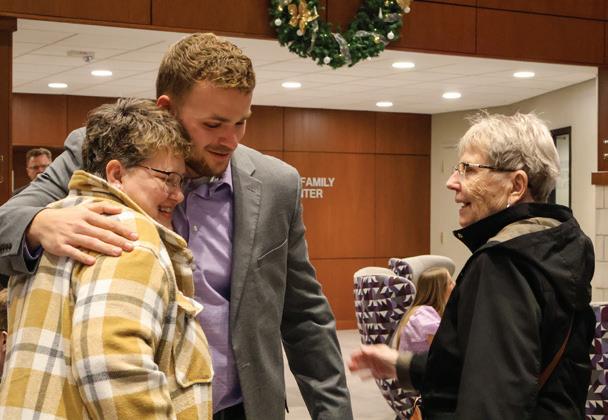
Since leaving Wesleyan, Stanton — and his family — have remained engaged with the institution (see Fall 2021 Contact’s cover story), through financial giving, board service and volunteerism, not to mention multiple grandsons attending. His latest work is two signs on campus, one commemorating a tree installed during his presidency to remember the history of Methodist education, the other (accompanied by a small statue) remembering the legacy of John Wesley himself.
There is always more to the story, he said, but there won’t be another book from him.
“I’ve had some thoughts about what might have been put in, and it’s infinite,” Stanton said. “I’ve done enough. I’ve told the story, and it leaves some things in the book that made the most difference to the institution.”
From a Precipice to Grand Opera: KWU During the Stanton Presidency 1984-2002 is available at Yotee’s in the Student Activities Center or online, through Amazon.
Story and photo by Jean Kozubowski
Tim Farina has three steadfast objectives for Kansas Wesleyan’s approximately 700 athletes when he arrives for work at 5 a.m. at the Everett Morgan Strength Training Center.
“We’re improving performance by making them faster, stronger, more powerful,” said Farina, who was named strength and conditioning coach in August 2024. “Those are the three things I really care about; that’s our goal down here.”
Located in the basement of the Student Activities Center, Farina and part-time assistant Ritter Steinmann ’25, a former KWU pitcher, guide groups of Coyotes through their paces to help them improve their performance and mitigate injuries.
“On any given day, we’ll probably see at least half the athletic population come through this weight room, depending on the size of the team that we deal with,” Farina said. “We’re pretty much operating for 15 hours a day. I’m coaching a session every hour on the hour with my staff.”
The process continues weekends, though Farina pauses on Saturdays in the fall to assist football coach Matt Middleton — a labor of love for Farina, who played football in high school and college and professionally in France before embarking on his training career.
A native of Connecticut and graduate of Becker College in Massachusetts, Farina had been
Chris Snyder, an assistant coach for the Kansas Wesleyan football program, has been named the university’s women's flag football coach.
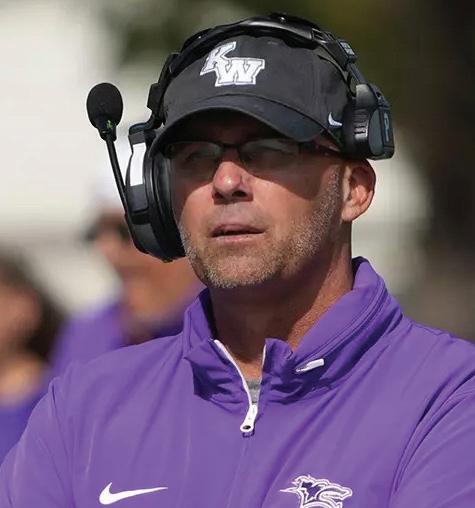
He replaces Melinda Nguyen, who has accepted a Division I head coaching job.
Snyder was passing game coordinator, recruiting coordinator, quarterback coach and developmental team head coach this fall. Snyder has been at KWU for nearly four years in his second stint. He was co-interim head coach for the final six games of the 2024 season and helped the Coyotes win the Kansas Conference’s Gene Bissell Division with a 5-0 record and gain a berth in the NAIA National Championships. He also served as interim bowling coach and was associate director of admissions from 2022-24. He was assistant head coach and offensive coordinator for coach Dave Dallas from 2009-12 during his first tour of duty at KWU.
Story by Bob Davidson
strength and conditioning coach at the United States Coast Guard Academy since 2021 before coming to KWU. He spent the summer of 2024 as an intern at Yale University, where he developed quantitative analysis for on-field productivity for the football team.
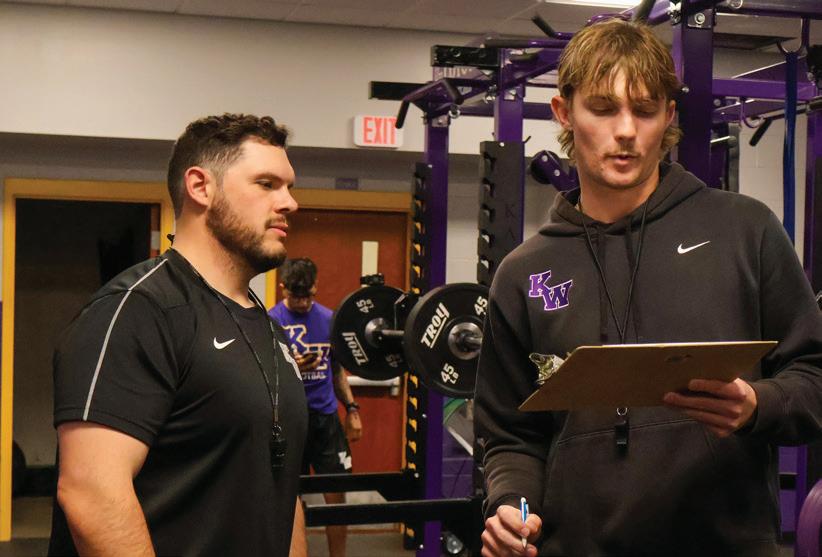
Training sessions at KWU are individualized and vary according to the time of year.
“Every team or individual is going to have specific things that they need to work on that prepare them for their competition, so that’s first and foremost,” Farina said. “Depending on whether they’re in season or off season, we will tailor things a little bit differently.
“About six to eight weeks before your season, we call it your preseason. That’s the time where the program is the most specific to that team because I’m getting them prepared for that competition. For example, sports such as volleyball or basketball are going to need a lot more jumping than maybe some other sports.”
The athletes' well-being is closely monitored.
“I want our athletes to receive good, wellrounded training year-round, and with that, hopefully, we’re not only mitigating risk but we’re improving performance,” he said. “We understand what we’re giving the athlete and what the effect is on a daily basis.
“Tim does a phenomenal job,” Middleton said. “For him to be able to write programs for every sport and manage them the way he does says a lot about who he is. I don’t know how he does it. He does a lot of Olympic lifting, but he knows football players are different than tennis players.”
Farina is thrilled with the recent Morgan Center renovation.
“It shows KWU’s commitment to its athletic population and its community to be healthy and to perform in their sports,” he said. “Those things combined are why I decided to come here."
Story by Bob Davidson
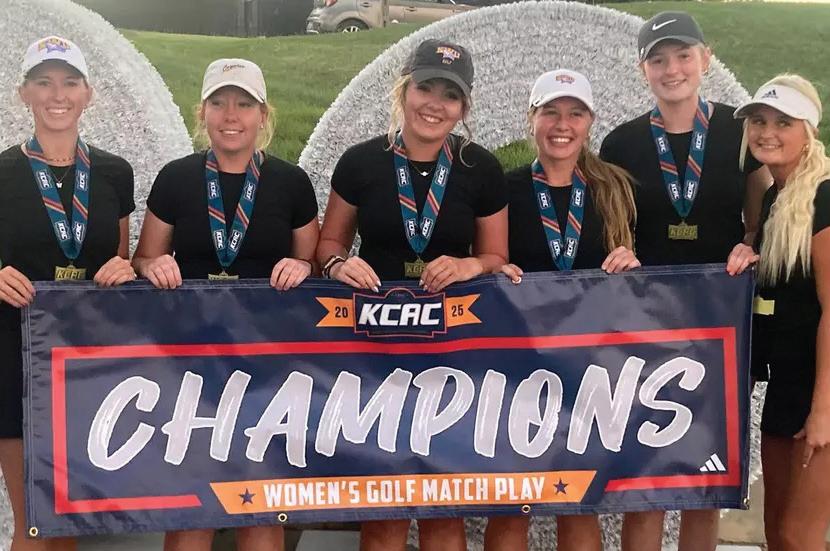
This fall, KWU women’s golf captured its fifth KCAC match play title in the event’s seven seasons, prevailing at Mariah Hills Golf Course in Dodge City.
The KWU basketball programs got their season underway this fall.
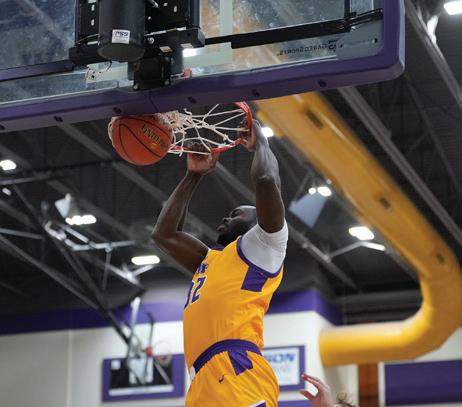
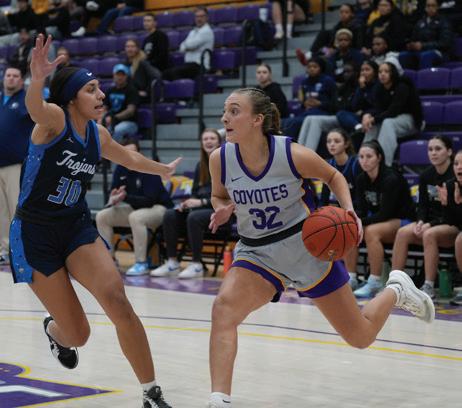
Scan the QR code to hear Tyler Henry, voice of the Coyotes, on the early portion of the teams' schedules.

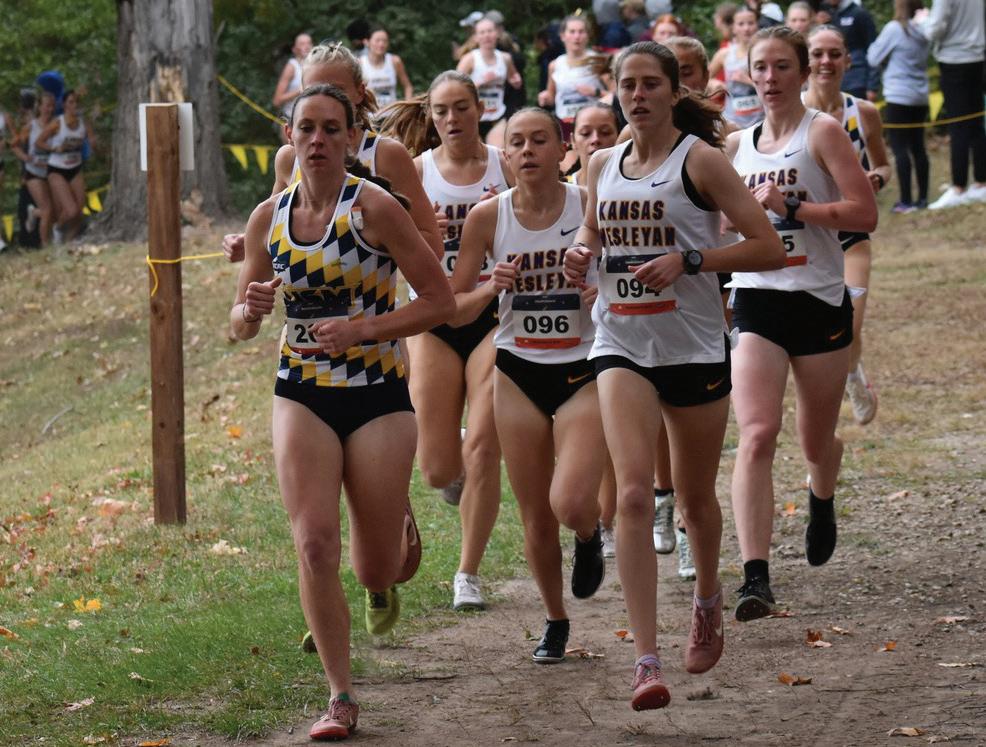
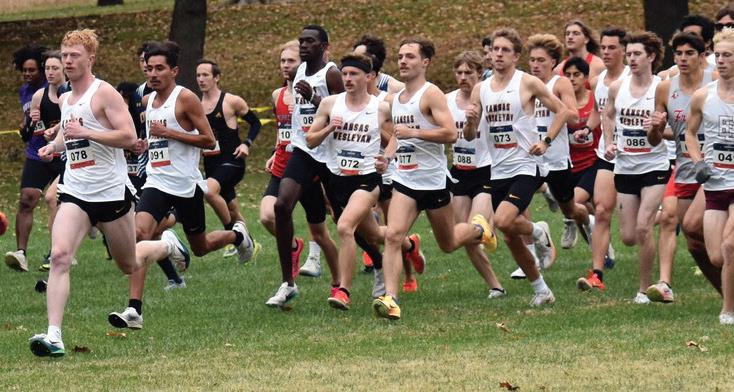
Coyote Cross Country continues to build a legacy as a national power, following a 15th-place finish for the women’s program at November’s NAIA National Championships in Tallahassee, Fla.
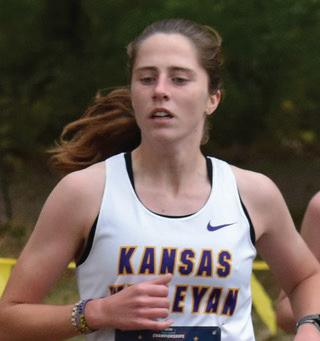
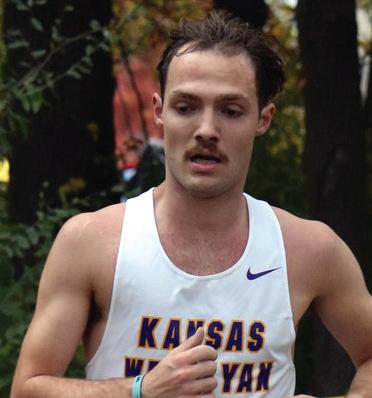
and Kirstin Hackney ’26 led the Coyotes at the national championships, placing 40th to earn AllAmerican honors. She was the first Coyote woman since 2009 and just the third overall to earn that honor.
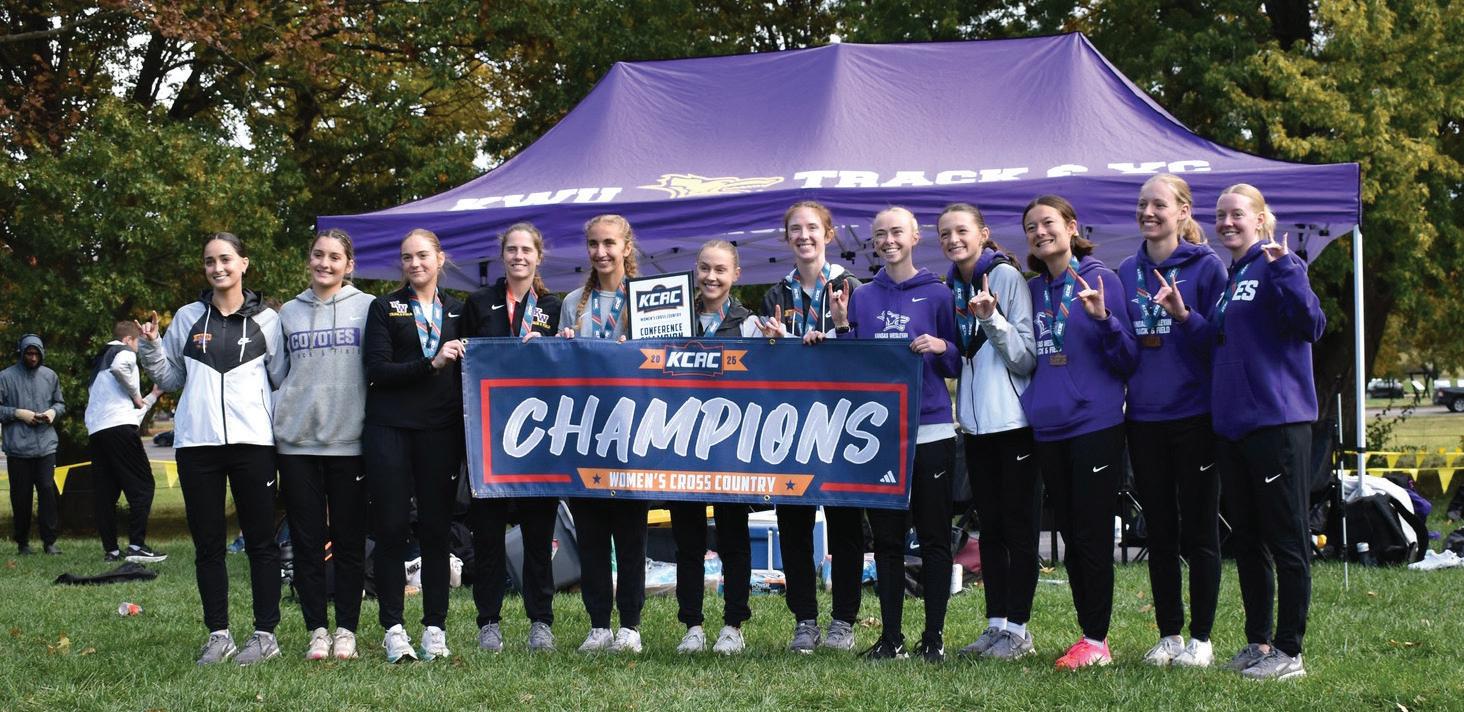
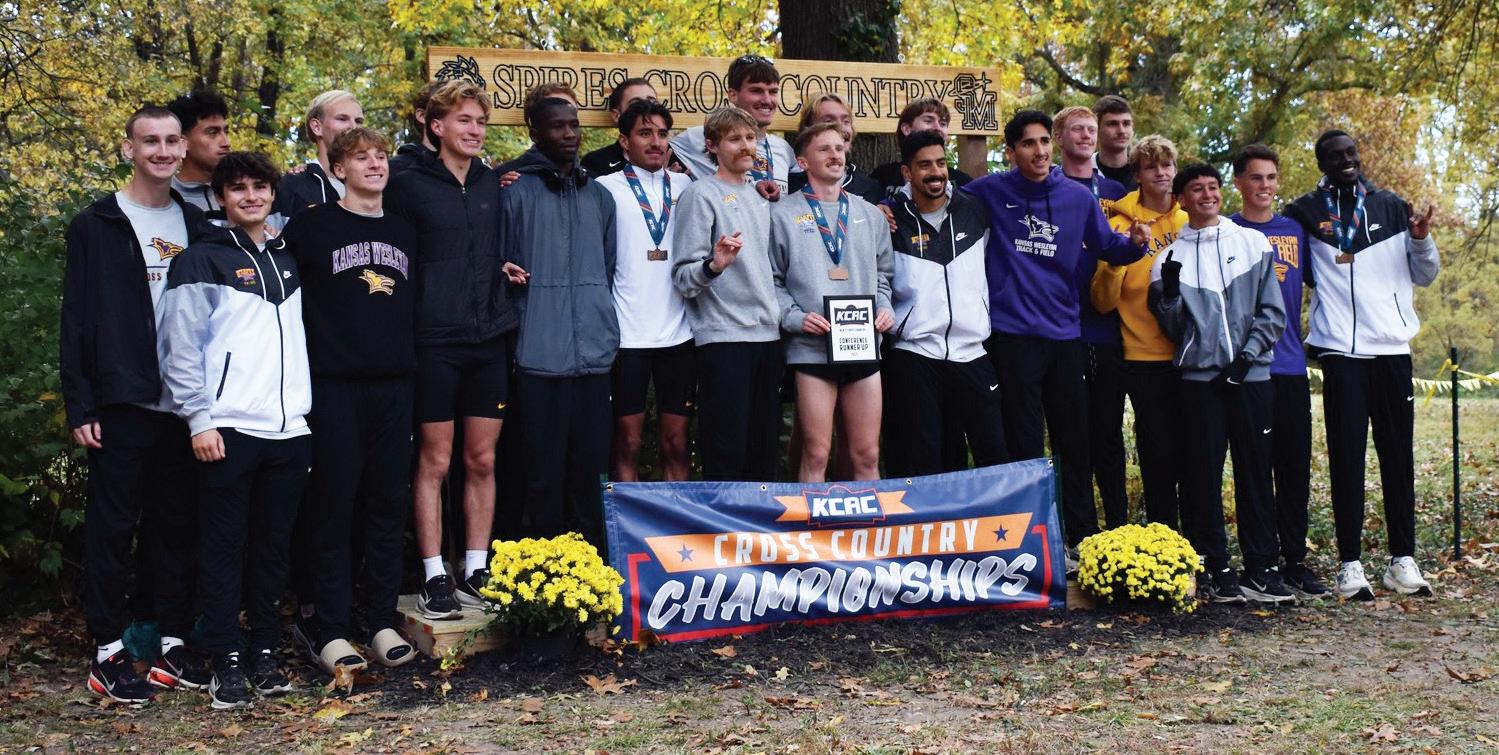
The men’s program placed 27th as each team made its second-straight appearance at the national meet, the first time that’s occurred in school history.
The women’s program, led by a core group of four seniors, had gotten there after dethroning Saint Mary’s at the KCAC Championships. Kierra Jensen ’26 was second at the KCAC meet,
Damion Jackson ’27 led the way for the men at both events, winning the KCAC title and going on to finish 57th nationally.
Head Coach Garrett Young was named both the KCAC Coach of the Year and the United States Track and Field and Cross Country Coaches Association (USTFCCCA) South Central Regional Women’s Cross Country Coach of the Year.
Kansas Wesleyan Athletics continued to excel in the classroom this fall, as KWU finished fourth nationally in the semester's Daktronics Scholar-Athletes standings. The Coyotes finished just three honorees shy of placing second in the NAIA.
“This is a testament to the relationshipfocused environment we have at Kansas Wesleyan,” said Miguel Paredes, athletic director. “We have faculty, staff and administrators that not only care about our students, but have built an environment where they can succeed in
the classroom. Our students know that and respond with focus and intensity to give their best effort. That synergy leads to successes like this one, efforts that we can all be proud of."
Dordt (Iowa) led all institutions with 132 honorees, followed by Reinhardt (Ga.) with 86, Marian (Ind.) with 85, Kansas Wesleyan with 84 and the College of Idaho with 83.
NAIA Scholar-Athlete honorees must maintain a minimum cumulative GPA of 3.5 on a 4.0 scale, appear on the eligibility certificate for their sport and have attended their institution for at least one full year. KWU athletics has exceeded a cumulative GPA of 3.0 for the past four consecutive years, a first in school history.
Salina will host the 2026 KCAC baseball and softball championships this spring. It is the first time since 2001 the KCAC baseball championship will be held in Salina, and the first time since 2007 for softball.
The softball championship will be held at Salina South’s fields April 29–May 1, while baseball will take place at Dean Evans Stadium April 29–May 2.
“We look forward to welcoming the KCAC to Salina this spring,” said Ken Oliver, executive vice president. “The improvements to both of these facilities during the past few years, along with
the great community partners KWU has, helped push forward our efforts to hold the event here. We believe it will have a significant economic impact on Salina and be a great opportunity to showcase our city.”
KWU baseball hosts in the midst of perhaps its most successful run ever, having come up one win shy of a second consecutive trip to the NAIA World Series last season. Softball, meanwhile, looks to break through after a .500 campaign last year. The top eight teams in the conference qualify for both events.
It was a great fall for KWU athletics, as you can read on surrounding pages! The Coyotes will enter the winter season leading the KCAC Commissioner’s Cup race once again. Below, please note the fall results.
Women's Cross Country KCAC Champions
Women's Golf KCAC Match Play Champions
Men's Cross Country KCAC Runners-Up
Football 7-4, T-2nd, Bissell Division
Women's Soccer 12-5-3 (Third in KCAC)
Men's Soccer 13-4-3 (Third in KCAC)
Men's Golf (Third, KCAC Match Play)
Women's Volleyball 14-14, (Fifth in KCAC)
“Any time you hold a conference tournament at home, it’s a great opportunity,” said Miguel Paredes, athletic director. “This is an opportunity to show what makes KWU great — the support of so many in our community! We hope everyone in the area marks their calendars and makes plans to attend.”
Ticket information will be announced on KWUCoyotes.com in the weeks to come.
After the Coyotes wrapped up an injury-plagued 2025 season, Head Coach Matt Middleton sat down with Bob Davidson to share his thoughts on building a great program, the 2025 year and the process behind moving forward.
Scan the QR code to read the full article.

It was quite a first year for men’s soccer head coach Ryan Palmbaum. Palmbaum’s squad finished the year 13-4-3, making him the youngest head coach in NAIA to exceed the 10-win mark. He was also the youngest head coach among the NAIA’s top-51 RPI programs, The team posted a third-place finish in the KCAC and advanced to the conference semifinals. Its only losses on the year were to nationally ranked opponents. The Coyotes posted six all-KCAC players and the conference’s goalkeeper of the year.
“This was a great year for our program as we build the foundation for long-term success,” said Palmbaum. “We outscored our opponents nearly two-to-one, all while leading the conference in shutouts, so we excelled in both facets of the game."
Five of KWU’s six all-KCAC honorees have eligibility remaining entering next season, so the future looks bright.
“I’m excited to see what our program can accomplish in 2026, with so much talent ready to return,” said Palmbaum. “Our potential as players and as a team is limitless, and I look forward to showing the KWU community what we can do next fall."
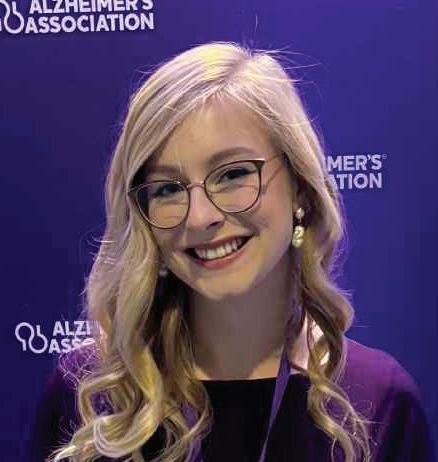
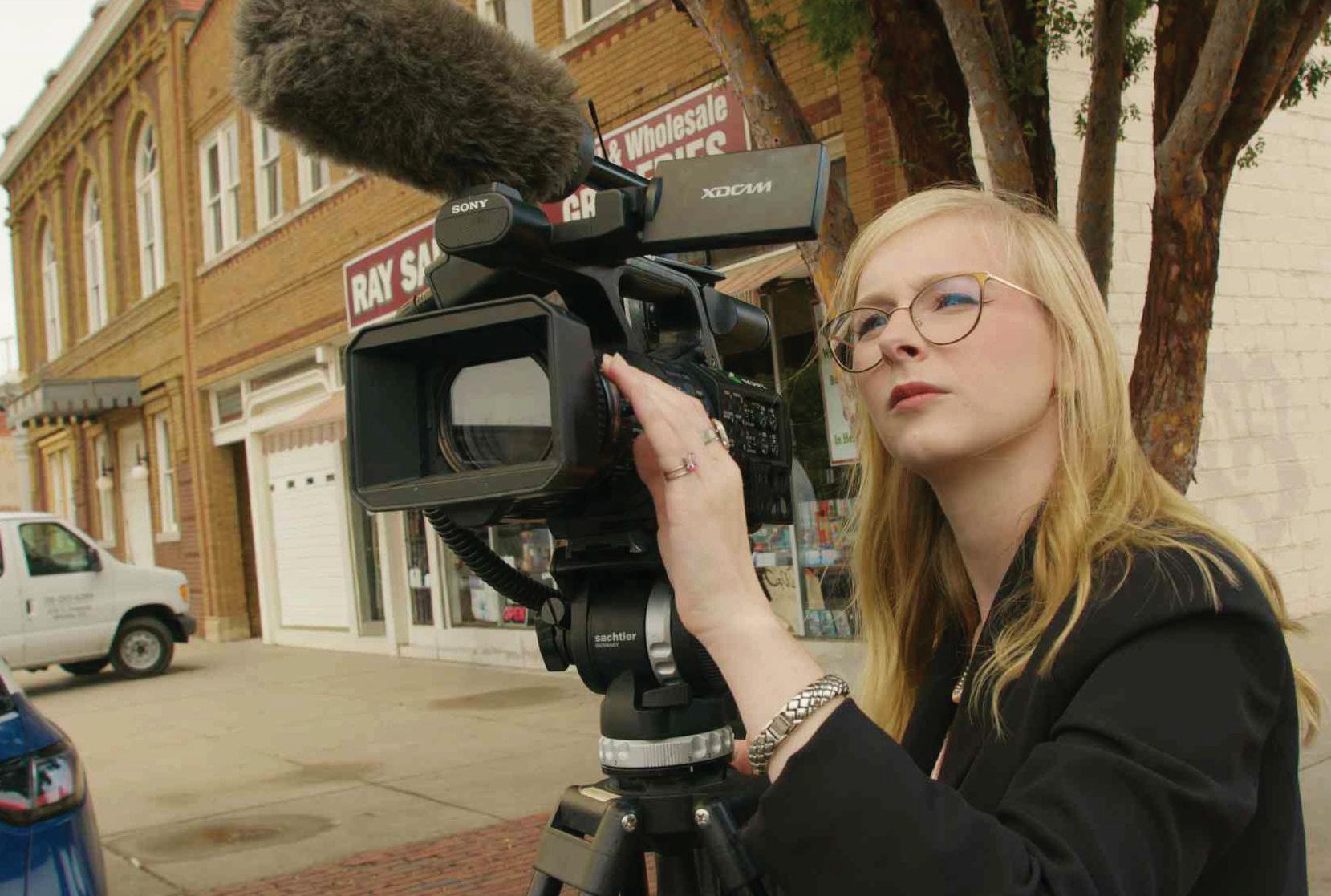
For 24-year-old Abby Wray ’23, life is, to put it simply, busy. Since her graduation from Kansas Wesleyan University, the now award-winning KAKE reporter has embraced a challenging work schedule and built an engaging social life, all while finding time to connect with and help her community.
When we think of TV journalism, we often picture full camera and sound crews behind a lead reporter. With modern reporting, though, that’s seldom true. Wray, for example, is a multimedia journalist, which means, most days, she’s a one-woman show.
Her day begins with a story assignment. From there, it’s her responsibility to conduct any interviews, take all the necessary footage and photos, produce any writing or graphical elements required to complete the story and have it ready to go by the four o’clock news.
“It’s a lot, but I love doing it,” Wray said. “I have my day timed out into chunks. I know if I'm back at the station at 2-2:30 with all my elements, I’m going to have a good story to run at 4, 5 and 6.”
In early 2025, Wray received a promotion and is now a weekend anchor in addition to her MMJ role. She anchors Saturdays and Sundays, with the added caveat that she fully produces the 9 p.m. newscast on Saturdays.
Her quick rise in the ranks has not gone unnoticed, either. Wray was the recipient of two first-place Kansas Association of Broadcasters awards in 2025.
The first was for Excellence in Diversity/Equity/ Inclusion News for her story about Harold Miller, the first black aviator in Wichita.
“It was an incredible opportunity to talk with him and learn about his life and platform such a beautiful, impactful story,” Wray said. “He had overcome so much to get where he was. It was empowering.”
The second award was for the News Feature category and went to a story Wray put together about a Pratt, Kan., farmer who surprised his wife with a message in a wheat field for their 20th anniversary.
“To be able to win awards — and win two first-place awards — it just felt like a culmination of so much hard work,” Wray said. “They were also such beautiful stories.”
As she reflects on the past two-and-a-half years of her career, Wray sees the way that her KWU education has followed her.
“Theatre and debate set me up for success [in multitasking],” she said. “Debate, forensics, choir — they teach you critical thinking, public speaking. They teach you everything you need to be a good journalist without teaching you journalism.”
During her time at KWU, Wray was heavily involved in debate and forensics, in particular, and has five national titles to show for it. She was also a student of professor Paul Green and learned a lot from him during her involvement with KWU Student Media.
Her love for life’s extracurriculars hasn’t faded, even with the demands of her work.
“Once you can doggy-paddle [at your job] is when you need to start implementing more social activities,” Wray said. Beyond spending time with and hosting friends, she’s also been a member of the improv troop Say What?! since November 2024.
“It has changed my life to be part of it,” she said. “It has given me 15 built-in best friends.”
The group is the longest-running improv troop in Wichita and performs often. One such performance even allowed Wray to combine her love of improv with her involvement in the Do What You Love to End ALZ fundraising committee for the Alzheimer's Association.
Say What?!, alongside another local improv troop, raised $1,000 for the fundraiser with their show.
surpass the $75,000 raised by the group in the previous year.
At Homecoming 2025, Wray was recognized for her litany of successes with the Young Alumni Award, which she accepted with family, friends and mentors surrounding her.
"It was a huge honor to win the Young
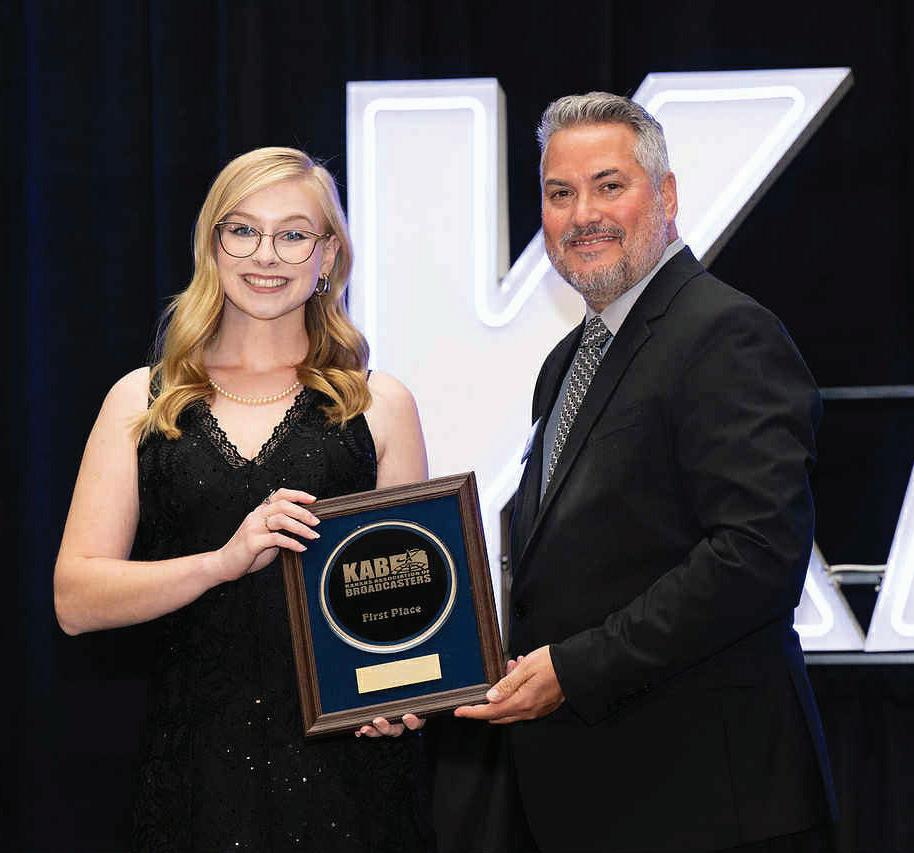
Photo courtesy of Kansas Association of Broadcasters
Wray takes pride in being able to connect with and educate her community about Alzheimer’s and other diseases of the brain.
“We don’t all know what dementia is, and it’s the brain shrinking,” Wray said of her involvement with the association. “When you don’t think about it as a physical disease, you don’t necessarily think about what it impacts and how it impacts your family.”
This upcoming year, Wray will chair the fundraising committee and hopes to meet or
Alumni award,” she said. “It has been partially because of the support from Kansas Wesleyan faculty and staff, especially Paul Green, that I’ve been able to be so immediately successful in my career.”
Story by Skylar Nelson ’21
Kansas Wesleyan’s newest members of the Board of Trustees are Judge Angela (Angie) Coble ’94, Bob Meyer ’73 and Teresa (Teri) Schultz ’88, all of whom began stints on the board late last summer. Michael Hastings ’82 joined the KWU Foundation Board in September.
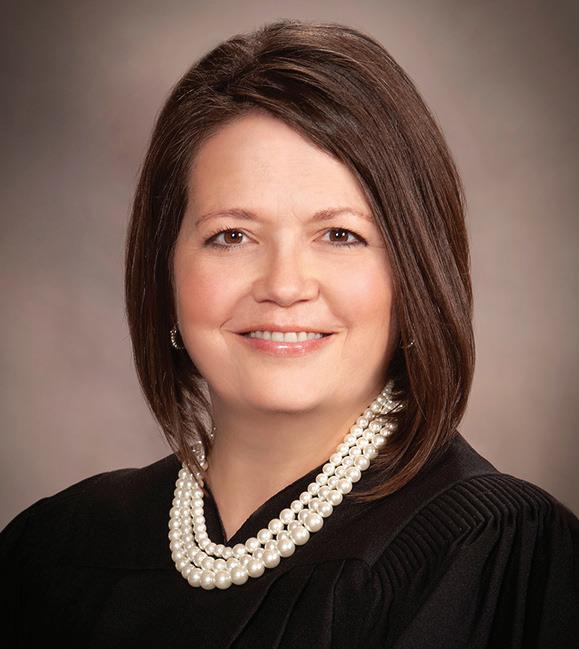
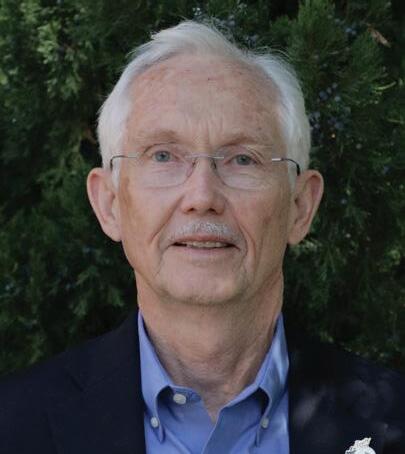
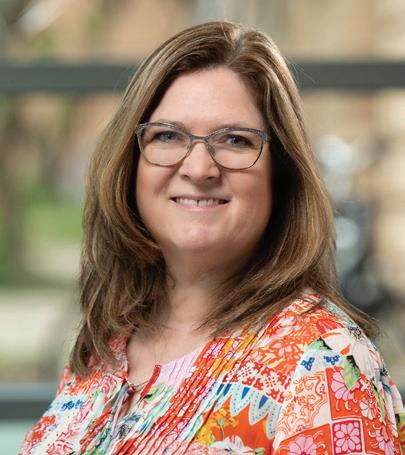
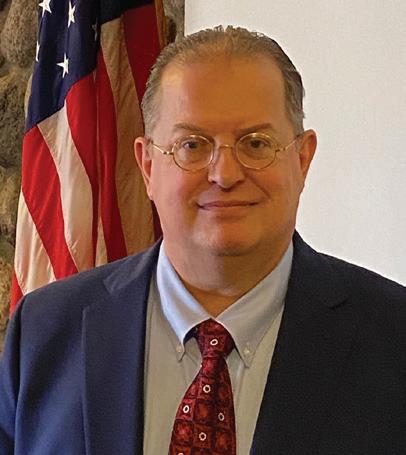
Angela (Angie) Coble ’94 (Salina, Kan.) is a judge of the Kansas Court of Appeals in Topeka but maintains her residence in Salina. After growing up in western Kansas and graduating from Stockton High School, she earned her bachelor’s degree at KWU with a degree in Criminal Justice, receiving the KWU Student Hall of Fame award in 1994. She later earned her law degree from Washburn University School of Law and practiced at a local law firm before spending a decade as a research attorney for two federal judges in Wichita. She was appointed to the Court of Appeals by Gov. Laura Kelly and confirmed by the Kansas Senate to her position in 2022. Coble has served the Salina community in numerous ways, as a volunteer at local schools, church and the Smoky Hill River Festival, and on the boards of organizations such as Salina Emergency Aid/ Food Bank, Salina Airport Authority, and more than a decade at Salina Family Healthcare.
Bob Meyer ’73 (Olathe, Kan.) is a longtime leader of the KWU Foundation who recently
completed eight years on that board, including a term as chair. Meyer worked alongside KWU leadership to foster continued improvements in the KWU endowment, which is now approaching $50 million. He spent 10 years utilizing his KWU Chemistry degree working for an environmental laboratory in Salina. He transitioned to financial advising in 1984 and has continued in that career since. In addition to his work with KWU, Meyer has served in various leadership roles in his church and with other charitable organizations. Meyer’s late wife, Karen, attended KWU. He is proud of their long connection to the university.
Teresa (Teri) Schultz ’88 (Lawrence, Kan.) is a patent attorney currently serving as director of licensing for the University of Kansas Center for Technology Commercialization, supporting all of KU, including the KU Medical Center. In addition to more than 12 years of experience in academic technology transfer, Schultz worked in the legal department of a pharmaceutical company for 12 years, advising the company with respect to intellectual property matters,
Distinguished students from across Kansas will descend upon KWU once again this March, when the university hosts the Kansas Press Association’s (KPA) Sunflower State Spelling Bee. The event is set for March 21 in Sams Chapel, and it will mark the third straight year that KWU will serve as host of the statewide event.
“Our partnership with the KPA has been a great one,” said Brad Salois, assistant vice president of marketing and communications, whose team has led the agreement from the start. “We share a focus on community and an emphasis on supporting the work that’s done locally to make our state better. Working together to provide this opportunity for
students is a natural fit.”
“The Kansas Press Association is proud to partner with Kansas Wesleyan for the 2026 Sunflower State Spelling Bee,” said Amber Jackson, KPA’s state bee coordinator. “We’re thrilled to be returning to campus and welcoming spellers from all 105 Kansas counties.”
Students up to eighth grade are eligible for the state competition. Each Kansas county may send its respective county bee winner to the state event. The winner of the Sunflower State Spelling Bee will be eligible for the Scripps National Spelling Bee, broadcast yearly on national television.
licensing and acquisitions. Schultz obtained a B.S. in Chemistry from Kansas Wesleyan, an M.S. in Chemistry from the University of Arizona, and a J.D. from Washburn University School of Law. Numerous family members, including both parents, are alumni of KWU, and she is related to Henry M. Mayo, the first graduate of Kansas Wesleyan (1887) through her grandmother’s side of the family.
Former Kansas Gov. William “Bill” Graves ’76 and Jerry Norton ’59 were selected as trustee emeritus members of the board.
Michael Hastings ’82 (Lawrence, Kan.) spent 33 years leading electric cooperatives across America. He got his start in that industry in Topeka in 1991 as part of Kansas Electric Cooperatives and went on to serve as the general counsel for the Association of Illinois Electric Cooperatives for 10 years. He then led organizations in Elizabeth, Ill., Mount Crawford, Va., and Espanola, N.M., before entering a self-described semi-retirement at the end of 2023.
Hastings is a 1982 graduate of KWU with a degree in Accounting. He earned a degree from Washburn School of Law five years later, as well as an MBA from the University of Illinois in 2005, when he ranked at the top of his class.

Presented by Mahaska, the Gala's Title Sponsor Saturday, April 11, 2026
Kansas Wesleyan University's Student Activities Center
Premier Sponsors:
Advantage Trust Company
Bennington State Bank
BE Wealth
Kansas Methodist Foundation
Sunflower Bank
UMB Bank
Hosted by Kansas Wesleyan University and the KWU Foundation
Tickets Now Available by Scanning Here!
Dr. Maj. Gen. Orris Kelly ’50 was featured in a Sept. 4 online article by the United Methodist Higher Education Foundation (umhef.org). The article says Kelly gives to the Higher Education Foundation because two United Methodist institutions, Kansas Wesleyan and Garrett-Evangelical Theological Seminary, gave him the skills and knowledge he needed to serve God and country. Kelly, now 99, retired as the 14th Chief of Chaplains of the U.S. Army, the highest rank a chaplain can receive. Kansas Wesleyan awarded Kelly an honorary doctorate at Commencement in 1976.
Linda Michaelson, wife of the late Dr. Roger I. Michaelson ’67, has established an endowed scholarship in his honor. Dr. Michaelson valued education and held degrees in Chemistry, Biology and Physics. He maintained a dental practice for more than 40 years and, before dentistry, worked in atomic absorption and trace metals toxicology.
Ron Smith ’73 recently had two western short stories published by Saddlebags Publishing and the Kansas Writers Association. He is a retired lawyer and author living in Larned. His website is deanhallidaysmith.com
Tracy Reitske ’77, KWU alum and former coach, was inducted into the American Volleyball Coaches Association Hall of Fame in December.
Amy Jensen ’92 was elected to the Wichita School Board in November.
Terri S. Van Slyke ’04 has a new book published Nov. 19. Warriors RIS3 blends Christian reflection, personal resilience and lessons learned on the basketball court. The book was published by Janine Chellington Press, a hybrid publishing company founded a few years ago by Jennifer Toelle ’04 Since launching the press, Toelle has published three of her own works, the Sagacity Stories series and Adopting the Forgotten
Brett Maddock ’25, Nursing graduate and KWU baseball alumnus, was selected by the Indianapolis Clowns in the first Banana Ball league draft. Banana Ball is a venture of the Savannah Bananas, and more information is available at bananaball.com.
Alfredo Garcia Jr. ’07 makes math fun for his third grade math and science class in Garland, Texas. He uses his Harley-Davidson to teach fractions by using the gas gauge and other parts of the motorcycle as educational tools. He played football at KWU for two years and coached for three years. His jerseys decorate one wall of his classroom and the floor is carpeted with artificial turf.
Madeline Mendez ’15 has been appointed first vice president to the Kansas NENA (National Emergency Number Association) Board of Officers. NENA is a national nonprofit organization dedicated to 911 operations, technology and policy issues. Mendez is communications supervisor with the Garden City Police Department.
MiKayla Anders ’18 was tabbed a finalist for Pet Sitters International’s Pet Sitter of the Year award, the industry’s highest honor. Anders is the owner/operator of Adventures in Pet Sitting in Salina and is a 2018 KWU graduate in Biology. Her business is a frequent employer of KWU students. The Pet Sitter of the Year was announced in January, shortly after press time.
James E. McClain ’57, Bennington, Kan., passed away on July 20, 2025.
JoAnn “Jody” Conrad Wilbur ’58, Colorado Springs, Colo., passed away on Oct. 4, 2025.
Jerry Spears ’63, Bennington, Kan., passed away on June 26, 2025.
Dr. Carl D. Evans Ph.D.’63, Irmo, S.C., passed away on Aug. 12, 2025.
Jill Hull ’63, Waterville, Kan., passed away on Sept. 8, 2025.
Roger I. Michaelson ’67, Bluffton, S.C., passed away on May 8, 2025.
Shryll Lee Hoffman ’68, Council Grove, Kan., passed away on Nov. 2, 2025.
Larry Edward Vereen ’70, Carlisle, Pa., passed away on June 20, 2025.
Frank Borden ’71, Lincoln, Neb., passed away on June 21, 2025.
Rev. Mary Al Titus ’82, Hutchinson, Kan., passed away on Oct. 31, 2025.
Stephanie De-Ann Marshall ’97, Abilene, Kan., passed away on Oct. 11, 2025.
Logan W. Wardyn ’16, San Ramon, Calif., passed away on June 23, 2025.