March 2007 SPECIAL SECTIOn: Kamehameha Schools Annual report Fiscal Year 2006 page 9 PUBLISHED
FOR
THE
KAMEHAMEHA
SCHOOLS
‘OHANA
Inside KS in the News 2 Education with Aloha 4 Na¯ Mea Hoihoi 5 Alumni Class News 13
5
Billy Fields and the Fields Masonry crew of Kona display the restored terrace at Keanakamano¯. Fields is the leading authority on traditional Hawaiian dry masonry.
Creating Hawaiian Spaces
13
Restored Ancestral Site Keanakamano¯ Brings Educational and Cultural Opportunities to Kamehameha Schools Kapa¯lama
W
hat’s old is new again in the area just ma uka of the Kapälama campus front gate. Drivers can’t miss the oneacre site on the left as the winding climb up to campus begins along Ke Ala Manö road. In January 2006, president and headmaster Dr. Michael Chun established the Kapälama Task Force to develop a plan for the restoration, use and maintenance of the area which is rich with history.
Several previous archaeological studies have been done in past years, including one in 1985 which involved Kamehameha students working closely with Dr. Chuck Burrows ’51 and Virginia Bail.
In 2002, a further archaeological survey identified this section of campus as a wahi küpuna, or ancestral site. It was one of 63 sites located on campus, 39 of which were in Keanakamanö Valley. A Hawaiian adze and an ‘ulu
“We’ve been striving to create spaces where we can practice cultural activities in Hawaiian ways on our own terms.” – Jamie Fong ’78
Students and staff plant kalo at one of the lower terraces at Keanakamano¯.
maika were recovered from the area during previous studies. A main feature discovered at the site was a large terrace with a rock wall facing and a flat area behind it believed to have been used as a kahua, or foundation, where any number of activities could have occurred. Four smaller terraces were also found, but these are believed to be remnants of a World War II Italian prisoner of war camp. When the 2002 archaeological survey was complete, Kapälama high school teacher Jan Becket and other faculty helped supervise student efforts to begin clearing the site, so that parts of it could be seen as people entered the campus. Operations Support staff also played a huge role in clearing the site of heavy plant growth, bringing new light to the area. Chun then tapped Kapälama Operations Support director Don Kawahakui and Ka‘iwakïloumoku coordinator Jamie Merseberg Fong ’78 to lead the task force with a goal of enhancing the site aesthetically and culturally. Ka‘iwakïloumoku’s mission is to provide Hawaiian cultural activities as one of the ways Kamehameha Schools can meet its educational and cultural kuleana. “We’ve been striving to create continued on page 6
KS In The News
Supporting Hawaiian-Focused Education by Dee Jay Beatty Mailer ‘70
KAMEHAMEHA SCHOOLS
Aloha käkou!
Board of Trustees
J. Douglas Ing ’62
This year brings with it a tremendous op-
Chair
portunity to reach deeper into our communities
Nainoa Thompson
to strengthen the mind, body and spirit of our
Diane J. Plotts
Vice Chair
Hawaiian keiki through the gift of education.
Secretary/Treasurer
Robert K.U. Kihune ’55 Constance H. Lau
Chief Executive Officer Dee Jay Mailer ’70
Vice Presidents Kirk Belsby
of all Native Hawaiians, but that is a goal we can reach – one student and family at a time – if we combine our efforts with those of other dedicated individuals and organizations.
As part of “Nä Lau Lama,” a statewide collaboration to advance
education for Native Hawaiians in public schools, Kamehameha Schools organized and co-sponsored a conference on Hawaiian-focused educa-
Endowment
tion in November 2006.
Michael P. Loo
Finance and Administration
Ann Botticelli
Community Relations and Communications
Chris J. Pating
Strategic Planning and Implementation
It is a daunting task to improve the well-being
The conference brought together the brightest minds and most in-
novative programs to exchange ideas, strengthen partnerships and build solutions to tough problems facing our communities.
Recent research shows that Hawaiian-focused education works; the
challenge is to broaden its success to reach more Hawaiian students; the majority of which are in our public schools. As Kamehameha alumni,
Colleen I. Wong ’75
we know those students: they are our family members, friends and
Legal Services
neighbors, all part of our larger ‘ohana.
D. Rodney Chamberlain, D.Ed.
Campus Strategies
Education Lee Ann DeLima ’77
Kamehameha Schools is committed to the excellence of our cam-
more Hawaiian learners through community and enrichment programs, preschools, and scholarships – opportunities made possible through the
Michael J. Chun, Ph.D. ’61
hard work and dedication of our teachers, staff, families, leadership and alumni.
Stan Fortuna Jr., Ed.D.
Headmaster KS Hawai‘i
survival and vibrancy for her people. Her foresight, passion and gener-
Sylvia M. Hussey
osity enable those of us blessed with her gift to help bring success to all
Head-Educational Support Services
Ke Ali‘i Pauahi Foundation
Our founder, Ke Ali‘i Pauahi, knew that education was the path to
in our community.
I mua me ke aloha pumehana iä ‘oukou.
Lynn C.Z. Maunakea Vice President and Executive Director
I Mua Staff Ed Kalama ’76
Editor’s Note: Kamehameha’s CEO since January of 2004, Dee Jay Mailer was recently honored by Pacific Business News as its 2006 Ernst & Young Business Leader
Editor
of the Year. Mailer was recognized for the strength of her leadership style based
Chad Kanui Lovell ’91
on Hawaiian values and an endearing humility and honesty that has won the
Assistant Editor
Gerry Johansen ’60
I
the bank’s O‘ahu n February, the region. Since joinstate Probate ing First Hawaiian Court selected in 1982, Kalama is Corbett Kalama to also the personal be Kamehameha banking and small Schools’ newest business banking trustee. Kalama segment manager. replaces Constance He carries Lau, who ana bachelor’s in nounced last year economics from that she would step down after being the Oregon College Corbett Kalama named chief execuof Education (now tive officer of Hawaiian Electric Western Oregon University) Industries, Inc. and has a graduate degree in Kalama, whose term bebanking from the Pacific Coast gins April 1, 2007 will serve the Banking School – University of remainder of Lau’s five-year Washington. He has also been term, which expires on June a teacher at Kailua High School 30, 2008. He can then be reapand with the Honolulu Compointed to a maximum of two munity Action Program. Kalama is a trustee of the five-year terms. Kalama comes to KameUniversity of Hawai‘i Foundahameha from First Hawaiian tion and has served as a trustee Bank, where he is executive for the Queen Lili‘uokalani vice president responsible for Children’s Center as well.
pus programs, the success of our alumni, and the challenge of reaching
Headmaster KS Maui
President & Headmaster KS Kapa¯lama
Corbett Kalama Named New Kamehameha Trustee
confidence of the Kamehameha ‘ohana.
Alumni Editor
Michael Young Photography
Contributors Elizabeth Freeman Ahana ‘93 Lilinoe Andrews Matthew Corry Lynn Criss Andrea Fukushima Krissa Melehina Groves ‘95 Pat Kaneshiro Stella Kutaka Nadine Lagaso
Lee Ann DeLima Selected Headmaster at KS Maui
I
n December, Lee Ann Johansen DeLima ’77 was named headmaster at Kamehameha Schools Maui. DeLima replaces Dr. Rod Chamberlain, who is now serving as vice president for campus strategies. DeLima had been acting headmaster at Maui since April of 2006, and joined the staff on Maui in 1999. She has previously served as vice principal and principal of the KS Maui middle school, principal of grades K-8 and interim high school principal. DeLima has a bachelor’s in elementary education from BYU-Hawai‘i and a master’s in educational administration from UH-Mänoa. “The students at Kamehameha Maui are well served by a dedicated and committed staff that combines its efforts towards one goal: to fulfill the mission of Ke Ali‘i Pauahi,” DeLima said. “As an alumna of Kamehameha Schools, I have fond memories of my teachers and
Lee Ann Delima
coaches who inspired me to appreciate Hawaiian culture and the value of a good education. “It is an honor to work alongside an exceptional staff, supportive parents and community members to nurture and inspire the rising generation of Pauahi’s beneficiaries to realize their full potential and become articulate, compassionate and noteworthy adults.”
Shawn Nakamoto Lokelani Williams Patrick ‘72 Steve Reelitz ‘73
Mahalo Connie
Rob Siarot
K
amehameha Schools celebrated the achievements of trustee Constance Lau with ceremonies on three islands in December. First named to the Interim Board of Trustees in 1999, Lau will end her term on the Kamehameha Schools Board of Trustees on March 31, 2007. “All of us who have had the privilege to work with Connie know what a blessing and gift she has been to Kamehameha Schools, and we bid her the fondest aloha as she moves ahead into the next chapter of her life,” said trustee chairman J. Douglas Ing.
Reid Silva Elizabeth Stevenson Laurielei Van Gieson Waracka ‘81 Noelani Yatsushiro Janet Zisk
2
The Kamala¯la¯walu building at Kamehameha Schools Maui houses the high school’s Business Academy.
Kamehameha Grants $8.7 million to Aid Charter Schools and Homeless are having on our haumäna, the vessels of all of our futures.” Five of the schools are located on O‘ahu, four are on the Big Island and three are on Kaua‘i. The one-time funding is intended to provide immediate support to education-related community efforts that would have high impact on a particular program’s ability to deliver educational services. Kamehameha is also joining public-private efforts to address the challenge of homelessness on O‘ahu’s Leeward coast by committing $3.9 million to fund Family and Children Learning and Resource Centers planned for development as part of four affordable and transitional housing community clusters beginning with a parcel in Mä‘ili. “Kamehameha Schools is assisting in the efforts to resolve house-lessness by joining with other community partners – the federal, state and county governments, other private charities, Native Hawaiian agencies and community providers in supporting the creation of these family learning centers,” Mailer said. For more on the one-time grants, visit “www.ksbe.edu” and click on “Newsroom.”
Remembering Pauahi
H
ulali Tori Canha ’07 offers ho‘okupu to Ke Ali‘i Pauahi during Kamehameha Schools Maui Founder’s Day ceremonies on Dec. 19, 2006. Roughly 900 parents, community members and alumni joined students to honor the memory of Bernice Pauahi Bishop at the 11th annual ceremonies held in the high school’s Ka‘ulaheanuiokamoku gymnasium.
I Mua is published regularly by the Kamehameha Schools Community Relations and Communications Group, 567 S. King St., 4th floor, Honolulu, HI 96813. I Mua exists to inform alumni, parents, students, staff and friends of Kamehameha Schools of current educational and endowment programs, to generate interest in and support for those programs, and to help alumni maintain close ties to the institution and to each other.
Change of Address Kamehameha Schools alumni who have a change of address, please notify the Alumni Relations office at 1887 Makuaka¯ne Street, Honolulu, HI, 96817-1887, e-mail: alumnikapalama@ksbe.edu, fax 1-808-841-5293 or call 1-808-842-8680.
Treasured Gift
B
Submissions
ruce and Jackie Mahi Erickson ’58 display a
If you have a story idea or a comment for us, please write to: I Mua Editor, Kamehameha Schools, 567 S. King Street, Suite 400, Honolulu, HI, 96813 or e-mail imua@ksbe.edu.
painting of Hilo Bay by artist Joseph Nawahi, one of only five known paintings by the self-taught
artist and respected lawyer, legislator and publisher who died in 1896. The Ericksons donated the painting, valued at up to $150,000 by the PBS Antiques Roadshow, to the Ke
For more information on Kamehameha Schools, visit: www.ksbe.edu.
Ali`i Pauahi Foundation. A mahalo ceremony was held for the Ericksons Jan. 16 at the Bernice Pauahi Bishop Memorial Chapel.
Pauahi Keiki Scholars Program
I
n February, Kamehameha Schools announced the awarding of $8.7 million in one-time grants to assist various educational endeavors on O‘ahu, Hawai‘i and Kaua‘i. About $4.8 million will go toward 12 Hawaiian-focused charter schools for facility construction and planning, renovation and repair projects. Another $3.9 million has been tabbed for the creation of family learning centers in conjunction with transitional housing developments now underway on the Wai‘anae coast. “Kamehameha Schools was blessed by a beloved Princess’ generosity and vision more than 120 years ago,” said Kamehameha CEO Dee Jay Mailer. “As we believe she would have wanted, we want to share that blessing with those who have the same mission we have – to strengthen the capacity of all in our communities to address the educational needs of our children and families. “Our Hawaiian-focused charter schools provide a rich, rigorous and quality education in our state, and through this one-time grant, we hope to boost the already positive impact they
Vol. 2007, Issue 1
Apply now for the 2007–2008 school year Scholarship money is available for 3- and 4-year-old keiki to attend eligible preschools. APPLICATION DEADLINES:
MONDAY, APRIL 30, 2007
For tuition period beginning Aug. 1, 2007 and ending July 31, 2008
SATURDAY, SEPT. 29, 2007
For tuition period beginning Jan. 1, 2008 and ending July 31, 2008
Visit www.ksbe.edu/finaid to download an application form and guidebook, a current list of participating preschools and a schedule of kökua workshops. Financial Aid & Scholarship Services 534-8080 1-800-842-4682 (press 9, then ext. 48080)
KAMEHAMEHA SCHOOLS Kamehameha Schools’ policy is to give preference to applicants of Hawaiian ancestry to the extent permitted by law.
3
KS In The News
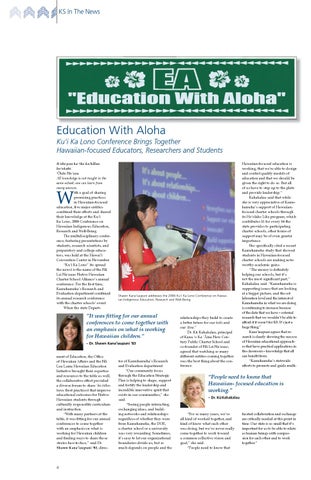
Education With Aloha Ku‘i Ka Lono Conference Brings Together Hawaiian-focused Educators, Researchers and Students A ‘ ‘ohe pau ka ‘ike ka hälau ho‘okahi. ‘Ölelo No‘eau All knowledge is not taught in the same school; one can learn from many sources. ith a goal of sharing promising practices in Hawaiian-focused education, five major entities combined their efforts and shared their knowledge at the Ku‘i Ka Lono, 2006 Conference on Hawaiian Indigenous Education, Research and Well-Being. The multidisciplinary conference, featuring presentations by students, research scientists, and preparatory and college educators, was held at the Hawai‘i Convention Center in November. “Ku‘i Ka Lono” (to spread the news) is the name of the Nä Lei Na‘auao Native Hawaiian Charter School Alliance’s annual conference. For the first time, Kamehameha’s Research and Evaluation department combined its annual research conference with the charter schools’ event. When the state Depart-
W
Shawn Kana‘iaupuni addresses the 2006 Ku‘i Ka Lono Conference on Hawaiian Indigenous Education, Research and Well-Being.
”It was fitting for our annual conferences to come together with an emphasis on what is working for Hawaiian children.” – Dr. Shawn Kana‘iaupuni ’83 ment of Education, the Office of Hawaiian Affairs and the Nä Lau Lama Hawaiian Education Initiative brought their expertise and resources to the table as well, the collaborative effort provided a diverse forum to share ‘ike kühohonu (best practices) that improve educational outcomes for Native Hawaiian students through culturally responsible curriculum and instruction. “With many partners at the table, it was fitting for our annual conferences to come together with an emphasis on what is working for Hawaiian children and finding ways to share those stories face-to-face,” said Dr. Shawn Kana‘iaupuni ’83, direc-
4
tor of Kamehameha’s Research and Evaluation department. “Our community focus through the Education Strategic Plan is helping to shape, support and fortify the leadership and incredible innovative spirit that exists in our communities,” she said. “Seeing people interacting, exchanging ideas, and building networks and relationships regardless of whether they were from Kamehameha, the DOE, a charter school or a university was very rewarding. Sometimes, it’s easy to let our organizational boundaries divide us, but so much depends on people and the
relationships they build to create a better future for our keiki and our ‘äina.” Dr. Kü Kahakalau, principal of Kanu ‘o Ka ‘Äina New Century Public Charter School and co-founder of Nä Lei Na‘auao, agreed that watching so many different entities coming together was the best thing about the conference.
Hawaiian-focused education is working, that we’re able to design and control quality models of education and that we should be given the right to do so. But all of us have to step up to the plate and provide leadership.” Kahakalau said that while she is very appreciative of Kamehameha’s support of Hawaiianfocused charter schools through its Ho‘olako Like program, which contributes $1 for every $4 the state provides to participating charter schools, other forms of support may be of even greater importance. She specifically cited a recent Kamehameha study that showed students in Hawaiian-focused charter schools are making noteworthy academic gains. “The money is definitely helping our schools, but it’s not the most significant part,” Kahakalau said. “Kamehameha is supporting issues that are looking at a bigger picture, and the collaboration level and the interest of Kamehameha in what we are doing is continuing to increase because of the data that we have – external research that we wouldn’t be able to afford if it wasn’t for KS. It’s just a huge thing.” Kana‘iaupuni agrees that research is clearly showing the success of Hawaiian educational approaches that have practical applications in the classroom – knowledge that all can benefit from. “Kamehameha’s statewide efforts to promote and guide multi-
“People need to know that Hawaiian- focused education is working.” – Dr. Ku¯ Kahakalau
“For so many years, we’ve all kind of worked together, and kind of knew what each other was doing, but we’ve never really come together to work toward a common collective vision and goal,” she said. “People need to know that
faceted collaboration and exchange are critically needed at this point in time. Our state is so small that it’s important for us to be able to relate as human beings with compassion for each other and to work together.”
Na¯ Mea Hoihoi T hi n g s
of
I n te r est
Community Learning Center Opens in Lı¯ hu‘e In December, Kamehameha Schools held blessing ceremonies celebrating the opening of the Community Learning Center at Lïhu‘e. Located at 3170-A Jervis Street, the building is near the Queen Lili‘uokalani Children’s Center. The center is modeled after the Community Learning Center at Nänäkuli, with meeting rooms, offices, a multi-purpose room and computers for use in training and classes. Currently the center houses parenting classes offered through the Hi‘ilani program, and assistance is offered with post-high financial aid and the Ho‘oulu Hawaiian Data Center. Other Kamehameha services are also being planned to operate out of the site.
Hu¯lili Vol. 3 Available from Kamehameha Publishing Hülili: Multidisciplinary Research on Hawaiian Well-Being, is a peer-reviewed journal inspired by a commitment to improve Hawaiian well-being, particularly at the intersection of science and ancestral knowledge. The 13 articles in Hülili Vol. 3 provide mounting evidence that Hawaiian perspectives matter, that Hawaiian language and knowledge systems are flourishing, and that Hawaiian identity and culture are central to Hawaiian well-being. Several of the contributing authors are either Kamehameha graduates or staff members. The journal is produced annually by the KS Research and Evaluation division under the direction
At the Hawai‘inuiäkea Film Festival held in October and November of 2006, producer/director/cinematographer Nä‘älehu Anthony ’93 and director Leah Kihara ’92 had films screened as did director Mary Tuti Baker ’70. One of the films featured at the festival was a study of slack key guitar, or kïhö‘alu, featuring Keola Beamer ’69.
Child Safety Program Comes to Kapa¯ lama of Dr. Shawn Kana‘iaupuni ’83, who serves as the journal’s editor. To order a copy, please send mailing information and $5 (checks payable to Kamehameha Schools) to: Hülili Vol. 3, Kamehameha Publishing, 567 South King Street, Suite 118, Honolulu, HI 96813.
Students and Alumni Shine at Film Festivals Student filmmakers from Kamehameha Schools Kapälama recently received seven awards at the 2006 International Student Media Festival, which celebrates outstanding classroom media projects across the nation. The ISMF is one of the longest running festivals in the country and is sponsored by the Association for Educational Communications and Technology, a leader in promoting the use of technology to improve teaching and learning. Honored were: Genesis Larson ’08, Brittany Robello ’08, Jeremy Lota ’06, Randel Jim ’06, Christin Couch ’06, Heather Chong ’06, Paul Judd ’07, Cody Gomes ’07, Sharisse Akagi ’06, Kamaka Pili ’06 and Alyssa Bergado ’06.
New “Kamehameha Schools Direct Mail List” Developed
D
In November 2006, Kamehameha Kapälama Elementary
participated in a child identification safety program in collaboration with the Missing Child Center-Hawai‘i, a program of the Department of the Attorney General which operates as a state resource center for missing children and their families. Participating students received identification cards with emergency contact information, their photograph, a dental record chart and a fingerprint sampling. Dental exams were conducted by a group of dentists who volunteer for the program through the Hawai‘i Dental Association Dental Samaritans.
irect mail - both postal and electronic - is an effective way for Kamehameha Schools to quickly distribute information about KS programs and services to Hawaiian families. Kamehameha Schools ‘ohana are invited to confirm your contact information and be included in a new “Kamehameha Schools Direct Mail List” that is being introduced by the school. Look for the special mailer that tells you all about this new mail list that will enable KS to send each family targeted educational information most relevant to their individual situations. You could receive a special gift (while supplies last) if you are among the first to confirm your contact information by returning the postage-paid questionnaire or completing the form online at www.ksbe.edu (click on “Kamehameha Schools Direct Mail List”) beginning in mid-April.
Dr. Glenn Kaneda examines first-grade student Riley Nozoe.
KE ALI`I PAUAHI FOUNDATION
It Takes Money toGive Give Money! It Takes Money to Money! KAPF is able to award post-high scholarships through the generosity of individual donors, corporations, and KS class and alumni associations who have contributed to establish scholarship funds. i
Donors and class committees establish criteria that they wish to use for screening applicants.
i
Scholarships are offered for a wide variety of subjects including: performing arts (Edwin Mahiai Copp Beamer Scholarship), Protestant Christian ministry (Iwalani Carpenter Sowa Scholarship), and everything in between.
i
Giving forward is an investment in the future of Hawai`i’s `öpio. Please consider making a gift to KAPF to fund an existing scholarship, or contact the Foundation to find out how to create one of your own.
The 2007 Scholarship Application process begins March 1, 2007. Online applications will be accepted through May 11, 2007. A complete list of Scholarships, as well as the online application are available at www.Pauahi.org. Ke Ali`i Pauahi Foundation 567 South King Street, Suite 160 Honolulu, Hawai`i 96813 808.534.3966 www.Pauahi.org Perpetuating the legacy of Ke Ali`i Bernice Pauahi Bishop
5
KS In The News
“Creating Hawaiian Spaces” continued from page 1
spaces where we can practice cultural activities in Hawaiian ways on our own terms,” Fong said. “We’re restoring a place where our students and staff can gather and do everything from cultivate native plants to revitalize Hawaiian thoughts and perspectives and apply them in contemporary ways.” The task force’s first move was to bring in the world’s leading authority on uhau humu pöhaku, or Hawaiian dry masonry. Billy Fields of Fields Masonry and crew began work in May 2006 to restore the existing large kahua, reconstruct the four lower terraces, build a burial mound for iwi (bones) found at the site and an exterior wall to encircle the area. Fields’ work was completed in August 2006 at this site referred to as Keanakamanö, which means “the cave of the shark.” Traditions speak of a cave in the valley that connected to an underground system extending toward Pu‘uloa (Pearl Harbor). The legendary sharks of Pu‘uloa were said to rest in the cave, giv-
Ka‘iwakı¯loumoku coordinator Jamie Fong gives Kamehameha fourth-graders a tour of Keanakamano¯.
that now greets visitors to the Kapälama campus. Discussions are also underway as to how best utilize the kahua.
“What matters is that our küpuna were living here.” – Dr. Ke¯hau Abad ’82
ing the valley its name. Ka‘iwakïloumoku has implemented a huaka‘i (field trip) program at the site, and the cultivation of native Hawaiian plants - such as kalo, ‘uala, koa and ‘öhi‘a lehua - has begun on the lower terraces. Solomon Waine‘e, Kapälama Grounds department manager, plays a key role in designing and implementing the plantings at Keanakamanö. He and his grounds crew, along with volunteer staff and students from throughout Kamehameha, have all lent a hand in creating the beautiful landscape
“There’s been all kinds of ideas,” Fong said. “One thought was that it could be a gathering place where people could get out of their typical offices and classrooms and actually have meetings or classes on the large terrace, perhaps within a hälau structure. We’ve brought together a group of staff to determine how the Kamehameha family might want to use the site.” “It’s tremendously important that we create Hawaiian spaces on campus,” said Dr. Këhau Cachola Abad ’82, who played a major role on the task force.
This photo shows the location of a World War II prisoner of war camp in Kapa¯lama that held Italian soldiers. The large open area at the left end of the camp was used as a soccer field and is believed to have been the location of an ancient kahua. (Photo courtesy Bishop Museum.)
6
Kamehameha students enjoy a game of ko¯nane, or Hawaiian checkers, at Keanakamano¯.
“We need spaces that allow us to interact with our environment. That would make a big difference in our ability to understand our küpuna - to think, behave and feel as they did.” Abad, a former Kamehameha Hawaiian culture and history teacher now serving the institution as director of Kamehameha Publishing, carries an anthropology doctorate with a focus on archaeology. She’s convinced the prisoner of war camp reused an existing site. “Our küpuna were everywhere - definitely in this entire valley,” she said. “Concrete evidence of this are all of the 39 wahi kupuna that extend ma uka throughout the valley. They did all sorts of things here. We haven’t even scratched the surface to fully understand these places.” Abad said no one can say with certainty that the site was formerly used as a heiau (religious site), but there are several reasons why that argument could be made, including the size of the platform which is too large for a
typical house site. “Geographically, the site is where a lot of heiau tend to be,” she said. “It sits prominently on a rise as you head ma uka, and it’s at the beginning of the valley. It has a commanding vantage point of the ma kai plain. This is common for many heiau. “If it was a heiau, it was a heiau of some import. An ali‘i organized this effort. These are huge stones, and this took a huge workforce.” In the long run, Abad said discussions on the exact usage of ancient Hawaiian sites can sometimes miss the major point. “Without our küpuna of the past telling us how they used this site, there’s no way for sure to know that this site was a heiau,” she said. “What matters is that our küpuna were living here. Just that alone suggests we ought to take care of it, so that in some way we can still remain connected to it and reclaim it in ways that are meaningful for us as Hawaiians today.”
Fields of Dreams Billy Fields Has Spent His Life Restoring Ancient Hawaiian Sites
A
s a young student, Billy Fields applied on more than one occasion to Kamehameha Schools, but was never invited to attend. If only Fields knew that one day, the institution would come calling specifically for him. When Kamehameha made its decision last year to restore a large terrace and kahua located in a wahi kupuna near the Kapälama front gate, Fields Masonry of Kona was the logical choice for the job. Fields Billy Fields and his men are the world’s leading practitioners in the art of uhau humu pöhaku, or Hawaiian dry masonry. “My men and I have dedicated our lives to restoring ancient sites so that they are not forgotten,” Fields said. “We can’t forget that this is our past.” Fields’ resume includes restoration work on nearly all the major Hawaiian islands, including: the Hulihe‘e Palace wall in KailuaKona on the Big Island; a hälau wa‘a (canoe shed) at Hulopo‘e Beach on Läna‘i; Pihana Heiau in Paukükalo, Maui; a hula heiau at Kë‘ë on Kaua‘i; fishponds along the southeastern coast of Moloka‘i; and Kükao ‘o Heiau in Mänoa, O‘ahu. He’s also constructed burial platforms at the Center for Hawaiian Studies at UH-Mänoa and at Kawaiaha‘o Church, and restored John Young’s tomb at the Royal Mausoleum. “In terms of his art, we got the best person,” said Dr. Këhau Abad, who served on the Kapälama Task Force which helped restore the Keanakamanö site. “There is no one like Billy who does this sort of work in the way that he does it with the kind of care that he and his crew take.” Hawaiians traditionally constructed stone walls and platforms using dry masonry techniques, strong and durable structures that lasted hundreds of years. One length of the kahua wall at Keanakamanö is huge, measuring 92 feet long and standing more than 12 feet high. Yet, no mortar is used to hold the structure together. “The wall is strong enough that you can walk on it,” said
Fields, the son of a mason who spent hours as a youngster observing the interlocking techniques of the old Hawaiians. “We use modern day technology with ancient techniques. Like anything else, this work is not for anybody. The work is brutal, but it’s fun and rewarding. “What we like to do as a part of our journey is train people, because somebody has to mälama these sites (after we leave).” Toward that end, Fields has worked closely with the Kapälama Operations Support staff, teaching them the secrets of his craft.
Kamehameha SchoolS
Ko¯ kua Workshops Kamehameha SchoolS is accepting financial aid applications for the 2007–2008 academic year. For help completing your application, come to one of our upcoming ko¯kua workshops:
KS Waima¯nalo Preschool (259–7922) April 3 & 17, May 1, 15 & 29 8:30 a.m. – 5 p.m. March 28, April 11 & 25, May 9 5 – 7 p.m.
Queen lili‘uokalani children’s center at Punalu‘u (293–8577) April 11 & 25, May 9 & 23 9 a.m. – 5 p.m.
Wai‘anae health academy (696–8216) April 5 & 19, May 3, 17 & 31 8 a.m. – 4:30 p.m.
KS community learning center at Na¯na¯kuli (668–1517) April 4, 11, 18 & 25 / 5 – 7 p.m. April 12 & 26 / 8 a.m. – 4 p.m. May 2 & 9 / 5 – 7 p.m.
Financial aid applications available for the following 2007–2008 programs: Our friendly staff will also answer your questions about KS admissions and Hawaiian ancestry verification.
• KS preschools & K–12 campuses (Apply by 4/30 to receive award notification in July 2007, or by 12/29 to receive notification after July.)
• Pauahi Keiki Scholars–qualified preschools (Apply by 4/30 for the August–July tuition period, or by 9/29 for the January–July tuition period.)
“My men and I have dedicated our lives to restoring ancient sites so that they are not forgotten.”
• Post–high school scholarships (Apply by 4/20 for need–based scholarships.)
Visit www.ksbe.edu/finaid or call 541–5300 for details. Kamehameha Schools’ policy is to give preference to applicants of Hawaiian ancestry to the extent permitted by law.
– Billy Fields “I’m hoping this project brings a sense of Hawaiiana to the campus,” Fields said. “Our take was to make this site a living site where people could plant and harvest and have activities. And to be the showpiece of the Kamehameha Schools front gate, keeping in mind our ancestors and our traditions.” Fields, who went on to major in tropical horticulture at UHHilo, said he is glad that he has finally made it onto campus. “Every place we go has its own story, every restoration is so interesting,” he said. “But we’ve probably never been treated this well on any job we’ve ever done. This experience has been one of the highlights of our career. Everybody has been real professional and yearning for the knowledge that my men and I bring. “As a child, I always wanted to come to this school, but it never happened. Then my daughter came here, and I got to lecture in her classes. Now I have my work here, so we’ve kind of come full circle.” For more on Billy Fields, read “Rebuilding Our Past” on the Ka‘iwakïloumoku Web site at “www.kaiwakiloumoku.ksbe. edu” and click on the “‘A‘ahoaka” heading.
Hawaiian Christmas
K
amehameha Schools Hawai`i dancers sway to an upbeat hula during a performance at “Kalikimaka Kalls.” The school’s annual Christmas concert, put together by choral music instructor Michael Springer, featured the school band, combined choirs, Hawaiian Ensemble and drama classes presenting the event in the style of a 1940s radio show. More than 200 guests caught the Dec. 4, 2006 show held in the Ha¯‘aeamahi Dining Hall.
7
Wanted MISSING ALUMNI
Kamehameha Schools Alumni Reunion 2007 (June 3-10) – celebrating classes ending in 2s and 7s – just won’t be complete without the friends listed below. Anyone with information (current address, phone number and/or e-mail) about these reunioning alumni is asked to contact the Parents and Alumni Relations (PAR) department.
CALL 842-8680
If calling from the U.S. mainland or neighbor islands, dial 1-800-842-IMUA, ext. 8680. You may also e-mail gejohans@ksbe.edu or lawarack@ksbe.edu.
1937
Baker, Wilhelmina Beebe, Margaret Kalama, Samuel McDonough, Beatrice Migliaccio, Minerva Varney, Peggy
1947
Kinney, Rayner Levy, Robert Marciel, Edith Silva, Ernest
1952
Aki, Lawrence Bird, Patsy Cox, Charles Cummings, Juliette Gubach, Muriel Haina, Samuel Lambert, B. Napoleon, Gerald Wills, Edmund
1957
Ching, Charen Colburn, Newton Ernest, Mark
1962
Chung, Colin Lau, Charles Lee, Paul Luke, Karen Thompson, Carrie
1967
Akeo, Yolanda Ako, Rolland Anderson, Brenda Apuna, Paul Austen, Jon Blake, Theodore Blevins, Patricia Brown, Robert Bush, Charlene Campbell, Naomi Char, Barnie Cheung, Constance Dorsey, Shannon Epstein, Momilani Fernandes, Russell Foster, Sterling Freitas, Keith Garnett, Diane Goulart, Charleen
8
Hanchett, Michael Holderbaum, Craig Horcajo, David Ka, Lorraine Kakalia, Claude Kamoku, Rhona Kealoha, Peter Lavilla, Celia Lee, Jerry Luka, Alvin Merrill, Marion Murphy, Clark Namba, Jackie Neves, Alexander Oliveira, Waynette Samson, Creighton Scarth, Barbara Self, Robert Souza, Ilona Todd, Myra Torris, Westly Wilcox, Maxine Yadao, Lorene Yee, Anthony
1972
Ah Soon, David Ah Sui, Leialoha Aiwohi, Thelma Barttels, Novalynn Bell, Doreen Bingle, Alria Boyd, Caroline Denges, Charlene Dumaran, Debra Fowler, Donnette Frendo, Jeanne Fries, Brenda Gibson, Gary Higa, Sharon Hoapili, Jonah Ikemoto, Derick Kaina, Moses Kealoha, Gardner Lee, Raynette Lester, Keith Mawae, James Mendenhall, Katherina Miner, Vernon Moku, Harris Okada, Gary Paulino, Ann Smith, David Smith, Wendell Stringert, Charles Strother, Puanani Valentine, Laura Vidinhar, Rickie
Wise, Lois Wong, Selene Yamada, Barry Zane, Wallace
1977
Aana, Jim Akeo, Deeneen Allen, Charles Amano, Johnny Brown, Janda Cantrell, Angela Chee, Galen Cockett, Wendy Comeaux, Tanya Dependahl, Twila Dickenson, Henry Enos-Costello, Andrea Hall, Gail Hennessey, Stacy Hodson, Kahiki Holt, Lawrence Holt, Naomi Isbister, Deanna Jardine, Keoni Kanamu, Laurie Kauahi, Daniel Kawewehi, Samuel Lau, Rowena Mehau, Tom Meredith, Larisa Miyashiro, Bridget Naea, Bernard Ngum, Randol O‘Riley, Diane Oana-Russo, Natalie Pang, Harrison Panui, William Paredes, Lloyd Perreira, Bonnie Querobin, Terri-Lee Rasmussen, Johnette Smith, Maureen Tamarra, Gordon Taua, Teresann Villanueva, Carol Wong, Alexis
1982
Aguilar, Natalie Akau, Joseph Aki, Kevin Baldovi, Renee Chinn, Michael Cole, Twanda Dominguez, Donna Franecke, Jewel Fukushima, Jon
Garcia, Glen Haina, Kevin Huddy, Kimo Kalauokalani, Donna Kamaka, Sharmayne Kashinoki, Tracy Kinney, Jean Koko, Paula Martin Susan Naipo, Stacy Ogea, Laura Olmos, Eric Orian, Kalikolehua Pimental, Christopher Potter, Kamuela Quindica, Kevin Roberson, Michael Rosenberg, Paul Smith, Manuel Stephenson, Deanne Trask, Joy Yin, Wendell Akana, Moses Akau, Jadelynn Bauer, Ian Cambra, Raelyn Carter, Morton Hammond, Walter Hoomanawanui, Shane Hutchinson, Robert Kealoha, Sean Kumamaru, Anthony Lee, James Lyman, Arthur Mesiona, Winona Naeole, June Peterson, Shawn Quick, Jason Rorie, Leah Salvador, Clayton Silva, Dionne Tomas, Kevin Williams, Richelle
1992
Abihai, Charlissia, Achi, Stanford Akiona, Lanora Antonio, Bridget Apana, Cicely Badayos, Haunani Carman, Albert Chun, Nicol Crawford, Deanna Duarte, Damien Duarte, Kalani Enderton, Christopher Fernandez, Herbianne
Fonoimoana, Rodney Gerard, Michael Guerrero, Dino-John Hee, Carisa Heely, Erin Hew, Mitchell Horn, Warren Ihu, Nathan Jardine, Allyson Kahapea, Nadine Kahoohanohano, Guy Kaleikini, Lee Ann Kekipi, Coran Kim O‘Sullivan, Michurlinn Lam, Jennifer Madolora, Natalya Mobley, Christin Murphy, Maile Prasser, Kit Rogers, Malia Shaver, Bernice Souza, Cathleen Swain, Kawekiulani Tagonan, Jake Terai, Tracy West, Shawna Williams, Nikki Wilson, Sara Wong, Ronald Yamabayashi, Kevin Yoneda, Chad
1997
Abdul, Natallie Ahuna, Mailekaluhea Aiwohi, Kasey Aiwohi, Paul Anderson, Kai Aoyagi, Anthony Pakalani, Bello Bode, Monica Breeden, Lindsey Brown, Danielle Chew, David Crabtree, Gerald Cramer, Kaimana Davida, Tangatatopa Dilliner, Ryanon Finke, Kimberly Fuller, Alohaleiokalani Gibson, Janny Grace, Steven Haiola, Kymberlyn Heen, Pelehonuamea Higuera-Trask, Mauna Kea Ibarra, Joselito James, Tara Kahale, Holopono
Kalawe, Jason Keahiolalo, Torae Landford, Bernard Lee, Beau Lent, Jason Lucrisia, Lindsey Masagatani, Christopher Napuelua, Casey Paku, Pomahina Summer, Parr Pau, Tyler Poe, Sonelle Ramos-Harrington, Shaun Reinhardt, Cherith Ruiz, June Katherine Seto-Mook, Leona Souza, Sandria Taala, Taliafi Tellyer, Tracy Thiravong, Kawehimakamae Villaflor, Matthew Walters, Mahana Wong, Carolyn Jewelle, Wright Yagi, Jade Yuen, Tani Yung, Jacob
2002
Albarado, Keika Alexander, Patrick Benevedes, Ryan Brackbill, Seana Duarte, Tish Erst, Nicholas Fukuda, Tarona Kim, Jordan Lee Loy, Rachel Luat Kelimakaalii Medeiros, Jordan-Ryan Montez, Dane Moore, Douglas Pi, Matthew Quiocho, Vernon Rebudal, Justin Rolsenbush, Elise Septimo, Tiana Storaasli, Kristin Toriki, Shannon Yates, Alexandra
Kamehameha Schools Annual Report J U L Y
1 ,
2 0 0 5
-
J U N E
3 0 ,
2 0 0 6
“ K a m e h a m e h a S c h o o l s ’ m i s s i o n i s t o f u l f i l l P a u a h i ’s d e s i r e t o c r e a t e e d u c a t i o n a l o p p o r t u n i t i e s i n p e r p e t u i t y t o i m p r o v e t h e c a p a b i l i t y a n d w e l l - b e i n g o f p e o p l e o f H a w a i i a n a n c e s t r y. ”
Historic Graduation Highlights Fiscal Year 2006 Learners served by Kamehameha programs up 26 percent; Endowment grows to $7.66 billion By every standard, fiscal year 2006 - from July 1, 2005 to June 30, 2006 - was a time of exceptional performance for Kamehameha Schools.
•
created position of vice president of Strategic Planning and Implementation. Pating is charged with implementing the Education Strategic Plan and overseeing Kamehameha’s long-range strate-
Significantly, the first-year objectives of the institution’s Education
gic planning efforts;
Strategic Plan, approved in June of 2005, were exceeded as the number of children and families impacted by Kamehameha Schools campus
The September 2005 hiring of Christopher J. Pating to the newly
•
The October 2005 establishment of the Ho‘okahua Department,
and community programs increased by 26 percent – from 22,400 to
headed by former Kapälama Performing Arts department head
more than 28,000 students.
Randie Fong. Ho‘okahua is tasked with facilitating and initiating efforts to foster nohona Hawai‘i, or a Hawaiian way of life, through-
An additional 15,000 learners were served through one-time pro-
out the Kamehameha system;
grams that are intended to introduce students to high-impact Kame-
•
hameha programs.
president and executive director of the Ke Ali‘i Pauahi Founda-
Kamehameha’s educational spending totaled $221 million for the year, bringing the institution’s cumulative total to more than $1.1 billion expended on educational programs and services since 2002. Strong performance in the year’s
T
The December 2005 hiring of Lynn Maunakea to her role as vice
tion, a support organization to Kamehameha Schools tasked with
he year’s signature
achievement was the celebration of the first
developing new and diverse sources of income to support the educational needs and goals of people of Hawaiian ancestry;
•
And the April 2006 appointment of Kamehameha Schools Maui headmaster Dr. Rod Chamberlain to the newly created position
financial activity – real estate, stocks
graduating classes at
of vice president for Campus Strategies. Chamberlain will lead
and other equity investments - net-
Kamehameha Schools
the alignment, coordination and implementation of campus-
ted a 17 percent total return, increas-
campuses on Maui
based strategies related to the Education Strategic Plan.
ing the fair value of Kamehameha’s Endowment by $897 million.
and Hawai‘i.
Fiscal year 2006 will be remembered for historic graduation ceremonies on Maui and Hawai‘i, a remarkable Endowment performance, and a faculty, staff and administration that brought Pauahi’s gift of
At the end of the fiscal year, Kamehameha’s Endowment had an overall fair value of $7.66 billion,
education to more Hawaiian learners and continued to fulfill the mis-
growing steadily from a mark of $5.54 billion in June of 2003.
sion of Kamehameha Schools.
The year’s signature achievement was the celebration of the first graduating classes at Kamehameha Schools campuses on Maui and Hawai‘i. A total of 281 seniors from KS Maui and KS Hawai‘i were members of the historic class of 2006, some of them students since the schools first opened temporary facilities in 1996. Combined with the larger enrollment on O‘ahu’s Kapälama campus, Kamehameha Schools can now expect to add more than 700 graduates from three islands to its alumni rolls each year.
Other highlights of the year included: • The July 2005 start of the revitalization of the
Royal Hawaiian
Shopping Center, the single largest real estate investment in Kamehameha’s portfolio. The first significant upgrade of the center in its 26-year history is targeted for completion at the end of 2007;
Kamehameha Schools celebrates historic graduation ceremonies on Maui and Hawai‘i.
9
A Challenging and Exhilarating Year by the Trustees of Kamehameha Schools Aloha käkou,
ebrating: a 26 percent increase in
The period between July 2005
the number of Hawaiian children
and June 2006 was both challeng-
served by our legacy, a 17 percent
ing and exhilarating for all of us at
return for the Endowment and a
Annual Report Fiscal Year 2006
Kamehameha Schools.
land strategy that looks beyond
We made tremendous strides
financial return to incorporate and
Contributors
in our educational outreach and
honor our values as a Hawaiian in-
Lilinoe Andrews
in the stewardship of our assets
stitution.
Marsha Bolson
while a broad cross-section of the
Even more exciting, this fo-
Ann Botticelli
community joined us to protect
cused, strategically aligned effort
the preference policy that is critical
continues. Clearly, the momentum
to our mission.
is building.
KAMEHAMEHA SCHOOLS
Neil Hannahs Ed Kalama
Our staff, under the leader-
On the legal front, we con-
ship of CEO Dee Jay Mailer, has
cluded the fiscal year with oral
worked tirelessly to implement the
argument in support of our pref-
Bruce Lum
vision for Kamehameha outlined
erence policy before a 15-judge
Janet Na
in the 2000 Strategic Plan and the
panel of the 9th Circuit Court of
Shawn Nakamoto
2005 Education Strategic Plan.
Appeals in San Francisco. On Dec.
ing that our policy is a permissible
who have been disadvantaged in
5, 2006 the panel issued an 8-7 rul-
remedy for an indigenous people
their own homeland.
Kimo Kaleiwahea Pat Kaneshiro
Our results are worth cel-
Teri Ng Kekoa Paulsen Jodi Kaneaiakala-Shim
A gathering of more than 10,000 turned out to support Kamehameha’s preference policy during a march to Mauna‘ala on Aug. 6, 2005.
The ruling was not unani-
Kamehameha Schools Board of Trustees
mous, but all of the judges – even those who dissented – acknowl-
Reid Silva
edged the validity of our mission.
Thomas Yoshida
And so we take a moment to
Michael Young
celebrate what has been accomplished, but keep our sights on continued fulfillment of our mission and of our founder’s vision. Robert K.U. Kihune
Constance H. Lau
J. Douglas Ing
I mua!
Diane J. Plotts
Nainoa Thompson
Fulfilling Pauahi’s Wishes For Her People by Dee Jay Mailer, Chief Executive Officer on behalf of the CEO Team Kamehameha
Schools
ex-
positioned to accomplish the ini-
to work together with our many
ents and alumni who exercise their
ists to build strength and hope
tiatives in the second year of our
community
values and potential every day by
through education for generations
plan.
hameha Schools has teamed with
of Native Hawaiians to come.
Kamehameha
Schools
partners.
Kame-
serving others.
was
many dedicated organizations in
It is our kuleana to carry out
That was the dream of our
blessed with an outstanding fi-
pursuit of our common goals, and
the wishes of our princess. It is our
founder Princess Bernice Pauahi
nancial performance in fiscal year
we thank them for their efforts.
kuleana to serve our communities
Bishop. In fiscal year 2006, Kame-
2006, which will serve us well as
Yet none of our accomplish-
and stakeholders, and it is our ku-
hameha Schools took significant
we move forward in our work with
ments would be possible without
leana to improve the well-being of
steps toward fulfilling her wishes.
our people and our communities.
the skill, enthusiasm and com-
our Hawaiian people through education.
Our first-year objectives of
The students on our campuses, in
mitment of very talented Kame-
our Education Strategic Plan have
our preschools and in our outreach
hameha Schools faculty and staff.
been met by tireless Kamehameha
programs are thriving thanks to
Their devotion and loyalty to
Schools faculty, staff, alumni and
the strength of our Endowment.
the dream of our founder is un-
community members. We are
We have learned that the best
matched. The proof of their hard
pleased to report that we are well-
way to extend our resources is
work? Thousands of students, par-
We are honored to have the privilege.
Kamehameha Schools Chief Executive Officer Team
Dee Jay Mailer Chief Executive Officer
Kirk O. Belsby Vice President for Endowment
Ann Botticelli Vice President for Community Relations and Communications
D. Rodney Chamberlain, D.Ed. Vice President for Campus Strategies
Michael J. Chun, Ph.D. President and Headmaster KS Kapa¯lama
Lee Ann DeLima Headmaster KS Maui
Randie Fong Director, Hawaiian Cultural Development
Stan Fortuna, Ed.D Headmaster KS Hawai‘i
Darrel Hoke Director, Internal Audit
Sylvia Hussey Head of Educational Support Services
Michael P. Loo Vice President for Finance and Administration
Lynn C.Z. Maunakea Vice President and Executive Director Ke Ali‘i Pauahi Foundation
Christopher J. Pating Vice President for Strategic Planning and Implementation
Colleen I. Wong Vice President for Legal Services
10
Focusing on Education Kamehameha Schools sees significant progress over the first full year of the Education Strategic Plan Launched in June 2005, Kame-
to serve Native Hawaiian children
tional and curricular models that
hameha’s Education Strategic Plan
from ages 0-8 and the ‘ohana who
build on a tradition of outstanding
refines the institution’s educational
care for them. In fiscal year 2006,
K-12 campus-based programs.
focus with a primary objective of
Kamehameha Schools:
creating long-term intergenerational
•
change for Hawaiians.
These programs serve as cen-
Served more than 6,000 chil-
ters for educational innovation, ex-
dren - an increase of 1,600 over
cellence and outreach, in order to
Along with the establishment
the previous year - through KS
optimize the campus and commu-
of three strategic priorities, the
center-based preschools, pre-
nity reach in support of the Educa-
plan guides institutional resources
school scholarships, literacy
tion Strategic Plan.
to children in predominantly Ha-
instruction and various educa-
waiian communities and includes
tional collaborations
strong educational program for the
Awarded 622 preschool schol-
nearly 5,300 K-12 students across
150 percent learners served over the
arships through the Pauahi
our three campuses, we’re improv-
next 10 years.
Keiki Scholars program, an
ing our efficiencies in operational
a long-range goal of increasing by
•
“While continuing to provide a
Fiscal year 2006 saw the first
increase of 80 percent over the
areas, aligning our systems,
measurable effects of the plan, with
previous year while financial
also measuring the impact of our
Kamehameha Schools clearly hit-
awards doubled to $3 million
current campus outreach programs
ting the mark with its educational goals. The number of children and
Second priority sustains momentum from grade 4 through post high school
to determine how to build on good results,” said Dr. Rod Chamberlain,
Kamehameha programs like Hi‘ilani offer early childhood family education for families with children prenatal to 3 years of age.
vice president for Campus Stratekey component of all three Ka-
families impacted by Kamehameha
Kamehameha’s second stra-
campus and community programs
tegic priority focuses on programs
increased 26 percent - from 22,400 to
and services that support children
included:
more than 28,000 - and an additional
through critical transition periods
•
15,000 learners served through one-
during their educational journeys,
time programs intended to intro-
and assists the efforts of post-high
duce students to high-impact KS programs. “We are right on target,” said
and
gies. In fiscal year 2006, those results
mehameha strategic priorities “Our strategic priorities have
A historical three-island gradu-
helped us become focused on our
ation of 722 seniors
educational initiatives,” Pating said.
A 17 percent increase in cam-
“As an educational organization, we
scholars studying for careers need-
pus enrollment of orphaned
really need to be specific, targeted
ed in building strong Hawaiian
and indigent students
and focused in what we do.
•
communities.
Christopher Pating, Kamehameha’s
•
In fiscal year 2006, Kame-
The strengthening of Hawai-
“We are to continue our efforts
ian language and culture cur-
going into our second year as we
vice president for Strategic Planning
hameha Schools:
riculum and service learning
strive to serve more Native Hawai-
and Implementation. “We need to
•
practices
ians than ever before.”
continue to keep everyone focused
•
For more information on the Edu-
session and summer programs
programs that reached more
cation Strategic Plan, please visit www.
Awarded $12.6 million to 2,200
than 4,500 adult learners – a
ksbe.edu/annualreports.
First priority targets prenatal to 8 years of age
students for post-high educa-
Quality early education is key
selected fields of study and
tion, with a new emphasis on
to future success in school and often, in life. Kamehameha’s early
with their physical and social envi-
Helped support 2,400 students in Hawaiian-focused charter schools
on the belief that children learn best ers, peers and through experience
Third priority addresses innovation on Kamehameha campuses Kamehameha’s third strategic
ronment. strate-
priority focuses on the continued
gic priority sets a clear direction
development of innovative instruc-
Kamehameha’s
first
numbers served through Kamehameha Schools programs and collaborations
non-traditional students
•
education programs are founded with the help of their parents, teach-
•
Parent, family and caregivers
dents through in-school, inter-
on the agenda of serving Native Hawaiian families.”
Reached a total of 7,300 stu-
SP1 SP1 SP1 SP1 SP2 SP3 SP1-3
Children Prenatal to 36 months Center-based preschools Preschool age children K-3 grade in public schools Supporting 4-12 grades, post-high and charter schools Campuses Caregiver training and support; support for families and caregivers of children PN-12 – community Total number of Hawaiians served
FY 05-06 104 1,439 1,094 3,375 12,043 5,298 4,686 28,039
Kamehameha Schools Community Collaborators ‘A‘ohe hana nui ke alu ‘ia - No task is too big when done together by all.
• •
Kamehameha Schools is committed to addressing
• • • • • •
∑ Hakipu‘u Learning Center
• •
∑ Hui No Ke Ola Pono, Inc.
• • • •
∑ Ka Huli o Häloa
the diverse educational needs of the Hawaiian community. In fiscal year 2006, Kamehameha Schools rekindled and strengthened collaborations with others to maximize long-term impact within communities. The following is a partial list of community collabo-
• • • • • •
∑ ‘Aha Pünana Leo, Inc.
∑ Chaminade University ∑ Department of Education, State of Hawai‘i ∑ Farrington Community School for Adults
∑ Hawai‘i Community College ∑ Hawai‘i Restaurant Association ∑ Hina Malailena ∑ Ho‘oulu Lähui
• • • • • • • •
Hui Mälama Learning Center and Neighborhood Place of Wailuku Institute for Native Pacific Education and Culture
∑ ALU LIKE, Inc. ∑ Castle Foundation Partnership
Friends of the Leeward Coast Public Charter School
rators who entered into memorandum of agreements with Kamehameha Schools over the past fiscal year:
∑ Foundation for Excellent Schools
∑ Kapi‘olani Community College ∑ Kaua‘i Community School for Adults ∑ Ke Ali‘i Pauahi Foundation ∑ Ma Ka Hana Ka ‘Ike Building Program ∑ Mana Maoli ∑ Maui Community College ∑ Myron B. Thompson Academy Papakölea Community Development Corporation
• • • • •
∑ Queen Lili‘uokalani Children’s Center ∑ Tütü and Me ∑ University of Hawai‘i at Hilo ∑ University of Hawai‘i at Mänoa ∑ Waipahu Community School for Adults
∑ Käko‘o Ka ‘Umeke ∑ KALO, Inc.
For more information on Kamehameha’s community col-
∑ Kanu I Ka Pono, Inc.
laborators, visit www.ksbe.edu/annualreports.
11
Extraordinary Year for Kamehameha Schools Endowment by Kirk O. Belsby Vice President for Endowment
By all measures, fiscal year
measure of our skills in adverse
2006 yielded returns that exceeded
market conditions will be our abil-
our own targets and peer bench-
ity to tack to minimize losses in
marks.
comparison with our peers.
Kamehameha’s
Endowment
Kamehameha’s
Endowment
team realized unprecedented fi-
Team also manages several edu-
nancial, educational, environmen-
cation collaborations, including
tal and cultural results as we man-
‘Äina Ulu, a collection of eco-cul-
aged the assets that comprise the
tural education collaborations that
legacy of Princess Bernice Pauahi
served more than 15,000 partici-
Bishop, founder of Kamehameha
pants in 2005-06. Since ‘Äina Ulu’s
Schools.
inception in 2001, in Waipä, Kaua‘i,
Robust capital markets and
the program has grown from six
the repositioning of Hawai‘i land
students in a solitary summer pro-
assets in a rising real estate envi-
gram to thousands of participants
ronment pushed financial returns
statewide. This illustrates the reso-
for the year to $897 million, raising
nance of this educational program
the Endowment’s overall fair value
model based on learning inspired
to $7.66 billion.
by the land.
Overall, the portfolio returned
Regarding the environment, a
more than 17 percent for the year,
third of our Hawai‘i land now has
which exceeded our CPI + 5 per-
stewardship management plans
cent return benchmark by ap-
to give strategic guidance to our
proximately by 7.7 percent and put Kamehameha
Schools
in the top 10 percent of a peer group of 100 nonprofit and master trust institutions. peer
Moreover,
a
survey
that
rated participants by risk ranked Kame-
he past three years have witnessed dramatic growth for the Kamehameha Schools Endowment in every relevant measure.
gram.
education at 4.0 percent of the five-year average fair value of its Endowment. Spending in FY 2006 was 3.8 percent and allocated as follows:
10%
3% 5% 56%
26%
Category
Investment
Amount
Campus-based Programs
$124 million
Community Outreach Programs
$57 million
Major Repairs & Capital Projects
$23 million
Debt Financing
$7 million
Other
$10 million
Total Trust Spending
in conservation pro-
$221 million
motes the availability of resources to
Kamehameha Schools Investment returns and Benchmarks
meet future needs.
Periods ending June 30, 2006
Kamehameha’s stewardship
ef-
forts also heal our lands and resources, which in the Hawaiian
hameha Schools in
worldview
the bottom 10 percent of incurred
represent the elder siblings that
risk. This relationship between re-
shaped Hawai‘i’s unique culture
turn and risk is highly desirable as
and values.
high, but stable growth.
Kamehameha Schools spending policy targets annual spending on
Mälama ‘Äina pro-
T
the Endowment works to achieve
Kamehameha Schools Trust Spending Fiscal Year 2006
Kamehameha lands represent the legacy of Hawaiian royalty and
One-year total return
*Three-year total return
*Five-year total return
*Since July 1, 1999 total return
Total Endowment
17.0%
15.1%
9.9%
9.8%
Blended Portfolio
11.1%
11.3%
7.4%
6.4%
CPI + 5%
9.3%
8.4%
7.7%
8.0%
+Large Endowment Fund Median
14.4%
14.7%
8.6%
9.5%
*Annualized +Source: Cambridge Associates
cultural, economic, educational, environmental and community re-
A full copy of Kamehameha
turns.
Schools’ audited “Consolidata
ed Financial Statements and
that hold extraordinary signifi-
unique, yet welcome set of chal-
Supplemental Schedules“ for
mehameha Schools Endowment in
cance for understanding Hawai‘i’s
lenges and has prompted Endow-
fiscal year 2006 is available at
every relevant measure with the
past and perpetuating cultural
ment to strive to become a global
www.ksbe.edu/annualreports.
total value of the portfolio increas-
practices into the future.
model for excellence in the man-
The past three years have wit-
are replete with sites or resources
nessed dramatic growth for the Ka-
This
mandate
presents
ing by more than $2 billion. While
This fiscal year, we enhanced
we will make every effort to sus-
our understanding of the cultur-
tain this growth, it’s important to
al history of our lands with the
A new three-year Endowment
note that our results are influenced
launch of the Land Legacy data-
Operating Plan is rolling out in fis-
We all recognize that we are
by larger capital and real estate
base, an informational inventory
cal year 2007 that addresses inter-
privileged to have this opportunity
market forces and cycles.
that includes 60,000 records.
nal architecture and processes that
to serve such an extraordinary Trust
will further strengthen the Endow-
and pledge our continued best ef-
ment.
forts to contributing in significant
agement of indigenous peoples’
confident in the Endowment’s abil-
real estate and financial assets.
ity to accomplish this ambitious
The wind has been at our back
The delivery of such wide-
in recent years, and we’re pleased
ranging results aligns with Endow-
that our values are rising higher
ment’s strategic mandate to pru-
than market benchmarks. Inevi-
dently increase the value of assets
advantage by becoming the best in
tably, the wind will turn and the
and achieve an optimal balance of
the business at what we do and I’m
We seek to gain a capabilities
The renovation of the Royal Hawaiian Shopping Center, begun in July of 2005, features The Royal Grove at Helumoa.
12
agenda.
ways to the accomplishment of the mission of Kamehameha Schools.
Alumni Class News
Alumni Alerts by Gerry Vinta Johansen ’60 • The Ninth Annual Alumni Glee Club Golf Tournament is slated for April 20, 2007 at Mämala Bay Golf Course, Hickam Air Force Base. Entry fee is $125 and includes golf, shirt, lunch and door prizes, banquet lü‘au and entertainment. Check out the PAR Web site at alumni.ksbe.edu for an online registration form or call Clifford at 382-8362. • Found: KS Class Rings: James K. Mawae ’72, Lori K. Cambra ’79, Tammy Lee ’81, Lee Ann Gascon ’91, Kori Nagamine of the class of ’93, Kahikolu ’95, Martina Wirtl ’97 and S. Cooper ’31. Also, initials T.M.H. ’68 and T.M. ’85. You may claim your rings by calling Gerry Johansen, KS Alumni Kökua at 842-8445.
• Ho‘olako Like Charter Schools Alumni Community Service Project: KS alumni classes have one last chance to contribute to this much-needed effort. If you haven’t heard of this project, please contact your class representative. These charter schools have high percentages of Hawaiian students and could use our help with materials, supplies and equipment. Five of the principals are KS alumni. Checks can be made payable to Kamehameha Schools with a memo indicating “KS Alumni Charter Schools Project.” This is a concerted effort by KS alumni to make a difference in the Hawaiian community. • Volunteers Make a Difference: At the 11th Annual KS Kapälama College Fair held on Dec. 23, 2006 the following alumni from the UH Mänoa’s John Burns School of
Medicine and William Richardson School of Law spoke to interested students and parents: School of Medicine: Kawika Mortensen ’01, Marcus Iwane ’02, Christian Kikuchi ’02, Jordan Lee ’00, Natalie Kong ’95 and Melanie Payanal ’96. School of Law: Kalei Rapoza ’97, Amy Ono Wiecking ’92, Lisa DeMello ’84, Tiffany Kaeo ’02. • KSAA Regional News: KSAA Intermountain Region is still looking for new members as it becomes activated with headquarters now located in Las Vegas, Nev. Contact Owen Wong ’61 at 702-8085119 for more information.
Rick Barboza is co-owner of Hui Ku¯ Maoli Ola, a 63-acre Windward nursery where Native Hawaiian plants are cultivated.
Native Plant Expert Finds His Royal Purpose Rick Barboza ’93 never intended his passion to become his purpose. After graduating from the University of Hawai‘i with a degree in zoology, Barboza grew Native Hawaiian plants as a backyard hobby, but earned a living as a sushi chef in Waikïkï. One night, a buyer from Home Depot happened to visit the restaurant. He suggested that Barboza’s hobby had business potential, and also offered to become his first client. Opened in 1999, Hui Kü Maoli Ola is a Native Hawaiian plant nursery which Barboza co-owns with childhood friend Matt Schirman. The company is a flourishing enterprise, reintroducing Native Hawaiian plants to their rightful place - back to Hawaiian lands. “It happened by accident,” said Barboza of how his business began. “We were growing these plants for our personal enjoyment,
to challenge ourselves and to learn what they were used for. We never dreamt it would turn into a fulltime job.” Before he knew it, their small hobby turned into a venture with 10 employees on a 63-acre nursery in Käneÿohe’s Haÿikü Valley. Cultivating more than 100 types of Native Hawaiian plants, Barboza’s company sells to both wholesale and retail outlets, and also offers consulting services, lecture opportunities and field trip experiences to schoolchildren. “It’s a great business, but I especially love when the kids come,” Barboza said. “We give them a firsthand look at what it’s like to be stewards of the land. When they work with their hands and see the results, it really sinks in. “With the introduction of nonnative species into our rainforests and the increasing amount of livestock and feral animals, a lot of our indigenous plant life won’t survive,” Barboza said. “It’s up to us
to educate the younger generation and visitors about the significance of our Native Hawaiian plant and animal life and their importance in our unique ecosystem.” Taking notice of the work Barboza and crew do is The Festival Companies, the developer for the Royal Hawaiian Shopping Center’s multi-million dollar renovation.
Barboza is assisting landscape architects EDAW, Inc., and Walters Kimura Motoda with the educational aspect of The Royal Grove – the focal point of the center’s revitalization. Complete with large open green spaces, The Royal Grove will be about the size of Honolulu’s Tamarind Park and will allow locals and visitors alike to enjoy the self-guided tour of native plants that will line the walkways. “I want anyone who steps foot into the grove to emerge with some knowledge about our native plants, what they were used for and why they were so important to our people,” Barboza said. “It’s important to increase public appreciation for the unique natural environment and cultural history of our island home.” Barboza’s concept includes a Hawaiian garden including native Hibiscus, medicinal plants and an endangered species section. “As a Kamehameha graduate, it’s a privilege for me to be part of such an important project with so much meaning,” Barboza said. “Working on the concept for the gardens that are part of The Royal Grove really gave me the chance to share my knowledge of native plants and help create a place for everyone to enjoy our Hawaiian culture.”
Kamehameha Schools Trivia Answers to KS Trivia questions on page 19 1. What was the cause of Princess Bernice Pauahi’s death; when did she die; and at what age? 2. In what ahupua‘a was the Kamehameha School for Boys first established? 3. What does the name “Kapälama” mean? 4. Who was mainly responsible for naming the buildings on the Kapälama Campus? 5. Who was the first and only KS alumnae, as Miss Hawai‘i, to place in the top five finalists in the Miss America Pageant?
13
Alumni Class News
1940s
n J. Arthur Rath ’49 has been appointed a two-term member of the University of Hawai‘i’s Arts and Sciences Advisory Council. Each term is for a three-year period.
1950s
n Marlene Sai ’59 has been appointed to the Commission on Culture and the Arts for the City and County of Honolulu by Mayor Mufi Hannemann. n Sally-Jo Bowman ’58 recently co-authored a new book entitled No Footprints in the Sand: A Memoir of Kalaupapa by Henry Nalaielua.
Nalaieula has spent most of the past 65 years at Kalaupapa, the remote Moloka‘i village where more than 8,000 Hansen’s disease patients were sent and where fewer than 30 remain today. Sally-Jo spent 20 years as an adjunct professor of journalism at the University of Oregon, where she earned her master’s in journalism in 1984. She received her bachelor’s in journalism in 1963 from the University of Minnesota. Sally-Jo’s next project is a forthcoming history of the ahupua‘a of Kailua.
1960s
n Mahealani Harris Shellabarger’s ‘62 book Lanikai was released in January 2007 by authorHouse Publishing. In this wonderful romance novel, she relates the uniqueness of her beloved Lanikai where most of the novel takes place. In the first few chapters, Mahealani gives the reader a glimpse of life at Kamehameha as she remembers it in the late 50’s and early 60’s. The sequel, Lanikai Flowers, will be out in a few months. Lanikai can be ordered by visiting www.authorHouse. com/bookstore. Questions may be directed to Mahealani at lanishell@aol.com. n Moloka‘i Properties, Ltd., also known as Moloka‘i Ranch, recently named John Sabas ’65 general manager for community affairs. John has held a number of administrative City and County of Honolulu and state positions on O‘ahu and Moloka‘i over the past 30 years. He was most recently a city deputy director for the Department of Community Services under Mayor Jeremy Harris and is a former
14
executive director for the O‘ahu Workforce Investment Board.
1970s
n Eric L. Adams, Jr. ’70 and Rolland J. Harvest ’71 were recently promoted to assistant chiefs with the Honolulu Fire Department. Eric, a 30-year HFD veteran, will be responsible for overseeing the department’s accreditation and certification, strategic planning, grants and records management. Rolland, a 24-year HFD veteran, has been assigned to daily field and emergency operations. n Rev. Dennis Kamakahi ’71 was a recipient of the Individual Artist Fellowship in Performing Arts from the State Foundation on Culture and Dennis the Arts. The $5,000 Kamakahi ’71 award is given in recognition of artistic excellence and outstanding cultural contributions to the state of Hawai‘i as an exceptionally talented performing artist. Kamakahi and George Kahumoku ’69 won Grammy Awards in February at the 49th Annual Grammy Awards for the slack key compilation “Legends of Hawaiian Slack Key Guitar.” n Lin Oi Laeha Nash ’72 was recently named McDonald’s Outstanding Manager of the Year for Hawai‘i, Guam and Saipan. Lin Oi started working at McDonald’s when she was 16 and has 35 years of service with the organization. She credits her last two managers, Anthony Almaraz and Jerry Sugihara, who served as her mentors , for her success. She is a graduate of Whitworth College in Spokane, Wash., and the University of Hawai‘i at Mänoa. n Honolulu Police Department officer Will Cluney ’73 was recently promoted to the rank of sergeant. Officer Cluney has had a long and storied career with the department, serving in many different areas. He has generously given his time to represent HPD at the annual KS Campus College Fair held annually during the Christmas holidays. Cluney has also participated in community service appearances at various schools and events across the island. n Carol Johnson O‘Neil ’74 went from pumping gas at Roy Johnson’s service station in Wai‘anae, to working at California Pizza Kitchen in Kähala, and then to driving a forklift at Bella Pietra, aka Natural Stone LCC, with locations on O‘ahu and Hawai‘i Island. She was recently featured in The Honolulu Star Bulletin in the “Hawaii at Work” section. Bella Pietra specializes in natural stone products. Carol works with stone that comes from Peru, Turkey, Brazil, Portugal, Israel and Italy. She has an associate of arts degree from Kapi‘olani Community College and lives in Hawai‘i Kai with husband John. n Cynthia D. Herring Quinn
Glen Honda ‘74 and family at ceremonies for the new deputy fire chief of Hawai‘i County. From left, Kalena Honda, Glen, Liana Iaea Honda, Kaipo Honda, Kala‘i Honda holding granddaughter Hulali, and Kika Honda.
’79 has been named director of external relations and communications at the University of Hawai‘i at Mänoa’s William S. Richardson School of Law. She is a UH-Mänoa graduate and an administrative law teacher at the law school. Previously, she was senior associate at Bronster Crabtree & Hoshibata law firm. n Glen Honda ’74 was joined by family and classmates in October 2006 when he was sworn in as the new deputy fire chief of the Hawai‘i County Fire Department. Glen began his career with the Honolulu Fire Department in 1986 and in 1991 was hired as a firefighter with the Hawai‘i County Fire Department. Glen has served as an emergency medical technician with the Air Medical Helicopter Unit, a fire equipment operator, and most recently as captain of the department’s Training Division. Glen and his wife, Liana Iaea Honda ’77, reside in Pa‘auilo with their four children: Kala‘i ’99, Kika ’00, Kalena ’04 and Kaipo ’11. Their family was recently blessed with a granddaughter, Hulali. Kalena is currently attending the Hawai‘i County Fire Recruit program. n Ho‘okupu Records recently released Ho‘omälie’s CD, “Only You,” a collection of Hawaiian music that sings to the listener’s sense of calm and inner peace. Nahenahe is another way to describe this masterful piece of musical artistry. The members of Ho‘omälie are also the founders of the Pacific Music Foundation, a nonprofit organization that performs its mission - to facilitate music that soothes - by perpetuating cultural arts, music and cultural exchange through music enrichment programs. All are former Concert Glee Club members: Zanuck Lindsey ’77,
Ho‘oma¯lie, from left: Zanuck Lindsey, Lopaka Ho‘opi‘i, John Enos, and Kimo Hussey.
John “Doza” Enos ’78, Lopaka Hoopi‘i ’79 and Kimo Hussey ’64 are all established musicians, but join their collective musical talents to promote the mission of the foundation. Their music has taken them locally to hospitals, küpuna centers, care homes, the boys’ and girls’ clubs, as well as abroad to the mainland, Asia, and in 2007 to a cultural exchange in Europe. n Jerry Kunitomo ’78 was recently recognized as the state winner of the American Express and National Restaurant Association 2006 Cornerstone Humanitarian Award. Jerry, the owner of BJ’s Chicago Pizzeria on Front Street on Maui, is considered more than a successful restaurateur. To many, Jerry is the “Steward of Lahaina,” with his influence experienced in many quarters of the close-knit historic town. Solomon Kaho‘ohalahala ’69, executive director of the state’s Kaho‘olawe Island Reserve Commission, described Jerry’s commitment: “He exemplifies the true spirit of welcome, attentiveness, care, respect, hospitality and compassion all rolled up in one.” Jerry’s philosophy is simple: “There are things that need to be done, and you just do them.”
1980s
n Michelle Yu ’81 is an information specialist with the Media Liaison Office at Honolulu Police Department and was named Civilian Employee of the Year for her outstanding contributions to the department. She received her award at the 2006 Employee Awards Program in October 2006 at the Neal S. Blaisdell Concert Hall. n Chadd Paishon ’81, along with his father-in-law, Clay Bertelmann and ”Nä Kali Wa‘a Moku O Hawai‘i” (canoe builders of the island of Hawai‘i) worked on the voyaging canoe built in honor of and for navigator Papa Mau Piailug. The plan for the canoe began in 2001, following the 25th anniversary celebration of Höküle‘a’s first Tahiti sail. The canoe, named Alingano Maisu, is sailing across the Pacific to Mau’s home on the tiny Micronesian atoll of Satawal. n Milan Burke ’03 is a student at Pitzer College in California after transferring from Hawai‘i Pacific University. As an international and intercultural studies major, Milan was invited in the fall of 2006 to participate in the School for International Training’s study abroad
program. Milan lived with a host family in Rabat, Morocco where she studied the Amazigh language in the Moroccan educational system. Also known as the Berbers, the Amazigh people are the indigenous people of Morocco, as well as North Africa and the Canary Islands. “The people in Morocco were good, kind people, and I shared as much about my life as I could, even cooking my host family a dinner of teriyaki chicken, rice and macaroni salad,” Milan said. Proud aunt is Victoria Burke Villegas ’82.
Professor Said Graiouid and Milan Burke at the Center for Cross Cultural Learning in Rabat, Morocco.
n Alfred B. Souza, III ‘86 is general manager of Aaron’s Restaurant on the top of the Ala Moana Hotel. n Jen-L Wong Lyman ’89 has been promoted to assistant vice president at First Hawaiian Bank’s Personal Trust Division.
1990s
n Carly Bolson Byrd ’98 was promoted to manager, overseeing Morgan Stanley’s corporate tax compliance department in the Jersey City, N.J. office. Carly has a bachelor’s degree in English from Scripps College and is pursuing a master’s degree in education economics and fiscal policy at Columbia’s Teacher’s College in New York. Ashley Byrd ’98, husband of Carly, received his economics degree from Columbia University and now heads the InterVarsity Christian Fellowship program at the university. n Kalei Kekuna Blank ’95 is a marketing director at Guthy-Renker in Santa Monica, Calif. Husband Kyle works for CBS sports and they both love to travel – most recently to China where Kalei was sent to do staff training. n Rosanna Alegado ’96 received her doctorate in microbiology and immunology at the Stanford School of Medicine in December 2006. She also has an undergraduate degree from MIT in Cambridge, Mass. n Marc C. K. Naval ’96 is a pilot for American Eagle Airlines. His wife Maria is an engineer for Lockheed Martin Aerospace Company and they reside in Fort Worth, Texas. n Pomai Kekuna Roberts ’97 graduated from Tufts Medical School in May 2006 in family medicine. She is a family doctor at Ventura County
Hospital in California. Husband Jeff is a computer consultant. n Melissa Wong Lingenbrink ’98 is currently a marketing analyst for Payless Shoe Source at their corporate offices in Topeka, Kan. She is responsible for print media, product line building, strategy and visual merchandising for the leased space market segment. She began her career in the women’s buying department and has spent the last two years in marketing. She resides in Kansas City with her husband and daughter. Melissa is a graduate of Brigham Young University in Provo, Utah. n Malia Maunakea Heinrich ’99 and husband Dave conquered the sheer test of the 2,650-mile Pacific Coast Trail which runs from Mexico to Washington as a part of the couple’s honeymoon. The six-month scenic stroll, from April to September of 2006, was a chance for the couple to learn about each other and get away from urban living. Malia and Dave described the experience as “amazing” and “beautiful,” but also said it was truly a major challenge. Malia is the daughter of Carl Maunakea ’72 and wife Lynn, the executive director of the Ke Ali‘i Pauahi Foundation.
2000s
n Aulani Kekuna ’01 is currently a student recruiter at Whitworth College in Spokane, Wash. She completed her college education last winter at Whitworth where she majored in communications. n A star was born in the summer of 2006 with Ashley Warling’s ’04 performance in “Oklahoma!” at the Windward Community College’s Palikü Theatre. Michael Bright ’85 had the lead role in the play, and Clarke Bright, a teacher at Kamehameha Kapälama Middle School, was musical director. n Adrian Kamali‘i ’00 was recently appointed by Governor Linda Lingle to be chairman of the King Kamehameha Celebration Commission. The commission’s history spans more than 90 years and administers the King Kamehameha Day Parade and its activities statewide. Adrian is the president of Pae ‘Äina Communications and also sits on the Board of Directors of Alu Like, Inc. In December of 2006, Adrian was the event chairman at Alu Like’s 30th anniversary celebration at the Hilton Hawaiian Village. The gala was overseen by Hilton’s senior events manager Lynn Reyes ’83 and hosted by Paula Akana ’80 of KITV 4 Island Television News and Dr. Elizabeth Lindsey ’74. With an annual operating budget of nearly $20 million, Alu Like has served more than 100,000 individuals over the past three decades. The group’s president and chief executive officer is Mervina Cash-Ka‘eo ’79 and board of director chairman is David Lovell ’69. n David Ke Ikaika Alii Edwards ’00 graduated from the Univer-
SOAR Counselors and current KS Kapa¯lama students who attended camp: From left, Ryan Snow ’02, Misty Nakayama ’07, Taylor Hibbs ’07, Crystal Miyamoto ’01, Katie Whitford ’07, Mark Serrao ’07 and Matthew Serrao ’00.
sity of Nevada Las Vegas in May 2006 with a bachelor of science degree in nuclear medicine. David is now employed as a David Ke Ikaika nuclear medicine technologist at Ali‘i Edwards ‘00 Desert Springs Hospital in Las Vegas, Nev. n Cindy Morales ’01 is general manager of Dixie Grill on Ward Avenue where she supervises a staff of 45. She received an associate arts degree from Leeward Community College and attended Washington State University in Pullman, Wash. n Nicholas Masagatani ’02 graduated from the Honolulu Police Academy in November 2006 and is currently assigned to the District 1 Nicholas station as a patrol Masagatani ‘02 officer. n Cole Kaimana Millare ’02 and Ryan Kawaihau Benevedes ’02 graduated in June 2006 from Santa Clara University in Calif. with bachelor of science degrees in civil engineering. Cole is presently employed as a project manager with Grace Pacific Corporation on O‘ahu. n Ryan Snow ’02, Crystal Miyamoto ’01 and Matthew Serrao ’00 participated in the summer of 2006 SOAR (Summer of Academic Refinement) Camp as counselors held
at Brigham Young University in Provo, Utah. The camp helps American minorities become more competitive in higher education learning. Several members of the class of 2007 at Kamehameha Kapälama attended the camp as well. n Shelley Muneoka ’03 graduated cum laude from Indiana’s University of Evansville in December 2006. Shelley had planned on majoring in music therapy but instead received a bachelor’s degree in social work. She has plans to pursue a master’s degree in Hawai‘i. n Lauren Iwalani Farias ’03 graduated magna cum laude from Chaminade University in May 2006 with a bachelor’s degree in business administration and is currently pursing Lauren Iwalani a master’s degree Farias ’03 in the same major at Chaminade. n Kyle Galdeira ’03 received a bachelor of arts degree in journalism from Hawai‘i Pacific University in January 2007. Kyle maintained a 3.9 grade point average, was a summa cum laude graduate and served as valedictory speaker representing undergraduate programs. He was named HPU’s baseball scholar of the year for 2005-06 and as editor of the school’s Kalamalama newspaper. Kyle was recently hired as a full-time writer for Hawai‘i Business Magazine.
I Mua invites all Kamehameha Schools graduates to share news about their personal, professional or academic achievements. Please limit announcements to 100 words. Digital photos should be jpg. or tiff. files, 4 x 6 inches in size and at 300 dpi resolution. Please see “Submissions” information on page 3. Mahalo!
Students in Transition While attending the Annual Students in Transition Conference in St. Louis, Mo., recently, KS career and post-high school counselor Laurie Shiets Apiki ’77 visited with St. Louis University students from left, Richard “Ricky” Martin ’04 (business administration major), Jacob Bode ’04 (nursing) and Jesse Lestronge ’05 (aeronautics).
15
Alumni Class News
Births
Congratulations to the proud parents!
n Lisa Noelani Tam-Hoy ’85 and Lance Robbins welcomed daughter Kealani Rose on June 19, 2005. She joins sisters Makanamaikalanimai Joy (age 15) and Mahinaokalani Grace (12) and brother Kekaimalu Charles (3). The Robbins currently live in Baltimore, Md., and Newport News, Va. n Alfred B. Souza, III ’86 and wife Bernadette welcomed son Jace Isaiah Kahokuuluewe on Oct. 31, 2005. He joins brothers Alfred B. IV (10) and Joshua Grant Kamakanaakeakua (9). Proud uncles are David Souza ‘ 87 and Steven Souza ’92. n Linda Pauole ’84 and E. Marc Ayau welcomed son Matthew Lonomakuaokealoha Lilo on Sept.
12, 2005. He joins brother, Marcus Alexander Makanaokeakua ( 5) and sister Tiare Lindsey Kamalani (10). n Stephen James Keawe Roy ’85 and wife Rebecca welcomed son Christian James Kalama on Oct. 12, 2005. Proud relatives include grandfather, Corbett Roy, Sr. ’47, aunties Stephanie Roy-Hussey ’74 and Garla Souza-Roy ‘80, uncles Corbett Roy, Jr. ’77 and Michael Roy ’79 and cousins Jeninne Kaili Hussey ’02, Corbett Trey Roy ’06 and Kylle Roy ’09. n Cherith Ke‘alamokihana Hurley ’97 and Eliot Reinhardt welcomed son Eli Ehookanaka on April 12, 2006. Proud aunty is Carmel Keli‘ikahi Hurley ’97.
n Jason Paul Cashman ’90 and Denise Lehuanani Cashman welcomed son Andrew Joseph Iakona on May 23, 2006. He joins sister Kaylin Lehuanani (6). n Layne Tamashiro ’97 and Ciara K. Higa ’01 welcomed son Taytan Kalamakuikalani Tetsuo on April 25, 2006. Proud relatives include great- grandfather Alvin Shim ’41, uncle Taylor Tamashiro ’95 and aunty Anela Villa ’96. n Jennifer Nakamoto ’92 and Elliott Garma welcomed twin daughters, Elise and Elsie on Aug. 1, 2006. They join sisters, Jennel (7) and Jenna (5). n Chante Sakaguchi ’05 and Colin Y. Dumlao welcomed son Tren-
ton-James Kukuiwailelealanui on June 30, 2006. Proud aunty is Casey E. Sakaguchi ’08. n Robert Hirota ’90 and wife Christine welcomed triplets Aaron, Brooke and Cedric on Jan. 20, 2006. n Ralph Koa Carreiro ’94 and Jensine Kala’i Honda ’99 welcomed daughter Hulali Kamilimilianamanu Tide on June 23, 2006. Proud grandparents are Glen Honda ’74, Liana Iaea Honda ’77 and Alexis Perry Carreiro ‘64. Aunties Kristen Kika Honda ’00 and Kaipo Honda ’11, uncle Kalena Honda ’04 and great grandfather Shermiah Jerry Iaea ’50 are also doting relatives.
Deaths
It is with sincere regret that we note the passing of the following graduates:
1921
Kealani Rose, Makanamaikalanimai Joy, Mahinaokalani Grace, and Kekaimalu Charles Robbins with mom Lisa Noelani Tam-Hoy ’85
Jace Isaiah Kahokuuluewe, Alfred B. IV and Joshua Grant Kamakanaakeakua Souza
n Evelyn Miulang Chun Wa Apo of Hau‘ula, O‘ahu died Dec. 19, 2006. She was born in Lahaina, Maui and was the oldest living alumna before her death.
1933
n Nip Tong Akona ’33 of Honolulu died Oct. 15, 2006. He was born in Kawaihae, Hawai‘i. Matthew Lonomakuaokealoha Lilo, Marcus Alexander Makanaokeakua and Tiare Lindsey Kamalani Ayau
Eli Ehookanaka Reinhardt
Christian James Kalama Roy
Andrew Joseph Iakona and Kaylin Lehuanani Cashman
1935
n Kenneth Kaleilehuaonalani Bell, Sr. of Hilo died Nov. 13, 2006. He was the oldest surviving Hui Panalä‘au colonist. n Jacob Robert Haili of Wailuku, Maui died Dec. 14, 2006. He was born in Kamuela, Hawai‘i and was a surviving member of Hui Panalä‘au Colony on Jarvis Island. n James Poheepali Yim of Boulder, Colo., died Oct. 3, 2006. He was born in Honolulu.
1943 Taytan Kalamakuikalani Tetsuo Higa
Elise, Elsie, Jennel and Janna Garma
n Leah Needham Ching of Kailua-Kona, Hawai‘i died April 11, 2006. She was born in Kalöpä, Island of Hawai‘i. n Josephine Marvalee Napaeolei Adams Crawford of Waikoloa, Hawai‘i died March 17, 2006. She was born in Lä‘ie, O‘ahu.
1944
Trenton-James Kukuiwailelealanui Dumlao
Hulali Kamilimilianamanu Tide Carreiro
16
Aaron, Brooke and Cedric Hirota
n James Harrison Kekahu Cockett of Kula, Maui died Oct. 27, 2006. He was born in Wailuku, Maui.
1947
n Walter Melville Kaiapa Pomroy died Dec. 13, 2006. He was born in Anahola, Kaua‘i.
1948
n William “Bill” Kaopuulani Deering of Kailua, O‘ahu died Nov. 18, 2006.
1949
n James Ah Chew Awana of Wai‘anae, O‘ahu died Aug. 31, 2006. He was born in Honolulu.
1958
n James “Jimmy” Bell, Jr. of Honaunau, Hawai‘i died Nov. 13, 2006. He was born in Waimea, on the island of Hawai‘i.
1960
n George “Toby” Mahoahoa Medeiros of Kailua, O‘ahu died Dec. 29, 2006. He was born in Honolulu. n Gwendolyn Leinaala Low Avilla of Kailua-Kona, Hawai‘i died Oct. 24, 2006. She was born in Honolulu.
1971
Tomi Downey Chong of Hale‘iwa, O‘ahu died Dec. 11, 2006. She was born in Honolulu.
1988
n Kimberly-Anne Tam Loo of Kailua, O‘ahu died Aug. 4, 2006.
1990
n Michelle “Mimi” Leanne Sabate Wolfe of Waipahu, O‘ahu died Dec. 19, 2006. She was born in Honolulu.
n Layne Tamashiro ’97 and Ciara Higa ’01 were married in a private ceremony on March 11, 2006 in Hönaunau, Hawai‘i.
Kalahui ’96. Marc and Maria currently reside in Fort Worth, Texas, where Marc is a pilot for American Airlines.
n Chante K. Sakaguchi ’05 and Colin Dumlao were married on March 18, 2006 at the Bernice Pauahi Bishop Memorial Chapel. Casey E. Sakaguchi ’08 served as maid of honor.
n Charity Duarte ’93 and Jose Tablada III were married on June 17, 2005 in a private beach ceremony in Nassau, Bahamas. Charity is currently working as a registered nurse at Castle Medical Center.
n Malia Chong ’98 and Christopher Gossert were married on Sept. 2, 2006 at the Bernice Pauahi Bishop Memorial Chapel by Rev. Hotch Kekoa and cousin Kei Oma ’97. The wedding party included Elizabeth Chang ’02 and Raenissa Ahsam ’98. n Marc C.K. Naval ’96 and Maria Kritikos were married on Aug. 19, 2006. Groomsmen included Lyle Akila Lucrisia ’98 and Anthony
n Micah Wong ’99 and Namie Kealoha ’99 were married on July 9, 2006. Wedding party participants included Sarah Wong ’01, Ko Kealoha ’01, Joni Harada ’99, Noah Wong ’06, Shanell Kawasaki Heu ’99, Justin Maio ’99 and Blaize Seto-Mook ’00. n Ikaika Ho‘opi‘i ’92 and Charnalle Mahoe ’97 were married on Jan. 14, 2006 at the Bernice Pauahi Bishop Memorial Chapel
by Rev. David Kaupu ‘51. The wedding party included bridesmaids Malia Apiki Kahawai‘i ’97, Brandy Naone-Aki ’97, Alberta Shimabukuro ’97, Stacie Robello Mahoe ’94, Leah Burnett Wisner ’97. Groomsmen included Kaipo Serikawa ’92, Sheldon Kanani Kauleinamoku ’92, Clinton Kaneshiro ’92, Allen Mahoe ’94 and Brandon Toro ’92. Grandfather Charles Naone ’51 and parents Charlita Naone ’76, Cary Ho‘opi‘i ’70 and Charlene Rodenhurst ’71 also shared in the joyous event. n Jake Pacarro ’97 and bride Jsonhel Nobrega were married on July 23, 2006. The wedding party included Jerome Pacarro ’99, Jarret Makaimoku ’95, Jesse Nakanishi ’95, Julian Nakanishi ’95 and Tamotsu Iwaishi ’01.
n Kira-Michelle Haruko Pohaikealoha Tom ’99 and Ryan Kawika Chapman Roberts were married on July 27, 2006 at the Bernice Pauahi Bishop Memorial Chapel. In attendance at the event were father Richard Tom ’79, mother Trudy Miyashiro Tom ’80, Kirsti Tom ’00, Korynn Tom ’06, grandmother, Mary Miyashiro ’57, uncle Masa Miyashiro ’84 and bridesmaids Candace Fujishige Haney ’99 and Malia Tom ’99. n Cindy Leah Shimatsu ’95 and Scotty Lewis were married on April 15, 2006 at Kolea on the island of Hawai‘i by Pastor Brian Boshard ’77. Bridesmaid Misti Manasas ’94 and flower girl Kayla Ganir ’15 were also in attendance. n Christopher Kaleo Felipe ’90 and Kami Kuulei Hapward were married on March 25, 2006 at the Bernice Pauahi Bishop Memorial
Layne Tamashiro ’97 and Ciara Higa ’01
Chante K. Sakaguchi ’05 and Colin Dumlao
Malia Chong ’98 and Christopher Gossert
Marc C.K. Naval ’96 and Maria Kritikos
Charity Duarte ’93 and Jose Tablada III
Micah Wong ’99 and Namie Kealoha ’99
Ikaika Ho‘opi‘i ’92 and Charnalle Mahoe ’97
Jake Pacarro ’97 and Jsonhel Nobrega
Kira-Michelle Haruko Pohaikealoha Tom ’99 and Ryan Kawika Chapman Roberts
Cindy Leah Shimatsu ’95 and Scotty Lewis
Christopher Kaleo Felipe ’90 and Kami Kuulei Hapward
Tasha Maldonado ’98 and Zach Tuiasosopo
Lois Thomasson Horne
(May 28, 1915 – Oct. 17, 2006)
Hired by Kamehameha Schools in 1946, Lois Horne spent 33 years as an elementary school art teacher for the institution. In 1968, Reinhold Book Corp. published a book authored by Horne about the art program she ran at Kamehameha. It was titled, “Painting for Children: A Collection of Paintings Done
in the Classrooms by Children from Five to Twelve.” Horne was interviewed last year by The Honolulu Advertiser when a retrospective on her artwork was displayed at Gallery on the Pali. She reminisced about teaching at Kamehameha in the 1940s, saying she lived in teacher’s cottages on Bishop Mu-
seum grounds allowing her to make a living on $2,300 for 10 months of work. “The beauty of it was you were five minutes away from your first class, and at that time there wasn’t a single other school that was doing what we were in the classrooms, with the freedom we had,” she said. “My years up there couldn’t have been any better.”
17
Weddings Congratulations to the happy couples!
Alumni Class News
KAMEHAMEHA SCHOOLS
Song Contest Coming to DVD! %VID7% EO
A cherished tradition - the Kamehameha Schools Song Contest - will be available this year on DVD for the first time in the history of the 87-year-old competition. A keepsake edition of 2007 Song Contest, “Mary Kawena Pukui - A Celebration of Story and Song,” will be available for purchase online and at most music retail outlets. Proceeds will benefit Ke Ali‘i Pauahi Foundation. Visit http://www.ksbe.edu for details.
Kamehameha Celebrates Positive Doe Decision John Doe Seeks Supreme Court Review John Doe filed a petition for a On Dec. 5, 2006, the 9th U.S. writ of certiorari, asking the U.S. Circuit Court of Appeals anSupreme Court to review the 9th nounced its en banc decision in Circuit Court decision. Mailer the case of John Doe vs. Kamesaid Kamehameha Schools will hameha Schools, with a majority of respond to the petition within 30 judges on the panel agreeing that days. Kamehameha’s preference policy “Rest assured, we will take is legally justified and permissible. all measures to preserve the 9th The court affirmed KameCircuit’s decision and the right to hameha’s 119-year policy of continue our preference policy. offering admissions preference to Pauahi left her Native Hawaiian estate to improve applicants, recog- “Rest assured, we the capability and nizing that Kame- will take all well-being of the hameha Schools is a private institu- measures to preserve Hawaiian people, and we will do tion founded the 9th Circuit’s what we must during a time of decision.” to protect her Hawaiian soverwishes,” Mailer eignty to remedy, said. through education, the imbalances “Our princess was a devout endured by an indigenous people. Christian and a believer in prayer. And that Kamehameha’s mission Throughout this challenge, all of has been recognized by Congress. us and many of our supporters “We are elated for the children have followed her example and we exist to serve,” said Kameprayed for guidance and strength. hameha CEO Dee Jay Mailer. “The And so we will say our prayers judges affirmed that our policy, of thanks, and also ask for the based on the intent of our founder strength to continue our fight, Princess Bernice Pauahi Bishop, is which we know is pono.” legally justified and right.” For more on the Doe vs. KameAt the same time, Mailer said hameha Schools case, please visit Kamehameha realizes the fight is www.ksbe.edu/lawsuit. not over. On March 2, the attorney for
18
Dr. Jeff Yin (left) enjoys a moment with the AP computer science class.
Math Whiz Jeff Yin ’91 Visits With Kapa¯lama Students career. So how did you score on the “I think that it’s valuable SAT? for students to get perspectives That’s just one question from alumni who have followed guest speaker Dr. Jeff Yin ’91 different paths and done difrecently answered to students ferent things in their lives,” Yin in Rhude Thompson’s adsaid. “They can get an idea of vanced placement computer scithe options available to them.” ence class. Yin shared thoughts Yin described how he’s on college and professional maximized his Kamehameha life - and even his personal life education into his current posi- during a special visit to the tion as a visiting scientist at the Kapälama campus. National Center for AtmospherYin earned a bachelor’s ic Research in Boulder, Colo. He degree in applied mathematlives in Boulder with his wife ics from Harvard University in Becky. 1995 and a doctorate in atmoYin conducts climate respheric science from the Unisearch by working with super versity of Washington in 2002. computers. “We use various A perfect SAT score is 1600, software and big programs,” or 800 each in math and verbal. he said, “to understand how to In case you were wondering, solve global issues.” Yin scored a 780 in math and The students asked familiar 730 in verbal while at Kameinquiries such as: hameha on his way “Where did you go Yin conducts to becoming class valedictorian. climate research to college?” “How well did you do Considered a by working with in high school?” great role model for Kamehameha super computers. “How much money do you earn?” And youngsters, Yin also “How did you meet your wife?” met with students in Andrea “I had a fun time with the Cyriacks’ advanced placement students and really enjoyed calculus and honors pre-calcuthe questions, even the perlus classes. He shed light on all sonal ones,” he said. “It’s a little those things you learn in math embarrassing, but I had a good and science – and how to apply time.” that knowledge into a full-time
KS Maui reacts to the en banc decision at an all-school assembly held Dec. 7, 2006.
Class Acts . . . NEWS FROM KAMEHAMEHA ALUMNI CLASSES
Class of 1948 Pu‘a Foundation honors Aletha goodwin Kaohi ‘48 In October 2006, the Pü‘ä Foundation held its fourth annual special event titled “Ka Leo O Ke Ola,” which honored Aletha Goodwin Kaohi ’48. The Pü‘ä Foundation is a nonprofit organization established in 1996 as a result of the apology, redress, and reconciliation process between the United Church of Christ and the Native Hawaiian people for the church’s complicity in the 1983 overthrow of the Hawaiian Kingdom. The Foundation’s mission is to engage, facilitate, and serve communities in their efforts to build a resilient society and enable them to improve their quality of life through healing and reconciliation processes that address consequences of the events of Jan. 17, 1893. The foundation draws its name, Pü‘ä, from the old Hawaiian custom of chewing food for infants and the aged. KS ’48 classmates and spouses attending the luncheon were Elmer and Mary Manley, May Parker Au, Grace Thoene Murphy, Miriam Cockett Deering, Wond and Molly Hart, Irwin Cockett, Albert Silva, and Stanley Lum. Pü‘ä executive director and planner/coordinator for the celebration was Toni Bissen Shinto ’82.
Class of 1953
From Sea to Shining Sea Thirty members of KS ’53 took their time, talents and treasures with them as they sailed off on the Pride of Hawai‘i for a sevenday Hawaiian islands cruise. They visited with classmates on the islands of Kaua‘i, Maui and Hawai‘i, taking time to visit the Kamehameha Maui and Kamehameha Hawai‘i campuses. Headmaster Lee Ann Johansen DeLima ’77 of Maui and high
SCHOOLS
school principal Ninia Aldrich of Hawai‘i, along with Kahu Wendell Davis ’71 embraced the class with enthusiasm and aloha.
Class of 1982 25th Reunion Planning Underway KS ‘82 is getting ready for its 25th reunion and would like to alert everyone of the Alumni Week Schedule: Sunday, June 3 – Opening Chapel; Monday, June 4 – Golf Tournament; Tuesday, June 5 – Kani Ka Pila; Wednesday, June 6 – President’s Reception; Thursday, June 7 – Taste of Kamehameha and Talent Night; Friday, June 8 – Class Night; Saturday, June 9 – Alumni Lü‘au; and Sunday, June 10 – Memorial Chapel Service in the morning and Class Family Picnic in the afternoon. For updated class information and the class Web site address please contact Dawn Kaniaupio at dawn@alphamedia.org. Please send current contact information including e-mail, address, phone, and fax to Dawn and courtesy copy to PAR at gejohans@ksbe.edu. Volunteer and be a part of the fun. Any questions please contact: Lianne Loo Chan at liannechan@hawaii.rr.com.
Class of 2000 Ko¯ kua Fund Established for TJ Auld Joseph ‘00 Members of the class of 2000 have established “The Kökua TJ Auld Joseph Fund” to help cover medical and living expenses for their classmate, who began chemotherapy in December of 2006 after being diagnosed with ovarian cancer. TJ, a wife and mother, is a preschool teacher at Keiki O Ka ‘Äina Family Learning Center in Waimänalo. Donations in any amount – more than $7,000 has already been raised - may be made at any one of Bank of Hawai‘i’s 84 locations throughout the Pacific.
Tree Top Gathering KS ’52 enjoys its annual Christmas Party at Tree Tops in Ma¯noa on Dec.11, 2006.
Checks or money orders may also be sent to Pae ‘Äina Communications, LLC at 1050 Kïna‘u Street, STE 706, Honolulu 96814. For
more information, contact Adrian Kamalii ’00 at 808-599-8705.
KS Career Fair Scheduled for April The Kamehameha Schools Alumni Association O‘ahu Region and the Kamehameha Schools Parents & Alumni Relations office will host the 2007 KS Career Fair in April. Got a business? Looking for new employees? Or just want to share about your unique business? Call event chair, Kainoa Daines ’97 at (808) 780-8411 or e-mail kdaines@miramarwaikiki.com Date: Saturday, April 21, 2007 Time: 9 a.m. – 1 p.m. Place: Kalama and Keku‘iapoiwa dining halls Discover a new career or just see what’s available in the community. Admission is FREE! Tell your friends, everyone is welcome!
Kamehameha Schools Trivia Answers to KS Trivia questions from page 13 1. 2. 3. 4.
5.
Breast cancer; Oct. 16, 1884; at age 52. The Kamehameha School for Boys was first established in the ahupua‘a known as Pälama. Kapälama means “enclosure made of lama wood”. Dr. Donald Kilolani Mitchell, who was associated with Kamehameha Schools as a teacher, author, consultant, historian and pioneer in Hawaiian studies, was mainly responsible for naming the buildings on the Kapälama Campus. He died in 1989. Patricia Lei Anderson Murray ’60. Miss Hawai‘i 1962.
I Mua welcomes news from individual Kamehameha classes. Please target announcements on
E Kala Mai…
class reunions,
In the previous issue of I Mua, the following KS Trivia is corrected as noted: 1. The KS graduate earning the most athletic letters was Alohanani Jamais ’96 with 15 (four years each in track and field, swimming, kayaking and three years in waterpolo). 2. Two KS alumnus participated in more than one Olympics: in addition to volleyball player Pete Velasco ’55, Kelsey Nakanelua ’84 represented American Samoa in 2000 and 2004 in track and field. 3. Kamehameha’s class of 1951 was the last class to hold commencement exercises in the Ke‘elikölani Auditorium.
fund-raising activities and class celebrations to 150 words. Photos of class activities will be published on a space available basis. Please see “Submissons” information on page three. Mahalo!
KS ’53 cruises to a visit at the KS Hawai‘i campus.
19
KS Sports
National Honor for Kapa¯lama Athletic Director Kamehameha Schools Kapälama athletic director Blane Gaison ’76 was recently presented a special citation award Blane Gaison from the National Federation of State High School Associations (NFHS). Gaison accepted the honor on Dec. 12, 2006 at the 37th annual National Conference of High School Directors of Athletics held
in Anaheim, Calif. He was one of only eight athletic directors chosen from across the country to earn the distinguished award. “I was told the only other person to receive this award from Hawai‘i was Ralph Martinson from Punahou back in 1978,” Gaison said. “Knowing that, I’m truly honored and humbled.” NFHS citations are presented to outstanding athletic directors in recognition of contributions to interscholastic athletics at the lo-
cal, state and national levels. State associations nominate athletic directors for the citations, and the NFHS Board of Directors approves the recipients. Gaison has served as president of the Board of Directors of the Interscholastic League of Honolulu, is active with the Hawai‘i High School Athletic Association, the Hawai‘i Interscholastic Athletic Directors Association and the National Interscholastic Athletic Administrators Association.
He is a former professional football player with the Atlanta Falcons, was named to the University of Hawai‘i’s prestigious Sports Circle of Honor in 2000 and led Kamehameha Schools to state titles in football and basketball in the mid 70s. “As an administrator, all I’ve ever tried to do was serve this institution, our students and our state as well as I possibly could,” Gaison said.
Stepping Up
K
amehameha’s Mari Punzal ’07 (right) outraces a Kapolei defender to the ball in the Meadow Gold Dairies/Hawai‘i High School Athletic Association Division I State Soccer Championship game held at Waipi‘o Peninsula Soccer Stadium in February. Punzal scored the winning goal for Kapa¯lama in a 2-1 victory. That same month, Kapa¯lama’s cheerleaders took the national title in the small varsity division in Orlando, Fla., and in March, their schoolmates took championships in the girls and mixed divisions at the state paddling championships. I mua! (Photo courtesy Jay Metzger of Metz Photography. For more photos, visit www.metzphotography.com.)
COMMUNICATIONS DIVISION 567 S. KING STREET, SUITE 400, HONOLULU, HAWAI‘I 96813
PERMIT NO. 1449 HONOLULU, HI
KAMEHAMEHA SCHOOLS
PAID NONPROFIT ORGANIZATION U.S. POSTAGE March 2007
n Corbett Kalama selected new trustee n Keanakamano¯ unveiled at Kapa¯lama front gate n Kamehameha Schools alumna named KS Maui headmaster n Special Section: Kamehameha Schools Annual report Fiscal Year 2006