WORLD www.jvhri.org
12 The Jewish Voice & Herald
JANUARY 18, 2013
Einstein in Iran
Jews of Ifsahan, Iran led somewhat sheltered lives By Sidney Goldstein
Special to The Voice & Herald EDITOR’S NOTE: Goldstein wrote this reflection, he said, after reading the two-part series about Iranian Jews by Naomi Lipsky (See “Iranian Jews lived comfortably …” in the Nov. 23 issue and “A relatively placid situation for Iranian Jews …” in the Dec. 7 issue, or visit jvhri.org and search for “Iranian Jews.”) WARWICK – One of the advantages of being a professor at Brown University was a sabbatical every seventh year and the ability to travel worldwide in connection with research. In 1968-69, my family and I lived in Thailand, where I served as advisor to a university research project. We took the opportunity to book our trip on Pan Am flights 1 and 2, which offered around-the-world tickets with unlimited stops. Among our stops on our way home in 1969 was Iran, which was then still under the rule of the Shah, Mohammad Reza Pahlavi. The five of us (my wife Alice, our children Beth, David and Brenda, then 14, 12 and 10, respectively, and I) spent several days exploring Teheran before traveling 200 miles south to Isfahan. Isfahan was famous for its beautiful mosques and intriguing bazaars. While exploring one of the bazaars, we stopped to admire the display of round trays with their intricate patterns of birds and flowers
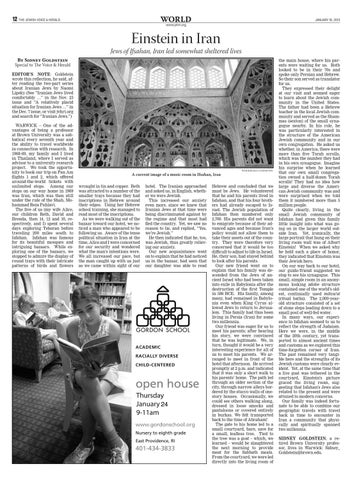
A current image of a music room in Ifsahan, Iran wrought in tin and copper. Beth was attracted to a number of the smaller trays because they had inscriptions in Hebrew around their edges. Using her Hebrew school training, she managed to read most of the inscriptions. As we were walking out of the bazaar toward our hotel, we noticed a man who appeared to be following us. Aware of the tense political situation in Iran at the time, Alice and I were concerned for our security and wondered what the man’s intentions were. We all increased our pace, but the man caught up with us just as we came within sight of our
hotel. The Iranian approached and asked us, in English, whether we were Jewish. This increased our anxiety even more, since we knew that Iranian Jews at that time were being discriminated against by the regime and that most had fled the country. Yet, we saw no reason to lie, and replied, “Yes, we’re Jewish.” He then indicated that he, too, was Jewish, thus greatly relieving our anxiety. Our new acquaintance went on to explain that he had noticed us in the bazaar, had seen that our daughter was able to read
Wikimedia Commons
Hebrew and concluded that we must be Jews. He volunteered that he and his parents lived in Isfahan, and that his four brothers had already escaped to Israel. The Jewish population of Isfahan then numbered only 2,700. His parents did not want to emigrate because of their advanced ages and because Iran’s policy would not allow them to take their assets out of the country. They were therefore very concerned that it would be too difficult to adjust to life in Israel. He, their son, had stayed behind to look after his parents. Our new friend went on to explain that his family was descended from the Jews of ancient Israel who had been taken into exile in Babylonia after the destruction of the first Temple in 586 BCE. His family, among many, had remained in Babylonia even when King Cyrus allowed Jews to return to Jerusalem. This family had thus been living in Persia (Iran) for some two millennia. Our friend was eager for us to meet his parents; after hearing his story, we were convinced that he was legitimate. We, in turn, thought it would be a very interesting experience for all of us to meet his parents. We arranged to meet in front of the hotel that afternoon. He arrived promptly at 2 p.m. and indicated that it was only a short walk to his parents’ home. The path led through an older section of the city, through narrow alleys bordered by the stucco walls of onestory houses. Occasionally, we could see others walking along, dressed in loose smocks and pantaloons or covered entirely in burkas. We felt transported back to the time of Abraham! The gate to his home led to a small courtyard, bare, save for a small, leafless tree. Tied to the tree was a goat – which, we learned – would be slaughtered the next morning to provide meat for the Sabbath meals. From the courtyard, we were led directly into the living room of
the main house, where his parents were waiting for us. Both looked to be in their 70s and spoke only Persian and Hebrew. So their son served as translator for us. They expressed their delight at our visit and seemed eager to learn about the Jewish community in the United States. The father had been a Hebrew teacher in the local Jewish community and served as the Shammas (sexton) of the small synagogue nearby. In his role, he was particularly interested in the structure of the American Jewish community and in our own congregation. He asked us whether, in America, there were more than five Torah scrolls, which was the number they had in his own synagogue. Imagine his surprise when he learned that our own small congregation owned a half-dozen Torah scrolls! They had no idea how large and diverse the American Jewish community was and were surprised when we told them it numbered more than 5 million people. Quite clearly, living in the small Jewish community of Isfahan had given this family little insight into what was going on in the larger world outside Iran. Yet, ironically, the large portrait that hung on their living room wall was of Albert Einstein! When we asked why he held such a place of honor, they indicated that Einstein was their Jewish hero. On our way back to our hotel, our guide/friend suggested we stop to see his synagogue. This small, simple room in an anonymous looking adobe structure contained one of the world’s oldest, continually used mikva’ot (ritual baths). The 2,000-yearold structure consisted of a set of stone steps leading down to a small pool of well-fed water. In many ways, our experience in Isfahan seemed to us to reflect the strength of Judaism. Here we were, in the middle of the 20th century, yet transported to almost ancient times and customs as we explored this time-forgotten corner of Iran. The past remained very tangible here and the strengths of its Jewish customs were clearly evident. Yet, at the same time that a live goat was tethered in the courtyard, Einstein’s picture graced the living room, suggesting that Isfahan’s Jews also related to the present and were attuned to modern concerns. Our family was indeed fortunate to be able to combine our geographic travels with travel back in time to encounter in Iran a community that physically and spiritually spanned two millennia. SIDNEY GOLDSTEIN, a retired Brown University professor, lives in Warwick: Sidney_ Goldstein@brown.edu.