41
B. Questions and answers
B1. How to support learning
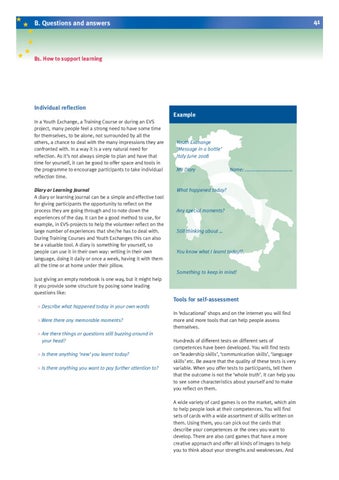
Individual reflection Example In a Youth Exchange, a Training Course or during an EVS project, many people feel a strong need to have some time for themselves, to be alone, not surrounded by all the others, a chance to deal with the many impressions they are confronted with. In a way it is a very natural need for reflection. As it’s not always simple to plan and have that time for yourself, it can be good to offer space and tools in the programme to encourage participants to take individual reflection time. Diary or Learning Journal A diary or learning journal can be a simple and effective tool for giving participants the opportunity to reflect on the process they are going through and to note down the experiences of the day. It can be a good method to use, for example, in EVS-projects to help the volunteer reflect on the large number of experiences that she/he has to deal with. During Training Courses and Youth Exchanges this can also be a valuable tool. A diary is something for yourself, so people can use it in their own way: writing in their own language, doing it daily or once a week, having it with them all the time or at home under their pillow.
Youth Exchange ‘Message in a bottle’ Italy June 2008 My Diary
Name: ...................................
What happened today?
Any special moments?
Still thinking about …
You know what I learnt today!?
Something to keep in mind! Just giving an empty notebook is one way, but it might help it you provide some structure by posing some leading questions like:
Tools for self-assessment > Describe what happened today in your own words > Were there any memorable moments? > Are there things or questions still buzzing around in your head? > Is there anything ‘new’ you learnt today? > Is there anything you want to pay further attention to?
In ‘educational’ shops and on the internet you will find more and more tools that can help people assess themselves. Hundreds of different tests on different sets of competences have been developed. You will find tests on ‘leadership skills’, ‘communication skills’, ‘language skills’ etc. Be aware that the quality of these tests is very variable. When you offer tests to participants, tell them that the outcome is not the ‘whole truth’. It can help you to see some characteristics about yourself and to make you reflect on them. A wide variety of card games is on the market, which aim to help people look at their competences. You will find sets of cards with a wide assortment of skills written on them. Using them, you can pick out the cards that describe your competences or the ones you want to develop. There are also card games that have a more creative approach and offer all kinds of images to help you to think about your strengths and weaknesses. And